Live Smarter, Live Sustainably At Setia eGreenLiving, technology and sustainability come together to redefine the way we live. With smart home systems, solar PV conduit readiness, EV port readiness and green switches thoughtfully integrated into every home, sustainable living becomes effortless and meaningful. Setia’s commitment goes beyond homes. It’s about shaping eco-friendly communities that create lasting impact, for today, and generations to come.
REAL ESTATE ASIA
FROM THE EDITOR
T
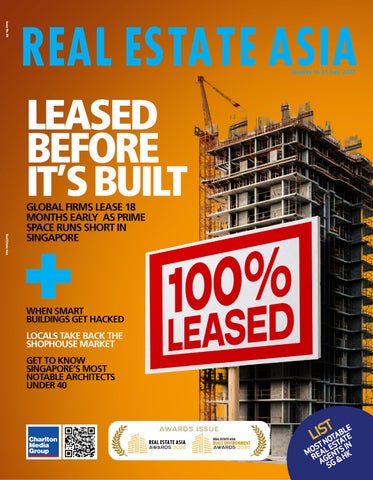
he walls may still be bare, but some of Singapore’s newest offices are already leased. Global companies are committing to space as much as 18 months before completion just to secure a foothold in a market short of prime offices. On page 6, we look at how the squeeze is changing where — and how early — companies are willing to lease.
PERMIT NO. MDDI (P) 056/02/2026
About Us
Real Estate Asia is the industry portal serving Asia’s dynamic real estate industry. Each section carries a balanced mix of articles which appeal to the C-level executives of large real estate developers, investors, brokers, and property services institutions in Asia. Do reach out to us if you would like us to tell your story to our readers via print and online advertising or events. PUBLISHER & EDITOR-IN-CHIEF Tim Charlton EDITORIAL MANAGER Tessa Distor PRINT PRODUCTION EDITOR Vienna Verzo PRODUCTION TEAM Alec Maquiling-Cruz Gwyneth Marie Bejer Vincent Mariel Galang Joanne Christine Ramos Anlene Rosales Sam Bernardo Clare Garaña EDITORIAL RESEARCHER Shiena Viene Sur GRAPHIC ARTIST Simon Engracial EDITORIAL ASSISTANT Dylan Afuang COMMERCIAL MEDIA TEAM Jenelle Samantila Dana Cruz Danielle Goh ADVERTISING CONTACTS Shairah Lambat shairah@charltonmediamail.com AWARDS Julie Anne Nuñez-Difuntorum awards@charltonmediamail.com ADMINISTRATION Eucel Balala accounts@charltonmediamail.com
The same push towards smarter buildings is creating another problem. More connected systems mean more points of exposure, whilst some owners are discovering far more devices inside their buildings than expected. We examine why smarter assets are also becoming harder to secure. Singapore’s shophouse market is shifting too. Local investors now account for an estimated 60% to 70% of commercial purchases, reversing a market once more reliant on foreign buyers. Turn to page 22. We also feature the winners of the Real Estate Asia Awards and Built Environment Awards 2026, recognising standout work in sustainable infrastructure, urban regeneration, design and construction across the region. See the coverage from pages 24 to 26. Read on and enjoy!
EDITORIAL editorial@realestateasia.com
SINGAPORE Charlton Media Group 101 Cecil St. #17-09 Tong Eng Building Singapore 069533 +65 3158 1386 HONG KONG Room 1006, 10th Floor 299 QRC, 287-299 Queen’s Road Central, Sheung Wan, Hong Kong +852 3972 7166 www.charltonmedia.com
Tim Charlton
MIDDLE EAST FDRK4467, Compass Building, Al Shohada Road, AL Hamra Industrial Zone-FZ, Ras Al Khaimah, United Arab Emirates PRINTED BY Midas Asiapac Pte Ltd 10 Admiralty Street, #06-22 North Link Building, Singapore 757695 +65 6383 5290
Real Estate Asia is proud to partner with and host the following summits and industry events:
Can we help?
Editorial Enquiries: If you have a story idea or press release, please email our news editor at editorial@realestateasia.com. To send a personal message to the editor, include the word “Tim” in the subject line. Media Partnerships: Please email editorial@realestateasia.com with “Partnership” in the subject line. Subscriptions email: subscriptions@charltonmedia.com
Real Estate Asia is published by Charlton Media Group. All editorial is copyright and may not be reproduced without consent. Contributions are invited but copies of all work should be kept as Real Estate Asia can accept no responsibility for loss. We will however take the gains. Sold on newsstands in Singapore, Malaysia, Hong Kong, London, and New York. Also out in realestateasia.com with online readership of 215,000 monthly unique visitors*. *Source: Google Analytics **If you’re reading the small print, you may be missing the big picture
REAL ESTATE ASIA
1
CONTENTS
24
EVENT LEADING FIRMS RECOGNISED AT REAL ESTATE ASIA AWARDS AND BUILT ENVIRONMENT AWARDS 2026
FIRST 06 Global firms rent unbuilt offices just to stay in SG 07 Who leads APAC’s branded residence race?
VOX POP 08 What drives APAC property rebound?
ARCHITECTURE LUMINARIES
10
PROPERTY WATCH THE LANDMARK REOPENS WITH SOCIAL SPACES
22
MARKET REPORT LOCALS OVERTAKE FOREIGNERS IN SHOPHOUSE DEALS
REAL ESTATE LUMINARIES 14 SG’s most notable real estate agents under 40 18 HK’s most notable real estate agents under 40
COMMENTARY 32 Medical centre expansion in Hong Kong: How to choose the right location
12 Singapore’s standout architects under 40
Published by Hong Kong: MIDDLE EAST: Charlton Media Group Room 1006, 10th Floor FDRK4467, Compass Building, Singapore: 299 QRC, 287-299 Queen’s Al Shohada Road, 101 Cecil St. #17-09 Tong Road Central, Sheung Wan, AL Hamra Industrial Zone-FZ, Eng Building Hong Kong Ras Al Khaimah, 2 SINGAPORE REVIEW REAL ASIA Singapore 069533ESTATEBUSINESS +852 3972 7166 | MARCH 2018 United Arab Emirates
For the latest real estate news from Asia visit the website
realestateasia.com
Design
REAL ESTATE ASIA
3
News from realestateasia.com Daily news from Real Estate Asia MOST READ
RESIDENTIAL
Singapore housing market enters ‘Goldilocks’ phase Singapore’s housing market showed signs of stabilisation in 2025, with private home prices rising at their slowest pace in five years and HDB resale price growth moderating to a six-year low, even as transaction volumes rebounded, PropNex Realty said. Analysts say the market is ‘just right’ as price growth slows.
RESIDENTIAL
4
RESIDENTIAL
Mumbai home sales drop to threeyear low amid cautious market Residential property sales in Mumbai fell to a three-year low in 2025, with full-year transactions declining 14.8% year-on-year, a JLL report said. Demand was stagnant in the final quarter of 2025, reflecting a more cautious approach from buyers as home prices continued to rise, according to the firm.
PROPERTY TECHNOLOGY
INDUSTRIAL PROPERTY
CapitaLand invests $700m in first data centre in Japan CapitaLand Investment Ltd. (CLI) is investing over $700m in Osaka—its first data centre in Japan—in line with its digitalisation investment theme and push to expand its geographical reach. This has spurred significant investments in data centre infrastructure, according to the Singapore-based real asset manager.
RESIDENTIAL
Smaller households drive Asia-Pacific housing crunch
Realion bets on unified proptech platform to drive APAC expansion
Banyan Group turns to space management for Phuket properties
Private developers and governments across the Asia-Pacific region are struggling to meet housing demand as more people form smaller households, increasing the need for individual units even in cities where population growth is slow. Faster construction and expanded rental markets could fix the problem.
Realion Group is investing in software and digital platforms to unify property technology services in APAC. “This is in response to the challenge of the abundance of applications and technologies in real estate that lack a singular, comprehensive, and clientfocused approach in Asia-Pacific,” CEO Desmond Sim said.
Banyan Group is optimising space by building amenities, including swimming pools on the rooftops of its luxury condominiums in Phuket, whose booming economy has spurred increased demand for land. This design is showcased in Skypark Elara Lakelands, the property developer’s newly launched luxury condominium.
REAL ESTATE ASIA
REAL ESTATE ASIA
5
FIRST & ETC) Group, told Real Estate Asia that after Shaw Towers is completed in the second quarter, no major Grade A office project will be completed in the CBD until 2028. The two firms expect rents to keep rising in 2026, although by different amounts. Sun forecasts Grade A CBD rents will increase 3% to 4% by yearend, with vacancy remaining below 5%. Cheong expects rents to rise 5% to 7% from end-2025 levels. Ashley Swan, executive director of commercial and industrial at Savills Singapore, attributed the acceleration in quarterly rental growth to a severe shortage of premium office space, with more tenants renewing leases instead of relocating and leaving space available.
HIDDEN CYBER RISKS LURK IN SMART BUILDINGS PROPERTY TECHNOLOGY
A
property manager expecting 30 to 40 connected devices can discover 400 once a building is scanned, exposing how little some owners know about the technology operating inside their assets. As buildings across Asia add systems for air-conditioning, lighting, security and other functions, that lack of visibility is becoming a cyber risk. Tommy Crowley, vice president for Asia-Pacific at WiredScore Ltd., told Real Estate Asia that vendor connections, legacy systems, and poor decommissioning practices are amongst the reasons device counts can grow beyond what owners expect. The problem is growing as building management systems become more widespread. Southeast Asia’s market for the technology is expected to expand 12% annually to $17.64b by 2034, according to Research and Markets Ltd. The systems are being adopted to improve energy efficiency and automate building operations, but every additional connection can widen the digital attack surface. Where the gaps are “A good example is physical vulnerabilities, which allow cybercriminals to access systems and disrupt buildings,” Crowley said. She cited unsecured telecommunications rooms and passwords written on sticky notes as basic lapses that can give cybercriminals access to building systems and allow them to disrupt operations. Access controls around critical infrastructure also remain weak in some markets, including India, she said. For property owners, the first challenge is therefore not simply installing stronger cyber defences, but knowing exactly what is connected to the building in the first place. As smart systems multiply, assets can become harder to secure when owners do not have full visibility over their own technology. 6
REAL ESTATE ASIA
The annual net effective occupier cost stands at $158.52 per sq. ft.
Global firms rent unbuilt offices just to stay in SG COMMERCIAL OFFICE
S
ingapore’s shortage of prime office space is pushing some companies to lease space up to 18 months before it is built. Others are turning to older, smaller or city-fringe offices to keep costs down. Grade A central business district (CBD) office rents are expected to keep rising through 2027 as little additional office space enters the market before 2028, property consultants said. “There’s a lack of new Grade A CBD office buildings that can reduce the rental pressure in the market,” said Alan Cheong, executive director of research and consultancy at Savills. He noted that most premium Grade A offices are almost fully occupied, pushing rents higher. He expects 455,000 square feet (sq. ft.) of office space to be completed in 2026 before supply drops to just 180,000 sq. ft. in 2027. He said completions are expected to rebound to 1.9 million sq. ft. in 2028, assuming projects are delivered on schedule. Christine Sun, chief researcher and strategist at Realion (OrangeTee
Alan Cheong
Christine Sun
Ashley Swan
Leasing activity According to Savills’ latest Prime Office Costs report, Singapore ranks 10th globally for annual net effective occupier costs, with Hong Kong and Tokyo remaining Asia-Pacific’s most expensive office markets. The city-state’s annual net effective occupier cost stands at $158.52 (S$202.81) per square foot. “Coupled with the limited supply of new office developments, premium office buildings continue to record healthy occupancy levels and rental growth,” Cheong said. He added that leasing activity has also been supported by pockets of expansion demand from the financial services and hedge fund sectors. Expansionary leasing accounted for 58% of major office transactions globally in the first half of 2026, signalling growing occupier confidence. Only 5% of top office deals involved occupiers reducing space, whilst the share relocating or renewing at a similar footprint fell to 37% in the first half of 2026, down from 44% in the same period in 2025. The shortage is also changing how vacancy is measured. Cheong said Savills counts newly completed buildings only after six months to avoid including space that has already been leased but not yet occupied. “In today’s market, it may take up to a year after completion for the building to be substantially filled,” he said, adding that this could temporarily lift reported vacancy rates even when demand remains strong.
FIRST NUMBERS
WHO LEADS APAC’S BRANDED RESIDENCE RACE?
Source: Savills Global Residential Development Consultancy Note: Data accurate as of 1 January 2026
REAL ESTATE ASIA
7
VOX POP
What drives APAC property rebound? APAC
A
sia-Pacific property investment is recovering, but investors are having to work harder to decide where the rebound is actually worth buying into. Investment volumes rose about 18% in the first quarter, according to Ada Choi, head of research for Asia-Pacific at CBRE. Singapore recorded growth of more than 170% quarter-on-quarter, helped by a major Hongkong Land transaction, whilst Japan and India also attracted strong investor interest. Lower borrowing costs in several markets have also helped restore positive spreads between property yields and financing costs, supporting the recovery. Sigrid Zialcita, CEO at Asia Pacific Real Assets Association (APREA), said the rebound is being supported by clearer pricing and stronger focus on cash flows, but it is not broad-based. Offices have re-emerged as a preferred sector as leasing improves and investors focus on higherquality buildings in core locations. Liquidity has also broadened, with cross-border capital flows at record levels and domestic institutions and REITs remaining consistent buyers. This broadens the pool supporting transaction activity. Cap rates are diverging because market conditions are no longer moving in one direction. Choi said Australia is facing a higher interest rate and inflation environment, causing investors to underwrite mild yield expansion
With an upward pressure on rates, we can expect cap rate compression to be limited this time around
rather than compression. Japan, after years of very low interest rates, has also entered a rate hike cycle, limiting further cap-rate compression. Mainland China is showing a different pattern. Choi said yield expansion has started to stabilise after several weak years, whilst the spread between property yields and borrowing costs is now the highest in the region. Investors remain selective about assets with resilient income streams. According to Zialcita, returns will increasingly be driven by rent and asset management rather than price gains. She said cap-rate movements are becoming localised, reflecting each market’s financing conditions, recovery stage and supply outlook. Investors are also reassessing risk because of geopolitical tension, high oil prices and rising construction costs. Choi said higher construction costs could make it harder to bring new office and retail projects to market, tightening supply in some cities. Zialcita said investors should move away from headline indicators and assess markets more carefully. India and Southeast Asia could offer upside, especially in trade and supply-chain-related assets. For APAC real estate investors, the opportunity is no longer simply buying into a rebound. The test is choosing markets where rental growth, asset quality and supply constraints can offset higher financing costs.
EXPERT OPINION ADA CHOI Head of Research, APAC, CBRE
C
ap rates are diverging because the interest rate movement is now more divergent, and the market situation across APAC is becoming a bit different. One thing we note is the change of the market situation in Australia. Australia is now having a much higher interest rate environment, and also the inflation environment is also quite tight. As a result, Australia already added back the interest rates this year thus far, and we are still expecting more rate hikes within this year. As a result, previously the market was expecting yield compression, but now the market is underwriting some mild yield expansion in Australia but this is on the back of the rental growth, and also some of the low vacancy in the market, cancelling out the impact. Japan has also been having this yield compression in the past few years, given that their interest rate is so low, and many of the investors like Japan, but now Japan has entered into the rate hike cycle. Although at this moment we saw that the Bank of Japan is very reserved for increasing interest rates, markets do expect a few rate hikes, but it is possible to have one more rate hike. Nonetheless, we are seeing that for the real estate pricing, particularly measured by the cap rate, it is not compressing anymore. The elephant in the room is always the Middle East conflict, and also the high oil price, which is leading to quite a lot of concern about the interest rate movement. Many of the forecasts have already changed during the past few months. The dynamics of the market is turning more on the fundamentals of the market, less concerned about the interest rate. Many of the investors have already revised their view on the interest rate and also the inflation, particularly about Australia. 8
REAL ESTATE ASIA
SIGRID ZIALCITA CEO, Asia Pacific Real Assets Association
T
he cap rate divergence is due to the differences in financing conditions, the recovery stages in markets, and the supply outlook interacting across these markets. Cap rate movements are localised rather than being influenced or driven by a single regional trend. One example of this is Japan. It has been a low interest rate environment, and what we’ve seen is that monetary authorities are now changing their policy, and it’s going to be on a path of gradual policy normalisation. With an upward pressure on rates, we can expect cap rate compression to be limited this time around. Investors in Japan are therefore shifting their strategy from yield expansion to income stability, recognising, of course, returns will be driven by rent rather than pricing. At the global level, the Middle East conflict is influencing the interest rate expectation, and we are seeing that in inflation and bond yields, and we are expecting this to be trending higher as the whole conflict remains unresolved. In terms of the divergence, we can expect an upward pressure on cap rates, particularly in more interest rate sensitive markets like Australia. In supply constrained markets with strong rental prospects, we could expect cap rates to remain stable despite higher financing costs. Investors need to move away from headline indicators, they have to be more granular in assessing their investments. Returns will be driven by rental growth and asset management rather than price gains. We all know that we have different dynamics across the region, and investors need to have a strategy for stability and growth. Exposure to markets, such as India, Southeast Asia, particularly those that have strong trade supply chain related assets, will have a higher upside.
REAL ESTATE ASIA
9
PROPERTY WATCH
The Landmark reopens with social spaces Its 109 rooms and suites have been refurbished with lighter timber flooring. HONG KONG
M
andarin Oriental The Landmark, Hong Kong has reopened with refreshed dining, wellness and social spaces as the luxury hotel targets corporate, leisure, and local guests. Michael Groll, general manager at the hotel, said the redesign centres on creating social experiences around coffee, wine and champagne. “Going up, guests can view alcoves lined with cityscape-inspired art,” he told Real Estate Asia. The hotel reopened on 1 June with a Queen’s Road Central entrance leading to a foyer inspired by historic
Michael Groll
local residences and a lobby lounge connected by a curved stone staircase. COMMUNE, a coffee venue at the centre of the lobby, is open to both guests and city residents. The hotel also expanded its food and beverage offerings. Amber, one of its four Michelin-starred restaurants, has added a cellar with floor-to-ceiling wine walls for guided tastings, whilst BLANC DE NOIRS is a 30-seat champagne and cocktail bar with access to Amber’s 3,000-label wine collection. Its 109 rooms and suites have been refurbished with lighter timber flooring, silk wall coverings, and custom rugs.
2
1
Queen’s 1 New Road Central entrance opens into the refreshed hotel.
2 COMMUNE anchors the lobby with coffee and social spaces.
4
3
feature 3 Rooms timber floors, silk walls, and custom rugs.
rates 4 Reopening start at $7,200 with dining credits.
5
6 cellar 5 Amber’s offers guided wine tastings from 3,000 labels.
6 The rebranded
spa will add yoga and Pilates spaces.
10
REAL ESTATE ASIA
REAL ESTATE ASIA
11
ARCHITECTURE LUMINARIES
Singapore’s standout architects under 40
F
rom Singapore’s first fully integrated healthcare campus to the redevelopment of Funan and The Cathay, this year’s architecture luminaries have helped shape projects across healthcare, civic infrastructure, education, hospitality, and heritage conservation. The eight professionals under 40 come from DP Architects, SAA Architects, CPG Consultants, RSP Architects Planners & Engineers, and Chang Architects, with DP Architects represented by three honourees. The youngest on the list is from DP Architects. This year’s honourees designed and managed major projects such as Woodlands Hospital, Funan Redevelopment, The Cathay, i12 Katong, and One Punggol’s Regional Library. Women make up five of the eight on this year’s list. Their portfolios span healthcare, civic infrastructure, education, hospitality and heritage conservation, reflecting the full breadth of Singapore’s built environment. Two honourees are also connected to the Goh Keng Swee Centre for Education — Liao Muqiong as Superintending Officer Rep on the project, and Kelvin Ng, whose portfolio includes work on the same development. Here are this year’s architecture professionals, arranged from youngest to oldest.
3
Chung Yen Ling, 31 CPG Consultants Pte Ltd
1
Jacqueline Tjen, 30 DP Architects
2
Siqi Zhang, 31, RSP Architects Planners & Engineers
Photo by Rory Daniels, courtesy of DP Architects
Photo by RSP Architects Planners & Engineers
Jacqueline worked on Dairy Farm Residences & Dairy Farm Mall, a S$125m, 460-unit integrated development with views of Bukit Timah Nature Reserve, tackling a sloping site by tucking the basement car park into the slope to fit its 1,500 PPVC modules. She also worked on The Verandah Residences, a S$37m, 170-unit low-rise development inspired by neighbouring black-and-white bungalows, using deep eaves, louvred screens and verandahs for natural ventilation. A core member of DP Architects’ residential typology group, she advances standardised, scalable residential delivery, and digital coordination tools.
Siqi worked on the i12 Katong Major A&A, a S$30m-plus revitalisation repositioning the mall as a premier East Coast lifestyle destination with new retail concepts, delivered entirely through the COVID-19 pandemic. As Project Architect on West Mall’s S$40m-plus redevelopment, she led design development and technical coordination for a new communal gathering space with sheltered MRT access, an upgraded public library and a basement food hall. A Registered Architect with a Master’s from NUS, Siqi has been with RSP since 2019, also contributing to Resorts World Sentosa’s Adventure Dining Playhouse.
4
Melissa Tsang Hiu Ching, 34 Chang Architects
5
Liao Muqiong, 36 SAA Architects Pte Ltd
Photo by Finbarr Fallon, courtesy of CPG Consultants
Photo by KHOOGJ, courtesy of Chang Architects
Photo by Ministry of Education. An artist’s impression of the Goh Keng Swee Centre for Education
Yen Ling worked as Design/Project Architect on Lentor Health Nursing Home (West Coast), a S$46m project under Ministry of Health research initiatives, reinterpreting the institutional model into a home-like environment and addressing resident concerns in a mature estate through feasibility studies. She also worked on Lentor Health Nursing Home (Macpherson), a project grounded in “Kampong Spirit” values, delivering onebed-one-window layouts and communal spaces for rehabilitation. She mentors young architects and leads BIM coordination at CPG’s Integrative Wellness Studio.
Melissa worked on Maple House, a S$1.5mS$2m Singapore home that preserved its original single-storey character with natural materials rather than maximising floor area. On Moongate House, she assisted the lead architect from concept through completion, developing a modular concrete language for its bespoke precast moongate form, balancing family living with large gatherings. She also worked with Studio Grain on the LowResolution Pavilion for Singapore Design Week 2025, using upcycled plastic. She practises under Chang Yong Ter whilst co-founding spatial design practice Nous Nous.
Muqiong was responsible for design execution, project management, and delivery on The Chevrons, a clubhouse redevelopment kept operational through phased TOP strategies. She managed Pei Chun Public School’s redevelopment from design development through completion, delivering a new annex to meet its fixed relocation deadline. As Superintending Officer Rep on the Goh Keng Swee Centre for Education, a 30-storey office tower under construction, she oversees design coordination, stakeholder management, and the integration of architectural interfaces with the adjacent Ministry of Education Headquarters.
12
REAL ESTATE ASIA
ARCHITECTURE LUMINARIES 6
Tan Wen Jun, 36 DP Architects
7
Kelvin Ng Si Hoa 38, SAA Architects Pte Ltd
8
Loh Zhu Ping, 38 DP Architects
Photo by Bai Jiwen, courtesy of DP Architects
Photo by SAA Architects
Photo by Masterz, courtesy of DP Architects
Wen Jun led design development for One Punggol’s Regional Library and community spaces, part of a multi-agency civic development. As design lead and project architect on the library, Wen Jun oversaw development from concept to tender, integrating assistive technologies to set a new benchmark for inclusive public libraries. The result is a human-centred space for all ages. At The Greenhouse at Dulwich College, a net-zero facility, Wen Jun led passive design and façade optimisation from concept through development. Wen Jun also contributes to DP Architects’ research groups and is a guest critic at NUS.
Kelvin played a key role in the design and delivery of Woodlands Hospital, Singapore’s first healthcare campus to fully integrate an acute hospital, community hospital, medical centre, and nursing home within a single development, despite expressway noise and rocky terrain. It was shortlisted at the 2024 World Architecture Festival and recognised with a Merit Award at the 2025 CREDAWARD. He also worked on Lentor Health Nursing Home, where landscaped buffers and layered greenery help mitigate airbase noise, and the ongoing Tengah General and Community Hospital, drawing on Tengah’s brickworks.
Zhu Ping worked on design resolution, project management and cost control for Funan Redevelopment, a S$354m vertically integrated development combining retail, offices, serviced apartments and a rooftop urban farm. He also worked on Mercure ICON Singapore City Centre, a S$790m hotel that is the Mercure brand’s largest property worldwide and Singapore’s first full concrete PPVC hotel. At The Cathay A&A, a S$70m heritage repositioning, he handled design resolution and stakeholder coordination through a conservation review. Zhu Ping holds a Master of Architecture from National University of Singapore and is a guest reviewer there.
Where Dubai Lives Serving Over 140,000 Residents Across 22 Communities Citywide Dubai Residential owns and operates one of Dubai’s largest and most diverse residential portfolios, offering a wide spectrum of living experiences across the city. Whether it’s premium living, family-focused communities, or corporate housing, each community is designed to elevate how people live, work, and connect. Through thoughtfully managed communities, Dubai Residential plays a meaningful role in supporting Dubai’s continued urban growth as a leading global city. dubairesidential.ae REAL ESTATE ASIA
13
REAL ESTATE LUMINARIES: SINGAPORE
SG’s most notable real estate agents under 40
S
even women and eight men made the final cut from PropNex Realty Pte Ltd, JLL, Huttons, and OrangeTee & Tie Pte Ltd. Leading the pack is OrangeTee, with five representatives; the youngest on this list is from Huttons. Realtors in the private residential market took the lead, taking seven spots. This year’s honourees are million- and billion-dollar sellers, with clients including ChiMei Global and major players across trading, insurance, fintech and media. Notable transactions include the leasing of 47,000 sq. ft. at IOI Central Boulevard Towers, one of Singapore’s newest landmark CBD developments. Here are this year’s honourees, arranged from youngest to oldest. 1
Aela Lim, 26 Huttons
Aela sold a three-room HDB flat at 37 Margaret Drive for S$908,000 in two viewings, despite its west-facing aspect and minimal renovation, one of four three-room flats to cross S$900,000 in 2025. She also moved a five-bedroom unit at Park Natura for S$300,000 above valuation, holding firm on pricing despite full west sun and an unpopular unit number. Aela entered the industry in 2021, building her business solo before rising to Division Director. During her years in the industry, she has closed nearly 100 transactions, with clients including ChiMei Global. 4
Vevien Ong, 30 PropNex Realty Pte Ltd
Vevien sold two of a client’s properties before securing an S$8.3m detached home at Faber Walk, closing almost S$2m below asking. A tenancy with another client grew into four deals over five years, including a Sentosa home. Vevien entered the industry at 23 and leads nearly 250 agents at VevienOngDistrict, transacting over S$500m in eight years; her district crossed S$1b across 1,700-plus deals in 2025. She was named PropNex Gen’s top agent under 30 and became one of its youngest millionaire realtors at 26, and acquired two properties before 30. 14
REAL ESTATE ASIA
2
Jervis Isaiah Ng, 30 PropNex Realty Pte Ltd
Jervis represented a buyer in a S$36m Good Class Bungalow acquisition on Cornwall Road, resolving a year-long deadlock between two heirs’ legal teams by treating it as structural, not price, and closing S$10m below valuation, which inspired Steward Asia, JNA’s GCB and shophouse arm. He also grew a client’s S$650,000 HDB position into a portfolio worth over S$10m in four years, generating over S$3m in capital gains. Jervis founded JNA Real Estate in 2017, aged 21, and now leads over 335 realtors. He was PropNex’s overall champion producer in 2024 and 2025. 5
Enos Yip, 34 Jones Lang LaSalle Property Consultants Pte Ltd
Enos advises a fintech scaling from 20,000 to 80,000 sq. ft. at Guoco Tower, securing space in a fully leased building with zero inventory. For a media group consolidating five Singapore offices into three, she secured a 45,000 sq. ft. anchor at One George Street and delivered all transitions on schedule. At Asia Square Tower 1 she structured an early lease break for a firm tripling to 18,000 sq. ft., using landlord incentives to offset relocation costs. Enos has 11 years in commercial real estate, advising both occupiers and landlords. She also represents shophouse assets alongside Grade A office work.
3
Alexis Quek, 30 OrangeTee & Tie Pte Ltd
Alexis represented the buyers of a 191 sq m residence at Klimt Cairnhill valued at S$7.6m, managing the deal from negotiation through completion in a segment where pricing judgment matters most. She also represented the seller of a four-bedroom unit at Leonie Parc View for S$6.43m, achieving a record price per square foot for the development. Alexis has completed 115 transactions in her first two years, advising homeowners, buyers and investors across the residential market, and shares property insights and homeownership guidance with a following of close to 18,000. 6
Cherie Lee, 36 Huttons
Cherie sold a Jalan Besar shophouse for S$4.6m, S$250,000 above expectations, and guided a newlywed couple through a ten-year plan beginning with their S$1.73m Parc Esta home, now worth roughly S$800,000 more after five years. A mathematics graduate from the UK, she worked in finance at J.P. Morgan and APAC marketing at Microsoft before entering real estate in 2020, since covering HDB upgrading, private resale, new launches and shophouses. She has built a portfolio of over 100 private rental properties and recorded multiple six-figure commission months, including one topping S$250,000.
REAL ESTATE LUMINARIES: SINGAPORE 7
Teng Hui Li, 36 Huttons
Teng sold an inter-terrace house at Loyang Villas for S$2.2m, above comparable transactions at the time, through pricing strategy and targeted marketing that drew competing interest in a difficult market. She also took over an HDB flat at Tampines Greenweave, unsold for six months under two agents, repositioning it to secure a buyer within a month above the seller’s expectations by S$10,000. Teng has spent seven years in the industry, working with over 200 families across homeownership, upgrading, investment and first-time purchases. She was named a Rising Millionaire at Huttons in 2025. She is active in both HDB resale and landed property types. 10 Jun Kiat Koh, 37
OrangeTee & Tie Pte Ltd
Jun Kiat brokered a coffeeshop sale in Ang Mo Kio for more than S$10m alongside his team leader. He also guided buyers through a competitive launch period to a home at River Green, weighing location, unit mix, pricing and growth potential. In another, he turned a ten-month-stale listing into a sale within three weeks, closing a week later. Jun Kiat has won Super Gold and Super Platinum Awards, ranked 16th on OrangeTee’s Top 50 and made its Top 300 in 2025, with his team runner-up for Outstanding IC Team in the first quarter of 2025. Clients commend him for his responsiveness and dedication to results.
8
Hansen Ng, 37 OrangeTee & Tie Pte Ltd
Hansen sold a low-floor Executive HDB flat in Ang Mo Kio for S$1.208m in June 2024, a town record for Executive flats, positioning it on its rarity and floor area to reach family buyers. He also sold a converted 1950s landed home on Everitt Road North, marketed on architectural character rather than as a conventional listing. Hansen entered the industry in 2014 and has won Super Platinum and Super Gold Awards, Top 50 Achiever placings, among OrangeTee’s Top 200 Achievers in 2024 and 2025, and its 10year long service award. He shares his experience with fellow agents, known for integrity and client responsiveness. 11 Bryan Tan, 37
PropNex Realty Pte Ltd
Bryan leads a division of more than 330 consultants at PropNex and works with developers on sales strategy for new launches including Emerald of Katong, Lentor Central Residences, River Green and Tengah Garden Residences, running training on project marketing and negotiation. He also sold a Shanghai Road condo after one viewing at S$1.75m, a record for the development, then advised the seller into a S$2.68m Havelock launch, and, when a client’s marriage ended mid-transaction, structured a S$2.2m joint acquisition with her sister rather than the S$1.3m purchase she had planned.
9
Matthew Lam, 37 PropNex Realty Pte Ltd
Matthew brokered a record S$6.8m Serangoon Gardens semi-detached sale for a multi-generational family, and a S$5.7m Kovan inter-terrace sale within a month via TikTok and Instagram Reels. In commercial, he closed a S$11m sale of three PLUS units on Cecil Street via a tender marketed to 48,000 companies and 30,000 professionals in a low-volume market. An engineer by training, Matthew founded MattLamAdvisory, PropNex’s champion advisory for five years, with 2,000-plus members transacting 2,144 new launches and 4,137 resale units. He developed The Essentials framework and was PropNex’s 2025-26 champion millionaire. 12 James Short, 38
Jones Lang LaSalle Property Consultants Pte Ltd
James advised a trading firm’s 47,000 sq. ft. acquisition at IOI Central Boulevard Towers as transaction representative, securing scalable expansion clauses in Singapore’s CBD. He advised a Singapore insurer on consolidating four offices at Marina One, taking fitted space to cut costs while coordinating exits against tight timelines. At 108 Robinson Road he structured a turnkey leasing programme filling the building, pricing fitted space to support the landlord’s strata sale through financial modelling. Originally from the UK, James has spent 12-plus years at JLL across Shanghai, Malaysia, and Singapore. REAL ESTATE ASIA
15
REAL ESTATE LUMINARIES: SINGAPORE 13 Lincoln Heng, 39
Huttons
Heng sold a 4,036 sq. ft. penthouse at Waterfall Gardens on Farrer Road for S$8m, a niche unit needing sustained negotiation to close. He also sold a S$5.5m landed home in Serangoon Gardens Estate for a retired couple downsizing to an HDB flat after years in the property, unlocking its value to fund the move. Heng has 15 years in the industry, advising first-time buyers, investment portfolios, and upgraders with a data-led approach across sales, leasing, and asset progression. He was named a Rising Millionaire at Huttons in 2025. He is recognised for his meticulous attention to detail and sharp negotiation across markets.
16
REAL ESTATE ASIA
14 Zoie Teo, 39
OrangeTee & Tie Pte Ltd
Zoie sold a low-floor residence at Nassim Lodge for S$14.5m through strategic marketing and negotiation, navigating Singapore’s competitive luxury market despite being new to the industry, and handled the leasing of a Tomlinson Road residence at S$37,000 a month, coordinating negotiations across multiple stakeholders. Zoie obtained her salesperson certification in November 2024, entered the industry in February 2025, and within her first year won OrangeTee’s Super Platinum Award for a six-figure single month, was named a Top 50 Achiever, Top Resale Rookie runner-up for 2025, and a Top 200 Achiever.
15 Jonathan Zhuang, 39
OrangeTee & Tie Pte Ltd
Jonathan represented buyers acquiring a semi-detached home at Grace Park in District 19 for S$5m, guiding it from opportunity to completion in an established landed neighbourhood. He also advised buyers securing a S$1.7m unit at Bloomsbury Residences during a competitive new launch, evaluating unit options against their budget and long-term plans. Jonathan specialises in linked sale-and-purchase transactions on fixed timelines. He has won multiple Super Gold Awards at OrangeTee, made Top 50 and Top 300 Achievers in 2025, with his team second runner-up for Outstanding IC Team in the fourth quarter of 2025.
73%
Homes sold above average market prices
65%
Homes sold in 7 days
*1%
Market-leading agent fee
Discover more
www.ohmyhome.com
Ohmyhome Pte. Ltd. | CEA License No.: L3010739Z
A NEW WORLD OF EXPERIENCES. ALL IN ONE DESTINATION. From luxury hospitality and global dining to immersive entertainment, wellness, sports and elevated retail. Doha Oasis brings together experiences designed to inspire connection, discovery, and unforgettable moments at the heart of Doha. Proud to be awarded as Qatar Brand Innovation of The Year - Hospitality & Leisure in Asian Innovation Excellence Awards 2025.
Step into our world
dohaoasis.com
REAL ESTATE ASIA
17
REAL ESTATE LUMINARIES: HONG KONG
HK’s most notable real estate agents under 40
O
ne honouree has transacted more than 700,000 sq. ft. of industrial and logistics space since 2021. Another helped lead the HK$7.2b acquisition of the high zone of One Causeway Bay, whilst others are closing trophy homes, heritage buildings, retail leases and redevelopment sites. This year’s 15 real estate luminaries under 40 reflect the breadth of Hong Kong’s property market, with work spanning office leasing, capital markets, luxury residential, industrial, retail and investment sales. They come from CBRE, Savills, Colliers, Cushman & Wakefield, and JLL, with CBRE and Savills each represented by four professionals. Here are this year’s honourees, arranged from youngest to oldest. 1
Churchill Keung, 27 CBRE
Known for his collaborative mindset and analytical approach, Churchill has built a strong start to his career in CBRE’s Capital Markets team. In four years, he has advised on investment sales exceeding HK$2b across industrial, retail and office assets. His recent work includes the HK$500m acquisition of an en-bloc industrial building in Tai Wai and the sale of COS Centre in Kwun Tong, which closed within four months of CBRE’s appointment. Churchill combines market insight, relationship-building, and handson execution across increasingly complex assignments and major deals.
4
Douglas Ng, 29 Savills
Douglas has built a strong reputation in investment sales, advising on more than HK$2.6b of transactions since 2023. His recent work includes the HK$431m sale of 60 West in Sheung Wan, where he helped position the property for potential student accommodation, and the HK$430m receivership sale of a redevelopment site in Kowloon Tong. He also led the HK$272m sale of The Nate in Tsim Sha Tsui. A Chartered Valuation Surveyor, Douglas combines commercial acumen with strong technical grounding across complex property deals and investment challenges for diverse clients. 18
REAL ESTATE ASIA
2
Jonathan Yip, 29 CBRE
Jonathan has quickly made his mark in Hong Kong’s industrial and logistics market, transacting more than 700,000 sq. ft. since beginning his real estate career in 2021. His recent assignments include a 150,000 sq. ft. lease at Cainiao Smart Gateway for a logistics provider and a 50,000 sq. ft. facility in Shatin for a semiconductor client. He also helped a technology occupier secure improved terms on a 100,000 sq. ft. workshop. Known for his practical solutions, Jonathan’s track record spans leasing, investment sales, and strategic advisory.
5
Kwan Chit Chiu, 31 Savills
Chit is a high-performing office leasing specialist, known for strategic thinking and a solutions-driven approach to complex occupier needs. His recent work includes a 72,000 sq. ft. lease renewal for YF Life at China Evergrande Centre, where the team secured favourable terms, signage and building naming rights. He also worked on United Overseas Bank’s Hong Kong portfolio and major office requirements at 28 Stanley Street, Gloucester Tower, and AIRSIDE. Chit combines market knowledge with strong client relationship management on demanding assignments across the city for major occupiers.
3
Ray Chan, 29 CBRE
Ray has emerged as one of CBRE Hong Kong’s rising investment specialists, completing over 30 transactions worth over HK$8b in five years. A standout achievement was the more than HK$1.9b sale of No. 1 North Point Terrace to Chinachem Group, described by CBRE as Hong Kong’s largest private residential redevelopment-site sale of 2026 to date. He also secured a wholebuilding student accommodation operator for a Wan Chai hotel within two weeks. Beyond transactions, Ray, a Chartered Surveyor accredited by RICS and HKIS, mentors graduate trainees and surveying interns.
6
Russell Tang, 31 Savills
Russell has carved out a distinctive niche in real estate through his focus on heritage buildings, tong lau (tenement buildings), and redevelopment opportunities. His recent work includes the HK$38m sale of 13 Moon Street in Wan Chai and the acquisition of the Grade 2 historic building at 99F Wellington Street for a charitable art foundation. He also handled the HK$180m sale of a redevelopment site in Kowloon Tong. A Chartered Surveyor and Certified ESG Analyst, Russell blends investment expertise with an appreciation for conservation and long-term urban value.
REAL ESTATE LUMINARIES: HONG KONG 7
Chris Hui, 31 Colliers
Chris has built a growing reputation in the office leasing market through his clientfocused approach. Some of his recent work includes Mizuho Bank’s approximately 135,000 sq. ft. lease renewal at K11 Atelier Victoria Dockside, secured significantly below market rents, and Estée Lauder’s approximately 68,000 sq. ft. lease extension at The Gateway. Advising clients across financial services, beauty, retail, insurance and healthcare, Chris is known for professionalism, market awareness, and practical occupier strategies across complex, high-profile leasing mandates for multinational clients in Hong Kong.
10 Vincent Law, 32
Cushman & Wakefield
Vincent has built his career by embracing change, moving from office leasing into Capital Markets and completing transactions exceeding HK$8b. He has worked on several major deals since joining Cushman & Wakefield Hong Kong as a graduate trainee in 2017, including the HK$7.2b acquisition of the high zone of One Causeway Bay, where he led a four-person team acting for the buyers. Vincent was also sole agent on the HK$1.2b disposal of a 50% stake in Millennium City 2 and advised on the HK$275m acquisition of The Unit Davis. His proactive mindset keeps him open to new challenges and opportunities.
8
Ken Hung, 31 Savills
Ken is establishing himself as a next-generation adviser in Hong Kong’s luxury residential market, specialising in prime houses and trophy homes. With more than HK$2b in completed transactions, he has developed a reputation for discretion, relationship management, and off-market dealmaking. His recent work includes the HK$1.09b sale of a residence at 1 Gough Hill Road on The Peak and the HK$354.9m sale of a high-floor unit at The Legacy. Ken combines market insight with a highly personalised approach to clients and complex negotiations in prime residential property. His trust-based approach has also helped him build connections with prominent families and long-term clients. 11 Daniel Yip, 34
CBRE
Daniel has built a reputation for taking on leasing assignments that go beyond a straightforward retail deal. With more than 12 years in the market, he specialises in landlord representation, retail strategy and non-traditional uses. His recent work includes a 36,385 sq. ft. lease at China Life Centre to a British international school and the takeover of a live performance venue at The Centrium. Known for his proactive, solution-oriented style, Daniel is particularly effective when transactions involve unusual occupier needs, multiple stakeholders, and operational complexity in Hong Kong.
9
Michael Liu, 31 Cushman & Wakefield
Michael has established himself as a trusted adviser to major office occupiers in Hong Kong, combining market knowledge with a practical understanding of business needs. His recent work includes a 125,000 sq. ft. lease restructuring at One Pacific Place and a 21,000 sq. ft. lease at One Causeway Bay. With nine years of specialist experience, his clients include Standard Chartered Bank, Deloitte, McKinsey, and Rabobank. Michael’s ability to navigate changing circumstances whilst being client-centred has supported lasting relationships across the city’s commercial property landscape.
12 Wong Tin Ngai (David Wong)
36, Jones Lang LaSalle
David brings 17 years of real estate experience spanning residential, retail, commercial and industrial properties. With sharp negotiation skills and deep expertise across multiple property sectors, he has completed over 100 deals and acts as exclusive agent to McDonald’s in Hong Kong, having handled more than 10 property disposals for the company across 2025 and 2026, with a combined value of nearly HK$1b. His other work includes the HK$650m sale of the One Kai Tak I and II commercial podium, and an industrial site acquisition in Tsing Yi. David’s clients also include the URA, HKHS, and OCBC Bank. REAL ESTATE ASIA
19
REAL ESTATE LUMINARIES: HONG KONG 13 Jackie Wong, 37
Colliers
Jackie brings over 14 years of experience helping brands and occupiers find the right space to grow in Hong Kong, drawing on a background across hospitality and real estate. At Colliers, she leads the firm’s retail leasing and consultancy platform, covering market-entry strategy, site selection, lease structuring and portfolio optimisation across banking, F&B, and retail sectors. Recent assignments include securing approximately 15,000 sq. ft. for a major banking tenant and 6,000 sq. ft. for a Chinese F&B concept. Jackie combines market insight with practical, brand-focused strategies for both occupiers and landlords.
14 Matthew Cheng, 37
15 Michelle Chiu, 38
Colliers
Jones Lang LaSalle
Matthew has spent more than 15 years helping investors navigate the property market, bringing a client-first mindset and strong market insight to Colliers’ Capital Markets & Investment Services team. His recent work includes the HK$176m acquisition of 108 Wellington Street in Central and the HK$313m disposal of the retail podium at Bell House on Nathan Road. Known for his practical approach, Matthew combines market insight, negotiation and tailored investment strategies to help institutional and private investors navigate changing conditions and unlock value across core and value-add opportunities.
With over 16 years of experience helping shape the city’s retail and food & beverage landscape, Michelle has advised more than 100 operators on market entry, site selection and expansion. Some of her notable deals include a 20,300 sq. ft. flagship at Sino Plaza for a Beijing restaurant, Bruno Steakhouse’s debut at Printing House and Manteigaria’s first Hong Kong location. Michelle combines local market knowledge with a strong understanding of how location, brand identity, and customer experience can support long-term growth and lasting success in a competitive market.
A Leading Property Developer with a Globally Diversified Portfolio For 50 years, Sinar Mas Land has built human-centric ecosystems. We go beyond properties to create meaningful experiences, fostering connection and purposeful living in communities where people can live, learn, work, play, shop, and dine.
Our Township:
20
REAL ESTATE ASIA
For more information:
www.sinarmasland.com
The final chapters of beach and marina living Limited collection of apartments & oceanfront chalets Reserve today: almouj.com | +968 2453 4444 |
almoujmuscat
REAL ESTATE ASIA
21
MARKET REPORT: SINGAPORE
Locals overtake foreigners in shophouse deals ABSD exemptions and stable rental income are drawing more Singaporean buyers. SINGAPORE
S
ingaporeans now account for an estimated 60% to 70% of commercial shophouse purchases, reversing a market that was once driven at least as heavily by foreign buyers. A decade ago, foreigners made up half or more of transactions, according to Richard Tan Kah Peng, associate branch district director at PropNex Realty Pte. Ltd. Today, local investors are taking a bigger share as they seek completed properties with stable rental income. One factor is tax treatment. Tan said higher taxes on residential property purchases have encouraged more investors to consider commercial shophouses, which are not subject to Additional Buyer’s Stamp Duty (ABSD). Under Singapore’s property tax regime, foreigners buying residential properties are generally subject to ABSD, whilst commercial properties, including fully commercial shophouses, are not. “Even in the recent war, there are more buyers in the marketplace,” Maureen Li, founder and CEO at ABIEL Property Investment Fund Pte. Ltd., told Real Estate Asia, adding that investors are looking for completed properties with stable rental income. Recovering market Tan added that interest amongst local investors continues to broaden, with about 90% of attendees at his investment seminars being first-time shophouse buyers. The market also showed signs of recovery in the second quarter. Huttons Asia Pte. Ltd. recorded 16 shophouse transactions worth $152.5m (S$193.7m), more than double the value in the previous quarter, helped by several big deals, including three shophouses in Lorong Liput sold for $55m (S$70m). A Japanese family office reportedly paid $17.3m (S$22m) for shophouses in Keong Saik Road, whilst another Keong Saik property changed hands for $12.5m (S$16m). 22
REAL ESTATE ASIA
Singaporeans now account for 60% to 70% of purchases involving commercial shophouses
The average transaction value rose to $9.5m (S$12.1m) from $5m (S$6.4m) in the first quarter. More than 60% of shophouses sold during the quarter were priced above $3.9m (S$5m).
Richard Tan
Maureen Li
Identifying value For the first half of the year, Huttons said there were an estimated 30 caveats, compared with 40 in the same period last year. Total transaction value fell 19.4% to $223.2m (S$283.6m) from last year. Singapore Realtors, Inc. (SRI) also reported that recorded shophouse transactions edged up to 89 in 2025 from 87 a year earlier. “The ability for transaction volumes to edge up suggests that buyers continue to identify value in well-located and incomegenerating shophouse assets,” Mohan Sandrasegeran, head of
research and data analytics at SRI, said in a February report. Outlook According to Li, foreign enquiries have increased over the past two to three months, although many have yet to progress into completed purchases. She said wealthy families and family offices continue to favour established locations such as Club Street, Amoy Street, and Telok Ayer. Tan expects prices to keep rising because the supply of fully commercial shophouses remains limited at about 3,000 properties, whilst many owners keep them across generations rather than sell. Li also expects values to remain supported by strong domestic demand, saying gains in Singapore’s broader property market typically flow through to commercial real estate.
Fluor is building a better world by applying world-class expertise to solve its clients’ greatest challenges. Fluor’s nearly 27,000 employees provide professional and technical solutions that deliver safe, well-executed, capital-efficient projects to clients around the world. JG Summit OSBL PMC With headquarters in Irving, Texas, Fluor has provided engineering, procurement and construction services for more than 110 years. Since 1987, Fluor’s Philippines office has served various industries, completing over 280 workshare projects with 34 other offices and Semiconductor Facility leading 37 regional and local projects.
Shell Malampaya Phase 3
Philippine Office Engineers
Petronas Rapid UIO
LNG Canada Project © 2025 Fluor Corporation. All Rights Reserved. Fluor is a registered service mark of Fluor Corporation. MC2500299
REAL ESTATE ASIA
23
EVENT: REAL ESTATE ASIA AWARDS 2026
Leading firms recognised at Real Estate Asia Awards and Built Environment Awards
A
sia’s real estate sector continues to evolve in response to urban demands, sustainability imperatives, and technological advancement. Developers and industry stakeholders are reimagining how spaces are designed and constructed to balance commercial performance with environmental responsibility and community impact. Against this backdrop, the Real Estate Asia Awards 2026 and the Real Estate Asia Built Environment Awards 2026 brought together the region’s leading players at the event held on 28 May 2026 at the Sands Expo & Convention Centre. The joint ceremony honoured organisations that are shaping the future of real estate and the broader built environment through innovation and design excellence. The Real Estate Asia Awards spotlighted outstanding developers and property companies that have delivered high-impact projects and demonstrated strong market leadership. The awards programme recognised residential and commercial developments and mixed-use and industrial spaces that have successfully responded to evolving consumer needs. The Real Estate Asia Built Environment Awards, meanwhile, focused on the wider ecosystem that brings developments to life. It celebrated the contributions of architects, engineers, contractors, and solution providers whose work underpins the functionality,
climate responsibility, and longevity of the region’s infrastructure and built assets. The programme highlighted achievements in areas such as green building practices, smart technologies, and innovative construction methodologies. The evening gathered a diverse mix of industry leaders, and fostered connections and a shared commitment to raising standards in Asia’s property landscape. All nominations were evaluated through a rigorous judging process conducted by an independent panel of respected industry experts. The judging panel for the Real Estate Asia Awards consisted of SengLeong Teh, Global Real Estate Hospitality & Construction M&A Leader, Ernst & Young; David Lee, Partner, Assurance, Real Estate & Hospitality Practice, PwC Singapore; Benjamin Tay, Deputy Head, Corporate Real Estate, Rajah & Tann Singapore, LLP; and Deven Chhaya, Partner - Infrastructure Advisory, KPMG Indonesia & Asia Pac Head of Cities. The Real Estate Asia Built Environment Awards judges, on the other hand, were Seng-Leong Teh; Shemane Chan, Partner, Rajah & Tann Singapore LLP; and Brendon Lee, Partner & Industry Lead - Real Estate & Construction Practice, RSM Singapore. Congratulations to all the winners who continue to set new benchmarks in Asia’s real estate landscape!
Developers REAL ESTATE ASIA AWARDS 2026 WINNERS Grovy • Luxury Residential Development of the Year - United Arab Emirates Al Mouj Muscat • Residential Development of the Year - Oman • Customer Insights Innovation of the Year - Oman Asset World Corporation (AWC) • Developer of the Year - Thailand • Retail Development of the Year - Thailand Banyan Group Residences • Marketing & Brand Initiative of the Year - Thailand BRITTANY • Luxury Residential Development of the Year - Philippines • Mixed-Use Development of the Year - Philippines CapitaLand Development (Vietnam) • Customer Service Innovation of the Year - Vietnam CapitaLand Investment • Digital Initiative of the Year - Singapore • Technology Innovation of the Year - Singapore
Henderson Land Development Company Limited • Developer of the Year - Hong Kong • Developer of the Year - Asia Heyazah Real Estate Development Company • Mixed-Use Development of the Year - Saudi Arabia Inventi Asia • Technology Innovation of the Year - Philippines JustCo (Singapore) Pte Ltd • Design Initiative of the Year - Singapore • Design Initiative of the Year - Thailand Kaden • Redevelopment of the Year - Saudi Arabia • ESG Initiative of the Year - Saudi Arabia Madinat Al Irfan • Mixed-Use Development of the Year - Oman
Dubai Land Department • Technology Innovation of the Year - United Arab Emirates
MASTERISE GROUP CORPORATION • Developer of the Year - Vietnam
Dubai Residential • Asset Management Initiative of the Year - United Arab Emirates • Customer Service Innovation of the Year - United Arab Emirates
Melhor Solutions Private Limited • Boutique Residential Development of the Year - India
Frasers Hospitality Asset Management • Hotel Development of the Year - Japan • Specialised Living Space Development of the Year - China
24
HEIGHT REALTY, Inc. • Sustainable Development of the Year - Philippines
REAL ESTATE ASIA
Meraas • Developer of the Year - United Arab Emirates Mindspace REIT • Mixed-Use Development of the Year - India
Msheireb Properties • Strategic Partnership of the Year - Qatar
Eng. Ali Al Kuwari, Msheireb Properties • CEO of the Year
New World China Land Limited • Sustainable Development of the Year - China • New World Development Company Limited | Shenzhen Qianhai Green
REAL ESTATE ASIA AWARDS BUILT ENVIRONMENT AWARDS 2026 WINNERS
Building Certification & Advisory Limited • ESG Initiative of the Year - China
Anagram Architects • Contemporary Design of the Year - India
Odiliya Homes & Real Estate Co. (Pvt) Ltd • Affordable Housing Developer of the Year - Sri Lanka
APUDG SDN BHD (AJM-Planning and Urban Design Group) • Net-Zero Initiative of the Year - Malaysia
OXO Group Indonesia • Sustainable Development of the Year - Indonesia
DATEM, Incorporated • Office Construction of the Year - Philippines
PHirst Park Homes Inc. • Affordable Housing Developer of the Year - Philippines • Affordable Housing Developer of the Year - Asia
Hbk Contracting Company • Urban Development and Regeneration Project of the Year - Qatar
Prime Group • Developer of the Year - Sri Lanka PT Bintan Inti Industrial Estate • Industrial Development of the Year - Indonesia Select Group • Residential Development of the Year - United Arab Emirates Sobha Community Management • Excellence Award of the Year - United Arab Emirates • Digital Initiative of the Year - United Arab Emirates Suntec Real Estate Services Management Pte. Ltd. • Sustainable Development of the Year - Singapore • Facilities Management Initiative of the Year - Singapore
LPPA Design Group, Inc. • Mixed-Use Construction of the Year - Philippines • Residential Construction of the Year - Philippines PT Brantas Abipraya (Persero) • Community Impact Project of the Year - Indonesia • Sustainable Infrastructure Project of the Year - Indonesia Summarecon Group • Urban Development and Regeneration Project of the Year - Indonesia Third Paragraph Interior Co • Interior Design Initiative of the Year - Singapore TWS and Partners • Contemporary Design of the Year - Indonesia • Sustainable Architecture of the Year - Indonesia
Award winners
REAL ESTATE ASIA
25
EVENT: REAL ESTATE ASIA AWARDS 2026
Al Mouj Muscat
Asset World Corporation
CapitaLand Investment
Henderson Land Development Company Limited
Frasers Hospitality Asset Management
Madinat Al Irfan
Odiliya Homes & Real Estate Co. (Pvt) Ltd
Summarecon Bandung by Summarecon Group
26
REAL ESTATE ASIA
BRITTANY
HEIGHT REALTY, Inc.
MASTERISE GROUP CORPORATION
PHirst Park Homes Inc.
Suntec Real Estate Services Management Pte. Ltd.
Prime Group
New World China Land Limited
SUSTAINABLE DEVELOPMENT OF THE YEAR - SINGAPORE FACILITIES MANAGEMENT INITIATIVE OF THE YEAR - SINGAPORE
Data-driven, value-led: How Suntec-RES optimises assets through analytics By combining data analytics, operational excellence, and smart tech, Suntec-RES turns sustainability into a powerful lever for financial returns, future-ready assets, and enhanced tenant experience. property as a premier destination of choice for visitors and tenants. In 2025, the development hosted The Purple Parade, welcoming over 15,000 participants and reinforcing its role as a socially responsible urban hub. This high-profile activation, alongside yearround tenant engagement programmes, strengthens corporate alignment with social sustainability, drives retail footfall and enhances the overall value of the asset.
Suntec Real Estate Services Management (Suntec-RES) at the Real Estate Asia Awards 2026
S
untec Real Estate Services Management (SRESM) has solidified its position as a market leader in high-performance asset management, securing two prestigious accolades at the Real Estate Asia Awards 2026: Sustainable Development of the Year - Singapore and Facilities Management Initiative of the Year - Singapore. These accolades recognise SuntecRES' transformative approach at Suntec City, where sustainability is a powerful lever to enhance asset value, operational performance, and tenant experience. By leveraging data analytics, operational excellence, and smart technology, SuntecRES' strategy unlocks measurable financial, environmental, and social returns for modern real estate portfolios. Driving financial performance through operational excellence Rather than relying on capital-intensive overhauls, Suntec-RES implemented a datadriven optimisation strategy that delivered a 30% reduction in electricity consumption (2025 vs 2019) translating to approximately $5m in annual cost savings. This was achieved through continuous tuning of building systems, strategic enhancements to critical equipment such as air handling units and ventilation systems, and intelligent reinvestment of savings achieved through operational optimisation into high impact equipment improvements. By prioritising operational efficiency over large-scale retrofits, Suntec-RES demonstrated that sustainability can directly improve net property income whilst extending
asset lifespan and reducing lifecycle costs. Furthermore, integration with Singapore’s district cooling network has fortified energy resilience, aligning the asset with national decarbonisation goals. Transforming waste management into a data-driven system Suntec-RES' approach to waste management bridges the gap between infrastructure and tenant behaviour, utilising data insights to drive improvements and measurable outcomes. Through process improvements and sustained tenant engagement, recycling volumes increased by 30% (approximately 140 tonnes) year-on-year in 2025. Key drivers of this initiative include smart recycling bins with intuitive “scan-select-drop” interfaces, QR-enabled disposal guidance for users, and real-time tracking of usage to optimise waste collection schedules. These innovations demonstrate how lowcapex, high-intelligence solutions can mitigate risk, streamline operations, and deliver outsized environmental returns. Elevating asset valuation Long-term asset value is not driven by infrastructure alone but by vibrant, inclusive communities. Suntec-RES seamlessly embeds sustainability into the corporate and social ecosystem of Suntec City to position the
Redefining facilities management via smart mobility The award-winning Smart Parking System spanning over 3,000 parking lots, exemplifies how Suntec-RES utilises property technology to revolutionise asset operations. By integrating video analytics, ultrasonic sensors, and license plate recognition into a centralised command centre, the system delivers optimised traffic flow with reduced parking search times and vehicle idling emissions. Phase 2 of the improvement will integrate the Suntec+ App for members' personalised rewards and predictive journey experiences. A blueprint for future-proof real estate Suntec-RES' recognition at the Real Estate Asia Awards highlights a critical industry shift: sophisticated sustainability frameworks are now central to asset valuation. By combining deep operational expertise, data-driven decision-making, and targeted investments, Suntec-RES delivers a highly replicable model that offers stronger financial performance through cost savings and efficiency gains, future-ready assets aligned with decarbonisation and regulatory trends, as well as enhanced occupier experience that drives retention and demand. As the real estate landscape evolves, Suntec-RES remains committed to scaling this high-performance blueprint across portfolios, setting the benchmark for sustainable asset management in Asia.
Suntec-RES strategy unlocks measurable financial, environmental, and social returns for modern real estate portfolios REAL ESTATE ASIA
27
HOTEL DEVELOPMENT OF THE YEAR - JAPAN SPECIALISED LIVING SPACE DEVELOPMENT OF THE YEAR - CHINA
Future of Urban Hospitality: How Frasers Hospitality Builds for a Changing World In the current dynamic and often crowded real estate landscape of Asia's gateway cities, true success is no longer just about location.
Modena by Fraser Shenzhen
Jason Leong, Executive Director and Head of Investment and Asset Management at Frasers Hospitality
YOTEL Tokyo Ginza
F
or Frasers Hospitality’s Investment and Asset Management team, the recent recognition at the Real Estate Asia Awards 2026 is strong validation of a forward-thinking approach that balances efficiency, flexibility, and future demand. The company’s award-winning properties, YOTEL Tokyo Ginza and Modena by Fraser Shenzhen, may cater to very different markets but were shaped by the same core fundamentals: a disciplined approach to land use, strong product–market fit, and a commitment to sustainability and operational efficiency from the outset. Its strategy begins with the city itself, understanding the structural trends that shape how people live, travel, and work to create concepts that remain resilient for the long term. YOTEL Tokyo Ginza: A masterclass in urban efficiency Tokyo presented one of the ultimate real estate challenges: a compact, irregular site in the heart of Ginza, constrained by tight planning parameters and high construction costs. Frasers Hospitality’s Investment and Asset Management team used those constraints as the organising principles for the entire development. The business case was underwritten on the basis that every square metre of allowable floor area had to contribute meaningfully to returns. This disciplined focus informed the building's core layout, circulation, and room design. When the pandemic disrupted construction and market dynamics shifted, the team revisited the original serviced residence concept and made a decisive pivot to a techenabled micro-hotel.
28
REAL ESTATE ASIA
The move was a strategic capital allocation that enabled a higher key count on the same footprint. The result is a product more closely aligned with the trend of shorter, more frequent stays in central Tokyo. In one of the world’s most supplyconstrained hospitality markets, this blend of optimised density, efficient operations, and guest relevance was what formed the bedrock of long-term performance. Sustainability and operational efficiency were equally integral with CASBEE Design certification, water- and energy-saving systems, and a green roof that lowers operational costs and highlights the asset’s appeal with guests, partners and capital that are increasingly focused on ESG credentials. Modena by Fraser Shenzhen: Designing for the future Shenzhen presented a different challenge and opportunity. Located in the Luohu District, a key gateway between Shenzhen and Hong Kong, the challenge was to serve a new generation of professionals who move fluidly between cities and modes of work. This demanded a premium rental apartment product with flexibility at its core. Modena by Fraser Shenzhen was conceived as a long-stay concept for residents who value stability and service, but require adaptability. Here, the emphasis shifted from maximum density to designing spaces that can transform
‘Each square metre must work hard for both today’s customer and tomorrow’s capital’
and adapt over time. With multifunctional layouts and transformable furniture, a single unit can serve as a workspace, home, and social setting. At the building level, co-working spaces, wellness facilities, and communal areas help anchor a community and support retention, a key driver of performance in premium rental assets. The operational model is built around engagement, service and experience, allowing the asset to respond as resident profiles and expectations evolve. Sustainability runs through the design concept, design and operations. Green building and wellness certifications like LEED Gold, China Green Building Label (2-Star), and Fitwel speak not only to environmental performance but also to the health and comfort of Frasers’ residents, attributes that matter to them and investors alike. A singular vision for a diverse portfolio YOTEL Tokyo Ginza and Modena by Fraser Shenzhen are vastly different in typology, yet they share a common DNA. They are the product of a consistent lens that starts with structural trends, tailors the products to the cities, and builds in resilience from the ground up. As Jason Leong, Executive Director and Head of Investment and Asset Management at Frasers Hospitality, explains: “Tokyo and Shenzhen are very different markets, but our lens is the same: each square metre must work hard for both today’s customer and tomorrow’s capital.” This philosophy is Frasers Hospitality’s competitive advantage. As land values rise, regulations evolve, and sustainability expectations increase, the ability to calibrate each concept and operational model to its unique location delivers a clear and compelling proposition for investors and partners: hospitality and living assets designed to stay relevant, efficient, and attractive to capital as cities continue to evolve.
WITH LINKED PAYMENT METHODS
EARN STAR$® SEAMLESSLY As a CapitaStar member, enjoy these exclusive benefits and more! Scan for full details. Not a CapitaStar member yet? Download the CapitaStar app to get started!
Mastercard
eCapitaVoucher
DBS/POSB Payment Modes
ShopBack
When you link & pay with DBS/POSB Mastercard
USE STAR$® To offset your parking, redeem eCapitaVoucher and exclusive eDeals
CELEBRATE With 3X STAR$ for your first eCapitaVoucher spend on your birthday month ®
REAL ESTATE ASIA
29
SUSTAINABLE DEVELOPMENT OF THE YEAR - CHINA ESG INITIATIVE OF THE YEAR - CHINA
New World advances a greener Greater Bay Area
The company advances sustainable urban development through green innovation, healthy buildings, as well as its SV 2030+ initiatives, amongst others.
N
ew World Development Company Limited, (“New World” or the “Group”) has received dual major honours at the Real Estate Asia Awards 2026, underscoring its leadership in advancing sustainable development. The awards recognise two complementary dimensions of New World’s sustainability strategy. New World Development Company Limited, along with Shenzhen Qianhai Green Building Certification & Advisory Limited, and New World China Land Limited, received the ESG Initiative of the Year - China and Sustainable Development of the Year - China, respectively, at the Real Estate Asia Awards 2026, reflecting the Group’s work in urban development and green building certification. Cross-border certification framework for green buildings The Qianhai CTF Finance Tower was implemented as a pilot project for a unified green building assessment system linking Hong Kong and Chinese Mainland standards. The initiative involved New World and Shenzhen Qianhai Green Building Certification & Advisory Limited, with technical input supporting the development of the “One Assessment, Dual Certification” mechanism. This framework reduced duplication in certification processes and enabled a single assessment approach across jurisdictions. The project achieved CGBL Three-Star, LEED Gold, and WELL Gold certifications. Its energy systems, including variable air volume technology and optimised cooling, delivered 18% energy savings beyond LEED benchmarks, whilst water systems achieved 45% savings through efficiency measures such as greywater reuse. Material selection included 24% recycled content and 95% regional sourcing, contributing to reduced embodied carbon. Transit-oriented development with integrated sustainability features New Metropolis in Guangzhou was developed as a mixed-use project above a major metro interchange, combining residential, office, retail, and public spaces within a single connected site. The layout integrated direct transit access, elevated walkways, and linked public zones to support movement between functions without reliance on private vehicles. Environmental performance 30
REAL ESTATE ASIA
was addressed through design and infrastructure. The development meets China’s Three-Star Green Building standard and has achieved LEED Gold pre-certification and WELL Health-Safety Rating. Energy savings are projected to exceed LEED baseline performance by 9%, whilst water savings reached 36% through efficient systems and reuse strategies. Sponge city features such as permeable pavements, green roofs, and water storage systems improved stormwater management and reduced flood risks. Health-related design elements include MERV-13 filtration systems to reduce indoor pollutants, alongside daylight optimisation and acoustic controls. Public
green spaces and landscaped areas have also been incorporated across multiple levels to support community use. Advancing the New World SV2030+ Sustainability Vision From pioneering cross-border green building standards to creating TOD communities and healthy buildings, New World continues to advance its SV2030+ Sustainability Vision. These multiple recognitions reflect the Group’s integrated approach to sustainability, spanning certification innovation, lowcarbon design, community wellbeing, and long-term value creation for people, cities and the environment.
From pioneering cross-border green building standards to creating TOD communities and healthy buildings, New World continues to advance its SV2030+ Sustainability Vision
REAL ESTATE ASIA
31
In Print, Online, Mobile, Events, Awards, and Research In Print, Online, Mobile, Events, Awards, and Research
OPINION
Medical centre expansion in Hong Kong: How to choose the right location MICHAEL WONG Senior Director Value Properties, CBRE
A
s Hong Kong’s private healthcare market continues to grow, more clinics and specialist practices are expanding beyond single-site operations into multi-location medical businesses. But choosing premises for medical use is very different from leasing a standard office. Factors such as floor loading, electrical capacity, plumbing system, licensing compliance, and accessibility can have a major impact on whether a site is truly viable. Too often, operators focus first on district, rent, and floor area efficiency, only to discover later that the premises cannot support the technical or regulatory demands of medical use. By the time those problems surface, the lease may already be signed, fit-out plans may be finalised, and costs may begin to escalate. For medical operators, site selection is not just a property decision. It is also a risk-management exercise. Structural loading is a critical first filter One of the most overlooked issues in medical site selection is floor loading. A normal office floor is designed for regular commercial activity, but medical operations may involve concentrated equipment loads. Dental machinery, diagnostic imaging systems, and other clinical installations can place far greater demands on a building than ordinary office fittings and workstations. In some cases, structural limitations can be addressed through reinforcement or redesign. However, these solutions often require professional engineering assessment, landlord or management approval, as well as additional time and cost. Not every building is suitable for such modifications, particularly older commercial blocks. In practice, some projects are delayed or even abandoned because the premises cannot accommodate the intended equipment. That is why structural capacity should be reviewed at the very beginning, not treated as a technical detail to be confirmed later. If the building cannot support the clinical model, an attractive address or competitive rent will not make the site workable. Power supply is about infrastructure, not just budget Electrical capacity is another essential consideration. Medical facilities may require not only sufficient power, but also stable supply, dedicated circuits, and, in some cases, integration with uninterruptible power supply systems or backup generators. Facilities dedicated to medical imaging and therapy require exceptionally stable infrastructure to prevent critical service interruptions. A common misconception is that electrical shortcomings can always be solved with extra spending during fit-out. In reality, the building itself may have limited spare capacity, especially if it was designed for conventional office use rather than medical operations. If this is discovered too late, operators may be forced to scale back equipment plans and redesign services. For that reason, healthcare tenants should assess available electrical
32
REAL ESTATE ASIA
capacity early, confirm whether upgrades are possible, and understand the limitations of the building’s existing systems. In medical leasing, infrastructure often matters more than rental cost. Compliance can determine whether a clinic can open at all Even when a premises appears commercially attractive and technically feasible, it may still fail as a medical site if it cannot satisfy licensing and compliance requirements. Clinics and day medical facilities in Hong Kong may need to meet detailed requirements relating to layout, circulation, accessibility, fire safety, and operational design. These are not minor technicalities. Door widths, barrier-free access, disabled toilet provisions, and other specifications can all affect approval. If the completed premises do not comply, additional works may be required before operations can begin. During that period, the tenant may already be paying rent without generating revenue. For medical operators, this can become one of the most avoidable costs in the expansion process. Compliance should therefore be treated as a core part of site selection, not something to be reviewed only after lease commitment. The earlier these issues are assessed, the lower the risk of expensive revisions and delayed opening. Location strategy: Matching district to medical model Once technical and compliance requirements have been addressed, the next question is location strategy. Many operators still assume that the more central the location, the better the outcome. But healthcare real estate is not simply about prestige or foot traffic. The right district depends on service type, operational needs, and long-term expansion plans. Prime districts such as Central, Admiralty, and Tsim Sha Tsui remain attractive for specialist outpatient practices, consultationbased services, and functions tied to insurance or corporate healthcare. These locations offer strong brand value, convenience, and professional positioning. For many healthcare groups, fringe-core districts may present a more practical option. Areas such as Mong Kok, Jordan, West Tsim Sha Tsui, and Causeway Bay combine strong transport links and public recognition with a wider range of building types and more operational flexibility. Compared with top-tier core locations, these districts may provide more suitable floor plates, more manageable rents, and better conditions for accommodating medical infrastructure. This makes them particularly attractive for dental centres, imaging services, or integrated health screening clinics that require both visibility and technical practicality. For operators seeking a flagship presence without the full constraints of the most premium districts, fringe-core areas can provide a strong middle ground between branding and function.
4
REAL ESTATE ASIA | Q1 2021