


![]()


Established 1982
Editorial Enquiries:
Charlton Media Group Hong Kong Ltd
Room 1006, 10th Floor, 299 QRC, 287-299 Queen’s Road Central, Hong Kong | +852 3972 7166
PUBLISHER & EDITOR-IN-CHIEF Tim Charlton
ASSOCIATE PUBLISHER Louis Shek
EDITORIAL MANAGER Tessa Distor
PRINT PRODUCTION EDITOR Vienna Verzo
LEAD JOURNALIST Gwyneth Marie Bejer
PRODUCTION TEAM Frances Gagua
Vincent Mariel Galang
Jilliane Rae Manuel
Alec Maquiling-Cruz
Jaleen Ramos
Olivia Tirona
Sam Bernardo
EDITORIAL RESEARCHER Shiena Viene Sur
GRAPHIC ARTIST Cathlyn De Raya
EDITORIAL ASSISTANT Dylan Afuang
COMMERCIAL MEDIA TEAM Jenelle Samantila Dana Cruz
Danielle Goh
ADVERTISING CONTACTS Louis Shek +852 6099 9768 louis@hongkongbusiness.hk Shairah Lambat shairah@charltonmediamail.com
AWARDS Julie Anne Nuñez-Difuntorum awards@charltonmediamail.com
ADMINISTRATION Eucel Balala accounts@charltonmediamail.com
EDITORIAL editorial@hongkongbusiness.hk
SINGAPORE
Charlton Media Group 101 Cecil St. #17-09 Tong Eng Building Singapore 069533 +65 3158 1386
HONG KONG
Room 1006, 10th Floor, 299 QRC, 287-299 Queen's Road Central, Sheung Wan, Hong Kong +852 3972 7166
MIDDLE EAST
FDRK4467, Compass Building, Al Shohada Road, AL Hamra Industrial Zone-FZ, Ras Al Khaimah, United Arab Emirates www.charltonmedia.com
PRINTED BY Gear Printing Limited Flat A, 15/F Sing Teck Fty. Bldg., 44 Wong Chuk Hang Road, Aberdeen, Hong Kong
Editorial Enquiries: If you have a story idea or press release, please email our news editor at editorial@hongkongbusiness.hk. To send a personal message to the editor, include the word “Tim” in the subject line.
Media Partnerships: Please email editorial@hongkongbusiness.hk with “Partnership” in the subject line.
Subscriptions: Please email subscriptions@charltonmedia.com. Hong Kong Business is published by Charlton Media Group. All editorial is copyright and may not be reproduced without consent. Contributions are invited but copies of all work should be kept as Hong Kong Business can accept no responsibility for loss. We will however take the gains. Sold on newsstands in Hong Kong, Macau, Singapore, London, and New York.

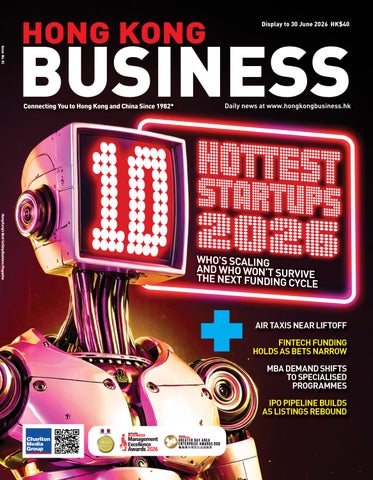
Startups face stiffer competition this year as investors increasingly back companies with clearly defined demand, particularly in deep tech. This trend is reflected in this year’s Hottest Startups list, which includes ventures such as CELLmeric and DAINVI Limited. See the full list on pages 30 to 31.
Meanwhile, fintech is expected to remain the focus of venture capital this year, with sectors such as blockchain, climate tech, and biotech also gaining traction. Find out more on pages 18 to 19.
On the education front, MBA enrolments are declining, highlighting growing pressure on business schools as costs rise and hiring remains selective. Check out the full MBA survey on pages 42 and 43. Moreover, MBA applicants are shifting towards specialised programmes such as ESG and data analytics to gain an edge in an increasingly competitive job market. Turn to page 40 for more details.
In insurance, Hong Kong’s 50 biggest insurers saw weaker results in 2024, with total premiums falling amidst softer savings inflows and tougher competition. See the full rankings on pages 44 to 45.
Hong Kong could soon roll out cross-boundary drone deliveries and air taxi services across the Greater Bay Area under the Regulatory Sandbox X initiative. Discover more on page 8.
On pages 52 to 53, we spotlight the organisations across sectors redefining value through customer-centric innovation at the Hong Kong Business High Flyers Awards. Also featured on pages 62 to 63 are the standout companies honoured at the Hong Kong Business Management Excellence Awards and the Hong Kong Business Greater Bay Area Enterprise Awards.

HongKongBusiness is a proud media partner and host of the following events and expos:


HongKongBusiness is available at the airport lounges or onboard the following airlines:


RT HealthTech turns lab robotics into affordable exosuits
RT HealthTech is commercialising university-developed robotics to make wearable mobility support systems that hospitals, rehabilitation centres, and eldercare facilities can afford. The company, which started in 2024, builds on research by founder Raymond Kai-yu Tong, a biomedical engineer and professor.

ShopBack Pay targets Hong Kong F&B to drive user growth
ShopBack Pay is targeting Hong Kong’s F&B sector as its entry point into the market, banking on high-frequency spending to anchor user engagement and drive repeat transactions. ShopBack has drawn about a million users in Hong Kong since its launch in 2022, with shoppers having earned more than $300m in cashback.


Bonhams hits $810m in sales as Greater China dominates
Bonhams Hong Kong accumulated $810m across its auctions and private sales in 2025, the highest total in nearly two decades or since its opening in 2007. It saw increased interest from new and younger collectors globally, with Millennials and Gen Z representing 25.6% of global registrants in 2025.

Cathay volume soars 27% in 2025 on year-end travel, expanded capacity
The Cathay Group reported strong passenger and cargo growth in 2025, due to a year-end travel surge and expanded flight capacity. Cathay Pacific and HK Express set a single-day record on 27 December by carrying more than 125,000 passengers which was then surpassed on 3 January with over 126,000 passengers.
WeLab Bank kills FX fees with HK’s first multi-currency debit card
WeLab Bank has partnered with Mastercard to launch a multi-currency debit card, becoming the first digital bank in Hong Kong to offer the product. The WeLab Global Wallet Debit Card allows customers to hold and spend in 11 currencies, including the US dollar, Japanese yen, euro, renminbi, and the Singapore dollar.

HKChat forces developer speed-up as 630,000 users swarm
About 630,000 users have registered for Hong Kong’s local AI assistant HKChat in the first two months of its operation. Developed by the Hong Kong Generative AI Research and Development Center the chatbot handles location-specific queries such as food recommendations and transport directions for users.


Hong Kong may soon see crossboundary drone deliveries and air taxi services linking cities in the Greater Bay Area (GBA), as authorities and businesses test low-altitude aircraft under the Regulatory Sandbox X initiative.
The area, home to more than 87 million people, offers a large market for such services, Steven Lui, technical director for traffic and transportation planning at AECOM Asia Co. Ltd., told Hong Kong Business.
Routes connecting Hong Kong’s Northern Metropolis with Shenzhen could cut last-mile delivery costs and times for urgent goods such as medical supplies and electronics.
Passenger mobility is also a potential avenue, he pointed out. “Electric vertical take-off and landing aircraft can complement existing road and rail networks, offering faster options,” Lui said in an exclusive interview.
Regulatory Sandbox X, launched in November 2025, builds on the city’s 2025 LowAltitude Economy Regulatory Sandbox.
The earlier programme approved 38 pilot projects, 32 of which are operational along designated routes.
Sandbox X has rolled out 29 projects spanning emergency rescue, logistics, inspections, maintenance, surveillance, and low-altitude infrastructure. It covers more complex scenarios, such as cross-
boundary routes and passenger-carrying unconventional aircraft.
Samuel Lam, CEO at X Social Group Ltd., said the expanded sandbox helps companies trial technologies whilst authorities develop measurable safety standards.
“We see strong adoption in infrastructure inspection, such as the Mass Transit Railway using drones to inspect tunnels,” he said in a separate interview with the magazine.
He also cited financial-sector applications, including drone reliability indexes that could let insurers offer pay-per-use or real-time coverage.
In addition, Lam sees potential for lowaltitude vehicles in the entertainment and tourism sectors, with drone light shows attracting visitors and supporting Hong Kong’s ‘mega-event economy.’
Beyond logistics and mobility, authorities are positioning the low-altitude economy as part of Hong Kong’s economic strategy.The city plans to develop a more internationally competitive ecosystem, according to the Transport and Logistics Bureau.
“In logistics and express delivery, lowaltitude flights can provide more direct
routes compared with traditional land-based transport,” the Bureau said.
Meanwhile, drones combined with data analytics can improve daily management and maintenance efficiency.
Scaling the technology will require coordinated low-altitude traffic management in Hong Kong’s dense airspace.
Lui told the magazine that multiple drones operating simultaneously—often from different manufacturers—will need integration with construction and infrastructure activities to avoid collisions.
“An Unmanned Aircraft System Traffic Management system is essential when multiple drones operate simultaneously to prevent collisions,” he added.
Moreover, backend infrastructure must be upgraded as industries such as construction move from visual inspections to advanced digital mapping, requiring the processing of large volumes of data in near real time.
Lam added that other challenges in scaling operations include risk management as well as public safety.
Lawrence Iu, executive director at think tank Civic Exchange, said regulatory hurdles remain. Aviation safety rules restrict drones from flying beyond the operator’s line of sight (BVLOS) in populated areas.
“Scaling will require careful relaxation based on sandbox evidence,” he told Hong Kong Business in a separate interview.
Hong Kong’s crowded airspace also presents challenges. “Integrating lowaltitude traffic safely with existing air routes will require robust traffic management systems and clearly defined flight corridors.”
“Many high-value routes involve the GBA,” Iu said. “Alignment of procedures, data flows, and responsibilities with Guangdong and national aviation authorities is essential but complex.”
Still, the sandbox model lets regulators collect operational data and user feedback before formal rules are enacted.
Trials are expected to inform clearer standards on BVLOS operations, data reporting, and cross-border coordination, paving the way for wider adoption of drone logistics and urban air mobility in the city, Iu told the magazine.
Public acceptance will also shape adoption, he added, noting that concerns around safety, noise, and privacy in dense urban areas must be addressed alongside regulatory progress.
Electric vertical take-off and landing aircraft can complement existing road and rail networks, offering faster options

Hong Kong Exchanges and Clearing Ltd. (HKEX) expects its Tech 100 Index to offer wider exposure to the city’s technology sector as mainland Chinese investors increase demand for Hong Kong-listed stocks.
Introduced in December 2025, the benchmark tracks 100 companies eligible for the Southbound Stock Connect, which is the trading link that allows mainland investors to buy Hong Kong shares.
Those investors account for roughly 25% of daily turnover, Gregory Yu, HKEX head of markets,
said in an exclusive interview.
“Whilst large-cap companies such as Alibaba Group Holding Ltd. and Xiaomi Corp. are the top-weighted constituents, we also want to give newly listed firms visibility,” Yu told Hong Kong Business.
Geographically diversified
About 400 firms have applied to list in Hong Kong, including seven international tech companies last year. “The index could become even more geographically diversified,” he told the magazine. Tech 100 was launched as Hong


Kong’s capital markets rebounded. Last year, the city raised $274.6b through 106 initial public offerings (IPO), ranking the world’s largest IPO venue by funds raised. Average daily turnover in the cash market jumped 95% year-on-year to $255.8b in the first 11 months of 2025.
Lorraine Tan, director of equity research (Asia) at Morningstar, Inc., said the benchmark could support the creation of tech funds and exchangetraded funds (ETF). “This gives broader exposure to the sector instead of cherry-picking individual stocks,” she said in a separate interview.
HKEX is working with mainland China’s E Fund Management Co., Ltd., one of the country’s biggest asset managers, to launch an ETF linked to the index. “This will allow mainland investors to gain exposure to Hong Kong’s market,” Yu said.
Tech 100 covers firms across artificial intelligence, electric vehicles, biotechnology, and robotics. “Our methodology is designed to capture both large and smaller companies,” Yu said.
Whilst large-cap companies are the top-weighted constituents, we also want to give newly listed firms visibility
Morningstar Senior Analyst Yiming Li said the index would compete with existing benchmarks such as the Hang Seng Tech Index and CSI Hong Kong Technology Index. Some technology themes, including AI and robotics, remain in early development, whilst others, such as electric vehicles, continue to attract investor interest, he added.
Hong Kong salary budgets are expected to grow 4% in 2026, reflecting business focus on cost control and long-term value, according to the 2026 Morgan McKinley Salary Guide.
Talent shortages persist in technology, healthcare, life sciences, and financial services, the report added. Moreover, senior-level movement has been limited, with very few executives actively seeking new opportunities.
Entry-level finance roles will see 5% to 8% increases, whilst mid-to-senior positions rise 8% to 12%, with transformation and data analytics roles commanding 15% to 18% premiums.
Banking merit increases range 3% to 5%, whereas professionals who change roles may receive 10% to 20% raises, with demand centred on risk, compliance, and front-office positions, the report revealed.
Technology salaries remained flat in 2025 as talent bidding wars eased. Contract software engineers receive 15% uplifts due to flexible hiring outpacing permanent recruitment.
Human resources increments range 3% to 5%, with higher pay for skills in transformation, analytics, and regulatory alignment.
Sales and marketing roles see 0% to 3% growth, with digital marketing and environmental, social, and governance (ESG) positions at 3% to 5%.
Supply chain salaries are stable, whilst strategic functions such as process improvement and strategic sourcing see 3% to 5% increases.
Engineering projects face delays, creating underutilised talent, the report said. Candidates prioritise job security and work-life balance, and government schemes like the Top Talent Pass and Quality Migrant Admission Scheme continue to attract international professionals.

Source: Tracxn


Trusted partner. Proven results.

At RGA Hong Kong, we tackle industry-wide underwriting challenges decisively and at scale, partnering with clients to orchestrate trusted, end-to-end risk solutions.
Our MedScreen+ platform transforms complex medical data into faster, clearer decisions, delivering transparency and efficiency for customers, distributors, and underwriters alike.
Recognized by the Hong Kong Business High Flyers for “Outstanding InsurTech & Digital Underwriting Innovation,” we remain committed to expanding digital underwriting and making financial protection accessible to all.
Standard rooms cost $1,400, villas $2,500–$3,000, and suites $4,000–$5,000.
Sun Hung Kai Properties’ The Royal Garden Kowloon East in Tseung Kwan O is targeting families, multigeneration travellers, and guests with pets by offering bigger rooms, family-friendly layouts, and outdoor spaces.
General Manager Johnny Cheung said the hotel’s advantage lies in its spacious rooms and calmer environment. “Our big competitive advantage is larger room sizes, fully renovated spaces, and calm, relaxed setups—not only inside the hotel rooms but also in the surrounding areas,” he told Hong Kong Business.
Rooms range from 388 square feet (sq ft) for standard units to 1,000 sq ft for suites. The hotel offers interconnecting suites for grandparents, parents, and children, bunk-bed layouts for kids, and “Family Fortress” rooms that can house two to three generations.


Terrace suites include private outdoor areas suitable for small business meetings or entertaining guests.
“Business travellers… want comfort whilst keeping up with work,” Cheung told the magazine.
Room rates start at $1,400 for standard rooms, $2,500–$3,000 for villas, and $4,000–$5,000 for suites,
The hotel is undergoing phased renovations that began in June last year. The first phase, completed in December, covered the lobby, function rooms, and a third of the rooms.
The second phase finished in March, and the final phase, from April to July, will complete the remaining rooms and reopen the rooftop Italian restaurant, Ponentino.
The hotel is adjacent to an MTR station, and shuttle services connect it to the Express Train station and Tsim Sha Tsui, making it convenient for travellers.


The office features two main meeting rooms designed to maximise natural light.
Brokerage uSMART Securities Ltd. has opened an office in Admiralty, bringing its investment banking, equity capital markets and asset management teams together in Hong Kong’s central business district.
Carrie Wong, marketing director at uSMART Securities, said the layout is built around collaboration zones known internally as “integrated deal flow hubs,” aimed at encouraging closer coordination across departments.
“The layout mirrors our complete closed-loop ecosystem, designed to break down silos and foster cross-departmental collaboration,” she said in an exclusive interview.
The site houses teams handling private financing, initial public offering sponsorship, debt financing, mergers and acquisitions advisory, equity issuance, investor relations and research-driven asset management.


The office features two main meeting rooms—a smaller space for focused discussions and a larger one for workshops—both designed to maximise natural light.
Client areas include private meeting suites for advisory work and technology-enabled rooms for virtual meetings with overseas teams and clients.
Wong said the pantry has become a key gathering point for staff. “It is far more than a kitchen; it is a vibrant social and collaborative hub,” she said.
Wong said the pantry plays a role in retaining talent, providing a shared space for employees to take breaks and interact informally.
“In high-stakes fields like ours, a space to decompress, recharge, and connect is not a luxury—it's a strategic necessity,” she continued.


Financial technology (fintech) startups are expected to remain the focus of venture capital in Hong Kong this year as investors channel money into fewer, more established companies, with total funding projected to reach $7.8b (US$1b).
Fintech firms accounted for the biggest share of venture investment last year, raising $4.2b (US$532m) out of the roughly $5b (US$638.2m) deployed across 32 funding rounds, according to data from Tracxn Technologies Ltd.
Two of the biggest deals involved fintech companies. PremiaLab HK Ltd. raised $1.7b (US$220m), whilst Red Dot Technology Ltd. got $837.8m (US$107m).
Investors backed fewer startups last year as venture deal volume fell by 30%, but committed larger sums to selected companies. The median investment rose from $39.2m (US$5m) to $54.8m (US$7m), according to Tracxn founder Neha Singh.
“Investors are looking for companies that are not just focused on rapid growth, but also have a clear path to making a profit,” she told Hong Kong Business
Cautious investment
Lap Man, co-founder and managing partner at Beyond Ventures, said investors are also focusing on startups with clear global potential, particularly those expanding beyond domestic markets.
“Solutions that only target the domestic market may have reduced funding potential,” he told the magazine. The shift reflects a more cautious investment environment following the surge of venture capital funding earlier in the decade.
The era of ‘spray and pray’ is over


“The era of ‘spray and pray’ is over,” Herston Elton Powers, founding managing partner at 1982 Ventures Pte. Ltd., said in an exclusive interview. “Company valuations fell, investments became smaller, and founders who understood their numbers rose to the top.”
Venture funding in Hong Kong rebounded last year after falling sharply in 2024. Total funding reached about $5b (US$638.2m), up from roughly $2.1b (US$274m) the previous year, Singh said.
Improving stock market conditions could help sustain venture investment, Lap told the magazine.
“All venture investments eventually need an exit,” he said in a separate interview. “If there is no exit, there is no way to recycle the capital.”
Favoured sectors
Hong Kong’s benchmark Hang Seng Index rose 27.8% in 2025, the city's strongest performance since 2017, following a 17.7% gain in 2024.
The city’s initial public offerings (IPO) also strengthened. Companies raised about $285.8b through 119 listings last year, with three deals ranking amongst the world’s 10 biggest offerings, according to Hong Kong Exchanges and Clearing Limited.
“If the market continues to perform strongly, that would be very positive,” Lap said, noting that stronger IPO activity would let venture funds return capital to investors and reinvest in startups.
Government initiatives are also helping attract venture capital. Programmes such as Hong Kong Investment Corp. Ltd. (HKIC), established in 2022, have increased

funding for technology companies and drawn additional investors into venture deals.
“The HKIC has been investing aggressively in the region and Mainland China,” Lap said. “They claim that for every dollar they invest, they leverage another $6— they have that kind of multiplier effect.”
Investors expect funding to continue flowing mainly into fintech, blockchain and artificial intelligence (AI) startups.
Powers said the opportunity in fintech remains long term as many people in emerging markets still lack access to financial services.
“Giving 700 million people access to financial services doesn’t [happen] in a single funding cycle,” he said.
Artificial intelligence is also gaining traction in Hong Kong’s startup ecosystem. Tracxn data showed the city has about 231 AI-focused startups, although only 28 have received venture backing so far.
AI startups raised $110.4m (US$14.1m) across five funding rounds in 2025. By February this year, they had already secured $184.8m (US$23.6m), suggesting funding momentum is building.
Other sectors may also attract investor interest. Jimmy Ng, senior director at Gobi Ventures, Inc , said China’s push to develop domestic technology capabilities is encouraging investment in semiconductors and other deep-tech sectors.
He added that areas such as satellite technology and braincomputer interfaces are gaining attention across the region.
Healthcare could also draw more funding as Hong Kong’s ageing population increases demand for services.
“There are not enough technological solutions to address this challenge,” Ng told the magazine. “This creates significant potential, especially on the service side.”
Lap said biotechnology could emerge as a key investment area. “Beyond that, other sectors such as electric vehicles and batteries are also attracting interest.”
Funding trend for the last 12 months

Investors are looking for companies that are not just focused on rapid growth, but also have a clean path to making a profit


Source: Traxcn
They are getting a boost from state funding and fee cuts.
Small and medium enterprises (SME) in Hong Kong’s retail sector are stepping up investments in digital platforms as they seek to compete with bigger chains, supported by state funding and cost-relief measures, analysts said.
Matched funding programmes covering e-commerce, point-ofsale (POS) systems, and customer relationship management (CRM) tools are helping smaller retailers modernise operations and reach both local and overseas customers.
“The one-is-to-one matching subsidies allow small shops to install self-service kiosks or smart inventory systems that were previously deemed expensive,” Pascal Siu, senior research manager and head of green and sustainability at the Hong Kong Foundation, told Hong Kong Business in an interview. He added that adopting e-payments such as Alipay and WeChat Pay is key to serving mainland tourists.
Results are beginning to show, according to Marco Poon, editorial panel member at the Chinese


University of Hong Kong’s Centre for Family Business.
“The programme targets retail, food and beverage, tourism, and personal services — with strong uptake already helping smaller family businesses lift sales by around 10% in many cases,” Poon, who is also a founding partner at JCP Partners, said in a separate interview. “Several thousand SMEs are positioned to benefit in 2025 and 2026.”
Beyond digital adoption, the government is expanding support to strengthen resilience and encourage overseas growth.
Measures include a $1.43b injection into the Dedicated Fund on Branding, Upgrading and Domestic Sales (BUD Fund), the launch of the Economic & Trade Express platform, streamlined restaurant licensing, and a unified branding initiative for local agricultural and fishery products.
Operating cost relief is also part of the package. Halved water, sewage, and trade effluent charges could save a typical retail outlet $12,000 to $48,000

annually, whilst larger restaurants may save as much as $120,000, Poon said.
Licence waivers for food, hawker, and liquor businesses are also expected to cut administrative costs by $2,000 to $10,000 per outlet.
“The government anticipates this will encourage 3,000 to 6,000 new outlets or expansions,” Poon said, adding that the measures lower barriers for entrepreneurs and family businesses seeking to grow.
Siu said the waivers could also help struggling venues, especially food and beverage outlets with high licensing costs, to renew rather than shut down.
Both analysts said the BUD Fund and Economic & Trade Express platform let retailers build online shops, register trademarks, and connect with overseas distributors.
Simplified applications capped at $100,000 per project also reduce timeto-revenue, enabling SMEs to move faster on digital initiatives.
Most growth is expected to take place through digital channels, shifting SMEs from rent-heavy models to hybrid setups, Siu said.
Improved CRM data lets retailers retarget customers rather than depend solely on foot traffic, whilst improved payment systems and lower trade barriers support expansion across the Greater Bay Area.
Hong Kong’s economy is forecast to grow about 2% to 3% annually, whilst online retail is expected to post compound annual growth of 7% to 11%, Poon said.
Digitally enabled family businesses are likely to gain market share, though competition from mainland e-commerce platforms remains a challenge over the next three to five years.
“These measures help close the gap with larger chains by cutting costs, improving access to finance, and accelerating digital adoption,” he said. “Domestic demand gets a boost from waivers and local consumption recovery, whilst BUD Fund and the Hong Kong Trade Development Council platforms unlock international growth.”
“We will likely see Hong Kong retail become more integrated with the Greater Bay Area ecosystem, serving as a premium ‘showroom’ for goods sold online,” said Siu.

The Faculty of Business of Lingnan University proudly announces that Prof LENG Mingming, Dean of the Faculty of Business and Chair Professor of Operations and Risk Management, has been awarded the 2026 Beta Gamma Sigma (BGS) Dean of the Year Award. Chosen as the sole recipient worldwide from more than 640 universities across 39 countries and regions, Prof LENG will receive the honour this April in Seattle.
The President of Lingnan University, Prof S. Joe QIN, congratulated Prof LENG, noting that under his leadership, the Faculty of Business has strengthened its academic excellence and international impact. The Faculty now ranks 24th in the 2025 UTD24 journal rankings of Chinese scholars in the Greater China region.
Prof LENG said he was deeply honoured, highlighting his long-standing commitment since 2005 to curriculum innovation, interdisciplinary research, and student development. He noted that the award recognises the collective efforts of the Faculty in nurturing globally minded, innovative business leaders.
Founded in 1913, Beta Gamma Sigma is the international honour society for business programmes accredited by the Association to Advance Collegiate Schools of Business (AACSB). Its Dean of the Year Award recognises one exceptional dean annually for outstanding leadership in business education, strong support for students, and sustained commitment to academic excellence and professional development.


CMHHK slots fill quickly, but gaps slow expansion.
Hong Kong’s first dedicated Chinese medicine hospital has drawn strong patient demand, but gaps in digital integration, workforce planning, and research commercialisation could limit its expansion, analysts said.
Subsidised outpatient appointments at the 400-bed Chinese Medicine Hospital of Hong Kong (CMHHK), which opened in December 2025, were fully booked in its first month shortly after reservations began.
The government later doubled quotas for the first 10 days of service and raised remaining monthly slots by 30% to meet demand.
The early surge underscores appetite for institutionalised Chinese medicine. Yet the longer-term test lies in whether the hospital can anchor a more integrated system that links clinics, laboratories, and the industry.
Only a small fraction of Hong Kong’s roughly 10,700 registered Chinese medicine practitioners are connected to electronic health record


systems, said Ryan Ip, vice president of Our Hong Kong Foundation.
“Workflow design and system integration also need to be optimised,” he said in an exclusive interview. “We recommend increasing promotion and engaging professionals to address practical concerns before gradually making eHealth participation mandatory.”
Ip added that low public understanding and limited crossdisciplinary awareness may slow adoption, requiring targeted education to improve confidence and appropriate use.
Without broader digital connectivity, patient data may remain fragmented, limiting coordination with Western medical providers and constraining clinical research.
Rathanesh Ramasundram, head of healthcare and life sciences, APAC Growth Advisory at Frost & Sullivan, Inc., said the hospital’s ability to fully use its bed capacity and clinical trial facilities would be critical.
The director also cited the need
for structured links between CMHHK, Western hospitals and community clinics to support integrated care models.
Next door, the Government Chinese Medicines Testing Institute (GCMTI) is developing testing and quality standards for Chinese medicine products.
“These institutions will likely turn Hong Kong’s Chinese medicine sector from a mainly outpatient, small-clinic model into a more integrated 'hospital–lab–industry' ecosystem,” Ramasundram told the magazine in a separate interview.
Commercial translation remains a weak link. Whilst research and standard-setting may strengthen clinical credibility, mechanisms to convert findings into exportable products are limited, Ip said.
“We recommend creating a joint research platform, including a commercialisation office, to help bring CMHHK and GCMTI’s findings to market, along with stronger trade and intellectual property protections,” he added.
Clinical collaboration is focusing on areas such as stroke rehabilitation and cancer care, where Chinese medicine is positioned as complementary to conventional treatment, Ip said. Mental health, particularly sleep and stress-related conditions, might also offer room for expansion, he added.
Workforce constraints could pose another bottleneck. A 2020 Health Manpower Survey showed most responding practitioners worked in the private sector, though participation rates were low.
Ip called for a comprehensive manpower review, licensing reform with practical clinical examinations, along with a stronger crossdisciplinary training.
Expanding integrated care will require more doctors trained in both systems. CMHHK has been tasked with training Western practitioners in Chinese medicine and supporting integrated centres.
“In five years, this could create a strong base of practitioners who can operate in hospital-grade Chinese medicine and integrated settings,” Ramasundram said.

Vacancy falls to 11.8%, with grade A rents still up to 20% above Singapore.
The office market remains under pressure, but signs of tightening are emerging in the city’s most sought-after Central buildings as financial firms expand and consolidate space, according to property advisers.
Vacancy in Central had fallen to 11.8% by November from 13.6% at the end of 2024, Ada Choi, head of Asia-Pacific research at CBRE, told Hong Kong Business
Availability in top-grade Central offices with harbour views dropped below 10%, pointing to a shrinking pool of prime space.
The improvement reflects a shift in occupier behaviour. After years of downsizing and cost-driven relocations, some tenants are moving into selective growth.
Choi said early signs of expansion are appearing in Central, led by financial firms with direct exposure to capital markets.
“In terms of demand, it’s mainly from nonbank financial service firms as Hong Kong’s initial public offering pipeline remains strong,” she said in an exclusive interview. “This will continue to be the trend in 2026.”
The scale of these occupiers means even modest growth can have an outsized effect. Sam Gourlay, head of office leasing advisory at Jones Lang LaSalle Inc. (JLL), said insurers remain amongst the city’s biggest tenants, with several occupying more than one million square feet.
A 10% expansion target for some insurers in 2026 would translate into meaningful net absorption, he said a separate interview.
Quantitative trading firms are also playing a growing role.
Gourlay said these funds are the main driver of demand, with many expanding their Hong Kong footprint faster than in Singapore. JLL has advised on several cases where these firms are growing two to three times more in Hong Kong than elsewhere in the region.
Quality is a key factor shaping


leasing decisions. Tenants are prioritising well-connected buildings that can serve as flexible work hubs for staff. Trophy assets with strong transport links are outperforming, Gourlay said, whilst demand for secondary offices remains weak.
Improved leasing demand
The resilience in Central contrasts with softer conditions across the wider market. Hong Kong had posted a 5.1% year-on-year decline in office rents as of the third quarter of 2025, according to CBRE, whilst Singapore posted growth of 2.1%. Choi said further rental declines of up to 5% are possible in Hong Kong, led by decentralised areas where about 70% of vacant space is located.
Central is likely to fare better. She said rents in the core district could stabilise as leasing demand improves, even as pressure persists elsewhere.
Comparisons with Singapore have become more frequent as rental gaps narrow, but Gourlay cautioned
against drawing simple conclusions.
Office location decisions are driven by talent, market access and business strategy, not rents alone.
Even so, Grade-A offices in Central remain about 20% more expensive than comparable space in Singapore, he said, adding that the gap might be close to its narrowest point.
Investor and occupier sentiment continues to diverge. “International institutional investors are having higher interest in Singapore than Hong Kong,” Choi said, citing stronger fundamentals, political stability and lower interest rates.
Occupiers, however, still see advantages in both cities, and Hong Kong is no longer facing an outflow of regional executives.
Talent policy is also supporting demand. Choi cited Hong Kong’s relatively open approach to attracting young overseas professionals. Still, the outlook depends heavily on capital markets. Gourlay said much of the recent improvement is tied to Hong Kong’s strong initial public offering activity in 2025.
Any slowdown in listings or a shift in global attention to other markets could weaken momentum in the office sector again, he added.

怎樣令幸福
可以不斷延續?

我們全面的健康保障, 讓你與摯愛創造更多幸福時光, 更好是用陪伴不斷延續愛。 了解更多
Electric machinery and sustainable materials are scarce and costly.
Building contractors face hurdles adopting a carbon-labelling scheme as high upfront costs slow implementation.
“Some of the biggest obstacles are the initial investments required for new practices and technologies,” Johnny Cheuk, senior vice president and Hong Kong executive leader at infrastructure consultancy AECOM, told Hong Kong Business.
“Small consultants need to pay upfront investment costs when they are on a steep learning curve adopting new practices or technologies to upskill their people,” he said in an interview.“These upfront costs are obstacles for smaller-sized consultants.”
Felix Chan, digital sustainability leader for East Asia at Arup Group Ltd., said low-carbon concrete and high-recycled-content rebar carry premium prices, raising project costs.
“Use of low-carbon concrete and recycled materials is improving and increasingly integrated into BIM (building information modelling) workflows,” he said in a separate exclusive interview. As adoption rises, prices should drop, he added.
Supply-chain limits further slow uptake. Cheuk and Chan noted that low-carbon concrete, recycled rebar, and electric machinery remain scarce, lengthening lead times.
“The readiness of the entire supply chain or ecosystem is very important,” Cheuk said, noting that if part of it is unfamiliar with these measures, progress slows.
The carbon-labelling scheme, introduced by the Hong Kong Construction Association, is part of a broader initiative to promote low-carbon construction across the region. It builds on the Best Practice Guideline for Carbon Smart Construction Sites, which introduces a “4M1E” framework— Man, Machinery, Materials, Methods, and Environment— covering 36 low-carbon measures.
These measures guide contractors to adopt digital management tools and BIM to improve planning

and decision-making, use electric machinery to reduce diesel reliance, apply low-carbon and recycled materials, implement prefabrication technologies, and integrate renewable energy systems and wastewater recycling on-site.


The guideline supports the labelling scheme, helping contractors monitor carbon performance, improve operational efficiency, and encourage wider adoption of sustainable construction practices across the industry.
Chan noted that implementing the scheme still requires technical adjustments. Contractors need to retrain staff and integrate new digital platforms, including BIM, to manage site operations effectively.
Some low-carbon materials and machinery need government recognition before use, adding another layer of complexity.
Despite these hurdles, analysts said the programme offers longterm gains. Chan said it strengthens a contractor’s brand and shows commitment to cutting emissions.
Cheuk added it sets benchmarks for green investments and could help firms access Environmental, Social, and Governance-focused financing.
Certification also sparks low-carbon innovation across projects. Datadriven site management cuts waste and lowers emissions, Cheuk said.
Carbon reduction potential is significant. Chan estimated the scheme could initially cut construction emissions by more than 35%, rising above 40% as adoption spreads.
Cheuk cited projects with reductions from 22% to 60% by utilising the modular integrated construction approach and S690 high-strength steel.
The programme’s success hinges on supply chain collaboration, government support, as well as gradual tech adoption to offset upfront costs, Cheuk said.
Both analysts see it as a first step toward standardising lowcarbon practices, setting industry benchmarks, and aligning Hong Kong’s construction sector with global decarbonisation targets.


Hong Kong startups face stiffer competition for capital this year as investors increasingly back companies with clearly defined local and international demand, particularly in deep tech, analysts said.
Startups are also shifting from broad consumer services to specialised, technology-driven solutions with measurable commercial value.
“In terms of products and services, they have increasingly gravitated towards deep-tech and cross-border solutions,” Cherry Yeung, a senior economist at the Hong Kong Trade Development Council, said in an exclusive interview.
Key sectors include financial technology, with roughly 590 firms, followed by information and computer technology with about 530, and biotechnology and healthcare, each hosting more than 300 startups.
Unlike typical software or internet startups, deep tech focuses on solving complex, real-world challenges, such as disease or climate change, through scientific innovations rather than purely business-model changes.
The city’s startup ecosystem grew 11% in 2025 to 5,221 companies from a year earlier, with further expansion projected at 13%–15% this year, Jayne
Solutions
that only target the domestic market may have reduced funding potential
Chan, head of startups at Invest Hong Kong (InvestHK), said.
Chan said growth could be further supported by structural shifts in capital and talent flows, particularly with Chinese companies increasingly using Hong Kong as a base for overseas expansion.
“This is complemented by initiatives like the Capital Investment Entrant Scheme, which attracts high-net-worth individuals—many of whom made their fortunes in tech and startups in China,” she added.
Investors are prioritising startups with clear market demand and global potential. “Solutions that only target the domestic market may have reduced funding potential,” Lap Man, co-founder and managing partner at Beyond Ventures, said in a separate interview.
“Another challenge is the high operating costs, including living expenses. However, this has been partly mitigated by AI tools and remote work models,” Lap added.
Early-stage financing remains a hurdle, with fewer private investors at the seed and angel levels.
“Many Hong Kong investors tend to focus on later-stage
opportunities,” Chan said.
Geopolitical risks, including global conflicts, also shape investor behaviour. Jimmy Ng, a senior director at Gobi Ventures, Inc., said war in the Middle East might redirect investor focus towards Asia, including Hong Kong, giving founders more bargaining power in a competitive but selective environment.
Deep-tech startups face particular pressure, given the longer development cycles.
“Investors and partners now focus more on technologies with clear differentiation, strong intellectual property, and real clinical or industrial impact,” Patrick Tang, CEO at CELLmeric Ltd., told the magazine.
Rosie Chan, CEO at JAPJAP Zero Waste Ltd., added that fundraising has become more challenging with more disciplined and selective investors.
“Startups need to demonstrate stronger execution and realistic growth strategies,” she said.
The government is seeking to ease funding constraints through accelerators, co-investment funds, and research commercialisation programmes.
The 2026–2027 budget includes a government-backed artificial intelligence (AI) research and development institute and a $10b industry-oriented fund to channel capital into AI, life and health technology, and robotics.
Initiatives include a pilot accelerator programme for tech startups, offering as much as $30m in matching subsidies, and a $2b state venture fund, which has invested $510m in local startups, helping attract roughly $5.1b in private investment.
University spin-offs get as much as $1.5m per year for six years through a government-supported technology startup support programme.
Several sectors are expected to see strong growth in 2026. Healthcare and medical technology companies benefit from Hong Kong’s 2018 listing rules allowing pre-revenue biotech firms to go public, attracting overseas capital, InvestHK’s Chan said.
Since the rules’ introduction,
about 80 biotech companies have listed in Hong Kong, according to the Hong Kong Exchanges and Clearing Ltd. website.
Emerging areas include cell and gene therapy, AI-enabled healthcare, and advanced biomanufacturing, Tang said.
“In the biomedical sector, technologies that improve the safety and scalability of advanced therapies are gaining increasing attention,” the chief executive officer added.
He noted that investors are particularly interested in technologies that can address major healthcare challenges, such as improving the safety, scalability, and affordability of advanced therapies.
JAPJAP’s Chan said climate technology and infrastructure solutions are expected to gain more interest. “This includes solutions related to the energy transition, circular economy systems, and environmental infrastructure.”
She cited urban infrastructure as an area with significant untapped opportunities. “Startups that can redesign core urban systems — such as waste processing — have significant potential.”
Quality and scale
Meanwhile, hardware and robotics are also gaining interest, particularly within the Hong Kong–Shenzhen ecosystem, Lap added.
Support is also being extended through programmes, such as the ‘Start-up Express’, that help new companies build connections with international investors, Yeung said.
“Early-stage financing is supported by government-backed platforms, including funds under the Hong Kong Science and Technology Parks Corporation and Hong Kong Cyberport Management Co. Ltd.’s (Cyberport) micro fund,” Leung said.
Moreover, the startup ecosystem is shifting towards quality and scale, with a focus on commercialisation and cross-border expansion.
Hong Kong is positioning itself as a gateway for growth, supported by its links to the Greater Bay Area and international capital markets, Lap said. “It will serve as a capitalsupporting market.”
InvestHK’s Chan added that the agency advises startups on funding, partnerships, and regulatory matters, helping them navigate the competitive landscape.
Here’s what experts said when asked which underfunded industries or technologies they see as having significant potential and why:


CHERRY YEUNG
Senior Economist, HKTDCResearchteam
Several industries and technologies show strong long-term potential in Hong Kong’s startup ecosystem. Biotech and healthtech are driven by cutting-edge biomedical innovation, supported by HKEX’s specialist listing regimes—such as Chapter 18A for pre-revenue companies—and closely linked to research capabilities across the Greater Bay Area. Fintech and digital assets also hold promise, particularly in tokenisation, SME financing, and cross-border payments.
HERSTON
ELTON
POWERS Founding Managing Partner, 1982Ventures
Everyone is funding AI applications, but few are investing in the infrastructure that makes AI actually work in this region. The models most relied on were trained on English-language, Western data, so they perform poorly in Bahasa, Thai, Tagalog, and Vietnamese. Every application built on top of them inherits this blind spot. There is a huge opportunity to fund the infrastructure needed to address these gaps—local language models, regionally trained datasets, energy-efficient hardware, AI-native tools, and AI cloud services across the region.
PATRICK TANG
Founder and CEO, CELLmericLimited
One of the biggest untapped opportunities is translating academic research into scalable medical technologies. Hong Kong has strong biomedical research capabilities, yet there is significant potential to better connect discovery, clinical validation, and industrial production. Another major opportunity lies in reducing the cost and complexity of advanced therapies. Whilst treatments like CAR-T cell therapy have remarkable clinical potential, their manufacturing remains complex and expensive. Technologies that simplify production and lower costs could enable much wider global access.
ROSIE CHAN
Founder and CEO, JAPJAPZeroWasteLimited
One of the biggest untapped opportunities is urban infrastructure innovation. Cities face growing pressures in waste management, resource efficiency, and sustainability. Startups that can redesign core urban systems—such as waste processing, energy use, or resource recovery—have significant potential. Decentralised solutions that enable local resource processing, rather than relying solely on large centralised facilities, also present a major opportunity.
JAYNE CHAN
Head of Startups, InvestHongKong
Biotech and healthtech are driven by cutting-edge biomedical innovation, supported by HKEX’s specialist listing regimes—such as Chapter 18A for pre-revenue companies—and closely linked to research capabilities across the GBA. Fintech and digital assets also hold promise, particularly in tokenisation, SME financing, and crossborder payments, backed by progressive regulation and Hong Kong’s world-class financial infrastructure. AI remains a core enabling technology, advancing finance, robotics, supply chains, and enterprise services, whilst benefiting from rapid regional adoption and strong demand across the Asia-Pacific.
Hong Kong Business' 2026 Hottest Startup list highlights a pivot towards high-stakes industrial and clinical solutions. This year’s cohort is dominated by institutional spin-offs and artificial intelligence pioneers that bridge the gap between lab-scale breakthroughs and global commercialisation. From DiamNEX’s revolutionary diamond cooling films and CELLmeric’s virus-free gene delivery to NEXX’s AI-driven logistics corridor to the MENA region, these startups are solving structural challenges. Whether tackling urban sustainability via JAPJAP’s bio-conversion or securing the “agentic economy” with Terminal 3, these startups prove Hong Kong is the definitive hub for precision engineering and resilient, AI-native infrastructure.

Founder: Chu Zhiqin
Funding: >$10m (Seed)
Founding Year: January 2025
Incubated at the University of Hong Kong and now expanding its regional footprint, DiamNEX is redefining power electronics through its patented edge-exposed exfoliation technique. This produces wafer-scale, ultra-flat, polycrystalline diamond films that are flexible and cost-effective, bypassing traditional etching and polishing. Recognised at the Geneva International Exhibition of Inventions and published in Nature, the startup recently secured eight-figure (RMB) angel funding to scale its pioneering cooling solutions. DiamNEX is currently operationalising a pilot production line in Shenzhen to supply consistent samples to potential global partners.

Funding:
Founding Year: April 2024
DAINVI Limited is a visual intelligence startup developing an edge-native Visual Consistency Intelligence (VCI) Decision Engine, powered by its G-O1™ architecture. The VCI Engine can operate as a standalone or additional reliability layer in vision systems, continuously evaluating whether vision outputs remain consistent as real-world conditions change—issuing explicit trust states without modifying existing pipelines or requiring data labelling. Validated in demanding environments where rare failures carry operational impact, DAINVI’s 2025/26 momentum includes an HKICT Silver Award and a Chinese mainland MIIT-endorsed national Top 300 ranking. DAINVI provides the reliability layer that builds trust.

Funding: Pre-Seed
Founding Year: January 2025
CELLmeric, a spin-off from The Chinese University of Hong Kong (CUHK), is redefining the affordability and clinical safety of cell therapy with its novel ‘Virus-Free Gene Delivery System’. Leveraging a low-energy platform that safeguards genomic integrity and therapeutic persistence, the startup engineers CAR-T cells with superior anticancer potency. This provides a safer and more cost-effective solution for cancer treatment, establishing Hong Kong as a leader in next-generation biotherapeutics. Now expanding into Greater Bay Area to leverage the region's growing biomedical innovation system, the company is specifically targeting advanced treatments for solid tumours and metabolic diseases.

Founders: Simon Chan & Howard Chan
Funding: $1.5m (Seed)
Founding Year: July 2024
Peqaboo is an artificial intelligence (AI)-driven platform revolutionising early pet disease detection. By transforming photos, videos, and wearable data into pre-diagnostic insights, the startup identifies health issues before they require emergency intervention. Peqaboo bridges the gap between home monitoring and clinical care, reducing owner anxiety whilst empowering veterinarians with AI-powered customer relationship management tools to streamline triage and enhance long-term patient outcomes. Expanding its footprint into Singapore, the company now offers “VetSheet,” a suite of clinical tools including an AI medical scribe and a 10-signal biometric “BooPetId” engine for 95% accurate identification.

Founder: Julian Benedikt Gaertner
Funding: $2m (Pre-Seed)
Founding Year: May 2024
ReGen Technology delivers low-cost, solar-powered desalination systems tailored for agriculture and remote communities. Its modular devices transform seawater and brackish groundwater into fresh water without external electricity, chemicals, or complex maintenance. By bypassing the high costs of traditional reverse osmosis, ReGen provides an affordable, off-grid solution that empowers farmers to improve soil health and overcome critical local water shortages. Regen was recognised with the ESG Excellence Award at the 2025 HKU Techno-Entrepreneurship Challenge and has successfully operationalised its innovative desalination silos at The Swire Institute of Marine Science. ReGen is scaling its “networked decentralisation” model, enabling project developers and NGOs to restore degraded lands.

Founders: Oscar Hui, Professor Bei Yu, Houston Huang, Kin Chung Chan, and Ibrahim Al-Derbasti (MENA business co-founder)
Funding: Series Pre-A
Founding Year: March 2024
NEXX is start-up that’s building the artificial intelligence (AI)powered logistics supply chain connecting Greater China and the Middle East and North Africa (MENA) region. Using a proprietary logistics language model and agentic AI, the start-up enables e-commerce merchants and operators to launch warehouses and fulfilment solutions faster, smarter, and with greater reliability. In a sector often slowed by cross-border complexity, NEXX is creating a more seamless, transparent, and cost-efficient path for international trade. A winner of TASMU Accelerator’s third cohort, NEXX is rapidly expanding in Qatar and across the wider MENA region, aiming to capture the fast-growing momentum under the Belt and Road initiative.

Founders: Chong Yuen Yu, Chien Wai Tong, Yau Pui Tik
Funding: $3.8m (Seed)
Founding Year: May 2024
Founded by CUHK nursing faculty, ACTuWISE is a nurse-led, technology-driven social enterprise blending Acceptance and Commitment Therapy (ACT) with artificial intelligence. The startup delivers personalised, evidence-informed mental health services and professional training at scale. By focusing on family caregivers and NGOs, ACTuWISE enhances the accessibility of psychological support, bridging the gap between clinical expertise and digital scalability to empower underserved communities and organisations. A winner of the HKTDC Start-up Express 2025, the firm is currently scaling its patented “ACT x ACT Engine,” a large language model trained on over 19,000 professional therapeutic dialogues. Under the leadership of CEO Prof. Connie Chong, the startup recently received an Outstanding Project Award in Shanghai.

Founders: Suen Man Kin (CEO) & To Sai Shing Tony (CTO)
Funding: $1.5m (Seed)
Founding Year: March 2023
A high-impact spin-off from the Chinese University of Hong Kong, Provectus Therapeutics accelerates drug development through its proprietary Next Generation Drug Screening AI Platform. By combining single-cell analysis with AI, the startup delivers high-resolution tumour insights to tailor personalised treatment plans. Winner of the 2024 CUHK Entrepreneur Day and the YDC Golden Technopreneur Award, this HKSTP Incu-Bio member recently launched ProvecTEST™, a breakthrough service providing precise, data-driven therapeutic options for cancer patients. Currently scaling into Singapore to collaborate with regional oncology centres, the company is integrating multi-omics data to refine its predictive algorithms for complex solid tumours.

Founders: Gary Liu, Malcolm Ong, & Joey Liu
Funding: $62m (US$8m, Seed)
Founding Year: February 2023
Terminal 3 enables secure, privacy-preserving data processing without requiring data transfer. By ensuring “access does not equal transfer,” the platform allows organisations to extract actionable insights whilst keeping sensitive information localised and protected. This approach significantly reduces compliance risk and enhances security across digital ecosystems, providing a safer, more efficient way for enterprises to leverage data-driven value. The firm recently secured US$8m in seed funding to scale its decentralised identity and “verifiable private identity” infrastructure. Now expanding its footprint into Singapore’s Smart Nation initiatives, Terminal 3 utilises zero-knowledge proofs and quantum-resistant encryption to power self-sovereign data for over 10 million users.

Founders: Chan Man Wai, Rosie Funding: Seed
Founding Year: January 2023
JAPJAP Zero Waste is an environmental infrastructure platform revolutionising food waste management in high-density urban environments. By integrating intelligent bio-conversion—driven by black soldier fly larvae (BSFL)—with a proprietary AIoT-enabled environmental control system, the platform enables efficient, on-site organic waste processing for schools, shopping malls, and commercial hubs. This circular approach cuts down reliance on carbon-intensive centralised facilities, offering a scalable, highgrowth solution tailored to Asia’s rapidly evolving green economy. Currently a member of the HKSTP Incubation Programme, the startup utilises a patented modular system where BSFL transform food waste into valuable insect protein.


Drivers with higher scores will unlock broader coverage and more benefits.
Zurich Insurance Group Ltd.’s Hong Kong unit and YAS Digital Ltd. are using artificial intelligence (AI) to link insurance coverage directly to real-world driving behavior, which they say could reshape motor insurance for the city’s taxi industry.
The initiative addresses what both companies see as a persistent gap in traditional motor insurance, which relies heavily on static factors such as age, claims history, and vehicle type, rather than how drivers actually behave on the road.
In Hong Kong’s dense urban environment, that has limited insurers’ ability to differentiate risk or reward safer driving.
Under the programme, Zurich Insurance (Hong Kong) and YAS analyse driving data to generate daily performance scores for taxi drivers, which are reviewed quarterly. Drivers are then placed into performance tiers, with higher scores unlocking broader personal accident coverage and additional benefits.
“Data is analysed to generate daily scores, which will be reviewed quarterly,” Eric Hui, CEO at Zurich Insurance for Greater China, said in an exclusive interview. “Drivers can receive corresponding insurance coverage and rewards based on their quarterly performance score.”
The model is built on YAS’s AI-assisted TAXY platform, which combines in-vehicle monitoring systems, smartphone sensors and real-time analytics. Over a six-month pilot period ending in September 2025, the system processed about 39 million data points and delivered a 20% improvement in safety scores amongst participating taxi drivers.
Zurich said the early results suggest the approach could modernise underwriting in a segment where accident risk is high and pricing differentiation has historically been limited.
Drivers with stronger safety records are entitled to more comprehensive personal accident protection, including coverage that can extend to family members, Zurich said.
The tiered structure reflects a broader industry shift towards usage-based insurance, where risk is assessed using actual driving patterns rather than demographic assumptions.
“Behavioural data is used to improve safety, not to punish drivers,” Hui said. “Driving behaviour helps us classify risk tiers so we can reward safer habits with better benefits, but we are mindful of keeping the system fair.”
Beyond insurance coverage, the data generated by the platform offers insights for drivers and fleet operators. The system analyses routes, working patterns and downtime, letting drivers cut wasted hours and improve daily earnings, whilst helping operators optimise fleet use, said William Lee, co-founder of YAS.
As insurers increasingly use behavioural data in pricing and benefits, concerns about algorithmic bias and transparency have grown across the industry. Zurich and YAS said the taxi
Behavioural data is used to improve safety, not to punish drivers
programme addresses those risks.
The scoring models rely on objective indicators such as harsh braking, speeding relative to legal limits, acceleration patterns, turning stability, distracted driving signals, accident black spots, and environmental risks along each journey.
These indicators are designed to reflect accident risk and are not influenced by personal traits such as age or gender.
To manage fairness, the programme includes regular audits of model outcomes, human oversight before any tier changes are implemented, and transparency tools that let drivers understand scores.
Drivers can participate using government-mandated in-car cameras or YAS’s mobile app, which uses smartphone sensors and GPS data. The system integrates weather conditions, traffic patterns and identified danger zones using Hong Kong-specific traffic algorithms, with machinelearning models refined continuously as new data is collected.
Both companies view the taxi initiative as a testing ground for broader applications of telematic-driven underwriting. Hui said the data generated through the programme could eventually form part of insurers’ underwriting considerations as usage-based products expand.
“Customers are increasingly looking for a more usagebased insurance cover,” Lee said, adding that the model could be extended to other fleet-based segments, particularly as new regulations shape Hong Kong’s ride-hailing industry.
Future phases may include links to digital commerce platforms and electric vehicle charging networks, aligning the program with longer-term trends in electrification and smart mobility. For Zurich, the taxi sector carries broader economic significance. “Hong Kong’s taxis are the heartbeat of the city,” Hui said.
“Using AI and smart telematics allows us to safeguard livelihoods whilst contributing to a more sustainable and resilient transport ecosystem.”


Vina Cheung expects RMB to rise to the third most-used global payment currency.
HSBC is betting Hong Kong will drive demand for China’s renminbi (RMB) as the currency strengthens and gains wider use in global trade.
“We do see very supportive market conditions that the currency can play a bigger role in the global financial system,” Vina Cheung, HSBC Holdings Plc global head of RMB internationalisation, told Hong Kong Business.
Cheung, who has led the bank’s RMB team for 13 years, helps companies and investors navigate cross-border payments and investments in the currency.
RMB recently hit a 34-month high of RMB6.93 a dollar, according to the People’s Bank of China, and ranks sixth in global payments by value, based on Society for Worldwide Interbank Financial Telecommunication (SWIFT) data.
Rising United States-China trade tensions have pushed companies to diversify currency holdings, boosting offshore RMB demand.
“China is playing a bigger role in the global stage, particularly in the trade and supply chain,” Cheung said in an interview, citing the “China+1” strategy adopted by companies to secure their supply chains. “Right now, it’s China plus many. It has never been out of the formula.”
“We expect the investment flow between China and the rest of the world to continue. That's why the Chinese currency will definitely be one of the good options for crossborder settlements, including investments,” she added.
RMB internationalisation
HSBC has centralised RMB clearing in Hong Kong and doubled its facility to $1.7t (US$227b), enabling faster, cheaper payments for multinational clients and Chinese firms.
Cheung cited a gold-trading client whose Hong Kong RMB accounts cut delays and high offshore transaction costs.
The bank also participates in China’s Cross-Border Interbank Payment System, joining in late 2024, and has advised regulators on RMB internationalisation. Cheung expects RMB to rise to the third most-used global payment currency, up from fourth in late 2024 and early 2025, according to SWIFT.
The bank also serves as a “trust adviser” not just for corporates but even for regulators seeking views on the currency, she told the magazine.
Cheung said that international regulators have a lot of questions about the RMB internationalisation agenda and reach out to HSBC about this.
Her small team handles regulatory compliance, client engagement, and currency strategy daily.
She said Chinese language skills helped her navigate markets from Canada to Singapore and Hong Kong.
She also highlighted progress for women in senior

banking roles. It’s not just about numbers, but balanced evaluation regardless of gender, she pointed out.
“HSBC invests heavily in leadership programmes for women,” Cheung told the magazine.
Notable programmes include HSBC Rise, a leadership program launched in 2024 offering workshops and interactive coaching sessions. In the UK, HSBC has a corporate partnership with 100 Women in Finance, an organisation committed to supporting the empowerment of women across the financial services industry.
HSBC also has a Women’s Business Growth Initiative in the UK that focuses on women-led businesses.
Whilst taking note of the percentage of women in senior leadership positions is important, she said that what matters more is having a mindset of having balanced evaluations regardless of gender.
“I have the full confidence that HSBC is investing a lot on women’s leadership and on programmes to improve that,” she told the magazine.
Right now, it's China plus many. It has never been out of the formula
Separately, HSBC has expanded its China proposition in recent years. In Singapore, the bank named two women leaders—Ying Wang and Irene Zhang—in China-focused roles to strengthen its proposition in the China corridor.
HSBC China, meanwhile, is expected to maintain steady asset quality, capitalisation, profitability, and liquidity, Moody’s Ratings said in a late 2025 report. Profitability is expected to remain stable over the next 12-18 months.


Differing legal systems can create friction for firms operating across borders.
Trust providers are grappling with complexity as entrepreneurs spread their businesses, assets, and families across multiple jurisdictions, making wealth structures designed for a single domicile ill-suited to clients whose lives span borders.
That shift is forcing trust providers, which structure and manage wealth and succession plans, to adopt more flexible arrangements.
“Entrepreneurs are thinking in a far more global way than before — and they expect their wealth arrangements to move with them,” Vincent Chok, director at Legacy Trust Co. (Hong Kong) Ltd., told Hong Kong Business.
The trend is particularly pronounced in Hong Kong, where business owners have long operated beyond the city’s borders.
An HSBC Holdings Plc report published in October 2025 found that eight in 10 entrepreneurs in Hong Kong hold multiple residences, one of the highest proportions globally.
About 37% have a house in


Mainland China and roughly 27% in Singapore, alongside ties to markets such as Taiwan, Japan, the United Kingdom, and France.
“They want clarity over where their assets sit and how succession will work when their family is based elsewhere,” Chok said in an exclusive interview with the magazine.
Trusts are also evolving into governance tools for globally dispersed families, rather than just estate-planning vehicles.
He added that trusts increasingly need to consolidate assets held across different countries under a single structure, whilst separating ownership from management to ensure a smoother handover to the next generation.
That task is complicated by differing tax regimes, inheritance laws, and legal systems, which can create friction for families and businesses operating across borders. Regulatory shifts and geopolitical uncertainty add to the challenge.
“The global environment is

changing quickly, making flexibility increasingly important,” Chok said. “The goal is not just to preserve wealth, but to create a framework that allows it to endure across generations and borders.”
The rise in multi-residency reflects structural realities of Hong Kong’s economy, according to Alberto Moel, professor of practice in finance at the University of Hong Kong.
“This hasn’t been a trend—it’s the way it’s been for a long time,” he said in a separate exclusive interview.
Entrepreneurs naturally expand beyond the city due to its small domestic market, making crossborder structures a necessity rather than a choice. “Being multi-resident is part of your business strategy.”
Moel added that many firms quickly extend operations to mainland China, Singapore, Canada, or beyond as they scale.
Despite greater mobility, Hong Kong continues to serve as a key base for many businesses, supported by its financial infrastructure and access to Mainland China.
“Hong Kong sees strong demand and supply through the northbound and southbound Stock Connect links,” he told the magazine, adding that the city continues to benefit from strong capital market activity.
Average daily turnover in Southbound Stock Connect, which links the mainland’s stock markets with Hong Kong, rose to $121.1b last year, according to Hong Kong Exchanges and Clearing Ltd.
Chok added that Hong Kong’s common law system and experience in handling cross-border capital continue to attract international entrepreneurs and families with interests across Asia.
“Hong Kong continues to be a very practical jurisdiction,” he said.
However, Hong Kong’s global image does not always reflect its underlying strengths, with perceptions abroad often lagging reality.
“People here know that—we like the standard of living, the infrastructure, the ease of doing business and the opportunities available,” Moel said. “But I don’t think a lot of that is clear to people outside of Hong Kong, because they see it as just another Chinese city.”

Enrolment across three local universities slipped 0.94% to 632 students last year. HR & EDUCATION
Master of Business Administration (MBA) applicants in Hong Kong are tilting towards specialised programmes in areas such as environmental, social and governance (ESG) framework, data analytics, and artificial intelligence (AI), as they seek a clearer career edge in a tightening job market.
Applicants are increasingly favouring programmes with defined niches, rather than traditional general-management tracks, as employers place more weight on technical and domain-specific skills, Victoria Lo, assistant dean and head of international programmes at the Hong Kong Management Association, told Hong Kong Business.
“There is a growing appetite for careers in digital transformation, analytics, and innovation-related roles, as well as in areas linked to ESG and sustainable finance,” she said.
Total MBA enrolment across three local universities slipped 0.94% to 632 students last year from a year earlier, according to a survey by Hong Kong Business, underscoring the pressure facing business schools as costs rise and hiring remains selective.
The University of Hong Kong reported the highest enrolment, with 217 MBA students. The Chinese University of Hong Kong followed with a combined 216 students across its two MBA programmes, whilst Hong Kong Polytechnic University (PolyU) had 42 MBA students.
Hiring in the city remains cautious. A December 2025 report by Japan’s PERSOL Holdings Co. Ltd. showed steady demand for digital sales roles, bilingual professionals, and frontline managers, whilst broader recruitment stayed selective.
Hong Kong’s unemployment rate eased to 3.8% in the three months through February, but total employment edged down to 3.66 million, according to government data.
Banking and financial services remain popular amongst MBA applicants, but interest is shifting towards roles that combine business,


technology, and data, Lo said.
Areas tied to digital transformation, analytics and ESG-related functions are drawing attention as companies invest in automation, sustainability reporting, and compliance.
Business schools say the shift is forcing them to sharpen their value propositions. “Unless a programme has a strong niche or clearly defined purpose, it becomes difficult to stay competitive,” Justin Law, MBA programme director at Hong Kong Polytechnic University, said.
The programme director added that slower economic growth, particularly in Mainland China, and the high cost of MBA programmes are also weighing on demand.
Curriculum overhaul
Employers globally are placing greater emphasis on artificial intelligence-related skills, said Victor Lau, director of the Chinese-language MBA programme at Hang Seng University of Hong Kong, citing a July 2025 report by the Graduate Management Admission Council.
“MBA curricula can no longer treat digital capability as a side topic or sustainability as a decorative addon,” he said in an exclusive interview. “Both now sit much closer to the core of managerial work.”
In response, schools are redesigning curricula. City University of Hong Kong is moving towards a more STEM (Science, Technology, Engineering, and Mathematics)oriented MBA, with a stronger
focus on artificial intelligence and interdisciplinary learning, said Kevin Sun, its MBA programme director.
“We are proposing new courses where students can learn from researchers in the fields of engineering, materials science, electrical engineering, and law,” he said in a separate interview.
Student interest is also rising in sectors such as manufacturing, construction, and energy, he said.
Hang Seng University is redesigning its MBA programmes to align with regional business needs, combining Chinese-language instruction with international business training as companies expand across the Greater Bay Area. Its Chinese-language MBA will launch in September, offering both full-time and part-time options with two intakes per year, Lau said.
PolyU has also overhauled its curriculum, adopting a case-based teaching approach that blends core business subjects with contemporary themes.
Assessments now place greater emphasis on class discussion and participation, Law said.
Flexibility has become another key factor, particularly for working professionals. Accelerated formats and intensive study blocks are gaining popularity amongst executives managing full-time roles, Rebecca Lui, vice-president at Kaplan Hong Kong, said in a separate interview.
Still, educators say in-person teaching remains critical.


Premiums fall 2.5% in the most recent Hong Kong Insurance Authority release.
Hong Kong’s 50 biggest insurers reported weaker results in 2024, according to the latest annual data released by the Hong Kong Insurance Authority in late December 2025, with total premiums declining as softer savings inflows and tougher competition weighed on the market. Demand for protection and wealth products held up.
Premiums amongst the top 50 insurers fell 2.5% year on year to $605.2b (US$77.4b) from 2023, according to the 2024 Hong Kong Insurance Rankings compiled by Hong Kong Business using data from the Hong Kong Insurance Authority.
For the overall market, gross premiums slipped 1.9% to $635.2b. Life insurance remained the biggest segment, accounting for 42% of total premiums. They filled the top 10 spots in the rankings, and all but one posted growth despite the broader decline.
AIA International Ltd. led the list, with premiums rising 1.3% to $88.2b (US$11.3b). Manulife (International) Ltd. followed, posting 50.9% growth, whilst Prudential Hong Kong Ltd. ranked third with a 5.2% increase.
HSBC Life (International) Ltd. took fourth place after expanding 18.3%, and China Life Insurance (Overseas) Company Ltd. came in fifth with 4.6% growth.
Hang Seng Insurance Company Ltd. and BOC Group Life Assurance Company Ltd. posted gains of 50.4% and 22.9%, respectively, whilst FWD Life Insurance Company (Bermuda) Ltd. rose 24.1% to secure the eighth spot.
AXA China Region Insurance Company Ltd. at No. 9 was the only company in the top 10 to post a decline, with premiums falling 10.9%.
Sun Life Hong Kong Ltd. ranked 10th and delivered the strongest growth amongst the group, with premiums climbing 51.1% to $20.2b.
Despite the overall drop in premiums, leading insurers said underlying demand remained firm heading into 2025 and 2026.

We see balanced opportunities across the high-net-worth segment
Ken Lau, managing director of Greater China and Hong Kong CEO at FWD, said the company kept strong momentum in 2024, supported by expansion in both local and offshore markets.
‘Dual-focus approach’


Provisional data from the regulator for the first three quarters of 2025 showed FWD Hong Kong’s new business first-year premium jumping 93%, whilst annual premium equivalent increased 74% from a year earlier, compared with 43% growth for the industry over the same period, Lau said.
FWD’s “dual-focus approach,” which centred around the local market whilst seizing opportunities in the Greater Bay Area, made this possible, Lau said in an interview.
Sun Life Hong Kong also pointed to product development and distribution strength.
CEO Clement Lam said results were driven by a focus on high-networth clients and a multi-channel approach, including its exclusive
bancassurance partnership with Dah Sing Bank.
The insurer led the brokerage channel with annual premium equivalent of $5.8b (US$741.5m) and 90% growth across distribution channels.
For the first three quarters of 2025, annualised premium equivalent exceeded $8.4b (US$1.1b), up 30% year on year, with Sun Life maintaining its top position in broker sales.
“The introduction of Hong Kong’s first indexed universal life insurance for professional investors in May further expanded our high-networth client business,” Lam said.
Lam said he remains optimistic about Hong Kong’s insurance market.
“We see balanced opportunities across the high-net-worth segment, with growing demand for retirement planning, wealth preservation, and cross-border mobility,” he said.
The chief executive added that demand for savings, healthcare and retirement products is likely to grow steadily in the coming year.

Software development will be the biggest talent shortfall by 2030.
Job seekers will increasingly need the ability to work with and manage artificial intelligence (AI) tools—from understanding how automated systems make decisions to checking for errors—as banks rely more heavily on data and machine learning, analysts said.
Industry observers added that closer collaboration between regulators, banks and education providers will be critical to sustain the talent pipeline, with clearer governance standards and shared training frameworks helping workers gain earlier exposure to regulated environments.
“Skill gaps continue to persist in sustainable finance, compliance, and data analysis,” Dora Leung, senior manager in banking and financial services at recruitment company Randstad Hong Kong Ltd., told Hong Kong Business.
“Upskilling efforts and targeted training have helped narrow the gap, but talent must continue to keep pace with changing regulations and AI tool integration,” she said.
The ability to understand and use AI systems will become one of the fastest-rising skill needs in the sector, according to a study by the Hong


Kong Monetary Authority (HKMA). Software development is also projected to be the biggest skill gap by 2030, with 36% of banks identifying it as a major constraint.
“To future-proof careers in an increasingly automated environment, banking professionals have to acquire the skills needed to communicate and interact with AI systems effectively,” Hong Kong’s central bank said, adding that digital automation is already influencing how banks assess performance, manage risk and deliver services.
Yet banks are struggling to bring in AI and data specialists at the speed they want.
Expansion
Demand for machine-learning talent is high across industries, and candidates who are strong in AI often lack experience working in a highly regulated environment, said Wisely Wong, senior director at Hays Hong Kong Ltd.
“Banking is a regulated sector. Even experienced AI hires still take time to warm up and understand banking products and compliance constraints, which delays impact,” he
said in an exclusive interview.
HKMA’s study noted that banks’ adoption of big data, AI, and automation would continue to expand even as a shortage in specialist talent remains a bottleneck. Some lenders have launched inhouse training to accelerate adoption.
UBS Group AG and DBS Bank Ltd. have rolled out AI-focused certification programmes to help employees understand how to use the tools in risk, operations and customer management, said Justin Tan, head of L.E.K. Consulting’s Asia financial service practice.
“Senior management needs to walk the talk and ensure they themselves are conversant in the new paradigm,” Tan said, adding that support, incentives and engagement from leadership are essential.
Despite the rapid growth in demand for AI-literate talent, adoption across financial services remains uneven.
Mercer’s Global Talent Trends 2025 report showed only 37% of companies use generative AI regularly and just 7% think AI has fundamentally changed their business model.
Many cite heightened operational and reputational risks from misuse of the technology.
To close the gap, Leung told the magazine that employers should shift towards skill-based hiring rather than prioritising past experience. Recruiters said administrative roles remain the most vulnerable to automation, including in finance.
“Organisations are likely to become smaller but potentially more profitable because the goal is to make more money, but with lower employment costs,” John Mullally, managing director in Hong Kong at Robert Walters Plc., told Hong Kong Business in a separate interview.
The managing director added that many workers have specialised too narrowly and would need broader skill sets to stay competitive.
Mercer found that half of organisations are redesigning work to boost productivity, whilst 61% are in the early stages of becoming “skillpowered.” Firms further along in this transition report higher retention, engagement, and output.


Capping permitted vehicles could trigger supply shortages.
The ride-hailing licensing law could limit vehicle numbers and increase compliance costs, according to analysts.
Platforms might need to allot more resources to legal compliance and data reporting, Chi Sum Li, head of government and public sector at KPMG China, told Hong Kong Business in an interview.
“They would need to focus on revenue per licensed driver and vehicle, not just maximising the number of drivers,” he pointed out.
Capping permitted vehicles could trigger supply shortages, Chi said. “This would result in higher fares, extended passenger wait times, and diminished service quality,” he said.
The Road Traffic (Amendment) (Ride-Hailing Service) Bill 2025, passed in October 2025, sets up a framework for licensing platforms, vehicles, and drivers.
Detailed rules on permits and operations are expected through another legislation in the first half.
Unlicensed platforms face fines of as much as $1m and imprisonment for up to 12 months, Johnny Ho, a partner at Robertsons Solicitors, said.
The law addresses gaps that allowed ride-hailing services to operate


without oversight for years. Past incidents, such as a 2015 police raid on Uber Technologies, Inc.’s Hong Kong office, highlighted the risks of unregulated operations.
The legislation also clarifies passenger safety and insurance coverage, Ho said, noting that standard private car policies often exclude commercial use.
These gaps created risks to passengers, inadequate insurance, and unfair competition for taxis, he pointed out to the magazine.
Ride-hailing vehicles will only be allowed to provide trips booked through licensed platforms and cannot pick up street hails, which remain reserved for taxis, Wilfred Ng, a partner at Bird & Bird (Hong Kong) LLP, said in a separate interview.
To prevent the market from becoming saturated, the Commissioner for Transport retains the power to cap the total number of vehicle permits in circulation — ensuring orderly development rather than a free-for-all.
“In addition to regulating ridehailing services, the Ordinance strengthens the fight against illegal ‘white licence car’ operations,” the Bird & Bird partner added.

Chi said the law could push the taxi industry to modernise, including electronic payments and improved service standards.
He added that ride-hailing platforms may adopt subscription or membership pricing to build customer loyalty.
Ho said it could also support job creation and expand transport options, particularly as regulated ride-hailing services become more widely adopted. Enhanced passenger choice and safety are amongst the expected outcomes, potentially reducing complaints about service quality, he added.
The changes could also encourage innovation, including the adoption of electric vehicles and better integration with transport platforms.
The framework affects drivers as well. Cars must be registered to them and used solely for ride-hailing.
They will also face stricter entry requirements, including mandatory training and competency tests, and at least one year of driving experience under the new framework.
Whilst some stakeholders suggested multiple drivers per vehicle could improve efficiency, the government kept the restriction to maintain traceability, rule enforcement, and insurance compliance, Ng said.
Platforms must demonstrate operational experience, financial capacity, and management competence. Vehicles must meet age, inspection, and insurance requirements. Enforcement is stronger: drivers caught offering illegal rides could face driving bans of 12 months to three years, Ho added.
Ride-hailing cars can also be impounded even when the driver is not identified, closing a loophole where owners previously claimed ignorance. Platforms will be required to maintain detailed operational records and ensure that all drivers and vehicles comply with licensing conditions, Ho said. “They must perform due diligence.”
Meanwhile, pricing will largely be left to market forces, with fares set by platforms. “However, the government has made clear it will not hesitate to intervene should the market see predatory pricing or conduct that undermines fair competition,” Ng said.


ForHong Kong businesses operating in increasingly complex environments, growth today depends on certainty as much as ambition. As operations extend abroad, corporates must manage cash flows across entities, currencies, and regulatory environments whilst maintaining central oversight from Hong Kong. In this context, transaction banking has evolved from a back-office function into a core enabler of how businesses operate, scale, and manage risk.
At the same time, transaction volumes are rising, settlement expectations are tightening, and cash is often generated in one market but required in another. For treasury teams, the margin for error is narrowing, as delays or blind spots create friction when precision matters.
Resilience, therefore, is defined not only by financial strength but by certainty. Businesses need confidence that cash moves smoothly, visibility is maintained, and payments are executed reliably, raising expectations of the financial infrastructure that underpins trust and control.
Smarter, digitally enabled banking built around real operating needs
Smarter transaction banking responds to rising complexity by aligning financial infrastructure with the realities of crossborder operations. Digitally enabled capabilities give treasury teams timely visibility across entities, whilst seamless payment flows, faster settlement, and automated processing help sustain continuity across markets. As transaction data is consolidated and analysed, finance functions move beyond execution towards a more insight-led role, enabling faster decisions around cash flow, liquidity, and working capital.
DBS drives this transformation through
client co-creation, moving beyond standardisation. By deeply understanding how businesses manage liquidity and grow, the bank designs bespoke solutions that strengthen control, enhance cross-entity oversight, and support sustainable expansion.
Leveraging its ASEAN footprint and digital platforms like DBS IDEAL, treasury teams gain comprehensive oversight of balances, streamline cross-border activities including foreign exchange and telegraphic transfers, and automate manual processes. This delivers precision and confidence for businesses of varying scales.
At DBS, we see AI as an enabler of trust
In practice, these capabilities translate into tangible business impact.
A Hong Kong-headquartered real estate investment trust (REIT) with operations in Singapore faced growing complexity in managing liquidity across multiple entities as transaction volumes increased. Working closely with DBS, the group implemented a digitally enabled cross-border cash concentration structure that was aligned to its operating and liquidity needs. The solution enabled the timely deployment of funds across markets, with liquidity managed centrally through DBS IDEAL to provide clear, realtime visibility. This strengthened financial control whilst supporting the REIT’s regional growth with greater assurance.
Trust and resilience strengthened through intelligence and scale
Trust is fundamental when funds move across markets. As transaction volumes rise and cross-border operations grow more complex, resilience depends not only on financial strength but also on consistent execution, accurate intelligence, and the ability to anticipate risk.
At DBS, AI-powered capabilities are embedded into banking servicing to strengthen human judgment and reliability rather than replace
relationships. By synthesising client data, transaction patterns, and historical interactions, AI supports relationship and service teams with earlier insights and more informed advice, whilst AI-powered servicing platforms manage routine enquiries efficiently to maintain consistent service quality as volumes grow.
This approach is reflected in DBS Joy, the Group’s virtual assistant on DBS IDEAL, which supports corporate clients across regions and handles over 120,000 interactions for around 4,000 users monthly**. This adoption reflects how intelligent servicing enhances responsiveness whilst maintaining specialist oversights. In 2025, DBS Hong Kong saw digital transaction volumes rise by 29 percent year-on-year^, whilst continuing to enhance its fraud detection and prevention capabilities.
“At DBS, we see AI as an enabler of trust,” said Jolynn Wong, Managing Director and Head of Global Transaction Services, DBS Hong Kong. “By equipping our bankers with deeper intelligence and ensuring reliable servicing at scale, AI allows us to support clients more proactively. That resilience, knowing your bank can anticipate needs and perform consistently in complex environments, is what gives businesses the confidence to grow.”
“Our security standards safeguard client data across jurisdictions and uphold the highest regulatory standards at every stage,” Jolynn added. “That foundation allows our clients to expand across markets with confidence, knowing their financial infrastructure is dependable, whilst we take care of the rest.”
As Hong Kong businesses extend their footprint across regional and global markets, operating with clarity and control across borders has become critical. In a fast-moving environment, trusted financial foundations support reliable cash flows, disciplined risk management and the ability for businesses to thrive with clarity.
**Basedonthepressrelease“DBSrollsoutGenAIpoweredchatbottoallcorporateclients”ofDBSGroupon 10November2025.
^Thedigitaltransactiondatapresentedisderivedfrom DBSHongKong’sinternalsourcesandcoverstheperiod from1January2025to31December2025.


With the rapid changes and rising expectations prompting industries to adapt, innovation has become the measure of a business’ success. To attain this and stay ahead in a competitive environment, organisations across different sectors have reimagined value through advanced technologies, fresh thinking, and customer-centric solutions.
The Hong Kong Business High Flyers Awards 2026 applauded the enterprises that have set new standards in the business landscape with their exceptional products and services. The awardees were
AlloyX Group
2026WINNERS
• Stablecoins Applications
AXA Hong Kong and Macau
• Generative AI Solutions – Insurance
FSE Lifestyle Services Limited
• Conglomerates
FWD Insurance
• Insurance Technology of the Year
• Insurance Product Innovation of the Year
Generali Hong Kong
• Marketing Campaign of the Year
GODIVA
• Premium Chocolatier
Hang Seng Bank
• Best Retail Bank
Hyatt Regency Hong Kong, Tsim Sha Tsui
• Best City Hotel

honoured at the programme held at Hyatt Regency Hong Kong, Tsim Sha Tsui on 20 January 2026.
The event recognised the efforts of the outstanding visionaries who have gone beyond achieving internal improvements and have produced contributions that are shaping the future of Hong Kong. Bringing together influential leaders, entrepreneurs, and creative minds, the awards programme was a celebration that attests to the region’s growing strength.
Congratulations to each of the winners for their achievements and dedication to excellence!
Lingnan University - Faculty of Business
• Excellence in Postgraduate Business Education
Manulife (International) Limited
• Most Innovative Technology Insurance Company
Now Health International
• Most Innovative Health Insurance Leader
PolyU Business School
• Excellence in MBA Student Leadership Development
PrimeCredit Limited
• Outstanding Finance Company
Regent Hong Kong
• Top Luxury Hotel
RGA Reinsurance Company, Hong Kong Branch
• Outstanding InsurTech & Digital Underwriting Innovation
Standard Chartered Bank
• Bank of the Year
Sun Life Hong Kong Ltd
• Best Insurance Company - HNW Value Added Service


As the global chocolate industry evolves from a traditional craft into a highly competitive, lifestyle-driven business, leading brands are under increasing pressure to deliver beyond product quality by creating meaningful experiences. Marking its centennial year, premium chocolate maker GODIVA is embracing this shift with a bold strategy that balances heritage with modern reinvention.
Under the leadership of APAC Managing Director Manoj Loya, the brand’s Asia Pacific operations are entering a new chapter defined by craftsmanship, creativity, and cultural connectivity. Having spent a decade with the company, Loya champions the belief that iconic brands must continuously reinvent themselves whilst staying true to their essence.
For GODIVA, this means transforming from a premium chocolatier into a contemporary brand, honouring its Belgian methodologies and signatures whilst also building deep local resonance in markets such as Hong Kong. Central to this evolution are three strategic pillars: continuous innovation, a robust omnichannel model, and strategic partnerships. Its master chocolatiers constantly reinterpret iconic ranges, ensuring each creation strikes “a delicate balance between heritage
and innovation, global and local needs, and staying attuned to Hong Kong’s preferences and cultural context.”
Signature launches such as the New Core Gold and Truffle Collection elevate timeless recipes and packaging whilst retaining iconic brand cues. Meanwhile, the Pistachio & Kunafah Series introduces globally inspired flavour profiles that resonate strongly with premium consumers seeking sophistication.
Seasonal collections also demonstrate this craftsmanship. For celebrations such as Chinese New Year and other locally significant holidays, traditional pralines are reimagined through thematic colours, storytelling, and culturally attuned flavour infusions.
“Such creative and locally relevant partnerships and activations fuel GODIVA’s century-long success and build a strong foundation for our premium positioning, facilitating its evolution into a contemporary, premium lifestyle brand that underpins our enduring legacy of innovation and excellence in chocolate creation,” Loya said.
The brand’s reinvention is supported by a comprehensive omnichannel ecosystem designed to maximise accessibility without sacrificing exclusivity. Its distribution channels span boutiques, fast-
Inspired by Lady Godiva’s bold and generous spirit, we create chocolates that awaken the senses and transform every moment into something extraordinary.


moving consumer goods channels, corporate sales, and e-commerce platforms, creating multiple consumer touchpoints whilst maintaining a consistent premium experience.
This integrated approach has strengthened brand presence across Hong Kong and the broader Asia Pacific region, and has ensured consumers can engage with the brand in diverse contexts — from curated in-store experiences to convenient digital purchases.
Strategic collaborations have also driven cultural relevance and consumer engagement for the company. GODIVA has recently partnered with recognised institutions such as Disneyland to produce collectable chocolate gifts that generated exceptional demand and reinforced the brand’s premium gifting appeal. It has also collaborated with popular franchise Labubu through its limited-edition designs, generating strong omnichannel buzz and social engagement.
As it continues to strengthen its brand positioning, its identity also goes beyond confectionery. Loya emphasises that GODIVA now “extends beyond premium chocolate to represent artistry, indulgence, and enduring craftsmanship.” This progression signifies
• Born in Belgium in 1926, GODIVA carries a legacy of artistry, craftsmanship, and indulgence.
• Belgian chocolatier Pierre Draps Sr. began handcrafting exquisite chocolates in his Brussels workshop. With artistry, passion, and an unwavering devotion to quality, he laid the foundation for what would become GODIVA.
• Guided by Belgian heritage and the creativity of its chefs, GODIVA explores bold flavours, refined textures, and striking designs that redefine indulgence.
Opposite page: Manoj Loya, Managing Director, APAC, pladis Global
the company’s transition to a lifestyle brand with profound cultural and gastronomic significance.
“I invite you to experience the unique ways of how we reimagine chocolate with bold innovation and the means in which we create irresistible chocolate moments that inspire joy and sophistication across the globe,” he said.
The company’s momentum has been further validated when it was named Premium Chocolatier at the Hong Kong Business High Flyers Awards 2026, recognising its ability to uphold its legacy of Belgian chocolate craftsmanship whilst evolving into a modern confectionery powerhouse. Loya highlighted that winning the award is “a tremendous honour that reflects the dedication of the entire team to excellence, innovation, and consumer delight.”
Looking ahead, GODIVA aims to accelerate omnichannel growth, deepen impactful partnerships, and continue expanding across Asia Pacific markets, all whilst preserving its century-old legacy of excellence. With innovation as its compass, the company maps out its future as the ultimate premium chocolate brand in Asia Pacific and beyond.


or nearly a century, financial services company Hang Seng Bank has proudly grown alongside Hong Kong, establishing itself as a trusted bank whilst navigating economic cycles, technological shifts and ever-changing customer expectations. Today, its competitive edge is rooted in the determined efforts of its teams to transform its legacy into modern relevance.
Customer centricity has long been integral to Hang Seng’s identity. This has prompted the bank to accelerate its efforts in elevating physical and digital engagement.
Amongst its notable projects is the recent opening of Harbour City Wealth Centre in Tsim Sha Tsui, which the bank deems an important step in bringing personalised wealth management closer to the people. As Hang Seng’s first branch located in a Grade A commercial building, the nearly 10,000-square-foot centre is purpose-built to serve over 7,000 wealth management clients.
To stay ahead of customers’ future needs, Hang Seng has introduced the concept of Future Banking – a revamp of the traditional banking model to offer its diverse customer base with creative, caring, and forward-looking banking services.
The launch of “Future Banking 2.0” with a market-new “Come to You” service concept that seamlessly integrates cutting-edge Smart Teller technology with personalised customer service, allowing
customers to be served whilst seated comfortably in the banking lounge and reducing their waiting time.
These initiatives demonstrate the bank’s continued efforts in strengthening its extensive distribution network and enhancing customer experience within Hong Kong’s competitive retail banking environment.
Hang Seng remains fully committed to delivering innovative banking solutions and exceptional customer experiences. By supporting retail clients’ growth and introducing new community initiatives, it aims to contribute to a thriving Hong Kong.
As service excellence continues to be foundational in Hang Seng’s efforts, product innovation has also become a key growth driver.
The bank has unveiled its latest "Family+ wealth management" campaign, a unique initiative supporting mass affluent customers in achieving holistic family wealth goals. This campaign integrates the enhanced "Family+" account structure with advanced wealth planning, accumulation, and protection services, offering families a transparent and structured way to manage their finances.
Hang Seng has also introduced its newly launched “Goal planner,” which allows customers to set, tag, and track multiple family financial goals with ease. This innovation ensures that every family’s needs are
As the leading local bank in Hong Kong, we always place customers at the heart of our operations. Looking forward, we are committed to continuous delivering quality, trusted, warm and professional services to all our customers.


addressed, even in a fast-changing environment.
In catering to diverse investor needs, the bank has expanded its gold investment ecosystem. The launch of Hang Seng Gold Master has enhanced trading capabilities for investors, whilst the introduction of Hong Kong’s first exchange-traded fund (ETF) by its wholly owned subsidiary, Hang Seng Investment, has further broadened market access. This is the first market gold ETF with an in-kind redemption option through a bank, offering investors with a low entry threshold.
Hang Seng Investment has also partnered with J.P. Morgan Asset Management to launch its first active ETF, strengthening its investment platform amidst growing demand for diversified strategies.
Hang Seng’s product innovations are also a response to the shifts within the Hong Kong retail banking landscape, marked by nearuniversal fintech adoption, accelerated wealth diversification, and cross-boundary expansion. It has led them to embed segment-specific propositions into products, channels, and incentives, boosting new-tobank affluent clients, as well as retail banking revenue.
The bank’s longstanding community presence remains a defining strength, especially in an industry where trust is currency. However, it is also clear in its position that heritage must be actively renewed. This is evident in the launch of its Fraud Protection Specialist Team, a marketfirst initiative deployed across its 21 branches.
The Fraud Protection Specialist Team empowers retirees from the banking sector to strengthen client protection by offering in-person guidance to customers who suspect of fraudulent activity, providing
• Hang Seng has proudly grown alongside Hong Kong for over 90 years, establishing itself as a trusted and respected local bank. Currently, it is serving almost 4 million customers with care.
• Hang Seng’s brand is defined by a nearly century-long heritage, deep community roots, and a commitment to continuous evolution. It is dedicated to supporting customers and the wider community with the warmth of its services, driving progress through innovation whilst staying true to its values.
Opposite
immediate support and expert advice with the adoption of AI-supported fraud detection tools. In doing so, Hang Seng has reinforced frontline defences whilst preserving invaluable institutional knowledge and pairing professional expertise with empathy.
Adapting to an ever-changing landscape
Hang Seng’s brand is built on nearly a century of heritage, deep community ties, and ongoing evolution. The bank supports customers and the community with the warmth of its services, innovation, and its core values. Its strategy focuses on leading in everyday banking, offering comprehensive wealth solutions, strengthening channels, and leveraging data for market advantage.
With Hang Seng’s forward vision, it has been honoured as the Best Retail Bank at the Hong Kong Business High Flyers Awards 2026. Rannie Lee, Hang Seng Bank Head of Retail Banking and Wealth, noted that this recognition is a testament to the dedication and hard work of its teams across all business units. “This achievement motivates us to continue delivering outstanding customer service and driving customer growth, values that have always been central to Hang Seng,” she said.
Looking ahead, the bank aims to continue growing its customer base with leading products and services and scale up the adoption of artificial intelligence to enhance customer experience.
In a market defined by rapid digital transformation and rising expectations amongst consumers, Hang Seng's unwavering focus on teamwork, innovation and service sets the standard for what modern retail banking in Hong Kong can achieve.


Hong Kong has become a seedbed for insurance technology innovations. Insurers are now leveraging artificial intelligence (AI), cloud computing, and advanced data capabilities, amongst others, to digitalise customer journeys and build more agile operating models. What was once a traditionally conservative sector is now actively experimenting with new ways to deliver value and efficiency to customers.
In an industry long defined by complexity and tradition, as technologies mature, the spotlight has shifted away from pure efficiency gains towards experience differentiation. Opportunities now lie in how effectively insurers translate digital capabilities into meaningful customer outcomes — reducing processing time, increasing clarity, and enhancing customer experience at every touchpoint.
By placing customers at the heart of every decision and pairing this focus with bold digital innovation, Manulife Hong Kong and Macau (Manulife) is helping to shape what modern insurance looks and feels like in the region. Guided by its mission, “Decisions made easier. Lives made better,”
Manulife continues to invest in modern, integrated platforms that elevate speed, simplicity, and personalisation across the customer journey.
One of the company’s defining milestones in its transformation journey is the launch of the Manulife AI Assistant — Hong Kong’s first generative AI-powered customer tool in the insurance sector1. Designed to deliver intelligent, human-like support around the clock, the platform stands out for its deep localisation. The AI Assistant is built to naturally understand Hong Kong’s distinctive mix of Cantonese and English expressions, offering intuitive and contextually relevant responses that generic solutions simply may not match. It also reflects Manulife’s commitment to responsible innovation, as it is powered by a proprietary model with robust guardrails to ensure accuracy, reliability, and safety. “It also empowers us to look beyond the traditional boundaries of insurance and reimagine how protection, support, and peace of mind are delivered to individuals and organisations alike,” Andy Bruce, Chief
Decisions made easier. Lives made better

Information Officer of Manulife Hong Kong and Macau said.
Since its launch, the platform has driven a significant increase in digital self-service transactions and delivered visible improvements in customer engagement. Over the past year, the company has also introduced Manulife Digital Claims & Services, a fully digital, open-to-all claims submission experience. The solution allows customers to submit any type of claim in four simple steps, significantly improving ease, transparency, and processing efficiency. Together, these innovations reflect Manulife’s mission to make protection easier, better and faster for every customer. “These enhancements advance our ambition to be the number one choice for customers in Hong Kong, whilst deepening customer trust through consistently seamless digital experiences,” said Bruce.
In preparing for emerging risks and shifting customer expectations, Manulife has embedded agility into the way it operates. Cross-functional, customer-focused teams work in rapid cycles, continuously iterating and delivering value.
• Manulife has been a trusted name in Hong Kong for over 125 years and in Macau for close to 30 years. Since its operations began in Asia in 1897, it has grown into one of the top-tier providers of financial services, offering a diverse range of protection and wealth products and services to over 2.6 million customers in Hong Kong and Macau.
• As of 31 December 2025, Manulife (International) Limited was the No.1 MPF service provider in Hong Kong in terms of market share of total MPF assets by MPF scheme provider.*
• Manulife is customers’ first choice of trustworthy insurance brand in Hong Kong.**
This approach enables the organisation to respond quickly to accelerating change whilst remaining resilient and future-ready. This progress has not gone unnoticed. Manulife emerged victorious at the HKB High Flyers Awards 2026, winning the Most Innovative Technology Insurance Company category. For the company, the award is both a milestone and a motivation, recognising the passion and dedication of its teams as they strive to make decisions easier and lives better.
“We are redefining what customers can expect from their insurer. By applying customer-centric innovation through Generative AI and digital transformation, we are delivering smarter, more intuitive experiences that make protection easier, better and faster for every customer,” Bruce said. Looking ahead, Manulife aims to continue scaling AI and generative AI to uplift customer experience, increase operational productivity, and unlock new opportunities for innovation.
*Source: “Mercer MPF Market Shares Report” as of 31 December 2025, by Mercer (Hong Kong) Limited.
**Based on an online brand awareness survey conducted by Human8 in February 2025. The survey included 362 customers who hold products from Manulife and other insurance companies in Hong Kong.
1Based on comparison of AI customer chatbot functionalities offered by major life insurance companies in Hong Kong, as of 9 July 2025.


For nearly 50 years, financial services company PrimeCredit has cemented its reputation as a trusted partner for individuals seeking personalised, reliable financial solutions.
In an industry often criticised for complexity and rigidity, the company has consistently differentiated itself by combining human-centric service with innovative, technology-driven solutions.
Taking charge of the organisation’s success is CEO Beril Shen, whose banking and finance journey spans over two decades and focuses on strategic business development in consumer finance and retail banking, covering channels, segments, and business planning.
With its belief that 2026 is going to be a year where the perseverance and hard work of Hong Kong will be rewarded, PrimeCredit is ready now more than ever to help its customers act boldly and meet their financial goals.
The pillars of PrimeCredit’s service commitment
PrimeCredit’s philosophy is simple: to become the “most reliable financial partner for life,” delivered through its three "A" service pillars: Available, Affordable, and Accessible. They guide every product, service, and initiative that the organisation initiates, creating a seamless experience for customers. These pillars are actively amplified through the strengthening of
its service offerings across multiple fronts. Its omnichannel reliability ensures 24x7 support, allowing customers to reach the company whenever and however they need. On the digital front, its intelligent online lending platform delivers instant approvals alongside tailored, data-driven recommendations that align with each customer’s unique financial situation.
Its proactive debt solutions, including its decade-long balance transfer consultation service, are also now available online. Its consultants provide personalised debt consolidation plans that ease repayment burdens and help customers rebuild both their financial health and credit scores.
Beyond reliability, the company brings excitement into finance through its WeWa Card and WeWa Club that create a vibrant community for both cardholders and the general public through their gamified rewards and exclusive events. It has launched the WeWa Visa Signature Card with a new cash rebate programme, where customers can pick one of the spending categories and get up to a 4% cash rebate.
“With our WeWa Card, we are moving beyond transactions to create genuinely fun and happy experiences. The fun is for everyone, not just cardholders. Our "WeWa Club" is open to all, offering members access to exclusive events and special discounts in the WeWa marketplace,” Shen said.
Our commitment to pursuing P.R.I.M.E (i.e., People, Responsibility, Insights, Merits, and Excellence) is at the core of our comprehensive range of loans and credit card offerings, catering to our valued customers' diverse needs, and to be their most reliable financial partner for life.


Recognising the shift from offline to online, PrimeCredit has undergone a massive digital transformation. For Shen and the company, the transformation “was not just a change in process, but a fundamental evolution of our philosophy to empower customers with a convenient, hassle-free digital experience that reflects modern needs.”
In the past year, it has focused on innovations that deliver real value. Customers can now enjoy instant, anytime access to funds via its mobile app, including fast disbursement through Hong Kong's FPS. It also offers a fully online loan and credit card journey, with instant virtual cards upon approval.
Robotic applications in its processing centres have also reduced manual work and sped up services, whilst internal artificial intelligence (AI)-driven databases have enhanced data analysis and operational efficiency.
“Our philosophy is to provide high-quality, tailor-made financial solutions whilst understanding what our customers feel, think, and wish,” the CEO said. She highlighted that this commitment comes as today's customers expect speed and simplicity.
For the ninth consecutive year, PrimeCredit has been decorated as the Outstanding Finance Company at the HKB High Flyers Awards 2026.
“While I am proud to accept it, this award truly belongs to every single member of the PrimeCredit team. It is a powerful testament
to their unwavering dedication to our customers and their consistent excellence,” Shen said. The CEO added that for nearly 50 years, PrimeCredit has been a partner through economic highs and lows, supporting customers in good times and in bad.
Whilst PrimeCredit has already established a big data platform several years ago and has achieved success, it recognises that the application of big data is a vast and ongoing journey.
“We are focused on leveraging technology to create even more seamless and personalised experiences, and on developing innovative solutions that provide genuine, tangible value at every stage of our customers' lives. Our goal is not just to meet expectations, but to exceed them, building a future where PrimeCredit is synonymous with trust and empowerment,” Shen said.
Looking ahead, PrimeCredit’s core strategic focus for the coming years is going to lie in deepening its big data capabilities, complemented by AI and machine learning. Shen noted that the company’s goal is to track, analyse, and convert data into tangible business value and an unparalleled customer journey more effectively.
Warning: You have to repay your loans. Don't pay any intermediaries.
Enquiry and Complaint Hotline: 2111 2999 Money Lenders' Licence Number: 647/2025
As Hong Kong strengthens its position as a leading regional business hub, industry leaders continue to demonstrate resilience, innovation, and strategic vision. The 2026 Hong Kong Business Management Excellence Awards and Hong Kong Business Greater Bay Area Enterprise Awards once again showcased excellence, celebrating initiatives that have delivered lasting impact.
Held on 11 February 2026 at Hotel Icon Hong Kong, the Awards Dinner brought together distinguished leaders from a wide range of industries to recognise outstanding achievements in diverse sectors.
These awards programmes honour exceptional leaders, innovators, and teams who have demonstrated exemplary leadership and
Airport Authority Hong Kong
• Aviation
Allianz Trade
• Business Insurance
Infineon Technologies China
• Semiconductor
Innovator of the Year
• Life Insurance - BOC Group Life Assurance Company Limited
• Transportation - Hitachi Rail GTS Hong Kong Limited
Team of the Year
• Education - LiPACE, Hong Kong Metropolitan University
• Energy - The Lantau Group
• Hospitality & Leisure - Training and Development, Galaxy Entertainment Group
• Retail - Sun Hung Kai Real Estate Agency Limited
• Transportation - Hitachi Rail GTS Hong Kong Limited
Diversity and Inclusion Initiative of the Year
• Media & Entertainment - Haymarket Media Limited
Employee Engagement of the Year
• Media & Entertainment - Haymarket Media Limited
• Transportation - MTR Corporation

strategic management, driving sustained business growth and organisational success. They also acknowledge Hong Kong- and Macau-based companies with projects and initiatives launched within the Greater Bay Area that advance collaboration, investment, and sustainable regional development.
The esteemed judges for this year's awards consisted of Ivan Chan, Head of Financial Advisory and Audit Partner, Forvis Mazars in Hong Kong; Gloria So, Partner, Advisory Services, SW Hong Kong; and Laurent Doucet, Partner, Roland Berger.
Congratulations to all the winners!


HKMU LiPACE pioneers multiple forms of programme collaboration with GBA institutions.

TheLi Ka Shing School of Professional and Continuing Education, HK Metropolitan University (HKMU LiPACE) specialises in delivering Higher Diploma (HD) programmes that answer to both the academic study and employability needs of senior secondary graduates. The school is amongst the earliest in the postsecondary education sector to adopt vocational professional education and training (VPET) as its mission, which predates the current applied degree trend seen in selffinancing higher education in Hong Kong. As a responsive educational institution, the school had seized on every opportunity to add value to its graduates by embracing the Greater Bay Area (GBA) concept and integrating it into programme design and teaching and learning as early as 2020.
First mover foresight leads to recognition
The HD has had a long history in Hong Kong, dating back to the 1980s, with a clear vocational orientation. Over the years, it has evolved to satisfy both academic and employment needs and represents one of the two types of sub-degrees offered in Hong Kong. However, the school's HD programmes have stayed true to their applied education nature by mandating work-integrated learning (WiL) or experiential learning to give students the predisposition to think about careers and working lives. What it focuses on is not only job preparation but also a lifetime of satisfaction and success whilst manoeuvring through multiple jobs and personal life transitions. Central to educating students for career readiness is to enable them to see major trends coming that will define their future, no matter which field they will be engaged in. In
the Hong Kong context, major transformations happening in our midst are defined by a centrifugal pull into the GBA that can assure our prosperity and inclusion in the national development plan. In short, the school wants to help its students see the big picture.
It is exactly for this reason that HKMU LiPACE approached GBA higher vocational education institutions for collaboration, which was well received. "Our very first partner in the GBA, the Shenzhen University of Information Technology, was not only supportive but moved along with us in great uniformity to ensure that ideas could be translated into reality," said Dean Benjamin Chan. Major hurdles such as medium of instruction and discipline-based constraints were overcome to align the mainland's 3-year diploma with HK's 2-year higher diploma, generating a "1.5 + 1.5 year model" that was implemented successfully. The outcome is China and HK's first higher vocational education dual awards, with two distinct qualifications, given to provide young people with maximum mobility to traverse both academic systems. The solid result is evidenced by the first cohort of 14 graduates in the summer of 2025, where many amongst them had applied to HK and overseas universities for further study.
new paths to keep the innovation spirit alive
Riding on the experience derived from the initial project, Dean Chan is upbeat about
many other collaborations in progress. He shared that there is now a "2 + 1 year model" in collaboration with the Guangdong Polytechnic of Science and Technology in Zhuhai and another collaboration with the Guangdong University of Foreign Studies in Guangzhou. To move beyond programmebased initiatives, the school has tried out other forms of partnership, such as joint programme development for Digital Business Practice, guest teaching for a course on tourism in GBA, as well as AI and Blockchain where mainland technological developments have been leading in recent years. The school collaborates with no less than ten GBA higher education institutions to provide experiential learning to its students. "Our target is to reach 100% for all the HD programmes with experiential learning undertaken in the GBA and I am optimistic that this target can be met by 2027," said Dean Chan.
Having been recognised by the Hong Kong Business Management Excellence Awards 2026 serves to infuse immense pride and encouragement to the staff of HKMU LiPACE to do even more for the benefit of its learner constituency. As the first awardee in the education sector under the Team of the Year category, the significance of this award cannot be underestimated because education can last for a lifetime. The seed has been planted, and time will show the outcomes on successive cohorts of graduates who have partaken in this kind of learning experience.
*Shenzhen Institute of Information Technology, has been renamed as Shenzhen University of Information Technology (SUIT) since June 2025.

The school had seized on every opportunity to add value to its graduates


True excellence begins with people, and at GEG, people are at the heart of everything.

Entertainment Group (GEG) has always believed that exceptional experiences begin with exceptional people. GEG operates three flagship destinations in Macau: on Cotai, Galaxy Macau, and the adjoining Broadway Macau, a unique landmark entertainment and food street destination; and on the Peninsula, StarWorld Macau.
Today, Galaxy Macau proudly stands as the world’s largest collection of luxury hotel brands, spas, and restaurants under one roof. As the company embarked on a bold new chapter with the opening of Phase 3 projects, including the Galaxy International Convention Center (GICC) and Capella at Galaxy Macau, this belief was the guiding principle. Expanding one of the world’s premier integrated resorts was not just about adding world-class facilities — it was about elevating the service promise through a workforce ready to deliver unforgettable hospitality.
Behind this transformation stands the GEG Training & Development team (T&D) — the strategic engine enabling the company to scale with agility, precision, and heart.
Launching Phase 3 required more than welcoming thousands of new team members — it was also about forging a unified service culture across a diverse portfolio. With the recent additions of Andaz Macau, Raffles at Galaxy Macau, and Capella at Galaxy Macau, the integrated resort now brings together nine internationally acclaimed premier hotel brands, offering guests world-class, onestop tourism and leisure experiences.
To achieve this, GEG mobilised its business units to drive alignment and deliver an end-to-end people-readiness strategy. This included comprehensive orientation and service philosophy training
to embed a shared “GEG DNA” and immersive, cross-departmental simulations of the guest journey that aligned all operations through real-world scenarios.
This “One Team, One Goal” approach created synergy from day one, ensuring the signature excellence of GEG was felt the moment doors opened.
The ‘Asian Heart’ philosophy
At the core of GEG’s identity is the “World-class, Asian heart” philosophy. This philosophy is the cultural compass guiding every interaction.
The company offers training to ensure this philosophy is not merely taught — it is felt. The warmth, sincerity, and respectful attentiveness that define Asian hospitality are woven into daily practice, creating guest experiences that are globally exceptional yet deeply personal.
Mastering change in a digital era
Innovation succeeds only when people embrace it. As GEG introduced advanced technologies, from a new CRM platform to digital enhancements integrated into daily operations, the T&D team proactively addressed the human-centric side of transformation, ensuring that innovation was not just implemented but truly adopted. Through targeted Change Mindset programmes, the T&D team equipped thousands of gaming-related team members with the confidence and resilience needed to embrace change. Rather than viewing technology as a challenge, they learned to see it as a powerful tool to elevate service standards and strengthen guest relationships, ensuring that innovation enhances the gaming experience as well as overall customer satisfaction.
A commitment to continuous development
Transformation is not a one-time event; it is a continuous journey. To sustain
excellence, a decentralised learning ecosystem was developed to empower certified trainers, mentors, and coaches embedded across all departments.
This ensures that skills, service philosophy, and best practices are continuously shared, strengthened, and lived every day by every team.
Commitment extends beyond the properties and into the community. Through the People Culture Program, high-potential local talents are identified and nurtured, charting clear pathways for internal mobility. Nearly half of all promotions elevated team members into managerial roles — a testament to the belief in developing Macau’s future leaders.
Proof in performance:
Excellence recognised globally GEG delivered millions of training hours annually, reflecting a deep and ongoing investment in people.
The results speak for themselves. In 2026, Galaxy Macau broke its own record for having the most Five-Star hotels under a single roof. Raffles at Galaxy Macau earned a Forbes Five Star rating in its first year. Sushi Kinsho was awarded a Michelin Star in its debut year.
These achievements are not just accolades — they are direct outcomes of a workforce prepared, inspired, and committed to excellence.
Shaping the future through people
GEG shapes the future through its people. By cultivating agility, empowering talent, and embedding the Asian Heart philosophy at scale, GEG ensures that as the organisation grows and innovates, its people grow alongside it.

‘It was about elevating the service promise through a workforce ready to deliver unforgettable hospitality’


Empowering employees to innovate through a secure, enterprise-wide AI foundation.

MTRCorporation (MTR) has been awarded Employee Engagement of the Year - Transportation at the Hong Kong Business Management Excellence Awards 2026, recognising its development of the AI Foundation Platform (AIFP) — a secure, enterprisegrade platform designed to empower employees to explore and deploy artificial intelligence solutions in support of daily operations.
As a major public transport operator, MTR manages complex systems, diverse functions, and large volumes of operational knowledge. Whilst the potential of generative AI to enhance productivity and problem-solving was clear, leadership recognised that widespread adoption could not rely solely on specialist developers or isolated pilots. There was a need for a common foundation that would allow employees closest to operational challenges to participate in innovation whilst maintaining strong governance, security, and consistency across the organisation.
AIFP was developed by MTR to meet this need, one that balances accessibility with responsibility. It provides a governed, secure environment where non-technical business users can transform internal knowledge into AI-powered applications, such as chatbots, without needing to write code or manage
underlying infrastructure.
Central to AIFP’s design is the principle that empowerment must go hand in hand with control. The platform operates within MTR’s corporate standards for data protection, cybersecurity, and responsible AI use, ensuring that innovation does not compromise trust or operational integrity. This approach allows teams to experiment, learn, and deploy solutions with confidence.
By lowering technical barriers, AIFP has broadened how employees engage with AI. Business teams are increasingly able to participate more actively in identifying use cases, testing ideas, and refining applications based on operational needs. This shift has encouraged greater cross-functional collaboration, as teams from different disciplines work together to co-create solutions rather than operating in silos.
One illustrative application of AIFP involved collaboration between several MTR teams to develop AI chatbots supporting volunteers during the National Games period. The solution provided practical, one-
stop information on venue access and spectator support, demonstrating how cross-functional teams could rapidly translate operational requirements into AI-enabled tools. More importantly, the initiative highlighted how empowered employees could take ownership of problem-solving whilst leveraging a shared, enterprise-wide platform.
MTR began the development of AIFP in 2023, following early exploration of offthe-shelf generative AI tools. Feedback from employees consistently pointed to the need for a more user-friendly and integrated solution, one that would allow business teams to build AI-enabled applications without heavy reliance on specialist development resources. In response, AIFP was designed to be scalable, reusable, and aligned with longterm organisational needs, rather than a collection of one-off solutions.
Beyond individual use cases, AIFP represents a broader cultural shift within the corporation. It reinforces the idea that innovation is most effective when it is supported across the organisation, with both business and technology teams contributing their expertise. By equipping employees with appropriate tools, frameworks, and governance, MTR has fostered an environment where experimentation is encouraged, collaboration is strengthened, and continuous learning is supported.
The recognition from the Hong Kong Business Management Excellence Awards reflects MTR’s commitment to leveraging technology and AI to enhance efficiency and service excellence and foster responsible, employee-led innovation. Through AIFP, MTR has established a scalable foundation that enables practical problem-solving whilst maintaining the standards required of a critical public transport operator.
MTR has fostered an environment where experimentation is encouraged, collaboration is strengthened, and continuous learning is supported


Whether it’s delivering a full turnkey metro system, or increasing the capacity of an existing network, Hitachi Rail works as a trusted partner to help its customers to improve the safety, availability and reliability of new and existing urban railways – improving passenger experience and helping operators to optimise costs.

At The Lantau Group – a consulting firm – we help our global clients navigate the complexities and opportunities of the energy transition in APAC through robust market analysis and advisory; deep regulatory, competition, and policy expertise; and through effective strategies, and roadmaps. We work with leading energy stakeholders around the world who are increasingly focused on the dynamic APAC region.
Our quarterly market services combine market description, market development tracking, market analytics, and market forecasts. We cover China/Taiwan, India, all major ASEAN countries, and Korea:
• Overall background, context, and market developments of interest
• Actual outcomes and associated explanation and analysis
• Wholesale and retail market dynamics

• Solar and wind profile value capture rates
• Fuel contracting and cost implications
• Demand and supply drivers
• Green markets and REC value tracking
And more, using models and methods developed right here in Hong Kong.

Hong Kong International Airport (HKIA) actively expands its intermodal services to serve the growing air travel demand of the region and to connect the Chinese Mainland with over 200 destinations worldwide.

Authority Hong Kong (AAHK)
was honoured at the HKB Greater Bay Area Enterprise Awards 2026 in the Aviation category, recognising its key endeavours in strengthening connectivity with the Greater Bay Area (GBA) and elevating travel experience for passengers flying internationally via HKIA. With HKIA positioned as the leading aviation hub in the Asia Pacific region, AAHK is committed to strengthening its intermodal network and introducing innovative services for international air passengers across the GBA.
HKIA now connects to over 110 destinations across the GBA, offering an extensive intermodal network that encompasses high-speed ferry, coach, limousine, and rail transport. Supported by a diverse range of cross-boundary services designed to facilitate seamless journeys, HKIA remains firmly focused on maintaining its standing as the preferred air gateway for travellers across the GBA.
Entrenching a seamless travel experience through unique bonded services
HKIA’s SkyPier Terminal offers bonded ferry and transfer coach services that exempt transfer passengers from undergoing immigration procedures in Hong Kong. High-speed ferry services connect HKIA to seven ferry ports across Dongguan, Guangzhou, Macao, Shenzhen, and Zhongshan, whilst transfer coaches leverage the Hong Kong-Zhuhai-Macao Bridge (HZMB) to provide convenient
to
At upstream ports, passengers can complete check-in and bag drop as if they were already at HKIA, enabling them to proceed directly to the boarding gate upon disembarking from ferries or coaches. Since its service launch in 2005, AAHK has worked closely with business partners to continually broaden service coverage.
Building on the success of bonded ferry and transfer coach services, AAHK pioneered the “Park & Fly” transfer connection in November 2025. “Park & Fly” creates a novel self-drive experience for travelling to HKIA, enabling car owners to drive their own vehicles across the HZMB directly to the “Park & Fly” automated car park, located adjacent to HKIA. Upon arrival, passengers can drop off their vehicles and proceed hassle-free to the restricted area for their international flight. “Park & Fly” is another example of HKIA’s commitment to reinforcing seamless intermodal experiences and contributing to the GBA’s regional integration,” said Ray Li, General Manager, Market Development of AAHK.
Delivering convenience at the doorstep through land
To further penetrate GBA markets, HKIA offers seamless land transport to more than 110 destinations across the region.
The land transport network combines convenience with choice, as one-stop coach services connect HKIA to a wide range of destinations, whilst the SkyLimo service provides a premium, door-to-door travel option for passengers who prioritise comfort. More than 35 city terminals are now in operation across the GBA, providing flight information, coach, or SkyLimo departures, as well as check-in services at selected locations – allowing the HKIA passenger experience to begin well before travellers arrive at the airport.
The rapid development of the GBA’s high-speed rail network also created opportunities for HKIA to attract intermodal passengers through rail-to-air connectivity. The first HKIA city terminal for rail passengers opened at Guangzhou South Railway Station in 2025, enabling rail travellers to transition effortlessly from rail to air travel. Additional city terminals will be introduced at key high-speed rail hubs.
Driving synergies via cooperation with GBA airports
To enhance synergies amongst key GBA airports, AAHK has been cooperating with Zhuhai Airport and Shenzhen Bao’an International Airport to drive crossboundary air transfer. Leveraging the strong domestic networks of these airports, passengers departing from Zhuhai and Shenzhen can complete check-in and bag drop procedures before travelling onwards to HKIA. The Fly-via-Zhuhai-Hong Kong and Fly-via-Shenzhen-Hong Kong services facilitate smooth transfers from domestic destinations to the world via HKIA, further enhancing regional competitiveness.
AAHK remains committed to reinforcing HKIA’s role as a dual aviation gateway connecting the Chinese Mainland and the world. These continued efforts to strengthen intermodal connectivity underscore the growing demand for deeper integration between the GBA cities with global markets. By facilitating seamless travel between the GBA and overseas destinations via HKIA, AAHK firmly believes that Hong Kong’s status as an international aviation hub will be further reinforced.
HKIA remains firmly focused on maintaining its standing as the preferred air gateway for travellers across the GBA


Allianz Trade in Hong Kong has supported businesses with:
✓ Over €457 million in insured trade
✓ Credit risk consultations for over €1 billion in trade business
We can help you today


Semiconductors are crucial to solve the energ y challenges of our time and shape the digital transformation. This is why Infineon is committed to actively driving decarbonization and digitalization
A s a global semiconductor leader in power systems and IoT, we enable
game - changing solutions for green and as well as smar t and secure IoT.
We make life easier, safer, and greener Together with our customers and par tners For a better tomorrow.


There is a quiet but consequential change unfolding in the offices of private wealth managers across Asia. The person walking through the door is younger. They pose different questions. And what they want from a trust structure would have seemed unusual to their parents.
This generational shift is not a distant trend – it is happening now, and it is reshaping what wealth management services must deliver in 2026 and beyond. For Hong Kong, which has staked a significant part of its financial future on becoming the preeminent private wealth hub, the implications are profound.
A wealth hub that must now prove its depth Hong Kong has made notable strides in attracting mobile global wealth. Family office assets under management have grown steadily, and the city has surpassed its initial targets for family office establishment ahead of schedule. The government's latest Policy Address reinforces this momentum, with plans to bring in hundreds more family offices through tax concessions, visa facilitation, and enhanced capital mobility. All reinforces a robust ecosystem for multigenerational wealth.
But attraction is only half the equation. The more essential task is retention and rootedness. Wealth that parks here temporarily contributes little to Hong Kong's long-term economic fabric. What the city needs is wealth that embeds: that establishes its structures locally, plans its successions here, and forges deep, lasting institutional ties.
That is where the trust industry plays a pivotal role, and where it must evolve to meet the demands coming from a new generation.
Inheritance reimagined: What the next generation actually wants We have seen a marked uptick in younger clients engaging directly with their family's wealth structures. They’re not merely as inheritors waiting in the wings, but as engaged shapers of the legacy. This cohort is globally educated, digitally fluent, and far more vocal about what they expect.
What stands out most is their reframing of inheritance: they do not view inheritance as an obligation to be honored – they view it as a mandate to be shaped. This is a fundamental departure from the previous generation's posture of stewardship and preservation. For them, a trust is not a lockbox. It is a platform.
They demand transparency. They want to see where assets are, what they are doing, and whether they align with values they care about – whether that is sustainable investment mandates, philanthropic structuring, or impact-oriented capital deployment. Environmental, social, and governance (ESG) is not a marketing concept to this generation, but a baseline expectation. They also have little patience for rigid, template-driven structures that fail to account for blended family dynamics, multi-jurisdictional asset exposure, or the fluid realities of modern life.
Yet there's an important balance here that's often overlooked: younger clients are not reckless. They are acutely aware of compliance risk. They've witnessed prominent failures unfold in the public eye and grasp the high cost of inadequate safeguards. The providers who win their confidence will combine genuine flexibility

VINCENT CHOK Director Legacy Trust Company
with unyielding discipline, offering seamless digital access whilst upholding rigorous anti-money laundering (AML) standards and proven expertise in navigating global regulations, including common reporting standard (CRS) and cross-border obligations.
From vault to engine: Rethinking what a trust does
The traditional conception of a trust is chiefly a vehicle primarily for tax efficiency and estate simplification, and it’s evolving to something more dynamic. Forward-thinking families now regard their trust structures as resilience engines: adaptive frameworks designed not just to protect assets across generations, but to transmit values, accommodate change, and create optionality in an uncertain world.
This shift carries practical consequences for trust providers. Digital capability is no longer a differentiator; it is table stakes. Clients expect to interact with their trust the way they interact with any well-designed financial application: intuitively, in real time, with clear visibility. Firms that cannot deliver this will lose the next generation before the conversation even starts.
But here lies a critical tension that the industry must not gloss over: as more instructions and oversight migrate online, the trustee's duty of care does not diminish – it intensifies. Greater digital access means greater exposure to fraud, impersonation, and social engineering. The response cannot simply be a better interface. It must include deeper identity verification protocols, more robust instruction review mechanisms, and a vigilance culture that treats every digital interaction as a potential vector for harm. Convenience and security are not a trade-off; they must be engineered together.
Integration of technology and humanised services for the long arc
It is tempting to read the next generation's demand for real-time visibility and digital engagement as a signal that human relationship is becoming less important.
However, what younger clients are rejecting is not human connection; it is friction without purpose.
They want seamless digital access precisely so that when they do sit across the table from a wealth advisor, the conversation can rise above the administrative and into the meaningful. They want their relationship manager to already know the numbers, so they can talk about what the numbers mean for the family.
Far from wanting less human involvement, this generation often seeks more of it – especially in the emotionally-charged domain of succession planning. Blended families, differing visions amongst siblings, the weight of legacy expectations, and the fear of unintended conflict all demand the empathy, nuance, contextual understanding, and trusted discretion that only seasoned professionals can bring. These elements cannot be replicated by code or dashboards alone.
The firms that will lead in 2026 onward are those that have genuinely interrogated what the next generation needs, invested in the infrastructure to deliver it, and retained the human wisdom to know when the algorithm should step aside.
Wealth that endures is not merely protected. It is understood.

Over the past decade, Hong Kong has made strong progress in positioning itself as a regional hub for biotechnology and life sciences. The government has committed over $10b to supporting the sector, investing in research infrastructure, technology development, and talent recruitment.
Universities are producing high-quality science, and government programmes aim to move discoveries from the lab to market.
Yet many biotech startups struggle to commercialise their innovations. The issue is not a lack of science—but a structural bottleneck in university licensing practices.
Intellectual property: A startup’s foundation
In biotech, intellectual property (IP) forms the foundation of any venture. Investors evaluate not only the underlying science but also the clarity, strength, exclusivity, and enforceability of the associated IP rights.
Much of Hong Kong’s biotech innovation originates in public universities, which typically retain ownership of the underlying IP.
Startups formed to commercialise university research must negotiate licences with their institutions—often as a prerequisite to attracting investment or forming strategic partnerships.
Whilst this model theoretically balances public and commercial interests, licensing frameworks in practice are often rigid, fragmented, and misaligned with the operational realities of early-stage startups.
Common licensing challenges: Exclusivity, delays, and financial terms
A major hurdle is securing exclusive licences. For venture-backed startups, exclusivity is essential—without it, investors perceive heightened risk and diminished strategic value.
In Hong Kong, securing exclusive licences can take months— sometimes over a year—due to complex review processes and government oversight. For startups operating with limited cash runways, such delays can prove commercially damaging.
Even when exclusivity is granted, financial terms can be burdensome. Universities may require significant equity interests, upfront fees, milestone payments, or fixed royalties—often before companies have secured revenue or funding. In some cases, founders personally shoulder these costs.
Sublicensing restrictions present another challenge. Global pharmaceutical companies often expect flexibility to sublicense IP as part of broader collaboration agreements.
Restrictive terms can limit deal opportunities and undermine the international competitiveness of Hong Kong-based startups.
These licensing hurdles create barriers to commercialisation of university-originated research projects. Streamlining university licensing practices offers a clear opportunity to strengthen Hong Kong’s biotech ambitions.
More predictable and startup-friendly frameworks would enable

DR FREDDY YIP Associate Cooley
companies to remain and scale locally whilst providing investors with greater confidence.
Addressing these structural inefficiencies would enable Hong Kong to better translate its strong research capabilities and public investment into a more dynamic and competitive innovation ecosystem.
International models provide instructive contrasts.
In the United States, university licensing practices have evolved alongside the venture capital ecosystem.
Whilst universities retain intellectual property ownership, licensing fees are typically modest, with value captured through downstream royalties or equity stakes.
Standardised model term sheets often reduce negotiation friction and accelerate deal completion.
By contrast, Hong Kong's approach remains fragmented, with each university applying its own policies and risk tolerance.
This lack of consistency creates uncertainty for both founders and investors, hampering ecosystem development.
Reforming licensing frameworks for sustainable growth
These licensing bottlenecks go beyond individual startups, directly affecting investment decisions, talent retention, and the long-term health of Hong Kong’s innovation ecosystem.
Meaningful reform requires coordinated action amongst universities, supported by a government-led framework tailored to Hong Kong’s legal and institutional environment.
University licensing terms must adapt to early-stage venture realities, with greater flexibility around exclusivity, royalties, upfront fees, and sublicensing arrangements.
Approval processes also need to be faster and more transparent to match investor timelines.
Such reforms need not compromise standards.
Rather, they demand recognition that sustainable commercialisation requires aligned incentives across universities, founders, investors, and industry partners.

Hong Kong has the talent, research capabilities, and government funding necessary to compete globally in biotechnology.
However, translating this potential into sustainable industry growth depends significantly on reforming the licensing structures that currently impede the path from discovery to commercial deployment.
For executives and investors evaluating opportunities in the life sciences sector, licensing policy has evolved from a technical consideration to a strategic imperative—one that fundamentally influences where innovation occurs, where capital is deployed, and where the next generation of biotech leaders will emerge.


