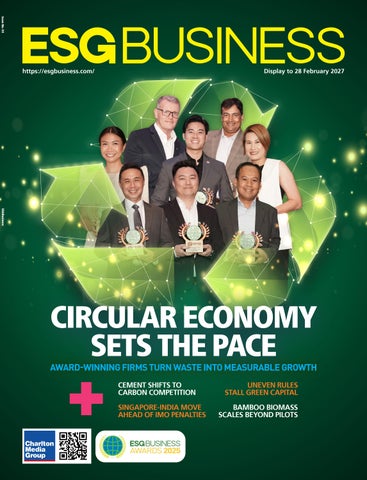
ESGBusiness 2026

Page 1


PUBLISHER & EDITOR-IN-CHIEF Tim Charlton

EDITORIAL MANAGER Tessa Distor

EDITOR Vienna Verzo

PRINT PRODUCTION

PRODUCTION TEAM Vincent Mariel Galang

Noreen Jazul

Marielle Medina

Ibnu Prabowo

Olivia Tirona

Levi Buenviaje

EDITORIAL RESEARCHER Shiena Viene Sur

GRAPHIC ARTISTS Cathlyn de Raya

Simon Engracial

COMMERCIAL MEDIA TEAM Jenelle Samantila

Dana Cruz

Danielle Goh

ADVERTISING CONTACTS Shairah Lambat shairah@charltonmediamail.com

AWARDS Julie Anne Nuñez-Difuntorum awards@charltonmediamail.com

ADMINISTRATION Eucel Balala accounts@charltonmediamail.com

EDITORIAL editor@esgbusiness.com

SINGAPORE

Charlton Media Group 101 Cecil St. #17-09 Tong Eng Building Singapore 069533 +65 3158 1386

HONG KONG

Charlton Media Group Hong Kong Ltd Room 1006, 10th Floor, 299QRC, 287-299 Queen’s Road Central, Sheung Wan, Hong Kong

MIDDLE EAST

FDRK4467, Compass Building, Al Shohada Road, Al Hamra Industrial Zone-FZ Ras Al-Khaimah, United Arab Emirates www.charltonmedia.com

PRINTED BY

Times Printers Private Limited 18 Tuas Avenue 5, Singapore 639342 www.timesprinters.com A member of Times Publishing Limited

Can we help?

Editorial Enquiries: If you have a story idea or press release, please email our news editor at editor@esgbusiness.com. To send a personal message to the editor, include the word “Tim” in the subject line.

Media Partnerships: Please email editor@esgbusiness.com with “partnership” in the subject line.

Subscriptions: Please email subscriptions@charltonmedia.com.

ESGBusiness is published by Charlton Media Group. All editorial is copyright and may not be reproduced without consent. Contributions are invited but copies of all work should be kept as ESGBusiness can accept no responsibility for loss. We will however take the gains.

*If you’re reading the small print you may be missing the big picture

FROM THE EDITOR

Sustainability is shifting from targets to enforcement across Asia. On pages 6 to 8, we look at how methane compliance is moving into the insurance market. Sompo is piloting cover linked to satellite detection and leak thresholds as EU methane rules tighten. Risk transfer is becoming part of emissions control.

Financing remains uneven. A CEO study finds 84% plan to maintain sustainability investment, yet only 35% of Sustainable Development Goals are on track. More than 140 economies have adopted net-zero targets, but capital continues to concentrate in advanced markets. Read the analysis on page 7.

In Indonesia, oversupply has reset the cement industry. Utilisation remains at 54%, and producers are competing on energy costs and carbon intensity rather than volume. Efficiency is no longer optional. The full report is on pages 16–18.

Shipping faces its own shift. The Singapore–India green corridor comes ahead of the IMO’s Net-Zero Framework, which will impose emissions penalties from 2028. Ports and operators are positioning for alternative fuel bunkering and tighter disclosure. Turn to page 18.

Execution on the ground continues. Clean Power Indonesia is scaling bamboo biomass from small island pilots to larger hybrid systems, testing whether decentralised renewables can replace diesel at commercial scale. Read more on page 10.

Across these stories, the change is clear: sustainability is being priced, regulated, and operationalised.

Read on and enjoy.

ESGBusiness is a proud media partner and host of the following events:

Haymarket’s ambition is for our workforce to be truly reflective of the communities we serve and we continue to embed diversity, equity and inclusion in all that we do. This is reflected in our overarching purpose:

Shaping a better future with remarkable content.

Wealth

News from esgbusiness.com

Daily news from Asia

Singapore rolls out initiatives for carbon market development

The government has launched initiatives to aid the development of carbon markets, including a voluntary carbon market guidance, discussions amongst Asian businesses, and the $11.5m carbon market development grant. Applications for the grant opened on 1 November 2025.

Global energy consumption to rise due to data centres, EV demand

Global energy consumption is expected to increase by 2.9% yearly from 2030 to 2050, with emerging data centres and rise in electric vehicles seen as new demand drivers, a report said. “Data centres could drive a sharp increase in energy demand,” McKinsey & Company said in its Global Energy Perspective 2025 report.

Lack of risk framework stalls longterm clean energy investment

The main challenge in financing clean energy projects is securing customer financial commitment due to the lack of a defined risk framework that would assure long-term investment viability. Having a clear framework would secure a counterparty for the long-term financial risk.

Over half of CEOs confident in meeting 2030 net zero commitments

Over half of CEOs say they are on track to hit their 2030 net zero targets, according to KPMG. This may be due to businesses reviewing their interim climate goals to be more realistic and aligned with their core business strategy. A key challenge to reaching net zero is the complexity of decarbonising supply chains.

Firms do not have sufficiently robust reporting on nature – EY

Businesses are not yet producing sufficiently detailed reporting to show how they address nature-related risks and opportunities, according to EY. The firm’s analysis of 435 companies found that only 26% align with the Taskforce on Nature-related Financial Disclosures recommendations.

Waste-to-energy ties with mainland key to Hong Kong’s green goals

Hong Kong should tap waste-toenergy facilities across the Greater Bay Area instead of building its own, as it tries to phase out landfills by 2035 and generate over 900 million kilowatt-hours of electricity, analysts said. Waste-to-energy facilities are key to Hong Kong’s push for more sustainable waste management.

SUSTAINABILITY IMPACT PROGRAMME

SINGAPORE LAW FIRMS SEE SURGE IN GREEN WORK

Law firms in Singapore are seeing a surge in client demand for sustainability-related advice as companies scramble to comply with tighter environmental, social, and governance (ESG) requirements.

Law firm Dentons Rodyk & Davidson LLP said more clients are seeking advice on carbon projects and international trade, where compliance with overseas rules is considered critical.

“Those impacted by commercial considerations, like businesses investing in carbon projects or involved in international trade… are the sectors most actively seeking sustainability legal assistance,” Jean Nie Ho, a partner at Dentons Rodyk and head of its ESG practice, told ESGBusiness in an exclusive interview.

The city-state’s sustainability legal service market is expected to grow 10% annually to as much as $390m (S$500m) by 2033 from 2023, according to a study by PwC Singapore.

Key drivers and challenges

The report cited key drivers such as Singapore’s Green Plan 2030, the 2050 net-zero target, and the Carbon Tax Act, along with the implementation of Article 6 of the Paris Agreement, all of which create new compliance requirements for businesses.

These shifts have generated more work for law firms, particularly those advising on carbon tax, emission projects, and regulatory alignment.

Despite the growth outlook, PwC highlighted hurdles for law firms. Gaps in technical expertise, strong competition from international players, and client pressure to keep fees low remain major challenges.

The study found most lawyers know sustainability concepts but lack formal technical training for complex ESG work. According to PwC, clients want advice blending legal and commercial insight, though cost still influences their choice of counsel.

Sompo pilots methanelinked insurance

Sompo Japan Insurance, Inc. is piloting methane insurance as regulators worldwide increase pressure on companies to track and cut emissions of the potent greenhouse gas.

The insurer has teamed up with Momentick Ltd., Sompo Risk Management Inc., and JGC Holdings Corp. to launch an insurance-linked methane detection service.

The package combines satellite monitoring, on-site inspections, and financial cover to help clients detect leaks, meet reporting requirements, and avoid penalties.

“[Our] goal is reducing the risk of fines and other financial losses, such as in air, energy, and more,” Keisuke Yano, senior deputy manager at Sompo. “Next is protecting the safety of employees and the local community by preventing the leakage and spread of high-concentration mechanisms.”

Momentick’s satellite platform pinpoints emissions around insured assets and generates reports that Sompo can use for underwriting. JGC provides drone and on-site surveys for operators needing more granular data.

Sompo said the service supports

companies aiming to comply with the Global Methane Pledge, which targets a 30% cut in methane by 2030. Though the product is untested, the firm sees growth potential in Europe and North America, where oversight is expanding.

“Last year, we had a lot of activity in France, so we invested there, and we would like to provide this branch and provide solutions to companies not only in Japan but also overseas,” Yano said in an exclusive interview.

The European Union adopted binding methane rules in April 2024 requiring companies to measure, report, and verify emissions under the OGMP 2.0 framework. The same standards apply to oil, gas, and coal imports into the EU.

“This impacts not only the EU but also other countries such as Qatar, Norway, the UK, and Algeria,” Takahiro Okazaki, programme manager for GHG management at JGC, said in the same interview.

He noted that more than 140 companies in 70 countries have joined OGMP 2.0, covering 40% of global oil and gas production and 80% of traded energy.

In Southeast Asia, Malaysia’s Petroliam Nasional Berhad, Indonesia’s PT Pertamina, and Thailand’s PTT Public Co. Ltd. are signatories, whilst in Japan, only one company has joined.

New budget source

Okazaki said Sompo’s product helps firms finance compliance.

“Sompo’s insurance services are a good driver to enhance abatement because clients often struggle to secure budgets,” he said. “If Sompo can work with them from the insurance side, it creates another budget source. This can be very helpful for clients.”

Sompo is also testing a clause linking payouts to leak detection. “The rule is detecting emissions exceeding a certain threshold. For example, 1,000 kilogrammes per hour, and then we pay insurance money as countermeasure costs,” Yano said.

Momentick processes data from nine satellite constellations with artificial intelligence to deliver live reports.

“We can provide companies with live emission reports almost in real time,” Momentick CEO Daniel Kashmir said. “It’s not only about what happened today or yesterday. We have data on assets worldwide going back seven years.”

The Global Methane Pledge targets a 30% cut in methane by 2030
INSURANCE
Keisuke Yano
Takahiro Okazaki
Daniel Kashmir

CEO study flags weak rules stalling sustainability returns

Global companies are expanding sustainability spending even as weak regulation and uneven access to green finance constrain progress, according to the 2025 UN Global Compact-Accenture CEO Study.

Only 35% of the United Nations Sustainable Development Goals are on track, underscoring the gap between stated commitments and measurable outcomes, according to the survey. It also showed that corporate sustainability is now embedded in most business operations, but inconsistent policy and financing remain the main

McKinsey & Company estimates a possible $1t opportunity for private capital by 2030, given growing demand for technologies that support climate resilience and adaptation.

barriers to scaling results.

The study of nearly 2,000 chief executives across 120 markets found that 84% plan to maintain and prepare for sustainability investment. Corporate integration has expanded, with 86% of companies building environmental and social objectives into core operations and 59% linking management pay to sustainability metrics. However, only 25% of CEOs rank technology and innovation amongst their top business priorities, despite 97% identifying them as essential for long-term performance, reporting compliance, and risk management.

Sustainable finance remains a key constraint, according to the report. Although 80% of CEOs said access to capital has improved over recent decades, only 55% expect financing conditions to continue strengthening.

More than 140 economies, representing about 90% of global GDP, have adopted net-zero targets, but most climate-aligned funding remains concentrated in advanced economies.

The study also highlighted a widening gap between corporate ambition and execution across regions. It showed that companies operating in emerging markets face higher financing costs, less consistent policy support, and fewer transition funding mechanisms, limiting their ability to deploy capital at scale.

The report noted that without broader participation from financial institutions, governments, and multilateral lenders, corporate sustainability efforts risk remaining fragmented and uneven despite rising executive commitment.

“When regulation supports sustainability, capital follows,” Nikolaj Sørensen, chief executive of Sweden’s Orexo AB, said in the report.

“Overall, private capital activity in climate adaptation and resilience has been materially lower compared with investment in decarbonisation and mitigation,” McKinsey & Company wrote in its report.

As of June 2025, less than $8b had been raised for investments in resilience from fewer than 120 dedicated climate resilience funds, whereas more than $650b had been raised for decarbonisation and broader sustainability investments from over 1,300 private funds.

“Although private capital in this area is beginning from a small base, it’s starting to mobilise around climate resilience as an

attractive theme,” McKinsey said.

When regulation supports sustainability, capital follows

“Larger firms are making investments dedicated to adaptation and resiliency, often out of their existing climate funds,” it added. In 2024, 11% of investments in climate resilience came from private capital sources. The 89% majority was backed by public and philanthropic funding.

“For corporate executives and investors of private capital, we estimate technologies that support climate resilience could represent addressable markets worth $600b to $1t by 2030,” said McKinsey, which quantified the nearterm opportunity to help potential investors.

The following technology categories represent attractive investment opportunities: building resilience; grid hardening; logistics and supply chain; water infrastructure; resilient agriculture; healthcare and livelihood; disaster prediction, prevention, and recovery amongst others.

The study indicated that companies are likely to prioritise targeted efficiency measures, including supply chain emissions reductions and stricter disclosure standards. It added that broader transformation will depend on clearer regulatory alignment, more consistent policy enforcement, and wider participation in sustainable finance across regions.

Projected investment opportunities for selected technologies by 2030

Source: McKinsey & Company

Nikolaj Sørensen

Paya Lebar Green debuts as eco-smart hub

It’s also designed to enhance the health and well-being of its occupants.

Paya Lebar Green, the latest office development by Lendlease, combines sustainability, wellness, and advanced digital infrastructure as it positions itself as a premier business destination beyond Singapore’s central business district (CBD).

Tenants can optimise space use and reduce energy costs through smart Internet-of-Things (IoT) sensors embedded throughout the building, Richard Paine, head of development at Lendlease, told ESGBusiness.

“The IoT smart sensors will help the building be climateresponsive and inform tenants on occupancy and the utilisation rate of spaces,” he said in an interview.

Paine said they wanted to make the building as energyefficient in operation as it was during construction.

To minimise environmental impact during the build phase, Lendlease used biodiesel and electric-powered equipment, including battery systems for tower cranes and solar-powered lighting. The building was also built using low-carbon concrete, which traps carbon within the mix, and eco-certified finishes.

These efforts contribute to Paya Lebar Green’s achievement of the Building and Construction Authority (BCA) Green Mark 2021 Platinum-Super Low Energy certification, Singapore’s highest green building standard.

Paya Lebar Green isn’t just energy-efficient; it’s also designed to enhance the health and well-being of its occupants. It earned a WELL Core Silver pre-certification, an international standard for wellness-focused buildings.

1 Paya Lebar Green provides easy access to amenities in and around the precinct.
4 Paya Lebar Green North, a fully refurbished 8-storey building.
2 Lobby of the new 12-storey Paya Lebar Green South building.
Smart technology for a seamless workplace experience.
Thoughtful design combining refined aesthetics and technology.
End-of-trip facilities and shared mobility solutions encourage greener commutes. (Photos by Steve Redstone)
Richard Paine

Empowering Spaces, Sustaining the Future

CPI scales bamboo biomass to bigger projects

The company will apply its biochar innovation to hybrid power systems in Atambua and Nusa Penida.

Clean Power Indonesia (CPI), which pioneered bamboo-fuelled power plants in the Mentawai Islands in West Sumatra, is scaling up its renewable energy initiatives with a 30-megawatt (MW) hybrid project in Atambua, Timor and a plan to achieve 100% renewable energy in Nusa Penida before Bali’s 2045 net-zero target.

The company’s earlier project in Mentawai delivered 700 kilowatts (kW) of power to 1,233 households across three villages—Saliguma, Madobag, and Matotonan.

Operated by PT Carta Putra Indonesia and funded by the US Millennium Challenge Corp., the $14m initiative replaced costly diesel generation with bamboo biomass whilst generating income streams for local communities.

“Small islands in Indonesia can’t rely on the same energy models as India or China—we need solutions that work with our local realities,” CPI President-Director Jaya Wahono told ESGBusiness.

The Mentawai facilities, later handed over to the National Development Planning Agency (Bappenas) and then the local government, became a model for community-led energy. Locals set up cooperatives and their own enterprises to cultivate bamboo, supply fuel, and buy power from PT Perusahaan Listrik Negara (Persero) Tbk (PLN), creating both supply and demand locally.

The programme generated about $122,000 (IDR 2b) annually from bamboo sales and was projected to save as much as $857,000 (IDR 14b) yearly by displacing diesel.

“By making the community both the supplier of biomass and the user of electricity, you ensure sustainability—people have a direct stake in the system’s success,” Wahono said in an interview.

Long-term power plan

One innovation was biochar, a by-product of bamboo gasification. Initially applied to restore degraded soils, it is now being developed as a potential substitute for coking coal in steelmaking.

“With biochar, you get three wins at once—reduced emissions, healthier soils, and potential carbon credit revenues,” Wahono told the magazine.

The tech is central to CPI’s projects. In Atambua, East Nusa Tenggara in Timor, the company is preparing raw materials and finalising feasibility studies for a hybrid plant integrating biomass, solar, and wind.

Bamboo offers both economic and environmental advantages, making it a practical energy source for the 100 million Indonesians who still rely on biomass for daily needs. Unlike conventional timber, bamboo grows rapidly, reaching up to a metre per day, and can be harvested in just three to six years. It emits fewer pollutants than wood or petroleum and helps ease pressure on forests, a critical priority in a country that lost more than 840,000 hectares to deforestation in 2012.

Listed in PLN’s long-term power plan, the project is designed to reach 30 MW and replace stalled coal developments in the region. CPI seeks to replicate the participatory model used in Mentawai to ensure reliable feedstock supply and community benefits.

In Bali’s Nusa Penida, CPI is pursuing an even more

ambitious target: achieving 100% renewable energy by 2030. The plan has been adopted into the Bali provincial government’s strategic programme.

The system will use gamal wood for biomass—its leaves feed livestock whilst stems supply fuel—alongside solar and battery storage. Electricity will be sold to PLN under long-term contracts.

“The people here understand this isn’t just about power—it’s about jobs, income, and a healthier environment,” Wahono said.

Uneven energy access

Nusa Penida has attracted investment from a major Indonesian company and is expected to become a learning hub for small islands nationwide.

The Mentawai project was the proof of concept; now, Nusa Penida will be the proof of scale

Indonesia’s uneven energy access underscores the significance of such projects. Whilst Jakarta’s per capita electricity use is around 6,000 kWh, the national average is just 1,000 kWh. In remote areas such as Mentawai and Nusa Tenggara Timur, consumption falls to 200 kWh, similar to Sub-Saharan Africa.

By combining biomass, solar, wind, energy storage, and advanced biochar applications, CPI aims to show that small islands can leapfrog fossil fuels entirely.

“The Mentawai project was the proof of concept,” Wahono said. “Now, Nusa Penida will be the proof of scale.”

Jaya Wahono, president-director at CPI
INDONESIA

APAC energy tech adoption slumps below 15%

The ABB Index surveyed 4,085 regional leaders on digital transition gaps.

Fewer than 15% of companies in the Asia-Pacific region are fully leveraging digital technologies to drive their energy transition despite growing recognition of their importance, according to the energy industries division of ABB Pte. Ltd.

Interest is accelerating, but adoption is still limited, Anders Maltesen, president of ABB’s Energy Industries division, Asia, told ESGBusiness.

Some companies are taking concrete steps. In the Philippines, Aboitiz Equity Ventures, Inc. is “doing a lot on digital to improve their energy efficiency and reduce their emissions,” whilst in Thailand, IRPC Public Co. Ltd. uses an advanced process control system to optimise steam and energy use at its cogeneration plants, he said.

The technology cut high-pressure steam header variability by up to 50% and lowered steam consumption.

ABB’s Asia-Pacific Energy Transition Readiness Index 2025 surveyed 4,085 energy leaders across the region between May and June 2025 and found that 71% see artificial intelligence (AI) and automation as key enablers of transition goals. Yet only 11% to 14% reported using fully optimised tools such as AI-driven optimisation, digital twins, or scenario modelling.

The ABB study also found mixed perceptions about the region’s progress. About 65% of respondents said the transition is moving at an adequate pace, whilst 56% have a formal energy management and transition plan. However, only 13% rated themselves as highly ready in terms of technology and infrastructure.

Here’s the rest of the interview.

Why are Asia-Pacific companies optimistic about energy transition but slow to act?

Every country is different, and everybody has a different energy transition recipe to get to their goal. I think it’s important to understand why we also see some differences in terms of why there is a disconnect between optimism and action. We see a high level of confidence, and that means people start to believe that we are on the right track. People will see that we will make it, but also part of it is the newer technology—they are still in the pilot phase. Scaling them at the moment is likely not economical because at the pilot, we get higher costs. So we need to see that the first few commercial-scale projects come through, and then when they prove that we can bring down the cost, we’re likely going to see that accelerating.

What is hindering companies from developing foundational plans for their energy transition?

Asia is competing with the rest of the world. Capital is looking for the right mix between risk and return. Asia needs

to focus on looking at how to get the right risk-and-return balance. The capital is there, but it’s about getting that right. Organisations are ramping up their investments, 57% are spending more than 20%, which is actually above the global average. So it’s not that things are not happening, but they could go better faster when we manage the risk-and-reward balance, specifically for private capital. Government funding is a different issue, and we have also seen more and more companies focusing on allocating more investments.

I think they expect to grow their investments in sustainability by 50% over the next five years.

So that’s also a good indication that things are on the right track. If we think there’s a bottleneck today, that is going to disappear in the next few years.

Not enough companies have set targets yet, but it also depends on the size of the companies. I would say most of the bigger companies, we definitely see that targets are set. Now, some smaller companies maybe are not setting targets, but that doesn’t mean they’re not doing things. They’re not as focused on communicating their targets to the outside.

Are data and advanced tech being underused in the AsiaPacific region’s energy transition?

[Companies] expect to grow their investments in sustainability by 50% over the next five years

We definitely see a lot of interest in this part of the world, but we should not forget one of the reasons, and this comes back to the trilemma. If we look at, for example, Malaysia, Indonesia, the Philippines, Vietnam, and Thailand, affordability has been higher on the agenda than sustainability. Therefore, I would say some of these countries are likely a bit slower in adopting it.

Japan, Korea, Singapore, and Australia are leading more here, and some of them are definitely at par with what we have seen in some of the European countries, specifically in Northern Europe. So I think it’s a little bit in terms of the priorities on the trilemma, but we see that picking up.

Anders Maltesen, president of ABB’s Energy Industries division, Asia

MARKET REPORT: SINGAPORE

Developers scrap single-use designs

Clients want buildings that are integrated and human-centric.

SINGAPORE

Property owners in Singapore are ditching single-purpose projects in favour of buildings that function well and enhance how people experience them.

“There is increasing demand for mixed-use developments, integrated transit-oriented projects, and community-centric spaces that respond to evolving urban lifestyles,” David Chim, executive director at Aedas Architects, told ESGBusiness in an exclusive interview.

‘Human-centric’ designs Clients are seeking buildings that are “integrated” and “human-centric,” said Ng Meng Hui, managing director at RSP Architects Planners & Engineers. Projects are expected to be porous, biophilic, and closely linked to their surroundings.

“There is a strong trend towards dissolving walls between a building and its surroundings, blurring boundaries for greater community engagement,” he told the magazine.

RSP’s SIT Punggol Campus Court shows the shift. The campus connects directly with the Park Connector Network along the Punggol Promenade Nature Walk, letting joggers and cyclists pass through its grounds and use facilities such as the food court.

At ONG&ONG Pte. Ltd., architect Ryan Teo said sensory inclusivity is being incorporated into design. For Pathlight School (Tampines), his team created alcoves with tactile wall installations to offer students calming spaces. “These small touches make a big difference in making spaces feel warm, safe, and welcoming,” he said.

Accessibility has become central to human-centric design. RSP’s Bird Paradise was designed with wide, gentle walkways and cooling rest stops to ensure ease of use for wheelchair users, families with prams, and visitors of all abilities.

Singapore’s revised Code on Accessibility in the Built Environment, effective from 1

November 2025, now mandates features such as grab bars, rest areas, and standardised tactile indicators.

SAA Architects Pte. Ltd. Director Ivy Koh said the revised code would be a “core design driver,” influencing planning from the earliest stages.

The firm’s mixed-use GENEO uses barrier-free access, tactile wayfinding, and inclusive amenities for people with disabilities.

Flexibility and adaptability are also shaping demand. Ng said stakeholders want properties with flex spaces — areas that can shift functions with sliding walls or technology. Teo added that rigid layouts are giving way to designs that support work, rest, and socialising in the same footprint.

Koh noted that health campuses are increasingly designed to expand

bed capacity when required, whilst in the residential sector, landed properties are being redeveloped into multigenerational homes.

Elizabeth Hardie, an architect at ONG&ONG, said developers are planning for future upgrades.

“This has led to increased demand for additional mechanical and electrical shafts and design provisions that allow for future upgrades, such as the easy installation of new piping or wiring without disrupting existing building functions,” she said in a separate interview.

Sustainability is another driver. Chim said more asset enhancement and adaptive reuse projects are being commissioned as clients seek to reduce carbon impact whilst meeting user expectations.

The SIT Punggol Campus connects directly with the Park Connector Network (Photo from RSP)
David Chim
Ng Meng Hui
Dela Paz Power Plant
Limay Power Plant
San Roque Hydroelectric Power Plant Ilijan Power Plant
Sual

MARKET REPORT: INDONESIA

Cement makers cut emissions as glut persists

Over 56m tons of excess capacity push producers to compete on efficiency and carbon intensity.

Indonesia’s cement industry is stuck in a low-use trap, and producers are being forced to compete on efficiency and carbon performance rather than volume as oversupply shows no sign of easing.

National cement use remained at 54% in 2025, according to PT Cemindo Gemilang Tbk’s market and sustainability outlook released in January 2026, underscoring how excess capacity has reshaped competitive dynamics in Southeast Asia’s biggest economy.

“In an oversupplied market, competitiveness is increasingly defined by efficiency and carbon performance rather than volume expansion,”

Surindro Kalbu Adi, commercial and logistics director at Cemindo, said in an exclusive interview. “With utilisation structurally low, the market no longer rewards capacity expansion.”

With overcapacity estimated at more than 56 million tons, adding production lines no longer translates into growth.

Why it matters: Cement makers are facing a structural reset. With demand soft and capacity locked in, margins are increasingly determined by energy costs, emission intensity, and product mix—not how much cement a company can sell.

For investors and policymakers, the sector’s path points to consolidation, decarbonisation

Customers are starting to evaluate cement not only on strength, but also on its carbon profile and long-term durability

spending, and sharper competition amongst incumbents.

Domestic demand weakened in 2025 as infrastructure spending slowed, including projects linked to Indonesia’s planned capital relocation to Nusantara.

National cement sales fell about 1.5% year on year to 63.85 million tons in 2025. Growth was concentrated mainly in eastern Indonesia, whilst demand in Java and other major markets cooled.

For Cemindo, sustainability has shifted from a regulatory obligation to a commercial strategy.

Through its Semen Merah Putih brand, the company grew 4.2% in its key markets in 2025, even as overall industry volumes fell, showing that product mix and cost control are driving growth in a flat market.

Energy remains the industry’s biggest cost and emission source. Cemindo operates waste heat recovery systems totalling 30 megawatts in Indonesia and 13 megawatts in Vietnam, supplying about 24% of clinker production energy and cutting roughly 100,000 tons of carbon dioxide a year.

“Every reduction in energy use and clinker factor also improves operating efficiency,” Surindro said, adding that decarbonisation and cost control are increasingly inseparable.

From 2016 to 2024, Cemindo cut

carbon emissions per ton of cement by about 21% by improving premix design and using more materials like fly ash, reducing energy use and costs as pricing power weakens.

The company has also extended emission cuts beyond the factory.

Cemindo has rolled out 17 electric quarry trucks and 23 electric forklifts, eliminating about 8,500 tons of carbon dioxide every year and bringing logistics into its cost and carbon strategy.

Product mix is becoming another differentiator. Lower-clinker products such as FLEXIPLUS, ECOPRO, Semen Patriot and Watershield now account for about 81% of Semen Merah Putih’s portfolio, well above the industry average of 71%.

All products carry Green Label Indonesia certification, mostly at the Platinum level. “Green cement is no longer a premium niche,” Surindro told ESGBusiness. “It is becoming the standard operating model in a crowded and regulated market.”

Industry necessity

Demand signals are beginning to reflect that shift.

Hydraulic cement, including FLEXIPLUS, surged more than seven times last year and is targeted to grow another 20.7% this year, as developers factor emissions and durability into procurement decisions.

“The transition to more sustainable construction materials is no longer a choice, but an industry necessity,” said Oza Guswara, general manager for sales and marketing at Semen Merah Putih. “Customers are starting to evaluate cement not only on strength, but also on its carbon profile and long-term durability.”

For Indonesia’s cement industry, low capacity use is likely to persist, leaving efficiency, reliability and carbon performance as key advantages, whilst slower adopters face continued margin pressure amid tighter standards and uneven demand. “Sustainability must work across the ecosystem, from producers to contractors, so efficiency and quality move together,” Surindro said.

Surindro Kalbu Adi
Indonesia’s cement sales fell about 1.5% year on year to 63.85 million tons in 2025

IDC ESG 30 Honouree

& SHIPPING

SG-India corridor targets low-carbon fuel

The

partnership also builds digital information exchange between ports.

Singapore and India’s green and digital shipping corridor is expected to create opportunities for clean-fuel bunkering and infrastructure as the maritime sector prepares to align with the International Maritime Organization’s (IMO) target of netzero emissions by 2050.

Shahrin Osman, business development director for maritime advisory at Norway-based classification society Det Norske Veritas (DNV), said India’s renewable energy capacity of 234 gigawatts, based on Rystad Energy’s 2025 report, positions it to produce zero- or near-zero-emission fuels.

“They have that ability to produce zero or near-zero fuels… that gives an opportunity to this ecosystem to look at how they could use this green and digital shipping corridor to enter into this alternative fuel bunkering,” he told ESGBusiness.

Alternative fuel bunkering

Singapore and India signed a deal in September 2025 to establish the Singapore-India Green and Digital Shipping Corridor. The partnership seeks to develop infrastructure and technologies that support low-emission fuels and enable digital information exchange between ports.

Osman said alternative fuel bunkering could spur industries around fuel storage and supplier services. “When you have the ability to provide that, then the port will become more attractive,” he said.

“Even though they may not have cargo, load or discharge, if there is a competitive supply of cleaner fuels, then the vessel will call the port to get that supply.”

The partnership comes ahead of the IMO’s adoption of its Net-Zero Framework, which introduces penalties for ships that fail to meet emission targets. From 2028 to 2030, fees will be set at $100 per tonne of carbon dioxide equivalent for ships near compliance and $380 per tonne for those further off-target.

Osman said such rules would push

ship owners to adopt alternative fuels rather than pay penalties.

Beyond fuels, the corridor also opens the door for shore power supply at ports, where ships plug directly into clean electricity. Osman said this could be four times more efficient and cheaper than producing synthetic e-fuels.

Goh Puay Guan, associate professor at the Department of Analytics and Operations at the National University of Singapore, said the digital side of the agreement could improve port operations.

also integrate energy-saving technologies such as wind-assisted propulsion systems (WAPS). These can reduce fuel use and emissions by as much as 40%, though they require at least $500,000 in upfront costs per vessel, DNV said in a report in March 2025.

About 50 commercial ships were equipped with WAPS as of January 2025, with more orders expected.

“Digitalisation is an opportunity for improving efficiencies and cost effectiveness, which could be served by companies in supply chain visibility, artificial intelligence, data analytics, robotics and automation, that are able to customise these tools for the maritime industry,” he said.

Osman said ship owners could

Solar panels are another option, though their contribution is typically limited to a 2% reduction in fuel consumption due to space constraints on vessels, according to the report. Osman cited Norway’s Green Shipping Programme as a model, with 19 of 53 pilot projects producing low- or zero-emission solutions since 2015.

Goh added that the SingaporeIndia corridor could expand to include other countries and broaden its coverage in the future.

The partnership comes ahead of IMO’s adoption of its Net-Zero Framework (Photo by Lim Sin Thai)
Goh Puay Guan
Shahrin Osman

EVENT: ESGBUSINESS AWARDS

Standout sustainability leaders lauded at ESGBusiness Awards 2025

Sustainability and ESG excellence took centre stage as the ESGBusiness Awards 2025 celebrated companies demonstrating exceptional commitment and achievement in environmental, social, and governance practices. The prestigious awards programme honoured organisations and initiatives actively driving progress towards sustainable development goals whilst championing resource conservation, social responsibility, and ethical governance.

Industry leaders, innovators, and changemakers were brought together at the Awards Ceremony held on 25 September 2025 at The Westin Kuala Lumpur, Malaysia, showcasing their contributions in building a more sustainable future.

Amongst the winners in this year’s awards programme is 7-Eleven Hong Kong & Macau, DFI Retail Group, which took home accolades in the Circular Economy Award - Hong Kong and Initiative AwardHong Kong for Upcycling categories.

“Thank you, ESGBusiness and the judges for these two honours. I extend my heartfelt gratitude to our customers and to our NGO

ESGBUSINESSAWARDS 2025WINNERS

7-Eleven Hong Kong & Macau, DFI Retail Group

• Circular Economy Award - Hong Kong

• Initiative Award - Hong Kong for Upcycling

A.T. Biopower Co., Ltd.

• Excellence Award - Thailand for Sustainable Energy

ADNOC Drilling Company PJSC

• Energy Innovation and Research Award - UAE

• Initiative Award - UAE for Asset Integrity

AETOS Holdings

• Excellence Award - Singapore for Sustainable Mobility

• Initiative Award - Singapore for Green Mobility

AGRIS

• Net-zero Award - Agriculture

• Sustainable Agriculture Award - Vietnam

Alinma Bank

• Renewable Energy Financing Programme Award - Saudi Arabia

Alliance Bank Malaysia Berhad

• Collaborative Partnership Award - Malaysia

• Stakeholder Engagement Award - Malaysia

AMEA Power

• Education Equality and Access Award - UAE

• Sustainable Infrastructure Award - UAE

ALRAJHI BANK

• Good Governance Award - Saudi Arabia

Alshaya Group

• Waste Reduction Award - Kuwait

Apical Group

• Sustainable Supply Chain Partnership Award - Singapore

partners, Foodlink Foundation and Senior Buddy Charity Farm, whose collaborations make Grounds to Green possible,” said Gloria Shiu, Marketing Director, at 7-Eleven Hong Kong & Macau, DFI Retail Group, during the awards ceremony. “These awards strengthen our commitment to reduce waste, give back, and build a more sustainable Hong Kong, one cup of 7CAFÉ coffee at a time.”

The esteemed panel of judges for this year’s awards programme consisted of Dr. Niven Huang, Managing Director, KPMG Sustainability Consulting, Taiwan; Jimmy Tee, Partner, Sustainability and Climate Change and Financial Services Assurance, PwC Malaysia; Arina Kok, Asia-Pacific Climate Change Advisory Leader; Asean Climate Change and Sustainability Services Co-Leader; Malaysia Climate Change and Sustainability Services (CCaSS) Leader; and Partner, Ernst & Young Consulting Sdn Bhd; Tanima Singh, Specialist Principal India, Kearney; and Michelle Gunawan, Partner, Boston Consulting Group.

Congratulations to all the winners!

AsiaPay

• Net-zero Award - Financial Services

Ayala Land, Inc.

• Circular Economy Award - Philippines

• Sustainable Supply Chain Partnership Award - Philippines

BDO Unibank, Inc.

• Good Governance Award - Philippines

• Renewable Energy Financing Programme Award - Philippines

Brainbox Syndicate (Pvt) Limited

• Economic Empowerment Award - Pakistan

Bridge Data Centres

• Sustainable Water Management Award - Singapore

Cebu Pacific

• Inclusion and Diversity Award - Philippines

• Sustainable Transportation Award - Philippines

Chang Hwa Bank

• Carbon Disclosure Award - Taiwan

CRC Sports Co., Ltd.

• Waste Reduction Award - Thailand

CTBC Bank

• Global Partnership Award - Taiwan

• Renewable Energy Financing Programme Award - Taiwan

Cushman and Wakefield for Standard Chartered Bank Account

• Net-zero Award - Real Estate Services

• Waste Management Award - Singapore

DFI Retail Group

• Sustainable Supply Chain Partnership Award - Hong Kong

DP World, Dubai

• Biodiversity Conservation Award - UAE

Ecolab

• Inclusion and Diversity Award - UAE

Esco Lifesciences Group Ltd

• Circular Economy Award - Indonesia

• Workplace Wellness Programme Award - Singapore

Eupe Corporation Berhad

• Green Building Award - Malaysia

Harbin Electric International Company

• Green Spaces Award - Pakistan

Haymarket Media Limited

• Carbon Disclosure Award - Hong Kong

• Inclusion and Diversity Award - Hong Kong

HH Global

• Initiative Award - Hong Kong for Social Impact

• Stakeholder Engagement Award - Hong Kong

Hong Leong Bank Berhad

• Renewable Energy Financing Programme Award - Malaysia

• Biodiversity Conservation Award - Malaysia

ICT Academy of Tamil Nadu

• Youth Employment Award - India

Infrastructure Development Company Limited (IDCOL)

• Renewable Energy Financing Programme Award - Bangladesh

• Sustainable Infrastructure Award - Bangladesh

InLife Foundation

• Economic Empowerment Award - Philippines

InLife

• Reward and Recognition Award - Philippines

INVESTBANK

• Education Equality and Access Award - Jordan

• Biodiversity Conservation Award - Jordan

JS Bank

• Community Health Outreach Programme Award - Pakistan

• Renewable Energy Adoption Award - Pakistan

JSCB Uzbek Industrial and Construction Bank

• Renewable Energy Adoption Award - Uzbekistan

• Sustainable Infrastructure Award - Uzbekistan

Kenanga Investment Bank Berhad

• Carbon Disclosure Award - Malaysia

• Digital Inclusion Award - Malaysia

Krungthai Bank PCL

• Health Technology Innovation Award - Thailand

• Workplace Wellness Programme Award - Thailand

Malayan Banking Berhad (Maybank)

• Net-zero Award - Banking

• Wildlife Protection Award - Malaysia

Megaworld Corporation

• Biodiversity Conservation Award - Philippines

• Waste Management Award - Philippines

Megaworld Lifestyle Malls

• Renewable Energy Adoption Award - Philippines

• Smart City Award - Philippines

Melco Resorts & Entertainment

• Waste Reduction Award - Hong Kong

MR.DIY Philippines

• Job Creation Award - Philippines

Mynt

• Cross-Sector Collaboration - Philippines

• Digital Inclusion Award - Philippines

NTUC LearningHub Pte Ltd

• Community Health Outreach Programme Award - Singapore

• Initiative Award - Singapore for Inclusive Growth

OCBC Bank (Malaysia) Berhad

• Sustainable Infrastructure Award - Malaysia

Pandora Production Co. Ltd

• Circular Economy Award - Thailand

Personal Collection Direct Selling, Inc.

• Green Packaging Solution Award - Philippines

• Initiative Award - Philippines for Environmental Impact

Pertamina Hulu Energi

• Renewable Energy Microgrids Award - Indonesia

PHILIPPINE MANUFACTURING CO. OF MURATA, INC.

• Social Inclusion and Equal Opportunities Award - Philippines

Princeton Digital Group

• Sustainable Infrastructure Award - Singapore

Probe Group

• Sustainable Infrastructure Award - Philippines

• Sustainable Water Management Award - Philippines

PT Permata Graha Nusantara

• Sustainable Infrastructure Award - Indonesia

PT PLN Indonesia Power UBP Suralaya

• Economic Empowerment Award - Indonesia

• Sustainable Product Design Award - Indonesia

PT Siloam International Hospitals

• Community Health Outreach Programme Award - Indonesia

PT Vale Indonesia Tbk (PT Vale)

• Biodiversity Conservation Award - Indonesia

• Waste Management Award - Indonesia

PT Waskita Karya (Persero) Tbk

• Sustainable Water Management Award - Indonesia

PTT Exploration and Production Public Company Limited

• Ocean Research and Monitoring Award - Thailand

Purview Services

• Digital Inclusion Award - Singapore

• Health Equity and Inclusion Award - Singapore

EVENT: ESGBUSINESS AWARDS

Qianhai Reinsurance Company Limited

• Healthcare Services Award - China

Rajah & Tann Singapore

• Net-zero Award - Legal

Samsung Malaysia Electronics (SME) Sdn. Bhd.

• Waste Management Award - Malaysia

San Miguel Global Power Holdings Corp.

• Education Equality and Access Award - Philippines

• Initiative Award - Philippines for Employee Engagement

Sandisk

• Energy Efficiency Retrofit Programme Award - Malaysia

• Industrial Energy Efficiency Award - Malaysia

Saudi Telecom Company (stc)

• Economic Empowerment Award - Saudi Arabia

• Social Inclusion and Equal Opportunities Award - Saudi Arabia

Southeast Asia Commercial Joint Stock Bank

• Gender Equality and Women Empowerment Award - Vietnam

The Bank of Punjab

• Digital Inclusion Award - Pakistan

• Inclusion and Diversity Award - Pakistan

Touch ‘n Go Sdn Bhd

• Education Equality and Access Award - Malaysia

• Inclusion and Diversity Award - Malaysia

TPI Polene Public Company Limited (TPIPL)

• Industrial Energy Efficiency Award - Thailand

United Overseas Bank (Thai) Public Company Limited

• Energy Efficiency Retrofit Programme Award - Thailand

• Inclusion and Diversity Award - Thailand

Universal Robina Corporation

• Waste Reduction Award - Philippines

VinUniversity

• Collaborative Partnership Award - Vietnam

• Cross-Sector Collaboration - Vietnam

BDO Unibank, Inc.
CRC Sports Co., Ltd.
7-Eleven Hong Kong & Macau, DFI Retail Group
Alliance Bank Malaysia Berhad
AETOS Holdings Apical Group
AGRIS
Bridge Data Centres
Ayala Land Inc.
Cebu Pacific
Cushman and Wakefield
DFI Retail Group
Esco Lifesciences Group Ltd
HH Global
Malayan Banking Berhad (Maybank)
Mynt Sandisk
Eupe Corporation Berhad
Hong Leong Bank Berhad
MEGAWORLD CORPORATION
Personal Collection Direct Selling, Inc.
Samsung Malaysia Electronics (SME) Sdn. Bhd.
San Miguel Global Power Holdings Corp.
Probe Group
Touch ‘n Go Sdn Bhd
Haymarket Media Limited
InLife
MR.DIY Philippines
PT Vale Indonesia Tbk (PT Vale)
VinUniversity

Sandisk wins at ESGBusiness Awards 2025 for industrial optimisation, energy efficiency retrofit

Sandisk advances sustainable manufacturing with AI-powered lighting control and intelligent maintenance systems.

The company won Energy Efficiency Retrofit Programme Award - Malaysia and Industrial Energy Efficiency Award - Malaysia in the ESGBusiness Awards 2025. The recognition highlights the company’s success in deploying scalable and costeffective technologies that enhance energy efficiency across its production floors.

Smart Vision AI Retrofit

The first initiative, the Smart Vision AI Retrofit for Energy-Efficient and Sustainable Production Floors, integrates Vision AI with IoT to deliver behaviour-driven lighting control. Unlike traditional motion sensors that often trigger from robotic movement or incidental activity, the system activates lights only during genuine humanmachine interactions. By leveraging existing CCTV and lighting infrastructure, the system minimises false activations, eliminates unnecessary energy use, and ensures safety without compromising productivity.

This retrofit significantly reduced energy consumption, supporting the factory’s sustainability objectives and promoting more environmentally responsible operations. The system also extended the lifespan of lighting equipment by

reducing frequent on-off cycling, lowering maintenance needs. Its modular design supports rapid deployment across diverse factory layouts, with real-time monitoring and analytics enabling continuous improvements in energy management.

Smart Energy Optimization & Maintenance

The second initiative, the Smart Energy Optimization & Maintenance Intelligence System, is expected to redefine maintenance practices by replacing rigid schedules with adaptive, condition-based interventions. By utilising real-time data, machine learning, and automated insights, the system aligns maintenance with actual machine health and energy efficiency. This approach reduces downtime, prevents unnecessary energy consumption, and extends equipment lifespan.

Through predictive models, the system can accurately flag early equipment degradation and optimise scheduling around

low-demand periods, reducing peak energy use and operational costs. By integrating data from multiple sources, it enhances decision-making for both maintenance and operations teams, ensuring machines operate at optimal energy levels whilst reducing waste.

Together, these projects demonstrate Sandisk’s ability to integrate advanced technologies into existing infrastructure to deliver measurable impact.

The solutions not only improve operational efficiency but also establish practical models for sustainable industrial retrofits, encouraging broader adoption across the manufacturing sector.

The ESGBusiness Awards celebrates companies that are leading the way in building a sustainable future. The awards programme honours businesses that demonstrate outstanding commitment and achievement in environmental, social, and governance (ESG) practices.

These projects demonstrate Sandisk’s ability to integrate advanced technologies into existing infrastructure to deliver measurable impact

Sandisk at the ESGBusiness Awards 2025

SUPERSPORTS MOVES THE CHANGE IN SOCIETY, RE-BALANCE THE WORLD

From 2022 to 2024

Protecting our planet, one repair at a time

We’re honoured to have our Eco Repair initiative recognised for empowering Malaysians to live more sustainably through our devices.

GROWING IMPACT FOR A BETTER TOMORROW

At INVESTBANK, our commitment to education, sustainability, and community wellbeing continues to guide our mission. Our ongoing dedication to creating opportunities for people and protecting the environment for future generations is reflected in receiving two ESG Business Awards for Education Equality & Access and Biodiversity Conservation.

Investbank.jo

+962 6 500 1515

Eco Repair extended the lifespan of

mobile devices televisions

And helped save trees

DRIVING SUSTAINABLE IMPACT WITH INTELLIGENT TELEMATICS

CUT FLEET EMISSIONS, IMPROVE SAFETY, AND DRIVE ESG PERFORMANCE

AETOS helps organisations to modernise fleet operations with intelligent telematics and remote monitoring capabilities:

Leading with purpose through our transformative journey

At Hong Leong Bank, we embed sustainability into the heart of everything we do. As we transition towards a low-carbon economy, we strategically balance our climate commitments with core business objectives, by empowering our customers to make sustainable choices. Working hand-inhand with them, we fulfil our purpose as a leading financial institution in Asia, while cultivating a resilient, inclusive, and future-ready economy.

Scan here to learn more about how

Why ASEAN needs a regional methane target

When it comes to climate change, it’s important to consider not just carbon dioxide (CO2), but also the significant impact of methane (CH4).

Methane is approximately 84 times more effective than CO2 at warming the atmosphere during the first 20 years after its release.

The 8th ASEAN Energy Outlook, ASEAN’s energy demand is projected to nearly triple from 2022 levels, reaching 1,108 million tons of oil equivalent (Mtoe) in 2050.

The report also projects energy-related emissions to reach 5,127 million tons of CO2, with methane accounting for 15.7% of about 1,100 million tons of CO2 equivalent.

In the ASEAN energy sector, methane emissions are led by oil and gas at 56%, followed by coal at 44%.

Looking more closely at the oil and gas value chain, methane is released at multiple points in upstream, midstream, and downstream, with the upstream being the largest contributor due to energy demand and potential leaks.

These emissions come from vented sources at 64.57%, followed by fugitive at 26.30%, and flared at 9.13%.

Due to methane’s significant short-term warming potential, urgent reductions in methane emissions from oil and gas should be a key element of the region’s climate strategy.

ASEAN member states and national oil company commitments

ASEAN is not starting from scratch in tackling methane emissions. Several member states and their national oil companies (NOCs) have made public commitments, joining global initiatives such as the Global Methane Pledge, the Oil and Gas Decarbonization Charter (OGDC), and the Oil and Gas Methane Partnership 2.0 (OGMP 2.0).

Amongst NOCs, Pertamina has pledged to reduce methane emissions by 40% by 2030, PETRONAS has committed to a 70% reduction across its natural gas value chain by 2030, and PTT targets a 20% greenhouse gas emissions reduction by 2030.

Beyond these individual pledges, several NOCs and government agencies have issued joint statements committing to decarbonisation with an emphasis on methane mitigation.

At the national level, Cambodia’s Methane Reduction Roadmap, adopted in 2025, set targets of reducing energy-sector methane emissions by 5% in 2030 and 6% by 2050, whilst Vietnam’s Action Plan for Methane Emission Reduction aims for a 30% cut below 2020 levels by 2030, focusing on oil and gas, coal mining, and fuel consumption. These national efforts are complemented by initiatives like the Methane Leadership Program (MLP), which brings together policymakers and industry to build technical capacity and share best practices. Yet despite these steps, progress remains fragmented and insufficient. According to the Methane Management Roadmap for Oil and Gas in ASEAN, there is still a substantial 64% gap between current methane emission levels and the near-zero methane target set for 2030 by OGDC. The gap highlights the urgency for ASEAN to move beyond scattered national initiatives and establish a coordinated regional

methane reduction target.

The importance of establishing a regional methane target in ASEAN Despite this urgency, ASEAN still lacks a binding regional policy or target to close the methane gap.

The Methane Management Roadmap for Oil and Gas in ASEAN offers guidance, but because it remains voluntary, progress is left to the discretion of individual member states.

Without a unified target, ASEAN may face challenges in achieving its climate goals and could potentially lag in the global efforts to reduce methane emissions.

Even when only half of the ASEAN countries are considered the major methane emitters, a regional target would still bring benefits. Setting a regional target would encourage regional NOCs and independent operators to establish their own methane reduction target, fostering a level playing field across the industry.

A unified commitment would also promote greater collaboration and knowledge sharing in methane management efforts across member states, leading to more effective emissions management strategies.

Furthermore, regional endorsement could attract more diverse sources of funding for methane abatement projects, showcasing ASEAN’s commitment to emissions reduction and supporting individual countries’ Nationally Determined Contributions (NDCs).

This collective commitment could significantly contribute to the varied greenhouse gas emissions reduction goals outlined in individual countries’ Nationally Determined Contributions.

The European Union has already shown that a region can successfully adopt a collective methane target through binding regulations, strict monitoring, and ambitious goals.

ASEAN, too, can take inspiration from this precedent by designing a regional framework that reflects its own priorities and circumstances.

Types of methane regional targets for ASEAN

Should ASEAN choose to commit to a regional methane target, the next question is what form that target should take.

One option is an absolute reduction target, like the European Union’s, which aims to cut methane emissions by 77% by 2030, regardless of production growth.

Another is an intensity-based target, such as the OGDC, which sets a collective goal of reducing upstream methane intensity to 0.2% by 2030. Both approaches have merit, and ASEAN can tailor them to regional and national contexts.

Importantly, this isn’t a new concept for ASEAN.

The region already has experience in setting collective energy goals through the ASEAN Plan of Action for Energy Cooperation (APAEC) Phase II. This includes an ‘aspirational target’ to achieve 23% renewable energy in the total energy mix and to reduce energy intensity by 32% by 2025, respectively. Establishing a similar regional target for methane would extend this framework, aligning climate goals with ASEAN’s long-standing commitment to energy cooperation.

Turn static files into dynamic content formats.

Create a flipbook