A C H A R L E S T O N A N I M A L S O C I E T Y P U B L I C AT I O N
CAROLINA
TAILS FALL 2026
PEOPLE & ANIMALS TOGETHER PACT SC Takes Off
100-YEAR-OLD ADOPTER Love at Every Age
CRUELTY CRACKDOWN
The Feds Stepping Up?
All rescue pets deserve a second act Fetch is proud to sponsor the life-saving work of Charleston Animal Society.
DIXIE Rescue dog
Learn more at fetchpet.com
Thank you Charleston Animal Society for saving lives! 1831 Central Ave A Summerville, SC 29483 (843) 873-8194
In Honor of the Beloved Pets of the Greers... Past and Present Sam, Abby, Simon, Bear, Cider, Sirri, Tanner, Sadie, and Rusty
2 CAROLINA TAILS | FALL 2026
CAROLINA
TAILS
Contents FALL 2026
11
5 Welcome Publisher: Charleston Animal Society Editor-in-Chief: Dan Krosse Managing Editor: Joe Elmore Sponsorships: Danielle Zuck Graphic Design: mclaughlin design Copy Editors: Joe Elmore, Kylie Wiest, Natassia Donohue Writers: Dan Krosse, Joe Elmore, Rita Giordano, De Daltorio, Nick Krueger Photographers: Allie Rostadt, Jeanne Taylor, Will Howell, Dan Krosse, Caitlin Maselli, Heather Grogan, Lindsey Cummings, Kylie Wiest, Nick Krueger For inquiries regarding sponsorships, distribution or suggestions in Carolina Tails contact: 2455 Remount Road North Charleston, SC 29406 (843) 747-4849 CharlestonAnimalSociety.org Executive Committee & Officers Aussie Geer, Co-Chair Gerri Greenwood, Co-Chair Jane Graham, Vice Chair Brantley Meier, Secretary Don Smith, Treasurer Cara Bibbiani, Board Member Arlene Morris, Board Member Shelly Leeke, Board Member Hank Greer, Board Emeriti Laurel Greer, Board Emeriti 2026 Members of the Board William Asche Tommy Hall Bill Jasper Linda Bakker Shelly Leeke Cara Bibbiani Luigi Bravo MaKeva McDaniel Caroline Clark Brantley Meier Edward “Ted” Corvey, Matt Miller III, Esq. Arlene Morris Aussie Geer Dick Murphy Jane Graham Carolyn Murray Naomie Olindo Gerri Greenwood Hank Greer Don Smith Laurel Greer Gary Striar President and CEO: Joe Elmore Media & Marketing Consultant: Dan Krosse, dpk media solutions To see all editions of Carolina Tails, visit CharlestonAnimalSociety.org/magazine. For sponsorship, please contact Danielle Zuck: dzuck@CharlestonAnimalSociety.org or (843) 329-1541.
© 2026 Carolina Tails is published by Charleston Animal Society, 2455 Remount Road, North Charleston, SC 29406. Carolina Tails is a registered trademark. Reproduction in whole or in part without the express, written permission of the publisher is prohibited.
6 Pet Pointers 8 A Lifesaving PACT for South Carolina 11 Pit Priority Program 12 100-Year-Old Adopter
12
14 Fighting Cruelty is More than Tougher Laws 15 Feds Crackdown on Cruelty 16 40 Dogs Rescued in Berkeley County 18 Do Animal Abuser Registries Work?
16
22 Decision 2026 Congressional District 1 Candidates 26 Keeping Pets Safe Over the Holidays 29 Inside the Minds of Aging Cats 30 When the Shelter Becomes the Classroom Humane Education for Homeschoolers 32 Dog Park Upgrades!
29
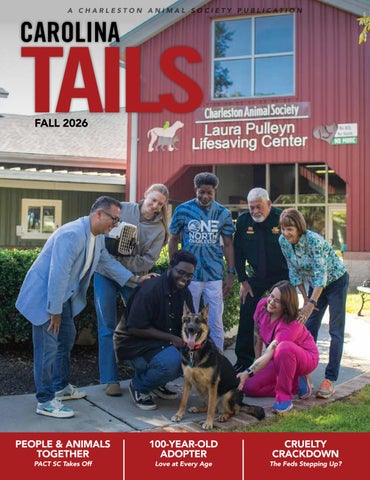
ON THE COVER: Charleston Animal Society is launching PACT SC — People and Animals in Communities Together in South Carolina. PACT SC begins with a fundamental belief: responsibility for animals cannot rest with shelters alone. Lasting progress requires all of us to work together. As the saying goes, “It takes a village!” Photo by Allie Rostadt l Little Runaway Photography.
30 FALL 2026 | CAROLINA TAILS
3
WHEN THEY GET SHAKY-ER Know where to go.
AN ER EXPERIENCE TO SUPPORT YOUR PET—AND YOU Around-the-clock ER: You can’t schedule an emergency; VEG is open 24 hours every day, including holidays Call and speak with a doctor: Get answers from an expert, or come right in and see a doctor right away No waiting and worrying: We’ll prioritize your pet; paperwork can wait Stay with your pet: We keep people and their pets together throughout all phases of treatment
OPEN 24/7 2183 N Hwy 17, Mt Pleasant
We keep your pet comfy: We’ll sit on the floor with your pet, if that’s how they’re more comfortable We treat all pets: Dogs, cats, rabbits, snakes…if it fits through our door, we’ll treat it!
Dear Friends,
Welcome to the Fall 2026 issue of Carolina Tails! Every season brings fresh opportunities to reflect on the extraordinary power of community and compassion. Because of generous, dedicated animal lovers like you, thousands of vulnerable animals across South Carolina are given a second chance at life, love, and healing. Every animal saved, every shelter supported, and every family kept together happens because our community chooses to stand up for those who cannot speak for themselves. As Charleston Animal Society continues to build a kinder, safer world for animals, this issue highlights the inspiring progress we are making together, starting right here in our own backyard. On page 8, Charleston Animal Society President and CEO Joe Elmore introduces PACT SC (People and Animals in South Carolina Communities Together), a bold new statewide initiative backed by a $1.052 million congressional appropriation and Petco Love that strengthens workforce training and shelter medicine.
Board Co-Chair Gerri Greenwood with her dog Remy.
Taking action across the state, Pawmetto Lifeline CEO Denise Wilkinson shares on page 10 how a $610,000 legislative earmark will provide spay-neuter surgeries for approximately 2,500 pit bull-type dogs, tackling shelter overpopulation at its root. We have more than one article on the fight against animal cruelty. On page 14, we outline why stronger animal cruelty laws are only the tip of the iceberg, emphasizing that true protection comes from robust education, trained officers, and prevention resources below the surface. That national momentum against cruelty is echoed on page 15 with the launch of the federal Animal Welfare Strikeforce, while on page 16 we share the powerful account of a joint intervention with the Berkeley County Sheriff’s Office that rescued over 40 dogs and puppies from severe neglect and alleged dogfighting.
Tuesday, November 3rd is election day and we hope you get out there and vote! Page 22 offers perspectives on possible federal microchip reunification legislation from U.S. Congressional Candidates for District 1. Cat lovers don’t want to miss our article on page 28, that gives expert guidance on understanding cognitive changes in aging cats. On page 30, Charleston Animal Society’s Chief Education Officer De Daltorio shares how our monthly homeschool sessions turn the shelter into a vibrant classroom where kids learn alongside our rescue animals. As the year comes to a close, we warmly invite you to join us on Thursday, December 10th at 12:00 p.m. for our annual Lifesaver’s Luncheon, where we will gather to share uplifting stories of help, healing, and hope. Your ongoing support is the heart and soul of everything we do. Together, we have saved thousands of precious lives, but the journey continues, and every animal in need is counting on us to keep fighting for them. Thank you for everything you have done for Charleston Animal Society in 2026. Wishing you and your loved ones joyful, safe, and Happy Holidays! With gratitude,
Aussie Geer Board Co-Chair Charleston Animal Society
Gerri Greenwood Board Co-Chair Charleston Animal Society
Charleston Animal Society Board Co-Chair Aussie Geer with her Charleston Animal Society alums Shadow and Wally. FALL 2026 | CAROLINA TAILS
5
NEWS :: You Can Use
Pet Pointers
TOP HONOR FOR CHARLESTON ANIMAL SOCIETY EMPLOYEE
REMEMBERING RICH AVANZINO
The animal well-being community lost a true visionary on September 20, 2026. Rich Avanzino, affectionately and widely known as the father of the ‘no-kill’ movement, passed away peacefully at the age of 84. While we mourn the loss of a remarkable leader, we also celebrate a remarkable life dedicated to transforming the animal well-being industry into a more collaborative, inclusive, and hopeful space and that forever changed the destiny of countless companion animals and the people who love them. Rich didn’t just work in animal well-being; he completely revolutionized it. Stepping into the role of founding president of Maddie’s Fund in 1999, he was tasked with directing a staggering $300 million family foundation endowment. For Rich, this wasn’t just a fund; it was a catalyst for a new era. He believed deeply that the public was the solution, not the problem, and he used his platform to shift the entire national conversation toward no-kill standards and community-wide solutions. Under his guidance, the field experienced a seismic shift. Rich brought a brilliant, results-driven “venture philanthropy” mindset to the industry. He elevated the standards of animal welfare organizations by requiring grantees to commit to sound business management practices, strategic planning, and performance measurement. Recognizing that shared knowledge empowers everyone, he focused national attention on data by delivering the first searchable database based on the Asilomar Accords, uniting more than 500 organizations in transparency and shared progress. Data collection and sharing continues to be the standard. (Source: Maddie’s Fund) 6 CAROLINA TAILS | FALL 2026
Charleston Animal Society’s Chief Human Resource Officer Angel Waterfield received a top state honor. Waterfield was named the HR Professional of the Year by the Society of Human Resource Professionals (SHRM). Waterfield has led the growth and professional development of Charleston Animal Society’s staff since 2015. Waterfield volunteers with SHRM on the local, state, and national levels. A proud cat owner, Waterfield is a key part of the lifesaving success at the Society, making sure employees have what they need to do their jobs to the best of their abilities each and every day.
2026 RAFFLE WINNERS Because of your generosity, the 10th Annual Hank & Laurel Greer Lifesaving Raffle became Charleston Animal Society’s most successful ever. We extend our deepest gratitude to Hank and Laurel Greer, whose incredible generosity in donating the grand prize vehicle and every cash prize made this lifesaving fundraiser possible. Congratulations to our 2026 Lifesaving Raffle winners: • 2026 Toyota Grand Highlander Platinum Hybrid AWD MAX: Ann Baker of Charleston, SC • $6,000 Cash Prize: Rebecca Knapp of Charleston, SC • $4,000 Cash Prize: Teresa Pooler of Charleston, SC • $2,000 Cash Prize: Gigi Colaiacovo of Anderson, SC • $500 Cash Prize: Sandy Rath of Pawleys Island, SC • $500 Cash Prize: Elena Loomis of Summerville, SC From all of us at Charleston Animal Society, thank you for standing with us and making lifesaving possible.
ENDANGERED SPECIES ACT ENDANGERED?
EUTHANASIA DROPS 43% AT BERKELEY CAMPUS
This past summer the word “harm” was redefined by the Federal Government as it pertains to the Endangered Species Act. Since 1973 “harm” has referred to anything that injures or kills a protected species, including “significant habitat modification or degradation.” But the new regulation does away with that definition, with key agencies stating that they will no longer consider destroying or modifying a species’ habitat a form of prohibited harm. “This is really a stake through the heart of the Endangered Species Act,” says Jane Davenport, a senior attorney at Defenders of Wildlife, a nonprofit conservation organization that is challenging the changes in court. “It will still be illegal to … go out and find a northern spotted owl and shoot it dead. But it’s not going to be considered harm to cut down the old-growth trees without which northern spotted owls cannot reproduce.” Trump administration officials say the change will halt unnecessary regulations. According to the National Parks Conservation 85% of the general public and 82% of hunters support the Endangered Species Act. If you’re concerned, you can contact your U.S. Representative and Senator.
One year after entering a historic agreement to manage operations at the Berkeley County animal shelter, Charleston Animal Society presented remarkable results to the Berkeley County Council, highlighting a dramatic reduction in euthanasia and hundreds of saved lives in its inaugural year. Addressing county leadership, Charleston Animal Society Senior Vice President and Chief Operating Officer Aldwin Roman, CAWA, shared that since assuming operations on July 1, 2025, the strategic partnership has resulted in a 43% drop in euthanasia, compared to the previous year’s outcomes. “The most important thing I can tell this Council tonight is that 600 more animals are alive today that would not have been alive under the previous year’s outcomes,” said Roman. “Euthanasia dropped 43% in our first year — dog euthanasia fell 15% and cat euthanasia fell 53%. These are transformational results that reflect thousands of individual decisions made by staff, volunteers, foster families, and adopters, all working together.” Roman emphasized that these achievements were the direct result of deliberate, research-backed animal welfare models implemented from day one of the partnership: • • • •
Managed Intake & Community Support Expanded Veterinary Care Seven-Day Adoptions & High-Impact Marketing Targeted Behavioral Support
The operational turnaround was achieved while overall intake actually decreased by 13%, driven by managed intake strategies that keep pets with their families or safely in their communities whenever possible, reserving shelter beds for animals in immediate need. FALL 2026 | CAROLINA TAILS
7
NEW MOVEMENT :: Community and Animals
A Lifesaving PACT for South Carolina By JOE ELMORE, CAWA, CFRE Charleston Animal Society President and CEO
C
harleston Animal Society has never been content to simply to accept that difficult problems cannot be solved.
In 2013, we built the first No Kill County in the Southeast. We then took what we learned beyond Charleston County through No Kill South Carolina (NKSC). In 2024, South Carolina reached a historic milestone: for the first time, 90% of the animals entering shelters across our state were saved based on our NKSC Lifesaving
8 CAROLINA TAILS | FALL 2026
Rate; although, much work remains in various areas of the state. That achievement should make every South Carolinian proud, but reaching a milestone is not the same as securing the future. Shelters remain overcrowded. Both rural and urban communities often have little access to affordable veterinary care. South Carolina faces a shortage of veterinarians and licensed veterinary technicians as do many areas of the country. Animal control
PACT SC
officers and shelter employees are routinely asked to manage complicated medical, behavioral and public-safety situations without consistent professional training. That is why Charleston Animal Society is launching PACT SC — People and Animals in South Carolina Communities Together. PACT SC begins with a fundamental belief: responsibility for animals cannot rest with shelters alone. Lasting progress requires shelters, veterinarians, licensed veterinary technicians and critical support staff, rescue groups, law enforcement, policymakers, educators, volunteers, pet owners and community organizations to work together. Simply building more shelters is not a sustainable solution. Without addressing the underlying causes of animal intake, new facilities will quickly reach capacity, creating substantial and avoidable costs for taxpayers and philanthropists. Two major investments are making PACT SC possible.
A $1.052 million congressional appropriation will support a statewide animal-care workforce initiative. Veterinary and veterinary technician students will receive practical experience in shelter medicine and high-quality, high-volume spay-neuter procedures. Shelter employees and animal control officers will receive training in leading practices. Entry-level workers will have opportunities to learn on the job and earn meaningful credentials. Young people
will be introduced to careers in veterinary medicine, humane education, sheltering and animal control. At the same time, renewed multiyear support from Petco Love will help strengthen No Kill South Carolina’s statewide network and put expertise into communities where it is most needed. Petco Love’s sustained commitment was instrumental in helping South Carolina reach its historic lifesaving benchmark. Now, that partnership will help us protect and build upon it. What will PACT SC look like? It will look like a family finding vaccinations and spay-neuters they can afford. It will look like a veterinarian helping a rural shelter manage a disease outbreak. It will look like a veterinary student learning shelter medicine while serving animals that otherwise might not receive
care. It will look like an animal control officer receiving professional training, a shelter worker earning a credential and a community outreach apprentice connecting families with vaccinations, microchips and spay-neuter services. It will also include a Lifesaving Shelter Medicine Corps — a network of veterinarians and veterinary technicians sharing their expertise with shelters across South Carolina. Most importantly, PACT SC will focus on strengthening local capacity. We cannot sustain lifesaving simply by moving animals from one community to another. Animal welfare is community welfare.
When pets are vaccinated and sterilized, communities are healthier. When animal control officers are properly trained, the public is safer. When families can obtain affordable veterinary care, the humananimal bond is protected. When shelters collaborate rather than compete, public resources go further. The congressional appropriation provides an unprecedented investment in people. Petco Love provides the partnership and statewide foundation. PACT SC brings them together around one enduring promise: People and Animals in South Carolina Communities Together. One South Carolina committed to saving lives. FALL 2026 | CAROLINA TAILS
9
WE’VE MADE A
TO ALLEVIATE SUFFERING People & Animals in South Carolina Communities Together
Learn about PACT SC at: CharlestonAnimalSociety.org/PACT-SC 10 CAROLINA TAILS | FALL 2026
PIT STOP SC
SPAY-NEUTER :: Statewide Initiative
Pit Priority Program Lawmakers earmark $610,000 to pay for spay-neuter surgeries around the state By DAN KROSSE In September, Pawmetto Lifeline announced it received a $610,000 earmark from lawmakers to spay and neuter thousands of pit bull-type dogs in South Carolina. v had a chance to speak with Pawmetto Lifeline CEO Denise Wilkinson about the lifesaving impact this program will bring. CAROLINA TAILS: Tell us why you worked so hard to get this $610,000 in state funding to spay and neuter pit bulltype dogs around the state? DENISE WILKINSON: We did this because we know the number one issue in shelters around the state, is the overpopulation issue of pit bull-type dogs. They are dying at the highest rate in our shelters, and we simply don’t have enough families adopting this breed. And so we made this a top priority for our organization to get funding to support communities around South Carolina so they can help families spay and neuter these dogs. CT: How many dogs could this help? DW: We estimate we will be able to spay and neuter approximately 2,500 pit bull-type dogs. With just one dog having 10 to 12 puppies and then each of those puppies breeding in six months, you do the math and you’ve got a crisis very
quickly with either strays on the streets or dogs ending up in our municipal shelters. This is exactly what has happened since 2020 when so many of the spay-neuter clinics closed during the pandemic. We hope lawmakers will continue to fund this program on an ongoing basis until we have a balance between supply and demand for this breed. CT: People want to have their pets spayed and neutered, but cost is often a challenge, right? DW: Responsible, loving pet parents want their dogs spayed and neutered. We only want professional breeders doing the breeding, but if you have to go to a private clinic and pay $800 to $1,500, there are just too many families that cannot afford that in 2026. So I believe most people want to do the right thing and they need assistance. And I think this is a great way to protect the breed, but also help families all over the state of South Carolina that have bully breed or pit bull-type dogs and they want to spay and neuter CT: What do you say to the critics who say that this program is picking on bully breeds? DW: They are absolutely incorrect. When one particular breed is dying at
the highest rate in our shelters, we are protecting the breed. We love this breed, but to know and to see every single day how many of these dogs that are healthy, that are adoptable, that are dying in the municipal shelters, it is absolutely heartbreaking and that is not the humane or compassionate way to deal with this challenge. So, we’ve put a real long-term solution in place that is humane and has compassion extended to this breed. CT: How can people sign up their dogs? DW: We hope to have the funding midfall or at the latest in January. We will release the list of all of the clinics that are partnering with us and then they can reach out to their local clinic and schedule an appointment for their pit bull-type dog. And then we will work with the clinic to reimburse them for those services. FALL 2026 | CAROLINA TAILS 11
ADOPTIONS :: Felines
Love at Any Age
TIMELESS COMPANION
100-Year-Old Adopts Cat at Charleston Animal Society By DAN KROSSE Out of the 229 adoptions during the Clear the Shelter crescendo event at Charleston Animal Society in August, Maxine Pearson’s stood out. Even adoption counselor Abigayle Hodges had to take a second look as she filled out Maxine’s paperwork. “I thought it might be a typo, so I asked her, ‘Is this the right birthdate?’ She said, ‘Yes that’s my birthday,’ and I said, ‘Oh my goodness!’” The birthday Abigayle was looking at said January 1, 1926! Just months away from her 101st birthday, Maxine went to Clear the Shelters on a mission. Just four months before, she had to say goodbye to her 18-year-old cat– and it was time for a new one — luckily, she met a tabby, “Sweet Tea,” on the adoption floor and it was a perfect match. “Sweet Tea looks grumpy, but she was one of the sweetest cats we had,” said Abigayle. “I could die at any time, we know that,” Maxine says through a smile, “But I get to have her in the meantime.” Maxine has renamed Sweet Tea, calling her “Kitty Kitty Daisy.” And for the first few weeks, Kitty Kitty Daisy played hard to get, hiding under beds as she learned her new home — but she immediately started keeping a close eye on Maxine. “I was flattered that sometimes if I get up in the night, she follows me to the bathroom. She doesn’t sleep in my room, but she knows,” Maxine said. Her son says his mom is a former model and is always smiling. Visitors immediately fall in love with Maxine’s infectious laugh and are amazed at her mobility that would rival any 70-year-old. This century-old adopter thoroughly enjoyed Clear the Shelters and the adoption staff at Charleston Animal 12 CAROLINA TAILS | FALL 2026
Society, “Long live your group,” Maxine chuckles. “It’s wonderful the way you present those animals and let us have them when the time comes.” Maxine has no regrets and encourages people of all ages to adopt, “You know, I’ve been a widow for a long time and suddenly you have an animal that loves you better than anything and you can return that. I advise you, get a pet!” Wisdom for the ages.
Maxine (top left) is a vivacious 100-year-old who loves to smile and definitely loves cats. She saw Sweet Tea on the adoption floor at the Clear the Shelters adoption event at Charleston Animal Society. The loss of Maxine’s 18-year-old cat (inset left) earlier this year prompted her to look for a new cat. Sweet Tea (inset) is now named “Kitty Kitty Daisy” and is slowly getting used to her new home.
A Night of Glamour. A Lifetime of Love. Platinum Sponsor: Valerie Luther FALL 2026 | CAROLINA TAILS
13
FIGHTING CRUELTY :: Prevention
MY TURN
WHAT’S AN ICEBERG HAVE TO DO WITH FIGHTING CRUELTY? By JOE ELMORE, CAWA, CFRE Charleston Animal Society President and CEO As we think about the fight against cruelty, I want you to picture an iceberg. When a horrific case of animal cruelty makes the news, our attention naturally goes to what we see above the surface -- the law. Are our laws strong enough? Are the penalties tough enough? Do we need new laws? Those are important questions. And yes, there are animal protection laws in South Carolina that should be strengthened. In fact, Charleston Animal Society is working right now with municipalities, counties, and our state leaders in making our animal protection laws more effective. But stronger laws are only the tip of the iceberg. The much larger mass of an iceberg, the part below the surface, is the capacity to prevent cruelty from happening in the first place. ISSUES BELOW THE SURFACE That’s education. It’s helping people understand responsible animal care. It’s early intervention, recognizing when an animal or a family is in trouble and addressing the problem before neglect becomes cruelty. It’s having enough animal control officers and making sure they’re professionally trained to recognize cruelty, investigate it, collect evidence, and build a case that prosecutors can successfully pursue. It’s having veterinarians and forensic expertise available to document the abuse. And it’s having shelter capacity to safely care for animals when they need to be removed from dangerous situations. Sometimes that happens for weeks or even months while a case moves its way through the court system. We know this because we do this work every single day. Charleston Animal Society regularly stands shoulder to shoulder working side by side with law enforcement agencies at the local, municipal, 14 CAROLINA TAILS | FALL 2026
Shirley came to Charleston Animal Society with her fur knotted in painful mats. Here you see the before and after of Shirley. Her grooming trim greatly relieved her pain.
county, state, and even the federal levels providing expertise and support to ensure those animal cruelty investigations are top notch. CAPACITY AND NEW LAWS And that expertise has taught us something very important. Good laws and the capacity to make those laws work must go hand in hand. As the Post and Courier wrote in a recent editorial, we need to ask not only whether our laws are strong enough, but whether communities have enough animal control officers, whether those officers have the training to conduct effective investigations, whether shelters can accommodate animals seized in cruelty cases, and whether we’re doing enough to educate people about responsible animal ownership. And here’s what I believe is most important. Our goal shouldn’t be to prosecute more cruelty. Our goal should be to prevent more cruelty. Of course, when someone intentionally harms
Our goal shouldn’t be to prosecute more cruelty. Our goal should be to prevent more cruelty. an animal, there must be accountability, but if education, intervention or assistance can prevent an animal from suffering in the first place, that’s success. So yes, let’s strengthen South Carolina’s animal cruelty laws. And we’re actively doing that now as we have for the last 152 years. But let’s put just as much energy into what lies below the surface — prevention, education, intervention, professional training, investigative resources, veterinary expertise, prosecution, and shelter capacity. Because a true measure of our animal protection system is not how many laws we can pass. The true measure is how many animals we can prevent from suffering in the first place.
ANIMAL WELFARE :: Strikeforce
GETTING TOUGH
Feds to Crack Down on Cruelty A new Animal Welfare Strikeforce was launched in September by the Federal government. Partners in the new cruelty crackdown include the Department of Health and Human Services (HHS), the Department of Justice (DOJ), the US Attorney’s Office for the District of Columbia, the USDA Office of Inspector General (US OIG) and the DOJ OIG. “Animals deserve to be treated with respect and cared for properly. Today’s announcement will lay out new standards to improve animal welfare, deploy new training and staff to continuously monitor facilities under our care, and build further public awareness to protect our companion animals,” said Secretary of Agriculture Brooke L. Rollins. “Today’s Strikeforce meeting will continue to build and develop policies to protect our nation’s animals.” Key parts of the plan will strengthen dog and fellow companion animal welfare including: ADVANCING UPDATES TO STANDARDS OF CARE In 2027, USDA will put forth a regulatory proposal based on 7,522 unique public comments received in response to our Request for Information that overwhelmingly support strengthening AWA standards for dogs. DELIVERING BREEDER REFRESHER NOTICES USDA is amplifying its communication and emphasizing the rules through the issuance of over 2,000 regulatory refresher mailings to dog breeding facilities to make crystal clear what the law requires for humane care.
DEPLOYING WELFARE WATCHDOGS USDA recently deployed the Animal Protection Bureau (APB), a dedicated unit of specialists formed to enhance nationwide oversight, strengthen enforcement, and advance the humane treatment of animals covered under federal law. The newly formed team is in action, playing a pivotal role in supporting the Animal Welfare Act (AWA) by conducting targeted compliance reviews, coordinating investigative efforts, and implementing modernized enforcement strategies. INCREASE INSPECTOR GENERAL STAFFING In the coming year, USDA OIG John Walk plans to increase its special agent investigators working on animal fighting and other matters by 20%. The OIG supplements APHIS investigations with administrative and legal escalation and the work has resulted in successful enforcement against bad actors, including prosecuting dog fighting and substandard breeding operations. COMPLIANCE GOAL In 2026, USDA prioritized removing repeat bad actors from programs —denying or terminating eight dog breeder licenses, suspending six, revoking five, and, with DOJ, pursuing a serious danger case against a dog breeder and supporting criminal investigations involving three facilities with dogs. In 2027, USDA will intensify this work by identifying dog breeders skirting welfare requirements. FALL 2026 | CAROLINA TAILS
15
FIGHTING CRUELTY :: Berkeley County
40 Dogs Rescued in Berkeley County
C
harleston Animal Society assisted the Berkeley County Sherrif’s Office, and Humane World for Animals, formerly called the Humane Society of the United States, in the rescue of more than 40 dogs and puppies from an alleged cruelty situation which involves conditions commonly seen in dogfighting operations.
Rescuers arrived on scene on August 13th and found numerous dogs on heavy chains, in temperatures topping 100° F. Some of the dogs were standing in inches of stagnant water from recent rainfall, flooding the areas where their chains were affixed to the ground. Several other dogs and 15 puppies were contained in hutches. Veterinarians noted that many of the dogs were suffering from painful, inflamed paws, apparently from standing in waste16 CAROLINA TAILS | FALL 2026
contaminated water for several weeks. Some of the dogs have scarring on their faces and legs, which veterinarians noted appear to be consistent with organized dogfighting. “This investigation is a powerful example of what can be accomplished when law enforcement and animal welfare organizations work together to protect those who cannot protect themselves,” Berkeley County Sheriff Duane Lewis stated. “In Berkeley County, we take animal cruelty seriously. I am extremely proud of our investigators for the work they have put into this case. Our Sheriff’s Office will continue to take allegations of animal cruelty seriously, thoroughly investigate them and hold those responsible accountable under the law.”
PHOTOS BY MEREDITH LEE, HUMANE WORLD FOR ANIMALS
17
FALL 2026 | CAROLINA TAILS
POLICIES :: What Works?
Animal Abuser Registries: Do They Work? Editor’s Note: Two states currently have animal abuser registries (Tennessee and Florida), and five others have pending legislation. Some municipalities have registries and even the proposed federal LEASH act would include a federal registry. While tracking criminals convicted of animal abuse sounds like a good idea, what does it accomplish? The ASPCA recently stated their position on the concept, which we share below. Animal abuser registries are intended to alert the public to the presence of animal cruelty offenders in the community and to provide heightened scrutiny of individuals perceived to be at high risk of re-offense to animals or people beyond any period of incarceration, probation, or parole. Although we appreciate that animal abuser registry proposals derive from a genuine motivation to take animal cruelty seriously, the ASPCA believes that this approach does little to protect animals or people and can have unintended consequences. Existing strategies, such as well-enforced no-contact orders, mandated psychological assessment and inclusion of pets in orders of protection, provide a response that is more effective in preventing harm to animals and people. Interest in animal abuser registries has, in part, been driven by a growing body of research indicating that repeated acts of intentional cruelty to animals can be associated with a greater incidence of a variety of other crimes, including acts of interpersonal violence. Although animal cruelty is strongly associated with a variety of other crimes, including assault and drug crimes, it is not necessarily predictive. Not all acts that could be prosecuted as animal cruelty are equally predictive of future offenses, and the nature of animal cruelty offenses can vary depending on 18 CAROLINA TAILS | FALL 2026
age, gender, culture and the motivation of the offender. The predictive value of past animal offenses associated with future animal offenses is strongest for animal hoarders, who show extremely high recidivism rates. Hoarding is strongly predictive of future hoarding – however it is not necessarily predictive of other offenses in general. This issue is best addressed by community-based long-term monitoring of such cases, rather than by special registration. SPECIFIC CONCERNS We now have almost a decade of experience with proposed or enacted animal abuse registries. Several concerns have been raised that call into question the effectiveness of these programs and have led us to consider alternative approaches that have been demonstrated to achieve the same goal of responding to animal cruelty offenders in ways that protect animals and people. • Registries are expensive to institute and maintain • Registries have limited reach and are rarely utilized • Registries are limited in scope and do not offer real protections for potential victims of animal cruelty • Registries may actually decrease the prosecution of serious animal cruelty cases • Registries do not remove potential access to pets • Registries can create a ‘vigilante’ mentality in the public • Registries can put additional burdens on animal sheltering organizations • Other registries (e.g. sex offender registries) have not been shown to reduce recidivism of the registered offense WHAT WORKS It is apparent that animal abuse registries are an ineffective, potentially costly
Charleston Animal Society Chief Medical Officer Lucy Fuller examines a dog in July 2025, when 35 dogs and three dog skulls were found on the property of a man who had been convicted once before (in 2015) of animal cruelty. Two hundred animal bodies were found on his property in the first case. approach to preventing those convicted of animal cruelty from causing future harm to animals or people. Instituting such programs creates a false sense of security that animals and people in the community are gaining protection from possible offenders. However, there are several approaches already widely in place that can achieve these goals: • Strengthen and Broaden Existing Animal Cruelty Laws • Make Effective Use of Well-Enforced No-Contact Orders • Make Use of Provisions to Include Animals in Domestic Violence Protective Orders CONCLUSION The ASPCA supports all efforts to have animal cruelty taken more seriously by law enforcement officials and the public. However, we believe that registries of animal cruelty offenders do little to advance these efforts and can be counter-productive to them. Fortunately, there are a variety of existing approaches that have already been proven to give communities the ability to monitor the actions of known offenders and increase the safety of people and animals alike.
Platinum Sponsor: Arlene Morris & Colin John Campi
Behind Every Mask Is a Heart for Animals. FALL 2026 | CAROLINA TAILS
19
VISIT OUR STORE!
PET TOYS!
PET CARRIERS AND SO MUCH MORE!
COME SHOP TODAY!
Right inside the shelter, we have an amazing retail space that has everything you need for your pet! Shopping with a purpose helps save lives. Charleston Animal Society 2455 Remount Road North Charleston, SC 29406 WEEKDAYS: 12 - 3 l WEEKENDS: 10 - 5
MORE THAN JUST DINING... IT’S A TRAILBLAZING HOSPITALITY EXPERIENCE.
480 East Bay St. | Suite A | Charleston, SC 29403 | 8 4 3 . 2 7 8 . 5 4 8 8 | m a r b l e d a n d f i n . c o m |
HUSK CHARLESTON
20 CAROLINA TAILS | FALL 2026
MARBLED & FIN
MINERO JOHNS ISLAND
DELANEY
marbledandfinchs
THE JAMES
CHEEKY
FALL 2026 | CAROLINA TAILS
21
ANIMAL ISSUES :: Decision 2026
Candidates Speak About Animals ELECTION DAY IS TUESDAY, NOVEMBER 3RD, SO BE SURE TO GET OUT THERE AND VOTE! While there are dozens of state and local races, a key federal race is the U.S. Congressional seat for South Carolina’s first district that runs from Beaufort through Charleston and into Berkeley Counties. Voters will also decide who will become the next U.S. Senator from South Carolina. Carolina Tails asked each candidate the same question that you will see on the following page. NO ENDORSEMENTS
HOW THE PROCESS WORKED
Nonprofits like Charleston Animal Society are not permitted to endorse any candidates and you will not find any endorsements in our coverage.
Carolina Tails asked a question to candidates and gave them 150-200 words to respond. Their answers are running in the magazine unedited.
Voter education activities (including presenting public forums and publishing voter education guides) conducted in a non-partisan manner are allowed. In addition, other activities intended to encourage people to participate in the electoral process are also permitted.
Candidates were contacted through their campaigns and followed up with more than once. You will see the responses from the candidates who responded below. If a candidate did not respond, you will see that in our coverage.
BACKGROUND FOR THE QUESTION • Approximately 5.8 million dogs and cats enter shelters and rescues annually, contributing to overcrowding, public expense and preventable euthanasia.
strengthen rabies and disaster-response records, and reduce costs for taxpayers.
• A registered microchip dramatically increases the likelihood that a lost animal will be reunited with its family.
• Microchipping could occur when an animal receives its rabies vaccination, is sold or transferred, enters or leaves a shelter, or is imported into the country. Rabies vaccination should never be withheld if an owner declines microchipping.
• A National Companion Animal Identification and Reunification Legislation could significantly increase reunifications, reduce shelter overcrowding and avoidable euthanasia,
• A federal point-of-service subsidy or refundable tax credit could cover the reasonable cost of the rabies vaccination, microchip and basic registration.
22 CAROLINA TAILS | FALL 2026
Q:
If elected, will you introduce and advocate for bipartisan legislation establishing a national companion-animal identification and reunification system — based on the same permanent-identification principle as the VIN system (for vehicles), but designed
specifically to protect animals, families and personal privacy?
2026
U.S. Congress, SC District 1 Candidates
Charleston County Councilwoman Jenny Costa Honeycutt (R), Candidate for U.S Congress, South Carolina District 1, with Charlie.
JENNY COSTA HONEYCUTT (R): “As the Lowcountry’s next Member of Congress, I would support efforts to reunite lost pets with their families, improve animal welfare, and reduce the burden on local shelters. I would also work across party lines on common-sense, practical solutions, including better coordination of existing microchip registries and improved access to identification services. “Before committing to introducing federal legislation, I would need clarity on how such a national system would operate, protect pet owners’ personal information, respect state and local authority, and avoid duplicating existing services. Further, any proposed federal subsidy or tax credit would also need a clear cost estimate and appropriate safeguards for taxpayers.”
Vice Admiral Nancy Lacore (Ret.) (D), Candidate for U.S Congress, South Carolina District 1, with Leo.
NANCY LACORE (D): “I would support bipartisan legislation establishing federal standards for a voluntary companionanimal identification and reunification system that builds on the microchipping and private registry systems already in place. “Millions of dogs and cats enter shelters and rescues every year, and permanent identification can make a significant difference in reuniting lost pets with their families. We should make that process easier and more reliable for pet owners, veterinarians, shelters, and rescues across the country. I would support federal standards that help existing microchip and registry systems work together more effectively, while protecting the personal information of pet owners. “I also believe we should look for practical ways to make microchipping and registration more affordable and accessible for families, including at common points of care such as rabies vaccinations. Participation should remain voluntary, and declining to microchip a pet should never prevent an animal from receiving a rabies vaccination or other necessary care. “The goal should be simple: help more lost animals get home safely, reduce unnecessary pressure on shelters and rescues, and do it in a way that respects families’ privacy and choices.”
FALL 2026 | CAROLINA TAILS
23
Unmask the Magic of Saving Lives. Platinum Sponsor: Doreen & Michael Chapman
24 CAROLINA TAILS | FALL 2026
Putting the “Paw” in Applause Platinum Sponsor: Louise & Walter Palmer
FALL 2026 | CAROLINA TAILS
25
26 CAROLINA TAILS | FALL 2026
May your love, light, and legacy live on in every animal saved and every hope restored.
In loving memory of
Karen Siegel
August 30, 1956 - June 18, 2025 With Love, Bob, Abigail, and Sofie FALL 2026 | CAROLINA TAILS
27
An Evening of Elegance. A Mission of Compassion. Platinum Sponsor: Karen Sadik-Khan
A Pawsitively Glamorous Night! Platinum Sponsor: McDaniel Family Foundation
28 CAROLINA TAILS | FALL 2026
CATS :: Circle of Life
Inside the Minds of Aging Cats
GETTING OLDER
By RITA GIORDANO Cat lovers, take note. Has your tabby companion of 10 years started giving yowling serenades at 3 a.m.? Or perhaps your Siamese of a certain age has gone from a lifetime of Mr. Cool to Clingy Kitty. Well, the tabby isn’t being a brat, and your stately Siamese isn’t suddenly calling on its inner cute. Their behaviors may be sending a message that you and your cat’s veterinarian should heed. Both senior cats could be displaying signs of aging feline brain changes, including possible early cognitive decline, according to Carlo Siracusa, professor of clinical animal behavior and welfare and Director of Penn Vet’s Small Animal Behavior Service, Department of Clinical Service and Advanced Medicine. Other common clues to cognitive aging in cats follow the pattern Siracusa and his colleagues call VISHDAAL. Besides increased vocalization, especially at night, and changes in interaction (being more clingy or more reserved), other related behaviors include sleep/wake disruptions, house soiling, disorientation (staring, wandering), anxiety, altered activity (such as pacing or becoming withdrawn), and learning or memory slips. “These are not ‘just old age.’ They’re red flags to share with your vet,” said Siracusa, a cat lover who studies and publishes research into feline aging and cognition. It’s an area he and his fellow researchers believe merits more awareness by both owners and clinicians. Siracusa offered some suggested steps that can go a long way toward improving the lives of feline friends as they age. Enrichment toys like food puzzles, along with short play sessions, help engage memory and motor patterns, but your cat should also have multiple quiet times during the day when he or she is left undisturbed to rest. Feeding should follow the natural pattern of multiple small meals throughout the day rather than a single large feeding. And for aging pets,
familiarity is a positive thing. “Adventures and changes in life are not good for older animals,” Siracusa said.
recommended that the screening begins while the cat is still relatively young, so there is a good basis for comparison.
Siracusa suggested keeping a log and This is something both veterinarians and sharing their observations at vet visits. owners can help with. Siracusa encourages “Owners should be aware that no behavior veterinarians to use available owner change is too small to report at these questionnaires – the Feline Cognitive checkups,” Siracusa said. Dysfunction Rating Chart or newer E-CAT – to track cats’ cognitive changes over time Reprinted with permission from Penn Vet. and discuss the results with owners. He FALL 2026 | CAROLINA TAILS
29
HUMANE EDUCATION :: Homeschool
When the Shelter Becomes the Classroom
TEACHING COMPASSION
By DE DALTORIO Charleston Animal Society Chief Education Officer On any given day at Charleston Animal Society, you might find a group of students reading to a dog, learning how to safely interact with animals, exploring veterinary careers or completing a service project to help pets in our care. Education has long been an important part of our mission, with programs ranging from summer camps and field trips to classroom programs and youth volunteer opportunities. But one of our programs is reaching a group of young people that can sometimes be overlooked when we think about traditional education: homeschool students. Once a month, our shelter becomes their classroom. Over the past two years, Humane Education Coordinator, Lindsey Cummings has developed Charleston Animal Society’s homeschool programming into something truly special. Rather than trying to recreate a traditional classroom at the shelter, Lindsey takes advantage of what makes learning here different; the animals themselves. “Each month, these kids arrive for our homeschool programs eager to learn and lend a hand,” said Cummings, “It’s incredibly rewarding to build lasting connections with returning students, while also helping them grow their knowledge and confidence around animals.” A lesson about engineering might mean designing and building cardboard “condos” for shelter cats and then watching to see what the kittens think of their creations. A lesson on animal behavior can include learning the basics of positive-reinforcement training and then working with a shelter dog. Students interested in science and veterinary medicine can explore X-rays, practice an intake exam and learn what happens behind the scenes in animal care. Other sessions connect students to the larger world of animal welfare. This fall, students are learning about local wildlife and wildlife rehabilitation with Keeper of the Wild, creating enrichment for animals, participating in shelter service projects, exploring animal nutrition and even using art to help promote adoptable animals. Leanna Klauck homeschools her son Micah and says the experience at Charleston Animal Society has been a wonderful addition to his curriculum, “The classes at the shelter combine education, hands-on learning, and a genuine appreciation for animals.” When a child designs enrichment and then watches an animal engage with it, the result of their work is right in front of them. When they create an adoption poster, there is a real animal waiting for a home behind that photograph. When they learn how to train a dog using patience and positive reinforcement, concepts like communication, observation and empathy suddenly become much more tangible. 30 CAROLINA TAILS | FALL 2026
Student learning how to read an x-ray at the “Vet for a Day” Homeschool program. The animals aren’t an addition to the lesson, they are part of the learning. This is what makes this program so unique. Homeschooling has become an important educational choice for many families, and those families are looking for meaningful opportunities for their children to learn together, explore new interests and connect with their community. Our homeschool program gives students the chance to do all three, while also discovering the many ways they can make a difference for animals. For us, that connection matters. We want young people to leave Charleston Animal Society knowing more than they did when they arrived, but we also want them to leave caring more. Whether a student someday becomes a veterinarian, an animal welfare professional, an engineer, an artist, or simply a compassionate pet owner and neighbor, the experiences they have with animals can shape how they understand and interact with the world around them. That’s really what humane education is about. The homeschool program gives us another way to reach young people, meet them where they are, and let animals become part of how they learn. It’s not just about animal welfare, but about responsibility, empathy and their own ability to make a difference.
PROUD SUPPORTER OF THE CHARLESTON ANIMAL SOCIETY & RAISING READERS
and
Community LEARN HOW WE CAN SUPPORT YOUR FAVORITE ORGANIZATION LEARN MORE ABOUT ALL OF OUR AREAS OF FOCUS
CanesAndCommunity.com
PET WELFARE Our namesake, Raising Cane, was a yellow Labrador and our inspiration for supporting no-kill rescues and shelters, dog parks and other pet organizations.
Stop The Cruelty Extreme Heat, Heavy Loads, Long Days, and Dangerous Conditions
CharlestonCarriageHorseAdvocates.com FALL 2026 | CAROLINA TAILS
31
GREAT OUTDOORS :: Our Dogs
PLAYTIME!
A Better Place to Play
James Island County Park Dog Park Gets an Upgrade
PHOTOS COURTESY CCPRC
By NICK KRUEGER For dogs, a trip to the park is about more than getting outside. It’s a chance to run, sniff, swim, make new friends and experience something beyond their familiar backyard. For people, it’s a chance to watch their best friend do what they do best: have fun. At James Island County Park, that experience just got better. The dog park underwent a series of enhancements in 2026, designed to make an already popular destination more comfortable, accessible and enjoyable for dogs and their owners. The improvements touch nearly every part of the experience. NEW AMENITIES One of the most noticeable changes is something both two- and fourlegged visitors are sure to appreciate: shade. Large new shade umbrellas have been installed throughout the big dog park, providing muchneeded relief from the Lowcountry sun. New picnic tables underneath the umbrellas give owners a comfortable place to relax while their dogs play and give pups a spot to catch their breath before heading back out for another round of zoomies. The big dog park also received brand-new fencing, bringing a fresh look while adding flexibility to the space. A new gate connecting the dog park to the beach allows owners to decide whether their dogs get access to the water. That means water-loving pups can still make a splash, while dogs and owners who would rather keep their paws and shoes dry can enjoy the rest of the park without worrying about an unexpected swim. After all that running, rolling and swimming, a little cleanup is usually in order. A new rinse station in the big dog park makes it easier to wash off sandy, muddy or wet pups before heading home. New concrete pads also provide ADA access to the station, while new benches, trash cans and dog waste bag stations throughout the park add even more convenience. 32 CAROLINA TAILS | FALL 2026
MORE FUN OPTIONS The upgrades at James Island County Park are part of a larger collection of places where Charleston County Parks welcomes dogs to get outside. Off-leash dog parks at Wannamaker County Park and Palmetto Islands County Park give pups room to run and socialize, while the dog park at Johns Island County Park adds another option for Lowcountry dogs and their humans. Together, these spaces give owners more opportunities to trade the backyard for a new adventure. The fun doesn’t stop at the dog parks either. Leashed dogs can join their owners on miles of trails throughout the county park system, offering endless opportunities to sniff, explore and discover a new favorite route. Charleston County Parks even gives dogs their own opportunities to celebrate, with events such as Yappy Hour and Dog Day Afternoon bringing pets and their people together for a little extra fun each year. At its heart, that’s what a great dog park is all about. It’s a place where dogs can be dogs, but it’s also a place where people can slow down and enjoy time with their companions. The new improvements at James Island County Park make that shared experience more comfortable, convenient and enjoyable. So, grab the leash, pack the water bowl and let your dog lead the way. Around here, there’s always another park to explore, another trail to sniff and another adventure waiting.
DEC 10TH
LIFESAVER’S LUNCHEON 12:00 P.M STORIES OF HELP, HEALING AND HOPE
RSVP: RSVP@CHARLESTONANIMALSOCIETY.ORG (843) 329-1558