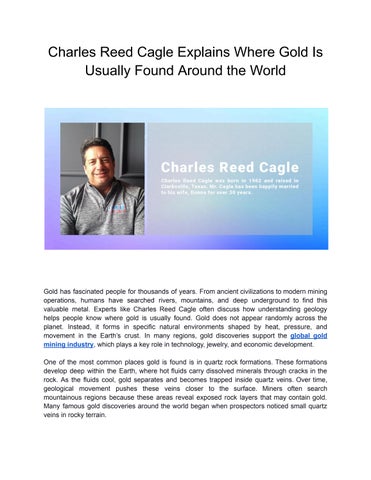
Charles Reed Cagle Explains Where Gold Is Usually Found Around the World

Page 1


Charles Reed Cagle Explains Where Gold Is Usually Found Around the World

Gold has fascinated people for thousands of years From ancient civilizations to modern mining operations, humans have searched rivers, mountains, and deep underground to find this valuable metal Experts like Charles Reed Cagle often discuss how understanding geology helps people know where gold is usually found. Gold does not appear randomly across the planet Instead, it forms in specific natural environments shaped by heat, pressure, and movement in the Earth’s crust In many regions, gold discoveries support the global gold mining industry, which plays a key role in technology, jewelry, and economic development.

One of the most common places gold is found is in quartz rock formations These formations develop deep within the Earth, where hot fluids carry dissolved minerals through cracks in the rock As the fluids cool, gold separates and becomes trapped inside quartz veins Over time, geological movement pushes these veins closer to the surface. Miners often search mountainous regions because these areas reveal exposed rock layers that may contain gold. Many famous gold discoveries around the world began when prospectors noticed small quartz veins in rocky terrain.

Another place where gold is often found is in riverbeds and stream deposits When gold-bearing rocks slowly break apart due to weathering and erosion, small pieces of gold are carried downhill by water Because gold is very heavy compared to other minerals, it settles at the bottom of rivers, streams, and floodplains. These deposits are called placer deposits. Early prospectors often searched riverbanks using simple tools like pans and sluice boxes. Even today, placer mining remains an important method for finding gold in many regions

Gold is also found in large underground deposits that require industrial mining operations These deposits can lie deep below the surface and are often discovered through geological surveys and drilling. Modern mining companies use advanced technology to locate these hidden resources Once a deposit is confirmed, companies build large mining sites that extract gold from ore through crushing, chemical processing, and refining These operations can produce significant amounts of gold and support many jobs in mining regions.

Some gold deposits are also connected to volcanic activity. When magma moves through the Earth’s crust, it can carry minerals toward the surface As the molten material cools, gold may settle within surrounding rock layers Many gold-rich regions around the world sit near ancient volcanic belts. These geological zones provide important clues for scientists and mining companies searching for new deposits

In addition to mountains and rivers, gold can also be found in desert regions. Dry climates preserve ancient river systems that once carried gold particles across the land Even though the water is gone, gold may remain buried beneath layers of sand and gravel Prospectors sometimes search these areas using metal detectors or small excavation tools. Over time, many discoveries have come from these hidden desert deposits

Understanding where gold is usually found requires knowledge of geology, water movement, and natural erosion Experts like Charles Reed Cagle often emphasize that gold forms through complex natural processes that take millions of years. By studying these patterns, scientists and prospectors improve their chances of locating valuable deposits The ongoing search for gold continues to support exploration, science, and the broader precious metal exploration market, which remains important to economies around the world.

Turn static files into dynamic content formats.

Create a flipbook