![]()


FROM PROPERTY TO PERSONHOOD: WHY NATURE NEEDS A VOICE IN LAW LAN CAO
GERRYMANDERING THE ELECTORAL COLLEGE HENRY NOYES 1 3
4
6
IN OUR FARA ERA: MODERNIZING THE FOREIGN AGENTS REGISTRATION ACT
NAHAL KAZEMI
HOUSING IN CRISIS: CAN LOCAL GOVERNMENT TRESPASS ON DEED RESTRICTIONS?
KENNETH STAHL
7
9
WHEN AI READS YOUR BRIEF, WHAT STORY DOES IT TELL?
ABIGAIL PATTHOFF
SCOTUS IN FOCUS UNPACKS THE SUPREME COURT’S 2024-25 DECISIONS
11 KENNETH STAHL INTRODUCING FOWLER SCHOOL OF LAW’S INTERIM DEAN
12 RIAZ TEJANI THINK LIKE A LAWYER: WELCOMING DR. RIAZ TEJANI TO FSOL
13 JOHN BISHOP BUILDING A COMPETITIVE STUDENT ADVOCACY LEGACY ONE COMPETITION AT A TIME
15 CLAY O’NEAL HIGH STANDARDS, KINDNESS & MENTORING: AN ALUMNUS SHARES HIS PASSION FOR COACHING
18 A SELECTION OF REPRESENTATIVE PUBLICATIONS JOURNAL ARTICLES, BOOKS & CHAPTERS, OP-EDS & POPULAR MEDIA PUBLICATIONS, PRESENTATIONS AND APPOINTMENTS
CHAPMAN UNIVERSITY DALE E. FOWLER SCHOOL OF LAW
DONALD P. KENNEDY HALL ONE UNIVERSITY DRIVE ORANGE, CA 92866 Chapman.edu/law


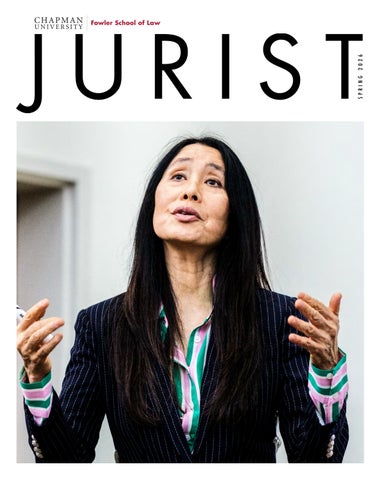
COVER PHOTO: FOWLER SCHOOL OF LAW PROFESSOR LAN CAO PRESENTING TO HER 2L CLASS
FACULTY ADVISOR: ASSOCIATE DEAN FOR RESEARCH AND FACULTY DEVELOPMENT, DR. DEEPA BADRINARAYANA
DESIGN, EDITING & PRINCIPAL PHOTOGRAPHY: DEANE SUTIC LIBRARY ADVISOR, PHILLIP DER MUGRDECHIAN
WITH GRATEFUL THANKS TO THE CHAPMAN FAMILY, FOWLER SCHOOL OF LAW FACULTY, ADMINISTRATIVE SUPPORT TEAM, LAW LIBRARY TEAM AND FSOL STUDENTS
LAN CAO
When we are children, many of us instinctively understand something that our legal system does not. We read Charlotte’s Web and root for Wilbur the pig when a girl named Fern and a spider named Charlotte work to save his life. We read The Lorax and nod when he declares, “I speak for the trees.” We grasp, almost effortlessly, that animals and forests are not merely objects. Somewhere between childhood and adulthood, however, our legal imagination narrows. Nature becomes “property.” Rivers become “resources.” Animals become “goods.”
Modern environmental law reflects this narrowing. It regulates how much pollution is permissible. It calculates how much environmental harm is economically efficient. It measures success by Gross Domestic Product (GDP), even when the growth it celebrates comes from extraction, deforestation, or the monetization of clean-up after environmental destruction.
The rights of nature movement asks a radical question: What if we are starting from the wrong premise?
Instead of asking how much harm to nature is acceptable, what if the law recognized that natural communities — rivers, forests, ecosystems — have a right to exist, flourish, and regenerate?
At first glance, this may sound fanciful. Yet the law already grants rights to non-human entities. Corporations can sue and be sued. Trusts and estates have legal standing. Ships, historically, have been treated as juridical persons. The question, then, is not whether law can recognize non-humans as rights-holders: The question is whether we are willing to extend that recognition beyond economic entities to living ecological systems.
The United States has largely resisted this move. Grassroots efforts in places like Grant Township, Pennsylvania — where residents attempted to recognize the rights of a watershed to defend itself against fracking waste injection permitted by the EPA — have faced standing and preemption challenges and judicial skepticism. Our environmental regime remains grounded in cost-benefit analysis and administrative permitting. We regulate harm; we rarely question the underlying paradigm.
Elsewhere, however, a different legal imagination is taking shape.
In 2008, Ecuador amended its Constitution to recognize the rights of nature — Pachamama — to exist and regenerate. Crucially, Ecuador’s Constitution provides that any person or community may bring suit to enforce those rights, without needing to prove individualized human injury. Courts have since enforced those rights, halting mining projects in fragile forests and applying the precautionary principle even where traditional permits were issued. In the Philippines, the Supreme Court’s writ of Kalikasan allows citizens to seek protection for ecosystems without proving individualized human injury. In Colombia and Argentina, courts have recognized certain animals as rights-bearing beings rather than mere property.
Importantly, this shift is not confined to developing nations. In 2017, New Zealand — a Western, common law democracy — enacted legislation recognizing the Whanganui River as a legal person, with appointed guardians to speak on its behalf. The statute reflects both Māori cosmology and modern parliamentary governance, demonstrating that recognizing nature’s legal standing is compatible with contemporary constitutional systems.
What if the law recognized that natural communities – rivers, forests, ecosystems – have a right to exist, flourish and regenerate?
In November 2024, Spain joined this evolving legal landscape. Its Constitutional Court upheld a law which grants legal personhood to the Mar Menor — Europe’s largest saltwater lagoon — and its surrounding basin. This law became the first Rights of Nature law in the European Union to survive constitutional review.

Lan Cao is the Betty Hutton Williams Professor of International Economic Law and is the Director of the International Law Program. She clerked for Judge Constance Baker Motley of the U.S. District Court for the Southern District of New York, and practiced with Paul, Weiss, Rifkind, Wharton and Garrison in New York City. She was a Ford Foundation Scholar in 1991 and is also the author and co-author of several books and supplements, including the novels Monkey Bridge; The Lotus and the Storm; and Family in Six Tones. Her academic monograph Culture in Law & Development: Nurturing Positive Change was published by Oxford University Press in 2016.

The Spanish court rejected arguments that rights belong only to humans or that such recognition creates legal chaos. Instead, it grounded its decision in Article 45 of Spain’s Constitution, which mandates environmental protection and restoration. Like Ecuador, Spain’s law allows any individual or entity to bring legal action on behalf of the lagoon.
Around the world, we are confronting what U.N. Secretary General António Guterres has called an era of “global boiling.” Yet, our dominant development model continues to reward extraction, short-term gain and shareholder maximization.
These developments do not mean that economic development ceases. Rather, they signal a shift in hierarchy: economic rights cannot automatically trump ecological integrity.
The rights of nature movement is often described as “innovative.” In reality, it is ancient. Indigenous traditions across Asia, Latin America and Africa have long understood humans as part of an interconnected web of life. Rivers are living entities. Forests are inhabited by spirits. Animals are kin. The novelty lies not in Western invention, but in Western legal systems finally beginning to listen.
My own engagement with this movement has been shaped by serving on an advisory team for Bhutan’s Gelephu Mindfulness City — a newly established Special Administrative Region that seeks to harmonize economic development with environmental stewardship.
Bhutan’s development philosophy, Gross National Happiness (GNH), rejects GDP as the sole measure of progress and constitutionally mandates forest cover and ecological preservation.
Gelephu represents an experiment: Can a city be designed from the ground up around mindfulness, sustainability, and interdependence? Can economic growth be pursued without sacrificing ecological integrity? These questions matter far beyond Bhutan. Around the world, we are confronting what U.N. Secretary General António Guterres has called an era of “global boiling.” Yet, our dominant development model continues to reward extraction, short-term gain and shareholder maximization.
GDP counts the value of cutting down a forest. It does not count the value of the forest standing.
The rights of nature framework does not offer a simple solution. It does not guarantee that rivers will always “win” in court. But it changes the conversation. It gives nature a voice in the legal system. It shifts the burden, in some jurisdictions, onto developers to demonstrate lack of harm. It reframes environmental protection not as charity toward nature, but as recognition of intrinsic value.
In an age defined by climate crisis, perhaps the more radical position is to maintain the status quo.
When the Lorax leaves behind the word “Unless,” and when Wilbur is saved because someone cared enough to intervene, the lesson is the same: care must precede survival.
GDP counts the value of cutting down a forest. It does not count the value of the forest standing.
The rights of nature movement is, at its core, about institutionalizing that care. It asks law to catch up with what children often intuitively grasp: that we are not masters of the natural world, but participants within it.
In moving from property to personhood, we are not diminishing human rights. We are enlarging our moral and legal community to reflect the ecological realities upon which all human prosperity ultimately depends.

HENRY NOYES
Like many others, I was horrified to read the Supreme Court’s 2019 opinion in Rucho v. Common Cause, which sanctioned partisan gerrymandering by giving it a veneer of legitimacy. I drafted an outline of an article about the logical extension of that opinion–to allow state legislatures to gerrymander the Electoral College – and sent it to a colleague who is an election law expert. His response was that it was plausible that a state legislature could gerrymander the Electoral College, but that it was “politically dangerous” and seemed unlikely that a state legislature would do so.
I shelved the article, concluding that political guardrails would hold. The Supreme Court’s opinion admits that “[e]xcessive partisanship in districting leads to results that reasonably seem unjust.” The injustice is the ability of the majority party to use political gerrymandering to entrench itself as the governing party and to remain so, long after that party falls out of favor. It is the tyranny of the minority. It contradicts the principle stated in the Declaration of Independence that the Government derives its “just powers from the consent of the governed” and in the Constitution that “We the People” form a government. Excessive partisanship in districting is antiAmerican and surely not something that state legislatures will embrace?
It seems not only likely, but inevitable, that Rucho will be employed to gerrymander the Electoral College.
Oh, how Pollyanna of me. Consider Texas, California and every other state now engaged in mid-decade redistricting to leverage and maximize their partisan gerrymandering advantage. It seems not only likely, but inevitable, that Rucho will be employed to gerrymander the Electoral College.
We need not debate the merits of the Court’s decision in Rucho. It is a cowardly miscarriage, penned by activist conservative Justices. I write to highlight the inevitable extension of this decision: Republicans will wield this new, nonjusticiable power (and the concomitant political
cover that it provides) to gerrymander the Electoral College. And, when they do, Democrats will follow suit. Rucho encourages, enables and ensures an arms race to the end of meaningful participation in elections, including presidential elections in many states.
It is a winner-take-all system that is NOT based on the popular vote for the relevant sovereign territory.
Here is a template for how Texas (where Republicans have a state government trifecta) might gerrymander the Electoral College by state statute that would replace its existing method of selecting presidential electors:
The set of elector candidates that is elected is the one that corresponds to the candidates for president and vice-president who win the most individual Texas Congressional districts. The winners of each Congressional district shall be the candidates for President and Vice President who receive the highest number of votes in that Congressional district.
This system for allocating Texas’s electoral college votes mimics the Electoral College system used to elect the President. It is a winner-take-all system that is NOT based on the popular vote for the relevant sovereign territory. Instead, it allocates the spoils of victory — all of Texas’s electoral college votes — to the winner of the most subdivisions of that sovereign territory. In the event of a tie, the winner is declared by the relevant House of Representatives. The Gerrymandered Electoral College incorporates Texas’s current gerrymandering of its Congressional districts and uses its partisan advantage to render the wishes of a majority of the voters meaningless.
Alternatively, Texas may insulate its gerrymandering of the Electoral College from any future corrective legislation from Congress by creating its own unique set of forty “Electoral College Districts.” Texas would require that each of these Electoral College Districts be roughly equal in population, just as its Congressional districts are roughly equal in population. But, because these districts are not Congressional districts, Texas would be free from Congressional regulation pursuant to its Elections Clause powers. The winner of the popular vote would “win” the


Electoral College District, and the winner of the most Electoral College Districts would win all of Texas’s 40 Electoral College votes.
The Gerrymandered Electoral College is constitutionally bulletproof:
(1) It is an exercise of State Legislatures’ unique, and uniquely-broad, constitutional power;
(2) it satisfies the Constitutional requirement of population equality (in the first example above, it piggybacks off of the Constitutionally-prescribed and approved population equality provisions for redistricting Congressional districts);
(3) it mimics the actual Electoral College in its antimajoritarian nature;
(4) it exploits the fact that political gerrymandering is a nonjusticiable political question; and
(5) in the second example above, it leverages states’ near-plenary power over the allocation of their Electoral College votes to avoid oversight, constraint or regulation by Congress. This last aspect is particularly powerful.
Once a state establishes “Electoral College Districts” and
enacts a Gerrymandered Electoral College, Congress will be powerless to override it.
This power is not new. The Constitution’s Electoral College appointments provision is the constitutional version of the Ring of Power. The Electors Clause of the Constitution (Article II, Section 1, Clause 2) gives nearly unbounded power to the State Legislatures to choose the method for allocating Electoral College votes. States have chosen, so far, not to wield this power to its fullest partisan extent. The Supreme Court’s decision in Rucho, however, provides State Legislatures with political cover and assurance that this partisan exercise of the Electors Appointment power is nonjusticiable and, ultimately, “legal.”
A colleague critiqued this article recently, saying, “Are you comfortable putting the Nuclear Codes on the internet?”
My response was, “I’m pointing out that the Nuclear Codes are ALREADY on the internet.” So no, I am not comfortable with it. None of us should be comfortable with it.
NAHAL KAZEMI
Propagandists, Innocent Victims, or Useful Idiots? The Urgent Need to Reform the Foreign Agents Registration Act
The Foreign Agents Registration Act (FARA) of 1938, passed to combat Nazi propaganda, has become newly relevant. FARA requires those acting as agents of foreign principals to register with the U.S. government and disclose their activities. While the law is a vital tool for transparency and combating corruption, its current form presents a dual problem of under- and over-enforcement. The rise of modern disinformation campaigns and the law’s potential for political misuse underscore the need for reform.
A Key Anti-Corruption Tool: The Menendez Case
Recent high-profile cases highlight FARA’s vital role in preventing officials from using their positions to serve foreign interests. A landmark example is the case of former U.S. Senator Bob Menendez. In July 2024, Menendez was convicted of acting as an agent for the government of Egypt. Prosecutors alleged he and his wife accepted hundreds of thousands of dollars in bribes, including cash and gold bars, in exchange for using his official position to benefit Egyptian officials and businessmen. Menendez’s conviction marked the first time a sitting U.S. official was found guilty of acting as a
foreign agent, but it is not the only recent high-profile prosecution of a government official or politician. Cases against Paul Manafort, Michael Flynn, Henry Cuellar, and Eric Adams demonstrate FARA’s potential to combat surreptitious foreign efforts to influence American policy and governmental decisions (though all of these individuals were later pardoned by President Trump).
A New Era of Propaganda: The Recent Influencer Case
Despite its importance in cases of explicit corruption, FARA’s current structure is ill-equipped to handle the
The indictment alleged that the Russian agents funneled nearly $10 million to a U.S. company and a network of right-wing commentators.
evolving landscape of foreign influence, particularly when foreign governments use proxies and influencers to launder propaganda. A notable example occurred in September 2024, when the Department of Justice unsealed an indictment against two employees of the Russian state-controlled media outlet RT for conspiracy to violate FARA.
The indictment alleged that the Russian agents funneled nearly $10 million to a U.S. company and a network of right-wing commentators. The scheme allegedly sought to create and distribute thousands of videos with Russianaligned narratives, as well as messages intended to amplify domestic divisions in the United States. While the Russian agents were indicted, the owners and influencers of the American media company were not charged.
This case demonstrates a critical flaw: FARA lacks civil enforcement tools to address negligent failures to register. The indictment alleged the U.S. company actively concealed its links to Russia from influencers (who nonetheless knew their financial backer was foreign) and the public; the influencers argued this made them victims in this alleged scheme. As written, FARA fails to incentivize Americans to verify whether they are acting as foreign agents. The criminal nature of FARA’s primary enforcement mechanisms means prosecutors must prove willful intent. This is difficult to do when the purported agents are unaware of the identity of their foreign funding source, even if that lack of awareness stems from unreasonable conduct.
FARA is also vulnerable to political weaponization. The DOJ has brought enforcement efforts against journalists, environmental nonprofits and media entities, suggesting the potential for overreach.
The Danger of Selective Enforcement FARA is also vulnerable to political weaponization. The DOJ has brought enforcement efforts against journalists, environmental non-profits and media entities, suggesting the potential for overreach. Following the killing of Charlie Kirk, the Trump administration announced it would use the law against what it deemed to be “domestic terror groups” (a designation for which there is no legally recognized basis) with foreign connections. Further complicating matters is the DOJ’s unusually broad definition of agency, which can sweep in conduct even when there is no evidence a foreign principal exercises real control over the purported agent. The potential extent of these risks is apparent when you compare the U.S. law to FARA-like laws elsewhere.
FARA lacks civil enforcement tools to address negligent failures to register.
Countries such as Russia, Hungary, and Georgia have enacted “copycat” FARA laws that are used to stifle dissent and harass regime opponents. These foreign laws presume the receipt of even minimal foreign funding is sufficient to classify an organization as a “foreign agent” and typically single out NGOs and media as subject to the law, while for-profit entities and individuals are often exempt. Independent NGOs and media outlets have thus been subjected to stigmatizing labels, burdensome reporting requirements, and severe penalties. Instead of enhancing transparency, these laws become tools to silence critics and suppress civil society.
The Path Forward: Amending FARA for the 21st Century
To ensure FARA remains an effective tool without being abused, it must be amended. A key reform would be to clarify the definition of foreign “agency” to focus on clear indicia of control, minimizing the potential for loose affiliations to be treated as a formal agency. This would help prevent the law from being weaponized against legitimate civil society organizations and journalists.
Furthermore, the law should be amended to focus on civil enforcement, with disclosure as its primary purpose. By offering robust civil remedies, such as fines for negligent failures to register and injunctions to require retroactive registration, the law can create a powerful disincentive for those who fail to exercise due diligence. These reforms would enhance compliance and reduce the risk of political abuse, ensuring that FARA remains a vital tool for transparency in a world of complex and evolving foreign influence.


KENNETH STAHL
Candidates across the political spectrum are debating how best to address the national housing affordability crisis. One approach currently afoot in many states is to reform restrictive land-use regulations that block the production of new housing. Despite much promise, these efforts have been hindered by homeowners’ associations that impose and vigorously enforce overlapping restraints on housing production through private deed restrictions. In response, many cities and states have considered enacting laws to “override” or invalidate these private deed restrictions.
To date, more than one hundred local governments have taken steps to revise their land-use regulations and permit more housing, bucking the historical trend.
While the power of the state legislature to override private deed restrictions is relatively straightforward, the question remains whether local governments have the power to do so. Although it has long been thought that local governments would never willingly loosen land use restrictions, given the influence in local politics of “Not in My Backyard” (NIMBY) homeowners who strongly oppose change, the depth of the housing crisis and the emergence of powerful “Yes in My Backyard” (YIMBY) housing advocacy groups have changed that calculus. To date, more than one hundred local governments have taken steps to revise their land-use regulations and permit more housing, bucking the historical trend. A trend in which public land use restrictions like zoning and private deed restrictions served similar purposes and acted as complementary systems of land use control. As local governments increasingly recognize the role of restrictive zoning regulations in blocking housing supply, they are moving to remove or soften these regulations. But private deed restrictions are much harder to change. One way to resolve this conflict is for local governments to
affirmatively invalidate deed restrictions that obstruct local housing needs.
So, do local governments have this power? I argue that local governments do have the power to override deed restrictions and are far better positioned to do so than state governments. Local governments possess knowledge of local conditions and history that enable them to tailor government overrides appropriately. Local governments’ particularized knowledge enables them to answer specific questions relevant to the enforcement of deed restrictions–such as whether a restriction has or has not been consistently enforced, whether there has been a relevant change in conditions that may render the restriction obsolete, or even whether the continued enforcement of a restriction is inconsistent with public policy. Besides, local governments’ sensitivity to landowners’ concerns makes it unlikely they would overreach in regulating private property rights.
Local governments possess knowledge of local conditions and history that enable them to tailor government overrides appropriately.
Local governments’ particularized knowledge enables them to answer specific questions relevant to the enforcement of deed restrictions.
These days, local government scholars are divided over whether local land use control has the potential to be something more than just a license for NIMBYs to block needed housing.
One principal question still open to debate is whether state legislatures could displace or preempt local governments’ power to override deed restrictions.
Although state legislatures typically prevail in preemption disputes based on the strong statewide interest in preventing extralocal impacts of land use regulation and the need for certainty in real estate transactions, local covenant overrides are unlikely to present either of these problems. Covenant overrides are more likely to reduce extralocal impacts by absorbing regional demand for housing rather than externalizing it onto neighboring communities, and given the widely documented lack of sophisticated consumer knowledge regarding the content of deed restrictions, it’s unlikely local covenant overrides would have any significant effect on real estate markets.
These days, local government scholars are divided over whether local land use control has the potential to be something more than just a license for NIMBYs to block needed housing. At heart, local power and local knowledge need not be synonymous with a hard “no” on land use and development. By overriding deed restrictions that block housing production, local governments can leverage their knowledge of local conditions to actually say “yes” to new housing. And doing so affirms the capabilities of local democracy without devolving into unchecked parochialism.

ABIGAIL A. PATTHOFF
You write and rewrite your brief until every detail serves your client’s story. You select quotations that reveal character. You deploy active and passive voice strategically, letting subtle word choices convey credibility and blame. You sequence events to build emotional momentum. Every sentence is designed to persuade a human judge.
But increasingly, the first “reader” of that brief may not be human at all. It might be ChatGPT, Claude, or another AI system, tasked with producing a “neutral” summary for a judge. Courts across the country are beginning to experiment with generative AI tools, and among the various applications being explored, one stands out for its potential to alter how judges interact with legal advocacy: AI summarization of the parties’ briefs.
The American Bar Association has identified summarization as a key judicial use case for generative AI. The National Center for State Courts lists summarizing large amounts of text among AI’s “potentially useful tasks” for judges. Illinois has gone further, providing judges with suggested AI prompts, including “Summarize
the following legal brief and identify key arguments.”
The efficiency gains are obvious. What once took a law clerk hours now takes AI seconds. But the rapid authorization of these tools has outpaced our understanding of what they actually do. In a forthcoming article, I examine how AI summarization could transform storytelling in legal briefs.
Decades of cognitive science and research confirm what skilled advocates have long intuited: judges are wired for narrative. When presented with a dispute, they don’t just want to know what happened. They want to understand why it happened, who the key players are, and what motivated their actions. Studies show that judges rate briefs with strong narrative elements as significantly more persuasive than briefs presenting identical legal arguments without the story. Other research demonstrates that judges subconsciously respond to sympathetic narratives in ways that can override even precedential guidance.


That responsiveness to story isn’t a flaw in judicial reasoning. It’s how human cognition works. Narrative is how human beings make meaning from facts. The advocate who can transform a contract dispute into a story about betrayed trust, or a regulatory challenge into a narrative about arbitrary government power, is closing the gap between what happened and what it means.
What I saw in the output told a different story. For a summary that claimed to be neutral, it was full of choices.
To explore how AI actually handles legal narrative, I presented ChatGPT with a classroom exercise I use to teach legal storytelling: two abridged, hypothetical fact statements presenting competing narratives of the same criminal assault. Like any well-crafted brief, both told a story, using techniques like character development, theme, and description to give the facts meaning. I asked it to summarize the facts as if creating a bench memo for a judge. When ChatGPT handed me its summary, it said its output was “neutral” and fact-based. Of course, AI can’t actually explain its own processes, but it’s easy to see how a judge experimenting with these tools might take that reassurance at face value.
be something the emerging regulatory frameworks have no category for: a summary that gets the facts right while quietly reshaping the meaning advocates built from those facts.
This matters because it’s not just about summarization. A University of Chicago study found that when ChatGPT and federal judges were presented with the same cases but with defendants framed as more or less sympathetic, the AI adhered to precedent over 90% of the time regardless of framing. Federal judges, on the other hand, ruled for the sympathetic defendant roughly 65% of the time, even when doing so meant departing from precedent. In other words, narrative moves human judges. AI doesn’t notice it.
Even the most comprehensive judicial AI frameworks currently have no category for this kind of problem. California’s recently adopted Rule of Court 10.430 requires courts to verify AI accuracy, correct hallucinations and remove biased content. These are real concerns. But in my exploratory exercise, ChatGPT’s summary didn’t hallucinate. It didn’t produce biased output in any conventional sense. It produced a summary that was factually accurate yet narratively gutted. No existing framework checks for that.
And if the narrative costs are real, they may not fall equally. Parties whose cases depend on humanizing their clients — criminal defendants, civil rights plaintiffs, asylum seekers, parents in custody disputes — could lose the most when AI strips narrative from their briefs. If the best argument you have is a story about what your client endured and why it matters, AI summarization could create a structural disadvantage.
She served as a judicial clerk to The Honorable Frederick P. Stamp, Jr. on the United States District Court for the Northern District of West Virginia. She is also an editorial board member of the peer-edited journal, The Second Draft. Her scholarly interests include teaching pedagogy and legal writing.

What I saw in the output told a different story. For a summary that claimed to be neutral, it was full of choices. It chose to call the defendant a “janitor,” the prosecution’s word, rather than the defense’s “custodian,” a subtle distinction that carries different connotations about occupational status and dignity. It stripped out every reference to what either party was feeling during the incident at issue, treating fear and anger as spin rather than as facts that might matter to a legal defense. The prosecution had framed the case around domestic violence; the defense had framed it around mutual aggression. The AI gave the judge neither framework, producing instead a flat chronology with no organizing principle to help a reader understand what the case was really about. And where both sides had used specific, concrete actions to paint a picture of what happened, the AI replaced them with abstractions like “verbal and physical confrontation occurred.” None of this was hallucination. None of it was inaccuracy. But it may
Courts are adopting generative AI and beginning to govern its use. But the policies so far focus on confidentiality, accuracy, and bias. The effect on narrative advocacy hasn’t been part of the conversation. We need empirical research on how AI summaries affect judicial decision-making, and honest conversations about where in the judicial workflow AI summarization is appropriate and where it is not. We should also be asking whether parties have a right to know if their briefs will be AI-summarized, and whether they should have an opportunity to object.
Most importantly, we need to act while we still have the chance to shape how these tools are used, before the filter hardens into an invisible barrier between the stories lawyers tell and the judges who need to hear them. AI’s efficiency gains are real. But if we allow machines to silently decide which parts of human advocacy matter and which do not, we may find we have traded something essential for something fast.
Drawing together Fowler School of Law faculty, students alumni, staff and guests, October 23rd’s SCOTUS in FOCUS discussion panel delivered a masterclass in legal scholarship, providing a non-partisan forum for legal discourse, debate and a thorough weighing up of the merits of key United States Supreme Court decisions from the 2024-25 term.
Faculty panelists, Interim Dean Kenneth Stahl, Dr. Tom Campbell and Professor Larry Rosenthal, led by special guest moderator, decorated United States Marine Corps Judgeand Chapman alumnus LtCol Alex Douvas (JD ’05), tackled SCOTUS decisions, dissent and opinions on cases as disparate as Ames v. Ohio Department of Youth Services, Mahmoud v. Taylor, Seven County Infrastructure v. Eagle County, CO, and United States v. Skrmetti
Panelists took the Supreme Court opinions to task while considering the intricacies of each case and giving careful regard to the implications for similar cases and how these decisions may impact lower court decisions in the future.
An annual fixture on the Fowler School of Law calendar, SCOTUS in Focus offers the Fowler School of Law and its braoder community a rare glimpse and deep dive into decisions handed down from the most senior jurists in the land, shedding light on their rationale and framing the issues at stake within the pageant of national affairs, scholarly excellence and intellectual rigor. This year’s event provided a showcase of professionalism, collegiality and civility as faculty panelists dissected the issues and throughly inspected the merits of each case.


Assuming the reins as Interim Dean at the Fowler School of Law is legal scholar, land use lawyer, and acclaimed teacher Kenneth Stahl. Stahl, a graduate of the University of Michigan and Yale Law School, is a Professor of Law and director of the law school’s Environmental, Land Use and Real Estate Law certificate program. As housing has become an increasingly important policy issue in recent years, Stahl has emerged as one of the nation’s top scholars of housing law and policy.
Over his seventeen years at Fowler School of Law, Stahl’s scholarship on land use and housing has been featured in numerous law journals, including the University of Pennsylvania Law Review, the Harvard Civil Rights-Civil
Liberties Law Review, the Iowa Law Review, Fordham Law Review and George Washington Law Review, to list a few. He is frequently consulted by policymakers, housing advocates and developers for his advice on housing and land use issues.
Stahl’s interest in zoning and local government dates back to his undergraduate years at the University of Michigan. His time at UMich piqued his curiosity in research, where his senior thesis in political philosophy won Highest Honors and Highest Distinction. The nascent passion for research endured, and followed him to Yale, where he served on the staff of both the Yale Law Journal and the Yale Journal of Law and the Humanities, and

where he first developed an interest in land use law. That interest eventually led to Stahl’s first serious piece of legal scholarship for the Cardozo Law Review, a 2008 article entitled The Suburb as a Legal Concept: The Problem of Organization and the Fate of Municipalities in American Law. The pathbreaking article argued that American law shifted from privileging cities to privileging suburbs during the early twentieth century as part of a liberal project to incorporate intermediate organizations into the administrative state.
Stahl brought a burgeoning expertise in land use and local government with him to the Fowler School of Law, where he won Professor of the Year in his very first year as a teacher in 2008. Descended from a long line of teachers, the ancestral pedagogue in him took to professorship like a proverbial duck to water. His lawyerly preoccupations found expression in legal research, scholarship and a deeper consideration of the local politics behind zoning and land use. His scholarship married his interests in day-to-day dealings with local and state government factions and competing political philosophies, first outlined in his award-winning UMich undergraduate research thesis, perfectly. You might say, this land use and real estate expert had found a home teaching at Fowler School of Law.
By 2020, Stahl had cemented his position as a leading legal scholar in his area with his text, Local Citizenship in a Global Age, a timely exploration of the different ways citizenship is constructed and practiced at different
scales of government – local and national. Not one to rest on his laurels, Stahl followed up the publication of his book by winning Chapman’s coveted Michael Lang Award for Scholarly Excellence in 2021.
In his role as interim dean at the Fowler School of Law, Stahl is opening a new chapter in an already storied academic career. As he says, “It’s a shift from focusing primarily on my scholarship and teaching to focusing on an administrative role and the opportunity to really serve the school.”
His focus is on building relationships with the faculty and administrative teams that keep the school running and building bridges from the school to the world beyond the classroom.
“This is a very important time in the history of the school,” says Stahl, “I often ask myself what is the one unique, irreplaceable thing the Fowler School of Law offers? The sense of community here is incredible. Our students have this joi de vive that is absolutely infectious.”
At the thirtieth anniversary of the school’s founding, with a recent rise in the U.S. News rankings, admissions qualifications and American Bar Association Student Advocacy rankings, the Fowler School of Law maintains a strong, upward trajectory, and the stewardship of this Orange County bastion of legal education remains in great hands.

Fowler School of Law scholars recently welcomed a new team member to the school, Dr. Riaz Tejani, whose legal scholarship sheds light on the social and cultural impacts of law and economics in legal theory, legal education and professional legal ethics. A prolific researcher and author, Tejani’s authorial credits already include titles like: Law Mart: Justice, Access, and For-Profit Law Schools, an ethnographic investigation of for-profit legal education during and following the 2008 global financial crisis; Law and Society Today, a critical survey of contemporary themes in socio-legal studies; and, his most recent book, Law and Economics: New Trajectories in Law, a critical introduction to the field of law and economics for sociolegal and humanities scholars.
Tejani currently serves on a number corporate and nonprofit boards and has been a public arbitrator for the Financial Industries Regulatory Authority (FINRA).
He is co-director of the Law and Society Association’s CRN 28 on New Legal Realism, an associate editor for Political and Legal Anthropology Review, and board member and program chair for the Law and Humanities Interdisciplinary Workshop—a consortium of faculty from Penn, Stanford, Georgetown, UCLA and USC. His work is routinely cited in publications such as the Harvard Law Review, Yale Law Journal Forum, Annual Review of Law and Social Science, The Nation, and NPR, with select writings reprinted or translated in India, Sri Lanka, Bangladesh, Pakistan, and China.
Originally mentored by leading legal Anthropologist Dr. Elizabeth Mertz, Tejani’s scholarship in law and economics first emerged from his formative social science and anthropology studies, which accompanied him into the law school classroom. As he puts it, “Sitting there, I became increasingly aware of the socio-cultural

structures informing the legal constructs I was studying, I started to think about how and why we speak about legal issues the way that we do and the underlying thinking that informs what counts as ‘a legal problem’ and what doesn’t.”
For Tejani, law and economics are fascinating and routinely recurring bedfellows in the legal classroom, pervading almost every aspect of the law school curriculum. As he sees it, “Our concepts of justice are formed and continue to be shaped by the economics and outcomes of the choices and decisions made within the legal system and its frameworks of understanding and action.”
Imparting the critical lens this perspective lends in the classroom is part of Tejani’s subtle yet impactful approach to teaching law. Teaching the core, foundational issues first, he gradually introduces a self-reflexive and critical alternative to students to illustrate the limits of a particular approach, drawing a critical question out of them: “What does the law look like when you view justice in the light of these new, critical possibilities?”
“Our concepts of what is just or unjust seem to be in constant evolution,” says Tejani, suggesting that the law is a living, gestalt-like construction–in perpetual evolution as culture, human understanding and social mores evolve. For his students, Tejani hopes to imbue his classes with self-reflexivity, empowering students to question their own place in the law and examine where they exist and interact within its structures.
With the legal profession currently adapting to the widespread use of Artificial Intelligence, Tejani’s critical, reflexive approach to the law may have something to
teach us, both about the economics of the AI adoption as well as the ethical dilemmas that routinely crop up for practitioners already using this fledgling technology.
“We might do well to view AI in a limited, circumspect capacity,” he offers, “I think AI could be used effectively as an assistant, but little more. In law, when you use an assistant, you are obliged to observe certain ethical duties regarding their capacity to assist you. For example, there may be certain training and limits on case information access that limit what your assistant can or should do for you. No right-minded lawyer should ever consider their assistant to be some sort of case-winning übermensch brimming with all the answers,” he quips.
Tejani trains his students with an eye to instilling better critical judgment in them. One of his favorite classroom exercises is to present students with fact patterns and memos created by both AIs and third-year associates, which students must audit and evaluate for errors in thinking, legal research and potential AI hallucinations. For Tejani, readying his students for the rigors and pitfalls of modern professional practice is not simply a matter of teaching them torts and contracts, but also teaching the essential critical skills to work responsibly with new technologies, using them wisely to improve their professional performance as lawyers by leveraging their own critical self-reflexivity.
For now, progress is incremental, but Tejani sees a future in legal education where these critical safeguards are built into the classroom conversation, where topics like ethics and law and society help to inform critical distance for emergent professionals and become an essential part of the ubiquitous classroom emphasis of training students to “think like a lawyer.”


BY LORELEI OLIVAS
“Catch!”
This alarming instruction is often the first thing you’ll hear when you walk into John Bishop’s office. Chapman’s iconic Director of Student Advocacy keeps a supply of footballs of varying sizes in his office, along with two mini basketballs, to surprise visitors and students alike. Team members are never safe from a crossing route during cross-examination practice. Practiced and more senior team members catch and toss back without missing a Socratic beat.
Why the barrage of spirals? Does it teach students to be quick on their feet? Does it remind them to pay attention to their surroundings in court? Are they learning to rely
on each other like true teammates?
“No,” says Bishop, “I just think catch is fun.”
Bishop has infused Chapman’s student advocacy program with a broad vision for nationwide success, and under his leadership, the wins and podium finishes are starting to stack up. In his first year in charge, Chapman jumped 26 places in US News’ Trial Advocacy rankings and added a finish in the Top 20 in the University of Houston’s Moot Court Rankings, a finish in the Top 15 in Hofstra’s Gavel Rankings, and a national second-place finish in the ABA’s Competitions Championship.
Bishop credits the school’s strong alumni base and their
participation and investment in the competitions program for Chapman’s recent rise and success. Chapman took third place in the Summit Cup Mock Trial Competition in Denver, the first competition of 2025. The Summit Cup, an invitation-only contest, is open to twelve teams that won national mock trial competitions the year prior; Chapman had never participated before, with two young Assistant District Attorneys, Lance Cotton (JD ‘19) from Orange County, and Kalista McCauley (JD ‘23) from Riverside County, coaching the Fowler School of Law team on nights and weekends in the lead up to the contest.
The devotion that our alumni show to our students is the key to our success.
“The devotion that our alumni show to our students is the key to our success. Students get more than just good coaching—they meet role models, and they start to believe that they too are capable of doing great things,” adds Bishop.
A month later, alumnus Clay O’Neal (JD ‘14), COO at the largest union-affiliated contractors association in the Western United States, coached two teams to the championship rounds in Negotiation, first at the National Sports Law Negotiation Competition and then again at the ABA Negotiation Regionals.
“Clay is easily the best ADR coach around,” says Bishop, “and proof that Chapman graduates exceptional lawyers, not just great competitors.”
Bishop’s tenure as the Director of one of the fastestrising programs in the nation followed the sudden loss of Fowler School of Law professor and beloved coach Nancy Schultz, the progenitor of the student advocacy program and Bishop’s own coach when he was still a law school student. It is Schultz who nurtured the fledgling talent of many of the alumni on Bishop’s current coaching roster, imbuing each with a love for advocacy and for lawyering. With the torch passed to a new generation of advocates, it’s not hard to see how students readily attribute success to Bishop’s abiding passion for the law school and his willingness to go the extra mile to support teams and coaches.
“Seeing how much work he puts into improving the competition’s program made me want to go all-in, in every way I could. That attitude is infectious,” says alumnus Luke Hottinger (JD ‘25), part of a National Championship-winning team in February 2025 and now an associate at Fisher Phillips in Irvine.
“We have some of the best coaches in the country, and that starts with Bishop,” adds Joe Kahn (JD ’25), Chapman’s first NALAE All-American in 2025 and 2025 Cardozo FAME Center Moot Court Competition winner, and yet another alumnus who regularly returns to the school to coach Chapman mock trial teams.
Bishop may raise an eyebrow at the praise from students, but he is proud of the trajectory his teams are on. “I want Chapman students to be nationally respected for the way they perform before, during, and after their time in the program. People should respect us for the way we act–win or lose,” says Bishop. Two Chapman teams won “Most Professional Team” awards in competition in 2025. He is just as proud of the professionalism awards as he is when a team makes a podium finish: “Attorneys are judged for their reputation more than their results.”
Seeing how much work he puts into improving the competition’s program made me want to go all-in, in every way I could. That attitude is infectious.
In 2026, Bishop aims to establish Chapman as one of the premier hosts of student advocacy competitions in the country and to continue welcoming schools to the Wylie Aitken Courtroom and the Fowler School of Law campus. This March, the school will host the National Criminal Trial Competition, as well as the ABA Mediation National Championships. The National Criminal Trial Competition will be the third time Chapman has welcomed schools from across the country to compete in a tournament written, directed and produced by Chapman alumni, coaches and students.
“If we aspire to be one of the best schools in the country, we need to do our part to make the advocacy community stronger,” says Bishop.
In the meantime, Bishop will be in his office at Kennedy Hall, putting the pieces in place for another busy semester. The open door is an invitation to come by and meet his students, just make sure you’re ready to catch!
“Head on a swivel,” jokes Bishop, with a trademark smile.


BY AUBREY ADAMS

Law school trains students to research, memorize and perfect legal arguments. The Alternative Dispute Resolution (ADR) student advocacy program does the opposite: It teaches students to listen, adapt and respond in real-time. That difference is exactly what drew alumnus Clay O’Neal (JD ’13) to Chapman’s ADR program and what continues to bring him back each year as a coach and leader, long after graduating. O’Neal has built a legacy in competitive student advocacy rooted in mentorship, high standards, kindness and his remarkable passion for mentoring law students.
O’Neal’s connection to ADR began early in law school, where, as a Chapman student, he gravitated toward experiences that felt practical and dynamic. While many advocacy programs emphasize research and scripted arguments, ADR immediately stood out to him for another reason: it was skills-based and interactive with immediately observable results. Most importantly, it required students to think on their feet. Much like sports, ADR demands preparation and discipline, but once
competition begins, the choices that matter and outcomes they precipitate happen in real time. Competitors may walk in with a carefully crafted game plan, but the opposition’s playbook is always unpredictable, a challenge that was more than a little enticing as O’Neal earned his stripes in competitive dispute resolution as a student.
As a student, O’Neal served as President of the ADR team and participated in Mock Trial contests. Through ADR, he had the opportunity to compete internationally, traveling to places like Paris, Dublin and Kyiv, and credits his time in student advocacy as one of the most profound aspects of his law school experience. When he speaks with law students about the realities of legal practice, he likes to remind them that most cases never reach trial. Instead, disputes are usually resolved through conversations, compromise and strategic problem-solving between lawyers. The training he advocates in ADR coaching teaches students how to gather information, understand opposing interests and their pain points,
and how to communicate effectively, skills that translate beyond the context of advocacy competitions.
O’Neal assumed his role as a student advocacy coach while still a student at Chapman, initially helping his classmates prepare for competitions and work through challenging concepts and strategies. After graduating, he remained involved, taking on additional responsibilities until he was officially appointed to Fowler School of Law’s alumni-led student advocacy coaching staff.
For O’Neal, coaching has always been deeply personal: “Coaching ADR,” he says, “gives me that same sense of purpose. The excitement is not about trophies or rankings. It comes from watching students take what they learned into practice and apply it under pressure.”
For this much-admired coach and alumnus, watching students perform at their best, build confidence in their abilities and surprise themselves with competition success never seems to get old. Still, O’Neal is no pushover and is known for holding his students to the highest standards. He expects maximum effort and thorough preparation
for practice sessions and holds that, “mistakes are only problematic when they are preventable.”
His approach is demanding. For students interested in pursuing ADR, O’Neal’s advice is simple and practical: Raise your hand, show up, get involved, be willing to learn and take the skills you learn seriously. The skill set built during practice matters more than the details of a resume, he adds, “How you treat others, how you support your peers, and how you show up in a community will stay with you long after graduation.”
Through his dedication to coaching and mentorship, this singular alumnus and celebrated competitions coach continues to shape the outstanding successes of the Chapman Law ADR program and the lives of the students who pass through it. His impact is measured not only in trophies, but also in the confidence gained, skills sharpened and moments when students realize they are capable of far more than they ever thought possible.

ERNESTO HERNÁNDEZ LÓPEZ
United States-Mexico-Canada Agreement (USMCA)—Sanitary and Phytosanitary Measures (SPS)—GMO corn.
119 American Journal of International Law 3 (July 2025)
NAHAL KAZEMI
Starving the Beast: A New Vetting Model to Prevent Corruption in International Security Sector Assistance.
16 Harvard National Security Journal 2 (June 2025)
YOUNG LARMORE
Field Goals.
51 Southern Illinois University Law Journal 3 (Forthcoming Spring 2026)
HENRY NOYES
Gerrymandering The Electoral College.
109 Marquette Law Review 4 (Forthcoming Summer 2026)
ABIGAIL PATTHOFF
The Narrative Cost of Efficiency: What Gets Lost When AI Summarizes Legal Briefs?
23 Legal Communication & Rhetoric: JALWD (Forthcoming Fall 2026)
LAWRENCE ROSENTHAL
Originalism Chokes: The 2024 Trump Case.
54 University of California Law Constitutional Quarterly 1 (Forthcoming Fall 2026)
MARIO MAINERO
Evidence: The California Code and the Federal Rules, A Problem Approach. The California Code and the Federal Rules, A Problem Approach (8th Ed., 2025), with Christine Chambers Goodman and the late Miguel Mendez
CELESTINE RICHARDS MCCONVILLE
Federal Courts: A Contemporary Approach.
Casebook: Federal Courts: A Contemporary Approach (7th Ed., 2026), with Donald L. Doernberg
PAUL PATON
Business Organizations: Practice, Theory and Emerging Challenges.
Casebook: Business Organizations: Practice, Theory and Emerging Challenges, (3rd Ed., 2025), with Yalden, Robert, Janis Sarra, Mark Gillen, Ronald Davis, and Mary G. Condon
RICHARD REDDING Partnerships.
Depoliticizing Science Requires Revolutionary Reform of the Professoriate. in The War on Science: Thirty-Nine Renowned Scientists and Scholars Speak Out About Current Threats to Free Speech, Open Inquiry, and the Scientific Process (Lawrence M. Krauss (Editor), 2025)
TOM CAMPBELL
To Resolve the Clash Over USAID, Look to the Constitution’s Separation of Powers. Orange County Register, February 5, 2025
Trump’s New FTC chair is MAGA in Name Only. The Hill, March 7, 2025
Trump Should Toss the Biden Playbook, Call Off the FTC vs. Meta. Real Clear Markets, April 29, 2025
How Trump’s ‘Big, Beautiful’ Bill Could End the FTC As We Know It. Real Clear Markets, June 4, 2025
There Are No Upsides to Firing Fed Chairman Jerome Powell. Orange County Register, July 22, 2025
In the DOJ Antitrust Case, AI Disrupts the Market. Real Clear Markets, September 18, 2025
It’s up to SCOTUS to Uphold the Independence of the Fed. Orange County Register, September 24, 2025
Trump Should Follow AI’s lead, Not Biden’s. Washington Reporter, November 27, 2025
SCOTUS Tariff Ruling Offers a Lesson on Statutory Limits. Orange County Register, February 22, 2026
ERNESTO HERNÁNDEZ-LÓPEZ
As Tarifas de Trump Contra o Brasil São Ilegais? Latinoamérica21, September 24, 2025
A Landman in Venezuela. Newsweek, January 9, 2026
TINA CHING
1987 HB 2314 to 2021 HB 3265: From Oregon’s Original Anti-racial and Ethnic Profiling Law to the Sanctuary Promise Act.
Oregon Historical Society: All of Us Symposium, Portland, OR, September 24, 2025
NAHAL KAZEMI
Foreign Agents Registration Act.
BYU: Rocky Mountain Junior Scholars Forum, Brigham Young University, Provo, UT, October 16 & 17, 2024
PAUL PATON
Artificial Intelligence and Legal Education: American Developments.
International Bar Association Academic Forum 2025, University of Toronto, Toronto, ON, Canada, November 7, 2025
Lawyering Inside and Outside the ‘Sandbox’: Canadian and International Trends
International Bar Association Annual Conference, Toronto ON, Canada, November 5, 2025
Diversity, Equity and Inclusion: The Good, The Bad, and the Obnoxious.
International Bar Association Annual Conference, Toronto ON, Canada, November 4, 2025
Law Firm Mergers: New Perspectives, Cross-Border and Multidisciplinary Complications and Solutions.
International Bar Association Annual Conference, Toronto ON, Canada, November 3, 2025
Navigating Ethical Dilemmas: Federal Government Attorneys’ Obligations to Their Clients and the Judicial System. District of Columbia Bar, Virtual, October 17, 2025
360 Degree Management – Exploring the Decanal Interface with Different Constituencies and Stakeholders at State, Private, Religious and Independent Law Schools.
4th Annual Promoting Diversity in Law School Leadership Workshop, Seattle University School of Law, Seattle, WA, September 26, 2025
Transformation, Impact and Opportunities: Leadership Lessons from Trailblazing California Law School Deans.
California Lawyers Association Annual Meeting, Los Angeles, CA, September 13, 2025
Faculty Appointments Workshop: Best Practices for Faculty Hiring.
American Association of Law Schools, Virtual, July 31, 2025
Ethical Conundrums in Cross-Border Legal Practice.
71st Annual Natural Resources and Energy Law Institute, Whistler, BC, Canada, July 17, 2025
Lawyers in the Crosshairs: How the Enforcement of Anti-Money Laundering Laws against Lawyers and the Expanding Scope of Regulations and Updated Ethical Obligations raise Risks for the Profession.
American Bar Association Section of International Law Annual Conference, New York, NY, May 1, 2025
Diversity and Equity in Higher Education Leadership.
Attallah College of Educational Studies (Master’s in Leadership Course), Chapman University, Orange, CA, April 23, 2025
ABIGAIL PATTHOFF
Robot Readers: Legal Storytelling in an Era of AI-Assisted Review. Conference on Applied Legal Storytelling, University of Michigan School of Law, Ann Arbor, MI, July 11, 2025
JOHN BISHOP
Committee Member, ABA Mediation Committee. American Bar Association
PAUL PATON
Commissioner, Future of Legal Services Commission, (reappointed 2026).
International Bar Association
Officer, Section on Public and Professional Interest Council. International Bar Association
Chair, Alternative and New Law Business Structures Committee. International Bar Association
Member, Diversity Data Working Group , IBA Diversity and Inclusion Council.
International Bar Association
Standing Committee on International Trade in Legal Services (2024-2027).
American Bar Association
ABIGAIL PATTHOFF
Chair, AALS Section on Legal Writing, Reasoning, and Research 2026. Association of American Law Schools
Chair-Elect, AALS Section on Legal Writing, Reasoning, and Research 2025. Association of American Law Schools
RICHARD REDDING
Fellow of the Society of Clinical Psychology. The Society of Clinical Psychology