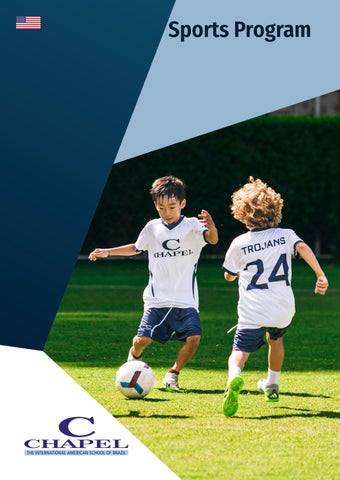
Sports Program
Sports Are an Essential Part of the Chapel Experience Always Moving Chapel students can choose from a wide range of sports, because the school believes that sports are a key part of the school experience. There are curricular activities (those that are part of the mandatory Physical Education classes) and extracurricular activities (those carried out outside of the regular school period). The entire sports program at Chapel is driven by the school values as outlined in its mission statement: “Chapel provides an American-style education to an international student body within a caring and academically challenging environment. Guided by Christian values, students learn to make conscious decisions, to take responsibility for their personal actions and for the needs of the community, while respecting life and cultural diversity.” During sports practice, these goals are furthered by the development of interpersonal skills, the so-called soft skills such as discipline, commitment, respect, persistence, collaboration, and the ability to work in a team. Our focus is on preparing people to exercise their citizenship. While Chapel’s goals do not center on developing professional athletes, we still strive for and achieve a high level of competitiveness in school events. Chapel’s Physical Education classes are taught by teachers who share the tasks of organizing and monitoring the activities in class, which usually consist of 24 students. This results in classes of a high standard, with a better use of time, space, and resources. The entire class can work on the same activity, or else be split into two groups, which take part in activities that are different from those that make up each academic grade’s curriculum.
Sports Program Overview Curricular Activities The sports curriculum runs from Pre I to 10th grade. Along the course of the school years, the number of classes per week may range between two and four. Early Childhood Education Center – ECEC At Chapel, the ECEC Physical Education Program aims to develop fundamental physical skills and appropriate physical activity experiences. It provides training to promote knowledge acquisition and develop skills in five main categories of movement exploration (Movement Concepts, Balance, Mobility, Manipulative (Throwing and Catching), as well as Social and Emotional Development). During Physical Education classes, our students learn to develop confidence in their abilities, and lay the foundation for a lifelong love of sports, physical activity, and a healthy lifestyle. Students engage in a series of activities that develop physical, cognitive, and socioemotional skills that help them acquire self-knowledge, as well as learn about the importance of healthy lifestyles, selfexpression, decision-making, and social skills. In ECEC, Physical Education classes are 30 minutes long. The activities are playful and based on two pillars: motor development and social interaction. Through recreational games, classes aim to get children really moving and socializing. The idea is to plant a seed in children at an early age, so that they enjoy physical activity. Elementary School 1st to 6th Grades From the 1st to 6th grade, the Physical Education student assessments are based on participation (socioemotional performance), motor skills, and physical abilities. The range of physical activity increases the higher the grade. Learning the rules and techniques for various sports gradually becomes more important, naturally and organically, as a backdrop to games and activities. 7th to 10th Grades At this stage, classes strongly focus on both group and individual sports, with the aim of acquiring motor and technical skills. The mastery and use of concepts related to each modality – such as the correct positioning of athletes in the offense or defense, and the right technical move – are now considered when each student is assessed. 11th and 12th Grades In the last two school grades, Chapel offers a wide range of physical activities and sports, but students also have the option of practicing off-campus. Regardless of where they are carried out, 38 class hours of physical activities must be completed by students each semester.
What the School Teaches Physical activities in Chapel’s curriculum include a large number of games and playful activities, gymnastics, martial arts, and sports such as soccer, basketball, volleyball, physical training, floor hockey, handball, track and field, futsal, climbing, softball, flag football, wrestling, racket sports (badminton, tennis and table tennis), lacrosse, TEQbol, and tchoukball. Focus on Personal Responsibility When it comes to physical activities and sports for children and teenagers, a major issue for students and parents is no doubt that of self-image, both in terms of the physical standards extolled by advertising and social media, and the fear of bullying because of standards of body types or physical performance. Chapel seeks to provide a safe environment so that all students feel good when practicing physical activities, and learn to deal with emotional highs and lows. After all, practicing sports means balancing victories and defeats. It is a great learning experience, since it helps people deal with euphoria as well as frustration. The strategy adopted by teachers, grounded on a wide range of approaches, constitutes an important support throughout this process. Activities can be organized so that interactions take place among students with similar performance levels in each sport (all playing volleyball, for example, but placed according to their technical level). Another option is to make up four teams, evenly distributing those who perform best; or else, have half of each class practice a particular sport. This balance, which is developed by teachers based on their experience and knowledge, creates a positive environment for all.
Extracurricular Activities In addition to curricular Physical Education activities, Chapel also offers a wide range of extracurricular sports as continuous student training. ECEC In the ECEC, the extracurricular activities program for Pre II and Kindergarten students provides playful activities and multi-sport classes twice a week for one hour. Elementary School Elementary School students have the Young Trojans sports program, which includes a wide range of extracurricular sports activities. In this way, students’ interests are more widely addressed, while families have more options that suit their day-to-day schedule. Young Trojans activities start in 1st grade. As a result, children can practice sports starting at age six – even if it is just playing. In 1st and 2nd grades, the group sport teams are not separated by gender: girls and boys practice together. They only practice sports separately from 3rd grade onwards. Until 6th grade, there are no official competitions, just festivals and friendly games against other schools, which helps children learn from an early age how to interact and adequately cope with the emotions that may arise. The school occasionally hosts visiting teams, while other times Chapel teams play at other schools. Up until sixth grade, the idea is for games to always be played among children in the same grade. High School Teams are formed for the sports in each competition: Middle School (MS) (7th and 8th grades) and Varsity (9th to 12th grades). Chapel competes in the São Paulo High School League (SPHSL) championship, which brings together five international schools (American and British), and takes place throughout the semester, and in the Association of American Schools in Brazil (AASB) competitions, which includes 14 American schools in Brazil. These are traditional competitions the school has participated in since the 1970s. In 7th and 8th grades when the sports category becomes Middle School (MS), teams can have players from both grades and of mixed ages. In Varsity, from 9th to 12th grades, the mix of ages increases even more. This progression is embedded in the natural shift in the students’ status along their journey at Chapel. Whoever was the oldest student in the class becomes the youngest when they get to Middle School (MS) sports, and the process repeats itself two years later, when a MS veteran becomes Varsity’s youngest. This all contributes to the students’ maturing process and their ability to adapt to different situations. Another change starting in Middle School is that events previously held once yearly now take place twice a year. The first semester, from August to December, includes official competitions in football, basketball, and cheerleading. In the second semester, from January to June, the season shifts to futsal, volleyball, softball (baseball), as well as cheerleading again. The traditional Varsity (9th to 12th grades) competition between 14 schools — the AASB Varsity National Tournament — takes place at Acampamento Nosso Recanto, known as NR, in the town of Sapucaí-Mirim, in southern Minas Gerais. NR is a venue that has hosted sports tournaments for international schools since 1995. It provides excellent monitoring, hospitality, food, and security. The AASB Middle School National Tournament for MS (7th and 8th grades) teams also takes place there.
Celebrations that Engage the School Community The days leading up to Chapel’s participation in the AASB Varsity National tournaments are marked by Spirit Week, a series of social and celebratory events that stir up school spirit for this sporting competition, and that get everyone rooting for the school teams to do their best. The Pep Rally takes place at the end of Spirit Week, on the Friday prior to the trip (which starts on Sunday). The entire High School heads to one of the courts, where the traveling teams make a major presentation featuring battle cries and cheerleading performances, as well as take part in other social activities organized by StuCo, the Student Council. The sports year closes with a grand celebration, the Sports Banquet, which brings together students and families. After a celebration dinner, three standouts for each team are announced, chosen by coaches for the categories of best defensive player, best offensive player, and most inspirational player. Recently, the award started being given out to three nominees for each category, thereby increasing the number of students receiving recognition.
Tournaments AASB Middle School National Tournament Teams: MS (7th and 8th grades) Where and when it takes place: NR 2 (Acampamento Nosso Recanto), November and May Participating schools: Chapel, Graded, PACA, EAC, Sant’Anna, ISC, PASPOA, EARJ, OLM, EABH, EAB, School of Nations, PASB, and EAR. Modalities: First semester - soccer, basketball, and sideline cheerleading. Second semester - futsal, volleyball, softball, and exhibition cheerleading. AASB Varsity National Tournament Teams: Varsity (9th to 12th grades) Where and when it takes place: NR 2 (Acampamento Nosso Recanto), October and April Participating schools: Chapel, Graded, PACA, EAC, Sant’Anna, ISC, PASPOA, EARJ, OLM, EABH, EAB, School of Nations, PASB e EAR. Modalities: First semester - soccer, basketball, and sideline cheerleading. Second semester - futsal, volleyball, softball, and exhibition cheerleading. SPHSL (São Paulo High Schol League) Teams: Varsity and MS Where and when it takes place: Varsity (round-robin: playing one game at home and one away against each opposing team), MS (single round, two games at home and two away) throughout the first or second semester Participating schools: Chapel, Graded, EAC, PACA, and St Paul’s Modalities: First semester - soccer, basketball and competitive cheerleading. Second semester – futsal, volleyball, and softball.
Young Trojans Sports Soccer: from 1st to 6th grade Basketball: from 1st to 6th grade Volleyball: from 5th to 6th grade Cheerleading: from 1st to 6th grade Artistic gymnastics: from 1st to 6th grade Tennis: from 1st to 5th grade Multi-Sports: from 1st to 5th grade Flag Football: from 3rd to 5th grade
Frequently Asked Questions
When did Chapel’s tradition in sports begin? Chapel’s focus on sports and physical activities dates back to the founding of the school, close to 80 years ago. If you just leaf through the yearbooks available in the school library, it will become clear how relevant this history is. Is the goal to develop professional athletes? The idea is to provide experiences in several sports modalities, based on the understanding that physical activity is an essential component to achieve balance during school years, and a source of precious learning experiences for life. The goal is to contribute toward the development of people who can exercise good citizenship. What is the theoretical basis for Physical Education at Chapel? The sports curriculum at Chapel is based on SHAPE America, developed by the Society of Health and Physical Educators (SHAPE), a traditional institution founded in 1885. SHAPE is synonymous with health education and school physical education excellence. The precepts established by the National Common Curricular Base (BNCC) are also followed. Why can physical activities be carried out off-campus in 11th and 12th Grades? This is a strategy to achieve balance at a time in the school year when academic studies are more intense. The school allows students to practice sports off-campus to address the needs of students who specialize in a specific sport or activity, aware that this practice already requires a significant amount of training. Some students also choose to engage in a customized workout plan led by a personal trainer. How can we provide evidence that 11th and 12th graders are performing off-campus sport activities? Evidence of off-campus sports practice basically comes from information provided by students, which is logged into the semester activity record together with the information on planning, activities, and confirmation. In some cases, especially those involving a personal trainer, the school’s sports department may also choose to contact the professional in charge. How does Chapel address conflict and complaints during physical activities and sports practices? These situations are tolerated up to a certain point, with continuous monitoring by teachers. In addition to the school’s general rules, which determine what is or is not acceptable, it is worth remembering that a student’s behavior affects their grade in Physical Education. In turn, the grade for Physical Education, like all other subjects, affects the student’s GPA (Grade Point Average). This is an important consideration in scholarship and college applications. Personal responsibility is the only component that is continuously assessed in Physical Education classes, while other attributes are only assessed occasionally depending on the activity. What is the level of participation in extracurricular sports activities? Substantial. Currently, 86% of Elementary School students engage in an extracurricular sports activity at school. From 7th grade onwards, when academic demands and other interests also compete for a teenager’s attention, the rate of participation is also very high, 81%. How involved are parents in sports activities? Parental engagement is high and goes beyond just cheering in the bleachers. On SPHSL game day, for example, moms representing the Parent-Teacher Association (PTA) take part in the Booster Club, ] and invite
volunteer parents to work at the school canteen. Besides helping develop a closer relationship with students, this fosters a sense of community, which is so prominent at Chapel School. Do girls have the same number of options in sports and physical activities as boys? Sports activities at Chapel have helped break paradigms and contributed to cultural transformation. One example is cheerleading, which is no longer just about putting on a show, but also about competing in international school championships. Traditionally associated with girls, cheerleading has also drawn boys interested in its rich combination of artistry and sports. Conversely, girls have shown a growing interest in soccer, and they already make up the majority of players in 5th and 6th grades. Who organizes the championships that Chapel participates in? Competitions are organized by the schools, following guidelines established by representatives of all involved institutions. Occasional changes may be introduced from year to year, such as modifications to a sport’s official rules. An example of a mutually agreed change is the possibility of a football player who has been substituted going back to the field to play, something that is not permitted in the official rules. How are athletes selected for the tournaments? Students are invited to participate in official tournaments based on their performance in training and games, academic achievements, and attitude throughout the season. What are the criteria for selecting students to participate in a championship? The player selection process is based on several criteria, including technique and the student’s current physical fitness. Nevertheless, other aspects, such as socioemotional skills, are also taken into account. How can parents support their children when they are not invited to participate in a championship? Emphasize the message that this is part of life, and that continuing to strive toward the goal is the right path toward eventually participating. Chapel’s sports department works together with families to help them understand that children have different development timelines and skill levels. Not all kids necessarily do well in sports, and this is not the most important factor when considering all the other benefits of practicing a physical activity. It is worth remembering that those not invited to be part of a team can still play in friendly games at Chapel and other schools. The only difference is that these matches do not count toward a championship but are just as organized and include referees. What measures should be taken to prevent extracurricular sports from interfering in students’ academic performance? Poor academic performance in other subjects may result in students not being invited to an official competition. In this case, it is understood that the student is having difficulties reconciling sports with other academic activities. For this reason, the priority would be to get back up to speed on the subject they’re lagging in. Showing commitment to academic improvement is a factor that would be considered in the following athletic selection process.
Guiding Statements Our Mission In a caring and academically challenging environment, Chapel provides an American-style education to an international student body. Through Christian values, students learn to make informed decisions, to own responsibility for personal actions and community needs, and to respect life and cultural diversity. Our Shared Vision Engage. Challenge. Support. Care. Prepare students for life. Our Motto Faith in education Our Definition of Internationalism Chapel School is an accepting and inclusive environment that respects and embraces cultural uniqueness and diversity. We seek to create an open-minded community while making connections between different perspectives, beliefs, and nationalities to promote a sustainable future in all its dimensions. Our Shared Understanding of High-Quality Learning At Chapel School, learning is a collaborative and personal journey, crafted to suit the needs and strengths of each student. Rooted in research-based best practices and grounded in international and national curricula, our approach to learning encompasses a holistic view of student growth. Learning extends beyond academic knowledge. It embraces the spiritual, socioemotional, cognitive, and physical dimensions of student development. Our learning process nurtures life skills while fostering critical and creative thinking, communication, and collaboration. By cultivating a sense of responsibility and belonging, we empower our students to become active contributors to their communities. Learning has a higher purpose to positively impact society.
CONTACT 55 11 21017400 admissions@chapelschool.com www.chapelschool.com
Version: November, 2025