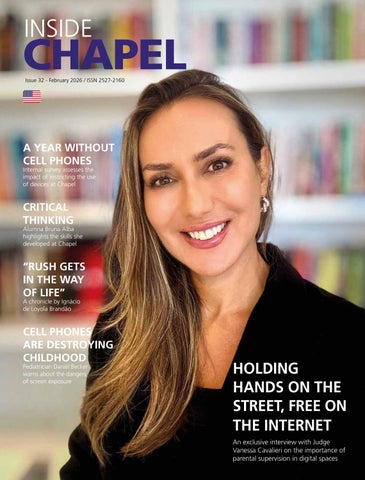
Internal survey assesses the impact of restricting the use of devices at Chapel
CRITICAL THINKING
Alumna Bruna Alba highlights the skills she developed at Chapel
“RUSH GETS IN THE WAY OF LIFE”
A chronicle by Ignácio de Loyola Brandão
CELL PHONES ARE DESTROYING CHILDHOOD
Pediatrician Daniel Becker warns about the dangers of screen exposure
An exclusive interview with Judge Vanessa Cavalieri on the importance of parental supervision in digital spaces
Mission Statement
In a caring and academically challenging environment, Chapel provides an American-style education to an international student body. Through Christian values, students learn to make informed decisions, to own responsibility for personal actions and community needs, and to respect life and cultural diversity.
Ms. Juliana Menezes, Chapel Superintendent
Welcome to the 32nd edition of Inside Chapel and to the second semester of the 2025-2026 school year. We are delighted to begin this new chapter together and to welcome back our students, families, and staff for a semester centered on learning, growth, and meaningful connection.
In this edition, we turn our attention to the role of technology in childhood and adolescence, exploring its long-term impact on school-aged children. With contributions from respected specialists, we share data, reflections, and thoughtful invitations to pause and consider how we can best support our children in today’s digital world.
Pediatrician Daniel Becker highlights findings from a study by the Maria Cecilia Souto Vidigal Foundation that point to an important opportunity for greater awareness. The research shows that many Brazilians remain unaware that the foundation for cognitive, physical, and social emotional development is laid in early childhood. It also reminds us that early childhood extends to age six, a vital period that deserves care, attention, and intentional support.
This edition also features Judge Vanessa Cavalieri, our cover guest and an invited speaker for this semester’s Parent Talk. Drawing on her years leading the Juvenile Court, she shares how the profile of teenagers entering the legal system has changed in recent years, particularly following the COVID-19 pandemic. Her reflections invite us to look more closely at the challenges faced by today’s teenagers and to recognize the importance of guidance, dialogue, and collective responsibility.
This edition also shares insights from a recent survey conducted with our High School students, revealing that 85.5 percent report using their phones more on weekends than on weekdays. Weekends offer valuable opportunities for family time, shared activities, and in-person connections. We also recognize that, as adults, we navigate similar challenges. Balancing emails, messages, and social media is something we are all learning to do together, as parents, educators, and role models. At home, these conversations must continue, and families play a central role in setting boundaries and modeling healthy habits.
Another interesting finding from the survey is that only 2.5 percent of respondents reported using their phones primarily for academic or schoolrelated research. This reinforces the understanding that there is little need for these devices during the school day. At school, cellphones remain out of sight as part of our commitment to supporting students’ mental health, social emotional development, and meaningful face-to-face interactions. While challenges do arise, they serve as opportunities for reflection and refinement. This approach reflects a sustained effort to balance digital use with in-person interactions and learning. We consistently revisit our guidelines and practices to identify areas for growth, always prioritizing students’ well-being.
As always, Inside Chapel is an invitation to reflect, to connect, and to walk alongside one another in the shared work of supporting our children as they grow in a complex and ever-changing world.
EDITORS-IN-CHIEF:
Miguel Tavares Ferreira, Marcos Tavares Ferreira, Eliana Cardia, and Silas Nunes
EDITOR: Paula Veneroso MTB 23.596 (paulacopywrite@gmail.com)
Adriana Calabró, Ignácio de Loyola Brandão, Maurício Oliveira, and Paula Veneroso
PHOTOS:
Acervo Pessoal, Arquivo Chapel, Caroline Pereira, Grazy Barreto, Leo Aversa and Freepik
GRAPHIC DESIGN AND LAYOUT: João Henrique Moço
TRANSLATIONS: Chapel School
PRINTER: Margraf
ADRIANA CALABRÓ
[On the Path to Success, p. 32] Adriana Calabró is a journalist who develops literature, theater, and audiovisual projects, and conducts her own research on writing as a tool for transformation. She received the PUC/UNESCO Best Books of the Year Seal (2017) and the João de Barro Prize (2016) for her debut book for young readers, Vida Game. She also won the ProAC Literary Creation Award (2007), the Elas Cabíria Telecine Seal (2021), and the Rio WebFest Award (2022, as a collaborating screenwriter). Adriana was a finalist for the Off-Flip and Paulo Leminski awards, as well as in short film festivals in Brazil and in Contis, France. She is the author of nine published books.
IGNÁCIO DE LOYOLA BRANDÃO
[Rush Gets in the Way of Life, p. 37] is a Brazilian short-story writer, novelist, and journalist. Throughout his career, he has published dozens of books across various genres (novels, short stories, chronicles, children’s and young-adult literature, biographies, among others), many of which have been translated into several languages. Recognized as one of the most important authors in contemporary Brazilian literature, he has received several awards—including multiple editions of the Jabuti Award and the Machado de Assis Award, the latter granted by the Academia Brasileira de Letras (of which he is a member) in 2016 for his body of work.
MAURÍCIO OLIVEIRA
[Internal Survey Assesses the Impact of Cell Phone Restrictions, p. 15] has written for the main Brazilian press outlets, including Veja, Exame, O Estado de S. Paulo, Valor Econômico and UOL. Maurício has a Master’s degree in Cultural History and a doctorate degree in Journalism from the Federal University of Santa Catarina (UFSC), and has published over 30 books, which include Amores Proibidos na História do Brasil, Garibaldi, Herói dos Dois Mundos, and Pelé, O Rei Visto de Perto
PAULA VENEROSO
[“Parents have no idea what their kids are doing on computers or cell phones.”, p. 24, and Lowered Eyes: The Silent Screen Epidemic, p. 9] is the editor of Inside Chapel. She is a journalist with a Master’s degree in Portuguese from PUC-SP. She has worked as a copyeditor, writer and reporter at Veja and Veja São Paulo magazines and at Folha de S. Paulo Newspaper. For more than 20 years she taught graduate courses in journalism. She currently works as a book designer and editor, in addition to producing and editing news articles for print and digital media.
SUMMARY
A GENERATION CAPTIVATED BY SCREENS
Pediatrician and childhood advocate Daniel Becker warns of growing cell-phone addiction among adults and children, which leads to irreversible harm in cognitive development. According to him, “a childhood without play creates stupid, unhappy, depressed, violent, and intolerant adults.”
15 35 38
SCHOOL WITHOUT CELL PHONES
To understand the impact of Law 15100, which restricted cell-phone use in Brazilian schools, Chapel surveyed 200 students (ages 12 to 18) and 59 teachers. The results showed increases in conversation, interaction, and fun-filled moments, leading to improved coexistence at school.
CHRONICLE
In the chronicle “Rush Gets in the Way of Life,” Ignácio de Loyola Brandão, a member of the Brazilian Academy of Letters, recalls his childhood and teenage years spent among friends at a time when conversations were face-to-face and notes were handwritten. He reflects on how schools and teachers shaped lives before cell phones displaced moments of genuine exchange.
SPOTLIGHT
See what made news at Chapel: the Association of American Schools in Brazil unifies sports competitions into a single tournament with 14 schools; NHS members create the Buddy Program and collaborate with Chapel’s Early Childhood; and the new Christmas at Chapel format offers a relaxed morning with a family picnic, a solidarity campaign, and fun-packed activities for children.
CELL PHONES DO NOT GO WITH CHILDREN
Vanessa Cavalieri, Chief Judge of the Juvenile and Child Welfare Court (Vara da Infância e Juventude) in Rio de Janeiro, warns that the digital space is unsafe for children and teenagers when unmonitored. She argues that parents must pay attention to what their children are doing online. Her opinions on the harms of the internet are forceful and point to a lack of parental control. In an exclusive interview, she explains what motivated her to create the Eu Te Vejo (“I See You”) protocol and to support digital-disconnection movements.
30 45 55
TALENTS & PASSIONS
Teachers Priscilla Odinmah and Erick Santana talk about their respective passions for singing and road cycling. Among students, dedication to social projects, talent in sports—golf, tennis, volleyball, and car racing—arts, and music-related pursuits, such as painting, ballet, and piano, and even fragrance connoisseurship stand out.
USING TECHNOLOGY RESPONSIBLY
Bruna Alba, a Chapel alumna and current Head of Marketing for Amazon Mexico, shares some insights into her professional journey and reflects on the strong foundation built at Chapel, especially how critical thinking shaped her personal and professional growth, contributing to her rise in major international companies.
GALLERY
Photos from cultural and commemorative events during Chapel’s last semester: the traditional Book Fair; the fun Spirit Week and Halloween costumes; the new Christmas at Chapel format, and the NHS and NJHS induction ceremonies.
By Paula Veneroso
Leo Aversa
LOWERED EYES: THE SILENT SCREEN EPIDEMIC
A FIERCE CRITIC OF EXPOSING CHILDREN TO SCREENS, PEDIATRICIAN DANIEL BECKER DOES NOT MINCE WORDS – HE BELIEVES THAT CELL PHONES ARE DESTROYING CHILDHOOD. HE SEEKS SYSTEMIC SOLUTIONS AND WAS ONE OF THE MAIN SUPPORTERS OF THE LAW BANNING CELL PHONE USE IN BRAZILIAN SCHOOLS: “I WAS ONE OF THE MAIN PEOPLE RESPONSIBLE FOR THIS LAW, AND AM VERY PROUD OF IT,” HE SAYS. BUT DESPITE THE POSITIVE OUTCOMES, BECKER WARNS THAT CHILDREN AND TEENAGERS ARE ADDICTED TO SCREENS, AND THAT LAWS ALONE ARE NOT ENOUGH. TO REALLY CHANGE THINGS, FAMILIES, SCHOOLS, AND THE GOVERNMENT NEED TO MAKE SWEEPING CHANGES.
In the daily lives of Brazilian families, one scene repeats itself with alarming regularity: a silent child, face lit by the glow of a screen, sliding their fingers in a hypnotic rhythm. Far from the excitement of real life, this child, says Becker, is at the center of an epidemic that spreads silently and requires a clear diagnosis and forceful response. Recent surveys back up what the specialist has been saying for years, and also show that the problem is only getting worse. Between 2015 and 2024, the number of children under two with internet access jumped by nearly 400%. Even though the Brazilian Pediatric Society (SBP) recommends that babies under two have no screen time, the latest study by the Center for Regional Studies on the Development of the Information Society (Cetic.br) found that 44% of kids in this age group already use the internet. An even more alarming 2025 study by the Maria Cecilia Souto Vidigal Foundation in partnership with Datafolha, titled “An overview of early childhood: what Brazil knows, lives, and thinks about the first six years of life,” showed that 78% of children under three spend more than an hour a day on screens, and that nearly all kids aged four to six (94%) are exposed for three hours daily.
Photos:
WHEN A CHILD IS ENTERTAINED BY SCREENS, THEY LOSE THEIR ABILITY TO CREATE, DEAL WITH BOREDOM, AND THINK.
Early Childhood: No Screens
According to Becker, early childhood must finally be understood as the most important stage of human development: “It is a time of explosive, fast, and intense growth – the most intense in life. Human learning has always taken place in the real world, the three-dimensional world.” He reminds us that humans “grow in daylight, sleep in the darkness of night, develop by moving their bodies, interacting, telling stories, rationalizing, thinking, facing boredom with creativity, playing with children, and especially planning and organizing.” This is human development par excellence, the kind that has made our species what it is today. Many of these essential abilities—not only neurological ones—develop in early childhood.” Another worrying finding from the Maria Cecilia Souto Vidigal Foundation study is that 84% of Brazilians do not know that the foundation for cognitive, physical, and social-emotional growth is laid during these years. For 41% of the people surveyed, this process starts only in adulthood (18), while another 25% think it begins in the teenage years (12–17). In fact, most Brazilians
(98%) do not even know that early childhood ends at age six. At this stage, the brain makes about one million synapses per second, and 90% of its connections are formed. Screens disrupt this process by keeping kids from engaging with nature, daylight, real human interaction, and play. “When a child is entertained by screens, they lose their ability to create, deal with boredom, and think. It hinders contemplation and this means abolishing creativity—they stop developing normally, particularly in early childhood,” explains Becker. That’s why experts recommend keeping screens from young children, as France does.” In Brazil, we talk about avoiding screens until age two, but ideally that should last longer, because screens do not offer any developmental benefit. On the contrary, they only cause harm,” he warns.
Children and Teenagers: Real Experiences
From childhood to adolescence, Becker lists a long line of harms caused by screens, and one of the worst is addiction. “Apps, social media, and short videos are addictive because everything on them is easy, fast, and irresistible,” he says. Even worse, teens miss out on many real-life experiences that shape them into functional adults. “During puberty, the brain undergoes a major transformation, when the child’s brain matures into an adult’s; it’s quite intense during puberty,” he explains. This is when the prefrontal cortex develops—the part of the brain responsible for executive functions typical of an adult. “Planning, organization, impulse control, critical thinking, delaying gratification, facing frustrations, carrying out tasks, solving problems, resolving conflicts, empathizing, all of this takes place in this part of the brain.”
The specialist adds that, to develop such crucial skills, young people need real face-to-face experiences, social experiences with
parents and groups. “Arguing and making up with friends, hugging, pushing each other, playing ball, winning and losing, understanding that practicing more improves your game, getting scolded by a teacher, doing poorly on a test, studying harder and doing better on the next one, doing homework, and getting organized for it, working out issues with relatives and friends, having role models for behavior, learning ethics and behavior from parents and grandparents, practicing sports, dedicating yourself—all of that is part of our social and cultural
SCREENS DO NOT OFFER ANY DEVELOPMENTAL BENEFIT. ON THE CONTRARY, THEY ONLY CAUSE HARM.
life,” he says. “Exploring nature, challenging yourself, climbing a tree, hiking, having courage, curiosity, and initiative—these are the key experiences gained in adolescence.”
More Than Just Lost Time
The average Brazilian teenager spends eight to nine hours a day on screens—enough to disrupt sleep and cause devastating consequences beyond harming key skills like attention and focus, warns Becker. “Anxiety, depression, and panic are some of the most common ones, but we’ve also seen a rise in selfharm, suicidal thoughts, and even suicide, especially among girls,” he says. Such harm, according to the pediatrician, comes from the kind of content children are being exposed to online—content he calls extremely damaging. “It’s full of hate, intolerance, consumerism, extreme violence, misogyny, racism, hatred toward the poor and toward schools, vape sales, fake supplements, fake medications, fake treatments, and gambling, all of which reach young people, along with pornography, which is addictive and leads to a completely twisted sexual awakening,” he explains. The effect of social media on girls is especially harmful. “When they are constantly exposed to fake bodies, they end up believing theirs are terrible and start seeking an absolutely flat abdomen. They want to buy every kind of medication, go on diets, make themselves vomit, hurt themselves, and sink into depression,” he adds.
What Can Be Done?
School alone cannot fix the problem, Becker warns. Its role, he says, is to provide digital education, while families and the government must set limits and create laws to regulate the digital world. In this sense, the law banning cell phone use in schools has made a real difference: “This four-, six-, or eight-hour break in children’s and young people’s lives is being
commended by teachers, who see students interacting face-to-face, paying more attention in class, and reconnecting during recess through play or conversation,” he asserts. Ideally, rather than creating a rebound effect, where kids make up for lost screen time once they get home, this restriction at school should lead them to rediscover the real world.
For that to happen, families need to do their part. “The family needs to set rules, use parent control apps, supervise and limit screen time, accounts, and the kind of content their kids can access,” argues Becker. For him, committed parents sit with their teens to watch videos together, look at the content they are receiving, and help them think critically about it. “If possible, parents should
IDEALLY, PARENTS SHOULD GIVE THEIR CHILDREN A CELLPHONE AS LATE AS POSSIBLE, AFTER THE AGE OF 14.
give their kids cell phones as late as possible; I always recommend ninth grade—about age 14 or 15—and joining social media only in high school, preferably junior year, or about age 16. That’s the universal recommendation proposed by Jonathan Haidt, the author of An Anxious Generation. And even then, supervision should always be present,” he stresses.
As for the role of government, Becker believes that banning cell
phones in schools is an essential public policy, but that childhood and adolescence need greater federal protection. He cites Federal Law 2628, sanctioned in September 2024, which created the Digital Statute for Children and Adolescents (Digital ECA): “Several activists fought for three years and got nowhere. Then suddenly, a video by influencer Felca sparked public outrage, and Congress finally woke up and
FROM COLLEGE TO THE FAVELA:
approved the law.” The pediatrician explains that, although the law ensures greater control of crimes on social media—such as publishing inappropriate content that incites hate, intolerance, racism, dangerous challenges, early sexualization, showy display of wealth, and gambling—it will not end children’s and teens’ screen addiction. That, he insists, must be handled by families, ensuring that kids have more experience in real life.
THE ROOTS OF COMPREHENSIVE PEDIATRICS
Daniel Becker’s self-description as a childhood activist is not a recent marketing strategy but the reflection of a career-long identity that began decades ago, when he was a pediatric resident at the Federal University of Rio de Janeiro (UFRJ). There, he cared for children from Maré, the favela next to the university hospital. “The kids would come in very sick, and we’d treat malnutrition, infection, and parasites, but months later they’d come back just as ill. It made no sense to me. So many resources and so much money, time, and energy were spent caring for a sick child who, once back home, would get sick again,” he recalls, explaining how that realization shaped his professional path.
That experience led him to study social pediatrics, first in France and later through a master’s in public health at the Oswaldo Cruz Foundation (Fiocruz). In 1988, he went to Thailand to work in refugee camps, and became the first Brazilian to join Médecins Sans Frontières (Doctors Without Borders). “I learned to practice medicine without any resources beyond my abilities,” he recounts. When he returned to Brazil, Becker worked in the favelas, dedicating over 20 years to practicing in the city outskirts, where he focused not only on poverty but on equity in health. “Health is a social construct. It doesn’t come from doctors and medicines. Health is achieved when there are good living conditions, when there’s development, education, income, basic sanitation, a healthy environment, cultural life, recreation, physical exercise, positive relationships, and community. In short, when all the elements that make a good life are in place.”
Collective Solutions for Collective Problems
In public hospitals, doctors’ offices, emergency rooms, and university classrooms, it became increasingly clear to Becker that people needed to understand something fundamental: good health isn’t achieved only through medication, diets, or exercise. “Collective problems
require collective solutions,” he says, explaining how comprehensive pediatrics—the term that defined his approach—came to be. In the early 1990s, Becker joined the newly formed Center for Health Promotion (CEDAPS), a non-profit organization that pioneered the use of community health agents in Rio de Janeiro’s favelas and launched the city’s first Family Health Team. This initiative was later presented to Brazil’s Ministry of Health and became the model for the country’s main public health policy—the Unified Health System (SUS)— created about the same time. “Today, the primary health program serves 150 million Brazilians. It’s the largest public health program in the country and one of the proudest accomplishments of my career,” he says. Through CEDAPS, Becker worked in 23 countries, collaborating with UNICEF (the United Nations Children’s Fund) and the WHO (World Health Organization) on international health projects.
“We Should All Be Activists”
Around 2010, Becker began writing about comprehensive pediatrics on Facebook; his posts were well-received, and he quickly gained a substantial following. “I started talking about two essential things for children: their key physical space—nature—and their main activity—play,” he says. During the pandemic, he was among the first to advocate for the return of inperson classes and remained at the forefront in warning about the dangers of excessive screen time. He also fought fiercely to ban cell phones in schools and now speaks out about environmental issues. “I’ve always believed in looking at the present to predict the future, to act early and make things better later. That’s what I call activism,” he explains. Today, Becker’s concerns extend to environmental issues: “The climate crisis is already here, and we need to understand that kids are suffering, and will suffer even more. We all have to act as environmental activists. The truth is, we all need to be activists now.”
INTERNAL SURVEY ASSESSES THE IMPACT OF CELL PHONE RESTRICTIONS
LAW NUMBER 15100, ENACTED IN JANUARY, HAS IMPROVED STUDENTS’ AND TEACHERS’ EXPERIENCE AT CHAPEL.
The routine in Brazilian schools has been altered by federal law 15100, which restricts cell-phone use in basiceducation institutions nationwide. In place since January, the law has been well received by those who recognized the need to limit children’s and adults’ access to the device. Right before the law was voted on, its approval rate reached 86%, according to a national survey conducted by Instituto Nexus. Of those interviewed, 54% agreed with completely banning cell-phone use in schools, while 32% supported allowing it in learning environments when used for didactic and pedagogical activities under teacher supervision. Only 14% of Brazilians opposed the measures being debated in Congress at that time. At Chapel—as in the rest of Brazil—the law drastically reduced losses caused by constant digital distractions at school. Without cell phones always in hand, students increased their attention during classroom activities and interacted more with each other during breaks. Gradually, the initial sense of loss gave way to rediscovering the joy of games, outdoor play activities, and something that had been somewhat forgotten: talking, chatting, telling stories, and listening to them.
By Maurício Oliveira Photos: Chapel archives
“Our assessment of the changes brought by the law is extremely positive, since cell-phone use in schools had become a major concern for parents and teachers alike,” says Ms. Juliana Menezes, Chapel’s Superintendent. “I am sure that for the students it was also an important step in maintaining mental health.”
Less cell phone, more focus
To understand the impact of the law one year after it went into effect, Chapel organized student and teacher surveys on the topic. Two hundred responses were received
from students ages 12 to 18, and 59 from teachers, a significant sample of the school community. Of all those surveyed, only 11 (nine students and two teachers) mentioned not having a cell phone, evidence that having the device is prevalent even among children and teenagers.
Of the students who responded to the survey, 37% noticed changes in the overall time their cell phone is used after the law went into effect, with 34.5% saying they were using it less and only 2.5% saying they were using it more. The remaining 63% said that the overall time
was compensated for with more use outside of it.
Isabela Schahin, 14, is part of the group that noticed reduced cell-phone use, from an average of five to three hours per day. “I feel I have more focus when studying and more time for sports and talking to friends,” she says. She adds that she always enjoyed chatting with others, but sometimes felt inhibited when approaching peers who were on their phones. That barrier is now gone.
The importance of the example
Of the students interviewed, 78.5% knew the World Health Organization (WHO)’s recommended maximum screen time per age
group—yet 46% of those who knew the guidelines admitted they were not following them. After the law was enacted, however, it became clear that cell-phone use increased significantly on weekends: 85.5% of students surveyed said they use their phone more between Friday and Sunday than from Monday to Friday.
It is a sign that families still have much to discuss at home. For 40.5% of the students surveyed, parents do not agree with their cell-phone use, while 36.5% said parents find their use acceptable. The remaining 23% were unable to answer or said parents were indifferent.
Of the students surveyed, 66% think parents use their cell phones even more often than they do. “When we set rules, we have to make sure we follow
them too,” recalls Ana Paula Aragon, mother of 15-year-old twins Enrico and Anna Beatriz. She mentions, for example, that the family has a rule of not using phones during meals. “The other day, I wasn’t sure about something we were discussing--I think it was the name of a country’s capital-so I took out my phone to check. They called me out immediately, and they were right to do so: a rule is a rule.”
As a result of the new policy, parents have also had to adjust to challenges in communicating with their children. It was quick and easy to send messages at any time before; now, they must contact Chapel’s office to send a message,
everyone planning better what needs to be done and agreed upon,” admits Ana Paula.
Losing instant communication is the main reason 65.5% of students surveyed believe the law has at least one drawback. Of these, 74.5% pointed to the biggest con as difficulty reaching family and friends, while the remaining 25.5% were divided among boredom, anxiety, and reduced access to entertainment and news.
Gains and losses
When the law was sanctioned, Chapel’s directors and teachers worked out how they would use cell phones in school. The choice was made to keep phones stored away—
for example, teachers cannot even be seen with cell phones in their pants pockets during breaks. The outcome was a change in teachers’ habits as well, since they would also often spend time after lunch on their devices.
Among the teachers surveyed, 57.6% reported using their cell phones less overall, while 42.4% reported using them for the same amount of time. None of the teachers surveyed said they were using phones more than before.
Another of Chapel’s decisions was to discontinue using cell phones for educational purposes during classes, as allowed by the law. The reason was to avoid potential loopholes for students to access their devices at other times in school. This measure affected a significant number of teachers, since 40% of them had been using their cell phones to support classroom activities.
Marcio Kuroiwa, the chemistry and science teacher for 7th to 12th grades, is enthusiastic about using technology resources in the classroom, and, therefore, points out a collateral effect of the new law: “The cell phone is very practical for recording videos, taking pictures, among other functions,” he notes, adding that he has tried to find alternatives to compensate for the loss of these features. Even with occasional setbacks like these, however, 50% of teachers surveyed believe their work experience has improved, while 40.7% say it remains the same, and only 8.5% indicated a worsening.
Those who reported improvements in their daily routine point to reduced strain from constantly monitoring and curbing cell-phone use during classes. Livia Galeote, a
7th- and 8th-grade teacher, felt very relieved when the law was enacted. “In the classroom, we had to pay attention to several things at the same time, which increases mental strain. The cell phone was definitely one of the stress factors.”
Welcome hullabaloo
Of the teachers surveyed, 61% believe that students are happier and 39% say they are just as happy after the law went into effect. None reported students being less happy. This view differs slightly from how students rated their own happiness on the topic: 14% think they are happier, 79% say they are just as happy, and 7% say they are less happy.
Nuno Tavares, 17, is one of the students who considers himself happier. “Not using the
cell phone helped me pursue other things at school, including Chapel resources like the sports courts and the soccer field,” he says. One of the discoveries with classmates was Four Square, a game ideal for short breaks. “I always liked moving and doing sports. So I am definitely happier now, because I have more friends doing those with me.”
Marina Almeida, 13, noticed how hard it was to stay in touch with parents and friends at first, but says the negative aspect of the law was offset by the new ways she and her peers have fun and interact. “We started doing things that we didn’t do
before, and that was really cool. The biggest one is Truco (a card game),” she recounts.
The hullabaloo typical of Truco—played mostly in the library—somewhat symbolizes the changes cell phone restrictions brought to Chapel. “In the beginning, the noise was very loud. Afterward, things got better,” recalls 6th-grade math and science teacher Ruby Sheets. “I am not complaining—not at all. It was sad to walk past 15 kids holding cell phones with their heads lowered in silence. I think it’s beautiful when they talk, interact, and have fun together.”
Although there are clear signs of improvement after the implementation of the new law, Chapel acknowledges that there is still room for growth. The school believes that adapting to new situations—particularly those brought about by rapidly evolving technologies—requires continuous reflection, vigilance, and collective responsibility. Although the challenges remain, the positive results that have already been observed confirm that moving forward on this path is necessary and that the benefits of doing so will continue to outweigh the difficulties the school must face as it does.
After changing the way you use your cell phone, do you feel happier, less happy, or the same?
SUMMARY OF THE SURVEY RESULTS
Students
Did your school life get better, worse, or stay the same?
What is your main use of the cell phone?
Passive — scrolling in social media
Active — communication with others 36%
Music, games, series 11%
Researching — academic/school work 2.5%
Do you use it more, less, or the same amount of time?
What do your parents think about your cell phone use? Agree
Do you discuss cell phone use at home?
No
They use the cell phone more: On weekends
From Monday to Friday 14.5% Is there a con to not using the cell phone?
What was the longest period you went without using your
What is the main drawback of using your cell phone less?*
Harder to communicate with family and friends
Do you think your parents use their cell phone less than you do?
Less access to information and news
Reduced access to entertainment
* Among the 131 students who reported at least one drawback
Teachers
Do you use it more, less, or the same amount of time?
Did your experience as a teacher get better, worse, or stay the same?
LAW NO. 15100 OF JANUARY 13, 2025
Provides for student use of personal portable electronic devices in public and private basic education institutions.
FROM THE OFFICE OF THE PRESIDENT
I hereby announce that the National Congress has decreed and that I sanction the following Law:
Art. 1 This Law governs students’ use of personal portable electronic devices, including cell phones, in public and private basic-education institutions, in order to safeguard the mental, physical, and psychological health of children and adolescents.
Sole paragraph. For the purposes of this Law, classrooms are defined as all school spaces in which educational activities are conducted under the guidance of education professionals.
Art. 2 The use of personal portable electronic devices by students during class, recess, or breaks between classes is prohibited at all stages of basic education.
§ 1 In the classroom, the use of electronic devices is permitted exclusively for educational or instructional purposes, as directed by education professionals.
§ 2 Situations involving danger, necessity, or force majeure are exempt from the prohibition set forth in the caput of this article.
Art. 3 The use of personal portable electronic devices by students is permitted, regardless of educational stage
Did you use cell phones as part of your lessons before the law?
Do you feel students have changed after the cell phone restriction? Are they happier, less happy, the same?
READ THE LAW
or physical setting, inside or outside the classroom, for the following purposes:
I - to ensure accessibility;
II - to ensure inclusion;
III - to meet students’ health needs;
IV - to ensure basic rights.
Art. 4 Education networks and schools shall develop strategies to address psychological distress and mental- health issues among basic-education students, informing them of the risks, warning signs, and preventive measures related to psychological distress in children and adolescents, including the excessive use of the devices referred to in Art. 1 and access to inappropriate content.
§ 1 Educational networks and schools shall offer periodic training on the detection, prevention, and treatment of signs indicative of psychological or mental distress and the harmful effects of excessive screen use and personal portable electronic devices, including cell phones.
§ 2 Educational establishments shall provide listening and support spaces for students and staff experiencing psychological or mental distress resulting primarily from excessive screen use or nomophobia.
Art. 5 This Law shall enter into force on the date of its publication.
Brasília, January 13, 2025; 204th year of Independence and 137th year of the Republic.
By Paula Veneroso
“PARENTS HAVE NO IDEA WHAT THEIR KIDS ARE DOING ON COMPUTERS OR
CELL PHONES”
INTERVIEW
THAT IS WHAT JUDGE VANESSA CAVALIERI SAYS. IN THE PAST DECADE, THE CHIEF JUDGE OF THE JUVENILE AND CHILD WELFARE COURT (VARA DA INFÂNCIA E JUVENTUDE) IN RIO DE JANEIRO FOR THE LAST 20 YEARS HAS OBSERVED A SIGNIFICANT AND CONCERNING CHANGE IN THE PROFILE OF TEENAGERS INVOLVED IN VIOLATIONS. THE MAGISTRATE HAS IDENTIFIED A RISE IN SERIOUS DIGITAL OFFENSES, OFTEN COMMITTED BY UPPER-MIDDLE-CLASS TEENAGERS, WITHOUT THEIR PARENTS’ KNOWLEDGE.
This finding, along with the life stories of dozens of young people who planned and carried out school attacks, has led the judge to important conclusions: unsupervised digital spaces have become some of the most dangerous environments for children and teenagers, and school violence is closely linked to mental-health issues, a lack of parental supervision online, and challenges such as cyberbullying. According to Vanessa Cavalieri, the potential benefits of social media do not outweigh the harmful effects on children and adolescents. “Everytime a girl searches for a cookie, she is flooded with posts that glorify eating disorders and are deliberately presented by algorithms,” she says. To discuss these and other issues, the judge gave Inside Chapel an exclusive interview.
You mentioned that you noticed a change in the profile of young offenders when you became a judge in Rio de Janeiro’s Juvenile Court. What changed?
VC: Over the past 10 years that I’ve headed the Juvenile Court, we’ve seen a clear shift in the profile of teenagers in the legal system, especially after the pandemic. Aside from the boys from vulnerable socioeconomic backgrounds, living in conditions of severe deprivation and with limited access to basic rights, other boys who were not usually involved in police cases began showing up — boys and girls from upper-middle-class families, students at good schools, with stable, well-structured homes and no major issues regarding access to basic rights. And they’re committing violent crimes more frequently, often connected to the use of technology.
Photos: Personal archives and Freepik
Why did you feel the need to create the “I See You” protocol, and what are the main results so far?
VC: The “I See You” protocol has a broad goal: to reduce violence in schools and among teenagers. In 2023, following a wave of school attacks, we realized that many of these boys and girls had been victims of violence, violations, bullying, and humiliation at school, none of which was visible to their families or teachers until they stopped being victims and
became aggressors. We want to shed light on this problem and highlight its causes so that schools, families, and government agencies can act proactively in the fight to prevent youth violence.
Are you also part of “Movimento Desconecta”? Could you explain what it is and what it promotes?
VC: I am an ambassador and supporter of Movimento Desconecta , a group of families
who joined together to establish a collective agreement to delay giving children a cell phone or access to social media.
The goal of this movement is that no child should receive a smartphone before age 14 and no one should use social media before 16. This initiative was based on recommendations by psychologist Jonathan Haidt in The Anxious Generation, rooted in the understanding
that early exposure increases vulnerability, mental health risks, and developmental harm. We also know that it is very difficult for a single family to maintain these limits or rules, especially when the child is excluded from WhatsApp groups or social networks. Our view is that, by forming a committed community of families, we can create “bubbles” in which children have their childhood preserved and protected from screens.
What are the most urgent and alarming dangers you have noticed in the digital space, and why are seemingly harmless social media like TikTok dangerous? Which platforms are the most damaging today?
VC: There are many dangers posed by social networks and digital platforms to both physical and mental health. Lack of physical activity, chronic sleep deprivation, rising rates of depression and anxiety, self-harm, and eating disorders are some of the most frequent. There are also safety risks. Children and teenagers are not only vulnerable to becoming victims of crimes, recruitment, pedophiles, and criminals, but they may also commit violations themselves when co-opted by extremist online communities. We know that on TikTok, Instagram, or X, there
are people inciting extremism, violence, neo-Nazism, and who promote misogyny, racism, and homophobia. Without a doubt, the most dangerous platform today is Discord, because there is no active content moderation or enforcement. Its design leaves users highly vulnerable to all types of crime, since the platform shows no commitment to safety. What used to take place on the dark web five years ago now occurs openly on the surface web within user-created Discord servers. Without oversight, the internet is more dangerous for a child or teenager than the street.
In the court’s view, what are parents and guardians responsible for monitoring in their children’s online lives? Where does freedom end and negligence begin?
CELL PHONES WERE NOT DESIGNED FOR KIDS.
VC: The law establishes that, up to age 18, parents are responsible for their children. That includes where they go, the risk they face, and applies equally to physical and virtual environments. Parents are responsible for monitoring and supervising what their children above age 18 and up do online and in person, and for preventing access to age-inappropriate content. Pornography and online betting, for example, are only permitted for adults (over 18), and social networks have guidelines as well. A child should never have access to social media. When a child or teenager harms someone, the parents are civilly liable, that is, they share legal responsibility under civil law and may be ordered to pay for moral and material damages, healthcare treatment of victims, and more. Today, the absence of limits is a widespread issue across all social classes. We see absent fathers and permissive mothers. When I speak in schools, the only parents who show up are
A CHILD SHOULD NEVER HAVE ACCESS TO SOCIAL MEDIA.
those who least need the talk. The ones who need to hear it the most rarely attend.
Your recommendation is for families to use parental-control apps to monitor kids’ activities. Based on your experience, how effective are these tools, and what are their limitations?
VC: Yes, in addition to talking with kids, guiding them, and establishing clear rules, I recommend that parents use parental-monitoring tools— parental-control apps. The best ones are the ones kids hate. These apps can limit screen time and restrict access to content children should not see, because you cannot expect a child or teenager— with an underdeveloped brain and exposed to professionally engineered digital seduction by Big Tech—to self-regulate and exercise the self-control needed to avoid placing themselves at risk. Just as we supervise what children do in person, we must also supervise what they do online.
What is the government’s responsibility in protecting children and adolescents from the risks of the digital environment?
VC: In our view, the government’s responsibility— meaning the State in the broad sense, including the executive, legislative, and judiciary branches--is to
IN THE
DIGITAL SPACE, CHILDREN AND TEENAGERS ARE NOT ONLY VULNERABLE TO BECOMING VICTIMS OF CRIMES, BUT MAY ALSO COMMIT VIOLATIONS.
WHO IS THE JUDGE FIGHTING DIGITAL NEGLECT
Judge Vanessa Cavalieri has built her career as one of Rio de Janeiro’s most active voices in the defense of children’s and teenagers’ rights. Her professional and academic path reflects deep engagement with youth vulnerabilities and social challenges. She holds a law degree and began her legal career in a position with significant contact with impoverished communities. At 22, she became the District Attorney for the state of Rio de Janeiro. In 2005, she became a judge, and ten years later assumed the role of Chief Judge of the Juvenile Court, where she encountered the harsh reality of criminal minors and cases of negligence and violence. Her expertise led to an invitation to collaborate with the National Legal Council (CNJ) in the childhood and juvenile department circa 2017 to map out programs for special statements of children and teens who had suffered violence, and to teach at Rio’s Judicial Training School (Escola da Magistratura do Rio de Janeiro - EMERJ).
regulate platforms by creating the required laws. The Digital Statute for Children and Adolescents was recently approved and will take effect in March. The government’s duty is to enforce it, ensuring that platforms comply with and are monitored under the new regulations.
You played a key role in creating the law that bans cell-phone use in schools. What main impacts have been observed a year after its implementation in Brazil? Have you seen any results in your field?
VC: The ban on cell phones in schools emerged as part of a global movement inspired by a UNESCO recommendation. Several countries adopted it to protect the moments of interaction among students—playtime, games, conversations, debates, conflicts, dating—in short, all the socialization that takes place during breaks. The law was also informed by research showing that phone use in the classroom harms learning by dividing attention and reducing concentration in subjects like math. A survey conducted in Rio de Janeiro one year later found improvements in grades, a decline in violence, and a clear link between these results and the ban on cell-phone use.
Children and teenagers often do not understand that what they do online can cause real-life harm. In your opinion and experience, what are the most serious problems they may face?
VC: The most serious risk of all is death. Teenagers are dying in online challenges and in situations that lead to suicide, often encouraged by other teens inside Discord
communities. We’re also seeing worsening mental-health issues, more cases of self-harm, and eating disorders. They can also lose their freedom by being required to fulfill a socio-educational measure and be placed in a facility. Depending on the seriousness of the violation, they may even lose their freedom entirely.
Why should giving cell phones to children be delayed, and access to social media even more so? At what ages should these be allowed?
VC : Among specialists, there is almost full agreement that children under 12 should not have a cell phone. Cell phones were not designed for kids. Social media and games were not created with them in mind. So, for kids, cell phones bring no benefits at all. . For teenagers, we recommend smartphones starting at 14 and social media after 16, because the first stage of
THE BEST PARENTALCONTROL APPS ARE THE ONES KIDS HATE.
adolescence — up to about age 15 — is a vulnerable period for mental health. There is grieving for the loss of childhood, grieving for the “childhood parents,” for childhood friends, and for the child’s body. It’s a phase of adjustment, full of emotional instability caused by hormones and change. And the mental-health risks that already exist in adolescence become even more intense when social media enters the picture — something we already know is harmful to mental health. This is especially true on networks like Instagram and TikTok, where teens constantly compare themselves to others, and everyone else’s life always seems better. So, it’s important to protect their mental health in early adolescence. They tend to be more mature at 16 or 17.
Do you think it is possible to create laws about this?
VC: I think that the law can prohibit social-media use for anyone who is underage. I believe the new law, the Digital ECA, will require age verification on platforms, because age recommendations on many platforms already require users to be 18+. For example, X and Discord are rated 18+, Instagram is 16+, and so on. But when it comes to the age for a child’s first phone, I don’t think that should be determined by law. Families need to build awareness around this and respect the different stages of childhood.
What are your thoughts on WhatsApp groups, both for parents in school groups and for kids and teens in their own groups?
VC : WhatsApp groups help communication and make coordination easier, but poor use can be harmful. So the first step is to separate adult use from children’s and teenagers’ use. Children
THE “I SEE YOU” PROTOCOL
In response to an urgent need for awareness about online dangers and the prevention of digital crimes, Judge Vanessa Cavalieri, together with Rio de Janeiro’s Child and Youth Court and CEJUSC (Center for Legal Conflict Resolution and Citizenship) for Restorative Justice, created the “I See You” protocol. The program aims to prevent violence in schools and reduce the involvement of children and adolescents in digital crimes, raising awareness among families, schools, and the justice system about the root causes of this violence, the importance of functional parenting, and digital safety. It seeks to transform school environments into safer, more welcoming spaces. The protocol also promotes digital literacy and, in one of its branches, supported the law banning the use of cell phones in schools—reflecting the judge’s commitment to ensuring that society and the justice system “see” children and teens before they reach a path of violation. With over 140,000 followers, the Instagram account (@ protocoloeutevejo) provides tips on active parenting, information on digital safety and legislation, and compiles all of the interviews the judge has given on the subject.
should not use WhatsApp, because the minimum age is 13, and that information is right there on the app as the recommended age. If a child under 13 is using WhatsApp, it means that the parent allowed them to lie about their age on an app that is not ageappropriate. That should not happen. Parents need to act like adults and respect the law. And, if they do allow it, at very least they must supervise what their child is doing — read the messages, access all content — because we are talking about kids. As for teenagers, they can have more freedom: arranging outings, programs, parties, birthdays, or study groups about subjects of interest, including studies. I believe that the tool can be used positively, but parents still need to supervise WhatsApp groups. A group with 40 teenagers is not private; it’s
basically a public space, like a social network, and it requires oversight. This allows parents to step in when something starts heading in the wrong direction — humiliation, crime, exposure, or content that goes against the law or the family’s values. For parent groups — mom groups, family groups — I think adults need
to use common sense. They must respect the school and its pedagogical choices, remember that not everything will go their child’s way, and that frustration is normal. If there is something more serious to resolve with the school, parents should contact the school directly, and not use a WhatsApp group, because that leads nowhere.
DEEPENING THE CONVERSATION
THE CURRENT ABSENCE OF LIMITS IS A WIDESPREAD ISSUE ACROSS ALL SOCIAL CLASSES.
Books
THE ANXIOUS GENERATION: HOW THE GREAT REWIRING OF CHILDHOOD IS CAUSING AN EPIDEMIC OF MENTAL ILLNESS
Author: JONATHAN HAIDT
PuBlisher: COMPANHIA DAS LETRAS
Websites
SAFERNET BRASIL (https://www.safernet.org.br)
SCREEN DAMAGE: THE DANGERS OF DIGITAL MEDIA FOR CHILDREN
Author: MICHEL DESMURGET
PuBlisher: VESTÍGIO
A not-for-profit organization dedicated to defending and promoting human rights in the digital space.
CHILDHOOD BRASIL (https://www.childhood.org.br)
A private non-profit organization that combats sexual abuse and exploitation of children and teenagers.
FAMILIES AND THE INTERNET10 WAYS TO PROTECT CHILDREN AND ADOLESCENTS FROM SEXUAL AND ONLINE VIOLENCE AvAilABle free of chArge At: www.sheylli.com.br/livros
CHILDREN AND CONSUMPTION (https://criancaeconsumo.org.br)
An Alana Institute program dedicated to ending the commercial exploitation of children everywhere, including in the digital environment.
SHEYLLI CALEFFI (https://www.sheylli.com.br)
An activist who fights sexual violence, and an actress and educator who discusses the issue openly on social networks.
By Adriana Calabró
ON THE PATH TO SUCCESS
BRUNA ALBA, A CHAPEL ALUMNA AND CURRENT HEAD OF MARKETING FOR AMAZON MEXICO, SHARES A BIT ABOUT HER PROFESSIONAL LIFE AND RECALLS THE FOUNDATION LAID IN SCHOOL, WHICH HELPED HER RISE THROUGH MAJOR INTERNATIONAL COMPANIES.
After spending her early school years in Luxembourg, Bruna moved back to Brazil with her family. In her luggage, she brought European experiences, the inquisitiveness of a 10-year-old, and the preparation she began in fourth grade at Chapel. With her English sharpened through daily use at her international school and Portuguese spoken at home and elsewhere, she quickly adapted to her new routine. Passionate about sports, she fondly remembers her time on the courts and fields, especially because Chapel offered such a wide range of them, coordinated by skilled instructors. Other highlights were the friendships that began during her first years at Chapel and continue to this day. “My friends are all over the world, and we always choose a meeting point to see each other,” she says with a smile.
Another key point Bruna highlights is critical thinking--a skill she says Chapel helped her and her peers develop early on, and one that became decisive in her personal and professional journey. “Through it, I could
Photos: Caroline Pereira
understand cultural diversity, have a broader outlook, and communicate from a wider perspective in any situation. The debates at Chapel trained me for this,” she reflects.
A Map of Possibilities
A student who always knew what she wanted and had the skills to back her aspirations, Bruna always envisioned an international career for herself. But she did not believe that studying abroad was the only way to achieve it. What mattered most to her was gaining solid training, broadening her knowledge, and then applying for competitive positions in reputable multinational companies. That, she believed, would be her passport to crossing borders, and that is exactly how she built her corporate path. Early in her career, Bruna joined Procter & Gamble, where she spent over 13 years building the foundation of a successful career, climbing the ranks until she eventually became the Marketing Director for Latin America. Then came the pandemic, and with it, a shift in direction. She received an offer to take on a leadership role at a promising Peruvian family business. Bruna accepted the invitation and took off as a senior executive. Coincidentally or not, the company grew as a whole and expanded into new markets. Just as she was settling into life in Peru— which, in her words, was a great place to live—another opportunity arose: business expansion.
“Management told me I was being promoted, but the position involved moving to Mexico. I didn’t think twice! I got on the first flight as soon as the airports opened after the pandemic. As soon as I arrived, I realized that this was where I wanted to live. I was enchanted,” Bruna recalls.
The Art of Saying Yes
The life of a businesswoman comes with many demands, and when the path is one of growth, it also brings many opportunities.
Becoming Head of Marketing for Amazon Mexico, leading a team of 11 other heads, was one of those opportunities.
Today, Bruna is passionate about what she does and applies much of what she has learned throughout her career and from the pillars of a well-rounded education in her daily work. “I like working with a happy, motivated team. That means listening to many different types of people and being responsible for putting together a team suited to multiple roles. That’s strategic,” she explains.
AT THE SAME TIME THAT TECHNOLOGY EXISTS AND WE CAN’T IGNORE IT, WE MUST USE IT RESPONSIBLY.
UNDERSTANDING CULTURAL DIVERSITY, HAVING A BROADER OUTLOOK, AND COMMUNICATING FROM A WIDER PERSPECTIVE IN ANY SITUATION. THE DEBATES AT CHAPEL TRAINED ME FOR THIS.
As for challenges, Bruna is well aware of them and focuses on finding the best solutions. “First, we have to stay in constant touch with the consumer to gain relevant insights. There’s no point in assuming you already know everything. You have to go out into the field to understand,” she says. “Another point is knowing how to stand out in an increasingly competitive environment, which includes developing and training teams to keep performing at high levels.” She also points out that keeping up with current trends is both a necessity and a challenge, especially when it comes to artificial intelligence.
“Amazon has been automating processes and making experiences easier for consumers and employees. Data analysis that once took a long time now happens more quickly,” says Bruna, who plans to focus on studying and implementing AI agents responsibly in the coming years. “At the same time that technology exists and we can’t ignore it, it’s a means to evolve in marketing. We must use it responsibly, with critical thinking, and be mindful of confidential information,” she reflects. According to her, strategies should be discussed so that the best tools—whether existing or developed internally—can be chosen.
Advice from a Businesswoman
Every career path is unique and nontransferable, but it is always valuable to ask those who have achieved great success about their best practices. Those who come later, including Chapel students and young professionals who walk in their footsteps, are usually grateful for such guidance. In Bruna’s case,
her response is both practical and inspiring. She says she had a strong foundation that gave her confidence every step of the way, and that she never stopped updating herself, as shown by her ongoing learning pursuits. She completed advanced studies at top institutions such as FGV, the University of São Paulo, and Harvard Business School. She also highlights a dynamic duo: on one side, mentors who helped her along the way, and the bosses who supported her professionally; on the other, her own ambition, effort, and perseverance. “It is no use giving
up at the first challenge,” she says. “I tell my interns, who sometimes panic when facing a problem: ‘Stay calm, look at it from another point of view—you’ll figure it out.’ I believe competition and challenges will always exist, but you have to build selfconfidence. Each of us has to do our part,” she advises. Her message resonates strongly with others in corporate leadership. What Bruna Alba practices and says in her daily professional life rings true for anyone aiming even higher.
THE LIFE OF A BUSINESSWOMAN COMES WITH MANY DEMANDS, AND WHEN THE PATH IS ONE OF GROWTH, IT ALSO BRINGS MANY OPPORTUNITIES.
By Ignácio de Loyola Brandão Member of the Academia Brasileira de Letras
RUSH GETS IN THE WAY OF LIFE
Young readers, from the same generation as my grandchildren, might be surprised by what I’m about to say. Some might think I’m making it up. They’ll claim that every era has its own ways, its own way of being. I’m 89, I’ve lived almost a century, and you’re just getting started. Who am I? A writer who has published 60 books—my first one 60 years ago—a member of both the Academia Brasileira and the Academia Paulista de Letras. I’ve always done what I love, and that was my father’s greatest lesson: do what you love, go after your dream.
My father was a railway worker. To make extra money, he taught arithmetic at night and, on Sunday evenings, gave free talks at a church about the saint of the month. I would stay in the back, watch him being applauded, and hear people say: “Brandão speaks so well.” Maybe that’s where my love for speaking, writing, and being heard came from.
In the 1960s, when I was 25, making a phone call was practically a ritual. You can’t imagine the patience it required. First, you had to own a telephone— already considered a luxury. It was even listed on income tax as an asset. Only a few people had one: the mayor, the police chief, the judge, some doctors, lawyers, and the wealthier residents. When you lifted the receiver, an operator would answer. You’d give her the number and she’d connect you, or tell you it was busy. Sometimes, she’d add, “The doctor is having dinner,” or “He’s taking a nap.” They knew everything about everyone, like the characters in a soap opera or queens of the lines that connected all the town’s conversations. Heaven
Photos: Grazy Barreto
forbid they revealed what they heard, because they heard everything
And if it was a long-distance call, it was torture. When you asked to call another city, the operator would say, “There’s a six-hour wait.” Out-of-state? Ten hours. You’d hear the chain of voice: “Bauru answering, passing to Jaú. Jaú answering, passing to Itirapina. Itirapina answering, passing to Rio Claro.” Each voice was a new step, and each step was an eternity. Sometimes, when the call finally went through, the line would drop. Pure agony.
I remember once, when I was already a journalist in Los Angeles, I had to change my return flight to Brazil. I called the airline and asked: “Do I have to go to the travel agency in person?“ The young agent sounded surprised: “But you’re calling from Los Angeles, and our office is in Alabama, on the other side of the country, 2,043 kilometers away. Let’s handle it by phone.” And she did. That was in 1967, almost 60 years ago. I was stunned. That’s when I realized the world had changed overnight.
Today, you can pick up a cell phone, call the North Pole, and an Eskimo will answer within seconds. Millions
of kilometers have been reduced to a fraction of a second. Do you realize how many minds, equations, formulas, reasoning, and bursts of inspiration it took to make that possible? The cell phone stands among humanity’s greatest achievements.
It‘s in every pocket, bag, and hand. It should inspire awe. Yet it’s being used—our fault—to damage minds, hearts, and wallets. What frightens me most is the growing suffering among young people, weakened by social media, targeted by hackers and malicious people. The cell phone fascinates and terrifies at the same time.
I’m not setting rules; I am speaking as an essayist, from experience. I’m shocked when I open YouTube and find myself being pursued by algorithms that feed me bad news, toxic gossip, and embarrassing content. I close them, but they pop up again. If this happens to me—someone who’s lived almost nine decades—imagine teenagers who are still figuring out who they are.
At school I learned to read and enjoy books. Writing was mandatory starting
in second grade. My teachers, Lourdes Prada and Ruth Segnini, would send us out into the street: “Observe, talk, listen. Bring back what you found interesting, sad, or funny.” We’d return with notebooks full of notes. It was training for thinking, imagining, turning experiences into writing.
Thanks to that, I’ve written eight thousand newspaper essays. One of my first came from something that happened on the street. I was walking on the sidewalk when an elegant lady of about seventy crossed my path. I moved left; she did too. I moved right; so did she. Twice, three times, until we stopped and smiled. In big cities, people usually get irritated: “Move! I’m late! I have a meeting to go to.”
But not her. She moved out of the way, she stepped back, and she moved again, four times. Finally, she stopped and said, “Thank you, sir, for dancing with me this morning.” Pure poetry. I wrote a short story about it and got a job for it. Sometimes life hands you ready-made literature; you just have to pay attention to notice it.
My family gave me children’s books.
I’d read them and retell the stories while my friends gathered around. I’d even make up stories as if they were real, like the one about the zebra that lent her stripes during Carnival so they could be used as streamers. “Imagination allows anything to happen,” our teachers would say. “Use it, abuse it.”
Don’t be afraid of the absurd. It is real. At recess, our conversations never ended. Each group talked about the movie serials that played in the theaters at night. The episodes always ended in a cliffhanger, and we’d spend the whole week imagining possible outcomes, inventing elaborate solutions for heroes in distress. That is how we learned how to create.
In talking about soccer and basketball, we learned how to argue and defend our opinions about why our team was better. Debate was
our sport. And there were notes hidden under desks—little paper secrets that you would unfold to read messages like: “I’ll meet you at the movies,” or “I’ll treat you to a tamarind ice cream tomorrow.” The thrill of receiving an invitation, the flutter of a first meeting. And sometimes the sting of reading: “You write so badly that I don’t even want to meet you.” We’d copy poems from the library and pass them on to impress someone. We were forced to look for books, to copy from them, and use the words to seduce others.
Notes from other classes and other periods were also passed around. Meetings were arranged with “mystery” partners, but deep down everyone knew who it was. There was adventure. discovery, and courage. Life had a beat and a rhythm.
Now I look at my six grandchildren; all different ages, all glued to their phones, waiting for notifications and calls, not conversations or discussions.
The cell phone has taken that away. It delivers a ready-made world, readymade opinions, ready-made emotions. And we adults allow ourselves to get carried away too. Just look around a restaurant: whole families sit in silence; each person absorbed in their screen.
I’m not against cell phones. They brought progress and broadened horizons. But they’ve made us dependent. They’ve robbed us of debate, connection, imagination. Back then, writing a book required patience. We had typewriters, sheets of paper, scissors and glue for cutting and pasting. A portable Olivetti was heavy, and every keystroke had to be forceful, its metallic sound echoing throughout the house. Each completed page was filled from the typewriter, set aside, and corrected. If you needed to change a sentence, you had to retype the whole page. Oftentimes, the flow of ideas was lost in the cutting and pasting process. Interrupted thoughts rarely returned the same. It was exasperating. That’s why writers of every era are grateful for computers—they’ve freed storytelling and allowed ideas to run wild.
But there is something that no technology can replace: conversations in person, eyes bright with curiosity, the discovery that life does not fit on a screen. Cell phones have improved communication, but also diminished it.
I am where I am thanks to school: to the teachers who encouraged me, the conversations that shaped me, and the mentors who set examples. I remember Maria Helena de Moura Neves, a brilliant Portuguese grammar scholar who inspired and encouraged me. I remember Dona Mariquita, who prepared me for the high school entrance exam, and whose daughter, Ruth, later became Brazil’s First Lady. People who devoted their lives to education and opened paths for millions of children.
Were it not for them, I wouldn‘t be a writer. So I’m not asking you to give up your cell phones, just don’t let them control you. Leave room for real encounters, for imagination beyond the screen, for silence that lets you think. Life is far more interesting when it isn’t ready-made.
SPOTLIGHT
CHRISTMAS AT CHAPEL BRINGS FAMILIES TOGETHER IN A RELAXED AND WELCOMING ATMOSPHERE
Christmas at Chapel, organized by the school in collaboration with its Parent Teacher Association (PTA), was held on the morning of November 8th and featured a new format. It brought together nearly 500 people for an inviting gathering on school grounds. The day began with a picnic specially arranged for the event, but later moved to the school’s auditorium because of the rainy weather. According to Juliana Menezes, Chapel’s Superintendent, “for our community, Christmas is an invitation to share the light of Christ through kindness and love, which strengthen our ties of faith and unity. It was a special and exclusive event for parents, students, siblings, and teachers. Even after an early morning with heavy and persistent rain, we had a truly unforgettable day with the families who were together, present, and enjoying every moment with lightness and joy.” PTA board member Ana Paula Aragon adds: “this morning of celebration was designed specifically to bring families together, because the true Christmas spirit is about celebrating together.”
On stage, maestro Renato Misiuk’s choir performed classical and Christmas songs while families
socialized and savored the delights prepared by the Nutrition Department. “The food was delicious and one of the highlights of the event. The care in its preparation was noticeable to all, from the choice of delicacies and fruits to the presentation and flavor; everything was truly wonderful,” says PTA executive board member Mariana Jucá.
The children listened to stories told brilliantly by Andi Rubinstein and took part in art workshops, personalizing Christmas ornaments for the tree and writing letters to Santa with teachers Sylvia Almeida, Cristina El Dib, and Camila Costa. The kids’ program also featured the traditional—and exciting—arrival of the jolly old man who, with great charisma, posed for photos with families and gave each child a treat. “It was a delightful morning in which families were able to socialize in a relaxed way, cherish the moments with their children, and be present with no obligations, simply enjoying and making the most of their time with other school families,” shares PTA board member Carla Fegyveres.
Christmas at Chapel was also marked by solidarity through a project in which more than one hundred
families sponsored students from Santo Eugênio school, providing the social school’s children with clothes, shoes, hygiene kits, toys, and coloring books and pens. According to Ms. Menezes, “This year, we took great joy in bringing our community together through an act of solidarity: the PTA organized Christmas kits for the kids of Santo Eugênio school, the social school supported by the Oblate priests, strengthening ties and sharing the Christmas light with those who need it most. We are deeply grateful to the families who sponsored one or more children,” notes the superintendent. At the Giving Project stand, coordinated by Ms. Cristiana Cavalcanti and Mr. Christopher Govier, handmade recycled-paper notepads created by club members were sold. The proceeds will be used to purchase school supplies for Santo Eugênio school students. “We sold out of handmade notepads once again. We are thankful to the families who are always support this project and contributing to the cause,” say Ms. Cavalcanti and Mr. Govier.
“It was a success because it’s an event that strengthens the school’s mission: community, families, and unity. It was a unique, pleasant, and welcoming moment, very much Chapel.”
Ana Paula Aragon, PTA executive board member
“The new format of the school’s Christmas event was a true success! A relaxed, lively moment filled with good energy, in which families could socialize and enjoy every second. The delicious breakfast prepared so lovingly by the Nutrition Department was just marvelous and delighted everyone.”
Marcia Cecilio, PTA member
“How Chapel cares for its community has always been a distinguishing factor. This is evident in the staff’s and security team’s warmth— professionals who always greet us with a smile, grateful for our presence, and that is very special. I also found the school’s initiative of having families sponsor the Santo Eugênio school children fantastic—this truly represents the Christmas spirit.”
Sarita Cardoso, PTA member
“The workshops were full the entire time and were a hit. Both the letter-writing to Santa and the ornament-making—Christmas balls decorated for the tree—excited the children. The choir was wonderful and brought an extra spark to the event, as did the storytelling.”
Carla Fegyveres, PTA executive board member
“I really enjoyed the workshops—the kids had fun and still took home a memento of the day, which was very nice. To me, the choir was the highlight of the event because it was beautiful in every way, from the choice of songs to the presentation—truly moving.”
Mariana Jucá, PTA executive board member
THE BUDDY PROGRAM BRINGS ECEC STUDENTS
AND NHS MEMBERS CLOSER
THE NHS MEMBERS SERVE AS MENTORS TO THE YOUNGER CHILDREN, BUILDING MEANINGFUL RELATIONSHIPS WITH THEM, OFFERING GUIDANCE AND ENCOURAGEMENT, AND ACTING AS POSITIVE ROLE MODELS.
Since the start of the school year, a group of High School students has been mentoring Pre II and Kindergarten classrooms through the Buddy Program established by the National Honor Society (NHS). NHS members volunteer a few times a week in Early Childhood classrooms, supporting teachers and their aides in daily activities. They engage with students to support the young children’s social and academic development. Founded on four principles—academic merit, leadership, service, and character—the honor club is made up of students who stand out not only academically but also through qualities such as integrity, respect, and perseverance, and who commit to altruistic actions that create positive change in the school community and society. They serve as leaders and as inspiration for other students. “Being a buddy to Early Childhood students means practicing all of the honor club’s principles, that is, being a model whom the younger ones can look up to and use as an example, not an older student who joins them to just play or get their attention,” explains the NHS President and one of the project’s founders, 12th grader Maria Carolina Melo.
The idea for the Buddy Program emerged right after English teacher Christopher Abbs took on the role of coordinating the NHS. “When we joined the program last year, we noticed the need for this kind of component in the group served by the NHS. We looked at school events and activities where they could get involved and, in a way, train them
to take on leadership roles, not only in the classroom but also by helping younger kids,” the teacher explains. From there, the honor club began establishing the partnership with the ECEC, going through all the necessary steps, including communicating with Early Childhood families. To do this, they relied on Early Childhood Coordinator Carla Eggers, who, familiar with the High School curriculum and aware of the NHS members’ needs and challenges, offered to present the project to teachers and meet with students to help shape it. “We try to encourage this type of initiative because, aside from being very positive for the kids, it is a way for the older students to develop leadership skills—one of the NHS principles. The meetings with student representatives do not impose rules; they provide support and encourage suggestions throughout the project’s development. We talked and fine-tuned expectations and procedures with students leading the process, and that was very enriching,” the coordinator notes, sharing that the experience has been commended by all those involved. When they are with the children, the young mentors help them with English, since many of them are developing the language. “We speak only English with the students, and this helps their learning in formal classroom settings and also in more informal interactions,” says Maria Carolina, recalling that the mentors’ posture is completely oriented toward the children’s learning and connection: “We sit on the floor with them, pay attention to the teachers’ and assistants’ language and don’t talk when it isn’t allowed. We are really there to serve as an example.” The example, however, extends beyond the classroom: “Our conduct has to be consistent at all times and in all settings. We behave appropriately everywhere:
when we cross the street at the crosswalk, when we pick up paper from the floor and throw it away—we are watched by the little ones in all the small gestures,” says Leticia Menezes, a 12th grader and the NHS treasurer. For her and other NHS members participating in the Buddy Program, interacting with the Early Childhood children is energizing: “For me—someone who had never stepped into the ECEC—it has been wonderful. The time I spend with the children is the best part of my day. Being with them helps me handle the stress of senior year, which is full of obligations and assessments, because I get so involved in what we’re doing that this helps me calm down and lighten up,” she concludes.
CONSOLIDATING SPORTS TOURNAMENTS ENHANCES CULTURAL EXCHANGE
Traditional sports tournaments at American schools recently underwent a major reconfiguration so that all competitions now follow a single calendar shared by all AASB (American School Association in Brazil) member schools. Before this change, American schools belonged to different leagues and therefore did not compete in the same tournaments. “AASB’s goal has always been to bring the 14 member schools together in one tournament,” says Bruno Pereira, Chapel’s Sports Director, who took an active part in redesigning the event. “So we studied and developed a new format for the
tournament beginning in the 2025 school year. All schools are now in the same league, and everything takes place in the same location, the Nosso Recanto (NR) camp sports complex on the border between São Paulo and Minas Gerais States,” explains Mr. Pereira, who also coordinates Chapel’s Physical Education Department.
The first season of the AASB Varsity National Tournament, held last October, brought together 9th- to 12th-grade athletes from American schools across Brazil to compete in soccer, basketball, and cheerleading. The second season of the tournament will take place this coming March and will feature futsal, volleyball, softball, and cheerleading. “One of the greatest benefits of this reconfiguration is the richer cultural exchange among athletes. Some of the schools had never crossed paths in tournaments before; having a unified competition calendar now creates more opportunities for cultural interaction,” notes the Sports Director, who also highlights how this has raised the level of competition. “The more teams there are, the harder it is to place among the top ones.”
As for athletes in the early high school years—7th and 8th grades—they now compete in the AASB Middle School National Tournament, which also has two seasons. The first season took place last November and included soccer, basketball, and cheerleading. The second season will be held next May and will feature cheerleading, futsal, volleyball, and softball. “Rich cultural exchanges will also take place at the AASB MS Tournament, with 14 schools across Brazil. This will allow our students to connect with peers from several other states, such as Minas Gerais, Rio Grande do Sul, Bahia, and Pernambuco,” points out Mr. Pereira.
Another change introduced by the tournament redesign is how athletes are assigned to the Varsity or Middle School categories, which is now based on grade level rather than age. “We no longer use terms like ‘sub 15,’ for example, because grade level now determines whether an athlete joins the Varsity or Middle School team,” clarifies the director, who is optimistic about the changes: “I believe our athletes have experienced very meaningful tournaments, even though they are more challenging. Nevertheless, as always, we do everything to achieve the best results.”
AASB VARSITY NATIONAL TOURNAMENT
Athletes: 9th- to 12th-grade students
Season 1 (October 2025)
Modalities: Soccer, basketball, and (sideline) cheerleading
Season 2 (March 2026)
Modalities: Futsal, volleyball, softball, and cheerleading
AASB MIDDLE SCHOOL (MS) NATIONAL TOURNAMENT
Athletes: 7th- and 8th-grade students
Season 1 (November 2025)
Modalities: Soccer, basketball, and (sideline) cheerleading
Season 2 (May 2026)
Modalities: Futsal, volleyball, softball, and cheerleading
SCHOOLS PARTICIPATING IN AASB TOURNAMENTS
SP
Chapel School – The International American School of Brazil
Graded – The American School of São Paulo
PACA – Pan American Christian Academy
EAC – Escola Americana de Campinas
Sant’Anna International School
PR
ISC – International School of Curitiba
RS
PASPOA – Pan American School of Porto Alegre
RJ
EARJ – Escola Americana do Rio de Janeiro
OLM – Our Lady of Mercy American School
MG
EABH – Escola Americana de Belo Horizonte
DF
EAB – American School of Brasília
School of the Nations
BA
PASB – Pan American School of Bahia
PE
EAR – American School of Recife
collectors’ club
Discover the new edition of MAM’s Collectors’ Club, featuring works by Regina Gomide Graz for Movimento Transbordar, Rosana Paulino, and Waltercio Caldas.
Club membership is for one year, and you will receive a set of three pieces that have not been seen before.
Art for your collection. Support for the museum’s longevity.
Scan to find out more
TALENTS & PASSIONS
In this edition, Talents & Passions highlights the abilities of fifth-grade teacher Priscilla Odinmah, a fantastic singer who developed fluency in Portuguese through music. It also features Portuguese Department Head, and Spanish and Portuguese teacher Erick Santana, who spends his free time road biking—a sport that demands resilience, self-control, and the ability to make sharp decisions in seconds—and shares his adventures on the road. Among the students, seven standouts from sixth to 12th grade who dedicated themselves to social projects, sports such as golf, tennis, volleyball, and car racing; arts and music like painting, ballet, and piano; and even fragrance appreciation are presented here.
ODINMAH CHANTING AND ENCHANTING
I TRULY BELIEVE THAT BEING IN BRAZIL HAS STRENGTHENED MY IDENTITY AS A SINGER.
Born and raised in New York, Priscilla Odinmah grew up among music, because she excelled at it. She started singing at age five at P.S. 859 Special Music School, the same place where she attended grade school. She then went on to Stuyvesant High School, where she joined the chamber choir. She continued singing until she enrolled at Middlebury College, the century-old liberal arts institution in Vermont, where she majored in Education and Psychology and joined an a cappella group. “Today I know music has always been part of my life. I remember my grandma had a microphone at her house, and I was always the one singing,” recalls the fifth-grade teacher, who also learned to speak Portuguese through singing.
“In college, if I learned any of the languages offered, I could do an exchange program in that country, with my scholarship covering my stay,” she explains. At the time, she vented to her best friend about how she was struggling with French—her chosen language—who then suggested she take Portuguese classes. “She said: ‘Come with me! On Fridays, there’s karaoke with Brazilian music.’ That’s all it took for me to fall in love with the language. The first song I sang was Devolva-me, recorded by Adriana Calcanhotto,” she recalls, laughing. In 2014, after studying the language for a year and a half, she visited Brazil.
In 2016, after graduating, Priscilla came to Brazil through the U.S. government’s Fulbright scholarship program to work as an English teaching assistant in language and literature programs at federal universities. “I worked with Inglês sem Fronteiras at the federal universities in Pernambuco and Ceará. When I lived in Fortaleza (Ceará State), I met some people who did jazz concerts at cultural centers and started singing with them,” she says. After her university experience, Priscilla moved to Espírito Santo, where she worked for three years at the American School of Vitória. She moved back to the United States in 2021 with her Argentine husband, whom she met in Brazil, to complete her master’s in primary and secondary education. For the last two years, the couple has been back in Brazil because of the opportunity to teach at Chapel, a return filled with joy, since both have strong ties here. It did not take long for Priscilla to find another choir: for the past year, she has sung with the University of São Paulo (USP) choir’s “Pedra 90” project, whose repertoire honors 1980s and 1990s samba from the city of São Paulo.
ERICK SANTANA ROAD CYCLING
At Chapel for the past 12 years, Portuguese and Spanish teacher Erick Santana is adventurous, but not only in language arts. On weekends and whenever he has free time, he grabs his bike and sets out on long-distance rides with his road-cycling team. “I always enjoyed biking, but it was during college at the University of São Paulo that I began training seriously and even competing,” says the teacher, who takes advantage of the quiet streets on campus to train. For more than 10 years, he has been part of the JCC Team, a high-performance group coordinated by former professional athlete Jean Coloca, who now organizes rides spanning hundreds of kilometers at speeds close to 70 km/h. “We train weekly in a group of 20 to 30 cyclists, who are doctors, teachers, and lawyers. We plan routes in advance. It’s a very organized hobby,” he says.
Road cycling is demanding. It requires peak physical conditioning and constant training. Since Mr. Santana cannot join weekly team practices—held at the same time as his classes at Chapel—he compensates at home with a simulator. “I have an electric bike that, when connected to the computer, recreates the power, resistance, and speed of a real bike,” he explains. The team meets every weekend, whether for routine practice near São Paulo or in towns like São Roque, Araçariguama, and Santana de Parnaíba—and sometimes for longer routes through Campos do Jordão, Taubaté, or Aparecida do Norte.
Each ride includes a support vehicle responsible for safety and medical or mechanical assistance. “Road cycling is dangerous and leaves no room for mistakes. One small slip can bring down all the cyclists behind you. That is why I learn so much: I train concentration, develop resilience, and strengthen teamwork,” he explains, adding that: “In stressful situations, I can stay calm, observe, and assess what’s happening. Cycling teaches you that panicking won’t help.” He also learned by riding alone. “I enjoy riding solo a lot. I’ve spent two weeks of vacation cycling through Campos do Jordão, riding downhill, uphill, reflecting, and planning. It really relaxes me,” he concludes.
ROAD CYCLING TEACHES ME A LOT. I TRAIN CONCENTRATION, DEVELOP RESILIENCE, AND STRENGTHEN TEAMWORK.
MAKING A DIFFERENCE
I BELIEVE ALL KIDS DESERVE GOOD THINGS. THAT’S WHY I WANT TO DO WHAT I CAN TO HELP THEM.
She is only 12, but has already noticed that small actions can make a big impact in the world. Because of her parents’ work, Sofia has been visiting the southern coast of Bahia practically ever since she was born. She even lived in Trancoso, which she visits several times a year. That is where, about a year ago, she discovered the Formiguinhas Project, which offers academic support, literacy programs, and art and sports workshops for children ages 4 to 16 living in vulnerable, low-income conditions. Sofia was touched by the kids in the social project and made a point of getting to know it better. “They also offer free doctor and dentist appointments and encourage kids to take part in Trancoso’s traditional festivities to foster and help preserve local culture,” she says excitedly. During one of her school vacations, Sofia even led origami and braceletmaking workshops for the project’s children.
Back at school, she gathered four sixth-grade classmates to collect books to update the project’s library. “The library was set up entirely with donations, so there are a lot of textbooks that kids don’t really use, and outdated books that do not engage their interest,” she explains. Through a joint effort, her friends collected hundreds of books, which they delivered in-person last October during a trip to Trancoso.
Sofia, who has been at Chapel since Pre I, feels completely at home here. Besides cultivating friendships, she participates in the Art Club and plays sports like volleyball and basketball. “I really like the classes, the people who work and study here. And the food is really good,” she says. Her routine also includes weekly language classes, music, and sports: “I take French and guitar lessons, and I swim,” she adds.
HENRIQUE LAMONIER THE RIGHT SWING
Henrique Lamounier, a seventh grader at Chapel, learned to play golf at age five, encouraged by his dad. He began playing for leisure as soon as the family joined Clube de Campo de São Paulo, on the banks of the Guarapiranga Reservoir: “I played for fun and even stopped for a while to sail and ride horses at the club, but over time I became part of a group of friends who played too, so this encouraged me to go back,” he says. Golf is known for bringing people together and forging long-lasting friendships, regardless of skill level.
About two years ago, he began training to compete in tournaments that include multiple stages across Brazil. This happened naturally and with encouragement from his parents and friends. “As I practiced and improved, I became more excited about the tournaments,” says the 13-year-old. The Brasil Kids Golf Tour is a local tournament affiliated with U.S. Kids Golf, one of the largest and best-known youth golf organizations in the world. Its events are held on several golf courses. The stage at Clube de Campo de São Paulo is one of the largest and has the highest number of registered golfers, and it was where Henrique chose to make his competitive debut: “It was great, because my first tournament was at a club I already knew. At first, you play to gain experience; you can’t expect big results,” he explains. In 2025, after achieving strong results, he qualified for the South American Championship, held once a year at the Olympic Golf Course in Rio de Janeiro, which was built specifically for the 2016 Olympics.
Today, when he is not at school, Henrique is preparing physically and technically for the sport he has come to love. “Every day of the week I do something that helps me improve in golf. If I’m not at the club, it’s working out at the gym. I also enjoy practicing other sports, like jiu-jitsu and basketball, which help me prepare physically and mentally. In fact, I am very proud to play basketball for the Chapel Trojans,” says the young athlete, who finds time to read, another passion of his since childhood. “My parents read to me every day before I even knew how to read; it’s a habit I don’t want to lose.” Henrique reads at least two books a month, and usually chooses one in Portuguese and one in English, a language he really enjoys. At Chapel, what most caught his attention from the beginning were the libraries—because they are so welcoming—and of course the soccer fields and the greenery that stand out on campus.
GOLF IS NOT AS EASY AS IT SEEMS, AND A LOT OF PEOPLE GIVE UP EARLY ON. I TELL THEM TO KEEP IT UP, BECAUSE IT GETS BETTER LATER. ON THE COURSE, WE LEARN LESSONS THAT CAN BE USED IN LIFE, LIKE PATIENCE, RESILIENCE, AND HUMILITY.
MANCHON
PLAYING THE PIANO IS GOOD FOR MY MENTAL HEALTH. I TRY TO PLAY MY PIECES EVERY DAY, EVEN IF IT’S FOR A LITTLE WHILE.
Bernardo Manchon’s family made a sensible and thoughtful decision when they turned adversity into opportunity during the Covid-19 pandemic. Five years ago, when social interactions were restricted, the eighth grader’s parents arranged tennis lessons for him inside their condominium—in an open area, with masks, and at a safe distance—as well as online piano lessons. “There was a court in my building, so it was a chance to keep practicing a sport. I had played soccer ever since I was little, but I had to stop,” says the eighth grader, who just turned 14. He enjoyed tennis so much that he continues to practice it today at a tennis academy.
It was the same with the piano. His mother bought the instrument during the pandemic so the whole family could learn with an online private teacher. “I started playing with the SimplyPiano app and then taking online classes. Now I have lessons at home with the same teacher,” explains the student, who has performed in several concerts. Around the time of this interview, he was practicing a piano adaptation of In the Hall of the Mountain King, originally composed for orchestra by Edvard Grieg. In addition to Grieg, Bernardo has mastered pieces by Beethoven and Chopin, music that demands speed and precision. “Chopin’s left hand is complex. You play very fast with the right, and the left is more difficult,” he notes.
At Chapel since early childhood, Bernardo has participated in the school’s soccer team, joining exhibition games and tournaments organized by the sports department. “I really like Chapel’s soccer team, and the court, the atmosphere. It’s all really nice,” he shares. Outside of school, he plays tennis at Esporte Clube Sírio, where he is a member. It is no surprise that Physical Education tops his list of favorite classes.
JOÃO
PEDRO C. SAUMA BERGER INSPIRED BY HIS GRANDPA
At Chapel since Pre I, João Pedro C. Sauma Berger is now a ninth grader who, like most teens his age, balances his studies with a love for sports. At school, he had the chance to try softball, a sport offered once a year for one semester. At Clube Monte Líbano, where his family is a member, he learned to enjoy several other sports, including swimming, tennis, and more recently, beach tennis. “I started swimming when I was a baby and I still swim because it’s part of my routine,” says the 14-year-old. Tennis has also been in his life for years and came through his maternal grandfather, his biggest motivator: “I started playing because of him—in fact, by coincidence, I enjoy everything my grandpa does. I like running, so does he; I play tennis, and he did too,” he reveals.
João Pedro does not hide the admiration he has for his grandfather, who is largely responsible for his current passions, one of which is the foray into the world of fragrances. “I became interested in notes and fragrances by watching my grandfather, and he taught me how to understand them,” he explains. He describes the mastery of identifying notes—aromas that make up a fragrance and vary according to evaporation and how long a scent lasts on the skin. He explains that more intense notes, usually recommended for the evening, include oud, while daytime perfumes tend to rely on aldehydes because they bring a fresh, clean quality inspired by natural elements. “My favorite perfume is Note di Colonia IV by Acqua di Parma, which has opoponax as a base note—and it’s one my grandpa wears,” he says.
In his free time, Joâo loves traveling with his family, either to their small farm in São Roque, São Paulo State, where he plays with the farm dogs, or to Ilhabela, on the northern coast of the state, where he enjoys boat rides with none other than his grandpa.
WATCHING MY GRANDFATHER, I STARTED TO ENJOY FRAGRANCES, AND HE TAUGHT ME HOW TO IDENTIFY SOME OF THE NOTES IN THEM.
MOTOR RACING IS A SPORT THAT REQUIRES A LOT OF TECHNIQUE AND CONCENTRATION. MY GOAL IS TO GAIN AS MUCH EXPERIENCE IN COMPETITIONS AS POSSIBLE.
He is only 16, but has already opened the Brazilian Formula 1 Grand Prix twice at the Interlagos racetrack in São Paulo. Marcelo Hahn is a Formula 4 driver—the entry-level category in professional racing—where Brazil participates as part of the preliminary program for the world’s biggest motorsport championship. His debut race in the category was precisely at Interlagos, in front of thousands of spectators, including the F1 drivers themselves. “When I started, the hardest race of the year was actually my first one; my career is full of challenges,” says the 10th-grade Chapel student.
Created for young drivers beginning their career in high-performance, single-seat cars—vehicles with just one seat, open wheels, and an open cockpit—F4 serves as a bridge between karting and more advanced categories such as F3 and F2. This is Marcelo’s path, or rather, Celo’s, as he is known on the track. “I was seven when I first raced karts, but I didn’t keep at it. When I returned, some time later, I competed for a year before entering F4,” he explains. He has been encouraged by his father—and award-winning driver in the Gran Turismo (GT) category—and by his older brother, Chris, who started out in F3 and now races GT. “I always loved the adrenaline; I’ve followed my dad since I was little. F4 is the beginning of a dream, because the car is open and built for speed,” he says. He adds that, contrary to what many think, F4 drivers do not sit upright in the cockpit: “We race in a reclined position—that’s much more exciting.”
To gain technique and experience in such a demanding sport, Celo trains using a simulator, an old kart, and the track itself. If his choice of sport came from his father, the foundation for his discipline came from his mother, Priscila, a former high-performance volleyball athlete for renowned clubs like Juventus and Corinthians. She explains that her dedication of many years to Olympic sports shaped the way she raised her children, with three core values: teamwork, respect, and discipline.
JULIA PARASKEVOPOULOS
LOGIC AND ARTS
Eleventh grader Julia Paraskevopoulos recounts the many talents she has cultivated since childhood, including ballet, with the lightness of a dancer. Although she had to pause her training when her family moved from Campinas to São Paulo during the Covid-19 pandemic, she resumed classes at Estúdio de Ballet Cisne Negro. Today, she is experiencing a joyful moment: she earned “High Merit” in London’s Royal Academy of Dance exam. “Ballet has always taken up a large share of my time, but I do it gladly because it brings me so much joy,” says the 16-year-old.
At Chapel since 2021, she found a way to put her math skills to use as soon as she joined the IB (International Baccalaureate) program: she began helping fourth- to sixth-grade students prepare for the Kangaroo Math Olympiad, the international competition in which she has already earned a bronze medal. “I’ve always been a STEM person—very logical—so I decided to help the elementary-school students with something I enjoy,” she explains, adding that she has always had a knack for the field.
Physics is her favorite subject, and the science-loving student plans to become an engineer. In addition, as a former Drama Club member, she pursues the arts to broaden her horizons and is currently part of Chapel’s Art Club. Lately, though, time has been short, since ballet requires many hours of weekly practice. Besides exams to advance to the next level, she has been rehearsing for two shows: The Nutcracker, a school tradition, and Coppelia for her dance school’s end-of-year performance.
Julia is deeply fond of her school: “I love Chapel—the atmosphere, the trees, the field, and the people,” she concludes.
BALLET HAS ALWAYS TAKEN UP A LARGE SHARE OF MY TIME, BUT I DO IT GLADLY, BECAUSE IT BRINGS ME A LOT OF JOY.
DESIGN BEYOND THE SEA
I AM DEVOTING MYSELF TO GETTING INTO A GOOD UNIVERSITY, PREFERABLY IN SPAIN, BECAUSE I WANT TO WORK WITH ART.
Sofia Campos, the daughter of a teacher, always had the opportunity to study in welcoming school environments. When she joined Chapel in 2018—after attending a bilingual Montessori school—she immediately felt at home with its ample green spaces and well-equipped campus. “What struck me the most when I first got to know Chapel was its large campus and wonderful infrastructure,” she says. She was in fifth grade when she learned to play volleyball, a sport she played for seven years: “I connected with volleyball, and until last year I played in many tournaments and exhibition games for Chapel. I stopped now so that I can focus more on studying,” explains the senior, referring to the exams and demands of the IB (International Baccalaureate) program and the application process for colleges abroad.
Passionate about the arts from a young age, Sofia is taking IB Arts and plans to enroll in an art or design program at a university outside Brazil. Among the visual and plastic arts techniques, her favorites are drawing and painting, though the possibilities are many: “IB Arts encourages us to explore many different mediums, the classes are productive, and the school offers a wide range of resources and materials,” she notes.
Thanks to the College Fair promoted by Chapel, Sofia began considering pursuing her undergraduate studies in Europe: “I am devoting myself to getting into a good university, preferably in Spain, because I want to work with art,” says the 17-year-old. Her preference for Spain stems from several reasons: in addition to being known for its top art and design schools, it is also where her cousin is studying marketing, and where Sofia, who comes from a Hispanic family, would feel at ease. “Europe has always been very intriguing to me,” says the young artist, who will be saying goodbye to Chapel inspired by the many discoveries and possibilities that an international education will bring.
GALLERY
The traditional Book Fair program; the fun Spirit Week and Halloween costumes; the new Christmas at Chapel format, and the NHS and NJHS induction ceremonies were some of the special moments that marked Chapel during the last semester. In the next pages, check out the photos of these cultural and festive events that brought the school community together.
FEIRA DE LIVROS BOOK FAIR
Fotos: Arquivo Chapel
Photos: Chapel Archives
01 - As bibliotecárias da Chapel, Ms. Solange Silva, Ms. Ana Lucia Oliveira, Ms. Fernanda Caires e Ms. Meire Silva, responsáveis pela Feira de Livros.
01 - Chapel’s librarians, Ms. Solange Silva, Ms. Ana Lucia Oliveira, Ms. Fernanda Caires, and Ms. Meire Silva, were responsible for the Book Fair.
02 - Ao lado da bibliotecária Fernanda Caires, os professores responsáveis pelos workshops oferecidos durante o evento literário: Ms. Cristina El Dib, Ms. Sylvia Almeida, Ms. Adriana Alves, Ms. Livia Galeote, Ms. Talita Vieira, Mr. Caio Gragnani, Mr. Igor Lisboa e Mr. Javier Rebagliati.
02 - The teachers in charge of the workshops during the literary event with librarian Fernanda Caires: Ms. Cristina El Dib, Ms. Sylvia Almeida, Ms. Adriana Alves, Ms. Livia Galeote, Ms. Talita Vieira, Mr. Caio Gragnani, Mr. Igor Lisboa, and Mr. Javier Rebagliati.
03 - Ms. Cristina El Dib orienta as alunas do 5º ano, Isabel Luz e Nina Daher, na oficina de colares inspirados na natureza.
03 - Ms. Cristina El Dib gives guidance to 5th grade students Isabel Luz and Nina Daher during the workshop on nature inspired necklaces.
04 - Thomas Giacaglia (irmão da estudante Olivia Giacaglia, do Kinder A) com o pai, Alessandro, participando da oficina de artes.
04 - Thomas Giacaglia (Kinder A student Olivia Giacaglia’s brother) with their dad, Alessandro, during the art workshop.
05 - Julia Guglielmetti, do 7º ano, divertiu-se no workshop.
05 - 7th grader Julia Guglielmetti had fun during the workshop.
06 - Julia De Renzis, do 1º ano, escolhendo livros.
06 - First grader Julia De Renzis choosing books.
07 - Lavinia Jucá (2º ano) e Berlin Bokermann (3º ano) venderam cadernos de papel reciclado para o The Giving Project.
07 - Lavinia Jucá (2nd grade) and Berlin Bokermann (3rd grade) sold recycled paper notebooks on behalf of The Giving Project.
08 - João Ermel, do 1º ano, durante a contação de histórias.
08 - First grader João Ermel during storytelling.
09 - Nicholas Ribeiro, Catarina Caram, Maria Mertens, Barbara Monte Alto, Mr. Leonardo Silveira, Enzo Ventura, Lucca Karam, Rafael Kato e Mr. Marcio Kuroiwa.
09 - Nicholas Ribeiro, Catarina Caram, Maria Mertens, Barbara Monte Alto, Mr. Leonardo Silveira, Enzo Ventura, Lucca Karam, Rafael Kato, and Mr. Marcio Kuroiwa.
10 - Elisa Furlong, do 2º ano, com John Kirk, durante a contação de histórias.
10 - Second grader Elisa Furlong with John Kirk during storytelling.
SPIRIT WEEK
Fotos: Arquivo Chapel
Photos: Chapel Archives
01 - No dia do pijama, os amigos do 7º ano Luiz Felipe Mariutti, Henrique Lamounier, Gustavo Rocha e Rafael Soares.
01 - The 7th grade friends on pyjama day: Luiz Felipe Mariutti, Henrique Lamounier, Gustavo Rocha, and Rafael Soares.
02 - Os seniors Mohamad Smaili, Luca Menezes, Henri Martin, Tomas Resegue e Abdul Smaili.
02 - Seniors Mohamad Smaili, Luca Menezes, Henri Martin, Tomas Resegue, and Abdul Smaili.
03 - As amigas seniors Barbara Monte Alto, Sofia Zaher, Beatriz Rangel, Beatriz Ackel, Mel Arantes e Sophie Neto capricharam nos pijamas.
03 - Seniors and friends Barbara Monte Alto, Sofia Zaher, Beatriz Rangel, Beatriz Ackel, Mel Arantes, and Sophie Neto paid special attention to their pyjama looks.
04 - Gabriela García e Manuela Salgado (8º ano) ao lado de Helena Tuma (9º ano).
04 - Gabriela García and Manuela Salgado (8th grade) next to Helena Tuma (9th grade).
05 - Felipe Campaña (9º ano) e Henri Martin (12º) capricharam na descombinação.
05 - Felipe Campaña (9th grade) and Henri Martin (12th grade) tried their best to be mismatched.
06 - Numa confusão de trajes, os seniors Charbel El Khouri e Tomas Resegue.
06 -Seniors Charbel El Khouri and Tomas Resegue with very discombobulated outfits.
07 - Despedindo-se do High School, a turma dos descombinados: Sofia Zaher, Barbara Monte Alto, Alex Baines, Antonio Mello, Lorenzo Perrotti, Beatriz Rangel, Beatriz Ackel e Nuno Tavares.
07 - The group in mismatched outfits saying goodbye to High School: Sofia Zaher, Barbara Monte Alto, Alex Baines, Antonio Mello, Lorenzo Perrotti, Beatriz Rangel, Beatriz Ackel, and Nuno Tavares.
08 - Com suas camisas esportivas, Felipe Heine, Matheus Lopes, Pedro Lima e Davi Choo (10º ano).
08 - Felipe Heine, Matheus Lopes, Pedro Lima, and Davi Choo (10th grade) wearing their sport shirts.
09 - Do 7º ano, a são-paulina Julia Guglielmetti com Greta (Maddie) Iwarson.
09 - São Paulo fan Julia Guglielmetti with Greta (Maddie) Iwarson from 7th grade.
10 - As amigas do 10º ano Laís Ribeiro, Nina Kameyama Pereira, Bianca Ludgero, Ana Luiza Dall’Ovo, Maria Antonia Michaluart e Isabela Paraskevopoulos desfilaram suas camisas esportivas.
10 - Tenth grade friends Laís Ribeiro, Nina Kameyama Pereira, Bianca Ludgero, Ana Luiza Dall’Ovo, Maria Antonia Michaluart, and Isabela Paraskevopoulos paraded in their sport shirts.
11 - Nicholas Ribeiro (7º ano) vestido como Mr. John Morrison.
11 - Nicholas Ribeiro (7th grade) dressed as Mr. John Morrison.
12 - A senior Mel Arantes vestida como Mr. Silas Nunes.
12 - Senior Mel Arantes dressed as Mr. Silas Nunes.
13 - Barbara Monte Alto (12º ano) vestida como Mr. Ronaldo Souza.
13 - Barbara Monte Alto (12th grade) dressed as Mr. Ronaldo Souza.
14 - João Jorge Cury (como Trojan), do 11º ano, ao lado de Mr. Sean Quinn.
14 - Eleventh grader João Jorge Cury (as the Trojan) next to Mr. Sean Quinn.
15 - No dia do azul e branco: Tony Choo, Nicholas Ribeiro, Rafael Kato, Lucca Karam, Nuno Tavares, Mel Arantes, Theo Giarola, Vitto Di Grassi Neto, Gabriel Son, Mr. Leonardo Silveira, João Jorge Cury, Maria Mertens, Mel Arantes, Barbara Monte Alto, Beatriz Rangel, Ana Luiza Nagano, Catarina Caram, Sofia Miraglia, Paula Lins, Mr. Marcio Kuroiwa e Bernardo Aymoré.
15 - On blue and white day: Tony Choo, Nicholas Ribeiro, Rafael Kato, Lucca Karam, Nuno Tavares, Mel Arantes, Theo Giarola, Vitto Di Grassi Neto, Gabriel Son, Mr. Leonardo Silveira, João Jorge Cury, Maria Mertens, Mel Arantes, Barbara Monte Alto, Beatriz Rangel, Ana Luiza Nagano, Catarina Caram, Sofia Miraglia, Paula Lins, Mr. Marcio Kuroiwa, and Bernardo Aymoré.
HALLOWEEN
Fotos: Arquivo Chapel
Photos: Chapel Archives
01 - Alice Christo, do Pre I, com Ms. Camila Costa.
01 - Alice Christo from Pre I with Ms. Camila Costa.
02 - Do Kinder, Martina Antunes e Omar Zarif.
02 - Kindergarteners Martina Antunes and Omar Zarif.
03 - Eduardo Breuel e Joaquim Cannon, do Pre I.
03 - Eduardo Breuel and Joaquim Cannon from Pre I.
04 - Thomas Baldassarri, do 1º ano, fez sucesso como Obelix.
04 - First grader Thomas Baldassarri was a hit as Obelix.
05 - Diretamente da Transilvânia, as amigas do 2º ano: Gabrielle Aya Ambrósio, Bettina Sergole, Antonella Giamundo, Maria Eduarda Iberê e Leticia El Khouri curtiram a festa.
05 - The 2nd grade friends who looked like they came straight from Transylvania: Gabrielle Aya Ambrósio, Bettina Sergole, Antonella Giamundo, Maria Eduarda Iberê, and Leticia El Khouri enjoyed the celebration.
06 - As policiais do 4º ano: Maria Valentina Boesel, Isabela El Khouri e Donatella Carui.
06 - Fourth grade policewomen: Maria Valentina Boesel, Isabela El Khouri, and Donatella Carui.
07 - Helena Zono e a boneca assassina Isabela Yumi Hoshino (3º ano).
07 - Helena Zono and the killer doll Isabela Yumi Hoshino (3rd grade).
08 - O pequeno zumbi, Rafael Muradian, do 1º ano.
08 - The young zombi from 1st grade Rafael Muradian.
09 - Teresa Noto (1º ano), Marina Toro, Antonia Gurgel, Isabella Haddad e Sofia Tchilian (4º ano) capricharam nas fantasias.
09 - Teresa Noto (1st grade), Marina Toro, Antonia Gurgel, Isabella Haddad, and Sofia Tchilian (4th grade) were meticulous with their costumes.
10 - Do 6º ano, Paula Fernandez, Stella Carui e Stella Gurgel arrasaram nos looks de piratas e princesa.
10 - Paula Fernandez, Stella Carui, and Stella Gurgel from 6th grade crushed it with their pirate and princess outfits.
HALLOWEEN
11 - A turma do 5º ano com Ms. Priscilla Odinmah, Ms. Juliana Chyla e Ms. Aline Cuchiaro.
11 - The 5th grade class with Ms. Priscilla Odinmah, Ms. Juliana Chyla, and Ms. Aline Cuchiaro.
12 - Do 5º ano: Giancarlo Rodrigues, Marcos Masi, Helena Bortolin, Carolina Azevedo, Filippo Karsten, Ms. Aline Cuchiaro, Luisa Echenique e Pietra Almeida.
15 - Maria Diederichsen (7º ano) e Maria Antonia Michaluart (10º ano) arrasaram como Lorax.
15 - Maria Diederichsen (7th grade) and Maria Antonia Michaluart (10th grade) crushed it as the Lorax.
16 - Do 7º ano: Manuela Delmazo, Alice Hodge, Beatriz Rahal, Nicholas Ribeiro, Luiz Felipe Mariutti, Manuela Gurgel, Joana Marques e Julia Queiroz.
16 - Seventh graders: Manuela Delmazo, Alice Hodge, Beatriz Rahal, Nicholas Ribeiro, Luiz Felipe Mariutti, Manuela Gurgel, Joana Marques, and Julia Queiroz.
17 - Entre o inferno e o céu, as amigas do 10º ano: Beatriz Fonseca e Helena Ramalho.
17 - Beatriz Fonseca and Helena Ramalho, friends from 10th grade, representing heaven and hell.
EVENTO DE NATAL
CHRISTMAS AT CHAPEL
Fotos: Arquivo Chapel
Photos: Chapel Archives
01 - Larissa Fonseca (Pre I) com seus pais, Tamires e Leopoldo, e o irmão menor, Felipe.
01 - Larissa Fonseca (Pre I) with her parents, Tamires and Leopoldo, and her younger brother, Felipe.
02 - Eduardo Breuel, do Pre I, com os pais, Rony e Andrea.
02 - Eduardo Breuel, from Pre I, and his parents, Rony and Andrea.
03 - Helena Moreira (3º ano) e Miguel Ramos (Pre II) com os pais, Agnaldo e Pamela, e o irmão mais novo, Gabriel.
03 - Helena Moreira (3rd grade) and Miguel Ramos (Pre II) with their parents, Agnaldo and Pamela, and their little brother, Gabriel.
04 - Do Kindergarten, Liam Giliam, Lorenzo Giamundo e Valentim Pereira.
04 - Kindergarteners Liam Giliam, Lorenzo Giamundo, and Valentim Pereira.
05 - As amigas do Kinder: Lorena Luna, Laura Ayres, Julia Chede e Rafaela Gouveia.
05 - Kindergarten friends: Lorena Luna, Laura Ayres, Julia Chede, and Rafaela Gouveia.
06 - Dominando a bola, Victor Mantegazza, do Pre I.
06 - Victor Mantegazza, from Pre I, was in full control of the ball.
07 - Teresa Noto (1º ano) concentrou-se na sua produção.
07 - First grader Teresa Noto was focused on what she created.
08 - Jogando futebol: Leonardo Mariutti (4º ano), Felipe Guimarães (3º ano), Thomas Toledo (1º ano) e Pedro Mercadante (3º ano).
08 - Leonardo Mariutti (4th grade), Felipe Guimarães (3rd grade), Thomas Toledo (1st grade), and Pedro Mercadante (3rd grade) played soccer.
09 - Isabella Straube, do 5º ano.
09 - Fifth grade’s Isabella Straube.
10 - Representando o clube The Giving Project: Ms. Carla Eggers, Ms. Cristiana Cavalcanti, Mr. Colin Weaver e Lis Cozzatti, do 4º ano.
10 - Representatives of The Giving Project club: Ms. Carla Eggers, Ms. Cristiana Cavalcanti, Mr. Colin Weaver, and fourth grader Lis Cozzatti.
11 - No trono do Papai Noel, Luisa Pavan e Rebecca Prosini, do 1º ano, e Pietro Prosini, do Pre I.
11 - Luisa Pavan and Rebecca Prosini, from 1st grade, and Pietro Prosini, from Pre I, on Santa Claus’ chair.
12 - Com muito amor, Maria Eduarda Iberê e Antonella Giamundo, do 2º ano.
12 - Maria Eduarda Iberê and Antonella Giamundo, from 2nd grade, show much love.
13 - Luísa Assan, do Pre II, com o Papai Noel.
13 - Pre II’s Luísa Assan with Santa Claus.
14 - Os irmãos Matheus Saraiva (1º ano) e Clara Saraiva (Pre II) curtiram o bom velhinho.
14 - Siblings Matheus Saraiva (1st grade) and Clara Saraiva (Pre II) enjoyed the good old man.
15 - Com Papai Noel, Isabella Serpa (1º ano) e Gustavo Serpa (4º ano) entre seus pais, Juliana e André.
15 - Isabella Serpa (1st grade) and Gustavo Serpa (4th grade) sit with Santa Claus between their parents, Juliana and André.
16 - Ivo Pitanguy, do Pre II, com o Papai Noel.
16 - Pre II’s Ivo Pitanguy with Santa Claus.
CERIMÔNIA DE POSSE
DO NJHS
NJHS INDUCTION
CEREMONY
Fotos: Arquivo Chapel
Photos: Chapel Archives
01 - Os dez novos membros do NJHS com o advisor, Mr. Érico Padilha.
01 - The 10 new NJHS members with their advisor, Mr. Érico Padilha.
02 - Alicia Min Hee Choi com seus pais, Elizabeth e Jin Suk, ao lado de Mr. Sean Quinn.
02 - Alicia Min Hee Choi with her parents, Elizabeth and Jin Suk, next to Mr. Sean Quinn.
03 - Antonio Rossi Diederichsen com sua irmã Maria Eduarda e Mr. Sean Quinn.
03 - Antonio Rossi Diederichsen with her sister Maria Eduarda, and Mr. Sean Quinn.
04 - Joaquina Furlong com seus irmãos, Lucas e Elisa, os pais, Ana e Carlos, e Mr. Sean Quinn.
04 - Joaquina Furlong with his siblings, Lucas and Elisa, their parents Ana and Carlos, and Mr. Sean Quinn
05 - Lara Pedro Faggin com sua mãe, Luciana, e Mr. Sean Quinn.
05 - Lara Pedro Faggin with her mother, Luciana, and Mr. Sean Quinn.
06 - Laura Gouvêa Pontes com seus pais, Michelly e Antonio, e Mr. Sean Quinn.
06 - Laura Gouvêa Pontes with her parents, Michelly and Antonio, and Mr. Sean Quinn.
07 - Laura Sanjar Pereira com sua mãe, Fernanda, e Mr. Sean Quinn.
07 - Laura Sanjar Pereira and her mother, Fernanda, and Mr. Sean Quinn.
08 - Maria Cavalcanti de Albuquerque Masi com sua mãe, Maria Luiza, e Mr. Sean Quinn.
08 - Maria Cavalcanti de Albuquerque Masi with her mother, Maria Luiza, and Mr. Sean Quinn.
09 - Manuela Azevedo Delmazo com seu irmão Lucca, os pais, Paula e Luiz Felippe, e Mr. Sean Quinn.
09 - Manuela Azevedo Delmazo with his brother Lucca, their parents, Paula and Luiz Felippe, and Mr. Sean Quinn.
10 - Nicholas Cruso Morais Ribeiro com seus pais, Mariana e Marcelo, e Mr. Sean Quinn.
10 - Nicholas Cruso Morais Ribeiro with his parents, Mariana and Marcelo, and Mr. Sean Quinn.
11
12 - Membros NJHS 2025-2026.
- NJHS 2025-2026 members
11 - Sofia Alejandra Garzón Ramos com sua mãe, Alba, e Mr. Sean Quinn.
- Sofia Alejandra Garzón Ramos, her mother Alba, and Mr. Sean Quinn.
CERIMÔNIA DE POSSE DO NHS
INDUCTION
CEREMONY
Fotos: Arquivo Chapel
Photos: Chapel Archives
01 - Os sete novos membros do NHS tomaram posse em novembro.
01 - The seven new NHS members were inducted in November.
02 - Ana Luisa Labbate Neves com sua irmã, Maria Eduarda, os pais, Carolina e Rogério, e Mr. Sean Quinn.
02 - Ana Luisa Labbate Neves with her sister, Maria Eduarda, their parents, Carolina and Rogério, and Mr. Sean Quinn.
03 - Julia Gebenes Paraskevopoulos com sua irmã, Isabela, e sua mãe, Maura, ao lado de Mr. Sean Quinn.
03 - Julia Gebenes Paraskevopoulos with her sister, Isabela, and her mother, Maura, next to Mr. Sean Quinn.
04 - Stella Rendtorff Baines com seu irmão, Alex, sua mãe, Maxine, e Mr. Sean Quinn.
04 - Stella Rendtorff Baines and her brother, Alex, her mother, Maxine, and Mr. Sean Quinn.
05 - Lais Buzzinaro Ribeiro com sua mãe, Paula Cristina, e Mr. Sean Quinn.
05 - Lais Buzzinaro Ribeiro with her mother, Paula Cristina, and Mr. Sean Quinn.
06 - Os irmãos Lorenzo e Luca Perrotti, com a irmã, Valentina, e Mr. Sean Quinn.
06 - Brothers Lorenzo and Luca Perrotti, their sister, Valentina, and Mr. Sean Quinn.
07 - Nicolas Garzón Ramos com sua mãe, Alba, e Mr. Sean Quinn.
07 - Nicolas Garzón Ramos and his mother, Alba, and Mr. Sean Quinn.
08 - Membros NHS 2025-2026 com o advisor, Mr. Christopher Abbs.
08 - NHS 2025-2026 members with advisor Mr. Christopher Abbs.