Channing School - Year 9 History Journal, Summer 2026
Year 9 History Journal Global Conflicts
Welcome to the Channing History Department’s first Year 9 History Journal. This academic year, the theme for our annual History conference was Global Conflicts, and we invited a number of distinguished historians, including Professor Richard Overy and journalist and geographer Tim Marshall, to discuss conflicts from differing perspectives.
To complement the conference and its theme, we invited a select group of Year 9 students to independently research their own areas of interest regarding global conflicts. We are incredibly proud to present their well-written articles on a wide-ranging selection of historical events in this publication.
We hope that you enjoy reading this journal, which showcases the academic and intellectual ambition of these Year 9 Channing students.
Ms J Kung Channing History Department
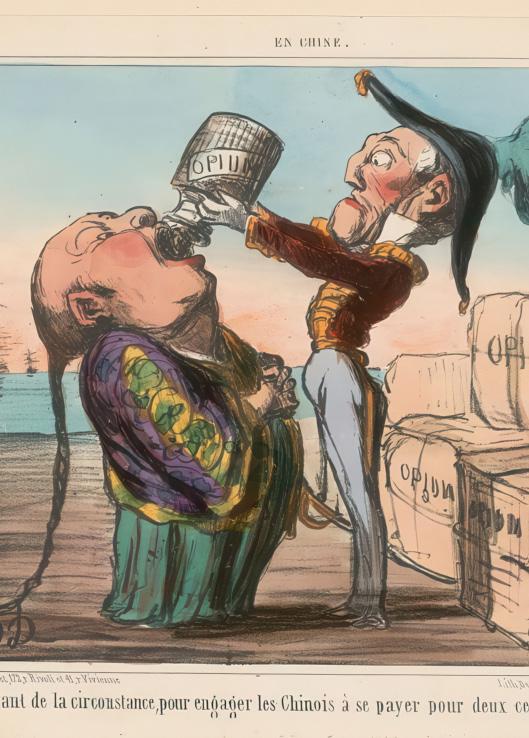
Front cover image: A lithographs from cartoonist Honoré Daumier’s second series on China. Titled “En Chine,” the series includes 27 prints published in Le Charivari between December 1858 and April 1860.
Table of Contents
3 Was the impact of the First Crusade(1096 -1099) more significant on interfaith relations or trade? - Daisy W
7 How did the Indo-Pakistani War transform Southeast Asia’s political landscape? - Aayu M
10 To what extent did the Opium wars affect China domestically and as a global power? - Alice S
14 To what extent was the Partition between India and Pakistan caused by religion? - Emilia M
20 To what extent did the Suez Canal crisis change Britain’s global influence after 1956? - Holly K
25 To what extent was the atomic bombing of Hiroshima by the USA during the Second World War justified? - Melisa K
29 What was the impact of the Vietnam War on domestic relations in the USA? (1955-1975) - Rafaella C
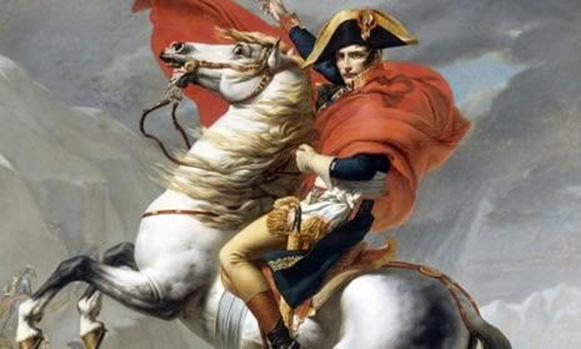
32 To what extent was the arrival of the Prussians the main factor of Napoleon losing the battle of Waterloo? - Thomasina R
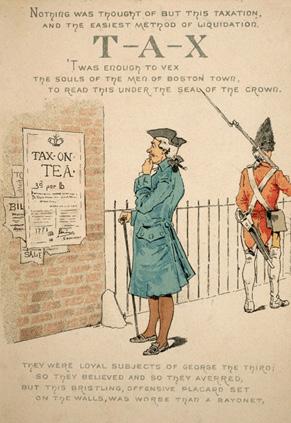
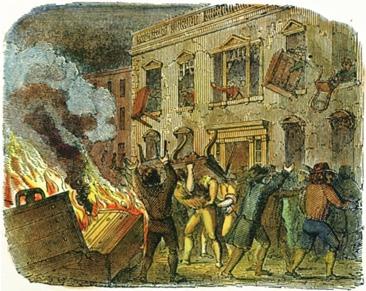
35 To what extent did economic factors cause the American Revolution? - Violet D
Was the impact of the First Crusade (1096 -1099) more significant on interfaith relations or trade?
Introduction
Before the Crusades interfaith relations were a complex mix of coexistence, trade and occasional conflict rather than the largescale religious warfare associated with the Crusades. There were other conflicts that had an impact on interfaith relations such as The Fall of Toledo (1085) but it did not rival the brutality of the Crusades. The Crusades also affected trade, which in Europe, was localised, centered on small towns, and heavily reliant on water transport. Trade in the Mediterranean was heavily influenced by Venice, Genoa, and Byzantine merchants acting as intermediaries between the Middle East and Western Europe. The First Crusade, which was fought between 1095 and 1099, was initiated by Pope Urban II to capture the Holy Land. In August 1096 the main armies departed from Western Europe, then in 1097 there was the first major engagement where Crusaders forced the surrender of the Seljuk-controlled city which is known as the siege of Nicaea (14th May - 19th
June 1097). The next major battle was called the battle of Dorylaeum (1st July 1097) where Crusaders defeated a Turkish army, allowing them to cross Anatolia (modern day Turkey). Then there was the siege of Antioch, between the crusaders and the Seljuk - Turk forces (20th October 1097 - 2nd June 1098). The siege of Ma’arra lasted from November - December 1098 and was a controversial siege that ended in a massacre and due to lack of food, reports of cannibalism. The primary goal of the crusades was fulfilled between the 7th June - 15th July 1099 when the city of Jerusalem fell after a month long siege and resulted in a widespread massacre of the inhabitants. Finally there was the battle of Ascalon on the 12th August 1099 when a newly arrived Fatimid army from Egypt was defeated by the Crusaders shortly after the fall of Jerusalem, securing the Crusader victory and concluding the main Crusade.
This event had a direct and significant impact on the interfaith relations and trade because it transformed existing friction into violent hostility, establishing a legacy of distrust between Christians, Muslims, and Jews that lasted for centuries. By framing warfare as a spiritual act and brutally seizing Jerusalem, the Crusade initiated a ‘clash of civilizations’ narrative that replaced previous coexistence with lasting mutual hatred. The Crusade normalized the idea of ‘holy war’ in both the Latin West and the Islamic world, where the conflict was often interpreted through the
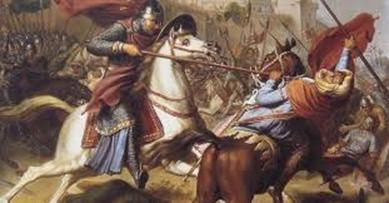
World history encyclopedia - Fighting of the first crusade
– by Daisy W
framework of crusade and jihad, causing deep distrust. The massacre of Muslim and Jewish residents during the fall of Jerusalem altered the Islamic view of Christians drastically, who were previously seen as, at worst, a minor nuisance. Although the shift in perspectives and peace during that time, the holy war did bring about many new trading opportunities such as importing spices, silk, dyes, cotton, and exotic foods, while demand for armor, transport, and banking, skyrocketed.
The new trading opportunities established after the First Crusade transformed the European economy by creating permanent trade routes between Western Europe and the eastern Mediterranean coast. This led to the introduction of new products and technologies that stimulated the European economy and laid the groundwork for the Renaissance. Although the trade routes had a long term impact on the European economy, the demand for luxury goods and importation of new spices, textiles, and agricultural products, were all short term impacts.
Impacts on interfaith relations
The short term impact on interfaith relations of the first crusade was extremely negative as agreed by The International Journal of Humanities and Social Science Intervention on the Impact of Crusades on Islam and Christianity as they write “Crusades had a very negative impact on the relations between Islam and Christianity. Crusades sabotaged the interfaith dialogue between these two communities who were initially living peacefully during the time of Prophet Muhammad (S.A.W.). The death of Malik Shah in 1092 AD, the Turkish Sultan of Baghdad, led to the disintegration of the empire in Syria, Palestine and Iraq”1. They also write “Christianity and Islam were already in conflict in 1095 AD in Spain and Sicily and in the Byzantine East. So it would be an exaggeration to say that Crusades were altogether responsible for their hostile
Therefore agreeing that the short-term aspects of interfaith relations immediately following the First Crusade were characterised by extreme violence, a dramatic breakdown of previous co-existence although there was preexisting tension. While interactions in the Levant were not entirely devoid of commerce or negotiation, the initial aftermath was dominated by the brutal treatment of Muslims and Jews and a profound polarization of religious communities.
There were many long term effects after the First Crusade on interfaith relations such as the normalisation of violence and holy wars, entrenched hostility, systemic distrust, and violent conflict. By introducing the concept of armed holy war, the Crusade fostered a lasting legacy of intolerance, initiating centuries of mutual antagonism between Christendom and the Islamic world, as well as initiating a new, violent chapter in Christian-Jewish relations in Europe. This is agreed on by Roche in his piece on ‘The Crusades to the Holy Land and Egypt (Consequences)’ however he has similar views to Wani in the ‘Impact of Crusades on Islam and Christianity’ that there were strains on interfaith relations between Muslims and Christian’s before the First Crusade as they write “The crusades increased the number and severity of the violent interactions between the different faiths, and the supposed memory of that violence is now used partly to justify bloodshed in the modern world. The Church’s support of sacral violence long predated preaching for the First Crusade. But the papacy did much more than merely offer their support for Christian Holy War in 1095 and indeed throughout the twelfth and thirteenth centuries. By overtly associating warfare with the defence of the Church and Christendom, the papacy gave war a moral dimension that had been largely missing before the eleventh century, and it also accentuated the clergy's association with violence.” 2
1 The International Journal of Humanities and Social Science Intervention on the Impact of Crusades on Islam and Christianity
2 The Manchester Metropolitan University on The Crusades to the Holy Land and Egypt (Consequences) relations.”
These negative impacts on the interfaith relations became significant long term issues as they transformed religious differences into violent political conflict, entrenching stereotypes, and institutionalizing mutual hostility. Some examples of these negative stereotypes in Europe were persistent propaganda that demonized Islam and intensified anti-Semitic violence. The longevity of the impact that the First Crusade had on interfaith relations was significant as it changed Christian-Muslim-Jewish interaction entirely from tolerance, coexistence and functional trade although there was rising religious tension to deep distrust, to the normalisation of religious violence and war as well as a legacy of long term prejudices that were worsened by the persistent stereotypes being spread throughout Europe.
Impacts on Trade
The First Crusade had an immediate impact on trade, shifting the economic balance of power in the Mediterranean and accelerating the movement of goods between Europe and the Levant (the eastern Mediterranean coast). The capture of major port cities along the Levantine coast (such as Antioch and Acre) during and immediately after the First Crusade allowed European merchants to directly access eastern trade routes. This bypassed some of the traditional routes managed by middlemen as many permanent trade routes were created during this time however the types of goods being transported changed over time. For example, between 1099 - 1120 the trade routes from the Levant to many Italian port cities focused on high value, low bulk luxury items for export to Europe, while importing essential, locally produced, and raw materials from the surrounding Islamic hinterland. Most of the traded goods being imported to Europe from the Levant were spices such as pepper, cinnamon and ginger, textiles like silk, cotton and linen as well as sugar, perfume and glassware. The goods exported out of Europe
were largely considered to be local goods such as timber, iron, slaves, wheat and barley.
The short term effects had a shocking significance on trade between Europe and the Levant as agreed on by Study Smarter on Crusades Impact: Economic and Cultural Effects as they write “The Crusades significantly affected the cultural and social fabric of both Europe and the Middle East. 1) Exposure to New Cultures: The Crusaders' interactions with the Byzantine and Arab cultures introduced Europeans to advanced technologies, literature, and philosophies. 2) Trade and Commerce: The Crusades stimulated trade routes and resulted in the inflow of exotic goods, spices, and textiles. This influx fostered a more interconnected global marketplace.
(Note: Trade paved the way for cultural exchanges, influencing European lifestyles, fashion, and cuisine.” 3 Overall this implies that the short term impacts on trade were significant and laid the groundwork for the long term effects.)
The establishment of the Crusader states as a result of the first crusade served as a massive catalyst for economic, technological, and social transformation in Europe. By creating a, sometimes forced, "bridge" between Eastern and Western worlds, the trade initiated by the Crusades had several long-term, profound impacts such as an increase in the dominance of Italian trading ports and cities, the expansion of the trade network and routes and the standard of luxury goods being transported.
This is backed by the World History Encyclopedia on The Crusades: Consequences and effects article since they state that “Travel became more common, initially in the form of pilgrimage to the Holy Land and there also developed a thirst to read about such journeys which were widely published. The age of exploration had begun and would lead to the discovery of the New World where the concept of a crusade against non-believers was once more applied. Hernán Cortés, the conqueror of the Aztecs, claimed his followers
3 Study Smarter on Crusades Impact: Economic and Cultural Effects
were milites Christi or 'Knights of Christ' waging a guerra santa or 'Holy War'.” 4 These effects did lead to the development of modern banking and finance as because to facilitate the massive, long-distance financial requirements of crusaders and pilgrims, early banking methods were developed. This included the use of "letters of credit" by military orders like the Knights Templar, which evolved into modern banking practices. Another significant consequence of the first crusade on trade was the shifting economic power from land to cash as many knights and nobles sold or
mortgaged their lands to fund their crusades, the traditional, land-locked feudal system began to decline. This was replaced by a more cashbased "money economy".
Which was more significant overall?
Overall the First Crusade had many major impacts on trade and interfaith relations both in the long term and short term. However, the First Crusade had a larger and more significant impact on interfaith relations in the long term as the crusade caused a legacy of deep distrust between Christians and Muslims. This later led to the normalisation of religious violence and
holy war as well as extreme polarisation and negative stereotypes about Jews and Muslims in Europe. As Roche 5 and Wani6 agree the significance of the impact on the interfaith relations in both the long term and short were both major and caused many impacts on how Christians and Muslims viewed each other down the line.
Although the First Crusade kick started many permanent trade routes, started the development into modern banking and connected Europe to the Levant, the effects on interfaith relations had a much longer lasting impact because it transformed the way these two civilisations interacted and trusted each other for centuries and the events of the first crusade were not quickly forgotten, and the memory of the Crusades continues to shape Christian-Muslim relations, even 900 years later. Therefore I believe that the effects of the First Crusade on interfaith relations was more significant than it was on trade.
Bibliography
The Impact of Crusades on Islam and Christianity, The International journal of Humanities and Social Science, 2013 - https://www.ijhssi.org/papers/ v2(3)/version-1/F234346.pdf
The Manchester Metropolitan University on The Crusades to the Holy Land and Egypt (Consequences), 2011 - https://e-space.mmu. ac.uk/338865/1/The%20Consequences%20of%20 the%20Crusades%20to%20the%20Holy%20 Land%20and%20Egypt.pd
Study Smarter on Crusades Impact: Economic and Cultural Effects, 2024 - https://www. studysmarter.co.uk/explanations/religious-studies/ religious-history/crusades-impact/ World History Encyclopedia on The Crusades: Consequences and effects, 2018 - https:// www.worldhistory.org/article/1273/ the-crusades-consequences--effects/ Wikipedia on The First Crusade, 2001 - https:// en.wikipedia.org/wiki/First_Crusade
4 World History Encyclopedia on The Crusades: Consequences and effects
5 The Manchester Metropolitan University on The Crusades to the Holy Land and Egypt (Consequences), 2011
6 ‘The Impact of Crusades on Islam and Christianity’, The International journal of Humanities and Social Science, 2013
First crusade - Wikipedia
How did the Indo-Pakistani War transform Southeast Asia’s political landscape?
– by Aayu M
The Indo-Pakistan war was a conflict between India and Pakistan in 1971 which resulted in the formation of Bangladesh.
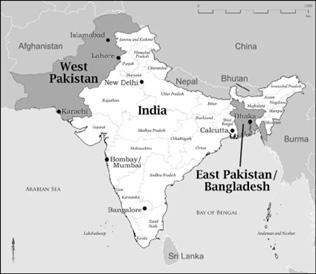
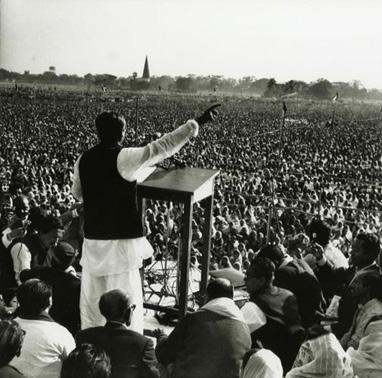
In 1947 India gained independence and a partition of India took place creating West and East Pakistan. West Pakistan had the goal of making Pakistan a single nation and declared Urdu as the official language of Pakistan, despite East Pakistan consisting of Bengali speakers. This caused tension and resulted in the formation of the Language Movement of Bangladesh (then East Pakistan) from 19471971. The trigger of the war was in December 1970, in Pakistan general elections, the Awami League, led by East Pakistani nationalist leader Mujibur Rahman, won a majority. However, the West Pakistan President Yahya Khan didn’t approve of Rahman becoming the next Prime Minister. In March 1971 Khan organised a military crackdown to get rid of all the protests in East Pakistan, which led to widespread killings and sexual violence towards women by Pakistan soldiers. The total number of deaths was estimated to range from 300,000 - 3,000,000. This nine-month event became known as Operation Searchlight. A large number of survivors travelled to India as refugees and formed a group known as the Mukti Bahini who fought with the Pakistan military with support from the Indian army and it later became known as the Indo-Pakistan
War (refer Figure 1).
The most immediate political transformation of the war was the creation of Bangladesh. Pakistan was divided into 2 parts, East Pakistan and West Pakistan with 1,000 miles (1,600km) of Indian territory between which ensured political instability from the beginning. The war permanently altered South Asia’s map by the creation of a new nation, Bangladesh (formerly East Pakistan). This weakened Pakistan by the loss of land as well as its political influence. Prime Minister of Bangladesh Tarique Rahman had stated “The 1971 Liberation War is the foundation of Bangladesh as a state and its politics, and the country’s very existence cannot be imagined without it.” 1 This showcases
1 Tarique Rahman is the Prime Minister of Bangladesh who has spoken about the importance of the 1971 Liberation War in Bangladesh’s history and that it is a defining factor in how the country’s political system was made.
Figure 1: Map of India and partitioned Pakistan before the 1971 Liberation War
a positive approach towards the war and highlights how the war was not simply a military conflict but it resulted in a new nation whose political identity was founded upon that. The creation of a new nation also meant that Bangladesh’s political alliances and economic development would also affect South Asia,
affecting its political landscape (Refer Figure 2).
One of the greatest political landscape changes was the transfer of regional power across nations. 93,000 Pakistani soldiers had surrendered and were placed in Indian prisons for about 3 years. The war was 13 days long and was known as one of the quickest wars to ever take place and had the highest number of soldier surrenders since the second World War. This war also transformed political landscapes by showcasing India as a powerful nation, by how it successfully won the war despite being a relatively new nation formed in 1947. India had also elevated its global standing by resisting threats from the US deploying their air force during the war which showcased that it was a strong nation with a force to be reckoned with. Srinath Raghavan, who was an author of 1971: A Global History of the Creation of Bangladesh and an Indian journalist as quoted
in the book stated: "1971 has become almost folklore in India... post-1971, we have had quite a tough posturing in international diplomacy. 1971 changed the way we look at ourselves as Indians." 2 This shows a positive opinion about the war about how Indians view the IndoPakistani war as something which gives them pride in their nation and showcases how it gave India a stronger representation in international relations and in South Asia (Refer Figure 3).
Despite India's military intervention in 1971, it managed to adhere to its non-alignment policy. Indian Prime Minister Indira Gandhi, at the time stated that India had only assisted for “humanitarian reasons” and they couldn’t stand to see “a population liquidated”. 3 India remained faithful to its policy of nonalignment, which was a strategy developed during the cold war to avoid taking sides with America or the Soviet Union. However, India had signed a Treaty of Peace, Friendship, and Cooperation with the Soviet Union in 1971, it did not try to invade Bangladesh post-war and supported its growth as an independent nation. This resulted in debate where some historians such as Richard Sisson and Leo Rose argued that the war was the result of political
2 Srinath Raghavan is an Indian historian who wrote the book 1971: A Global History of the Creation of Bangladesh about the creation of Bangladesh and the impact of the 1971 war and has attended interviews discussing the 1971 Liberation War with his opinions and insights.
3 Indira Gandhi was the Prime Minister of India during the Liberation War. She was the first female Prime Minister of India and supported Bangladesh with military assistance from the Indian Army.
Figure 2: 7th March 1971, President declares independence
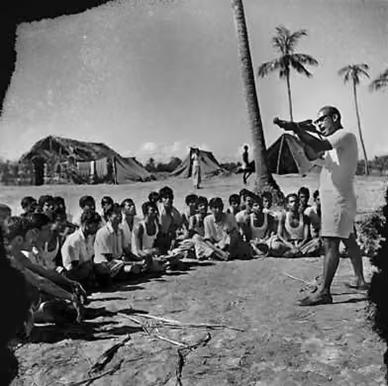
Figure 3: Soldier Training Camp for the Indian Army 1971
misjudgements and India had refused to invade to avoid further conflict and supported the decision to remain non-aligned. 4 However, historians like Bharat Karnad argued that India missed an opportunity to expand and grow as a nation by invading Bangladesh and that they should have invaded. 5 However, India’s decision not to do so symbolised their commitment to their nonalignment policy, a policy which India still abides to today. This transformed political landscapes by balancing power between nations by India being a pacifist nation which also influenced South Asia’s political dynamics (refer Figure 4).
In conclusion, the 1971 Indo-Pakistani war transformed Southeast Asia’s political landscape by the creation of a new, independent nation which resulted in new alliances and political borders, the transfer of power across regions which established India from a newly independent nation to a respected regional power and India’s non alignment policy which influenced its alliances with powers such as the Soviet Union and striving to balance power across nations. The 1971 Indo-Pakistan war was an event which redrew nation’s boundaries and transformed their political views. It also caused
a shift in regional balance of power and still serves as an important factor in South Asian politics today.
Bibliography:
American Diplomacy. (2016). Why India is Not a Great Power (Yet) https://americandiplomacy.web. unc.edu/2016/02/why-india-is-not-a-great-poweryet/ (Published: February 2016) (Accessed: 11 April 2026)
Martin, Roland, Pereira, Andrew. "Bangladesh Liberation War". Encyclopedia Britannica, 19 Mar. 2026, https://www.britannica.com/event/ Bangladesh-Liberation-War. (Accessed 11 April 2026.)
Pereira, Andrew. "1971 India-Pakistan War". Encyclopedia Britannica, 12 Mar. 2026, https:// www.britannica.com/event/1971-India-PakistanWar. (Accessed 11 April 2026.)
The Times of India. (2026). Bangladesh existence can't be imagined without 1971 war: BNP acting chairperson Tarique Rahman https://timesofindia. indiatimes.com/ (Published: 7 January 2026) (Accessed: 11 April 2026)
University of Chicago. (2022). Interview: Dr. Srinath Raghavan, https://southernasia.uchicago.edu/ interview
-dr-srinath-raghavan/. (Accessed: 11 April 2026.)
Zeitlin, A. (2020). Book review: War and Secession: Pakistan, India and the Creation of Bangladesh South Asia Journal. https://southasiajournal. net/post/commentary/25921 /single2.html (Published: 26 August 2020) (Accessed: 11 April 2026)
4 Richard Sisson and Leo Rose were historians who had written a book titled War and Secession Pakistan, India, and the Creation of Bangladesh where they expressed their opinion that India had made the correct decision by not invading Bangladesh and stating that India’s goal was to liberate Bangladesh (formerly East Pakistan) and that they wanted to avoid a long term war.
5 Bharat Karnad is an Indian strategist who has spoken about India’s potential for growth and ability to become a leading power. He has written a book titled Why India is Not a Great Power (Yet) in 2015 where he expressed his opinion of how India could grow as a nation and stated his opinion that they should have invaded Bangladesh and missed out an opportunity to grow.
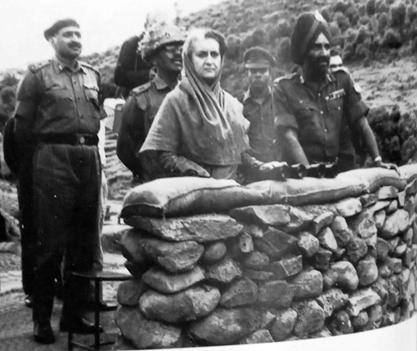
Figure 4: Indira Gandhi with the Indian Army 1971
To what extent did the Opium wars affect China domestically and as a global power?
– by Alice S
The Opium Wars (1839–42 and 1856–60) were a decisive turning point in China’s relationship and image with the wider world and had a profound impact on its status as a global power. Before 1839, Qing China saw itself as the dominant civilisation in East Asia, economically self-sufficient and culturally superior. However, the defeat by Britain exposed serious military, political and economic weaknesses. In the short term, the wars significantly weakened China’s supremacy, reduced its geopolitical influence, and damaged its international reputation. Yet in the longer term, they also forced China to confront its weaknesses and begin reform. Many historians, such as Hsu, believe the wars marked the beginning of China’s decline, while others believe they mainly revealed problems that already existed and helped China in the long term to be a global power now. While the Opium Wars did not single-handedly cause China’s decline, they accelerated and symbolised the collapse of its traditional global power. Therefore, they affected China to a very large extent.
Background
Before the Opium Wars, China believed it was the centre of the world, known as the “Middle Kingdom”. Its society was based on Confucian values (values focused on social harmony, respect for hierarchy and moral selfcultivation), and it expected other states to
accept its superiority through the tributary system (a system when neighbouring states acknowledged China’s superiority through symbolic, ritualistic and economic exchanges such as ‘Kowtow’). The Qing dynasty ruled China by combining Manchu military strength with traditional Chinese bureaucratic methods. This system had functioned effectively for 195 years and reinforced the idea that China did not need any foreign ideas. Economically, China was one of the largest economies in the world. It produced tea, silk and porcelain, which were highly desired in Europe. It was also largely self-sufficient and tightly controlled trade with Western nations operated through the Canton System, which restricted foreign merchants to Guangzhou (Canton) and limited their contact with Chinese society. This allowed China to control foreign influence and maintain economic dominance. Historian Mark Elvin argues that China’s traditional economic
system had reached a “high-level equilibrium,” 1 meaning it was stable but resistant to innovation. This stability and resistance to reform prevented China from developing the weapons of modern industrial warfare such as steam-powered ships, making it vulnerable to western powers. 2
Causes
The main cause of the First Opium War was economic imbalance. Britain imported huge amounts of tea from China, but China did not want much in return. To solve this problem, Britain began selling opium grown in India to Chinese merchants. By the 1830s, opium imports had reached approximately 40,000 chests per year, leading to widespread addiction and social problems.The Qing government eventually took action and attempted to stop the trade. In 1839, Commissioner Lin Zexu confiscated and destroyed over 20,000 chests of opium in Canton. Britain responded with military force, claiming it was ‘defending free trade’. However, historian Jung Chang argues that Britain’s true motivation was profit and imperial expansion rather than fairness. 3 This suggests the war was driven by imperial ambition rather than misunderstanding.The Second Opium War followed similar tensions. Britain and France demanded even more access to Chinese markets and diplomatic rights. When China resisted, war broke out again.The resulting conflict forced China to accept even harsher conditions. These wars demonstrated the clash between China’s traditional methods and Western imperialism and showed how far behind China was compared to the industrialized western powers. 4
Outcome
China lost the Opium wars largely because
of the military and technological inferiority against Britain. Britain had steam-powered gunboats, modern weapons and a more trained, disciplined army, whereas the Chinese forces relied on outdated weapons, poorly trained soldiers with weak coordination. There was also a lot of corruption in the Qing military system, only making their methods
less effective.
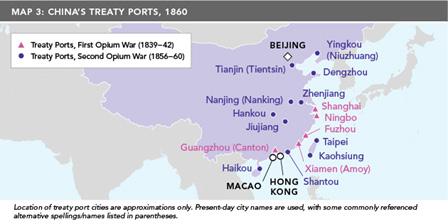
The First Opium war ended in (1842) with the Treaty of Nanjing which forced China to give Britain Hong Kong, pay £21 million indemnity and open 5 treaty ports (ports made specifically for trading with the west). It also granted British citizens immunity from Chinese law. The Treaty of Tianjin (1858) and Convention of Beijing (1860) after the Second Opium War legalised opium, opened more ports, allowed foreign embassies in Beijing and permitted Christian missionary activity. This was a big cause for China’s downfall. Immanuel Hsu argues that these unequal treaties marked the beginning of foreign domination and seriously weakened China’s authority. 5 By 1911, more than 80 treaty ports were open for western trade. China had not been colonised completely, but it had lost control over key parts of its economy and legal system. Its global power was clearly reduced. 6
1 Elvin, The pattern of the Chinese past, Eyre Methuen, page 314
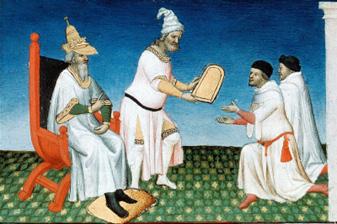
2 A Medieval French illumination showing Kublai Khan giving Marco Polo a letter of safe conduct, showing Marco Polo’s travels in the 13th century and China’s power at that time. Made around the 14th-15th centuries.
3 Chang, Empress Dowager Cixi: the Concubine who launched modern China, Jonathan Cape, page 95
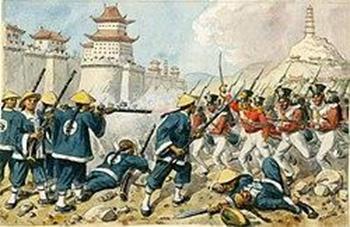
4 The 98th Regiment of Foot at the attack of Chin-Kiang-Foo, depicting the Battle of Chinkiang on 21 July 1842, resulting in the defeat of the Manchu government. Watercolour by Richard Simkin.
5 Hsu, The Rise of Modern China, Oxford University Press, page 168
6 Map 3, China’s treaty ports, 1860
Domestic Impact
The defeats also damaged the Qing dynasty internally. Defeat damaged the emperor’s legitimacy and confidence in the traditional system making many people feel betrayed, many people started questioning whether
the government was able to protect the country properly. Soon after the First Opium War, China faced the Taiping Rebellion, one of the deadliest conflicts in history, which caused around 20–30 million deaths. While the rebellion had many causes, foreign humiliation contributed to the rebellion. Mary Wright argues that Qing leaders struggled between preserving tradition and accepting necessary reform. 7 Some officials realised China needed to modernise. This led to the Self-Strengthening Movement (1860s-1890s), which aimed to adopt Western military technology while keeping Confucian values. Shipyards, arsenals and language schools were built. However, these reforms were limited and inconsistent. Paul Cohen argues that China’s efforts show it was not completely resistant to change, but politics was divided and foreign pressure made reform difficult. 8 The Opium Wars therefore weakened China politically but also pushed it towards modernisation. Before 1839, China dominated East Asia through the tributary system. After the Opium Wars, this dominance declined. Western powers influenced east asian countries, and Japan - which modernised successfully during the Meiji Restoration - eventually defeated
China in 1894–95. The Treaty of Shimonoseki forced China to give up Taiwan and recognise Korean independence. Jonathan Spence argues that the Opium Wars began a pattern of ‘foreign intervention’ that continued throughout the nineteenth century. 9 China was increasingly treated as weak and vulnerable. Its global image changed from a confident, powerful empire to an exploited, weak and crumbling country.
Relationship with the West
Relations with Western powers shifted from limited trade to forced cooperation. Missionaries and merchants gained legal protection, often causing local tensions and foreign embassies in Beijing symbolised China’s loss of power, control and superiority. Many Chinese people recognise this time as ‘the Century of Humiliation’. The Opium Wars symbolised national humiliation and foreign exploitation. Hsu argues that this period permanently altered China’s global status and created long-term resentment towards the West. 10 Economically, China suffered largely from the indemnities and loss of control over trade. This reduced China’s economic independence. Yet, new treaty ports such as Shanghai became important commercial centers. Western-style schools and bureaus opened and introduced more scientific and technological knowledge. Elvin suggests that China’s economic problems were partly due
7 Wright, The last stand of Chinese Conservatism, Stanford University Press, page 6
8 Cohen, Discovering history in China, Columbia University Press, page 72
9 Spence, The search for Modern China, W.W. Norton & Company, page 157
10 Hsu, The Rise of Modern China, Oxford University Press, page 170
to the way they handled the economy and not entirely caused by western interference. This supports the argument that the Opium Wars accelerated decline rather than creating it. 11
In the short term, the Opium Wars clearly weakened China. It lost territory, control and prestige. Internally, rebellions and corruption increased. Internationally, China became vulnerable to imperial powers. However, in the long term it forced China to face reality. People began to question the traditional systems and began to reform, even though it was limited. By 1911, the Qing dynasty collapsed due to a combination of internal instability and external pressure from the west. Some historians argue that China was already in decline due to population growth and bureaucracy. The Opium Wars exposed these weaknesses rather than causing them entirely. Even so, their symbolic importance was enormous. They represented the moment when China’s traditional world order collapsed.
To a very large extent, the Opium Wars affected China’s global power between 1839 and 1911. In the short term, they caused humiliation, territorial loss and foreign domination by the west. China’s regional authority declined, and its sovereignty was weakened. However, the wars also forced China to begin to reform and reconsider outdated systems which ended up helping China become such a global superpower now. While they did not single-handedly destroy China’s power, they accelerated its decline and transformed its relationship with the world. Therefore, the Opium Wars were a crucial factor in weakening China but also making it so powerful now.
Bibliography:
Chang (2011) Empress Dowager Cixi: The Concubine Who Launched Modern China. Jonathan Cape.
Cohen (1984) Discovering History in China. Columbia University Press. Elvin (1973) The Pattern of the Chinese Past. Eyre
Methuen.
Hsu (2000) The Rise of Modern China. Oxford University Press.
Spence (1999) The Search for Modern China. W.W. Norton & Company.
Wright (1957) The Last Stand of Chinese Conservatism. Stanford University Press.
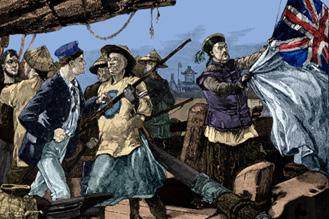
11 An illustration showing Qing officials pulling down the British flag on the ship named The Arrow on October 8th 1856, sparking the second Opium war. It is a colonised historical illustration created in the 19th century and has no known creator.
To what extent was the Partition between India and Pakistan caused by religion?
– by Emilia M
Introduction
The Partition between India and Pakistan was an event in modern history that is still sensitive to many worldwide. This conflict is often cast as being caused only by religion, meaning that the layered history behind the event - specifically from the end of the 19th century to 1947, when the paperwork was officially signed - is too regularly forgotten. This essay will argue that, yes, when questioning what the precondition to the divide was, religion was the initiating factor, but it will also acknowledge the role other factors played in the result, such as: Britain’s global and domestic position at the time and the influence of internal political parties and their leaders.
Religion
During the spotlight period, Muslims in India were considerably smaller in population to the Hindus and wanted more recognition in their government. Internally, there was also an imbalance because their roles in society often differed depending on the region - in Punjab, they were seen as princely but in Bengal, they were practically peasants. Earlier in the 19th century, some Hindus started to feel uncomfortable when it appeared that a more accepting relationship was being formed between both faiths. Due to this,
a festival called Ganpati was deliberately commemorated in order to keep people of the Hindu faith away from the Muslim celebration of Mohurram as it was seen to have become too sociable. Bal Gangadhar Tilak, a leader within the Indian National Congress (INC), wanted a complete disassociation between the religions that were currently happy living side-by-side. The partition of Bengal in 1905 - a decision to split the administration of the Bengal region between the mostly Hindu western areas and the eastern Muslim areacaused more upset and left Hindu nationalists angry. However, Sir Syed Ahmad Khan, the first Muslim League leader and eventually proclaimed father of the two-nation theory, believed it gave protection to the poor Muslim population there and that it could be seen as a step in the right direction for Muslims’ role in the future. Khan then sent a group to talk to Viceroy Minto to promote Muslim representation in the government. The AllIndia Muslim League was formed after this with the aim of campaigning for separate status for India’s Muslims. It is important to remember that this did not always mean forming a separate state. Historian Yasmin Khan agrees and believes the ultimate Partition was never inevitable, but caused by the circumstances surrounding it 1 . In the lead up to the partition on the 15th August 1947, people were often
1 Yasmin Khan - The Great Partition: The Making of India and Pakistan
split into categories based on their religion, such as when voting. It was hard to find a place where all people lived harmoniously alongside each other without any discrimination. As the intensity increased over Britain potentially granting India its long-deserved independence, many Muslims started to become worried about living under Hindu authority. Violence often erupted in the streets between the two opposing sides, an example being the Calcutta Killings of 1946 where 4,000-5000 innocent people died. There weren’t many at the time who were happy in the situation which meant something had to change. There can be no disagreeing with the fact there was clear tension between the two viewpoints and a deep disconnect which meant India’s future at the time was very uncertain.
Influence of Leaders and Their Parties
People in India were desperate to be freed of the hold Britain had over them. No matter the internal conflicts, everyone seemed to share this same goal. However, at any attempts of unity between the Indian National Congress and the Muslim League, Mahatma Gandhi seemed to pull out: in 1922, when 22 police officers were killed by civilians because of aggression over food prices, he cancelled without warning the severe Non-Cooperation boycott movement, an attempt to capture Britain’s attention about the need for independence. Judith M. Brown, a prominent historian in the South-East Asia landscape, credits this and many of Gandhi’s other actions to be out of his strong opposition to violence. He had ‘uncompromising optimism’ in the belief of always taking the moral high ground. She describes him as a ‘prisoner of hope,’ which perhaps suggests it was always more important for him to stick to his grounding values as a human over the patriotic goals for his country 2 . In 1924, he again seemed to go back on nationalist plans and focused
on returning to traditional village values and protection for lower classes. His erratic actions meant people, including Mohammed Ali Jinnah, the leader of the Muslim League, were confused and let down by who was supposed to be a central figure in society; hope and support in Gandhi’s plans to be an independent and united state were dwindling. After the nationalist movement was left in unrecognisable pieces, Britain proposed certain reforms with the intent of increasing Indian presence in decisions.
3 The Muslim League was open to this but the INC immediately opposed and wanted Dominion status. The Muslim League thought this demand would deny any possibilities of Muslim representation. Jinnah had long hoped for unity between the two cultures but, in the end, decided to follow the Two-Nation Theory proposed by his predecessor Muslim League leader, Sir Syed Ahmad Khan. He believed that Hindus and Muslims would never have anything in common and stayed strong in the Muslim league’s fundamental belief in the necessity of Muslim representation. Jinnah soon after attended a conference in the UK where he called Gandhi out on his failure to get anywhere and officially gave up on the hope of a joint action. By 1937, the INC were governing most Indian provinces except the majorityMuslim areas. Jinnah wasn’t happy and called for the British government to ‘Divide and Quit’ - finally asking for a separate state as well as
2 Judith M. Brown - Gandhi: Prisoner of Hope
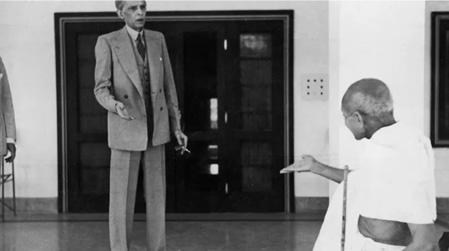
3 (Jinnah and Gandhi, Delhi, 1939)(BBC) - image
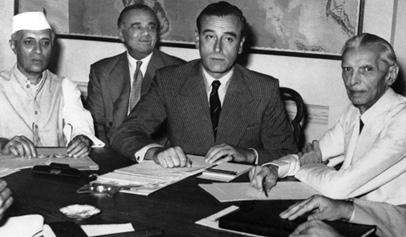
independence - but Hindus were only calling for ‘Quit.’ The aim of the INC was never to be separate from Muslims and focused only on nationalist plans, showing their potential lack of co-operation. Gandhi even tried to urge Viceroy Mountbatten to give the role of prime minister of a united India to Jinnah in order to avoid
the partition. The leaders couldn’t agree on a joint decision for the future of India, leaving the country torn in two. This meant that a split had to be made as neither were happy. Jawaharlal Nehru, President of the Congress, ended up reluctantly accepting the partition proposal because he saw it as the only way India would be granted its essential independence. In this way, the conflict between the two sides is what ultimately influenced Mountbatten’s resolution for Britain to divide 4 the state before leaving. Without this pressure and tension between the polar-opposite parties, Britain would not have made the momentous decision to split and would have left India with its original border intact. However, the conflict wasn’t the initiating factor of the disconnect but what the deeply layered religious history became in the form of two political parties with very diverse views.
Britain’s Position and Influence
Britain was clearly struggling at the end of WWII due to many things which ultimately meant they no longer wanted to govern
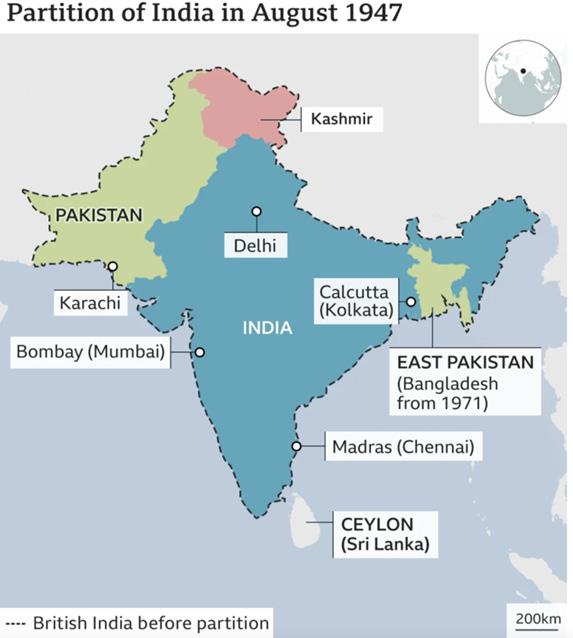
India and were looking for a quick exit. By witnessing the Indian National Congress and the Muslim League’s disagreements over their shared country, Britain felt it was doing best to split the nation into two - a Hindu state and a Muslim state. It had very little role in the decision wanting to be made and only signed the documents with very little grasp on what was happening in a country over 4,000 miles away. The ultimate decision over border technicalities was made by Cyril Radcliffe, who had minute understanding of the landscape of India, both social and geographical 5 . It is said that, due to Britain’s desperation and rush to release India from its governance, inaccurate and out-of-date information was used in the decision making. Yasmin Khan describes the process as ‘reckless' with very little consideration for the country’s individual inhabitants 6. It was ultimately guesswork in the form of where railways and rivers fall, with no real desire to make a positive impact on people, proven by the process only taking seven weeks for the Radcliffe committee to conclude.
At the time, Britain herself was 7 in the
4 (Conversation with, from left: Nehru, Lord Ismay, Viceroy Mountbatten and Jinnah)(Brittanica) - image
5 The Story of India: A Visual History of the Indian Subcontinent, Dorling Kindersley Publications
6 Yasmin Khan - The Great Partition: The Making of India and Pakistan
7 (Map of India and Pakistan After Partition)(BBC) -image
midst of many pressures - both domestic and abroad. Clement Attlee had just won the general election in 1945 after the end of WWII. This brought the UK back to left Labour leadership and a different approach to world management. The population of the UK started to 8 demand change. Statements such as the Beveridge report of 1942 highlighted the need for focus on the internal social services and called out the government as the only being capable of doing this. The report ended up persuading the government to implement the national health service. This meant that, in order to prioritise its internal affairs, Britain would have to make some adjustments. In the early post-war years, the debt-to-GDP ratio in Britain was at a high - 252% - not seen since the Napoleonic wars. The cost of maintaining global colonies became too great, especially one with a scale and size such as India. Attlee also believed in the importance of ensuring a
nation was self-sufficient. One of his greatest achievements as prime minister was the Coal Industry Nationalisation Act of 1946 as well as others which meant that Britain’s coal,
electricity and railways etc. could run without international aid. With this information in mind, Attlee could have seen no need to keep India in the empire and therefore made the difficult decision to let it go. However, it could also be said that it was an unwilling decision, coerced into happening due to pressure from the United States, particularly its president Franklin D. Roosevelt. Roosevelt felt strongly that anticolonialism would prevent future wars and set out imposing economic strains and agreements which made it almost impossible for Britain to keep its colonies whilst thriving. It is important to note that the ultimate decision to relinquish India from Britain’s clutches, however it came about, would have regarded the country as a whole unit, not yet divided up. It is with the influence of India’s political figures that the parting with India changed to a parting with India and Pakistan. Overall, Britain’s role had profound depth on the world stage, already reeling from a world war, as well as millions of individual lives. But it can be said to have merely been a reaction to what was happening to them - on a domestic and international level - rather than an entirely voluntary choice and it was not the precursor that started the decision.
Conclusion
In this essay, we have touched on the roles played by Britain's position domestically and globally and their preference at the time; India’s political parties and their beliefs on internal affairs; and the treatment of India’s Hindu and Muslim population. Ultimately, without the overwhelming tension between the two faiths, there would have been no motivation for parties to form and the birth of the ‘divide and quit’ principle which led Britain’s decision to partition. Some could argue that this would have happened without disagreements between Muslims and Hindus but this would have eventually led to an independent India, without the two separate states. All factors covered played an important role in what eventually came to be in August
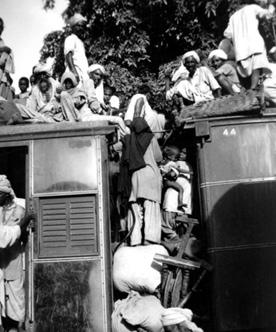
8 (Muslims fleeing to Pakistan, 1947)(Brittanica) - image
15, 1947, but without long-standing religious friction as the background to it all, this major global conflict event in modern history would not have happened.
Background - English Involvement in India:
The Crown took over full control of India in 1858 which meant all members of the cabinet which made decisions for the Indian subcontinent were British officials, led by the viceroy. Before this period - known as the British Raj - it was the East India Company that controlled India. It was an English company which focused on exploiting South Asia’s products for profit. It mainly traded cotton, spices, tea and other items. Many Indians were in poverty under British rule and subject to frequent famines all fueled by underlying racism. The poor treatment of civilians was the motivation for the INC to form and rebellions to occur.
Glossary:
Viceroy - a ruler exercising authority in a colony on behalf of a sovereign.
Viceroy Minto - Born Gilbert John Elliot-Murray-Kynynmound, he was the Governor-General of Canada from 18981904 and Viceroy for the British Government to India from 1905-1910.
Indian National Congress (INC)Founded in 1885 by Allan Octavian Hume, a British civil servant, it is a prominent political party that set out with the goal of promoting a free India and is still in action fighting for the wellbeing of India’s citizens. Their objectives are the well-being and advancement of the Indian people and ensuring every citizen has equality of opportunity and of political, economic and social rights.
Muslim League - The All-India Muslim League - later the All-Pakistan Muslim League - was a political party with the objectives of safeguarding India’s Muslims and ensuring they had a voice in society. Until 1940, it aimed for the unification of Hindus and Muslims, but later campaigned for a Muslim state (now Pakistan). In the 1970s, its presence
disappeared due to a lack of popularity.
Mahatma Gandhi - Born in India in 1869, he was a prominent leader and activist that led India to independence. He was arrested alongside Nehru several times due to his efforts and died in 1948.
Ganpati - Also known as the Ganesh festival, this celebration lasts 10 days in August/ September and commemorates the birth of Ganesh, the hindu deity, recognized worldwide due to its elephant head.
Two-Nation Theory - The belief that Hindus and Muslims belong to two different religious philosophies, social customs and literary traditions, meaning two different civilizations should be formed.
Jawaharlal Nehru - Born 14 November 1889, he studied law at Cambridge and later became interested in the politics of his homeland. Nehru joined the Indian National Congress in 1919 and became its president in 1929. His values remained focused on independence up until 1947 when, after independence was granted, he became Prime Minister of India until his death in 1964.
Beveridge Report - The Social Insurance and Allied Services written by William Beveridge in 1942 after being commissioned to investigate and value public services in Britain which proposed new social programmes such as the NHS.
Bibliography:
Lang, Seán, The Other India in the Modern History Review, 2010/11, Volume 6 https://magazines.hachettelearning.com/magazine/ modern-history-review/6/3/the-other-india
Judith M. Brown - Gandhi: Prisoner of Hope Scottish Archive Network https://catalogue. nrscotland.gov.uk/scancatalogue/person. aspx?code=NA9316&st=1&tc=y&tl=n&tn=y&tp=n&k=&ko=o&r=GB233%2FMS.11001&ro=s& Ruth, Michael, Indian National Congress (political party) in EBSCO, 2025 https://www.ebsco. com/research-starters/politics-and-government/ indian-national-congress-political-part
Dorling Kindersley Publications - The Story of India: A Visual History of the Indian Subcontinent Britannica Editors, Muslim league in Britannica, 2026 https://www.britannica.com/topic/Muslim-League
Gadgil, Manasi, All You Need to Know About the Ganesh Festival in India in Contiki, 2024 https:// www.contiki.com/six-two/article/ganesh-festival-india/#:~:text=35%20year%20olds-,What%20 is%20the%20Ganesh%20Festival%20in%20 India?,and%20death%20according%20to%20 Hinduism
Kermani, Secunder, How Jinnah’s Ideology Shapes Pakistan’s Identity in BBC Islamabad, 2017 https:// www.bbc.co.uk/news/world-asia-40961603
Yasmin Khan - The Great Partition: The Making of India and Pakistan
Crafts, Nicholas, Rebuilding after the Second World War: What Lessons for Today in Economics Observatory, 2020 https:// www.economicsobservatory.com/ rebuilding-after-second-world-war-what-lessons-today#:~:text=The%20UK's%20ratio%20 of%20public,and%20economic%20growth%20 was%2rapid
Clement Atlee in GOV-UK https://www.gov.uk/ government/history/past-prime-ministers/ clement-attlee
J.W, To What Extent Did the United States Precipitate the Dissolution of the British Empire after 1939? In St Hugh’s College Oxford, 2023 https://www. st-hughs.ox.ac.uk/wp-content/uploads/2023/02/ JW-Essay-3.pdf
Government of the Raj 1858-1947 in UK Parliament https://www.parliament.uk/ about/living-heritage/evolutionofparliament/ legislativescrutiny/parliament-and-empire/parliament-and-the-american-colonies-before-1765/ government-of-the-raj-18581914/#:~:text=Changes%20in%20legislative%20 authority,Indian%20nationalists
Britannica Editors, East India Company in Britannica, 2026 https://www.britannica.com/topic/ East-India-Company
McClane, John R, Primary Sources: the Partition of Bengal in History for the 21st Century, 2023 https://www.history21.com/wp-content/ uploads/2023/05/Global-1905-5.2-PrimarySources-The-partition-of-bengal.pdf
Lewis, Terrence L, Mahatma Gandhi in EBSCO, 2022 https://www.ebsco.com/research-starters/ history/mahatma-gandhi
Vajiram Editor, Muslim League, Background, Formation, Objectives, Impacts in Vajiram and Ravi, 2026 https://vajiramandravi.com/upsc-exam/ muslim-league/#muslim-league-objectives
Our Values in the Indian National Congress https:// inc.in/our-values/object-of-the-indian-national-congress-article-i-inc-constitution
Partition: Why was British India Divided 75 Years Ago? In BBC News, 2022 https://www.bbc.co.uk/ news/world-south-asia-62467438#:~:text=Between%20200%2C000%20and%20one%20 million,were%20raped%2C%20abducted%20 or%20disfigured
Jawaharlal Nehru in Never Such Innocence https://www.neversuchinnocence.com/ jawaharlal-nehru-partition-of-british-india 1942 Beveridge Report in UK Parliament https:// www.parliament.uk/about/living-heritage/transformingsociety/livinglearning/coll-9-health1/ coll-9-health/
To what extent did the Suez Canal crisis change Britain’s global influence after 1956?
– by Holly K
The Suez Canal crisis of 1956 marked a decisive turning point in Britain’s global influence. Whilst Britain’s decline as a world power had begun prior to the 1956 crisis, the conflict significantly accelerated this process by exposing the limits of British military, political, and economic power. Britain’s controversial actions during and handling of the crisis led to widespread international condemnation, the humiliation of being forced to withdraw from the conflict under pressure from the United States (US) and the United Nations, and the resignation of Prime Minister Anthony Eden.
As Prime Minister Anthony Eden declared during the crisis, “Our quarrel is not with Egypt, still less with the Arab world. It is with Colonel Nasser. He has shown that he is not a man who can be trusted to keep an agreement.” 1 This statement reflected Britain’s belief that Egyptian President Gamal Abdel Nasser posed a direct
challenge to British authority and international stability. Furthermore, the crisis undermined Britain’s prestige and status and contributed to the acceleration of decolonisation, reducing its ability to exert influence on a global scale. However, despite these setbacks, Britain did not cease to be an important global power, maintaining influence through alliances such as NATO and its relationship with the United States. Therefore, while the Suez Crisis did not solely cause Britain’s decline, it significantly changed and weakened Britain’s global influence after 1956.
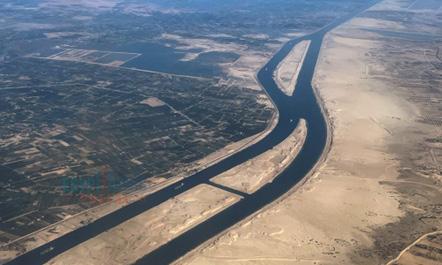
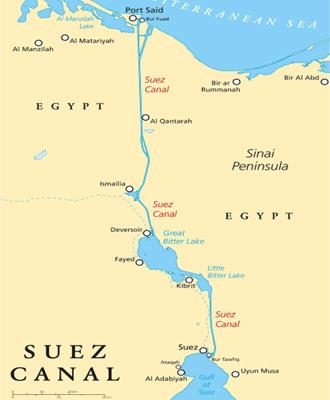
The Suez Canal, a 102-mile waterway linking the Mediterranean Sea and the Red Sea, was conceived by Ferdinand de Lesseps and opened in 1869 after ten years of construction. The project relied heavily on forced Egyptian labour and cost the French investors and Egyptian government significantly more than originally planned. From the beginning, the canal was extremely important to Britain because it dramatically shortened the sea route between Britain and its Asian empire. Before the canal opened, ships travelling from London to Bombay had to sail around the Cape of Good Hope in southern Africa, a journey of around 10,500 miles. The Suez Canal reduced this to roughly 6,000 miles, cutting travel time by several weeks 2 . This made it a vital route for imperial trade, allowing faster transport
1 Anthony Eden, broadcast speech, 8 August 1956, quoted in The Times , 9 August 1956.
2 ‘Why the Suez Canal was so important to the British Empire,’ BBC History
Suez Canal, 2015, New York Times
of goods such as cotton, tea, spices, and manufactured British products between Britain, India and other parts of Asia. Later in the twentieth century the canal also became crucial for transporting Middle Eastern oil to Europe, further increasing its strategic importance to Britain’s economy and global influence, and landing the canal with the nickname given by Britain, ‘lifeline to the empire’.
In 1875, when Egypt’s ruler Isma’il Pasha faced bankruptcy after overspending on modernisation projects, he sold his shares in the canal to the British government 3 . Britain then occupied Egypt in 1882 to protect its financial and strategic interests. Although the 1888 Convention of Constantinople 4 guaranteed free passage through the canal for all ships, Britain restricted access during wartime, especially during both World Wars, showing how much control it exercised over the region.
By the early 1950s, particularly by 19541956, the canal had become a symbol of Britain’s imperial power and global influence.
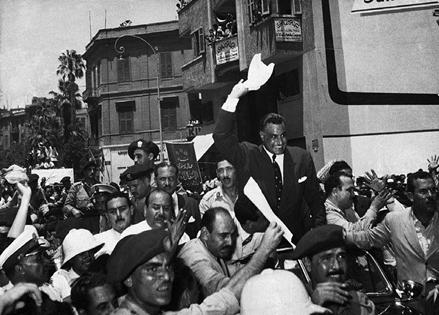
However, Egyptian resentment of foreign control, especially British control, continued to steadily increase. On 26 July 1956, Egyptian President Gamal Abdel Nasser nationalised the Suez Canal Company 5, a controversial act that sparked anger from both Britain and France, especially due to the fact that the canal was already owned by an Anglo-French organisation. He intended to use the profits to fund the construction of the Aswan High Dam after the United States withdrew financial support for that project 6
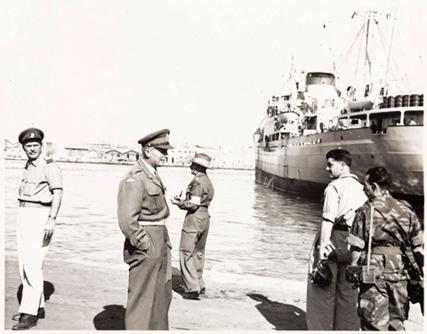
For Britain and France, this decision came as a shock. It was not only a massive financial threat but also a serious challenge to their authority and prestige in the Middle East. In the context of the Cold War following the end of the Second World War in 1945, Western powers feared that instability in the region could increase Soviet influence 7 . Britain also relied heavily on Middle Eastern oil supplies and saw the canal as essential for maintaining both its economic recovery and its strategic position in the Cold War balance of power. In response, Britain and France secretly planned a military intervention with Israel, known as Operation Musketeer 8 , all whilst engaging in diplomatic actions and negotiations with Egypt. On 29 October 1956, Israeli forces invaded the Sinai Peninsula, and on the 5th November British and French troops landed at Port Said in an attempt to regain control of the canal and, if possible,
3 Discussed in ‘The Purchase of the Suez Canal Shares,’ UK parliamentary papers, 1875
4 Convention of Constantinople (1888), international treaty regulating the Suez Canal
5 Gamal Abdel Nasser, Alexandria speech announcing the nationalisation of Suez Canal, 26 July 1956
6 The Independent, 14th January 2021
7 Salim Yaqub, ‘Containing Arab Nationalism: The Eisenhower Doctrine and the Middle East,’
8 ‘Operation Musketeer,’ documents in the UK national archives
Map of Suez Canal, Britannica
President Gamal Abdel Nasser, June 18 1956
depose Nasser.
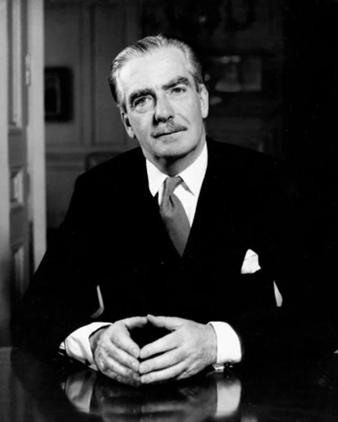
During the invasion, the British Prime Minister Anthony Eden had a significant part to play. Eden’s main motive in the 1956 Suez crisis was to defend Britain’s economic and strategic interests after Nasser nationalised the Suez Canal Company, and to maintain Britain’s status as a major world power. However, he misjudged the strength of Arab and Egyptian nationalism and, most importantly, underestimated the opposing power of the United States under President Dwight D. Eisenhower. Eden himself viewed the situation in dramatic terms, warning that if Nasser were allowed to succeed he might become “a kind of Moslem Mussolini” 9, showing how strongly he believed Nasser threatened Western influence in the Middle East. This miscalculation led to diplomatic humiliation and exposed Britain’s dependence on the US, significantly weakening its global influence. The historian A.J.P. Taylor argues this by criticising Eden for behaving as though Britain was still a major imperial power at the time 10 , highlighting that Suez exposed the gap between Britain’s ambitions and its real world capabilities. This shows that Britain severely overestimated its power within the conflict, which affected subsequent actions and impacted its role as a major, influential power. Although Britain’s influence was already on the decline, a significant factor that led to an even more drastic loss of Britain’s prestige was the condemnation and humiliation by the United States. Britain and France’s military action against Egypt failed mainly due to the intense pressure from the US, including threats to devalue the pound 11, showing Britain could not act independently when faced with such a powerful country. This highlighted Britain’s economic fragility, especially outlined when the British government required a loan from the International Monetary Fund in order to stabilise the pound and protect Britain’s foreign currency reserves after the Second World
War, which the US threatened to block unless Britain agreed to withdraw from Egypt. The US also threatened to sell its sterling bond holdings, which would have devalued the pound and undermined Britain’s foreign exchange reserves. The humiliation and extreme loss of status Britain faced because of the United States’ intense, unwavering criticism ultimately contributed to Eden’s resignation in 1957.
The United States’ refusal to support the military action shattered British prestige, undermined Eden's leadership, and triggered a political crisis that worsened Eden’s already severe health issues, making his position unsustainable. These events proved to other nations that not only was Britain’s economy failing, but also that it was starting to lose independence. This led to a loss of respect for Britain on an international scale and a diminution of its global influence. Historian William Roger Louis argues that Suez demonstrated that Britain could no longer act as a global power without American support12 , showing a decisive decline in its international influence.
9 Ollie Stone-Lee, ‘Eden: A Man Under Strain,’ BBC
10 A.J.P Taylor, English History 1914-1945 (Oxford University Press, 1965)
11 Diane B. Kunz, ‘The United States and the Suez Crisis: Economic Pressure and Diplomacy,’ The Journal of Economic History
12 William Roger Louis, Ends of British Imperialism
Sir Anthony Eden- Prime Minister of Britain taken in 1956
A direct consequence of the Suez crisis was the rapid acceleration of decolonisation that began almost immediately after the crisis, with the most intense, rapid phase spanning from 1957 to the early 1960s 13 The crisis revealed Britain’s inability to maintain its empire through force against nationalist movements or an extremely powerful opposition, in this case the United States, emboldening anti-colonial forces and encouraging nationalist movements. This also sped up the move towards independence in many African colonies like Kenya, Uganda and Tanzania 14 . Britain started to retreat from the empire faster, emphasising the impact that this humiliation had on such a previously major nation. Historian John Darwin argues that while Suez did not single-handedly end
the British Empire, it accelerated an already ongoing retreat from imperial commitments 15 . However, although some of Britain’s influence declined rapidly, it did not completely disappear. Despite the humiliation, Britain retained its permanent seat on the United Nations Security Council and, critically, maintained its independent nuclear deterrent 16. Membership of the United Nations was vital as it provided a permanent veto power, allowing the UK to block any resolutions contrary to its national
interests and ensuring it had to be consulted on all major international crises, helping them to keep some kind of global status. Britain continued to act, in some ways, as a significant global power, undertaking successful military interventions in Jordan in 1958 and Kuwait in 1961 17 , demonstrating the fact that some of their military, naval, and diplomatic capabilities had still remained strong.
Contrary to the idea that the alliance was broken, the relationship between the United States and the United Kingdom recovered quickly under Prime Minister Harold Macmillan, and Britain continued to act as a crucial, although still junior, partner to the United States, particularly within NATO. This encouraged Britain to shift its focus from trying to maintain their ‘sole major power’ global status towards closer alliances, particularly with powerful countries such as the United States and ultimately, entry into the European Economic Community in 1973 18 as a means to secure economic growth and relevance globally. This shows that whilst their global influence did change for the worse, it did not completely vanish and they were still able to maintain, and in some cases grow and strengthen, other global alliances with countries and groups.
In conclusion, I believe that Britain’s global influence was already on the decline prior to the 1956 crisis, however the Suez Canal crisis acted as a turning point to drastically speed up the collapse in their prestige and status. The crisis had been a humiliating and extremely embarrassing lesson to Britain. The crisis had shown from its outcome that in terms of power and influence, the former colonial empire was no longer in the same league as major global powers such as the United States or USSR and in future, any major British operation would need American support and approval.
Britain’s declining status had been highlighted and their economic fragility post WW2 was
13 Charles. E. Nowell, ‘The Sinai-Suez campaign’ , Britannica
14 Richard. A. Webster, ‘The Sinai-Suez campaign’ , Britannica
15 John Darwin, The End of the British Empire: The Historical Debate
16 ‘Suez Crisis’ , National Army Museum
17 ‘Gulf War’ , National Army Museum
18 ‘Why was the Suez Crisis so important?’ , Imperial War Museum
Lieutenant General Sir Hugh Stockport at Port Said, 1956
now known internationally, however not all was lost for Britain. Although Britain was a junior partner to the United States and had lost part of its empire to independence, specifically in African colonies, they still managed to maintain strong alliances with different countries and groups and keep some of the power that had once made them invincible. Thus, while the Suez Crisis did not solely cause Britain’s decline, it significantly altered and weakened their global influence and prestige after 1956.
Bibliography:
Darwin, John. The End of the British Empire: The Historical Debate.
Eden, Anthony. Broadcast speech, 8 August 1956. Quoted in The Times, 9 August 1956.
“Gulf War.”, National Army Museum
Kunz, Diane B. “The United States and the Suez Crisis: Economic Pressure and Diplomacy.” The Journal of Economic History
Louis, William Roger. Ends of British Imperialism Nasser, Gamal Abdel. Alexandria speech announcing the nationalisation of the Suez Canal, 26 July 1956.
Nowell, Charles E. “The Sinai-Suez Campaign.” Encyclopaedia Britannica
“Operation Musketeer.”, The National Archives (UK) “The Purchase of the Suez Canal Shares.” UK Parliamentary Papers, 1875.
Salim Yaqub. “Containing Arab Nationalism: The Eisenhower Doctrine and the Middle East.”
Stone-Lee, Ollie. “Eden: A Man Under Strain.”,BBC History
“Suez Crisis.”, National Army Museum
Taylor, A. J. P. English History 1914-1945. Oxford: Oxford University Press, 1965.
“Why the Suez Canal Was So Important to the British Empire.”, BBC History
“Why Was the Suez Crisis So Important?”, Imperial War Museums
Webster, Richard A. “The Sinai-Suez Campaign.” Encyclopaedia Britannica
Convention of Constantinople. 1888. International treaty regulating the Suez Canal.
To what extent was the atomic bombing of Hiroshima by the USA during the Second World War justified?
– by Melisa K
Background
At the Yalta Conference, from 4th-11th February 1945, Roosevelt met with Churchill and Stalin at Yalta in the Crimea to discuss the postwar settlement. The US believed Soviet support was crucial for victory in the Pacific. However Stalin had signed a neutrality pact with Japan in 1941 that, unless one party notified the other one year prior to its termination, would automatically renew for another five years. To secure Soviet entry into the war within “two or three months” of Germany’s surrender, Roosevelt offered Stalin a series of territorial concessions.
In April 1945, the Soviet Union notified the Japanese that it had no intention of renewing the neutrality pact, but dishonestly assured them that the pact would still be in effect for another year. The Soviet Union deduced that the ideal moment for attack would be in August, which would clearly violate the pact. Stalin’s solution was to have the Allied nations invite them to join the war at the approaching Potsdam conference, as its commitment to the Allies would override its legal obligations to Japan. 1
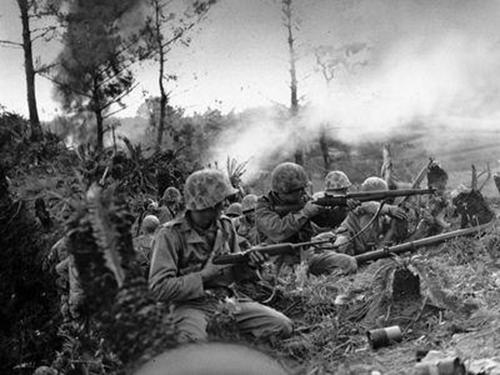
The Battle of Okinawa was a turning point for the US and took place on April 1st - June
21st 1945. Located just 563 km (350 miles) south of Kyushu (the southernmost of Japan’s four main islands), Okinawa’s capture was considered an essential precursor to a ground
invasion of the home islands.
The Battle of Okinawa was also one of the bloodiest in the Pacific War: American casualties consisted of some 12,000 killed and 36,000 wounded and an estimated 110,000 Japanese troops were killed, whilst fewer than 8,000 surrendered. The civilian population of the island was reduced by perhaps a quarter; at least 100,000 Japanese civilians were either killed in combat or committed suicide, partly
1 Yamaguchi, Hibiki, Fumihiko Yoshida, and Radomir Compel. 2019. “Can the Atomic Bombings on Japan Be Justified? A Conversation with Dr. Tsuyoshi Hasegawa.” Journal for Peace and Nuclear Disarmament 2 (1): 19–33. doi:10.1080/257516 54.2019.1625112.
U.S. Marines fighting for control over a ridge near Naha, Okinawa, May 1945. U.S. Department of Defense
since the government deliberately spread rumours of atrocities, that the Americans would inflict upon them once they captured the island. Some civilians who refused were even killed by their own soldiers. Okinawa further affirmed the idea that, even if defeat was inevitable, the Japanese would not surrender: its horror was considered a preview of what an invasion of the Japanese home islands might have looked like.
Meanwhile, the Japanese leadership had thought that in Okinawa they would inflict damage on the Americans and gain favourable conditions under which they could terminate the war. So after the decisive defeat at Okinawa, they began to seriously discuss how to terminate the war for the first time. Two (implausible) options were determined: either, to persuade the Soviet Union to mediate a settlement; or, to break American morale by inflicting tremendous damage on them in the predicted invasion of Kyushu.
On 6th August 1945, the Americans detonated an atomic bomb over Hiroshima. Of a population of 343,000, 70,000 were killed instantly: by the end of the year the death toll
had exceeded 100,000. Two thirds of the city area was destroyed.
On the 8th August, two days after Hiroshima, the Soviet Union declared war on Japan and invaded Manchuria shortly after, ending the hopes for mediation.
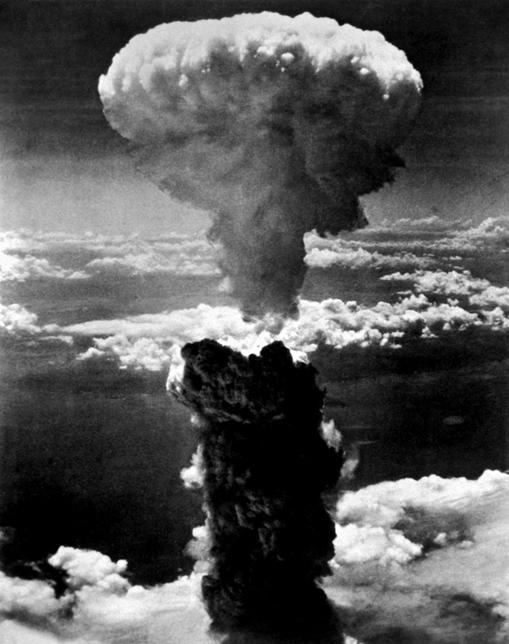
On the 9th August, the Americans dropped a second atomic bomb this time on Nagasaki. An estimated 40,000 people were killed instantly, and at least 30,000 more would succumb to their injuries and radiation poisoning by the end of that year. About 40% of Nagasaki’s buildings were completely destroyed or severely damaged. 2
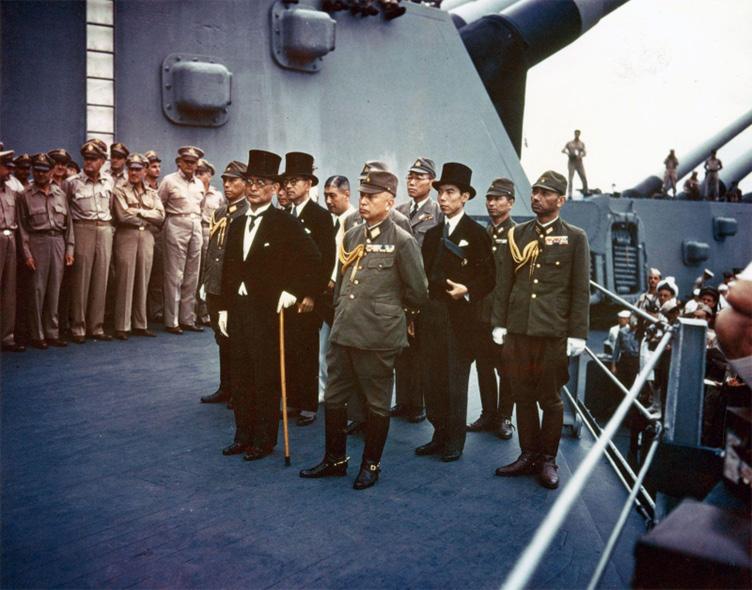
On the 14th August the Japanese government accepted the Allied terms. The Second World War formally ended on the 2nd September, 1945, with the signing of surrender documents on the deck of the USS Missouri.
For the use of the atomic bombs
The orthodox historians reason that the use of the atomic bomb ended the war quickly and therefore saved both Japanese and Allied lives.
American policymakers rejected the possibility of issuing a warning or demonstrating the bomb beforehand, suspecting that the Japanese might create problems that would
2 Britannica School , s.v. "atomic bombings of Hiroshima and Nagasaki," accessed February 25, 2026, https://school.eb.co. uk/levels/advanced/article/atomic-bombings-of-Hiroshima-and-Nagasaki/633399#347387-toc
A mushroom cloud rising above Nagasaki after the atomic bomb was dropped. U.S. Department of Defense
Japanese representatives, including Foreign Minister Shigemitsu Mamoru (with walking cane) and Umezu Yoshijiro (front right), on board the USS Missouri during the surrender ceremonies. Naval History and Heritage Command (USA C-2719)
sabotage the mission. If the bomb was presented on neutral ground, they doubted that the “determined and fanatical military men of Japan would be impressed.” 3
By 1944, the USA had advanced close enough to the Japanese home islands for B-29 bombers to firebomb major cities built primarily of wood and paper. Nearly two thirds of Tokyo was destroyed and in a single night 100,000 civilians perished. Over 300,000 Japanese civilians were killed through strategic bombing in the 12 months prior to the atomic bombs. Orthodox historians argue that, if the use of the atomic bomb was immoral, this was equally so and that if the Americans hadn’t used it, they still would have been killing civilians through other means.
Additionally, they cite that as late as 30th July, the Japanese still had not responded to the Potsdam Proclamation. Even after both bombs were detonated, Army Chief of Staff Umezu Yoshijiro argued that, even if the ultimate victory was beyond reach, the army was still capable of one last campaign.
James R. Van de Velde adds that few actions in war are ethically just, and given the particular totality of the Second World War, there was nothing uniquely immoral about the U.S. using the atomic bomb. 4
He further argues that changing the unconditional surrender policy or offering to continue the monarchy would have been politically tenable and - depending on the terms - might have allowed a militaristic regime to remain in Japan.
Against the use of the atomic bombs
Revisionist historians contend that the atomic bombs were unnecessary now that Japan was
already militarily defeated and that they were only used to intimidate the Soviets. They cite that once the Americans cracked the Japanese diplomatic code they were fully apprised of Japan’s willingness to surrender so long as the imperial institution was preserved. Revisionists further argue that the decision was political rather than military, noting that several senior American military figures later described the bombings as unnecessary. Rather, they believe it was a political decision made to intimidate the Soviets: Truman and Byrnes had reversed Roosevelt's policy of cooperation with Stalin in planning a postwar order. 5
Stalin had not been allowed to sign the Potsdam Proclamation. Tsuyoshi Hasegawa argues that if he had, it would have induced surrender without the bomb, as the Japanese would have recognised the futility of their resistance. 6
Kenneth B. Pyle argues that, if the purpose of war is to achieve political goals that could not be reached by diplomacy, the unconditional surrender policy abandoned the clear aims that had brought the Americans into the Pacific War in the first place (namely their insistence on Japanese withdrawal from the continent ) for the absolute submission of their enemy and the complete reconstruction of its government, economy and society.
Further, Pyle argues that it would have been more sensible to have a less absolute set of demands, likely averting the casualties of Americans, Japanese and other Asians during the final year of the war - including the victims of the atomic bomb. A considerable portion of the Japanese elite were disposed to negotiate surrender, and, after all, that the American occupation itself made compromises, choosing to retain the emperor, alongside most of both the nationalist elite and the oligopolies called
3 PYLE, KENNETH B. “Hiroshima and the Historians: History as Relative Truth.” The Pacific Northwest Quarterly 104, no. 3 (2013): 123–32. http://www.jstor.org/stable/24628776
4 Van de Velde, James R. “Opinion: The Enola Gay Saved Lives.” Political Science Quarterly 110, no. 3 (1995): 453–59. https://doi.org/10.2307/2152574
5 PYLE, KENNETH B. “Hiroshima and the Historians: History as Relative Truth.” The Pacific Northwest Quarterly 104, no. 3 (2013): 123–32. http://www.jstor.org/stable/24628776
6 Yamaguchi, Hibiki, Fumihiko Yoshida, and Radomir Compel. 2019. “Can the Atomic Bombings on Japan Be Justified? A Conversation with Dr. Tsuyoshi Hasegawa.” Journal for Peace and Nuclear Disarmament 2 (1): 19–33. doi:10.1080/257516 54.2019.1625112.
Conclusion
Van de Velde has merit in highlighting that the Second World War was already a total war involving civilian targets without the nuclear bombings, which therefore were not uniquely immoral. However, I agree with Pyle that the Americans could have altered its demands for surrender. This would not, as Van de Velde argues, have allowed a militaristic regime to remain in Japan if preserving the emperor with the majority of the nationalistic elite and the zaibatsu did not. Moreover, it may have prevented further casualties on both sides.
Bibliography
Harding, C “Dropping the bomb on Hiroshima” Modern History Review, Volume 23, Issue 1 Steinberg, A. "Harry S. Truman." Encyclopedia Britannica, January 15, 2026. https://www. britannica.com/biography/Harry-S-Truman Britannica Editors. "Potsdam Conference." Encyclopedia Britannica, July 11, 2025. https:// www.britannica.com/event/Potsdam-Conference. Britannica Editors. "Yalta Conference." Encyclopedia Britannica, February 5, 2026. https://www. britannica.com/event/Yalta-Conference Britannica Editors. "Pearl Harbor attack." Encyclopedia Britannica, January 26, 2026. https://www.britannica.com/event/ Pearl-Harbor-attack Britannica Editors. "Battle of Okinawa." Encyclopedia Britannica, January 14,. https://www.britannica. com/event/Battle-of-Okinawa Hook, Jason “Days that shook the world: Hiroshima, 6th August 1945.” Hodder Wayland Grant, R. G. “Hiroshima and Nagasaki” Wayland Pant, G. S. “Hiroshima: The Lingering Effects.” India International Centre Quarterly 14, no. 2 (1987): 59–68. http://www.jstor.org/stable/23001419
MALLOY, SEAN L. “‘A Very Pleasant Way to Die’: Radiation Effects and the Decision to Use the Atomic Bomb against Japan.” Diplomatic History 36, no. 3 (2012): 515–45. http://www.jstor.org/ stable/44376188
Harding, C. "The USA and Japan, 1941-52 – Before Pearl Harbour (1853 - 1941)." MASSOLIT, uploaded by MASSOLIT, 15 Aug 2018, https:// massolit.io/courses/the-usa-and-japan-1941-52/
pearl-harbour-to-hiroshima-1941-1945
Hamby, A. (1995) History Today [online] Retrieved 4 February 2026, from https://www.historytoday. com/archive/feature/truman-and-bomb
Harding, C. Dropping the Bomb on Hiroshima. Modern History Review [online] Retrieved 4 February 2026 from https://magazines.hachettelearning. com/magazine/modern-history-review/23/1/ dropping-the-bomb-on-hiroshima/
7 PYLE, KENNETH B. “Hiroshima and the Historians: History as Relative Truth.” The Pacific Northwest Quarterly 104, no. 3 (2013): 123–32. http://www.jstor.org/stable/24628776
What was the impact of the Vietnam War on domestic relations in the USA? (19551975)
– by Rafaella C
The Vietnam War began in 1955 as a distant Cold War conflict, but by the late 1960s, it had become a war that deeply affected American society at home. Vietnam had been divided in 1954 into communist North Vietnam and anticommunist South Vietnam, according to Khan Academy, the USA became involved in 1955 because of Cold War fears and the “domino theory”1, the belief that if one country fell into communism, other nations in Asia would follow. Many Americans supported this aim. However, as the war dragged on into the late 1960s, casualties increased, media coverage exposed, with graphic images, the gruesome fighting happening and domestic relations in the USA became severely strained. Between the early 1960s and 1975, the Vietnam War caused deep political division, mass protest, racial tension, generational conflict and a serious decrease of trust in government. Historians such as George C. Herring argue that it “divided the American people as no other event since their own Civil War.”2
Firstly, the war created a large debate between supporters and opponents, dividing families, schools and communities. Supporters of the war believed the USA had a duty to
1 Khan Academy, “The Vietnam War,”
defend freedom and contain communism. Many trusted the government and thought the war was winnable. They often saw protests as unpatriotic and believed Americans should support their troops regardless of political doubts. For older generations especially, shaped by World War II (1939-1945) and early Cold War fears, standing firm against communism seemed necessary. However, by 1965, opposition to the war grew rapidly. Critics argued that too many American soldiers were dying for unclear reasons and that the USA should not interfere in what was essentially a Vietnamese civil war. The existing draft system was heavily used from 1960 for the Vietnam war, forcing roughly 2.2 million young men to serve by this point, intensifying anger. Research from the Library of Congress shows that poorer Americans and racial minorities were disproportionately represented in combat roles whilst wealthier Americans could often avoid service through college deferments.3 This led to accusations that Vietnam was a “workingclass war,” increasing racial and class tensions. Historian Christian G. Appy suggests that even U.S. troops themselves were divided over whether the war was justified.4 This suggests
2 George C. Herring, “America and Vietnam: The Unending War,” Foreign Affairs 70, no. 5 (Winter 1991): 104–119
3 Khan Academy, “The Vietnam War,”
4 Christian G. Appy, Working-Class War: American Combat Soldiers and Vietnam (Chapel Hill and London: University of North Carolina Press, 1993)
that division over Vietnam went beyond protests and politics. Even within the army, soldiers disagreed about the war, showing how deeply it had split the nation.
One of the most significant domestic impacts
and coverage of the Pentagon Papers8 in 1971 further damaged public trust. The Pentagon Papers revealed that the government had hidden or softened the truth about the war, leading many people to feel deceived. This damaged faith in the government as many Americans felt betrayed.
was the ‘credibility gap’, the growing idea that the government was not telling the truth about the war. According to the Brookings Institution5 official statements often claimed progress, yet events on the ground suggested otherwise. An example being the turning point of the 1968 Tet Offensive. Although U.S. and South Vietnamese forces eventually regained control, the scale of the attacks shocked the public. If America was “winning,” how could such a massive assault occur? When respected news anchor Walter Cronkite 6 described the war as “mired in stalemate,” many Americans began doubting optimistic government claims.
Television played a crucial role in shaping the domestic reactions. Vietnam was often called the “first television war.” Reports such as Morley Safer’s coverage of Cam Ne on CBS 7 showed U.S. Marines burning villages, raising moral questions. Footage of the Saigon execution broadcast on NBC in 1968 horrified viewers.
Later revelations of the My Lai massacre
This distrust fuelled mass protest
movements. Large demonstrations, such as the March on the Pentagon in 1967, the protests at the 1968 Democratic National Convention in Chicago and the Moratorium March of 1969 involved hundreds of thousands of people. The United States House of Representatives
5 Marvin Kalb, “Credibility Gap” Redux, Brookings, February 21, 2012
6 Chester J. Pach Jr., “Tet on TV: U.S. Nightly News Reporting and Presidential Policy,” in 1968: The World Transformed, ed. Carole Fink, Philipp Gassert, and Detlef Junker (Cambridge University Press, 1998), 55–82
7 CBS News, “Safer’s Watershed Report from Cam Ne,” May 15, 2016
8 U.S. National Archives and Records Administration, “Pentagon Papers,” last reviewed July 29, 2019
Vietnamese soldiers during the Vietnam War, South Vietnam, c. 1965
Television news footage showing a reporter interviewing a Vietnamese civilian during the Vietnam War, South Vietnam, c. 1966
Anti-Vietnam War protest in the United States, c. 1970
records 9 show that politicians reacted strongly, sometimes condemning protesters as “bums” or extremists. This response increased polarisation between government authorities and citizens. The government reacted to the protests by deploying police and guards, in an attempt to control the protestors. But in some cases, this led to protests turning violent, reinforcing fears among war supporters that social order was breaking down. The conflict overseas had clearly created great conflict at home.
The pressure from these protests had a significant influence on the White House. Following the policies of Lyndon B. Johnson, who had greatly increased the number of American troops in Vietnam, Richard Nixon faced growing pressure from the anti-war beliefs spreading across America. In early 1969, he introduced ‘Vietnamization,’ a policy that aimed to gradually withdraw U.S troops while giving South Vietnamese forces more responsibility for fighting the war. Nixon hoped this would reduce American deaths, calm protests at home and avoid making the United States appear weak. Vietnamization eventually helped lead to the Paris Peace Accords, agreements signed on January 27th 1973 that formally ended U.S. military involvement, after which most American troops withdrew from Vietnam.
In conclusion, the Vietnam War had a profound impact on domestic relations in the USA between the 1960s and 1975. It divided the nation politically, socially and culturally. The draft created class resentment, media coverage exposed the brutality of the war and the credibility gap destroyed trust in government. Protests and political conflict demonstrated how deeply society had split. By 1973, most U.S. forces had withdrawn and America was not only militarily exhausted but socially divided. Therefore, the legacy of Vietnam was not just a foreign policy failure but a transformation of domestic relations, leaving a more sceptical and politically polarised United States.
Bibliography
Appy, Christian G. Working-Class War: American Combat Soldiers and Vietnam. Chapel Hill and London: University of North Carolina Press, 1993. https://projectsmrj.pbworks. com/f/Working%2BClass%2BWar%2B%2BChristian%2BAppy.pdf
CBS News. “Safer’s Watershed Report from Cam Ne.” May 15, 2016. https://www.cbsnews.com/news/ controversial-report-changed-war-coverage-inamerica
Herring, George C. “America and Vietnam: The Unending War.” Foreign Affairs 70, no. 5 (1991): 104–119. https://web.viu.ca/davies/H323Vietnam/ Herring.AmericaVietnam.pdf
History, Art & Archives, U.S. House of Representatives. “Bums, Beatniks, and Birds: The House Responds to Anti-Vietnam War Protests.” May 6, 2021. https://history.house.gov/Blog/2021/ May/5-6-Bums-Beatniks-Birds
Kalb, Marvin. “Credibility Gap’ Redux.” Brookings, February 21, 2012. https://www.brookings.edu/ articles/credibility-gap-redux/ Khan Academy. “The Vietnam War.” Accessed April 19, 2026. https://www. khanacademy.org/humanities/us-history/ postwarera/1960s-america/a/the-vietnam
Library of Congress. “Digital Resources.” In Racial, Ethnic, and Religious Minorities in the Vietnam War: A Resource Guide. Last modified July 7, 2025. https://guides.loc.gov/racial-ethnicand-religious-minorities-in-the-vietnam-war/ digital-resources
Pach Jr., Chester J. “Tet on TV: U.S. Nightly News Reporting and Presidential Policy Making.” In 1968: The World Transformed, edited by Carole Fink, Philipp Gassert, and Detlef Junker. Cambridge: Cambridge University Press, 1998. https://www.cambridge.org/ core/books/abs/1968-the-world-transformed/ tet-on-tv/00E5E12B40
U.S. National Archives and Records Administration. “Pentagon Papers.” Last reviewed July 29, 2019. https://www.archives.gov/research/ pentagon-paper
9 History, “Bums, Beatniks, and Birds: The House Responds to Anti-Vietnam War Protests,” Whereas: Stories from the People’s House, May 6, 202
To what extent was the arrival of the Prussians the main factor of Napoleon losing the battle of Waterloo?
– by Thomasina R
The Battle of Waterloo was fought on the 18th of June 1815 and was won by British and Prussian forces. The Battle marked the end of the Napoleonic wars and Napoleon’s rule as Emperor of France.
At around 3:30 am on the day of the battle, the British commander Duke of Wellington received confirmation that the Prussian Field Marshal, Blücher, and his troops, would march to Waterloo. This would have been reassuring for Wellington because his army was smaller and less experienced than Napoleon's
1 John Bew, History Today Volume 63 Issue 9 September 2013
meaning he would need some help in order to secure victory. Historian John Bew describes Wellington as ‘The Iron Duke, a model of calm in a crisis.’ However he also points out that the Duke was honest enough to know that defeat beckoned if his Prussian Allies did not arrive before sunset. 1
In 1815, the Prussian army was one of the most experienced, professional and resilient armies in Europe. Their resilience showed when on the 16th of June 1815, they lost to Napoleon and the French army. However, just two days later, the Prussians fought in the Battle of Waterloo, a victory Wellington may not have claimed had it not been for Blücher and his troops.
The army consisted of approximately 44,000 troops and 160 guns. 2 This, along with Wellington's 68,000 troops and 156 guns almost matched Napoleon's army of 72,000 men and 246 guns. 3 Strength in numbers benefitted the Allied army when the Prussians began to attack Napoleon’s right flank at the village of Plancenoit. Their attack forced Napoleon to divert critical reserves such as Lobau’s Corps, the Young Guard, and parts of the Old Guard away from his main attack
2 John Mackenzie, British Battles: Battle of Waterloo, the battle that ended the dominance of the French emperor Napoleon over Europe.
3 National Army Museum, Battle of Waterloo
Meeting of Wellington and Blücher from, The Wars of Wellington, a narrative poem
on Wellington’s centre, splitting his forces and disrupting his battle plan. Peter Hofschröer, author of ‘The Waterloo Campaign’ argued that Napoleon’s defeat at Waterloo was primarily due to the Prussian army not Wellington4. Their presence at the battle not only boosted numbers, but also stopped Wellington’s army becoming overwhelmed, sustained most of the casualties, and ultimately turned a stalemate into a decisive victory.
Field Marshal Blücher did not go into the Battle of Waterloo without a plan. After being defeated at the Battle of Ligny, he did not retreat east towards Prussia, but reestablished his position around Wavre where he was able to stay in contact with the allied force that had retreated from Quatre-Bras to Waterloo.5 He was informed that Wellington would be fighting a defensive battle at Waterloo and so he resolved to send the 4th corps to attack Napoleon’s right flank. The 2nd and 1st corps would march in two columns towards the battlefield at Waterloo and the left column led by Bülow and Pirch II would take Plancenoit. This plan was exceptionally well thought through and the execution of it forced Napoleon to fight a two front battle. Napoleon’s army was divided, and therefore made it weaker and easier for the Prussians to attack.
However, many historians including David Chandler, author of ‘Campaigns of Napoleon, argue that Napoleon's defeat was not only due to Blücher and the Prussian army, but due to
his own poor leadership. Chandler describes Napoleon as ‘a military genius’ who earlier in his career may have been able to handle the issue of the Prussians' arrival better.6 There was poor communication between marshal Michel Ney and Emmanuel de Grouchy because of Napoleon’s vague orders and his failure to use his wings effectively. For example, Grouchy was ordered to ‘march to the sound of the guns’ by a general however he refused and stuck to his orders he had been given by Napoleon to engage the Prussians at Wavre. Grouchy didn’t realise the main battle was decided by the speed with which the Prussians arrived, a
movement that Ney and Napoleon failed to prevent.
Napoleon’s strategy to defeat Wellington and Blücher also failed as soon as he realised Blücher had not retreated eastward. His plan was to divide Wellington and the Prussians by forcing Wellington towards the sea, and the Prussians towards the east. He would then conduct a diversionary attack against Hougoumont where he hoped Wellington would send reinforcements, and a main attack against the bulk of the Anglo-Allied army could begin. This all relied on his army being able to drive the Prussians away from Waterloo and to the east, however they were unsuccessful. Napoleon did have a plan to handle the Prussians if they did arrive at Waterloo but he based it on them arriving too late or already defeated which they didn’t. Overall his plan was
4 Peter Hofschröer, BBC Waterloo: The Three Commanders
5 Napoleon.org , Blücher and the Prussians at Waterloo
6 David Chandler, Campaigns of Napoleon, Macmillan Publishing, London, 1965
Royal artillery field gun used by the British at Waterloo
Napoleon crossing the Alps by Jacques-Louis David
not badly thought out, but the execution of it was poor.
In conclusion, the arrival of the Prussians was the main, but not the only factor in Napoleon’s defeat at Waterloo. Their arrival meant more troops and weapons for the Anglo-Allied army, increased pressure on Napoleon, an army who were strong and resilient, and a commander that executed a well thought out battle plan, leading to a decisive victory. Napoleon lacked strong leadership skills during the battle, leading to miscommunication among his army and a poorly executed battle plan. Napoleon’s defeat at the Battle of Waterloo marked the end of the Napoleonic Wars, Napoleon Bonaparte’s rule as Emperor of France, and his attempts to dominate Europe. He abdicated on June 22, 1815 and was exiled to St Helena. His defeat did not necessarily mean society or the people in power changed in Britain or Prussia; however in France the House of Bourbon was restored to the throne, bringing Louis XVIII to power.
Bibliography
Bew John, History Today, Volume 63 Issue 9
September 2013
Chandler David, Campaigns of Napoleon, Macmillan Publishing, London, 1965
Hofschröer Peter, The Three Commanders, BBC Waterloo, 17th February 2011
National Army museum, The Battle of Waterloo
To what extent did economic factors cause the American Revolution?
– by Violet D
The series of events that led to the outbreak of the American Revolution accumulated over the course of nearly a decade following the end of Britain’s involvement in the Seven Years’ War. It was the result of three factors, two of which were social and political, which I will measure the impacts against the economic causes.
In terms of economic factors, the main one was Britain’s continuous enforcement of a series of new taxes and tariffs from over the course of 1764 to 1774. This was due to Britain having previously in 1763, just emerged from the Seven Years’ War victorious, albeit heavily in debt, due to the immense military expenditures from the multi-continental conflict. Therefore this caused Britain, in an attempt to regain some of their revenue, to begin levying duties on one of its largest colonies at the time: America. As previously stated, the first tax was enforced in 1764, that being the Sugar Act, which introduced new enforcement measures upon various foreign luxury imports such as molasses, wines and textiles, however the most famous act was administered nearly a year and a half later, in 1765, which was known the Stamp Act.
This act imposed taxes upon all imported paper goods, which inconveniently consisted of many everyday items such as newspapers, advertisements and legal documents, as well
as any other forms of printed products. This resulted in an outrage because unlike the Sugar Act, it affected nearly all colonists, rather than just merchants, with it being a direct internal tax. This subsequently led to the creation of the famous slogan of ‘No Taxation without Representation’ and a series of collective widespread protests and boycotts.
Colonists were furious at Britain for imposing these acts, marking it as an attack on their autonomy, arguing the decisions being made were unjust without them having elected representatives in Parliament and therefore any advocacy or acknowledgment for their own constitution. It’s argued by historians Jari Eloranta and Jeremy Land that “Most scholars have … neglected … the economic issues pertaining to the Seven Years’ War. It was the economic problems and consequences, not political or military debates that drove the decision-making process vis-à-vis funding of this conflict. The substantial increase in public debt created extremely difficult conditions to overcome when consolidating a new and expanding empire, and it would be beyond temptation for politicians not to impose some of the cost of such a conflict onto the colonies, whether justified or not.” 1
Following these events, colonists felt an increasing indignation towards Britain; whilst initially some still felt a sense of obligation
1 Jari Eloranta and Jeremy Land, Hollow Victory? Britain’s Public Debt and the Seven Years’ War , Economic and Business History Society, 2011. https://www.ebhsoc.org/journal/index.php/ebhs/article/download/215/198/431
towards the monarchy, there was an undeniable shift in the nation’s overall political identity, with the increase in taxes raising concerns over how much liberty and control they had over their own country. For example, it’s stated by historians Daniel Bunn and Nate Scherer: “It was not the burden of taxation that led to revolt; the colonies actually paid significantly less in taxes than other British subjects. Rather, it was the idea that Britain could freely impose taxes on the colonies without their consent, especially taxes that were arbitrary and punitive.” 2 Bunn and Scherer highlight the fact of how financially insignificant the taxes imposed upon the colonies were compared to the ones imposed upon the subjects living within Britain itself: statistically a colonist would have to pay one shilling annually in taxes,
compared to a subject living in Britain having to pay 26 shillings. 4 This emphasises the greater effect political causes had in contributing to the rising conflict between the nations, due to it not being the taxes that profoundly affected the colonists but rather the alarm they caused by being interpreted as an attack upon their autonomy. It was through the distress caused by these taxes that there became a stronger desire for self-governance and determination, driven by the rise of new ideologies defined by principles of liberty and independence.
It was another pivotal event that consequently further escalated the tensions between America and Britain, and pushed the desire for sovereignty amongst colonists to extreme extents; the Boston Massacre. This occurred only a few years prior to the American War of Independence. Taking place on March 5th, 1770, in Massachusetts: a crowd of colonists grew hostile and physically violent towards a group of British soldiers, which resulted in them opening fire, killing five people and injuring several more. Succeeding this event, multiple rebel group leaders, such as Paul Revere and Samuel Adams, used the event to paint violent propaganda against the British, further fueling the sentiment of the anti-British ideologies, as well as increasing the colonists’ desire to separate from Britain even more.
As a result of this, there became a growing sense of disconnect and hostility between the colonists and the British, and therefore a stronger distinction in identity between the two countries being disparate, and along with America’s new aspirations to become an independent nation. It’s argued by George Trevalyan that the American Revolution “was a defensive movement, undertaken on behalf of essential English institutions (genuine national self-government and real ministerial
2 St. Germain, Edward, Causes of the American Revolution l Political, Economic and Social, American Revolution.org, n.d. https://www.americanrevolution.org/causes/
3 Mark Malory, No Taxation Without Representation , American Battlefield Trust, n.d. https://www.battlefields.org/learn/ articles/no-taxation-without-representation
4 Bunn, Daniel and Scherer, Nate, Taxes and the Road to Revolution: A Brief Overview , Tax Foundation, 2nd July 2025. https://taxfoundation.org/blog/independence-day-taxes/#:~:text=Intriguingly%2C%20however%2C%20when%20the%20 founders,Taxes%20that%20Led%20to%20Revolution
5 Eric Robson, The American Revolution Reconsidered , American Battlefield Trust, February 1952. https://www. historytoday.com/archive/american-revolution-reconsidered
A political cartoon protesting against the Tea Act of 1773.2
responsibility) against the purpose and effort of a monarch to defeat the political progress of the race” 5. As previously stated, the colonists felt that the series of acts enforced upon them over the course of the decade were an attack on their individual and collective liberty, which resulted in them rebelling, in fear that if they didn’t they would eventually lose full control over their own nation.
Furthermore, this led to formation of multiple rebel groups, such as the American Patriots and the Daughters of Liberty, although the most notable example being the Sons of Liberty, though originally known as the Loyal Nine, which was established in 1765, in Boston. They were some of the most prominent figures in organising boycotts and riots, although often taking their protests to extreme measures. A key example of this, that occurred quite early on during the Revolution, specifically on August 26th 1765, was when “Boston rioters raided the home of the Lieutenant Governor Thomas Hutchinson”, an infamous loyalist politician to the British, “and stole an estimated £250,000 worth of his possessions” 3 , highlighting the radical extents rebels were willing to go to oppose British powers and their allies.
However, their most significant act of rebellion whilst leading up to the American War of Independence would have to be the Boston Tea Party. After the Tea Act was initially enforced in 1773, a tariff which was imposed upon imported tea, the colonists were infuriated, because it was the sixth major tax administered upon them. As an act of defiance, Americans, who were also encouraged by the Sons of Liberty, dumped British tea into Boston Americans dumped British tea into Boston Harbour. This led to the creation of the Coercive Acts, or more widely known as the Intolerable Acts; it was Britain’s attempt to restore their authority by punishing its colonists. This included the closure of Boston Harbour and the Massachusetts colonial government being replaced by British crownappointed officials, however this only fueled the colonial resentment further, uniting them against British powers, as colonists ultimately felt they were being unfairly condemned. As a result, the first ever Continental Congress was held in Carpenters Hall, Philadelphia, only nearly nine months later, where a total of fiftysix of the Colonial leaders gathered to discuss their response to Britain’s actions. Ultimately, in their grievances to British policies, they suspended their trade with Britain, refusing Parliament’s right to tax them and petitioned King George III to repeal the Coercive Acts. Although it was agreed that they would reconvene in May if their demands to the British Parliament were not met or if tensions still hadn’t settled. However, less than a year later, on April 19th 1775, the American War of Independence began.
Overall, whilst I believe economic factors did hold a significant influence as the trigger of the American Revolution, the strong desire for self governance that occurred due the accumulating taxes upon the colonies led to the urge to separate from the British Empire. This also led to the unwavering defiance to
6 Who Were the Sons of Liberty? American Battlefield Trust, n.d. https://www.battlefields.org/learn/articles/who-weresons-liberty
7 Tyler, John W., “Such Ruins Were Never Seen in America”: The Looting of Thomas Hutchinson’s House at the Time of the Stamp Act Riots , The Colonial Society of Massuchetts. https://www.colonialsociety.org/publications/3297/such-ruinswere-never-seen-america-looting-thomas-hutchinsons-house-time-stamp
Sons of Liberty Protesting the Stamp Act by Attacking the House of Lieutenant Governor Thomas Hutchinson at Boston on 26 August 1765, John Warner Barber (1798–1885), mid-19th century. Wood engraving. Granger Collection, New York.7
British powers by the colonists and rebel groups, which precipitated events such as the Boston Tea Party. As the taxes imposed a relatively insubstantial financial burden, they likely would have had little impact on America had they not been so deeply interconnected with the burgeoning desire for political autonomy. This creates a shared importance between each factor, as one could not have sparked the revolution without the other. In conclusion, I believe that each factor played an equally integral role in causing the Revolution, and without the impact of one, the longstanding significance of the other's effects would’ve been ultimately withheld from each other.
Bibliography:
Babbs-Miller, Kathryn; Dean, Linda; Hensinger, Michael; Levering, Doug; Phipps, Becky; Mead, Philip; Newell, Aimee; Norman, Trish; Rossi, Kevin; Skic, Matthew; Stiles, Jonathan; Straus, Brandon; Turdo, Mark; Vona, Abby; and Whaley, Adrienne, Timeline of the American Revolution, subcategory of the Protest and Pride 1754-1775 section, Museum of the American Revolution website, rewritten in 2022. https://www.amrevmuseum.org/timelines/ timeline-of-the-american-revolution
Bunn, Daniel and Scherer, Nate, Taxes and the Road to Revolution: A Brief Overview, Tax Foundation, 2nd July 2025. https:// taxfoundation.org/blog/independenceday-taxes/#:~:text=Intriguingly%2C%20 however%2C%20when%20the%20 founders,Taxes%20that%20Led%20to%20 Revolution
Eloranra, Jari and Land, Jeremy, Hollow Victory? Britain’s Public Debt and the Seven Years’ War, Economic and Business History Society, 2011. https://www.ebhsoc.org/journal/index.php/ebhs/ article/download/215/198/431
Ladenburg Thomas, The Events Leading to the American Revolution, Digital History, 2007. https://www.digitalhistory.uh.edu/teachers/ lesson_plans/pdfs/unit1.pdf?utm
Maier, Pauline, The American Revolution, 17631783, The Gilder Lehrman Institute of American History, n.d. https://www. gilderlehrman.org/history-resources/essays/ american-revolution-1763-1783
Malory Mark, No Taxation Without Representation, American Battlefield Trust, n.d. https:// www.battlefields.org/learn/articles/
no-taxation-without-representation Robson Eric, The American Revolution Reconsidered, American Battlefield Trust, February 1952. https://www.historytoday.com/archive/ american-revolution-reconsidered St. Germain, Edward, Causes of the American Revolution l Political, Economic and Social, American Revolution.org, n.d. https://www. americanrevolution.org/causes/ Tyler, John W., “Such Ruins Were Never Seen in America”: The Looting of Thomas Hutchinson’s House at the Time of the Stamp Act Riots, The Colonial Society of Massuchetts. https:// www.colonialsociety.org/publications/3297/ such-ruins-were-never-seen-america-lootingthomas-hutchinsons-house-time-stamp Williams, Emma Slattery, American Revolution Timeline: Team Taxes and the Taking Up of Arms, History Extra, 5th July 2022. https://www.historyextra.com/period/ georgian timeline-american-revolution-keymilestones/?scrlybrkr=01790ee8
America Revolution Timeline, American Battlefield Trust, 22nd October 2024. https://www.battlefields.org/learn/articles/ american-revolution-timeline
Sons of Liberty, Boston Tea Party Ships and Museum website, n.d. https://www.bostonteapartyship. com/sons-of-liberty
American Revolution, 1763-1783, from across multiple articles, n.d. https://www. loc.gov/classroom-materials/unitedstates-history-primary-source-timeline/ american-revolution-1763-1783/
Timeline of the Revolution, National Park Service, n.d. https://www.nps.gov/subjects/ americanrevolution/timeline.htm
Timeline: The American Revolution, The Gilder Lehrman Institute of American Revolution, n.d. https://www.gilderlehrman.org/history-resources/ online-exhibitions/timeline-american-revolution
Who Were the Sons of Liberty? American Battlefield Trust, n.d. https://www.battlefields.org/learn/ articles/who-were-sons-liberty
Ten Causes of the American Revolution, Boston Tea Party Ships and Museum, n.d. https://www.bostonteapartyship.com/ article/10-causes-of-the-american-revolution