How UHF RFID Fixed Readers Are Transforming Livestock Tracking in India
According to India's 20th Livestock Census, the country had approximately 536.76 million livestock in 2019, including 193.46 million cattle, 109.85 million buffaloes, 148.88 million goats and 74.26 million sheep. At this scale, manually identifying and monitoring every animal is difficult. This is where RFID (Radio Frequency Identification) can provide an automated method of animal identification, movement tracking and data collection.
The Growing Need for Livestock Tracking in India Modern dairy and livestock operations increasingly need to know:
Which animal is currently in a particular shed?
Has an animal moved outside its permitted area?
Which animals are due for veterinary treatment?
Which animals are being transported?
What is the animal's breeding and production history?
Can the animal's movement be traced during a disease outbreak?
The Government of India has already established large-scale digital livestock identification initiatives. Under earlier government programmes, animals were assigned unique identification numbers and their information was uploaded to the INAPH (Information Network for Animal Productivity and Health) database. Government programmes have also emphasized animal identification, traceability and disease monitoring. This creates an important foundation for the next stage: automated electronic identification and movement tracking.
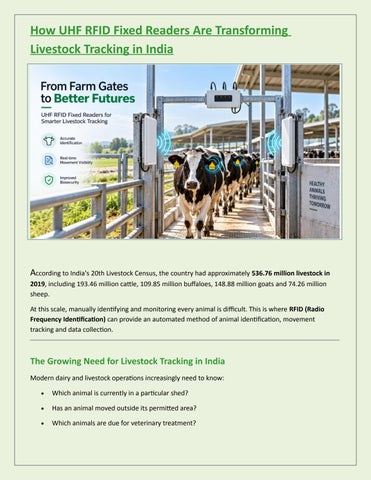
How Does a UHF RFID Fixed Reader Track Livestock? Imagine a dairy farm with 500 cattle. Each animal is assigned a unique RFID tag. Fixed RFID readers can then be installed at strategic locations such as:
Farm entrance, Exit gate, Cattle shed entrance, Feeding area, Milking area, Veterinary area, Weighing station, Quarantine area, Loading/unloading area
When an animal carrying an RFID tag passes through the reader's detection zone, the reader captures the tag's unique identification number. For example: Animal: Cow 1025 RFID ID: E200XXXXXXXXXXXX Location: Milking Area Time: 06:42 AM The software can associate this RFID ID with the animal's existing profile. The system can therefore create an automated movement history: Farm Gate → Shed → Feeding Area → Milking Area → Veterinary Area → Shed This transforms RFID from simply an identification technology into a livestock visibility platform.
7 Important Applications of Fixed RFID Readers in Livestock
1. Automated Animal Identification One of the simplest applications is automatically identifying animals. Instead of manually checking an animal number, workers can allow animals to pass through an RFIDenabled gateway. The system automatically records: Animal ID + Date + Time + Location This can significantly reduce manual data entry.
2. Monitoring Animal Movement Fixed readers can be positioned at different points across a farm. For example: Location
RFID Reader
Main Gate
Reader 1
Cattle Shed
Reader 2
Feeding Area
Reader 3
Milking Area
Reader 4
Veterinary Area Reader 5 Loading Area
Reader 6
The software can use these reader events to create a movement history for each animal. This can be particularly useful for large dairy farms, breeding centres and livestock facilities.
3. Disease Control and Traceability Disease outbreaks can create significant economic and operational challenges for livestock owners. Electronic identification can help establish:
Which animals were present in a particular location?
Which animals came into contact with a particular group?
Which animals entered a quarantine area?
Which animals were transported from an affected location?
Which animals require vaccination or inspection?
The Indian government has specifically identified animal traceability and disease monitoring as important objectives of livestock identification programmes. (Press Information Bureau) RFID can therefore become one component of a broader livestock disease-traceability system.
4. Dairy Farm Management For organized dairy farms, RFID can connect animal identification with daily operational activities. For example: RFID Identification → Milking → Milk Production Record → Veterinary Record → Feeding Record When an animal enters the milking area, the system can automatically identify it and associate the animal with its production record. This reduces dependency on manual identification and can improve data accuracy.
5. Livestock Transportation Transportation is another important application. RFID readers can be installed at:
Farm loading gates
Transport yards
Collection centres
Livestock markets
Slaughter/processing facilities where applicable
Quarantine facilities
The system can record which animals were loaded into a particular vehicle. When those animals arrive at the destination, another RFID reader can automatically record their arrival. This creates a digital movement trail.
6. Preventing Unauthorized Animal Movement A fixed RFID reader can also be connected to an alert system. For example, if an animal is moved through an unauthorized gate: RFID detected → Animal identified → Location checked → Rule violated → Alert generated The alert could be sent to:
Farm manager
Security team
Veterinary officer
Livestock management software
This can help improve security and reduce unauthorized movement.
7. Automated Livestock Inventory Traditional livestock counting can be labour intensive. A large farm may have hundreds or thousands of animals. With strategically positioned RFID readers, management can automatically collect animal-identification events. This can help answer: "Which animals are currently recorded inside this facility?" Instead of relying entirely on manual counting.
Why UHF RFID Is Interesting for Indian Livestock Operations The livestock identification market is already expanding. Grand View Research estimates India's livestock identification market generated approximately US$121.6 million in 2024 and projects it could reach US$235.2 million by 2030, representing a projected CAGR of 11.7% from 2025–2030. These figures cover broader RFID and livestock-identification markets rather than specifically UHF fixed readers for livestock. However, they indicate a broader technology environment in which automated identification and tracking solutions are expanding.
The Opportunity for UHF RFID in India's Livestock Sector India's livestock identification opportunity is particularly interesting because of the enormous scale of the sector. Even a small percentage of this population moving toward electronic identification represents a potentially large technology opportunity. The opportunity is not limited to individual farmers. Potential users include: Dairy Farms, Breeding Centres, Veterinary Hospitals, Gaushalas, Livestock Collection Centres ,Animal Transportation,Government Departments, Insurance Companies, Research & Agricultural Institutions
Challenges to UHF RFID Adoption in Livestock Despite its potential, UHF RFID is not a universal solution. 1. Tag Design Animal environments are very different from warehouses. Tags need to withstand:
Dust
Mud
Water
Physical impact
Animal movement
Outdoor temperature variations
Tag placement is also important.
2. Reader Installation Reader and antenna positioning needs careful planning. A poorly designed RFID gate can produce:
Missed reads
Multiple reads
Reads from adjacent lanes
Incorrect animal identification
Therefore, antenna positioning, RF tuning and read-zone design are critical. More information about the UHF RFID reader - https://chainway.net/Products?tid=40
3. Animal Movement Animals do not move like boxes on a conveyor. They can:
Stop
Turn around
Move together
Change direction
Stand close to one another
The RFID system must therefore be designed around actual animal behaviour.
4. Cost Cost remains an important consideration, particularly for small farms. Government discussions around livestock RFID have previously identified the cost of tags and readers as a barrier to wider adoption. This means India's future RFID opportunity will depend heavily on: Lower hardware cost + easy deployment + useful software + measurable ROI.
What Does the Future Look Like for UHF RFID in Indian Livestock? The Indian livestock identification market has a strong underlying opportunity, with market research projecting double-digit growth through 2030. For livestock, the next phase could move from:
Manual Identification ↓ Electronic Identification ↓ Automated RFID Identification ↓ Real-Time Movement Tracking ↓ Digital Livestock Records ↓ AI-Enabled Livestock Management The biggest opportunity is therefore not simply selling an RFID tag or reader. It is creating a complete livestock traceability ecosystem.
Where Chainway Fixed RFID Readers Can Fit For solution providers such as Chainway India, fixed UHF RFID readers can form the core identification infrastructure of a livestock-tracking solution. A typical deployment could include: UHF RFID Ear/Animal Tag ↓ Chainway UHF RFID Fixed Reader ↓ RFID Antenna ↓ Edge Gateway / Network ↓
Livestock Management Software ↓ Cloud Dashboard ↓ Mobile Application This architecture can be adapted for dairy farms, breeding centres, veterinary facilities, livestock transportation, government programmes and large organized livestock operations. The important point is that the reader is only one component. The real value comes from connecting RFID events with animal records, locations, workflows and alerts.
For More Details about UHF Readers, please visit - https://shorturl.at/rwX8V
Conclusion India's enormous livestock population, increasing digitization of animal records, focus on disease control and growing livestock-identification market create a significant opportunity for RFID-based solutions. The future of livestock management is moving toward traceability, automation and data-driven decision making. UHF RFID fixed readers can play an important role by creating automated identification points across farms and livestock facilities.