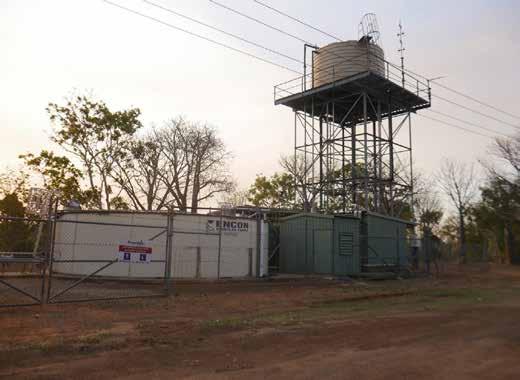
The small community of Bulla (Gudabijin) (140km east of Kununurra and 370km south of Darwin Northern Territory) has a problem with Barium, an earth metal being detected in the drinking water at up to ten times the safe limit. The issue has been ongoing and known for many years. The responsible authority, the Power and Water Corporation appears unable to resolve the issue, even though a water treatment plant has been installed.
Bulla is the only location in the country that has breached the Australian Drinking Water Guidelines for Barium. The latest published levels recorded over 2023-2024 appear to be getting higher.
In April 2023 Friends of the Earth published a report concerned about drinking water in a number of locations across the Northern Territory. It appears that little has changed since then at Bulla.
Bulla has a population of about 80 people. The local school has between 10-20 students. Population numbers in Bulla can fluctuate.
In their 2023 report, Power and Water Corporation acknowledge that health parameters were not met at Bulla. The easiest solution would be a reverse osmosis water filter for the community and school at Bulla.
Government resources for improving drinking water quality are limited and communities, with larger populations that will receive help before smaller ones.
The residents at Bulla are legally justified that the NT Government needs to seriously address the issue facing a community.
Full Article: Barium in Bulla Drinking Water at Unsafe Levels for Decades - Friends of the Earth Australia
6 May 2025
A recent report, Increasing Fire Weather Season Overlap Between North America and Australia Challenges Firefighting Cooperation, found that fire weather seasons in eastern Australia and western North America are increasingly overlapping due to climate change, posing serious challenges to international firefighting cooperation. Traditionally, Australia has relied on assistance from countries like the US and Canada during its fire season, sharing resources such as firefighters, incident managers, and aircraft. However, as fire seasons grow longer and more intense in both hemispheres, this reciprocal support system is under threat.
Friends of the Earth campaigns coordinator Cam Walker emphasised the urgent need for Australia to establish its own fleet of Large Air Tankers (LATs). Currently, Australia owns just one LAT and leases up to six more from North America during the northern hemisphere’s off-season. With these off-season windows shrinking, securing leased aircraft in future fire seasons
may become increasingly difficult. The Royal Commission into Natural Disaster Arrangements recommended that the federal government create a national aerial firefighting capability, but the previous government decided not to pursue this.
FoE is calling on the current government, which has invested in water-bombing aircraft and is reviewing aerial firefighting capacity, to commit to purchasing a sovereign fleet of LATs to ensure Australia’s preparedness. Additionally, FoE urges the government to stop exporting fossil fuels that worsen climate change, fast-track new technologies for rapid fire detection, and establish a national remote area firefighting team. This mobile team would support state and territory crews in protecting remote national parks and World Heritage Areas, especially as fire seasons become longer and local resources become stretched.
Full Article: https://www.foe.org. au/fire_season_overlap_threatens_ firefighting_efforts
FiRE S EAS on oVERLAP t hREAt E n S FiREFighting
W ES t PAC’ S nEW CL iMAt E PLA n BE t RAYS SCiE ntiFiC
REAL it Y (M AR k E t FoRCES )
6 June 2025
Westpac Banking Corporation has significantly weakened its climate transition plan (CTP) policy, abandoning its previous requirement that fossil fuel companies produce Parisaligned transition plans by October 2025. The bank has introduced a vague four-tier rating system that lowers the bar for funding eligibility and could allow continued support for companies expanding coal, oil, and gas projects. Previously, Westpac required upstream oil and gas clients to cover all emissions, and to halt new fossil fuel developments. The new policy removes this clear standard, offering only a weak expectation for companies to have a ‘plan to reduce’ emissions and an ‘ambition’ to reach net zero by 2050. This shift undermines efforts to align finance with the Paris Agreement.
Westpac’s policy expansion to include metallurgical coal miners and coal power generators appears cosmetic, as major clients like BHP may avoid scrutiny due to revenue thresholds. The bank also excludes midstream oil and gas companies such as APA Group, which supports major fracking projects.
Full Article: https://www. marketforces.org.au/westpacs-newclimate-plan-betrays-scientific-reality/
BUR dE kin ShiRE RELEASE
PFAS dE t EC tion d AtA FoR
AYR , noR th QUEE n SLA nd
14 May 2025
Recently released data has confirmed that the town of Ayr in North Queensland has been significantly impacted by PFAS contamination in its drinking water supply, with levels regularly exceeding proposed health guidelines.
The primary source of the contamination has been identified as the local fire station, where firefighting foam use resulted in PFAS concentrations up to 9,100 times above safe drinking water limits. These chemicals have leached into the nearby Nelsons Borefield, historically Ayr’s main water source. Three bores were shut down in 2018 due to contamination, with further bores taken offline in subsequent years.
Testing shows that since 2018, Ayr’s drinking water has frequently exceeded current and proposed national PFAS guidelines.
The Queensland Government has committed over $58 million for a new water treatment plant and bore upgrades. Affected bores are now only used during supply emergencies.
The contamination raises serious questions about historical exposure and regulatory oversight. Friends of the Earth continues to monitor the issue and is calling for greater transparency and accountability.
Full Article: https://www.foe.org.au/ burdekin_shire_release_pfas_detection_ data_for_ayr_north_queensland
hiS toRiC tREAt Y LAWS PASS ViC toRi A n UPPER hoUSE
Oct 30, 2025
Australia’s first Treaty between First Peoples and government will commence before the end of the year after the Victorian upper house passed enabling legislation today.
The Statewide Treaty Bill was supported by Labor, Greens, Animal Justice and Legalise Cannabis MPs in the upper house. The Bill passed the lower house earlier this month.
On behalf of the Assembly, Co-chair and Wamba Wamba, Yorta Yorta, Dja
dEECA
A LLEgE dLY
CAUght
dES
t RoY ing EndA ngERE d F Rog hABitAt ( gECo goongERA h En V iRonME nt CE nt RE )
8 May 2025
DEECA, the government department responsible for environmental protection, reportedly damaged critical habitat for the endangered Watson’s tree frog in East Gippsland. This occurred despite having detailed maps and internal guidelines to safeguard these fragile breeding sites, DEECA contractors sprayed herbicides on vital water bodies and adjacent creeks and caused physical damage during road maintenance in early 2025. This site destruction within national parks reflects a systemic failure to protect the species.
The Watson’s tree frog is listed as endangered and relies on small, specific pools for breeding, making any habitat loss a major threat. With only five known breeding sites in Victoria, the damage poses a significant risk to the population’s survival.
Dja Wurrung and Dhudhuroa woman Ngarra Murray celebrated the passing of the Treaty legislation through the upper house and thanked the representatives who voted in support.
The Statewide Treaty commences in December 2025.
Article sourced from the First Peoples Assembly of Victoria
Read more here Historic Treaty laws pass Victorian upper house — First Peoples’ Assembly of Victoria
DEECA’s actions potentially breach multiple environmental laws and stand in stark contrast to the conservation work conducted by its own Arthur Rylah Institute. Conservation group GECO has formally reported the breaches to the Office of the Conservation Regulator but has yet to receive a response. They continue to monitor the situation and call for stronger accountability and community support to safeguard endangered species and their habitats.
Full Article: https://www.geco.org. au/deeca_destroying_frog_habitat
FoE int ERn Ation AL
tRoPiCAL FoRES t FoREVER
FACiL it Y LAUnChES At CoP30, FALL ing S hoR t oF nECESSARY t RA n SFoRMAti VE Ch A ngE
06 Nov, 2025
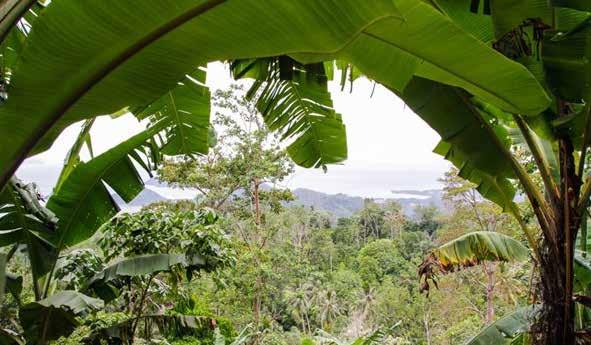
As COP30 opens in the heart of the Amazon, the top priority for the thousands of people attending the Peoples’ Summit, is building a collective agenda for transformative change and the preservation of forests.
A new group, The Tropical Forests Forever Facility (TFFF), was launched at the Leaders’ Summit. While the TFFF claims to represent an unprecedented step in global forest conservation efforts, it falls short with insufficient efforts to directly support Indigenous Peoples and Local Communities. They once again presented a finance mechanism that puts profit above peoples and furthers the financialisation of nature.
Read more here. Reaction: Tropical Forest Forever Facility launches at COP30
inC-5.2 oU t CoME : P LAS tiCS tREAt Y
nEgoti Ation S EX t E ndE d
AS MAJoRit Y oF CoUnt RiES
S tA nd UP FoR AMBition, PRoCESS UndERMinE d BY CoRP oRAt E int ERES t S
15 Aug, 2025
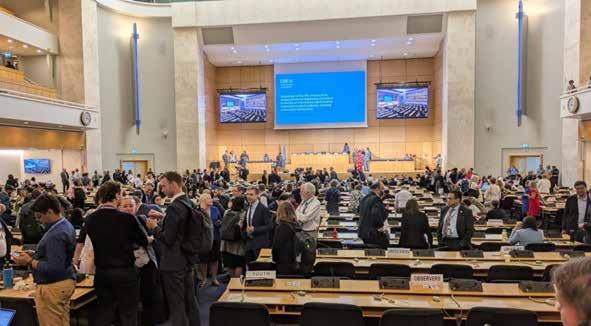
The UN Plastics Treaty closed in Geneva, Switzerland with negotiations being extended again. In the final days key elements such as production reduction were gutted. In response, the majority of voting states blocked what would have been a hollowed-out, ineffective and non-binding agreement.
Friends of the Earth International will continue engaging constructively in the conclusion of an ambitious and binding Plastics Treaty. As talks ended without a clear way forward, it is crucial to change the process to break the deadlock. We left with disappointment yet determination for the fight against plastic pollution, for peoples and the planet.
Full Article: INC-5.2 Outcome: Plastics Treaty negotiations extended
F RoM thE A MA zon to BEL é M : thE Fight FoR CL iMAt E JUS tiCE MUS t E nd CoRP oRAt E iMPUnit Y
25 June 2025
Corporate impunity continues to enable environmental destruction while denying justice to those most affected.
In the Ecuadorian Amazon, Indigenous communities are still dealing with the legacy of Chevron’s oil operations. Over decades, the company dumped billions of litres of toxic waste into rivers and left hundreds of unlined waste pits. After Ecuadorian courts ordered Chevron to pay compensation, the company left the country and turned to international arbitration to avoid accountability.
This is part of a growing global trend in which transnational corporations use closed-door legal systems to challenge environmental regulations. These mechanisms exclude affected communities and prioritise corporate profits over human rights and ecological protection.
In 2024, the region experienced one of its worst droughts in history. Rivers dried up, and residents were forced to rely on contaminated water, with serious health and environmental consequences. Governments have largely failed to act, often shielding polluters instead of supporting impacted populations.
There is an increase in calls for justice for indigenous communities. This includes ending legal protections for polluters and ensuring that accountability, not impunity, defines the global climate response. Without justice, there can be no effective or equitable climate action.
Full Article: https://www.foei.org/ fight-for-climate-justice-must-endcorporate-impunity/
Editorial: A Living Archive
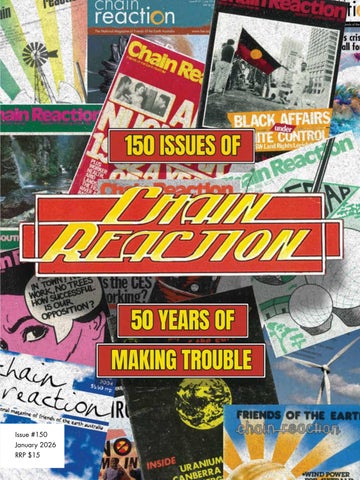
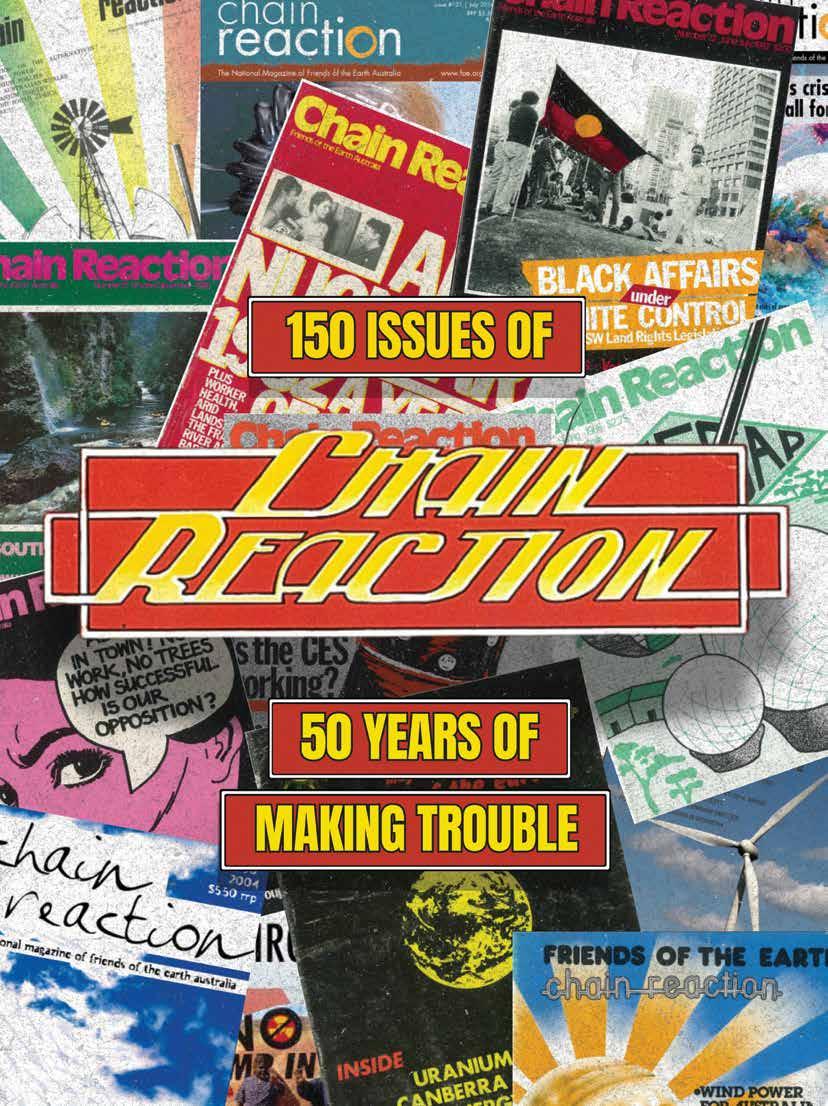
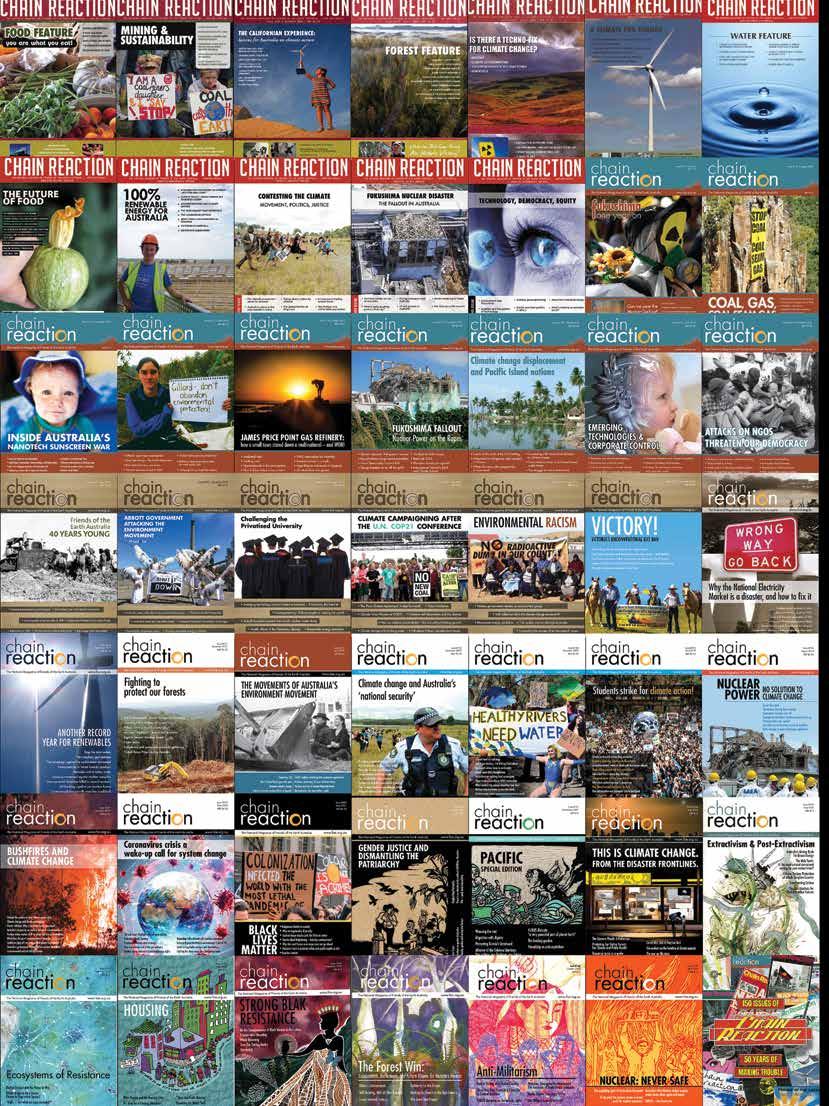
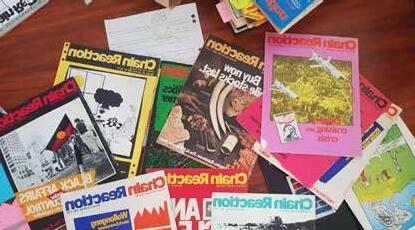
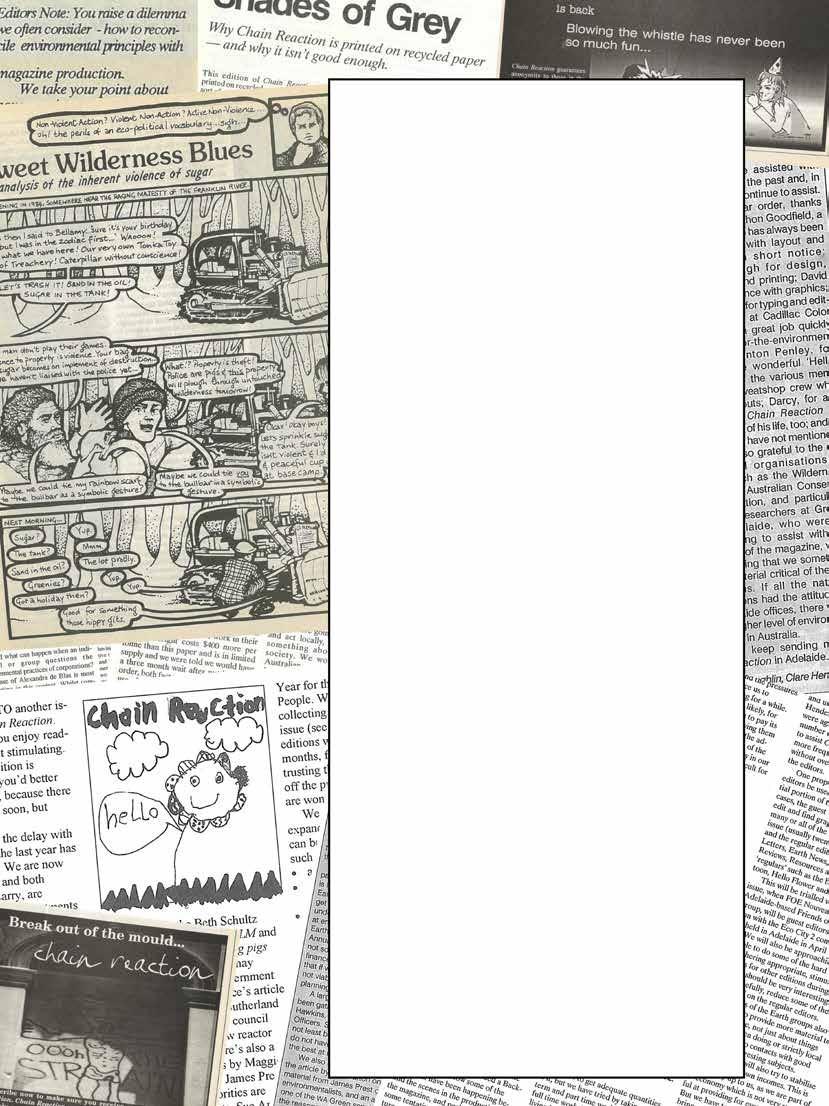
Since 1975, this magazine has been a foundational text for the environment movement across so-called Australia. Now in its 50th year, we’re taking a creative look back at the many decades of Chain Reaction.
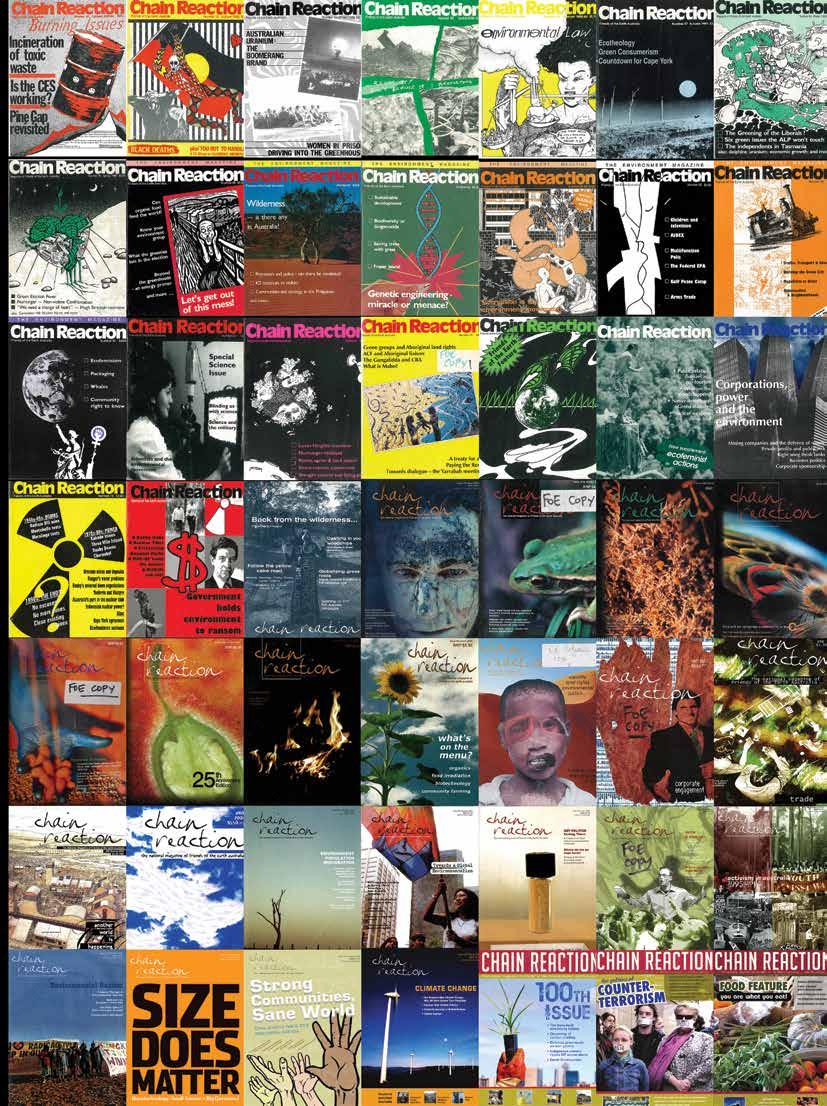
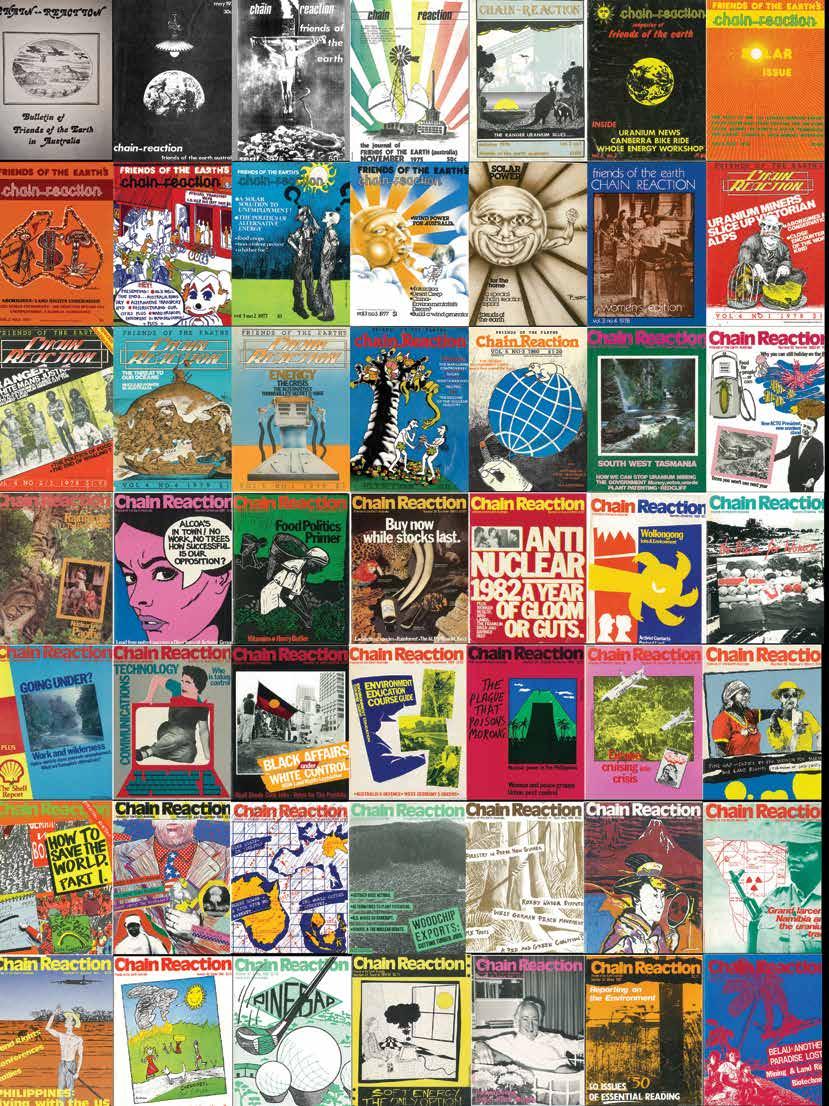
To produce this issue, a small collective has spent countless hours pouring over all 149 previous issues of the magazine. We kept our eyes peeled for key issues, popular topics, behind-thescenes insights, great graphics, and historical moments. We then worked to digitally collage the highlights of each decade, to tell the story of Chain Reaction through the archives.
Looking back over its history with both familiar and fresh eyes, Chain Reaction proves to be far more than a record of FoE’s wins and day-to-day campaigns. It has acted as an open space for debating ideas, testing perspectives, and unpacking the issues of the moment. Over the decades, the magazine has moved through many seasons and taken on different shapes, mirroring the shifts unfolding across environmental, and socio-political movements. Its focus, voice, and style changed alongside them. In the process, it became a home for radical expression in all its forms, inviting critique, provocation, and thoughtful disruption.
Ch A ngES ARE CoMing to Ch A in R EAC tion
Chain Reaction, a National Project of FoE Australia, has been the beating heart of FoE for 50 years. Over this time it has been a vital source of radical education, and a key constitutional purpose of our federation. It has kept a documented record of the history of activism of FoEA; announced our successes, and informed on our continued work across a wide range of initiatives.
For the past few years, there has been work behind the scenes to reinvigorate Chain Reaction, and its editorial process, to reflect modern factors such as cost of living, workers’ rights and its audience. Creating and integrating change is never easy. FoEA has decided on a path forward. Changes to the number of yearly publications, subscription costs (moderate increase) and subscriber only early online access to current articles are among the proposed changes.
As always, each entire Chain Reaction edition will be available for free on the FoE website. We will keep subscribers and members updated with the changes as soon as they are ratified. It is due to your continued support that Chain Reaction reached its 50th birthday.
Thank you
From the Chain Reaction Collective.
In the pages of this magazine, you’ll find an archival exploration of the last 5 decades of Chain Reaction—collage pages showing the emergent themes of each decade, and telling the story of campaigns. Interspersed within these collages are letters, written by people who were involved in the project from the 70s to today, telling stories from behind the scenes about their time as editors, designers, campaigners or contributors. Towards the end of the magazine there’s a new section, called WHY WE PRINT. To celebrate the importance of print media in today’s digital world, we’ve collected testimonials from people involved in other print projects—publications, publishing houses, printers, bookshops and libraries. These little testimonials are designed to make the case for print and all it allows in our increasingly digital age, and to celebrate the many local projects dedicated to radical print media.
This issue is a celebration of what Chain Reaction has been for five decades—a movement newspaper, a place for reflection and debate, a community art project, and a living archive.
Thank you for taking the time to read the story we’ve worked hard to tell.
ARChi VES: WA nt to dig dEEPER ?
If you love exploring archives, and want to dig into the history of Chain Reaction and Friends of the Earth Australia, scan the QR code below. You can access almost every edition of the magazine, as well as behind-the-scenes insights, and the extensive FoE Nuclear Free archives too. A massive thanks to the crew who put this collection together.
If you’re more into print, hard copies of each issue of Chain Reaction are available for perusing at the FoE Melbourne campaign centre.
A short history of the Chain Reaction magazine
Jim Green
The Friends of the Earth magazine Chain Reaction began as the Greenpeace Pacific Bulletin in 1974 as part of a campaign opposing nuclear weapons testing in the Pacific. The name was changed to Chain Reaction in 1975.
Peter Hayes reflected:
“FoE Melbourne’s first order of business in 1974 was to organize a “Greenpeace Action” in the form of supporting an Australian vessel to sail to Moruroa in mid-1974. This was before Greenpeace existed as an organized entity in Australia. In 1972, a “Greenpeace” vessel captained by David McTaggart had sailed to Moruroa, and Greenpeace in Canada was just starting to get organized.
“I did not want a Greenpeace entity, but rather, a Greenpeace action that would embody FoE’s mission and exemplify our style. This took the form of Rolf Heimann’s Tahiti ketch that left from St. Kilda pier of a speech by Jim Cairns and to the sounds of a jazz band. ... To support Rolf’s voyage, we began to publish Greenpeace Pacific Bulletins and raising money. I think there were a couple, likely one at start of 1974, and a second in winter 74. This morphed into the FoE magazine Chain Reaction ...”
Peter Hayes, Barbara Hutton and Neil Barrett were among the founding editors. In its early editions, Chain Reaction often had an emphasis on practical issues such as how to build a wind generator. This was seen as part of a politics of democratising technology and society – “technology for the people by the people”.
From the start there was also a strong culture of activism and protest. The September 1975 edition of Chain Reaction reported on FoE Melbourne’s much-publicised “lavatory sit-in” to protest the Concorde aircraft, complaining about “super-expenditure for a super-luxury”. The British Aircraft Corporation maintained a “bemused upper lip” but the Australian transport minister threatened to sue FoE for $1 million over the pamphlet, ‘British Airways is Taking Australia for a Ride’.
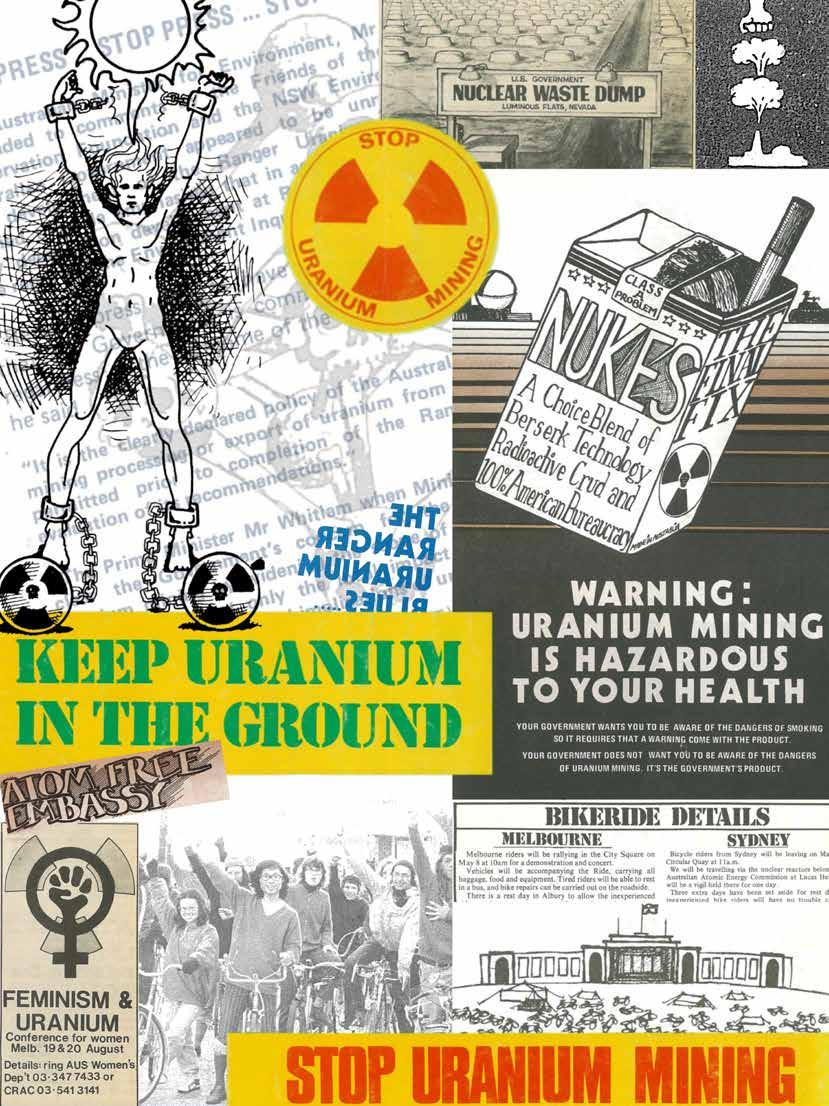
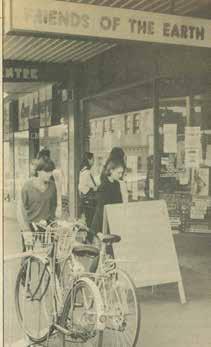
Also in 1975, around 250 people took part in a bike ride against uranium mining from Melbourne, Sydney and Adelaide to Canberra, where Bill Liechacz from FoE NSW burnt the coffin of the ‘ALP Conscience’ with a flame kindled by his solar cooker. The following year, 400 riders participated. The rides built FoE’s profile to such an extent that, in the words of Chain Reaction editor Richard Nankin, “we now work in overcrowded offices, with people coming and going at all hours, the phones always ringing madly”.
After a few editions of Chain Reaction, it was decided to expand its anti-nuclear focus in order to become a national ‘activist-orientated’ environmental journal. But nuclear issues were hugely contentious at the time. Peter Hayes reported in 1977 that almost all FoE groups in Australia were working on nuclear and whaling issues, among others, and that FoE was dealing with a “vast influx of active and angry people”.
A 1977 edition of Chain Reaction apologised for its lateness which was a result of partially successful efforts to stop uranium being loaded at wharves in Melbourne and Sydney:
“Absenteeism reached 100% during the Swanston Dock actions
where mounted police led a charge over the top of protesters sitting on a wharf beside a ship loaded with Australian uranium. Commenting on the police’s heavy-handed tactics at the protest, Chief Police Commissioner Miller says: ‘I’d use elephants if I had them.’”
Meanwhile FoE had initiated the Atom Free Embassy at Lucas Heights because the Australian Atomic Energy Commission was storing uranium there.
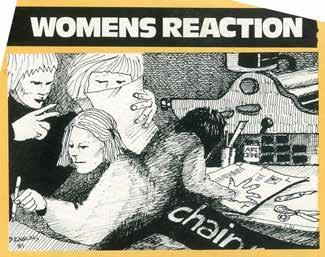
In 1978, a Women’s Edition of Chain Reaction included articles on sexism in the environment movement; women at work; and several articles on feminism, sexism and the nuclear industry. A letter in Chain Reaction said FoE Sydney and Melbourne were mostly male but “joyfully nonoppressive”. But in 1982, in a series of letters and articles in Chain Reaction , many women expressed opinions like that of Margie Kaye, who said “the environment movement over the last 10 years has continually failed to examine sexism within its internal structures”. Denise Chevalier wrote on behalf of FoE Collingwood: “We, the women at FoE, have fought hard for what we have achieved. We have far more women than men working with us. The women are now at the fore in the decision making in all our campaigns”.
In 1979, mining magnate Lang Hancock promoted the use of nuclear weapons to blast artificial harbours. Joh BjelkePeterson said he could not oppose uranium mining, “firstly because it would not be right and secondly because it would be wrong”. He had previously promoted the use of nuclear weapons (‘peaceful nuclear explosives’) to halt the progress of the Crown of Thorns Starfish on the Great Barrier Reef. Chain Reaction reported: “Fortunately, the starfish seemed to have slackened off of their own accord – possibly tipped off by somebody!”
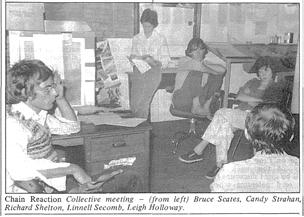
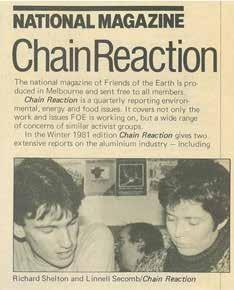
In the early 1980s, Mark Carter, co-founder of the Food Justice Centre, and Leigh Holloway oversaw production of Chain Reaction, which carried a lot of big picture strategic debate, with sharp layout and often striking covers. Some of the most inspirational inserts and editions date from that time. Under the editorship of Mark and Leigh and, later, Linnell
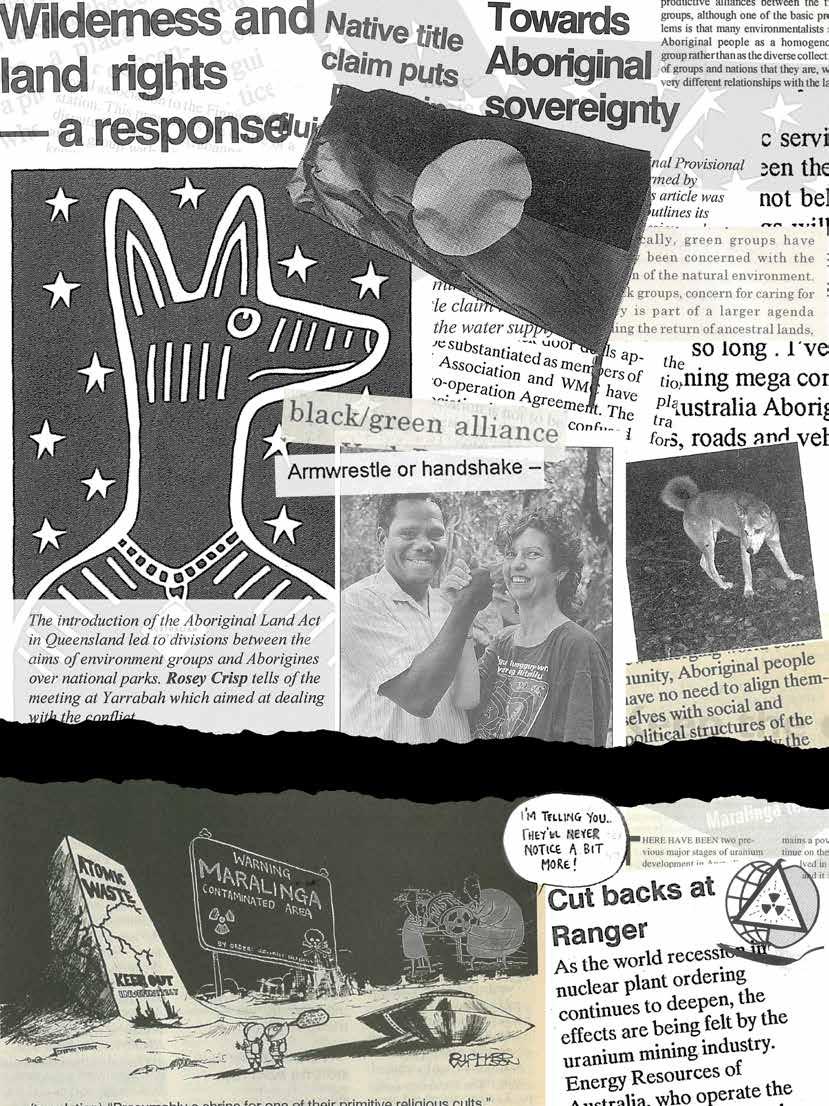
Secomb, Chain Reaction continued its evolution towards an emphasis on social issues. Cover stories included food politics, workers’ health, women’s employment in the service sector and jobs in Wollongong. Aboriginal land rights and debates over mining on Aboriginal land were recurring themes from the early editions of Chain Reaction.
In the early 1980s, there were considerable differences of opinion about Chain Reaction. In 1981, a faction of the editorial collective moved office in the middle of the night to ‘save’ the magazine from those they regarded as not having the “responsibilities we had to the wider national FoE and environmentalist constituency”. The conflict was partly due to the sheer size of the editorial collective: the winter 1981 edition of the magazine credited 45 people as being involved with editorial decisions. Those credited included people who went on to become Senators, local councillors, authors, an adviser to Paul Keating and the first energy minister in the Bracks Labor government in Victoria.
After Mark Carter and Leigh Holloway left, the Chain Reaction editorial team continued to grow, and contributing to it at this time were some long-term members, including Eileen Goodfield who dedicated more than six years of service and insight to the magazine. Chain Reaction’s commitment to ensuring equal involvement by women and men in the collective included providing free child care to people working on the magazine.
In 1986, Johnathan Goodfield resigned as one of the main editors after four years in the job, and a new collective, which included people who had already been involved in the group for some time, was established. This team included people who then contributed several years of effort to the magazine, including Ian Foletta, Eileen Goodfield, Fran Callaghan, Clare Henderson and Larry O’Loughlin.
Throughout its history, Chain Reaction has had a reputation for addressing issues before they become the subject of common debate in the environment movement or broader society. One example of this is the debate over the use of the ‘wilderness’ concept in environmental campaigning; that is, whether wilderness actually exists in Australia given Indigenous management of Australian landscapes for
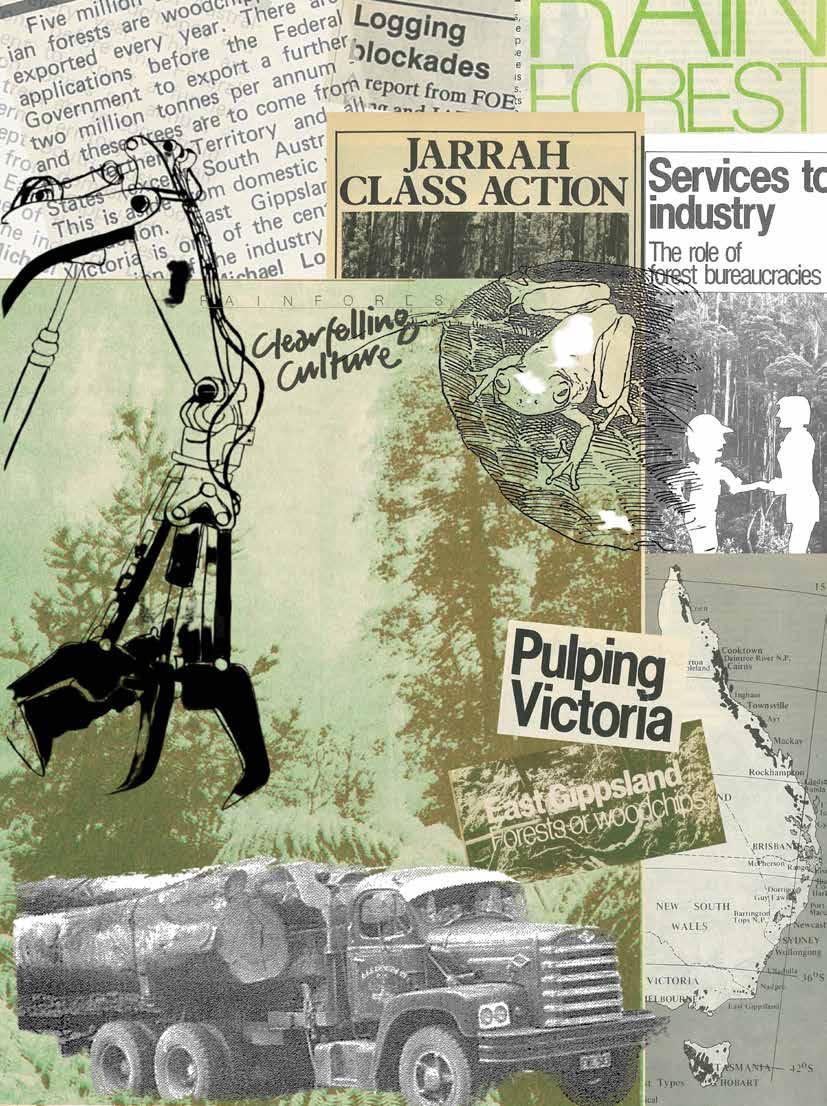
thousands of human generations. Likewise, FoE and Chain Reaction took up the issue of the impacts of herbicide use in timber plantations at a time when most other green groups were uncritically promoting plantations.
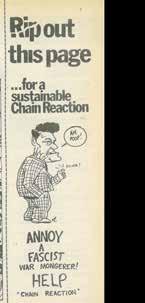
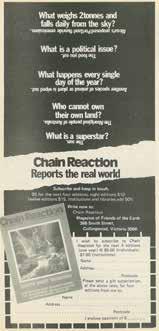
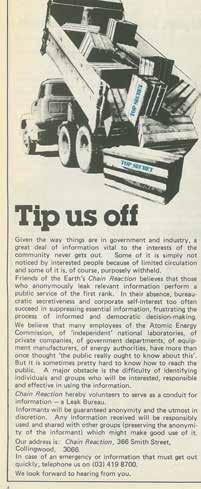
Chain Reaction also helped raise awareness within the environment movement about counter tactics used by industry, including front organisations, PR, and ‘dirty trick’ campaigns. Bob Burton contributed much of this groundbreaking work. In earlier years, Chain Reaction carried advertisements for FoE’s ‘Leak Bureau’ asking corporate or governmental whistleblowers to provide information. The Leak Bureau’s most spectacular success came in 1976, when a whistleblower from the Mary Kathleen Uranium Mining leaked documents revealing the existence of a global uranium cartel. This resulted in protracted international scandals, fines totalling hundreds of millions of dollars, and the disbandment of the cartel.
A notable feature of Chain Reaction has the publication of debates on ‘internal’ matters concerning the environmental movement. In the early 1980s, this included debates over feminism and socialism, and in the late 1980s, there was a brief but intense exchange over NVA or non-violent action.
In recent years this has included issues of political positioning within the movement and corporate engagement. This encouragement of debate has not been without controversy: discussion about the role of direct action and tactics by some groups created heated responses in the early ‘80s, and in 1991 an issue of the magazine on ‘corruption in the environment movement’ generated a huge amount of angst and anger amongst a number of individuals and environmental groups.
Clare Henderson and Larry O’Loughlin were Chain Reaction editors from 1986 to 1996. When they moved from Melbourne to Adelaide in early 1989, the existing Melbourne-based collective disbanded. In the following years, Clare and Larry produced Chain Reaction almost entirely through their own efforts although a number of people did work with them from time to time. Guest editors produced a number of editions, while Clare and Larry did the layout and production, administration and distribution of the magazine.
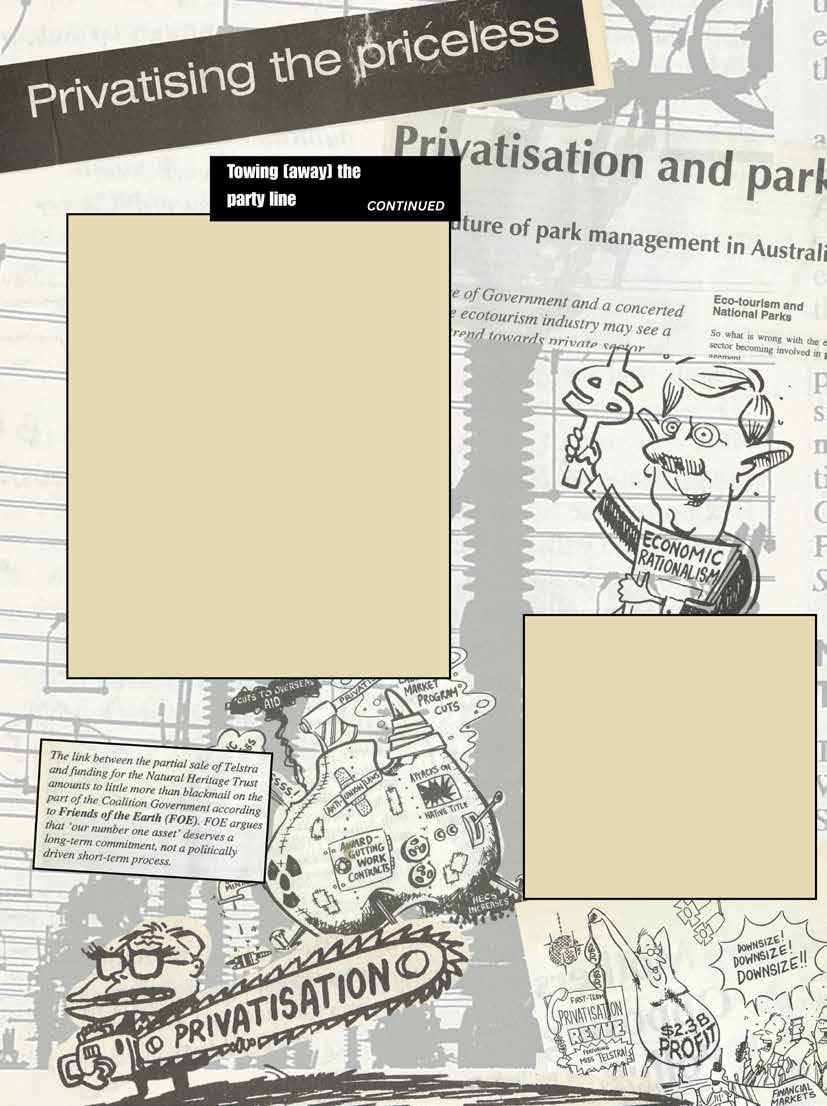
Clare and Larry’s final edition, in the year that the Howard Government was elected, was a scathing analysis of the Coalition’s failure on environment policy and the ‘clean and green’ image it was trying to cultivate. FoE’s strong opposition to the partial sale of Telstra – in return for some limited environmental funding – was a breath of fresh air compared to the timid response of some environment groups to the new government.
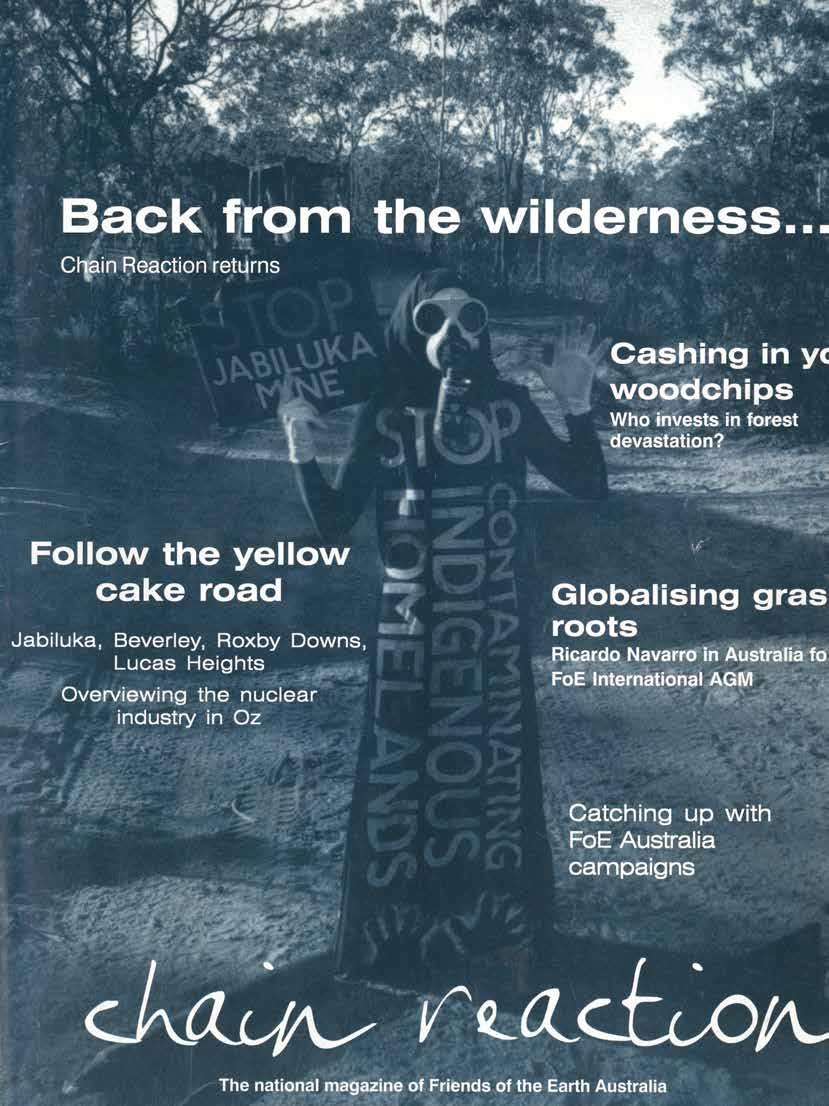
The magazine had a brief period of non-production from 1996 until 1998, but apart from this period, it has been produced consistently for more than half a century, largely through volunteer labour. It was resurrected by Anna Burlow, Kulja Coulston, Tristy Fairfield and Barbara Kerr in 1998 with an edition titled ‘Back from the Wilderness’, taking an anti-nuclear and international focus.
From 2007 until 2020, Jim Green (FoE Australia’s national anti-nuclear campaigner) acted as editor. From 2020–2024, Moran Wiesel took over as coordinator, working with the Chain Reaction collective, and over the past year Emily WoodTrounce has led the collective producing the magazine.
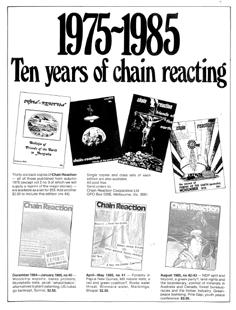
More than three-quarters of all issues of Chain Reaction produced since 1975 are online in PDF format at foe.org.au/chain_reaction _past_issues
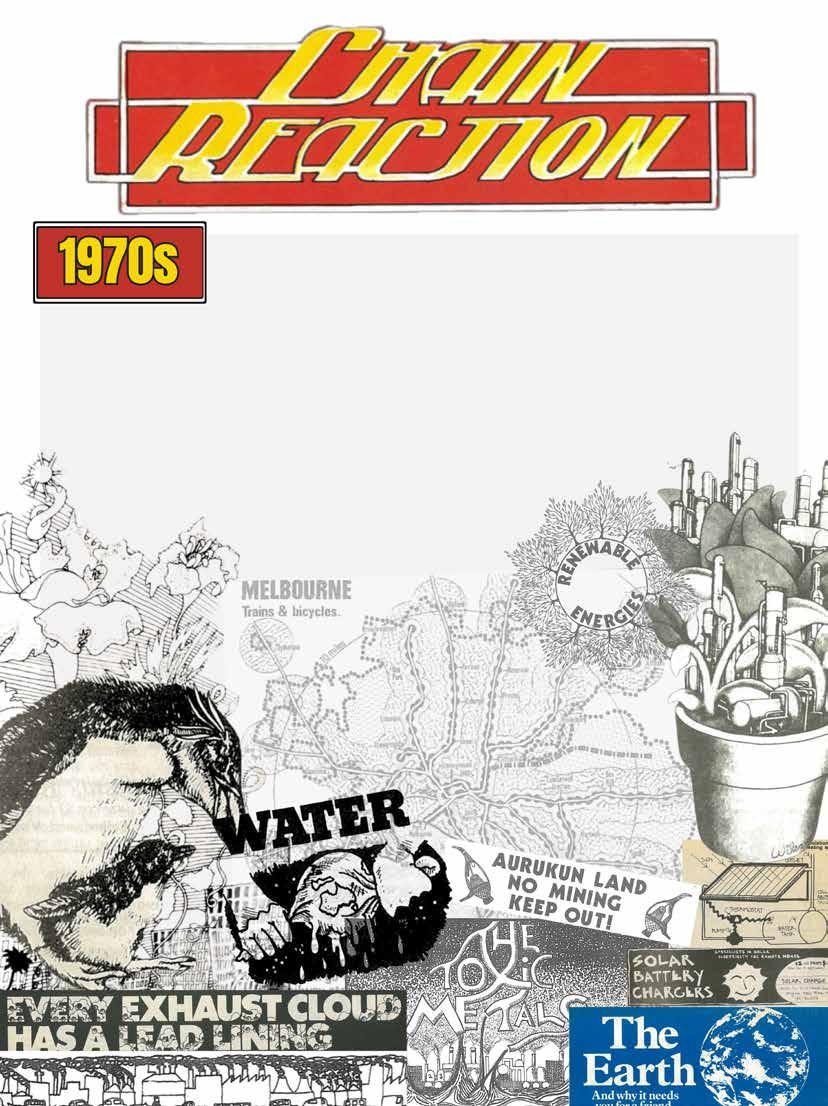
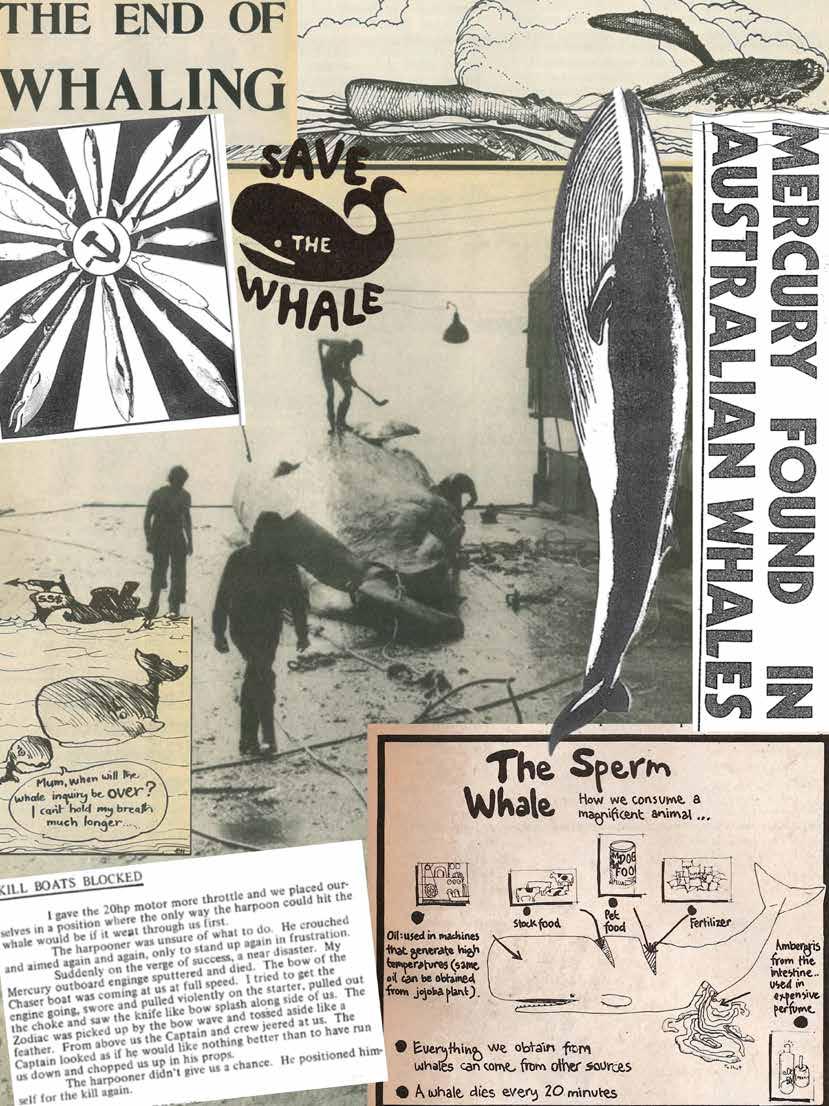
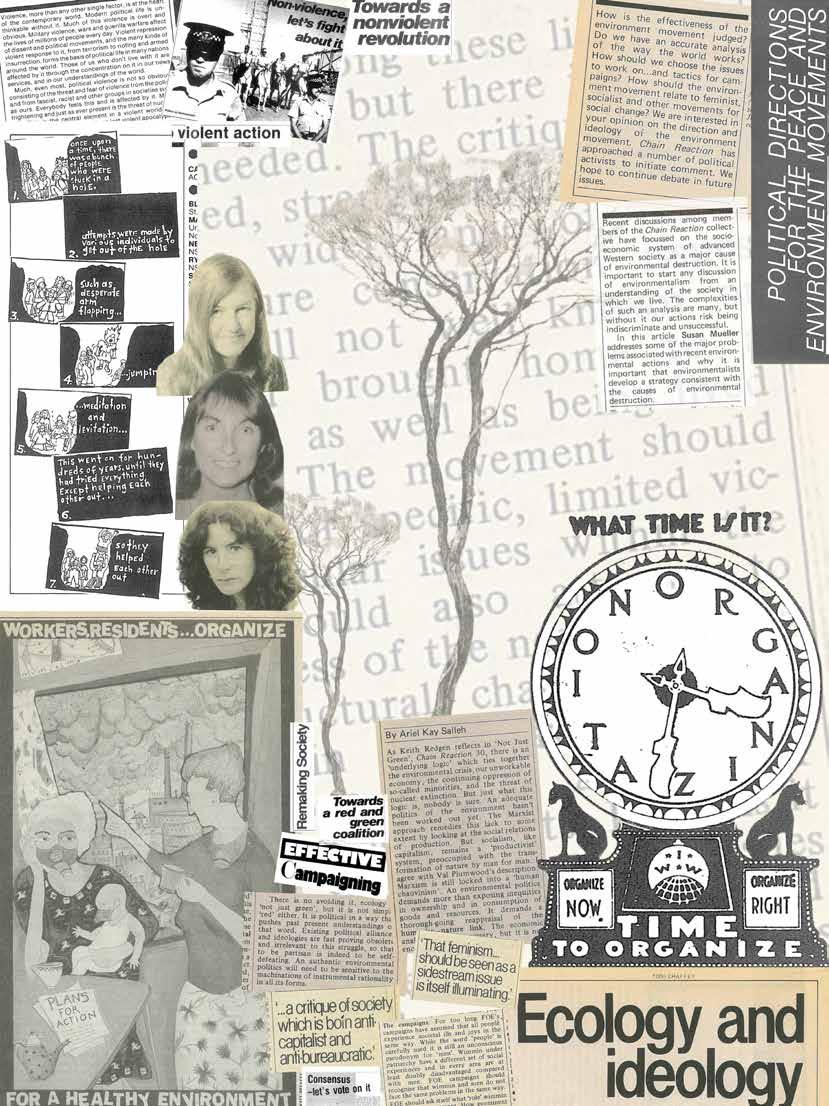
Chain Reaction was first produced in 1975, originally as the Greenpeace Pacific Bulletin. Emerging from the beginning of Friends of the Earth’s work in so-called Australia, the magazine’s first five years tell the story of an organisation passionately campaigning across many fronts. Particularly prominent are issues around whaling, feminism, the nuclear power debate, the presence of lead in petrol, and renewable energy—even publishing a solar issue, with some iconic how-to manuals filled with diagrams and instructions for setting up and understanding solar power systems.
In 1978, a feminist takeover of the magazine produced the Women’s Edition—marking an early move towards intersectionality. An all-women editorial team brought together articles exploring sexism in their movements, the relationship between feminism and ecology, and the systematic oppressions of patriarchy
The 70s were also host to the FoE Leak Bureau—a spot for industry whistleblowers to publish information. The revelation of a global uranium cartel by a leak in Chain Reaction became an international scandal with wide-reaching implications.
Three letters are included in the following pages: Geoff Evans, Wieslaw Lichacz, and Peter Hayes tell stories from their involvement in the early years of FoE and Chain Reaction, reflecting on these projects at their very beginning.
F RoM R A diCAL ECoL ogY to gL oBAL JUS tiCE : A C ti V iSM Sh APE d BY Union SoL idARit Y A nd En V iRonME ntAL A C ti V iSM
By Geoff Evans, May 2025
I joined Friends of the Earth (FoE) while studying environmental science in Canberra, after attending the Radical Ecology Conference in Melbourne in Easter 1975, which included the first anti-uranium march. FoE and Chain Reaction—edited for many years by my close friends Mark Carter and Leigh Holloway—deeply shaped my understanding of campaign strategy, organising, and the idea that the personal is political.
Chain Reaction marked a pivotal shift in the Australian environment movement—broadening its focus beyond nature conservation, national parks, and land use to interrogate the economic systems driving environmental destruction. It challenged the dominance of consumerism, unsustainable industries, and urban over-consumption, while exposing how power and wealth were increasingly concentrated in the hands of a few. The magazine sparked bold, strategic debates about the very structure of society and the economy, demanding accountability from the forces fueling ecological and social harm.
Two landmark issues—the NSW Builders’ Labourers Federation (BLF) Green Bans and the nuclear debate— epitomized this transformation. Chain Reaction championed the Green Bans, amplifying the voices of construction, manufacturing, and other workers in Australia and abroad who spoke out about the social and environmental
consequences of their industries, and asserting workers’ demand for control over the impact of their labour. It also provided a platform for Mirrar, Arabunna, Martu, and other Indigenous communities resisting uranium mining in the NT, SA, and WA, as well as opposing French nuclear testing in the Pacific.
As Friends of the Earth’s National Liaison Officer (NLO) from 1976 to 1977, I worked closely with editors Leigh Holloway, Mark Carter, and later with Linnell Secomb, to deepen Chain Reaction’s engagement with social justice. Together, we expanded its coverage to include workers’ health, women’s employment, job struggles, food politics, the links between personal and social liberation, sexual politics, Aboriginal land rights, and the contentious politics of mining.
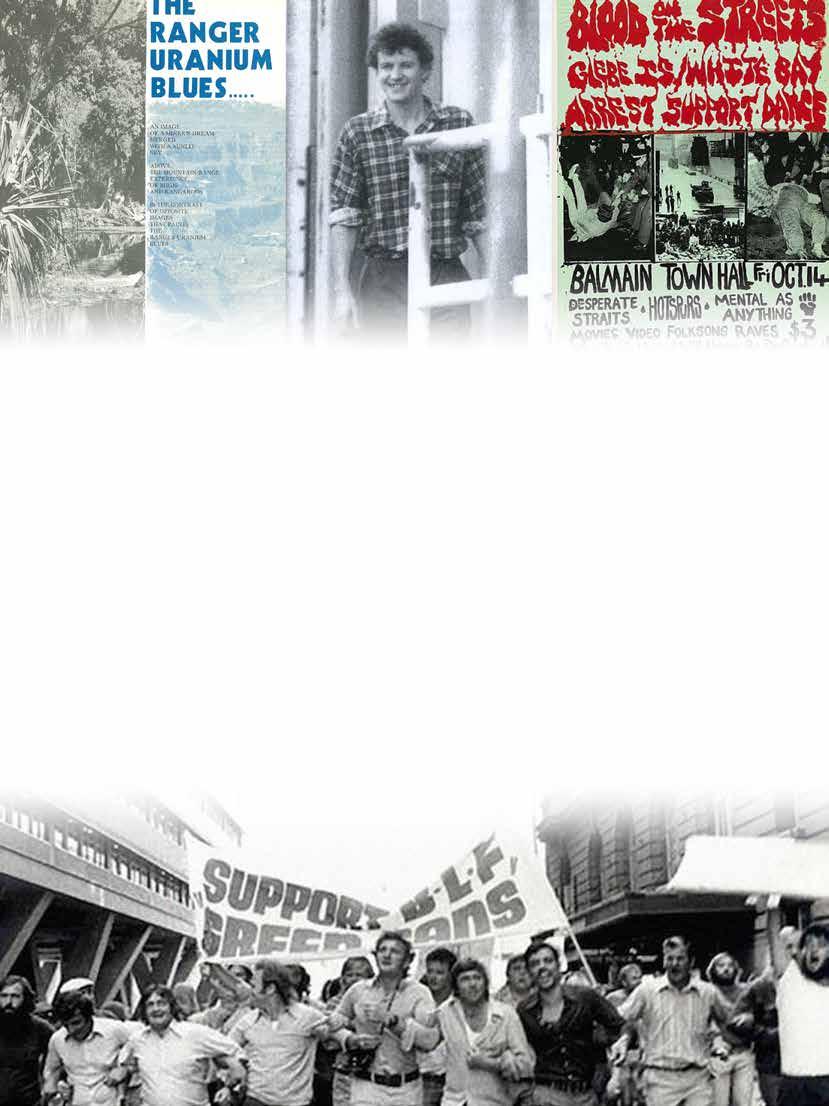
Top Left: An image from a 1976 Chain Reaction article on the Ranger Uranium Mine
Top Centre: Geoff Evans ASIO file photo late ‘70s-early ‘80s
Top Right: Poster by Toby Zoates—a Friends of the Earth activist and participant in the White Bay uranium protests—depicts his recollection of the event. It was created to promote a benefit gig he organized to help cover fines for those arrested during the protest.
Source: Mirror Sydney – Uranium Protests)
Bottom: The Builders’ Labourers Federation marching for Green Bans, 1974
A Ch A in R EAC tion oF A C ti V iS
t AntiBodiES hELP hEAL E AR th’ S PA ndEMiC oF gREE d A nd CRUELt Y hARMing thE En V iRonME nt
Wieslaw Lichacz CPM
May 2025
The 1970s witnessed a surge in environmental activists, including students and workers, who collaborated to address pollution and corporate malfeasance. Friends of the Earth played a pivotal role in organizing efforts against environmental threats, collaborating with other conservation groups to raise awareness and prompt inquiries into harmful practices.
From these origins, Chain Reaction was born to serve a rapidly growing activist movement.
The magazine became a vital news source for environmental issues, especially those rarely covered elsewhere, fostering a community of activists who produced and distributed each issue, enhancing public awareness and engagement.
Many hours, nights, souvlakias, coffee etc became training and proving grounds where during magazine production, bands of volunteers dispatched boxes of magazines to FOE branches popping up like mushrooms all over Australia after a good wet season. In the branches teams would roll up the magazines into mailing sleeves to send out to an exponentially growing membership.
Activists, including legal experts, utilized information from Chain Reaction to not only raise awareness but to effectively challenge corporate practices, resulting in significant legal victories and changes in environmental policy.
The L eak Bureau
FOE launched a Leak Bureau that was sharpened into an innovative tool used by many others. This concept was developed well before Wikileaks and whistleblowers became more pronounced. The Leak Bureau was published as a concept in the second edition of Chain Reaction to expose corporate malfeasance and environmental wrongdoing. It quickly received and rounded up tangible evidence that spawned cases in the courts, parliaments, boardrooms and the streets.
The Leak Bureau played a crucial role by revealing serious problems at Australia’s only nuclear research reactor at Lucas Heights. It also resulted in out-of-court settlements and treble damages for uranium price fixing. The illegal price fixing by major international and domestic uranium producers breached the US Sherman Anti-Trust Act, costing these uranium producers more than $800 million USD. FOE and the Leak bureau was fortunate to have the expertise of many including the late Mary Elliott, who contributed significantly to the legal battles against global authoritarians seeking Australia’s uranium through corruption and malpractice.
Attempts were made by corporate agents to coerce FOE to give them secret corporate documents published in Chain Reaction and elsewhere about price fixing. FOE refused these corrupt bribes, instead handing much of the material to relevant tribunals and the US Justice Department, and leaked it to the media. This led to subpoenas being issued against company executives named in the documents, preventing them from entering the USA without facing a Grand Jury.
The activists behind the FOE Leak Bureau’s efforts showcased the power of grassroots activism and legal expertise in challenging corporate practices and protecting the environment. We need to dramatically step-up these efforts in a riskier authoritarian geopolitical and more secretive and threatened environments.
Left to Right:
The Atom Free Embassy became a focus for the FOE Leak Bureau to campaign for a replacement of nuclear research by retrofitting Lucas Heights Atomic Energy Commission nuclear research reactor activities with research on cleaner renewable energy.
Photo: Wieslaw Lichacz
Leak Bureau ad from Chain Reaction
Leak Bureau ad from Chain Reaction
Ch A in R EAC tion: W Riting tRU th to Po WER
Peter Hayes
It’s hard to believe that neither cell phones nor private computers existed when FOE was launched in Australia in 1973/4. Information moved by snail mail or airmail. Phone calls were expensive. We typed letters and mimeographs on an Orange manual Olivetti typewriter at 59 MacArthur Place. Politics moved slower, and was inherently more local than global. The most essential ingredient for slow motion organizing of a bottom-up social movement was trust, built locally, and sometimes state-wide or nationally by travelling organizers or at face-face meetings.
There were only a few ways to spread a message to a wider public. The ubiquitous poster, the printed tabloid. Occasional coverage in the media.
Into this void came Chain Reaction. The original concept was to rotate the editorship and production teams around Australia. The goal was to establish a new voice that articulated the nexus of ecological, social, and political issues that FE activists in Australia understood from the get-go were linked and had to be addressed simultaneously and not separately and sequentially.
T here’S NO F u T ure IN FOe
I only wrote twice for Chain Reaction. One essay, written in 1977, was intentionally provocative: “There’s no future in F.O.E.” By this, I meant that only by integrating ecologic and sustainability into all sectors and all dimensions of society could we hope to survive and then—and only then—could we afford to relax. This remains the case today. The topics we raised in the mid-seventies were viewed as secondary by pollies and corporate types. Now they have become core issues that no-one can ignore. To this extent, we have succeeded in making FOE superfluous.
But at the same time, the cumulative cost in terms of ecological losses is massive. The on-going destruction of the biosphere is accelerating in both absolute and relative terms. Thus, over the last five decades, we also failed.
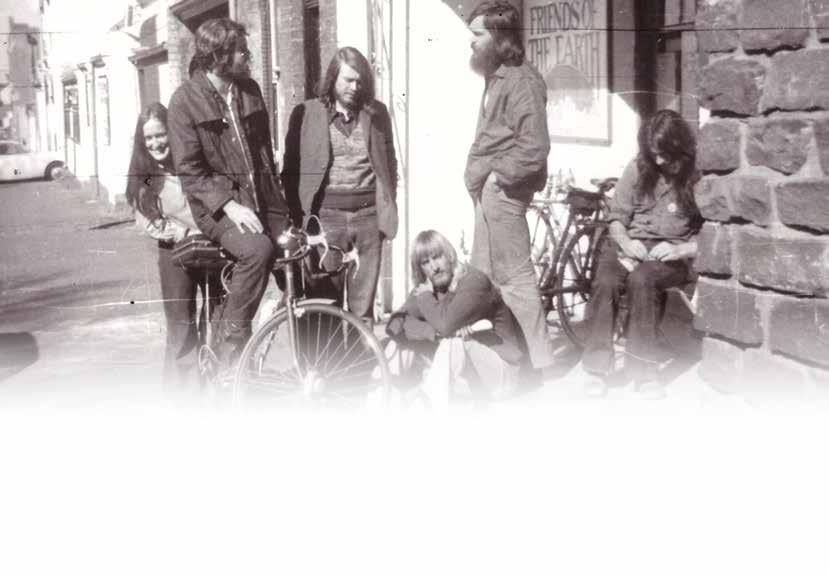
59 MacArthur Place after the national meeting at French Island, 1974. Left-right: Alison Parks, Peter Hayes, Stephen Myers, Strider, Paul Marshall sitting in the doorway. Credit: Wieslaw Lichacz.
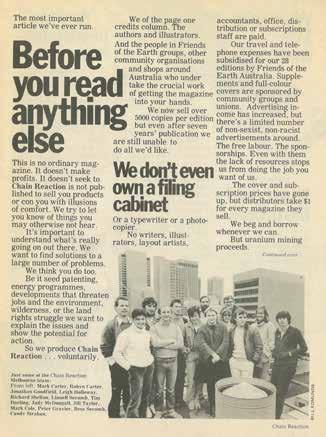
We don’t even own a filing cabinet’ ad for Chain Reaction
Survival over the next generation demands radical thinking and reorientation of the collapsing status quo, even more so than in the past. Our only one Earth hangs in the balance. Only a mosaic of bottom-up, networked governance and the reconstruction of life support systems at each locale can match the complexity and pace of global-local change while building the requisite resilience needed for survival.
My fervent hope is that Chain Reaction will highlight these trends and the resulting political challenges, and continue its fearless and uncompromising stance of writing truth to power.
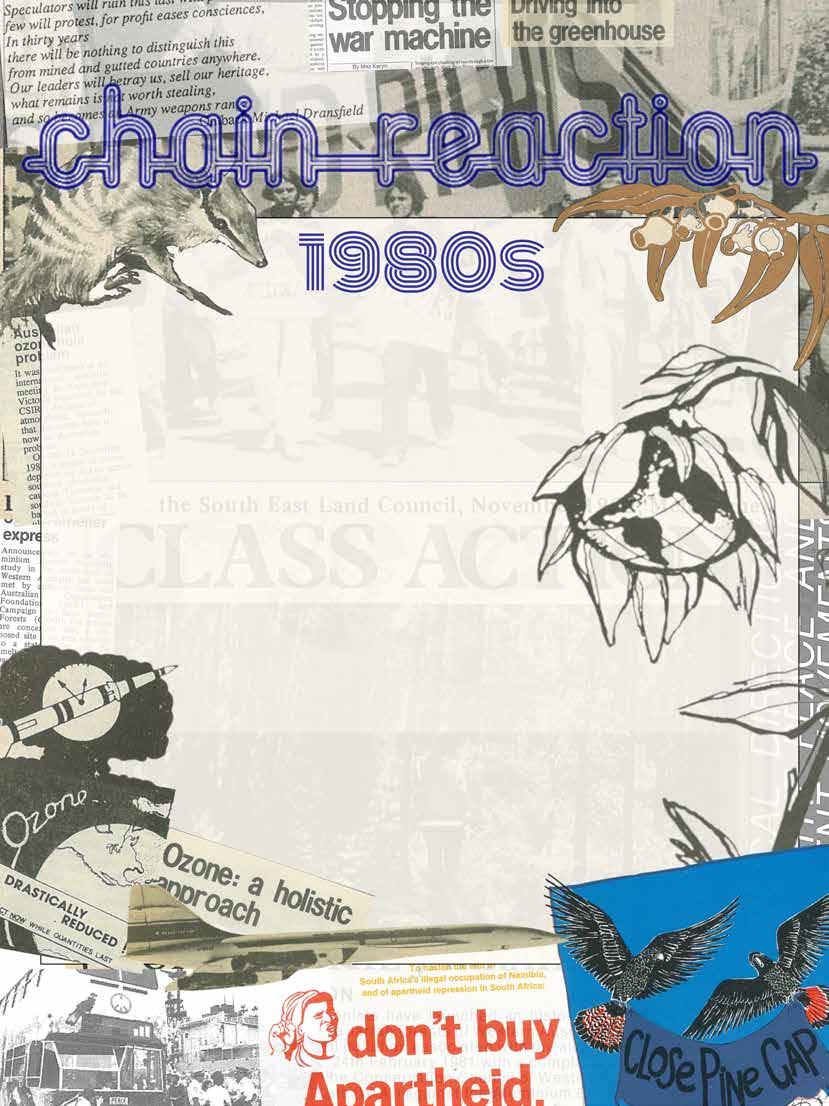
Chain Reaction in the 1980s tells the story of the emergence of intersectionality in the environment movement, and the many tensions erupting as a result. Ecofeminism, Land Rights, and the Peace movement all entered the conversation in a new way, and ultimately were there to stay—to the dismay of some.
A recurring column called ‘Ecology and Ideology’ saw this debate over movement scope and strategy play out over the years, with responses from the public published as letters in each edition. Debates around the concept of ‘wilderness’ in the context of Aboriginal Land Rights show the presence of a new anti-colonial lens in a conservation movement with a growing social awareness.
Regularly, the magazine published pull-outs of ‘Activist Contacts’, lists of organisations and campaigns, as well as their regular meeting times and locations, with landline numbers to call if you wanted to get involved with a particular group. The presence of these sheets is a reminder of the key role of print media in a pre-digital age, where a newspaper was truly an epicentre of contact with the broader movement.
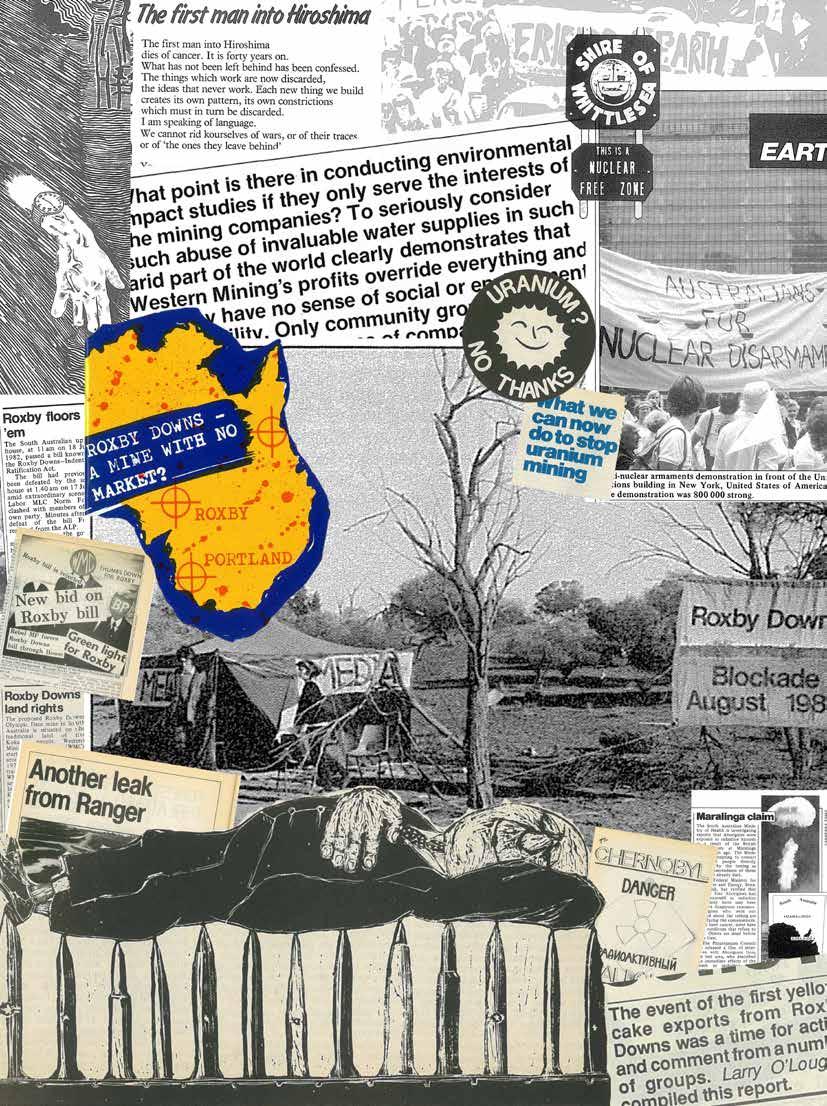
The opening of the Roxby Downs uranium mine saw an explosion of anti-nuclear campaigning, and a mass movement formed around the fight to keep Australian uranium in the ground. This intersected with increased attention to peace and antimilitarism—with the Peace Bus actions for nuclear disarmament, the World Bike Ride for Peace, the Greenpeace Rainbow Warrior, and protests against US military bases making headlines.
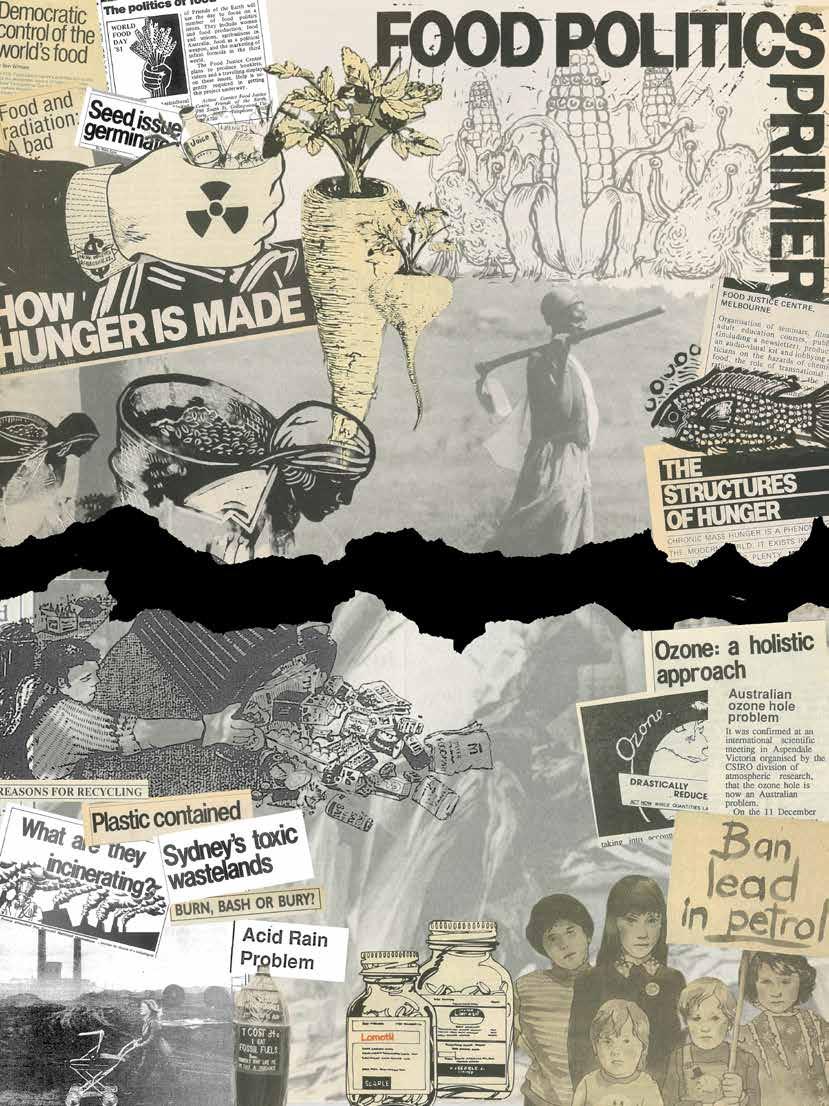
Food sovereignty was an ever-present issue, with FoE’s new Food Justice Centre opening as a hub for education and organising around the politics of food. Conversations around GMOs were accompanied by others on waste, plastics, chemicals, pollutants, and recycling.
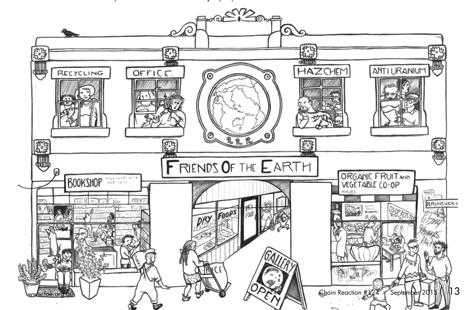
The 80s also saw the introduction of BACKSTAGE - a new column which told the behind-the-scenes stories of Chain Reaction. The various iterations of publishing collectives showed their faces, told their stories, and often expressed the need for financial and physical support. Many of the images and sections pulled from this column are earlier in this issue, peppering the History of Chain Reaction article.
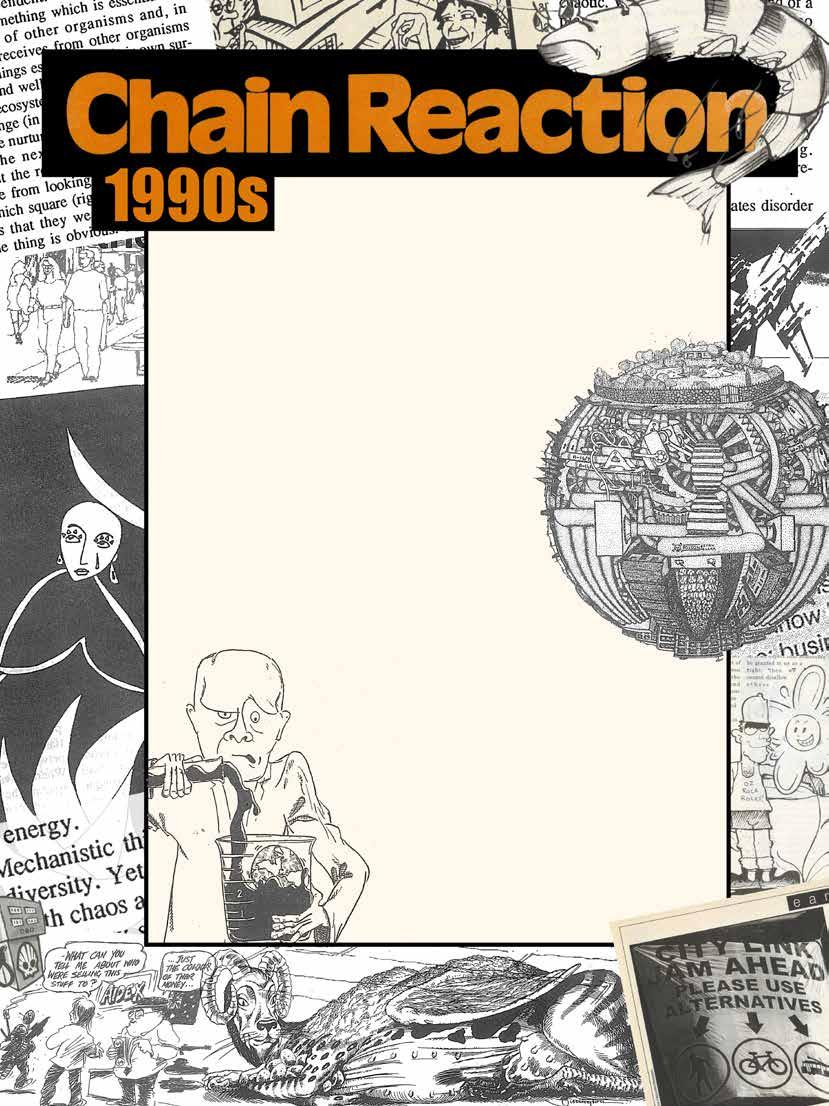
In exploring the history of Chain Reaction and the environmental movement more generally, it would be quite easy to reflexively reach for the maxim that the more things change, the more they stay the same. Many of the same debates, misdirections, talking points and broad issues will sound familiar to even the youngest of readers.
The 1990s had some significant wins. The Montreal Protocol began the successful phasing out of HFCs. The depletion of the ozone layer, once a looming figure of great dread for those born in the latter half of the century, now on track to being fully repaired by the middle of the current. The total ban on leaded petrol, to come into full effect in Australia in 2002, told the auto industry that even the scourge of engine-knocking was no longer justification for poisoning the air, soil, and water.
The Mabo Decision marked a turning point in the movement for Aboriginal Land Rights. Chain Reaction’s pages showcase the complex discourse that emerged post-Mabo, with FoE’s own Cam Walker publishing an article outlining the reality of self-determination, redirecting naysayers to their responsibility to address institutional neglect.
As Cam discusses in the following pages, Chain Reaction ruffled more feathers in the movement by advocating against Howard-era privatisation—showing once again FoE’s ability to swim against the current.
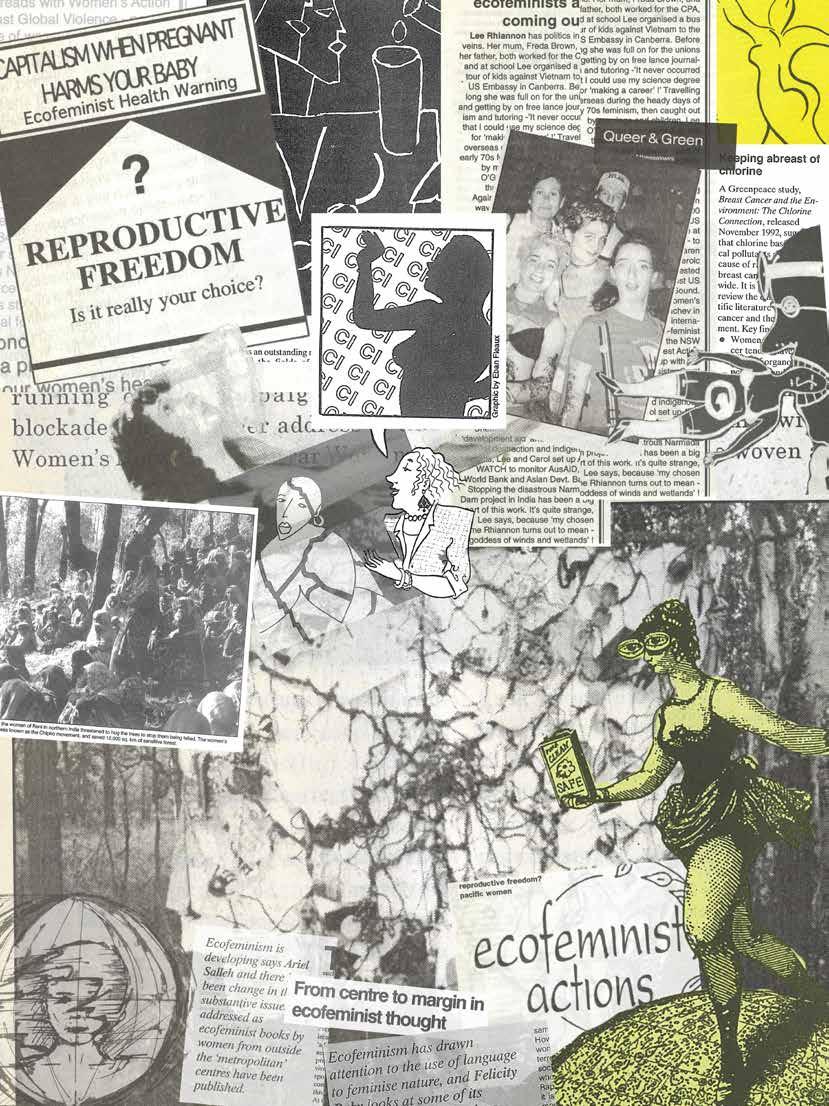
Chain Reaction’s commitment to nascent intersectional ideas, particularly its focus on feminist ideas and action within the movement, also reveal many of the shifting currents under the surface. Early feminist talking points—chemical exposure in the home, the safety of pregnant women and their children, and discrimination in environmentalist circles—branched out to explore queerness, and the plight of women in the Global South. Conversely, the supplementary Ecofeminist Actions insert represented an effort to ratify a uniquely feminine environmentalism.
These discourses are most definitely representative of Chain Reaction’s capacity to capture the shifting sands and disparate strands within what can sometimes seem a narrow and rarely changing set of concerns.
t o W ing [AWAY ] thE PAR t Y L inE
Cam Walker
One of the great things about Chain Reaction is that it has always encouraged debate within the environmental movement. While it is the ‘national magazine of Friends of the Earth Australia’ it has never just published the organisation ‘line’, and has offered a platform for hundreds of people to express ideas and debate positions, and argue about strategy and theories of change.
This was especially important in the days before widespread access to the internet. A story or opinion piece in CR could generate controversy for months as readers debated movement politics. Long and sometimes heated interactions in the 1980s often focused on sexism within the movement (around the same time there was a very live debate within some local FoE groups which resulted in a picket line outside a FoE office in Melbourne). CR tried to offer space for emerging issues and those on the sidelines of mainstream debate within the environment movement. For instance, during the campaign to protect the Franklin and Lower Gordon rivers in south west lutruwita/ Tasmania in the early 1980s, CRs main contribution was to look into the employment implications of the campaign in a state that had been heavily reliant on the development of hydro power. Chain Reaction started highlighting the human rights implications of climate change well before the rest of the climate movement in Australia, sided with First Nations peoples against conservationists who opposed traditional land practises in Queensland in the 1990s, and has been willing to step outside the parametres of reformist campaigning by challenging growth based capitalism and extractivism. CR ran many stories on the capture of larger environmental groups by conservative governments and the corporatisation of their approach to campaigning, which often generated angry and heated reactions for people within those Orgs.
The environment movement is composed of a huge range of local, state, national and global organisations, with obvious diversity of political positioning. There are a number of significant conflicts over the years that have caused rifts within the movement.
Apart from the ‘Sanctuary’ movement of the 1990s referenced above, which saw division between groups who supported First Nations aspirations and those willing to oppose them, and the public fights over the Rudd/ Gillard era Carbon Pollution Reduction Scheme (CPRS), perhaps the biggest single conflict ever covered by CR was the attempt by the Howard government to privatise Telstra – the continued next page…
public telecommunications company – ostensibly so it could fund environmental protection.
While most public institutions have been privatised over the decades since the 1980s, it was the attempt by the conservatives to start the break up of Telstra between 1996 and 1999, when 49% of Telstra was sold in 2 share offers, that privatisation became a huge issue for the environment movement. On one side, groups like World Wide Fund for Nature, The Wilderness Society and Surfriders Foundation publicly supported the sale of Telstra, while FoE and The Greens opposed it.
FoE viewed the privatisation of Telstra as detrimental to both the environment and social justice. We argued that selling off Telstra, a publicly owned utility, would harm the environment and disrupt the development of telecommunications in Australia. FoE also highlighted the inherent link between environmental protection and public ownership of essential services, arguing that privatisation could lead to a weakening of environmental regulations and oversight. In CR FoE pointed out that linking funding of an essential portfolio (in this instance the environment) with the partial sale of a public asset (Telstra) was
effectively blackmail and it criticised the groups willing to support it. An edition of CR from 1996 featured images of the leaders of the groups who were supporting the sale and indepth coverage of the issue. Needless to say, they weren’t impressed at being called out and relationships crashed for several years. But the attempts by the conservative government to coopt the movement in those days had to be resisted and hindsight shows that FoE and CR were on the right side of history on that issue.
ho W Chain ReaCtion R E t UR nE d FRoM thE WiL dER nESS
By Tristy Fairfield, with thanks to Kulja Couston for filling many memory gaps
By 1998, Chain Reaction had been out of print for a couple of years. The decision was made to try and get it going again – and an unlikely team answered the call.
Bringing Chain Reaction ‘Back from the Wilderness’ – the title of our first issue together – was an adventure that I’m not sure Kulja Coulston, Anna Burlow, Barbara Kerr and I fully realised we were setting out on. Those who had put out the original call for volunteer editors (via noticeboards and shop windows) promptly discovered they didn’t have the time and left us to it.
Thankfully, Kulja – roped in by her housemate Beth Mellick who was on staff at FoE Fitzroy at the time – was already (at 22!) an experienced writer, editor and production manager. She brought with her not only much-needed know-how, but also her equally gifted brother, Shamus Hoare, who produced our illustrations and cartoons, and even created a custom font that debuted on the ‘Back from the Wilderness’ cover.
The rest of us brought an eclectic mix of (sometimes) complementary skills and naïve enthusiasm. I was keen to move out of my depressing insurance job and eventually ended up looking after FoE Fitzroy’s finances – a complete career 360º, thanks to Chain Reaction. Anna was a law student, and Barbara was well connected in activist circles.
Resurrecting Chain Reaction came with some unexpected requirements alongside the more obvious article sourcing, editing, layout, photography, printing and distribution. We quickly learned that the magazine was financially independent from FoE – so we had to raise enough money from sales (to FoE groups and other outlets) and advertising to stay afloat.
O u T OF T he w IL der N eSS, INTO T he FI re
To add to the challenge, our predecessors had parted ways with FoE on not-so-ideal terms. They had retained the subscription lists, bank details, advertising contacts and back issues. After lengthy and ultimately fruitful negotiations to bridge the divide, Kulja and I made an epic road trip to their home in Canberra in Shamus’ van to retrieve the missing materials from their garage.
We then discovered we’d inherited an intimidating backlog of unfulfilled subscriptions - many libraries and individuals had paid but never received the issues they were owed. Before we could focus on publishing, we had to rebuild trust – calling outlets across the country to let them know a new issue was finally on its way. At the national FoE gathering in Shoalhaven, we secured support from local groups willing to bulk-purchase future issues. Finally, we were in business. Now came the actual doing.
Kulja’s day job – as a health journalist for the Optometrists Association – proved invaluable. Though one of the more
conservative health bodies around, they let us use their office and equipment after hours until we got on our feet. We had no computer, no office, and not even any software (long before it could just be downloaded!) until we found a home at Ross House and sourced what we needed from FoE, friends and families.
We were constantly on the phone or emailing the most wellknown, influential and inspiring activists and campaigners around Australia, and occasionally internationally, asking them to write for us or be interviewed. As someone new to the environmental and social justice world, being able to meet, speak with and learn from so many amazing people was incredibly exciting – and daunting. The Jabiluka camp was in full flight at the time, and we regularly came across some of the most renowned activists of that era as they returned to Melbourne to tell their stories and grow public support. We shared an office with some of the more active of the September 11 WEF protesters. It was brilliant, rewarding mayhem.
Like any good passion project, there were late nights that turned into early mornings, weekends where we only left each other’s company to sleep, many meetings, long phone calls and shared tales of life. Friendships were forged somewhere between proofreading marathons and desperate software troubleshooting.
“Meanwhile, Cam Walker’s cautious guidance was like that of a parent who wants their offspring to grow – but not topple down the stairs or catch their hair on fire.”
By the time of the 25th anniversary, we had settled into a production rhythm – with many issues published and an evolving and supportive team. John Kelly and Helen had joined by then, taking some of the load off. Helen had a background in events management, so the Chain Reaction 25th Anniversary Party at Trades Hall was suitably spectacular. Between Helen’s vision and Kulja and Shamus’s creativity and practical skills, the room at Trades Hall was transformed with scrims and projections and – though I can’t remember it – I’m sure a great soundtrack.
We invited past editors, including Candy Broad, who was then Environment Minister in the Bracks Labor government (she declined). But the top of our wishlist was the legendary Moss Cass, Environment Minister in the Whitlam Labor government. Our elation when Moss agreed to join us and give the keynote speech was beyond description. Meeting him as he walked up the stairs at Trades Hall that night and watching him speak felt surreal – and incredibly special.
I picked up a copy of Chain Reaction at FoE in February this year and was thinking about its continuity and consistent, outspoken leadership. We were very lucky to have been part of such an iconic publication – even if only for a brief, wild moment in its long journey.
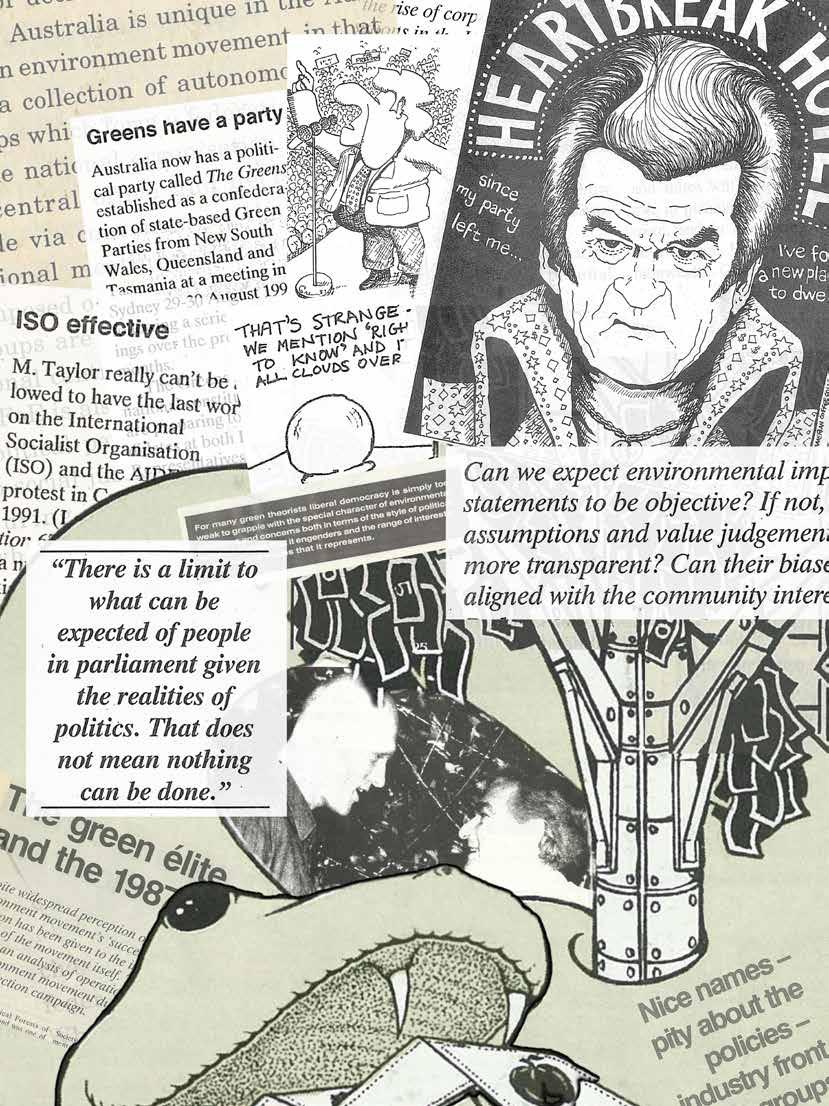
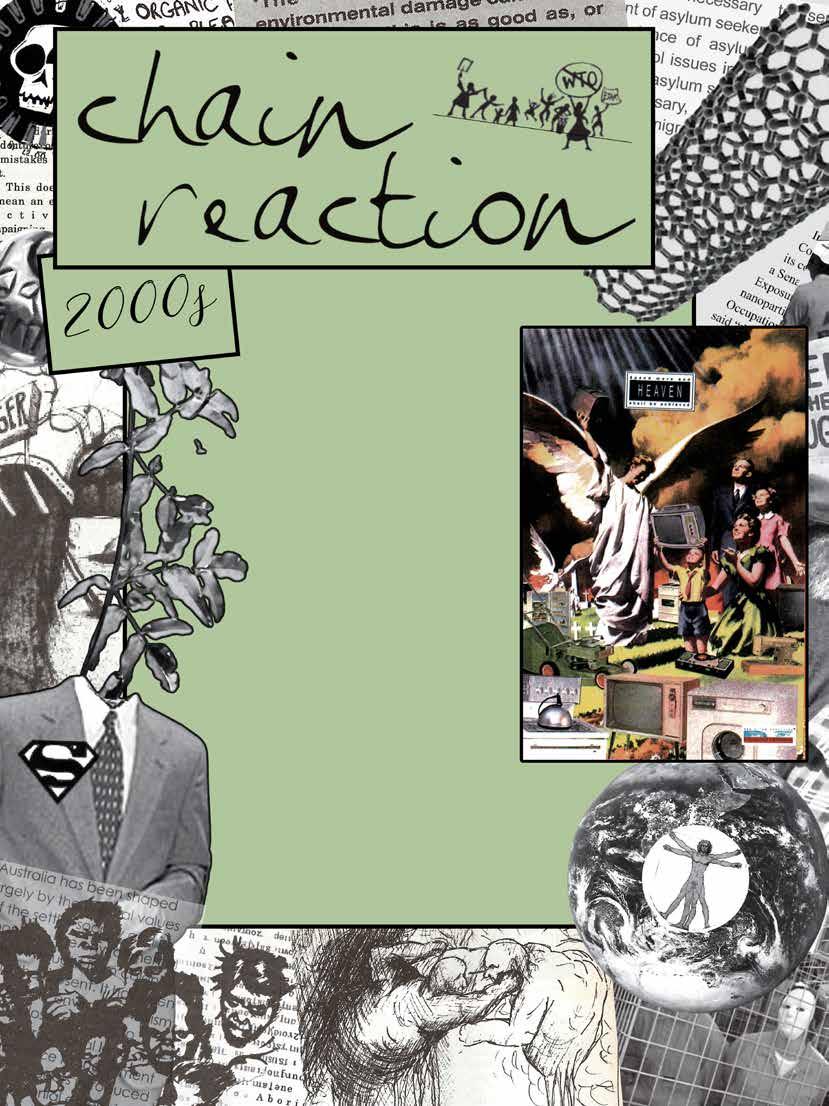
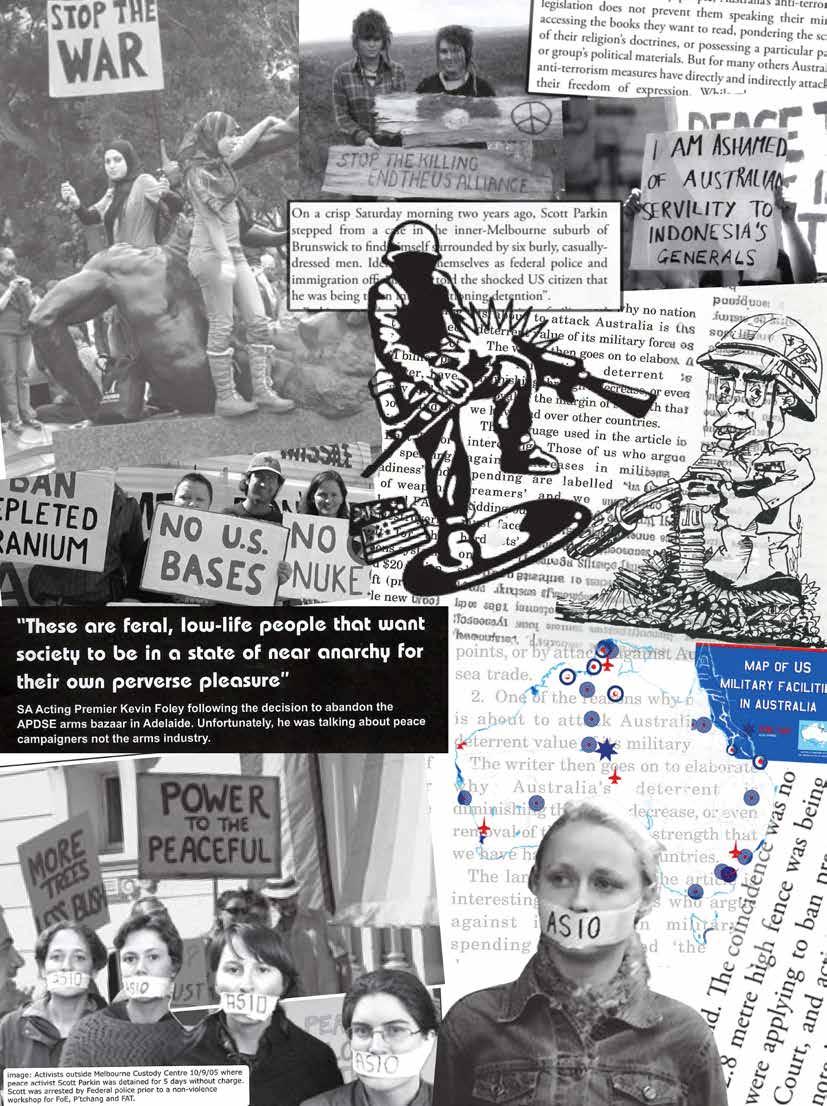
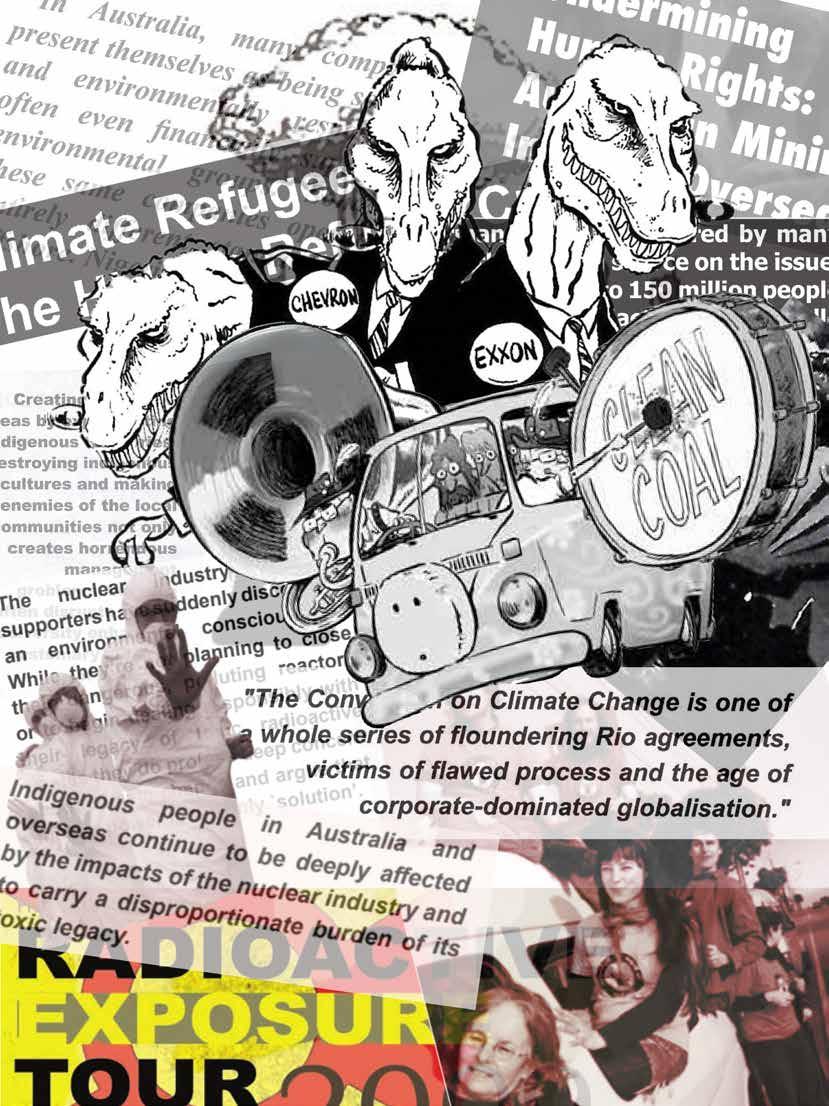
The 2000s saw the continuation of many issues which plagued the 90s: The growing prominence of climate change became a larger concern in the public consciousness, and the co-option of environmental talking points by multinational and government actors, no longer confident in nuclear’s sole ability to deflect, added clean coal to the roster of noxious non-solutions to keep troublesome greenies at bay. In response to the movements of the World Trade Organization, a widespread anti-globalisation movement took flight.
Chain Reaction once more became a frontline in tearing down the litany of smokescreens erected time and time again by those who refused to stomach the realities, or longed to extract yet more blood from the stone.
Meanwhile, crackdowns and muzzling of protest which during the 90s had consisted primarily of civil action against unions, Indigenous groups and activist organisations, now received a much welcome infusion in the wake of the September 11th attacks and resulting ‘War on Terror’.
The prominence of the internet in people’s lives was still taking shape, and Chain Reaction and print media remained a central hub for discussion and debate.
In our current age of algorithmic silos and tightening grip on online discourse, we see the long tail of this era’s attempts to tighten the noose around free expression. Print media, in our digitally surveilled age, may be more necessary than ever.
Ch A in R EAC tion At A CRo SSRo A d S
Nat Lowrey
Chain Reaction has always been rooted in Friends of the Earth’s mission by amplifying grassroots struggles, centering environmental justice, and challenging systems of power. It has never felt like a mouthpiece. That’s what gave it its unique character. While it reflected and supported FoE’s campaigns, it also created space for critical reflection, debate, and the voices of allies, thinkers, and activists beyond the organisation.
In many ways, the magazine was like a meeting place, a crossroads where FoE’s work intersected with broader movements for justice. That wider lens gave Chain Reaction its own identity: it wasn’t just about what FoE was doing, but why, and in what context. It tackled the politics behind the policies, and the systems behind the symptoms.
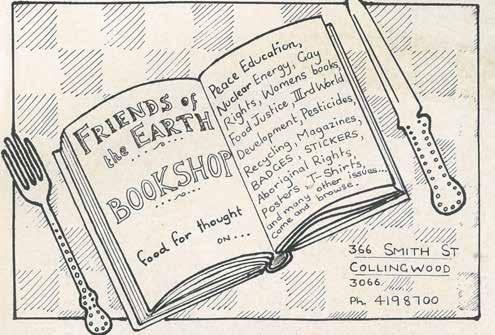
I started working at the FoE Melbourne Bookshop (now gone) as a co-coordinator in early 2004. I fell in love with Friends of the Earth, its principles and its people instantly. Myself and Sarah Barber were busy bringing the bookshop out of trading insolvent when I found out that Chain Reaction was struggling and in need of a designer and reforming an editorial team.
I armed myself with a hacked version of InDesign and started working on the magazine with Jim Green. For the next 5 years, Jim and I worked together with a very small collective to keep Chain Reaction published. In late 2009 I handballed the design work to my cousin Lilly Lowrey who continued until the end of 2011.
The themes of Chain Reaction were often shaped by the key political and environmental issues of the time - particularly current Friends of the Earth campaigns, actions, and the work of FoE affiliates across the country. Chain Reaction always carved out space for intersectional coverage including centering First Nations voices, frontline communities, and those most impacted by environmental and social injustice. These were stories often ignored in the mainstream, and we saw it as our responsibility to highlight them.
The editorial team had a lot of trust and freedom to shape each issue, so we could explore topics that pushed boundaries, brought in new perspectives, or responded to urgent moments. That autonomy helped the magazine
evolve as more than just a campaign tool - it has been a space for solidarity, storytelling, and strategy across movements. Lack of funds was always the issue. Jim and I worked tirelessly on the magazine (and he continued to after I was gone). Many hours were put into the callout for articles, following up with people, editing, then laying out the magazine. Amazing really, that Chain Reaction has survived all these years with little to no funds.
a N ew cOaT OF pa INT
One pivotal moment was the lead-up to the 100th issue. Jim and I saw it as an opportunity to refresh the design and give the magazine a stronger visual identity. Despite budget constraints (sticking to black and white interiors with a colour cover) we pushed for a redesign that reflected the evolving tone and maturity of the magazine, without losing its grassroots heart.
There’s so much value in independent print media, perhaps now more than ever. When I joined the Chain Reaction editorial team in 2004, independent print was a crucial counterweight to the mainstream media. It gave space to voices and issues ignored or misrepresented elsewhere. Print had a kind of tactile permanence and intimacy. It could be passed around at rallies, read on public transport, shared in waiting rooms and kitchens. It felt grounded.
At the time, the internet was opening new possibilities, but it was far from the powerful publishing platform it is today. Chain Reaction’s printed pages played a vital role in building networks of resistance and solidarity, connecting activists, thinkers, and everyday people across the country and sharing the incredible work of the FoE network across the country but also as a federation internationally.
As a designer, I saw print as a creative political act, layout, typography, and visual language could shape how messages landed and lingered – I still see design in this way.
Today, digital media has exploded, but so too has disinformation, burnout, and algorithmic noise. Independent print offers a slower, more reflective space, one that invites deeper engagement.
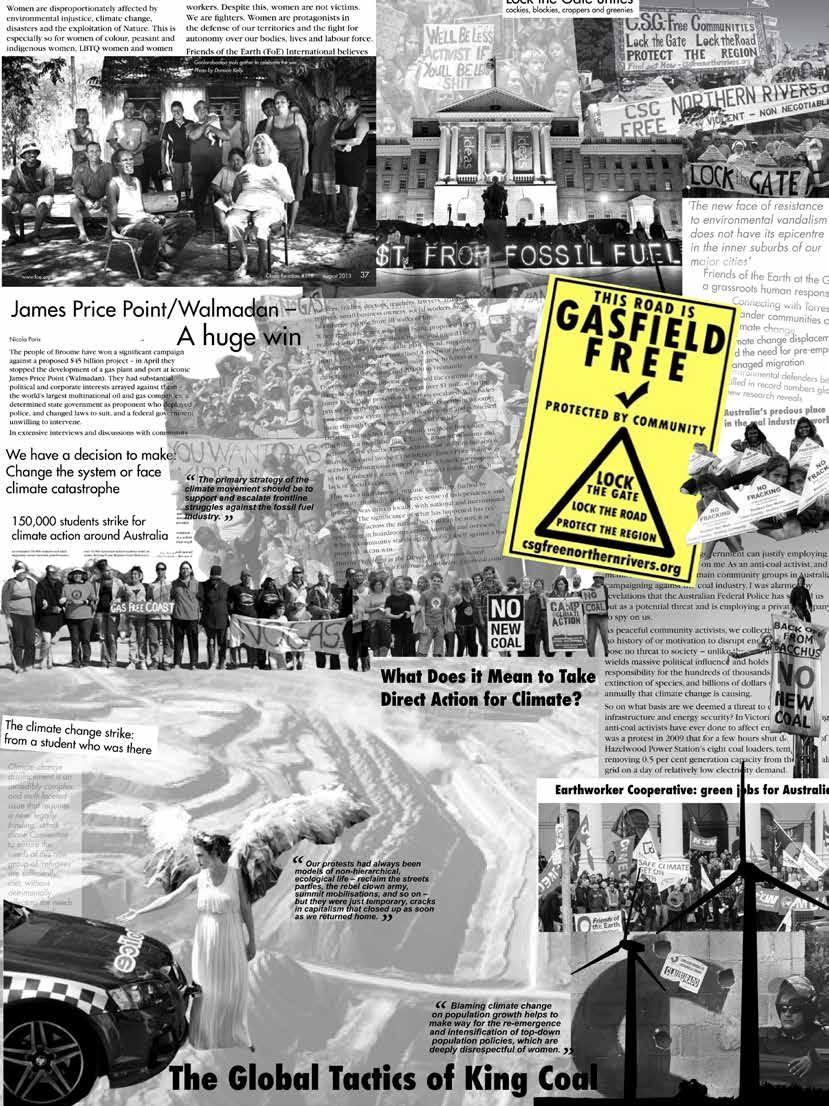
The 2010s issues of Chain Reaction chart a decade where environmental politics grew sharper, more urgent, and increasingly entangled with questions of justice, democracy and technological power. Climate and energy were unmistakably the defining anchors of the decade. As coal and gas developments spread across the continent, the magazine became a platform for unpacking the stories behind these projects; the communities fighting coal seam gas in Queensland, the voices resisting destructive mining in forests and farmland, and the broader global machinery of “King Coal.” A mix of analysis, on-the-ground reporting, and commentary traced how climate activism evolved and renewed itself during these years.
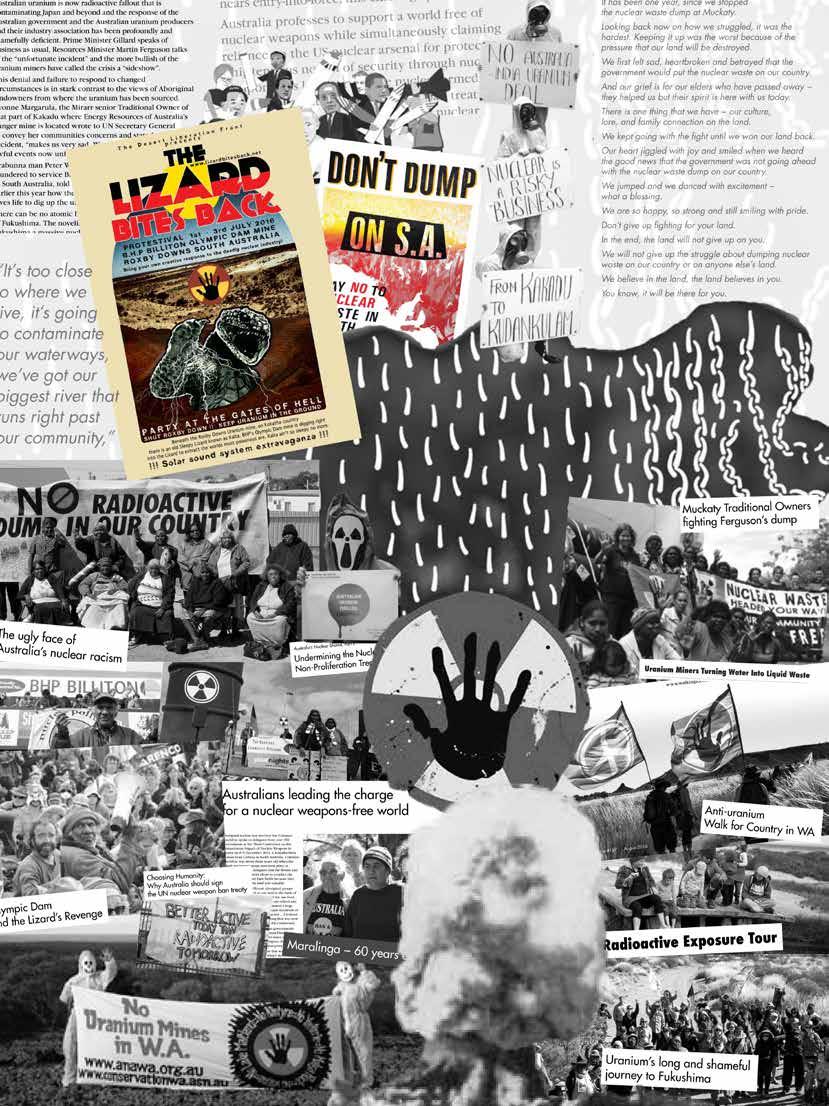
Running parallel was Chain Reaction’s sustained scrutiny of the nuclear industry. Fukushima cast a long shadow, and the magazine returned to the disaster repeatedly, as a continuing reminder of the risks, the failures in oversight, and the political spin surrounding the nuclear industry. FoE ran their successful Radioactive Exposure Tours, taking the public out to Country affected by nuclear industries, and supporting the many frontline First Nationsled fights against waste dumps. Uranium exports, nuclear waste dump proposals, and the rhetoric of the “peaceful atom” were all examined with the critical attention that has long defined the magazine’s nuclear coverage.
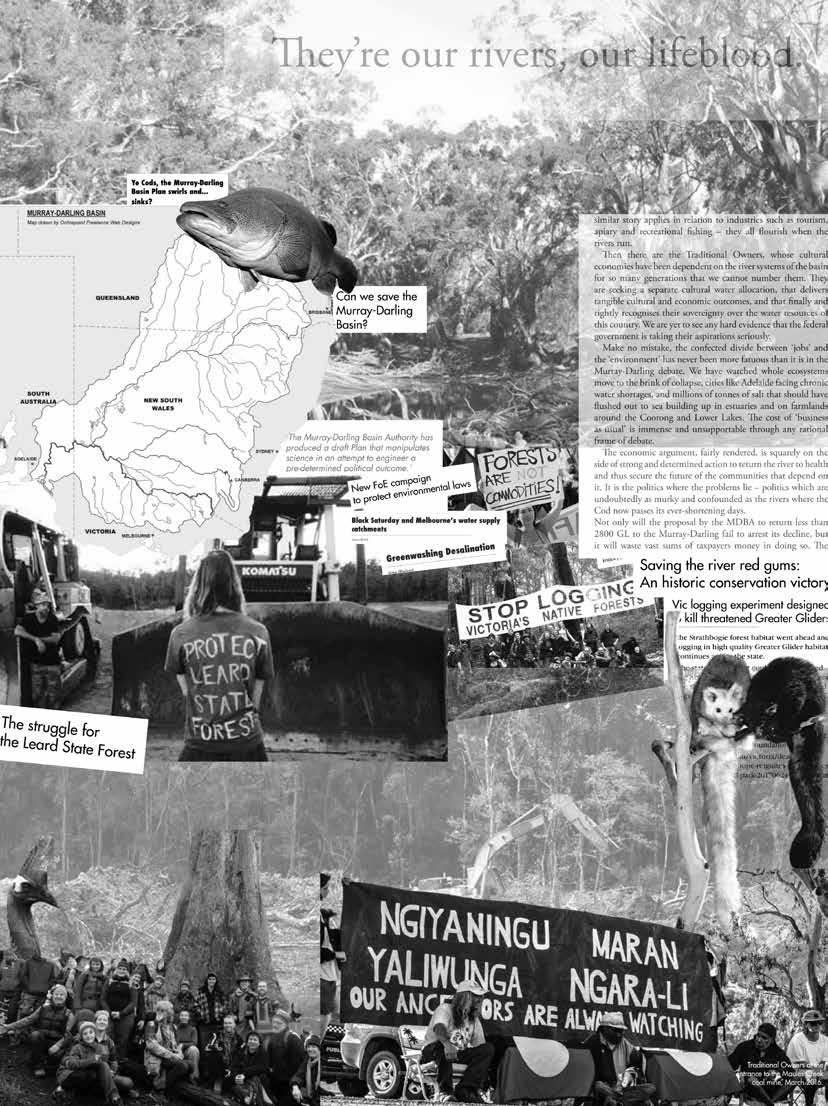
Water, food systems and land stewardship also featured strongly. Articles mapped the political and ecological tensions around the Murray–Darling Basin, explored water justice and contamination, and highlighted community-scale solutions to food security amidst growing corporate control.
A distinct feature of the 2010s was the magazine’s deep and cutting edge engagement with emerging technologies—nanotechnology, synthetic biology, geoengineering, GM crops, continuing Chain Reaction’s tradition of interrogating not just the science, but the power structures behind it. As in earlier decades, questions of democracy, rights and corporate influence are threaded throughout these discussions.
“My youthful years are now marked by chapters delineated by disasters.”
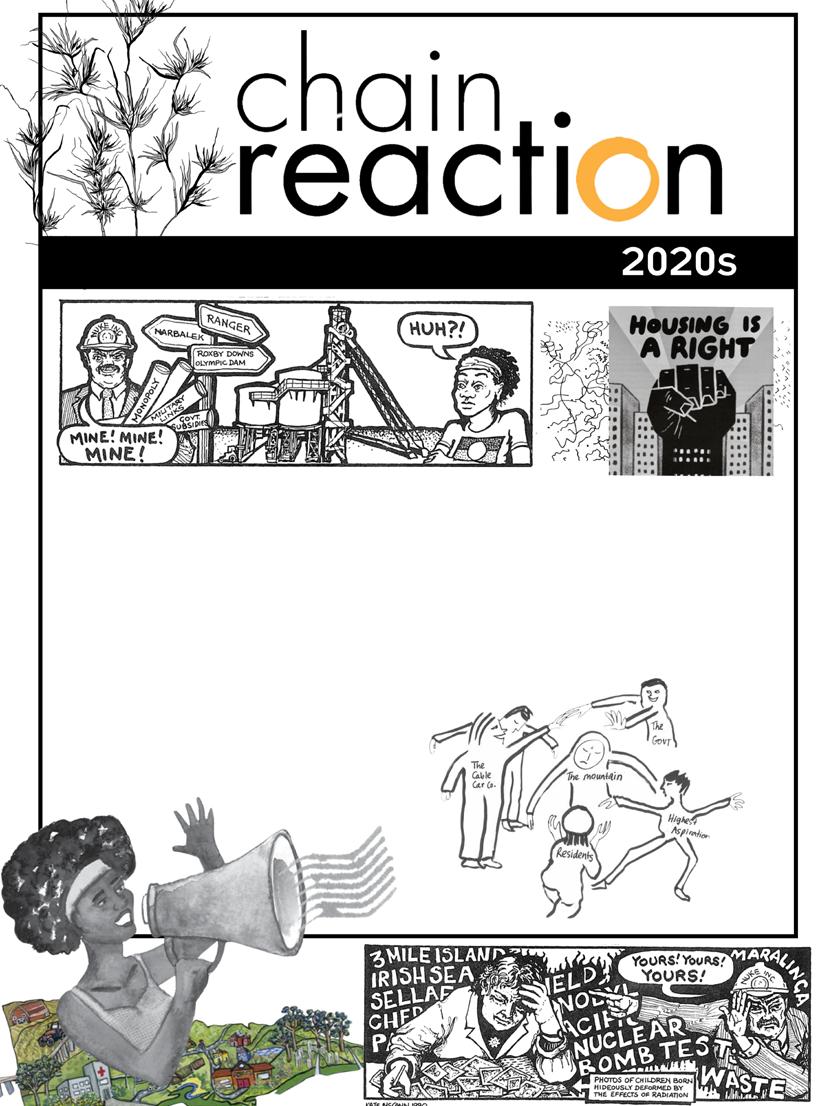
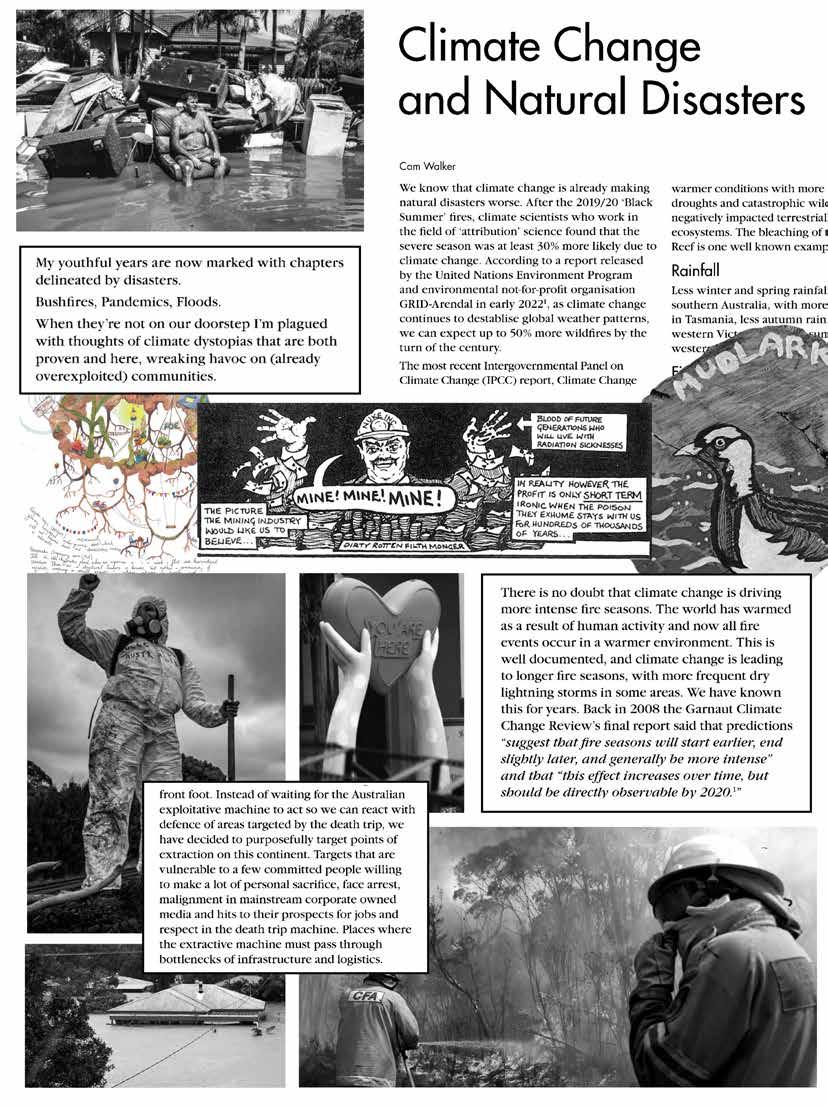
During the 2020s the pages of Chain Reaction filled with reportage as fire and flood devoured entire regions of the country. But the ongoing disaster fatigue of the 2020s, and debate around CoViD lockdowns, vaccination passports, and long neglected healthcare infrastructure also presented an opportunity for many looking to capitalise on the distractions.
The concept of ‘climate justice’ has become central to FoE’s organising, looking at the many socio-economic intersections between the ongoing climate crisis and forms of oppression in our world.
Chain Reaction’s team worked to provide insightful coverage of these disasters, while working to also investigate what was slipping past the public consciousness in the wake of these major, unmissable challenges, such as massively expanded logging operations, proposed and to commence while a significant portion of the population would be busy battling the effects of cabin fever, and too shut in to notice the damage before it were a fait accompli.
But CR has never been a forum for mere coverage of current events, nor has FoE been an organisation merely reacting to climate and environmental disaster. As this issue shows, the story of CR and FoE is the growing conviction that these issues - climate catastrophe, pollution, deforestation - are part of, and must be informed by an awareness of, the greater structural and social power structures and injustices endemic to them.
Now, halfway through the decade, the future of Chain Reaction is undecided. Work is being done to reinvigorate the project, ensuring it remains relevant and able to fund itself in the years to come.
ARE n A
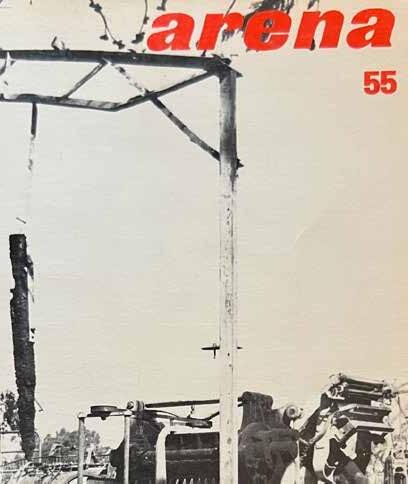
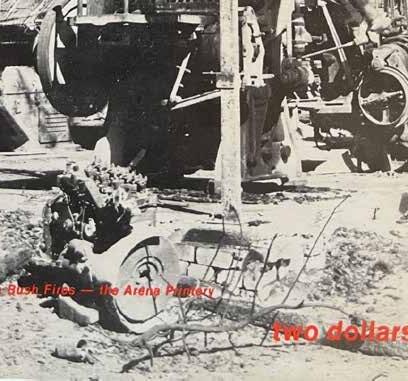
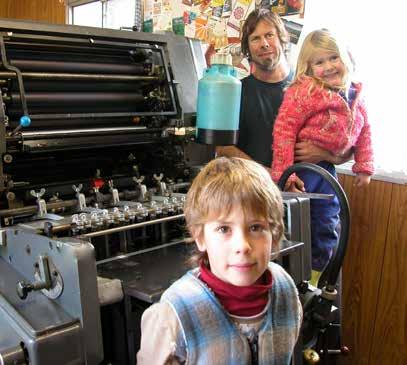
The magazine Arena was founded in 1963 by a dissident group from the Australian Communist Party who went independent as a local manifestation of the New Left movement. In 1973, Arena acquired a printing press and set to work in a shed in rural Plenty. This was part of the rich tradition of radical left groups running their own presses to publish under repressive conditions. Yet the drive to print our own material came from a deeper source than just political independence. A crucial component of why we print had to do with formulating a deep critique of how the division between intellectual and manual labour may be reorganised to create richer ways of cooperating—and better politics. This involved developing the material skills to operate and maintain the machinery of printing, a process that involved many people, innumerable challenges, and a hearty mix of satisfaction and suffering.
Printing moved for a decade to a community property near Malmsbury, then back to the city in the 1990s when Arena launched its second series, and a commercial printery. The last hub in Fitzroy ran up until the fateful month of March 2020, when our landlords issued a development-motivated eviction order—coinciding with the first COVID-19 lockdown. This, compounded by long-term decline in demand for print, resulting in the closing of Arena’s commercial printery. Simultaneously, we launched Arena’s third series: the printed quarterly Arena and the digital fortnightly Arena Online. Even if we could not sustain a commercial printery, we remain committed to the materiality of print. The praxis of bringing together intellectual and manual labour may now be diminished, but the meaning of materiality of the printed word and conditions under which they are produced remain a marker of our politics.
A printed volume is a material singularity that emphasises the editorially chosen connection between the articles, the temporal moment of each contribution in relation to each other and to events in the world, and the place of the object in the room where you read—or don’t. Awareness of the materiality of the object in your hand, its aesthetic presence, pushes towards you as reader being re-embodied in the act of reading. This is qualitatively different to reading words on a screen, where they exist as part of a vast network of globespanning computing-machines. Surely this apparatus is also material—composed of immensely energy-intensive and toxifying infrastructure at every level—but its materiality is extremely abstract, drawn away into the disembodied realm of infinite flux, totalitarian surveillance, and hallucinating AI. By contrast, a printed issue of Arena connects one more directly with a community of practice; it is meaningfully grounded in a way that media flowing only through the abstractions of computing-machines really struggles to be. We continue to pursue our founding commitment to fight for a deep and fully human society in which multidimensional lives can be lived in common within the natural world. Producing a material object is a crucial part of this struggle.
WHY
thE SUnd AY PAPER
The Sunday Paper was born during the popular uprisings of May 2021 as an art project and an act of protest. Specifically, it was created to oppose Zionist-owned Schwartz Media, a company that for years had monopolised ‘progressive’ arts and media, weaponising its power and influence to suffocate criticism of the Zionist entity. The colonial agenda of Schwartz Media and other Australian Zionist organisations, highlighted through The Sunday Paper, has now become more widely exposed and popularly critiqued.
The Sunday Paper also exists to challenge a more pervasive and less visible form of silencing: While outwardly supportive of Indigenous rights, and perhaps even self-described as radically anticolonial, many progressive publishers, platforms, and organisations will quietly erase words like ‘martyr’ or ‘intifada’, and will quickly withdraw their support at the mention of armed liberation struggle. In doing so, they police the terms of resistance and determine the limits of political analysis.
WE PRINT
SL ing S hot Book S
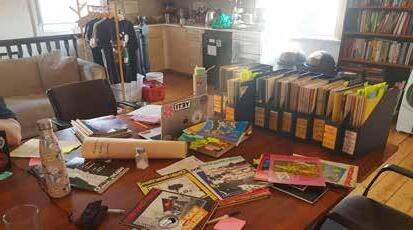
Slingshot Books is a tiny, radical publishing house for kids and their grown-ups. As a child-centred publisher, I focus on print because I feel that kids need as much time with physical books as they can get. This is especially true in an era where screens seem near inescapable.
The range of print material available for children is relatively narrow when we compare it to the range of formats, subject matter and worldview represented in the grown-ups’ section of the bookshop. I widen that range of print material for kids, so their worldview can similarly widen.
I’m focussed on the experience of the child, who deserves narratives that are gripping, curious, entertaining, imaginative, and that honour their right to childhood. Part of honouring their right to childhood is ensuring they have access to beautiful, surprising, meaningful, playful, politically astute books.
It’s my hope that the growing Slingshot library helps raise curious, brave, loving and critically engaged people who are committed to collective liberation.
The format of a newspaper is a playful jab back at the garbage proliferated in newspapers across this continent, from The Australian to The Saturday Paper. But it’s also an act of great care: revolutionary print material is often expected to look hastily and cheaply produced, without art direction, editorial, and all the other forms of creative support that traditional print material is given. We seek to demonstrate that revolutionary thought deserves this kind of attentive production, and that the visual culture of liberation can be meticulous and artful while remaining staunch.
The Sunday Paper is a print-only publication. This is because we seek to give our readers an opportunity to step away from their screens and slow down enough that they might read a long-form article with the more down-regulated nervous system that print matter invites. We also want to give our writers the freedom of knowing that their pieces aren’t being treated as clickbait or as an opportunity for virality. Print can offer us a chance for less surveillance and greater freedom as we read and write.
The Sunday Paper will continue to publish work that is brave and unapologetic, rejects normalisation, honours the martyrs of every anti-imperialist struggle, and upholds the necessity of resistance. And it will continue to publish in a print-only capacity.
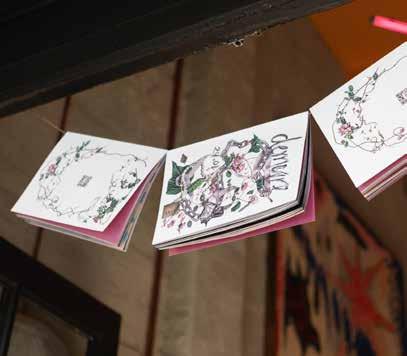
dEMURE MA g
Demure Mag is a Naarm-based publication that encourages the discovery and appreciation of emerging femme, queer and gender-non-conforming creatives. Our purpose is to subvert the definition of the word through experimental and engaging explorations being actioned by young people. We are an accessible medium which strives to continuously publish a huge variety of different forms of artistic expression by young creatives who may or may not have their own platform or shared their work publicly before. Having one’s work published is not only a confirmation of skill, but increases an individual’s self-confidence and makes connections to other like-minded people not so far away.
In an increasingly digitally-isolated world, print publications offer a tangible and grounding form of connection. As a publication born in lockdown, we realised early on that we need to not take physical connection and community for granted, and to support local voices and storytelling. Print holds such an emotional and sentimental value. Having your work featured in or even receiving a magazine can evoke a sense of care and presence that digital messages lack. Print slows down the consumption of information, encouraging deeper reflection, and strays from algorithm-based engagement.
BLACk SPAR k CULt URAL CE nt RE
A hot cup of tea, book in hand. Simple pleasures we can all access. The walls of bookshelves and surfaces piled with zines are not just an aesthetic choice or a means of income at Black Spark, they are a way of ensuring the exploration of concepts of creativity, learning and liberation are always accessible in the space.
All forms of print media are loved and cherished at Black Spark. As a space born out of the need to connect in-person, after many months of lockdowns, it only makes sense that our media is also able to be enjoyed in-hand too. Away from devices like phones and laptops that compete for our attention, we can be more present with each other over paper.
JUS t US PRESS
Transferring ideas and stories to printed form has endured the test of time. It is humbling to comprehend the expanse of works that have been created since the first recorded literary works, and we often ponder what voices have been empowered throughout the ages, who has been silenced, and how that has shaped each society. In this sense, print has the power to destroy or create, to harm or heal.
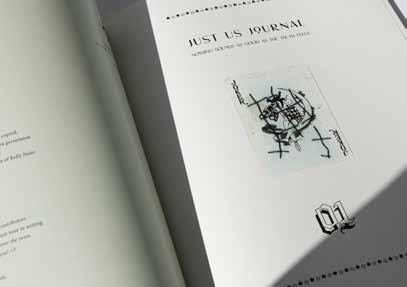
Just Us Press was launched in 2024 with a focus on contributing books that encourage healing and connection through exploring related themes, whilst hoping to empower diverse voices and perspectives in the process. We feel it’s important to put the power of print into many hands, and celebrate our differences whilst seeking truth and mutuality. Throughout this journey, our role is to collaborate and facilitate, so that more people can be seen/heard/understood, and most of all, experience the joy of having their unique visions and stories turned into beautiful books and print.
Just Us Journal also launched in 2024 as our flagship biennial publication, with each issue taking a deep dive into a chosen topic through collated writings, interviews, art and resources. For our first issue we explored the concept of ‘action’ - asking questions such as what fuels the choice to act, and what forces (internal/external) fight against it.
Instagram: @justuspress_
( diS)S oLU tion
(Dis)solution is an independent print journal and network for collaboratively creating and sharing radical, critical thought. Based in Naarm, it publishes work from emerging writers, artists and activists which challenges the catastrophic, ecocidal structures of the 21st century.
We print so that our work exists in material form in the world. So the magazine can be passed to a friend, or whoever might read it next. So our communities may gather in a place, around a publication and the ideas within it. So that sharing may once again be a face-to-face activity, not only the pressing of a button. We print to stay relational.
We print to resist the short-termism of late-stage capitalism. To resist the twitterfication of social media. To insist that our readers hold their focus on the articles long enough to actually read them in their totality. In our world of rapidly declining attention spans, we print to make the case for long form thought, expression and argument: elaborated, considered, and referenced.
We print to avoid the surveillance and censorship of radical ideas on the internet, where every move is tracked, every keystroke logged. In print and in person, we control the terms of our engagement.
We print to coalesce story and community, as a creative form of storytelling and curation that we do not want to lose. https://dissolutionmag.com/
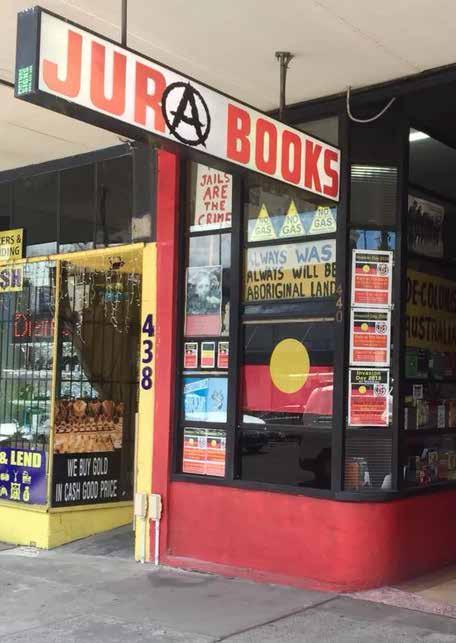
JURA Book S
Many congratulations to Friends of the Earth on reaching 150 issues of Chain Reaction! Regularly producing this journal for 50 years is a fantastic achievement. It’s so encouraging for progressive, forward thinking people to have access to the ideas and news about the environment, and about those who are fighting to protect the ecosystems and ecospaces of our world. That it’s a printed journal is important. As a tactile object it can be held, passed around, shared, discussed. It has a permanence that the ephemeral world of digital media struggles to match. And having an independent organisation, FoE, and a publication, Chain Reaction, that is not beholden to, but independent of, digital billionaires and their capitalist, exploitative processes is equally important.
Likewise, for a place like Jura Books, the print medium has a particular significance: we encourage visitors to explore anarchist ideas and practices. The written medium demands action more complex than the click of a button; it calls for a reader’s attention and engagement in the physical world. Yes, we sell books, but it’s not all about transactions.
It’s also about beauty and wonder - the art of the written word on a page - where one can explore an author’s mind, personality, intellect,and be amazed and captivated by this process; where one can be challenged in journeying through new lands and excited by the wonder of new and varied possibilities.
thE nEW int ER n Ation AL Book S hoP
There’s a beauty in any object that has gone through the production process. For written media, there’s a writer, an editor, a printer, a binder, as well as the trees and the elements that go into the ink - each moment a factor of someone or something’s attention, of their care that brings it into being, an object which holds weight and meaning. Physical media requires a physical space for it to exist in. Here the process continues, in the bookshop – the written media (journals, books, zines) exist among other objects reinforcing the care of so many. Then, there’s the person selling the book – in the case of NIBS, the volunteers – brought there through this care.
The physicality of the object allows for these connections to emerge, and for it to go beyond the physical, the ultimate purpose of the book-object to begin with. The first written media that brings your attention to a cause as Chain Reaction has done time and time again, to a book you so feverishly disagree with that it crystallises a fundamental belief to yourself, bringing it to your consciousness. There’s also other people – the stranger who recommends you a book in passing, the comrade who lends you the zine, the friend or the person you buy the book for (or buys it for you) – the purposiveness which only exists in this set space, in this time. The physical book, existing in the physical space of a bookshop, is the rare recognition of the knowledge of this purposiveness of this creation, of this labour.
The New International Bookshop is an independent broad left bookshop, run by volunteers for the past 29 years, operating out of Victorian Trades Hall and Literary Institute in Carlton, Victoria.
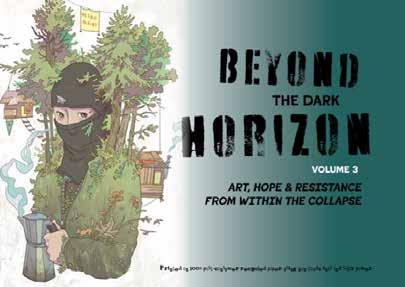
BEYond thE dAR k hoRizon
Beyond the Dark Horizon is an irregularly published set of short books that focus on radical-ecological and anarchist creative writings, short pieces, art and photography. We publish rants, raves, poems, photographs, cartoons, illustrations, letters and other short submissions and print them in a flip book format. They are produced out of Naarm and we take submissions from across the continent and the world. They are a form of communication between radical writers and creative folk amongst our radical community, an attempt at movement building in print. They showcase radical writings that large publishers might avoid, and publishing independently allows us to get each issue directly into the hands of the radical, direct action, anarchic-left without having to sell them or give a cut to a publisher.
We’ve published articles that praise those who rip down colonial statues, tips for dealing with cops, story reflections on sheoak trees, reports on sabotage direct actions, and a variety of other topics of interest to radicals and ratbags. We put it out in the hope of creating a desire to act and think differently about what radicalism means.
The books are usually handed out to friends and comrades in the radical community. Hopefully they last on people’s book collection, are picked up and flicked through from time to time, and are an archive of experiences, thoughts and communication that lasts for a while. In place of the ephemeral nature of much modern, internet based content we hope they last.
Amplify Bookstore is Australia’s only bookstore specialising in books by authors who are Black, Indigenous, and/or People of Colour. It’s an antiracist project with two purposes: to highlight the racial diversity that does actually exist within publishing output, and to be a safe landing pad for readers of colour who have been historically underserved by this output to find books by and for their own communities.
We were online-only for four years but have more recently opened a physical location. The physical shop allows us to showcase the collection in full for leisurely browsing, chats, and holds a third space offering in our reading room.
Particularly in the English-speaking world, our bodies and humanity have always been politicised and are increasingly facing censorship. Print books can stand against this; they leave behind a physical record of our stories, ideas, and histories. Radical books have always largely come from small presses, and independent bookshops like Amplify have been their greatest champions, in spaces where we are free to curate the collection to align with our ideals to support a better future rather than profit above all.
Visibility in the public sphere is a vital tool of resistance. It is powerful to be present and declare the need for your existence. Print media and physical spaces dedicated to them fight against erasure and hold space to elevate the voices of those who are so often side-lined by the mainstream.
Ro SA PRESS
Rosa Press is a publishing collective dedicated to communist poetics, which we take broadly to refer to the different ways of envisioning and struggling for a world in which everyone has what they need in order to live regardless of how much they contribute to the social store. We’re dedicated to work that grapples with our current conjuncture and its manifold crises, which might be summarised by two broad designations: the limit of capitalist growth and climate apocalypse.
Put another way, we’re interested in poetics that emerge from those ongoing struggles to transform the world. The published text is one way to produce publics who come together to read, listen, look, argue, debate, judge, deliberate, reflect. And we’re interested in printed forms that produce publics, however large or small. We tent to make printed matter that has a history of circulating hand-to-hand: small books, chapbooks, pamphlets, broadsheets.
For us, the published form of a text is a continuation of its content. As such, publishing is always creative, social and political: an experiment in giving form to ideas, and experiment in forging social relations.
MURMUR L iBRARY
Murmur Library is a decolonial community lending library based in Naarm, sharing books, zines and other printed matter by Black, Indigenous, and culturally diverse authors. Founded in 2020, Murmur exists to hold space for storytelling outside the white gaze, prioritising works that are often excluded from mainstream publishing, or actively suppressed through censorship and neglect.
We collect everything from glossy art magazines to pocketsized protest zines, from banned novels to out-of-print poetry collections. We hold texts on prison abolition, land rights, cultural memory, trans rage, and climate justiceoften self-published or distributed through word of mouth and grassroots networks.
We print our own zines and collect print because it can’t be edited post-publish, deleted by an algorithm, or hidden behind a shadow ban. In the face of rising book censorship locally and internationally, Murmur stands firm in the belief that the physical book is a site of resistance. Print protects nuance and allows for slowness. You can’t doomscroll a zine, you have to sit with it.
Independent print media carries the spirit of care. It’s not produced for scale, but for intimacy. For passing between hands, dog-earing, annotating, re-reading, and lending. It is tactile, sensory and enduring, encouraging deep attention and embodying connection.
As libraries become sites of political contestation and digital platforms profit from homogenised content, the value of independent publishing allows us to archive grief, joy and memory.
At Murmur, our commitment to print is a commitment to community, to cultural continuity, and to the belief that storytelling, especially from the margins, should be both preserved and passed on. We print because our stories deserve to outlast the silence that tried to swallow them.
BLACk RA inBo W
Black Rainbow Printing was conceived as a 1960’s style “free press” back in 1985. At that time, it’s founder, Charley Daniel, had become involved in environmental and antinuclear activism and he saw his trade as a printer could be a great asset to the movement. One of the first things that came to mind was that the very trees that we were trying to save from clearfell logging were being fed through our own printing presses as the pamphlets, stickers and reports we were producing to highlight the issues. It was after this realisation that Black Rainbow started a secondary campaign to offer the public an alternative to the destructive products of the logging, pulp and paper industry – this resulted in the introduction of recycled paper, non-toxic inks and press chemicals into the Australian market. Environmentally sustainable printing was born.
After a letter, published in the “Age” newspaper in 1989 espousing the advantages of recycled paper went viral, Black Rainbow was inundated with hundreds of letters from people wanting to use a sustainable printing service. The rest is history and forty years later Black Rainbow is still setting the benchmark for ‘genuine’ sustainable printing. Over the past four decades Black Rainbow Printing has continued to not only support environmental and social justice campaigns throughout Australia but initiated its own successful campaigns, fighting for environmental justice in water quality, biodiversity & forest preservation.