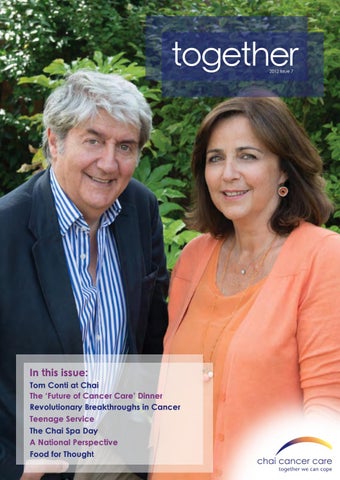
2012 Issue 7
In his issue: Tom Con i a Chai The ‘Fu ure of Cancer Care’ Dinner Revolu ionary Break hroughs in Cancer Teenage Service The Chai Spa Day A Na ional Perspec ive Food for Though
Message from the Chairman: Louise Hager It is my pleasure to welcome you to this, the 7th edition of ‘ ’. Inside you will find a wide range of features that reflect the many and varied aspects at Chai. I would like to thank all those who were involved in contributing and in particular to the medical experts for their in-depth articles. These provide us with the latest developments from within the cancer field. I hope that you enjoy reading this issue as much as we have enjoyed putting it together for you. It has been another exciting year for Chai. We have moved into our fantastic new building, the third on our North West London site. This now houses our Medical Outpatient Rehabilitation and Palliative Care Service, additional Therapy Rooms, Art Studio and Music Room and a dedicated Recreational Room for teenagers who have been affected by a cancer diagnosis in their family. The new building is truly spectacular, but its physical beauty is nothing compared to the heart that beats within it and, indeed, wherever Chai’s services are provided across the UK. Over the years we have been blessed in developing a highly professional and caring team. Lisa Steele, who has been with Chai for 11 years, has recently been appointed Chief Executive. Her experience in management and psychological expertise ensures that Chai will continue to go from strength to strength. Of course, I couldn’t finish without thanking all our loyal friends and supporters whose generosity enables us to provide our vital services. As we do not receive any statutory funding, without you we couldn’t do what we do. Together we can and together we do!
Chai Cancer Care
requests the pleasure of your company at
The 2012 Natalie Shipman Memorial Lecture on
Breast Cancer Surgery in the 21st Century and Beyond Keynote Speaker – Dr Michael Douek Monday 3rd December 2012 at 7.30pm Admission free by ticket only Please call 020 8202 2211 to reserve a place The Chai Cancer Care Centre 142 – 146 Great North Way, London NW4 1EH
Cover image: Tom Conti with Katherine Lennard from the Chai Art Workshop. Photographer: Jeremy Coleman
Contents Revolutionary Breakthroughs in Cancer: Professor Daniel Hochhauser
4–5
Art Workshop: Past and Present
6–7
Chai Spa Day
8–9
Multiple Myeloma 2012: Dr Robert Marcus
10 – 11
Food for Thought: Lana Pinshaw
12 – 13
A National Perspective: Lisa Steele, Chief Executive
14 – 15
The Chai ‘Fu ure of Cancer Care’ Dinner
16 – 17
New Developments in Radiotherapy: Professor Michael Brada
18 – 20
New Service: Music Therapy
21
Donor Profile: Dame Gail Ronson
22 – 23
Re-energising Your Body
27
A Year in Photos
28 – 29
: Sponsored Activities October 2011 – June 2012
30 31
Year in Fundraising – 2012
President
Trustees
Medical Patrons
Dr Jane Neerkin
The Rt. Hon. Lord Young
Louise Hager
Prof Michael Baum
Prof Gordon Rustin
of Graffham
Lady Kalms MBE
Prof Michael Brada
Prof Karol Sikora
Susan Shipman
Mr Michael Douek
Prof Albert Singer
Founder Presidents
Philip Weinstein
Prof Andrew Eder
Prof Stephen Spiro
Susan Shipman
Lord Young
Prof Rosalind Eeles
Prof Irving Taylor
Mr Daren Francis
Dr Adrian Tookman
Frances Winegarten z”l Honorary Patrons
Prof Anthony Goldstone CBE
Chairman
Lord Janner of Braunstone QC
Prof Daniel Hochhauser
Louise Hager
Maureen Lipman CBE
Prof Ian Jacobs
Chief Rabbi Lord Sacks
Prof Gordon Jayson
Chief Executive
Mr Amir Kaisary
Lisa Steele
Prof Jonathan Ledermann Prof Gordon McVie Dr Jeremy Nathan
This edition of ‘ ogether’ is generously sponsored by The Dorset Foundation
Revolutionary Breakthroughs in Cancer: Professor Daniel Hochhauser
Professor Daniel Hochhauser MA, DPhil, FRCP Daniel Hochhauser is Kathleen Ferrier Chair of Medical Oncology and a Consultant Medical Oncologist at UCL Cancer Institute/UCLH Trust. He specialises in treatment of gastrointestinal cancer. Research is focused on development of novel targeted therapies within a laboratory programme in UCL Cancer Institute and early-phase clinical studies.
By now we are all used to the announcement of a new cancer breakthrough. With increasing frequency, we read or hear of advances made in the laboratory and clinic which will lead ‘within a few years’ to the development of revolutionary advances in cancer treatment. It is common for patients to bring into consultations a cutting from the Daily Mail or Telegraph containing news of mice cured by a new antibody, or a drug which has shown promising preliminary results. For patients receiving difficult treatments for cancer, these stories often lead to bewilderment, and sometimes anger. Why are we not receiving the new treatments? Is it because the National Health Service rations treatment? Why is treatment so much more advanced in the United States? It is easy, and indeed too convenient, to put the blame for this solely on the newspapers themselves. Certainly it is of more interest to announce ‘Novel agent kills cancer cells in major laboratory breakthrough’ than to run a story entitled ‘Quite interesting results found when cells on a plastic plate exposed to drug’. Often investigators themselves, understandably enthusiastic about their research, are responsible for the exaggeration of results which they believe to be a major advance. Pharmaceutical companies are bound to place a positive spin on interesting but preliminary results of new agents. Funding bodies quite naturally want to demonstrate to the public that the money donated to them is resulting in significant advances in cancer care.
“There have indeed been revolutionary changes in the management of several cancer types over the past few years.” 4
And yet a major responsibility does rest with the often poor level of scientific reporting in newspapers. Comparison of the level of discussion of cancer in the New York Times with that of the Telegraph, for example, is striking. On the day that I am writing this, the Telegraph reported a Scottish study that drinking seven or more cups of tea per day, as compared with a more normal rate of 0-3, resulted in a significant increase in the risk of prostate cancer (it should be noted that the UK Tea Association vigorously oppose this conclusion). The study itself is published in an obscure journal and is hardly definitive (an excellent critique is published on the NHS Choices website (http://www.nhs.uk/news/2012/06june/Pages/ tea-raises-prostatecancer- risk.aspx). What will the impact of this article be for those who have been diagnosed with prostate cancer? Will they be wishing they had drunk more coffee (until the next study suggesting a link with pancreas cancer)? Does this apply to lemon tea? If I drink six cups of tea will I be OK? Expect answers to none of these questions in the future but, although the story is weak, its impact may be significant in adding to the sum total of anxiety about getting cancer. For others it may add to the scepticism regarding cancer epidemiology, a field which has in fact made significant impact in our understanding of cancer over the past decades. Despite the exaggerations and distortions there is, however, a real sense among those who are involved in the treatment of cancer that rapid changes are occurring. There have indeed been revolutionary changes in the management of several cancer types over the past few years. These have often resulted from careful laboratory science leading to well-designed clinical trials. A recent example is the alteration in treatment for the skin cancer malignant melanoma, which responds poorly to chemotherapy. Following pioneering work in the laboratory of Professor Michael Stratton (a former Natalie Shipman Memorial Lecturer), mutations in a gene called BRAF were identified
Although this is a good example of success following a series of positive studies, many of the most significant advances have come from rigorous application of what is already known. An example is in the treatment of rectal cancer for which, as with many cancers, surgery is the only curative option. Following detailed studies over decades by the surgeon Bill Heald in Basingstoke, the importance of meticulous surgery in reducing the risk of the cancer returning locally (recurrence) became not only widely accepted throughout the United Kingdom and internationally, but also mandatory. Now all such cases are discussed in multidisciplinary meetings with treatment plans including surgery, radiation and chemotherapy decided by a team including all key specialties. This was not a dramatic breakthrough in the commonly accepted term, but it has had a more important impact than many, if not most, of the publicised revolutionary breakthroughs.
“The general trend is for incremental advances which have a modest impact by themselves, but in aggregate are significant.” Although we will continue to receive reports of major new anticancer therapies, the general trend is for incremental advances which have a modest impact by themselves, but in aggregate are significant. Many reported successes are in the context of cancer cell lines grown in the laboratory or in animal models. These are essential first steps in developing new therapies, but often require prolonged testing and trials in humans to confirm whether they will in fact be of benefit in the clinic.
DNA Helix
as being a hallmark of this cancer. Rapid development by clinicians in collaboration with pharmaceutical companies has resulted in a new generation of BRAF inhibitors such as the drug Plexxicon PLX4032. Patients whose tumours contain the BRAF mutation show dramatic responses to this treatment, often with complete remissions. Although unfortunately relapses occur in most patients, this drug has already resulted in significant improvements in the duration and quality of life. It is a dramatic demonstration of the power of new technologies to develop potent therapies. Two innovative developments in immune therapy for melanoma have also recently been described, and there is a great sense that the tide is turning for treatment of this cancer based on solid scientific research.
The ability of scientists to study the DNA sequence of tumours in great detail (so-called deep sequencing) is allowing understanding of the pathways leading to cancer and will facilitate strategies to target those which maintain tumour growth and spread (metastasis). Again the seminal work of Mike Stratton (as well as groups elsewhere) in classifying human cancers in terms of rates of mutation, changes of cancers with time and differences between tumour types (heterogeneity) has deepened our understanding of this complexity. Clearly these are important advances and we must be careful not to sound a note of exaggerated triumphalism that cancer is on the verge of cure. An important, recently published study by Professor Charlie Swanton demonstrated that individual tumours may contain different populations of cancer cells which may differ widely in their genetic composition (intratumoral heterogeneity). This may indicate that several pathways may have to be targeted for some cancers, clearly an important challenge for the future. So major advances are occurring, and will continue to be reported, but great caution is needed to interpret these reports. However, an alternative perhaps more constructive strategy which might be adopted, is that of Henny Youngman “When I read about the evils of drinking,I gave up reading”.
5
Art Workshop: Past and Present
Tom Conti and Linda Sharpe unveiling the ‘Garden of Life’ painting
Every Thursday afternoon for the past 5 years, Chai’s established Art Workshop in the Hendon Centre has been the highlight of the week for so many. Some of the participants have never previously held a paintbrush and have found a latent talent brought out through the supervision and encouragement of artist Linda Sharpe. The group is made up of cancer patients and their family members, ranging from the ages of 5 to 87 years old. The camaraderie that extends to both long standing members and newcomers creates a very special atmosphere and, of course, tea and biscuits are always served!
with orders already been taken for the 2013 edition, it looks to be another success! Seeing the potential of the Art Workshop, Linda decided she wanted to create a unique project that was personal to each individual in the group. The detailed project took a year to complete. The idea chosen was an ‘enchanted garden’ which Rosh Hashanah Card 2012
The need to expand Chai’s creative therapies was a major factor in the refurbishment of a connecting building at the Hendon Centre. The building now houses a fit for purpose art studio, which has enabled us to increase the number of supervised Art Workshops. Responding to requests from our clients, we have expanded our creative workshops and now also offer photography, ceramic painting, appliqué and jewellery making. Since its inception, the Art Workshop has produced Chai’s annual Rosh Hashanah card that is mailed out to over 14,000 people. Each year the group decide on a theme, so that the image on the front and the message inside reflects how clients feel about the specialised support and care that Chai provides. To raise much needed funds and to show their appreciation to Chai in a tangible way, three years ago the Art Workshop decided to set themselves a challenge by creating a calendar. The group eagerly look forward to adding their contribution to each calendar and
6
“We couldn’t have imagined being able to find light and bring colour back into our lives. The Art Workshop has the most unique atmosphere. It is a special place where we come together and share our joys and sorrows and form precious new friendships.” The Chai Art Workshop (artist Janice Oliver)
“I can’t think of anywhere that has an organisation like this.” President The Rt. Hon. Lord Young of Graffham
Founder Presidents Susan Shipman Frances Winegarten z’l
Chairman Louise Hager
Medical Patrons Prof Michael Baum Prof Michael Brada Mr Michael Douek Prof Andrew Eder Dr Rosalind Eeles Dr Ian Ellis Mr Daren Francis Mr Jerry Gilmore Prof Anthony Goldstone CBE Prof Daniel Hochhauser Prof Ian Jacobs Prof Gordon Jayson Mr Amir Kaisary Prof Jonathan Ledermann Prof Gordon McVie Dr Jeremy Nathan Dr Jane Neerkin Prof Gordon Rustin Prof Karol Sikora Prof Albert Singer Prof Stephen Spiro Prof Irving Taylor Dr Adrian Tookman
Rosh Hashanah Card 2011
Chai Services Counselling Therapies Medical Outpatient Rehabilitation & Palliative Care Complementary Therapies Home Support Children & Family Support Groups Advice & Advocacy Volunteer
Chief Executive Linda then designed. The garden incorporated an image from Elaine Kerr everyone’s Trustees imagination, which was then divided into elements Louise Hager Lady Kalms MBE that each member painted. When the garden was reassembled, Simon Kanter Susan Shipman Philip Weinstein everyone’s pieces fitted together like a puzzle revealing the Lord Young painting, which was appropriately named ‘The Garden of Life’.
Tom Conti, currently starring in the hit TV show “Parents”, was Chai’sChai range of services are available at locations in: year to unveil the finished invited to in February of this North West London · South London · Hackney · Essex · Southend · · South Manchester · Glasgow · Your own home paintingNorthtoManchester the group and their family members. Incredibly 142 - 146 Great North Way, London NW4 1EH Tel:Tom 020 8202 addressed 2211 Fax: 020 8202 2111 moved,Freephone the audience and spoke about what Helpline: 0808 808 4567 www.chaicancercare.org info@chaicancercare.org makes Chai so special, “there is a tremendous sort of adhesion to all your lives and that is this extraordinary thing of being Jewish. I can’t think of anywhere that has an organisation like this.” Chai Lifeline Cancer Care Registered Charity No. 1078956 ix
RHCard_2011_COVER.indd 1-2
Ilan Ronel, a member of the Art Workshop then added “my daughter once said to me there are not many benefits of being a cancer patient, so whenever you come across one you have to take it. I wouldn’t go as far as saying coming to QX6_blank_MA 21/11/11 19:47 Page 1 the art class was worth it, but I would say it is one of the good things we can enjoy!”
06/09/2011 12:44
“At Rosh Hashanah we bring together many different symbols which are unique and special to this Yom Tov. At Chai we all come together and benefit from expert support and care which is unique and special the whole year round.” The Chai Art Workshop Group (artists and T Ronel)
January
February
March
April
May
June
July
August
September
October
November
December
Our thanks to the original artists whose work gave us our inspiration. Designed and printed by Mike Plosker for Printers Inc & Design Ltd. Tel: 020 8905 4743 email: printers.inc@btinternet.com Photography by: Brian Macket Photography Tel: 07958 345946 www.brianmackett.co.uk
Chai Cancer Care, 144-146 Great North Way, London, NW4 1EH Tel. 020 8202 2211 or Freephone Helpline 0808 808 4567 Fax. 020 8202 211 Email: info@chaicancercare.org www.chaicancercare.org
InsideNotes Back Page Charity Number 1078956
Calendar 2012 Front Cover
Back cover of the Art Workshop Calendar 2012
7
Chai Spa Day
Matt Roberts, Lisa Steele, Louise Hager, Karen Goodkind, Nicky Clarke, Ruth Bray
If there’s one thing better than being pampered, it’s being pampered for a good cause. The third biennial Chai Spa Day was held at the beautiful home of Jacqueline and Michael Meller. After weeks of rain, the sun shone and the ladies took full advantage; professional coaching in the tennis court, swimming in the outdoor pool and fitness training in the spectacular garden. Organised by Karen Goodkind and Ruth Bray, the Spa Day gave the opportunity for 100 ladies to sample some of the services that Chai provides; from pampering to Pilates, healing to hairdressing, alongside a delicious lunch generously donated by Jason Millan and Tony Page. As in past years there were workshops from inspirational speakers, nutritional expert Ian Marber and celebrity trainer Matt Roberts. Throughout the day Alan Herdman, founder of Pilates, was advising on Pilates techniques and Robbie Steinhouse, International Life Coach, was offering one to one sessions in the palm filled atrium. Hairdressing icon Nicky
Alex & Neil Samuels
8
Clarke gave a styling demonstration and took questions from the audience. When Nicky heard about the work Chai does he was so moved that he offered the ladies at the Spa Day a 50% discount for a haircut at his new London salon – an offer too good to refuse for many! However the real highlight was listening to Alex Samuels, a 22-year-old student who has Non-Hodgkin’s Lymphoma. He told the guests, “You cannot comprehend what going through cancer is like until you have been there yourself. Chai gave me, my parents, sister and grandparents the courage and confidence to cope”. The day raised over £30,000 which will go directly towards Chai’s services. And some of the guests were so inspired by the need to support Chai that a fundraising Kilimanjaro walk has been organised for next June. No doubt those brave ladies will be hoping for another Chai Spa Day soon after their return! Photograper: Chiko
Lisa Steele, Lynne Attias, Johanne Harrison & Louise Hager
Beverley Calvert & Cindy Dawood
Jacqueline Meller & Karen Goodkind
Alexandra Maurice, Ruth Bray & Alicia Ani
Shelley Metliss
Lisa Tchenguiz
Ruth Yelizarov & Natalie Tahan
Alex Samuels’ Speech
Anita Zabludowicz, Louise Hager, Karen Goodkind & Ian Marber
Buffet Donated by Jason Millan
Karen Goodkind & Tracy Grabiner
Matt Roberts’ Workshop
We would like to thank those who helped make the Spa Day so successful by generously donating their time, goods and expertise: Aben Wines, Chiko Photography, Elemis, Kristal Florist, Jason Millan, Minton Water, Tony Page, Sam Rolnick and celebrity guests Alan Herdman, Ian Marber, Matt Roberts, Nicky Clarke and Robbie Steinhouse.
9
Multiple Myeloma 2012: Dr Robert Marcus
Dr Robert Marcus, MA, FRCP, FRCPath Consultant Haematologist at Kings College Hospital, Denmark Hill London and at LOC 95 Harley St London W1. Dr Marcus qualified in medicine from University College Hospital Medical School in London in 1977 and specialised in Haematology at the Royal Postgraduate Medical School and Royal Free Hospitals. rior to returning to London to take up a position at Kings College P Hospital in 2008, Dr Marcus was Consultant Haematologist in Addenbrooke’s Hospital in Cambridge for 20 years where he established the East Anglia bone marrow transplant unit and developed a particular interest in new treatments for haematological malignancies, specifically in the use of stem cell transplantation. Dr Marcus’ other research interests include development of antibody therapies in Haematology and he has been a senior investigator in a large number of practice changing studies therapy in many subtypes of lymphoma Dr Marcus is the chairman of the NCRI low-grade lymphoma working party, designing new studies in this field and is examiner for the Royal College of Pathologists. He is Medical Advisor to the Lymphoma Association and Vice President of the Leukaemia Care Society. Dr Marcus has authored more than 140 peer-reviewed manuscripts and reviews. He has co-edited three books, including in 2007, a standard textbook on lymphoma now in the process of revision.
Multiple Myeloma is a cancer of the bone marrow that although still incurable in most cases is now a controllable disease whose outlook has improved enormously in the past decade. Myeloma is mainly a disease of the elderly with the majority of patients over 70 at the time of presentation. There are approximately five thousand new cases of myeloma diagnosed in the UK each year. Myeloma arises from the uncontrolled growth of plasma cells that, under normal circumstances, make the antibodies that help us to fight infection. When these cells grow they secrete an abnormal protein known as a ‘paraprotein’ that is a measure of the number of abnormal plasma cells in the body. Secondly, they start to attack the bones, the painful ‘Lytic Lesions’ that are the hallmark of the disease. Thirdly, the protein may damage the kidneys. Fourthly, the damage to bone can lead to a rise in blood calcium levels and fifthly when the abnormal plasma cells reach a certain level they may interfere with normal blood production leading to anaemia or a fall in white blood cell numbers that can increase the risk of infection.
10
Sometimes patients just have the abnormal protein in blood and low levels of the plasma cells in the bone marrow without any of the other problems described above. This is known by the term MGUS (monoclonal gammopathy of uncertain significance) when the levels of protein and bone marrow infiltration is low or ‘smouldering multiple myeloma’ (SMM) when the levels are higher. Many patients with MGUS never progress to true myeloma and require no treatment. Many patients with SMM will progress to true myeloma but once again there is no need to treat patients until they do. What are the symptoms of Myeloma? Most patients with myeloma present with bone pain; either in the spine or ribs, or occasionally with fractures in the long bones. Some rarer patients present with symptoms of compression of the spinal cord. In some the disease is found when the paraprotein is detected following investigations for other conditions. Patients with a paraprotein with either bone pain anaemia, abnormal kidney function or raised
calcium levels need to be referred to a Haematologist as a matter of urgency. Patients with spinal cord symptoms should be regarded as medical emergencies and referred to hospital immediately, patients with just an abnormal protein will need to be seen for additional investigations. How is Myeloma diagnosed? Myeloma is a bone marrow disease, so the most important test is a bone marrow examination. This can be done as a day case under local anaesthetic and is usually associated with short lived discomfort. The bone marrow will be examined under the microscope to look for the numbers of plasma cells, how abnormal they look and their genetic make up, all of which may influence the choice of treatment. Other important investigations include tests for renal function and calcium levels, white and red blood cells and platelets. The levels of albumin and a chemical called ‘Beta 2 Microglobulin’ are also measured. These simple tests often indicate how likely the disease is to respond and for how long. Paraprotein levels are measured and more recently so are ‘serum free light chains’ since both the levels and the rate of fall of these during treatment are useful indicators of response. Patients also have a complete set of x rays of the bones a ‘skeletal survey’ and some patients, especially those with severe back pain may require an MRI scan of the spine. Who needs treatment? Only patients with symptomatic MM require therapy – those with bone problems ‘lytic lesions’ or other myeloma related symptoms arising from the kidneys or bone marrow. Patients with MGUS or SMM do not seem to benefit from early therapy. What treatment should Myeloma patients receive? This can be divided into general or supportive and specific anti myeloma therapy although there is some overlap. General: Pain relief for bone lesions is essential; patients may require quite powerful analgesia up to and including morphine and similar agents. Patients with myeloma MUST NOT receive non steroidal anti-inflammatory agents such as Nurofen since these can do severe damage to the kidneys. Patients with severe local pain may benefit from radiotherapy. Patients with fractures or at high risk of fracture may require orthopaedic surgery to correct or prevent this. Patients with high calcium levels or compromised renal function need specific therapy to control salt and water balance that may include special calcium lowering agents and occasionally renal dialysis. Patients with myeloma also benefit from long term bone strengthening medications such as Zoledronate. Specific anti Myeloma therapy: The goal of myeloma treatment is to reduce the abnormal plasma cells to a minimum for the longest possible time; unfortunately most patients are not cured but once disease returns many patients can enjoy long periods of freedom from disease with second and often third line treatment.
What is the best first therapy for Myeloma? The addition of at least one of the new agents, either Thalidomide, Bortezomib (Velcade) or Lenolidamide (Revlimid) when added to Melphalan and Prednisolone or Cyclophosphamide and Dexamethasone increases freedom from disease. In the UK the current national study is looking at whether Lenolidamide is better than Thalidomide and is also asking whether Lenolidamide maintenance prolongs freedom from disease. Bortezomib based combinations are usually reserved for patients who do not respond well to first line therapy, patients with specific cytogenetic abnormalities in the plasma cells or whose disease returns after initial treatment. Outside the UK Bortezomib is often used as part of first line therapy. Once patients respond to first line therapy the main question is what to do next. Patients who are fit enough and will accept having a 3-4 week period in hospital should be offered autologous stem cell transplantation. There is considerable evidence that this approach keeps patients free of disease for longer than if they don’t undergo this procedure, but it is rarely a cure.
“We have made considerable progress in the treatment of myeloma in the past decade with a near doubling of survival times.” What about donor transplantation? This approach is only is applicable to very small numbers of young patients with very aggressive disease but the risks are high and the cure rates quite low, this should only be considered in specialist centres in the context of a clinical trial. What about maintenance therapy? This is the question being addressed in the UK national trial; any prolongation of remission has to be set against the toxicity and the possibility of a lower chance of response when the disease returns. What do we do when the disease comes back? This depends on the duration of first response, but in general terms patients who have relapsed after first line therapy can receive Bortezomib based second line therapy and those who have received Bortezomib can receive Lenolidamide with the expectation of useful further freedom from disease. What about new Agents for Myeloma? There are now a number of new agents entering clinical trials that are showing considerable promise in the treatment of relapsed disease, they include Carfilzomib and Pomalidomide and new antibodies that can destroy malignant plasma cells. Conclusion We have made considerable progress in the treatment of myeloma in the past decade with a near doubling of survival times. If the same progress is made in the next ten years we can realistically hope that patients will in future be able to have a normal life expectancy when diagnosed with multiple myeloma.
11
Food for Thought: Lana Pinshaw
Lana Pinshaw BscDiet (sRD) Lana Pinshaw is a South African qualified dietician. She graduated in 1998 from the University of Pretoria and soon left South Africa to further her career in London. She is a freelance dietitian in both the NHS and private sectors and has been working at Chai for the past 10 years. Lana offers individual dietary assessments with practical advice to help find the easiest possible way to make dietary changes and improve health and wellbeing, helping to overcome possible side effects of treatment. The assessment will involve comprehensive dietary analysis to determine aspects of existing diet. A personalised dietary plan and detailed advice will be given, together with recipes and menus for guidance.
A Cancer diagnosis can impact in many ways, but ‘loss of control’ is one of the feelings often expressed by our clients. Food is one area where they can regain some of this control. However there is much confusing and conflicting information in the media and on the internet. It is essential that those living with cancer take advice and ensure that a healthy, balanced diet is being followed. During and after treatment there are the practical issues of maintaining weight and achieving a nutritional balance. Therefore, following a supervised immune-boosting programme is of tremendous benefit both physically and emotionally. So what is top of the nutritional charts for those living with cancer? Well, an abundance of ongoing research highlights the importance of a diet rich in phytochemicals (antioxidants) – which also benefits those suffering with heart disease, diabetes and high blood pressure. These precious phytochemicals are found in plant foods such as fruits, vegetables and whole grains. Lana Pinshaw, Chai’s dietician has clear ideas on healthy eating and cancer: ‘Good food should serve three important functions: essential fuel, essential nutrients and pleasure! No single food has to provide all three at once, but the aim should be to have more nourishing foods than usual when fighting cancer. Cancer patients and their family members, who may be preparing the food, all want to know more about the right foods to eat and how to use this information in a way that suits them.’ In response, Chai is launching a much needed service – a series of interactive and small group workshops, taking place in Chai’s newly refurbished kitchen. These workshops, run by Lana, will cover a variety of nutritional topics, along with simple cookery demonstrations on how to prepare
12
healthy meals with selected ingredients, and how to tailor meals to specific tastes/requirements. An initial series, starting in October, will cover the following six topics: Fuelling Up on Low-Fat Foods This workshop will look at creating meals from naturally low-fat foods and using cooking methods that do not require added fats/oil. Lana will explore how to prepare delicious, low-fat dishes made from whole grains, vegetables and fruit. Discovering Dairy Alternatives This session will examine the controversy over the consumption of dairy products as a catalyst for certain cancer cells. For those who choose to follow a dairy-free diet, there will be advice on a selection of dairy alternatives to provide calcium and other essential nutrients, along with suggested recipes. To Eat or Not Eat Meat? Much research has pointed to links between too much red meat and cancer – largely due to the high fat, fibre-free characteristics of meat compared to plant foods. Through demonstration and tasting, this workshop will reveal a variety of vegetarian sources of protein (low fat, high fibre), loaded with cancer-fighting nutrients. Cancer-Fighting Compounds & Immune-Boosting Foods Going through cancer treatment, and post-treatment, individuals’ immune systems can be compromised. Antioxidants (from fruits and vegetables) can help to boost a healthy immune system. This workshop explores foods
that are rich in protective compounds and immuneboosting nutrients such as beta-carotene, lycopene, vitamin C and zinc. Maintaining a Healthy Weight It is widely recognised that obesity is a risk factor for many illnesses, and healthy weight control is essential. This workshop covers creating high-fibre, low-glycaemic dishes to help maintain a healthy weight. Build-Up Diet Cancer treatment often affects typical eating patterns and this workshop reveals a few strategies worth adopting to encourage eating delicious, nourishing foods no matter how often tastes and appetites change. For further details on these workshops, contact Jo Awad 020 8202 2211
Stuffed baked apples Serves 4
Ingredients 4 cooking apples Water 3 tablespoons ground almonds 1 tsp caster sugar 30g butter 2 pieces crystallised stem ginger cut into small strips 2 tablespoons ginger juice Cream or ice cream to serve or for other stuffings (choose from the following): * Chopped hazelnuts, sultanas and honey * Chopped dates, walnuts and honey * Chopped prunes and brown sugar * Raisins and honey * ( You will need approx. 2-3 teaspoons of each filling per apple) Directions 1. M ix almonds, sugar and butter. Set aside. 2. Preheat oven to 230°C. Grease baking tray or ovenproof dish. 3. C ore apples and stuff with the almond mixture. Place the ginger pieces in the openings of each apple. Sprinkle with ginger juice. 4. Place apples in prepared tray/dish and bake in preheated oven about 30 minutes. Serve immediately. Ginger Juice Finely dice (or blend in a food processor) fresh ginger. Place into a tea towel and squeeze out the juice. Health Benefits Apples are high in fibre, flavonoids, and fructose. Almonds are high in monounsaturated fats, Vitamin E, Calcium, Magnesium ,Potassium and are high in protein. Ginger helps to alleviate nausea, vomiting and muscle aches.
Curried Lentil Soup Serves 10
Ingredients 1 cup dry lentils, rinsed 1 onion, chopped 2 celery stalks, sliced 4 garlic cloves, minced 1 teaspoon cumin seeds, or 1/2 teaspoon ground cumin 8 cups water or vegetable broth 1/2 cup dry couscous 1 cup crushed tomatoes 1 1/2 teaspoons curry powder 1/8 teaspoon black pepper 1 teaspoon salt, or to taste Directions Combine lentils, onion, celery, garlic, cumin, and water or broth in a large pot. Bring to a simmer, then cover loosely and cook until lentils are tender, about 50 minutes.Stir in couscous, tomatoes, curry powder, and black pepper. Continue cooking until couscous is tender, about 10 minutes. Add salt to taste. Health Benefits Lentils: Great vegetarian source of protein and fibre Crushed tomatoes: High in vitamin C, lycopenes, potassium, niacin, Vitamin B6 and folate Curry Powder: including cumin and turmeric possess antioxidant and anti inflammatory properties.
A Meal in a Glass Makes 1 large or 2 small smoothies
Ingredients 1 cup soy or skimmed milk 1 banana, peeled and cut into chunks 6 fresh or frozen strawberries, rinsed and hulled if fresh 1 tsp fresh ginger, peeled 1 teaspoon agave nectar or honey (optional) 4 ice cubes 1/2 cup of no added sugar muesli (optional) Direction Place all ingredients except muesli and ice cubes into a blender. Puree until smooth. (The smoothie will seem very thick until the ice is added) Add the ice cubes, and pulse or puree until the ice is crushed and the smoothie is well-blended and then add the muesli. Pour into glasses, and enjoy! Health Benefits Ginger adds a bright kick to this creamy strawberry and banana smoothie.
13
A National Perspective: Lisa Steele, Chief Executive
Before Chai was established in 1990 by Susan Shipman and Frances Winegarten z’l, there was nowhere to turn for cancer support within the Jewish community. Now there is a generation who cannot remember a time when the services we offer were not available. Over those two decades we have seen the effect of a cancer diagnosis, not only on the patient, but on their family members as well, and we have grown and developed our services accordingly. Today 60% of our clients are cancer patients and the other 40% are family members. It is not unusual for us to be supporting four generations of the same family. The combination of earlier diagnosis and better treatments mean more people are living longer with cancer. As Chai’s national reputation has grown, so has the demand for our services. There are currently 1.6 million people living with cancer in the UK, a figure that is estimated to rise to 4 million by 2030. Chai is actively supporting over 1650 clients across the country and the number is growing by the month. Our ethos is to provide a highly professional service, delivered with sensitivity and care. Every client and their circumstances is unique and all our services are tailored and personalised accordingly to ensure that their specific needs are met.
New Clients June - July
The Expansion of Our Services North West London Earlier this year, we completed the latest building project in Hendon giving clients access to the ground-breaking Medical Outpatient Rehabilitation and Palliative Care Service. Frequently the treatments that are keeping cancer patients alive for longer result in side effects that make life difficult, and in some cases, unbearable. The new Chai service offers pain management support, help with the physical and psychological effects of treatments, information giving and advance care planning. Dr Adrian Tookman, Consultant Physician Palliative Medicine at the Royal Free Hampstead NHS Trust; Medical Director, Marie Curie Hospice, Hampstead and Chairman of Chai’s Medical Advisory Panel has been pivotal in setting up the service which is proving invaluable to the growing numbers of clients who use it. The rest of the newly refurbished building has given us the space to create a number of other widely welcomed services. The specially designed Music Room has enabled us to exploit the well-recognised benefits of music therapy. This new service helps people living with enormous challenges to face them with more hope and self-confidence. The purpose built Art Studio has given us the space to expand our well established art workshops, where cancer patients and their families can share and enjoy the creative outlet it offers. The group and individual art therapy sessions are attended by participants ranging in age from 5 to 87. The extensively equipped kitchen is used by our dietician to provide a range of workshops for patients struggling with eating and food issues. We now have a dedicated Initial Consultation Room which is light filled and welcoming, helping clients who are coming to Chai for the first time to feel at ease and comfortable. Over the past year, we have seen a significant increase in the number of young parents diagnosed with cancer. The impact of this can be overwhelming, especially for the children. With this increase in mind, we have prioritised the need to expand and develop our Children, Teenage and Family Services, focusing on therapies, including play, music and art therapy, for children and teenagers directly affected by a cancer diagnosis in their family. Therapists at Chai are specially trained and qualified to support children from the age of 2. In addition, our Teenage Support Centre and Recreational Room in Hendon is used for both individual and group sessions. Giving young people a chance
14
to share their experiences with others in a similar situation in a safe unpressurised environment, makes a very real difference to their ability to cope in extremely difficult circumstances.
Chai Centres Across the UK
Our Glasgow service opened in 2010 and continues to grow steadily. We use rooms in Jewish Care Scotland’s premises and are grateful to The Jewish Blind Society for helping to cover some of our costs. Earlier in the year Louise and I were given an extremely warm welcome by Giffnock Synagogue where we spoke to the community at a packed Kiddush. Following this visit our client base in Glasgow has steadily grown. Louise and I were also invited to talk to a cross-section of the South London community and saw for ourselves the need for Chai’s services. As a result we are increasing our awareness-raising efforts across South London. The provision of services in Essex, Southend and Hackney continues to expand in response to the need. We have further developed our team with additional counsellors and specialised therapists.
Glasgow
South Manchester
North Manchester
Morris Feinmann in South Manchester are valuable assets in running these services.
Essex North West London Southend
South London Hackney
In addition to our flagship centre in North West London, we now have 7 satellite centres across the country – South London, Hackney, Essex, Southend, North and South Manchester and Glasgow. In each area, a detailed and careful consultation process has ensured that the services reflect the needs and character of the local community. This has proved a significant factor in their success. Costs have been kept to a minimum by our policy of approaching other established organisations whenever possible within the communities who have extra space to provide a base. As a result the biggest outgoing we incur is the direct costs of running our services.
Chai at Home For clients who can’t come to a Chai centre because they are either too unwell or in the terminal stages of their illness, Chai provides a Home Support Service. When a patient is at such a difficult and vulnerable stage in their illness, it is vital that whoever comes into their home is trustworthy, knowledgeable and sensitive. Continuity of care is particularly crucial at this stage and whenever possible, Chai ensures that the same therapist who has supported the client continues to facilitate the treatments they require as their needs change. In the past year, the number of home visits we have carried out has increased by 18%. We continue to constantly evaluate and develop all our services to ensure they meet the growing and changing needs of our clients. Through the remarkable growth of the past 22 years and looking forward to the challenges of meeting the cancer care needs of the Jewish community in the future, Chai has stayed steadfast to the principle so succinctly expressed by one of our clients “Cancer doesn’t care, but Chai definitely does.”
Home Visits - June-July
Our service in Manchester has grown dramatically in the last year. When we first opened our satellite service in North Manchester in May 2009, we had just 7 telephone clients. In response to the demand we have extended our service to South Manchester and we now currently support 212 clients across the Greater Manchester area. A dedicated Client Services Manager ensures the smooth running of our services and we have recently recruited more counsellors, two complementary therapists and a physiotherapist to meet the increasing need. Our partnerships with the Fed in North Manchester and
15
The Chai ‘Fu ure of Cancer Care’ Dinner The moving and personal welcome from our hosts Gerald and Dame Gail Ronson set the tone at our Annual Dinner at the Grosvenor House in December. Endorsing the importance and value of Chai’s specialised services, Dame Gail urged guests in the capacity filled room to generously support Chai. £800,000 was raised which will go towards ensuring the ‘future of cancer care’ in the community. The special atmosphere in the room was summed up by one of the guests; “Cancer is such a serious subject, but the Chai Dinners are always uplifting and inspiring - looking forward to next year!”
Angela & Stephen Rubin OBE
Michelle & Simon Cope-Thompson
Albert Hay, Norman Mandell & Michael Edelson
Gillian & Irving Carter
Suzanne & Jeffrey Zamet
16
Gerald & Gail Ronson DBE
Jane & Stephen Collins, Rebecca Silver
Sir Maurice &Lady Hatter
Gina & Lee Marks, Diana & Harvey Goldsmith CBE
Josephine & Barry Slavin
Lauren & Keith Breslauer, Leon & Cara Blitz
Maxine & Nick Leslau
Tommy Kay & Jacky Edelson
Joy Lyons, Lady Sacks & Judith Sheldon
Naomi Fisch, Rachel Peleg, Andrew Fisch, Oren Peleg
Marion & Anthony Diner
Susan & Andrew Heller, Richard Fetterman
Lisa & Mark Berg, Daniela Pears
Michelle & Robert Shemtob
Rick & Carole Sopher
Nicola Loftus, Steven Lewis & Gail Ronson DBE
Susan Shipman, Louise Hager & Justin Stebbing
Marc & Emma Samuels
Michael & Robyn Stein
17
Photo acknowledgements: Jeremy Coleman
Morven Heller & Lord Young
New Developments in Radiotherapy: Professor Michael Brada
Professor Michael Brada BSc, MB ChB, FRCP, FRCR, DSc Professor of Clinical Oncology (Emeritus), The Institute of Cancer Research Honorary Consultant in Clinical Oncology, University College London Hospitals Consultant in Clinical Oncology, Leaders in Oncology Care (LOC), London Professor Brada is a leading UK and international expert in neurooncology and thoracic oncology involved in research and treatment of benign and malignant tumours of the brain and spinal cord and tumours of the lung. His focus has been on evaluation and implementation of new technology and new systemic treatments. He was the first to develop and implement fractionated stereotactic radiotherapy for brain tumours. Also evaluated novel chemotherapy and radiotherapy in glial tumours and was instrumental in the initial studies of Temozolomide and more recently other new drugs for the treatment of brain tumours. Published over 250 peer-reviewed articles, editorials, and book chapters. As an acknowledged national and international expert he served as the President of the European Association of Neuro-oncology (EANO), Chairman of the NCRI Brain Tumour Clinical Studies Group and as the President of The European Society of Therapeutic Radiation Oncology (ESTRO), a leading position in European radiotherapy. He has been elected an honorary member of a number of national radiation oncology societies and a founding Fellow of European Academy of Cancer Sciences.
Radiotherapy (RT), the use of ionising radiation, is the second most effective oncological treatment after surgery. The most common form described as external beam radiotherapy, uses high energy X-rays (photons) from a linear accelerator (linac) or gamma rays from a cobalt source. Linear accelerators, the mainstay of radiotherapy for decades have become sophisticated high precision equipment delivering radiation with great accuracy. There are two principal reasons why radiation is effective against tumour cells without damaging normal cells. Radiation is concentrated onto the tumour by shining and focusing the beams from multiple directions. Ionising radiation damages cells, particularly their ability to divide by damaging the DNA; normal cells have a better ability to repair radiation damage than cancer cells. By giving treatment in a number of small doses (described as fractionated radiotherapy) normal tissues and organs are spared damage.
Modern External Beam Radiotherapy In modern radiotherapy, described as 3 dimensional conformal radiotherapy (3DCRT), shaped beams of high energy radiation conforming to the shape of the tumour are directed from outside and focused onto a tumour. The majority of innovations in radiotherapy are about improving the targeting of radiation to achieve maximum precision in directing radiation onto the tumour with least radiation reaching tissue around the tumour and elsewhere in the body. 3DCRT requires • a stationery tumour and the person and this is described as immobilisation. •p recise knowledge of exactly where the tumour is using modern imaging such as a CT and MRI scan. • t he ability to accurately focus the radiation beams onto the tumour defined in planning. Modern 3DCRT with a linac achieves all these.
18
Immobilisation Various immobilisation systems in the form of plastic masks, frames and shaped mattresses are used to ensure that the person treated is able to get into and remains in the same comfortable position for each treatment and can stay as still as possible during treatment. Imaging The tumour to be treated is best shown on a CT or an MRI scan where the whole extent of the tumour needs to be identified. Focusing beams The direction, number and shape of beams to best concentrate the radiation onto the tumour is worked out using modern computerised planning systems and this information is transferred to the linear accelerator. The beam is shaped by a multileaf collimator (MLC) within the head of the linac consisting of a set of motorised metal plates or leaves which block the radiation beam to shape it. Radiotherapy treatment During treatment, once the person is in the correct and comfortable position on the treatment couch, shaped beams are directed from a number of positions onto the tumour as defined in the planning process, and they shine through the skin without damaging it. The treatment is a painless procedure (just like having an X-ray taken), which lasts a few minutes. This is repeated on a daily basis during a course of fractionated radiotherapy (where “fraction” is the daily dose) which lasts anywhere between two and six weeks. Modern linacs are equipped with a CT scanner (cone beam CT) and with an X-ray unit, which can take pictures of the tumour and the position of the patient to improve accuracy and allow for adjustment. The aim of Radiotherapy The aim of radiotherapy, as any other treatment for benign and malignant tumours is cure, which means normal life expectancy or at least significant prolongation of life. This can be achieved either by radiotherapy alone or, more frequently, in combination with other treatments, particularly surgery and chemotherapy. This is described as radical radiotherapy. In benign tumours where the tumour may not disappear after treatment the aim is also to achieve cure by stopping it from ever growing again. In situations where the tumour cannot be cured the aim is to stop it from growing for as long as possible, and to improve symptoms and this is known as palliative radiotherapy.
are lacking. The precise information on the effectiveness is also difficult to glean from the wealth of information seen through all media outlets and some journal publications, which mix advertising and marketing with independent evaluation. Intensity Modulated Radiotherapy (IMRT) The metal leaves of a multileaf collimator (MLC) can be used to alter the intensity of the radiation beam and this is described as intensity modulated radiotherapy (IMRT). IMRT is simply a more sophisticated way of shaping radiation around complex tumour shapes, particularly where a critical normal structure, for example the spinal cord, lies within a concave part of a tumour. IMRT requires more sophisticated planning and is also more complex to deliver and check. IMRT has been shown to be of advantage only in specific tumours and sites where it is particularly important to avoid irradiating surrounding tissue. The principal aim of IMRT is therefore improvement in the potential side effects of treatment and not necessarily to improve the chances of cure. Arcing IMRT The beam shaping with MLC can be a continuous process where the leaves adjust their position while the radiation beam rotates around the patient. This technique is described as intensity modulated volumetric arc therapy and the commercial names are RapidArc and VMAT when used on a linac or Tomotherapy, using a dedicated rotating linac. The advantage of arcing over fixed beam IMRT is that it can deliver complex treatment faster. It has not been shown to improve cure rate or reduce side effects beyond best conformal radiotherapy or IMRT. Stereotactic Radiotherapy Stereotaxy is a system developed for accurate brain surgery to define the position of a lesion using a 3D coordinate system. It has been used for precisely targeted radiotherapy (stereotactic radiotherapy or radiosurgery). For the treatment of brain tumours, it usually means immobilisation in a frame or high precision mask. The tumour position on the planning CT/MRI is identified using measurements. While the term stereotactic radiotherapy continues to be used, with modern imaging a 3D coordinate system is no longer necessary and the precision of treatment can be achieved without it. Therefore the name stereotactic does no longer have a clear meaning and equally precise treatment can be given without “stereotaxy”. With modern on treatment imaging (see IGRT below) stereotactic radiotherapy can be given in a mask and is sometimes described as “frameless” stereotactic radiotherapy. Radiosurgery (SRS & fSRT)
Novel technologies Most advances in radiotherapy, many of which are marketed by their trade names, are refinements of the different aspects of the treatment process. The exception is heavy charged particles (protons), which require specific equipment. New techniques should aim to improve the chances of cure with fewer side effects and to improve symptoms. Novel treatment technologies, similar to new drugs used for the treatment of cancer, require testing in trials to show whether the potential technical advantages translate into clear benefit for patients; in many instances trials of this type
Stereotactic radiotherapy, initially introduced by neurosurgeons and given in a single dose, is called stereotactic radiosurgery (SRS) although it has little to do with traditional surgery. If given in multiple treatments it is called fractionated stereotactic radiotherapy (fSRT). SRS can be given using a linac or a dedicated unit such as the gamma knife or Cyberknife (see below). In terms of concentration of dose onto the tumour and sparing of normal tissues and organs and the accuracy of the treatment, there is no clear difference between the different machines used to deliver such radiation, including
19
the linac. SRS is used for the treatment of AV malformations, single brain metastases and some benign brain tumours; fSRT is used for most benign brain tumours and some brain metastases. Image Guided Radiotherapy (IGRT) A major advance in radiotherapy has been the introduction of imaging during the course of treatment. It ensures that the right area targeted at the beginning is treated accurately throughout the course of treatment. This can be done using X-rays in the treatment room or with X-ray equipment mounted on the linear accelerator. This can be in the form of simple X-rays or as a CT scan mounted on the linac (cone beam CT), which can visualise the tumour. Imaging during treatment is described as image guided radiotherapy (IGRT). IGRT with X-rays generally checks the position of the patient. Visualising the tumour and its position is important for accurate targeting of radiation and can be achieved either with X-rays by inserting metal markers into the tumour, or with cone beam CT. Newer techniques can provide real-time information on the position of the tumour during treatment for example with tiny radio-transmitters inserted into the tumour and monitored from the outside with system similar car navigation type GPS. Gamma Knife A gamma knife (GK) is a radiotherapy unit where small cobalt sources are arranged in a hemisphere and focused through a system of collimators onto a small central spot, which ranges from 6mm to 18mm in diameter. For larger lesions a number of spots are matched using a planning process equivalent to the linac computer planning to conform the high dose to the shape of the tumour. GK has been in operation for over 30 years and is used specifically for the treatment of lesions in the brain and is given in a single radiation dose as SRS (GK SRS). The distribution of dose and the overall accuracy are no different to SRS given with a linac. Cyberknife (CK) A small linear accelerator has been mounted onto a robotic arm, such as used in car manufacturing, and this machine, when coupled with X-ray sources, that can monitor the treatment (as in IGRT), is called a Cyberknife. The close link between imaging and the robotic arm allows for the beam to adjust to changes in position checked by X-rays and by external cameras. CK can be used for radiosurgery (SRS) or for fractionated stereotactic radiotherapy (fSRT), albeit currently in only few fractions, both in the brain and in the rest of the body (see SBRT/SABR below). The accuracy and the distribution of dose between the tumour and normal tissue are similar to linac and GK SRS and fSRT. Stereotactic Body Radiotherapy (SBRT/SABR) The principle of stereotactic high precision treatment has been introduced for the treatment of tumours elsewhere in the body for example the lung or the liver and this is called stereotactic body radiotherapy (SBRT) or stereotactic ablative radiotherapy (SABR).
20
Clinical value of high precision techniques In the brain, which is a delicate organ, single fraction radiosurgery (SRS) is generally reserved for smaller tumours away from critical structures while fractionated stereotactic radiotherapy (fSRT) can be used for larger tumours anywhere in the brain. For small tumours the results of treatment are generally the same whether it is given in one or many fractions, while for larger tumours and tumours close to critical structures, fractionated treatment is safer and generally more effective. The effectiveness and safety of fSRT given to the brain in few fractions (eg 5-10 rather than around 30, known as hypofractionated radiotherapy) is not well defined. Stereotactic body radiotherapy (SBRT/SABR) is a treatment used for small tumours principally in the lung and the liver and is considered equivalent to surgery and high dose radical radiotherapy. Any of the high precision techniques (using linac with conformal radiotherapy, IMRT, arcing IMRT or robotic mounted linac) can be used with equal effectiveness and safety. While the perception exists that newer machines deliver treatment better, there is neither good theoretical basis for this in terms of better targeting of radiation dose nor published peer reviewed data showing that the outcome in terms of cure, risk of side effects or the control of symptoms is any different. As with any other equipment, increased sophistication in technology brings both advantages and disadvantages. The example is in car manufacturing where a Formula 1 racing car, perhaps the most sophisticated in terms of engine capability and speed, has advantages specifically for the racing track and not so many advantages for busy city streets. Technology and Clinical Skill When you decide to fly in a commercial plane you rely on the combination of faultless machinery and the skill of the operators – the pilots and the navigation experts. Similarly, what constitutes best treatment is unlikely to be technology alone. In fact, the small differences in the various machines are likely to be less important than the skill of the clinician, particularly their knowledge of when, where and how to treat, and the robustness of the treatment infrastructure, than the kit used for treatment. In the end the choice in most instances should rest with the patient and should be based on objective information on the true outcome of the various treatment approaches in the hands of the person and the team delivering it. Conclusion Radiotherapy is an important and effective treatment for various tumours and modern radiotherapy with linear accelerators in experienced hands, using modern technology provides a safe and effective approach. New machinery offers tantalising technical benefits, which frequently come with some disadvantages, and the choice of the best treatment should come from the combination of clinical and technical skill and patient’s choice based on objective information.
New Service: Music Therapy
Phil Evans is a registered Music Therapist, musician, teacher and composer. As well as working at Chai he is also a Music Therapist at Nordoff Robbins’ Music Therapy Centre in Kentish Town and at a nursing home in Highgate.
Sing, play, shout, clap, laugh, cry… we all respond to music. At whatever stage of life we are and however healthy we may be music can connect us, move us, remind us who we are and change the way we think and feel. Music therapy harnesses that universal response - using the power music has to communicate, to connect and in doing so, change us. Everyone reacts differently to a cancer diagnosis. Many people find it difficult or impossible to talk about the huge range of emotions they are feeling – either as a patient or as a family member. Music can be another way of expressing and understanding those feelings. Chai’s registered music therapist provides both individual and group music therapy sessions working with cancer patients, children and families. Some clients have never played or sung in their lives, others are proficient musicians – musical skill makes no difference to the benefits music therapy can have. Whoever the client, whatever the challenge, the focus is on
Benefits may include: • expressing feelings that aren’t able to be articulated verbally • re-affirming identity through sharing music that is personal and meaningful • addressing isolation and maintaining social relationships through shared musical experience • enabling an experience of ‘normality’ • easing anxiety • raising confidence, self-esteem and sense of joy • providing health benefits such as pain relief • assertion of choice which has been taken away in other areas • distraction from treatment • an opportunity to be creative, spontaneous and develop new skills
Music Therapy Room
working with what they can do; the potential they have to create, communicate and improve their quality of life. There is a significant body of research into the many ways that music can help cancer patients. For some the benefits are emotional, for others they can be social, cognitive or physical. Playing music together engenders for many a sense of hope. It can provide meaning and connectedness and helps participants to re-discover their sense of creativity. What happens in a Music Therapy session? A music therapy session at Chai can vary enormously depending on the person or group of people involved. The work can involve singing, playing or listening to music together and part of the music therapist’s role is to help people engage in music therapy in a way that’s right for them. Sessions may include playing music you know or music made up on the spot, writing songs, listening, rehearsing and performing or creating music-based stories. Chai’s recently expanded service at its flagship centre in Hendon includes a large, fully equipped music therapy room including a huge range of instruments – from electric piano to thumb piano, African drums to kazoo! Chai’s music therapist has also recently begun a Music Workshop where all are invited to play, sing, listen and chat together. If you’re interested in attending, or indeed in finding out more about what music therapy at Chai can offer, please contact Jo Awad 0208 202 2211.
“For some the benefits are emotional, for others they can be social, cognitive or physical.” 21
Donor Profile: Dame Gail Ronson We have watched Chai develop and grow nationally and last year Gerald and I went to our first Chai dinner and we were overwhelmed by the passion and professionalism of the team at Chai, and the tremendous support it offers to all their clients. So when Louise asked us to host the dinner this year Gerald had no option but to say yes! Have you been round Chai again since that first visit? Absolutely, many times! Just before we hosted the Dinner, I came with David Young, Chai’s President and a good friend. As always, I was so impressed, not just with the astonishing range of their services but also with their vision for the future. They have responded to an ever-growing need and developed beyond anything I could have imagined. Just to walk into the spectacularly well-planned new building is an uplifting experience, never mind to be treated there in the environment of warmth and confidentiality that is Chai’s hallmark. Everyone who turns to them is treated as an individual with their own specific needs, which are addressed with a tailor-made programme of support. That’s what Chai is really about for me – practical and emotional help at the moment it’s needed, for both cancer patients and their families as well.
“We have watched Chai develop and grow nationally.” How long have you known about Chai, and when did you become involved with the work they do? Gerald knew Louise’s parents very well, so it was through that friendship that I’ve been aware of Chai since Frances started it with Susan. We’ve been supporters ever since those early days, but I only visited the centre for the first time when Amelie Jakobovits z’l showed me round seven years ago. Obviously I was impressed by what I saw. But my appreciation of how an organisation like Chai can provide a lifeline to cancer patients and their whole families changed quite profoundly following my own personal battle with breast cancer four years ago.
“I managed to find the inner strength I needed to deal with my diagnosis and treatment.” I managed to find the inner strength I needed to deal with my diagnosis and treatment, my family didn’t know how to handle the shock. They continually fussed around me, which actually made it more difficult for me to cope. I chose to go to my daily appointments on my own (the only help I needed was the services of Gerald’s driver!) and was lucky that I came through the treatment and my life returned to normal.
22
You also do a lot of other charity work, how do you manage all the commitments that involves? My two main charities – and passionate interests – are Jewish Care and The Royal Opera House, and I’ve been involved with both for over 30 years. My work for Jewish Care (where I’m now Honorary President) is enormously important to me. It’s very hands on. I like to take an active part in the work of the organisation. I see people. I visit the services. I’m very involved. It makes me feel part of the community. I’m on the board of the Royal Opera House, and am very involved with them and their fundraising. Recently I was asked to become President of the RNIB. I’d been involved with for them for about 10 years. My grandmother had vision loss because of macular degeneration and I know only too well how invaluable it is to be able to access the right advice and support. I was amazed and honoured when they asked me to take over from the Duke of Westminster, but I thought about it deeply because I didn’t want it to compromise my work with Jewish Care and the ROH. But it doesn’t. On the contrary, it informs and deepens my knowledge of welfare. The way I see it is that Gerald goes to work in his office every day. Charity work is my job and I love it. I wake up every day with a sense of purpose and excitement.
The Ronson Family at Buckingham Palace where Dame Gail received her DBE
“As much as I love my charity work, my husband and my family are the most important things in my life. They come first.”
Do you feel proud of what you’ve achieved? Obviously I get pleasure from being a benefactor, but you can’t be an asker without being a giver. I find it offensive that people think I’ve achieved what I have because of my husband. Of course, he’s been my greatest supporter, but I’ve achieved what I have because I’m a stickler and I’ve always worked very hard for the causes I believe in.
You and Gerald have been married for 45 years in September [congratulations!] and together you have 4 children, 7 grandchildren and 4 step-grandchildren. Family is something that’s very important to you isn’t it? As much as I love my charity work, my husband and my family are the most important things in my life. They come first. They always know I’m there for them whenever they need me. I do feel there are women in the workplace who have lost sight of the need to pay attention to their families and their homes. They’ve become strident and self-focused. They seem to have lost their femininity in their attempt to get ahead in what they see as a male-dominated world. I feel that you shouldn’t be ashamed of being a woman and being feminine. You can be successful without being threatening. I’m not in competition with the men I work with. I’m me and I bring what I can to the job in hand. That doesn’t make me any less of a leader in what I do. We all need to work as a team and be respected. There is no need to be vociferous or demanding. Women have so much to offer that’s complimentary to men. We’re not in competition with them, we’re their partners – in the workplace as well as in the home.
Dame Gail welcoming the Guests at the Chai Dinner 2011
23
We are so excited to announce that Chai has become the first charity to benefit from the Give4Sure worldwide app, which has been created in partnership with professional web developers.
The revenue generated from this new initiative will help give Chai a little extra to continue to meet the increasing need for our specialised services. We still however, rely heavily on the regular donations that we receive.
The amazing thing about Chai Give4Sure is that the money comes from the retailers and not from the donors. All donors have to do is shop online, and the retailers will give Chai a small percentage of the total spend.
Together with your help we can make those extra pennies really count, so please don’t wait until you need to do a shop.
Chai will also be sending special offers to donors at seasonal times of the year to help them get the most out of their online shops!
Visit www.chaicancercare.org
Download Chai Give4Sure now!
The features that make the Chai Give4Sure app brilliant are:
• I t’s completely safe to use, guaranteed virus-free and collects absolutely no personal information
• It’s the first of its kind as it’s effectively ‘invisible’ on your computer with no extra logins or visiting additional sites
• I f you decide you do not wish to continue with it, Chai Give4Sure is simple and quick to uninstall
• Quick and easy to install on your PC or laptop • Only needs to be downloaded once • Can be used internationally, so your family and friends abroad can download it also • When you do an online search, the app highlights pages from participating retailers in orange for easy identification
• It’s completely unique to Chai and therefore not available from app stores and can only be downloaded from Chai’s website • A mobile version of the app will soon be available to download, so you will be able to use it on your smart phone, Ipad or tablet as well!
Over 1500 retail partners, including:
THE WHITE COMPANY LONDON
24
Teenage Service
“Dealing with these difficult situations in the present is an investment for their future, helping them to form and sustain healthy relationships into adulthood.” Teenage Recreational Centre
We all know how stressful being a teenager can be. It is a time of great transition in their lives where they are separating from their families and becoming increasingly independent. The pressures of secondary school, complicated family and peer relationships together with rapid brain development means that teenagers tend to find stress difficult to cope with. So, if there is cancer in their family as well, life can become overwhelming. In response to the significant increase in the number of parents who have been diagnosed with cancer where there are teenagers in the family, Chai has set up a dedicated service to work specifically with this age group. At an already challenging time in their lives they are being forced to confront additional fears, whether related to the illness or about their own health and mortality – a theme we all struggle with. A cancer diagnosis will have an impact on the whole family unit, necessitating many changes in roles and positions.
“This is a time when teenagers may feel different to their friends and may find it hard to spend time with them, to share their feelings and to feel understood.”
Teenagers may find that they need to take on more responsibility, adopting a parental role. Younger siblings tend to develop more behaviour-related issues, from anger outbursts to a decline in school performance. Problems of concentration and a change in eating patterns may also be apparent, but there are no hard and fast rules. Every family and every child is unique and reacts differently. Often, when there is cancer in the family, teenagers can feel alone and isolated. An illness raises lots of dormant issues and emotions and teenagers are great absorbers of these emotions, which in times of illness are likely to be experienced with greater intensity. This is a time when teenagers may feel different to their friends and may find it hard to spend time with them, to share their feelings and to feel understood. Teenagers may also feel anger and guilt; they may be angry with the sick parent, angry with the other parent for not being able to change the situation, or indeed angry with themselves. Equally they may feel guilty – wondering if their actions have in some way caused the illness. Often they experience a combination of the two, perhaps feeling guilty for expressing anger towards their ill parent, ‘How can I be angry with dad when he has cancer?’ All these feelings can manifest themselves in many different ways. Our specialist counsellors support these teenagers, allowing them to express their feelings in a safe environment at a time of great emotional upheaval. The newly refurbished building on our North West London site has a dedicated Teenage Recreational Centre which is used specifically for individual and group sessions. This centre is designed to bring young people in similar situations together. Our highly experienced therapists will build relationships of trust and mutual respect. Dealing with these difficult situations in the present is an investment for their future, helping them to form and sustain healthy relationships into adulthood.
25
Thank you for sponsoring a Mezuza
Ilan Ronel putting up the Mezuza in the new Art Studio
The third wing at Chai’s flagship centre in North West London was commissioned in February 2012 and we invited our supporters to make a personal and lasting contribution to the redevelopment by sponsoring a Mezuza. We are delighted with the positive response and we would like to extend our heartfelt thanks to everyone who sponsored a Mezuza. Mr Jonathan Benjamin Mr Anthony Bernstein Mr & Mrs Daniel Bloomfield Mrs Linda Diamond Mrs Sheila Diamond Mr Neil Graham Dr Jennifer Kay The Kraines Family Mr Michael Lazarus Mr Stephen Lewis Mr Richard Lipman
Mrs Paris McKay Mr Laurence Middleweek Mr Jason Millan Ms Amanda Mitchell Mr & Mrs Nadhim Mouallim Mr & Mrs Peter Needleman Ms Laura Samuels Mr & Mrs Howard Sheldon Mrs Selma Shrank Mr & Mrs Stewart Sinclair Mr & Mrs Gerald Wiseman
Our heartfelt thanks also to those who dedicated a Mezuza in memory of a loved one. Barbara Bright z’l June Christie z’l Hazel Dewinter z’l Dr Lipman z’l David Miller z’l Gillian Angela Newton z’l David Steele z’l
26
Re-energising Your Body
The Chai Gym
Rehabilitation and exercise play a major role in the services that Chai offers clients pre, during and post treatment. A team of four physiotherapists, all specialists in exercise prescription, run a full range of physical programmes. As Chai physiotherapist, Gonda Lewis explains: “For many years we have acknowledged the link between exercise and well being, and have seen that the right exercise helps with recovery from cancer treatment and surgery.” Indeed, according to recent research, exercising and physical activity can benefit the outcome of treatment and cancer survivorship. A study published by Macmillan Cancer Support in 2011 says just two and a half hours of physical exercise each week, can reduce the risk of dying from cancer and minimise the side effects of treatment. It even suggests that cancer patients could be at greater risk of serious long-term health problems and of the cancer recurring, if they are physically inactive. Chai’s exercise programmes, like all of our services, are tailor-made for each individual and require the consent of their oncologist. Clients receive a full assessment - on a bike and treadmill, with blood pressure and pulse rate checked during and after exertion. Then programmes are designed according to clients’ needs through and post treatment. Activities range from individual fitness sessions, with one-toone supervision advancing to once or twice weekly open gym sessions (small groups under general supervision). In addition, there are 2 levels of Pilates, yoga and gentle movement classes available. The ‘feel good’ factor generated from exercise cannot be under-estimated and there is growing evidence that low-intensity activities such as aerobics and walking can raise serotonin levels and improve cancer-related fatigue and depression. “Exercise is not about exhausting the body, it’s about re-energising,” says Gonda. “Even if someone is having a
bad week, our individualised programmes can be of benefit. People are often pleasantly surprised how exercise helps them cope with symptoms such as strengthening muscles, weakened from treatment and improving posture and movement after surgery.” Indeed, Chai’s approach is in line with The National Cancer Survivorship Initiative (NCSI), which campaigns to develop rehabilitation programmes to lessen the impact of cancer and its treatment. The NCSI recently stated: “Physios will play an increasingly important role in helping survivors maintain a good quality of life.” “We all know how beneficial exercise is for the general public and all the recent research on exercise and cancer survivorship shows it has the same benefits and more in this group. In fact, if we could bottle exercise and sell it, it would be flying off the shelves!” says Dr Rachel Craig, Consultant in Palliative Medicine at the Chai Medical Outpatient Rehabilitation and Palliative Care Clinic. For further details on Chai’s physical activities service, please contact Jo Awad 0208 202 2211
Exercise during treatment can…. • Reduce tiredness, stress anxiety and the risk of blood clots
• Improve appetite, range of movement and mental health
• Help look after your bones and heart and keep weight healthy
• Prevent/control constipation
• Build muscle strength and relieve pain • Improve sleep patterns through physical exertion and lowering stress levels
• Help regain independence and function following treatment and surgery
27
A Year in Photos September 2011
March 2012
Art Fair Cassie Tarn and Tara Gorman hosted an exhibition, selling their artwork, raising funds for Chai.
Golf Fore Chai 88 people attended the biennial tournament, organised by Jo Fogel and the committee, which took place at Hartsbourne Country Club, raising over £35,000.
October 2011
Jewish Living Expo Chai attended the Jewish Living Expo, organised by the Jewish News, at Wembley Stadium.
December 2011
Outlook Walk Chai’s Outlook Committee held its annual 10K walk raising over £19,000. Gift Sale
November 2011 Natalie Shipman Memorial Lecture
Table Tennis
On December 5th 2011, Chai Cancer Care held its annual Natalie Shipman Memorial Lecture, ‘Current Research and Clinical Trials- The Future for Cancer Cures?’ which was presented by Professor Justin Stebbing.
The 3rd annual Table Tennis competition organised by Simon and Lindsay Davidson raised over £10,000.
February 2012
The Chai Gift Sale organised by Claire Abraham, Madeleine Cope-Thompson, Claire Leek, Emma Spitz and Robyn Stein. Over £6,000 was raised from 25 stands and sales of freshly baked Challas by Angela Jacobson.
Bridge Lunch Chai held a successful Bridge lunch raising £4,199.
The Hebrew Order of David The Hebrew Order of David generously donated £1000 to Chai Cancer Care towards the Music Therapy Room. Made Me Nuclear
Sinai pupil’s Sweet Shop Sinai students Joel Awad, Louis Lazarus, Tammy Aremband, Josh Lazarus, Alex Simon and Lily Reuben sold sweets in the school playground raising £180.56.
28
Jewish American singer-songwriter Charlie Lustman performed his own collection of pop songs entitled ‘Made Me Nuclear’ for Chai clients. Tom Conti Unveiling
Bridge Lunch
Tom Conti unveiled the Chai Art Workshop painting, named ‘The Garden of Life.’
The second Bridge lunch of the year was enjoyed by all that attended and raised £3,335 for Chai.
April 2012
May 2012
Virgin London Marathon Jonathan & Lauren Barr, Oliver Newton, Lee Daniels, Oliver Fishman, Errol Rudnick, Sasha Maisel and Julia Teper all took part in the Virgin London Marathon in aid of Chai, raising an amazing £52,000 in sponsorship!
Decadent Desserts Gila Pfeffer hosted a series of Decadent Desserts events and raised £456.
Community Fun Run Chai had 94 runners take part in the Maccabi Community Fun Run raising over £18,000.
June 2012
Club 18 Golf Day
Stella and Dot
Katherine Lennard Coffee Morning
The 7th annual Club 18 Golf Tournament, held at Dyrham Park Country Club, raised over £25,000.
Rita Levy and Valentine Elghanian hosted the ‘Stella and Dot Trunk Show’ raising £1000.
Katherine Lennard invited her friends and family to a Coffee Morning held at Chai.
July 2012 Hasbani Tuck Shop Albie and Ruby Hasbani organised a tuck shop after school to raise money for Chai and raised £374.33. Carol Ellman Lunch An emotional ‘End of Treatment’ lunch took place at Chai in July organised by Carol Ellman.
10 years of the Outlook Walk tremendous success far exceeding everyone’s expectations, with 75 walkers and raising over £12,000. Hallmarks of the Outlook Walk has been attention to detail, delicious refreshments and lots of fun and laughter. Its reputation has grown far and wide and now is an annual fixture for so many. After 10 years, an amazing £200,000 has been raised which has gone towards Chai’s specialised and much needed services. Chai Cancer Care’s Outlook Committee was founded by Chai volunteer Susan Freedman in 2002. Many of the committee members had either personally been diagnosed with cancer or had a close friend or family member who had cancer. They also wanted to support an organisation where they could see the direct impact of their efforts - so Chai was the obvious choice!
This year’s walk will take place on Sunday 7th October 2012 and is open to everyone to come along and enjoy a wonderful day. If you are interested in participating, please visit the events page on Chai’s website www.chaicancercare.org or call Jo Milehi on 020 8457 3394.
In 2003, Susan and fellow committee member Fran Goldin had an inspired idea to arrange a sponsored 10k walk in the beautiful Hertfordshire countryside. The first walk was a
29
: Sponsored Activities October 2011 – June 2012 We are delighted that over the last year so many of our fundraisers have used our bespoke website . Thank you so much!
Jo Fogel and Oliver Newton – Virgin London Marathon
was set up to give our supporters a platform to allow them start their own fundraising pages, detailing how they have chosen to raise money for Chai. Each page shows a sponsorship target and has room for pictures to be added and messages of support to be left. The reason is so great is because we own the site. This means there are no additional fees and the money raised goes straight towards helping cancer patients and their families, unlike other fundraising websites.
Josh and Jake Forman - Road trip to Istanbul
Vanessa Kushner Skydive
Errol Rudnick Virgin London Marathon
Joel, Mark and Jayden Awad - Community Fun Run
Jonathan and Lauren Barr - Virgin London Marathon
Oliver Fishman Virgin London Marathon
Sam and Jake Lazurus Community Fun Run
We would like to acknowledge a few of our wonderful supporters who challenged themselves with various activities this year, and set up ‘forchai’ pages in order to make sure every penny went directly to Chai:
Yael Zakeria - Skydive
30
Ben Myers Beth Leyens Chiara Morris Dana and Maryanne Goldman Deanne, Daniel, Brooke and Ben Bloomfield Deri Ansher Elisheva Chody Erez Goldberg Errol Rudnick Helen Lewis Ilan Ronel and Family
Mikey and Adam Presser Joel, Jayden and Mark Awad Joanna May Josh Tapper Josh and Jake Forman Ann, Dean, Juianne, Jonah, Asher and Ellie Jayson Kaila and Abbie Maze Katherine Lennard Lauren and Jonathan Barr Nicole Freeman Nikki Epstein
Oliver Fishman Oliver Newton Rochelle Franks Sally Barker Sam Lazarus Scott and Oli Leigh Vanessa Kushner Wendy Hoffman Yael Zekaria Yishai Feinmesser
Year in Fundraising – 2012 to the 94 runners who took part in the Community Fun Run and our 8 supporters who ran the London Marathon this year.
Thanks to your generosity, this past year has been a very active one for Chai. We would like to take this opportunity to thank our loyal Benefactors, Patrons and Friends who have helped enable us to continue to support the ever increasing number of cancer patients and their families in our community. Legacies are a crucial source of income for Chai and we are pleased to be part of the new Jewish Legacy Giving campaign. This is a cross-communal initiative which was recently launched to increase awareness of both Will writing and leaving a charitable donation. Should you choose to inform us of your intentions to leave a bequest, we would be honoured to recognise this generosity during your lifetime. Please call Sara Glaser on 020 8457 3395. The success of Chai’s Commemorative Giving campaign ‘Occasions’ has continued to go from strength to strength. Thanks to your support, donations made in lieu of Simchas and special celebrations have been an important source of income. A big thank you goes to all our supporters who have worked tirelessly this year to raise funds for Chai through a variety of events. We had two Golf Days this year; Golf For Chai and the Club 18 Golf Day. We also had the biennial Chai Spa Day, two Bridge Lunches and our annual Gift Sale. We are grateful
Since we launched our bespoke fundraising website ‘forChai’ we have seen the number of sponsored activities skyrocket, for which we are extremely grateful. As we own the site, by using ‘forChai’ to set up your fundraising pages we receive every penny of the money raised, unlike other fundraising websites. To set up your page, please visit www.forchai.org Chai’s Shopping App is another first for Chai. As you shop online, Chai will benefit at no extra cost to you! If you would like to get involved with Chai activities, please call Jo Milehi on 020 8457 3394. To find out more about our Annual Dinner in December please call Rachael Martin on 020 8457 2077. You can keep up to date on all our fundraising activities and events by visiting our website www.chaicancercare.org or following Chai on Twitter and Facebook. With heartfelt thanks, The Fundraising Team
Name: Address:
Postcode:
Tel:
Email: Learn more about leaving a Legacy
Become a friend of Chai Payment details I/We will pay by Standing Order £
per month (Chai will contact you with the relevant information)
ogether I/we enclose a cheque/charity voucher made payable to ‘Chai Cancer Care’ Payment by Credit/Debit Card: Amex
CAF Card
Visa
MasterCard
Maestro
Card number: Issue number:
Expiry date: Security code:
(last 3 digits on reverse of card, 4 digits for Amex)
Please send me: A receipt by post/email
Details on leaving a Legacy
Details about sponsoring one of our many services
Gift Aid Declaration: I wish Chai Cancer Care to treat all taxed donations (future donations and all donations made in the six years prior to the date of declaration) as Gift Aid Donations. You must pay an amount of Income Tax and/or Capital Gains Tax for this tax year at least equal to the tax that we will claim from HMRC. Please notify Chai if you change your name or home address. Signature:
Date:
Chai Cancer Care will not pass on any of your details to a third party (in accordance with the Data Protection Act 1998).
Registered Charity No.1078956
© Chai Cancer Care 2012
31
How How does does Chai Chai care? care? Thanks to the generosity of the Thanks to the generosity of the community, Chai Cancer Care is community, Chai Cancer Care is able to provide specialised support able to help thousands of people services to thousands of people across the UK who have been across the UK who have been affected by a cancer diagnosis. affected by a cancer diagnosis. To find out more please call our To find out more please call our Freephone Helpline on Freephone Helpline on 0808 808 4567 or 020 8202 2211 0808 808 4567 or 020 8202 2211 or visit www.chaicancercare.org or visit www.chaicancercare.org
Advisory Services Advocacy and Information Advice Bureau Financial and Legal Guidance Jewish Perspectives on Cancer Medical Connections Nutritional and Dietary Advice Resources and Information Counselling Counselling for Individuals, Couples and Families Counselling for Genetic Issues Relationship Counselling Telephone Counselling Music Therapy Children, Teenage and Family Service Art Therapy Music Therapy Play Therapy Therapies Manual Lymphatic Drainage Physiotherapy Medical Outpatient Rehabilitation and Palliative Care Service Complementary Therapies Acupuncture Aromatherapy Foot Care Service Healing Hot Stones Indian Head Massage Reflexology Reiki Therapeutic Massage Home Support Service Group Activities Art Workshop Book Club Bridge Computer Lessons Gentle Movement Meditation Music Workshop Pilates Open/Supervised Gym Sessions Yoga
Services are available at: North Westare London Services available at: Redbridge South London North West London Southend Redbridge North Manchester South London South Manchester Southend Glasgow North Manchester Hackney South Manchester Clients’ Homes Glasgow Hackney Clients’ Homes Chai Lifeline Cancer Care Registered Charity No. 1078956 Chai Lifeline Cancer Care Registered Charity No.1078956.
Support Groups BRCA Gene Carriers’ Group Bereavement Groups Breast Buddies Groups for Cancer Patients Volunteer Services