This is an official Army publication, prepared under the direction of the Centre for Historical Analysis and Conflict Research (CHACR). The information it contains is for official use only and may not be reproduced for publication in any form without the express permission of the Ministry of Defence. Individuals or agencies wishing to reproduce material should contact the Editor. The views expressed herein are those of the author concerned and do not necessarily conform to official policy. Crown Copyright applies to all material published in this Review except where acknowledgement is made to another copyright holder; this does not affect the intellectual property rights of non-MoD authors. No article, illustration or image may be reproduced without the permission of the Editor.
Clearance: All military contributors are responsible for clearing their material at commanding officer or equivalent level. Beyond this, responsibility for clearance with the MoD lies with the Editor. Contribution from overseas commands must be cleared by the relevant Command Headquarters before submission. The British Army Review assumes such clearance has taken place.
Submissions: Articles should not normally exceed 3,000 words. Material for the next issue should be sent, for the Editor’s consideration, to:
The British Army Review, Robertson House, Royal Military Academy Sandhurst, Camberley GU15 4NP
Email: editorBAR@chacr.org.uk
Major
(Retd)
Major Hugo Cartwright, Capability Strategy
Lieutenant
Lieutenant Colonels Ben Irwin-Clark and Amos Simms
Colonel
Major Laurence
CGS’s Visiting Fellow, RUSI
Major General (Retd) Dr Andrew Sharpe, Director CHACR
FOREWORD
UKRAINE’S ‘VIDEO NASTIES’ ARE GRIPPING SEQUELS, BUT NOT WARFARE ORIGINALS
IHAVE been struck, over the last year or so, by the number of Ukrainian, and Russian, video clips from the front depicting the destruction of their enemies. Perhaps it is because it makes dramatic footage, or perhaps because it is as all-pervasive as some would suggest (or perhaps because the steady stream of first-person-viewer footage is so readily available), but most of these video clips, indeed, almost all of them, are views from the ‘eyes’ of the drone pilot as they swoop in on the unsuspecting/fleeing/cowering individuals or vehicles below them. This is striking stuff, and makes ‘good TV’, and therefore good and powerful propaganda. It is not surprising, therefore, that so much of our impression of this conflict is dronecentric. It feels new. It feels uncomfortable. It is widely reported, studied and commented upon. And it is all about the ‘new idea’ of near-surface warfare.
That said, on reflection, these video clips remind me of the images that I saw when I was conducting research into the fate of the very experienced and battlehardened German 7th Army in Normandy in 1944 as the Falaise pocket was closed around them. The images from that research, that stuck in my mind at least, were of destroyed vehicles and corpses strewn around the battlefield, almost all of whom had been hit by aircraft operating both near the surface and at varying levels above it. Those pictures of German soldiers who were still engaged in the fighting, as often as not, included one or more soldiers staring with alert but haunted eyes, upwards, with near-surface fears being as prominent, or even more prominent, than the threats from the Allies’ land-bound capabilities. In the Second World War the near-surface scream of the diving Stuka, or of the strafing Typhoon or Mustang, held as much fear for Allied and German soldiers as the whine of the quad-copter rotors holds for the modern soldier.
So, as is so often the case with ‘new’ developments in warfare, old truisms still hold true. The war in Ukraine is forcing us to learn (or re-learn?) lessons about dispersion, battlefield density and good old-fashioned camouflage and concealment. This special edition of The British Army Review offers a wide variety of angles, insights and opinions into the newly important near-surface battle. From Illya Sekirin’s article that suggests that Ukraine has shown us that a radically new approach to land warfare is required, to Wilf Owen’s mischievously titled opposite standpoint in his A Drone Ate My Homework article, the full range of views and insights on the subject is offered. I was particularly struck, for example, by the reminder from history offered by John Black who points out that we’ve been here before when airpower first entered the battlespace, and that our understanding of the place that unmanned aerial vehicles hold in the panoply of war can be better understood if we start by studying the lessons already learned, explained and executed in air doctrine. But it is invidious (even though I’ve just done it) to pick out any articles from this collection – they all have a great deal to offer.
If you are not interested in near-surface warfare then you are almost certainly not a practitioner, student or observer of the modern military profession. If you are interested in that subject, then you have a great deal to gain from giving this edition of The British Army Review very careful thought and consideration.
AUTHOR
Major General (Retd)
Dr Andrew Sharpe is Director of the British Army’s CHACR.
AN ‘AIR-ARMY’ CAN’T FLY WITH CLIPPED WINGS
AUTHOR
Major Hugo Cartwright works in Capability Strategy in the MOD. In addition to Regimental Duty, he has previously served as Chief of Staff 11 Brigade, MA2 to CGS and as a Brigade Ops Officer in 16 Brigade.
TO drone or not to drone?’ that is the question – at least it would appear for some. Over the course of the last two years it has been a not irregular occurrence to speak to senior figures and academics who, whilst recognising the utility of drones in Ukraine, question whether they will endure in the same dominant and pervasive manner going forward.1 With this sentiment, there is occasionally the added inference that the situation would not have reached this point had Russia fought a top tier Western-military force from the start.2 Yet, the truth is that whilst the character of the next war is very unlikely to look like the current one, it is even less likely to look like the character of any war before that – the current war whilst a weak datum point is, relatively speaking, also your most reliable.
1For a consolidation of some of these perspectives see: A. Fox, Drones Are Game-Changing, But They Are Not the Answer to the Inherent Challenges of Land War, Small Wars Journal by Arizona State University.
2An example of this narrative can be found here: Drones Won’t Save Us: Learning the Wrong Lessons from Ukraine Will Cost the US Army its Edge in Maneuver WarfareModern War Institute.
3See B.H Liddell Hart, Why Don’t We Learn From History?.
4The Past as Prologue, The Importance of History to the Military Profession.
5E, Stringer (Air Marshal), The Say-Do Gaps in Defence, Policy Exchange Jan 2026.
However, failing to draw the correct lessons from foreign conflicts is a fairly regular historical trope.3 Perhaps the most commonly used, if hackneyed example, is the accusation that the nations engaging in the First World War seem to have taken little heed of the real lessons of the Russo-Japanese War – viewing them “through the distorting lenses of political intrigue, social attitude, military orthodoxy and wishful thinking”.4 The same criticism is also used for the tank versus horse debate that followed the Great War, where some saw the moderate success of cavalry in Mesopotamia
as vindication that they were still worth investing in as a combat capability – the final cavalry units were phased out in 1939, a full 24 years after the first appearance of the tank on the battlefield. More recently, it could be argued that the dominance of drone warfare in Nagorno-Karabakh seems to have had little impact on the British military’s perception of the capability requirements of modern war: since then we have remained wedded to an armoured equipment programme, still lack unit level air-defence or a credible counterunmanned aerial systems capability, and have not invested in our own armed drone capability in a meaningful or systematic way.5 Change has only started to come a half a decade later, as we watch drone warfare developments accelerate and democratise in the Ukraine conflict. I also write in the knowledge I have been complicit in this inertia and, at the time, I happily accepted enduring ‘truths’ about Western combined-arms warfare being superior.
Perhaps the elements that are most frustrating about drone warfare sceptics are that the cost of lethality is ignored. This is a vital lens that can be hard for military professionals to understand, as they are often kept at armslength from the finances of the business. Of course, one could create an armoured vehicle with such amazing capabilities that it might make drones redundant for a period of time
(until they go through their own tech counter development), much as one could develop supreme anti-aircraft defences for a battleship. However, the moment that the combined cost of delivering the offensive and defensive capabilities of a platform outweighs the value it brings to the battlefield it is obsolete – not because it is no longer useful but because there are better capabilities to prioritise investment in.
Meanwhile, what the drone offers in nature is not novel, it is simply a change in character enabled by technology developments in battery power, communications and computing. It is just another point in the continuum of dominance delivered by tactical air-power – which is all that a drone provides. This relative dominance over ground manoeuvre formations can be seen from the Falaise Gap, through Israel’s wars to the road out of Kuwait in 1991. Where air power has reached it has been dominant; the idea of armour as the primary manoeuvre arm has arguably been out of date for almost 80 years. In many ways it is the cost of lethality argument that has saved them hitherto, with the arrival of surface-to-air-missile technology making the cost of effective tactical air forces on the scale they manifested at the end of the Second World War exorbitant. It is this cost limitation that drones have punctured, restoring in many ways the logical evolution of the expression
of land-power through an ‘Air-Army’. The drone is just an aircraft – just without the costs, limitations and frictions imposed by a pilot and an independent chain of command.
We have already written in a previous edition of The British Army Review on some models and principles for the systematic building of a British drone/near-surface formation in which ground forces play a supporting rather than supported function. It is comforting to see that similar deductions are now emerging from the fighting forces within Ukraine.6 By contrast, the British Army remains without a useful formal doctrine for incorporating drone warfare beyond the sub-tactical7 and without an associated vision for done capability development.8
6V. Bowen, Ukraine’s plan to cut off Russia’s front-line troops is working, Telegraph 14 Mar 26 and 20260120THE_CONCEPT_OF_RESTRUCTURING_THE_ DEFENSE_SYSTEM_OF_MILITARY_UNITS-OS. pdf, written by a Chief of Staff of a current Ukrainian fighting brigade.
7See the British Army’s Small Uncrewed Aircraft System Tactical Aide Memoire.
8H Dove, Uncrewed Systems: Is the Uk’s Doctrinal Stance Fit for the Future?, Defence Futures and Force Design, 2025.
9The flagship study conducted by Army Futures on the future of the land battle.
10The Army’s running study on the implications of the war in Ukraine.
11-12Project VELOCITY, p.34.
13‘The ARRC and UK divisions are likely to face a Russian combined arms army (CAA). It is a formation akin to a corps, containing several motor rifle and tank divisions or brigades, powerful artillery brigades, air defence, engineers, electromagnetic warfare (EW), logistics and intelligence, surveillance and reconnaissance (ISR) assets (including numerous uncrewed aircraft systems (UAS)). Doctrinally, Russian forces are likely to still think in terms of deep battle and active defence, with massed firepower, echeloned forces, operational manoeuvre groups and counter-attacks, and heavy integration of air, EW and long-range fires.’ Doctrine Note 26-01 Theory of Battle, Land Warfare Centre, 2026, p.1-2.
14Ibid, p.1-13.
This article argues that this failing is as much cultural as conceptual and will seek to demonstrate the gap between the Army’s narrative on the future of war and its emerging doctrine and resource priorities. It will then examine the US Navy’s rapid transformation from a ‘big-gun navy’ to an ‘air navy’, through the 1930s and into the opening exchanges of the Pacific War. It will offer these as a model for the changes the British Army could and should make to similarly transform into an ‘air army’.
AN EXAMINATION OF THE BRITISH ARMY
Three examples, among many, stand out to show the difference between what the Army is saying and what the Army is doing. The three are not random but show how both as individuals and as a collective the Army is falling into this say-do trap and, perhaps more unhappily, is ensuring our successors will remain in it.
My first example is the difference between the conclusions of Projects Velocity9 and Eagle,10 and the Army’s latest doctrine note 26/01 Theory of Battle. The conclusions of the former were that, amongst other things, manoeuvre
would primarily be conducted in the nearsurface,11 with near-surface dominance a pre-condition for ground manoeuvre. It also predicted that, as a result, near-surface warfare would evolve from delivering ground effect to primarily focus on contestation within the near-surface itself.12 All of which has already been borne out by Project Eagle’s analysis of the Ukrainian conflict. By contrast, the Army’s Theory of Battle paints a picture of a pre-2021 Russian formation13 in which unmanned aerial systems are an additional capability primarily focussed on intelligence, surveillance and reconnaissance that can be used to allow them to deliver more traditional Russian doctrine formats. It focuses on deep precision fires as the primary land effectors and still identifies decisive manoeuvre as belonging to the armoured brigades.14 As a document describing how a British formation would fight, it would not look too alien to those lining up in West Germany in the 1980s. Yet to assume the Russian Army, which will emerge from the Ukraine conflict with a more powerful and coherent range of drone capabilities than any NATO army, would revert to a force type and style that NATO armies have spent decades preparing to fight seems wishful. There is of course a reality to the doctrine, which is that you can only use what you have got – yet currently the British Army has neither armour nor a significant fires capability – and so it remains fiction regardless. That we could produce such a document in the context of not just what we are seeing in Ukraine but also in the context of our own intellectual investments seems bizarre – though its conclusions are reflected in our equipment plan.
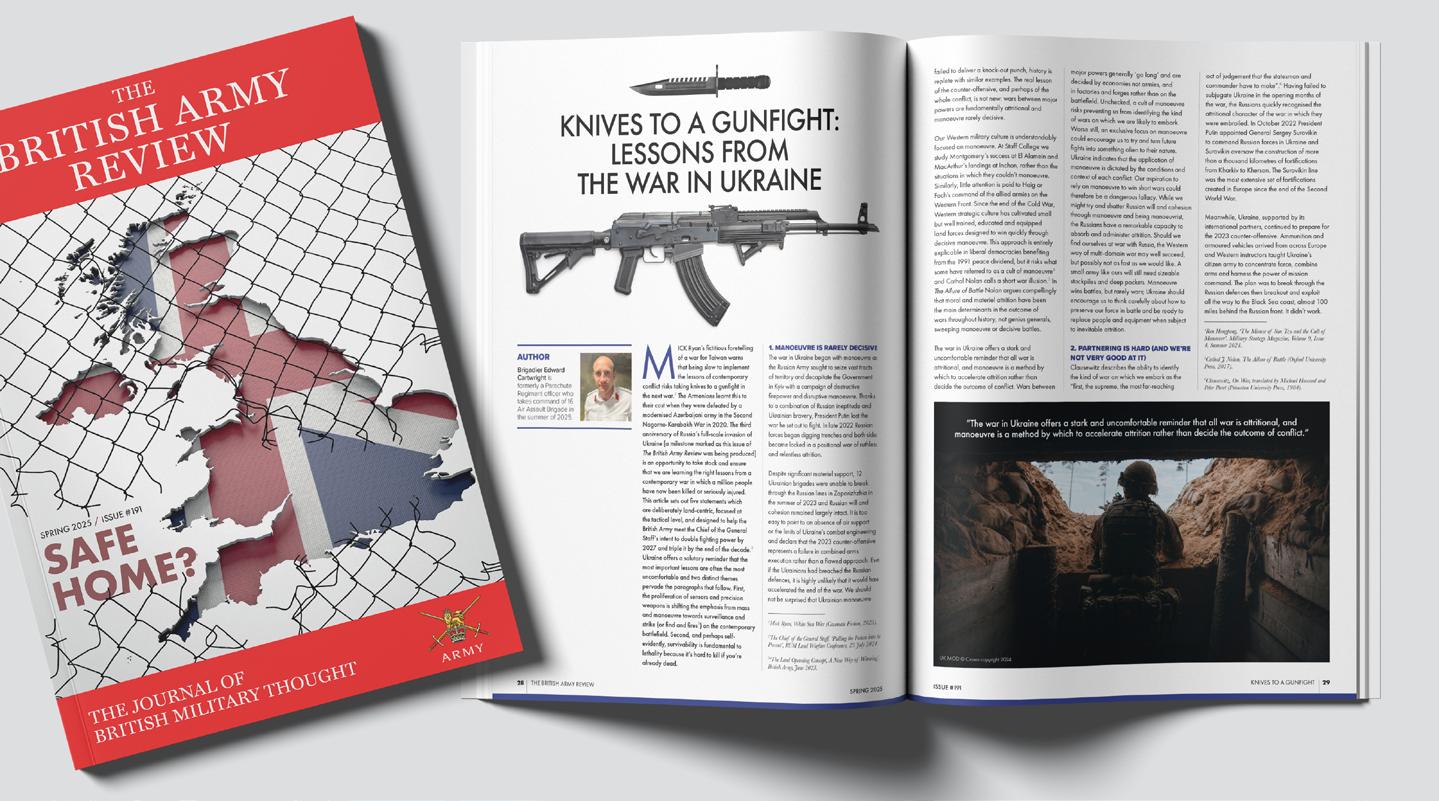
The second example is an article that appeared in a former edition of this journal. Written by an officer who had spent the previous 12 months in Ukraine, Knives to a Gunfight (pictured above) covered his experiences and offered recommendations for the British Army. He raised that drones had
become a dominant lethality platform on the battlefield,15 that this growth in capability had happened over a relatively short period of time and that it looked to be continuing. He noted that the establishment of specialised Ukrainian drone units had made a significant difference to the effectiveness of the force,16 and he warned of the West not being ready for a war that could come soon. Yet, in the same article he recommended against the British Army developing its own drone units,17 sensing it was too early, and his concluding paragraphs culminated on the need to do the basics well. This was a marked contrast to the call-to-arms hinted at in the title of his article and the very clear argument he made within it on the impact of drones on the battlefield. With the statistics now pointing to drones being responsible for between 70-80 per cent of the kills in 202518
and individual drone effectiveness increasing over the period from 15 to 50 per cent with the formation of a professionalised drone cadre, this author’s argument has been proved correct but his conclusions proved overly conservative. Indeed, so powerful has the impact been that the gap between Russian and Ukrainian troops has crept to 25 kilometres as each side seeks to escape the death zones created by pervasive drone operations.19 For note, 25 kilometres is a greater distance than the AS90 can fire, and, going back to our equipment plan, is over twice the range of the 120mm mortar the Army aspires to acquire as part of the latest Defence Review.
The third and final example is the difference between the speeches of the Army’s Chiefs over the last two Defence Reviews and the
capabilities they have asked to purchase. General Sir Mark Carleton-Smith spoke of an “Asymmetric Army for the Digital Age”,20 which combined boots and bots, and in which armoured vehicles would be mother ships for unmanned capabilities. General Sir Roly Walker’s speech to RUSI on 17 June 2025 observed that the Army needed 5th Generation capabilities, that the market for military drones over the next decade was likely to be double the value of the armoured vehicle market and that he wanted to spend 50 per cent of his budget on attritable systems.21 Yet both have presided over Defence Reviews which primarily focus the Army’s resources on our armoured capabilities: Challenger 3, Ajax and Boxer. And although there is investment in modernised targeting tools and command and control, there appears to be no resourced intent to equip either the 1st or 3rd Division with a specialised drone capability at scale. There are all sorts of reasons why the Chiefs are trapped to buy some of this equipment, but if we are going to modernise and make the most of the generational investment promised by this Government then it is hard not to raise an eyebrow at the mismatch between words and deeds.
It does not have to be this way. And, even if we remain trapped in a legacy equipment programme, there is still room to develop at seed-corn the capabilities we would undoubtedly need come conflict. The Army aspires to spend more money on buying 120mm mortars in this Defence Review, but given the range issues raised earlier – could this funding not be prioritised against a more systematic development of a near-surface capability?
THE US NAVY MODEL
When looking at transformative change of a fighting service it is hard to look past the US Navy’s experience in the Second World War.
For those unfamiliar with the US Navy’s approach during the inter-war period, they were probably the most intellectually prepared force to enter the Second World War.22
15Brig Edward Cartwright, ‘Knives to a Gunfight’, BAR 191 (2025) p.30.
16-17Ibid, p.31.
18Project EAGLE, Memo for United Kingdom MoDInsights from Ukraine’s Drone War, May 2025.
19V. Bowen, Ukraine’s plan to cut off Russia’s front-line troops is working, Telegraph 14 Mar 26
20Gen Sir Mark Carleton-Smith, Speech at Hermitage, 29 Sept 2020.
21Gen Sir Roly Walker, Speech at RUSI Conference, 17 June 2025.
Between the wars the US Navy became increasingly clear that the most significant naval threat in the Pacific would come from Japan, a nation that had studiously adopted the customs and technologies of the US Navy’s other most significant competitor; the Royal Navy. To understand this threat and the technologies that the Navy needed to invest in, and to train their naval staff, the US Navy embarked on an holistic programme of live and simulated wargaming that set both the Fleet-at-Sea and the Naval Schools on a joint programme to research the emerging problem sets – with a symbiotic flow of information between them. By the time war broke out, all of the commanders that would define the US Navy’s success in the Pacific War had marinated in the evolution of these problem sets and their solutions. Crucially, as a result of this process an informal but clear and effective doctrine of naval air power had begun to emerge.23 Such was the impact of this preparation on their ability to fight, that within six months of Pearl Harbor – with most of its battlefleet damaged or still under-water, the US Navy had turned to its aircraft carriers as the decisive weapon to hold back the Imperial Japanese Navy. And, using these aircraft carriers, they fought and won two of the most iconic and epoch defining naval battles in history at Coral Sea and Midway – battles so decisive that they determined US victory in the Pacific was just a matter of time.24
Unlike later battles, these were fought entirely with pre-war equipment – the vast production lines of ships and aircraft were yet to bear fruit. This was payback for the intellectual and physical investment in the officers and men of the US Navy, that allowed them to fight and win, shorn of the technology that had previously been thought to determine the fight.
Now to assume this transformative culture came entirely or even largely from within the Service would be wrong. What saved the US Navy’s air power was political control. Peacetime and retrenchment following the Great War had encouraged all militaries to prioritise protecting core capability. Britain’s Fleet Air Arm, which had led the development of naval air power (including the first purpose-built aircraft carrier), spent the inter-war years so starved of resource that the primary British naval strike aircraft on the outbreak of war remained a biplane with an open cockpit. The US had a not dissimilar issue, with powerful arguments led by Billy Mitchell for incorporation of the US Navy’s aircraft capabilities within a USAFlike construct, and the grasping of resources to fund more conventional capabilities within the Navy. However, the US Navy was run
“There is still room to develop at seed-corn the capabilities we would undoubtedly need come conflict. The Army aspires to spend more money on buying 120mm mortars... could this funding not be prioritised against a more systematic development of a near-surface capability?.”
on a bureau system in which each bureau was given independent political oversight. As such, it was the bureau that dictated the funding priorities for naval aviation, and it was Congress who in 1925 dictated that only those who had pilots wings could command naval air assets (carriers, seaplane tenders, etc.). This policy was supported by resource and deliberate – sending senior officers to schools alongside ensigns and lieutenants.25 Both King and ‘Bull’ Halsey were already naval captains by the time they were sent to flight school and got their wings. The latter decision drove the US Navy’s command structure to be retrofitted with air-mindedness rapidly as ambitious commanders sought competitive advantage for command, whilst the former meant that the US Navy has some of the most advanced carrier aircraft in the world. By the time of the outbreak of war, the US Navy had aviators at every rank from Chief of Naval Operations to the ensigns joining the carrier squadrons, and the latent skill sets and understanding of this new capability had been grown to such a degree that there was little shortage of skilled commanders who could seize this moment of revolution in naval affairs (they had done something similar with submarines – and Admiral King, their Chief of Naval Operations – had both submarine and aviation experience in addition to his long career as a surface warship officer). By 1943 the US had 34 ‘air admirals’, in 1944 it had 54 – making up over 25 per cent of those at flag rank26 –not bad for a policy that had started just over a decade previously.
SO WHAT?
The first conclusion is that wargaming in staff departments will not bring understanding of novel capabilities into the mainstream; Project Velocity will remain shelfware for most of the Army. However, if those same wargames had played out at Junior, Intermediate, Advanced, and Higher Command and Staff Courses (in addition to wargaming in the formations) the insight and understanding would be distributed across and developed by the whole force.
The subsequent conclusion is that aligning individual incentives with generating transformational skillsets is a powerful way to accelerate change in an organisation. Building military staff rules that favour near-surface knowledge, skills and experience whilst generating drone-warfare courses to retro-fit the chain of command is an obvious and realistic way to ensure we are set for conflict morally, conceptually and physically.
My final and boldest conclusion is that direct political oversight of transformative/novel technologies could be hugely beneficial for driving progress and closing the ‘say-do gap’. This could be a fascinating portfolio for the Minister for the Armed Forces but would need to go beyond acting as a lobbying power to the deliberate allocation and control of resource. This ministerial responsibility for protecting, driving, resourcing and guiding unmanned capabilities across the Services could be a bold step toward modernisation.
AND AN AFTERTHOUGHT...
The final and finest pattern of infantry sword for the British Army was produced in 1897 (as a revision from the 1895 pattern), arguably long after battlefield technology had demonstrated it was obsolete. The final and finest battleship built for the Royal Navy was launched in 1945, years after carriers had shown it to be a legacy capability. Britain’s final and finest piston-engined propeller fighter entered service four years after the Gloster Meteor and Me-262 had ushered in the jet age. Will Challenger 3, Ajax and Boxer be blessed with a similar description in due course? I have a suspicion...
22This intellectual investment continues to this day, with Annapolis remaining a dynamic hub for military academic thought.
23Clark Reynolds, The Fast Carriers, Krieger, New York 1978 p.17.
DRONIFICATION: A REALISTIC RUNWAY TO REMAINING COMPETITIVE
AUTHOR
Illya Sekirin volunteered to fight for Ukraine in March 2022 and saw front-line service as a small tactical drone operator and instructor. He went on to become an unofficial adviser to several members of the Ukrainian High Command and authored a paper that informed President Volodymyr Zelensky’s decision to create Unmanned Systems Forces as a separate branch of the Armed Forces of Ukraine. Illya is the author of Rise of the Machines –Drone Warfare in the Russia-Ukraine War: Tactics, Operations, Strategy
“When the greatest striking power of the offensive resides in a particular weapon, this weapon must claim the right to use that power according to its own rules. It will be the main battle-winning weapon, wherever it is put into action, and the other weapons must accommodate themselves to its needs.”
– Heinz Guderian
1
THERE are moments in history when a ground-breaking military technology enters the mainstream and changes warfare forever. In the 20th century, it was the tank and the aeroplane; in our time, it is the drone. Uncrewed Aircraft Systems (UASs) have expanded both qualitatively and quantitatively during the Russia-Ukraine war to such an extent that conventional weapon systems – armour, artillery, attack helicopters and massed infantry – have lost much of their former battlefield potency. Indeed, with more than 80 per cent of combat casualties and hardware destruction now being caused by the drone,2 it has become the new king of the battlefield.
Service today appears to be roughly where the Armed Forces of Ukraine were in 2023: acknowledging that drones have a place on the modern battlefield, and are perhaps equal to armour, artillery or infantry. Technologically, this no longer reflects reality.
The drone has become so dominant that it has relegated all competing weapon systems away from the kill zone. What remains at the front are only dispersed, concealed and sparsely manned infantry positions – and even these can be sustained, in the main, using cargo hexacopter-type UASs and Uncrewed Ground Vehicles (UGVs). Similarly, force rotation and medical evacuation now require sophisticated, carefully planned operations, often conducted under exceptional conditions such as dense fog, when drone visibility is severely degraded.
1Heinz Guderian, Achtung-Panzer! The Development of Tank Warfare (London: Weidenfeld & Nicolson, 1999), 205.
2Michael C. Horowitz, ‘Ukraine’s Operation Spider’s Web Shows Future of Drone Warfare’, Council on Foreign Relations (Expert Brief), 3 June 2025, cfr.org/expertbrief/ukraines-operation-spiders-web-shows-future-dronewarfare (accessed 27 December 2025).
3NATO Must Learn from Ukraine’s Frontline Drone Labs, Center for European Policy Analysis, 7 October 2025, cepa. org/article/nato-must-learn-from-ukraines-frontline-dronelabs (accessed 27 December 2025).
Drones have established an ever-expanding kill zone – currently measuring approximately 20 kilometres on both the Russian and Ukrainian sides of the line of contact (around 40 kilometres in total)3 – within which anything that moves is rapidly identified and destroyed in real time by swarms of FPV [first-person view] and bomb-dropping UASs. The era of drone warfare has arrived.
With that in mind, I was encouraged to learn during a visit to the United Kingdom for the CHACR annual conference, that the drone revolution has not gone unnoticed by the British Army. Conceptually, however, the
In other words, the drone is no longer a peer of artillery, armour, army aviation or mass infantry. It has defeated these systems, pushed them away from the front line, and reduced their role to niche applications where they can still function. If the British Army’s response to the drone revolution is merely to elevate drones to parity with traditional capabilities, allocating resources accordingly, it will place itself at a severe disadvantage against adversaries that have put drones at the centre of their force design and subordinated legacy systems to them.
A case in point is the Armed Forces of the Russian Federation. A theoretical armed conflict with Russia is a distinct possibility in the coming years, if not months. The Russians – arguably the second most experienced military in the world in drone warfare after
the Ukrainians – have made the drone the centrepiece of their military doctrine, with other force capabilities structured to support it (at least in practice if not fully in formal doctrinal documents). UASs now form the backbone of Intelligence, Surveillance, Target Acquisition and Reconnaissance (ISTAR) and situational awareness, creating what is often described as a ‘transparent battlefield’. At the same time, drones act as kinetic systems, delivering immediate and precise fires against any detected movement or thermal signature within the kill zone.
When the destructive power of drones alone is insufficient, UASs direct strikes by medium- or long-range fires, including aircraft-delivered glide bombs, multiple rocket launchers and even ballistic missiles. No movement – even by dispersed infantry – takes place within the kill zone without coordination through UASs. Increasingly, drones are also extending their omnipresence deep into operational and strategic rear areas, where they can be deployed in mass to strike the enemy at depth.
Accordingly, the British Army should also make the drone the centrepiece of its force design and approach to warfighting. Doing so will not be easy. The drone revolution demands a fundamental rethinking of doctrine, organisational structures, procurement processes, training and every other aspect of preparing for and conducting war. Moreover, this transformation cannot be driven by senior leadership alone. It must involve the rank and file, who must embrace the shift and actively support it. To capture this transition from manned to unmanned warfare, I propose the term dronification. The desired end state is the comprehensive integration of uncrewed systems and associated technologies –electromagnetic warfare, cloud-based realtime data analysis and artificial intelligence – across the force. Wherever a drone can enhance lethality, survivability or efficiency, it should be employed, not only in combat roles but also in logistics, medical evacuation and force sustainment.
BACK TO THE DRAWING BOARD
Recognising that full dronification of the British Army would take years – alongside comparable reforms in the Royal Navy and
“The rank and file must be granted sufficient autonomy to begin learning and adapting to drone warfare immediately, rather than waiting for top-down reform to be fully designed and implemented.”
Royal Air Force – and given the need for the Service to be ready to fight wars on land (with drones) today or tomorrow, this transformation must be driven simultaneously from the top down and from the bottom up.
While Army leadership is engaged in establishing centralised uncrewed systems forces or similar structures to institutionalise the use of drones – encompassing rapid procurement procedures, personnel training and doctrinal refinement – the rank and file must be granted sufficient autonomy to begin learning and adapting to drone warfare immediately, rather than waiting for top-down reform to be fully designed and implemented. Bottom-up dronification, however, should not be chaotic. Clear boundaries and guidance must be set by senior leaders to define the limits of this autonomy.
Notably, both the Armed Forces of Ukraine and the Russian Armed Forces began their drone revolutions as decentralised bottom-up initiatives, which were institutionalised only years after uncrewed systems had already come to dominate the battlefield. This historical experience offers an instructive model.
allocated to support collaboration. Ideally, each unit would identify a core group of technologically-savvy and motivated officers, non-commissioned officers and soldiers responsible for driving bottom-up dronification within their unit and sharing lessons learnt with sister and higher formations.
To formalise this function at unit level a dedicated drone officer, responsible for promoting the integration of UASs and associated technologies, should be appointed.
To ensure that bottom-up dronification of land forces proceeds efficiently, and to prevent units from repeatedly ‘reinventing the wheel’, close integration between British and Ukrainian drone ecosystems should be pursued. This would include not only structured exchanges of operational knowledge between peer units, but also access for British formations to Ukrainian drone industry and training centres.
4Global Tactical Edge Acquisition Directorate (G-TEAD) Marketplace, U.S. Army contract opportunity, System for Award Management (SAM.gov), sam.gov/workspace/ contract/opp/c56028b99e7644a5a48e0d28f5111c8a/ view (accessed 27 December 2025).
5Brave1, Ukrainian Defense Innovations (official website), Government of Ukraine, brave1.gov.ua/en (accessed 27 December 2025).
For bottom-up reform to succeed, it is vital to establish strong horizontal links within and between Army units to share knowledge and practical experience in the employment of drone technologies. This activity should not be suppressed but actively encouraged by Army leadership, with dedicated resources
If, for example, individual procurement budgets were allocated to British brigades and equivalent formations – in a fashion similar to the US Army, which has begun to experiment with delegated spending using its Global Tactical Edge Acquisition Directorate (G-TEAD) Marketplace4 – these units could access Ukraine’s digitised drone procurement system Brave15 (on which the American system was modelled) to purchase equipment tailored to their operational needs. Ukrainian droneindustry capacity already greatly exceeds the purchasing power of the Ukrainian state and
its supporting non-governmental organisations, making it economically and operationally rational to procure battle-tested Ukrainian UASs, UGVs and electronic warfare equipment at a fraction of the cost charged by many Western manufacturers.
Each combat arm of the British Army can begin bottom-up dronification immediately through incremental change. Ideally, experimental budgets should be allocated to brigade-level formations for this purpose; however, some measures –such as training in dispersion and concealment – can already be implemented without any additional allocation of funds.
Infantry: Massing troops is now an invitation to detection and destruction by enemy drones. Offensive and defensive operations therefore need to be conducted by dispersed, concealed formations. Small surveillance drones – comparable to the DJI Mavic 3 or its military-grade equivalents, of which the Brave1 marketplace features several models –can be employed to assess whether a position is detectable from near-surface altitude (from approximately 30 to several hundred metres). Such reconnaissance should inform stricter concealment standards and improved integration of terrain masking.
Offensively, infantry must learn to manoeuvre under persistent drone coverage, operating in small infiltration groups of two to five soldiers through treelines and urban terrain, including the use of thermal-signature-reduction cloaks and other measures. Light individual mobility platforms, such as all-terrain vehicles or motorcycles, may further reduce exposure during movement within the kill zone (noting that they are not suitable for direct assaults against enemy positions).
Every infantry soldier must possess a basic
6Matthew Loh, Business Insider, 11 December 2025, businessinsider.com/ukrainian-uncrewed-ground-vehicleroad-night-ambush-russian-m2-browning-2025-12 (accessed 27 December 2025).
7United24 Media, united24media.com/latest-news/ ukrainian-ground-drone-with-machine-gun-defendsfrontline-position-solo-for-45-days-14488 (accessed 27 December 2025).
8Matthew Loh, Business Insider, 17 December 2025, businessinsider.com/ukraine-small-propeller-drones-flyfaster-formula-car-fedorov-2025-12 (accessed 28 December 2025).
9‘Blinding the Russians’ eyes in the skies: how Ukraine is fighting the drone war’, Ukrayinska Pravda (English edition), 23 December 2024, pravda.com.ua/eng/ articles/2024/12/23/7490268 (accessed 28 December 2025).
“Every infantry soldier must possess a basic understanding of tactical drone employment, detection systems and the use of portable electronic warfare devices to mitigate threats.”
understanding of tactical drone employment, detection systems (small hand-held radio frequency scanners that beep whenever a UAS flies nearby and may even intercept the video feed from an enemy FPV) and the use of portable electronic warfare devices (jammers) to mitigate threats.
Armour: The role of armour in drone-saturated warfare has been significantly reduced. The tank as we know it is probably dead, on the grounds it is expensive to produce and represents a very easy target for enemy FPVs. However, what armour units can do in their bottom-up dronification efforts is to increase survivability by procuring additional counterFPV screens, armour and nets; adapt their tactics to ensure the force is dispersed and moves rapidly between covered positions; and place a greater focus on concealment.
In the longer term, tanks are likely to be supplanted by uncrewed systems. Accordingly, armoured units should begin procuring and training with assault UGVs – both tracked and wheeled – equipped with remotely-operated machine guns and automatic grenade launchers to allow current tank crews to transition to operating uncrewed ‘mini-tanks’. Those sceptical of such an evolution should watch the video of a Ukrainian Droid TW 12.7 land robot destroying a Russian MT-LB (lightly armoured tracked infantry fighting vehicle) with a remotely-controlled M2 Browning machine gun.6 The same model independently defended another Ukrainian position for 45 consecutive days, without any human soldiers present.7 If used in a concentrated fashion, UGVs can do what tanks used to do – provide shock in combined arms manoeuvre.
Artillery: Artillery must also adapt to the challenges of constant surveillance and being targeted by enemy drones. Dispersion, concealment and rapid displacement will be critical, alongside close integration with friendly drone networks, particularly those operated by supported infantry formations. In training, additional emphasis should be placed on the rapid movement of artillery pieces to firing positions,
a high rate of accurate fire and equally rapid concealment. It can be expected that artillery will operate predominantly at maximum range in order to minimise exposure to the enemy drone kill zone.
Army aviation: Army aviation is likely to be progressively succeeded by FPV capabilities – quadcopter-based systems operating out to up to 20-30 kilometres and fixed-wing drones capable of distances of 30-100 kilometres (known as ‘mid-strikes’ among the Ukrainian drone community). Reconnaissance and attack helicopters will retain utility primarily in permissive or humanitarian contexts, rather than in combat against peer adversaries. Even now, Ukrainian drone interceptors have the capacity to engage hostile fixed-wing drones and manned helicopters at speeds of up to 400 km/h8 and at altitudes of up to 5,600 metres or more.9
Helicopter aircrew and ground personnel should therefore begin developing secondary competencies in operating and maintaining medium-range strike drones, extending the reach of tactical systems which will be mainly flown by infantry units.
Combat support and combat service support: Combat support arms and combat service support – including engineers, logisticians and medical services – must also adapt to the expanding drone kill zone. Commanders must reassess survivability, mobility and sustainment under persistent aerial observation.
Medical doctrine, in particular, will require revision. Immediate and enhanced first aid training may need to be expanded significantly, as casualty evacuation from within the kill zone is increasingly difficult and the traditional ‘golden hour’ may no longer exist. Casualties, even those with a tourniquet and requiring urgent professional medical help, may need to survive for
extended periods – potentially days – before evacuation, likely conducted by UGVs rather than manned platforms.
TOP-DOWN DRONIFICATION
While bottom-up dronification can buy time and generate operational competence, lasting transformation requires central direction. A coordinated effort by military, and potentially political, leadership will be necessary to establish uncrewed systems forces, either as a separate service (equal in standing to the Army, Royal Navy and Royal Air Force) or as a dedicated combat arm within the Army.
Regardless of organisational form, such forces would be responsible for driving full dronification of the Army: institutionalising lessons from bottom-up innovation and fielding large drone formations of at least brigade size (possibly even a drone division). These formations could perform operational-level penetrations of enemy kill zones, in a manner analogous to the employment of armoured divisions during the Second World War. In a notional example, a drone division would position thousands of its operators along a 30-kilometre front, preferably on high ground to provide favourable radio horizons for its UAS and electronic warfare forces. By creating a crushing local correlation of drone forces in its favour and exploiting surprise, it would rapidly establish UAS superiority over the battlefield and then attack on the ground in echelons on a narrower 10-kilometre front using waves of UGVs. Once UGVs and UASs defeat the enemy in this sector, small mechanised assault groups would rapidly bring forward small parties of storm troops to mop up any remaining resistance. In this way, under a strong UAS umbrella, a breach in the enemy kill zone would be created, through which drone-centred manoeuvre units (the mobile element of the drone division) could pour to envelop large enemy groupings and their drone kill zone from the rear and reach other operational or strategic objectives.
To enable effective command and control of such a large drone armada, and to supply drones and related equipment to other combat and support arms of the Army, a dedicated procurement process would be required. While local commanders at brigade and divisional levels should be able to procure their own drones as part of bottom-up dronification, Army leadership would need to ensure that the supply chain is resilient to shock. Ideally, drone manufacturing facilities should be dispersed, protected and located as close as practicable to the likely theatre of operations. If a conflict on NATO’s eastern flank is anticipated, it would be prudent to establish
“Casualties may need to survive for extended periods – potentially days – before evacuation, likely conducted by UGVs.”
drone and counter-UAS industrial capacity in Eastern Europe (for example, Ukraine and neighbouring countries), which also offers a lower-cost production base. Furthermore, Ukraine has already achieved up to 90 per cent drone localisation,10 meaning it is much less dependent on Chinese-made drone parts than manufacturers in other countries.
Where clear trends emerge in the preference for particular drone models among local commanders, central command could then negotiate more favourable contracts with manufacturers. Crucially, the provision of drone and electronic warfare equipment must be accompanied by real-time technical support from industry. Any soldier, noncommissioned officer or officer should be able to contact a brigade- or division-level drone workshop, staffed by trained personnel and supplied with spare parts directly by the drone maker. These workshops, in turn, should have direct access to real-time technical assistance and support from the companies that design and produce the systems. Drone warfare is technologically sophisticated and failures are inevitable; maintaining a close and continuous link between user, brigade workshop and manufacturer is therefore essential.
In addition, electronic warfare and drone forces should be closely integrated at the tactical, operational and strategic levels to ensure effective coordination. Without such integration, electronic warfare operators risk jamming their own drones and creating gaps in counter-UAS defences.
RADICAL TIMES CALL FOR RADICAL SOLUTIONS
If the changes proposed in this article appear radical, that is because the drone revolution demands extraordinary measures. As Niccolò Machiavelli observed in The Prince “…he will be successful who directs his actions according to the spirit of the times, and he whose actions
do not accord with the times will not be successful”.11 The drone revolution is already upon us and, if the British Army embraces it, the Service can secure a decisive first-mover advantage rather than ceding that competitive edge to its adversaries.
A fully dronified British Army may also reduce the need for mass mobilisation in times of war. Polling suggests that only around 30 per cent of the UK population would be prepared to defend the homeland, with willingness to defend Poland or France falling to just 13 and 16 per cent respectively.12 Post-industrial society is unlikely to change in this respect; adaptation is therefore required. Rather than investing billions of pounds in the infrastructure required to train and equip mass armies, which may prove difficult to raise and risk internal social strain, it would be more effective to invest in the full dronification of a volunteer professional force. Such an approach could increase lethality and survivability by an order of magnitude, drawing on Ukrainian experience of holding front lines with brigades operating at only 30 per cent of nominal strength13 through extensive use of drones. Pay for servicemen and women would, of course, need to increase to attract sufficient numbers, particularly those with technical skills, but this would still be significantly cheaper than fielding large conventional mass armies. It is better to attrit drones than soldiers.
These lessons apply equally to other NATO states. In close coordination with Ukraine, those in the Alliance could establish worldclass uncrewed systems forces. Russia, now arguably the second most dronified military, does not fear Western armour, army aviation, artillery or infantry. It does, however, fear Ukrainian drones. If those capabilities become NATO capabilities, a future armed conflict with the Russian Federation could be deterred by demonstrating the futility of attempting to fight a fully dronified force.
10Dev.ua, ‘Vyriy Drone explains why full localisation is not the goal’, 26 August 2025, available at: dev.ua/ news/my-ne-zatsykliuiemosia-na-tsyfrakh-chy-tse-90ukrainskykh-komplektuiuchykh-u-dronakh-chy-100-u-vyriydrone-poiasnyly-chomu-povna-lokalitsiia-dlia-nykh-nesamotsil-1756197078 (accessed 27 December 2025).
11Niccolò Machiavelli, The Prince, trans. W. K. Marriott (1908), ch. XXV.
12Only 16% of Brits would fight to defend France, UnHerd, 6 June 2024, available at: unherd.com/newsroom/only-16of-brits-would-fight-to-defend-france (accessed 27 December 2025).
13Moseychuk and Bohdan Krotevych (“Tavr”): “I will never say anything good about Akhmetov” (YouTube video interview), presented by Nataliya Moseychuk with Bohdan Krotevych, available at: youtube.com/watch?v=H51Oqhq_ Agw (accessed 27 December 2025).
‘A DRONE ATE MY HOMEWORK’: THE DEATH OF MILITARY THOUGHT AND SCIENCE
AUTHOR
William F. Owen (Wilf) served for 12 years in the British Army in regular and reserve infantry and intelligence units. He co-founded and is the editor of Military Strategy Magazine His book, Euclid’s Army: Preparing Land Forces for Warfare Today (Howgate Publishing), is out now.
THE common belief is that ‘drones’ have fundamentally altered the battlefield, becoming crucial for reconnaissance, target acquisition and precision strikes. Many military analysts think that low-cost commercial drones can effectively halt any military advance because of their apparent demonstrated ability to destroy expensive conventional platforms such as tanks. Removed from the specifics of the war in Ukraine, this may not be a safe assumption. Moreover, it may fail the ‘if true, so what?’ test. What follows has the added upsetting quality that ‘lessons from Ukraine’ are objectively lessons because the Western military science and thought ignored the very clear evidence of both World Wars and existing capabilities. The observations of the ignorant will thus always be lessons.
Using historical facts that almost anyone can confirm assumes we can all agree that:
n Drones have been widely employed for
real-time reconnaissance and directing artillery fire since the 1970s;
n Drones have been widely employed for photo reconnaissance and electronic warfare since the 1960s;
n Drones firing weapons date to the 1970s and was routine by the 21st century;
n The first drone cargo delivery was made by the CQ-10 Snow Goose in 2005;
n Combat-proven loitering munitions have existed since the 1980s;
n The British Army had extensive experience of using both large and very small Uncrewed Aerial Systems (UAS) in Afghanistan and Iraq, and that experience should have informed UK warfighting capability before the Russian invasion of Ukraine in February 2022.
By any factual measure, nothing done by
drones in the Russo-Ukrainian War is new, except for fibre-optic guidance, which is a well-established technology. As we shall see, conceding or admitting this might be considered broadly unacceptable.
Without wishing to add to the pain, a more detailed examination might help. On 7th October 2001, an MQ-1 fired two Hellfire missiles in an attempt to target a Taliban leader. As of February of that year, testing had been conducted against tank targets in the Nevada desert. Drones could kill tanks, something well known and documented since December 1971, when Ryan Firebee fired an AGM-65 Maverick against a test target. The 1971 test was extremely well documented and in the public domain by 1973. The drone firing Hellfires was a worldwide headline, two decades before the war in Ukraine. The ability for drones to kill tanks in large numbers was thus a well-established and empirically proven capability even in the 20th century.
Allied to this and given the literally millions of drone hours flown in Afghanistan and Iraq, why wasn’t the battlefield declared ‘transparent’ a decade and a half earlier? The vast majority of the British Army should have asked “if true, so what?’ and been aware of the historical precedent.
THE EMPEROR’S NEW DRONE
The cultural problem of admitting that what is being seen in Ukraine is nothing new, as well as a plethora of other things advertised as lessons, is the flow-down implication of such an admission.
For example, if loitering munitions were so useful and indeed combat-proven from the 1980s at defeating enemy air defence, where was the UK’s loitering munitions programme, and why has it been cancelled? If the Russian Lancet was so deadly, why was the battlegroup in Estonia being fitted with Active Protection Systems (APS) as part of an urgent operational requirement? No Russian or Ukrainian vehicle is fitted with an APS. The Israelis have more than 750 armoured fighting vehicles fitted with APS and merely used a software upgrade to ensure
“What was deemed transformational in Ukraine was routine in the British Army a decade earlier: UK troops employed a similar system on operations in Afghanistan as of 2006, in the form of Desert Hawk.”
that it could defeat drones.1 In a very real sense, if Israeli equipment and training were used against an enemy with current levels of Russian or Ukrainian training and equipment, the potential for massed armour manoeuvre, complete with breaching equipment and the wide-area suppression of enemy air defence (as performed against Iran and Syria) and counter-battery fires, would render $3,000 first-person view drones mostly, if not completely, irrelevant. Unlike drones, operationally proven APS did not exist until 2011, despite the systems having it been developed to a high level of technological readiness some five to seven years earlier. Did APS ‘transform the battlefield’, and if so, how come the UK does not have it in widespread service? Why focus on first-person view drones when APS would render them mostly irrelevant? The reality of APS has been completely absent from any reporting or analysis that this author could find at the time of writing, yet it was described in my own work nearly two years ago.2
This is not a criticism of the British Army’s equipment plan, but it seems odd to claim, ‘drones are transforming warfare’ and not to have addressed that supposed fact within wider capability. In other armies, this now includes deployed and in-service direct energy weapons.
This was publicly announced in the press.3 These are the same make and type of drones deemed to have transformed warfare in Ukraine.
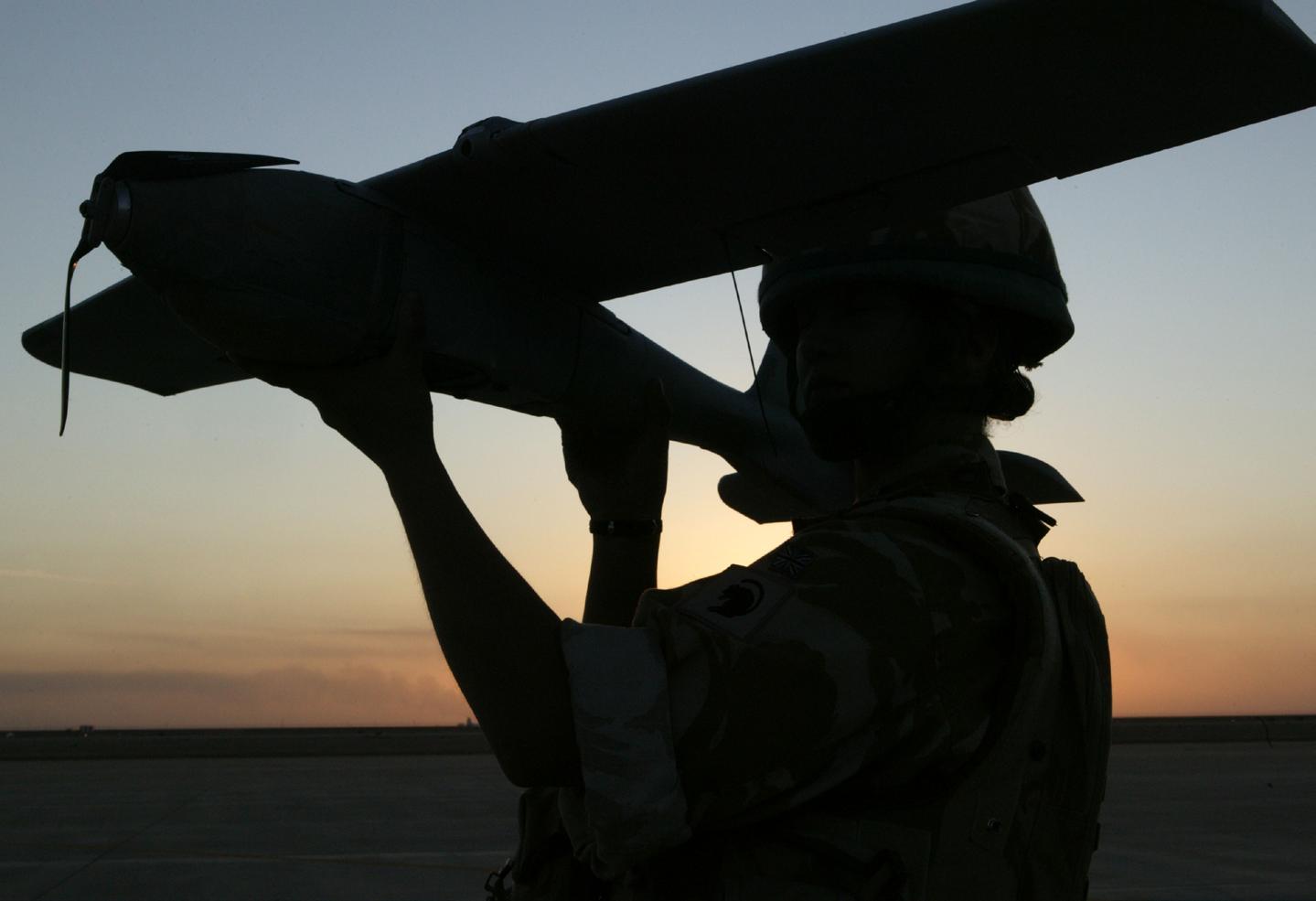
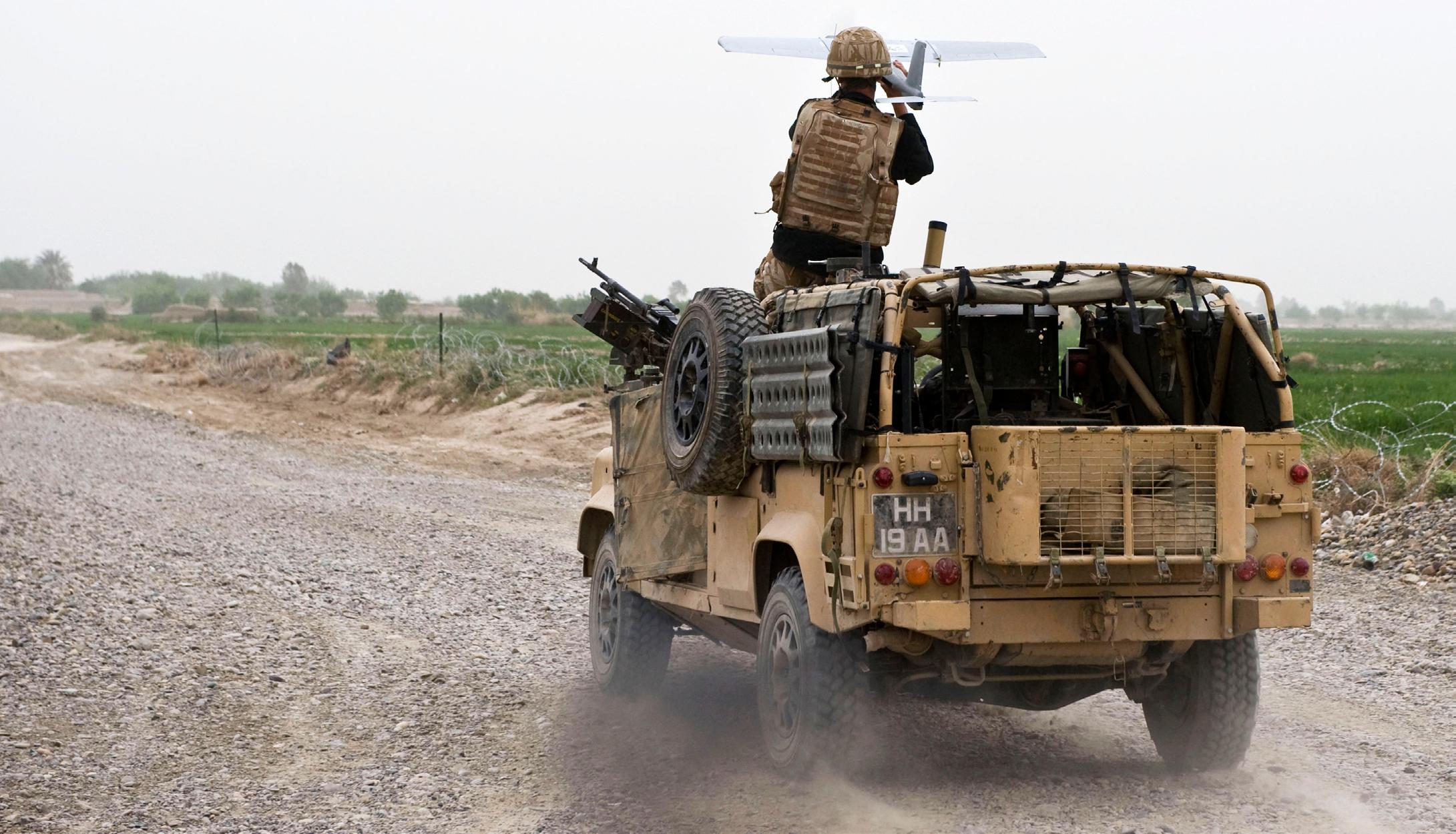
What was deemed transformational in Ukraine was routine in the British Army a decade earlier: UK troops employed a similar system on operations in Afghanistan as of 2006, in the form of Desert Hawk, used by 18 Battery, 32 Regiment Royal Artillery. In the same vein, it is worth noting that the British Army had platoon and company-level ‘drones’ in service in Afghanistan as of 2012-13 in the shape of the Black Hornet. While not entirely successful and procured as an urgent operational requirement, why was this capability not pursued, given the obvious and improving technology in the area? Given first-hand combat experience, who in the British Army suddenly deemed drones ‘transformational’?
1The widely published pictures of IDF MBTs sporting “drone cages” is misleading. It was a unit level modification, specifically for grenade dropping drones, and with the advent of other countermeasures is useful as shade.
2Owen, William F. Euclid’s Army, page 88. – published January 2025, based on research from December 2023.
In 2010, the Israel Defense Forces (IDF) formed the Sky Rider Unit of the Artillery Corps to create a low-cost, man-portable UAS capability with two hours of endurance and 10 kilometres of communications range. In 2017, every company commander in the IDF’s Infantry, Border Defence and Combat Intelligence Corps became equipped with a Mavic off-the-shelf camera-equipped drone.
It has been technically simple to equip every UK infantry battalion with a ‘drone platoon’ since 2008, assuming spare manpower on establishment, which is a far more complicated issue, as is training budget, but it might be assumed that this would have been balanced against the clear operational advantage, had one really existed. In October 2018, OSCE [Organization for Security and Cooperation in Europe] drones encountered Russian Army jamming in the Donbas, but the event passed completely unnoticed by most defence analysts and commentators.4 This was despite the US Army explicitly describing the phenomenon in its Russian New Generation Warfare Handbook in December 2016, noting that the Russians were clearly aware of the utility of UAS.
Now in the public domain, this author’s work on the UK Strike brigade concept included
the use of Desert Hawk, with officers from 32 Regiment involved in developing the thinking. Beyond any shadow of doubt, some of the Afghan experience did transfer to warfighting concepts. The Strike concept was also very aware of the threat of the Russian Orlan drone, deemed so effective in the Zelenopillia rocket attack on 11th July 2014 in the Luhansk region. All of this was predicated on the belief in widespread Russian competence in matching persistent intelligence, surveillance and reconnaissance with devastating levels of deep fires. Neither of these has proven to be the case, as the best advice from Russian Army subject matter experts was incorrect regarding overall Russian military competence. This is not a minor point. This author took part in a number of command post exercises and force development war games, where Russian ISTAR [Intelligence, Surveillance, Target Acquisition and Reconnaissance] fires were advertised as more competent and lethal than the UK’s, and combined with greater equipment capabilities, including scatterable mines and intelligent sub-munitions. The Russian Army has now had nearly four years to recover its competence, yet this is not readily apparent. As of 14th January 2026, Russia has been at war longer than it was with Nazi Germany.
Very few observers have noted that the ‘rise of the drones’ has been in the context of an enemy armed force that has fallen well short of where most armed forces should be in the 21st century. Why would anything done in the face of an almost completely incompetent land force, as in that which Russia has fielded, be grounds for improvement?
In some ways this is not even a land domain problem, even accepting cross domain paradigm, because given that it is the Royal Air Force’s primary task is to destroy enemy integrated air defences, as the Israeli Air Force
“Amongst the plethora of UK firms and individuals trying to sell drones to the British Army, where is the fibre-optically guided capability?”
did with Iran, it then falls to them to use that freedom of action to begin shaping the enemy to the point where their use of drones is utterly irrelevant. Every assertion made to date about the use of drones, including trials and exercise claims as to how unprepared the British Army might be, ignores or is unaware of the potency of air power. Israel’s air operations against Iran have yet again shown how vulnerable integrated air defence systems based on Russian and Chinese radars are once C3I [Command, Control, Communications and Information] and active radars are targeted. In sharp contrast to the excitement about drones, very little commentary has touched on air-launched ballistic missiles, F-35s and high altitude, long endurance UAS that can destroy integrated air defence systems.
WHO CARES, AND DOES IT MATTER?
To paraphrase William Gladstone, “insight delayed is insight denied”. In terms of both UK and NATO force development, it is fairly grotesque to make claims based on ‘what the war in Ukraine has shown’, when the core skill of any land warfare armed force is not to be surprised by what technology can do, because to be so, axiomatically, means someone failed to study warfare. Thus, it is somewhat bizarre for the Strike brigade to develop an entire formation-level concept of operation between 2017 and 2019, predicated on reducing the detection threshold of a defensive
laydown, against Russian UAS surveillance and then for others to claim, ‘drones are transforming warfare’, when an entire concept of employment accounted for it.
While fibre-optically guided drones are novel and a direct product of Russian operational experience, fibre-optically guided missiles have existed for over 40 years. At the time of writing, there have been no reports of fibre-optic-controlled anti-tank guided missiles being used in Ukraine, but Iran fields at least one type based on the Israeli Gill-Spike system. Ironically, the wider and real impact of fibre-optically guided loitering munitions does seem somewhat under-recognised by the commentator community, who are the most vocal on insights and lessons from Ukraine. If anyone doubts that observation, it may be fair to ask: amongst the plethora of UK firms and individuals trying to sell drones to the British Army, where is the fibre-optically guided capability? If such a capability does exist, then this can only be good news, but the wider point still stands.
As is now clear, many ignored a mountain of objective data apparent well before the February 2022 invasion. Was this a systemic failure to study warfare?
MILITARY SCIENCE AND THOUGHT
Professional military education should be the body of instruction that provides the body of knowledge that makes any soldier better at their job. In very simple but not incorrect terms, it is things every officer and soldier should know within the context of a body of instruction that never ceases because no one should forgo an opportunity to gain more relevant and useful professional knowledge. Every day is a school day!
Professional military education should be
“If the British Army has a strong track record of operating hand-launched drones in Afghanistan, from Black Hornet to Desert Hawk, it seems odd to claim insights from a conflict a decade later.”
based on two fields of accepted study. These are military science and military thought. The precise definition, or even the differentiation, of each is debatable and even subjective. Still, military science demands that you know how armed forces operate under any condition or phase of war. It is primarily associated with practical skill and is intended to improve the conduct of warfare. It is a science because it uses observation and systematic evidencebased and/or testable methodologies. Military thought demands familiarity with the body of literature associated with war and warfare, which extends well beyond military history and can often be indistinguishable from culture because it is primarily about ideas and beliefs and how these shape and affect actions. At some point, the two blend into a range of outputs, which, once formally taught, might be defined as part of professional military education.
Currently, many would opine, military thought and science are in crisis because of social media. This has created a literal Tower of Babel. The sheer diversity of debate forums and the volume of comments have effectively gutted informed debate. This isn’t just a military problem. Only a small percentage of academic papers are ever read or cited.
Almost every aspect of military science is testable (thus ‘science’). Military thought can be more rigorous than many suppose, given even basic tools to observe human behaviour, which is the defining output of human thought. Observations about warfare that lack testable
evidence are mere anecdotes and may have ‘alien abduction’ levels of credibility.
The British Army is a large organisation and should be well-resourced to investigate such questions. It should be entirely possible for officers to ask hard questions about warfare and then rigorously test them. Culture may well override the empirically derived result, but the recording of the science and the nature of the enquiry should serve as a counterweight to that. So if the British Army has a strong track record of operating hand-launched drones in Afghanistan, from Black Hornet to Desert Hawk, it seems odd to claim insights from a conflict a decade later.
It would have been trivially simple at any time between 2001 and today to audit, measure, record and understand the implications of the available drone (UAS) technology, even in the context of what other nations were doing. While there are very real organisational, bureaucratic, cultural and even personality barriers to coherent force development, there should be few to none to coherent enquiry and research that move military science and thought past the realms of PDFs and iPhone screens. Military science is being done badly. We need to do better.
CONCLUSION
Hopefully, what should now be clear is that what is often deemed a lesson is a failure of enquiry, and no amount of classified frontline reporting could speak to the contrary. That failure is addressable, given sufficient
incentives and leadership to advance it. To assert ‘drones are the future’ while unaware that very little published thought and writing has addressed the utility of drones for a user who has lost air superiority and lacks the means to counter close air support, battlefield interdiction and air manoeuvre, risks looking foolish. Indeed, to assert that drones are ‘transforming warfare’ is unsupportable without considerable context, which one conflict against a very badly trained Russian Army could never provide.
Correctly resourced research and analysis could have established a conclusion to a high degree of certainty had it occurred at any time in the last 20 years. It is important to realise that research and analysis are not innovation, and that innovation unsupported by evidence and analysis is likely to lead to failed programmes. No minister wants to be photographed with those who said the emperor (or minister) had no clothes. You can only develop the capabilities for tomorrow by having a deep understanding of what can be done today, based on what was done in the past. My personal observation is that future warfare can only be foreseen by those competent at current warfare.
To claim observations from current conflicts are ‘lessons’ – as in something not previously known – is to excuse failures of learning and education. In the case of ‘drones’ it can very clearly be seen that the British Army already had ample evidence of both their potential and limitations.
AUTHOR
Lieutenant Colonel John Black is the Commanding Officer of 2nd Battalion, The Royal Yorkshire Regiment (Experiment and Trials Group).
LOOK TO THE SKIES
WHAT is variously termed drone warfare, counter uncrewed air systems operations or near surface operations is not a revolution. It is simply a rediscovery of the air war by land forces, albeit with smaller, uncrewed platforms at lower altitudes. The journey of discovery that combatants around the world have embarked on is uncannily similar to that of early military aviators, with the same painful lessons encountered in the same order.
The size, operating altitude, ranges and plenitude of small uncrewed air systems (sUAS) mean that it is tactical ground commanders who are now grappling with the same problems faced by aviators a hundred years ago.
Those commanding in ‘the close’ can shortcut a century of military aviation lessons to a proven theory of victory through the study of air doctrine. That study shows us that control of the air must be our principal aim. It arms us with strong recommendations for tactics, capabilities and force structures.
We must prioritise offensive capabilities that
deliver control of the near surface – reusable interceptors, sUAS mounted radars and antiradiation loitering munitions – if we are to achieve combined arms manoeuvre today.
KITES AND PHANTOMS
“At first the speed and freedom of action… caused it to be considered primarily an instrument of exploration and reconnaissance. Then gradually the idea of using it as a range-finder for the artillery grew up. Next, its obvious advantages over surface means led to its being used to attack the enemy on and behind his own lines, but no great importance was attached to this function because it was… incapable of transporting any heavy load of offensive matériel. Then, as the need of counteracting enemy aerial operations was felt, anti-aircraft guns and the so-called pursuit planes came into being.”
The words of foundational air power theorist and practitioner, Giulio Douhet, in The Command of the Air could have been written about the use of sUAS in Ukraine. In fact, they were written in 1921, based on his experiences leading the development of military aviation in Italy before and during the First World War. What was true of Biggles’
Kite has so far been true for the DJI Phantom.
Just as when the skies above Europe became a “new field of action”, as Douhet puts it, the skies above battlefields today are once again new fields of action, but with an important distinction. The competition is now not only in the deep blue skies, but “right overhead and underneath our air superiority”, as described by General Raymond Thomas, Commander US Special Operations Command, speaking of American operations in Mosul in 2016: “Our most daunting problem was an adaptive enemy who, for a time, enjoyed tactical superiority in the airspace under our conventional air superiority in the form of commercially available drones.”
It is the size of sUAS, not their remote operation or capacity for degrees of autonomy, which makes them a new factor. Larger UAS, essentially traditional aircraft without crew, do not represent a novel challenge for existing doctrine. The compact size of sUAS typically translates to lower cost and therefore plentiful quantities and the luxury to consider the platforms consumable. Every utility pouch could now launch an air threat. Tactical ground commanders, from battlegroup to brigade, cannot safely presume that their higher formation, let alone air force, has won the skies immediately above them. The same consternation that generalissimos and ministers felt for air war in the interwar period is today shared by commanders from corporal to corps. And while that worry stems from a more persistent, precise and parochial vector, they would do well to study history.
Douhet’s theories were hugely influential in the interwar period. They emphasised the power of the bomber and the utter impossibility of defence against air attack. In the 1930s, before radar and when metal monoplane bombers outstripped the performance of fighters, he seemed correct. Stanley Baldwin, three times Prime Minister, summed up the feeling of the age when he said to Parliament: “I think it is well also for the man in the street to realise that there is no power on Earth that can protect him from being bombed. Whatever people may tell him, the bomber will always get through.”
Those words were oft repeated in the 1930s. He was not alone; Liddell Hart, HG Wells and many others were equally apocalyptic. Harold Macmillan later wrote that he and others around him “thought of air warfare in 1938 rather as people think of nuclear war today”. To orthodox military thought, this new air power had laid vulnerabilities bare, the bombers could not be stopped, and victory
would go to whomever bombed first and fastest. This is broadly the orthodox line today with regards to sUAS. The battlefield is transparent and deadly drones operate with impunity. Only by weight of
“Tactical ground commanders, from battlegroup to brigade, cannot safely presume that their higher formation, let alone air force, has won the skies immediately above them.”
munitions can we hope to win an attritional fight, milling by FPV [first-person view (drone)] and Shahed.
Luckily for Britain in particular, Douhet et al were wrong. Air Chief Marshal Hugh Dowding proved, with the ‘Dowding System’ of integrated radar and fighter direction, that defence was possible in the Battle of Britain. More precisely, and directly in contradiction to orthodox thought, he proved that airspace could be controlled; that possession of thin air could be enforced, and that for the enemy to use that air he would have to fight for it first. Control of the air proved vital to defence, and later the worth of control of the air in offence would be proven in the skies over occupied Europe. We are yet to reach such a point in the conduct of near surface operations, but the barriers to get there are more organisational than technical, and far less daunting than those faced by Dowding. What is more, we have a guide.
SHORTCUT A HUNDRED YEARS OF HARD LESSONS
The evolution of the practice of air power did not stop in 1945. Soviet surface-to-air missiles challenged Western command of the air in Vietnam and Syria, prompting the evolution of suppression of enemy air defence tactics, exemplified by the Israeli Operation Mole Cricket 19 over Lebanon in 1982. Right up to this very day, lessons have been learned, often at great cost. It would be foolish, toiling under the misapprehension that there is something inherently new under the sun, to learn those same lessons the hard way.
Doctrine is the distillation of our lessons from history. It is therefore fitting to use UK Air Power (Joint Doctrine Publication 0-30 and
Armed with a knowledge of current operations and the latest offerings of the defence sector, we can make a nuanced translation from air doctrine. It describes four fundamental roles in the near surface: control of the near surface; near surface attack; intelligence, surveillance and reconnaissance (ISR); and sUAS enablement.
Of the four roles, ISR by sUAS is the best understood and utilised in the British Army today. In near surface attack, that is attacking surface targets for the benefit of ground commanders, much work is being done, and a wealth of lessons are continuously identified from current conflicts. sUAS enablement could include the use of sUAS for communications, supply, medical support or military engineering. It is challenging and under-exploited, but some capabilities are being developed. However, the control of the near surface is the most critical role to tactical success, and the least developed.
Control of the near surface underpins all near surface operations because it secures freedom of action in that battlespace for friendly sUAS, while limiting or denying its use by an adversary. In comparison to control of the air or sea, conditions of parity or superiority are likely to fluctuate more in time and space due to the more limited reach and higher rate of attrition and adaptation inherent to smaller platforms. Control of the near surface is comprised of offensive counter UAS and defensive counter UAS.
The efforts of the British Army thus far have concentrated on defensive counter UAS
(CUAS). In the absence of equipment, the focus was at first on ‘passive measures’ such as camouflage, concealment, fortification and dispersal. With ‘risk-to-life’ and the coroner’s court looming large, funding is becoming available for force protection focussed capabilities in detection and warning, and in ground-based point defence. Defensive CUAS is a vital component of control of the near surface, but to rely on defensive measures alone is to cede the initiative to the enemy and commit to merely weathering their attacks. A depressingly familiar cycle from the poppy fields of Afghanistan.
Offensive CUAS is the means to not only protect the force most comprehensively, but to create a temporary zone of opportunity over our tactical objectives to allow concentration of force and combined arms manoeuvre. Offensive CUAS actions target enemy sUAS capabilities as close to their source as possible. They are generally proactive in nature and seek to dominate the enemy’s near surface to prevent them launching threats against our forces by affecting them in the air and on the ground, along with their supporting systems. Doctrine tells us there are three types of offensive CUAS action, each with a capability that must be acquired to achieve them: suppression of enemy CUAS, ground control station attack and intercept.
WILD WEASELS
“Intercept is the foundational capability for control of the near surface; this is the lesson from [former Air Chief Marshal Hugh] Dowding.”
guidance to target the active radars used in air defence systems. The idea of using such systems on sUAS to target Russian close support air defences is not new. The West German Dornier ‘Drohne AntiRadar’ was developed with the USA in the early 1980s to do just that. Ultimately cancelled, it was reverse engineered by the Israelis (IAI Harpy), who sold it to the Chinese People’s Liberation Army (AVIC ASN-301), who sold it to the Iranians (Shahed 131), who sold it to the Russians (Geran-1), at which point the USA reverse engineered it (SpektreWorks LUCAS), using it against Iran on Operation Epic Fury in late February 2026.
intercept enemy sUAS throughout the relevant near surface battlespace, we will suffer the effects of the enemy’s sUAS, and associated recce-fires complex, as we attempt those tasks. Intercept is therefore the foundational capability for control of the near surface; this is the lesson from Dowding. But intercept remains a technical challenge and has not yet reached its full potential, especially as it is currently being conducted in Ukraine.
INTERCEPT IN UKRAINE
Intercept by means of sUAS is an important defence strategy for the Government of Ukraine. The country’s National Security and Defence Council said Ukraine produced 100,000 interceptor sUAS in 2025. Interceptor sUAS were credited with more than 70 per cent of Shahed kills in February 2026, according to Ukraine’s Commander-inChief Oleksandr Syrskyi. The Armed Forces of Ukraine operate at least eight major models of mass-produced interceptors, with one of the best performing models, the Octopus 100, being a joint venture with the British and assembled in Suffolk.
Suppression of enemy CUAS is any activity that neutralises, destroys or temporarily degrades enemy CUAS capabilities by destructive and/or disruptive means. Removing the enemy’s ability to defend themselves in the near surface will give our own platforms the impunity to operate above them. In the close battle these defences will primarily be electronic warfare sensors and jammers, in addition to soft and hard kill systems, including conventional close support air defence systems. Targeting these systems also robs the enemy of their great strength in electronic warfare and helps create openings for deep operations by other echelons. Our study of air doctrine tells us that such missions require significant signals intelligence collection and planning, in addition to staff coordination with air, electronic warfare specialists and other formations – making such efforts the reserve of the brigade, though some capabilities would be required at battlegroup level.
Air doctrine and history also tell us that the foundational capability for suppression of air defences is the anti-radiation munition, typically a missile that uses a passive radio frequency sensor and proportional navigation
While these derivatives have a variety of payloads, the uniformity of the design, from the tailless delta wing to the British designed and made AR731 Wankel engine (or localised copy), suggest it is a winning blueprint for low-cost loitering munitions. The US LUCAS [Low-cost Uncrewed Combat Attack System] has a reported unit price of less than $30,000. A modular design that allowed for a variety of payloads, control systems and communications could fulfil the anti-radiation, decoy and jamming, and conventional munition roles within a suppression of enemy CUAS mission.
Once a degree of impunity from the enemy’s defences has been secured, creating lasting control of the near surface requires the destruction of the elements controlling and supporting the enemy’s near surface assets. This is termed ground control station attack. To hunt out the operators and supporting systems of enemy sUAS requires capable sensors, particularly electronic warfare, but also powerful optics and thermal cameras. With increasingly sophisticated defences and control schemes, it is likely that multiple sUAS and munition types will be needed to breach, flush-out and destroy enemy operators at considerable ranges.
Conducted correctly, CUAS suppression and ground control station attack deliver more lasting superiority in the near surface, creating freedom of action for ground manoeuvre and other near surface tasks. However, without first and continuously maintaining the ability to
Ukraine’s interceptor units are the centrepiece of its ‘Drone Line’ national defensive belt. Most often organised as squadrons within brigades, individual interceptor crews are spread along the front, receiving alerts and being vectored on by passive listening systems and a chain of ground-based radars, in a near perfect echo of the Dowding System. The groundbased radars are vulnerable to detection and targeting by Russian artillery and so are kept at a distance from the front, with more powerful radars needing to be further back.
There is one vital difference from the Dowding System; Ukraine’s interceptors are destroyed in functioning. They are more akin to surface-toair missiles, which gives several disadvantages. A surface-to-air missile-style interceptor cannot maintain position in a volume of near surface space and engage multiple targets. Being consumable, there are hard economic limits on the sensors that can be integrated, which curtails more accurate automated terminal guidance and vectoring. Indeed, Ukraine’s interceptors are mostly manually guided to proximity before detonation.
REUSABLE INTERCEPTORS
A reusable interceptor, that might be expected to survive many missions, could be fitted with better sensors and compute, improving its chances of destroying the target. Such a design requires expendable sub-munitions to function. These could range from smaller and cheaper sUAS slaved to the interceptor, to something as simple as shotgun shells. Both
approaches are being pursued by industry.
While potentially cheaper, the argument for reusability is less economic (£5,000 Ukrainian interceptors already enjoy success against £30,000 Shaheds) but tactical. A Ukrainian VB140 ‘Blyskavka’ interceptor, a fixed-wing pusher propeller design, has an explosive payload of 1kg and can destroy one target. A reusable platform of the same class, necessarily but acceptably larger to accommodate better sensors, control systems and a projectile weapon, could engage 20 times if using conventional shotgun rounds for the same weight in munitions (at a total cost of ~£10). This ability to pursue multiple targets grants the ability to maintain control over a given volume of near surface space continuously, especially space that is not currently held by one’s own ground forces.
Ukraine has not yet developed such interceptors fully, as their requirements are those of strategic defence against the Shahed threat. In this context the ability to implement surface-to-air missile proxies quickly from existing systems is of enormous value and the Drone Line is a suitable response. But if our requirement is to win control of the near surface to enable ground manoeuvre, our requirement is quite different.
THE ORLAN PROBLEM
The challenge to achieve combined arms manoeuvre against a peer competitor in a near future conflict is dissimilar to the ‘strategic bombing’ of the Shahed threat in Ukraine today. Such a conflict would see an enemy with sufficient artillery stocks to threaten massed fires in support of its own manoeuvre forces in the close battle. The near surface threat that is most pertinent in this context is the so-called ‘Orlan problem’. The STC Orlan-10 [pictured below, alongside a control centre] is a class 1 fixed-wing reconnaissance sUAS
“The near surface threat that is most pertinent in this context is the so-called ‘Orlan problem’... a class 1 fixed-wing reconnaissance small uncrewed air system employed by Russian formations and artillery.”
employed by Russian formations and artillery. In Ukraine it is often observed flying relatively low (~3,500ft above ground level) to pick out concealed targets. However, employed against manoeuvring units, especially mounted units, it can direct fire from slant observation operating at higher altitudes (operational ceiling 16,000ft above ground level) and greater horizontal distance, several kilometres behind the front line of enemy troops. A relatively distant Orlan calling in fire from a Russian Brigade Tactical Group’s organic artillery, or more, in the early days of a conflict, when ammunition stocks are ready and the system is yet to be degraded, is the pacing threat that only forward intercept can counter. But to achieve intercept forward, just as in Dowding’s day, we must first find the target. This can only reliably be achieved over relevant distances with radar.
sUAS-MOUNTED RADAR
Ground-based radars that can detect a class 1 UAS at such ranges as the ‘Orlan problem’ poses are expensive and vulnerable. They are often masked by ground clutter and are thus very poor at detecting yet more tactical threats such as FPV drones (small, improvised loitering munitions) due to their extreme low altitude flight.
A new generation of small and lightweight
has been experimenting with such systems since 2024, provided by Alpine Eagle. With this innovation we can skip past the Dowding system to the AWACS- [Airborne Warning and Control System] enabled offensive counter air operations of the modern era, projecting command of the near surface forward with airborne sensors directing interceptors. Such a system is capable of using multiple platforms to search a large volume well forward of the force, able to find the Orlan and direct interceptors or other effectors to engage. Such a system also has wider utility for the ‘Shahed problem’, the ‘FPV problem’ and as a highly capable ISTAR asset when turned to ground targets.
The British Army’s Experiment and Trials Group will examine a variety of detection and intercept systems in a contested tactical setting during the US Department of Defense’s Project Convergence, the annual capstone event in the US interservice modernisation programme, centred on Fort Irwin California during the summer of 2026. Offensive CUAS tactics were initially attempted in the 2025 iteration, with the lessons informing the direction of the near surface operations concepts that informed this article. While results of 2026’s experiments will have recommendations for specific capabilities, structures and training, general recommendations can be made now.
CAPABILITIES, STRUCTURES, TRAINING
While any endorsements of specific platforms and systems must follow rigorous competition and trials, early capability recommendations can be made. Although the scope of near surface operations is broad, the following capabilities are not currently being acquired but must be to ensure control of the near surface:
n A common, mass-produced consumable loitering munition with, among others, optional anti-radiation warheads. Much time, effort and money is currently wasted acquiring a zoo of multifarious but barely distinguishable launched effects platforms. A single modular design like LUCAS/Shahed to fit a variety of roles in tactical near surface operations and other launched effects for operators across Defence is the correct approach. Anti-radiation munitions are vital to opening the near surface for further action and hold great utility countering Russian jamming and communications. Decoy, jammer and conventional munition payloads will also be required.
n CUAS radars mounted on Class 1 sUAS.
The enabling capability for offensive control of the near surface, enabling interceptors to be vectored onto near surface threats before they can target our own ground forces, and creating a sensor driven air picture for the near surface. Such radars will also dramatically improve battlefield surveillance for ground manoeuvre forces.
n Reusable interceptor sUAS. An interceptor that can fly multiple missions and engage multiple targets in a single sortie. Improving sensors, time on task and carrying sufficient munitions for multiple engagements by trading some size and much increased mission count per platform. Able to provide continuous coverage of a volume or objective inclusive of engagements.
Any one of these capabilities alone would be a step change in our CUAS capability. Taken in combination they would give the British Army a world-leading ability to control the near surface. Control of the near surface is now a precondition to tactical action, and as such every manoeuvre unit and formation will require organically the capabilities mentioned above. They cannot be the preserve of a specialist troop in the joint force or an experimental unit. That will require changes to structures, workforce and training.
Early experimentation indicates that a manoeuvre sub-unit commander is already close to maximum cognitive burden in the close fight without adding the complexities of airspace control measures, beyond line-ofsight engagements and a novel command and control challenge. While the company or squadron commander may utilise some sUAS, the fight for near surface control must begin at battlegroup level. The conduct of near surface operations in support of manoeuvre forces is essentially that of a covering force, and so independence in this command is doctrinally consistent. This most likely means a near surface platoon in a support company/squadron, or a whole sub-unit, with dedicated platoons for the capabilities above or a blend of other near surface tasks. Which approach is optimal largely depends on how effective near surface means are in achieving the whole unit’s mission. We will test both on Project Convergence this year. Whichever approach is taken, we must specially train combat soldiers for near surface roles. It is no less demanding or safety critical than mortaring and requires a similar progression of competency, it should therefore also qualify for promotion to retain
and build experience. Changes to combat employment models are inevitable.
At formation level a similar argument could be had. Brigades will be required to orchestrate suppression missions, with coordination with electronic warfare, fires and higher formation. Greater ranges and larger platforms will require dedicated groups to control, launch, recover, maintain and sustain. They will essentially require specialised sub-units or units to conduct the near surface fight. Again, this approach will be explored on Project Convergence with 11 Brigade this summer.
If near surface control is a precondition for manoeuvre, then it is by definition part of combined arms manoeuvre. We must therefore be able to train with near surface capabilities in a way that actually changes behaviours in the training audience, rather than an incongruous ‘white card’ moment. If our next contracts to provide constructive, virtual and instrumented live training do not provide for fully integrated sUAS and other near surface capabilities, we will have failed our soldiers.
More important than quickly acquiring the above near surface capabilities is introducing training proxies, fully compatible with our instrumented training systems and able to simulate the latest effects and countermeasures observed in theatre. Without such integration with instrumented training, any sUAS can only
be useful for technical rather than tactical training. Better integration with instrumented training can also simulate electronic warfare effects in a more frequent, consistent, safe and ‘readable’ way for the training audience. Such proxy sUAS systems can be generic and favour rugged reusability over performance, providing they have the same regulatory and training requirements of operational sUAS and are owned by units, so that they can be utilised both for individual and collective training. Their adoption in collective training can then drive change in the training audience and tactics, techniques and procedures adoption by the field force prior to the delivery of operational systems.
HISTORY RHYMES
The great military strategist Bernard Brodie said: “Only those to whom the study of war is novel permit themselves to be swept away by novel elements in the present war.” The conflicts that will follow in the wake of Russia’s war in Ukraine will likely be as different from this struggle as the many wars of 1919 were from the Great War. However, fighting in the near surface will forevermore be a feature of conflict. The technology is here now and there is advantage to be had. We are in a way fortunate that developments have followed, and likely will continue to follow, the broad arc of the history of conflict in the air. We must use our air doctrine as a guide to modernise, drive clear demand signals into industry, train ourselves and get ahead of our foes, while there is still time.
AIR DEFENCE AND THE BATTLE FOR ISTAR DOMINANCE
AUTHORS
Dr Sidharth Kaushal and Sam CrannyEvans (pictured), who is the editor and owner of Calibre Defence, and an Associate Fellow at the Royal United Services Institute.
COMBAT in the land domain has been shaped significantly by the battle for ISTAR [Intelligence, Surveillance, Target Acquisition and Reconnaissance] dominance. Drones, satellites and radars make this a constant struggle, and one where aggressive counterdrone actions are required to succeed. This article examines the character of the ISTAR battle and the role of counter-uncrewed aerial system capabilities.
Much of the analysis of the fighting in Ukraine focuses on drones and the roles that they are playing. Perhaps this is partly because the war has been fought so publicly, drawing so many to become invested in the outcomes of skirmishes inside Kupyiansk. But as soldiers and analysts, it is important to put drones into perspective; they are far from new elements of a battle. Ukraine and Russia have been using drones to coordinate massed artillery strikes, as well as bomb and harass each other since 2014. ISIS flew over 300 drone missions in one month during the 2016 battle for Mosul, including some armed strikes.1 From late 2017
tearing the country apart since 2021.3 The Houthis have also employed drones both for strikes and reconnaissance since 2017, with the team at Armed Conflict Location & Event Data recording more than 200 incidents of reconnaissance between 2015 and 2024.4 Both loitering munitions and reconnaissance drones played a role in the short war between India and Pakistan in May 2025, and later that year, drones were used for reconnaissance and bombing in the skirmishes between Thailand and Cambodia. This is to say nothing of the wars in Ukraine and Gaza, the fighting that followed the collapse of the Assad regime in Syria, or the drone attacks conducted by various terrorist groups in Africa.
The bottom line is that drones are here to stay. However, while it is hypothesised by some that
1c4isrnet.com/unmanned/uas/2018/01/05/how-650drones-are-creating-problems-in-iraq-and-syria (accessed March 2, 2026).
2jamestown.org/swarm-attack-russias-military-facilitiessyria (accessed March 2, 2026).
the pervasive presence of unmanned aerial vehicles (UAVs) on the modern battlefield effectively signals the death of manoeuvre, this view is one based on an overemphasis of one part of the strike complex at low altitude – namely the sheer number of effectors. However, any system has bottlenecks and the key bottleneck in the employment of low altitude UAVs are the components which ensure their coordination. This includes intelligence, surveillance and reconnaissance capabilities but also, more crucially, operators. While people can be trained to use UAVs quickly, doing so well in ways that allows for careful targeting takes time.5
The loss of operators and their replacement by individuals less experienced who compromise their own security can lead to cascading effects across any strike complex. By way of an historical analogy we might consider how losses among Japan’s naval aviators impacted allied air combat. Japan’s losses reached a tipping point after the Battle of Guadalcanal, and allied air losses dropped precipitously because the quality of their opponents deteriorated markedly. This led to higher early casualties among Japanese pilots and thus even less experience gained across the force.6 Today, specialist operators represent a bottleneck in adversary low altitude threat complexes. As a result, it stands to reason that air defences could be positioned as the defensive component of an offensive system designed to unmask and engage these operators.
THE ISTAR BATTLE
Broadly speaking, the ISTAR battle is a contest in the near surface regions for targeting information. The goal of each side is to find and strike as many targets as possible with some preference for disruptive targets like air defence, artillery and command nodes. This logically includes three types of activity:
n Reconnaissance activities to find enemy targets, either logging them for wider situational awareness or to coordinate immediate strikes.
n Counter-reconnaissance activities, ranging from camouflage, concealment and deception through to hunting and destroying enemy sensors.
n Battle damage assessments to measure
6Mark Peattie. Sunburst: The Rise of Japanese Naval Air Power:1909-1941. (Annapolis: Naval Institute Press, 2001) p.310.
7drone-warfare.com/2026/02/26/russias-rubicon-centerand-unmanned-systems-forces-from-elite-drone-unit-tomilitary-branch (accessed March 2, 2026).
A British paratrooper deploys a drone to gather reconnaissance during Exercise Orion, a nine-day defensive operations wargame held on the St CyrCoëtquidan training area in Brittany earlier this year.
“Any system has bottlenecks and the key bottleneck in the employment of low altitude UAVs are the components which ensure their coordination... While people can be trained to use UAVs quickly, doing so well in ways that allows for careful targeting takes time.”
the effect of those strikes and determine the need for any further action.
The reconnaissance assets can, or should, include sensors that work in as many sections of the electromagnetic spectrum as possible. This means radars for detecting and locating artillery fire as well as drones and perhaps personnel; signals intelligence at several echelons enabling drone teams and other radio frequency communications to be located; and reconnaissance personnel deployed on foot or in vehicles, and, of course, drones.
It is likely that adversaries like the Russian ground forces are becoming very accomplished in all aspects of the ISTAR battle. Force elements like the Rubicon Centre are focused only on the tactics, techniques and procedures necessary to push Ukrainian electronic warfare back, to hunt its drone
teams and target its radars.7 Beyond Rubicon, which is very specialised, Russia’s ground forces are awash with reconnaissance drones that are likely to be further bolstered by the addition of the Unmanned Systems Troops. There are, of course, the small quadcopter and first-person view drones that should be seen as a constant threat, but Russia also deploys considerable quantities of the Orlan-30 and Zala Z-16 reconnaissance drones. They come in different configurations with some that are very disposable and others carrying more advanced payloads. These types of drone are expected to carry reconnaissance out to a depth of around 150 kilometres from their launch point. Once over a target area, the Orlan-30 and Z-16 can support dynamic targeting with loitering munitions like the Lancet-3, the 152mm laser-guided Krasnopol artillery round, the Tornado-S multiple rocket launcher, and the Iskander-M short-range
ballistic missile. The same drones may also be used for artillery spotting and fire correction, as well as targeting for glide bombs delivered by fixed-wing aircraft.
What is notable about the Russian approach is that near surface threats are combined with capabilities such as glide bombs and even the Iskander-M and Tochka-U, which are occasionally released by combined arms army artillery groups (where they normally sit) to support a brigade’s targeting.8 The complexity of the near surface UAV threat, when combined with Russia’s arsenal of precision strike capabilities, make surfacebased air defence near the forward line of own troops unaffordable.
Instead, the central question near the forward line of own troops is whether adversary ISTAR can be blinded or reduced to create windows of opportunity that can be exploited by a force’s own strike capabilities. The data surrounding the activity of the Russian Rubicon Centre is instructive here. As already mentioned, the unit appears to focus most of its efforts on the enablers behind Ukraine’s frontline. The pro-Russian open-source tracking website lostarmour claims to have logged more than 18,000 strikes by the Rubicon Centre at the time of writing. Some 4,300 of them were against Ukrainian drones, another 3,100 were on antennas and radars. The latter likely includes antennas used for communicating between units, as well as with drones. The unit also proved effective in countering Ukraine’s operation in Kursk, where it targeted the supply routes that were keeping the pocket viable.9 Another tactic, which Rubicon appears to have supported but is also conducted by other Russian units, is the focused hunting of air defence. This includes launchers and radars with the goal of creating safer windows for systems like the Orlan-30. With fewer air defences available, these drones can be pushed further behind the frontline to look for high value targets that are targeted by Iskander and other long-range systems.
The net effect of this adversary focus, as well as the convergent threats which can be brought to bear in the same parts of the battlespace, is that static air defence designed to create a protective umbrella over a force will become a poor long-term strategy. The sheer number of layers which would be needed to protect a force against UAVs and loitering munitions, multiple rocket launchers, glide bombs and the occasional high-value short-range ballistic missile make concentrated air defence impractical. To say nothing of the risk that such a concentrated system, which
“Failing to bring an Orlan-30 or similar drone down could lead to a very lethal strike on a command post or other high-value asset that dislocates an entire force.”
would be easily detectable, would face. Instead, air defence in the near surface battle should be viewed as a means of shaping and supporting the ISTAR battle.
ACHIEVING DOMINANCE
For the British Army in its present form, it could be argued that this places a premium upon protecting its ISTAR assets. Because the Army has comparatively few drones and units for the job, any losses will potentially have an outsized impact on the ability of deployed forces to resource the ISTAR pipeline. It follows, given Russia’s own focus on targeting ISTAR, that hunting Russia’s ISTAR assets would be a necessary and effective route to achieving ISTAR dominance.
What the authors propose is that air defence should be treated as a component of a single reconnaissance-strike complex within offensive forces, rather than a separate function. The goal of air defence capabilities in this context is not to provide an hermetic bubble around land forces per se, but rather to set the conditions for effective attacks. Those attacks need to balance traditional targeting priorities – an enemy’s artillery, air defence and forces – with counter-ISTAR opportunities. As in the Guadalcanal example above, and as has been expressed by sources in Ukraine, the loss of skilled drone pilots can have a greater impact than the loss of a drone. It follows that targeting which prioritises operators is an important piece of achieving ISTAR dominance. That is not to say that it should be the sole focus of an air defence force. There are four ways in which air defence assets can contribute to ISTAR dominance:
n By destroying more capable reconnaissance assets, including Group 2 fixed-wing drones, helicopters and larger strike drones similar in size and function to the Bayraktar TB2.
n By using sensors relevant to air defence in
the near surface to develop patterns of life, not just to engage. For example, by tracing a drone’s flight path back to its landing point.
n By using short-range air defence system emplacement to shape adversary operator behaviour.
n By creating a sensor layer which not only enables the defence but provides persistent intelligence, surveillance and reconnaissance cover at depth behind adversary formations. To some extent, this sensor layer should be generic, with elements that can support air defence as much as targeting.
TARGET THE EYES
There are dozens of articles examining the cost of air defence missiles compared to the thing that they are used against. This is understandable, air defence has never been so public or relatable. But these conversations often miss the point of air defence: as an asset, is it there to protect something that is materially much more valuable than anything that could harm it? Or, it is there to protect something that would have severe ramifications for the health of a wider force if it were destroyed? In the event of a war with Russia, and in the case of short-range air defence, the latter is extremely relevant.
By way of example, there are reports of Russia firing Iskander ballistic missiles at a single air defence platform or howitzer. The point here is not to draw any comment on Russia’s use of expensive munitions, but to emphasise that there would be few restrictions on the use of those missiles. Iskander is not alone, there are a lot of Russian assets that can reach deep behind a forward line of own troops, and in all cases a drone would likely be the reconnaissance asset. This means that an Orlan-30, which is thought to cost a few tens of thousands dollars, is a more than valid target for a high-velocity missile or even a Sky Sabre. Failing to bring an Orlan-30 or similar drone down could lead to a very lethal strike on a command post or other high-value asset that dislocates an entire force.
This means having enough interceptors distributed throughout a force to engage those drones as and when they appear. They represent the leading edge of Russia’s ISTAR
8Sidharth Kaushal and Jack Watling. Requirements for the Command and Control of UK Ground Based Air Defence. (London:RUSI, 2024) p.6.
9rferl.org/a/russia-drone-rubicon-secret-ukrainewar/33532804.html (accessed March 2, 2026).
battle, and while they are not the only means of delivering target data to a long-range asset, they are the one that is most relevant to air defence.
TARGET THE OPERATOR
Counter-UAS capabilities can be employed for more than air defence. One of the key functions that these capabilities can perform is pattern of life analysis. Both active and passive sensors can be employed in order to track the behavioural patterns of UAVs and create targeting opportunities. An illustrative example of this was in 2025 when an Iranian attack on a US base in Syria occurred because the Iranian UAV followed US ISR UAVs through a safe channel in the base’s air defences.10
Some larger UAVs in Ukraine, those requiring catapult launch, are followed rather than being shot down. This allows a Russian unit to trace the drone back to its operators, who will usually have to land it in a large clearing. They can then target the drone crew as well as the drone and any ground infrastructure.11 As part of an ISTAR battle, this approach has widespread and lasting effects that are much greater than simply shooting that drone down. Of course, it is not always an option, and drones do have to be shot down. But tracking a drone back to its users is an element to consider.
Many sensors relevant to counter-UAS can also be employed to trace operators. Electronic intelligence and electronic support measure capabilities which detect control frequencies will include direction finding, for example. This was evidenced early in the Ukraine war – both sides used the DJI Aeroscope, a system that detects DJI drones within a certain range and provides a location and other data on the user.12 Hundreds of developmental cycles have addressed this weakness and commercial drones usually have their firmware adjusted to prevent that data being transmitted. Nevertheless, it stands as an example of how direction finding can be used in the ISTAR battle.
Conceptually, near surface air defence should be viewed as part of a largely offensive all
arms battle, rather than a separate line of effort. This speaks to a wider conceptual consideration, the fact that air defence simultaneously requires an all arms approach and can contribute to one. Many of the sensors most relevant to the near surface battle are not dedicated air defence systems. Spectrometers are typically held by electronic warfare units, for example, while acoustic sensors will be controlled by artillery. As a more concrete example, the Army’s new ground-based surveillance radar can be used to detect incoming fire as well as drones.13 Helicopters, which can be effective defensive assets in some circumstances, are not a dedicated air defence asset. While air defence can draw on these systems, they can also contribute to the offensive employment of capabilities like helicopters by shaping adversary behaviour, by drawing UAV operators away from a likely channel of ingress, but also by supporting a level of persistent pattern of life generation by surface-based electronic support measures and active sensors which can remain in an area for longer than many army aviation assets.
There is an integral link between credible short-range air defence systems and counter operator activity. Russian operators including the Rubicon group publish a large number of videos associated with Lancet strikes and other munitions. This data has been collated and we now have several years worth that point to certain patterns of activity. Short-range air defence systems account for a far larger number of attempted strikes proportionate to their numbers than any other type of system, followed closely by antennas and radars.14 This carries important clues for how the role of air defence systems should be understood. Instead of being viewed merely as a means of providing cover, air defence might be understood as a tool with which to shape the battlefield. Since adversary operators will prioritise short-range air defence systems, by selectively emitting in ways that might be detected, the operators of a short-range air defence system could draw enemies into specific launch positions. Doing so would
allow friendly ISTAR assets to be concentrated in the radii from which launches of certain threat types, such as loitering munitions, will occur. This might mean that in some cases radar should selectively unmask to draw operator attention. Alternatively, decoys might represent another way of shaping the behaviour of adversaries. This might be illustrated by an analogy from naval combat; the Soviet concept for the use of its Kiev class carriers. Though not especially capable, Soviet planners correctly anticipated that these carriers would be the first targets for a naval campaign due to the assumptions made by Western naval planners. This allowed the Soviets to dictate when and where combat occurred through the placement of their carriers, which were expected to unmask Western naval assets for other more capable systems. It stands to reason that short-range air defence could be carefully and selectively used in a similar role, effectively setting up traps for an enemy’s reconnaissance teams.
CONCLUSION
The core thesis of this article is that defence in the near surface should not be a standalone doctrinal concept. Not only are many of the capabilities most relevant to air defence drawn from non-specialised units, but thinking of air defence in standalone terms can lend itself to an effort to layer capabilities against a wide variety of threats. The end result of that kind of effort is likely to result in a defensive architecture that will have limited application against the panoply of strike options that a country like Russia could deploy. Instead, defensive capabilities should be viewed as a means of setting the conditions for offensive activity. At one end, they need to be capable and expected to cause excessive attrition of the most potent aerial ISTAR capabilities. At the other, they can contribute to shaping and recording the behaviour of adversary operators. This focus would enable a deployed force to degrade an enemy’s entire ISTAR effort, rather than simply adding to its industrial burden.
10The Guardian. US strikes Iran-backed group in Syria after deadly attack on coalition base. 24 March 2023. theguardian.com/world/2023/mar/24/us-strikes-iranbacked-group-in-syria-after-attack-on-coalition-base
11Author interview with Ukrainian drone manufacturer, 2025.
12Michael Kofman and Rob Lee, “Mike Kofman and Rob Lee on Drones in Ukraine,” March 2, 2024, in War on the Rocks, produced by Nick Danforth, podcast, MP3 audio, 45:12, warontherocks.libsyn.com/mike-kofman-and-roblee-on-drones-in-ukraine
13Sam Cranny-Evans, “Elbit Systems UK delivers new radars to Royal Artillery.” Calibre Defence, November 17, 2025. calibredefence.co.uk/elbit-systems-uk-delivers-newradars-to-royal-artillery
14Data from a forthcoming RUSI report by the authors.
Lieutenant Colonel Ben Irwin-Clark is the Commanding Officer of 1st Battalion Irish Guards and has recent experience on Op Interflex and in developing sUAS capability.
Lieutenant Colonel Amos Simms, ARRC, is SO1 Mental Health at Cyber & Specialist Operations Command, Headquarters Defence Medical Services.
THE defining sensory signature of contemporary land warfare is no longer solely the crack of small arms or the thump of indirect fire; it is the steady, insect-like buzz of uncrewed aerial systems (UAS) overhead. In Ukraine, soldiers describe drones as sounding “like bees”1 – constant, intrusive and periodically lethal. That sound is more than an acoustic detail: it becomes a persistent psychological presence, one that, over time, can contribute to fear, fatigue and in some accounts a reduced sense of control or helplessness. In operational reporting, this has been characterised as a ‘vector of fear and fatigue’, reflecting the cumulative effect of continuous overhead presence.
What appears to distinguish the drone threat at small-unit level is not simply its lethality, but its persistence and immediacy. Rather than episodic exposure to danger, soldiers may experience prolonged periods of surveillance, uncertainty and the sense of being continuously observed, what has been described as a near-constant experience of ‘being watched’, with the knowledge that detection can rapidly translate into strike. Emerging literature on drone warfare suggests that this may create a form of chronic anticipatory anxiety, while related evidence
from combat stress and cognitive psychology indicates likely effects on attention, decisionmaking and perceived control.2-4
For the British Army, the question is not whether drones will be present in future conflict, but what sustained exposure to this form of threat does to the human system, and how we prepare soldiers to function effectively within it.
FROM EPISODIC DANGER TO PERSISTENT VULNERABILITY
Two features appear to shape the psychological impact of drone exposure: persistence and perceived uncontrollability.
Even when unarmed, small UAS can create a continuous threat of detection, which may
1ITV News, “‘The drones are like bees’: Ukrainian soldiers speak from the frontline” (21 May 2024).
2Cox NL. Psychological implications of drone warfare on the modern warfighter. Military Psychology. 2025;1–7.
3Bonvie JL, Matta SE, Andriichenko S, Slobodian I, Leiner A, Brockdorf Y, Stern TA. Psychological sequelae of drone attacks. Prim Care Companion CNS Disord. 2025;27(6):25f04056.
4U.S. Army Training and Doctrine Command. The psychological implications of drone warfare. Fort Eustis (VA): TRADOC; 2024.
escalate rapidly into indirect fire, loitering munitions or manoeuvre. This creates a form of sustained anticipatory threat, rather than discrete combat events. Psychological research suggests that such conditions can increase vigilance, consume attentional resources and impair working memory and decisionmaking.5 The compression of the kill chain, from detection to strike in minutes, has been described as shifting the experience of combat from being ‘in contact’ to something closer to being ‘hunted’.
At the same time, drone presence may erode the soldier’s sense of control. Traditional fieldcraft rests on the assumption that skill, concealment and drills meaningfully reduce risk. Persistent aerial surveillance challenges that assumption, undermining the soldier’s traditional expectation that skill and fieldcraft meaningfully reduce risk, creating a sense that established protective behaviours are less reliable. When exposure feels continuous and concealment temporary, the distinction between safe and unsafe becomes increasingly blurred. At close range, small UAS may also be experienced as an intimate threat, hovering, adjusting and appearing to observe, creating a subjective sense of being individually selected.
The result may be a shift in cognitive framing, from ‘risk can be managed’ to ‘risk is everpresent’. In practice, this can feel like a state in which vigilance cannot be relaxed, and the opportunity to ‘let down one’s guard’ is limited.
“The compression of the kill chain, from detection to strike in minutes, has been described as shifting the experience of combat from being ‘in contact’ to something closer to being ‘hunted’.”
That shift is important because perceived lack of control is strongly associated with increased stress, reduced confidence and degraded cognitive performance.6
THE LIVED EXPERIENCE: VIGILANCE, CONDITIONING AND FATIGUE
Reports from Ukraine and other contemporary conflicts increasingly describe a form of constant vigilance associated with drone presence. Journalistic and open-source reporting has described what has been termed ‘drone-induced anxiety’ among exposed populations, echoing many of the same features reported by military personnel. The sound of drones, particularly when repeatedly paired with threat, may become a conditioned cue for danger, reinforcing sustained alertness and limiting opportunities for recovery.7-8
In field reporting, the persistent buzz is often described as becoming associated with
imminent harm, shaping behaviour and attention even in the absence of an immediate strike. Over time, this can contribute to: n Hyper-vigilance and attentional fatigue; n Sleep disruption and reduced recovery; n Irritability and impaired judgement.
Sleep is likely to be a critical mechanism. Human Rights Watch reporting from Kherson has described patterns of drone use that shape movement and behaviour through persistent uncertainty and threat, illustrating how continuous overhead surveillance can influence both morale and decision-making.9-10
5Eysenck MW, Derakshan N, Santos R, Calvo MG. Anxiety and cognitive performance: attentional control theory. Emotion. 2007;7(2):336–353.
6Fassett-Carman AN, DiDomenico GE, von Steiger J, Snyder HR. Clarifying stress-internalizing associations: stress frequency and appraisals of severity and controllability are differentially related to depression-specific, anxietyspecific, and transdiagnostic internalizing factors. J Affect Disord. 2020;260:638–645.
7Jovanovic T, Norrholm SD, Fennell JE, Keyes M, Fiallos AM, Myers KM, et al. Posttraumatic stress disorder may be associated with impaired fear inhibition: relation to symptom severity. Psychiatry Res. 2009;167(1-2):151–160.
8War on the Rocks. The psychological impact of drones in modern warfare. J D Maddox, 24 Jul 2025.
9Troxel WM, Shih RA, Pedersen ER, Geyer L, Fisher MP, Griffin BA, et al. Sleep in the military: promoting healthy sleep among U.S. servicemembers. Sleep. 2015;38(5):709–722.
10Human Rights Watch. Ukraine: civilians harmed in Kherson by drone attacks. New York: Human Rights Watch; 2024.
In this context, the experience described by some personnel as feeling ‘hunted’ may be a useful shorthand for a combination of persistent vigilance, uncertainty and reduced perceived control. While adaptation is clearly possible, Ukrainian forces have demonstrated rapid tactical learning in concealment, movement and counter-drone drills, including tighter counter-intelligence, surveillance and reconnaissance discipline, manoeuvre timing and emissions control. This adaptation, however, is not without cost. Sustained vigilance and disrupted recovery can gradually erode performance if not actively managed.
PREPARING SOLDIERS TO FUNCTION UNDER PERSISTENT THREAT
The aim of training should not be to remove fear, but to maintain function under pressure – the ability to think, decide and act despite sustained threat.
1. Treat drones as an always-on contact precursor. Drone detection should trigger immediate, rehearsed actions at section and platoon level. Drills must be simple, automatic and widely understood, treated with the same immediacy as ‘contact front’, and embedded within routine standard operating procedures rather than held as a specialist skillset.
At the tactical level, this should include:
n Immediate concealment and signature reduction;
n Movement control (freeze, mask or displace as appropriate);
n Clear decision points (evade, deceive or prepare to fight).
Where developed, unit-level drills (e.g. Redeye/Hawkeye-type responses) should be integrated into section and platoon standard operating procedures so that, if a drone is seen or heard, actions are instinctive and coordinated.
US and NATO-aligned publications have increasingly emphasised that counter-drone competence cannot sit solely with specialist elements but must become embedded at smallunit level. While primarily doctrinal, this reflects the operational reality that the time between detection and strike is often too short to defer action elsewhere.
Repetition is critical. Training should rely on short, repeated serials with immediate feedback; what was observed, what signatures were exposed and how quickly follow-on effects (e.g. indirect fire) would be expected. Familiar, practised responses can convert uncertainty into action, helping to stabilise
“A designated and rotated drone sentry role should be formalised at smallunit level. This role should be explicit, trained and routinely practised.”
performance under stress.11 In practical terms, repetition converts panic into procedure.
2. Introduce structured drone stress exposure in training. Training should include controlled exposure to drone-related stressors, progressing from recognition through to decision-making under uncertainty. This should build on existing approaches such as live fire tactical training and other forms of challenging training, but with drone-specific conditions integrated as a routine feature rather than an exception.
A progressive model might include:
n Recognition skills: auditory and visual identification of common drone types and behaviours; estimation of distance, capability, intent and likely kill chain.
n Action under stress: simple tasks conducted under persistent drone presence (e.g. administration, casualty evacuation rehearsals, manoeuvre, communications checks).
n Decision-making under uncertainty: ambiguous drone activity requiring commanders to balance time, concealment, mission tempo and risk.
This approach aligns with broader stress exposure training principles: not to eliminate stress, but to reduce novelty, improve familiarity and support task performance under pressure.12-13
The aim is to normalise the stressor while preserving performance. If this is not trained, the first time soldiers are required to think and act under persistent drone presence is likely to be in combat.
3. Reinforce signature discipline as a core skill. Drone environments penalise predictable patterns and poor discipline. Evidence from Ukraine suggests that even minor lapses
in movement or concealment can rapidly translate into detection and strike. Training should therefore refresh core soldiering skills, concealment, dispersion and camouflage, but with a distinctly drone-specific lens.
At small-unit level, this should include:
n Pattern discipline: avoid pattern-setting, vary routes and timing, and rehearse ‘stop–start’ movement designed to disrupt drone tracking.
n Overhead cover as default: practise rapid creation and consistent use of overhead concealment in hides, HQ locations and resupply points.
n Emissions control and countersurveillance control measures: train soldiers to assume their electronic signature is a targetable cue; enforce comms brevity and device discipline
These measures are not only tactically effective; they may also help restore a degree of perceived control, which is important for maintaining confidence and reducing stress.14
These are primarily physical-component measures, but they also act on the moral component by restoring agency – a sense that individual and collective actions can meaningfully reduce risk.
4. Formalise the ‘drone sentry’ role. Persistent threat creates cognitive fatigue. Expecting all soldiers to maintain continuous vigilance is likely to be both unrealistic and inefficient.
A designated and rotated drone sentry role should therefore be formalised at small-unit level. This role should be explicit, trained and routinely practised, with appropriate support (e.g. viewing devices, simple identification aids and clear reporting formats).
At its simplest, this approach: n Focuses attention and responsibility; n Allows others periods of reduced vigilance and recovery;
11Flood A, Keegan RJ. Cognitive resilience to psychological stress in military personnel. Front Psychol. 2022;13:809003.
12Cigrang JA, Todd SL, Carbone EG. Stress management training for military personnel. Mil Med. 2000;165(12):955–959.
13U.S. Army Training and Doctrine Command. The psychological implications of drone warfare. Fort Eustis (VA): TRADOC; 2024.
14Fassett-Carman AN, DiDomenico GE, von Steiger J, Snyder HR.
15Wickens CD. Multiple resources and mental workload. Hum Factors. 2008;50(3):449–455.
n Provides structure to threat monitoring.
This reflects broader principles of cognitive load management and task allocation under sustained stress, where clearly defined roles reduce diffuse vigilance across the group.15 It also represents good leadership. Structuring vigilance in this way signals that the chain of command recognises the cognitive burden of persistent threat and is actively managing it.
5. Rehearse casualty care under drone threat. Drone presence complicates casualty management. Movement, noise and predictable patterns may increase risk, and the act of assisting a casualty can itself attract attention in a persistently observed environment.
Training should therefore include:
n Casualty drills under simulated drone observation;
n Use of concealment, deception and alternate routes (e.g. decoys, smoke, route variation);
n Decision-making under competing pressures (tempo versus safety, exposure versus urgency).16
Where possible, training should also reflect the reality that routes may be observed and that repeated patterns can be exploited. This prepares leaders to make disciplined decisions under conditions of uncertainty and threat. In practice, this may involve difficult trade-offs, when to move, when to pause, and how to balance risk to the casualty against risk to the wider group.
This is uncomfortable training, but it is necessary. It prepares leaders to make considered, humane decisions under pressure, rather than improvising in conditions of heightened stress.
BEYOND DRILLS:
ADAPTING FIGHTING POWER
Tactical standard operating procedures alone will not be sufficient if the wider system does not adapt. Persistent drone threat does not sit neatly within a single domain; it places simultaneous pressure on the physical, moral and conceptual components of fighting power, and preparation must therefore be balanced across all three.
Physical component. At the physical level, the response is in part familiar, but must now be applied with greater consistency and discipline.
Field defences should normalise overhead cover, decoys and rapid concealment as
routine practice, rather than treating them as specialist or ‘engineer-led’ enhancements. Similarly, sustainment activity should move away from centralised patterns, with resupply and administration conducted through dispersed, concealed micro-sites wherever possible.
A critical, and often overlooked, aspect is sleep. Persistent overhead threat degrades opportunities for rest and the cumulative effects of sleep loss are well established: reduced attention, impaired judgement and increased error rates. In this context, protected rest should be treated as a planned component of combat effectiveness, not an administrative convenience. Left unmanaged, chronic sleep disruption becomes not only a performance issue, but a contributor to longer-term psychological strain.
Moral component. The moral component becomes increasingly important under conditions of persistent surveillance and perceived vulnerability.
Under drone threat, soldiers may experience a reduced sense of control over their environment. Leadership must therefore work actively to restore confidence, competence and purpose. This begins with honest communication: describing the threat accurately, without false reassurance. Trust is more readily built through calm realism than through minimisation.17
Competence must also be visible. When soldiers see that drills are understood, practised and enforced, the threat becomes more manageable. Structure reduces uncertainty. In this sense, good soldiering and good leadership act directly on the psychological experience of the threat.
There is also a requirement to deliberately manage recovery. Persistent vigilance cannot be sustained indefinitely without degradation. Commanders should therefore build microrecovery into routine activity, protected pauses, structured meals and rotation of cognitively demanding roles such as drone sentry. This is not a question of welfare; it is a matter of maintaining operational effectiveness over time.
Conceptual component. At the conceptual level, the challenge is to recognise that drones represent not just a new capability, but a change in the character of contact.
Doctrine and training design should reflect the reality that the battlespace is now persistently observed. Drones should be treated as a
continuous layer of contact and a shaping influence on behaviour, rather than as an intermittent or purely kinetic threat.
This has implications for training policy. Skills such as signature discipline, counterobservation and functioning under persistent surveillance should be embedded as core soldiering competencies, comparable to how improvised explosive device awareness became institutionalised during Telic and Herrick, but broader in scope and more enduring in nature.
Finally, adaptation must occur at pace. Observations from Ukraine suggest that learning cycles in a drone-saturated environment are measured in weeks rather than months. The Army should therefore prioritise rapid feedback loops from exercises and operations into training design, making full use of existing mechanisms for lessons capture and exploitation.
WINNING THE HUMAN FIGHT UNDER THE BUZZ OF MACHINES
The British Army does not need to become drone-fixated; it needs to become droneliterate and psychologically prepared.
Contemporary conflict demonstrates that soldiers can adapt quickly to persistent overhead threat, tightening fieldcraft, hardening routine and learning to operate under continuous observation. However, it also highlights the cumulative human cost, the ‘human bill’ of persistent surveillance: anticipatory anxiety, disrupted sleep, sustained vigilance and a gradual erosion of perceived control.
If drone exposure is treated solely as a technical or procurement problem, that cost will be reflected in degraded performance and longer-term mental health outcomes. The response must therefore remain balanced across fighting power: improving survivability (physical), reinforcing confidence and cohesion (moral), and adapting doctrine and training for a persistently observed battlespace (conceptual).
Fighting power will not be preserved by assuming the sky is empty. It will be preserved by preparing soldiers to operate effectively, even when it never is.
16Klein G. Sources of power: how people make decisions. Cambridge (MA): MIT Press; 1998.
17Anderson L, Campbell-Sills L, Ursano RJ, Kessler RC, Sun X, Heeringa SG, et al. Prospective associations of perceived unit cohesion with post-deployment mental health outcomes. Eur J Psychotraumatol. 2019;10(1):1562840.
AN INNOVATION PERSPECTIVE CULTIVATED, NOT COMMANDED:
AUTHOR
Colonel Chris Hitchins recently took over as Chief of Staff of the Land Warfare Centre after commanding 2 PARA. During his tenure as Commanding Officer, 2 PARA, he established the first offensive UAS platoon in the Field Army and initiated the Army’s all-arms generalist CEMA [Cyber and Electromagnetic Activities] capability.
T1The airspace in which those sUAS that are impractical to target with GBAD typically operate, approx. 0-5000ft AGL. Taken from Recce-Strike TDN April 2025.
2Andrew F. Krepinevich, Jr., The Origins of Victory: How Disruptive Military Innovation Determines the Fates of Great Powers (New Haven, CT: Yale University Press, 2023), page 3-4.
3Cited in UK Ministry of Defence, Future Character of Conflict (Shrivenham: Development, Concepts and Doctrine Centre, 2010), 2.
4Daniel Kahneman, Thinking, Fast and Slow (London: Penguin Books, 2012), page 219.
5Philip E. Tetlock and Dan Gardner, Superforecasting: The Art and Science of Prediction (London: Random House, 2015), page 92.
HE opening of the near surface1 as a competitive sub-domain has triggered the most significant epochal leap in the character of conflict since the precision-warfare revolution that followed the Cold War.2 It presents threats and opportunities in equal measure, though their future manifestation is unknowable. The velocity of technological iteration now outpaces the speed at which armies can adapt using established mechanisms. Anything short of a genuinely innovative approach risks an analogue of Zeno’s Paradox: by the time we traverse half the distance to parity with the pacing threat, the battlefield will have moved further ahead. Continuous catch-up modernisation may maintain our relevance, but it is unlikely to yield decisive superiority. To achieve that, we must return to first principles, anticipate emerging trajectories, seize and sustain the initiative, embrace failure as a necessary cost of progress, and shift the burden of adaptation onto our adversaries. Yet innovation resists prescription; it is a nebulous and unbounded phenomenon. Fundamentally cultural rather than structural, it must be cultivated, not commanded. As such, the more we discuss and debate it – vice trying to codify and teach it – the more we cultivate a culture in which it can flourish.
This article seeks to contribute to that conversation by considering how best to nurture innovation, guard against unhelpful biases, and strengthen our chances of attaining the ‘Holy Grail’: an inventive leap capable of delivering genuine, decisive advantage. Its
focus is on the next five to ten years and on the lower tactical (unit) level, where the author has recently confronted these issues as an infantry commanding officer.
The second-mover advantage gained by observing the Ukraine conflict is invaluable, but fixating upon it would be a mistake; it is not the fight we will fight. Armies throughout history have erred by preparing for the last war, and this war is indeed the next war’s last war. While we can and must observe trends and technological trajectories, the next conflict will be different. Readers will likely be familiar with Michael Howard’s dictum that “no matter how clearly one thinks, it is impossible to anticipate precisely the character of future conflict”.3 It is an observation reinforced by science. Our planning assumptions draw on predictive documents such as the Defence Concepts and Doctrine Centre’s Future Operating Environments 2040 (2025). These rely, logically, on expert authors who, to their credit, acknowledge the fragility of their own predictions. Philip Tetlock’s research demonstrated that “people who spend their time, and earn their living, studying a particular topic produce poorer predictions than dart-throwing monkeys”.4 In his experiments, predictive accuracy fell toward chance over five years due to the butterfly dynamics of non-linear systems.5 This does not augur well for predictions stretching ten or 20 years ahead. In short, our planning assumptions about the future are about as accurate as the roll of a die.
This leads to the second half of Howard’s
truism: “The key is to not be so far off the mark that it becomes impossible to adjust once that character is revealed.”6 His observation is often read as a comment on prediction, but it is equally about adaptation. He does not argue that one must wait for the next war to learn its character, nor that its revelation will be a single event. More likely, the character of future war will emerge incrementally and non-linearly over time. Moreover, adaptation – in peace as in war – is interactive rather than unilateral. Military innovation does not occur in a vacuum; it provokes counter-innovation. A capability might appear battle-winning at inception but will, once revealed, stimulate adversarial adjustment. Nonetheless, adaptation, rather than prediction, is where the British Army has the most agency in achieving near surface dominance.
How far behind the pacesetting battlefield we are, technically and conceptually, is difficult to know. Yet the history of military technical revolutions suggests that catching up is far from impossible. The Imperial German Navy began building modern battleships only a year after the Royal Navy launched HMS Dreadnought in 1906.7 Similarly, rapid Allied adaptation during the Second World War meant that Germany’s mechanised combinedarms ‘Blitzkrieg’ force, dominant between 1940 and 1942, had lost its technological and procedural edge by 1944.8 Even the United States’ nuclear hegemony after the Second World War lasted only four years before the Soviet Union joined the nuclear club.9
Adaptation, however, is only half the story. In a Darwinian sense, adaptation means evolving over time to meet environmental demands. In Army terms, this is capability development or, for the immediate challenge of the near future, warfare development. While warfare development may restore competitive
6Cited in UK Ministry of Defence, Future Character of Conflict, 2.
7-9Krepinevich, Origins of Victory, 17.
10-12Peter Thiel, with Blake Masters, Zero to One: Notes on Startups, or How to Build the Future (New York: Crown Business, 2014), page 6.
13Matt Ridley, The Rational Optimist: How Prosperity Evolves (New York: HarperCollins, 2010), 4.
14Valery Gerasimov, “The Value of Science Is in the Foresight: New Challenges Demand Rethinking the Forms and Methods of Carrying Out Combat Operations,” trans. Timothy L. Thomas, Military Review (January–February 2016), armyupress.army.mil/Portals/7/military-review/ Archives/English/MilitaryReview_20160228_art008.pdf.
15Eric Ries, The Lean Startup: How Today’s Entrepreneurs Use Continuous Innovation to Create Radically Successful Businesses (New York: Crown Business, 2011), page 31.
parity or even provide temporary advantage, it is unlikely to deliver decisive superiority by itself. Seizing the developmental initiative and creating the environment to which our adversary must adapt, requires innovation across all components of fighting power.
Peter Thiel, founder of Palantir [a software developer that designs data integration and analytics platforms], is one of the few who clearly articulates innovation’s role in progress. He distinguishes between horizontal progress, which iterates what works – going from 1 to n, and vertical progress, which means doing new things – going from 0 to 1.10 China, he argues, has mastered horizontal progress, aiming to catch up with where the USA is today within the next ten years;11 they are increasingly fast followers. Our near surface development is following a similar pattern: we are looking at what works, then repeating and iterating it. Vertical progress is harder to imagine because it requires doing something no one has ever done before. Great innovations like the railway, aeroplane or tank – each revolutionising warfare in their own ways –exemplify vertical progress. Thiel argues that, outside computers and communications, there has been little genuine vertical progress since the 1970s.12 A visitor from half a century ago would readily recognise today’s train, plane or tank, yet the iPhone would seem like science fiction. Horizontal progress is development, transforming developing societies into developed ones. Vertical progress is innovation – it put man on the moon.
However, as compelling as Thiel’s logic is, he is a technologist and military innovation requires a more holistic perspective across all components of fighting power. Aside
from a few notable historical examples, like the atomic bomb, few military revolutions have been purely technical and fewer still have demonstrated such discontinuity with what came before. Generally speaking, revolutions in military affairs tend to involve the recombination and integration of existing ideas, practices and technologies. Matt Ridley, a prominent author on science and innovation, wryly observed that “innovation is what happens when ideas have sex”.13 Germany’s revolutionary combined arms manoeuvre doctrine from the 1930s and 40s, so-called Blitzkrieg, was more than a linear development from the positional warfare of the First World War; it was an innovative leap based on first principles thinking. It was – arguably – a 0 to 1 moment, albeit based on the novel integration of established technologies: the tank, the aeroplane and the radio, none of which the Germans had a technological advantage in. The innovation was conceptual and relied on people and their ideas.
The difficulty with harnessing innovation lies in its ethereal and unpredictable nature; it is more art than science. Our adversaries recognise these challenges as well. General Valery Gerasimov, writing in 2013, captured the essence of the problem, observing that “you cannot generate ideas on command”.14 Creativity hates hierarchy, defies control and springs up in the most unexpected places.
Eric Ries, author of The Lean Startup, offers a similar perspective. “Innovation is a bottom-up, decentralised and unpredictable thing,” he argues, “but that does not mean it cannot be managed”.15 Indeed, to achieve coherence it must be managed, but in ways that do not stifle creativity. Recognising this, the Field Army has established the deliberately command-led
“Adaptation, rather than prediction, is where the British Army has the most agency in achieving near surface dominance.”
“No single innovation is likely to confer near surface supremacy; it will come from combinations of them – and the more combinations explored, the greater the probability of success.”
Project Aksa to focus and direct bottom-up adaptation, with Taskforce Rapstone acting as a lightning rod – capturing bottom-up innovation, nurturing promising ideas, iterating them through spiral development, and scaling them to put novel capabilities into soldiers’ hands. Acknowledging that development and innovation are distinct is essential to defining the Army’s approach.
It is not a perfect system, but it is a bold step in the right direction. Yet while the virtues of decentralised, bottom-up innovation are well known, large organisations like the Army almost inevitably drift toward centralisation over time.16 The hierarchy will likely argue that effort is being duplicated, or that many ideas lack merit or coherence across defence lines of development, but such instincts would risk suffocating the very innovation they intend to manage. Perhaps the greatest impediment to innovation, however, is risk aversion or, as Lord Vallance, Minister of State for Science, Innovation, Research and Nuclear, observes, treating failed attempts as a “monumental waste of public money”.17 To be truly innovative, he argues, we must be willing “to take portfolio risk and accept that things will fail”.18 Failure must be recognised as an essential part of the innovation process.
As commanding officer of 2nd Battalion, The Parachute Regiment, the author witnessed the efficacy of the Aksa–Rapstone partnership with the creation of the Army’s all-arms generalist Cyber and Electromagnetic Activities (CEMA) capability – previously unheard of in British combat units. What began as a subunit-level initiative from a small group of enthusiastic paratroopers, without top-down direction, was
identified by Rapstone as promising, given modest funding, linked into the wider CEMA network, and elevated to a formal line of effort under Aksa. In this sense, the Rapstone model resembles decentralised innovation ecosystems such as Boeing’s Skunk Works, NASA’s Pirates or Apple’s renegade Macintosh Team, where mavericks coalesced and unfettered innovation thrived. A system that harnesses the entire Field Army’s innovation leverages cognitive diversity on an industrial scale.
Another facet of raw innovation that sits uneasily within bureaucratic hierarchies is its indifference to systemic dependencies. Coherence across defence lines of development is essential for capability development, but it should not anchor tactical advantage. The ‘Ripley Doctrine’ of the US Army during the early Civil War illustrates the danger. When the Prussians adopted the breech-loading Dreyse Needle Gun in 1848, they gained decisive tactical advantages: a rate of fire of seven-to-eight rounds per minute rather than two-to-three, and the ability to fire from the prone position, giving them dominance over opponents forced to stand or kneel to reload muzzle-loaders.19 Yet, over a decade later, under James Ripley, Chief of Ordnance (1861–1863), the US Army resisted adopting breech-loaders and later repeating rifles, arguing that rapid fire would waste ammunition and strain supply chains.20 Similar echoes are heard today in debates over power management. Like ammunition resupply, power management is a problem to be solved, not a constraint on tactical progress.
While grassroots innovation should be encouraged, we must remain realistic about
what low-cost, tactical-level experimentation can achieve in financially straitened times. Aksa addresses this by focusing energy: each brigade is allocated a distinct line of effort. This reduces duplication, concentrates resources and enhances cross-defence lines of development coherence. However, it does come with trade-offs. First, it implicitly discourages parallel innovation across the force, narrowing the funnel of ideas. On balance, this trade-off is probably worthwhile and, whilst not actively encouraging parallel innovation, it does not preclude it either; good ideas can still be captured and scaled.
Second, this approach risks creating developmental stovepipes. Stanley McChrystal uses the analogy of a gardener to describe how bottom-up innovation should be harnessed, setting the right conditions and nurturing.21 To stretch his analogy, selective breeding can be encouraged by influencing which ideas are exposed to each other. Given that we will operate as part of a system, cross-
16Clayton M. Christensen, The Innovator’s Dilemma: When New Technologies Cause Great Firms to Fail (Boston: Harvard Business Review, 2016), 30.
17-18Patrick Vallance, “Net Zero: What’s Innovation Got to Do With It?” podcast, Carbon Trust, November 2023.
19W. H. B. Smith, The Book of Rifles (Harrisburg, PA: Stackpole Books, 1963), 87-90.
20Richard W. Stewart, ed., American Military History, Volume I: The United States Army and the Forging of a Nation, 1775–1917 (Washington, DC: U.S. Army Center of Military History, 2005), 192–93.
21Stanley McChrystal et al., Team of Teams: New Rules of Engagement for a Complex World (New York: Portfolio/ Penguin, 2015), 223.
pollination between Aksa’s lines of effort is essential, though notably not baked into the current system with brigades (the owners of discrete projects) seldom training alongside each other. Additionally, following Thiel’s observation that the only true vertical progress of the last half-century has been in computers and communications, it would be prudent to ensure that all lines of effort are crosspollinated with emerging command, control, communications, computers and intelligence (C4I) technologies by design.
C4I has been the common denominator in all revolutions in military affairs within the land domain since the invention of the telegraph. The Prussian ‘Railroad, Rifle and Telegraph Revolution’ of the 1860s; the socalled Blitzkrieg in the early 1940s; and the precision-warfare revolution of the 1990s, were each catalysed by developments in C4I. As such, the recent incorporation of technical industry mission partners into Aksa’s lines of effort is a hugely encouraging development. Indeed, they might even provide a crucial bridge across potential stovepipes.
Similarly, outside of C4I, little of the technology seen on Ukrainian battlefields today is fundamentally new. The first commercially available quadcopter – central to the race for near surface dominance – emerged last century,22 as did the early precision munitions on which modern recce-strike complexes depend. Decisive advantage, rather than mere competitive advantage, therefore, lies not in what J. F. C. Fuller called the “constant tactical factor” of developmental action–reaction–counteraction: of better drones, superior electronic warfare suites or more effective counter-UAS; crucial though these things are. The ability to seize the developmental
initiative likely lies in the exponential gains delivered by vertical progress in areas such as data analytics and machine learning, which underpin advances in artificial intelligence. Quantum computing will likely accelerate these developments further. Processing power that was prohibitively expensive only recently will soon be commoditised. The age of automation is giving way to the age of autonomy: precision robotics have existed for decades, what has been lacking is the brain. To return to Ridley’s point, no single innovation is likely to confer near surface supremacy; it will come from combinations of them – and the more combinations explored, the greater the probability of success.
As with the German Army of the 1930s, which developed ‘Blitzkrieg’ without access to the tanks, aircraft or radios required to prove the concept,23 our thinking must not be constrained by the equipment available today, nor even by what currently exists. The Germans famously used cardboard tanks, bicycles and war games to refine their doctrine.24 The fully integrated synthetic environments now available allow us to experiment and iterate at unprecedented pace – prototyping capability combinations at negligible cost. Crucially, they provide the ability to make inferences about future developmental progress, for example, advancements in battery technology which are widely expected to deliver at least twice the energy density of current systems within the next decade.25 The myriad implications for everything from sustainment to uncrewed aircraft system loiter times and remote sensor endurance can be modelled now.
In conclusion, the importance of innovation to the Army is well established, yet its meaning – and how it differs from other forms of adaptation – remains less understood.
The Army’s response to Russia’s invasion of Ukraine, and the rapid shift in the character of conflict it triggered, has rightly been urgent and focused on what can be delivered at speed: warfare development. This approach begins from relative disadvantage and seeks first to catch up with, then surpass, Russian capability. Phrases such as ‘transform at the pace of relevance’ abound but, to the author, risk fostering a mindset of horizontal rather than vertical progress; mere relevance is a low bar.
Innovation is not a subset of capability or warfare development. It must be pursued as a deliberate operation in its own right. Its unpredictability, emergent nature and resistance to hierarchy make it an awkward fit for the Army, yet it is indispensable. While innovation cannot be commanded, it can be cultivated; we can increase the likelihood of success by creating favourable conditions and deliberately cross-pollinating ideas and lines of effort. Innovation is a biological process, not a mechanical one:26 it thrives on the collision and recombination of ideas. If we are to breed a truly superior strain, C4I must be our thoroughbred, with every other line of effort crossed with it to maximise the chance of a genuine innovative leap.
22Roger Connor, “A Brief History of Quadrotors,” Smithsonian National Air and Space Museum, August 1, 2017, smithsonianmag.com/air-space-magazine/briefhistory-quadrotors-180963372.
23Krepinevich, Origins of Victory, 269-284.
24Ibid., 273.
25M. Burton et al., “Techno-Economic Assessment of Thin Lithium-Metal Anodes for Solid-State Batteries.” Nature Energy (2025), 1.
26Christopher Hitchins, “Can Biology Give Us the Information Edge that Physics Cannot?” RUSI Journal 164, no. 2 (May 30, 2019): 72–80.
“C4I
must be our thoroughbred, with every over line of effort crossed with it to maximise the chance of a genuine innovative leap.”
AUTHOR
Georges StrachanHeyes served for 20 years as a British Army infantry officer. He holds an MA in Strategic Studies and maintains an active research interest in intersection of AI, military planning, and operational command.
AI-AUGMENTED DECISION-MAKING
THE integration of Artificial Intelligence (AI) into military operations represents the most significant transformation in warfare since mechanisation. As militaries worldwide race to harness its potential, a fundamental question emerges: how will these technologies reshape military leadership and decision-making? This article argues that AI will augment, not replace, human command, but this augmentation will be more profound and disruptive than most doctrine currently anticipates. Ukraine’s war provides the proof of concept; Western militaries, and in particular the British Army, must now institutionalise these lessons before the next conflict.
THE HUMAN ELEMENT IN MILITARY LEADERSHIP
Military leadership extends beyond issuing orders. It encompasses inspiring, directing and empowering subordinates to accomplish missions under extreme uncertainty. At its core, military leadership is fundamentally human; rooted in trust, judgment, moral courage and
the capacity to make life-and-death decisions under pressure.
Modern Western doctrine has coalesced around Mission Command: decentralised execution, disciplined initiative and subordinate empowerment.1 Mission Command acknowledges the limits of central planning and embraces human judgment at the tactical edge. Yet Mission Command often exists more in doctrine than practice. The temptation toward centralised control, enabled by modern communications, consistently undermines decentralised execution. Senior commanders, able to observe tactical actions in real-time, frequently cannot resist intervening.
Military decision-making occurs in volatile, uncertain, complex, and ambiguous environments. Information is incomplete or contradictory. Time is scarce. Adversaries deceive and disrupt. Physical danger, fatigue, and stress degrade cognitive performance. In this crucible, commanders must balance analytical rigour with speed of effect.
1Benjamin Jensen and Maj. Gen. Jake S. Kwon, “The U.S. Army, Artificial Intelligence, and Mission Command,” War on the Rocks, March 4, 2025.
This human dimension is both strength and vulnerability. Human leaders adapt to the unexpected, exercise moral judgment and accept responsibility. Yet they are also prone to cognitive biases, limited processing capacity and fatigue. Decades of research have identified systematic errors in human judgment: confirmation bias drives us to seek information confirming pre-existing beliefs; availability bias causes us to overweight easily recalled information; overconfidence leads us to overestimate our abilities; anchoring disproportionately weights initial information.2 These biases interact with operational stress to degrade decisionmaking.3 Training and structured processes mitigate but cannot eliminate them, they are features of human cognition.
THE AI AUGMENTATION IMPERATIVE
Modern military operations generate overwhelming data volumes. Sensors across land, sea, air, space and cyberspace produce continuous streams of information. The human mind cannot process this torrent in real-time. Traditional planning processes, comprehensive though they may be, consume days, time no longer available in modern digitised warfare.
This creates a paradox: the more information available, the more time required to process it and the slower the operational tempo. Commanders feel simultaneously overloaded with data and starved for understanding, finding themselves overtaken by events.
Multi-domain warfare compounds the challenge. Commanders must consider effects
2Daniel Kahneman and Amos Tversky, eds., Judgment Under Uncertainty: Heuristics and Biases (New York: Cambridge University Press, 1982).
3Daniel Kahneman and Amos Tversky, eds., Judgment Under Uncertainty: Heuristics and Biases (New York: Cambridge University Press, 1982).
4Emelia Probasco et al., “AI for Military Decision-Making: Harnessing the Advantages and Avoiding the Risks,” Center for Security and Emerging Technology, April 2025.
5“Delta (situational awareness system),” Wikipedia, last modified December 17, 2025; Ukraine Ministry of Defence, “The DELTA combat system has been deployed across all levels of Defence Forces of Ukraine,” August 2025.
6Center for Strategic and International Studies, “Does Ukraine Already Have Functional CJADC2 Technology?” January 21, 2025.
7“Tech Companies Turned Ukraine Into an AI War Lab,” TIME, February 8, 2024.
8“Software on the Front Line: How Palantir Is Aiding Ukraine in Its War with Russia,” InDepthNews, August 24, 2025.
9“Ukraine’s technological edge,” The Times, December 24, 2022.
and vulnerabilities across all domains while synchronising actions to create dilemmas for adversaries. How does a cyberattack on enemy air defences enable an air assault? How do space-based sensors cue maritime fires supporting ground manoeuvre? The permutations exceed human cognitive capacity.
These limitations (biases, processing capacity, cognitive load) do not diminish human leadership’s value, rather they establish the case for augmentation. AI can process vast data streams, identify patterns, counter biases through objective analysis and model complex cross-domain interactions, freeing commanders to focus on what they do best: exercising judgment, inspiring subordinates and accepting moral responsibility.4
UKRAINE: THE PROOF OF CONCEPT
Ukraine provides the first large-scale demonstration of AI-augmented military decision-making. The results should concentrate minds in Western defence ministries.
The Delta situational awareness system, developed from 2016 by volunteer technologists and formally adopted by Ukraine’s Ministry of Defence in 2023, now supports over 100,000 users across all command levels.5 Delta integrates data from commercial and military drones, satellite imagery, sensor networks and human intelligence into a unified operational picture accessible from any device. The system supports targeting more than 2,000 enemy assets daily and processes tens of terabytes of intelligence data.6 Its Avengers AI platform automatically identifies targets in thousands of simultaneous video streams, reducing the workload and errors of manual monitoring.
Palantir’s MetaConstellation and Gotham platforms have proven equally transformative. These systems fuse drone video, satellite imagery, intercepted communications and civilian reporting into coherent operational pictures. According to Palantir’s CEO, the company is “responsible for most of the targeting in Ukraine”.7 Targeting cycles that once took hours now take minutes. By September 2022, Ukraine had struck over 400 Russian targets with HIMARS [High Mobility Artillery Rocket System], a success credited not merely to the rockets’ accuracy but to software-enabled targeting pipelines.8
The operational implications are stark. General Sir Richard Barrons observed that a military headquarters could identify a maximum of ten targets per day 20 years ago. Ukrainian equivalents now identify over 300 daily, far more targets than they can engage
currently, though Ukraine’s use of drones at scale is reducing that gap.9 Processes that took hours now take minutes. A volunteerdeveloped system achieved near-universal adoption across Ukrainian forces, vastly exceeding the adoption rate of official military technology initiatives.
Ukraine fights at NATO speed without being in NATO. The question for Western militaries is whether they can match this when required.
HOW AI WILL TRANSFORM MILITARY HEADQUARTERS
If Ukraine demonstrates AI’s potential, what does full integration look like for established Western forces? Several transformations are not merely possible but increasingly inevitable.
Radically reduced headquarters. Contemporary military headquarters are enormous; brigades number dozens, divisions hundreds, corps over a thousand personnel.
These sprawling organisations exist largely to process information and coordinate activities. They are also highly vulnerable: large, static command posts present lucrative targets requiring extensive force protection.10
AI-enabled decision support will allow dramatic staff reductions. If algorithms fuse intelligence, optimise logistics, generate courses of action and monitor execution, fewer human staff are needed. A handful of officers, aided by robust AI systems, will accomplish what currently requires scores of personnel. Smaller headquarters offer reduced vulnerability, enhanced mobility, decreased logistics burden and improved security. In an era where adversaries can rapidly detect and strike static headquarters, this capability will prove decisive.
Accelerated decision cycles. Speed in decision-making translates directly to battlefield advantage. Boyd’s OODA [Observe, Orient,
Decide, Act] loop suggests that organisations making faster decisions can repeatedly operate inside adversaries’ decision cycles, creating compounding advantages.11
AI will deliver dramatic acceleration. What currently takes hours or days will be accomplished in minutes. AI-enabled intelligence fusion provides real-time situational awareness. Predictive analytics aid assessment. Automated course of action generation and wargaming accelerate planning. This acceleration does not mean rushing to poor decisions, it means compressing routine cognitive tasks, freeing commanders to focus on judgment and decision.
In practical terms, this enables near-instant planning: a commander receives a mission, AI systems immediately generate multiple courses of action, human planners rapidly assess options and subordinate orders flow within an hour rather than days. Subordinates receive
more time for their own planning, respecting the one-third/two-thirds rule that current processes violate.
Mission command fully realised. AIaugmented command can break the micromanagement cycle that undermines mission command. If AI systems encode and propagate commander’s intent throughout an organisation, subordinates can make rapid decisions aligned with that intent without awaiting approval. The AI serves as a persistent, machine-speed interpreter of intent, checking whether contemplated actions serve the commander’s purpose.
10Francesco Giumelli, “The Impact Of Artificial Intelligence On The Military Decision-Making Process And Mission Command,” The Defence Horizon Journal, September 11, 2025.
11Benjamin M. Jensen et al., “Reimagining Command and Control with Human-Machine Teams,” Special Competitive Studies Project Defense Paper Series, December 2024.
“Ukraine fights at NATO speed without being in NATO. The question for Western militaries is whether they can match this when required.”
Simultaneously, AI liberates senior commanders from intervention. Confident that systems are tracking execution, highlighting deviations requiring attention and ensuring subordinate actions align with intent, commanders can resist micromanagement. They focus on adjusting intent as situations evolve, trusting subordinates to execute with initiative.
CRITICAL RISKS AND HONEST CHALLENGES
These projections assume successful AI development and integration, which is far from guaranteed. Several risks demand honest assessment.
Automation bias. Research consistently demonstrates that humans over-rely on AI recommendations, even when conflicting evidence exists. Studies show operators acted on AI-generated recommendations without proper verification 60 per cent of the time.12 The USS Vincennes incident in 1988, where the AEGIS system contributed to the shooting down of Iran Air Flight 655, demonstrates that even trained operators can fail to correctly interpret system outputs under extreme stress.13 If we assume commanders will critically evaluate AI outputs, we ignore substantial evidence to the contrary. Training and organisational culture must actively counter this tendency.
Adversarial manipulation. AI systems depend on data for training and real-time operation. This dependence creates vulnerabilities adversaries will exploit. If AI makes recommendations based on sensor data, and adversaries can spoof or poison that data, the entire augmentation premise collapses. Data integrity in contested environments is not a secondary concern – it is foundational.14 An AI system performing robustly in controlled testing may behave unpredictably when confronted with manipulated inputs.
Degraded operations. What happens when AI systems fail, are degraded by electronic warfare or are simply unavailable? If headquarters are designed around AI augmentation, dependency is created. How do we maintain manual fallback capability? This is a critical operational consideration that doctrine must address before, not after, integration.
The data problem. AI systems require training data. Military operations are relatively rare and heterogeneous. How do we train systems when data is limited and when the next war may look nothing like the last? Systems trained on historical data may fail catastrophically when confronted with novel situations.15
“AI remains a tool, not a commander. Judgment, creativity, moral courage and accountability remain human responsibilities.”
Trust calibration. Trust in AI requires something fundamentally different from trust in subordinates. Trust in people is built through shared experience, observation under pressure and social bonds. Trust in algorithms requires understanding of system limitations, calibrated confidence intervals and acceptance of opaque reasoning. Commanders must trust AI as they trust subordinates – understanding both capabilities and limitations – but the basis for that trust differs. Leader development must address this explicitly.
THE ADVERSARIAL ASYMMETRY PROBLEM
Perhaps the most concerning strategic question: will adversaries unencumbered by ethical or legal constraints exploit AI more aggressively, delegating lethal decisions to autonomous systems while Western militaries maintain human control?
This asymmetry could confer significant tactical advantages to less scrupulous actors. An adversary willing to remove humans from the loop entirely may achieve faster decision cycles, smaller headquarters signatures and reduced personnel requirements. Western militaries maintaining meaningful human control may find themselves at a tempo disadvantage.16
This is not an argument for abandoning ethical constraints. International humanitarian law requires human judgment in targeting decisions. Ethical considerations demand human accountability.17 These are not merely legal requirements but reflect values worth defending. However, doctrine and capability development must acknowledge this asymmetry and develop mitigation strategies. Faster AI-augmented human decision-making, robust counter-autonomous capabilities and exploitation of adversary system vulnerabilities all merit investment.
The asymmetry also creates escalation risks. If both sides employ AI systems operating at machine speed, the tempo of conflict may exceed human capacity for considered intervention. Crisis stability requires attention to how AI-augmented forces interact, not merely how they perform individually.
CONCLUSION
AI will transform military decision-making: this is no longer a question of whether, but how quickly and how wisely. Ukraine demonstrates the potential: compressed targeting cycles, enhanced situational awareness and softwareenabled coordination that allows a smaller force to compete with a larger adversary. The operational implications (smaller headquarters, faster decisions, genuine mission command) are profound.
Yet AI remains a tool, not a commander. Judgment, creativity, moral courage and accountability remain human responsibilities. International humanitarian law demands human control of lethal force. The social and psychological dimensions of leadership resist automation.
The future lies not in choosing between human and machine but in forging effective humanmachine teams. Humans provide purpose, judgment and accountability. AI provides speed, analytical power and freedom from cognitive limitations. Together, they will achieve what neither could alone.
This requires more than technological development. It demands doctrinal innovation, leader development for human-AI teaming, legal and ethical frameworks governing AI use, and organisational cultures that embrace augmentation without abandoning human primacy. The militaries that successfully navigate these challenges, harnessing AI’s power while preserving the essential human element, will possess decisive advantages in future conflicts.
The question is not whether AI will transform military leadership, but whether we will lead that transformation or be overtaken by it.
12“Bending the Automation Bias Curve: A Study of Human and AI-Based Decision Making in National Security Contexts,” International Studies Quarterly 68, no. 2 (March 2024).
13CSET, “AI Safety and Automation Bias,” November 2024.
14Helen Toner et al., “Reducing the Risks of Artificial Intelligence for Military Decision Advantage,” Center for Security and Emerging Technology, December 13, 2023.
15Avi Goldfarb and Jon R. Lindsay, “Prediction and Judgment: Why Artificial Intelligence Increases the Importance of Humans in War,” International Security 46, no. 3 (2022): 7-50.
16Giuseppe Nalin and Niccolò Tripodi, “Future Warfare and Responsibility Management in the AI-based Military,” Journal of Advanced Military Studies 14, no. 1 (Spring 2023): 83-106.
17Cordula Dröge and Kolja Thiem, “AI in Military DecisionMaking: Supporting Humans, Not Replacing Them,” ICRC Humanitarian Law & Policy Blog, August 29, 2024.
IDENTIFYING THE HUMAN FACE OF MODERNISATION
AUTHOR
Lieutenant Colonel Nick McGinley is the Commanding Officer of the 1st Battalion, Royal Anglian Regiment.
THE character of warfare has changed; dominating the nearsurface fight is now a prerequisite for successful ground manoeuvre.1 While equipment programmes race ahead, there are emerging people-related themes that have not kept up. This article suggests the British Army’s move toward near-surface warfare risks outpacing the infantry’s cultural acceptance and organisational architecture unless we act to align incentives, standardise structures and rebalance the training load. It explores three related issues: cultural challenges in the infantry; opportunity costs and structural implications; and the tension between modernisation and operations. My aim is to highlight the direction these changes are taking the infantry and the implications they present.
CULTURAL CHALLENGES IN THE INFANTRY
I was struck by a recent conversation I had with a soldier after explaining the growing need to spend more time on Uncrewed Aerial Systems (UAS) upskilling. He recognised the
need for this change but wanted no part of it. In his words, “this is not proper soldiering”. He had joined up for the physical and mental challenges associated with close quarter battle. He did not want to spend hours in an e-gaming suite sharpening his UAS skills – he had signed to serve for something different. It is easy to dismiss such comments as resistance to change, but the reality is more nuanced. We need to acknowledge how this demand is altering the types of soldiers we can expect in an infantry battalion. As these changes start to take hold you can extrapolate from this small example an indication of the cultural challenges expected. Some of the reluctance stems from unfamiliarity or discomfort with new skills; others simply feel it diverges from traditional soldiering. Equally, many soldiers have embraced this transformation and thrive on the more technical challenges associated with flying UAS. I have heard this dichotomy unhelpfully characterised as the difference between ‘grunts versus geeks’. This issue has been foretold for some time, and it speaks to the challenges around the cultural conceptions of warrior ethos, heroism and honour.2
1Near surface is defined in the Land Operating Concept as the land force’s vertical flank.
2Neil C. Renic (2018), UAVs and the End of Heroism? Historicising the Ethical Challenge of Asymmetric Violence, Journal of Military Ethics, 17:4, 188-197, DOI: 10.1080/15027570.2019.1585621.
Depending on your viewpoint some see the need to retain the close quarter battle focus of the infantry, others see the demand to evolve into a more tech-based, UAS-focussed approach. I think we need both. The more I discuss this with soldiers, the more I see the need to correct the narrative around this subject. The reality is a UAS pilot needs a blend of both traditional and more modern skills. This includes a recce mindset, an insight into anti-tanks and armoured fighting vehicle recognition, combined with the technical aptitude of a soldier in the signals platoon. This point was underscored by an anecdote highlighting the challenges of operating UAS at night over long distances, conducting missions from concealed positions, and extracting under fire. Such tasks are physically and mentally demanding, requiring high degrees of professionalism. This is still ‘proper soldiering’ and will be more challenging than ever before. Soldiers with a strong infantry ethos are best equipped to excel in these conditions. Core soldiering skills enhance the effectiveness of UAS operators, enabling them to better understand and relate to the fight compared to those
“Given the amount of time needed to accrue UAS proficiency it seems only right to honour this dedication with promotion earning opportunities... it needs to be attractive enough so soldiers who have an aptitude in this area feel incentivised to dedicate their career to it.”
without such experience. Moreover, when all else fails, soldiers should be able to fall back on the core skills to achieve their mission.
Reframing this narrative is important to retaining the right talent. Ultimately if we fail to adapt to the demands of near surface warfare then we may not get close enough for a rifle or bayonet to matter. These cultural challenges become even more pressing when viewed alongside the structural and career architecture currently unable to support UAS proficiency.
OPPORTUNITY COSTS AND STRUCTURAL IMPLICATIONS
As the courses and amount of time spent to train pilots become apparent, it is obvious this is going to be a significant draw on training time. First-Person View (FPV) pilots need to complete 30 hours of simulated flight time before they can be considered on the fourweek course at Bovington. The extent of the training time reflects the skill needed to fly these drones. Following the course, frequent top-up training is needed to keep the pilot current and competent. There are two second order effects of this demand. First, there is currently no promotion pathway which recognises this competency and no officially sanctioned organisational structure such as a UAS platoon or UAS company in which to promote.3 Second, adding UAS training into the programme will come at the expense of other infantry skills which need to be maintained.
The current employment guidance in the infantry does not recognise a promotion pathway for UAS skills in the same way it does for other specialisms, for example snipers and anti-tanks.4 Given the amount of time needed to accrue UAS proficiency it seems only right to honour this dedication with promotion earning opportunities – I am sure this will be considered in future re-writes of this document. This needs careful deliberation, so the career pathway does not lead soldiers down a cul-de-sac and close down options in the future. Equally, it needs to be attractive enough so soldiers who have an aptitude in this area feel incentivised to dedicate their career to it. For example, can enough career opportunities be generated to offer a viable career to warrant officer class 2/1 in the UAS field or should we be expecting these soldiers to be dual qualified? It seems likely UAS will be treated as any other infantry specialism with opportunities to promote up to sergeant/colour sergeant in a bespoke UAS platoon or company. Thereafter you would expect the strength of their promotion to be founded on broader infantry experience such as career courses, instructional ability, etc.
3Current guidance indicates units should be prepared to establish UAS Platoons, but an official structure is yet to be agreed.
4Combat Arms Policy for Employment (CAPE) 2025. 510-49, Planning and Execution Handbook, 2023.
This model would retain the status quo and is a fair reflection of the need to blend a mix of capabilities in the infantry. The problem with this approach is that it does not prioritise the need to win the near surface fight – the current model favours ground manoeuvre career pathways. Whatever is decided will have implications on how seriously we dedicate time and effort to meet the specialisms required.
Related to this is the need to officially form UAS platoons or companies which demonstrate the rungs of the career ladder soldiers could expect to climb. There is also the need to standardise and bring coherence to this area through structural changes for infantry units. I would expect if you compared how units across the infantry are growing their UAS capability you would see a broad spectrum of approaches. Standardisation may come at brigade level as UAS capability seems to be coalescing around the tasks and structure of a 1* formation. From a combat estimate planning perspective, it is helpful to have coherence so you can think two-down and plan one-down.5 With a more standardised approach to UAS capability the planner can be more confident that units can achieve the actions and effects assigned to them in an orders process. This would encourage a more scientific approach to assure yardsticks such as frontages, depth, FPV consumption rates, flying time and battery usage, amongst other things.
There are already plenty of metrics out there and greater standardisation enshrined in the Planning and Execution Handbook would be helpful to achieving a benchmarked capability against which you can plan.
With structural standardisation across units brings the question of whether UAS platoons and companies should be an addition to the current structure or come at the expense of another infantry specialism. Given the fiscal constraints of Defence, it seems extremely unlikely that more liability will become available for an additional UAS platoon. The question, therefore, is whether you should sacrifice a current infantry specialism which is deemed of lesser importance or convert rifle platoons. As evidence from current conflicts indicates there are good arguments to retain all the range of infantry specialisms; although I think some are more important than others. Converting rifle platoons is a viable option but comes at the expense of having more generalists. It is a tricky balance and one we probably will not get right when it meets the reality of a future conflict. Retaining a balanced approach to an infantry unit is probably the best way forward with structures that are resilient and adaptable to be ‘good enough’ for the next war. However, this raises the criticism of whether we are really specialising enough to meet the demands of a near surface battle.
The other broader implication is the opportunity cost of spending more time training for UAS vice other infantry skills. Before the advent of drone warfare, infantry units were already lamenting the amount of time available for core skills. Where does UAS training fit into this priority – should it be layered on top of everything else? In my opinion, if we do so then we risk creating a ‘jack of all trades and a master of none’ – we should be offering areas where we can disinvest in training. Recent experience on a collective training exercise in Kenya highlighted how soldiers with a sole focus on UAS were more effective than those made a UAS operator as a secondary role. Everyone will have their own views on where training time could be saved, and I will not advocate either way. For now, it is up to units to decide how much time they allocate to UAS training and consequently where they can afford to take risk elsewhere. Given my previous comments about standardisation, I expect this prioritisation will continue to be driven at brigade level. The macro point is that with the fundamental character of warfare changing we should reduce the training burden to buy time for a focus on UAS. Something must give as you cannot expect more training time
“The hopes of many soldiers on achieving the same operational prowess as previous generations are pinned on seemingly ever diminishing opportunities. There is little that can be done to change this position, but it is worth recognising this tension exists.”
added into the programme without a loss of competency somewhere else.
THE TENSION BETWEEN MODERNISATION AND OPERATIONS
The final area of contention relates specifically to the broader challenge facing the British Army. As the Security Defence Review points out, the Army is in a state of transition from the post-Cold War era to one where it needs to recapitalise its capabilities to meet future threats and challenges.6 In nearly all areas the Army is modernising or has plans to modernise. Consequently, this is being made a priority effort. This requires a concerted focus to inculcate new equipment and train for the challenges of modern warfare. For the 1st Battalion, Royal Anglian Regiment in 2026 this is specifically targeted at UAS upskilling, taking on a new vehicle fleet and enhancing command and control.
In many ways extant operational commitments are somewhat of a speed bump on this journey and hinder faster progression to modernisation targets. This is causing a tension between the strategic objectives of the Army and the individual wishes of the soldiers. For many, operational commitments and earning a medal are their principal reasons for joining – this is what is keeping them in the Army and is a retention positive activity. I would observe at brigade level, where operational commitments are aligned to units there is a desire to shed yourselves of the tasks to focus on modernisation. There is a concern that if you park modernisation objectives for the best part of a year whilst you focus on the force preparation and deployment, then you will cliff-edge in capability terms. The challenge therefore is trying to find the right balance of operational commitments to keep soldiers professionally satisfied whilst at the same time keeping modernisation on track. Within 11 Brigade we are trying hard to mitigate standalone training so that all activities are
linked to a campaign approach. This is more difficult to implement in practice as the void between skills is stark. For operations, soldiers are practising low level force protection drills; their wartime role focusses on high intensity defence and delay tactical actions in a near-surface warfare environment. This is nothing new and veterans from the counterinsurgency era would recognise a similar challenge. The difference though is that medal earning opportunities are now few and far between. Therefore, the hopes of many soldiers on achieving the same operational prowess as previous generations are pinned on seemingly ever diminishing opportunities. There is little that can be done to change this position, but it is worth recognising this tension exists. This adds to the leadership challenge of modernising at a time when soldiers aspirations might be elsewhere.
SUMMARY
Near surface warfare demands more than new kit; it requires cultural, structural and training changes. The shift in the character of warfare challenges traditional perceptions of infantry soldiering. Many soldiers join for the physical and mental demands of close combat and struggle to see UAS training as ‘proper soldiering’. While some embrace the technical challenges, others feel disconnected. To retain talent, we must reframe the narrative to show UAS proficiency is an evolution of traditional soldiering, requiring a blend of core infantry skills and technical expertise.
UAS training also comes with significant opportunity costs. The time and resources required for proficiency reduce the focus on other essential infantry skills, and there is currently no formal career pathway or organisational structure, such as UAS platoons, to support this capability. Without clear promotion opportunities, we risk losing skilled soldiers.
Finally, balancing modernisation with operational commitments is a challenge. While modernisation is essential to meet future threats, operational deployments remain a key motivator for many soldiers. Leaders must carefully manage this tension to maintain morale while driving transformation.
The shift to near surface warfare is necessary, but it requires cultural adaptation, structural changes and a clear vision to ensure the infantry remains effective and ready for future challenges.
6p108. Strategic Defence Review. Making Britain Safer: secure at home, strong abroad. 2025.
BREACHING THE LINE: HOW CAN THE BRITISH ARMY REVERSE DEFENCE SUPREMACY?
AUTHOR
Major Laurence
Thomson is the Chief of the General Staff’s Visiting Fellow at RUSI. As part of the Military Sciences team, his research is focused on land power lethality, contemporary conflict and British Army modernisation.
“To preserve is easier than to acquire; from which follows at once that the means on both sides being supposed equal, the defensive is easier than the offensive… however, the natural course in war is to begin with the defensive, and to end with the offensive.”
– Carl von Clausewitz, On War, Book VI (1832)1
THE British Army has always sought contemporary lessons to better prepare for future war. Military observers were dispatched to the Russo-Japanese War (1904-05) to compile thousands of pages and multiple volumes related to tactical and technical details from both sides. Their observations of trench warfare, barbed wire and the devastation of artillery barrages were prescient of what was shortly to consume a generation along the Western Front in the First World War.2 Similarly, many today champion the innovations and adaptions on Ukraine’s battlefields; however, despite four years of the Russo-Ukrainian War, neither side is close to an operational breakthrough nor strategic victory. Both are unable to exploit tactical success, consolidate meaningful
operational gains and force the other to the negotiating table.
Technology has increased the range and fidelity of sensors, as well as the accuracy and lethality of munitions, whilst making them cheaper and more widely available. The proliferation of surveillance systems paired with an expanding array of near surface weapons, including uncrewed systems, has enabled mass precision.3 Networked communications connect ‘sensors’ to ‘deciders’ and ‘effectors’, enabling action increasingly at machine speed. Moving on the battlefield is perilous and offensive action prohibitively costly. The defender holds an almost insurmountable advantage by being able to entrench, survive and strike from a distance. Reversing this paradigm and regaining offensive initiative are the most acute challenges facing the British Army today.
1Carl von Clausewitz, On War, (Wordsworth Classics, 1997), pp. 279-80.
2See: The Historical Section of the Committee of Imperial Defence, The Official History of the Russo-Japanese War, (HMSO, 1906-07)
3Hugo Cartwright et al., In-Flight Fight: Manoeuvre in the Near Surface, Issue 195, (BAR, 2025), p. 35.
4Michael Howard, The use and abuse of Military History, Journal, Vol. 138, Iss. 1, (RUSI, 1993), p. 28
This article addresses these challenges by first analysing defence dominance, defining key characteristics that draw from the Russo-Ukrainian War. Second, it examines contemporary conflict in ‘width, depth, and context’ by considering the absence of conventional air power and armoured manoeuvre in Ukraine.4 Every conflict is shaped by unique operational and strategic conditions and, whilst indispensable as a case study, the Russo-Ukrainian War is neither singular nor are all its lessons universal. Third, it synthesises recommendations for the British Army’s optimisation and modernisation programmes, using the components of fighting power as a rubric. It concludes that the British Army needs to evolve how it fights, not just what it fights with and where
It proposes the adoption of Near Surface Land Warfare (NSLW), a novel approach that uses network-enabled, multi-domain strike complexes operated at every echelon to destroy multiple targets simultaneously with greater accuracy and faster tempo to generate offensive ‘opportunity windows’. Operating as a component of the integrated force, land forces disintegrate an adversary’s reconnaissance strike complex to enable offensive combined arms manoeuvre. These strengthen offensive land forces with aggregate cross-domain effects and near surface technologies “to exploit relative advantages”.5 Protected within a ‘snowdome’ of anti-access, area denial their survivability is enhanced, maintaining momentum and avoiding forced culmination. NSLW reimagines offensive manoeuvre within NATO’s existing multi-domain operations concept, complementing doctrine rather replacing it.6
WHY DEFENCE IS DOMINANT
Contemporary defence dominance derives from the collectivisation of three technological components into a single system that “is drastically changing the shape of warfare”.7
Namely, pervasive and persistent Intelligence, Surveillance and Reconnaissance (ISR); mass precision fires; and networked systems integrating them across the electro-magnetic spectrum. The evolution of multi-domain strike complexes comes as a result of two factors: the advent of new technologies –particularly uncrewed systems and networked communications – and the possibility of integrating compound multi-domain effects. The former increases range and destructive power, the latter enhances synchronisation
5Zackery Spear and Michael Culler, How we Fight: The Case for Reconnaissance-Strike Battle, (MWI, 27 May 25).
6Press Release, Multi-Domain Operations and Digital Transformation: Enabling Converged Effects in the Modern Battlespace, (NATO, 2 May 25)
7Press Release, Experimenting to win in modern warfare, (MOD, 30 Oct 24).
8MOD, JDN 1/23: Intelligence, Surveillance and Reconnaissance, (DCDC, Jan 23), p. 3.
9Lucile Brizard, Sky Fortress – Ukraine’s Acoustic Detection System That Tracks Drones Cheap and Fast, (United 24, 1 Jul 25).
10Audrey Decker, Ukraine’s cheap sensors are helping troops fight off waves of Russian drones, (Defense One, 20 Jul 24).
11Jack Watling, Emergent Approaches to Combined Arms Manoeuvre in Ukraine, (RUSI, 23 Oct 25).
12Max Bergmann and Maria Snegovaya, Russia’s War in Ukraine: The Next Chapter, (CSIS, 30 Sep 25), p. 3.
13MOD, Allied Joint Publication 3-2: Land Operations, Edition B, Ver. 1, (NSO, 2022), p. 51.
Picture: Vadym Pliashechko / State Border Guard Service of Ukraine / the Collection of war.ukraine.ua
“Sensor saturation has made a more ‘transparent battlefield’ but this is not omnipotence and areas of ISR ‘dead ground’ exist. Whilst both sides in Ukraine’s war have entrenched, fortified and deepened their defensive lines, surprise can still be achieved – though it remains costly.”
and tempo. The multi-domain strike complex’s core purpose remains to disrupt an enemy’s rear, collapse their front and allow penetration by offensive forces.
PERVASIVE AND PERSISTENT ISR
The British Army defines ISR as “integrated activity… [that] collects data and information… for use by decision-makers, ‘effectors’ [i.e. kinetic and non-kinetic weapons] and intelligence analysts”.8 It takes an integrated approach with ISR as a single joint enterprise to avoid echelon or domain silos. Fusing friendly force dispositions with information and intelligence builds a common operating picture that delivers real-time situational awareness. Combined with sufficient ‘target acquisition’ detail and decision support mechanisms, this is the foundation of effective operations.
The proliferation of persistent and pervasive uncrewed systems, particularly Uncrewed Aerial Systems (UAS), has enabled concurrent detection and tracking of targets over increasing ranges and speeds. The Ukrainian Army has developed significant capability and its ‘Sky Fortress’ operational-level acoustic detection system has more than14,000 multisource sensors covering in excess of 30,100 square kilometres.9 Commercially available, cheap and quick to produce, the whole system costs less than two US Patriot ground-based air defence missiles.10 Reports indicate a sensor and “attrition belt of approximately 30km on the frontline” where both sides can see and
target each other, forcing the avoidance of concentrations above section level in groups of six to eight personnel.11 The exponential increase in variety and density of ISR systems has led to greater force dispersal to avoid detection, though electro-magnetic spectrum stand-off sensors mean deception is equally important for survivability. Russia continues attempting offensive actions but struggles to gain territory, suffering heavy losses. Estimates are losses of 100-150 troops per square kilometre gained in 2025. Sensor saturation has made a more ‘transparent battlefield’ but this is not omnipotence and areas of ISR ‘dead ground’ exist. Whilst both sides in Ukraine’s war have entrenched, fortified and deepened their defensive lines, surprise can still be achieved – though it remains costly.12
MASS PRECISION
Mass precision integrates high-volume fires with precision weapons – including drones – allowing the delivery of precise effects at scale, across multiple domains on a dispersed battlefield without physically massing forces. Its evolutionary path traces through the Second Nagorno-Karabakh and Russo-Ukrainian Wars as modern technology merged two concepts long considered mutually exclusive: precision strike and mass fires. British doctrine defines fires as “the use of weapons to create a physical, virtual or cognitive effect on a target” and encompasses all-domain kinetic and non-kinetic effectors, whilst precision is accuracy in time and space.13 Together, they offer “a greater likelihood of effect” with
“capabilities which can be used en masse but which are relatively precise”.14
The Russo-Ukrainian War heralds the dividend of mass precision and demonstrates the advantage to be decisively held by the defender. Ukrainian forces have paired M142 high mobility artillery rocket systems [HIMARS] batteries with UAS ISR to strike Russian units, logistics depots and command nodes.15 In response, Russian forces have abandoned mass armour and artillery attacks having lost over 3,000 tanks plus other vehicles, helicopters and even naval vessels since February 2022.16 However, Russian reconnaissance strike complexes have also been effective despite issues with leadership, equipment and tactical integration. UAS such as Orlan distributed to Russian artillery units coordinate counter-battery fire, often alongside prestige capabilities like the 1L219M ‘Zoopark-1’ to locate and engage Ukrainian artillery and armour.17 RUSI’s analysis of the 2023 Ukrainian offensive cited “the combination of sustained enemy observation and long-range fires” as a major factor in why it failed.18
Yet mass precision has limitations and vulnerabilities. Its consumption rate is significant and logistics are critical to maintaining firing rates and the optimum mix of conventional and sophisticated munitions.
14Dr Sidharth Kaushal, Mass precision strike: The best of both worlds, (ESD, 26 Mar 25).
15Mark Hvizda et al., Dispersed, Disguised and Degradable: the implications of the fighting in Ukraine for Future US-involved conflicts, (RAND, 2025), p. 14.
16Andrew Bowen, ‘Russian Military Performance and Outlook’, US Congress In Focus, (CRS, 28 May 25).
17Sam Cranny-Evans, ‘The move from Mass to MassPrecision’, In-depth Briefing, Issue 86, (CHACR, January 2025), p. 2.
18Jack Watling et al., Preliminary Lessons from Ukraine’s Offensive Operations 2022-23, (RUSI, 2024), p. 2.
19Noah Sylvia and Laurence Thomson, Making Sense of Britain’s Digital Targeting Web, (RUSI, 13 Oct 25).
20Waldemar Geiger, Recce-Strike insights from Quantum Systems and Stark, (Calibre Defence, 26 Aug 25).
21Press Release, Battlefield Innovation: Ukraine’s DELTA System Paves the Way for Allied Interoperability at CWIX24, (NATO, Jul 24).
22Federico Borsari, Adaptation Under Fire: Mass, Speed, and Accuracy Transform Russia’s Kill Chain In Ukraine, (CEPA, 7 Apr 25).
23Garrett Searle, Tactical Reconnaissance Strike in Ukraine: A Mandate for the U.S. Army, (US Army, 27 Mar 25).
24Roger McDermott, Russia’s Electronic Warfare Capabilities to 2025, (ICDS, 2017), p. 5.
25Federico Borsari, Adaptation Under Fire.
“To date, the Russo-Ukrainian War has been principally landcentric. Despite the conflict’s scale, conventional air power has been conspicuously absent... this warrants consideration given the prominence of air superiority and armoured manoeuvre in British Army and NATO doctrine.”
Both sides in Ukraine combine the use of cheaper, more numerous conventional rounds to soften targets, degrade air defence coverage and mark high payoff/high value targets for costlier, sophisticated munitions to be used. During intense or prolonged missions stockpiles of the latter can dwindle faster than industrial capacity can replace them, especially with contested communications and logistics lines. Mass precision relies on a networked communication information system providing uninterrupted data flow for targeting information. Efficacy depends upon this flow, without which it devolves into mass speculative fires. Electronic warfare and counter-UAS measures also degrade the effectiveness of an ISR system, uncoupling a reconnaissance strike complex without destroying weapon systems.
NETWORK COMMUNICATION SYSTEMS
The feasibility of a fires complex depends upon sufficient sensor coverage, networked to mass precision fires, within a resilient digital network. Variously termed a ‘kill web’, ‘kill chain’ and recently a ‘digital targeting web’, it is an interconnected system of systems “that unifies discrete targeting capabilities across” domains and wider defence enterprise.19 It converges synchronised effects on a target in time and space to enable subsequent tactical actions. Geographic dispersal through “a small footprint and the concentration of all required capabilities” ensures forces can avoid enemy observation and fire whilst maintaining lethality.20
With greater reach and higher tempo relative
to adversaries, networked communications enhance a force’s ability to detect, identify and strike. Done effectively, it dismantles an enemy’s reconnaissance strike complex faster than it can react, counter or recover. The Ukrainian Army has developed a robust network by combining commercial satellite internet, its internal DELTA communication information system and NATO systems integration, including through Link 16.21 When augmented by machine learning applications and artificial intelligence, the time it takes to find and strike targets reduces considerably. Numerous analyses of contemporary warfare emphasise “the critical importance of an agile, cross-domain, and joint targeting cycle” within a “dynamic kill chain”.22 Commentators note the “miniaturization of the reconnaissancestrike complex” as commanders of the lowest echelons can access capabilities once reserved for a division or corps.23
Network communication information systems, electronic warfare and the electro-magnetic spectrum represent foremost dependencies and therefore vulnerabilities of modern warfare. Data integrity, bandwidth and electro-magnetic spectrum access are susceptible to jamming, spoofing, cyber-attack and targeting. Russian systems such as the Leer-3 and Krasukha can jam signals and disrupt networks. Russian offensive electronic warfare assets hunt Ukrainian communication and information systems, with doctrine establishing “a close link between SIGINT [Signals Intelligence], air defence, artillery and EW [electronic warfare]”.24 Once detected, multiple Russian capabilities would engage, and frontline reports indicate that Russian forces have “worked to improve data sharing and processing” to establish “more integrated command centers”, enhancing performance.25 Moreover, communication information system complexity and data volume risk cognitive overload on human operators. There is a minimum threshold of information required to decide and act, beyond which information overload leads to ‘analysis paralysis’. Network resilience and fidelity determine whether forces can effectively employ multi-domain strike complex capabilities or whether they revert to traditional, less effective fires complexes.
AIR AND ARMOUR’S ROLE IN BREAKING DEFENCE DOMINANCE
To date, the Russo-Ukrainian War has been principally land-centric. Despite the conflict’s scale, conventional air power has been conspicuously absent and its role replaced by ground-based UAS and air-launched munitions. Similarly, whilst initially employed on both sides, armoured manoeuvre has been displaced from the battlefield. This warrants
consideration given the prominence of air superiority and armoured manoeuvre in British Army and NATO doctrine.
CONVENTIONAL AIR POWER
The limited role of conventional air power and crewed platforms in Ukraine has led to challenges about their centrality in combined arms manoeuvre. According to British doctrine, air power constitutes “a force multiplier” that complements “ground attack capabilities with significant firepower”.26 Since the 1980s, Bagnall reforms, doctrine, force structure and culture have centred on manoeuvre warfare and mission command with an essential element being ‘the manoeuvrist approach’, “a blend of disruptive manoeuvre and destructive firepower” that, through combined arms manoeuvre, creates “an effect greater than if each element was used separately or sequentially”.27 It remains fundamental to modern NATO doctrine – including multidomain operations.
The VKS’ [Russian Aerospace Forces (Vozdushno-Kosmicheskiye Sily)] failure to establish air control and Ukraine’s reliance on dispersed air defence layers mean few would characterise the Russo-Ukrainian War as a genuine peer-on-peer air campaign. Ukraine has successfully denied Russia uncontested access through its highly effective integrated air and missile defence system.28 It has done so by cohering tactical and operational capabilities ranging from legacy, commercial off-the-shelf and newly produced or donated systems.29 UAS and tactical loitering munitions fulfil a ‘tactical air force’ function by fulfilling the role of aviation and fixed-wing aircraft. Russian forces have similarly adapted with the use of glide bombs and air-launched missiles. Collectively, this has enabled the proliferation of mass precision, resulting in warfare conducted predominantly from ground and near surface levels, with air power relegated to episodic strikes and ISR support.
ARMOURED MANOEUVRE
Armour has played a varied role throughout the Russo-Ukrainian War. Initially, Russian battalion tactical groups sought rapid victory through deep, narrow thrusts to seize strategic objectives and were nearly successful. However, with insufficient combat enablers, particularly engineers, and air, electronic warfare or logistic support they were stymied by small unit ambushes, drone-enabled targeting and terrain denial using obstacles. Their destruction at places such as Bucha and Irpin demonstrated armour’s vulnerability when operating in close terrain alone against light infantry and antitank guided missiles: an old lesson re-learnt. Equally, what advances they did achieve were undermined by poor operational design and wider theatre coordination.
During the 2023 counter-offensive, Ukrainian forces used Western-supplied armoured vehicles to breach Russian defensive belts, provide close infantry support and deliver mobile fires. Progress proved slow and losses substantial; armour used in isolation frequently failed to overcome prepared defences. A synchronised framework incorporating ISR, fires and electronic warfare was essential and had been shown to work, albeit against weaker Russian defences, in the 2022 Kharkiv offensive.30 Armour and infantry require dispersion, concealment and husbandry. Static or unsupported armour becomes a liability and target. The Ukrainian Army reconceptualised armour’s use, adapting it to a role within the modern recce strike complex in defence and this must be considered in context. Dispersing armour increases its survivability and reinforces the resilience of frontline positions, it is not a Ukrainian priority to mass or manoeuvre them in a combined arms framework.
WHAT THE ARMY SHOULD DO: FIGHT FROM THE NEAR SURFACE
NSLW represents a doctrinal evolution –
“Their destruction at places such as Bucha
and Irpin demonstrated armour’s vulnerability when operating in close terrain alone against light infantry and anti-tank guided missiles: an old lesson re-learnt.”
not revolution – in how the British Army conceptualises and fights. NSLW constitutes the land component’s contribution to NATO multi-domain operations and the UK’s multidomain integration to develop “a whole that is greater than the sum of its parts”.31 It is symbiotic: the Army both contributes to integrated effects and leverages them through multi-domain strike complexes to enable aggregated combined arms manoeuvre. It synthesises emergent technology, evolving concepts and battlefield tactics with existing doctrine and the manoeuvrist approach. Building upon discussion of the land-centric ‘air ground littoral’ that first articulated the imperative, it adopts “a system of systems warfare” approach that recognises the near surface as “a new arena of combat”.32 It subsumes the air-centric concept of an ‘air littoral’ that confronted the challenges of managing “blue skies” control, acknowledging impacts from robotics and autonomous systems and artificial intelligence.
33
The British Army has already responded to modern war’s emerging characteristics. It issued a new capstone document, the Land Operating Concept, in 2023 for “fighting and winning wars”.34 This revised its warfighting philosophy and organisational ‘North Star’ by delivering operational ‘ends’ for modernisation to 2040. It articulated future challenges and directed the Army’s response, including to fight “Recce-Strike at every level… drawing on air, naval and space capabilities”.35 The conceptual ‘ways’ identified were subsequently matured and validated Army Futures’ Project Velocity, which concluded that success relied “upon a degree
26MOD, Joint Defence Publication 0-30: UK Air Power, 3rd Edition, (DCDC, 2022), p. 34.
27MOD, Joint Defence Publication 0-20: UK Land Power, Sixth Edition, (MOD, 2023), p. 36.
28Alexander Palmer and Kendall Ward, Air Superiority in the Twenty First Century: Lessons from Iran and Ukraine, (CSIS, Oct 25).
29Giorgio Mizio and Michael Gjerstad, Ukraine’s groundbased air defence: evolution, resilience and pressure, Military Balance Blog, (IISS, 24 Feb 25).
30The Economist, A stunning counter-offensive by Ukraine’s armed forces, (The Economist, 15 Sep 22).
31MOD, Joint Doctrine Publication 0-01: UK Defence Doctrine, Sixth Edition, (DCDC, 2022), p. 17.
32Gen Rainey and Dr James Greer, Land Warfare and the Air-Ground Littoral, No. 12, (US Army Aviation Magazine, 2023), p. 14.
33Kelly Grieco and Maximillian Bremer, Contesting the Air Littoral, Volume 3, No. 3, (Aether, 2024), p. 14.
34-35Press Release, Army announces new way of winning future wars, (MOD, 16 Sep 23).
of symmetry with our adversaries” to avoid defeat, allowing “a multidomain-enabled UK force to apply its asymmetric warfighting advantages to enemy vulnerabilities” to win.36 Theory was converted into concepts, concepts in turn become capability requirements, with the Army’s ‘means’ being codified under Land Battle Metrics.
Land Battle Metrics redefines battlespace geometry and articulates the fires capabilities and target set requirements necessary at brigade, division and corps to achieve battlefield success. It developed a sciencebased ‘kill contract’ that will become the planning foundation of every echelon. NSLW enables Land Battle Metrics through networkenabled multi-domain strike complexes and, once complete, will complement the Army’s parameters for how it optimises for ‘fight tonight’ by 2027-30 and how it modernises for ‘fight tomorrow’ out to 2030-40. To build a multi-domain strike complex requires the development of NSLW across all elements of ‘fighting power’, which is defined as “the ability of a unit or formation to perform assigned missions and tasks” and considered in terms of three interdependent components: the conceptual, the physical and the moral.37
CONCEPTUAL
NSLW’s pragmatic approach embraces manoeuvre, positional and attritional warfare to synthesise elements of all three.38 Forces that manoeuvre without position and attrition become contained, outflanked and overmatched. Those favouring position without manoeuvre and attrition remain static, isolated and bracketed with fires. Conversely, forces concentrating solely on attrition without manoeuvre or position face a contest of destruction. Commanders must exercise judgement in balancing these three elements.
The modern battlefield has broadened and deepened, evolving into four dimensions with the electro-magnetic spectrum. Employing network-enabled multi-domain strike complexes to hit multiple targets simultaneously creates offensive ‘windows of opportunity’. Analogous to multi-domain operations ‘convergence windows’, these fundamentally depend upon synchronisation and deconfliction across time and both physical and virtual space. Simply possessing greater accuracy and increased tempo is insufficient; the Russo-Ukrainian War demonstrates these are the means, not the end, and striking an adversary’s reconnaissance strike complex faster than it can regenerate or adapt is a precondition. NSLW depends upon aggregated combined arms manoeuvre exploiting opportunity windows to ‘bite and
Survivable (protect)
‘Attritable’ (can lose)
Consumable (will lose)
THREE RINGS OF LETHALITY
hold’ territory. Subsequently protecting ground with ‘snowdomes’ of localised anti-access, area denial through air defence, electronic warfare and fires capabilities is essential to building momentum.39 Moreover, the critical targets of an adversary’s recce strike complex lie in rear areas behind front lines, protected by their own anti-access, area denial. Defeating, displacing and penetrating this is necessary to allow access and advancement.
NSLW enables offensive manoeuvre by concentrating effects rather than mass. Maintaining survivability through dispersal remains vital for light and armoured forces alike as “it’s hard to kill if you’re already dead”.40 This almost certainly necessitates operating at company-level or smaller, with engagement authorities delegated accordingly. Small-unit tactics enabling independent
37British Army, Army Doctrine Primer, (DCDC, 2011), p. 1-3.
38Tom Simeons, The Relevance Of Positional Warfare In The Manoeuvrist Approach, (The Defence Horizon Journal, 24 Oct 24).
39Brad Mavel, Shattering the Snow Dome: How Army Ground Forces can Meaningfully Contribute to Joint Suppression of Enemy Air Defenses, (Military Review Online, 2017).
40Brig E. Cartwright, Knives to a Gunfight: Lessons from the War in Ukraine, Issue 191, (BAR, 2025), p. 28.
41Press Release, Fundamental lethality shift for British Army spearheaded by novel targeting tech ‘ASGARD’, (MOD, 20 Jul 25).
42General Sir R. Walker, RUSI Land Warfare Conference 2025: Chief of the General Staff keynote speech, (British Army, 17 Jun 25).
43Jack Watling and Nick Reynolds, Tactical Developments during the Third Year of the Russo-Ukrainian War, (RUSI, 2025), p. 10.
operations are required, alongside proficiency in tactics such as infiltrating assault positions on multiple axes to avoid detection and compromise. This permits greater frontages and depth which enables battlegroups to project fires capabilities up to 20 kilometres as units advance, thereby extending a multi-domain strike complex’s range onto enemy logistic, fires and command nodes. Technologies such as Dismounted Digital System through Army Futures and Project Asgard already connect the lowest tactical levels to a broader digital targeting web to “enable soldiers to rapidly find and strike enemy targets at greater distances than ever before”.41 NSLW complements the British Army’s existing force structure of corps, division and brigade, though new conceptual frameworks connecting these echelons likely require consideration.
PHYSICAL
NSLW depends upon coordinating layered multi-domain strike complex capabilities across a horizontal ‘surface’ battlefield at echelons from section-level (greater than 10 kilometres) to corps (greater than150 kilometres) and vertical ‘near surface’ flank from 0-2,000 feet above ground level at the range of groundbased UAS. Ensuring balanced capability allocation at appropriate echelon enables each level to fulfil its kill contract obligations. The Chief of the General Staff has directed the transformation of the Army’s lethality, avoiding “blood in first contact” and maximising technology, through a model of concentric capability rings called ‘consumable, attritable and survivable’, with each respectively contributing 40 per cent, 40 per cent and 20 per cent [pictured].42 Employing this model alongside a categorisation framework that designates sense–decide–effect–sustain enables investment to be quantified and guards against becoming imbalanced.
The near surface represents the intersection between land and air components which, as with all other domains, requires battlespace management. Ukrainian drones constitute the primary means by which Russian advances are halted, with artillery preserved to halt breakthroughs or support positions being overrun. All their formations field an ISR and strike mix of UAS, ranging from light and heavy bomber drones to first-person view variants. Most brigades maintain a UAV company or battalion, with units allocated to support 40-70-kilometre wide sections of the front.43 Near surface battlespace ownership mirrors the surface unless altered by the component commander, with airspace deconfliction managed at the highest tactical level and cascaded downwards to prevent physical and electro-magnetic spectrum fratricide.
“On the surface, battlefield geometry has similarly evolved. As robotics and autonomous systems develop in sophistication and capability, their proliferation and utility will increase.”
On the surface, battlefield geometry has similarly evolved. As robotics and autonomous systems develop in sophistication and capability, their proliferation and utility will increase. The Front-line of Own Troops marking friendly soldiers’ positions already has myriad uncrewed systems deployed ahead of it, necessitating new terminology, such as the Army Experimentation and Trials Group’s use of Front-line of Own Sensors and Front-line of Own Robots. As technology extends sensor and weapon ranges, commanders at every level must expand battlespace management responsibilities accordingly.
The corps manages the largest battlespace, up to 150 kilometres, at the upper tactical level and focuses on the most complex targets. It has the longest-range capabilities and coordinates with air and multi-domain operations assets to sequence multi-domain strike complex offensive windows, providing overall battlespace management coordination. The division focuses on delivering effects between 30-70 kilometres based on organic weapon ranges as the echelon at which defence supremacy is disintegrated. New developments in extended range rocket artillery reach out 150 kilometres.44 It sets preconditions for the brigades to conduct aggregated combined arms manoeuvre by synchronising tactical effectors. The brigade harnesses its organic find and fires capabilities between 0-40 kilometres to exploit offensive initiative and penetrate defensive lines through multi-domain strike complex-created windows. All levels have in common the need to disperse to avoid enemy fire, they all therefore require a larger geographic ‘holding’ area and will have to travel longer distances to get into place for an effector mission or tactical action. All of these are abstract planning figures and need amending to terrain and task, for example, urban will significantly reduce frontage and increase force requirements.
MORAL
Whilst the physical and conceptual components determine the Army’s capabilities and doctrine, the moral component governs its resolve. Though estimates vary regarding when future conflict with Russia or another adversary is most likely to occur, the imperative to prepare is unequivocal. The Russo-Ukrainian War has demonstrated the reality of modern largescale, high-intensity industrial conflict. It is reversionary to “attritional wars… fought with a ‘force-centric’ approach” that is “rooted in massive industrial capacity to enable the
44Jen Judson, Extended range version of Army guided rocket enters production, (Defense News, 26 Jun 24).
replacement” of personnel and materiel losses.45 Victory depends upon endurance and resilience. As an IISS analysis of the Russian military concluded, “while technology has changed the battlefield, competent soldiering will remain the central determinant of the outcome of future wars”. Napoleon’s maxim that “in war, the moral is to the physical as three is to one” is an enduring feature of conflict.
Popular discourse of modern war frequently celebrates the technological whilst sometimes overlooking the human. Motivation and moral cohesion underpin discipline and performance, whilst innovation and adaption are catalysts for tactical enterprise they are ultimately human endeavours. Industrial war demands whole societies to mobilise. Ukraine has shown how civilian invention harnessed to military necessity through a galvanised population can produce results in 3D printing drone parts, crowd-funding brigades and repurposing commercial technology.47 Soldiers fighting on confused and ambiguous battlefields, dispersed and separated from their chain of command, must be trained to remain in the fight. The manoeuvrist approach at every level remains central to NSLW but compounding multi-domain strike complexes to attack weakness with strength and collapse an adversary’s system depends upon proficiency. The integration of new technologies necessitates equipping soldiers with intellectual capacity to assimilate novel concepts and employ them effectively.
“Ukraine has shown how civilian invention harnessed to military necessity through a galvanised population can produce results in 3D printing drone parts, crowdfunding brigades and repurposing commercial technology.”
Forces can contribute to the integrated force and NATO through compounding crossdomain effects to break defence supremacy and regain offensive momentum. Multidomain strike complex-enabled ‘opportunity windows’ synchronised with aggregated combined arms manoeuvre – adapting existing capabilities with new technologies –can penetrate shattered defences to exploit in depth. Advancing under localised, protected ‘snowdomes’ that protect the force within friendly anti-access, area denial. NSLW is how the British Army must fight differently; the near surface is where
made the main contributions on the offensive side, but in 1918 were both arrested in their infancy”.52 It presents an interesting counter-factual to consider what lessons would have been drawn had that war instead ended in 1914, 1916 or 1917. 1914 would have vindicated manoeuvre and aggression; 1916 would have encouraged attritional warfare and use of mass; 1917 would have been positional and industrial overmatch to induce economic collapse. Considering Ukraine in a similar way questions the centrality of drones and the development of the near surface domain. In context they can be seen as an adaptation to the absence of traditional air power, rather than because it is a ‘better approach’. The so-called failure of armour is more attributable to poorly considered tactical employment, lack of combined arms expertise and poorly chosen terrain rather than heralding a more generalised demise of the tank.
The British Army is incorporating lessons from Ukraine and seeking a way to develop symmetric and asymmetric battlefield advantages as technological superiority cannot be assumed to persist without constant innovation and better procurement.48 But NSLW is a tactical framework, not a particular dimension, platform or capability. For it to succeed it depends upon harnessing soldier creativity and ingenuity born of necessity; bottom-up change often outpaces top-down direction.
CONCLUSION
“Wars can reshape how states prepare for future wars by demonstrating new technologies, accelerating the development of new techniques or operational concepts, and showing how previously experimental options perform on the battlefield.”
– RAND Research Summary (2025)49
History has demonstrated that periods of defence supremacy are not anomalous nor permanent. NSLW articulates how UK Land
Russia and Ukraine are locked in a ‘recce strike complex dual’ as each can stop the other winning but cannot win themselves.50
This, as General Zaluzhny said, makes Ukraine “just like in the First World War” and “puts Ukraine into a stalemate”.51 Project Velocity offers the operational ways to overcome this stalemate through symmetric ‘protection’ and asymmetric ‘defeat’ mechanisms, Land Battle Metrics outlines the capability requirements means needed to achieve it. What needs to be considered next is how to achieve innovation, adaption and procurement at pace. Equally, the British Army is seeking to harness the potential of robotics and autonomous systems, artificial intelligence and humanmachine teaming which promises to maximise NSLW within the consumable, attritable and survivable model of battlefield lethality.
That said, whilst technology has had significant tactical impact in Ukraine, it is not everything. Heinz Guderian wrote following the First World War that “it was the defensive that had derived the chief benefit from the build-up of… the infantry, artillery and engineers” whilst “the air and tank forces had
As Britain’s recent Strategic Defence Review acknowledged, “the delivery of warfighting power has always changed with technology… [but] the rate of change today is unprecedented”: it is contemporary warfare’s defining characteristic.53 NSLW’s development is the latest in an enduring technological and doctrinal cycle of ‘action, reaction and counteraction’ and what happens in response also needs be considered. The specifics of when, where and who the British Army will fight between now, 2035 and beyond are unknowable but the race to be ready has already started.
45Alex Vershinin, The Attritional Art of War: Lessons from the Russian War on Ukraine, (RUSI, 18 Mar 24).
46Alexander Stronell, Learning the lessons of NagornoKarabakh the Russian way’, Online Analysis, (IISS, 10 Mar 21).
47Jodesz Gavilan, Ukraine Expands Digital Marketplace to 130 Frontline Brigades, (Defense Post, 7 Oct 25).
48HM Government, National Security Strategy 2025: Security for the British people in a dangerous world, CP 1338, (OGL, Jun 25), p. 43.
49Bryan Frederick et al, Consequences of the RussiaUkraine War and the Changing Face of Conflict, (RAND, 22 May 25), p. 3.
50Scott Dawe and Anthony Mollica, Restoring Offensive Maneuver during a Reconnaissance Strike Complex Duel, Infantry Online, (US Army, 2023).
51Gen Zaluzhny, in, ‘Ukraine’s commander-in-chief on the breakthrough he needs to beat Russia’, (The Economist, 1 Nov 23).
52Heinz Guderian, Achtung-Panzer!, (Cassell, 2002), p. 200.
53MOD, Strategic Defence Review - Making Britian Safer: secure at home, strong abroad, (HMG, 2 Jun 25), p. 93.
CONCLUDING THOUGHTS
HOPEFULLY, having read through this special edition of The British Army Review and got to this concluding section, the reader will understand why it has been felt timely and necessary to dedicate an entire publication to this single subject. Nearsurface warfare is, perhaps, the hot military topic of the 2020s and has dominated much of the developmental debate in the land battlespace. This edition has, we hope, offered a wide field of views and opinions, and thus has not only been balanced, but has also managed to cover many aspects of this widely-discussed subject that may have been omitted from the more routine ponderings. The articles are an excellent collection of stand-alone considerations, and do not require a detailed summary, blow by blow, of their conclusions. We did feel, however, that it was apt to properly round off such a wideranging discussion. We offer, therefore, the following seven concluding thoughts.
First, we can be comfortable in stating that the use of drones in the land theatre of war, while not a new idea, has taken on a new and important aspect. There are clear continuities: the survivors of the Blitz suffered the same physical harm from the V1 ‘doodlebugs’ as the citizens of Kyiv and Tel Aviv are suffering from Russian and Iranian Shaheds. The effect of close air support, and aviation, have long been part of the land commander’s estimate; the fact that so many of the vehicles in the air above the battlefield now no longer have a human pilot inside them alters much, but also leaves much unaltered. Those Blitz survivors suffered the self-same noise-induced anxieties, when the V1 engines cut out above them indicating the imminent plunge to the ground of the flying bomb, as the denizens of dugouts in Ukraine suffer when they hear the whine of a quadcopter. So, this isn’t new, but it has taken on a dimension, scale, presence and significance that gives it new relevance and importance in modern warfare. Certainly, the next war will not be the same as the current or last wars, but only a very foolish doctrine writer, force designer or military commentator would ignore the new significance of the nearsurface battlespace.
Second, in a short space of time, perhaps only the last ten years, drone development has kept up with the cutting edge of the technological development curve. Drones are, at the same time, both simple and sophisticated. Many of
AUTHOR
Major General (Retd) Dr Andrew Sharpe is Director of the British Army’s CHACR.
them can be rapidly mass-produced, easily and quickly developed and adapted, can be very cheap (relative to most other forms of military hardware), and have become as expendable as any run-of-the-mill ammunition type. And because of all of this we can expect their development to continue to be exponential. For the UK this has two significant additional implications. From a nearly standing start (when others are racing, or at the very least jogging, away from the starting line) considerable and urgent investment needs to be made into a capability that must be omnipresent and expendable, and that will be out-of-date almost as soon as it enters service. And that means that almost all the mindsets and procedures that have accompanied military equipment procurements, and the contracts that surround them, need to be dramatically overhauled (not merely adjusted, adapted and re-arranged, but revisited from first principles, with no cow being too sacred to slaughter).
Third, we may not yet have the drones that we need, in form and at scale, but we need to train, now, as if we did. Simulation, whether table-top map exercise at the simplest level or the most sophisticated of electronic trainer, is available to everyone. Priorities, time and imagination are the only bars to pursuing meaningful training, throughout the Army, in this rapidly evolving, but here-to-stay, aspect of land warfare. At least two of those things (imagination and priorities) sit in the hands of every officer in a command or leadership appointment. From routine training in an infantry section to the Higher Command and Staff Course at the Staff College, training needs to include the use of drones and robots. Just because we don’t yet have all that we need is no excuse for failing to train as if we did. Should we become embroiled in a new war, at scale, that requires us to enter a serious fight we will need (and, one hopes, will therefore get) what is required. So we need to train to be ready, physically and conceptually, to receive it when the time comes. To fail to do so would be negligent.
Fourth, warfare in and from the air is definitely not a new phenomenon. For over a century, theorists and doctrine writers have taxed their minds, debated fiercely, refined their thinking and generated a body of wisdom. Certainly, some of what is contained within air doctrine is (quite literally) too far above the Army’s heads to be directly pertinent. But most of it is not, and so, with the near-surface battle taking on new significance to the soldier, air doctrine takes on a new significance. Hundreds of very clever people have spent over a hundred years thinking about things that are totally relevant to this fight. The Army would be very wise, therefore, if it made sure that every thinking soldier applied a portion of their professional curiosity to extant and well-developed air doctrine and thinking –rather than trying to re-invent the wheel (or the propeller!) from first principles.
Fifth, and perhaps lesson one from the doctrine discussed immediately above, air superiority matters. Likewise, near-surface superiority matters. The domination of the space immediately above the land battlefield is therefore the business of every land-bound planner and operator.
Sixth, drones, and all of the technology that goes with this aspect of warfare, are all just ‘kit’ and enablers. Outcomes in war are still decided as much by minds as they are by stuff. Mastering the near-surface battlespace is therefore not just about acquiring the right kit and practising with it (although that, of course, matters). How the Army’s people think about, examine, address, develop, adjust to and approach this significant aspect of modern land warfare is going to be as much about mindsets as about equipment sets.
Finally, once all of the accumulated wisdom of the past has been thought through, and we have made sure that we are not guilty of proving several of our authors’ concerns that our enthusiasm for identifying novelty may be outweighing the body of evidence and wisdom that would suggest that the nearsurface contest we are currently witnessing is not a ‘surprising new development’, there is ample evidence that a proper adjustment needs to be made, across the fighting Army, in our approach to the modern battlespace.
Cultural, technological, conceptual, training, procurement and structural change may be required. Possibly radically.
“THE PURPOSE OF THE BRITISH ARMY IS TO PROTECT THE UNITED KINGDOM BY BEING READY TO FIGHT AND WIN WARS ON AND FROM THE LAND.”