WAR OF THE WORDS
Prior to 2022 the literature examining conflict in Ukraine was relatively small, specialised and generally academic in tone. In the two years since, the situation has almost entirely reversed in so much as publishers – both academic and trade – compete with one another to produce books tracing the origins and subsequent drivers for what has become Europe’s most deadly conflict since 1945. As one of the world’s leading professors of security studies recently commented privately, they have more than 20 books on the subject currently on their desk and this number seems to grow every week.
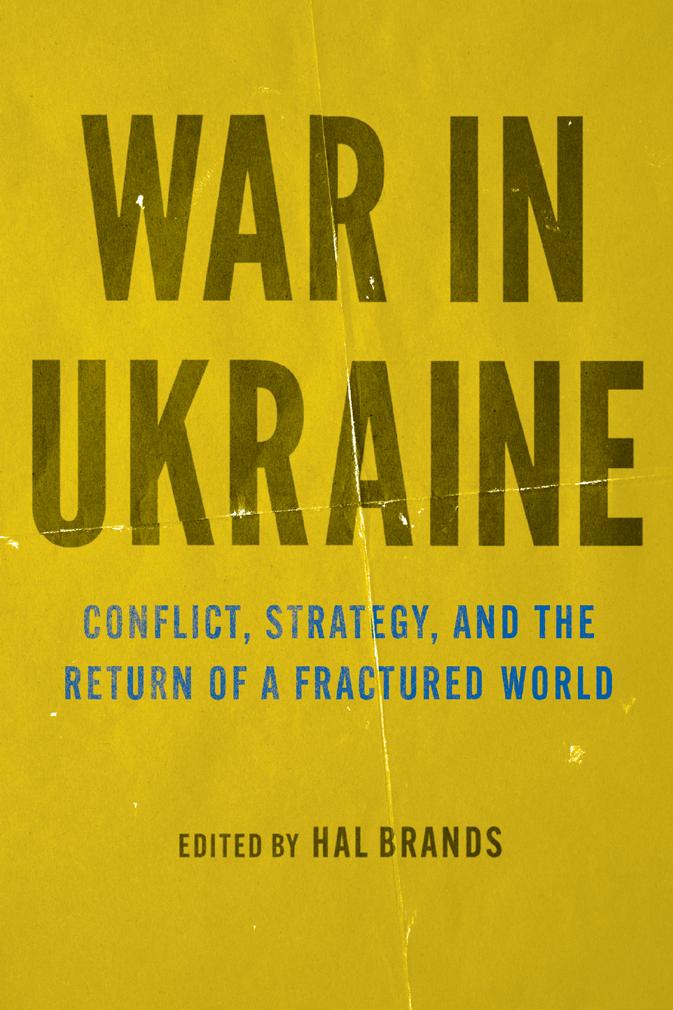
Amongst this glut, one of the very best – War in Ukraine: Conflict, strategy and the return of a fractured world – is based on a recent conference and has been published in quick time and made freely available for download. Its editor is Hal Brands – a distinguished professor at the internationally renowned John Hopkins’ School of Advanced International Studies and leading voice on this conflict (he has described Ukraine as a global proxy war and the first of what he terms “Cold War II”) – who has also written extensively on
China and strategy (he is also the editor of the 2023 updated version of Makers of Modern Strategy). As he notes in his excellent opening chapter, it is intended as a provisional history, as “[c]oming to grips with a war in progress is like shooting at a moving target”. Such conferences and publications, nonetheless, are an ‘essential’ activity to support the work of policy-makers and analysts and this certainly provides an absolutely critical addition to any reading on this conflict.
“THERE IS CONSIDERABLE INTEREST IN WEIGHING INTANGIBLES, SUCH AS MORALE, AGAINST THE TANGIBLES.”

Every one of the 21 contributors and 17 chapters offers something to the reader, whether it be to confirm or challenge how the war is understood. Organised into three broad themes – ‘Origins and Overviews’, ‘The Conflict’ and ‘Global Dimensions and Implications’ – there is a smooth flow from how it began to how it will end, with some interesting diversions along the way. These include discussions on planning, nuclear deterrence, resilience and adaptation, the impact of economic sanctions and a lot of examination of what drives Vladimir Putin. There is even a chapter on what the war means for the European Union; Mark Leonard’s assessment on the latter is that the potential exists for a much strengthened body to materialise which can defend itself, better use its economic power “and emerge as an equal partner to the United States”. In his chapter, Michael Kofman, an American military analyst born in Cold War Ukraine, provides a 22-page synthesis of the war up to February of this year and the eventual capture by Russia of the city of Avdiivka. In his concluding comments he notes that the conflict has actually “validated” expectations as, once the Russian ‘coup de main’ had failed, “the long war that followed hewed closely to historical patterns of large-scale protracted wars” as both sides have struggled with combining mass and firepower. He is doubtful on Western military support, “tactically significant, and even at times operationally impactful, but strategically indecisive”. Advantages have been fleeting and even drones, while facilitating new tactics and strike options, did not lead to
WAR OF THE WORDS // CHACR CRITIQUE

TITLE
Routledge, Paperback, £35.99, 264 Pages, ISBN: 9781032398433
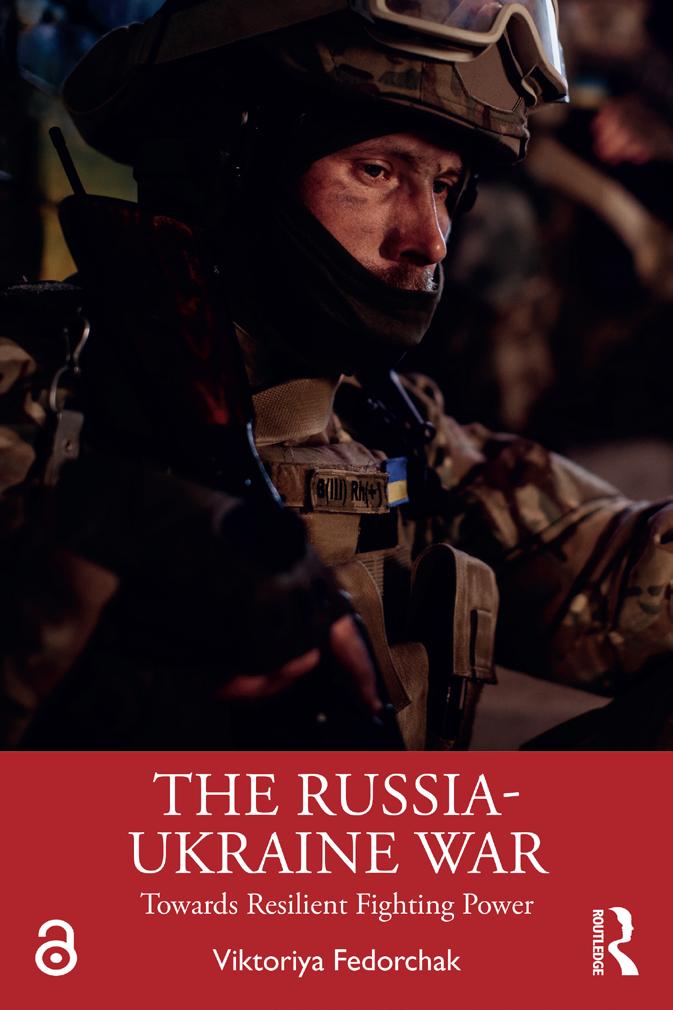
The Russia-Ukraine War: Towards Resilient Fighting Power
AUTHOR Viktoriya Fedorchak
REVIEWER
Professor Andrew Stewart, Head of Conflict Research, CHACR
breakthroughs. In his assessment, there is considerable interest in weighing intangibles, such as morale, against the tangibles. Incisive analysis throughout provides an exemplar of what is to be found in this deeply fascinating and valuable book.
Viktoriya Fedorchak is a member of the war studies department at the Swedish Defense University and her recent contribution to the growing canon of work highlights how right Brands is when he notes that “writing history in real time” is challenging. The RussiaUkraine War is not intended as a history but offers a highly readable examination of the conflict, well researched with an extensive secondary source foundation and replete with important insights. Having heard the author speak at the recent Helsinki ‘Russia Seminar’ where she delivered an excellent presentation, she is highly informed and, as a Ukrainian, inevitably passionate and animated about a subject that must be highly personal and painful. In a room where there were more than a number of newly emerged experts on the conflict, her voice was authentic and important. In terms of the book, it has great merits and would make a useful course reader for any study of contemporary conflict in which Ukraine is a case study (including land students who can focus on the relevant domain chapter). The author has two published books examining airpower and the air domain chapter, entirely understandably, reads particularly well.
best of these written by senior academics and practitioners – there is no shortage of highly informed discussion and analysis about global conflict and (in)security to intellectually dissect.
It is the big idea underpinning the book that is most valuable and the final chapter, Modern warfare and resilient fighting power, was fascinating and could usefully be studied closely. Not only does this discuss resilience but also innovation, the role of technology and even organisational and structural integration, all of which are valuable research themes for the British Army and others. The subject of a recent CHACR Commentary, the experience of Ukraine has demonstrated that “the preparation of a society for total defence requires clarity of objectives, and realistic training and consequent realisation of what war is about, and that it requires defence of the homeland”. The only question that might be raised, and one acknowledged by the author, is that, with the short period examined, can some of the lessons learnt which are highlighted really be accepted as such or are they still more lessons ‘observed’ or ‘identified’?
“CAN SOME OF THE LESSONS LEARNT WHICH ARE HIGHLIGHTED REALLY BE ACCEPTED AS SUCH OR ARE THEY STILL MORE LESSONS ‘OBSERVED’ OR ‘IDENTIFIED’?”
For anyone who is following the conflict with any degree of interest, there is not much in here that they will not already have encountered elsewhere in their intellectual reflection on the fighting in Ukraine. As the introduction explains, the focus was the first year of the war with the manuscript completed last summer. For what is surely the most closely scrutinised conflict in history, and with so many books sat on a desk jostling for space in an information saturated world, the question has to be asked if the reader can gain a similar or better level of knowledge from regular monitoring and review of the many dedicated open-source intelligence offerings (albeit recognising some sit behind paywalls). From the Institute for the Study of War to War on the Rocks via excellent Substacks such as Comment is Freed and Futura Doctrina – with the
As Professor Sir Lawrence Freedman warns us: “Bad strategy can take many forms. It normally includes the underestimation of an opponent. It may involve over-reliance on some hunch about how others will act, or not thinking through the possible consequences of a course of action, or failing to work out how a good idea can best be implemented. Sometimes the failure is the result not of bad strategy but of unrealistic objectives – what is attempted can never be achieved despite the conviction that there must be a way. The strategist’s conceit is to assume that the objective can be reached if available resources are applied with intelligence, imagination, and a steely will, as if every problem has a solution.” Therein, perhaps, lies the problem with this war and the other ‘hot’, ‘tepid’ and ‘cold’ conflicts in the Middle East and Indo-Pacific. There is no acceptable outcome for those involved beyond total victory, with its often ambiguous and unachievable constituent elements. As a result, irresistible force is condemned to battle with immovable objects with only the prospect of exhaustion and collapse to force an ending. And the growing danger is the no longer far-fetched possibility of a fiery finale which affects us all.
WAR OF THE WORDS // CHACR CRITIQUE