FROZEN FOOTSTEPS WORTHY OF RETRACING
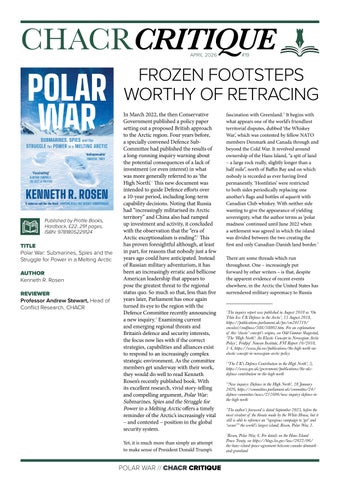
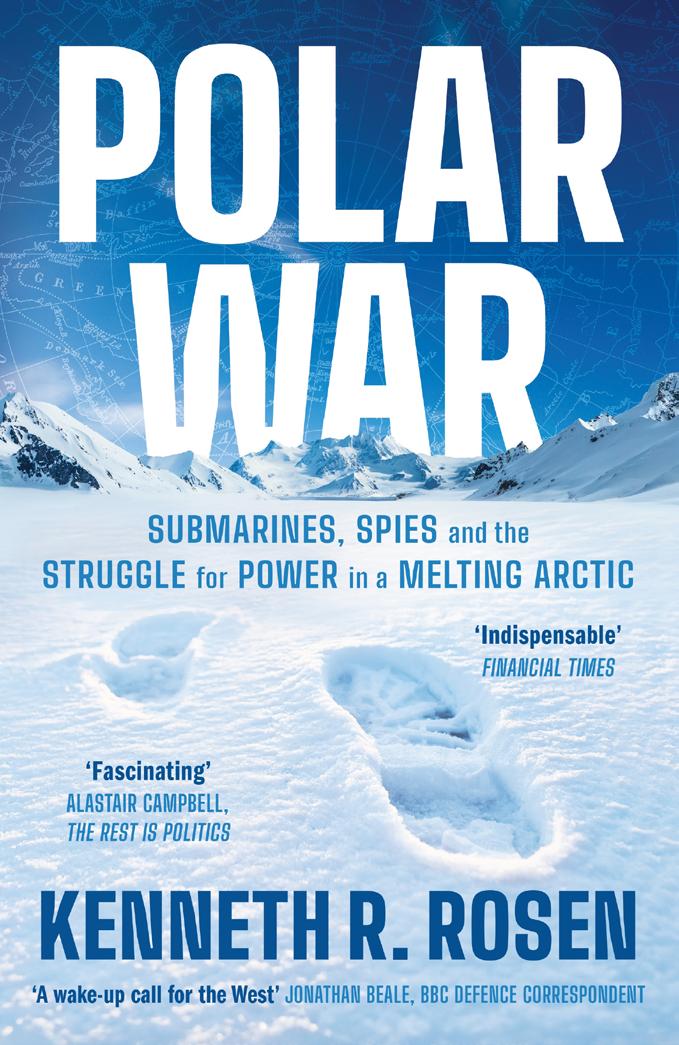
In March 2022, the then Conservative Government published a policy paper setting out a proposed British approach to the Arctic region. Four years before, a specially convened Defence SubCommittee had published the results of a long-running inquiry warning about the potential consequences of a lack of investment (or even interest) in what was more generally referred to as ‘the High North’.1 This new document was intended to guide Defence efforts over a 10-year period, including long-term capability decisions. Noting that Russia had “increasingly militarised its Arctic territory” and China also had ramped up investment and activity, it concluded with the observation that the “era of Arctic exceptionalism is ending”.2 This has proven foresightful although, at least in part, for reasons that nobody just a few years ago could have anticipated. Instead of Russian military adventurism, it has been an increasingly erratic and bellicose American leadership that appears to pose the greatest threat to the regional status quo. So much so that, less than five years later, Parliament has once again turned its eye to the region with the Defence Committee recently announcing a new inquiry.3 Examining current and emerging regional threats and Britain’s defence and security interests, the focus now lies with if the correct strategies, capabilities and alliances exist to respond to an increasingly complex strategic environment. As the committee members get underway with their work, they would do well to read Kenneth Rosen’s recently published book. With its excellent research, vivid story-telling and compelling argument, Polar War: Submarines, Spies and the Struggle for Power in a Melting Arctic offers a timely reminder of the Arctic’s increasingly vital – and contested – position in the global security system.
Yet, it is much more than simply an attempt to make sense of President Donald Trump’s
fascination with Greenland.4 It begins with what appears one of the world’s friendliest territorial disputes, dubbed ‘the Whiskey War’, which was contested by fellow NATO members Denmark and Canada through and beyond the Cold War. It revolved around ownership of the Hans Island, “a spit of land – a large rock really, slightly longer than a half mile”, north of Baffin Bay and on which nobody is recorded as ever having lived permanently. ‘Hostilities’ were restricted to both sides periodically replacing one another’s flags and bottles of aquavit with Canadian Club whiskey. With neither side wanting to give the appearance of yielding sovereignty, what the author terms as ‘polar madness’ continued until June 2022 when a settlement was agreed in which the island was divided between the two creating the first and only Canadian-Danish land border.5
There are some threads which run throughout. One – increasingly put forward by other writers – is that, despite the apparent evidence of recent events elsewhere, in the Arctic the United States has surrendered military supremacy to Russia
1The inquiry report was published in August 2018 as ‘On Thin Ice: UK Defence in the Arctic’, 15 August 2018, https://publications.parliament.uk/pa/cm201719/ cmselect/cmdfence/388/38802.htm. For an explanation of this ‘elastic’ concept’s origins, see Odd Gunnar Skagestad, ‘The ‘High North’: An Elastic Concept in Norwegian Arctic Policy’, Fridtjof Nansen Institute, FNI Report 10/2010, 1-4, https://www.fni.no/publications/the-high-north-anelastic-concept-in-norwegian-arctic-policy
2‘The UK’s Defence Contribution in the High North’, 5, https://www.gov.uk/government/publications/the-uksdefence-contribution-in-the-high-north
3‘New inquiry: Defence in the High North’, 28 January 2026, https://committees.parliament.uk/committee/24/ defence-committee/news/211600/new-inquiry-defence-inthe-high-north
4The author’s foreword is dated September 2025, before the most virulent of the threats made by the White House, but it still is able to reference an “egregious campaign to ‘get’ and ‘secure’” the world’s largest island; Rosen, Polar War, 1.
5Rosen, Polar War, 6. For details on the Hans Island Peace Treaty, see https://blogs.loc.gov/law/2022/06/ the-hans-island-peace-agreement-between-canada-denmarkand-greenland
(and to a lesser degree China), which has chosen to make this region a security focus.6 The other and more prominent argument presented by Polar War is the environmental damage the region has experienced, with the potential for much worse to come. Rosen finishes his story in Coldfoot in Alaska, 120 miles north of the Arctic Circle, where he offers some concluding observations about what he refers to as “the changing Arctic”. He argues: “The American Arctic has never been more vulnerable to security issues, made worse by climate change.”7 Agreeing with him, one of the book’s 400 interviewees describes it as having always just been “a place to extract things from” and, with the melting of snow and ice, this has now accelerated the scramble for potential resources.8 This leads to a considered appendix offering recommendations on how the United States can advance its national security in the Arctic while also preserving the region for future generations. The impacts of global warming threaten changes that cannot be corrected in the future and Rosen is clearly influenced by this danger but, in presenting a cautionary tale, he also explains how the conditions have been set for a potentially violent near future. After years spent plotting theoretical battles in the High North, the conclusion must be that there has perhaps never been greater potential for a very real Cold War. Add to this already volatile state the Trump presidency which appears well versed in the Peloponnesian War, an updated version in which the
“[The author] also explains how the conditions have been set for a potentially violent near future. After years spent plotting theoretical battles in the High North, the conclusion must be that there has perhaps never been greater potential for a very real Cold War.”
Greenlanders – and by extension the Danes –are now cast into the Melian role. For now an uneasy truce holds but there is every reason to believe this may once again be tested.
The author is an independent journalist and previous recipient of the prestigious Bayeux Calvados-Normandy Award for his work on Islamic State fighters in Iraq. This project was inspired by a December 2022 article he wrote on Svalbard (itself a source of concern for some years and a potential location for future Russian testing of NATO resolve).9 For a popular read – and a really excellent one at that – there is a good bibliography which is supplemented by the hundreds of interviews and records of a number of regional visits. This ‘on the ground’ research gives it, at times, an appealing ‘travelogue’ quality, albeit one infused with often deeply reflective and thoughtful discussion about what might yet become the most pressing security dilemma.
This makes the inclusion of only a single map – repeated on the front and back inside covers and titled ‘Russian and American Defense Assets in the Circumpolar North’ – all the more perplexing. More pleasingly, there is a nearly 60-page reference section. The only criticism of this, more a constructive observation than anything else, is that this really should not be hidden at the back of the book, particularly as many of these references include more layers of detail (and critical thought) which would sit well in the main body of the text. Rosen demonstrates a tremendous modesty, making no claim to be an authority on the region or its environment, noting he does not speak any of the local languages and that Polar War is based on “impersonal and brisk” study.10 In reality, this is an extremely well-researched and considered book which will leave the reader much better informed about a traditionally overlooked but increasingly complex and dangerous geopolitical challenge.
6This was examined in the March 2026 CHACR monthly digest, https://chacr.org.uk/2026/03/30/chacr-digest-54
7Rosen, Polar War, 212.
8Rosen, Polar War, 208.
9Kenneth R. Rosen, ‘A Battle for the Arctic Is Underway. And the U.S. Is Already Behind’, Politico Magazine, 17 December 2022, https://www.politico.com/ news/magazine/2022/12/17/climate-changearctic-00071169
10Rosen, Polar War, 224.
Photo by Annie Spratt on Unsplash