WEAPONS OF AN ANALYSIS OF RUSSIA’S POST-INVASION MEDIA
VLADIMIR Putin set out to establish the state’s formative influence over the media from the earliest days of his first presidential term in 2000,1 assuring that most major television stations and newspapers were owned by the state or government-friendly businessmen. Although the presidential administration did not change the market basis in
1ridl.io/from-professional-to-reliablejournalists-the-revolution-of-russian-media
2doi.org/10.1177/1077695817719137
3Spin Dictators: The Changing Face of Tyranny in the 21st Century. Daniel Treisman and Sergei Guriev. Princeton University Press, 2023.
which the outlets functioned, and which had made mass media highly dependent on advertising revenue, Putin and his successive governments did curtail media freedoms drastically compared with the relative (if oligarchcontrolled) liberties of the 1990s.
Traditionally, Putin’s governments have used a wide array of methods to control the media and direct its coverage, including bribes, preferential treatment, indirect control through ownership, control over advertising and refusal to provide access to information.2 This political control has in turn been reinforced by self-censorship. The Ministry of Justice has also
played a central role, namely by designating critics of the government as ‘foreign agents’. Consequently, while the term ‘informational autocracy’3 – denoting a country where manipulation as much as fear is deployed to maintain public support – has been a useful term to apply to the Russian information space over the last two decades, over time the autocratic part has been edging out the informational element, spurred by, or blamed on, internal and external events.
Russia’s full-scale invasion of Ukraine on 24th February 2022 signalled a stark degradation towards media authoritarianism
IN-DEPTH BRIEFING // #57 // JULY 23 1 // IN-DEPTH BRIEFING // CHACR
in an already less than promising environment. Almost immediately following the invasion, Roskomnadzor, the state censorship agency, blocked 3,000 sites including Twitter, Facebook and Instagram. A law penalising the spread of intentionally ‘fake’ news about the military (No. 32 - FZ) passed in early March. Leading media outlets that offered an alternative agenda, or shone a light on Russia’s crimes in Ukraine, were forced to close or leave the country. In June 2022, Meta was recognised as an extremist organisation and its sites banned, although the messaging app WhatsApp was not impacted. Other popular sites, including YouTube, were also left untouched.
This confusing picture reflects the Kremlin’s strategic approach to the information space in Russia: rather than a totalising approach that seeks to convert audiences into ‘true believers’, state-aligned propaganda attempts to nudge them along a spectrum of acceptable information outcomes for the authoritarian state. Consequently, the media environment in Russia is repressive but far from totalitarian and the modus operandi of the key media actors, including but not limited to the Kremlin, continues much as before, albeit adapted to the conditions of the so-called ‘special military operation’.
MEDIA CONSUMPTION
Nevertheless, the increasing number of prohibitions on forms of media, combined with the dramatic nature of Russia’s fullscale war against Ukraine, have led to several shifts in terms of media consumption since February 2022. This report largely focuses on television and social media (specifically Telegram), as the two main news sources for Russians and the ones to which the Kremlin plays close attention.4 The main trends between February 2022May 2023 were as follows:5
l Immediately following the
invasion, Russians turned en masse towards the news and political shows, as in 2014. At their peak in 2022, news and socio-political shows made up around 30 per cent of TV viewing. The audience of news sites and apps grew whenever the war became more prominent (e.g. during the full-scale invasion, during the mobilisation call).
l However, following the anxiety induced among many by the September 2022 call for mobilisation,6 audiences shifted away from the news, preferring escapism in the form of soaps and entertainment.
l The audience of social networks and vlogging platforms changed shape in marked ways, with Facebook and Instagram dropping precipitously due to their pages being banned. YouTube remains a popular entertainment platform and has not been banned; however, it is used for video-hosting, games, etc rather than political shows.
l By contrast, for political content, Russians have turned to the messaging and news app Telegram, which is actively growing among all age groups.
SOCIAL MEDIA
In early 2023, there were 127.6 million internet users in the
Russian Federation, with internet penetration at 88.2 per cent.7 Russia was home to 106 million social media users in January 2023, equating to 73.3 per cent of the total population.
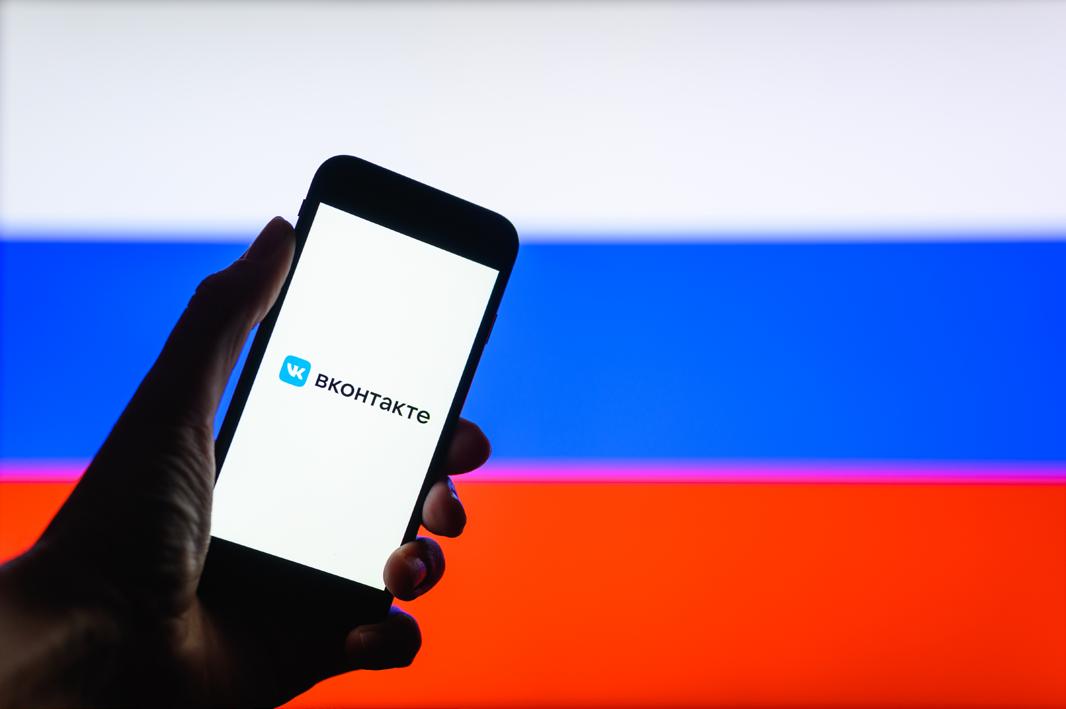
Vkontakte (Вконтакте) remains the most popular social media network. It is similar to Facebook but is under state control and users are aware of this. Consequently, users are more guarded and use the network for entertainment consumption and socialising, rather than for expressing and reading political opinions. TikTok is also quite popular but primarily among younger audiences, under 25, who use it for entertainment. Moreover, Russian authorities have introduced considerable prohibitions on content from abroad to ensure TikTok can be carefully monitored.
YouTube remains popular, especially video bloggers. The two most popular video blogging channels, Wylsacom (Valentin Petukhov)8 and Yurii Dud, have 6.7 million and 4.5 million subscribers respectively.9 While the former focuses on video gaming, not politics, he condemned Russia’s invasion of Ukraine. He remains in Russia but does not focus on politics. By contrast, Dud has, over the years, become very political
and made numerous criticisms of the war, meaning he had to leave Russia. Tragically, their focus and fates represent the two pathways currently available to opponents of the regime: largely avoid politics or take a more vocal stance, but from exile. Although the Kremlin has not blocked YouTube, there have been media campaigns against anti-war YouTubers, like Dud.10
Twitter and Facebook were never widely used but following the prohibitions placed on their activity, their influence and use is negligible. Consequently, post2022, the most important social media site for news and politics is Telegram. Unlike on any other platform, the top channels across all age groups except for the under 25s, are political ones.11 Since the beginning of the war, Telegram’s audience has more than doubled and over 40 million Russians use Telegram every single day.12 On Telegram, Russians can access almost any news they like, yet, of the 30 most popular Russian channels about politics, 24 are pro-war.13 The leader among them is the head of Chechnya, Ramzan Kadyrov. He has almost three million subscribers and since the invasion his audience has grown around 45 times. His channel is the fourth
4themoscowtimes.com/2022/11/19/ how-not-to-interpret-russian-political-talkshows-a79399
5mediascope.net/news/1537495
6levada.ru/en/2022/12/12/conflict-withukraine-november-2022
7datareportal.com/reports/digital-2023russian-federation
8youtube.com/user/wylsacom
9youtube.com/channel/
UCMCgOm8GZkHp8zJ6l7_hIuA
105-kolonna.ru
11mediascope.net/news/1601603
12mediascope.net/news/1601603
13voboda.org/a/krupnyh-politicheskihtelegram-kanalov-podderzhivayutvoynu/31914606.html
IN-DEPTH BRIEFING // RUSSIAN MEDIA SPACE
2 // IN-DEPTH BRIEFING // CHACR
“RUSSIA WAS HOME TO 106 MILLION SOCIAL MEDIA USERS IN JANUARY 2023. EQUATING TO 73.3 PER CENT OF THE TOTAL POPULATION.”
most popular Russian Telegram channel overall, lagging behind the apolitical FUCK and Topor Live as well as the pro-war “SMI Rossiya-Ukraina”.
Disproving the myth that if only Russians were given access to the truth they would learn what was really happening in Ukraine and oppose it, there were only six anti-war Telegram channels in the top 30, the most popular of which is Stalingulag (with around one fifth of the followers of Kadyrov). Aleksei Navalny’s channel is also in the top 30 with 241,000 followers, however, the Navalny channel is dwarfed by the followings among the Russian war correspondents, who publish photos and videos from the front as well as very Ukrainophobic and militaristic commentaries. Some but not all of the military correspondents are anonymous. Other popular figures include the prominent media presenter Vladimir Solovev, the chairman of the state parliament, Vyacheslav Volodin, and the MFA spokeswoman Mariya Zakharova.
Relating to online news sites, there has been little change in the most popular and most cited news sources. Media sites that are popular tend to also be on Telegram. Both state and statealigned news dominate the top ten channels on the federal, or allRussia, level. On a more regional level, the most-visited news sites tend to be non-federal, local news, or regionally-affiliated sites, such as Bloknot (focused on the Volga region). The same
14twitter.com/RuMOR_CarletonU
15ridl.io/how-the-war-changed-russia-smedia-consumption
16tandfonline.com/doi/abs/10.1080/0090 5992.2015.1013527
17t.me/arinab1973/2782
18rbc.ru/technology_and_media/21/04/20 23/644241819a794720778290aa
19opendemocracy.net/en/odr/russia-ukraine-war-support-interviews-opinion
is true for television and, as Professor Paul Goode’s work at RUMOR has shown,14 local news channels mention Russia’s war on Ukraine much less frequently, and in more sober ways, than is the case for the federal channels.
TELEVISION
The number of Russians who use television as the primary source of news has been decreasing steadily since June 2013,15 largely to the advantage of online sources of information. However, the television lines have a shaping effect on online news sources, especially since changes in Russia’s digital policies in 2017 led to algorithmic boosting for state propaganda lines trialled on television.16 There are three main TV channels that have traditionally served as key sources of news: Channel One, Rossiya-1 and NTV. They still account for approximately one third of the total volume of television time in Russia. During the invasion
afterwards, the scale of people watching television rose sharply and the numbers watching news and political shows also grew dramatically, comparable only with 2014 and 2015, when the war in Donbas was raging.
According to calculations by journalist Arina Borodina,17 the pro-Kremlin propagandist Vladimir Solovev appeared on air for nearly 218 hours in the three months following the invasion. On both 27th February and 13th March – respectively, the dates when Russia’s initial invasion and efforts to take Mariupol were clearly failing – Solovev was on screen for more than five hours. Russia’s main television channel gave prime-time slots to his shows, scrapping the soaps they normally showed on Mondays to Thursdays. The consistent flow of television propaganda ensured that audiences were kept in a state of high emotional engagement as opposed to intellectual or critical
The situation, and TV schedule, changed after the call for mobilisation in September 2022, as Russians increasingly sought to disengage from the war and to seek escapism through their television sets. When comparing the most popular television channels in April 2022 and April 2023, it is notable that state controlled channel Rossiya-1 dropped several places, as opposed to channels more focused on entertainment (RENTV) and state-aligned channels (First Channel), used here to designate media that is supportive of and constrained by the Russian state apparatus but not directly state-owned and still dependent on advertising.
Cognisant of the need for advertising revenue, the statealigned stations responded to the growing number of Russians who were not following – or did not want to follow – the so-called ‘special military operation’ by reducing the number of political discussion shows and increasing the number of soaps. From this point, the leading category on television became television series, taking up 29 per cent of all television viewing time. Together with entertainment shows and televised films, this ‘escapism’ genre made up 55 per cent of all television viewing. By contrast, political discussion shows dropped to 12 per cent.18
HOW PROPAGANDA WORKS
From afar, the intensity and frequency of Russian state propaganda around the start of the full-scale invasion has encouraged observers to blame television for Russians’ detachment from, and derision of, the reality of the war. After all, whether or not someone takes their information from state media sources is one of the key determinants of support for the war.19 But the findings above combined with indicators of trust in television news complicate
3 // IN-DEPTH BRIEFING // CHACR IN-DEPTH BRIEFING // RUSSIAN MEDIA SPACE
“THE PRO-KREMLIN PROPAGANDIST VLADIMIR SOLOVEV APPEARED ON AIR FOR NEARLY 218 HOURS IN THE THREE MONTHS FOLLOWING THE INVASION.”
this assessment.20 While 42 per cent trust the information given to them by television (three per cent – completely, 39 per cent –mostly), 44 per cent do not (31 per cent largely do not trust, and 13 per cent completely distrust). There are regional differences here, while the Southern Federal Region of Russia (which borders Ukraine and stretches down to the North Caucasus) has a 56 per cent trust rating, the Far East has a mere 31 per cent.
These statistics warn against a) presuming all Russian audiences react similarly to television content; and b) presuming that the television content reflects, or creates, Russians’ views. Far from everyone in Russia perceives the war or the Russian government’s actions abroad in black-orwhite.21 State-aligned propaganda appears to be sensitive to this and as such the content created to promote pro-war messaging is better understood as a spectrum, with sources seeking resonance among different audience types.
Any successful effort at persuasion requires both a platform, so audiences encounter your narrative, and resonance, so it appeals to and fits with viewers’ understandings and experiences of the world. The latter is especially
20expertnw.com/news/rossiyane-doveryayutinternet-smi-i-telegram-kanalam-bolshe-chemtelevideniyu-issledovanie
21d.docs.live.
net/12f06696b7386627/763–65,%20 https:/doi.org/10.1038/s41562-02201375-x
22irfanerdogan.com/dergiweb2008/24/13. pdf
23online.ucpress.edu/currenthistory/articleabstract/121/837/258/193298/
Russians-in-Wartime-and-DefensiveConsolidation
24journals.uchicago.edu/doi/ abs/10.1086/696863
25opendemocracy.net/en/odr/russia-ukrainewar-support-interviews-opinion
26Memory Makers: The Politics of the Past in Putin’s Russia. Jade McGlynn (Bloomsbury, 2023).
important to a 21st century authoritarian state, since it is close to impossible to establish a monopoly on information or ensure that audiences never encounter criticism of the government or its policies. Moreover, propaganda is not very good at persuading sceptics but it is good at reinforcing the views of those who already support the policy, including by dispelling doubts raised by contradictory information or difficult questions.22
That does not mean propaganda has zero effect on people who are sceptical or outright hostile to the views being promoted –more that it is unlikely to have the same effect as on those who are inclined towards such views. In any country, the same piece of propaganda can produce varied results in audiences. It might mobilise support in some viewers, while in others it will simply spark what the anthropologist Jeremy Morris calls a ‘defensive consolidation’ – we are where we are, so we might as well stick together.23 In others still, the same item can demobilise opposition, either directly through fear or indirectly by encouraging people to disassociate from
the war. Research on Chinese news media found that heavyhanded, over-the-top propaganda backfired in the sense that viewers were less likely to trust and support the narratives and state media producing them. What it did achieve was to make those watching such extreme propaganda less likely to protest, because they interpreted the crudeness of the propaganda as a demonstration of the power of the state.24
These findings are easily applied to Russia’s case, where the proKremlin media emphasises the manipulative nature of politics. Capitalising on distrust, the Kremlin and its media assistants can persuade people that it is not possible to know the truth – about a specific topic or in general. But when human beings believe nothing can be trusted, we will still look for, and need, some support and criteria through which to parse the world and evaluate events. Often we will create such a framework out of events, memories, emotions that we instinctually understand such as national identity, or a selfinscribed narrative of our own life as better or worse after X event –perhaps, before or after the fall of the USSR.25
People may well feel such knowledge is ‘safe’ from manipulation, but that would be a mistake. Rather, this is where the state-aligned domestic Russian propaganda excels itself, given that since 2012 the government and allied organisations, such as the Russian Historical Society and Russian Military Historical Society, have propagated a militaristic vision of a resurgent messianic Russian identity at odds with the malicious West.26 Their influence is evident within the everyday fabric of Russian life, from leisure activities to television content, with the Russian Military Historical Society contributing to more than 600 television series and films in the last eight years, many of which Russians will watch as they try to avoid the war, but which will reinforce the same key narratives and arguments used to justify Russian aggression against Ukraine.
A SPECTRUM OF AUTHORITARIAN ALLIES
As such, it is important not to talk of state propaganda as if it were one coherent narrative or consistent channel; hence, the use of the term state-aligned media to denote those channels spanning the state-owned to those that are independent,
IN-DEPTH BRIEFING // RUSSIAN MEDIA SPACE 4 // IN-DEPTH BRIEFING // CHACR
“SINCE 2012 THE GOVERNMENT AND ALLIED ORGANISATIONS HAVE PROPAGATED A MILITARISTIC VISION OF A RESURGENT MESSIANIC RUSSIAN IDENTITY AT ODDS WITH THE MALICIOUS WEST.”
sometimes even policy-critical but broadly supportive of the Russian state, which they conflate with the Russian nation. Moreover, anyone in Russia is still free to access leadershipcritical opposition media (without VPN) via Telegram, which has not been banned and is unlikely to be banned following a failed, and at times darkly comic, effort to outlaw the messaging app in 2018.27
Telegram essentially functions like a pseudo-democratic institution that allows authoritarian rulers to gather information about society, to co-opt elites, make credible commitments, resolve conflicts, provide signals about attributes of the regime, deflect responsibility, or let people feel as though their concerns have been heard, even if not addressed.28 Pseudodemocratic institutions help authoritarian regimes to develop resilience and flexibility but they need to be credible, which means they also need to be able to constrain the actions of the elites to some extent.
In Russia before 2022, the wider media functioned as a pseudodemocratic institution, with three types of institutions clearly present, from the uncritical state television channels, to the leadership-critical opposition media (albeit often restricted or co-opted, as with Ekho Moskvy) and policy-critical newspapers, sites and bloggers. The latter even served on presidential advisory councils. While the media landscape for leadershipcritical sources has become much more repressive since Russia’s full-scale invasion of Ukraine, this is not necessarily the case for policy-critical sources, as seen by Evgenii Prigozhin’s (head of the Wagner mercenary group) frequent outbursts.
There is notable variation even within Telegram in the way information is shared to pro-war Russian audiences, depending
on the type of channel and the perceived target audience.29 The spectrum of authoritarian allies model, explored below, is a way to group Russian publics and understand better the diversity within pro-state narratives on themes or topics. The original spectrum of allies model (used by Western pressure groups) comprises active support, passive support, neutral, passive opposition and active opposition and works on the assumption that movements seldom win by overpowering the opposition; they win by shifting support out from under it.30 In this model, the best approach is to nudge groups further along the spectrum of allies: from passive opponent to neutral, from neutral to passive support, from passive support to active support, as depicted in Diagram A.
The broader Russian government communications strategy can be understood using a model based on similar principles but with some important adaptations. It comprises active support, ritual support, loyal neutrals, apathy
and active opposition. Notably, any version applied to Russia must understand that the Russian government does not just ignore but sets out to either destroy active opposition (by outlawing their views) and/or to render them apathetic, as depicted in Diagram B.
Some state-aligned media sources (and their narratives) work to nudge the apathetic into loyal neutrality (‘my country, right or wrong’), while others (or perhaps even the same sources) shift loyal neutrals into ritual supporters. Ritual supporters here designates those who support the government’s approach but in a more plebiscitary way, approving the government’s actions and seeing themselves as aligned with the government’s position, rather than people who are consumed by the ‘Ukraine question’. From the point of view of an authoritarian government like Russia’s, ritual supporters are the ideal category, insofar as such regimes distrust political agency even if in support of the regime. An obvious example of this would be the
arrest of pro-war demonstrators detained under anti-protest laws by Russian police.31 As such, the government uses aligned sources to encourage the shuffling of active supporters into the ritual support category, creating clear boundaries for what is and is not an acceptable way to show allegiance by modelling more banal forms of heroism.32
The spectrum of authoritarian allies approach is a useful – if slightly heuristic – way of grouping Russian publics according to their interaction with and consumption of narratives, including pro-regime narrative resonance and persuasiveness. It contextualises certain findings relating to the Russian media and state, such as the presidential administration’s long-standing obsession with polling and the way certain (critical or extreme) narratives are tested on some shows but not others.33 The spectrum of authoritarian allies model does not depict the Russian government’s deliberate approach towards media and public opinion management but is rather a model for understanding how the state-aligned media space and its influence works in practice and, as such, represents the reality that those trying to curate the information space have created but to which they also must respond.
WHO CREATES THE PROPAGANDA?
There is a tendency from the
27reuters.com/article/us-russia-telegram-banidUSKBN23P2FT
28academic.oup.com/ct/articleabstract/30/2/105/5736120
29mediascope.net/news/1601603/
30trainings.350.org/resource/spectrum-ofallies
31themoscowtimes.com/2022/03/14/videoshows-back-to-back-arrests-of-anti-and-prowar-activists-in-moscow-a76917
32doi.org/.doi:10.1017/nps.2020.20
33doi.org/10.1080/106058
6X.2016.1144334
IN-DEPTH BRIEFING // RUSSIAN MEDIA SPACE 5 // IN-DEPTH BRIEFING // CHACR
ACTIVE SUPPORT PASSIVE SUPPORT NEUTRAL PASSIVE OPPOSITION ACTIVE OPPOSITION ACTIVE SUPPORT RITUAL SUPPORT LOYAL NEUTRALS APATHETIC ACTIVE OPPOSITION Policy critical Uncritical Leadership critical
FIGURE A: Spectrum of allies
FIGURE B: Spectrum of authoritarian allies
West to view the Kremlin as the originator of a malevolent and all-encompassing information plan that is imposed on editors and others as messengers. This is flawed but the Kremlin does take great interest in ensuring its products and messages are popular. It largely does this through arms-length ‘kuratory’, or curator managers whose job it is to make sure the required messages ‘sell’. For example, the Institute for the Development of the Internet spends billions of roubles every year creating videos, mini-films, and appealing online pro-Kremlin content.34
34meduza.io/feature/2023/06/06/ chistymi-rukami-vzyat-patrioticheskih-denegi-ne-zashkvaritsya
35vedomosti.ru/politics/ articles/2017/09/24/735092-kremle-fsbtelegram-kanalov
36newyorker.com/news/annals-ofcommunications/inside-putins-propagandamachine
37newyorker.com/magazine/2019/12/16/ the-kremlins-creative-director
38mlg.ru/ratings/media/federal/11185
Their work now is aimed at promoting the war and they often use freelancers, including even some who oppose the war. But the Institute is not staterun, it is rather a GONGO – or government-organised NGO. This self-contradictory term includes within it a number of co-opted, or state-created, organisations that exist to implement and promote the state’s policies but are nominally independent of the state (see also the earlier mentioned Russian Historical Society and Russian Military Historical Society).
The presidential administration plays close attention to the results of these different organisations and of the media providers themselves. Vladimir Putin receives media monitoring briefs every morning (Telegram channels
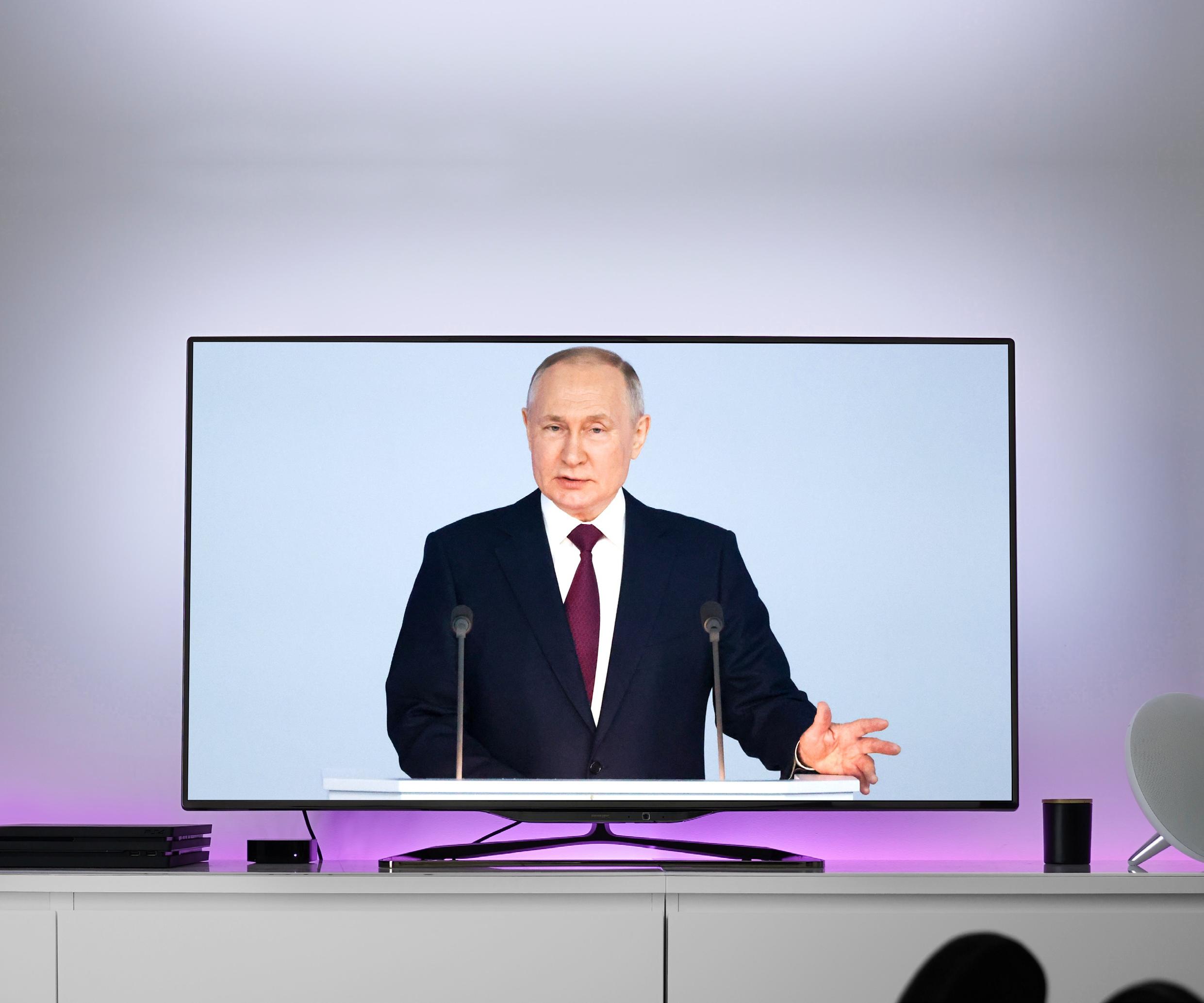
are included within these), which keeps the president abreast but also provides an opportunity to media actors, since, in theory, they can also air their views to the head of state.35 The dialogic nature of politics and the information space is important. This is not a one-way street. Media actors and ‘kuratory’ who perform well are rewarded with additional resources, money, access and so on.
Naturally, the media is not left without any guidance. Five days a week a state-controlled consultancy issues a detailed list of six-to-ten topics ‘designed to supplement the Ministry of Defence’s war updates that constitute mandatory coverage’.36 But, as draconian as this might be, it does not equate to sending television channels the content. Rather, editors are trusted to
understand their audiences, trade, and personal interests in supporting the government. The most successful of these has been Konstantin Ernst, who runs First Channel, Russia’s most popular television channel. Ernst creates the content as he sees fit, and the presidential administration leave him to do that.37 As such, editors and senior journalists have considerable interpretative freedom. In this atmosphere of competition for audiences and state approval, a useful analogy for the Russian state-aligned media would be that of salesmen: they have a product to sell (President Putin, government policy, etc.) and a script (the talking points listed above), but they can adapt the script and how they sell it is their decision.38 Ultimately, they need to prove they can sell the product.
In accordance with the spectrum of authoritarian allies, different channels and media will need to do this in different ways, all while remaining dynamic and attentive to audience needs. This
6 // IN-DEPTH BRIEFING // CHACR IN-DEPTH BRIEFING // RUSSIAN MEDIA SPACE
“A USEFUL ANALOGY FOR THE RUSSIAN STATE-ALIGNED MEDIA WOULD BE THAT OF SALESMEN: THEY HAVE A PRODUCT TO SELL AND A SCRIPT, BUT THEY CAN ADAPT THE SCRIPT AND HOW THEY SELL IT IS THEIR DECISION.”
Composition: Aleksandr Samochernyi on Freepik/Kremlin.ru, CC BY 4.0
is reflected in shifts in narrative in Kremlin-aligned Telegram channels and television news since February 2022. If, at the beginning of the war, the main focus among relevant channels was to manage active opposition into apathy, a shift also achieved via repressive state apparatus, and to consolidate ritual support among audiences with the potential for policy-critical stances by reiterating Russian military might and greatness, this is no longer the case. In 2023, the emphases have become more fragmented and there is a greater focus on, and popularity of, anti-Western narratives to encourage audiences into the ‘loyal neutrals’ segment, rather than merely promoting apathy. Ukrainian attacks on Russia are used to emphasise the sense that ‘Russia is under attack’. So too are elements of Russophobia in the West engaged with more frequently, as compared to the early months of the war when viewers chose not to engage with these, with the exception of well-
over a sustained period. They very rarely represent a direct line from the Kremlin or presidential administration. There are important exceptions to the rule, often from major media figures covered in the West (and which Russian authorities know will be covered by Western media). A good example here is the June 2023 comment by Margarita Simonyan that Russia should consider negotiations now that Ukraine is getting fighter jets. As the academic Sam Greene notes, this suspiciously dramatic volte face in Simonyan’s views should rather be seen as a strategic narrative aimed at both Western and domestic audiences for the following purposes:39
1) Disrupt Western strategic narratives by undermining the analytical consensus that Russia will keep fighting until it wins
or loses outright and providing some succour to those who promote pushing Ukraine to a negotiated settlement as a way of ending the war.
2) Maintain domestic constructive ambiguity: as well as creating ambiguity to frustrate Western forecasters, it sends signals, most notably to the elites who are not enamoured of the war, to continue to adopt a ‘waitand-see’ approach as reason could still prevail. This demobilises elites from pursuing active, and costly, opposition.
3) Conduct reflexive public opinion research by eliciting public responses to such a shift, providing the Kremlin with much-needed insights into public opinion.
be hermetically sealed off against external narratives.
Consequently, state-aligned media need to be able to undermine alternative narratives while at the same time ensuring their message – the meaning within their narrative – resonates with audiences. Instead of trying to reprogramme people’s thinking with a comprehensive ideology, in a modern authoritarian society, state-aligned media aim to improve evaluations of the country and its leadership – or to influence opinions on sensitive issues central to the leadership. Media actors and kuratory are incentivised to do this and while their performance is closely monitored, they are not micromanaged.
ingenuity born of necessity
This approach is highly unlikely to change until either the method stops working or a different method is required due to a major change in circumstances. That major change has not yet occurred: sanctions are not hurting the Russian economy or people that much and the Kremlin tries hard to keep the war from everyday life – in the cities at least. This is also reflected in the government’s reluctance to announce a second call for mobilisation. As the above report details, the Kremlin imposes constraints on individuals’ political freedom but it also recognises – and fears – audience agency, which it seeks to co-opt in a variety of ways, including rendering people apathetic, bamboozling them, encouraging defensive consolidation, drawing on traumas, appealing to a sense of belonging or unmet political or social need, and so on. It can only do that if people consume the messages, or buy the product, and there are a wide range of actors willing and capable of creating popular content. There also appear to be a wide range, and number, of audiences ready to buy it.
39twitter.com/samagreene/ status/1666503456083853314
7 // IN-DEPTH BRIEFING // CHACR IN-DEPTH BRIEFING // RUSSIAN MEDIA SPACE
“IF, AT THE BEGINNING OF THE WAR, THE MAIN FOCUS AMONG RELEVANT CHANNELS WAS TO MANAGE ACTIVE OPPOSITION INTO APATHY, THIS IS NO LONGER THE CASE.”