THE ROLE OF SECURITY FORCE ASSISTANCE
IN A COMPETITIVE WORLD
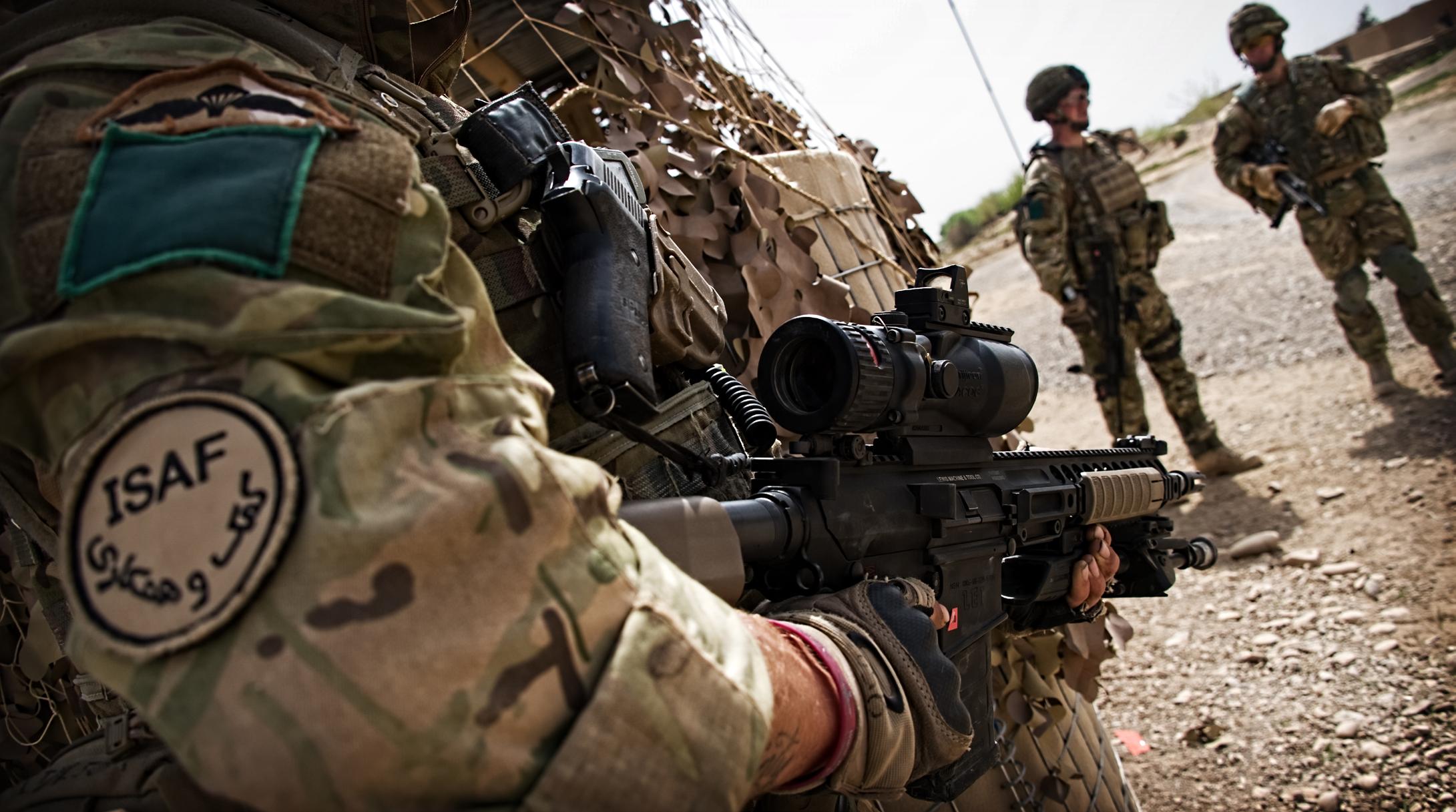
THE British Army has recently begun to institutionalise Security Force Assistance (SFA) in its force structures and doctrine, as part of a wider commitment to assist partner forces overseas. This can be seen in the establishment of 11th (SFA) Brigade, as well as the creation of the new Ranger Regiment as the core of the Army Special Operations Brigade.1 These changes mirror similar investments in SFA among UK allies, most notably in the US Army’s establishment of its own Security Force Assistance Brigades in 2017, and the adoption of new NATO doctrine for SFA a year earlier.2 While far from a new practice, the training of partner forces has acquired a particular association with counterinsurgency and stabilisation activities in recent years. During campaigns in Iraq and Afghanistan, for example, the British Army made extensive use of military partnering to develop host
nation armed forces and improve local force densities.3 However, the contemporary security landscape has changed substantially since the socalled War on Terror and is now increasingly characterised by intense geopolitical competition and interstate rivalry.4 The recent initiation of a new Strategic Defence Review thus presents a timely moment to appraise the utility of SFA for UK Defence in the current international climate.
In the years since 9/11, SFA has been used for a bewildering array of other tasks, from peace-building to counterterrorism. Indeed, the NATO definition of SFA includes all “activities that develop and improve, or directly support, the development of local forces and their associated institutions in crisis zones”, encompassing virtually all aspects of the constitution and employment of partner military force.5 For some, this breadth of scope and application has leant SFA a kind of everything-and-nothing
quality, obscuring its practical utility.6 Others have even argued that UK SFA has become more performative than substantive – about shoring up national insecurities over the UK’s place in the world more than developing genuine military capabilities
1On the wider context informing these changes, see Captain Ben Tomlinson, ‘Anniversary Analysis: Assessing the Ongoing Development of the Ranger Regiment’, CHACR In-Depth Briefing 68, November 2023.
2NATO, AJP 3.16: Allied Joint Doctrine for Security Force Assistance (Brussels: NATO Standardization Office, 2026), UK MOD version published 14 August 2017.
3Robert Johnson, ‘Upstream Engagement and Downstream Entanglements: The Assumptions, Opportunities, and Threats of Partnering’, Small Wars & Insurgencies, 25:3 (2014), pp. 647-668.
4HM Government, Integrated Review Refresh 2023: Responding to a More Contested and Volatile World (London: HMSO, 2023).
5NATO, AJP 3.16, p. 1-1. According to this definition, SFA includes activities to generate, organise, train, enable, advise and mentor partner forces, see p. 2-1.
6Patricia L. Sullivan, ‘Does Security Assistance Work? Why It May Not Be the Answer for Fragile States’, Irregular Warfare Initiative, 15 November 2021.
Picture:
abroad.7 This In-Depth Briefing examines the utility of SFA in the contemporary operating environment to address two related questions: what is SFA useful for during international competition? And how should British Army assistance activities navigate the opportunities and risks of this changing international landscape?
CAPACITY BUILDING AND COMPETITION
Building the military capacity and capability of partner forces is generally seen as the sine qua non of SFA. However, the effectiveness of SFA as a tool of capacity building is significantly conditioned by wider questions of interest asymmetry.8 Where the aims and interests of the SFA provider and the recipient align, SFA can produce notable improvements in partner capabilities. In such cases, SFA can support international security under conditions of geopolitical competition in a number of ways.
Firstly, SFA-like activities conducted with formal allies in security organisations such as NATO can serve to reinforce collective defence. Here, militaryto-military training activities help to strengthen the credibility of collective military commitments by improving inter-operability, building mutual trust and signalling political resolve.9 In a similar fashion, SFA might be used to reinforce wider deterrence by shifting regional balances of power in favourable ways. By improving military readiness and capabilities in partner states, SFA can help to turn vulnerable territories into veritable porcupines that are hard for adversaries to swallow up, precluding sudden land grabs such as Russia’s fait accompli in Crimea.10 Of course, deterrence by denial is a high bar. Yet, SFA might also be used to reinforce deterrence through punishment, either by building the military capacity of a threatened partner to impose costs on an
“SECURITY
FORCE ASSISTANCE-LIKE ACTIVITIES CONDUCTED WITH FORMAL ALLIES IN SECURITY ORGANISATIONS SUCH AS NATO CAN SERVE TO REINFORCE COLLECTIVE DEFENCE. HERE, MILITARY-TO-MILITARY TRAINING ACTIVITIES HELP TO STRENGTHEN THE CREDIBILITY OF COLLECTIVE COMMITMENTS BY IMPROVING INTER-OPERABILITY, BUILDING MUTUAL TRUST AND SIGNALLING POLITICAL RESOLVE.”
aggressor, or by working to shift the balance of military power elsewhere in ways an adversary finds uncomfortable to apply reciprocal pressure. In this way, SFA might help to disincentivise territorial aggression. Admittedly, shifts in the balance of power alone are generally considered insufficient to deter a determined adversary, and so reliable deterrence must include efforts to shape an adversary’s frame of decision-making.11 In principle, SFA might contribute here too, supporting the credibility of costs and commitments in the mind of an adversary by signalling international resolve or bolstering a partner’s national will to fight. Finally, SFA conducted to help stabilise a partner facing internal conflict will still promote wider
asymmetry.12 In consequence, extensive SFA programmes have often resulted in little discernible improvement to partner force capabilities, despite some proximate or superficial alignment between the provider and the recipient.13 In other cases, profound interest asymmetries have led to unintended negative consequences, such as partner force involvement with coups d’etat or human rights abuses.14
7Malte Riemann & Norma Rossi, ‘Remote Warfare as “Security of Being”: Reading Security Force Assistance as an Ontological Security Routine’, Defence Studies, 24:1 (2021), pp. 489-507.
8Stephen Biddle, ‘Building Security Forces & Stabilizing Nations: The Problem of Agency’, Daedalus, 146:4 (2017), pp. 126-138.
9Derrick Frazier & J. Wesley Hutto, ‘The Socialization of Military Power: Security Cooperation and Doctrine Development Through Multinational Military Exercises’, Defence studies, 17:4 (2017), pp. 379397; Beatrice Heuser &Harold Simpson, ‘The Missing Political Dimension of Military Exercises’, RUSI Journal, 162:3 (2017), pp. 20-8.
10See for example, James Timbie & Admiral James Ellis Jr., ‘A Large Number of Small Things: A Porcupine Strategy for Taiwan’, Texas National Security Review, 5:1 (2021), 83-93.
11Michael J. Mazarr, ‘Understanding Deterrence’, RAND Perspective Briefing (2018).
regional and international security against a backdrop of geopolitical competition, providing military capacity building is used to underpin good governance rather than authoritarian repression.
However, where the interests of provider and recipient diverge somewhat, SFA often struggles to produce effect – particularly where changes advocated by military advisers run counter to the vested interests or strategic aspirations of the partner. Moreover, as providers often have limited choice in their selection of local partner, and recipients most in need of external assistance are often the least able to absorb it, SFA programmes are almost always subject to some degree of interest
12See Eli Berman & David A. Lake (eds.), Proxy Wars: Suppressing Violence through Local Agents (Ithaca: Cornell University Press, 2019); Stephen Biddle, Julia Macdonald & Ryan Baker, ‘Small Footprint, Small Payoff: The Military Effectiveness of Security Force Assistance’, Journal of Strategic Studies, 41:1-2 (2018), pp. 89-142.
13Jahara Matisek, ‘The Crisis of American Military Assistance: Strategic Dithering and Fabergé Egg Armies’, Defense & Security Analysis, 34:3 (2018), pp. 267-90.
14Patricia Sullivan, ‘Lethal aid and human security: The effects of US security assistance on civilian harm in low- and middle-income countries’, Conflict Management and Peace Science, Online First (2023), pp. 1-22; Carla Martinez Machain, ‘School of influence: Human rights challenges in US foreign military training’, Conflict Management and Peace Science, Online First (2023), pp. 1-23; Jesse Savage & Jonathan Caverley, ‘When Human Capital Threatens the Capitol: Foreign Aid in the Form of Military Training and Coups’, Journal of Peace Research, 54:4 (2017), pp. 542–557.
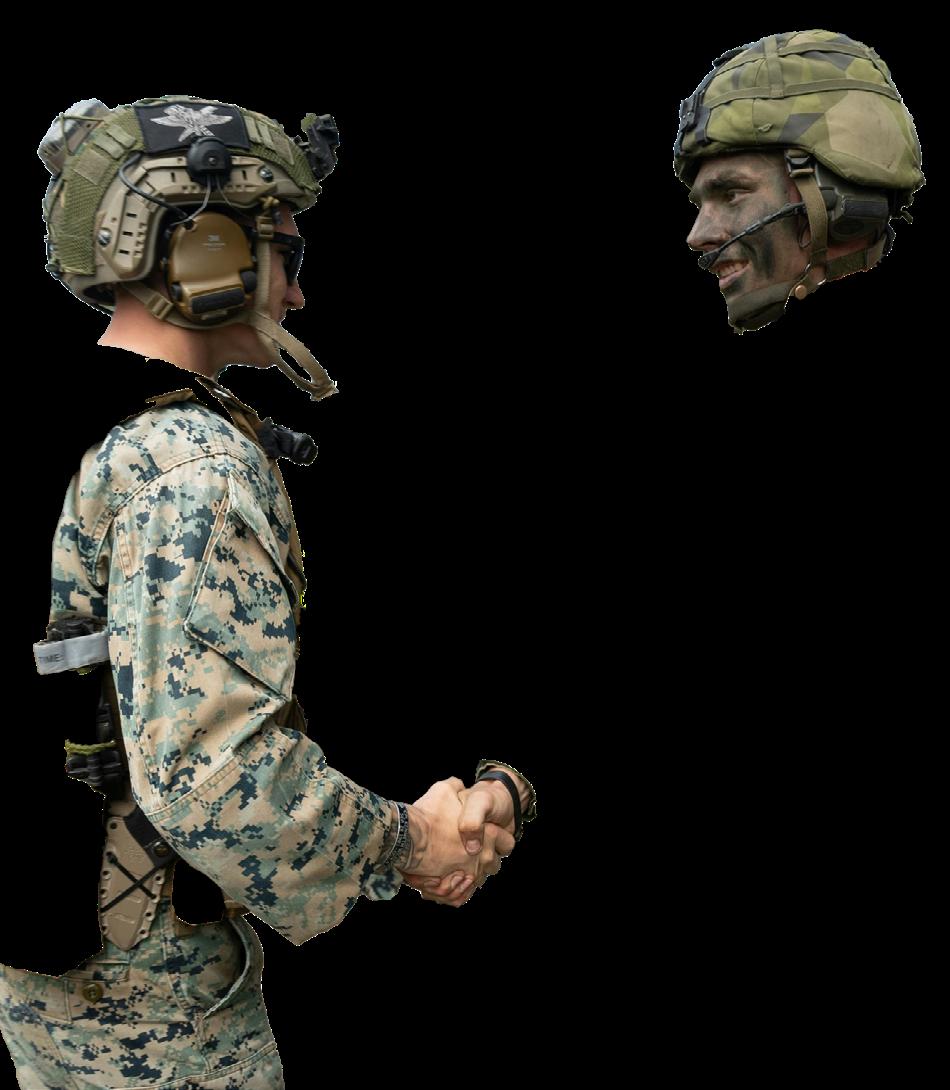
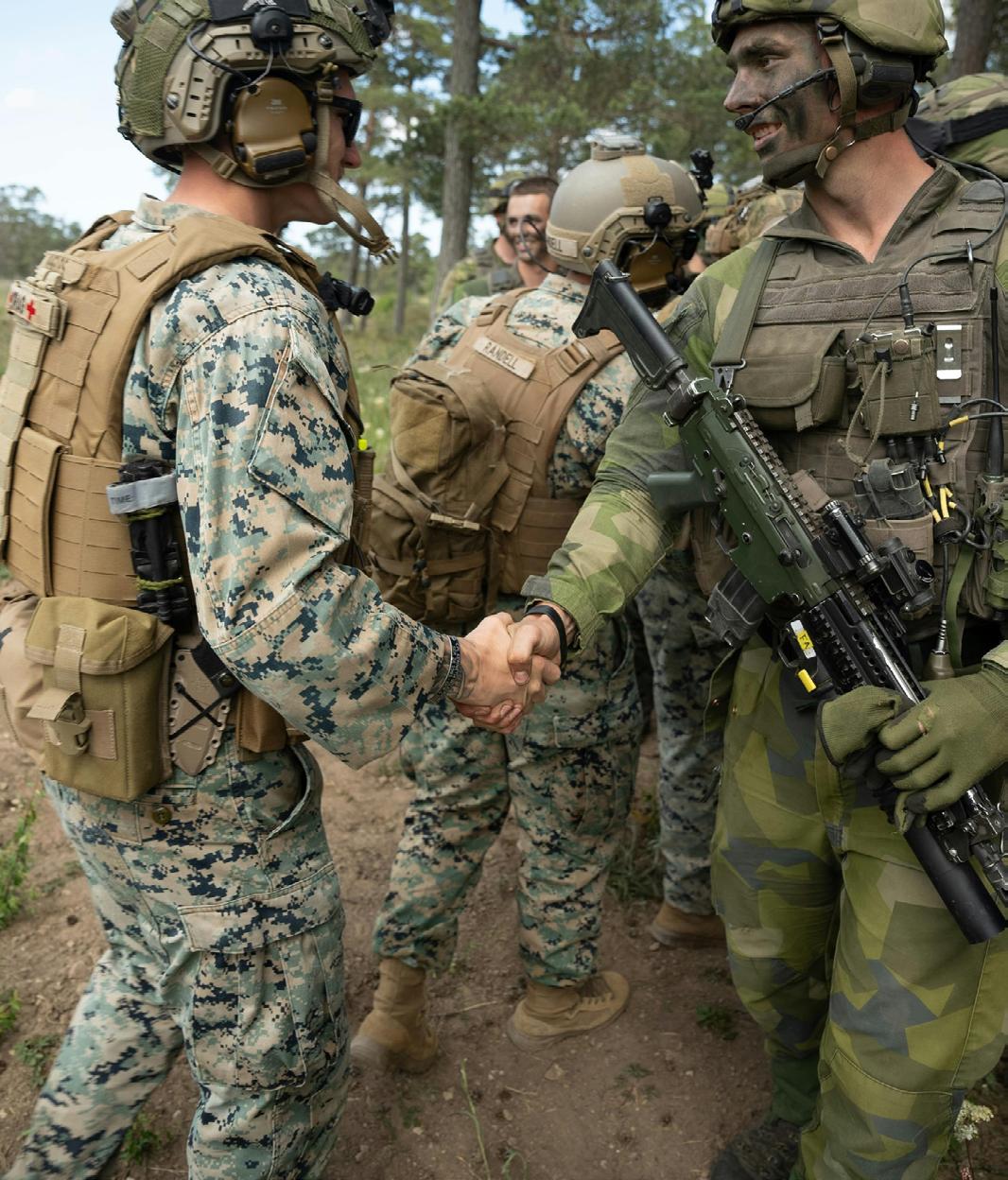
A Swedish soldier shakes hands with a US marine during Exercise Baltops 2024 in Gotland Picture: UN Photo
In response to this challenge, some analysts have argued that conditionality can provide a corrective to problems of interest asymmetry during SFA. By using carrots and sticks to shape the interests of the recipient, SFA providers hope to reduce opposition to reforms advocated during military training programmes, thereby increasing the effectiveness of their aid.15 During recent campaigning in Iraq, for example, US military advisers used conditional access to US indirect fire, air support and intelligence to incentivise tactical changes they considered necessary to improve Iraqi battlefield performance.16 However, to be effective, conditionality relies on a degree of dependence. But when recipients have access to multiple sources of military assistance, they can bypass conditionality by shifting to an alternate SFA provider. In this
“WESTERN SECURITY FORCE ASSISTANCE ONLY HAD A LIMITED EFFECT ON MALIAN MILITARY CAPABILITIES, WHILE ISLAMIST INSURGENCY GRADUALLY SPREAD INTO NEIGHBOURING BURKINA FASO AND NIGER.”
providers off against each other, undermining the effectiveness of military assistance.17 During the Cold War, for example, newly independent Zimbabwe received simultaneous military assistance from the UK and North Korea, using British fears of growing communist influence to subvert British red lines and extract even more military training.18 As a result, intensifying levels of international competition are likely to exacerbate the risks of interest asymmetry for SFA providers. Moreover, the provider whose interests align most closely with the recipient tends to win out in these conditions, creating a real danger of a race to the bottom in which liberal values
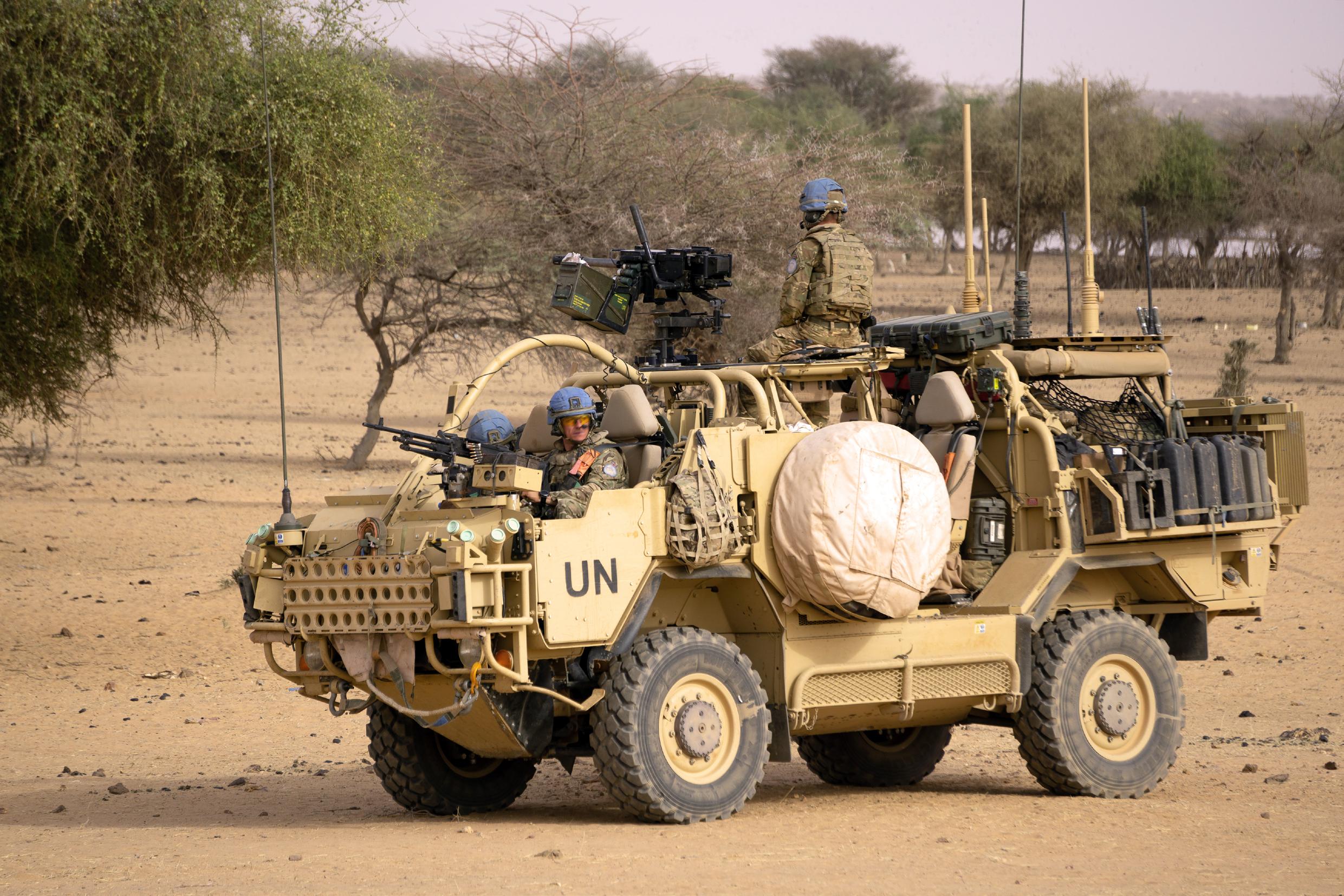
recently in Mali. In 2013, France intervened in Mali to prevent northern Tuareg rebels – piggybacked by various Islamist extremist groups – from advancing on the country’s capital, following the battlefield collapse of the Malian military and an associated coup d’etat. In the subsequent Algiers Accord, the Malian government was obliged to grant a degree of autonomy to the north in return for Western military aid, resulting in a European Union Training Mission to rebuild the Malian military, alongside French and US counterterrorism operations and a UN peacekeeping force. However, Western military
the Malian military continued to view northern separatism as the primary issue. As a result, extensive Western SFA only had a limited effect on Malian military capabilities, while Islamist insurgency gradually spread into neighbouring Burkina Faso and
15Rachel Tecott Metz, ‘The Cult of the Persuasive: Why U.S. Security Assistance Fails’, International Security, 47:3 (2023), pp. 95-135; Max Z. Margulies & Rachel Metz, ‘Issue linkage in Security Assistance: A Pathway to Recipient Security Sector Reform’, Journal of Strategic Studies, Online First (2024), pp. 1024.
16Jeffrey Martini et al, Operation Inherent Resolve: U.S. Ground Force Contributions (Santa Monica: RAND, 2022), p. 205.
17Alex Neads, ‘Rival principals and shrewd agents: Military assistance and the diffusion of warfare’, European Journal of International Security, 6:2 (2021), pp. 233-55.
18Blake Whitaker, Built on the Ruins of Empire: British Military Assistance and African Independence (Lawrence: University of Kansas Press, 2022), pp. 157-93.
19Renanah Miles Joyce, Exporting Might and Right: Security Assistance and Liberal International Order, Chapter 4: Tanzania, forthcoming.
Niger.20 Ultimately, the tensions generated by this divergence of interest led to a series of further coups, and the eventual ejection of Western military trainers in favour of Russia’s Wagner group. Not only has the professional standards of the Malian military declined further in the aftermath, but Russia has gained access to Mali’s valuable extractives industry as a quid-pro-quo for military support.21 Mali has also become a springboard for Russian influence in the region, following on the heels of further coups in Burkina Faso and Niger.
Thus, increasing geopolitical rivalries calls into question the utility of SFA as an instrument of capacity building with all but the most closely aligned allies and partners. Moreover, while the US remains the largest single provider of military aid globally, this challenge is likely to be felt most keenly by those providers with more modest military budgets – such as the
20Denis M. Tull, ‘Rebuilding Mali’s Amy: The Dissonant Relationship Between Mali and its International Partners’, International Affairs, 95:2 (2019), pp. 405–422; Michael Shurkin, Stephanie Pezard & S. Rebecca Zimmerman, Mali’s Next Battle: Improving Counterterrorism Capabilities (Santa Monica: RAND, 2017).
21Christopher Spearin, ‘Wagner Group – A Tool and Target of Great Power Competition in Africa: Implications for Canada’, International Journal, 79:1 (2024), pp. 111–125.
22Adam Scharpf, ‘Why Governments Have Their Troops Trained Abroad: Evidence from Latin America’, International Studies Quarterly, 64:3 (2020), pp. 734–747.
23Tarak Barkawi, ‘“Defence Diplomacy” in North-South Relations’, International Journal, 66:3 (2011), pp. 597-612.
24Walter Ladwig III, ‘Supporting Allies in Counterinsurgency: Britain and the Dhofar Rebellion’, Small Wars & Insurgencies, 19:1 (2008), pp. 62-88; Clive Jones, ‘Military Intelligence and the War in Dhofar: An Appraisal’, Small Wars & Insurgencies, 25:3 (2014), pp. 628–646. The Shah of Iran provided significant ground forces to Oman from 1972. See James Goode, ‘Assisting Our Brothers, Defending Ourselves: The Iranian Intervention in Oman, 1972–75’, Iranian Studies, 47:3 (2014), pp. 441-462.
“THERE IS SURPRISINGLY LITTLE STATISTICAL CORRELATION BETWEEN EVEN VERY MAJOR ARMS TRANSFERS AND RECIPIENTS’ FOREIGN POLICY ALIGNMENT.”
UK. Importantly, though, SFA is not just about capacity building: it can also be a vehicle for soft power, as a means to accrue influence with partners even where they do not fully share the UK’s interests or values. Here, SFA activities should be seen primarily as a way to promote political, military and diplomatic access to third states, and to diffuse British military attitudes and norms, rather than to build partner capacity for its own sake. Indeed, recipients of security assistance often see the benefits of foreign military training in exactly these political terms.22 However, using SFA as a tool of influence presents its own discrete challenges and risks, requiring distinct choices in terms of the aims, conduct and design of UK SFA.
SFA AND INFLUENCE
Security assistance has long been used as a form of defence diplomacy to develop understanding of, and ideally influence with, partner military institutions. Here, even smallscale and short-term SFA activities can provide a currency of diplomatic exchange, creating opportunities for defence attachés to grow professional networks in the partner force. In this way, SFA can be used to gradually increase the UK’s understanding of the
partner force, and to develop relationships of trust with influential partner officers.23 Where SFA extends to the embedding of British officers in partner force organisations for longer periods of time, access may also accrue into a degree of influence over partner force decision-making and intentions. Extensive UK assistance to Oman during the Dhofar War, for example, provided seconded British officers with unparalleled insights into Omani politics, including advance notice of an impending palace coup. By extension, British officers were able to exert a significant degree of control over Omani military decision-making, despite the presence of other security assistance providers.24 The access provided by contemporary SFA can also be cross-leveraged for other purposes, for example in support of non-combatant evacuation operations, or for more prosaic reasons, such as to gain short-notice permissions for overflight or transit rights to facilitate operations elsewhere. In advance of Operation Palliser in Sierra Leone in 2000, for example, the UK pre-positioned helicopters in Dakar, obtaining Senegalese approval with French support while the aircraft were already in the air en route.25
In principle, SFA could also
be used to block the access of a rival state. The acquisition of weapons and equipment, in particular, represents a costly commitment that can tie-in a recipient for many years, given the need to maintain access to spare parts, ammunition and technical support. For this reason, UK security assistance during the Cold War often sought to promote British weapons and equipment to former colonies, in an effort to secure continued British influence with newly independent states.26 The results of this approach, however, were fairly mediocre in the face of cheaper Soviet arms exports, and in practice the extent to which SFA can entirely block rival access remains unclear. Certainly, there is surprisingly little statistical correlation between even very major arms transfers and recipients’ foreign policy alignment, suggesting SFA alone may struggle to achieve much effect.27 Admittedly, arms sales can simultaneously help to defray domestic research and development and acquisition costs, providing additional economic benefits for the provider.28 Yet, the inability to control what a partner subsequently does with the weapons provided creates significant secondorder risks for suppliers –especially where recipients do
25In contrast, Spain declined British requests to transit aircraft from Gibraltar to Sierra Leone via the Canary Islands. See Andrew Dorman, Blair’s Successful War: British Military Intervention in Sierra Leone (Farnham: Ashgate, 2009), p. 75.
26See Whitaker, Built on the Ruins of Empire, passim.
27John Sislin, ‘Arms as Influence: The Determinants of Successful Influence’, Journal of Conflict Resolution, 38:4 (1998), pp. 665–689; Patricia Sullivan, Brock Tessman & Xiaojun Li, ‘US Military Aid and Recipient State Cooperation’, Foreign Policy Analysis, 7:3 (2011), pp. 275–294.
28Keith Krause, ‘The Political Economy of the International Arms Transfer System: The Diffusion of Military Technique via Arms Transfers’, International Journal, 45:3 (1990), pp. 687–722.
not share underlying values.29 Moreover, assiduous efforts by military advisers to promote national arms exports over and above local needs can end up undermining the wider capabilities of the partner force, undermining the long-term benefit in terms of political influence.30
More concretely, SFA can be used disruptively to undermine the influence of an adversary. A prime example is the recent French effort to use military assistance to develop relations with Armenia, exploiting Armenia’s sense of abandonment by Russia following defeat in the Second Nagorno-Karabakh War to retaliate against Russian inroads in the Sahel.31
29Carla Martinez Machain, ‘School of Influence: Human Rights Challenges in US Foreign Military Training’, Conflict Management and Peace Science, 41:1 (2024), pp. 3-25; Patricia Sullivan, ‘Lethal Aid and Human Security: The Effects of US Security Assistance on Civilian Harm in Low- and Middle-Income Countries’, Conflict Management and Peace Science, 40:5 (2023), pp. 467–488; Patricia Sullivan, Leo Blanken & Ian Rice, ‘Arming the Peace: Foreign Security Assistance and Human Rights Conditions in Post-Conflict Countries’, Defence & Peace Economics, 31:2 (2020), pp. 177-200.
30Donald Stoker, ‘Buying Influence, Selling Arms, Undermining a Friend: The French Naval Mission to Poland and the Development of the Polish Navy, 1923-32’, in Donald Stoker (ed.), Military Advising and Assistance From Mercenaries to Privatization, 1815–2007 (Abingdon: Routledge, 2008).
31Radio Free Europe/Radio Liberty, ‘France Hails Deal To Provide Armenia With Howitzers As “New Important Milestone”’, 18 June 2024.
32Pedro Seabra, ‘Falling Short or Rising above the Fray? Rising Powers and Security Force Assistance to Africa’, Journal of Intervention and Statebuilding, 15:5 (2021), pp. 682-697.
33Ilaria Carrozza & Nicholas Marsh, ‘Great Power Competition and China’s Security Assistance to Africa: Arms, Training, and Influence’, Journal of Global Security Studies, 7:4 (2022), pp. 1-22.
34Quoted in Neads, ‘Rival Principals and Shrewd Agents’, p. 245.
35For examples, see Tull, ‘Rebuilding Mali’s Amy’; Adam Grissom, ‘Shoulder-to-Shoulder Fighting Different Wars: NATO Advisors and Military Adaptation in the Afghan National Army, 2001–2011’, in Theo Farrell, Frans Osinga, & James Russell (eds), Military Adaptation in Afghanistan (Stanford: Stanford University Press, 2013), pp. 263–87.
“SECURITY FORCE ASSISTANCE CAN REDUCE ASYMMETRIES IN MILITARY VALUES, THEREBY REDUCING THE POLITICAL RISKS ASSOCIATED WITH THE TRANSFER OF MILITARY CAPABILITY. OVER TIME, THIS MAY ALSO REDUCE THE APPEAL OF RIVAL PROVIDERS DISPLAYING SIGNIFICANTLY DIFFERENT VALUES, HELPING TO MAINTAIN BRITISH INFLUENCE.”

Indeed, even relatively smallscale SFA can have significant disruptive effects in the face of high sunk costs. In Namibia, for example, China has been able to undercut decades of Brazilian assistance to develop Namibian naval institutions through one-off gifts of equipment and infrastructure.32 This example mirrors wider Chinese approaches to SFA in Africa, which generally eschew enduring commitments in favour of widespread, small-scale equipment and infrastructure gifting that simultaneously leverage China’s extensive economic and development activities to garner military influence with minimal investment.33 However, caution must the taken to ensure the provision of arms and assistance to third parties in an effort to disrupt the influence of a competitor does not inadvertently have a destabilising effect on regional security. In 19th century Japan, for example, Britain and France used military assistance to compete with each other for influence over Japanese trade. Yet, as one French diplomat presciently observed, “the Japanese seek arms and when they see themselves sufficiently provided, they will doubtless seek enemies”.34

Critically, the extent to which the access provided by SFA translates into strategic influence will remain dependent on the wider structure of political interests between each party. As a result, the degree of influence accrued by UK SFA in any given situation hinges on the relative value the recipient places on UK assistance. Programmes seen as high value by the UK may generate little wider influence if the recipient holds a different view of their utility, either in real terms or in comparison to other alternate providers. However, the political perceptions and institutional expectations of a partner force are often somewhat opaque, significantly complicating the technical conduct of SFA planning activities such as training needs analysis.35 As a result, the potential influence accrued through SFA can be a bit like Schoedinger’s proverbial cat: the provider can never be sure if their access and activity will exert genuine influence with the partner on a given issue until they actually seek to exercise it, whereupon they may discover that they have less influence than they thought.
To a certain extent, UK SFA might actively help to bridge political differences with the recipient state by inculcating the partner force with British military values and standards. By seeking to diffuse professional norms alongside tactical capabilities, SFA can reduce
asymmetries in military values (if not actual national interests), thereby reducing the political risks associated with the transfer of military capability. Over time, this may also reduce the appeal of rival providers displaying significantly different values, helping to maintain British influence. At the end of the Cold War, for example, Western security sector reform programmes served to consolidate fragile democracies in eastern and southern Europe after periods of communist and authoritarian rule, paving the way for NATO membership.36 In a similar fashion, extensive post-conflict military assistance programmes have helped to reorient coup-prone and predatory armed forces in countries such as Sierra Leone and Libera.37 At a smaller scale, professional military education programmes also demonstrate an ability to reshape the attitudes and perceptions of foreign officers in line with the values
36Alexandra Gheciu, ‘Security Institutions as Agents of Socialization? NATO and the “New Europe”, International Organization, 59:4 (2005), pp. 973-1012; Tomislav Ruby & Douglas Gibler, ‘US Professional Military Education and Democratization Abroad’, European Journal of International Relations, 16:3 (2010), pp. 339–364.
37Peter Albrecht & Paul Jackson, Securing Sierra Leone 1997-2013: Defence, Diplomacy and Development in Action (London: Routledge, 2014); Sean McFate, Building Better Armies: An Insider’s Account of Liberia (Carlisle: US Army War College Press, 2013).
of their providers.38 However, diffusing norms via SFA is easier said than done, and typically requires extensive periods of sustained engagement rather than short-term, small-scale ‘drive by training’.39
TACTICAL TRADE-OFFS AND STRATEGIC DILEMMAS
Consequently, the UK faces a series of dilemmas and tradeoffs in the use of SFA as a tool of influence. As rivalry with revisionist states such as Russia deepens, the market for SFA is also diversifying, as an array of middle and rising powers make increasing use of military assistance as a tool of foreign policy.40 As this competition for influence intensifies, the UK must consider how best to prioritise its resources. On the one hand, the UK might seek to focus its SFA by privileging deep and enduring relationships with a select number of closely aligned partners. Arguably, this might maximise the potential to generate political influence from SFA, while potentially also diffusing professional values and military capability at the same time. Yet, such engagements have high sunk costs that make them vulnerable to undercutting by disruptive rivals, and narrowing provision risks creating vacuums in regions of secondary (but still not insubstantial) importance to be filled by others. Alternatively, the UK might seek to use broad and shallow SFA engagements to maximise reach and constrain key adversaries. Yet, such an approach is unlikely to generate profound influence with recipients, and would inevitably involve the provision of military aid to a range of partners with significantly divergent morals and values, increasing political and reputational risk.41 Moreover, we have relatively little structured knowledge about how different national approaches to the provision of SFA interact with each other in different contexts, complicating the ability to plan strategically.
Similar dilemmas exist regarding the content of UK SFA programmes. SFA programmes have traditionally prioritised dismounted close-combat skills, and this emphasis is reflected in the current composition of UK force structures for SFA. Yet, elementary skills packages are often the least desired form of assistance from the perspective of a partner force and there are no shortage of alternate providers offering credible training in how to navigate, shoot straight, communicate and medicate. Yet, while more advanced training might be less fungible and so generate greater short-term influence with recipients, such provision would likely also present greater risks for UK national security. Moreover, in many fragile states, the development of basic infantry skills often represents the easiest path to sustainable improvements in partner force capabilities, however mundane this may appear.
These tensions likewise extend to the kinds of aims UK SFA programmes should prioritise. On the one hand, providing assistance to develop the military capabilities of partners who share some interests with the UK, if not our democratic values, may help to defeat transnational terrorist groups and stabilise regional hotspots. Yet, in so doing, UK SFA also helps to entrench local autocrats and increase their repressive capabilities, simultaneously undermining some of the wider strategic benefits such programmes are intended to provide.42 This paradox is evident in Western responses to recent coups in Mali, Burkina Faso and Niger: continuing to provide SFA to military juntas effectively legitimates military dictatorships, but declining to do cedes ground to authoritarian rivals whose approaches to counterinsurgency have equally deleterious effects for human security.43 As a result,
some analysts have argued that Western SFA should make greater use of military engineers to support partner force efforts at roadbuilding and infrastructure development, bypassing concerns about lethal aid and interest asymmetry altogether.44 Yet, even non-lethal SFA can still undermine the promotion of democratic values abroad, by encouraging the encroachment of local military forces into civil state functions and thereby potentially undermining civilian control of the armed forces.
To a certain extent, these issues can be partially addressed through more adroit connections between SFA and other levers of national power. Equally, greater cooperation with allies in the provision of SFA might alleviate some of the challenges presented by growing international competition. There are already good examples of multinational SFA cooperation, as with the US-led Flintlock exercises. Yet, pernicious obstacles to closer integration remain. Even close allies often view SFA first and foremost as a vehicle for national interests, limiting the will to combine (and in some cases, even declare) SFA activities. For their part, recipient states are also often loathe to accept collaborative arrangements that undermine their sovereign right to maintain (and exploit) bilateral relationships with patron states. As a result, the best that can be hoped for in most situations is ‘multi-bilateralism’, in which each SFA provider maintains bilateral relations with the recipient force but informally co-ordinates and deconflicts activity with partners in-country at the local level, insofar as they see fit.45 Where possible, greater deconfliction should nonetheless facilitate synergies that amplify the influence of combined provision. Ultimately, though, the UK faces some hard choices to ensure its SFA programmes continue to promote British
influence – both in terms of UK interests and British values – in the contemporary geopolitical landscape.
38Carol Atkinson, ‘Constructivist Implications of Material Power: Military Engagement and the Socialization of States, 1972–2000’, International Studies Quarterly, 50:3 (2006), 509–537; Carol Atkinson, ‘Does Soft Power Matter? A Comparative Analysis of Student Exchange Programs 1980–2006’, Foreign Policy Analysis, 6:1 (2010), pp. 1-22; Adam Jungdahl & Paul Lambert, ‘Winning Hearts by Broadening Minds: Measuring the Impact of International Military Education’, DISAM Annual: A Journal of International Security Cooperation Management, 1 (2010), pp. 153-60.
39Quoted in Marco Jowell, ‘The Unintended Consequences of Foreign Military Assistance in Africa: An Analysis of Peacekeeping Training in Kenya’, Journal of Eastern African Studies, 12:1 (2018), p. 110. See also Renanah Miles Joyce, ‘Soldiers’ Dilemma: Foreign Military Training and Liberal Norm Conflict’, International Security, 46:4 (2022), pp. 53-56; Sharan Grewal, ‘Norm Diffusion through US Military Training in Tunisia’, Security Studies, 31:2 (2022), pp. 291-317.
40Marius Kristiansen &Njål Home, ‘Small State Security Sector Assistance in the Age of Great Power Competition’, Comparative Strategy, 41:4 (2022), pp. 403-14; Øystein Rolandsen, Nicholas Marsh & Ilaria Carrozza, ‘Small States’ Security Force Assistance in the Sahel’, PRIO Policy Brief 13 (2019); Andreas Krieg, ‘Security Assistance to Surrogates – How the UAE Secures its Regional Objectives’, Mediterranean Politics, 29:4 (2024), pp. 454-77; Abdolrasool Divsallar & Hamidreza Azizi, ‘Towards a Non-Western Model of Security Assistance: How Iran Assists Militaries’, Mediterranean Politics, 29:4 (2024), pp. 550-72.
41For debate over the ideal shape of SFA, see Biddle et al, ‘Small Footprint, Small Payoff’; David Ucko, ‘Can Limited Intervention Work? Lessons from Britain’s Success Story in Sierra Leone’, Journal of Strategic Studies, 39:5-6 (2016), pp. 847-77.
42Kristen Harkness, ‘Security Force Assistance to Cameroon: How Building Enclave Units Deepens Autocracy’, International Affairs, 98:6 (2022), pp. 2099–2117.
43See Jahara Matisek, ‘International Competition to Provide Security Force Assistance in Africa’, PRISM, 9:1 (2020), pp. 106-18.
44Nils Zimmermann, Ivor Wiltenburg & Jahara Matisek, ‘Supporting African Partner States Through European Military Assistance Programmes’, RUSI Journal, 167:3 (2022), pp. 42-53.
45Nina Wilén, ‘Analysing (In)formal Relations and Networks in Security Force Assistance: The Case of Niger’, Journal of Intervention and Statebuilding, 15:5 (2021), pp. 580-97.