NATO AND SERBIA
AS Russia’s “special operation” against Ukraine rolls into its third year, the shockwaves continue to reverberate throughout Europe in ways expected and others unforeseen. NATO has felt the full weight of the conflict and has experienced significant changes few envisioned a scant time ago. Finland and Sweden abandoned decades of neutrality for membership, while many NATO members have paid long-overdue attention to their atrophied military capabilities. With fears of a wider conflict on the minds in Brussels, NATO considers further enlargement (or expansion, in the eyes of Moscow) as expedient. This sense of urgency has also widened the aperture when considering who to engage for future membership. One such country in this category is Serbia, long considered an ally of Russia. Mention of Serbia joining NATO has often evoked fears of introducing a Trojan Horse
into the alliance. But as the war continues, many favour a harder push by NATO, and influential members such as the United Kingdom, to consider Serbia for membership. However, the history between the UK, NATO and Serbia is complicated by events during the Yugoslav War, as British jets took part in air strikes on Serbia. The threemonth bombing campaign remains a bitterly divisive issue that has been fuelled by a war of words between NATO and Serbia since the first bombs fell. While consideration should be given to Serbia pulling closer to NATO, any hope of a future together must involve NATO reconciling the past, while also weighing an opportunity to minimise Russian influence in Europe against inclusion in the alliance of a potentially divisive member.
“It was the best of times, it was the worst of times.” – Charles Dickens, A Tale of Two Cities
In the 1990s, optimism reigned
throughout Western Europe and America. Communism was defeated, the global economy was relatively healthy and 9/11 was not even a consideration in the wildest of imaginations. This, however, was not the case in the Balkans. Only a few years earlier, the region struck an optimistic tone. After 1989, many countries in Central and Eastern Europe saw their opportunity to win the freedom that had eluded them since World War II. Yugoslavia offered a complicated and unique case. This conglomeration of states was riddled with national, political, ethnic and religious differences. Born in 1918 from the ashes of World War I, Yugoslavia consisted of Bosnia and Herzegovina, Croatia, Macedonia, Montenegro, Serbia and Slovenia. Historical animosities between the unwilling participants were held in check by the unifying Josef Tito. Through his efforts, tensions simmered but did not boil over. As such, Yugoslavia carved out a relatively peaceful existence from its incarnation through to
1 // IN-DEPTH BRIEFING // CHACR
the 1980s, with its unique brand of socialism and impressive ability to keep the USSR at bay. However, the centrifugal forces unleashed from the successive blows of Tito’s death and the demise of the Soviet Union provided the conditions for tensions to explode. Yugoslavia rapidly disintegrated. But instead of benefitting from the post-Cold War peace dividend, Serbia and the other states united within the former Yugoslavia kindled old hatreds and war loomed in the Balkans.
“Events, dear boy, events!” –Harold MacMillan, former UK Prime Minister
Events began in earnest with the Bosnian War and later the Yugoslav War. During the latter, NATO initially stayed off the pitch, lacking the UN justification it was granted during the former. But it became apparent that civilians once again would not be spared the horrors of conflict. Sadly, the Yugoslav War holds the ignominious title of giving birth to the term ‘ethnic cleansing’.
horror in 1998, the UN struggled to stop the bloodshed while NATO uneasily observed the conflict on its eastern front. Some NATO members voiced a desire to intervene as it did during the Bosnian War. Events eventually provided the stimulus. The forcing mechanism was a new wave of ethnic cleansing launched by Serbian forces against the Kosovar Albanians on the 20th March 1999. The NATO response, without UN approval, began three days later with a series of air strikes. NATO jets, including those from the UK, struck Serbian military targets, government buildings and the country’s infrastructure. At the time, the Serbian Minister of Information decried the bombings as an “evil, terrible, subversive, cowardly attack by the NATO army on Serbia and Yugoslavia” and “proof of the neo-Nazi policies of the USA and its satellites”. The minister’s name was Aleksandar Vučić; he is currently the two-term President of Serbia who enjoys warm relations with Russia. The air strikes and undeterred Serbian
“AT THE TIME, THE SERBIAN MINISTER OF INFORMATION DECRIED THE BOMBINGS AS AN ‘EVIL, TERRIBLE, SUBVERSIVE, COWARDLY ATTACK BY THE NATO ARMY ON SERBIA AND YUGOSLAVIA’ AND ‘PROOF OF THE NEO-NAZI POLICIES OF THE USA AND ITS SATELLITES’. THE MINISTER’S NAME WAS ALEKSANDAR VUČIĆ.”
thousands of Kosovar Albanians into neighbouring Albania, Macedonia and Montenegro. The air strikes lasted through June 1999 and culminated with an agreement that saw the Yugoslav Army leave Kosovo. Additionally, the United Nations established an Interim Administration Mission in Kosovo which remains in place today.
Of note, NATO launched its campaign without the UN’s approval on the grounds that it was a humanitarian intervention. This remains a mortal sin in the eyes of the Serbians. The threshold for UN approval had not been reached to approve the use of force as the Security Council reached no decision under Chapter VII. NATO’s
defence against an armed attack was not applicable, negating the ability to invoke Article 5. While the sentiment to prevent human suffering was noble, the legality was tenuous at best and illegal at worst. Nevertheless, the operation proceeded. A UN investigation was launched after the conflict to determine the legality of the NATO air strikes. Multiple statements in the official report condemned the air strikes, but the UN offered no official judgment. However, the court of public opinion remains fiercely divided about the morality and legality of NATO’s decision to inject itself into the Yugoslav War. Accusations of murder, parried by responses of mercy, continue to ring loudly.
“Luke, you’re going to find that many of the truths we cling to depend greatly on our own point – Ben Kenobi, to Luke Skywalker, about the death of Luke’s father
While the scale and scope of NATO’s bombing campaign against Serbia is well documented, the principal antagonists agree on little else. Over this 25-year stretch, both sides have employed strategic communications to champion their role in the Yugoslav War. NATO has consistently cited moral considerations for its questionable legal intervention; advances in digital technology meant much of the world was aware of the events in the former Yugoslavia, and the outcry was intense. The graphic nature of the conflict made a strong humanistic appeal to the
2 // IN-DEPTH BRIEFING // CHACR IN-DEPTH BRIEFING // THE
COMPLICATED CASE OF NATO AND SERBIA
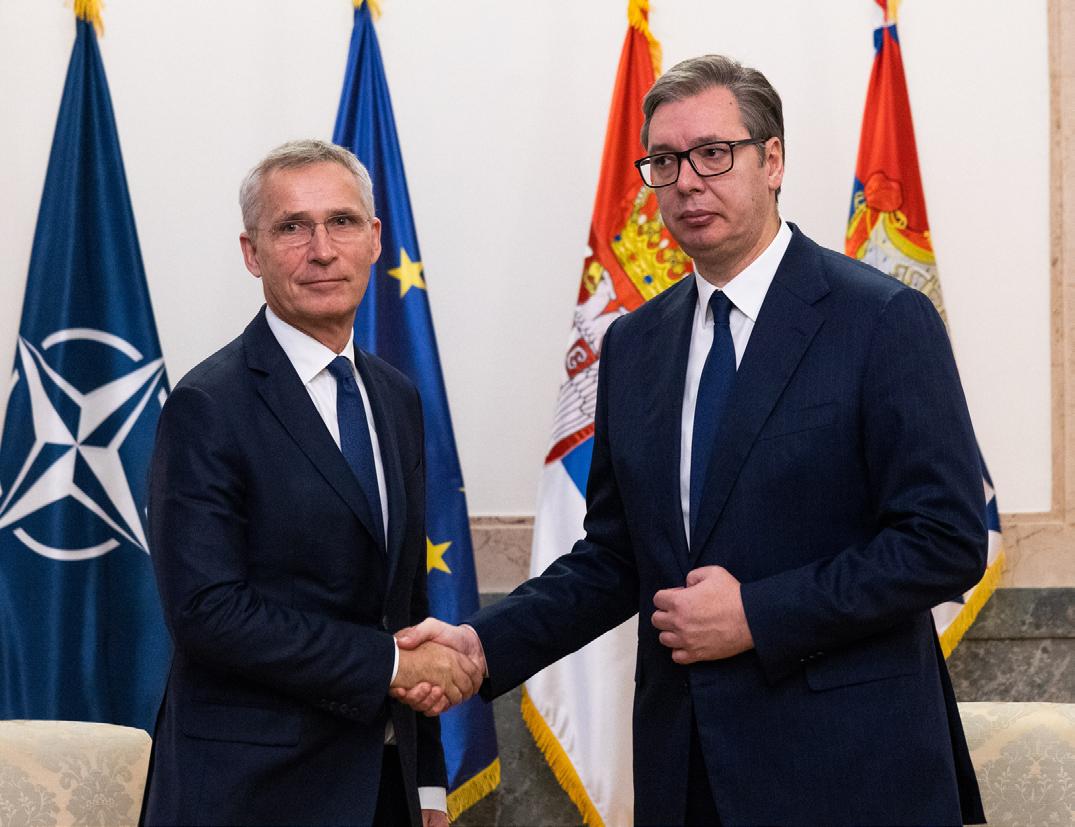
Picture: NATO
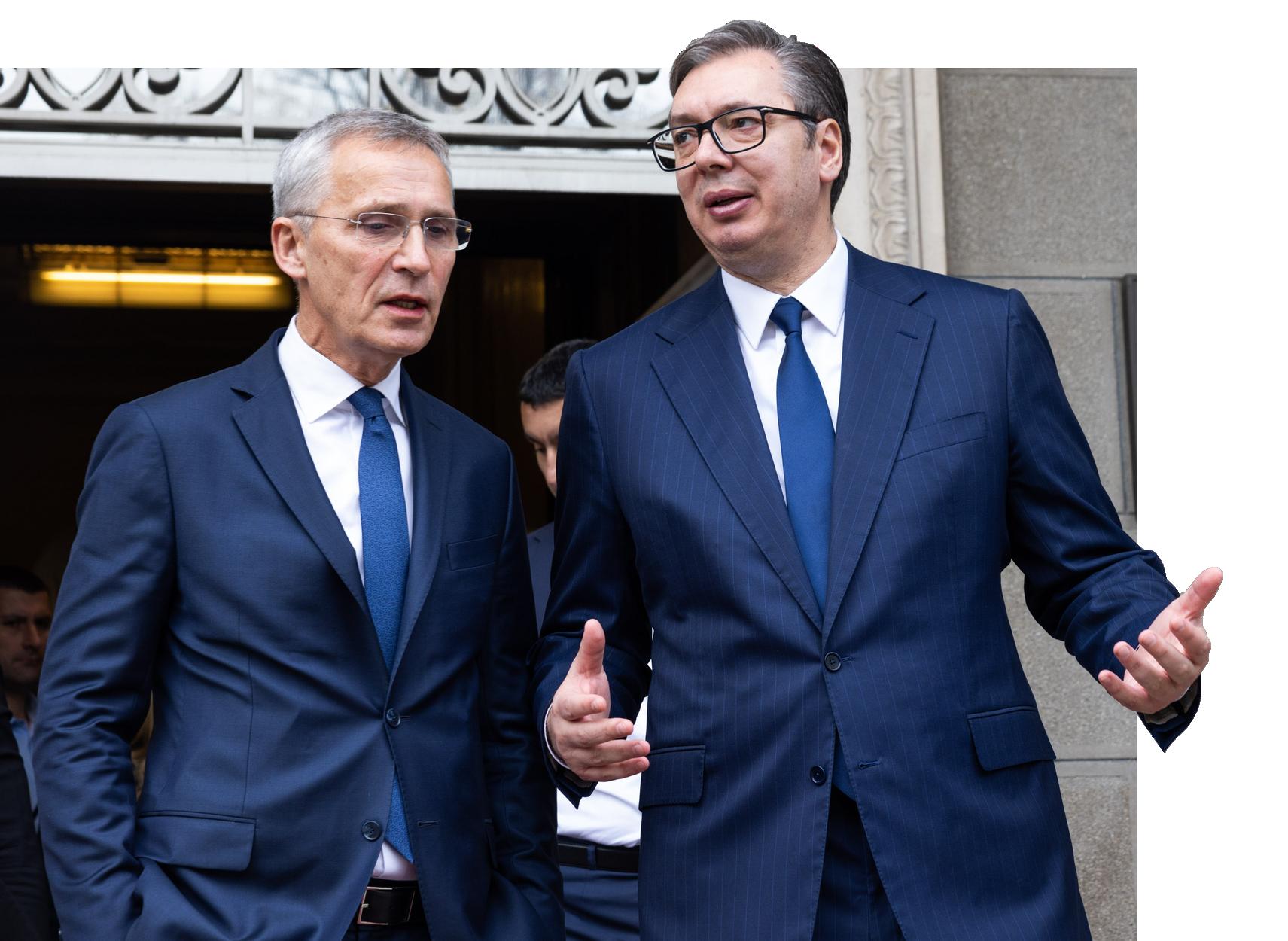
NATO Secretary General Jens Stoltenberg meets the President of Serbia, Aleksandar Vučić, during a meeting to the Western Balkans in November 2023
global audience, who wanted to see an end to the bloodshed of civilians. The subsequent actions of NATO testify to the impact and influence of the outrage. In the preceding decades, NATO had become a largely dormant organisation as member nations experienced dwindling defence budgets while conducting bland exercises that often irked and occasionally terrified the Soviets (for example, Able Archer in 1983). Public sentiment also blurred the blemishes of a tenuous legal argument. NATO’s intervention on humanitarian grounds, while a stirring narrative to an international audience, did little to persuade eagle-eyed legal experts who adjudicate matters through the lens of legality, not humanity. Consequently, NATO subtly defended its actions with carefully worded written narratives that can only be found deep within the archives of its website. The scarce content leads the inquisitive reader to deduce that Brussels would prefer the event fade into memory, given the current geopolitical environment in Europe and NATO overtures to Serbia. But supporting NATO’s action and messaging is an age-old axiom of geopolitics: the
winner writes the history. Postconflict, the evidence of Serbian war crimes and the conviction of Slobodan Milošević weakened the Serbian outrage and its argument against NATO intervention. This allowed NATO to re-brand its potential war crimes through a narrative of just cause. Tellingly, although NATO has benefitted from these revelations, it does not support them with consistent and robust messaging, further proof it seems content to turn the page on the matter.
“Our president understands that he who controls history controls the future. – Sergei Korovin.” –Daniel Silva, The Defector
Conversely, Serbia preserves the memory of the NATO air strikes in both mind and matter, through government strategic communications messaging rife with palpable emotion.
Visiting the former Serbian Ministry of Defence buildings [pictured above] offers a jarring and surreal scene to the viewer. While the Americans rebuilt the World Trade Center and added commemorative structures to mark the event, honour the dead and instil a spirit of resilience, the Serbians chose to freeze the
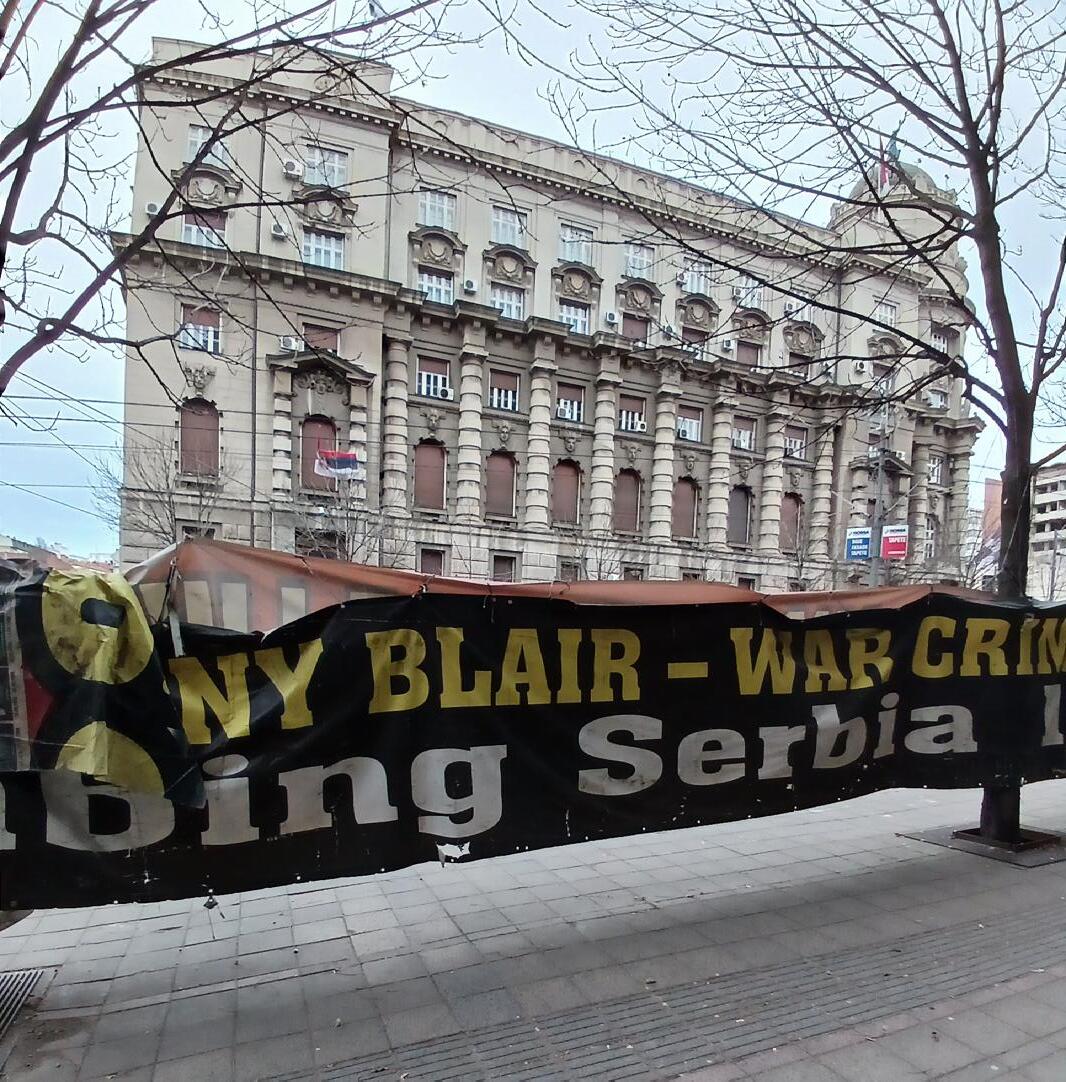
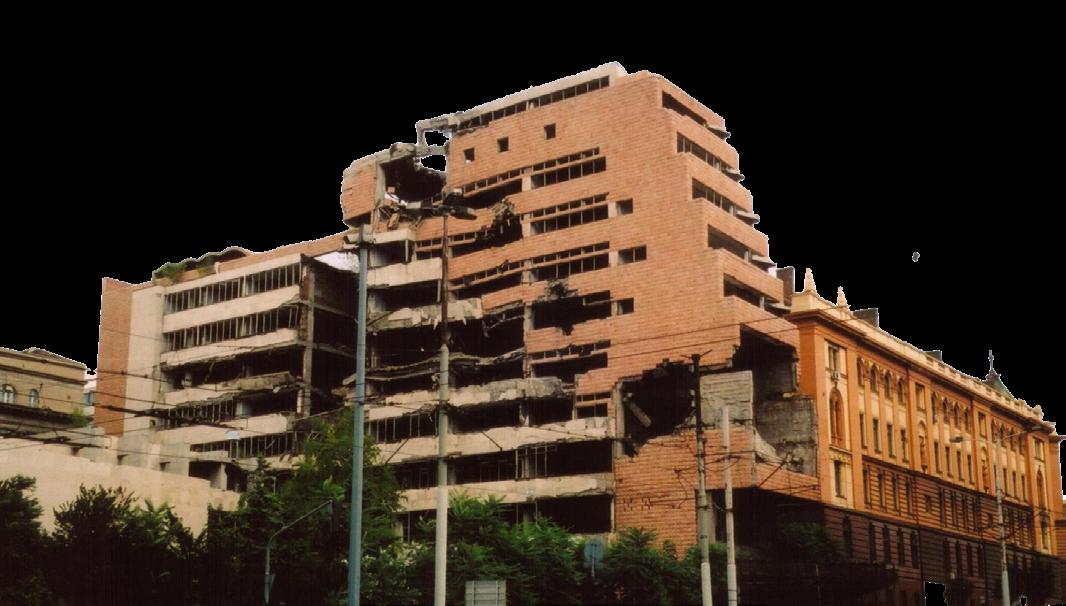
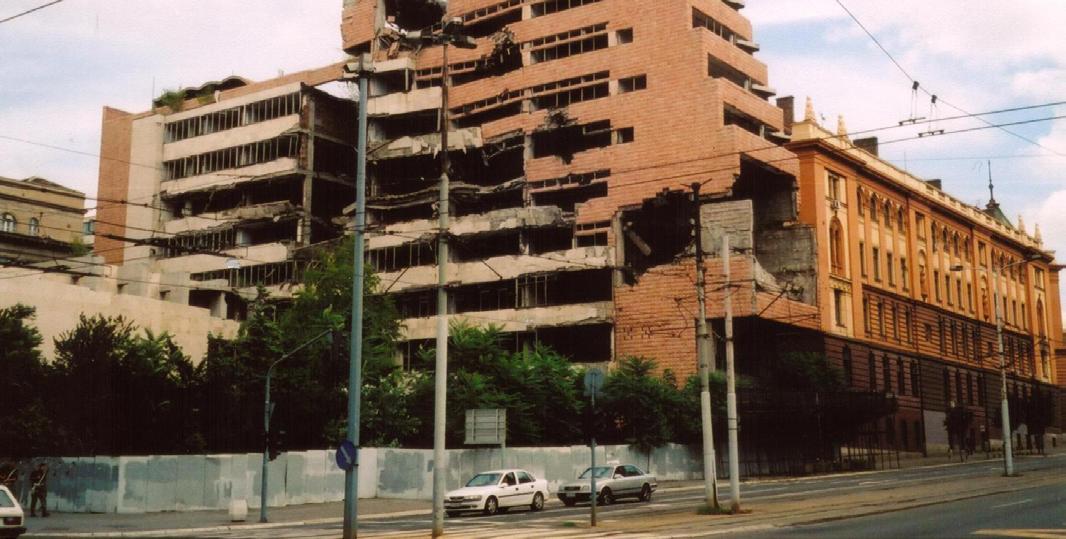
traumatic event in time. Building A remains much as it did after NATO air strikes. Supports ensure the damaged structure remains upright, while large signs greet visitors with a definitive and defiant narrative. Posted images of President Clinton and Prime Minister Blair bear the subtitle “WAR CRIMINAL” [see below] while the signage implores Serbians “to never forget when NATO murdered our children”. Graphic images of Serbian children are also displayed with severe injuries, including compound fractures and extensive burns. The presentation is piercing and provocative, but the physical state of the display is wanting of care and projects a feeling of reluctant acceptance. The signs are well-worn, faded and fastened to existing supports by a hodge podge of tiedowns, strings and homemade attachments; it contrasts sharply with the message’s urgent tone. Nevertheless, the narrative is straightforward and disturbing, while further amplified in gravity and significance by the unarmed roving guard who ‘patrols’ the area. Across the street, the façade of the less damaged Building B looms, adorned with a gigantic image of a Serbian military unit designed to inspire Serbians to join the military. In its totality, the scene presents a determined message that, while vigorous in spirit, seems to have a diminished effect on the daily foot traffic. Rarely do pedestrians stop to take in the damaged building and read the signage. Most walk past with no acknowledgment of the site’s historical significance. Its
location, far from busy, touristcentric areas, limits its audience to local Serbians seemingly long acclimatised to the horrific aspects of the production. However, a vastly different reception is apparent on the anniversary of the air strikes, as the Serbian government and several nationalist groups propagate a fiery strategic communications narrative. Populace support is unmistakable. The 20th anniversary saw crowds gather in the thousands, led by President Vučić, who delivered a passionate anti-NATO speech in which he could be seen crying. Serbian nationalist groups also hosted parades with thousands in attendance and skilfully blended still potent public outrage over the air strikes with a far-right political agenda. The messaging has been effective and consistently amplifies existing Serbian outrage over NATO actions and refreshes calls for war crimes to be levied against NATO and the UK.
While Serbian strategic communications put forth on the matter are vitriolic and bitter, there is little notoriety after the anniversary dates. NATO-Serbian relations do carry forth, but antiNATO sentiment remains strong. Most polling shows Serbians opposed to NATO membership (but a majority favour the current partnership). The postanniversary reduction in strategic communications that highlight the NATO bombing campaign could be seen as a deliberate message of moving past a dark
3 // IN-DEPTH BRIEFING // CHACR
IN-DEPTH BRIEFING // THE COMPLICATED CASE
NATO
OF
AND SERBIA
chapter in Serbia’s history; a history which incriminates not only NATO but also Serbia itself. Inevitably, the mention of the NATO air strikes illuminates Serbian ethnic cleansing, making the issue a double-edged sword that many Serbians might prefer to leave in the past while still harbouring mixed feelings toward NATO in the present.
“When you come to the fork in the road, take it.” – Yogi Berra, former American professional baseball player and Hall of Fame inductee
Serbia and NATO currently stand at a crossroads. Since its inclusion into Yugoslavia, Serbia has clung to an official policy of neutrality; comments from Serbian officials reaffirm that position. This policy puts Brussels in a dilemma. With Serbia’s historical ties and proximity to Russia, NATO appears unempathetic if it criticises a politically expedient Serbian approach. Indeed, NATO tolerates a similar policy from Hungary. One could offer that NATO would be wiser to accept limited relations with Serbia than no relations at all to counter the Serbian relationship with Russia. The current geopolitical environment in present-day Europe gives these efforts at rapprochement a needed boost. It provides a rationale for NATO to mend relations with Serbia while deflecting and diminishing memories of its bombing campaign. With concerns of a wider, regional war with Russia, the best militaries in NATO – the US, UK, France and Italy – stand to bear the burden of a conflict; another ally in Serbia would certainly not hurt that effort. Progress has been made. Serbia was admitted to the Individual Partnership Plan in 2015 and regularly participates in NATO exercises. While a small development, it is potentially promising for NATO members, especially the UK, which disproportionally
“IMPROVED SERBIAN RELATIONS WITH NATO WOULD NECESSITATE A RECALIBRATION IN WHICH BOTH SIDES MAKE GENUINE EFFORTS TO MEET SOMEWHERE IN THE MIDDLE GROUND.”
bears NATO warfighting duties. While this might seem ambitious and unreasonable given Serbia’s friendly relations with Russia, it is worth noting Serbia condemned Russia’s attacks on Ukraine at the UN General Assembly in 2022. Additionally, Serbia has strengthened relations with France in pursuit of military equipment to replace its aging Soviet equipment, which could increase interoperability between Serbian and the more capable NATO militaries, including the UK.
Meanwhile, the Serbian government attempts to hedge its reputational bet, trumpeting its relations with Russia and acknowledging its dalliance with NATO, while Vučić often criticises both. But much like other leaders in NATO, Vučić must placate disparate groups within his domestic audience. As often in politics, actions do speak louder than words, and current momentum seems slightly more in favour of cooperation, or at least amicable relations, than frosty solitude. Further escalation emanating from Ukraine may help overcome conflicting narratives between NATO and Serbia and give the effort a further push toward membership,
a development that few even considered possible. Given the UK’s out-sized role in NATO, this might be welcomed news. As is often the case in international relations, pragmatism trumps all, especially during times of conflict.
Pragmatism has often been a
Bibliography
recurring feature in NATO’s historical dealings with problematic members. Brussels has a long history of tolerating member policies that clashed with the ideals of the alliance due to political necessity; the Greek juntas in the 1970s and current authoritarians in Hungary and Türkiye (with close relations to Russia) come to mind. Improved Serbian relations with NATO would necessitate a recalibration in which both sides make genuine efforts to meet somewhere in the middle ground. While the events of 1999 will remain disputed and each side’s narratives conflicted, focusing on geopolitical realities might dull the sharper memories and shift focus to matters at hand. In this hopeful scenario, a complicated chapter in Serbia’s relations with the West fades with time and the necessity for pragmatism offers a partnership to the benefit of all parties. Such difficult decisions for NATO and the UK may become necessary as the Westphalian system and rules-based order, beneficial to both, continues its sunset.
icty.org/en/press/final-report-prosecutor-committee-established-review-nato-bombingcampaign-against-federal
balkaninsight.com/2019/03/22/78-days-of-fear-remembering-natos-bombing-of-yugoslavia theconversation.com/ukraine-war-serbia-is-shifting-closer-to-russia-heres-why-192472 rferl.org/a/serbia-russia-nikitin-entry-ban/32503633.html
foreignpolicy.com/2023/02/03/russia-serbia-ukraine-war-kosovo-vucic-putin-balkans politico.eu/article/serbia-vucic-davos-world-economic-forum-european-union-membership balkaninsight.com/2019/03/22/78-days-of-fear-remembering-natos-bombing-of-yugoslavia edition.cnn.com/2023/08/14/europe/serbia-vucic-kosovo-balkans-west-intl-cmd/index.html balkaninsight.com/2022/04/05/lesson-from-ukraine-stop-appeasing-russias-trojan-horseserbia balkaninsight.com/2019/03/25/serbia-marks-nato-bombing-anniversary-as-nationalistsprotest web.archive.org/web/20131112060639/http:/www.mfa.gov.rs/en/press-service/ statements/12420-serbia-and-nato-are-we-at-a-turning-point web.archive.org/web/20151215204542/http:/www.infobalkans.com/2015/01/16/ dacic-ipap-step-forward-serbia-nato-relations nato.int/cps/en/natohq/topics_50100.htm rferl.org/a/operation-allied-force-before-after/29831978.html nato.int/cps/en/natohq/news_220285.htm?selectedLocale=en
IN-DEPTH BRIEFING // THE COMPLICATED CASE OF NATO AND SERBIA 4 // IN-DEPTH BRIEFING // CHACR
Picture: NATO