CHACRDIGEST#16
FOREWORD
After the collapse of the Soviet Union and the so-called end of history, it became almost unthinkable to talk about nuclear weapons as a serious strategic threat to Western militaries. The 2000s and 2010s – which were largely dominated by Western asymmetric warfare against weak states, insurgencies, and non-state actors –only reconfirmed this notion that the nuclear age was long past. But in 2023 the issue of nuclear security is once again at the forefront of key global security concerns. In this edition we take a look across the piste at some critical issues affecting the world today.


A NEW NUCLEAR (DIS)ORDER?

2023 promises to be a year in which nuclear issues – nuclear weapons, nuclear safety, and nuclear energy – will be high on the agenda for policymakers and security professionals around the world. The Iran nuclear deal, also known as the Joint Comprehensive Plan of Action, appears to be all but dead, once again raising the question as to if and how Iran can be prevented from building a nuclear weapon. Meanwhile, Russia’s war against Ukraine has a twofold nuclear dimension: the possibility that a desperate Russia could resort to using nuclear weapons, and the threat that Ukraine’s nuclear power plants could be catastrophically damaged. Finally, there are a growing number of people championing the potential for nuclear energy to play a part in the global energy transition away from fossil fuels. In early February, Chatham House hosted International Atomic Energy Agency Head Rafael Mariano Grossi to talk about all things nuclear; the recording of the event is worth watching.
WAS UKRAINE WRONG TO GIVE UP ITS NUKES?
Ukraine inherited a significant slice of Moscow’s nuclear cache following the collapse of the Soviet Union but decided to surrender that arsenal in 1994 in exchange for assurances from Russia, the United Kingdom, and the United States that its sovereignty and territorial integrity would be respected. The agreement, known as the Budapest Memorandum, is one that many Ukrainians have come to regret. In this article Mariana Budjeryn argues that it was never so simple, Ukraine did not inherit a workable deterrent, more a “proliferation starter-kit”, with Moscow still holding the briefcase containing the codes. The author’s argument is that Ukraine’s leadership chose sensibly not to pursue a full deterrent, but that means the conventional security of Ukraine’s borders is fundamental to upholding nonproliferation norms. Should Ukraine be forced to back down by Putin’s nuclear bullying this could set a dangerous precedent.
ATOMIC STRAIT: HOW CHINA’S BUILD-UP AFFECTS THE SECURITY DYNAMICS WITH TAIWAN
Beijing is rapidly modernising its nuclear arsenal. Changes include an increase in warhead numbers from more than 400 today to potentially 700 by 2027 and more beyond, consolidating a nuclear triad, developing new delivery systems, and digging at least 300 new missile silos. In this report CNAS analyst Jacob Stokes argues that it is clear China’s upgraded arsenal is designed to fulfil new roles, primarily by backstopping China’s increasing presence in South-East Asia, and offering it an umbrella of security should it choose to test US resolve in Taiwan. In the face of this increasing danger the report asserts that the US must modernise its own nuclear force but avoid an arms race. Instead, nuclear contingencies should be built into all security scenarios in Taiwan, and that Taiwan’s conventional military capabilities be substantially upgraded to dissuade Taipei from seeking its own nuclear deterrent.
ONE YEAR IN, TWO DIFFERENT WARS BEING FOUGHT
The war in Ukraine has revealed two variant doctrines by its combatants. Although Moscow tried in the early stages to fight a modern conflict, its army has become bogged down in tactics reminiscent of years gone by, relying on artillery barrages and massed infantry assaults to punch holes in Ukrainian defences, while also targeting cities and trying to hold on to occupied territory. The Ukrainians by contrast have limited their scope to fighting Russia’s military largely within Ukrainian borders, and have shown an innovative and flexible command structure. In this article marking one year of the conflict, Professor Sir Lawrence Freedman argues this is a classic 20th century war between Ukrainian “classical warfare” and Russian “total warfare”. Freedman’s piece is an informed juxtaposition of two different strategic approaches, each with their own strengths and limitations.

RUSSIA’S WAR AND ITS RELATIONS WITH THE ISLAMIC WORLD
WIDER READING
In his latest book, Atoms and Ashes, Serhii Plokhy runs through the major developments of nuclear power, and nuclear weapons since the mid-20th century. The book chooses to focus on six distinct events rather than a free-flowing historical narrative, starting with America’s badly miscalculated Castle Bravo nuclear test, through to civilian disasters such as Kyshtym, Chernobyl and Fukushima. The book is a cautionary tale to seriously consider the economic, environmental, and perhaps most importantly, the human costs of a technology that is far from safe or accident free. As the 21st century sees the resurgence of nuclear power as a ‘climate friendly’ option in power generation, alongside the rise of nuclear deterrence as a key topic in international affairs, it is worth reminding the casual reader and policymaker alike that the atom’s boundless potential can, if handled the wrong way, prove hugely destructive. The book is an enjoyable, quick read that is full of colour and often quasi-narrated through first-hand accounts, which brings to life a topic that can sometimes seem inaccessible and overly scientific.
Russia’s invasion of Ukraine has fundamentally transformed relations between Moscow and the West, but despite the US and Europe’s efforts, Russia has not been isolated on the international stage. In this report published by the French Institute of International Relations, Marlene Laruelle focuses on Russia’s relations with the Islamic world. She highlights how Russia has been able to retain its constructive relations with many Muslim-majority states in the Middle East and beyond, but also provides an interesting analysis of how Moscow has found a loyal constituency in its own Muslim community and Islamic institutions.
BIDEN’S SECOND STATE OF THE UNION ADDRESS
In his second State of the Union speech, US President Biden covered a wide range of domestic and foreign policy issues. Overall, the focus was on matters at home, including police and gun violence, and the uncertain prospect of bipartisan problem solving in Washington. Looking beyond US borders, Biden primarily focused on Russia’s war in Ukraine, pledging to support Ukraine for the long haul. But he also highlighted the competition with China as America’s long-term challenge (an issue that drew extra attention after the shooting down of a Chinese spy balloon earlier that same week). The RAND Blog features a useful review of some of the key security related topics raised by Biden, annotated with comments from the authors. Meanwhile, Daniel Drezner at Chatham House looks at the State of the Union address through the lens of the transatlantic relationship that appears stronger than in recent years in light of Russia’s war in Ukraine. On the other hand, Kori Schake, writing in Foreign Affairs, offers a thoughtful though highly critical review of Biden’s foreign policy to date.
ISRAEL’S UNCERTAIN DIRECTION
As the new government of Prime Minister Benjamin Netanyahu settles into office in Israel, three big issues stand out that will define both Israeli domestic and foreign policy. At home, the government is pushing ahead with reform of the judicial system that many regard as severely undermining Israeli democracy. Meanwhile, the most hard-line members of Netanyahu’s coalition appear intent on further stoking the flames of the Israeli-Palestinian conflict. Peter Lintl at the German Institute for International and Security Affairs provides a very useful and nuanced overview of the issues at hand. Related to this, Udi Dekel at the Institute for National Security Studies in Tel Aviv argues that the looming collapse of the Palestinian Authority would likely feed escalation and increase the burden on Israel’s already strained security services. On the other hand, Netanyahu hopes to further advance the normalisation of Israel’s relations with Arab countries. Yoel Guzansky and Marta Furlan’s analysis of the evolving relationship between Israel and Sudan highlights some of the key challenges and contradictions emerging in this process.
NEWS STORIES TO WATCH OUT FOR

As the war in Ukraine and its multi-dimensional repercussions continue to dominate headlines, here are some other topics to keep an eye on:
In Peru, political chaos – and violent clashes that have already claimed the lives of 50 people – are set to continue.
Columbia’s first left-wing president, Gustavo Petro, has an ambitious agenda to make peace with rebel groups and drug gangs alike.
The civil war in Myanmar is increasingly moving from the periphery to the heartlands of the country.
The Chinese spy balloon incident may have signalled a new era of yet more mistrust and competition between China and the US.
The government of Fiji has announced that it wants to terminate a security agreement with China first concluded in 2011.
The catastrophic earthquake in Turkey may well impact the outcome of the upcoming elections as President Erdogan and his government come under increasing pressure over failings.
France’s withdrawal from Burkina Faso raises the spectre of a further expansion by the Russian Wagner Group in Africa.

India wants to boost its defence exports, looking to sell more fighter jets and helicopters in particular.
EUROPE’S CHALLENGE IN THE WESTERN BALKANS

European policymakers are looking at the Western Balkans with increasing concern, particularly with regard to the involvement of external powers Russia, China and Turkey. While all six Western Balkan countries are nominally closely aligned with the EU’s Common Foreign and Security Policy, they appear susceptible to other external influences. Russia’s influence in Serbia and Bosnia Herzegovina’s Republika Srpska are particularly worrying. Marina Vulovic’s commentary, published by the German Institute for International and Security Affairs, offers a succinct overview of the evolving security ties between the Western Balkan states and non-EU powers, and argues that Europe must increase its efforts to keep them in the fold.
NORTH KOREA STEPS UP UAV ACTIVITY
In late December, South Korean air defences detected an incursion of at least five unmanned aerial vehicles from North Korea; the South Korean military tried but failed to shoot them down. In this article, Joseph Dempsey at the International Institute for Strategic Studies analyses North Korea’s known UAV capabilities and what Pyongyang may be planning in this area going forward. He also provides a succinct explanation of why detecting and deterring such activity is so challenging.
ENERGY REMAINS ON THE AGENDA

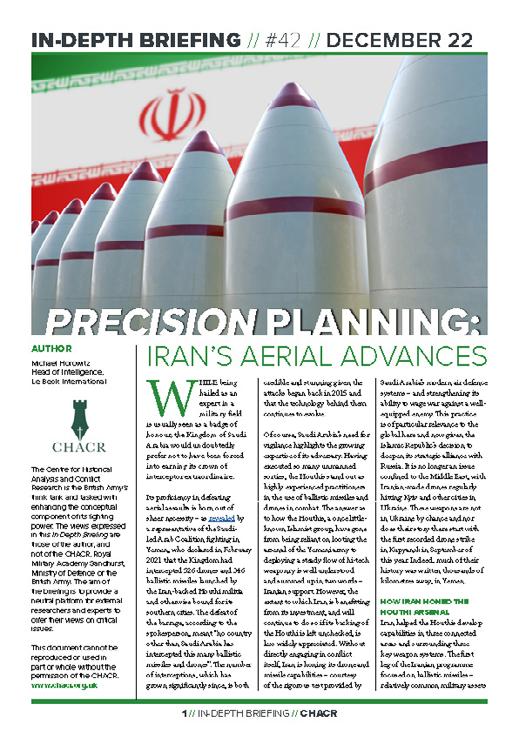
After a relatively mild winter and efforts by many governments to alleviate the financial burden on consumers, Europe’s energy crisis appears to have abated somewhat. But energy security remains at the top of the agenda for governments across the continent. This report, edited by Valeria Talbot and published by the Italian Institute for International Political Studies, highlights the various geopolitical and security implications of growing energy relationships between European consumers and Middle Eastern energy producers. Meanwhile, a fascinating episode of The Red Line podcast focuses on the winners and losers of the global energy transition, coming to the perhaps somewhat surprising conclusion that oil giant Saudi Arabia may be one of the countries best placed to reap major benefits. Finally, Matthew Funaiole, Brian Hart and Lily McElwee have produced a visually appealing briefing of China’s push to secure its energy interests in the Middle East region.