CHACRCRITIQUE AUGUST 2026
#21
A FOCUS ON FINLAND’S SECURITY STANDING
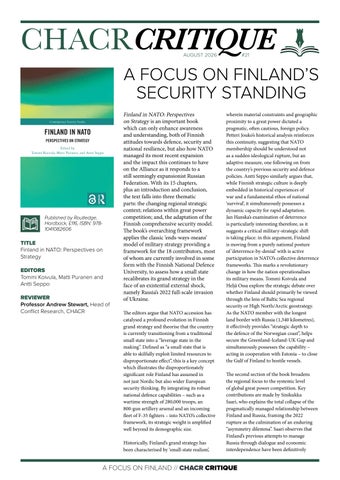
Published by Routledge, Hardback, £116, ISBN: 9781041082606
TITLE Finland in NATO: Perspectives on Strategy EDITORS Tommi Koivula, Matti Puranen and Antti Seppo REVIEWER Professor Andrew Stewart, Head of Conflict Research, CHACR
Finland in NATO: Perspectives on Strategy is an important book which can only enhance awareness and understanding, both of Finnish attitudes towards defence, security and national resilience, but also how NATO managed its most recent expansion and the impact this continues to have on the Alliance as it responds to a still seemingly expansionist Russian Federation. With its 15 chapters, plus an introduction and conclusion, the text falls into three thematic parts: the changing regional strategic context; relations within great power competition; and, the adaptation of the Finnish comprehensive security model. The book’s overarching framework applies the classic ‘ends-ways-means’ model of military strategy providing a framework for the 18 contributors, most of whom are currently involved in some form with the Finnish National Defence University, to assess how a small state recalibrates its grand strategy in the face of an existential external shock, namely Russia’s 2022 full-scale invasion of Ukraine. The editors argue that NATO accession has catalysed a profound evolution in Finnish grand strategy and theorise that the country is currently transitioning from a traditional small state into a “leverage state in the making”. Defined as “a small state that is able to skilfully exploit limited resources to disproportionate effect”, this is a key concept which illustrates the disproportionately significant role Finland has assumed in not just Nordic but also wider European security thinking. By integrating its robust national defence capabilities – such as a wartime strength of 280,000 troops, an 800-gun artillery arsenal and an incoming fleet of F-35 fighters – into NATO’s collective framework, its strategic weight is amplified well beyond its demographic size. Historically, Finland’s grand strategy has been characterised by ‘small-state realism’,
wherein material constraints and geographic proximity to a great power dictated a pragmatic, often cautious, foreign policy. Petteri Jouko’s historical analysis reinforces this continuity, suggesting that NATO membership should be understood not as a sudden ideological rupture, but an adaptive measure, one following on from the country’s previous security and defence policies. Antti Seppo similarly argues that, while Finnish strategic culture is deeply embedded in historical experiences of war and a fundamental ethos of national ‘survival’, it simultaneously possesses a dynamic capacity for rapid adaptation. Jan Hanska’s examination of deterrence is particularly interesting therefore, as it suggests a critical military-strategic shift is taking place: in this argument, Finland is moving from a purely national posture of ‘deterrence-by-denial’ with is active participation in NATO’s collective deterrence frameworks. This marks a revolutionary change in how the nation operationalises its military means. Tommi Koivula and Heljä Ossa explore the strategic debate over whether Finland should primarily be viewed through the lens of Baltic Sea regional security or High North/Arctic geostrategy. As the NATO member with the longest land border with Russia (1,340 kilometres), it effectively provides “strategic depth to the defence of the Norwegian coast”, helps secure the Greenland-Iceland-UK Gap and simultaneously possesses the capability – acting in cooperation with Estonia – to close the Gulf of Finland to hostile vessels. The second section of the book broadens the regional focus to the systemic level of global great power competition. Key contributions are made by Sinikukka Saari, who explains the total collapse of the pragmatically managed relationship between Finland and Russia, framing the 2022 rupture as the culmination of an enduring “asymmetry dilemma”. Saari observes that Finland’s previous attempts to manage Russia through dialogue and economic interdependence have been definitively
A FOCUS ON FINLAND // CHACR CRITIQUE
replaced by a strategy of deterrence and Western alignment. Matti Puranen introduces China as a complex ‘new factor’ in Finnish strategy. He utilises a network theory approach to describe the modern era as a competition over technological and economic networks, where the United States and China are the primary contenders. In his argument he details how Finland is deliberately ‘de-risking’ and untangling itself from Chinese telecommunications and Arctic infrastructure projects, a process driven by concerns over the emerging ‘authoritarian axis’ between Beijing and Moscow and the potential weaponisation of economic interdependencies. To offset these ‘great power’ threats, Finland has heavily invested in bilateral and minilateral defence networks. Kimmo Kaipainen highlights the evolution of the Defence Cooperation Agreement with the United States, which grants US forces access to critical Finnish infrastructure and integrates Finnish capabilities directly into American strategic planning. Similarly (and of specific interest to a British audience), Antti Pihlajamaa and Oscar Lassenius underscore the importance of the UK-led Joint Expeditionary Force and Nordic Defence Cooperation in providing sub-threshold crisis response options and enhancing the security of NATO’s northeastern flank. Within the volume’s final part, there are many excellent insights into the auxiliary functions of statecraft, specifically intelligence and crisis management. Olli Teirilä examines the dynamics of small-state strategic intelligence amidst what is termed as the “militarisation of international relations”. Teirilä argues that the current security environment forces intelligence agencies to prioritise immediate military threats. For the Finnish Security Intelligence Service and the Finnish Defence Intelligence Agency, NATO membership necessitates rapid integration into Alliancewide intelligence sharing mechanisms. Yet, Teirilä cautions that small states face a distinct risk: the overwhelming demand for tactical military warning could divert resources away from broader, long-term strategic intelligence concerning economic or diplomatic phenomena, potentially trapping policymakers in reactive, ‘crisis-driven’ decision-making loops. Katariina Mustasilta’s analysis of international crisis management underscores the changing utility of Finland’s expeditionary deployments. During its period of military non-alignment, participation in UN, EU and NATO-led operations served an instrumental purpose: it was a primary vehicle for Finland to prove its interoperability, demonstrate Western
“In an era when many Western militaries face recruitment crises and a disconnect between the armed forces and society, the Finnish model offers NATO a benchmark for bridging the civil-military divide.”
solidarity and secure access to NATO forums without formal Alliance commitments. However, as a full NATO member explicitly focused on territorial defence against Russia, the instrumental value of distant crisis management has diminished. Mustasilta warns that the profound shift toward collective territorial defence might overshadow Finland’s traditional role as a proponent of comprehensive peace-building, raising questions about the future allocation of national resources for overseas crisis management. Perhaps inevitably, Finland’s unique societal resilience mechanisms – collectively termed ‘comprehensive security’ – act as a golden thread. Teemu Häkkinen and Miina Kaarkoski examine Finland’s system of universal male conscription and the exceptionally high societal willingness to defend
the nation, which consistently polls above 70 per cent. In an era when many Western militaries face recruitment crises and a disconnect between the armed forces and society, the Finnish model offers NATO a benchmark for bridging the civil-military divide. Christian Perheentupa traces the evolution of “total defence” into the modern comprehensive security model, which coordinates military, civilian, economic and psychological resilience to safeguard the “vital functions of society”. He notes a distinct rhetorical and practical shift with comprehensive security no longer just about national survival. Within NATO, it is now explicitly framed as “part of collective deterrence and defence” and can be viewed as an Alliance strategic asset. This comprehensive approach is starkly tested at the nation’s borders. Minna Jokela views border security through ‘complexity thinking’, arguing that the Finnish-Russian border has transformed from a mere administrative boundary into a strategic, securitised space. Following increased flows of migrants in late 2023, the Finnish Border Guard – a hybrid civilian-military organisation – has had to manage profound “epistemic uncertainty”. Jokela highlights that modern border security requires not just physical barriers, but institutional agility to handle threats that blur the line between internal civilian governance and external military defence.
A FOCUS ON FINLAND // CHACR CRITIQUE
Photo: NATO
Published by Biteback Publishing, Hardback, £18.99, ISBN: 9781837360307
TITLE The Triangle of Power: Rebalancing the New World Order AUTHOR Alexander Stubb REVIEWER Professor Andrew Stewart, Head of Conflict Research, CHACR
In addressing a distinct gap in international security literature, the editors have evaluated Finland not merely as an appendage to broader Nordic or Baltic regional studies but as a sovereign strategic actor in its own right. They conclude this critically important examination of the country’s defence and security policy by arguing that, while NATO membership represents an historical rupture, the underlying national objective remains the preservation of sovereignty and regional stability. The means and ways have, however, shifted permanently from balancing and appeasement to explicit Western alignment and robust collective deterrence. In this new construct, Finland already acts not merely as a “security consumer” sheltering under the NATO nuclear umbrella, but, as a potent, highly capable “security provider”. With a clear grounding in empirical, primary-source Finnish doctrine and featuring authors who are deeply embedded in the Finnish defence establishment, the book successfully bypasses abstract theorising in favour of pragmatic, operational insights into military strategy, intelligence and crisis management. By combining meticulous capability development and drawing on a deeply ingrained culture of resilience, a small state can transcend its material limitations and transition from military non-alignment to a pivotal ally. Today, Finland stands as a critical operational linchpin in a modern and never more significant NATO alliance. Whilst Finland in NATO is an excellent example of the value that lies within academic edited volumes – with so many chapters and such variety in them, it appeals to a broad regional and security readership – Alexander Stubb’s much shorter publication will have the greater global impact. This in part is because, despite its 215-page length, it is in fact a relatively short, easily readable and highly digestible discussion of the evolving international political system. That its author is the current president of Finland and former prime minister and minister for foreign affairs has no doubt also had an impact on readership. It should not be forgotten that, in addition to his distinguished political career, he is also a well-established scholar who has written approaching 20 books. None, however, may prove as important as The Triangle of Power, a highly informed and cleverly thoughtthrough exposition about how the world must respond to recent events. His subtitle – Rebalancing the New World Order – would appear a nod to President George H.W. Bush’s March 1991 speech and
its latent optimism about the end of the Cold War which, with the benefit of hindsight, proved entirely misplaced. The author identifies 24 February 2022 as “the day that ended the post-Cold War era”, with the Russian invasion and attempted annexation of Ukraine, which has resulted in continuing uncertainty and albeit often confused preconceptions about the international system. As Stubb’s puts it, “the war in Ukraine became a snapshot of the new world disorder, of things to come, or of how they already were”. In to the resulting vacuum, the author offers a replacement and two interlinking triangles. He argues that “the prevalence and balance of three dynamics” will ultimately prove critical to “the collective future”, namely competition, conflict and cooperation. The responsibility for making this new system function will fall to three global blocs – West, East and South – and it will be the interplay among them that determines where we go next: in this context, it is difficult to dismiss his final paragraph and the words of his mentor Martii Ahtisaari – “what humans begin, humans can also end”. He accepts that, what he refers to at one point as ‘realms’, have their own set of interests and “differ on the rules and principles that should govern the system” but he warns that this is a contest that cannot be avoided. The author as a clearly interested and highly knowledgeable historian, is equally comfortable with his references to Thucydides and Fukuyama. This is the real appeal, most obvious in the first of the book’s three parts – Order – which, in many respects provides a concise contextual framework. It is from this that Stubb is able to explain, from this internationally shaped Finnish perspective, how this point in time has been reached. And getting to the ‘now’, he cautions: “We humans tend to over-rationalize the past, overdramatize the present, and underestimate the future. History is written retrospectively in straight lines but in real-time occurs in zigzags. The reality is that events of the past did not happen as rationally as we think. The present is not usually as dramatic as the buzz leads us to believe. And future challenges will be even farther reaching than we imagine.” This is typical of a book which, written in a seemingly familiar, homely style, is in fact a deep synthesis of a long career spent both leading and thinking. It is highly recommended for anyone interested in reflecting upon the international system and where it goes next but also anyone keen to learn more about the philosophy of one of Europe’s most influential political figures.
A FOCUS ON FINLAND // CHACR CRITIQUE