
CHACR COMMENTARY // FEBRUARY 2026
BY: Sergio Miller, retired Intelligence Officer
When the Russian tanks roll westward, what defence for you And me?
Colonel Sloman’s Essex Rifles?
The Light Horse of L.S.E? – Philip Larkin
THIS Commentary contrasts the fortunes of two armies: the British Army and Spanish Army. I am halfSpanish and 40 years ago accompanied the Grenadier Guards company that undertook the first exchange visit to Spain of the postFranco era (while serving in Northern Ireland at the time; a welcome break from improvised explosive devices and shootings). It was the first occasion British troops had stood on Spanish soil since the Peninsular War and we were filmed by Spanish national television. What I saw in our
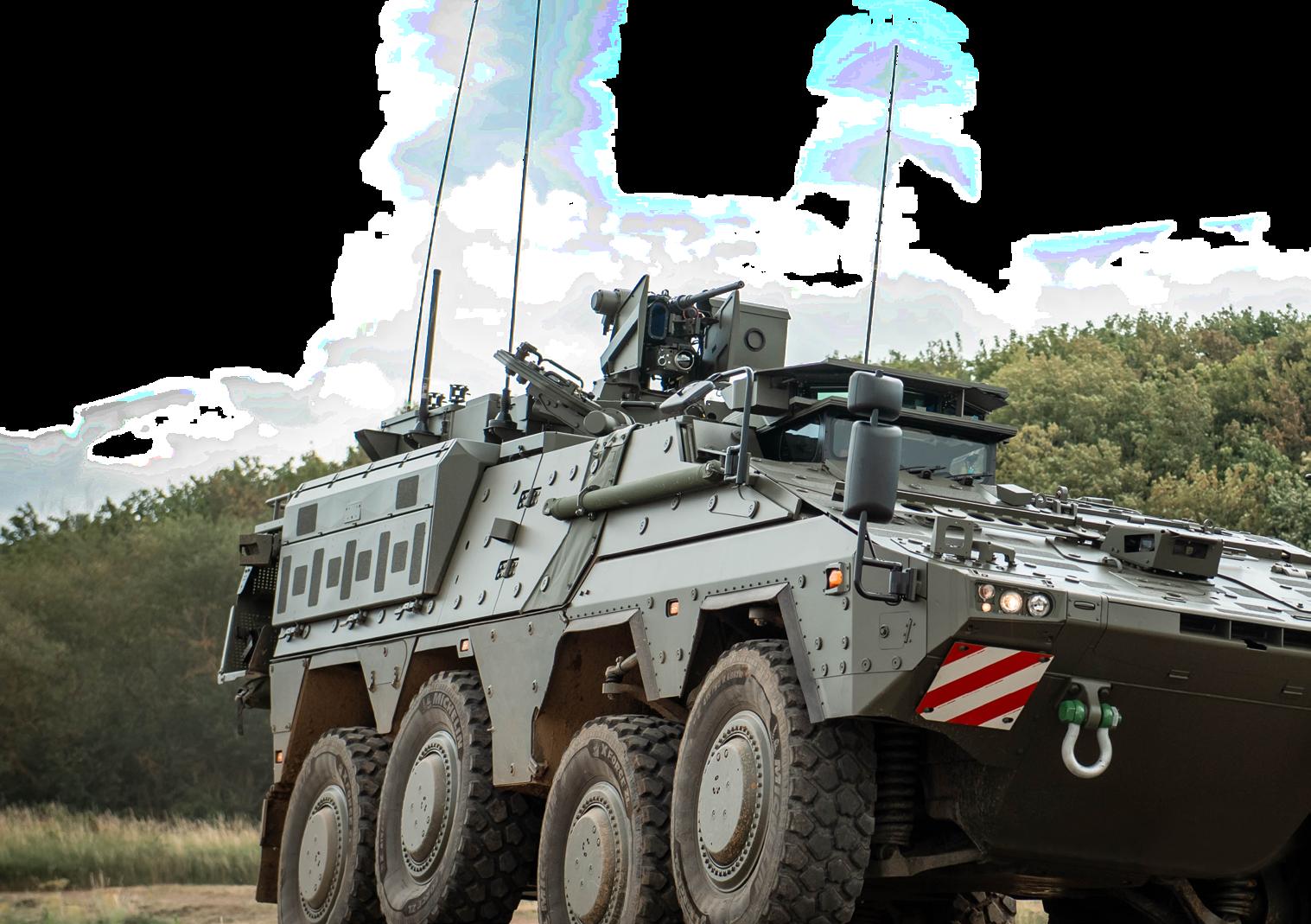
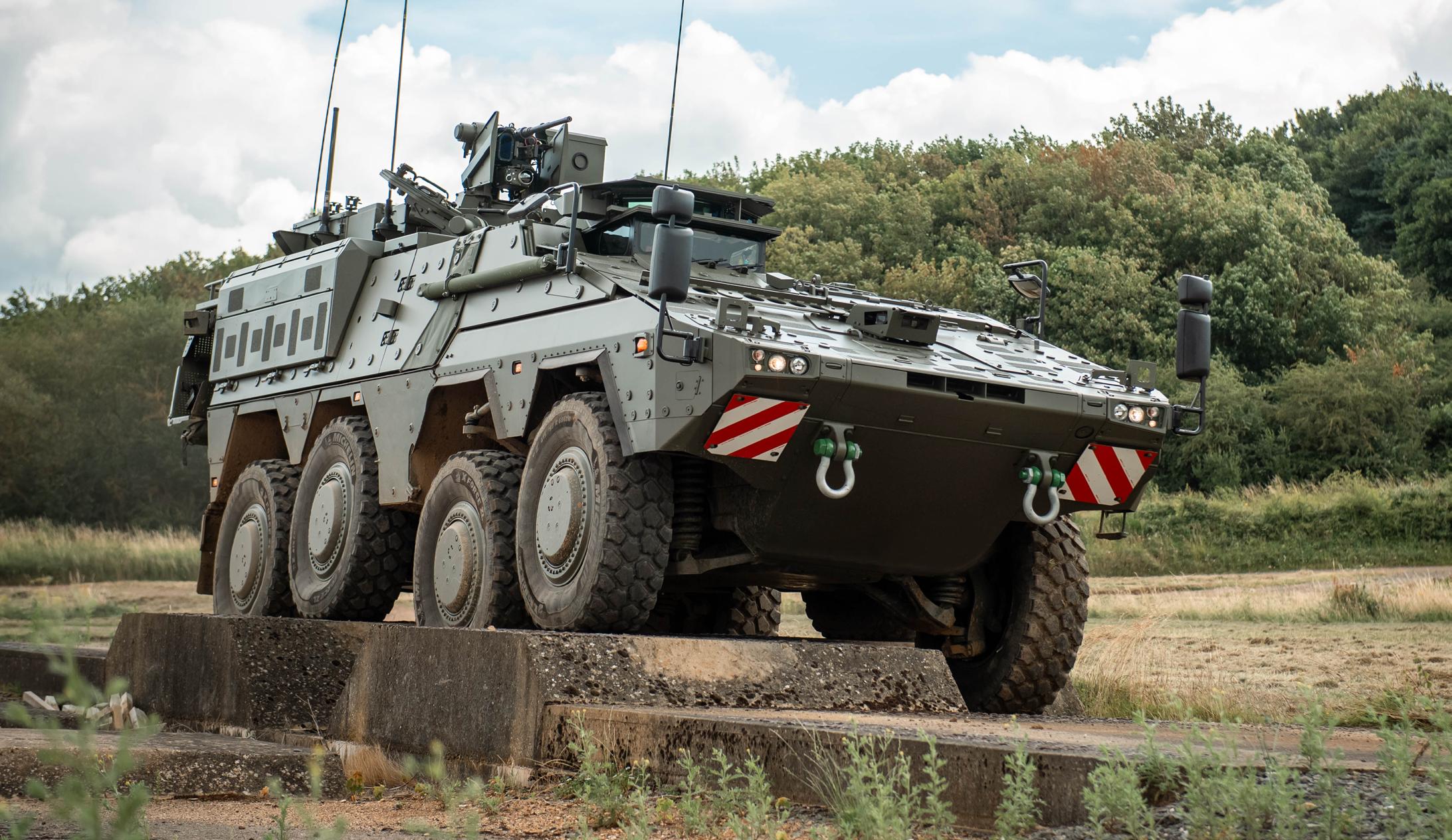
Iberian counterparts was a backward, poorly-equipped conscript army. One of the officers even apologised in embarrassment at the state of affairs. Today, a very different story can be told and this Commentary tells that tale through two procurements: ‘British Boxer’ (pictured above) and the Spanish VCR Dragón.
At first glance more similarities than differences may be apparent in the programmes. Britain joined the German-Dutch Boxer programme in 1996. In 2003, it withdrew to pursue the unrealistic and prohibitively expensive Future Rapid Effects Systems programme, copying the US Future Combat Systems. Both projects sunk. For the next 15 years indecision reigned. Finally, in 2018, a chastened MOD
rejoined the Boxer programme. The Defence Select Committee has been highly critical of the Department’s failures over this period. Having lost the capacity to build wheeled armoured personnel carriers, KNDS Deutschland had to step in to set up a facility in Telford (today RBSL Telford), and subsequently at Stockport (KNDS UK, formerly WFEL Limited). In April 2022, the MOD finalised a deal for 623 Boxers valued at over £3.4 billion. Welding of the first ‘British Boxer’ vehicles in Telford started in 2023, but the first vehicles were not completed until 2025. At the time of writing, only training vehicles have been delivered to the Army. Twentynine years have passed.
The VCR Dragón programme (originally Futuro Sistema de Combate Terrestre) started in 2007 but was postponed for
The author of this Commentary is a regular contributor to the Defence debate; he’s also a wellinformed retired Army officer who holds strong and clearly-expressed views. The subject of this Commentary (Defence procurement) is a hot topic, about which the CHACR receives a range of such observational and commentating articles and contributions. Defence procurement has become a subject of particular interest in the Army, and not just because of the surfeit of press coverage of such issues as the Ajax programme. The Chief of the General Staff, General Sir Roly Walker, has made it clear that if the British Army, smaller than ever and fielding aged equipment, is to compete on the battlefield of the coming years (or, indeed, to deter enemies and potential enemies from seeking to compete on that battlefield) then it will need to keep up with the march of technology and its eversteepening development curve in a way that current practices make very difficult. In that context, we felt that it was appropriate to offer this Commentary as a contribution to that debate, as an example of those regular contributions that are offered to the CHACR on or around this subject. The views expressed, therefore, are the author’s.
economic and political reasons (an anti-militarist tradition exists in Spain on the political left, a legacy of military interference in civilian government stretching from the post-Napoleonic period to the tragedy of the civil war (1936-39) and Franco years). Notwithstanding the delay, in 2015 the Spanish MOD selected the Piranha V as its future 8x8 armoured personnel carrier. In 2020, a contract was placed with the Spanish Tess Defence Consortium for 384 units valued at €2.1 billion. In January this year, the first 40 VCR Dragóns were delivered to the 2nd Brigade of the Spanish Legion in Álvarez de Sotomayor in Almería (the location where many Westerns are filmed). The programme has faced technical challenges and received criticism in Spain. Nevertheless, serial production is underway, 19 years after the programme was first raised. These overviews may suggest not dissimilar trajectories, but the differences are substantial and significant, as the table (right) demonstrates.
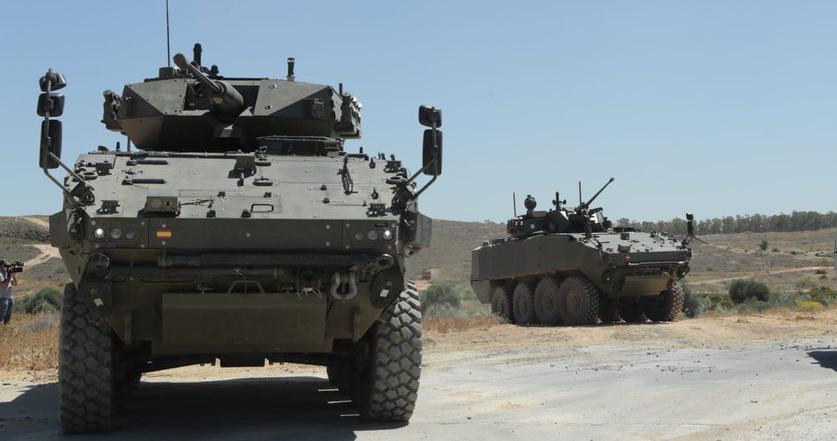
VCR Dragón (pictured below) is a serious wheeled armoured personnel carrier boasting a 30mm cannon and anti-tank missiles; ‘British Boxer’ is armed with a machine gun. Reflecting a modern obsession with process and Byzantine staff work, one quarter of the British vehicles will be command variants, an inconceivable proposition to a British Army of the Rhine and

n Led by a German-Dutch consortium ARTEC GmbH with the programme managed by OCCAR.
n Assembled in the UK creating a small number of direct jobs (400).
n The steel is German.
n Only armed with a machine gun.
n 25% of platforms are command vehicle variants (rather than fighting vehicles),158 from 623.
n Only training vehicles delivered eight years after rejoining the programme.
Falklands generation of soldiers (‘H’ Jones’ orders for Goose Green were three-pages long, unthinkable brevity today). Nobody has ever won a fight by assaulting the enemy with a platoon of command variants, brandishing spreadsheets, or will.
Britain made wheeled combat vehicles: Alvis Saladin (1,117 exported to 26 countries); Alvis
n Led by the Spanish Tess Defence Consortium.
n Really ‘made in Spain’ creating almost 9,000 direct Spanish jobs.
n The steel is Spanish.
n Real capability: 30mm cannon and anti-tank guided missile.
n 5.5% of platforms are command variants. (From first batch of 248 vehicles)
n First 40 vehicles delivered six years after contract signing.
Saracen (1,838 built, exported to 19 countries); Daimler Ferret (4,400 built, exported to 48 countries); and ROF Leeds Fox (325 built). Britain also made and exported a wide range of tracked combat vehicles.
All these British companies were undermined and eventually collapsed through political ideologies and economic orthodoxies, exacerbated
by Treasury nostrums that devastated Britain’s land defence industry from the Thatcher period to the present day. Government organisations born from the experience of the Second World War were also allowed to collapse: Fighting Vehicle Research and Development Establishment, the Armaments Design Establishment, Royal Armament Research and Development Establishment, and Military Vehicles and Engineering Establishment, among others. Royal Ordnance – part of the history of these islands since the Tudor period – disappeared.
Today, Britain is forced to invite foreign defence firms to make its land defence kit. This has consequences:
l ‘British Boxer’ is supporting a German-Dutch consortium, not a British one.
l ‘British Boxer’ is boosting the profits, share price and long-term prospects of a German-Dutch consortium, not a British one.
l ‘British Boxer’ is supporting mostly German direct jobs (roughly half the vehicles will be made in Germany).
l ‘British Boxer’ is stimulating German defence science and technology, design teams, technology innovation etc.
l ‘British Boxer’ is supporting German steel industry.
l ‘British Boxer’ must pay a Brexit premium in the form of additional bureaucracy.
l ‘British Boxer’ is not a sovereign defence capability; it is a successful German export.
In sum, ‘British Boxer’ – with other programmes like Ajax – is the outcome of more than 40 years of bankrupt defence industrial policy and mismanagement of one of the finest organisations these islands have ever borne – the British Army.