RUSSIA’S
invasion of Ukraine in February 2022 has led to an unprecedented level of scrutiny on the country’s behaviour on the world stage and, crucially, the combat effectiveness of its military forces. However, it is important for Western strategists to ask serious questions about how the Russian state conceptualises its security challenges to gain greater insight into how and why it has responded in the way that it has in Ukraine and elsewhere.
In an era of persistent competition, a more precise understanding of illiberal state thinking on security will, therefore, better equip the UK as it seeks to radically transform its own philosophy around the utility of the military instrument. Only by better appreciating how our adversaries think can we better equip ourselves to meet the cognitive challenge of modern war.
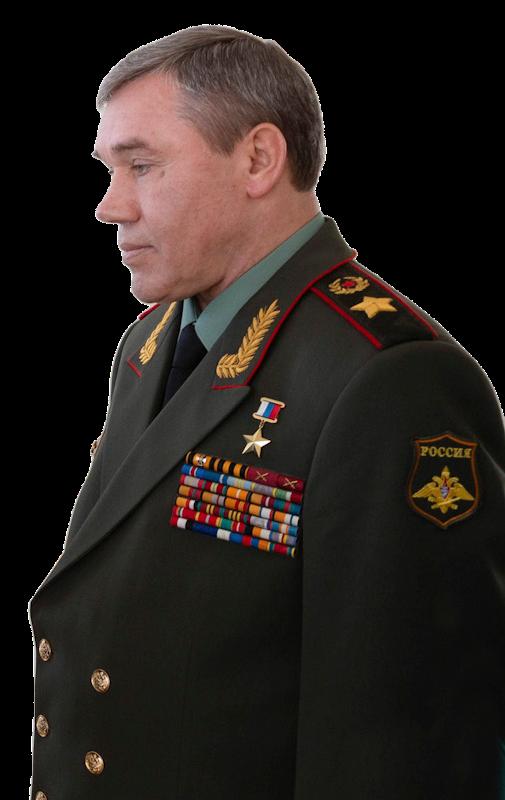
In a much quoted but little understood article published in the Russian newspaper VoennoPromyshlenni Kurier (VPK) in 2013, the country’s Chief of the General Staff Valery Gerasimov observed: “I would like to say that no matter what forces the enemy has, no matter how welldeveloped his forces and means of armed conflict may be, forms and methods for overcoming them can be found. He will always have vulnerabilities, and that means that adequate means of opposing him exist.”2
Gerasimov’s article is often perceived as the intellectual elixir which helps explain Russia’s annexation of Crimea and its fomenting of separatist insurgency in Eastern Ukraine3 , as well as the more recent ‘special
military operation’ in the country. Nonetheless, as Charles K. Bartles has argued, the main thrust of Gerasimov’s article appeared to be its author’s intent to send a message to the Kremlin that the Russian armed forces were well positioned to meet the challenge of current and future threats.4 From his rather lofty perch at the top of his country’s security architecture, General Gerasimov believed that it was essential for the Russian military to rethink not only how their forces were physically configured but also how they would meet the cognitive demands of these threats.
Interestingly, Gerasimov argued that the changes necessary for a fundamental shift in thinking about modern war must come from within the
1Aaron Edwards, the author of Strategy in War and Peace: A Critical Introduction (Edinburgh University Press, 2017), offers his thanks to his colleagues Tim Bean and Lance Davies for reading over a draft of this briefing.
2Valery Gerasimov, ‘The Value of Science Is in the Foresight New Challenges Demand Rethinking the Forms and Methods of Carrying out Combat Operations’, Originally published in Military-Industrial Kurier, 27 February 2013. Translated from Russian on 21 June 2014 by Robert Coalson, editor, Central News, Radio Free Europe/Radio Liberty. Reproduced in Military Review, January-February 2016.
3Andrew Monaghan, Dealing with the Russians (Cambridge: Polity, 2019), p. 38.
4Charles Bartles, ‘Getting Gerasimov Right’, Military Review, January-February 2016, p. 31.
AUTHOR 1 Aaron Edwards Senior Lecturer in Defence and International Affairs Royal Military Academy Sandhurst
1 // IN-DEPTH BRIEFING // CHACR IN-DEPTH BRIEFING // #37 // SEPTEMBER 22
military academies in Russia.5 It was here, traditionally, where foresight, directly linked to military science in Russian strategy-making, offered the prospect of lighting the way. ‘Any academic pronouncements in military science are worthless,’ he observed, ‘if military theory is not backed by the function of prediction.’6 As Gerasimov would emphasise in a subsequent speech to the Russian General Staff Academy, it was explicitly those academics (what he called “fanatics”) based in military education establishments who were expected to shoulder some of the heavy burden of analysing developments in modern war while also forecasting ‘events and variations of the development of a situation and to work on overcoming them.’ 7
In the annals of Russian military education, strategy has always been considered a necessary complement to armed force. The great Soviet general Aleksandr Svechin defined strategy as ‘the
art of combining preparations for war and the grouping of operations for achieving the goal set by the war for the armed forces’.8 For Svechin, the strategist must correctly evaluate ‘the nature of a war, which depends on different economic, social, geographic, administrative and technical factors’.9 Therefore, only by combining military and non-military instruments could Russia ever guarantee success in war. Western military analysts often conflate this long-standing strategic approach with a concept they themselves invented, which has been variously referred to by the epithets ‘hybrid warfare’, ‘grey zone’, ‘ambiguous warfare’ and ‘non-linear warfare’.10 Such thinking has been constructed amidst the rush of a predictable avalanche of intellectual fads recycled by commentators in the West, even if ‘hybrid warfare’ is an ‘alien concept’ in Russian military theory.11
While the Russian military has historically attempted to
5I use the term academies loosely. There are three levels of military education in Russia. The first are military schools that educate junior officers who will take up appointments as Platoon, Company and Battalion commanders. The second are military academies who educate those of ficers who have served for 5-10 years and attend courses for promotion to regiment, brigade and divisional levels. Finally, there is the Military Academy of the General Staff where Colonels and above are educated to take up higher appointments within the Russian armed forces. See the work of former Russian Colonel, Dr Igor V. Obraztsov, ‘Teaching Sociology in Military Edu cational Institutions of Russia’, Armed Forces and Society, 35(1), (October 2008), p. 178.
6Gerasimov, ‘The Value of Science is in the Foresight’, p. 29.
7Russian General Staff Chief Valery Gerasimov, Presentation to the General Staff Academy: ‘Thoughts on Future Military Conflict’, March 2018. Translated by Dr Harold Orenstein. Reproduced in the Military Review Online Exclusive, January 2019. Accessible at: https:// www.armyupress.army.mil/Portals/7/Army-Press-Online-Journal/documents/2019/ Gerasimov-2019.pdf. According to research undertaken by Igor V. Obraztsov, in the branch of Military Sociology taught throughout Russian military schools and academies, which deals with everything from the psychological effects of fighting on troops in armed conflict to unit cohesion, around 60% is given over theory and 40% to the development of professional skills. Interest ingly the vast majority of instructors tend to be serving officers with some retired officers taking teaching responsibilities. Obraztsov, ‘Teaching Sociology in Military Educational Institutions of Russia’, pp. 162-179.
experiment and adapt under fire (what armed forces haven’t?), Bartles believes that there has also been an attempt to apply kinetic and non-kinetic activities below the threshold for war.12 As Gerasimov has himself accepted, in paying homage to Svechin, each war ‘is a unique case, demanding the establishment of a particular logic and not the application of some template’.13 To be sure, the lack of a template or ‘doctrine’ means that Russian practitioners must work in conjunction with political and diplomatic instruments, active measures, and, of course, the deployment or employment of force,14 as a way of helping the Kremlin achieve its grand strategic objectives in any given security environment. In ensuring military activities help meet the demands of Moscow, the Russian armed forces have been encouraged to engage in thinking outside the box (nestandartnoe myshlenie).15 In many respects, Russian strategic thinking – like Soviet strategic theory before it – is shaped by the imperative of operational creativity (operativenoe tvorchestvo), which has been emphasised by President Putin in public speeches addressing Russia’s qualitative superiority in troop numbers, advanced operational skills and strategic ingenuity.16
A NEW WAY OF WAR?
Also reflected in Gerasimov’s article is evidence of Russian military hierarchy having studied Western interventions since the end of the Cold War, including Operation
Desert Storm17 and later US operations in the Middle East, drawing lessons on what became C4ISR (Command, Control,
8Svechin, Aleksandr A. Strategy – Edited by Kent D. Lee (Minneapolis, Minnesota: East View Publications, [1927], 1991), p. 69.
9Ibid.
10Monaghan, Dealing with the Russians, p. 40.
11Ibid., p. 41. See also Roger McDermott, ‘Does Russia Have a Gerasimov Doctrine?, Parameters, 46(1), (Spring 2016), pp. 97-105.
12Bartles, ‘Getting Gerasimov Right’, p. 34.
13Cited in Gerasimov, ‘The Value of Science is in the Foresight’, p. 29.
14The distinction between deploying and employing force is explained in Rupert Smith, The Utility of Force: The Art of War in the Modern World (London: Penguin, 2005).
15Dmitry (Dima) Adamsky, ‘Russian Les sons Learned from the Operation in Syria: A Preliminary Assessment’ in Glen E. Howard and Matthew Czekaj (eds) Russia’s Military Strategy and Doctrine (Washington D.C. The Jamestown Foundation, 2019), p. 402.
16Ibid
17Stephen Blank, The Soviet Military Views Operation Desert Storm: A Preliminary Assessment (Carlisle, PA: Strategic Studies Institute, 23 September 1991).
“THE EXPERIENCE OF MILITARY CONFLICTS – INCLUDING THOSE CONNECTED WITH THE SO-CALLED COLOR REVOLUTIONS IN NORTH AFRICA AND THE MIDDLE EAST – CONFIRMS THAT A PERFECTLY THRIVING STATE CAN, IN A MATTER OF MONTHS AND EVEN DAYS, BE TRANSFORMED INTO AN ARENA OF FIERCE ARMED CONFLICT, BECOME A VICTIM OF FOREIGN INTERVENTION, AND SINK INTO A WEB OF CHAOS, HUMANITARIAN CATASTROPHE, AND CIVIL WAR.”
IN-DEPTH BRIEFING // KNOWING THE ENEMY 2 // IN-DEPTH BRIEFING // CHACR
Picture: Mil.ru
Computers and Communication, Intelligence, Surveillance and Reconnaissance), integrated precision long range fires strike systems, the strategic utility of special forces and adaptation to fighting irregular adversaries.18 What appears to fascinate Gerasimov most beyond advanced military capability are the ways in which he believed the West was attempting to force political change by way of this strategic dexterity: “The experience of military conflicts –including those connected with the so-called color revolutions in North Africa and the Middle East – confirms that a perfectly thriving state can, in a matter of months and even days, be transformed into an arena of fierce armed conflict, become a victim of foreign intervention, and sink into a web of chaos, humanitarian catastrophe, and civil war.”19
For Gerasimov, Western attempts to weaken their state-based opponents in the Middle East and North Africa pointed to a noticeable change in the “rules of war”, indicating a growth of the ‘non-military means of achieving political and strategic goals’.20 One of those countries deeply affected by this new form of warfare was, of course, Russia’s partner, Syria. Quite apart from the strategic
military assets strengthening this partnership with President Assad’s country has afforded Russia, it also enabled the Kremlin to demonstrate how, from its relatively weak economic position, it too could engage in this new way of war by leveraging limited resources to win grander strategic prizes.21 On the face of it, Russia learned considerable lessons from its operations in Syria. Some 48,000 troops rotated through the theatre on three-month deployments, with considerable efforts going into C4ISR and Strike using a variety of advanced weapons.22 In addition, the
18Anna Borshchevskaya, ‘Russia’s Desert Storm: Putin’s Plan to Use America’s Military Playbook Against Ukraine?’, The Washington Institute of Near East Policy, 23 January 2022. Accessible at: https://www.washingtoninstitute.org/policy-analysis/russias-desertstorm-putins-plan-use-americas-military-playbook-against-ukraine
19Gerasimov, ‘The Value of Science is in the Foresight’, p. 24.
20Ibid.
21Borshchevskaya, ‘Russia’s Desert Storm’.
22Adamsky, ‘Russian Lessons Learned from the Operation in Syria’, p. 384. 23Gerasimov, Presentation to the General Staff Academy, p. 5. 24Ibid.
25Pavel Felgenhauner, ‘The Russian Strategic Offensive in the Middle East’ in Glen E. How ard and Matthew Czekaj (eds) Russia’s Military Strategy and Doctrine (Washington D.C. The Jamestown Foundation, 2019), p. 28.
26Anna Borshchevskaya, ‘Shifting Landscape: Russia’s Military Role in the Middle East’, Policy Notes: The Washington Institute for Near East Policy (September 2019). Accessible at: https://www.washingtoninstitute.org/policy-analysis/shifting-landscape-russias-mili tary-role-middle-east
deployment of Special Forces in places like Palmyra and Aleppo ran alongside a sophisticated information operation. As Gerasimov subsequently told the General Staff Academy: “In addition to traditional spheres of armed struggle, the information sphere and space will be dynamically involved.”23 In his view, Syria was a ‘prototype of “new-generation warfare”’, where states conduct ‘covert, insubstantial operations without being drawn into direct military conflict’.24
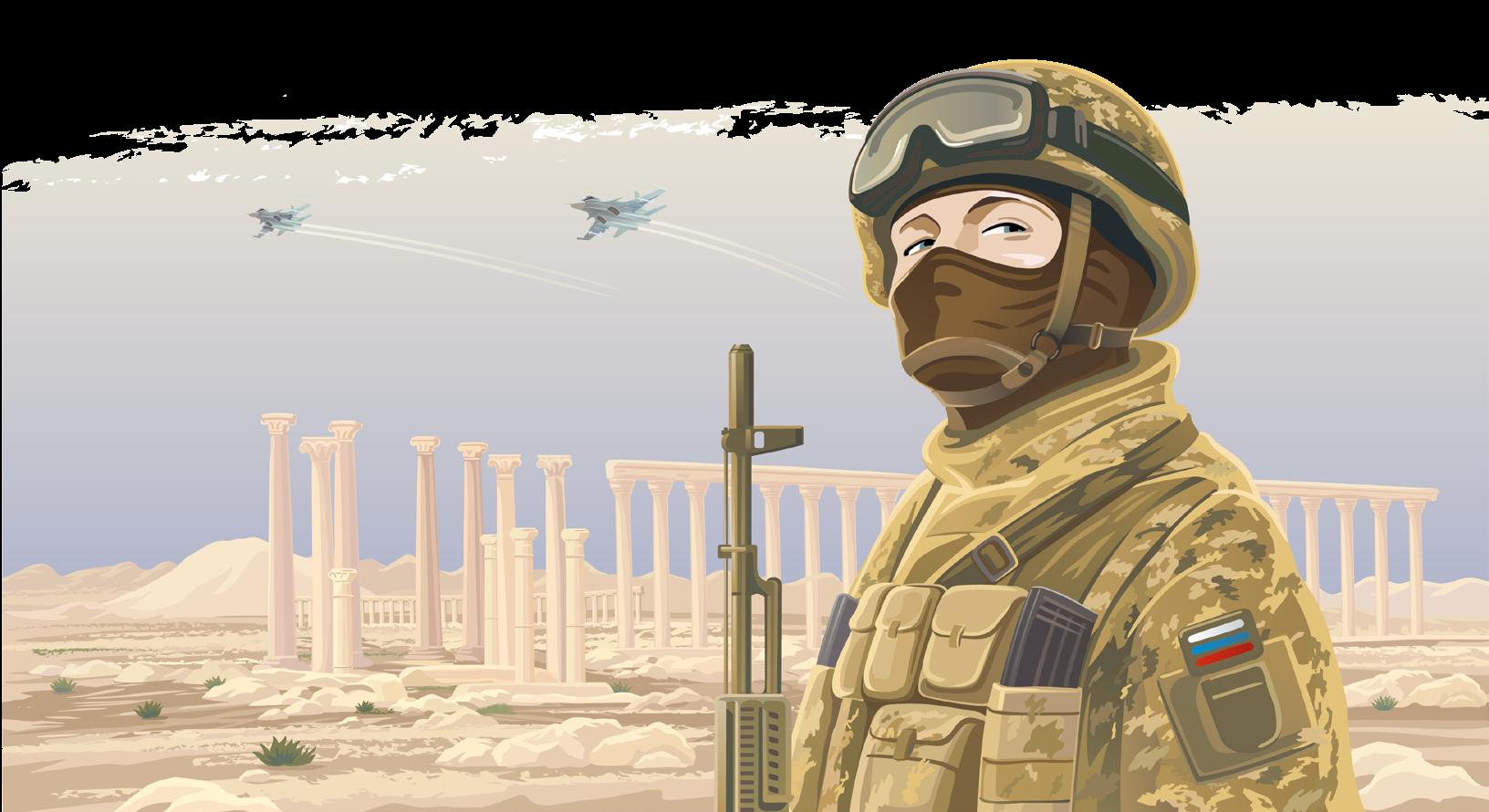
While it is superficially attractive to point to Russian military operations in Syria as heralding a ‘new way of war’, the reality is that – like elsewhere in the world – military activities are attendant to political imperatives. For the Kremlin, the overarching strategic objective in Syria was to ‘secure an operational base to deter NATO and the United States in the Mediterranean’.25 However, as already stated above, we should acknowledge that this theatre of operations enabled Russia to pursue ‘ambitious intentions, even if they are unmatched by resources’.26 Importantly, we need to see Russia’s Syrian expedition in the context of its earlier intervention
in Crimea and Eastern Ukraine where a range of military and non-military instruments were employed to de-stabilise the country in 2014. The incitement of mob violence, the deployment of, ‘little green men’, the active measures pursued against the local authorities in Crimea ‘represented decisive and competent use of military force in pursuit of political ends’.27 This was not wholly without challenges. In the Donbas the fostering of anti-government sentiment and insurgency, in the view of Koffman et al, brought success but ‘at a much higher cost than desired and through a fitful cycle of adaptation’.28
RUSSIA’S GUERRILLA GEO-POLITICS
There is undoubtedly an obsession amongst Russian military strategists about what they perceive to be a ‘Western way of war’.29 We must be aware that even though it may be based on empirical-based observation, Russians are no more or less susceptible to misperceptions, stereotyping and overestimating the capabilities of their adversaries as their Western counterparts. It may be objectively true that the West uses military and nonmilitary instruments, strategic communications, covert action and focused military interventions against weakened or disintegrating opponents. However, as the former CIA station chief in Moscow, John
“IN GERASIMOV’S VIEW, SYRIA WAS A ‘PROTOTYPE OF “NEW-GENERATION WARFARE”’, WHERE STATES CONDUCT ‘COVERT, INSUBSTANTIAL OPERATIONS WITHOUT BEING DRAWN INTO DIRECT MILITARY CONFLICT’.”
3 // IN-DEPTH BRIEFING // CHACR IN-DEPTH BRIEFING // KNOWING THE ENEMY
Sipher, has written, to draw moral equivalence between what democracies have done in protecting their freedoms and what their illiberal rivals have done to undermine them would be wrong.30 Besides, in democracies, there is every likelihood that covert action will become known, given the checks and balances (not least a free press) that belie this open system of government.31 To be sure, if both covert and overt activities by Western governments are something of an ‘open secret’, then, perhaps, it is the ‘so what?’ context in which Russian strategists are drawing their conclusions that is more significant.
Russian perceptions of the ‘Western way of war’ are shaped by a broader contextual reading of US domination of the Liberal International Order since the collapse of the Soviet Union and the end of the Cold War in
27Michael Kofman, Katya Migacheva, Brian Nichiporuk, Andrew Radin, Olesya Tkache va, Jenny Oberholtzer, Lessons from Russia’s Operations in Crimea and Eastern Ukraine (Santa Monica, CA: RAND, 2017), p. 73.
28Ibid., p. xiv; p. 77.
29In his excellent assessment of the so-called ‘Gerasimov Doctrine’, Roger McDermott reminds us that ‘almost all Russian military analyses of the concept [hybrid warfare’] as cribe its existence and parameters to Western states’. McDermott, ‘Does Russia Have a Gerasimov Doctrine?, p. 97.
30 John Sipher, ‘Western Covert Action and Russian Active Measures: Hypocrisy or Divergent Values?’, Just Security, 22 January 2019. Accessible at: https://www. justsecurity.org/62324/western-covert-ac tion-russian-active-measures/
31Gregory F. Treverton, ‘Covert Action and Open Society’, Foreign Affairs, 65(5), (Summer 1987), p. 1005.
32Andrei Kozyrev, ‘The Lagging Partnership’, Foreign Affairs, 73, May/June 1994, pp. 59-71.
33A copy of the first Foreign Policy Concept (2000) can be accessed here: https://nuke. fas.org/guide/russia/doctrine/econcept.htm
34For the latest claim to be ‘defending the motherland’ see President Putin’s Victory Day Parade speech on 9 May 2022, accessible at: http://en.kremlin.ru/events/ president/transcripts/68366
1991. From the 1990s onwards Moscow looked to the US to reconfigure the international system for the benefit of all states. Russia’s post-Cold War worldview was best captured by its then Foreign Minister in the 1990s, Andrei Kozyrev, who wrote how ‘partnership’ was the ‘best strategic choice for Russia and the United States’ and its rejection ‘would mean the loss of a historic opportunity to facilitate the formation of a democratic, open Russian state and the transformation of an unstable, post-confrontational world into a stable and democratic one’.32 Not long after being elected to office, President Putin presided over the publication of The Foreign Policy Concept of the Russian Federation (2000), which reflected his at ‘a growing trend towards the establishment of a unipolar structure of the world with the economic and power domination of the United States.’33 It was Putin’s belief that the principal questions of international security were being resolved by US unilateralism without recourse to the UN Security Council. The Kremlin now regarded sovereignty as a fundamental right – to choose Russia’s own destiny without the imposition of any external
interference – and, thereafter, embarked on a concerted campaign to protect the ‘motherland’ at all costs.34
The belief that Russia should be left to make its own way in the world was initially articulated in the Foreign Policy Concept 2000, which reflected Moscow’s flexible understanding of grand strategy, in terms of how it can apply military and non-military instruments of power to get its way in a US-dominated world order.35 Dmitri Trenin and other careful analysts of Russian foreign policy refer to these years as Moscow’s ‘breakout’ from the old, Washington-centric international order.36 Subsequent iterations of the Foreign Policy Concept have outlined both constraining and enabling factors in the general use of force in today’s world and suggest that other instruments – political, diplomatic, economic, scientific, cultural and informational – should play a key role in securing Russian national interests. Mark Galeotti, a leading expert on Russian military strategy and foreign policy, has characterised Moscow’s grand strategy as a form of ‘geo-political guerrilla warfare’.37 And, as Professor Galeotti reminds us, ‘Like it or (probably) not, the
West is at war, but not necessarily the kind of war it imagines or with which it is accustomed. It is already at war with Russia for the simple reason that it takes only one side to make a war, and the Kremlin has already made the decision that the West has started it’.38 The point for Russia in fighting this war is not only to survive but to win back the status and respect Putin believes Russia has lost since the collapse of the Soviet Union, which he regards as the ‘greatest geopolitical tragedy of the century’.39
KNOWING OURSELVES
While many military analysts would agree with General Gerasimov’s view of modern war, it is important to remind ourselves that Russian military strategists draw a clear distinction between the unchanging nature of war and its changing character.40 It is all too common to find these two aspects conflated, especially by some Western policymakers and practitioners in their rush
35For more on how Russia has navigated its way in military and strategic terms since the end of the Cold War see Lance Davies, Russian Conflict Management and European Security Governance: Policy and Practice (London: Rowman and Littlefield, 2020).
36Trenin, Dmitri Russia’s Breakout from the Post Cold War System: The Drivers of Putin’s Course (Moscow: Carnegie Centre, 2014). Archived at: carnegie. ru/2014/12/22/russia-s-breakout-frompost-cold-war-system-drivers-of-putin-scourse-pub-57589. Accessed: 9 October 17.
37Mark Galeotti, ‘‘Hybrid War’ and ‘Little Green Men’: How It Works, and How It Doesn’t’, e-International Relations, 16 April 2015. Accessible at: https://www.e-ir. info/2015/04/16/hybrid-war-and-littlegreen-men-how-it-works-and-how-it-doesnt/
38Mark Galeotti, Hybrid War or Gibridnaya Voiina? Getting Russia’s Non-Linear Military Challenge Right (London: Mayak Intelligence, 2016), p. 95.
39President Putin, Annual Address to the Fed eral Assembly of the Russian Federation, 25 April 2005. Accessible at: http://en.kremlin. ru/events/president/transcripts/22931
40Oscar Jonsson, The Russian Understand ing of War: Blurring the Lines Between War and Peace (Washington, DC: Georgetown University Press, 2019)
“RUSSIAN PERCEPTIONS OF THE ‘WESTERN WAY OF WAR’ ARE SHAPED BY A BROADER CONTEXTUAL READING OF US DOMINATION OF THE LIBERAL INTERNATIONAL ORDER SINCE THE COLLAPSE OF THE SOVIET UNION AND THE END OF THE COLD WAR IN 1991.”
Picture: fabrikasimf/freepik.com
IN-DEPTH BRIEFING // KNOWING THE ENEMY 4 // IN-DEPTH BRIEFING // CHACR
to explain the significance and proliferation of new weapons systems and technologies. As Rob Johnson reminds us, military strategy ‘requires a determination to avoid the assumptions of present-mindedness or at the very least use an analytical framework to mitigate their effects,’ including a process to ‘comprehend more thoroughly the significance of the changes taking place, but also the continuities.’41 ‘Knowing how the Russian leadership thinks about war,’ argues Oscar Jonsson, ‘ is a critical precondition for deterring Russia and also identifying when to cross, or not to cross, Russia’s “red lines”.42
At a time when the UK armed forces are advocating a radical new departure in how we think about modern war, it is essential that we ask whether, to paraphrase Galeotti, in seeking to understand the threat posed by this ‘Russian way of war’, the West has simply manufactured an enemy in its own image.43 Another, perhaps more critical, perspective worth considering is Jim Sciutto’s suggestion that our charactersisation of illiberal regimes, like Russia, practising a form of ‘political warfare’ (when, as Clausewitz teaches us, all war is, at its core, political) is really only a belated attempt to justify the ponderous response to Russia’s more dexterous use of strategy.44
Regardless of where the truth rests, the UK has, nonetheless, undertaken bold steps to rethink
its own understanding of modern war. Under the programme of work coalescing around the UK’s Integrated Operating Concept 2025 and MultiDomain Integration, a radical new departure has been mapped out. For this transformational work to be successful, however, it must recognise how and why our adversaries conceptualise the security environment in the way that they do. An essential component of this mindset shift will be the intellectual resources invested in making fundamental changes over the longer term. In the same way that Gerasimov has sought to exploit the untapped potential of those academics in Russia’s military academies, the British armed forces must harness the intellectual horsepower in their own military academies and staff colleges.
41Rob Johnson, ‘The Changing Character of War’, The RUSI Journal, 162(1), (2017), p. 11.
42Jonsson, The Russian Understanding of War, p. 152.
43Mark Galeotti, Russian Political War: Moving Beyond the Hybrid (London: Routledge, 2019), p. 9.
44Jim Sciutto, ‘Russia Has Americans’ Weaknesses All Figured Out’, The Atlantic, 14 May 2019. Accessible at: https://www.theatlantic.com/ideas/archive/2019/05/jim-sciuttokremlin-waging-new-kind-war/589387
45The Times, 10 August 1858.
46Eliot A. Cohen, ‘Change and Transformation in Military Affairs’, Journal of Strategic Studies, 27(3), (2004), p. 401.
To be sure, military academies offer what external training and education providers do not – a thorough understanding of military discourse, culture and tradition, as well as an ability to communicate concisely in the service of practical strategic, operational and tactical outcomes, without recourse to the kind of intellectual fads that tend to preoccupy external think tanks and university research institutes. In the recent Future Soldier concept note, the British Army has stated that the management of military and civilian talent is best achieved by ‘placing learning at the centre of training and education’. There is no better system for delivering this than pre-existing servicebased military education.
This is a welcome move to ensure soldiers and officers are prepared for the challenges that lie ahead. It is also something with echoes in history. In the aftermath of the British campaign failures in Crimea in the 1850s, the London Times complained that the Army had drawn too stark a ‘perpetual contrast between the impotence of theory and the efficiency of practice’. In criticising how the Army was ‘universally governed by a law which is familiarly
known as “the rule of thumb”’, the Times editorial believed the prevailing view from ‘the authorities of the Horse Guards’ before the war was that ‘a young officer would fight better on account of their total ignorance of discipline, strategy, tactics, and all other branches of a regular military education’.
45
Nowadays, subjugating the cognitive challenge of modern war to the ‘rule of thumb’ is no longer sustainable. As the eminent US strategist Eliot Cohen once observed: “At the heart of real change in military affairs is the notion of a ‘learning organization’, which is something quite different from a brilliant organization. This, in turn, requires an organizational culture that encourages experimentation and does not punish the failures that innovation invariably brings about. These qualities, in turn, rest on fundamental attributes of societies that reflect themselves in their militaries. For that reason, societies that do not see occasional failure as calamitous, that are willing to allow juniors to overcome or contradict seniors, and that do not value ‘face’ or reputation excessively are likely to succeed in transforming themselves.”46
The UK armed forces have before them a unique opportunity to radically reconceptualise the utility of the military instrument. To do this in a way that rises to the cognitive challenge of modern war it is, therefore, essential that we evaluate how our adversaries, like Russia, think and behave in the way they do. Only be recognising Sun Tzu’s dictum of knowing the enemy while, simultaneously, knowing ourselves may we stand a better chance of strategic success amidst the new era of persistent competition. Without our academic experts within military academies this challenge would be a much harder task to achieve.
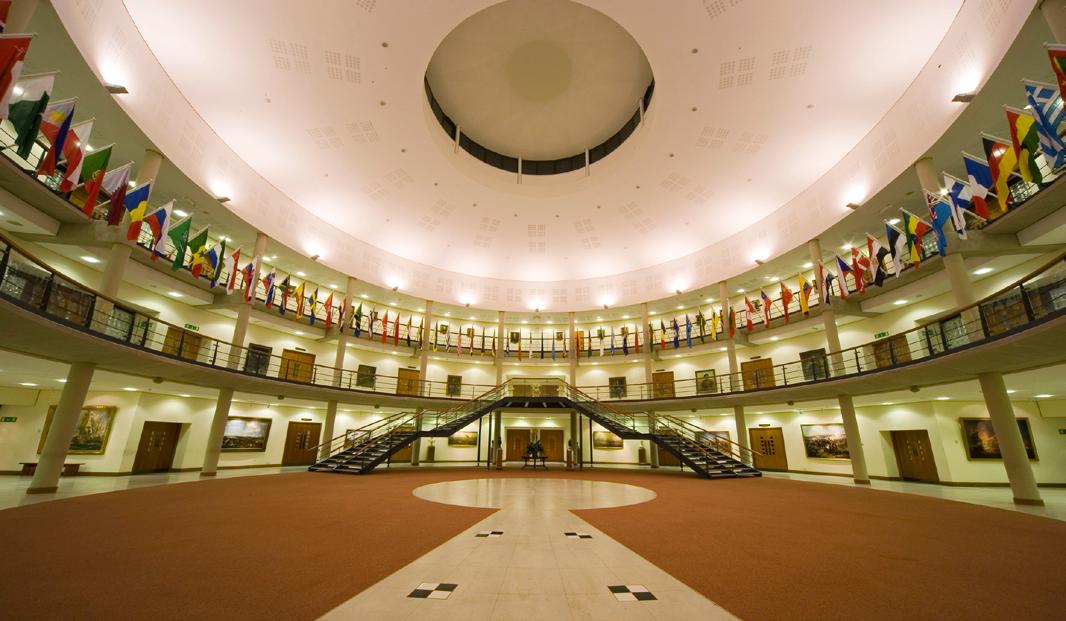
“IN THE SAME WAY THAT GERASIMOV HAS SOUGHT TO EXPLOIT THE UNTAPPED POTENTIAL OF THOSE ACADEMICS IN RUSSIA’S MILITARY ACADEMIES, THE BRITISH ARMED FORCES MUST HARNESS THE INTELLECTUAL HORSEPOWER IN THEIR OWN MILITARY ACADEMIES AND STAFF COLLEGES.”
Home to intellectual horsepower: Defence Academy, Shrivenham
Picture: Crown copyright
IN-DEPTH BRIEFING // KNOWING THE ENEMY 5 // IN-DEPTH BRIEFING // CHACR