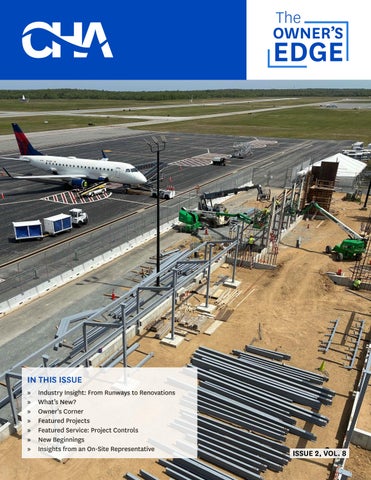
IN THIS ISSUE » » » » » » »
Industry Insight: From Runways to Renovations What’s New? Owner's Corner Featured Projects Featured Service: Project Controls New Beginnings Insights from an On-Site Representative
ISSUE 2, VOL. 8
FINDING A BETTER WAY.
CHA Consulting, Inc.
Industry Insight From Runways to Renovations: Navigating Active Airport Construction By Thomas Downie, LEEP AP BD+C, Senior Project Manager - OPM, and John DelBalso, CM, ACE, Senior Project Manager - Aviation Airports are among the most complex environments for capital improvement projects. Unlike many
infrastructure projects, airports must remain fully operational during construction, serving passengers, airlines, and tenants without interruption. For owners undertaking terminal expansions or renovations, the challenge is not simply building new space. The greatest hurdle is maintaining a safe, efficient, and regulated environment while the work unfolds around active operations. Drawing on recent experience supporting aviation clients, a clear lesson has emerged: successful projects depend on careful planning, disciplined phasing, and adaptability in dynamic conditions. Operating a “City” While Building Within It Airports function as self-contained ecosystems, similar to a small city. They include passenger processing, baggage systems, security checkpoints, concessions, ground transportation, and parking operations, all interacting in real time. Introducing construction into this environment significantly increases complexity. Project teams must manage not only the construction itself but also the movement of people and vehicles through constantly shifting pathways. Wayfinding, queue management, and access to services become critical considerations, especially when portions of the terminal are closed and normal access points are changed. Even in normal operations, passengers can struggle with navigation in an unfamiliar airport. During construction, clear signage and thoughtful circulation planning are essential to minimize confusion and maintain a positive passenger experience. Phasing Is the Only Path Forward Unlike many facilities, airports cannot simply shut down for renovation. Phased construction is not optional;
it is fundamental to delivering projects while maintaining operations. Typical approaches involve sequencing work across multiple stages, such as reconfiguring departure areas during off-peak periods, constructing additions, and then shifting operations to allow renovation of existing spaces. This approach allows airport operators to maintain continuity but demands precision in scheduling and coordination. Each phase must align with operational needs, seasonal fluctuations in passenger volumes, and the availability of temporary accommodations such as trailers, tents, and rerouted pathways. The result is a carefully choreographed process where construction activities and airport operations move in parallel. Regulatory Oversight Raises the Stakes Airport construction must meet stringent regulatory requirements at all times. Agencies such as the FAA and TSA maintain full oversight regardless of ongoing work. In many cases, requirements become more stringent due to the increased risk associated with non-routine conditions. Construction safety and phasing plans dictate how projects are delivered, including site separation, security lines, and operational protocols. Working within these constraints requires deep familiarity with aviation standards and constant coordination with stakeholders. Even small missteps can introduce construction delays or operational disruptions, making experience in this environment a critical asset. Temporary Isn’t Simple Maintaining service often requires extensive temporary infrastructure. This can include arrivals tents, temporary walkways, relocated baggage operations, and interim spaces for rental car services and concessions. These temporary solutions must function as seamlessly as permanent facilities, Continued on Page 7
OPM@chasolutions.com
The Owner’s Edge | Page 3
What’s New? Meet Project Manager Prajakta P. Patil, CCM, MCPPO Prajakta Patil was recently promoted to Project Manager at CHA after serving as an Assistant Project Manager for 3 years. She understands that buildings are ultimately an extension of the communities they serve, and that the best-built environments come from project teams that feel supported. Prajakta brings both technical expertise and a human touch to her work. Whether it’s a school, a library, a fire station, an airport, or the MBTA, she approaches every challenge with calm confidence. The theme that defines Prajakta’s career journey is heart. She pours it into her projects, her teams, and the communities she serves. She embraces innovation and enjoys shaping the next generation of public spaces. In 2025, Prajakta received CHA’s Strong Back Award. This honor is reserved for someone who lifts their project teams, pushes projects forward, and carries everyone across the finish line. For Prajakta, it was a deeply meaningful recognition, which reflects the values she brings to her work each day.
MBLC Checks Progress at J.V. Fletcher Library On May 28, the Massachusetts Board of Library Commissioners (MBLC) visited the J.V. Fletcher Library in Westford, MA, as construction is well underway. The MBLC has provided significant grant funding for this library renovation. The MBLC team of Andrea Bono-Bunker and Heather Backman visited the project site with Library Director Ellen Rainville, CHA On-Site Representative Mark Luzaitis, and CHA Project Executive Jennifer McGrory.
World Cup Ready! CHA celebrated the completion of the MBTA Foxboro Station Platform on June 2 with leaders of the MBTA and Governor Maura Healey. This critical infrastructure project was accelerated to provide additional train capacity for World Cup soccer matches at nearby Gillette Stadium. The major accessibility and capacity upgrade was completed in less than one year and is being recognized as the fastest permanent station construction project in MBTA history.
Hello Connecticut! Operating as Clough Harbour & Associates, LLP, CHA has long served clients across Connecticut from our base office in Hartford/Rocky Hill, a central geographic location. We are known for our award-winning bridge and highway design work, and we’ve now added Owner’s Project Management (OPM) services to our portfolio in the state. Experienced Project Manager Diana McNeil, AIA, LEED AP, has recently joined our team, focusing on Connecticut and Western Massachusetts. As an Architect and Project Manager, Diana has an impressive background in managing large capital projects, including schools and municipal buildings.
FINDING A BETTER WAY.
CHA Consulting, Inc.
Out and About The CHA team has been out in the community, supporting great causes and connecting with our clients. Once again, our team was honored to be part of the annual Francis M. Keville Scholarship Dinner hosted by the Boston Society of Civil Engineers Section. We also had a great showing at the BWiC Inspire Awards, hosted by the Associated General Contractors of Massachusetts, celebrating exceptional women in construction. It was a great day supporting the Mashpee Police Relief Association at their golf event. Assistant Project Manager Colby Ciffolillo went above and beyond and took home the award for “Best Dressed.” We also landed some great shots at the Professional Women in Construction (PWC) Boston Chapter annual golf tournament in May.
And the Winner is… We are thrilled to announce that the Skip Viglirolo Rink at the Belmont Sports Complex was awarded the Construction Management Association of America (CMAA) New England Project Achievement Award. CHA served the Town of Belmont as Owner’s Project Representative on this exciting community project. CHA’s OPM Team also played a key role as Owner’s Project Representative for the Eastchester and Jackson Houses Design Build - Geothermal and Heating Upgrades project for the New York City Housing Authority (NYCHA). This project has been collecting impressive national awards, including selection as one of eight prestigious Grand Award winners in the 2026 American Council of Engineering Companies (ACEC) Engineering Excellence Awards and an Engineering News-Record (ENR) Best of the Best Award for Sustainability.
Sharpening Our Skills The CHA PMCM team recently gathered for a day of team training to enhance our skills and collaboration. By investing in continuous learning, we’re expanding our team’s capabilities to bring forward-thinking solutions and added value to every client challenge and project.
New Faces. Shared Purpose. Please join us in welcoming some exceptional new talent to our PMCM team. We welcome Program Manager Heather Green; On-Site Representative Rob Nevin, CSL; Project Manager Bryna Charlton; and On-Site Representative Brian Nelson. We also congratulate Prajakta Patil, CCM, MCPPO, on her recent promotion to Project Manager.
OPM@chasolutions.com
The Owner’s Edge | Page 5
Owner’s Corner Featured Owner: Airport Director Geoff Freeman, Martha’s Vineyard Airport, West Tisbury, MA The Martha’s Vineyard Airport Commission is currently undertaking a major terminal expansion involving both a renovation and new construction. Approximately 5,000 SF of the existing 16,800 SF terminal will be renovated, while an additional approximately 15,000 SF will be added—nearly doubling the terminal’s overall size. For Geoff Freeman, managing the renovation and expansion of a critical piece of infrastructure on an island requires balancing seasonal demand, limited space, and long-term growth. Those realities are now shaping this transformative project aimed at improving the airport’s passenger experience and supporting the island’s future needs. A Growing Airport with Limited Capacity As the primary gateway to Martha’s Vineyard, the airport operates as a non-hub facility with intense seasonal demand. Passenger volumes have grown to approximately 80,000 annually, driven by commercial airline traffic. The existing terminal, built in the late 1990s, was not designed for this level of activity or for today’s operational requirements. Larger regional aircraft have increased passenger density, while the absence of adequate post-security space has forced reliance on temporary solutions such as seasonal tents. Security changes following September 11 further reduced usable space, limiting passenger movement within an already constrained footprint.
FINDING A BETTER WAY.
Funding Realities Drive Strategy The airport operates as a self-sustaining entity, reinvesting all aviation and non-aviation revenue into operations and improvements. Without local tax support and with limited ability to carry debt, funding for terminal projects is a challenge. When a $15 million federal grant created a rare opportunity to advance a terminal expansion project, the team mobilized and aggressively moved from grant award to construction in about 12 months, significantly faster than typical capital programs. Accelerating Delivery Through Collaboration Meeting an accelerated schedule required close coordination among federal, state, regional, and local partners. Clear communication and shared urgency helped streamline approvals that would normally take years. Flexibility by all stakeholders and agencies also proved essential. Airports Must Build While Operating Executing construction while maintaining full operations has been one of the project’s greatest challenges and is a challenge familiar to airports, large and small. An airport functions like a small city, with tenants, transportation services, and passenger activity that must continue uninterrupted. For any airport project, phased construction supports continuity but introduces logistical challenges, particularly within a limited footprint. Island conditions added another layer of complexity. Materials and labor must arrive by ferry, based on schedules that require advance coordination. In addition, on an island, workforce availability can be limited, and some workers may require housing.
CHA Consulting, Inc.
An airport functions like a small city, with tenants, transportation services, and passenger activity that must continue uninterrupted. Lessons for Owners Reflecting on the project, Geoff emphasized the importance of communication, patience, and adaptability. Frequent coordination and structured meetings have helped align diverse stakeholders, while digital tools have supported collaboration despite geographic constraints. Just as important is recognizing that complex projects require flexibility and time to navigate competing priorities and processes. As this critical airport expansion project progresses, it highlights a broader lesson for public-sector owners. Facilities must evolve to meet changing demands within real-world constraints. With the right partnerships and a willingness to adapt, even the most challenging projects can be completed and lead to long-term improvement. Industry Insight Continued from Page 3
accommodating passenger flow and operational needs while meeting safety and regulatory requirements. At the same time, they must be constructed, maintained, and eventually removed without disrupting ongoing operations. Although temporary by nature, these elements represent a substantial component of project planning and execution. Unique Challenges Demand Tailored Solutions No two airports are alike. Differences in size, layout, passenger volume, and stakeholder expectations mean that strategies cannot simply be replicated from one airport to another. Each project requires a tailored approach that considers site-specific conditions. For example, airports in constrained environments may require construction activities to occur in close proximity to active aircraft operations, increasing the importance of safety controls and coordination. Projects in remote or geographically constrained locations introduce additional challenges. Logistics, such as transporting materials, securing labor, and scheduling deliveries, can be major factors in project success. Weather, access limitations, and seasonal demand can further complicate construction timelines. Managing Disruption While Delivering Value Despite the complexity, airport projects share a common goal: improving the passenger experience and supporting
OPM@chasolutions.com
long-term growth. While construction may introduce temporary inconveniences such as tighter spaces, noise, or longer circulation paths, these impacts are managed through careful planning and communication. The ability to maintain full operations throughout construction reflects the strength of collaboration among owners and airport staff, designers, contractors, and project managers. Alignment across all parties is crucial to keeping the project on track while minimizing disruption. A Discipline Built on Experience Delivering successful airport projects requires more than technical expertise. It demands an understanding of how to balance construction with ongoing operations, regulatory requirements, and stakeholder expectations. In aviation, experience drives outcomes. Teams that understand how to phase work, manage logistics, and adapt to evolving conditions are best positioned to help owners deliver improvements without compromising service. As airports continue to invest in modernization and expansion, these lessons remain critical. Building the future of air travel begins with the ability to keep today’s airports running smoothly. For more information, contact Thomas Downie at tdownie@chasolutions.com or John DelBalso at jdelbalso@chasolutions.com.
The Owner’s Edge | Page 7
Featured Projects
© Robert Benson Photography and Flansburgh Architects
Nauset Regional High School, Eastham, MA
Martha’s Vineyard Airport Terminal Enhancements, Vineyard Haven, MA
The Nauset Regional School District tapped CHA to serve as the OPM beginning with the feasibility study phase through construction on its high school project. MSBA-funded construction included new additions totaling 106,000 SF and occupied, phased renovations to more than 110,000 SF of the existing school buildings.
The Martha’s Vineyard Airport terminal expansion involves both renovation and new construction to enhance passenger experience and operational efficiency. The terminal will be renovated, and additional square footage will be added, nearly doubling its overall size. CHA is providing OPM services, beginning with the feasibility/programming phase, to alleviate congestion in the hold room and ticketing lobby.
New additions and buildings now accommodate a performing arts center with a 750-seat auditorium, a dining hall, a new science and academics building, and a centrally located administration building. Renovated spaces include the school’s research center, TV studio, black box theater, robotics/ innovation labs, and updated academic classrooms. The project was designed and constructed net-zero-ready and in accordance with NE-CHPS and LEED certification specifications. Nauset is inside the Cape Cod National Seashore, making it the only high school on the East Coast located within a national park. The project was completed in 2025.
FINDING A BETTER WAY.
A key objective of this terminal enhancement project is to enclose the current outdoor departure area, which relies on a tent and portable restrooms. The expansion will also accommodate two TSA screening lanes, enabling the airport to better serve larger aircraft and manage peak-season passenger volumes. Upgrades to mechanical systems will improve HVAC performance, achieve compliance with ADA accessibility standards, and enhance energy efficiency. Overall, the project aims to streamline passenger flow, improve traffic circulation, and optimize the terminal’s operational functionality. The project will be completed in the spring of 2028.
CHA Consulting, Inc.
Rhode Island T. F. Green International Airport Terminal Improvements, Providence, RI Rhode Island T. F. Green International Airport (PVD) is undergoing a comprehensive terminal improvements program to modernize facilities and accommodate continued passenger growth. Originally constructed in 1993, the terminal now exceeds nearly 2 million enplanements annually. Many public-facing interior components, including flooring, ceilings, and finishes, have reached the end of their useful life and require full reconstruction to support the airport’s long-term operational needs. This multi-phase program includes both immediate construction initiatives and broader terminal renovation efforts encompassing design, stakeholder coordination, and future capital improvements. Construction activities are planned to maintain continuous airport operations and require phased execution, extended work shifts, and close coordination with airlines, tenants, and regulatory agencies. CHA is serving as the Owner’s Representative, providing project management, construction oversight, and design coordination services for both the terminal improvements construction program and the associated design efforts. CHA also provides full-time on-site resident project representative (RPR) services to document construction activities, support quality control, track quantities for payment, and coordinate phased work areas within an active terminal environment. In addition, CHA is acting as the owner’s project manager during the final design phase, overseeing the design consultant, managing coordination throughout the design development and procurement process, and providing specialized consulting services such as FAA and PFC funding eligibility analysis, grant reporting, and development of tenant design guidelines to support long-term terminal improvements.
Featured Service Project Controls
CHA’S PROJECT CONTROLS SERVICES INCLUDE: • Comprehensive project cost planning • Cost estimating • Cost management • Change order analysis • Scheduling • Document controls For more information, contact Bruce Jensen at bjensen@chasolutions.com or Heather Green at hgreen@chasolutions.com.
OPM@chasolutions.com
Successful projects are no longer defined solely by budgets and estimates, but by foresight, transparency, and disciplined controls that enable teams to respond quickly when conditions change. To help owners navigate increasingly complex projects, CHA has expanded its focus beyond traditional cost estimating into a comprehensive project controls offering. Through smarter planning, stronger controls, and earlier alignment, our experienced team helps protect project quality, keep projects on schedule and within budget, and improve overall outcomes. Program Management CHA also provides program management, aligning scopes, schedules, budgets, risks, and stakeholders across a portfolio of interdependent projects to achieve organizational goals such as growth, transformation, resilience, and long-term asset value. This approach delivers expertise across complex capital programs, integrating planning, financial oversight, risk management, and stakeholder coordination throughout the full project lifecycle.
The Owner’s Edge | Page 9
Town of Mashpee Police Station
Foxboro Commuter Rail Station
Martha's Vineyard Regional High School
Edgartown Fire Station
Nauset Regional High School
Massachusetts Maritime Academy
New Beginnings Town of Mashpee Police Station, Mashpee, MA
Martha’s Vineyard Regional High School, Oak Bluffs, MA
In May, the Town of Mashpee broke ground on its new police station. CHA is providing OPM services for the construction of the new 24,500 SF facility on the same property as the existing building, which will remain in use until the new station is available for occupancy. CHA also worked closely with the town during the feasibility study phase.
The Martha’s Vineyard Regional High School building project is moving forward, thanks to overwhelming support from the island community. On June 2, all six towns on the island voted to support the project’s funding and proceed with the Massachusetts School Building Authority (MSBA) grant process. This is the largest public construction project in Martha’s Vineyard's history and will transform the high school for future generations of students.
Foxboro Commuter Rail Station, Foxboro, MA On June 2, the Massachusetts Bay Transportation Authority (MBTA) celebrated a ribbon-cutting for the Foxboro Commuter Rail Station, located across the street from Gillette Stadium, which hosted seven 2026 FIFA World Cup soccer matches this summer as part of Boston’s hosting duties. CHA served as Owner’s Project Manager on this expedited project to upgrade and expand the station to accommodate the estimated 20,000 rail passengers per game. After the World Cup festivities, the project will provide long-term benefits for Foxboro residents and visitors, enhancing transportation access to Gillette Stadium and Patriot Place. The station improvements support the Commonwealth's broader investment in public transportation, accessibility, and regional mobility.
FINDING A BETTER WAY.
Edgartown Fire Station, Edgartown, MA In January, Edgartown firefighters and community leaders gathered to bid farewell to their existing fire station and celebrate the groundbreaking for a new, modern facility with more space to accommodate larger trucks. CHA is providing OPM services for the design and construction of the new fire station, which includes four apparatus bays and an auxiliary bay behind the main building. The new building will mimic the historic look and feel of the town’s existing station, which had reached the end of its useful life.
CHA Consulting, Inc.
Nauset Regional High School, Nauset, MA
Massachusetts Maritime Academy, Buzzards Bay, MA
In March, CHA joined school leaders, students, government officials, and the community to celebrate the official ribbon-cutting and grand opening of the Nauset Regional High School. This multi-year, phased project included new construction, temporary modular classrooms, and renovations to several school buildings.
In April, the Massachusetts Maritime Academy hosted a “Closing the Loop” Ceremony for its new energy-efficient geothermal system. The CHA Generation & Energy Management team worked closely with DCAMM and the academy’s staff to develop the design for the campus geothermal system, including an ambient loop that serves the campus, fed by a 252-borehole ground-source heat exchanger.
Hedge Elementary School, Plymouth, MA CHA will provide OPM services for the addition and renovation of Plymouth’s Hedge Elementary School, beginning with the feasibility study and schematic design phases and continuing through the design and construction phases. The school currently serves more than 200 students in grades K through 5.
John G. Whittier Middle School, Haverhill, MA CHA will provide OPM services for the addition and renovation of John G. Whittier Middle School, beginning with the feasibility study and schematic design phases and continuing through the design and construction phases. The school currently serves students in grades 5 through 8.
Insight from an On-Site Representative Senior On-Site Representative Derin Johnson For Derin Johnson, the role of an on-site representative is about far more than oversight. In his view, it is about connection, communication, and solving problems before they escalate. With more than 20 years in construction, he brings firsthand experience from the contractor side, allowing him to build trust quickly with field teams and anticipate challenges early. That perspective has shaped his approach to his daily work. Derin positions himself as a collaborator, working alongside contractors, subcontractors, and owners to keep projects moving efficiently. His goal is simple: keep everyone aligned and address issues in real time to avoid delays, added costs, or change orders. From his years of experience on construction sites, he believes one of the most significant lessons he’s learned
OPM@chasolutions.com
is the importance of early engagement. For example, on complex public safety projects with multiple stakeholders, bringing teams together early helps align expectations and reduce surprises later in construction. Another important lesson from years of on-site experience is to revisit original plans early in the field phase. Because design can be completed years before construction begins, confirming that owner expectations, equipment selections, and operational needs still align can help avoid late-stage surprises, costly changes, and schedule impacts once construction is underway. He also emphasizes the need for practical design decisions. While new technologies can be appealing, Derin advises owners to prioritize systems that are reliable, maintainable, and easy to operate over the long term. Buildings, he notes, are “living, breathing” assets that must function well beyond project completion.
The Owner’s Edge | Page 11
ISSUE 2, VOL. 8
Printed on 10% recycled stock
CHA CONSULTING, INC. 1 Washington Mall, Suite 1500 Boston, MA 02108
FINDING A BETTER WAY. The Owner’s Edge newsletter is published by CHA Consulting, Inc., 1 Washington Mall, Suite 1500, Boston, MA 02108 (617) 451-2717 | WWW.CHASOLUTIONS.COM/PMCM To be added to the mailing list, email marketing@chasolutions.com Reproduction or reuse of this material in whole or part is prohibited without the written permission of CHA.
Editorial Advisory Board Sean Sweeney, CSL, Michael T. Owen, FCSI, Molly E. Canfield, Mary Bray Gallagher, APR