The word Torah means “instruction” or “guide,” and it is often described as G‑d’s “user manual” for the world. But unlike an ordinary user manual— which is secondary to the product it explains—the Torah is primary not secondary.
The Torah isn’t a guide for managing an existing creation—it’s the reason creation exists. The Talmud states that the world was created in response to the Torah. G‑d created the world so that the instructions of the Torah could be lived and fulfilled.
The same is true for each of us. Rather than seeing yourself as a victim of random events, recognize that your divine mission is the primary focus, and your current life circumstances only play a supporting role, not the other way around.
For example, in 1967, when a snowstorm left a group of Jewish women stranded and stuck in a Detroit airport, they called the Rebbe for guidance, and he famously responded, “A Jew is never stuck; wherever you find yourself, it’s by Divine design.”
The story beautifully illustrates how even snowstorms and flight cancellations are secondary and divinely orchestrated to help facilitate the Torah’s primary mis sion. Inspired by this message, the group of Jewish women used the unexpected delay in Detroit to connect with other stranded Jewish travelers, resulting in new relationships and a lasting Jewish impact.
Similar to how you’ll see online ads in your feed based on your demographic, location and preferences, the Baal Shem Tov taught that everything we encounter in our lives is by divine design. For instance, if you notice a flaw in a friend, it’s only showing up in your “feed” to serve as a mirror, highlighting something within yourself that requires attention.
Can there be anything random in a world created and designed only to facilitate the Torah?
WHAT IS THE TORAH’S PURPOSE?
In short, the Torah’s objective is divine unity.
This unity isn’t about being alone, the only, or having no opposition. Absolute divine unity is revealed when the Torah transforms and includes even the most distant or seemingly opposite elements within the realm of holiness. As the light that was once darkness shines much brighter, and the peace that can bond enemies is much stronger, this Torah enabled unity is a more profound oneness.
But to unite and uplift the world, you need to be above it.
That’s why the Torah is in a constant state of being “given,” as G d makes sure the Torah retains its primary transcendent nature. This is similar to aerodynamics, where you need an outside force to lift yourself, and for creation and all its messy parts, the Torah is that “outside” force.
So, look deeply into the Torah and watch how the distance between heaven and earth dissolves and see how “commandments” connect and elevate you, and the world’s countless details with endless scenarios, into a profound divine oneness. •
(Based on a Chasidic Discourse by the Rebbe)
SINAI’S THORNY ROCKS
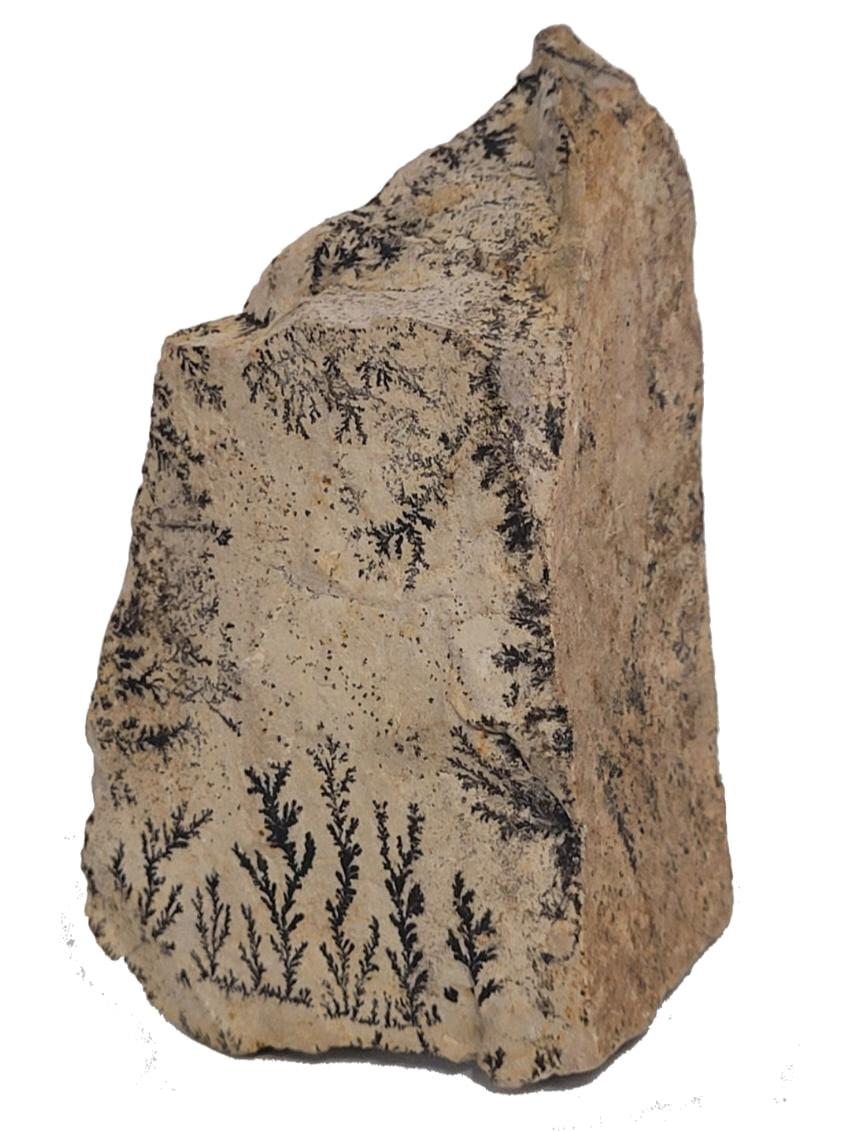
Mount Sinai got its name from its unique “sneh” imprinted stones. In Hebrew, “sneh” means thornbush, and according to Rabbi Ya’akov Emden (1697–1776), a prominent German rabbi and Talmudic scholar in the 18th century, each stone depicts a complete thornbush. Hence the name Mount (Sneh) Sinai.
Recently, researchers took the stones of Mount Sinai to Jerusalem University’s pathology institute, ground the rocks into a powder, and examined them under a microscope; incredibly, they found the image of a thornbush on the dust.
When choosing a mountain and backdrop for the Torah, G-d chose the unassuming Mount Sinai from among the more impressive and larger mountains because of its humility. The sages teach us that humility is the path to receiving the Torah.
We all have strengths and weaknesses, roses and thorns, but when G-d appears to Moses, He chooses a thornbush, and when it comes to climbing the mountain of G-d, you’ll find the stones have humble thorns.
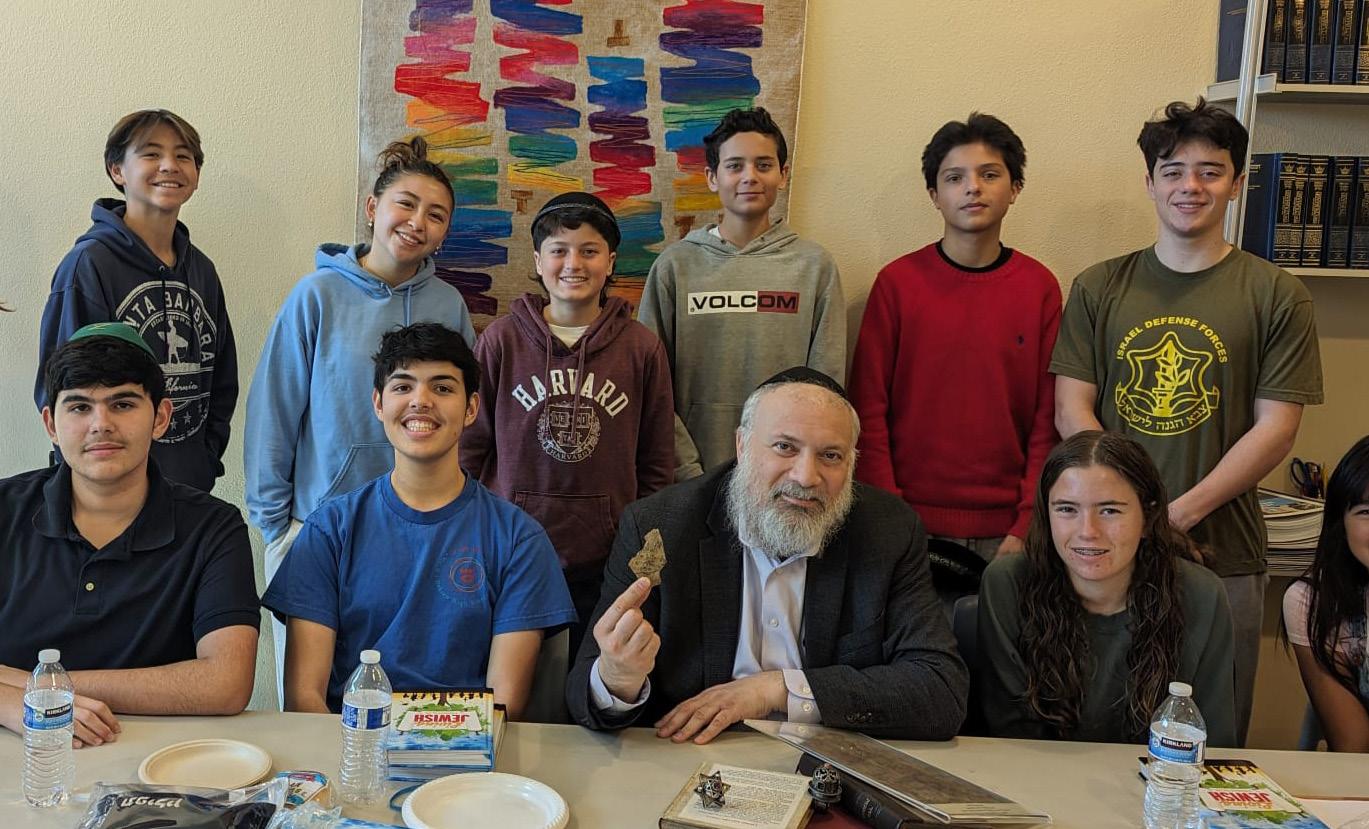
Rabbi Avraham Berns, a former librarian at the Rebbe’s Library at Chabad World Headquarters in Brooklyn, displays a stone from Mount Sinai with a visible thornbush depiction to Hebrew High students at Chabad in Los Alamitos, CA.
>> Rabbi Shmuel Marcus is the editor of Chabad Magazine and together with his wife Bluma and their family direct the Chabad in Los Alamitos in California.
HERE’S WHY YOU COUNT
Based on the teachings of the Rebbe
Some holidays, like Passover, arrive whether you’re ready or not. It comes as a gift—unearned and uncondi tional. But the next Jewish holiday, Sha vuot, is different. It doesn’t just happen on its own. It depends on you. And that’s by design.
The Torah intentionally does not write a date for Shavuot. Instead, after the first day of Passover, we are commanded to count seven complete weeks—a process known as Sefirat HaOmer or Counting the Omer. Only after these forty nine days do we reach Shavuot, the day we received the Torah at Sinai. This counting makes the holiday of Shavuot unique: it doesn’t just arrive—you cause it.
How does counting days cause Shavuot?
Counting sounds easy, like a child counting their fingers and toes or a baker counting a dozen plain bagels. But in Hebrew, counting is also associated with
IT’S MAGIC!
the brilliant sapphire stone because this “sefira” includes an act of polishing.
There are seven weeks to the Omer and seven human emotions; this is not a coincidence. We count each day by searching for personality traits that could use a little
Shavuot celebrates a more profound connection built through daily personal improvements.
shine, and this daily self improvement has a luminous effect.
The name says it all.
The Torah tells us that your counting “Shavuot” or “Weeks” causes the time and date of the great revelation. Sure, there was thunder, lightning, and great revelation of the Torah, but this holiday is more about
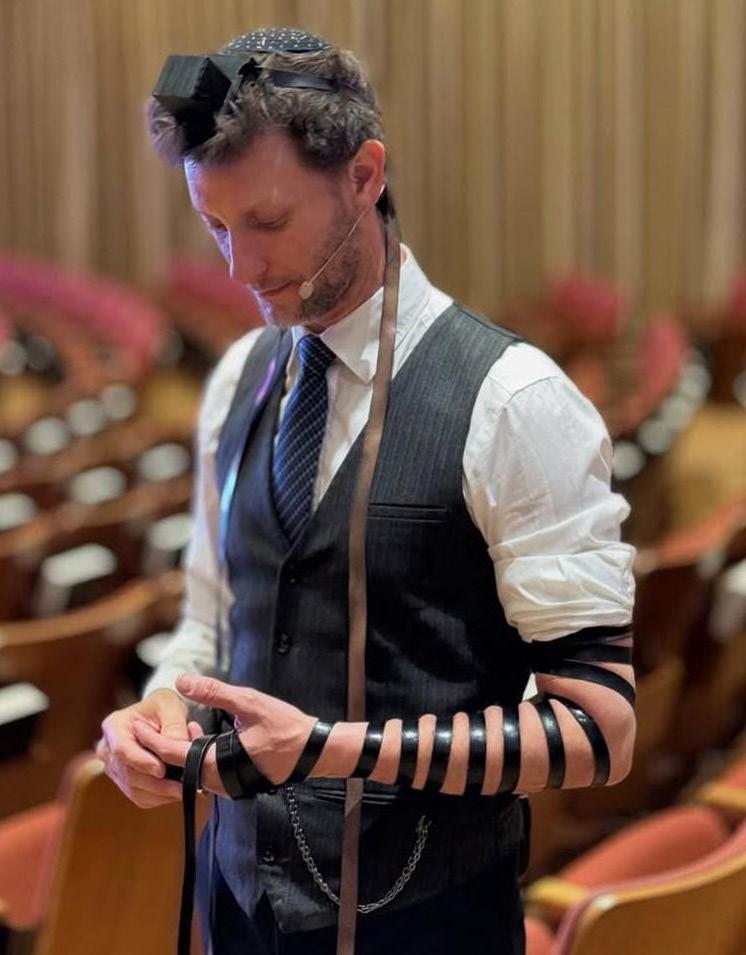
Lior Suchard is a world-renowned mentalist who has captured audiences on shows like Jay Leno and James Corden. He stars in Gone Mental and co-hosts Brain Games on National Geographic. With fans ranging from A-list celebrities to world leaders, Lior is best known for his incredible illusions, but when connecting with G-d, Lior doesn’t use slight-of-the-hand tricks. He uses Tefillin. That’s why we’re fans of his.
you, the reader, and what happens when you count weeks.
Shavuot celebrates that empowerment. Today, we take this power to change for granted. But, historically, our forefathers pre Sinai were trapped in an unchangeable world. The heavens were holy, the earth was mundane, and only G‑d could make changes or holidays. It took years of slavery, a wondrous Passover Exodus, and our counting of forty nine days until Shavuot for G d to gift us the power to change calendar days and, more importantly, the world around us.
This is the core of Shavuot, and it’s worth celebrating.
While watching the sea split is nice, knowing that our actions elevate and impact the world around us is truly wonderful. At Sinai, G‑d came down, and Moses went up—bridging heaven and earth forever, empowering us to turn ordinary homes into sacred spaces, everyday items into divine mitzvot, and regular days into holidays.
Yes, your Judaism is a gift at birth, and Passover is about G‑d’s unconditional love, yet, Shavuot celebrates a more profound connection built through daily personal improvements. It sounds fun to get a free ride and enjoy unearned miracles, but G d’s greatest gift to us is the power to be His active partner.
And that’s how you change the world: one day at a time. •
Moses came and called the elders and put the Lord’s words before them. And all the people replied in unison, “All that the Lord has spoken we shall do!” and Moses took the people’s words back to the Lord. And the Lord said to Moses, “Behold, I am coming to you in the thickness of the cloud, so that the people hear when I speak to you, and they will also believe in you forever.” And Moses relayed the words of the people to the Lord. And the Lord told Moses, “Go to the people and prepare them today and tomorrow, and they shall wash their garments. And they shall be ready for the third day, for, on the third day, the Lord will visibly descend upon Mount Sinai. And you shall set boundaries for the people, saying, Beware of ascending the mountain or touching its edge; whoever touches the mountain will die.’ No hand shall touch it, for he shall be stoned or cast down; whether man or beast, he shall not live. Only when the ram’s horn sounds a long blast may they ascend the mountain.”
So Moses descended from the mountain to the people, and he prepared the people, and they washed their garments. He said to the people, “Be ready for three days; do not approach a woman.” So it came to pass on the morning of the third day that thunderclaps and lightning flashes, a thick cloud upon the mountain, a mighty blast of a shofar, and the entire nation in the camp shuddered. Moses brought the people toward God, and they stood at the bottom of the mountain. And the whole of Mount Sinai smoked because the Lord had descended upon it in fire, and its smoke ascended like the smoke of the kiln, and the entire mountain quaked violently. The shofar’s sound grew increasingly stronger; Moses would speak, and God would answer him with a voice.
The Lord descended upon Mount Sinai, to the peak of the mountain, and the Lord called Moses to the peak of the mountain, and Moses ascended. The Lord said to Moses, “Go down, warn the people not to go nearer to the Lord, to gaze, and many will fall. And also, the priests who go near to the Lord shall prepare themselves, lest the Lord send destruction upon them.” And Moses said to the Lord, “The people cannot ascend to Mount Sinai, for You warned us saying, Set boundaries for the mountain and sanctify it.’” But the Lord said to him, “Go, descend, and return with Aaron, but the priests and the people shall not, lest He send destruction upon them.” So Moses went down and told the people.
יול — Second Aliyah ישילש — Third Aliyah
— Forth Aliyah
THE TEN COMMANDMENTS
Rise and face the Torah during the reading of the Ten Commandments:
THE TEN COMMANDMENTS
Rise and face the Torah during the reading of the Ten Commandments:
THE TEN COMMANDMENTS
Rise and face the Torah during the reading of the Ten Commandments:
God spoke all these words saying:
I am the Lord,
your God, Who took you out of the land of Egypt, out of the house of bondage.
I am the Lord,
God spoke all these words saying:
your God, Who took you out of the land of Egypt, out of the house of bondage.
I am the Lord,
Do not have other gods. Therefore, don’t make graven images like anything in heaven, earth, or the water beneath the earth. Don’t bow before them or worship them, for I, the Lord, your God, am a jealous God, Who visits the iniquity of the fathers upon the sons, upon the third and the fourth generation of those who hate Me. I do kindness to thousands of generations, to those who love Me and keep My commandments.
your God, Who took you out of the land of Egypt, out of the house of bondage.
Do not have other gods. Therefore, don’t make graven images like anything in heaven, earth, or the water beneath the earth. Don’t bow before them or worship them, for I, the Lord, your God, am a jealous God, Who visits the iniquity of the fathers upon the sons, upon the third and the fourth generation of those who hate Me. I do kindness to thousands of generations, to those who love Me and keep My commandments.
You shall not take the name of the Lord, your God, in vain, for the Lord will not hold blameless anyone who takes His name in vain.
Do not have other gods. Therefore, don’t make graven images like anything in heaven, earth, or the water beneath the earth. Don’t bow before them or worship them, for I, the Lord, your God, am a jealous God, Who visits the iniquity of the fathers upon the sons, upon the third and the fourth generation of those who hate Me. I do kindness to thousands of generations, to those who love Me and keep My commandments.
You shall not take the name of the Lord, your God, in vain, for the Lord will not hold blameless anyone who takes His name in vain.
Remember Shabbat and sanctify it. Six days shall you work, but the seventh day is a Sabbath to the Lord, your God; don’t do any labor, neither you, your son, your daughter, your servants, your beast, nor your stranger in your cities. In six days, the Lord made heaven, earth, the sea, and all that is in them, and He rested on the seventh day. Therefore, the Lord blessed the Sabbath day and sanctified it.
You shall not take the name of the Lord, your God, in vain, for the Lord will not hold blameless anyone who takes His name in vain.
Remember Shabbat and sanctify it. Six days shall you work, but the seventh day is a Sabbath to the Lord, your God; don’t do any labor, neither you, your son, your daughter, your servants, your beast, nor your stranger in your cities. In six days, the Lord made heaven, earth, the sea, and all that is in them, and He rested on the seventh day. Therefore, the Lord blessed the Sabbath day and sanctified it.
Honor your father and your mother, so you will live long on the land that God is giving you.
Remember Shabbat and sanctify it. Six days shall you work, but the seventh day is a Sabbath to the Lord, your God; don’t do any labor, neither you, your son, your daughter, your servants, your beast, nor your stranger in your cities. In six days, the Lord made heaven, earth, the sea, and all that is in them, and He rested on the seventh day. Therefore, the Lord blessed the Sabbath day and sanctified it.
Don’t murder.
Honor your father and your mother, so you will live long on the land that God is giving you.
Honor your father and your mother, so you will live long on the land that God is giving you.
Don’t murder.
Don’t commit adultery.
Don’t steal.
Don’t commit adultery.
Don’t murder.
Don’t bear false witness against your fellow.
Don’t steal.
Don’t commit adultery.
Don’t bear false witness against your fellow.
Don’t covet your fellow’s house; don’t covet your fellow’s wife, nor his servant, maidservant, ox, donkey, or whatever that is your fellows.
Don’t steal. bear false witness against your fellow.
Don’t covet your fellow’s house; don’t covet your fellow’s wife, nor his servant, maidservant, ox, donkey, or whatever that is your fellows.
Don’t covet your fellow’s house; don’t covet your fellow’s wife, nor his servant, maidservant, ox, donkey, or whatever that is your fellows.
FEMININE MYSTIQUE
By Shira Gold
When G‑d instructed Moses at Mount Sinai 3,300 years ago, He said: “Speak to the house of Jacob, and tell the sons of Israel” (Exodus 19:3). Our sages explain that “the house of Jacob” refers to the women, and “the sons of Is rael” refers to the men. In other words, G‑d instructed Moses to speak first to the women.
In Judaism, women have always been at the forefront of every significant moment in our history. In the Exodus from Egypt, for example, our sages declare that we were redeemed through the merit of the righteous women. Our Purim victory is thanks to Esther, and similarly, Yehudit played a key role in the Chanukah story.
But why is the feminine so central to Judaism and the Torah?
The Chasidic masters explain that masculine and feminine energies represent body and soul, the two essential divine forces in reality. Masculine energy represents vision, while feminine energy brings abstract potential into reality.
In Judaism, women have always been at the forefront of every significant moment in our history.
Most importantly, as we look ahead, we see the feminine energy shining in Jeremiah’s prophecy, which foretold that in the days of Moshiach, “a woman shall rise above a man.”
In Judaism, the body is the focus, not the soul. The Torah’s mission isn’t to escape to Heaven but to integrate and elevate the world. So, G‑d tells Moses to speak to the women first, hinting that the Torah’s true divine purpose is primarily realized in the material world. •
DATING TIPS FROM NETFLIX MATCHMAKER
Shavuot is often described as the “marriage” between G‑d and the Jewish people, so we reached out to Netflix’s Jewish Matchmaker, Aleeza Ben Shalom, for some expert dating tips. Here are her top three pieces of advice:
1. Don’t rush to break up—give it another date to see if a deeper connection can develop.
2. Smile! Your face shows your true feelings, so let your date see that you’re happy to be there, even if it doesn’t lead to a perfect match.
3. Never stop looking. If you’re serious about finding love, keep searching until you find the one.
>> Shira Gold is a staff writer at Chabad Magazine. She lives in Southern California with her husband and children.
TORAH TIDBITS
Enjoy these curated nuggets from the teachings of Chabad. For more on Torah study contact your local Chabad.
Passover celebrates our birth as a nation, but Shavuot is when we discover why we were born.
At Sinai, we received the Torah, it wasn’t just about escaping Pharaoh. It was about embracing a higher purpose and committing to it.
ARE YOU ACTION ORIENTED?
The Jews famously declared, “We will do and we will listen,” showing a commitment to action before understanding. There’s a big difference between hearing—like hearing thunder—and listening, as in listening to your doctor. By placing “doing” first, the Jews showed that their listening wasn’t passive; it was an active listening. On Shavuot we celebrate not only the “Giving” of the Torah but also our active receiving of it. This radical dedication has become the Jewish trademark.
SATISFACTION GUARANTEED
The Chasidic masters describe the Torah as a bridge that connects heaven and earth and the finite with the infinite. And this bridge is yours—it’s your inheritance. You don’t need to pay any tolls to cross it. Shavuot celebrates the grand opening of that bridge. It’s the day we received direction and the tools to fulfill our mission. Shavuot also relates to the Hebrew word for satisfaction—because only living your purpose will keep you truly satisfied.
SAY CHEESE!
The custom of eating dairy foods on Shavuot carries deep symbolic significance rooted in Kabbalistic teachings. One explanation is linked to the realization of the Jewish people upon receiving the Torah that their utensils were not
“The two most important days in your life are the day you are born, and the day you find out why.”
-MARK TWAIN
kosher, leading them to consume dairy products instead. Additionally, Kabbalistic symbolism associates Pesach with the blood of birth, while Shavuot is connected to the Torah, likened to milk. This reflects the transformation and progression from birth to maturation, culminating in the reception of the nourishing words of Torah on Shavuot.
THE ULTIMATE YACHT
When chaos surrounds you, like Noah, you can find refuge in the “ark.” Interestingly, the Hebrew word for “ark” is the same as for “word,” referring to G-d’s word, or the Torah. Just as Noah found safety in the ark, we can seek shelter from everyday turmoil by immersing ourselves in the divinity of the Torah.
STAY THIRSTY
Years ago, during Roman rule, Rabbi Akiva defied the ban on Torah study, illustrating with a parable about a fox who tried to convince fish to escape the fishermen by leaving the water. The fish refused to leave the water, explaining that they may or may not escape the fishermen’s nets but without water they would surely perish. Similarly, Rabbi Akiva argued that studying Torah was essential for life, like water for a fish. •