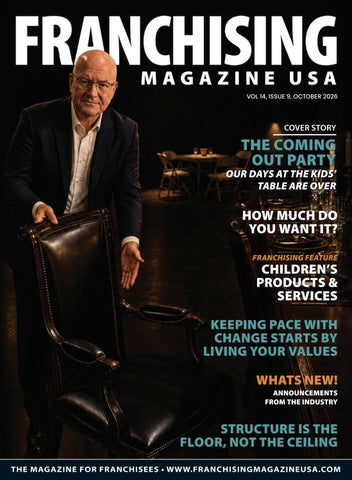
VOL 14, ISSUE 9, OCTOBER 2026
COVER story
THE COMING OUT PARTY
Our Days at the Kids’ Table Are Over
HOW MUCH DO YOU WANT IT? franchising feature
CHILDREN’S PRODUCTS & SERVICES
Keeping Pace with Change Starts by Living Your Values whats new! announcements from the industry
Structure Is the Floor, Not the Ceiling Franchising MAGAZINE USA 1 The magazine for franchisees • WWW.FRANCHISINGMAGAZINEUSA.COM
VOL 14, ISSUE
VOLUME 14, ISSUE 9, 2026
9, OCTOBER
2026
COVER stO
Ry
the coMin out pa g
rt y Our Days at the KiD s’ table are Over
On the cover: GEORGE KNAUF
how Much
Do
you want
it?
franch isin
g feature
chiLDren’S proDuctS & ServiceS
Keeping pa change ce with Living yo StartS by ur vaLueS
president: Colin Bradbury. colin@cgbpublishing.com Publisher: Vikki Bradbury. vikki@cgbpublishing.com editorial department: editor@cgbpublishing.com advertising: Jastine Supleo. advertising@cgbpublishing.com Production: usaproduction@cgbpublishing.com DESIGN: Michelle Quinn. michelle@cgbpublishing.com CGB PUBLISHING Canadian Office: Sidney B.C Canada U.S. Office: Seattle, WA www.franchisingmagazineusa.com
Proud member of the IFA:
International Franchise Association 1501 K Street, N.W., Suite 350 Washington, D.C. 20005 Phone: (202) 628-8000 Fax: (202) 628-0812 www.franchise.org
whatS ne announceM
FroM the
The ma gaz
ine for fra
nch isee s
w!
entS
inDuStry
Stru FLoor, no cture iS the t the ceiLi ng
• WW W.f ran
chi sin gm
agaFranc hising zin MagaZ eUs inEom a.c Usa 1
Welcome to the September 2026 issue
of Franchising Magazine USA!
The International Franchise Association (IFA) of the United States, The Canadian Franchise Association (CFA) and the Mexican Franchise Association (AMF) have signed the first Trilateral Cooperation Agreement between the three organizations, marking a historic step toward greater collaboration and growth across North America’s franchise sector. The IFA, CFA and AMF expect the collaboration to contribute to continued growth and development of the franchise sector across North America, supporting entrepreneurship, investment, employment and economic opportunity in all three countries. On the cover this issue we have George Knauf who is the founder of Orca Franchising and MyPerfectFranchise.com, creator of Knauf’s Hierarchy of Franchising™ (USPTO Serial No. 99795526), and author of The Last Employee: The Rise of Ownership. He is the only franchise consultant to keynote a major IFA event and holds an expert columnist role at Franchising Magazine USA. In the cover story George discusses how Our Days at the Kids’ Table Are Over and How a new class of franchise investor is claiming the economics that private equity kept to itself — and why the industry will never look the same. As usual we have some great topics from our residential experts in this issue, Evan Hackel starts off with Keeping Pace with Change Starts by Living Your Values. Lucas Frey covers the topic of how Your Calendar Reveals Your Brand’s Ceiling. Our guest writers in this issue are, David G. Thomas a shareholder with Greenberg Traurig, LLP, where he advises businesses on preventing, managing, and resolving complex disputes, Marshall Reddy a franchise consultant and industry thought
leader who helps professionals transition into business ownership through franchising, Ricky Kalmon Mindset Expert, Speaker and Author. Lots of great advice this issue you can find more by turning to the contents pages. Our main feature this month is Children’s Product and Services and we start off with Chis Conner, our resident feature expert who discusses what is available in the Child centred businesses and services. As always, we have articles on franchise systems that focus on this industry such as, Kids Lift, Tutu, Bach to Rock. Kids Create and Wheelhouse. For our veteran readers we meet David Kapojos of First Light Homecare who went From The U.S. Army to Home Care, David Kapojos Builds a Mission of Service in California, for David military service was never just about completing a mission. It was about responsibility, teamwork and taking care of the people beside him. Today, as the owner of FirstLight Home Care businesses in Pasadena, San Gabriel, Burbank, Glendale, and Chino Hills, Kapojos is bringing those same principles to a new mission: helping seniors, veterans and families have their best day, every day with the support of compassionate in-home care. Happy reading!
Vikki Bradbury | Publisher Franchising Magazine USA
The information and contents in this publication are believed by the publisher to be true, correct and accurate but no independent investigation has been undertaken. Accordingly the publisher does not represent or warrant that the information and contents are true, correct or accurate and recommends that each reader seek appropriate professional advice, guidance and direction before acting or relying on all information contained herein. Opinions expressed in the articles contained in this publication are not necessarily those of the publisher. The publication is sold subject to the terms and conditions that it shall not be copied in whole or part, resold, hired out, without the express permission of the publisher.
Franchising MAGAZINE USA 3
Want to stay on top of the latest news and whats happening at the forefront of franchising?
Subscribe to Franchising USA’s newsletter and receive all the latest franchising news delivered straight to your inbox, every week!
To subscribe visit: www.franchisingmagazineusa.com
conte nts september 2026
10
Have Your Say
Q&A
14 Stephen Kennedy, Marcos Pizza: Handle With Care: Your Data is More Dangerous Than You Think
28 Del Salinas: Caring Senior Service
52 Adam Petersen, Slumberland Furniture Franchise: Why Furniture Retail Franchises Continue to Attract Long-Term Investors
Franchisee in Action
Franchisor in Depth 24 Peter Roberts, Managed Mowed: The Rise of Managed Landscape Services in Commercial Real Estate 56 Matterhorn Fit: Why The Future of Human Performance Starts With The Nervous System
20 PuroClean: Building Across Borders: Franchise Owner Expands his Canadian Empire into the US
Cover Story 10 George Knauf: The Coming Out Party: Our Days at The Kids Table Are Over
In every issue 6
What’s New! Announcements from the Industry
33 Feature Supplement: Children’s Product and Services
66 A-Z Franchise & Services Directory
14
26
Expert Advice 16 Evan Hackel: Keeping Pace With Change Starts by Living Your Values 22 Luke Frey: Your Calendar Reveals Your Brands Ceiling
26
26 Marshall Reddy: How Much do You Want it? 30 Steve Buors: Beyond AI Content: How Franchise Brands Can Stand Out in a Sea of Sameness 50 Scott White: Behind Every Franchisee is a Story Worth Telling 54 Ricky Kalmon: Structure is The Floor, Not The Ceiling 58 George Knauf: The Question Most Franchise Investors Never Ask Themselves 60 David G. Thomas: How Multi-Tiered Dispute Resolution Systems Can Resolve Disputes More Efficiently And Effectively Than Arbitration or Litigation – And Even Strengthen Franchise Relationships
64 veterans in franchising Franchisee in Action 64 First Light Homecare: From The U.S. Army to Home Care, David Kapojos Builds a Mission of Service in California Franchising MAGAZINE USA 5
HTeaO Announces First Rio Grande Valley Location, Coming to Brownsville in Early 2027 The new store will be owned and operated by franchise partners Omar Ortega and Anna Marroquin HTeaO, the nation’s leading iced tea franchise, is expanding into South Texas with its first-ever location in the Rio Grande Valley. The new Brownsville store, located at 205 Rocky Road, Brownsville, TX 78526, will be owned and operated by local franchise partners Omar Ortega and Anna Marroquin of AMO Tea Enterprises 1, LLC, and is expected to open in early 2027. HTeaO officially broke ground on the new location on July 22, marking the start of construction and the brand’s entry into the Brownsville market and the Rio Grande Valley. The milestone represents another step in HTeaO’s continued Texas expansion as demand for the brand grows across the state. “Anna and I are incredibly excited to bring HTeaO to Brownsville,” said Omar Ortega, franchise partner of AMO Tea Enterprises 1, LLC. “We love what the brand offers, from the variety of fresh-
brewed teas to the welcoming experience, and we cannot wait to share that with the community. Our goal is to create a place people can stop by, cool off and enjoy with their family and friends.” The 1,900-square-foot location will feature HTeaO’s full menu of more than 20 fresh-brewed sweetened and unsweetened teas, along with specialty beverages, snacks and the brand’s popular bagged ice. Guests will be able to order inside or use the singlelane drive-thru for a quick and convenient experience. “Texas remains central to HTeaO’s growth strategy, and bringing our first location to the Rio Grande Valley is an exciting milestone for the brand,” said Shane Clark, Chief Development Officer of HTeaO. For more information on HTeaO, visit HTeaO.com
Amidst a Transformational Year, Workout Anytime Appoints Peter Stipher as Chief Operating Officer to Fuel Next Era of Growth accelerating growth and increasing enterprise value across the system. “Workout Anytime already has an outstanding foundation, an engaged franchise community and tremendous opportunity ahead,” said Stipher. “As we build for the future, our focus is on creating a smarter, more connected organization where every function works together to drive better decisions and better outcomes. Every investment we make should improve the member experience, strengthen unit economics and create longterm value for our franchisees. That’s an exciting opportunity, and I’m honored to help lead the next chapter of the Workout Anytime story.” Building on a momentous year, Workout Anytime announces Peter Stipher as Chief Operating Officer. Stipher’s appointment reinforces the company’s commitment to building one of the fitness industry’s most innovative and scalable franchise platforms.
Stipher has a proven track record of building and scaling businesses while executing on the key initiatives that keep companies lucrative, relevant and successful. As COO of Workout Anytime, Stipher will focus on creating a more unified, data-driven organization by aligning key business functions.
Reporting directly to Chief Executive Officer and majority owner Jerry Pugh, Stipher will oversee corporate-owned and franchise operations while leading the integration of technology, finance, marketing, analytics and operational strategy. His role is designed to create a stronger, more connected system that improves franchise performance and member satisfaction while
“With Pete’s exceptional ability to connect strategy with execution, he is the right person to help us level-up as the premier fitness franchise,” said Jerry Pugh, Chief Executive Officer of Workout Anytime. “Our vision is to create a company where every function works together to reach a common goal.
6 Franchising MAGAZINE USA
workoutanytime.com.
BrightStar Care Adds 19 Locations, Signs 20-Plus Agreements
PostNet opens new veteran-owned location in Alexandria, Virginia PostNet, a global leader in high-quality shipping, printing and logistics solutions, has opened a new veteran-owned center in Alexandria, Virginia, at 6471 Old Beulah Street, and hosted a grand opening celebration on Aug. 18.
BrightStar Care, the leading provider of nurse-led home healthcare, skilled care and medical staffing, is heading into the second half of 2026 with sustained momentum across franchise development, quality recognition, and technology. The brand signed more than 20 franchise agreements and opened 19 new locations in the first six months of the year, building a strong foundation for a year marked by national recognition, new leadership and expanded clinical support.
Owned by Eric Bell and Nick Munchel, PostNet Alexandria will provide local entrepreneurs, nonprofits, government professionals, military families and growing businesses with printing, shipping, design and business services backed by personalized support. Veteran leadership brings a service-first approach After a combined 25 years of military service and professional experience in government contracting, finance and nonprofit mentorship, Bell and Munchel saw PostNet as a way to help organizations and businesses in their area succeed.
Growth in 2026 continues to reflect rising demand for in-home care, which is raising awareness of the opportunity among prospective owners. With multiple revenue streams available to franchise owners, BrightStar Care stands apart from competitors with the full continuum of care owners can deliver, from companion care, medical care, and skilled care to medical staffing solutions for corporate partners.
“Every successful organization relies on clear communication, dependable logistics, strong branding and trusted relationships,” Bell said. “PostNet Alexandria was built around that idea. We want customers to feel like they have an advisor who understands their goals and can help them look professional, communicate more effectively and move their best ideas forward.”
“Demand for in-home care is creating real opportunity, and our job is to help owners capture it,” said Pete First, Chief Development Officer at BrightStar Care. “Prospective owners are drawn to a model that combines purpose, community impact, and multiple revenue streams, and the momentum we are seeing at the midpoint of 2026 reflects that pull. With roughly half of our territories still open for development, there is meaningful room to grow.”
Bell and Munchel also plan to partner with local schools, nonprofits and youth organizations by providing printing and marketing services while supporting fundraising initiatives, chamber events and volunteer efforts. The owners are involved with A Few Good MENtors, a nonprofit dedicated to mentoring young men, and support the D.C. Divas women’s football team.
The pace of the brand’s development reflects that demand. BrightStar Care has signed 60 franchise agreements over the last 18 months, a sign of sustained interest from operators inside and outside of healthcare. With more than 420 locations nationwide, BrightStar Care continues to expand into communities where the need for dependable, nurse-led care is clear.
Committed to giving back to the community
“Eric and Nick understand that PostNet is at its best when it becomes an active part of the community,” said PostNet Vice President of Franchise Development Bill McPherson. “Their commitment to serving others, combined with their leadership experience, gives them everything they need to build a thriving PostNet location. We expect them to become a go-to resource for businesses and organizations throughout Alexandria.” To learn more about franchise opportunities, visit postnetfranchise.com. Franchising MAGAZINE USA 7
DDH Home Organizing and Move Management Joins Franchise FastLane to Accelerate National Growth Mother-Daughter Team Taps Franchise FastLane to Bring Home Organization and Moving Services to New Markets After more than a decade of providing organizing and decluttering services to the New York metropolitan area, DDH Home Organizing and Move Management partnered with Franchise FastLane to bring their multi-million-dollar business to markets outside The Big Apple. As DDH expands, Franchise FastLane will support the brand with the necessary tools, coaching, and connections for long-term growth. DDH partners with movers, designers, and stagers, extending its services well beyond organizing spaces; the brand delivers comprehensive support designed to reduce stress, improve quality of life, and help clients feel prepared for what comes next. “We are thrilled and honored to bring the business ownership opportunity that has brought us so much joy and success to other entrepreneurs and potential franchise owners,” Lightfoot said. “Our partnership with Franchise FastLane is going to take our business to the next level.”
In addition to its franchise development services, Franchise FastLane provides the strategic guidance and dedicated support brands need to scale with confidence. “DDH is a business built on family, empathy, and empowering entrepreneurs through employment and leadership,” said Heather Harris, CEO of Franchise FastLane. “Ann and Kate have transformed their passion for home organization into a thoughtful, proven business model. We couldn’t be happier to have them join the FastLane family to bring their concept to new communities.” As a leading franchise development company, Franchise FastLane provides comprehensive support designed to help franchisors grow with clarity and confidence. Its services include franchise formation, franchise sales and development, territory checks, lead registration, marketing, compliance oversight, operational support through its proprietary tech stack and collaboration with franchise consultants. visit FranchiseFastLane.com
Birdcall Opens First Franchise Location in Starkville, Mississippi we’re thrilled to officially open our doors and celebrate this milestone with the community,” said Mark Hayden. “Greg and I have put a lot of thought into creating a restaurant that feels right at home in downtown Starkville, and we’re excited to welcome our neighbors, friends, and families to experience Birdcall.”
Birdcall—the Colorado-born franchise known for its naturally superior chicken, award-winning sandwiches, and elevated guest experience—has officially opened its first-ever franchise location in Starkville, Mississippi, marking a significant milestone in the brand’s ongoing national expansion. The 3,500-square-foot restaurant is located adjacent to the city’s historic State Theatre, bringing new life to one of Starkville’s most iconic buildings. It is owned and operated by brothers Mark and Greg Hayden, whose combined experience in construction, retail, and restaurant franchising makes them the perfect partners to bring Birdcall to the Starkville community. “Starkville has been an incredible community to work with, and 8 Franchising MAGAZINE USA
Birdcall CEO Mark Lohmann added, “After building Birdcall over the last nine years, it’s an incredible milestone to open our first franchise location with Mark and Greg. We couldn’t have asked for better partners to get us here. Starkville is a fitting place to begin, and we’re looking forward to building on this together.” Like every Birdcall restaurant, the Starkville location features a welcoming, high-energy atmosphere with a vibrant interior, bold artwork and self-serve ordering kiosks designed to make the guest experience seamless and fun. The made-to-order menu is highlighted by eightafter award-winning chicken sandwiches, sliders, hand-cut tenders, gluten-free nuggets, and chef-inspired salads, complemented by a variety of sides such as fries, tater tots, loaded tots, and coleslaw. Guests can also choose from a variety of house-made sauces and dressings. The restaurant also offers draft beer and house-made margaritas. www.eatbirdcall.com.
RNR Tire Express to Debut in Huntsville with New Franchise Agreement RNR Tire Express (RNR), the nation’s leading franchise retailer for tires and custom wheels and part of the multibrand franchisor company DX3 Brands, continues to expand its Alabama presence with a signed franchise agreement that will bring the brand’s flexible lease-to-own tire payment options to Huntsville for the first time. Spearheaded by local mother-son entrepreneur team Marian Snow and Brett Standifer, the new location is expected to open fall of 2027. “This marks an exciting step in our continued growth across Alabama,” said Adam Sutton, CEO of DX3 Brands and RNR Tire Express. Standifer has spent 26 years in aerospace and automotive engineering, with experience managing large-scale projects across the automotive, defense and military sectors. Snow has built a diverse entrepreneurial career spanning corporate marketing, mortgage banking, retail ownership and real estate investing while also being the author of a bestselling real estate book.
The agreement comes as Huntsville continues to gain national recognition for its economic strength and affordability. Earlier this year, the city was ranked the nation’s No. 1 city for financial resilience, reinforcing what drew Snow and Standifer to the market: a fast-growing community with strong economic momentum and a continued need for accessible tire and wheel solutions. “We wanted to build something together that reflected our family’s values while
creating opportunities for the future,” said Snow. “RNR stood out because of its people, its culture, and the meaningful difference it makes for customers every day. The Huntsville expansion reflects broader momentum across the rent-to-own industry. With rising economic pressures and inflation, RNR is expanding to meet the needs of underserved consumers seeking affordable, flexible options for tire and wheel services. www.RNRfranchise.com.
First-Ever Buffalo Wild Wings GO and Jimmy John’s Combo Opened in Palmetto Aug. 18
Two Inspire Brands favorites joined forces for the first time. Buffalo Wild Wings GO and Jimmy John’s® opened the country’s first co-branded location at 5241 69th St. E in Palmetto, bringing hand-sauced wings and made-to-order subs together under one roof. The location is owned and operated by Quality Foods Restaurant Group, which operates three other Buffalo Wild Wings
locations across Florida. Palmetto was a natural choice for the debut, as the city and surrounding Manatee County are among the fastest-growing areas in the country, with a community built around game days, from local high school football to Pirates spring training nearby at LECOM Park.
every location every four hours. Guests can
The combined concept gives guests two ways to satisfy a craving in a single stop. Buffalo Wild Wings GO delivers the brand’s speedy carryout- and deliveryfocused experience, with bone-in and boneless wings available in more than 26 signature sauces and dry rubs, plus tenders, sandwiches, wraps, burgers and shareable sides.
“Bringing the first-ever Buffalo Wild
Alongside it, Jimmy John’s serves its freshmade, fast-delivered sandwiches made with real, high-quality ingredients, including hand-sliced meats and bread baked fresh in
round out an order with Jimmy Chips® or a world-famous Jumbo Kosher Dill Jimmy Pickles®. The opening celebrated with a ceremonial ribbon-cutting alongside the Manatee Chamber of Commerce.
Wings GO and Jimmy John’s together is something special, and we’re proud to do it right here in Palmetto,” said Kenther Ramos, franchisee with Quality Foods Restaurant Group. “We’re giving this community something no one else has: two craveworthy menus, one location and no reason to ever choose between them.” For more information, visit buffalowildwings.com and jimmyjohns.com. Franchising MAGAZINE USA 9
COVER STORY: GEORGE KNAUF
THE COMING OUT PARTY
Our Days at the Kids’ Table Are Over
How a new class of franchise investor is claiming the economics that private equity kept to itself — and why the industry will never look the same.
10 Franchising MAGAZINE USA
MOVEMENT I — THE SHIFT Something permanent happened in franchising. It didn’t announce itself. There was no press release, no industry summit, no singular moment anyone could point to and say: there, that’s when it changed. But it changed. For most of the industry’s modern history, franchising operated on an invisible twotier system. Franchisees built businesses. Franchisors built empires. The franchisee model produced income, lifestyle, and if the operator was disciplined and fortunate, a respectable exit at three to six times EBITDA. The franchisor model produced something categorically different — royalty streams, brand equity, recurring fee income, and exits at fifteen to twenty-five times EBITDA. Private equity understood this asymmetry long before most franchisees did. PE firms didn’t buy franchises. They bought franchisors. They bought the royalty. They bought the multiple. That asymmetry was never inevitable. It was structural. And structures, when the right architecture arrives, can be dismantled. The architecture has arrived. It is available to anyone willing to build toward it. The franchisee who signs their first agreement today is not locked into a franchisee-level outcome forever. Knauf’s Hierarchy of Franchising™ maps a path from that first unit to any destination the investor chooses to pursue — single unit, multi-unit, multi-brand portfolio, or a full Franchise Portfolio Enterprise with the capital structure and exit economics that private equity has always claimed for itself. The journey starts at unit one. Where it ends is a function of ambition, architecture, and the decision — made early — about what kind of owner you are becoming. “Right now, one of the greatest opportunities we have to impact future generations is to make franchise ownership accessible to those with the desire to take control of their future.” — Jeff Dudan, CEO, Homefront Brands
What Dudan is describing isn’t a program or a product. It’s a recognition — shared by a growing cohort of operators, advisors, capital providers, and franchise executives — that the game of franchise
wealth creation is being rewritten from the ground up. The Industrial Revolution built a workforce. That workforce built employment as the default path to security. That default is ending. What replaces it isn’t gig work or remote jobs or the next iteration of the employment contract. What replaces it is ownership. And franchising, structured correctly, is the most proven vehicle for that ownership that exists. George Knauf has been making this argument for thirty years. As a buyerside franchise investment strategist, IFA keynote speaker, creator of Knauf’s Hierarchy of Franchising™, and author of The Last Employee: The Rise of Ownership, he has spent his career at the intersection of franchise candidate readiness and investment architecture. He is not currently a franchisor, but has been on that side of the table many times. He is not currently a franchisee, but has been a top performer there. He is the person who has sat across the table from thousands of candidates and asked the question most of the industry avoids: not which franchise should you buy, but what kind of owner are you trying to become? The answer to that question, articulated fully for the first time in The Last Employee and now playing out in real time inside operating franchise systems, is reshaping who gets wealthy in this industry — and how.
MOVEMENT II — THE GAP THAT CREATED THIS MOMENT To understand what’s changing, you have to understand what was broken. The franchise industry has always celebrated its franchisees. And rightly so — the multi-unit operators, the area developers, the franchisees who built from one location to ten to fifty have been the engine of system growth for decades. But celebration is not the same as compensation. For all the recognition heaped on franchise operators at conventions and award ceremonies, the economics of their exits have remained stubbornly franchisee-level. Three to six times EBITDA. A good outcome for a business owner. A modest outcome for someone who spent fifteen years building an enterprise. Meanwhile, the franchisor — the brand
that collected royalties on every dollar those operators generated — was being valued at fifteen to twenty-five times EBITDA when private equity came calling. Same industry. Same system. Different table. Knauf’s framework, Knauf’s Hierarchy of Franchising™, maps the six levels of franchise ownership from single-unit operator to what he calls the Franchise Portfolio Enterprise — a multi-brand, institutionally structured ownership platform that begins to capture economics previously available only to franchisors and their PE backers. But the Hierarchy is a map. The mechanism that actually closes the gap is something Knauf has been quietly building inside operating franchise systems: Fractional Franchisor Cashflows. It is not the only path to enterprise-level outcomes in franchising. But it may be the most exciting new instrument the industry has produced in a generation. The concept is precise. Rather than waiting for a franchisor to go to market and watching PE firms win the auction, a sophisticated investor enters the franchisor’s economic structure early — before the banker process, before the auction, before the multiple is set by institutional competition. The investor participates in the fee and royalty streams that define franchisor-level economics, with contractual positioning toward an exit at the franchisor’s multiple rather than the franchisee’s. The investor doesn’t need to become a PE firm to access PE-level outcomes. They need the right architecture and the right entry point. “Success in franchising starts with the operator and the economics at the unit level — not with an institutional capital structure working its way down. That’s where investors often get it wrong. What’s exciting today is that franchise operators are gaining access to more sophisticated sources of capital without necessarily having to become institutional businesses themselves.” — Joe Tagliente, Founder — SellSide Group | Tage Capital | FranSPARK
Tagliente’s observation identifies the critical distinction. This is not about turning franchise operators into institutional investors. It is about giving franchise operators access to Franchising MAGAZINE USA 11
COVER STORY: GEORGE KNAUF
capital structures that were previously institutional by default — and allowing them to participate in outcomes that those structures historically produced. Patrick Galleher has sat in every room where these transactions get done. As Managing Partner of Boxwood Partners, one of the most active franchise M&A advisory firms in the country, he sees the capital side of this equation with precision that few others can match. “Capital is chasing the stable royalty stream. Franchisors put up little capital and collect 5% to 8% of system sales, and that recurring, asset-light economic model and high free cash flow is exactly what a sponsor wants to underwrite.” “The other half of the trade is the operator side, where PE-backed multi-unit platforms are buying scaled franchisees at roughly 6x to 9x adjusted EBITDA and betting on consolidation math rather than brand creation.” “The shift is already visible in the largest operators, where growth has moved from steady organic unit adds to fewer but more consequential transactions, deeper brand diversification, and private equity reshaping who actually owns. That splits the market in two: scaled, multibrand platforms get a real auction, and sub-scale brands that have not reached royalty self-sufficiency find the capital markets much less friendly.” — J. Patrick Galleher, Managing Partner, Boxwood Partners
Galleher’s analysis names what the feature’s other voices confirm from different angles: the window is not permanently open. The capital markets of the next five years will not be equally friendly to everyone in this industry. Scaled, multi-brand platforms will get the auction. Sub-scale operators who have not built toward enterprise economics will find themselves on the wrong side of that split.
MOVEMENT III — WHAT THIS LOOKS LIKE IN PRACTICE This is not theoretical. It is not a white paper or a conference keynote concept. It is 12 Franchising MAGAZINE USA
running inside operating franchise systems today.
MOVEMENT IV — THE VOICES WHO SEE IT
Don Marks has been a franchisor for more than two decades. As CEO of System Forward, he has built and scaled multiple home and commercial services franchise brands through market cycles that eliminated less disciplined operators. He has seen franchise investment concepts come and go. He is not easily impressed by frameworks.
What makes this moment distinct from previous franchise investment cycles is the breadth of the validation. This is not one operator with a theory. It is not one advisor with a framework. The convergence of voices confirming this shift — from across the operator, capital, institutional, and mainstream business communities — is itself evidence that something structural has changed.
“The empire-building George Knauf describes in The Last Employee is already happening across home services and business services franchising. I’ve watched it from the franchisor side for more than two decades. Franchisees who build with the right architecture — recessionresistant models, protected territories, strategic positioning — don’t just survive market cycles. They build enterprises. We’re actively building Fractional Franchisor Cashflows inside System Forward brands today. Knauf has given the industry the framework story it has always needed but never had in writing.” — Don Marks, CEO, System Forward | 20+ Year Franchisor, Home and Commercial Services
Paul Flick has watched this from the franchisor chair at Premium Service Brands, one of the most respected multibrand operators in the home services category: “An empire builder can be a remarkably powerful partner. They bring capital, management depth, local market intelligence, recruiting muscle, and — perhaps most importantly — the desire to build something bigger than a single store. They are thinking in portfolios, not locations. That changes the economics and the conversation.” — Paul Flick, CEO, Premium Service Brands
Thinking in portfolios, not locations. That is the cognitive shift. The location mindset produces a business. The portfolio mindset produces an enterprise. Franchisors who understand this are not just tolerating this class of investor. They are building for them.
Randy Cross built his franchise career as an operator. He is now President of Fish Window Cleaning and a member of the IFA Board of Directors — the institutional voice of the franchise industry. His perspective bridges the franchisee experience and the industry’s highest leadership level. “The Last Employee speaks to something I know from my own life: ownership can change the direction of a person’s future. Franchising absolutely changed mine. George Knauf makes a timely and passionate case for people to stop building only someone else’s future and consider building one of their own. For anyone thinking about franchising, this book offers clear encouragement to take that first step.” — Randy Cross, President, Fish Window Cleaning | IFA Board Member
Cross’s credibility on this question is not theoretical. It is biographical. Laura Gassner Otting has spent her career at the intersection of human potential and workforce disruption. As a Wall Street Journal bestselling author and ABC contributor on workforce and careers, she speaks to an audience well beyond the franchise industry — the corporate professionals, displaced executives, and mid-career achievers who are looking at the traditional employment model and asking whether it still serves them. The employment disruption driving people toward ownership is an economy-wide phenomenon. Franchising, structured correctly, is the most accessible on-ramp. That is a category-defining position
available to this industry right now, if it chooses to claim it.
MOVEMENT V — THE NEW GAME The franchise industry has spent decades explaining itself to the outside world. Defending its model. Justifying its relevance. Sitting, as Knauf puts it, at the kids’ table of investment categories — respected enough to be included, not yet taken seriously enough to set the agenda. That era is ending. The convergence happening now — of workforce displacement driving people toward ownership, of sophisticated capital entering franchise systems at the operator level, of Fractional Franchisor Cashflows making enterprise-level exits accessible without institutional scale — is not a trend. It is a structural realignment. The employment model that defined wealth creation for the last century is giving way to an ownership model. Franchising, with its proven systems, its replicable economics, and its thirty-year track record of creating millionaires from firstgeneration investors, is positioned at the center of that realignment. Knauf’s Hierarchy of Franchising™ is the map. Fractional Franchisor Cashflows is one of the most exciting new instruments in the toolkit — a mechanism that makes franchisor-level economics accessible without institutional scale. The Franchise Portfolio Enterprise is the destination. These are not marketing terms. They are a framework for building generational wealth inside the most proven business model in the history of capitalism — available, for the first time, to investors who don’t need to become private equity to access private equity outcomes. This is what the convergence produces. Not a new type of franchise. Not a new category of investor. A new relationship between capital and ownership — one in which the distinction between franchisee and franchisor economics is not a birthright of institutional scale but a function of architecture, timing, and access. The architecture exists. The timing is now.
George Knauf is the founder of Orca Franchising and MyPerfectFranchise.com, creator of Knauf’s Hierarchy of Franchising™ (USPTO Serial No. 99795526), and author of The Last Employee: The Rise of Ownership. He is the only franchise consultant to keynote a major IFA event and holds an expert columnist role at Franchising Magazine USA. Learn more at OrcaZee.com.
The access is what Orca Franchising was built to provide. For thirty years, George Knauf has watched candidates walk into the franchise conversation with the wrong question. They asked which franchise to buy. He taught them to ask what kind of owner they were becoming. The candidates who answered that question correctly — who built through the Hierarchy, who thought in portfolios not locations, who positioned themselves for the exit before they signed the first agreement — those candidates built wealth that the industry’s conventional wisdom said wasn’t available to them. It was always available. It just required the framework.
The September issue of Franchising Magazine USA, distributed across the floor of the IFA World Franchise Show, lands in the hands of the most concentrated audience of franchise sophisticates in the industry. Operators looking for their next move. Capital providers looking for the right vehicle. Franchisors looking for the partners who think in portfolios. Candidates standing at the beginning of a journey that, with the right architecture, ends somewhere they haven’t yet allowed themselves to imagine. To all of them, the message of this moment is the same. Our days at the kids’ table are over. Franchising will not be us and them. It will just be us. v Franchising MAGAZINE USA 13
have your say: Stephen Kennedy | Chief Marketing Officer | Marco’s Pizza
Handle with Care: Your Data is
More Dangerous Than You Think Data is one of the most powerful tools in a marketer’s arsenal. It’s the foundation of any campaign and the true driver behind every informed decision about a company’s next move. More than a spreadsheet of numbers, data tells us what’s trending, what’s driving traffic, and what people are craving. When a campaign nears the end of its cycle, that same data tells us if the initiative was a success, what could have been done better, and is it worth running again.
like uranium. It’s far more powerful than oil; a very small amount, handled correctly, produces an extraordinary amount of energy. But it’s also unforgiving. Mishandle it, or leave it sitting unattended, and it stops being an asset and becomes a liability.
But the most sought-after asset in any business is also one of the riskiest. There’s the risk of overcorrection or misuse, and the risk of disappearing down a rabbit hole of data so deep you’ve forgotten how you got there in the first place.
Less is More
For years, the common refrain was that data is the new oil, a valuable resource essential to keeping a business running. But I’d argue that today, data is more 14 Franchising MAGAZINE USA
That distinction changes behavior. You don’t stockpile uranium for the sake of it. You acquire exactly what you need, contain it carefully, and build the reactor before looking for more. Many marketers, however, have done the exact opposite, spending a decade acquiring data, and comparatively little time actually using it as a backbone for decision making and creating beneficial change.
The answer to using your data wisely isn’t to simply seek out more data. Instead, you need to take the time to fully understand what you already have, determine what it means for your business and use it to grow or adapt. Only then can you thoughtfully decide if you need more, and if so, what specific data furthers the objective you are confronting.
Steve Kennedy is Chief Marketing Officer of Marco’s Pizza. He has more than 25 years of marketing leadership experience, including roles at Nestlé, Domino’s, and Noodles & Company.
This is a rare case where less is genuinely more, as in less data can sometimes
be more valuable when used properly.
Gather too much, and you’re left with an
overwhelming volume of information and
no clear direction for any of it. Rather than adding to the armory, use what’s already
in it. It conserves time and resources, and more often than not, it’s more beneficial.
Every marketing executive “ should be clear on one thing: there’s a real difference between being data-rich and being insight-rich. Most marketing departments aren’t short on data, but they are short on decisions.
”
uranium left unattended. It isn’t a neutral move, but it is a move that’s costing the brand by leaving truly informed decisions on the table. There’s one last thing uranium and data have in common: Both have a half-life. Insight is most valuable the moment you first collect it. It loses potency every week you spend validating it. This is where being right and being effective part ways. Analytical marketers work to be right; effective marketers work to be useful, and that comes with a deadline – not for the marketing department, but for the franchise owners on the front lines.
Every Dollar Has a Name On It
Every marketing executive should be clear on one thing: there’s a real difference between being data-rich and being insight-rich. Most marketing departments aren’t short on data, but they are short on decisions. A dashboard with 60 metrics isn’t a strategy, and it’s certainly not how your company’s success should be calculated. If everything is measured, nothing is prioritized, and the company quietly loses the ability to definitively say what it’s accomplishing this year. The scoreboard we should care about isn’t how many data sources we’ve integrated, but how many meaningful business questions we can answer with confidence and speed.
Three Ways Good Data Goes Bad The first failure when it comes to mishandling your data is overreliance. Lean on the numbers too heavily and you lose the “why” behind what you’re doing,
and with it, the genuine connection to the customer you were chasing in the first place. Data is great at telling you what happened, like a limited-time offer driving traffic. But it won’t tell you why that particular LTO gave stores a boost in sales. That reasoning is left for you to interpret. Then there’s the problem of measuring what’s easy instead of what matters. There’s always a metric that updates daily while the data that predicts the business takes real work to gather and moves more slowly. Successful campaigns aren’t built on a whim, and they’re not built on whatever happened to be convenient to track. The less is more factor only holds true when the “less” is the right less. The quietest failure is also the most common: doing nothing at all. You have the numbers, you don’t know what to do with them, so you file them away and tell yourself you’ll figure it out later. That’s
In the franchise space, when data lives at the corporate office and is simply summarized downward, there is no real adoption and the data becomes a wasted resource. In reality, the person who needs this insight the most is the owner standing inside their store, watching their business either succeed or fall stagnant, wondering why and what can be done. The stakes are personal in the franchise sector with every dollar in the national ad fund representing a real person and their family. That owner isn’t looking for simple numbers or a lecture, but requires a clear analysis of how they can improve their operations along with an understanding of what their money bought and whether it worked to support their business. The real value of data lies in the proof and transparency, showing local owners exactly what you know about their specific market and giving them the “why” behind the changes you’re recommending. The job isn’t to have the most data or an extensive number of dashboards; it’s to put the right insights in the hands of the person who can act on it, while acting still matters. Everything else is uranium in a container. v Franchising MAGAZINE USA 15
expert advice: Evan Hackel | Founder and CEO | Ingage Consulting
Keeping Pace with Change Starts by Living Your Values The pace of change has never been faster - and it will never again be this slow. Every franchise system is being reshaped by changing customer expectations, evolving technology, labor shortages, new competitors, economic uncertainty, and the rapid adoption of artificial intelligence. What worked five years ago may not work today. What works today may be outdated tomorrow. Yet while change accelerates, one truth remains constant: organizations that are grounded in a clear mission, authentic values, and a compelling vision adapt 16 Franchising MAGAZINE USA
better than those that simply react. The question isn’t whether your franchise system will experience change. It is whether your values are strong enough to guide you through it. Too many organizations proudly display their mission statement on a wall while making decisions that contradict it. Others have beautifully written values that employees cannot remember and franchisees never discuss. A vision without action becomes decoration. The strongest franchise organizations don’t just publish their values - they live them.
Change Requires More Than Speed
But speed without alignment creates confusion. If franchisees don’t understand why changes are being made, implementation slows. If employees don’t believe leadership is listening, enthusiasm disappears. If suppliers, customers, and stakeholders aren’t part of the conversation, opportunities are missed before anyone realizes they existed. I’ve seen organizations spend months creating strategic plans that failed because they were built by a handful of executives sitting in a conference room.
Many leaders believe the answer to rapid change is making decisions faster.
I’ve also seen organizations create remarkable growth by doing something much simpler: asking better questions and involving the people closest to the business.
Speed matters.
That is the essence of Ingaged
Leadership—bringing people into the thinking process so they become invested in the outcome rather than simply complying with it.
As an author, keynote speaker, consultant, and entrepreneur, Evan Hackel has been instrumental in launching more than 20 businesses and has managed a portfolio of brands with systemwide sales of more than $5 billion. He is the creator of Ingaged Leadership, the author of the book Ingaging Leadership: The Ultimate Edition, and a thought leader in leadership and success.
Start with Questions, Not Answers One of the biggest mistakes leaders make is believing they already know what needs to change. Instead, they should begin with curiosity. Before discussing strategy, ask questions like: • What has changed about our customers? • What has changed about our franchisees?
Evan is the CEO of Ingage Consulting. Visit www.evanhackel.com
Examine Your Values Honestly
Vision should unite everyone around a common destination.
Values only matter when they’re tested.
Include Every Stakeholder
Most organizations list words like Integrity, Excellence, Respect, Innovation, or Customer Service.
One lesson I’ve learned over decades of working with franchise organizations is that great ideas rarely come from only one place.
• What opportunities are we missing?
The real question isn’t whether those words appear on your website.
• What frustrations are people experiencing that leadership may not see?
The question is:
• Franchisees • Field consultants
• If we were starting this franchise today, what would we do differently?
• Do our daily decisions reflect these values? • Which values influence hiring?
• What should never change, regardless of what happens in our industry?
• Which values influence promotions? • Which values influence budgeting?
Those questions create conversations instead of assumptions.
• Which values influence difficult conversations?
Curiosity has become one of the most important leadership traits because curious leaders continually discover better solutions instead of defending yesterday’s answers.
They were aspirations.
Revisit Your Mission Many organizations assume their mission is timeless. Perhaps. But how often do you actually discuss it? Ask your stakeholders: • Why do we exist? • Who do we serve? • Are we still solving the right problems? • Would customers describe our purpose the same way we do? • Does every franchisee understand our mission? • Does every employee? If people throughout your organization answer these questions differently, you don’t have a shared mission - you have multiple interpretations. Alignment begins with clarity.
If your values disappear during periods of pressure, they were never truly values. Organizations with authentic cultures continually evaluate whether their behaviors match what they claim to believe.
Is Your Vision Still Inspiring? Vision should create energy. Unfortunately, many strategic visions become stale because they stop evolving while the marketplace continues moving. Ask yourself: • Where will our franchise system be five years from now? • What impact do we want to have on our customers? • How will technology improve - not replace - the human experience? • What kind of franchise organization do people want to join? • What legacy are we building? If your vision excites leadership but not franchisees, it probably needs refinement.
Your best insights may come from:
• Store managers • Front-line employees • Vendors • Customers • Advisory councils Every stakeholder sees something leadership cannot. The organizations that outperform their competitors create structured opportunities for those voices to be heard before major decisions are finalized. Too often, advisory councils become presentations where management explains decisions that have already been made. That’s not collaboration. Real collaboration happens much earlier, while ideas are still being formed. When stakeholders participate in creating solutions, they become champions for implementing them.
Build the Organization to Support Change Even the best strategy will fail if your organization isn’t prepared to execute it. One of the most overlooked questions leaders should ask is: Can our system actually support the change we are asking people to make? Too often, leadership announces a new initiative and assumes the organization will simply adjust. But successful change Franchising MAGAZINE USA 17
expert advice: Evan Hackel | Founder and CEO | Ingage Consulting requires much more than a good idea. It requires the right systems, processes, communication, and support. Ask questions like:
accompanied by a comprehensive learning plan that equips franchisees, managers, and employees with the knowledge, confidence, and skills they need to succeed.
• Do we have the operational systems needed to support this initiative?
Training should explain: • What is changing.
• Are our technology platforms ready?
• Why the change is necessary.
• Will our processes help people succeed, or will they create frustration?
• How to implement it successfully.
• Do we have the resources necessary to sustain this change over time? • Are our franchisees equipped to execute consistently across the system? If the answer to any of these questions is “not yet,” address those issues before launching the initiative.
Build Support Before You Build Change One of the biggest mistakes organizations make is confusing communication with commitment. Announcing a decision is not the same as gaining buy-in. People rarely resist change because they dislike new ideas. More often, they resist because they don’t understand the purpose, weren’t involved in the process, or don’t believe they can succeed. Successful franchise organizations deliberately build support before implementation. They communicate early, listen often, involve stakeholders in shaping the initiative, and clearly explain the “why” behind every significant decision. When people help create the solution, they become advocates instead of critics.
• What success looks like. • Where people can turn for coaching and ongoing support. When organizations invest in effective training, they remove uncertainty and replace it with confidence. Adoption increases. Execution becomes more consistent. Results improve because people understand not only what to do, but how and why to do it.
Build a Culture That Welcomes Change People naturally resist change they don’t understand. They embrace change they help create. That means leaders should continually ask: • What ideas should we test? • What should we stop doing? • What barriers are slowing innovation? • What risks should we be willing to take? • What lessons have we learned recently? • What can we improve next month - not next year? Organizations that ask these questions consistently become learning organizations.
That philosophy transformed franchise systems I have worked with. By engaging franchisees through advisory councils, town hall meetings, regional networking groups, and collaborative planning sessions, organizations gained stronger support, better ideas, and significantly faster implementation of new initiatives.
They become adaptable because learning becomes part of their culture.
Train for Success
Listening does not weaken leadership.
Too many organizations announce change and then hope people will figure it out.
It strengthens it.
Leadership Is About Listening Many executives believe leadership means having the right answers. I believe leadership begins with asking the right questions.
Hope is not a training strategy.
When people believe their ideas matter, they contribute more ideas.
Every meaningful initiative should be
When franchisees know they’re influencing
18 Franchising MAGAZINE USA
the future of the brand, commitment increases. When employees see leadership acting on feedback, trust grows. The result is better decisions, stronger relationships, faster implementation, and a culture where innovation becomes everyone’s responsibility rather than management’s assignment. This philosophy of involving people in meaningful decisions - what I call Ingagement - creates stronger alignment without turning decision-making into a democracy. Leaders still make the final decisions, but they make better decisions because they are informed by broader perspectives.
Final Thoughts The franchise organizations that will thrive over the next decade will not necessarily be the largest or oldest. They will be the ones that continuously ask better questions, genuinely involve their stakeholders, live their values every day, and ensure that every important decision reflects their mission and vision. They will also recognize that successful change requires four essential ingredients: • A clear purpose grounded in values. • Systems capable of supporting the change. • A thoughtful plan that builds commitment before implementation. • Excellent training that gives people the confidence to succeed. Technology will continue changing. Markets will continue shifting. Customer expectations will continue evolving. But organizations that know who they are, why they exist, where they are going - and who bring their stakeholders along on the journey - will always have an advantage. In a world moving at extraordinary speed, your greatest competitive advantage may not be moving faster than everyone else. It may be ensuring that everyone is moving together. v
START YOUR FRANCHISE JOURNEY Connections That Drive Growth
EVERY INVESTOR LEVEL FROM ACROSS ALL INDUSTRIES
COMPREHENSIVE SEMINAR SCHEDULE
Meet 300+ franchise brands
Hear from franchise experts
HUNDREDS OF LEADING FRANCHISES, ALL IN ONE PLACE
SAFEST WAY TO START A BUSINESS
Franchising MAGAZINE USA 19
franchisee in action: PuroClean
Building Across Borders:
PuroClean Franchise Owner Expands His Canadian Empire into the U.S. PuroClean’s presence in the state and strategically extending his business from Canada into the U.S.
A Network Built to Maximize Revenue For sophisticated entrepreneurs like Pietras, the value of the PuroClean franchise opportunity is tied to the infrastructure behind the brand. As a privately owned franchisor, PuroClean has the flexibility to invest where it matters most—back into the Franchise Owners rather than answering to outside investors. That long-term approach has fueled continued investments in franchise support, commercial capabilities, technology, strategic partnerships, and operational resources designed to strengthen the business for years to come.
For a franchise system, few endorsements are stronger than a successful multi-unit Franchise Owner choosing to invest again, this time across an international border. In 2010, Joe Pietras left the oilfield industry to open a PuroClean franchise in Lethbridge, Alberta, Canada—drawn to the opportunity to build a business helping people recover after property damage. Alongside his business partner, Pietras expanded into Calgary with three additional territories and became a 13-time PuroClean President’s Circle recipient, establishing himself as one of the brand’s top-performing Franchise Owners. Now, Pietras is bringing that experience to Kalispell, Montana, introducing 20 Franchising MAGAZINE USA
“I have been investigating the opportunity in the U.S. market for a few years now,” Pietras said. “Since Mark Davis and Frank Torre purchased PuroClean, I’ve seen the company build a corporate foundation that gives Franchise Owners opportunities they didn’t know existed.” One of those opportunities takes shape through PuroClean’s strategic partnership with Signal Restoration Services, a sister company under shared ownership that allows Franchise Owners to participate in large-scale commercial projects that may exceed their individual capacity. Pietras experienced the power of this partnership firsthand following the Fort McMurray wildfire in Alberta, which resulted in nearly $10 billion in damage. In the aftermath, Signal helped Canadian Franchise Owners restore numerous commercial properties, including one of the city’s largest restaurants. The experience showed Pietras the scale of B2B
opportunities available through the broader PuroClean network. Through this unique partnership, a two-way referral system has been also established, allowing PuroClean Franchise Owners to earn an incentive by referring large-scale projects to Signal, while Signal can route local opportunities back to PuroClean Franchise Owners. As Pietras expands into the U.S., that relationship gives his newest location another avenue to maximize revenue through the PuroClean network. Beyond the Signal partnership, PuroClean has invested in an in-house Commercial Operations Team that gives Franchise Owners specialized support for highmargin large loss restoration projects. From helping sell and secure the job to project coordination and operational guidance, the team helps Franchise Owners take on large losses across properties such as restaurants, bars, hotels, stadiums, and other large facilities.
National Relationships That Drive Growth Pietras has experienced the value of national accounts throughout his time with PuroClean, but expanding into the U.S. opens an entirely new market. PuroClean partners with three of the top five national insurance carriers, along with dozens of third-party administrators and commercial clients, creating revenue-generating opportunities that can be difficult to access without the right capacity, systems, and brand trust. Supporting those relationships is PuroClean’s dedicated Business Development Team, which works to secure new accounts while helping Franchise Owners strengthen existing client relationships. By supporting account
growth and delivering consistent service across the network, the team helps preserve the trusted partnerships that continue creating opportunities for Franchise Owners like Pietras throughout the U.S. “These opportunities were a large part of my choice to open my location in Kalispell,” Pietras said. “It definitely gives new franchise locations a lot more chance for rapid growth compared to my first location I opened in 2010.”
Sharper Tools, Stronger Support, Greater Opportunity Having gone through PuroClean’s New Franchise Training over a decade ago, Pietras’ recent return to the classroom offered a unique perspective on how the franchise system has evolved. New Franchise Training begins with three weeks at the PuroClean Academy. The curriculum includes hands-on restoration training inside one of 31 Flood Houses in the world, while also covering proprietary software, business systems, marketing, sales, and operational best practices designed to help Franchise Owners launch and grow their businesses.
For Pietras, going through the experience again gave him a firsthand look into
the high-impact resources available to
Franchise Owners entering the system
and it reminded me how exciting being a part of this business can be.”
Expanding with Confidence
given sharper tools and stronger support
As Pietras evaluated his next investment, he didn’t need to look for a new franchise system. Instead, he saw even more opportunity within PuroClean, expanding into the U.S. with access to national insurance relationships, commercial large loss capabilities, and a franchise network built to help entrepreneurs build and scale high-margin businesses.
part of the New Franchise Training class,
To learn more about owning a PuroClean franchise, visit PuroCleanFranchise.com.
today and how much stronger the
foundation for building a PuroClean franchise has become.
“The new ownership teams coming into the family are a lot stronger candidates
than in the past,” Pietras said. “They’re
than the old days. I was grateful to be a
Franchising MAGAZINE USA 21
EXPERT ADVICE: Luke Frey | CEO | Bella Vista Executive Advisors
Your Calendar Reveals Your Brand’s Ceiling The Invisible Leak One lesson from my years in the fire service stayed with me long after leaving the station. A slow leak in a fire hose coupling rarely attracts immediate attention. There is no explosion, no alarm, and no dramatic equipment failure. Water continues flowing, crews continue working, and the emergency appears under control. Yet with every passing minute, pressure gradually declines where it is needed most. Eventually the objective shifts from aggressively controlling the emergency to recovering from lost momentum. I watched that transition happen on emergency scenes. It was subtle at first, but once enough pressure had been lost, restoring it became increasingly difficult. The incident didn’t fail because of one dramatic event. It failed because a small problem quietly compounded over time. Growing franchise systems experience a remarkably similar phenomenon. Founders rarely lose the ability to scale because of one catastrophic decision. More often, scale slows because leadership time quietly begins leaking into activities that no longer create organizational capacity.
Success Changes the Job Early in the life of a franchise organization, the founder does nearly everything. Sales, operations, customer relationships, hiring, marketing, and financial oversight. Success depends upon extraordinary personal effort because there simply isn’t anyone else to perform those responsibilities. As the business grows, however, success changes the job. Additional franchise locations open, support requests increase, operational questions multiply, and leadership becomes more distributed. At precisely the point when the organization needs more strategic leadership, many 22 Franchising MAGAZINE USA
Luke Frey is a seasoned franchise strategist with over two decades of experience in leadership and business development. His journey from the front lines as a fire chief to the helm of his own successful franchise has equipped him with unique insights into the challenges and triumphs of franchise ownership. As the author of Your Guide to 90-Day Success: The Franchisee’s Strategy for Early Wins, Luke empowers franchisees to achieve early wins and sustainable growth by shortening the steep learning curve of business ownership. Passionate about helping others succeed, Luke offers actionable strategies that blend practical business acumen with a deep understanding of human dynamics. Through his work, he’s committed to shaping the future of franchising, one successful business at a time.
founders continue allocating their time as though they still operate a single location. That transition is one of the quiet realities of franchise growth. A founder’s calendar often reveals whether the organization is preparing to scale or simply becoming busier. Leaders who fail to adjust their time allocation eventually discover that yesterday’s habits become tomorrow’s constraints.
When Time Becomes the Constraint Many calendars gradually become filled with activities that once created value but now consume capacity. Leaders continue solving individual operational problems instead of improving the systems that prevent those problems. Meetings expand because coordination becomes more difficult, while decisions continue flowing through the founder because authority has not been intentionally transferred. None of these activities appear harmful by themselves. Together, however, they create organizational friction that quietly limits future growth. At one or two franchise locations, inefficiency often remains invisible. By ten or twenty locations, every hour the founder spends operating instead of building organizational capability becomes increasingly expensive. Franchise systems ultimately scale through leverage rather than personal effort. That makes leadership time one of the organization’s most valuable strategic resources.
Time Is Leadership Capital Time differs from every other organizational resource. Capital can be raised, employees can be hired, and equipment can be replaced. Leadership time, once spent, is gone forever. Research from McKinsey & Company has consistently shown that organizations that dynamically reallocate resources outperform those that continue investing in yesterday’s priorities. The same principle applies to leadership. A founder’s calendar is, in many ways, the organization’s most important resource allocation decision. Every hour invested in designing systems, developing leaders, strengthening franchise support, and improving unit economics compounds throughout the organization. Every hour consumed by work that others should eventually perform delays that compounding effect.
Conduct a Two-Week Time Study One exercise I frequently recommend with executive clients is both simple and revealing. Review the previous fourteen days of your calendar, not to determine how busy you were, but to identify the type of leadership your organization received. Categorize each block of time into one of three categories: • Traded Time — Completing tasks, solving immediate problems, responding to operational issues, and reacting to daily demands.
• Invested Time — Improving operations, refining profitability, strengthening customer experience, and enhancing existing processes. • Multiplied Time — Designing systems, developing leaders, strengthening franchise support, protecting brand standards, and building organizational capability that others can execute. When founders complete this exercise honestly, the results are often surprising. If less than 30 to 40 percent of leadership time is spent multiplying organizational capability, growth will eventually slow, not because the founder lacks ability, but because organizational mathematics eventually overwhelms personal effort.
Leadership Must Evolve During my years as a fire chief, I frequently reminded company officers that their responsibility wasn’t to pull the hose. Their responsibility was making certain the right hose reached the right place at the right time. Leadership had changed because their value no longer came from doing the work personally. It came from ensuring the organization performed effectively as a whole. The same principle applies to franchise founders. As organizations grow, founders
gradually stop being the most valuable people performing the work. They become the architects of the systems, leadership, and support infrastructure that allow others to perform the work consistently.
financial modeling, and strengthening the
That transition is rarely comfortable because many founders enjoy the work that originally made them successful. Yet remaining in those familiar responsibilities gradually limits the organization’s ability to grow beyond the founder’s personal capacity.
longer hours. My experience suggests
Begin With One Change You don’t need to redesign your calendar overnight. Instead, identify one recurring commitment that no longer requires your direct involvement and intentionally transfer it to someone else. Good candidates often include: • A recurring meeting that others can lead. • A report only you continue reviewing. • An operational responsibility you still enjoy performing. • A decision another leader can make. The objective isn’t simply delegation. The objective is to create protected time for work that only the franchise CEO can perform, including system design, leadership development, franchise support,
overall business model.
The Ceiling Is Already Visible Many founders believe scaling requires otherwise. Sustainable growth requires reallocating existing hours toward
activities that multiply organizational capability instead of consuming it.
Your calendar reveals the future ceiling of your franchise organization because
leadership priorities eventually become organizational priorities. The question
isn’t whether you’re working hard enough. The question is whether you’re investing
your limited leadership time building an organization that can continue growing long after every important decision no longer depends on you.
#FranchiseLeadership #FranchiseGrowth #Franchising #LeadershipDevelopment #ScalableSystems #OperationalExcellence #SystemsThinking #FounderToCEO #OrganizationalElasticity #FranchiseSuccess Franchising MAGAZINE USA 23
franchisor in depth: Peter Roberts | Co-founder | ManageMowed
The Rise of Managed Landscape Services in Commercial Real Estate
For many commercial property owners, landscaping has traditionally been viewed as a routine maintenance expense. However, as property managers face increasing pressure to maintain asset value, enhance tenant experiences and navigate weather-related challenges, landscaping is quickly becoming a strategic component of property management.
Most people don’t notice commercial landscaping when it’s exceptional and uniform, but they notice immediately when it’s neglected. The landscape is often overlooked, even though it forms one of the largest parts of a property’s first impression. The condition of a property’s exterior often creates the first impression for customers, tenants, employees and investors. A well-maintained property communicates professionalism, attention to detail and strong management. On the other hand, neglected landscaping can negatively impact perceptions before anyone walks through the front door. In fact, it’s estimated it takes only 7-10 seconds to form an opinion about the property in front of you. But curb appeal is only part of the story. ManageMowed works exclusively with commercial properties, overseeing a network of vetted local vendors while providing clients with dedicated account management. This approach allows property managers to maintain consistent standards across locations without taking
24 Franchising MAGAZINE USA
Huffman Family Sports Performance Center
The impact becomes even more significant in regions that experience challenging weather conditions. In areas like the Pacific Northwest, frequent rainfall can create persistent issues for commercial properties. Standing water, soil erosion, clogged drainage systems and overgrown vegetation can quickly escalate into costly maintenance concerns if left unaddressed. What starts as a minor problem can often become a larger operational issue that affects both property appearance and functionality.
on the administrative burden of managing multiple landscaping providers.
Landscaping’s Role in Property Performance and Management Today’s commercial landscapes play a critical role in supporting safety, compliance and long-term property performance. Maintaining visibility around entrances, reducing trip hazards, managing drainage systems and monitoring site conditions all contribute to a property’s operational success. For businesses and property owners, landscaping is increasingly tied to both risk management and asset protection. While exact universal figures for fineprevention savings are rare, industry data shows that 25% to 56% of property operators face legal disputes or cite regulatory compliance as their primary operational challenge. Professional commercial landscape management mitigates these multi-thousand-dollar exposures by enforcing strict adherence to building, safety, environmental and zoning codes.
Beyond maintenance and compliance, commercial landscaping increasingly serves as a reflection of a property’s overall management and operational standards. Well-maintained grounds create a welcoming environment for tenants, employees and customers while signaling that a property is cared for and professionally managed. In competitive commercial real estate markets, landscaping can influence tenant retention, customer perception and even leasing activity, making it a valuable tool for enhancing both property performance and long-term asset value.
The Rise of Managed Landscape Services Many property managers are shifting away from reactive maintenance and embracing a more preventative approach. Regular inspections, ongoing communication and consistent oversight help identify potential concerns before they require expensive repairs or disrupt daily operations. The challenge is not simply finding a company to mow grass or maintain shrubs, but creating a system that delivers accountability, visibility and consistency across every property. Despite generating more than $180 billion annually, the highly fragmented
U.S. landscaping industry is made up of nearly 700,000 independent operators, leaving many commercial property owners to manage multiple vendors, inconsistent service standards and limited accountability. That need for greater oversight has fueled the growth of managed landscape service models. Rather than coordinating numerous contractors independently, property owners are increasingly seeking partners that provide centralized management, quality control and a single point of contact.
Creating Value Beyond Maintenance As the property management industry continues to expand, demand is rising for services that help protect and enhance commercial assets. With larger portfolios and more geographically dispersed properties to oversee, property managers are increasingly prioritizing partners that can deliver consistency, accountability and operational efficiency. Commercial landscaping has become a key part of that equation, influencing curb appeal, tenant satisfaction, safety and overall property value. By simplifying vendor coordination and maintaining consistent standards across multiple locations, ManageMowed helps property owners protect their investments, strengthen first impressions and reduce the administrative burden associated with landscape maintenance. In today’s competitive commercial real estate environment, landscape management is no longer simply a maintenance function. It has become an essential strategy for preserving asset value, reducing risk and Huffman Salisbury University supporting long-term business success. v Franchising MAGAZINE USA 25
EXPERT ADVICE: Marshall Reddy | Franchise Consultant
how much do you want it?
If you have a lawn, you’ve met a weed. Some weeds seem unstoppable; you can cut them, pull them, cover them with a barrier and a bag of gravel, and in a couple of weeks, they’ll be pushing their way up to the sunlight. They survive. They persist, no matter what you throw at them. For many, being employed can feel just like being a weed. Millions of people dislike their jobs and wish they could make a change. But most of them will be stuck in the same job next year at this time. A few unstoppable entrepreneurs will make the change, take the risks, and persist through doubt and fear and barriers to achieve the life they’ve dreamed of. They’re the ones who know what they want and are determined to get it. 26 Franchising MAGAZINE USA
Here are some of the excuses people use for not taking the first step:
“Now is not the right time.” There’s never a perfect time to start a business. But there are thousands of success stories of people who started or bought a company during recessions, unfavorable market conditions, and even a global pandemic. Timing, as an excuse, can take several forms: national economic conditions, your age, your busy career, or waiting until your children are out of the house.
Marshall Reddy is a franchise consultant and industry thought leader who helps professionals transition into business ownership through franchising. As the Founder of WhatTheFranchise.com, he provides insights on evaluating opportunities, minimizing risk, and building long-term success.
The truth is that the best time to start a business is while you’re still employed. Your income will make lenders more willing to finance you, and your income will provide a cushion as you get started in the business and learn the ropes.
“Business owners have more (your excuse here) than I do.” It might be education, intelligence, skills, money, support, or connections. However, there’s only one factor that separates successful entrepreneurs from wannabes: the will to succeed. That’s something everyone has inside them, yet not everyone has the courage to trust. You can’t learn it in school or buy it off the shelf. Drive means you’ll find a way through or around every obstacle. In fact, that’s what obstacles do: show you how much you want to make a change. In Randy Pausch’s book The Last Lecture, he says, “The brick walls are there for a reason. The brick walls are not there to keep us out. The brick walls are there to give us a chance to show how badly we want something. Because the brick walls are there to stop the people who don’t want it badly enough.”
“Making a huge life change like this is scary.” Yes. Yes, it is. But that’s just a metaphorical brick wall, one that you built and that you can tear down yourself. I once had a client who left a 13-year enlisted career in the Navy to become a business owner. He’d been successful in the military, but hated leaving his wife and children for long, lonely deployments. He could have waited
another seven years to be eligible for retirement, but he wanted to take charge of his own life on his own terms and his own timeline.
thought. But he wanted this new life badly enough to persevere. As it turns out, he became one of the most successful new franchisees in the company’s history.
I connected him with a franchise opportunity that provided him with what he needed to succeed: a proven track record, corporate support, and a system that required only his efficient implementation and hard work.
I’ll never forget that client, because he represents everything a successful business owner has. Determination, drive, a strong work ethic, and the courage to do what it takes to change his life for the better.
More brick walls popped up along the way. He had to drive to Canada for his franchisee training, and his car broke down along the way with his wife and kids on board. It turns out the car couldn’t be repaired, so they had to buy another used one to continue the journey. There were a lot of signs from the universe that this venture was going to be harder than he’d
So this is my invitation to take a step toward your dream of business ownership this year. This week. It won’t cost a dime, and you can talk through all your hopes and fears with someone who’s not trying to sell you anything. My only job is to match you with a business opportunity that’s the right fit. The only question to ask yourself right now is how much you want your life to change. v Franchising MAGAZINE USA 27
Q&A: Del Salinas | Director of Dranchise Development | Caring Senior Service
Del Salinas serves as Caring Senior Service’s director of franchise development and is responsible for expanding Caring into new markets across the United States. Salinas was recruited to work as the director of HUB services for Caring Senior Service in 2018 from his previous roles in restaurant and service management. He worked for more than 20 years working with large companies implementing new systems to grow staff and profitability.
with
Del Salinas
Director of Franchise Development There's been a lot of discussion about people rethinking their careers. What changes have you noticed recently in the conversations you're having with prospective franchise owners?
28 Franchising MAGAZINE USA
The motivations haven't changed dramatically, but one topic I'm hearing more often is uncertainty about the future of traditional employment, particularly as AI continues to change the workplace. People are thinking more proactively about where they want to be five or ten years from now.
For some, that leads to a conversation about business ownership. They want greater control over their future, and
franchising can provide an opportunity to
become an entrepreneur while following an established system rather than building a business entirely from scratch.
Are today's candidates defining success differently than they did five or 10 years ago? What are they looking for beyond income? For many candidates, success isn't just about earning a good living. They want to build something of their own while doing work that has meaning and purpose. I don't think that's necessarily new, but I do think people are more willing to talk about it today. They want financial opportunity, but they also want to know that what they're building matters. In senior care, there's a very real opportunity to make a difference in the lives of seniors and their families while building a business for yourself.
Have you seen an increase in people leaving stable corporate careers in search of something more meaningful? What's driving those decisions? Everyone's story is a little different, but I regularly speak with people who have built successful careers and reach a point where they ask, "Is this what I want to do for the rest of my working life?" They may have a good job and a good income, but they're missing the personal fulfillment that comes from helping people. That desire to serve others, combined with the opportunity to control their own future, can be a powerful reason to explore business ownership.
What are some of the most common frustrations you hear from people before they decide to explore business ownership? One of the biggest frustrations is simply not knowing where to start. People know they want something different, and they understand that owning a business requires hard work but making that first move can feel overwhelming. I also hear of a desire for greater control.
People want more influence over their future, the life they're creating for their family, and the work they do every day. Franchising can help bridge that gap because you're becoming a business owner without having to figure out every step on your own.
Can you share a recent example of someone who chose entrepreneurship because it better aligned with the life they wanted to build? We recently had an owner who came from a career where they sometimes felt they were providing customers with services those customers didn't necessarily need. Over time, that became frustrating because they wanted their work to have a more direct and positive impact. Through Caring Senior Service, they're now providing a service that families genuinely need. What's especially rewarding is that they're able to take the skills and experience they developed in their previous career and apply them to a business where they can make a meaningful difference for seniors and their families.
Many people assume fulfillment and financial success are separate goals. How do you help candidates evaluate whether they can achieve both? It starts with listening. I want to understand what someone is trying to accomplish personally, professionally, and financially. Then we have an open conversation about what owning this business actually looks like—the opportunity, the responsibilities, the system and the commitment required. A franchise provides a proven system, but the owner still has to execute that system and put in the work. The goal is to help candidates determine whether Caring Senior Service aligns with both the life they want to build and their
financial goals. Those two things don't have to be mutually exclusive.
For someone who feels stuck in their career but isn't sure business ownership is right for them, what questions should they be asking themselves? I'd start with a few simple questions: Why do I want a change? What am I not getting from my career today? What do I want my life to look like five or ten years from now? Then I'd go deeper: Am I willing to learn? Am I prepared for the responsibility and commitment that comes with owning a business? Do I believe in following a proven system? And do I want to surround myself with people who can help me take the next step in my entrepreneurial journey? You don't have to know all the answers before exploring business ownership. Sometimes taking that first step and asking the right questions is how you find them.
Looking ahead, do you expect purpose and lifestyle to become even bigger factors in franchise ownership decisions? Why? Absolutely. Purpose and lifestyle have always influenced business ownership decisions, and I believe they'll continue to become even more important. People want to earn a good living, but they also want control over their future, fulfillment in their work, and the opportunity to be part of something meaningful. Home care brings those goals together in a unique way because you're building a business while providing a service that can have a direct impact on seniors, their families, and your community. For the right person, there is a tremendous opportunity. But every entrepreneurial journey begins the same way: being willing to take that first step and find out what's possible. v
Franchising MAGAZINE USA 29
expert advice: Steve Buors | CEO and Co-Founder | Reshift Media organize research, improve grammar, optimize content for search engines, create outlines, and accelerate drafting. When used strategically, AI can be a powerful productivity tool. The problem arises when organizations rely on AI to produce complete pieces of content without adding meaningful human input.
Beyond AI Content: How Franchise Brands Can Stand Out in a Sea of Sameness
Artificial intelligence has rapidly become one of the most influential forces in modern marketing. New platforms and tools appear almost daily, each promising faster execution, lower costs, and greater productivity. Marketing leaders are being encouraged to embrace AI as a way to accomplish more while operating with increasingly limited resources. For franchise organizations, the opportunity is especially compelling. AI can help corporate teams produce content at scale, streamline support for franchisees, and execute campaigns across large networks with unprecedented speed. Tasks that once consumed days or weeks can often be completed in a matter of hours.
optimized, yet ultimately forgettable. Articles, social posts, emails, and landing pages increasingly follow the same formulas, repeat the same ideas, and rely on the same language patterns. Marketers have begun referring to this phenomenon as “AI slop.” For franchise brands, this trend creates a significant challenge. The same technology that makes marketing more scalable can also make it more generic. As organizations lean heavily on AI-generated content, qualities such as authenticity, expertise, and local relevance become increasingly valuable differentiators. The real question isn’t whether franchise marketers should use AI. The question is how they can use it effectively while maintaining credibility, originality, and brand trust.
AI Isn’t the Enemy
But alongside these benefits, a growing concern is emerging.
It’s important to distinguish between AIgenerated content and low-quality content. These are not the same thing.
The web is becoming saturated with content that is polished, accurate, and
Today, most marketers use AI in some capacity. It can help generate ideas,
30 Franchising MAGAZINE USA
AI models are designed to analyze and synthesize information that already exists. They excel at identifying patterns and summarizing knowledge from across the internet. What they do not naturally provide are original experiences, proprietary insights, unique observations, or critical thinking developed through realworld expertise. As a result, fully AI-generated content often becomes a repackaging of information that has already been published elsewhere. This distinction is reflected in how search engines evaluate content. Google’s position has remained relatively consistent: the issue is not whether content was created with AI assistance, but whether it provides genuine value to users. Content that exists primarily to generate pages at scale without adding new information may fall under Google’s policies related to scaled content abuse. In other words, the focus is on usefulness rather than the technology used to create it. Search algorithms increasingly reward content that demonstrates expertise, originality, and practical value. Articles that include first-hand experience, proprietary data, customer insights, or unique perspectives naturally provide something that generic summaries cannot. This is one reason why many AI-generated articles fail to gain meaningful visibility despite being technically well written.
Why Franchise Systems Are Particularly Vulnerable Franchise organizations face two common risks when adopting AI-driven content creation. The first occurs at the corporate level. Head office teams often see AI as a fast and efficient way to create locationspecific service pages, blog articles, FAQs,
and landing pages. With a few prompts, marketers can generate dozens or even hundreds of local variations based on a national content template. The challenge is that these pages frequently offer only superficial localization. They may reference a city, neighbourhood, or region, but often lack genuine local context, market knowledge, or community-specific insights. The second risk exists at the franchisee level. Local owners are increasingly turning to AI to generate blogs, social media posts, website copy, and other marketing materials. While this can increase participation and content output, it can also produce a flood of generic material that lacks the perspective and expertise customers are looking for. The use of AI itself isn’t problematic. However, when both corporate teams and franchisees begin publishing large volumes of low-value content, the consequences can affect search visibility, brand differentiation, and customer trust. Consumers are becoming increasingly familiar with AI-generated content and are learning to recognize its telltale characteristics. Repetitive language, generic stock-style imagery, exaggerated claims, and shallow advice often signal that a brand is prioritizing efficiency over authenticity. That perception can be damaging. Trust remains one of the most valuable assets in marketing. Whether someone is selecting a dentist, restaurant, home service provider, childcare centre, fitness studio, or professional advisor, they want confidence that the business understands their needs and possesses genuine expertise. Content that feels overly automated can weaken that confidence.
How to Recognize AI Slop Avoiding low-value content starts with identifying it. Most AI-heavy content shares several common characteristics: • No original research • No proprietary data • No customer insights • No case studies • No first-hand experience • No distinctive opinions
Steve Buors is the CEO and Co-Founder of Reshift Media, the franchise industry’s leading digital marketing agency. Reshift Media is the creator of Franify, the world’s most powerful franchise marketing platform. Franify helps franchise organizations scale local marketing, advertising, and performance across every location from a single platform. www.reshiftmedia.com www.franify.com
At its core, the content simply combines information that already exists elsewhere. Many brands fall into the trap of prioritizing output over impact. Because AI makes content production easier, it can be tempting to focus on publishing more pages, more articles, and more posts. However, authority is not built through volume alone. In fact, a website filled with repetitive or thin content may become less effective over time. The goal should be to create content worth consuming, not simply content that exists. Perhaps the biggest indicator of AI slop is the absence of brand identity. If a competitor could publish the same article with only a few minor edits, the content isn’t contributing to meaningful differentiation. Great content reflects the unique experiences, customer relationships, expertise, and perspective of the organization behind it.
A Better Way to Use AI The most effective marketers view AI as an assistant, not a replacement. AI can dramatically improve efficiency during research, planning, outlining, drafting, editing, and optimization. It can help identify opportunities, overcome writer’s block, summarize complex topics, and streamline workflows. The strongest content combines AI efficiency with human expertise. Marketing leaders should treat AI-generated output as a starting point rather than a finished product. Subject matter experts, executives, and franchise operators should contribute insights drawn from real-world experience. Customer stories, case studies, lessons learned, and performance data add a level of credibility that AI alone cannot provide. Localization should also remain a core strategy. Franchise systems can create centralized frameworks that provide consistency across the network while allowing local operators to customize
content based on the realities of their individual markets. This approach balances scalability with relevance. Establishing clear AI guidelines is equally important. Franchise organizations should develop standards that outline how AI can be used by both corporate teams and franchisees. The goal isn’t to discourage adoption but to ensure that AI-assisted content is reviewed, enhanced, localized, and aligned with brand standards before publication. Most importantly, brands should continue investing in original thought leadership. Proprietary research, industry commentary, customer insights, benchmark reports, executive perspectives, and local market analysis remain among the most valuable content assets available. These are the pieces competitors cannot easily replicate.
Original Thinking Is Becoming More Valuable AI is transforming marketing, and franchise organizations that embrace it thoughtfully will gain significant advantages in speed, efficiency, and scale. At the same time, the explosion of AI-generated content is creating an opportunity for brands willing to invest in originality. As more content begins to sound alike, distinctive voices stand out. As more articles repeat familiar ideas, fresh insights become more valuable. As automation becomes commonplace, authentic expertise becomes a competitive advantage. AI can accelerate content creation, but it cannot replace experience, perspective, or genuine knowledge. Those qualities continue to form the foundation of effective franchise marketing, and they will ultimately separate industry leaders from the growing sea of generic AI-generated content. v Franchising MAGAZINE USA 31
THE RULES OF WORK ARE CHANGING. Stop playing by the old ones. AI is rewriting the workplace. Maybe it’s time to rewrite your future. Meet franchise brands actively expanding — and see what ownership could look like for you.
ATTEND A FRANCHISE EXPO Register for free with code: GETSTARTED
FRANCHISEEXPO.COM 32 Franchising MAGAZINE USA
september 2026
The Many Markets of Childhood: An Industry Where Opportunities Abound
‘s
When Franchising Shows Up for the Next Generation You Have a Great Program.
That Doesn’t Mean You Have a Franchise.
Franchising MAGAZINE USA 33
Want to stay on top of the latest news and whats happening at the forefront of franchising?
Subscribe to Franchising USA’s newsletter and receive all the latest franchising news delivered straight to your inbox, every week!
To subscribe visit: www.franchisingmagazineusa.com 34 Franchising MAGAZINE USA
conte nts
children’s produc ts & services 36
Expert Advice 36 Chris Conner: The Many Markets of Childhood: An Industry Where Opportunities Abound
Have Your Say 42 Bach To Rock: Building a Music Education Brand That Franchisees Can Believe in 48 Kidcreate Studio: How Kidcreate Studio is Building The Next Generation of Creative Kids
Franchisor in Depth 40 Kids-Lift: When Franchising Shows up for The Next Generation 44 Tutu School: How This Former Professional Ballerina And Founder is Remaining Ballet’s Future Through PurposeDriven Franchising
40
46 Wheelhouse: You Have a Great Program: That Doesn’t Mean You Have a Franchise
44 42
48
Franchising MAGAZINE USA 35
f r a n c h i s i n g f e at u re
EXPERT ADVICE: Chris Conner | Founder | Franchise Marketing Systems
The Many Markets of Childhood: An Industry Where Opportunities Abound Kids grow out of almost everything. Shoes are outgrown as soon as you buy them. Toys are loved and then quietly replaced with new favorites. Tastes change without warning. And that activity you were once convinced your child would love for years? The wind changed. But that is what is so great about kids — they are trying to find their way, willing to learn, willing to take on new challenges and willing to work hard. For us as parents, that can mean a neverending rotation of schedules, activities and expenses. For entrepreneurs, however, there is an interesting business lesson tucked inside all that growth and curiosity: the children’s market is constantly renewing itself. It’s a market that is an entire ecosystem of recurring needs. From childcare and early education to sports, creative 36 Franchising MAGAZINE USA
Chris Conner has worked in the franchise development industry for almost 20 years and helped over 600 brands franchise their brand and develop franchise distribution channels. He founded Franchise Marketing Systems in 2009, which now includes a team of 27 franchise consultants based in and Canada and supports brands around the world to grow and scale through franchise expansion. Visit www.fmsfranchise.com for more information
experiences, entertainment, and specialized services, child-centric franchises cover a surprisingly broad landscape. Children will continue to need places to learn, play, move, create, socialize and develop, no matter their age — and parents and caregivers are continually looking for businesses that can help them meet those needs. Let’s dive into several concepts that demonstrate just how diverse the children’s franchise market can be.
Kids Always on the Move Viking Sports is on a mission to build healthier, stronger communities through sports programming, activities, and events.
Based in Massachusetts, the company has been operating since 1993 and offers summer camps, school field days, skillsbuilding sports clinics, obstacle course rental, and other community-focused activities. Designed to serve a range of ages and abilities, the company gives franchise owners the flexibility to develop programs that respond to the needs and interests of their local markets. While Viking Sports fits naturally into the child-focused category, the business isn’t pigeonholed into being a kids-only concept. Its programming can extend to families as a whole and adults of all walks of life, creating opportunities to engage with a much broader community.
A Need That Never Clocks Out As long as parents are working, there will be childcare needs. It is one of the uncomplicated realities of the business world. Simply Smart Childcare operates in the early childhood education and childcare space, serving children from infancy through the preschool years. Its model incorporates Montessori-inspired learning environments, structured curriculum, nutritious meals, and programming designed around whole-child development.
This model offers an interesting opportunity within the youth sports and recreation market, particularly for entrepreneurs who enjoy working with people and want to build a business around activity, community, and experiences that get people moving. More information is available at www.vikingcampsfranchise.com.
Creativity Lives Here For those who prefer glitter over sweat, you’re in luck. Krafty Hands has followed creative instinct into franchising, giving entrepreneurs a business centered around children’s crafts, themed birthday parties, and hands-on experiences. Since 1989, Krafty Hands has worked to develop a range of offerings that go well beyond the traditional birthday party: art classes, mini camps, scout
gatherings, open craft sessions, and open play. Other events that aren’t traditionally “craft-centered,” such as baby showers, provide additional opportunities to engage with customers. That variety is one of the more interesting aspects of the concept. A children’s craft business doesn’t have to rely on a single type of event or customer. Instead, creativity becomes the common thread running through multiple experiences and occasions. There is also a community-minded side to the concept, with Krafty Hands creating crafting experiences for people with special needs and disabilities, as well as seniors. It adds another dimension to a business that brings an element of joy and purpose. Learn more about Krafty Hands at https:// kraftyhandsfranchise.com.
The parent experience is also an important part of the model. Through the SimplySmart app, parents can receive updates about their child’s day, communicate with teachers, and stay connected to school activities and information —all stand out details in the marketplace. Live-streaming capabilities provide another way for parents to check in on their children throughout the day. For franchise owners, Simply Smart sits within a category built around a fundamental need, while adding early education and parent engagement to the equation. Stop by https://simplysmartchildcare.com/ franchising for more information.
Say Hola to a Distinct Approach to Learning Since children are constantly changing, their early years are perhaps the most dramatic example of it. A toddler’s world can look remarkably different from one year to the next, making those early years
Franchising MAGAZINE USA 37
f r a n c h i s i n g f e at u re
EXPERT ADVICE: Chris Conner | Founder | Franchise Marketing Systems Visitors can feel the energy as soon as they step in. It’s built around active, social entertainment rather than simply putting a child in front of a screen. Families can participate in an environment designed to appeal across multiple age groups, while the combination of attractions creates opportunities for repeat visits. For entrepreneurs interested in the children’s entertainment category, NEXVERSE represents the experiential side of the market — a place where technology, physical play, and family entertainment meet. Visit www.nexversefranchise.com to learn more. a particularly interesting time for learning and development. BabyFe Bilingual Learning Centers grabs hold of this rapid developmental window and approaches early education through a dual-language environment, blending Spanish immersion with English language development through play-based activities, storytelling, music, movement, and handson exploration. That bilingual focus gives BabyFe a unique place in the early education market. Children have the opportunity to develop communication and early literacy skills while becoming comfortable navigating two languages — all within an environment designed around the way young children naturally learn. For franchise owners, the concept
combines the ongoing need for childcare with a bilingual approach that catches the eye of parents looking for something different — a win-win. Explore the BabyFe brand at https://www.babyfe.com.
Ready for Adventure? We’ve come a long way since ball pits and Galaga. NEXVERSE takes a futuristic approach to family entertainment, combining immersive digital experiences with physical attractions. The business is built around a spaceport-inspired environment featuring large-scale LED visuals, interactive gaming, and attractions such as soft play, ninja-style challenges, and mini go-karts.
Meeting Families Where They Are Every child is different, and some families are looking for services that address needs far beyond traditional childcare, education, or recreation. Awetism Wonderland was founded by Dr. Stephanie Vavilala, a licensed mental health counselor, autism specialist, and board-certified behavior analyst, following her own experience navigating her daughter’s autism diagnosis. With the goal of filling the gap in services, she developed a concept focused on more than therapy alone. The resulting environment is one where children can learn, build confidence, develop real-life skills, and experience joy along the way. The brand touches on several key areas for those with autism — therapy, academic support, enrichment, sensory experiences, and life-skills development within an environment specifically designed for them. For franchise owners, the concept enters a specialized, needs-based segment of the children’s market, giving families another resource designed around the unique needs of their children. Check out more details at https:// awetismwonderlandfranchise.com. I f you’re considering franchise ownership and want to explore whether one of these opportunities or another franchise concept could be the right fit, connect with the Franchise Marketing Systems team at www.fmsfranchise.com.
38 Franchising MAGAZINE USA
Don’t miss an issue
Get the App COVER STORY: GEORGE KNAUF
MOVEMENT I — THE SHIFT
THE COMING OUT PARTY
OUR DAys At thE KiDs’ tAblE ARE OvER
Something permanent happened in franchising. It didn’t announce itself. There was no press release, no industry summit, no singular moment anyone could point to and say: there, that’s when it changed. But it changed. For most of the industry’s modern history, franchising operated on an invisible twotier system. Franchisees built businesses. Franchisors built empires. The franchisee model produced income, lifestyle, and if the operator was disciplined and fortunate, a respectable exit at three to six times EBITDA. The franchisor model produced something categorically different — royalty streams, brand equity, recurring fee income, and exits at fifteen to twenty-five times EBITDA. Private equity understood this asymmetry long before most franchisees did. PE firms didn’t buy franchises. They bought franchisors. They bought the royalty. They bought the multiple. That asymmetry was never inevitable. It was structural. And structures, when the right architecture arrives, can be dismantled. The architecture has arrived.
How a new class of franchise investor is claiming the economics that private equity kept to itself — and why the industry will never look the same.
It is available to anyone willing to build toward it. The franchisee who signs their first agreement today is not locked into a franchisee-level outcome forever. Knauf’s Hierarchy of Franchising™ maps a path from that first unit to any destination the investor chooses to pursue — single unit, multi-unit, multi-brand portfolio, or a full Franchise Portfolio Enterprise with the capital structure and exit economics that private equity has always claimed for itself. The journey starts at unit one. Where it ends is a function of ambition, architecture, and the decision — made early — about what kind of owner you are becoming. “Right now, one of the greatest opportunities we have to impact future generations is to make franchise ownership accessible to those with the desire to take control of their future.” — Jeff Dudan, CEO, Homefront Brands
What Dudan is describing isn’t a program or a product. It’s a recognition — shared by a growing cohort of operators, advisors, capital providers, and franchise executives — that the game of franchise 10 Franchising MagaZinE Usa
wealth creation is being rewritten from the ground up. The Industrial Revolution built a workforce. That workforce built employment as the default path to security. That default is ending. What replaces it isn’t gig work or remote jobs or the next iteration of the employment contract. What replaces it is ownership. And franchising, structured correctly, is the most proven vehicle for that ownership that exists. George Knauf has been making this argument for thirty years. As a buyerside franchise investment strategist, IFA keynote speaker, creator of Knauf’s Hierarchy of Franchising™, and author of The Last Employee: The Rise of Ownership, he has spent his career at the intersection of franchise candidate readiness and investment architecture. He is not currently a franchisor, but has been on that side of the table many times. He is not currently a franchisee, but has been a top performer there. He is the person who has sat across the table from thousands of candidates and asked the question most of the industry avoids: not which franchise should you buy, but what kind of owner are you trying to become? The answer to that question, articulated fully for the first time in The Last Employee and now playing out in real time inside operating franchise systems, is reshaping who gets wealthy in this industry — and how.
MOVEMENT II — THE GAP THAT CREATED THIS MOMENT To understand what’s changing, you have to understand what was broken. The franchise industry has always celebrated its franchisees. And rightly so — the multi-unit operators, the area developers, the franchisees who built from one location to ten to fifty have been the engine of system growth for decades. But celebration is not the same as compensation. For all the recognition heaped on franchise operators at conventions and award ceremonies, the economics of their exits have remained stubbornly franchisee-level. Three to six times EBITDA. A good outcome for a business owner. A modest outcome for someone who spent fifteen years building an enterprise. Meanwhile, the franchisor — the brand
that collected royalties on every dollar those operators generated — was being valued at fifteen to twenty-five times EBITDA when private equity came calling. Same industry. Same system. Different table. Knauf’s framework, Knauf’s Hierarchy of Franchising™, maps the six levels of franchise ownership from single-unit operator to what he calls the Franchise Portfolio Enterprise — a multi-brand, institutionally structured ownership platform that begins to capture economics previously available only to franchisors and their PE backers. But the Hierarchy is a map. The mechanism that actually closes the gap is something Knauf has been quietly building inside operating franchise systems: Fractional Franchisor Cashflows. It is not the only path to enterprise-level outcomes in franchising. But it may be the most exciting new instrument the industry has produced in a generation. The concept is precise. Rather than waiting for a franchisor to go to market and watching PE firms win the auction, a sophisticated investor enters the franchisor’s economic structure early — before the banker process, before VOL 14, ISSUE 9, OCTOBER 2026 the auction, before the multiple is set by institutional competition. The investor participates in the fee and royalty streams COVER stORy that define franchisor-level economics, with contractual positioning toward an exit at the franchisor’s multiple rather than the franchisee’s. The investor doesn’t need to become a PE Our firm to access DaysPE-level at the KiDs’ outcomes. They need the right architecture table are Over and the right entry point.
the coMing out party
“Success in franchising starts with the operator and the economics at the unit level — not with an institutional capital structure working its way down. That’s where investors often get it wrong. What’s excitingfranchising today is that feature franchise operators are gaining access to more sophisticated sources of capital without necessarily having to become institutional businesses themselves.”
how Much Do you want it? chiLDren’S proDuctS & ServiceS
— Joe Tagliente, Founder — SellSide Group | Tage Capital | FranSPARK
Keeping pace with change StartS by Living your vaLueS
Tagliente’s observation identifies the critical distinction. This is not about turning franchise operators into institutional investors. It is about giving franchise operators access to
whatS new!
Franchising MagaZinE Usa 11
announceMentS FroM the inDuStry
Structure iS the FLoor, not the ceiLing Franchising MagaZinE Usa 1 The magazine for franchisees • WWW.franchisingmagazineUsa.com
www.franchisingmagazineusa.com Franchising MAGAZINE USA 39
f r a n c h i s i n g f e at u re
franchisor in depth: Vivi Nellen | Executive Director | Kids-Lift
When Franchising Shows Up for the Next Generation there and build relationships with the organizations serving their neighbors.
Meeting Kids Where They Are This year's back-to-school season offered countless examples of what that local connection can accomplish. In Palm Beach County, Window Gang franchise owners Jon and Sunny Thayer partnered with the Education Foundation of Palm Beach County to help pack backpacks for more than 36,000 students attending Title I schools throughout the district. Providing students with the supplies they need can remove one more barrier between them and a successful start to the school year. In North Georgia, House Doctors franchise owners Amber and George Thomas participated in their county's Back-to-School Bash and provided more than 900 earbuds for students to use in computer lab classrooms. It is a simple item, but one that can make a meaningful difference when students are expected to work with technology every day.
When we think about what children need to succeed, we often think first about the basics: a good education, a safe place to live, food on the table, and the supplies they need to show up prepared for school. But meeting those needs takes more than a single organization or program. It takes communities willing to show up. That is what makes franchising such a powerful model for giving back.
Other franchise owners are addressing needs that extend beyond the classroom. ProLift Garage Doors franchise owners David and Natascha Manley in Amarillo, collected more than 10,000 items during a food drive benefiting Fill with Hope. Kitchen Wise | Closet Wise and The Grout Medic franchise owners Scott and April Goodger in Ocala, Florida, held their fourth annual food drive, collecting more than 60 pounds of food for a local school while also sponsoring two local youth soccer teams. These are different projects addressing different needs, but they share something important: They were driven by people who understand their communities.
Giving Back Doesn't Always Mean Giving Money Community impact isn't always measured by a dollar amount. Sometimes it means showing up with a truck.
Through Kids-Lift, the charitable foundation of Premium Service Brands, I see firsthand how locally owned franchise businesses use their resources, relationships, and time to support children and families. What stands out most is that these efforts rarely look the same from one market to another. And that's the point!
Rubbish Works franchise owner Pete Whittier in Charlottesville, Virginia, helped remove old furniture and other items from a school to make room for new materials and a refreshed learning environment. In San Antonio, ProLift Garage Doors and Maid Right franchise owners volunteered at a back-to-school event benefiting nearly 200 students, sorting clothing and assembling family packages.
The needs of a child in Palm Beach County may look different from those of a student in Amarillo or a family in Chicago. Franchise owners are uniquely positioned to understand those differences because they aren't simply operating businesses in these communities. They live there, raise families there, volunteer
And sometimes the contribution is creating an opportunity that
40 Franchising MAGAZINE USA
Sometimes it means supporting the people who spend their days supporting children. ProLift Garage Doors franchise owners in Sugar Land, Texas, provided lunches for teachers as they prepared their school for the new year.
rarely fit neatly into one category. Food insecurity can affect a student's ability to learn, while a lack of school supplies can affect confidence. Classroom improvements can support the learning environment, while youth athletics can create opportunities for connection and development outside the classroom.
Building a Culture That Lasts Beyond Back-toSchool Back-to-school season gives communities a natural moment to rally around children, but the work shouldn't stop there. can change a child’s trajectory. ProLift Garage Doors franchisees Gerald and Jacqueline Papilion of Humble County, TX, mentored a local high school student who excelled in both academics and basketball but was struggling to get noticed by recruiters. When they learned she didn’t have a highlight video or how to connect with coaches, Gerald worked with a local videographer to create one and help guide her through the process of reaching out. Shortly after, the student received six offers, including a full ride scholarship. The common thread is that franchise owners contribute what they have: money, products, expertise, volunteer time or community relationships.
The Power of a Local Network Franchising is often viewed primarily as a model for creating consistency across a national network. But the model can also create something equally valuable: a network of local business owners who can respond to local needs. A national organization can identify broad areas of need, but local franchise owners are often the ones who know which school needs a refresh, which food pantry is running low, which nonprofit needs volunteers or which families could use additional support. Kids-Lift gives franchise owners a framework for turning that local knowledge into action while creating opportunities for franchisees across brands to work together. That collaborative model matters because children’s needs
Across the Premium Service Brands network, franchise owners continue to support food pantries, schools, youth sports, foster care organizations and other community programs throughout the year. Corporate employees and new franchise owners also participate in monthly food pantry efforts, packing bags with necessities for local families. That consistency is what turns a one-time donation into a culture of giving. For franchise systems, community involvement can also become an important part of the franchise experience. Owners want to build businesses they are proud of and to be proud of the role those businesses play in their communities. Giving them opportunities to make an impact can strengthen those connections while creating a culture that encourages other owners to participate. Ultimately, supporting children isn't about one season, one program or one organization. It is about creating communities where families have the resources, support and opportunities they need to thrive. Franchising has a unique ability to help make that happen. When hundreds of locally owned businesses are empowered to identify needs and take action in their own communities, the collective impact can be significant. At Kids-Lift, that's what we want to keep building: not simply a foundation that gives back, but a network of people who believe that investing in children means investing in the future of every community we serve. v Franchising MAGAZINE USA 41
f r a n c h i s i n g f e at u re
have your say: Brian Gross | Bach to Rock
Building a Music Education Brand That Franchisees Can Believe In
When Brian Gross joined Bach to Rock, the brand had just two schools. The opportunity in front of him was not simply to grow the number of locations, it was to build a business that could deliver meaningful music education to more families while giving franchise owners the systems, support and confidence to build sustainable businesses in their own communities. 42 Franchising MAGAZINE USA
Before Bach to Rock, Gross worked across commercial real estate lending, consumer brands and education. His experience included time with Bank of America, work involving major consumer brands such as DiGiorno and CoverGirl, and a role at Sylvan Learning focused on developing new revenue opportunities. He and his wife also launched a children’s shoe company, giving him firsthand experience with the realities of entrepreneurship.
important parts of Gross’ life. Having spent time as a high school coach and with a passion for all types of music, attending dozens of live shows each year, Bach to Rock’s philosophy resonated with him. Music education isn’t solely about learning an instrument individually, it could also help students collaborate, communicate, perform and build confidence.
Each chapter of his career contributed something different to his leadership approach. Large organizations demonstrated the value of strong brands and repeatable systems. His work in education reinforced the importance of delivering an experience that creates tangible value for families. Entrepreneurship gave him a deeper understanding of what it means to make decisions when the outcome directly affects the health of a business.
For prospective franchisees, the mission is often one of the first elements that stands out. Many candidates are looking for more than a traditional business opportunity. They want to build something that can become part of the fabric of their local community while creating a positive impact for students and families.
Those experiences now shape how Gross leads Bach to Rock, particularly when it comes to supporting franchise owners and building a system designed for long-term growth.
Building a Business Around a Meaningful Mission Music and education have long been
That philosophy remains central to the Bach to Rock model.
Some Bach to Rock owners are lifelong music enthusiasts. Others have spent years in corporate careers and are looking for an opportunity to reconnect with a more creative side of themselves. Regardless of their background, the model gives franchisees a chance to build a business while creating opportunities for local musicians and providing students with a place to develop skills that can extend well beyond music. At the same time, Gross believes mission alone is not enough to create a strong
children. Gross views his role not only as growing the company, but also as stewarding a culture where people have the tools to succeed and the opportunity to contribute their expertise.
Growth With Purpose
franchise system. It has to be supported by infrastructure.
Turning a Great Idea Into a Scalable System When Gross joined Bach to Rock, many of the brand’s processes were still being developed. As the company has expanded, it has formalized systems across the business, including how prospective students are captured, lessons are scheduled, curriculum is tracked and school operations are managed. That evolution is an important part of the value proposition for prospective franchisees. Owners are joining an established system rather than being expected to build every operational process on their own. One of the brand’s biggest priorities has been making those systems thoughtful and repeatable while continually improving the experience for students and families. Bach to Rock has invested heavily in training, including in-person education, video-based resources and a learning management system designed to help owners, teachers and team members continue developing their skills. That emphasis becomes increasingly important as the franchise system grows. The objective is not simply to open more schools, but to maintain a consistent, highquality experience across locations. The curriculum has evolved as well. Bach to Rock continues to build around the fundamentals of music education while responding to the interests of today’s students. Programs such as DJing and music production have expanded the offering, while the brand continues to pay
attention to cultural trends and new ways students want to engage with music and performance. The format may evolve, but the core concept has remained largely unchanged: students can gain more from music education when they have opportunities to play together, perform and enjoy the process.
Franchise Relationships Require More Than a Playbook As president, one of Gross’ most important responsibilities is maintaining close relationships with Bach to Rock’s franchise owners. “Franchising is a long-term partnership,” said Gross. “You’re not always going to agree on every decision, and that’s okay. What’s important is that both sides respect each other, keep the lines of communication open and are willing to find common ground. That’s how you build a relationship that can last and ultimately help everyone succeed.” Gross spends significant time speaking with franchisees in order to stay close to what they are experiencing in their local businesses. That feedback helps the corporate team identify where owners may need stronger marketing resources, additional training, operational improvements or new tools. It also reflects one of the most important lessons Gross has carried throughout his career: culture matters. At Bach to Rock, culture extends from the corporate team to franchise owners, teachers, students and ultimately the parents who trust the brand with their
Bach to Rock has ambitious goals for the future. For 2026, the company is targeting 10 new franchise agreements and five school openings, with a longer-term vision of significantly expanding its national footprint over the next several years. With a recent acquisition by Spark Harbor, the brand is well on its way to reaching those goals. Unit count is not the only measure of success though, one of Gross’ proudest moments continues to be watching students take the stage and entrepreneurs flourish within the system. “Seeing a student get up on stage is always incredibly rewarding,” continued Gross. “Whether they came to us shy or already full of confidence, you know how much practice, encouragement and growth went into getting them to that moment. I feel a similar sense of pride when I see our franchisees grow into entrepreneurs. Some have come to us after being laid off, while others were ready to leave corporate careers and pursue something more meaningful. Helping them build a business of their own, become part of their communities and realize those goals is one of the most rewarding parts of what I do.” That intersection of purpose and entrepreneurship is also what he believes helps Bach to Rock stand out to prospective franchisees. The brand gives owners the opportunity to build a business around an area that many families continue to prioritize: investing in their children’s development. Bach to Rock then supports that mission with the systems, training, relationships and ongoing innovation designed to help franchisees build healthy, sustainable businesses. Under Gross’ leadership, the goal is not growth simply for the sake of getting bigger. It is to create a model strong enough to support entrepreneurs, flexible enough to continue evolving and meaningful enough to make a lasting difference in the communities Bach to Rock serves. v Franchising MAGAZINE USA 43
f r a n c h i s i n g f e at u re
franchisor in depth: Tutu School
She envisioned a different approach, one that blended ballet, storytelling, music and imaginative play to help children build confidence, creativity, and a lifelong love of movement. The joyful, child-centered ballet experience that has since grown into an international brand with more than 125 locations.
Changing the Narrative on Ballet, Body Image and Belonging
How this former Professional Ballerina and Founder is Reimagining Ballet’s Future Through Purpose-Driven Franchising
programs often were not designed around children.
While the council's work begins with improving the experiences of young
Custer Weeks founded Tutu School in
As conversations throughout the ballet world continue to evolve around body image, perfectionism and mental health, Tutu School is helping reshape children's earliest experiences with dance through an inclusive, confidence-building approach.
and the San Francisco Ballet School.
44 Franchising MAGAZINE USA
The company also continues to champion inclusivity within the dance community. Through its recently launched Pirouette Council, Tutu School brings together experts from ballet, wellness, nutrition, and advocacy to help shape healthier, more inclusive early dance experiences. The initiative is designed to promote confidence, belonging, and wellbeing for children while supporting positive change within the broader ballet industry. Tutu School's focus on wellbeing reflects a broader shift taking place across the ballet industry. In 2024, the Joffrey Ballet partnered with RUSH University Medical Center to launch what it called the first program of its kind, providing on-site mental health support for dancers and staff. The initiative was created in response to challenges that have long existed within the dance world, including body image concerns, eating disorders, anxiety, performance-related stress, and resilience after rejection.
The future of ballet may be shaped less by perfection and more by confidence, creativity and belonging.
Former professional ballerina Genevieve
Tutu School's commitment to inclusivity and child wellbeing comes at a time when the professional dance world is increasingly reexamining how performers’ mental and emotional health are supported. A recent New York Times feature highlighted a growing shift within ballet away from a culture of "gritting our teeth" and toward one that prioritizes mental health, wellbeing, and belonging. Dancers and institutions are becoming more open about emotional wellness and recognizing that dancers are "a body and a mind," reflecting a broader evolution in ballet culture.
2008 after a career shaped by training
at some of the country's most respected institutions, including the School of
Ballet Chicago, American Ballet Theatre After years immersed in the ballet world and later becoming a mother of three,
Weeks recognized that traditional dance the developmental needs of very young
children entering ballet, its larger goal is to influence the conversation across the industry, promoting environments where dancers of all ages feel supported, valued and empowered to thrive both physically and emotionally
Enriching Developing Children Beyond the Ballet Studio The brand serves children ages 6 months to 8 years through a curriculum designed to support whole-child development in studio environments that are intentionally crafted to be welcoming, inclusive, and age-appropriate, encouraging children to participate at their own pace while building coordination, self-expression, and social skills. Movement and music are more than playful activities for young children; they are essential building blocks of early development. Through dance, little ones begin to understand spatial awareness, coordination, and balance, while also learning how to express themselves in ways words can’t yet capture. Music provides rhythm and structure, helping children internalize patterns, timing, and emotional cues. When combined, movement and music create a joyful pathway for selfexpression and learning that supports cognitive, emotional, and physical growth. Child development research consistently underscores the impact of creative physical expression. Studies from organizations like the National Association for the Education
of Young Children (NAEYC) show that dance and movement activities enhance not only motor skills but also language acquisition, memory, and problem-solving abilities. Experts emphasize that when children are encouraged to move with music, they engage both hemispheres of the brain, fostering stronger neural connections. Psychologists also highlight how expressive movement helps children build self-confidence and emotional resilience; skills that benefit them far beyond the dance studio. Additionally, Tutu School is a participant in the Generation Real Project, a coalition of youth-focused organizations committed to creating more opportunities for children to engage in physical activity, creativity, social interaction, and community away from screens. Collectively, participating organizations reach more than one million children annually.
An Established, Proven and International Franchise Opportunity Tutu School's franchise growth indicates a broader shift among families seeking enrichment experiences that prioritize confidence, creativity, and wellbeing over competition and performance pressure. At a time when parents are increasingly looking for meaningful, screen-free activities that encourage movement, imagination and real-world connection, the brand's joyful approach to ballet continues to resonate in communities around the world.
Inside each locally owned studio, franchise owners provide families with an enriching alternative to screen-based activities while creating spaces where children can build confidence, creativity, friendships, and a lifelong love of movement. Tutu School offers entrepreneurs a proven business model positioned at the intersection of youth enrichment, early childhood development, and screenfree learning. Industry recognition has followed the brand's growth, with Tutu School earning placements on Franchise Business Review's Top 200 Franchises, Top Franchises for Women, Top Franchises for Culture, and Top Innovation Award lists. As the brand expands, Tutu School is attracting entrepreneurs looking for both a purpose-driven business opportunity and a way to make a positive local impact. The company says many of its prospective owners come from backgrounds in education, parenting, community leadership, and youth development, united by a desire to create meaningful experiences for children. Looking ahead, Tutu School plans to continue expanding throughout North America and internationally while maintaining the personalized culture and joyful atmosphere that have become hallmarks of the brand. By combining artistic expression with child development principles, the brand hopes to bring its joyfirst philosophy to even more communities in the years ahead. v Franchising MAGAZINE USA 45
f r a n c h i s i n g f e at u re
FRANCHISor IN depth: Justin Nihiser | Managing Partner | Wheelhouse
You Have a Great Program.
That Doesn’t Mean You Have a Franchise. Every year at shows like this one, I meet founders of youth enrichment concepts telling a version of the same story. One location, maybe three. A waitlist. Parents who won’t stop referring. And somebody — a cousin, a former employee, a parent standing in the lobby — has already asked whether they can open one in their town. That is a wonderful problem to have. It is also the exact moment most concepts get franchising wrong. I have spent my career operating youth brands rather than advising on them, and the pattern is consistent. Founders treat franchising as a legal event. They hire a franchise attorney, produce a Franchise Disclosure Document, and start selling territories. But the FDD is the easy part. Selling franchises before the model is ready costs years, and sometimes it costs the brand. Before you sell a single territory, you owe your model four proofs: capital, autonomy, retention and enterprise. We call it CARE — which is also, not coincidentally, what parents are buying.
C Proof One: Capital Almost every single-unit youth concept is quietly subsidized by its founder. You teach the Saturday sessions yourself. You cover the front desk when an instructor calls out sick. You don’t pay yourself a market wage, and you may not be paying market rent. None of that transfers. Your franchisee is putting real money at risk — often their savings, sometimes a loan secured against their home — and they will pay a general manager, a full instructor roster, market rent, and a royalty on top of all of it. So rebuild your profit and loss statement honestly. Price every hour you personally work at what you would pay someone else to do it. Then answer the only question a serious candidate is actually asking: does this unit return the capital required to open it, on a timeline a reasonable person would accept, while paying its owner a salary? If it doesn’t, you don’t have a franchising problem. You have a model problem, and franchising will multiply it across every market you sell.
A Proof Two: Autonomy Youth enrichment is a people business. The product is a person in a room with children,
which makes autonomy the hardest proof in our category. The test is simple and uncomfortable: can someone who has never met you deliver your experience at your standard, and how long does it take to get them there? If your curriculum lives in your head, or in the one instructor everyone calls “the good one,” you have talent — not a system. Write it down. Session plans, coaching language, progression logic, and the specific moments that make a parent feel the tuition was worth it. Then hand it to somebody new, stay out of the room, and listen to what families say afterward. Safety standards deserve their own mention here. Ratios, supervision, background screening, and incident protocol cannot be left to franchisee discretion. In a children’s business, one bad operator is a brand event, not a unit event.
R Proof Three: Retention In our category you serve two customers. The parent pays. The child decides whether you keep them. Enrollment is easy to buy. Any concept can fill an introductory session with paid advertising and a discount. Retention is what determines whether a franchisee Figure 1 — THE CARE FRAMEWORK
46 Franchising MAGAZINE USA
survives — whether a family stays through the fall, comes back after the holidays, and re-enrolls for summer.
Figure 2 — WHAT A FRANCHISEE IS ACTUALLY BUYING
Look at your calendar honestly, too. Most youth concepts carry real seasonality built around the school year, with cash troughs a founder has learned to absorb and a firsttime owner has not. A franchisee opening in October needs to know what January looks like before they sign. Measure cohort retention, visit frequency, revenue per enrolled child, and capacity utilization. Bring those numbers to a franchise candidate and you are having a business conversation. Bring an enrollment count and you are handing out a brochure.
Figure 3 — THE READINESS BUILD
E Proof Four: Enterprise This is the one founders never see coming. When you franchise, you are not expanding your business. You are starting a second enterprise that has almost nothing in common with the first. Your customer is no longer a parent. It is a franchise owner. Your product is no longer classes — it is recruiting, training, field support, compliance, marketing systems, and technology. That business carries its own payroll, its own overhead, and its own losses in the early years, well before royalty revenue covers them.
Figure 4 — THE WHEELHOUSE TEAM
Model it before you commit. How many open units before support pays for itself? What does a field team cost? Who answers the phone at seven o’clock on a Tuesday when a franchisee’s lead instructor quits? Founders who skip this end up funding franchise support out of a corporate operation that is shrinking because nobody is running it anymore. It is also where the value you are building actually accumulates. A franchisor is worth some multiple of units, multiplied by average unit volume, multiplied by royalty rate. Every one of those three terms is set by decisions you make long before the first territory sells.
Earn the Right to Sell One thing worth saying plainly: starting legal work is not the same as authorizing franchise sales. There is nothing wrong with beginning your FDD, your operations manuals, and your training system while you finish
Justin Nihiser is Managing Partner of Wheelhouse, a franchise consultancy working exclusively with youth enrichment brands across sports, swim, music, STEM, arts, and tutoring. He previously served as CEO of Code Ninjas, COO of Brain Balance, and Vice President at School of Rock. proving the model. That work takes months and it should run in parallel. But the decision to sell belongs at its own gate, made on verified economics and demonstrated repeatability — not on the fact that your attorney finished drafting. The founders who build systems that last are rarely the fastest out of the gate. They
are the ones who spent two more quarters making the unit boringly repeatable, and then scaled something that held together at fifty units. Your program works. That was the hard part, and you have already done it. Everything from here is proving that it still works when you are not in the room. v Franchising MAGAZINE USA 47
f r a n c h i s i n g f e at u re
have your say: Justin Nihiser | Managing Partner | Kidcreate Studio
How Kidcreate Studio Is Building the Next Generation of Creative Kids The next generation will inherit problems no one has solved yet. Teaching them to follow instructions will never be enough; we have to help them imagine what does not exist, work through the frustration of creating it, and develop the confidence to make it real. Put a brush in a child’s hand and a blank canvas in front of them, and something important happens before the first mark is made: they have to decide where to begin. They choose a color, or make a line, or discover that the paint does not move the way they expected, and then they make another choice, and another after that. More importantly, the child never has to stop and ask whether there is only one correct answer, which is the real value of art. Kids spend much of their lives learning to meet an established standard, and those skills matter, but a world that rewards original thinking asks more. Kidcreate Studio exists to protect that experience. Our studios are built for children ages two to twelve: bright rooms filled with real brushes, real clay, and aprons that never come completely clean. Across more than 30 locations in 13 states, children take weekly classes, camps, workshops, parties, and mobile art programs. We have recently launched our most ambitious goal to date: introduce one million children to art by 2030. Creativity is not a nice-to-have for children who live near the right school. It is a necessity for every child.
Creativity Starts in the Hands Creativity is physical long before it becomes intellectual. It starts in the hand, in the grip on a brush and the uneven line that has to become part of the picture, and grows through the thousands of small adjustments a child makes while creating imperfectly, long before they learn to create well. Every creative discipline has a name for this process: the first draft. It is rarely beautiful, but it is where the real development occurs, teaching children that worthwhile things require revision, that mistakes become part of the solution, and that frustration is no reason to stop. 48 Franchising MAGAZINE USA
Franchising MAGAZINE USA 49
expert advice: Scott White | Co-Founder & CEO | Thunderly
Behind Every Franchisee Is a Story Worth Telling I’ve spent more than three decades in franchise marketing. In that time, I’ve had a front-row seat to thousands of stories that don’t get told often enough and are often the best part of the business.
became the largest employer in the area.
The veteran who came home from serving overseas and turned military discipline into a thriving service business. The corporate executive who walked away from a title and a corner office because she wanted to build something that was actually hers. The first-generation American in a small rural town who opened a franchise location and
When people think of franchising, they often think of the brand, flashy advertising campaigns, and high-profile corporate executives. Rarely do they think about the people on the front lines driving the brand’s success: the franchisee. And their stories often have no resemblance to that perception of a franchise brand.
50 Franchising MAGAZINE USA
The common thread: they each started in a different place, but they all got to where they are today through franchising. And that’s a story that a logo or press release can’t tell alone.
Who Is Buying Franchises
We work with franchise systems across dozens of categories, and the owners coming into those systems span the gamut of backgrounds – teachers who wanted more control over their financial future, immigrants who saw franchise ownership as a direct path to economic independence, and couples in their 50s who decided that now was the time to build something for their family. Some had never run a business before. Some had run several. It didn’t matter either way. The thread that runs through all of them isn’t a credential or a background. It’s a decision to grow something that is their own.
Seeing Yourself in Someone Else’s Story While a lot of franchise conversation and growth centers on the hot new suburbs or major metro markets, some of the most impactful and inspiring franchise stories come from smaller markets — communities that didn’t have the services, the jobs, or the economic activity that a successful franchise location can bring.
Scott White is Co-Founder and CEO of Thunderly, a franchise marketing agency that has connected aspiring business owners with franchise systems for more than 25 years. Learn more about the American Dreamers: The Stories of Franchising© campaign at thunderlymarketing.com/american-dreamers.
A franchise owner in a rural county isn’t just building a business. They’re often creating the first reliable employment in their area for a particular type of work, or bringing a service that residents previously had to drive an hour to access. That kind of impact doesn’t make headlines very often. Every one of those stories deserves to be told. Not because they make for good marketing, but because they change what people believe is possible for themselves. It’s inspiring and affirming to see someone who looks like you, who came from where you came from, and has already done the thing you’re considering sharing their success story.
Celebrating the Moments That Matter Most This year, as the United States celebrates 250 years, there’s a lot of conversation about what the American Dream means and whether it’s still accessible. I’m not going to pretend that question is simple to answer. But I will say that every day in the franchising world, I watch people gain access to it through franchising. That’s why at Thunderly we have launched American Dreamers: The Stories of Franchising©. It’s a year-long campaign that will spotlight franchisees across various brands, backgrounds, and markets. We want to showcase the diversity of those who are building businesses and livelihoods through franchising. We are doing it not to make a political point or sell something. We’re doing it because these stories deserve to be told on video. It’s the best way for any person
considering franchise ownership to see themselves reflected in the people already doing it.
Telling the Story, Not Just the Stat A press release can tell you a franchise grew from one location to five, but it doesn’t show you the moment they hired their first employee, what their storefront looks like on a Saturday morning, or give first-hand testimony. Text and images can only carry a story so far. Video does something different. It builds recognition and makes a brand feel like it belongs to a real person, not just a logo. More people are watching video today on their social feeds before they read anything else. For many, it’s become the first place they go to get a feel for a brand. Through these videos, consumers learn more about the brand, explore what it stands for, and decide whether they trust
it and will share the information with their friends. That’s the thinking behind how we approach American Dreamers. Each year our in-house team sits down with dozens of franchise owners at their locations to capture their unique story. Our production team then turns that interview into inspiring stories of ordinary people, no different than you or me, who believed in themselves, saw an opportunity, and built something of their own through franchising. Of course, franchising has been creating economic mobility for people from every walk of life for decades. While owners’ backgrounds, paths, and outcomes vary, the opportunity is consistent. If you’re willing to commit to a system and put in the work, there’s a franchise model out there that can work for you. And that’s a story worth telling again and again and again. v
Franchising MAGAZINE USA 51
have your say: Adam Petersen | VP Franchise Development | Slumberland Furniture Franchise
Why Furniture Retail Franchises Continue to Attract Long-Term Investors Some franchise opportunities are built around emerging trends. Others are tied to needs that have been around for generations. Furniture retail belongs firmly in the second category. People will always need places to sit, sleep, work, eat, and gather. What changes is how they shop for those products, which styles they prefer, and what they expect from the buying experience. For investors taking a longer view, that combination can be compelling. Furniture retail serves an established consumer need while continuing to evolve alongside housing trends, changing lifestyles, and new shopping habits. So, what gives furniture retail franchises their staying power?
Furniture Is a Consistent 1Consumer Need
Furniture isn’t typically an impulse purchase. It’s tied to what’s happening in people’s lives. Someone buys a first home and needs to furnish several rooms. A growing family needs a larger dining table or additional bedroom furniture. Homeowners renovate, people relocate, couples move in together, and older adults downsize. Businesses need furniture too, adding another source of potential demand. Then there’s the replacement cycle. Sofas wear out. Mattresses need replacing. Styles change. A room that worked for a household five years ago may no longer suit how that family lives today. Those different purchasing triggers mean furniture demand isn’t dependent on one particular trend. 52 Franchising MAGAZINE USA
Isn’t Limited to 2Revenue Sofas and Dining Tables
Another strength of furniture retail is the ability to serve multiple needs within the same business. Core furniture categories may bring customers through the door, but complementary products can broaden the opportunity. Depending on the concept, that could include mattresses and bedroom essentials, home office furniture, decorative accessories, or protection plans. The advantage of a varied product mix is that customers don’t all need to arrive with the same goal. One person may be furnishing an entire home while another needs a new mattress or a single accent piece. It also gives retailers opportunities to increase the value of existing customer relationships rather than depending exclusively on attracting new shoppers.
Established Brands Can 3Reduce the Trust Barrier
Furniture is different from many everyday retail purchases because customers can be committing significant amounts of money to products they expect to own for years. An established franchise brand can give a local store a useful starting point. Customers may already recognize the name, understand broadly what it offers, or have experience with the brand elsewhere. That familiarity can be difficult for an independent retailer to recreate quickly. Franchisees may also benefit from coordinated branding and marketing rather than developing their identity from scratch. But recognition alone isn’t enough. Local stores still need knowledgeable teams and an experience that turns familiarity into customer confidence.
Changes Keep 4Housing Creating Reasons to Buy
Furniture retail is closely connected to how people use their homes. A home purchase is an obvious trigger. New homeowners may need to furnish spaces they didn’t previously have or replace items that don’t work in the new property. But a move isn’t required.
Renovations and interior upgrades can prompt homeowners to rethink furniture that suddenly feels out of place. A finished basement can create an entirely new living area. A spare bedroom might become a nursery, guest room, or office. Remote and hybrid work have also changed how many households think about workspaces. A laptop at the kitchen table might work temporarily, but longerterm arrangements can create demand for desks, chairs, storage, and multifunctional furniture. For investors, the important point is that furniture demand can be connected to numerous housing and lifestyle changes.
Consumer Preferences 5 Create Opportunities to Adapt A long-established industry doesn’t have to be static. Today’s furniture customer may begin researching a purchase online, compare several products, visit a store to see them in person, and then make a final decision through another channel. Consumers are also looking at how furniture fits into changing homes. Multifunctional pieces can appeal to households working with smaller spaces or rooms serving multiple purposes. Sustainability may influence purchasing decisions for some shoppers, while others prioritize durability, price, comfort, or ease of care. Successful retailers don’t need to chase every trend. They need to understand which changes have lasting relevance to their customers and adapt accordingly.
Still Need to 6Investors Look Beyond the Industry Furniture retail may have long-term demand, but that doesn’t automatically make every franchise opportunity a strong investment. Local market conditions matter. Prospective investors should examine the demographics and housing activity in their territory, nearby competition, target customer, and how well the product selection matches local demand.
The financial model deserves equally careful attention. Startup expenses, inventory requirements, real estate, staffing, ongoing fees, and working capital can all affect the viability of an opportunity. Investors should also evaluate the franchisor itself. What training is available? How are franchisees supported after opening? How established are the supply and operating systems? What opportunities exist for future growth? The goal isn’t simply to find an attractive category. It’s to find the right business within it.
Why Furniture Retail Still Has Room to Grow Furniture retail’s long-term appeal doesn’t come from being immune to economic changes or shifts in consumer spending. No retail category is. Its strength lies somewhere more practical. For investors, a furniture retail franchise can turn that ongoing demand into a structured business opportunity, particularly when it’s backed by thoughtful operations, a diversified product mix, and an established customer proposition. The smartest investment decision still comes down to fit. Investors who understand their local market, evaluate the economics carefully, and choose a system aligned with their long-term objectives will be better positioned to turn an enduring consumer need into an equally enduring business. v
About the author: Adam Petersen VP Franchise Development Slumberland Furniture Franchise Web: https://slumberlandfranchise.com/ Adam brings more than 15 years of experience building and leading franchise development programs for well-known brands. He joined Slumberland because of its strong legacy as a family-owned business and its proven franchising model dating back to 1975. With decades of steady growth across the upper Midwest, the brand has built a solid foundation. Adam sees a major opportunity to accelerate that momentum and expand into new markets across the U.S. in the years ahead.
Franchising MAGAZINE USA 53
EXPERT ADVICE: Ricky Kalmon | Mindset Expert, Speaker, and Author
Structure Is the Floor, Not the Ceiling For more than three decades, I have demonstrated that the same instructions, resources, and opportunities can still produce completely different results because structure may provide the path, but mindset ultimately determines how each person navigates it.
elements allow the business to scale while protecting the integrity of the brand. Structure alone, however, does not create exceptional performance.
That principle is especially relevant in franchising. A successful franchise depends on systems, standards, training, and operational consistency. These
The Manual Is Not the Finish Line
54 Franchising MAGAZINE USA
Structure is the floor, not the ceiling. It defines what every location must deliver. The best leaders build on that foundation to strengthen their teams, elevate the customer experience, and increase the value of the brand.
Franchise systems are built around repeatability. Processes have been tested,
expectations have been established, and the playbook has been written. Having a proven playbook is a tremendous advantage, yet it does not guarantee that everyone will execute it with the same energy, discipline, or purpose. One location may technically meet every requirement while delivering a transactional experience. Another may bring the same system to life through engaged leadership, attention to detail, and genuine care for the customer. The difference is what leaders and teams choose to build beyond the basic requirements. The manual defines what must happen. Leadership determines how well it happens.
The Space Above the Standard Every franchise has nonnegotiable expectations that preserve consistency and customer trust. The most successful operators understand that meeting those expectations is only the beginning. Competitive advantage is often created in the space above the standard. It appears
when a manager recognizes potential in an employee and invests in that person’s development. It happens when a team anticipates a customer’s needs rather than simply responding to a request. It grows when a franchisee discovers a better way to execute and shares that insight across the organization.
Ricky Kalmon is a mindset expert, motivational speaker, and author of the Leverage Your Mindset book series. For more than three decades, he has worked with franchise organizations, business leaders, global companies, professional athletes, and sports teams to strengthen resilience, embrace change, build stronger cultures, and drive sustainable growth. His newest release, Leverage Your Mindset for Franchise Growth, is now available on Amazon. RickyKalmon.com
These actions do not weaken the system. They expand the value it was designed to create. Strong leaders ask, “Did we meet the requirement?” and then follow up by asking, “How can we create an even better result?” That is the difference between simply operating a business and elevating one.
responsibilities. It prevents one difficult conversation, disappointing number, or unexpected problem from setting the emotional direction for the entire day.
Everyone Is a Brand Steward
A redirect brings attention back to purpose:
experienced through people. Everyone
Mindset Determines Execution
Where can I make the greatest impact?
steward of its reputation.
What will our customers experience because of how we choose to show up?
Stewardship means recognizing that the
In my keynote programs and throughout my book Leverage Your Mindset for Franchise Growth, I show how people can receive the same direction and still produce very different outcomes. The difference is not always intelligence, talent, or experience. It is often the mindset each person brings to the moment. One person views a standard as a restriction. Another sees it as a framework for success. One completes a task because it is required. Another recognizes how that task affects the team, the customer, and the reputation of the brand. Structure creates alignment. Mindset creates commitment. When people understand both what they are doing and why it matters, execution becomes more intentional. They move beyond checking boxes and begin taking ownership of the outcome.
Reset and Redirect Before the Day Takes Control Even highly focused leaders can become consumed by staffing challenges, operational demands, sales targets, and a calendar that seems determined to fight back. That is why leaders and teams must reset and redirect their mindset daily. A reset creates separation between yesterday’s frustrations and today’s
What does my team need from me today?
Brand protection extends beyond legal
standards, visual guidelines, and quality-
control procedures. The brand is ultimately operating under its name becomes a
name above the door carries a history,
These questions help leaders move from reaction to intention. Mindset should not receive attention only after performance declines. It must be conditioned before the pressure arrives. If you do not intentionally direct your mindset, the demands of the day will gladly do it for you.
a promise, and an expectation. Each
Purpose Changes the Meaning of the Work
A powerful franchise culture emerges
decision can strengthen that promise or weaken it. This perspective encourages people to think beyond their individual roles and locations. It replaces “That is
not my responsibility” with “How will my response affect the entire experience?”
when people stop viewing the brand as
Purpose does not need to be complicated or framed as an inspirational statement on an office wall. It needs to be understood. The person greeting a customer is shaping the first impression of the brand. The manager correcting a small inconsistency may be preventing a larger performance issue. The franchisee developing a future leader is strengthening the organization beyond a single location.
something they simply work for and
When people see the larger impact of their roles, routine responsibilities become meaningful contributions. Accountability becomes personal because employees recognize that their actions influence more than a checklist or scorecard.
franchise organizations use standards to
Great leaders make that connection visible. They remind people that every role supports the team, every interaction shapes the customer experience, and every location represents the entire franchise system.
begin treating it as something they are responsible for advancing.
Build Higher Structure creates stability and gives a
franchise the consistency required to grow without losing its identity. It was never
intended to define the limit of what the
organization could achieve. The strongest establish alignment, leadership to inspire
ownership, and mindset to drive purposeful execution. They protect the foundation while continually building upon it.
Structure establishes what is expected. Leadership elevates what is possible.
Mindset determines how people show up to build it every day!
Motivation may create momentum, but mindset builds what lasts. v
Franchising MAGAZINE USA 55
FRANCHISOR IN DEPTH: Ryan Vesce | Co-Founder and CEO | Matterhorn Fit
Why the Future of Human Performance Starts with the Nervous System premium on health, youth sports, active lifestyles and preventative care.
Matterhorn Fit’s expansion reflects a broader shift in how consumers think about health, rehabilitation and performance.
Our expansion isn't about opening more locations for the sake of growth. It's about bringing a different model of human performance to communities that are ready for it. Consumers are looking for more than workouts. They want answers. Those answers often begin in the nervous system, a place many people never consider. Walk into almost any gym and the conversation centers on muscles. Trainers will talk about building strength, improving mobility or increase power. While those qualities are essential, they are only part of the equation.
Every movement starts in the brain
Ryan Vesce is CEO and Co-Founder of Matterhorn Fit, a multi-location rehabilitation and performance franchise specializing in neurological rehabilitation and high performance training. He oversees brand strategy, franchise development, partner placement, and operational systems across all locations. Before founding Matterhorn Fit, Ryan played 14 years of professional hockey and served as Captain at Cornell University. His leadership philosophy centers on disciplined systems, community impact, and scalable growth while keeping Matterhorn Fit’s culture front and center.
The health and wellness industry is entering a period of reinvention. For years, consumers needed to choose between fitness, physical therapy, personal training or recovery services. Today, those categories are beginning to merge. People no longer want separate solutions for pain, performance and longevity. They want convenience and they want quality delivered at the same time. They want one trusted partner who understands how the 56 Franchising MAGAZINE USA
body moves and can help them stay active for life. That shift is changing the way we’re seeing entrepreneurs evaluate franchise opportunities. It is also driving the next phase of growth at Matterhorn Fit. We are planning to expand into several strategic markets, including Orlando, Tampa, Ponte Vedra, Jupiter and Westport, Connecticut. Those locations were not selected simply because of population growth. They represent communities where residents place a
Before someone takes a step, swings a golf club or changes direction on a soccer field, the nervous system has already processed information from the eyes, inner ear, muscles and joints. In short, every movement starts in the brain. It determines balance, stability, coordination and force production before the muscles ever respond. "Muscles don't create movement on their own," says Sean Sullivan, co-founder and director of health & performance at Matterhorn Fit. "They respond to information. If the quality of that information changes, movement changes." That perspective has shaped the way Matterhorn Fit approaches both rehabilitation and performance. For example, a client recently arrived after months of recurring knee discomfort. He had completed strengthening exercises, stretched consistently and reduced his activity. Each time he returned to training, the pain eventually resurfaced. The knee
fitness and human performance. Generic programming is giving way to individualized coaching supported by data, assessment and measurable outcomes.
A new category For franchise investors, that evolution is creating an entirely new category. The next generation of performance businesses will not be defined by the number of treadmills on the floor or the size of the weight room. They will be defined by expertise, clinical thinking and the ability to deliver meaningful results through a repeatable system. That is one of the reasons Matterhorn Fit has attracted interest from entrepreneurs looking beyond traditional fitness concepts. We've never tried to build another gym. We built a system for scale, for consistency and most importantly, a system that allow us to deliver the same level of care whether someone walks into our flagship location or a future franchise across the country.
was where he noticed the problem. It was not necessarily where the movement issue began. During his assessment, the team identified an old ankle injury that had altered the way he accepted force with every step. His body had adapted by creating a new movement strategy. It kept him active, but it also increased stress farther up the kinetic chain. Instead of focusing exclusively on the knee, the team worked to improve the neurological pattern driving the movement before progressing into strength and performance training. That philosophy is central to our proprietary technique, the Matterhorn Method. Every client begins with an individualized neurological assessment. The goal is to understand how the brain and body are communicating during
movement. From there, the process focuses on reconnecting movement patterns, reinforcing those changes through repetition and progressively building strength on a more efficient foundation. "Our philosophy has always been to understand the person before prescribing the program," Sullivan added. "No two movement histories are the same. Previous injuries, sports, occupations, and daily habits all influence how someone moves. The assessment tells us where to start." That individualized approach reflects a larger trend taking shape across the wellness industry. Consumers have grown accustomed to personalization in nearly every aspect of their lives. They expect customized recommendations from their technology, healthcare providers and financial advisors. Increasingly, they expect the same from
That foundation has positioned us for thoughtful expansion while maintaining a consistent client experience across markets. As Matterhorn Fit prepares to enter Orlando, Tampa, Ponte Vedra, Jupiter and Westport, our leadership team believes those openings represent something larger than company growth. They reflect changing consumer expectations.People are becoming more proactive about their health. They want to understand why they move the way they do, not simply where they should exercise and longevity is no longer a buzz word. They are investing in businesses that combine rehabilitation, performance and long-term wellness into one integrated experience. For entrepreneurs who are exploring opportunities in health and wellness, that trend is difficult to ignore. The future of human performance will belong to businesses that understand movement before they prescribe exercise, that prioritize individualized care over standardized programming and that recognize the nervous system as the starting point for everything the body does. That future is already beginning to take shape and we’re committed to being part of building it. v Franchising MAGAZINE USA 57
EXPERT ADVICE: George Knauf | Franchise Investment Strategist | IFA Keynote Speaker | Creator, Knauf’s Hierarchy of Franchising
The Question Most Franchise Investors Never Ask Themselves You’ve done the research. You know the numbers. You’ve looked at the brands. But there’s one question that will determine everything — and most people avoid it entirely.
George Knauf is a Franchise Investment Strategist with thirty years in franchising and twenty-two years as a buyer-side franchise consultant. He is the creator of Knauf’s Hierarchy of Franchising, founder of MyPerfectFranchise.com and Orca Franchising, and author of The Last Employee: The Rise of Ownership (MyPerfectFranchise Publishing, 2026). He was the keynote speaker at the inaugural IFA World Franchise Show and is an expert columnist for Franchising Magazine USA.
I started a lawn business at thirteen because I couldn’t get a work permit. Nobody handed me a playbook. I just knew I wanted to build something of my own, and I started where I stood.
That is almost never the right question. The right question — the one that separates the people who build real wealth from the people who buy themselves a job — is simpler and harder at the same time.
What kind of owner are you trying to become?
Thirty years later, I’ve sat across the table from thousands of people who want to do the same thing. Corporate executives. Multi-unit operators. First-time buyers. People who have spent decades building someone else’s enterprise and are finally ready to build their own.
I’ve watched people sit with that question and light up. I’ve watched others go quiet. The ones who go quiet are usually the ones who have never let themselves answer it honestly. They’ve been so focused on the tactical decision — which brand, which territory, which investment level — that they skipped the strategic one entirely.
Most of them come to me with the same question. They want to know which franchise to buy.
Here is what I know after thirty years: the franchise you buy matters far less than the architecture you build around it.
58 Franchising MAGAZINE USA
I have spent the better part of my career building that door. Knauf’s Hierarchy of Franchising™ maps six levels of ownership — from the singleunit operator who is learning the model, all the way to what I call the Franchise Portfolio Enterprise, the ownership structure that begins to capture economics that private equity has always claimed for itself. Every level is a legitimate destination. I have clients who are thriving at Level 2. I have clients building toward Level 5. The Hierarchy is not a judgment about where you are. It is a map that shows you where you can go — if you decide early enough what you are building toward. That decision is the one most investors never make. They buy their first unit. They operate it well. They buy a second. Then a third. They are successful by any conventional measure. And then, ten or fifteen years in, they look up and realize they have built a very good job — one that depends entirely on them, that will sell at a franchisee multiple, and that will never produce the kind of outcome that the people who built the brand around them received.
Let me tell you what I mean. The franchise industry has always offered two outcomes. There is the franchisee outcome — income, lifestyle, a solid business, an exit at three to six times EBITDA if you build it right. And there is the franchisor outcome — royalty streams, brand equity, recurring fee income, and exits at fifteen to twenty-five times EBITDA. Private equity has always known which outcome they were buying. They bought franchisors. They bought the royalty. They bought the multiple. Most franchisees never knew there was another table. They were never shown the door.
That is not a failure of execution. It is a failure of architecture. And it almost always traces back to the same root cause: they never asked themselves what kind of owner they were trying to become.
The journey starts at unit one. Where it ends is a decision you make before you sign. The most powerful thing I can tell you — whether you are standing at the beginning of this journey or ten years into it — is that the outcome is not fixed. The franchiseelevel exit is not your destiny. It is a default. And defaults can be overridden. The tools now exist to build toward something categorically different. Fractional Franchisor Cashflows — one of the most exciting new instruments in franchise investing — allow a sophisticated
investor to participate in the fee and royalty streams that define franchisor-level economics, with positioning toward an exit at the franchisor’s multiple rather than the franchisee’s. It is not the only path. But it is a path that did not exist in this form a generation ago. And it is available now, to investors who are willing to think in portfolios instead of locations. It is available to the candidate signing their first franchise agreement this month, if they decide early enough what they are building. It is available to the multi-unit operator who has built well and is ready to build differently. It is available to the corporate executive who is standing at the edge of this decision, wondering whether the bigger game is for people like them. It is. But it requires answering the question most investors avoid. Not which franchise should I buy. Not which territory is available. Not what is the investment level. What kind of owner am I trying to become? Answer that first. Answer it honestly. Answer it before you sign anything, before you pick a brand, before you start running the numbers on a specific opportunity. The answer to that question is the architecture everything else gets built on. Get it right and the franchise you choose becomes the first step in a journey toward an outcome that most of this industry has never made available to investors who didn’t write nine-figure checks. Get it wrong and you will build something real, something valuable, something you can be proud of — and you will sell it at three to six times EBITDA and wonder what might have been different if someone had shown you the other table. I am showing you the table. The question is whether you are ready to sit at it. v
Franchising MAGAZINE USA 59
EXPERT ADVICE: David G. Thomas | A Shareholder | Greenberg Traurig, LLP
How Multi-Tiered Dispute Resolution Systems Can Resolve Disputes More Efficiently and Effectively than Arbitration or Litigation—and even Strengthen Franchise Relationships
Disputes are an inevitable part of doing business, particularly when parties are in business together within a franchise system. For many franchisors and franchisees, arbitration has long been viewed as a faster, less expensive alternative to litigation. Although arbitration often delivers efficiencies, it is still at its core a rights-based dispute resolution process, i.e., like litigation, arbitration places the outcome of a dispute in the hands of a third party. 60 Franchising MAGAZINE USA
Resolving disputes in a rights-based process, however, often comes at significant cost. Legal expenses accumulate, management time is diverted, relationships deteriorate, and adversariness endemic to the process can leave both sides very dissatisfied. For franchise systems built on long-term collaboration, even a favorable outcome in arbitration or litigation can undermine trust and negatively affect the system. Ultimately, whether disputes involve operational standards, territory issues, supplier relationships, or contractual obligations, conflicts can quickly become costly distractions if they escalate to
arbitration or litigation. Indeed, when
disagreements arise in a franchise system,
the goal should not simply be to figure out
who wins—it should be to protect the longterm health and business relationships that serve as the system’s foundation.
That is where multi-tiered dispute
resolution (MTDR) systems come in. A
MTDR system uses multiple tiers or steps
of party-drive dispute resolution processes before arbitration or litigation begins.
Those processes offer franchisors and
franchisees meaningful opportunities to
problem-solve before sending their disputes for ultimate resolution by another.
A Better Way to Resolve Conflict Not every dispute requires an immediate march into arbitration or litigation. Most franchisors are aware that negotiation, conciliation, and mediation differ fundamentally from litigation and arbitration because they are partydriven. Rather than asking someone else to decide who is right and wrong, these approaches focus on helping the parties better understand one another’s interests, challenge assumptions, improve communication, and find mutually beneficial solutions. This distinction is important because many franchisor-franchisee disputes are fueled not simply by legal or positional disagreements, but by differing beliefs and expectations about what occurred and what each party needs to move forward. When explored through structured dialogue, seemingly irreconcilable positions may become far more manageable. For franchise systems, preserving productive relationships can be just as valuable as “wining” the immediate disagreement.
Building Opportunities for Party-Drive Resolution into the Franchise Relationship MTDR systems are built through obtaining informed consent or “buy in” to include a MTDR clause in the franchise contract that governs the system. A properly drafted MTDR establishes a series of escalating steps that parties must follow before starting formal legal proceedings. A typical process may include: • Tier 1: Executive-level negotiations between individuals with authority to resolve the dispute, which may include online dispute resolution (ODR) processes and artificial intelligence (AI) that help parties effectively communicate and explore resolutions without escalating their dispute through adversarial decision-making. • Tier 2: Non-binding mediation or conciliation with a neutral third party. • Tier 3: Binding arbitration or litigation. An MTDR system is not meant to make dispute resolution more difficult or quell either party’s assertion of rights. Rather, the system seeks meaningful engagement before formal rights-based processes
David G. Thomas is a shareholder with Greenberg Traurig, LLP, where he advises businesses on preventing, managing, and resolving complex disputes. As a seasoned litigator, who also holds an LL.M. in Dispute Resolution and is a certified mediator, David helps clients navigate every stage of the dispute resolution process—from strategic negotiation through trial if necessary. David counsels companies on developing practical strategies to minimize litigation risk while preserving important business relationships when conflicts occur. He has been recognized by The Best Lawyers in America for Commercial Litigation, named a Massachusetts Lawyers Weekly “Go To Business Litigation Lawyer,” and recognized by Boston Magazine as a “Top Lawyer” in Class Action litigation.
begin, and to create opportunities for communication and problem-solving at the earliest stages of conflict—often before positions become entrenched and legal costs escalate. Notably, even if the parties need to resolve their dispute through a rights-based process, the work the parties performed in Tiers 1 and 2 may narrow and streamline their efforts in Tier 3. In other words, even if Tiers 1 and 2 do not resolve the dispute, they typically are a value add.
the importance of informed consent An MTDR system is most effective when both parties understand and genuinely support the process before a dispute ever arises, i.e., the system works best when based on “informed consent.” To obtain informed consent, the parties should understand how the system works (particularly if it involves using ODR processes and AI), why it is being adopted, and what rights the parties may be waiving by agreeing to it. Equally important is developing a shared understanding of the system’s goals. All of this helps obtain “buy in” to use the system, particularly when franchisees are part of the drafting and implementation process, or are educated about the system before being asked to agree to it. Obtaining that “buy in” encourages good-faith participation in the party-driven tiers and honoring agreements ultimately reached through those tiers.
drafting matters Although tiered or stepped dispute resolution clauses are enforceable across the United States, courts and arbitrators often examine whether the party-driven tiers were sufficiently defined and intended as mandatory conditions before rightsbased proceedings could begin. As such, an MTDR clause should clearly define
each stage of the process, including timelines, responsibilities, procedures, and the circumstances under which the parties may advance to the next step. Terms such as “good-faith negotiations” should be drafted with enough clarity to avoid creating more disputes over what the parties were expected to do, and to prevent a finding that the clause is too vague to enforce. Because enforceability may vary among jurisdictions—and becomes even more complex in international franchise relationships—organizations should work with experienced legal counsel when developing or revising these clauses and implementing any MTDR system. Resources such as the International Bar Association’s guidance on arbitration clauses and the American Arbitration Association’s clause-drafting materials can provide useful starting points, but contract language should ultimately reflect the unique needs of each franchise system.
A strategic investment in long-term relationships Strong franchise systems depend on collaboration, communication, and mutual success. While arbitration and litigation will always have an important role when disputes cannot be resolved otherwise, they need not be the first response. A thoughtfully designed MTDR system—supported by a properly drafted MTDR clause and informed consent— gives franchisors and franchisees other opportunities to address disputes through communication, negotiation, and problemsolving before positions harden and relationships deteriorate. The result is often more than just lower legal costs. Rather, MTDR systems support stronger conflict management cultures, greater trust between business partners, and offer dispute resolution frameworks designed to foster the long-term success of franchise systems. v Franchising MAGAZINE USA 61
magazine usa
Our Next Feature:
multi-unit franchises Next month our Special Feature on multi-unit franchises provides the perfect opportunity to showcase your Franchise. For advertising opportunities please contact Vikki Bradbury at: vikki@cgbpublishing.com
www.franchisingmagazineusa.com
Leadership. Teamwork. Executing SOPs. Connecting veterans with education, resources and opportunities at vetfran.org
Franchising MAGAZINE USA 63
veter a n s s u p p leme n t
franchisee in action: David Kapojos | FirstLight Home Care
From The U.S. Army to Home Care, David Kapojos Builds a Mission of Service in California For David Kapojos, military service was never just about completing a mission. It was about responsibility, teamwork and taking care of the people beside him. Today, as the owner of FirstLight Home Care businesses in Pasadena, San Gabriel, Burbank, Glendale, and Chino Hills, Kapojos is bringing those same principles to a new mission: helping seniors, veterans and families have their best day, every day with the support of compassionate inhome care. Kapojos enlisted in the U.S. Army in 2000 and began his career as an infantry soldier. He was deployed to Iraq in 2008 and Afghanistan in 2012 before transitioning into military police. He also served in a 74 Delta CBRM role and transferred to a reserve unit in 2010. After 20 years of service, he began his next chapter with FirstLight Home Care in 2018. “I had planned my retirement and initially thought I would continue my career in the military,” Kapojos said. “But I decided I wanted to have my own business.” The decision to enter home care was deeply personal. Kapojos’ father was a physician who was diagnosed with Parkinson’s disease at age 60. As his father’s needs increased, the family experienced firsthand how difficult it could be to find a caregiver who could provide the right level of support. “It was incredibly difficult to find someone who could provide my dad with the care he needed,” Kapojos said. “That experience
64 Franchising MAGAZINE USA
when there is an immediate need. Each staff member has an important role, but the work depends on everyone working together to support the client and family. One of Kapojos’ priorities as a franchise owner is serving veterans, whom he considers part of his extended family. That commitment became especially meaningful when he met a Vietnam War veteran who had struggled to accept care and bounced from agency to agency. When Kapojos arrived at the veteran’s home for an assessment, he quickly realized the man needed more than help with daily care. Their shared military background opened the door to a conversation that lasted for hours, as they talked about service, life and the challenges of aging. What began as a care assessment became a meaningful connection built on trust and understanding. “When I met him, I realized he was not just looking for a caregiver. He was lonely and needed someone who would listen and understand where he was coming from,” Kapojos said. “As a fellow U.S. Army veteran, I understood the military lingo and the connection we shared. That helped me earn his trust, and he has been a loyal client for two years.”
showed me how many families struggle to find dependable, compassionate support for their loved ones. It inspired me to find a better way to help seniors receive the care and dignity they deserve.”
Kapojos credits his military experience with helping him navigate the challenges of business ownership. It has shaped how he approaches decisions and manages his team.
Although Kapojos had no background in the home care industry, he began researching his options and discovered FirstLight Home Care. He immediately connected with the franchise’s training, systems and service model, which aligned with the kind of business he wanted to build.
“In the military, we do not quit. We keep going,” he said. “Through that experience, I learned discipline, teamwork and leadership skills which are all vital to opening a business and managing people.”
“When I initially started looking into FirstLight, I got hooked right away,” he said. “Their mission was aligned with what I was looking for. I served my country for 20 years and now it is time for me to serve my community in honor of my dad.”
His leadership style is built on trust and accountability. Kapojos says he learned in the Army that experienced professionals have a responsibility to do their jobs without being micromanaged. He applies that same approach to his FirstLight team. He also views caregiving as a team effort, from caregivers on the front lines serving families to the team answering the call
Kapojos hopes his story encourages other veterans to consider franchising. He entered business ownership without knowing how to run a home care company, but he found that a franchise provided the foundation, training and systems to help him build the necessary expertise. “I started with nothing,” he said. “The only things I knew were strategy, teamwork and combat missions. I knew nothing about opening a business. But a franchise gives you the foundation and systems that allow you to be successful.” For Kapojos, the military mission has changed, but the purpose remains familiar. Through FirstLight Home Care, he and his team serve seniors across Los Angeles County, including veterans and older adults who want to remain independent at home. “Many people in our community are lonely and need support,” he said. “We are proud to serve them, especially veterans. It is our honor to provide comfort, help them maintain their independence and support them at home.” Franchising MAGAZINE USA 65
F R AN C HI S E & S E R V I C E S DI R E C TO R Y
Aroma Joe’s Founded in 2000, Aroma Joe’s is a coffee and beverage destination known for handcrafted drinks, signature AJ’s RUSH® Energy Drinks, and all-day food served in a friendly, upbeat environment. Headquartered in Scarborough, Maine, the brand has grown to more than 100 locations across the East Coast and continues to expand. Aroma Joe’s is committed to positively impacting people through passion, caring, and commitment to excellence. Its proprietary coffee is craft roasted and Rainforest Alliance Certified, ensuring it is sustainably
Batteries Plus Batteries Plus is the nation’s leading battery and power solutions service center, offering a comprehensive selection of products, technical expertise, and customized services through a nationwide network of over 800 locations open and in development. Headquartered in Hartland, Wisconsin, and
British Swim School British Swim School is a leading swim education franchise dedicated to building confidence in every stroke and safety for life. With over 45 years of experience, British Swim School empowers swimmers of all ages and abilities with essential water survival skills that last a lifetime. Serving communities across the United States and Canada, British Swim School offers expert-led swim lessons through a progressive, skill-building program designed to meet swimmers where they are, whether they are just getting comfortable in the water or refining advanced techniques. Lessons are held at
Camp bow wow Camp Bow Wow is the premier dog care franchise, built upon a proven, scalable business model successfully operating for 25 years. Recognized as a leader in brand awareness, we offer an emotionally rewarding and robust business opportunity through four key revenue streams: Doggy Daycare, Overnight Boarding, Grooming, and Training/Enrichment. The “CampLife” experience is defined by an uncompromising focus on safety and fun. Dogs
Cornwell Quality Tools Company
66 Franchising MAGAZINE USA
grown and ethically sourced. In partnership with its roaster, the company also supports a Coffee Farmers Group of 40 family-owned farms in Honduras, each audited annually for environmental, social, and economic standards. Focused on genuine connection, every customer is greeted by a barista and served with a smile. With flexible build-out options, strong community engagement, and multi-unit franchise opportunities, Aroma Joe’s For more information contact Ashley Sidney at: franchising@aromajoes.com franchising.aromajoes.com
owned by Freeman Spogli, Batteries Plus is dedicated to providing reliable, commercial and residential power solutions – including batteries, lighting, and repair services – to help organizations and customers minimize downtime and maximize efficiency. For more information about Batteries Plus and its franchising opportunities visit batteriesplusfranchise.com.
convenient, accessible pool locations and taught by highly trained instructors in a warm, welcoming environment. British Swim School’s inclusive approach ensures that everyone, from infants and toddlers to adults and individuals with special abilities, has the opportunity to become a safe and happy swimmer. Through trusted instruction and a proven method, British Swim School helps families swim smarter, safer, and stronger at every age and every stage. For more information contact Ashley Gundlach at: Phone: 844-576-2796 Email: goswim@britishswimschool.com Website: https://britishswimschool.com/
enjoy supervised, all-day play in dedicated yards, overseen by our Certified Camp Counselors® who are trained in pet first aid and CPR. We provide pet parents peace of mind with 24/7 live-streaming webcams. With over 220 locations and high multiunit ownership, Camp Bow Wow offers a strong, established system for entrepreneurs passionate about dogs. For more information contact Mark L. Jameson at : Phone: 214-346-5679 Email: Mark.jameson@propelledbrands.com Web: www.campbowwow.com/franchising/
time focusing on getting their job done.
Cornwell Quality Tools has been “The Choice of Professionals®” since 1919. For more than 100 years, we’ve been building a reputation for producing the best tools and equipment around, trusted by professionals across the automotive, heavy-duty, and related repair industries.
Our franchisees become the go-to source for these professionals in their communities, offering them the tools and equipment they want at competitive prices. Our franchise owners provide excellent, reliable customer service, meeting the demand as they expand and manage all aspects of their tool truck franchise.
We proudly manufacture quality tools and storage equipment that’s built to last. And we make it convenient for automotive technicians and shops to purchase what they need, so they can spend more
For more information contact Andrew Scott at: Phone: 330-336-3506 Email: Franchise@cornwelltools.com https://cornwellfranchise.com/
Daisy is the fastest growing national brand in smart space installation and service, helping homeowners and small businesses make technology simple, reliable, and enjoyable. Local branches design, install, and support connected solutions including audio/video, lighting, shades, security, networking, smart home systems, home theater, and ongoing DaisyCare support.
coaching, and a 24/7 customer call center. Franchisees can serve luxury homeowners, remodelers, builders, designers, architects, and small businesses without needing a traditional retail storefront. Daisy is ideal for entrepreneurial operators who want to lead a relationship-driven service business, build a local team, and grow with a category-defining national platform in the connected living market. It is a modern service brand for the future of connected living.
For franchise owners, Daisy brings structure to a fragmented, high-demand industry. The model combines a premium local service business with national systems, training, vendor relationships, marketing, business
For more information contact Gavin Lantzy at: Phone: 949-799-2900 Email: Gavin.lantzy@daisyco.com Website: www.daisyco.com/franchising
franchising usa
Excellent for branding and recognition.
A-Z Listings are a great way to promote your business, giving you a presence within our publication and also the Franchising USA website.
Choose a 12 or 6 month package or simply add the A-Z directory onto your Focus, Profile or Ad!
Each detailed, full colour A-Z listing comes with a 150 word write up and your logo.
Fitura Brands Fitura Brands is a next-generation wellness and performance franchise platform built for the modern consumer. Headquartered in Park City, Utah, the company is developing a portfolio of categorydefining concepts positioned at the intersection of fitness, recovery, longevity, hospitality, and social wellness. Its brands include Padel//SWT, a premium indoor padel and performance club; Core Precinct, an athletic reformer Pilates concept focused on precision movement and strength; and ContrasTheory, a structured recovery and contrast therapy studio
Ford’s Garage The franchise offered is for a Ford’s Garage Restaurant that offers Prime Burgers and Craft Beers alongside a full menu and full bar. Ford’s Garage gives customers the vibe of being in a 1920’s service station/ prohibition bar with its old-style brick, dark
Freeway Insurance Becoming your own boss is a wish held by many, and franchising makes that possible. The insurance industry is an incredible option with a unique mix of limitless potential and true security: People will always need insurance — no matter the state of the economy. Choosing your insurance franchise partner relies on forming an alliance with a company that shares your values, growth expectations and, most of all, offers you the life you envision. Freeway Insurance guarantees a franchise model built with your success
F R AN C HI S E & S E R V I C E S DI R E C TO R Y
Daisy
To learn about the A-Z directory or any other products please contact Vikki Bradbury: advertising@cgbpublishing.com or 778-426-2446
centered around heat, cold, and breathwork experiences. Unlike traditional fitness franchisors, Fitura Brands is building an integrated ecosystem designed around how people train, recover, connect, and perform today. The platform combines elevated design, centralized marketing infrastructure, operational support, and scalable franchise systems to create premium wellness destinations with long-term category relevance. Founded in 2025, Fitura Brands is preparing for franchise expansion across the United States beginning in 2026.
colors, rich wood and hand-hammered copper bar tops. The atmosphere allows customers to enjoy music, sports on the big-screen, and a delicious meal with friends or family. For more information contact David Ragosa at: Dragosa@fordsgarageusa.com Fordsgarageusa.com
as top priority. Freeway’s winning culture revolves around people first: You, your customers and your community. Simply put, we deliver the best cost, choice and convenience. That’s our Customer Trifecta. With Freeway Insurance’s established franchise model, focus on diversity and accessibility, and continuous support, we will turn your passion into a winning business. For more information contact Alex Trachtman at: Phone: 214-505-6973; Email: Alex.trachtman@confie.com or visit www.freewayfranchise.com
Franchising MAGAZINE USA 67
F R AN C HI S E & S E R V I C E S DI R E C TO R Y
Heart to Home Meals Heart to Home Meals delivers nutritious, chefcurated meals directly to the homes of older adults. With 150+ menu options tailored to a range of dietary needs, Heart to Home helps seniors age in place with dignity and ease. Since launching in the U.S. in 2019, Heart to Home Meals is where local teams deliver more than just meals by fostering meaningful personal connections
Kumon North America Inc. High school math teacher Toru Kumon developed the Kumon Method of learning more than 60 years ago in Japan, when his son was struggling with second-grade arithmetic. Realizing that a strong foundation in the basics-addition, subtraction, multiplication and division-was essential for higher-level math, Kumon created a series of math worksheets for his son to work on after school.
For more information contact Richard Peroe at: Phone: 757-818-5088 Email: Richard.peroe@hearttohomemeals.com Web: https://hearttohomemealsfranchiseusa.com
With daily practice, Kumon’s son gradually expanded his mastery of mathematical skills and by sixth grade was able to solve differential equations and integral calculus problems. Today, at locations throughout North America, Kumon franchisees apply this method of daily practice and self-paced advancement to children’s math and reading skills. Phone: 201-928-0444 Website: Kumonfranchise.com
franchising usa
Excellent for branding and recognition.
A-Z Listings are a great way to promote your business, giving you a presence within our publication and also the Franchising USA website.
Choose a 12 or 6 month package or simply add the A-Z directory onto your Focus, Profile or Ad!
Each detailed, full colour A-Z listing comes with a 150 word write up and your logo.
Penn Station East Coast Subs Penn Station is a fast-casual sandwich franchise built on craveable flavor, operational discipline, and a commitment to doing things right. For more than 40 years, the brand has been known for grilled-to-order subs, classic deli sandwiches, fresh-cut fries, and fresh-squeezed lemonade—made with care by teams who take pride in the food they serve. Penn Station meets guests where they are, offering sandwiches, wraps, salads, and kid meals, with options available grilled or served cold as deli classics. Customers can order in-store, online for pickup, or delivery, and enjoy
Pillar To Post Home Inspectors At Pillar To Post we are the leader in the Home Inspection Industry, as we have more owners and inspectors than any other home inspection company, highest average invoice, more million-dollar producers, more innovations, more hours of training, and more coaches than any other brand. We offer an executive model, where the franchise business owner has full-time involvement in the business but does not have to be a home inspector.
68 Franchising MAGAZINE USA
In addition to customers paying privately for our meals, Heart to Home Meals also partners with various Medicaid and Medicare Advantage insurances, underscoring our dedication to health equity and further emphasizing our mission to provide nutritious and delightful meals effortlessly.
To learn about the A-Z directory or any other products please contact Vikki Bradbury: advertising@cgbpublishing.com or 778-426-2446
a welcoming, energetic in-restaurant environment. Behind the scenes, the brand is deeply focused on franchise owner profitability, investing heavily in training, operations support, marketing, and technology. Penn Station strives to turn customer love into repeat visits, stronger sales, and long-term, sustainable growth for its franchisees. Contact: Jane McPherson Phone: 513-474-5957 EXT 107 Email: Jane.mcpherson@penn-station.com Website: https://www.penn-station.com/
The owner is focused on building a Scalable locale team. With an established brand of 450+ franchises in the US and Canada, with a reputation for integrity and professionalism, inspiring our clients to trust us in every market. By focusing on these values, we have become the largest home inspection franchise in North America and we’re proud of our rapid growth. We are also under the FirstService Brands umbrella alongside Floor Coverings International, CertaPro Painters, Paul Davis, and California Closets. https://franchise.pillartopost.com/
Randy’s Donuts: A Franchise Built on Iconic History and Fresh Opportunity Founded in 1952, Randy’s Donuts is world-famous for its giant rooftop donut and handmade treats. The brand has grown from a Southern California icon to a global sensation featured in film, TV, and pop culture. Since 2015, under the Kelegian family’s leadership, Randy’s has modernized operations while preserving its legacy of quality and freshness. With over 70 years of donut-making expertise, the brand has earned top franchise rankings and continues expanding through
Rhea Lana’s Franchising Systems, Inc. Rhea Lana’s is the nationally recognized, awardwinning children’s consignment franchise that helps families save money, earn income, and shop highquality items for their kids. Founded in 1997, our mission is to serve families with excellence by hosting seasonal, week-long consignment events that feature gently used, name-brand clothing, toys, baby gear, and more at a fraction of retail prices. Consignors earn a generous percentage on their items, while shoppers enjoy
Rodizio Grill Established in 1995, Rodizio Grill® The Brazilian Steakhouse™ is the first authentic Brazilian steakhouse in the U.S. Founded by Ivan Utrera, who wanted to bring this popular Brazilian Churrascaria concept, along with cherished family
a proven hub-and-spoke model ideal for multi-unit investors. Franchisees benefit from flexible formats, no corporate markups on supplies, and hands-on training and support. From onboarding to grand opening and beyond, Randy’s provides tools, proprietary recipes, and ongoing guidance to help owners thrive. Backed by strong brand recognition, a focus on quality, and multiple revenue streams, Randy’s Donuts offers a one-of-a-kind opportunity to grow with one of the most beloved brands in the world. https://randysdonuts.com
incredible value. With locations nationwide, Rhea Lana’s has become a trusted name in communitybased resale, combining a professional, organized shopping experience with a heart for giving back through charitable donations. Our proven business model offers franchise owners flexibility, profitability, and the opportunity to make a meaningful impact in their communities. For more information contact Riley Norman at: Ph: (501) 499-0009 Email: rileynorman@rhealana.com Web: www.rhealana.com
recipes, to the USA from his home country of Brazil. Rodizio Grill’s all-inclusive menu offers unlimited Brazilian sides, over 30 gourmet salads, and rotisserie grilled meats and grilled items, carved tableside by Rodizio Gauchos. For more information, visit Rodizio.com.
Stratus Building Solutions
technology, and back-office support so you can focus on growth, recruiting and leadership.
Stratus Building Solutions offers one of the most powerful Master Franchise opportunities in the industry. Ranked consistently among the top commercial cleaning franchises, Stratus empowers entrepreneurs to build scalable businesses by granting exclusive regional rights to develop their own network of unit franchisees.
This isn’t just another franchise it’s a business empire in a box. With more than 93 Master Franchise territories awarded across North America, Stratus is changing the way ambitious professionals enter franchising, offering stability, scalability and true legacy-building potential. If you’re ready to control your future, Stratus is the opportunity that puts you at the top.
As a Master Franchise Owner, you step into a proven $100+ billion industry with multiple recurring revenue streams, low overhead, and recession-resistant demand. Stratus provides unmatched training, marketing,
For more information contact Rob Lancit at: Phone: 516-551-4773 Email: rlancit@stratusclean.com Web: www.stratusfranchsing.com
Tint World®
professional installation services. Through Tint World® Mobile Services™, the company also offers residential and commercial window film, solar energy-saving films, security films, decorative films, graphics films and related installation services. Built around premium products, professional service, clean facilities and a customer-first experience, Tint World delivers style, protection, comfort, safety and performance for vehicles, homes and businesses.
Tint World® Automotive Styling Centers™ is a leading automotive styling and window tinting franchise providing customization, protection and enhancement solutions for automotive, marine, residential and commercial customers. Founded in 1982 in Tamarac, Florida, the brand began as a window tinting concept and has grown into a fullservice franchise system with more than 250 locations open or in development. Tint World specializes in window tinting, protective films, vehicle wraps, audio and security systems, car and truck accessories, wheels and tires, detailing ceramic coatings and
F R AN C HI S E & S E R V I C E S DI R E C TO R Y
Randy’s Donuts
For more information contact Michael Glick at: Phone: 888-629-8777 Email:Michael.glick@tintworld.com https://www.tintworld.com/
Franchising MAGAZINE USA 69
70 Franchising MAGAZINE USA