The essential guide for franchising with All Your questions
A nswered bY industr Y experts in buying, owning and running a franchise
The Franchise Guide 2025 is published by CGB Publishing Pty Ltd
PO Box 17
Pomona QLD 4568
Australia
Phone: 07 5485 2704
The information and contents in this publication are believed by the publisher to be true, correct and accurate but no independent investigation has been undertaken. Accordingly, the publisher does not represent or warrant that the information and contents are true, correct or accurate and recommends that each reader seek appropriate professional advice, guidance and direction before acting or relying on all information contained herein. Opinions expressed in the articles contained in this publication are not necessarily those of the publisher.
Welcome to the 18th Edition of Australian and New Zealand Business Franchise Guide.
Franchising, with its proven low-risk/high chance of success formula, has helped realise the business dreams of tens of thousands of Australians and New Zealanders. With so many systems to choose from, franchising offers anybody the opportunity to own and operate a business. No matter what your work background is or qualifications are, there is a franchise system to suit your finances, family, skills and lifestyle.
Originally all about food – with café, restaurant and takeaway sectors continuing to evolve and expand – franchising has grown to include practically every type of product and service imaginable.
Categories include accommodation, building and construction, business and financial services, computers, couriers, dog washing, domestic cleaning, maintenance, hair and beauty, education, entertainment, furniture and bedding, garden and landscaping, health and wellness, printing, real estate, recreation and sport, and retail just to name a few.
This book is set out to assist new and potential franchisees as they proceed on their way to becoming a member of a very special community of business owners. It begins with an explanation of the basic fundamentals of franchising, the legal requirements under the franchising code of conduct, financial related information, taxation considerations, and developing a franchise to maturity.
Every chapter has been written by respected specialists within the franchise community. So no matter where you are on your franchising journey, from simply toying with the idea of buying a business, to having signed a franchise agreement, to buying multiple units or multiple systems – this book will help you every step of the way.
Enjoy the Read!
Leading Fran C hising in a ustra L ia
Fran C hise Coun C il o F australia
ABOUT THE FRANCHISE COUNCIL OF AUSTRALIA (FCA)
Leading Franchising in Australia
Franchising is one of Australia’s greatest business success stories. Across 90,000 franchisee-owned businesses, the sector contributes $174 billion to the economy and employs more than 500,000 Australians. Behind those numbers are people, the entrepreneurs, innovators and community builders who make franchising one of the most dynamic and resilient business models in the country.
Standing proudly at the heart of that success is the Franchise Council of Australia (FCA), the national peak body representing every part of our diverse sector, from emerging local brands to national and global networks. The FCA exists for one purpose: to ensure franchising not only thrives but leads.
When you join the FCA, you’re joining a movement, a community that stands up for your business, your people, and your future.
A united community with one powerful voice
FCA membership is about belonging to something bigger. It’s a connected, collaborative network of business leaders who share knowledge, experience and purpose. Across Australia, FCA members represent every corner of the franchising ecosystem, franchisors, franchisees, accountants, lawyers, marketers and suppliers, all working together to strengthen the future of the sector.
That sense of connection is what makes the FCA community so powerful. At every event, every roundtable, and every conference, you’ll find members who believe in the value of partnership and shared purpose. The FCA provides the platform and it’s our members who bring it to life.
Franchising is built on relationships, and FCA membership fosters them by connecting those who lead networks, operate outlets and supply services to the industry. It’s where learning happens, ideas are shared and business partnerships begin.
Your voice in Canberra and at the table of Government
Advocacy is not something the FCA does quietly or occasionally. It’s at the very heart of our purpose. Every submission, every briefing and every meeting in Canberra and with Government at a State and Territory level is focused on one goal: ensuring the voice of franchising is heard, respected and understood by those who shape our nation’s laws.
The FCA is your lobbyist, the organisation carrying the weight of franchising’s future into the halls of Parliament. The FCA works directly with Treasury, the ACCC and governments at all levels to make sure the policies that affect franchising reflect the realities of running a business in today’s economy.
This advocacy is not abstract; it’s practical and outcomes-driven. The FCA continues to tackle key policy areas that our members tell us are important including workplace relations reform, taxation, migration, and the ongoing need to reduce red tape for business. Our mission is to ensure that regulation supports growth rather than hinders it and that franchising continues to create jobs and opportunities in every community across Australia.
Leading reform of the Franchising Code of Conduct
A cornerstone of the FCA’s advocacy is our leadership on reforming the Franchising Code of Conduct. The FCA has made it clear that the Code must evolve with the times, supporting businesses to grow while maintaining fairness, transparency and trust.
We are driving constructive reform that simplifies compliance, strengthens confidence and builds a fair, balanced framework that protects everyone, our franchisors, franchisees and the communities they serve. The FCA’s work in this area reflects an industry that is mature, professional and capable of self-regulation through best practice and accountability.
Our advocacy is only as strong as our membership. Every new member makes our collective voice louder, more credible and impossible to ignore.
Championing excellence and ethics
The FCA is proud to lead a sector defined by integrity and professionalism. Membership of the FCA is your visible signal of commitment to best practice and ethical conduct, values that underpin every successful franchise system.
Through the Franchise Industry Awards and our growing suite of professional development programs, the FCA celebrates excellence and builds capability across the industry. The Awards which we launched this year showcase the individuals and brands who exemplify leadership, innovation and community contribution, from frontline franchisees to executive teams.
These initiatives also demonstrate to government and the wider public that franchising is a sector capable of maintaining its own high standards. They showcase the success stories that prove franchising is not just a commercial model, it’s a community that values responsibility and achievement in equal measure.
Preparing for the future
The business landscape is changing fast. From hybrid workplaces to evolving consumer expectations, the speed of change can be daunting. Yet franchising’s adaptability remains its greatest strength and the FCA ensures our members are ready to meet that change with confidence.
Through research, education and collaboration, the FCA provides members with the tools and insights they need to lead. Whether it’s navigating new technologies, building sustainable supply chains or supporting multi-unit expansion, FCA members gain access to the expertise and partnerships and the community of contacts that turn challenges into opportunities.
The FCA’s forums, conventions and learning programs give members access to the latest information and ideas, helping them stay ahead in an increasingly competitive market.
A force for good
Franchising is more than an economic powerhouse, it’s also a social force. FCA members employ locally, train locally and give back locally. Our networks support community causes, champion diversity and create opportunities for Australians from all walks of life. Many Australians get their first job through a franchise business. Others find new careers, new livelihoods and even new communities through franchising. From family-run stores to global brands, our members show what’s possible when business and community come together with purpose.
The FCA is proud to champion these stories which show franchising is about more than transactions - it’s about people, opportunity and impact.
Franchising in force
At the heart of everything the FCA does is a simple truth: together, we are stronger.
For more than four decades, the FCA has guided the sector through change, challenge and reform. Today, we are leading the next chapter, stronger, more connected and more influential than ever.
If you believe in the power of community, the value of advocacy and the importance of a united voice that delivers for you now is the time to join us.
Be part of the network that protects, promotes and propels franchising in Australia and reinforce your own path to business success through everything the FCA unlocks for you.
What does the Fran C hising Code o F Condu C t really mean
for a ustralian
franchisees?
Jason Gehrke MBA CFE | Director Fran C hise advisory C entre
A BOUT THE AUTHOR
Jason has more than 30 years’ experience in the franchise sector and is the founder of the Franchise Advisory Centre, and publisher of Franchise News, Australia’s leading email news bulletin on franchise trends and issues.
He is an experienced non-executive director of franchise brands, as well as past chairman of the World Franchise Council and a current board member of the Franchise Council of Australia.
Jason is also a longstanding member of the ACCC’s Small Business & Franchising Consultative Committee. He teaches best practice in franchising to both franchisors and franchisees, and has delivered franchise education throughout Australia, as well as New Zealand, the United States, Canada, the United Kingdom, Malaysia and the Philippines.
What is the Franchising Code of Conduct?
The Franchising Code of Conduct (the Code) is the national set of regulations that govern franchising in Australia. It has been in force since 1 July 1998 and has been amended and updated in one form or another nearly a dozen times since then.
The original intention of the Code was to regulate the behaviour of franchisors toward potential and existing franchisees, and this is still its primary purpose today, however it also has some elements which touch former franchisees as well.
How does it protect franchisees?
The Code seeks to protect franchisees from poor practices by franchisors which are incompatible with a healthy and mutually-beneficial franchise relationship. There are three main elements to the Code which are:
1. Access to specific information about the franchisor and the franchise opportunity that must be provided at least 14 days before a franchise agreement can be signed. This is known as Disclosure, and all franchisors must follow the same template for their disclosure document regardless of how big or small their network, and regardless of how young or old their brand. Since November 2022, franchisors have also had to list certain information about themselves on an Australian government website called the Franchise Disclosure Register (www.franchisedisclosure.gov.au – see more details below).
2. The second primary element of the Code sets guidelines on what franchisors can and cannot do before, during and sometimes even after the franchise relationship has ended to protect franchisees from poor or exploitative behaviours.
3. The third element of the Code are processes for dispute resolution that can help resolve disputes more quickly, often at lower cost, and for generally quicker and more equitable outcomes compared to slow and costly litigation via the court system.
Who is responsible for enforcing the Code?
The Australian Competition and Consumer Commission (ACCC) has overall responsibility for enforcing the Franchising Code of Conduct. The ACCC can receive and investigate complaints from potential, existing or former franchisees. It can also impose fines for relatively minor breaches of the Code, or seek more substantial penalties up to AUD$198,000 (or in some cases, more than AUD$10 million) through the courts for serious and potentially deliberate breaches of the Code.
The ACCC has produced various information resources for potential and current franchisees and franchisors to help better understand the Code, including a compliance guide (for franchisors) and a free online course for potential franchisees (see below for more details).
What do potential franchisees need to know about the Code?
The Code protects existing and potential franchisees from poor behaviour in the franchise relationship. Every potential franchisee should know that the Code exists for their protection, but also gives them access to better information about a franchise investment, and a better understanding of franchising more broadly before signing a franchise agreement.
The Code does not absolve franchisees of the responsibility to undertake their own due diligence before investing in a franchise. Nor does it absolve franchisees of the obligation to adhere to the terms and conditions of the franchise agreement (assuming it complies with the Code), simply because the franchisee later decides they don’t like certain clauses.
The Code does not cover every possible instance of poor behaviour that might cause difficulties in a franchise relationship. Neither does a franchisor’s compliance with the Code guarantee that a franchisee will have a profitable and rewarding business, as the Code only regulates conduct in franchise relationships, and not the commercial outcomes of the relationship itself. There is risk in any business venture, and while a franchise mitigates that risk, it can’t eliminate risk altogether.
Early proponents of the Code argued that it would give people greater confidence to invest in a franchise, and that the franchise sector in Australia would grow as a result. While the sector has grown since the Code was introduced, there is no evidence that the existence of the Code has led to the franchise sector in Australia growing at a rate any faster than in countries such as the United Kingdom and New Zealand which do not have any kind of national franchise regulations.
Information overload?
There is generally a very low level of awareness of the Franchising Code of Conduct among potential franchisees in Australia at the start of their franchising journey. Most only learn about the existence of the Code some time after they have started their search for a franchise, and often only at a very late stage of the process when they receive a copy of the Code from a franchisor they may in discussions with, along with a disclosure document and franchise agreement for signing. (By law, franchisors must provide a copy of the Code with these other documents).
As a result, a potential franchisee may feel overwhelmed at the sheer volume of documentation they receive. Although most reputable franchisors will require franchisees to get legal advice before signing a franchise agreement, there is no reliable data to indicate that potential franchisees will actually read the documents for themselves, although anecdotally less than 10% may actually do so.
The Code itself is a document of 107 pages from start to finish, but this includes 16 pages outlining the template for a disclosure document (which the franchisee should receive anyway, but filled with relevant information about the franchisor and the franchise offer).
Meanwhile, a completed Disclosure Document might be up to 70 pages, and the franchise agreement itself could run to more than 100 pages, which, combined with the Franchising Code could result in a potential franchisee being confronted with around
300 pages of information (plus anything else required to be provided, such as a copy of the lease of the premises from which the business will operate).
The sheer volume of information provided, plus the legal language in which it is written can be challenging for even the most enthusiastic reader to digest, and has often led to claims that potential franchisees are overloaded with too much information before buying a franchise. Even if this was true, providing potential franchisees with less information upfront is not possible under the Code, and so potential franchisees must make the effort to work through the volume of information they are given.
Start at the beginning and rush slowly
The journey to becoming a franchisee will be different for different people.
Some people start their journey subconsciously as customers of a brand, then later decide they like the products or services so much that they can see it as a business opportunity for themselves and make inquiries accordingly. Usually this means they focus on just the one brand during their franchise journey.
Other people come to franchising in response to a desire to work for themselves in an industry they already know, or a completely new industry altogether. Unlike the enthusiastic customers who may only consider one brand, the potential franchisees driven by a desire to be their own boss may instead look into two or three different brands simultaneously (especially as there are around 1,200 different franchises across a wide range of industries now operating in Australia).
In the first instance, a potential franchisee may visit the website of a franchisor, then perhaps search online for additional information about their franchise offer, or visit various online commercial directories.
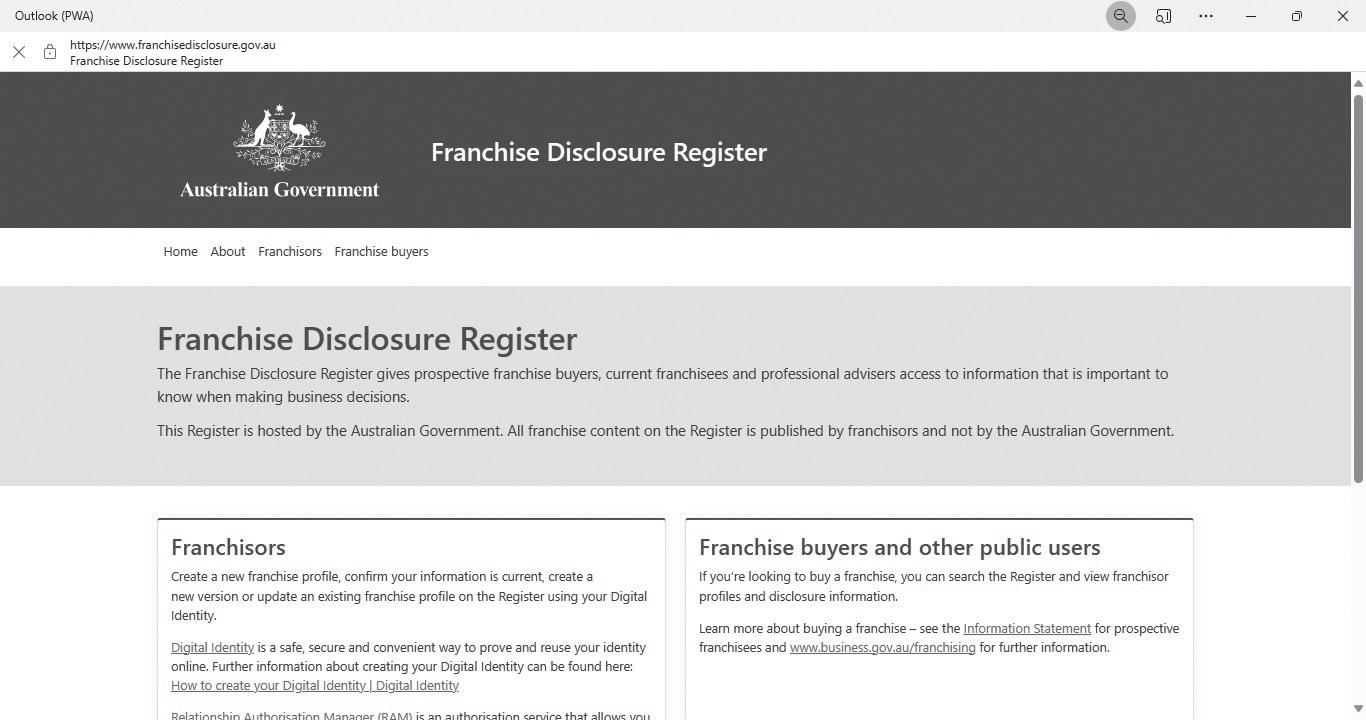
However, since November 2022 another highly useful information resource that allows potential franchisees to compare one franchise against another is the Australian Government’s online Franchise Disclosure Register at www.franchisedisclosure.gov.au Figure 1: The home page of the Franchise Disclosure Register at www.franchisedisclosure.gov.au
The Disclosure Register website is a free public information resource developed by the Australian Government to allow potential franchisees to more easily compare franchise offers. It does not have pop-up ads, animated gifs or videos unlike privately-operated online franchise directories.
Potential franchisees will need to click on the Search button on the front page of the website, then agree to the Terms of Use before proceeding.
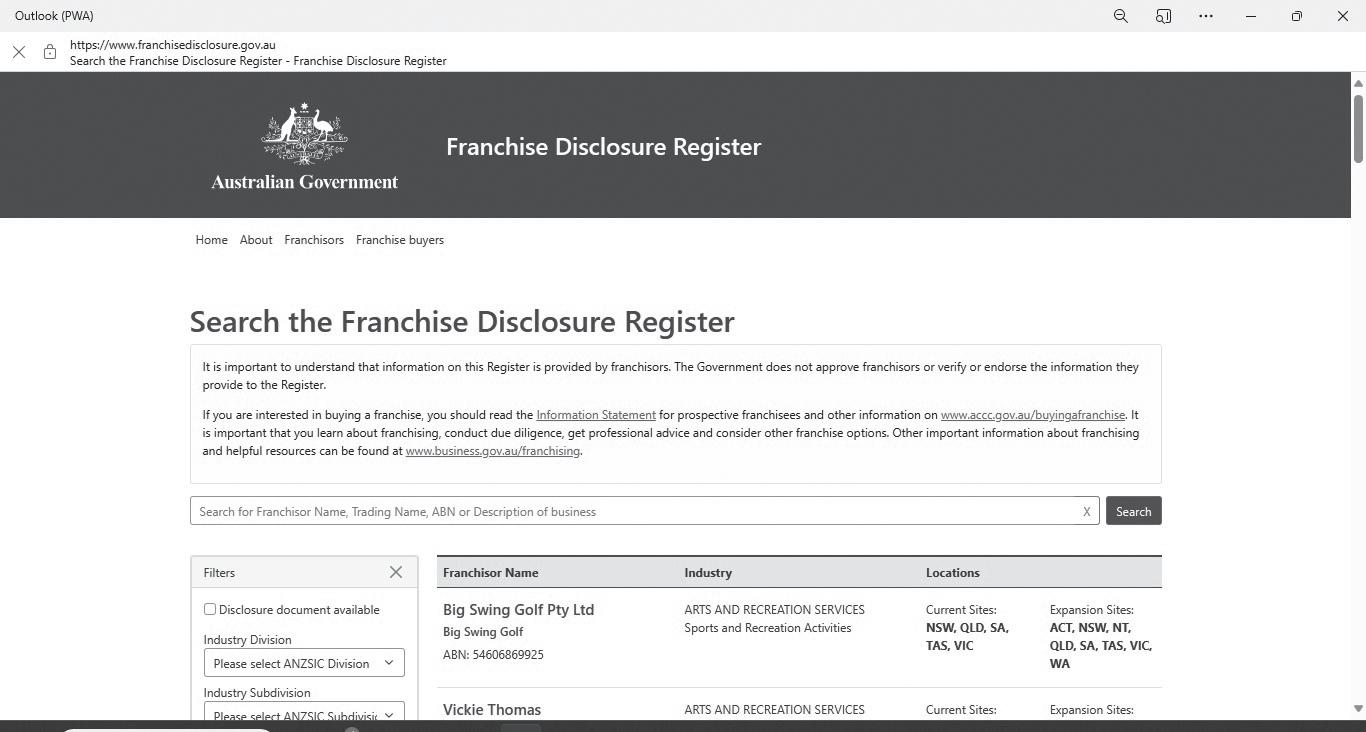
The user will then land on a page that might look like the following:
The Register lists every business that offers franchises in Australia, even if they are franchisors and master franchisees of the same brand (eg. XYZ Franchisor Australia Pty Ltd, and a state master franchisee - eg. XYZ Queensland Pty Ltd - as the franchisor may offer franchises in states other than Queensland, where another company has the right to grant franchises).
Because the Register lists all businesses that offer franchises, there are far more listings on the register (around 2,120 as at the time of writing this article). After allowing for multiple listings for brands which operate via master franchises and out of date listings, there are about 1,200 different franchise brands listed on the Register.
The Register classifies brands according to the ANZIC (Australian and New Zealand Standard Industrial Classification) categories for businesses used by the Australian Bureau of Statistics, with a major classification heading followed by a sub classification heading to help narrow down the search results. (This includes classifications in which no franchise businesses operate, such as Mining). A search for a franchise opportunity can be further refined to include states or territories in Australia where the brand currently operates, or where it intends to grow.
Some classifications may not be immediately apparent and need patience to find. For example, a potential franchisee interested in a fitness business would need to select the main industry division of “Arts and Recreation Services”, and then a subdivision of “Sports and Recreation Activities” to shortlist any fitness results.
Figure 2: The search page of the Franchise Disclosure Register
The Register also includes the ability to search by brands which have provided their Disclosure Document. In reality, very few Disclosure Documents are available on the Register because it is only voluntary for franchisors to provide this document, and the document itself often contains commercially sensitive information that franchisors may not want in the public domain.
Once a user has identified a listing of interest, clicking on it will provide more details about the franchisor and the franchise offer, including:
• The number of years it has been operating;
• How many franchised and corporate outlets exist;
• The states in which it operates or intends to expand;
• The anticipated setup cost for a new franchise;
• Fees and royalties payable under the franchise agreement;
• The length of an initial franchise term;;
• Contact details for the franchisor and other basic information about the franchise.
What is the Information Statement and online course?
The Information Statement for Prospective Franchisees is a government-mandated handout containing generic information about franchising that must be given by franchisors to potential franchisees as soon as possible after receiving an initial franchise inquiry. It can also be downloaded any time from the ACCC website here: https://www. accc.gov.au/system/files/information-statement-prospective-franchisees-2025.pdf
The purpose of the Information Statement is to alert potential franchisees of the sorts of questions they should explore when considering a franchise, provide an overview of the process, and provide details of additional sources of information such as the free online course for potential franchisees at www.accc.gov.au/franchising-education-program.
This free course is an updated version of one launched in 2010, and which had been undertaken by more than 20,000 potential franchisees before its relaunch. It takes around an hour to complete but provides vital insights for potential franchisees to consider before committing to a franchise. Australia was the first country in the world to offer a free online course for potential franchisees, and set a precedent which several other countries have since followed.
Links to all the resources mentioned in this article, plus additional resources can be found online here: https://www.accc.gov.au/by-industry/franchising
Don’t compromise on your research
Potential franchisees who take their time, read everything, and do lots of research before committing to a franchise vastly increase their chances of having a successful business compared to those who simply jump in. As a general rule of thumb, people who have never owned a business before should consider investing up to an hour of their time on their research, reading, due diligence and business planning for each $1,000 to be
invested in the business. This can also include time spent talking to existing and former franchisees, undertaking small business courses, and consulting with experienced franchising lawyers, accountants and business advisors.
For example, if a franchise costs $100,000, this means that a potential franchisee would spend around 100 hours on their due diligence and business planning before signing the franchise agreement. This might sound like a lot of time, but in reality, it is about two and half week’s full-time work. Investing two and a half weeks to protect an investment of $100,000 is a wise investment of time, especially compared to how much time it might take to earn that same $100,000 back if a rushed decision results in a failed investment.
The last word
In summary, the Franchising Code of Conduct exists to protect franchisees from bad franchisors and bad franchising behaviours. It is generally effective in doing so, but it can never protect a potential or existing franchisee from making a rushed, ill-considered or uninformed decision. Potential franchisees owe it to themselves and their families to make sure that they do their homework first before buying a franchise.
J ASON G EHR k E MBA CFE | Director
C HAPTER 3
W hat F ran C hisees shou L d K no W
B efore ta K in G u P a franchise
Robert Toth | Special Counsel s ani C ki l awyers
A BOUT THE AUTHOR
Robert is an Accredited Commercial Law Specialist with over 35 years expertise in franchise, license, and distribution law, acting for local and international franchisors and companies, advising franchisees and master franchisees with extensive experience in dispute resolution and mediation.
Sanicki Lawyers is a dynamic and progressive law firm based in Melbourne and Brisbane with a talented team of lawyers who advise clients on Intellectual Property, Franchising and Licensing as well as corporate and commercial matters.
Robert regularly publishes articles online and internationally on Franchising, Licensing and Distribution and is a Member of the Franchise Council of Australia (FCA), the International Franchise Lawyers Association (IFLA) and the Global Law Network a network of specialist lawyers around the world.
Robert is highly recognized as a leading Franchise Lawyer in Australia having been named as a Leading Franchise Lawyer in Australia in Who’s Who Legal: Franchise 2021, nominated again in 2023. Named by Global Law Experts as Franchise Law Expert of the year in Australia 2025.
Robert is also on the Advisory Board of a number of clients, as well as acting as a resident director for overseas companies.
Ifyou are in the market to take up a franchise opportunity there is no lack of franchises on offer and over the past 2 years we have seen several new franchise opportunities on offer from overseas and locally in different business sectors.
It is also the case that with the developments in technology and AI that many large companies for example Banks are laying off staff and this has led to increased unemployment rates.
This has created an excellent opportunity for franchisors to attract those made redundant with more prospective franchisees in the market.
For the prospective franchisee there are opportunities to upskill and or change their work pattern and earn an income from low-cost mobile franchises to professional service franchise in the areas of bookkeeping, accounting finance, broking, home care and conveyancing.
So many franchises, so little time
With so many franchises on offer how do you pick the right franchise for you?
It is more important now than ever to seek specialist and expert legal and financial advice before committing to a franchise.
Once you are in a franchise there is no easy exit without crystalising a loss, so you need to be cautious and do your due diligence before you commit.
If you are looking at a new franchise system from overseas it can be seen as a great opportunity, but it also comes with potentially greater risk.
We have seen a number of overseas franchise systems roll out sand then withdraw from the Australian market leaving many franchisees to pick up the pieces such as UFC Gym, 85 Degrees coffee chain and Carl’s Jr to name a few.
So do your due diligence on the franchisor just as much as they do their due diligence on you!
The franchise sectors showing continuing growth are in the areas of quick service restaurants (QSR), hospitality, home care, Finance, Mobile media, childcare and education centres, and even medical and allied health care specialist medical practices.
Franchising is still the most successful business model for people to operate a business supported by the franchisor its brand, systems and training.
The process of selecting the right franchise for you should be taken slowly with input from your family, partner and with expert legal and financial support.
It can be filled with excitement, and trepidation at the same time and as with any business venture it comes with risk.
The Franchise Register
Franchisors must register their system online with the ACCC at least 14 days before they enter into any formal agreement or accept any non-refundable money.
Franchisees can look up a franchisors details on the ACCC Franchise Register (which is a mandatory obligation for franchisors) which will give them high-level details about the franchise system.
If a franchisor is not on the register, you should not deal with that franchisor as it is a breach of the Franchising Code of Conduct. Franchisors must annually update or confirm information included in the Register.
Franchisees, now more than ever, due to the complexity of the legal documents should seek specialist franchise legal advice before entering into a franchise to understand their key obligations, responsibilities and risks.
Blue Skies?
As a franchisee you can get caught up with the glossy sales pitch of the franchisor’s marketing and website about “being your own boss” and buying into a lifestyle and sign up in haste, only to find that it was not what was represented or not what you expected. Once you are signed up it can be very difficult to exit without crystalising a loss.
We have seen franchisees go into a franchise for the wrong reasons some of these (which are real life cases) were:
Taking up a franchise for their adult children to operate- the problem here was that the child didn’t like the business, it was hard work, and they left after a few months leaving the parents to run the business.
Acquiring a franchise for a spouse as she was lonely and depressed to give her motivation – the problem here was she found the stress of business too much and they had to abandon the business and suffered a huge financial loss.
Acquiring a Charcoal chicken business having been made redundant from middle management at a large company – the problem here was after 12 months selling charcoal chickens in the middle of summer, the franchisee was over it and got out selling at a loss.
Do What You Are Good at or Do What You Love - We often ask clients to consider their skill set and work history and to look forward and imagine themselves being in the franchise selling the products or services in say 3- or 4-years’ time.
For example, ask yourself these questions:
• Do I want to be selling charcoal chickens in 3 years’ time?
• Even with training, do my skills and personality suit the proposed franchise?
Specialist advice
The best way to make an informed decision is to get advice from a Specialist Franchise lawyer and accountant who are members of the Franchise Council of Australia (FCA).
Seeking advice from your local conveyancer, family lawyer or neighbour over the fence is not proper legal advice and will not reduce your risk. Specialist Franchise lawyers know what is going on in the sector – the good, bad and the ugly!
Financial Considerations
Irrespective of how attractive and compelling the franchisors marketing and sales pitch may be, the decision to join should not be an emotional one.
If the numbers don’t work, after doing your own cash flow projections (with support from your accountant or financial advisor) then you are better to walk away!
There is always risk going into any business venture however you can limit that risk by asking the franchisor to provide you with some indicative cash flow models from existing franchisees and then ensure you have those reviewed by your accountant.
You should also consider the following:
• whether you can take a reasonable wage for your hours worked.
• does the cash flow show you can cover your operating expenses and also any finance to fund the franchise.
• What percentage of your expected revenue are your occupancy cost (that is rent, outgoings insurances, security bond) - Ideally this be low end around 12% to 15% and no more than 20 to 25% of your revenue.
• What amount of working capital will you need for the first 6 to 12 months of operation?
• What opening stock do you need and how will you fund it?
• What staff will you need aside from you and your family?
• Do you need to lease a vehicle for the business?
• Do you expect a return on your investment (ROI) in the future or happy just to take a salary?
These are all things to consider and factor into your cash flow projections before you decide to commit.
Franchise Code Changes
A new Franchising Code of Conduct was introduced on 1 April 2025, with some rules in the new code coming into effect on 1 November 2025.
The key changes are greater disclosure of significant capital expenditure, the specific purpose fund, reasonable opportunity to make a return on investment, compensation for early termination and restrictions on enforcing restraint clauses.
The irony in all this, is that franchisees now have more documents, not less, to review and absorb before deciding whether to take up a franchise and getting independent legal advice is even more important!!
The Sign Up Process
Franchise opportunities are advertised and promoted online, on mobile cars and billboards and via word of mouth and through business agent’s consultants or the business franchisor sales manager.
When dealing with a business agent or sale representative bear in mind their goal is to sign you up as fast as possible as that is how they make their commission or reach their targets.
On enquiry you will be asked to sign an NDA (confidentiality agreement) before the franchisor releases further financial or other confidential information about the franchise system and complete a detailed application form with personal and financial details for the franchisor to review to give you preliminary approval.
In this period, you should have met the franchisor founders or directors, if possible, to check if you feel you can work with them and their personalities and those around them
You are forming a business relationship with them and one of the key measures of success is that “people like to do business with people they like”, a simple but important concept.
If you meet the BDM and the Franchise team and you don’t get a good positive feeling about them, why risk going into business with them?
With a larger system they tend to be more corporatised and you will be unlikely to meet the actual founder or directors.
Once you are approved, the franchisor will ask for a deposit or Document fee to be paid before they prepare and issue the suite of franchise documents which will commence the 14-day disclosure period. In this period, you cannot sign the franchise agreement.
• The suite of franchise documents should include the disclosure document with attachments in the form required by the Code;
• the franchise agreement in the form required to be signed by the franchisee;
• any lease, offer to lease, sublease or occupancy License negotiated by the franchisor;
• receipt form to acknowledge receipt of documents – This starts the 14-day disclosure period;
• the legal, accounting, and financial advice certificates to complete and return with the signed franchise agreement and related documentation.
In some cases, there may be a “no prior representation statement” which requires the franchisee to set out any statements or representations made by the franchisor (or their agent) on which the franchisee relied.
The No Prior Representation Statement
This statement is an important document the franchisor can rely on if there is a dispute down the track so franchisees should not ignore it. Franchisees should set out in the statement any special promises or concessions offered by the Franchisor (or its agent or broker).
This document actually protects the franchisor, so, if there have been any special concessions don’t rely on verbal promise, make sure it is in writing and set out in the franchise agreement or the prior representation statement.
Any concessions should be set out in the agreement and signed by both parties and dated prior to or on the date the franchise agreement is signed.
Seeking Legal Advice
It is not compulsory for franchisees to seek legal, accounting, and financial advice however many franchisors will now insist their prospective franchisees get legal and financial advice as this reduces risk to the franchisor.
Seeking legal advice from a Franchise Specialist Lawyer will assist you to work through the volume of documents and the sign on process, help you make an informed decision and limit your risks.
An experienced lawyer will focus on the important commercial issues and identify issues of concern where there may be room for negotiation, rather than recommending wholesale changes to an agreement which are unlikely to be accepted and aggravate the relationship with the franchisor or their legal team from the very beginning.
The Four Commandments from the Desk of Toth!
One – irrespective of whether you seek legal advice (which we highly recommend) you should still read and become familiar with the documents. It is your contract which sets out your rights and obligations and those of your franchisor.
Two – do not rely on advice from your suburban conveyancing lawyer, next- door neighbour, or your mate at the pub! That’s not advice.
Three – entering into a franchise is a risk / reward decision and although easy to get into one it’s not so easy to get out if it doesn’t work out or you pick the wrong franchise. You may then crystalise a loss.
Four – Franchisors will often say their agreements are not negotiable, that is not always the case, and in fact we often negotiate reasonable concessions particularly when it is a new franchisor as they are keen to roll out.
Things to reasonably negotiate might be a reduced royalty over the first 12 months to get a chance to build the business, minimal or no marketing fee, reduced minimum performance criteria, renewal terms and costs and limiting non-compete restraint provisions.
Disclosure Document
Franchisors need to give the franchisee the disclosure document with the key fact sheet to franchisees at least 14 days before they either enter into an agreement or make a non-refundable payment.
Franchisors must give the disclosure document (and required attachments, including lease/occupancy information) at least 14 days before the franchisee enters into the agreement or makes a non-refundable payment.
The 14-day waiting period runs from when compliant disclosure is given.
If lease information is given later or differs, the franchisee has another 14-day disclosure period from that date.
Neither the franchisor nor franchisee can reduce or waive the 14-day disclosure period as it is a minimum mandatory period under the Code.
Under the new Code, franchisors must ensure their disclosure document includes clear information about any specific purpose funds and details of significant capital expenditure required during the term. These additions are designed to improve transparency around the financial commitments franchisees are expected to make.
Lease/Occupancy/Issues
The franchisor must provide full details of the lease and occupancy rights with a copy of any lease documents for example – the offer to lease- agreement to lease- leasesublease- occupancy license and lease disclosure statement issued by the landlord.
If the franchisor does not provide full and accurate information about the lease rights in the disclosure document the 14-day disclosure period does not start until they provide that information.
The cooling-off period
In addition to the 14 day disclosure period (now known as a consideration period) franchisees also have a 14 day cooling off period after signing the franchise agreement.
If the business involves premises, additional lease-timing rules apply. If lease terms are provided later or a lease is entered, the 14 days disclosure period starts again.
This means the days of signing up a franchisee without a site or while in negotiations for a site are fraught with risk for the franchisor.
Franchisor’s must also disclose if they have any interest in the lease or freehold and any rent incentives they receive.
Rebates and Financial Benefits
The percentage of rebates the franchisor receives (financial benefit) from each supplier over the last financial year as a percentage of all purchases by franchisees in the group (this excludes supplies by the franchisor or associate of a franchisor) now has to be provided.
There is no need to disclose this information if the agreement allows the franchisee to buy from non-approved suppliers or the rebate is paid to a cooperative fund controlled by the franchisor.
Rebates do not include payment by a franchise to the franchisor, master franchisor or associate for a wholesale supply and a lease incentive is not a rebate, but franchisors still need to disclose the lease incentives.
The new Code reinforces the franchisors’ obligation to disclose all supplier rebates and financial benefits as part of the specific purpose fund reporting framework.
Earnings Information
Franchisors must if they give earnings information give it in the disclosure document (not before or after signing the agreement) and include a statement that the information is correct to the best of their knowledge or state that the information may not be accurate.
A breach may attract a civil penalty, expressed in penalty units under the Code.
Capital Expenditure
Franchisors must now include detailed disclosure about significant capital expenditure, including the purpose, rationale, timing, expected benefits and risks, within the disclosure document.
This aims to ensure franchisees understand the full financial impact of any required upgrades or refurbishments.
Term and Restraint
The new Code introduces stricter rules around termination and the ability for franchisors to enforce restraint of trade provisions.
Compensation for Early Termination
From 1 November 2025, all franchise agreements must include a clause entitling franchisees to compensation if the franchisor ends the agreement early because it withdraws from the market, rationalises its network or changes its distribution model in Australia,
This obligation, once limited to new-vehicle dealership agreements, now applies to all franchise systems.
In these cases, the franchisor must buy back the franchise or compensate the franchisee for losses such as unsold stock equipment or fit-out specified by the franchisor.
Reasonable Opportunity for Return or Investment
A franchisor must not enter into a franchise agreement unless it provides the franchisee a reasonable opportunity to make a return on any required investment. This does not guarantee profit, but any premature termination that prevents the franchisee from recouping their investment may breach the Code.
Termination Procedures
The Code sets out clearer processes for ending agreements:
• Franchisees can terminate within the cooling-off period or propose termination at any time
• Franchisors may terminate for breach only after giving written notice and allowing a reasonable period to remedy (which must not exceed 30 days)
• Termination without breach is limited to circumstances specified in the agreement and must be exercised in good faith
• Immediate termination is allowed only for serious reasons such as insolvency or public safety and termination must pause if a dispute is underway.
Restraint of Trade
A franchisor may only enforce a restraint of trade clause if the franchisee committed a serious breach before the term ended and the restraint is reasonable in duration, area and scope to protect goodwill.
This makes restraint provisions more difficult to enforce and give compliant franchisees greater post-term freedom.
Goodwill Disclosure
Franchisors must disclose whether franchisees retain any goodwill at the end of the term and outline renewal and resale conditions.
Termination Rights
The seven grounds for a Franchisor to terminate for “special circumstances” now require the Franchisor to give a franchisee 7-day prior notice of termination even for special circumstances which then allows the franchisee to raise a dispute.
The franchisor cannot terminate the franchise if the franchisee raises a dispute, and the parties must try and resolve the matter in the 28-day period or refer the matter to the ASBFEO for mediation or arbitration. In the meantime, the Franchisor can require the franchisee not to operate the business in the 28-day period.
Specific Purpose Fund
The new Code introduces the concept of a Specific Purpose Fund, replacing the traditional ‘marketing fund’.
This term encompasses any fund controlled by the franchisor or an associate that franchisees are required to contribute to for a specific operational purpose, such as technology upgrades, brand promotion or cooperative advertising. Franchisors must hold these funds in separate bank accounts, prepare annual financial statements and disclose fund usage to franchisees.
Franchisee Exit Rights
Often a franchisee may feel they were put under some pressure to sign up a franchise and they may feel they have little choice but to go ahead, however under the Franchise Code franchisees actually have a number of opportunities to exit the franchise.
A franchisee can seek to exit a franchise:
• Disclosure Period
A franchisee can elect not to proceed in the 14 day disclosure period and is then entitled to a full refund of any money paid.
• Cooling off rights
In the 14day Cooling off period being the period after the franchisee has executed the franchise agreement in which case the franchisor can withhold an amount set out usually referred to as a Retention Sum to cover the franchisors reasonable cost and expenses.
• Early termination rights for franchisees
The new Code gives the franchisee a right to request early termination of their franchise Agreement at any time during the term giving reasons.
The franchisor must respond within 28 days and state whether or not they agree and give reasons why they do not agree.
It is highly unlikely the franchisor will agree to allow a franchisee to exit and there is no guidance under the Code what are considered good or acceptable reasons.
This will be something to be tested in the future and likely lead to the parties mediating.
• Mutual Agreement
The parties by mutual agreement can agree to end the franchise at any time on terms they agree.
Legal Costs
The Franchisor can no longer charge franchisees legal costs for any undetermined and future legal service costs, other than an upfront fixed fee set out in the agreement. The upfront “fixed amount of dollars” (fixed fee) can only be for preparing, negotiating, and executing the agreement.
Selling a Franchise Business
Franchisees now benefit from a 14-day cooling off right even after settlement of the business has occurred. Therefore, when selling a franchise business there should be special conditions that make the settlement conditional upon the 14-day cooling off period in favour of the purchaser ending.
Marketing Funds
The Code uses the word marketing, instead of advertising to clarify the Code applies to more than just advertising.
It also now extends marketing fund obligations to the “fund administrator” who could be the franchisor, a master franchisor or a third party authorised to administer the fund for the franchisor or master franchisor.
The Operations Manual
Most franchise agreements include provisions requiring franchisees to comply with the operations manual and therefore franchisees should ask to see the operations manual before entering into the franchise agreement or in the disclosure or cooling off period.
The Franchise Agreement
This is the contract setting out the parties’ rights and obligations, (generally weighted in favour of the franchisor) with consequences for a failure to comply which may give rights to serve a breach notice and even termination.
It is often assumed that the agreement will contain positive obligations on the franchisor however most agreements will state the franchise “may” not that they “must” do certain things. This makes it difficult to allege a franchisor has breached the agreement where they do not have a positive obligation.
Franchisees do have protection under the Franchise Code, the Australian Consumer Laws and unfair contract provisions and can instigate the dispute resolution process and seek mediation or arbitration via the ASBFEO where a dispute cannot be resolved directly with the franchisor.
The Fees Payable to the Franchisor?
Franchise Fees
Franchisors are tending to reduce the up-front franchise fee to make their franchise more attractive and affordable and often include the training fee into the up-front franchise fee.
Royalty
The service fee or royalty is usually expressed as a percentage of the franchisee’s gross sales, or it can be a fixed weekly or monthly fee.
Most franchises however charge a percentage royalty for example 8% of the gross revenue. This works for the franchisor as they receive their royalty on the franchisees turnover while the franchisee carries all the costs of operating the business!
This is the key reason many franchisees fail if the royalty and associated franchise fees are too high and there is insufficient margin on sales.
It is therefore critical for franchisees to do their own objective financial analysis and prepare cash flow projections with their accountant before they commit to see if the business model will work for you. Will you be able to take a reasonable salary for your effort, cover your overheads rent and staff costs?
Tip: If relying on the franchisor’s earnings information, ensure their model makes provision for a salary to the owner /operator before showing a profit.
Working Capital
We often find that the working capital requirements set out by franchisors in their disclosure documents are grossly understated particularly for a new greenfield site, so check with your accountant what a reasonable amount of working capital is needed to avoid financial stress in the first 6 to 12 months of operation.
Term and Renewal
Due to changes to the Code and the franchisees right to seek early termination of the agreement long term franchise agreements are less likely and most systems tend to offer 5-year terms with options, but it does depend on the nature of the business.
Just bear in mind that if you sign up to a 20-year term the only way you can exit really is by selling the business during the term.
Sites and Territories
Mobile franchises (such as those providing gardening or cleaning services) will generally be granted for a specific territory – listed as a number of postcodes or marked on a map attached to the agreement.
The territory may be exclusive or non-exclusive and this should be understood so you are aware if the franchisor or other franchisees can operate or market in your territory.
This has also been affected by online sales and the Code requires franchisors to now disclose what occurs when here are online sales.
What the Code does not do is to make franchisors allocate revenue for online sales to the franchisee, so you need to carefully check the franchisors agreement and policy on this issue.
Retail franchises (such as cafes or gyms) generally are not allocated a territory just a site from which they operate.
Goodwill
Most franchise agreements provide that any ‘goodwill’ developed in the franchise business remains with the franchisor on the basis that the franchisee has only developed its goodwill due to the rights granted by the franchisor to use its system, brand, and IP and therefore once that ends there is no goodwill the franchisee can claim.
Under the new Code disclosure requirements, the franchisor must set out if the franchisee is entitled to retain any goodwill at the end of the term.
It is generally accepted that both the franchisor and franchisee generate their own goodwill however the franchisees goodwill is very much tied to whether they have a lease or occupancy right and some term left on their franchise agreement to sell.
If you have 6 months left on your lease and franchise term, then you have little to sell!
Summary
There are many tricks and traps to be aware of, and the best insurance is to get specialist Franchisee legal and financial advice.
The franchisor does their due diligence on you as the franchisee so do your due diligence on the franchisor and talk to other franchisees in the system to get feedback.
Once you are in a franchise it is not easy to get out without crystallising a financial loss. .
Most franchise businesses have a lifespan after which you will likely want to sell and move on.so just as you consider taking up a franchise, think about how long you may stay in the business before you want to move on and sell.
Discuss the plan to become a franchisee with your wife, partner or beloved other and make sure everyone in the family is on board with your decision as it is a huge step emotionally and financially.
The best investment is getting the right advice from Franchise Law Specialist before you commit so you can make an informed decision.
R OBERT TOTH
Special Counsel | Accredited Commercial and Franchise Law
Specialist | Sanicki Lawyers Melbourne/Brisbane
Phone: 0412 673 757
Email: robert@sanickilawyers.com.au
Web: https://sanickilawyers.com.au/
C
HAPTER 4
s tarting a F ran C hise?
Get your tax and su P er ri G ht from day one
Angela Allen | Assistant Commissioner s mall Business a rea
o F the ato
A BOUT THE AUTHOR
Angela Allen is an Assistant Commissioner, Small Business, at the Australian Taxation Office. She is committed to supporting small business and continues to influence the end-to-end experience for small business taxpayers, prioritising education and transparency to help them get their obligations right from the start. Angela collaborates with other small business advocates, industry partners and government agencies to improve the small business experience. She is also passionate about investing in people, developing, and mentoring the leaders of tomorrow and inspiring others to reach their full potential.
Smallbusinesses, including franchises, are a vital part of Australia’s economy. Starting one is an exciting journey – but it comes with important responsibilities, especially around tax and superannuation.
As a franchisee, you’re running a business and must meet the same obligations as any independent business owner. Franchises can involve complex financial arrangements, such as franchise fees and deductions, so it’s essential for both franchisors and franchisees to understand their responsibilities.
By setting up good habits early – like choosing the right business structure, registering correctly, and keeping accurate records – you’ll build a strong foundation for long-term success. Managing cash flow and meeting superannuation obligations are also key to staying compliant and resilient.
Whether you’re starting a franchisee or launching a small business, the ATO offers tools and resources to help you prepare for your small business journey.
Check out ato.gov.au/readyforbusiness for more information.
Choosing the right business structure
Each business structure has its own unique reporting obligations and responsibilities, so it’s important to understand what type of structure suits your business the best. If you’re considering starting a franchise business, ensure you select the right structure for your business. There are 4 commonly used business structures in Australia:
• Sole trader: Simple and low-cost. Income is taxed at your individual rates, and you can claim business deductions. You’re personally liable for debts and legal issues. Paying yourself superannuation isn’t compulsory, but making contributions will help build your retirement savings.
• Partnership: Two or more people carry on a business together. The partnership lodges a return, but profits/losses flow to partners’ individual tax returns. Partners share control and are generally jointly liable for debts.
• Company: A separate legal entity that pays company tax on profits. It offers limited liability, but directors have duties and potential personal exposure in some cases (e.g., unpaid PAYG withholding or super). Companies have higher set up and administration costs as well as reporting obligations compared to other types of business structures.
• Trust: A trustee holds assets and operates for beneficiaries. Income is usually distributed to beneficiaries, who pay tax at their tax rates. Trusts can be flexible but require careful setup and administration.
There are a wide variety of franchise businesses and there isn’t one structure that suits all of them. Understanding each business structure will help you decide which will best fit your kind of business. You can find out more about business structures on ato.gov.au or you can also seek advice from a registered tax professional.
Business set up and registration
When starting your business, there are several registrations you may need to apply for, depending on the type of business you are conducting:
• ABN: Register your business name and an ABN (a unique 11-digit number that identifies your business to the government).
• Business name: Register if you trade under a name that isn’t your own personal name.
• GST: Register if your GST turnover is $75,000 or more, if you provide taxi/ridesourcing, or if you want to claim GST credits. You’ll also need to lodge Business Activity Statements (BAS) monthly or quarterly.
• PAYG withholding: Register if you have employees or certain contractors, so you can withhold tax from payments.
• Other considerations: TFN for non-individuals, fringe benefits tax (if relevant) and industry licences. If you have employees, superannuation, state-based payroll tax and workers’ compensation.
keeping accurate records
Good records save tax, time, and stress. Generally, you need to keep accurate records of your:
• Income: Invoices, sales records, POS (Point of Sale) reports.
• Expenses: Receipts, purchase invoices, asset records.
• Tax payments: BAS, PAYG summaries, GST workings, bank statements.
As a franchisee you may need to keep other records such as franchise establishment fees, renewal fees, royalties, interest and training costs. Some of these expenses may be tax deductible and some will form part of the cost base of your business and will not be.
Good record keeping can be made simple by using cloud accounting platforms, receiptscanning apps, and STP-enabled payroll, making compliance easier and reducing errors.
It’s also a good idea to open a dedicated business bank account to be used exclusively for the activities of the business. This keeps the business records separate and stops them being mixed up with your personal expenses. You can also use this separate account to set money aside ready to pay your tax obligations when you lodge and pay your BAS.
A little routine, and consistently keeping accurate records will prevent a last-minute scramble at BAS or tax time.
Managing cash flow and tax obligations
Cash flow management is a vital aspect of your business to keep track of your obligations.
The ATO’s Cash Flow Kit is a great resource and allows you to track and review your cash flow. This also allows you to forecast and budget your cash flow over a period of time, which not only helps to inform business decisions, but also helps you stay up to date with your obligations.
As your business grows, the ATO may also enter you into pay as you go instalments (PAYGI), so you prepay the tax on your business and investment income throughout the year. You’ll need to review each instalment to ensure it reflects your current income.
If you’re registered for GST, you must lodge Business Activity Statements (BAS) either monthly or quarterly. Preparing for BAS lodgment due dates is important and can be done simply if you’re keeping accurate and complete business records.
Superannuation obligations
Small businesses have important superannuation responsibilities under the Superannuation Guarantee (SG). From 1 July 2025, employers must contribute 12% of an eligible employee’s ordinary time earnings to a complying super fund. These contributions must be made quarterly, with due dates falling 28 days after the end of each quarter (e.g., 28 July for the April–June quarter). Failure to meet these obligations can result in the Super Guarantee Charge (SGC), which includes interest and penalties.
Sole traders are not required to pay SG for themselves, as they are not considered employees. However, they are encouraged to make voluntary personal contributions to build retirement savings.
Understanding your superannuation obligations is vital for the ongoing financial viability of your business.
Common mistakes and how to avoid them
Running any business comes with a unique set of challenges and especially if it’s a franchise. When it comes to tax, missing a due date or misclassifying an employee are simple errors but they can lead to costly penalties. Keeping on top of your obligations doesn’t need to be challenging – mistakes like these are often due to inconsistent record keeping practices.
There are some key good habits you can develop that will help you build a strong and resilient business, that also assists you to stay on top of your tax obligations:
• Accurate record keeping. Keeping accurate and complete records will help you meet your tax, super and employer obligations.
• Managing your cash flow. Setting money aside means you’ll have the funds available when it’s time to lodge and pay.
• Lodging and paying on time. If you don’t lodge on time, penalties may apply. Reporting GST monthly may make it easier for you to track your finances and business performance, as well as improve your cash flow and record keeping.
• Seeking advice when you need it. Getting the right help makes it easier to navigate change and uncertainty in your business lifecycle.
Stay informed and draw on your industry association, ATO resources, and your tax professional.
Where to get help
Small businesses can access a range of support to manage their tax and super obligations. Engaging a registered tax or BAS agent is also a smart first step as they can provide tailored advice for your situation and help you manage your lodgments.
The ATO also offers free resources, including webinars, tools and calculators. Additionally, there are free online courses through the Essentials to strengthen your small business learning platform, which cover topics like GST, super, and record keeping. These tools are especially useful for new or growing businesses.
You should also consider connecting with other small business owners through local chambers of commerce, industry associations, or online forums. Franchisees also have a unique opportunity to engage with their peers and coaches which can provide valuable advice and networking opportunities. Sharing experiences and solutions with others in similar situations can be both reassuring and insightful.
Check out ato.gov.au/SBsupport for more information.
Conclusion
Running a franchise can be a rewarding venture, but it comes with important responsibilities especially when it comes to meeting your tax and super obligations. As a business, failing to meet them can lead to unnecessary costs and ATO penalties.
By understanding your responsibilities early and setting up good business habits, you’ll stay compliant and keep your new business running smoothly. The ATO is here to provide new business owners the tools and knowledge to build strong foundations from day one.
From choosing the right structure, registering correctly, and keeping accurate records, every step plays an important role in the long-term success of your business. Managing cash flow, meeting super obligations, and avoiding common mistakes are key steps in building a resilient business.
Support is readily available from registered tax professionals to free ATO resources and peer networks. By taking the time to get it right early, you can focus on what you do best: running your business.
A NGELA A LLEN | Assistant Commissioner Small Business area of the ATO
C HAPTER 5
the integral role of intellectual Property Protection in s a F eguarding Your Fran C hise’s Future
Helen Kay | Founder rise le G al
A BOUT THE AUTHOR
Helen Kay, is an accomplished business and franchise lawyer with over two decades of legal expertise. As the founder of Rise Legal, Helen specialises in delivering strategic and practical commercial and franchise legal solutions. Her exciting career has seen her in pivotal roles at prestigious law firms, consistently offering exceptional legal counsel. Her unique combination of hands-on experience and visionary leadership positions her as an invaluable asset in the realm of commercial law and franchise expertise, assisting franchisors and franchisees in safeguarding their business through comprehensive commercial legal support.
Inthe dynamic and competitive world of franchising, intellectual property (IP) serves not just as a legal asset but as the very cornerstone of brand identity and market presence. Building on our previous article on comprehensive strategies to shield your franchise, this article delves deeper into the critical role of IP protection. We focus particularly on franchise lawyers should be aiding franchisors in fortifying their IP assets, therefore safeguarding the franchise’s collective value and ensuring benefits across the entire franchise system.
Intellectual Property: The Lifeline of Your Franchise
For franchisors, the distinctiveness of their brand—encompassing everything from logos and slogans to unique business methods—is not merely a marketing tool; it is a crucial asset that differentiates their offerings in a saturated market. This differentiation is largely governed by robust IP protection mechanisms, which include several key components:
Trademark Registration:
Trademarks protect logos, names, and slogans that define the brand. Registering these trademarks is a vital first step in setting up a successful franchise system as it grants exclusive rights to use these elements, preventing others from using similar marks that could confuse consumers.
By securing trademarks, franchisors ensure that the brand’s integrity is maintained across all locations, enhancing the franchisees’ trust in the value of their investment. This process not only protects the franchise from potential market dilution but also builds a stronger, more recognisable brand that attracts new franchisees.
Creating Separate IP Entities:
To further shield valuable IP from operational risks, it is prudent for franchisors to establish a separate IP holding entity. This strategic move isolates the IP assets from the franchisor’s operational business liabilities. For franchisees, understanding that their franchisor has securely ring-fenced its IP assets should provide them with assurance that the brand they are investing in is protected against potential legal battles or financial troubles.
IP Agreements:
An IP license agreement, entered into between the owner of the IP and the franchisor, allows the franchise’s operating entities to legally use the IP held by the separate entity and pas this right onto the franchisees.
The formal franchise agreement then not only clarifies the scope and terms of the franchisee’s’ IP usage but also standardises how the IP is utilised across all franchise units, ensuring consistency in customer experience.
Non-Disclosure Agreements (NDAs):
NDAs are essential in protecting sensitive information shared within the franchise
network. At Rise Legal we facilitate drafting comprehensive NDAs to ensure that innovations, operational practices, and strategic plans are not leaked to competitors. This form of protection is vital in maintaining the competitive edge of the franchise by securing trade secrets and proprietary processes.
Copyright Protection:
This protects original works such as manuals, training materials, and advertising materials created by the franchisor. Copyrights prevent unauthorised reproduction, thus maintaining the exclusivity and value of the franchise’s proprietary materials. This legal tool ensures that the intellectual efforts and creative outputs of the franchisor remain within the franchise, adding to the unique offerings that attract customers. These protections should be reiterated in the formal franchise agreements also.
Restraints of Trade:
These important legal provisions prevent franchisees from setting up competing businesses within a certain geographic area and time frame during and after leaving the franchise. Such clauses are crucial in protecting the market territory of existing franchisees and the overall integrity of the franchise system. They ensure that the franchise network is not undermined by former members who might otherwise use their insider knowledge to compete against the franchise.
In the competitive world of franchising, the protection of intellectual property is not just a legal necessity but a strategic imperative. By implementing comprehensive IP strategies, franchisors secure their brand’s uniqueness and future-proof their business, providing a stable and promising framework for all franchisees. With Rise Legal, embark on a journey to reinforce your franchise against uncertainties, ensuring its longevity and success.
H ELEN kAY
F inan C ia L essentia L s for franchise B uyers
Kate Groom | Co-founder and Director
Fran C hise aCCountin G and tax
A BOUT THE AUTHOR
Kate Groom is Co-Founder and Director of Franchise Accounting & Tax, an accounting and advisory firm which helps franchise owners with financial management, tax, and accounting.. Kate has a keen interest in financial and business education and has developed and run many courses for business owners. Since starting her working life in audit with Coopers and Lybrand in the UK, Kate has worked in a variety of management and leadership roles in accounting, insolvency, and franchising.
It’s natural to be excited about the opportunity of owning your own business. In fact, we expect that franchise buyers are full of enthusiasm for their new venture. Still, beyond the thrill of building something for yourself is the reality that financial management will be new territory.
Of course, we all deal with money every day, but managing money in your personal account or as an employee is very different from business finances. The good news is that financial management for business can be learned, and you don’t need to become an accountant to do it well!
In our experience, franchise buyers who get financial foundations right at the start avoid stress and costly mistakes later.
This guide will help you to build your awareness and ability in four critical areas every franchise buyer should understand.
Let’s walk through the financial essentials in the order you’ll encounter them - from prepurchase decisions through to getting started with your accounting record keeping.
PART 1: Financial Due Diligence
Does the franchise stack up financially? If it doesn’t work on paper, it won’t be better in real life!
Buying a franchise is one of the most significant financial decisions you’ll make. It’s natural to approach a business opportunity with optimism and enthusiasm. However, if the business doesn’t produce the financial results you’re counting on, you could face years of financial stress working long hours for little income, or find yourself unable to repay your investment before the franchise term ends.
Owning a franchise always involves financial risk. A wise buyer takes action to understand and reduce that risk before signing.
Understanding the risk means recognising some hard truths: you’ll only be able to pay yourself if the business makes a surplus after covering operating costs and staff wages. To actually repay your investment, the business must generate enough profit to cover all costs including your own wages. And here’s the critical point: if you can’t repay your investment within the franchise term, you face the real possibility that the business will close with debt still owing to yourself or a bank.
Now to the question of how to reduce the financial risk associated with buying a franchise. This is the financial due diligence stage of buying a franchise.
The first step in financial due diligence is to answer three questions:
• What will the annual operating costs of the business be? These should include your own wages and interest on any borrowings.
• How much profit does the business need to make over the initial franchise term to repay the upfront investment?
• What annual sales are needed to cover the operating costs, repay the initial investment, and provide a return on your investment of your own money?
Working out these answers requires detailed financial modeling that accounts for dozens of variables and their interactions. Most franchise buyers benefit from working with an experienced advisor or accountant who specialises in franchise businesses. Here’s what this process typically involves:
Estimating Your Operating Costs
Work out the likely operating costs for the first year you’ll own the business. You’ll need to estimate three types of cost:
Fixed costs of operation - costs you’ll incur regardless of your sales level. These include rent, insurance (general and workers’ compensation), vehicle costs, utilities, software subscriptions, professional fees like accounting, and ongoing franchise fees if they’re a set monthly amount rather than based on sales.
Variable costs - expenses that only occur when you make a sale. In a café, these include coffee, milk, food ingredients, and packaging. The franchisor should provide a target range, typically expressed as a percentage like 29-32% of sales. Franchise royalties calculated as a percentage of sales are also variable costs.
Annual wages cost, including superannuation - This can be tricky to estimate because while every business has a minimum staffing requirement, higher sales usually demand more staff. A good starting point is the cost of the recommended staffing level for the first year, or if you’re purchasing an existing business, use the current staff costs as a guide.
Calculating Your Breakeven Point
Once you know these costs, you can calculate your breakeven point - the minimum sales needed just to cover costs.
Here’s how: First, work out your contribution margin (this is simply 100% minus your variable costs percentage). So if your café’s food costs are 30% and royalty is 9%, your contribution margin is 61% - meaning 61 cents of every dollar in sales is available to cover fixed costs.
Then divide your total fixed costs and wages by this contribution margin. For example, if your fixed costs and wages total $300,000 and your contribution margin is 61%, you need sales of $491,803 just to break even.
But breaking even isn’t enough - you also need to repay your initial investment. To factor this in, add another annual cost: your total upfront investment divided by the number of years in your franchise term. A $400,000 investment in a 10-year franchise term means you need an additional $40,000 in profit each year just to get your money back.
Once you’ve completed these steps, you’ll have a reasonable estimate of the target sales for your first year. You can extend this analysis to cover three or four years to get a financial picture of the business over a longer term.
Do the financials stack up?
Once you’ve got the financial model worked out, it’s time to turn to the big question: “How confident am I that the business can operate within this cost structure and generate the target level of sales?”
This opens up another part of the due diligence process: looking for evidence that your assumptions are reasonable. To do this, you’ll need to ask questions of the franchisor and the existing franchisees.
This is where experienced guidance becomes invaluable. A specialist franchise accountant can help you test your assumptions against real franchisee data, identify red flags in the financial model, and ask the tough questions that might save you from a costly mistake. They’ve seen what works and what doesn’t across hundreds of franchise systems, and can spot the difference between a genuine opportunity and one that looks good on paper but struggles in practice.
The time and cost of professional advice during due diligence is small compared to the risk of buying the wrong franchise. Done properly, this financial analysis gives you either the confidence to proceed or the wisdom to walk away - both are valuable outcomes.
PART 2: Getting Your Business Structure Right
The decision about your business structure happens before you sign - and it matters more than you might think.
Many buyers assume they can “just get an ABN or a company and start trading”. However, this can prove a costly mistake as your structure affects your growth opportunities, tax planning options, and asset protection.
Once in place, a business structure is costly to change and can have tax consequences. Your upfront decisions have long-term consequences, so it’s worth taking advice to set up the most appropriate structure for you.
What Business Structure Actually Means
First, let’s take a quick look at the three common business structures used in Australia:
1. Sole trader: This is the simplest to set up, but offers no asset protection and limited tax planning.
2. Company: This provides asset protection by separating the business from its shareholders. A company also offers more tax options for the owners.
3. Trust structures: A trust structure, which involves multiple entities, provides maximum flexibility and supports multiple franchise ownership.
In franchising, you’ll probably find that the franchisor has specific requirements for the business structure. In our experience, most do not allow franchises to be operated by sole traders.
Which business structure is right for you?
The most appropriate business structure for you depends on your situation and business aspirations, including:
• Your personal asset position - the property and investments you own
• Your family situation - whether you have a spouse or dependents
• Your growth ambitions - whether you aspire to own multiple franchises or make other business investments
• Your franchisor’s requirements
Here’s an example of when a complex structure might be best even when the franchise is relatively modest in scale and profitability at the start.
Juliet approached us when she was looking to purchase an existing franchise business. While the business had modest turnover, Juliet was planning for growth. With a high family income from her husband’s work, Juliet didn’t need to draw much income from the business. Rather, she was keen to establish two franchise businesses and also purchase a commercial property. In this case, even though the franchise was of modest scale, Juliet wanted to set up a structure that would support her long-term plans. This meant a structure involving a Discretionary Trust as shareholder of her trading company.
In another example, a couple set up their business as a sole trader, only to discover later that the success of the business meant they faced a high rate of tax. They would have had more tax planning options in a company structure, potentially saving them tens of thousands of dollars.
Making This Decision
For most people, deciding on a business structure isn’t a DIY decision - the tax and legal implications are too significant.
You can approach your accountant for advice about business structures. In your consultation, expect the accountant to ask questions about your family situation and business aspirations, including how you’re funding the business. They’ll explain your options and provide a recommendation with their reasoning.
The time to get this expert advice is as you’re getting ready to sign the franchise agreement.
Getting structure advice feels like an extra expense when you’re watching every dollar. But it’s actually preventing a much bigger expense down the track - and giving you options you’ll appreciate as your business grows.
PART 3: Understanding Your Record-keeping Obligations and Director Responsibilities
More Than Just Good Practice - It’s the Law
When you become a franchise owner, you take on legal obligations around recordkeeping and financial management. These aren’t optional “best practices” - they’re legal requirements with real consequences for getting it wrong. The good news: the government provides free education to help you understand your obligations, and qualified experts can help you meet them.
Rather than feeling overwhelmed about the requirements, see this as your license to learn. Take the time to understand what’s required before you start trading.
Get started with self-education
It’s true that a little knowledge can be a dangerous thing. However, we believe every new business owner should make themselves aware of the legal essentials around topics like financial record keeping, business expenses, how GST works, and ‘Employing Staff 101’.
Remember, you’re not aiming to become an expert – just gather enough foundation knowledge to spot the landmines and have an informed conversation with your accountant.
The best place to start is with the Australian Government – look for websites that end with .gov.au (others may look official but often charge a fee for services). Three key sites that provide comprehensive, reliable and free training in english and other languages are:
Business.gov.au
Start here for the big picture of your obligations including:
• Comprehensive guides on record-keeping requirements for Australian businesses
• What records you must keep and for how long
• Tax, employment, and general business records keeping
Australian Tax Office (ATO) resources
This is your trusted source for explanations of tax essentials for small business. The ATO has several free courses for small business owners. Look on the ATO website for:
• Specific guidance on tax record-keeping requirements
• Explanations of GST, PAYG withholding, and income tax records
• Helpful explanations about Superannuation obligations
• Online tools and calculators
Fair Work Ombudsman (FWO)
The FWO has free courses and downloadable templates to help with every aspect of employing, managing and terminating staff. Their resources include the documents that you’re required by law to provide to permanent and casual staff. Check out their online learning centres for
• Free online courses on employment obligations (highly recommended - complete these before you hire anyone)
• Record-keeping requirements for employees
• Award and pay rate guidance
• Templates for employment documents
Your action: Block out time in your pre-launch period to complete at least the FWO courses and review the ATO and Business.gov.au materials relevant to your franchise type. This foundation will help you ask better questions of your advisers.
PART 4: Setting Up Your Financial Systems
The First Month Sets the Pattern for Years - Here’s What to Get Right
The Critical First Month
The decisions you make in week one of ownership determine whether you’ll always be catching up or in control. Over some 30 years in business, we’ve seen that businesses starting with proper systems stay on track, while those that don’t spend years (and thousands) fixing problems.
Let’s look at what to set up before your business starts trading.
Your Accounting Software
Your accounting software matters because every dollar in and out needs to be tracked from day one. And despite what you might read in the software ads, accounting software needs proper setup - it’s not plug-and-play.
On top of this, your accountant has preferences based on what they need for reporting and tax work. If the file isn’t set up and operated the way they prefer, you’ll face higher accounting bills for their extra checks and fixes to the file.
What “proper setup” means
Proper setup has several parts:
• Chart of accounts customized to your franchise type
• GST codes configured correctly
• Bank feeds connected for all accounts and business loans
• Initial investment and capital costs correctly entered into the accounting system
• Point of sale integration and payroll integration, if relevant
What often happens is that this is all left to the last minute, by which time you’re busy in the business. Sure, some parts get done, but it’s not methodical and by then you’ve got into bad habits.
This is why it’s best to get set up before you trade, get trained on how to use the software, and build the daily habit from the start.
Who does what in the accounting area?
In many cases, with the correct setup and training, a business owner can take care of their own basic bookkeeping. If you have a lot of transactions or special requirements you may need a couple of hours of help each week from a bookkeeper.
One key to smooth bookkeeping and accounting is to have your accountant on a retainer so they can perform quarterly checks. This means errors get spotted and fixed promptly, and the year-end tax work flows smoothly.
In our firm, for most new franchisees we recommend the following approach:
• You: Enter transactions daily or weekly, and perform basic categorisation.
• Bookkeeper: Accounts payable management and bank reconciliations for more complex businesses with high volumes of transactions or complicated bookkeeping requirements.
• Your accountant: Setup guidance, monthly or quarterly troubleshooting, BAS lodgement and year-end tax and accounting.
So what should you say to your accountant when you’re getting started with your business? It’s simple: “Show me your preferred setup and give me some guidance on what I should do.”
Wrapping this up
If you’re feeling that there’s a lot to this, well, you’d be right. But you don’t need to get across all these aspects of business at the start. You’ll get a long way by knowing enough to ask good questions (and know where some of the landmines are). With good advisers you’ll start to build confidence as you go through the purchase process and get your business structure set up.
Of course, as with anything new, there’s a learning curve. And building knowledge requires some investment of time and money upfront. Some days it may feel overwhelming when you’re also learning operations, managing customers, and building the business
But here’s what we know from 30 years in franchising:
The businesses that struggle financially almost always have weak foundations in these four areas. The businesses that succeed financially invested in getting this right from the start. And financial confidence grows with time and good habits
Your next step
If you’re assessing a franchise opportunity, start building your financial team now. The conversations you have before you sign will shape your success for years to come.
k ATE GROOM | Co-founder and Director
Franchise Accounting and Tax
Ph: 0466 376 386
E: kate.groom@franchiseaccountingandtax.com.au
s ite se L e C tion –
W hat do W e need to consider?
Peter Buckingham CFE, CMC, FIMC | Managing Director sP e C trum a nalysis australia Pty ltd
A BOUT THE AUTHOR
Peter Buckingham is the Managing Director of Spectrum Analysis Australia Pty Ltd, a Geodemographic and statistical consultancy. Peter is both a Certified Management Consultant (CMC) and a Certified Franchise Executive (CFE). Spectrum Analysis was FCA Supplier of the Year in 2021.
Site
selection is like a tug of war. On one side are all the good things you are looking for, and on the other side is the rent (or purchase price) being asked. We can all get fantastic sites if we pay outrageous prices, and we can all get poor and cheap sites, if we are prepared to compromise on the basic necessities we know we should have. Retail site selection is all about being able to achieve the positives, without paying an exorbitant cost.
How often does a business fail, not because the product is poor, but because the retail location planning has put the site in the wrong area? It is very difficult (almost impossible) to make every retail site perfect, but you can use some processes to improve the probability of success for your new stores.
What should we be looking at?
What we are retailing will have a huge influence on our retail decisions, including that type of stores are we seeking. By defining the areas you need to look at, you create a much more structured approach to evaluating a location. If we are an oil company, then we are looking for free standing locations with great traffic and access. If we want to go into a shopping mall then we need to look at the Mall’s statistics, and if we want an Inline shop, then the power of the strip, and the passing pedestrian traffic is very relevant. Each type of site is different and has its pros and cons accordingly.
Demographic Information to consider
Australia and New Zealand have very good demographic information to allow you to make some assessment of the area you are trying to open a store in. Using the Australian Bureau of Statistics, and the 2021 Census, you can find relevant information on any area by simply googling “quick stats” and following the links.
Ideally we like to have information so we can match up the potential customers with the resident population. What I mean by this is if we know who the potential customers are, we can look to where they live, and look to those highly represented areas for locating our business.
Using QuickStats we can see or make an assessment on things like residential population, average household income, age profiles and ethnicity to name a few. It also provides a simple map of the area, and you can see what access to an area looks like. For example, if you are opening in a beach side area, just remember fish do NOT buy your products, and if the ocean is on one side of you, then you only have 50% of customers to work with, compared to an area with no barriers or population in a 360 degree radius.
For example if I was going to open a Maserati or Ferrari dealership, I would be seeking a very high income area. If I was selling very cheap children’s clothes, I would be looking for a lower socio economic area, with a high % of children, or a lower than normal average age cohort.
Thinking about convenience and the physical location
Once we have at least drawn conclusions on what areas best suit what we are retailing,
how do we look for the retail site? Try and think in terms of whether your product is Destination or Impulse, and that will give you some ideas on where to look.
Impulse products are those things people buy at a whim, and need them on a regular basis. Think cigarettes, milk, lollies and other items from a convenience store.
Destination is much larger purchases, where you will make a conscious decision to seek out that product, and go to the destination where it is at. Think in terms of a new car, golf clubs, a high priced restaurant for your birthday or anniversary, or renovating your house.
The more you are at the impulse end of the line, the more you need to pay high rent for a top site with lots of passing traffic. The more you are destination, the more you can be off the main course / road, and pay less for a quality place that suits your needs.
It is pointless paying for more space than you need. Be focused on the footprint of the store you want to have and be clear on this when talking to an agent. It is setting up for disaster if you need 60 square metres and you are being asked to pay for 150 or 200 square metres
What we are normally weighing up (along with the rent) are the following factors:
• Space (square meters)
• Traffic – road, pedestrian and bicycles
• Visibility
• Access and parking
• Suitability of the physical facility
• Who are our neighbours
Developing a process to make great decisions
If we are only opening one store (as per a normal franchisee), then this decision is normally a one off, or not something being done on a regular basis. If we are a Franchisor or a large company with many retail outlets, then this is a regular event, and we should have a process to make the best possible decisions. This process normally would contain a statistically based model using various factors to give an estimate of the Gross Sales for the store, and then a forecast Profit (or Loss)!
Whilst a Franchisor cannot tell you what their internal modelling is telling them, you hope they do have a process to understand the potential for your new store to succeed.
Impulse purchases
Higher rent Destination purchases Lower rent
If you are only opening 1 or 2 stores, you have to make the best call you can. If we are a multi store franchisee, and opening your 10th or 11th store, you should have learnt off the previous stores, and have some idea which stores work best for you, and which stores perform poorly (from a demographic view).
I am always amazed at how much effort goes into screwing down the rental, or cutting the staffing levels to a bare minimum, because a store is not performing well. Maybe it is better to take more care in the sales prediction modelling and logic to predict what the store should or could be selling!
My recommendation for Franchisees and Franchisors alike is to think of site selection and retail site analytics and the development of a proper process as one of the most important long term investments in your business. If you only think of this as an annoying expense then you definitely have not got your priorities right, because these are often the most important long term investment decisions in your business for your financial survival.
Managing Director | Spectrum Analysis Australia Pty Ltd peterb@spectrumanalysis.com.au | www.spectrumanalysis.com.au
P ETER B UC k INGHAM
Be Y ond the Ban K : n e W Paths to f ranchise f undin G
Phil Chaplin | Chief Executive Officer
CF i Finan C e Grou P
A BOUT THE AUTHOR
Phil Chaplin is the Chief Executive Officer of the CFI Finance Group, a specialist finance company servicing the franchise, accommodation, and fitness sectors, as well as small businesses broadly across Australia and New Zealand. Phil has over 25 years’ experience in business finance and has managed companies in both the private and banking sectors. He is a former Chair of the Equipment Finance division of AFIA.
Starting a franchise business is an exciting step towards business ownership and independence. It’s an opportunity to take a proven concept and make it your own — but it’s also a serious financial commitment. For many would-be franchisees, the question of how to fund the dream looms large.
Once upon a time, small business finance meant convincing a bank manager that your plan was solid and your character was sound — a scene played out with both mirth and a dose of realism in Fantastic Beasts and Where to Find Them, when Dan Fogler’s character Jacob Kowalski pleads for a loan to open his bakery, armed only with a briefcase full of pastries and hope. Of course, banks still provide a significant amount of franchise finance, particularly for well-established systems, but they’re no longer the only show in town.
Across Australia and New Zealand, the ways entrepreneurs fund new ventures have broadened dramatically. While the local bank branch remains a starting point for many, an expanding mix of specialist lenders, private funding, franchisor support, and innovative financing structures now play equally important roles. The goal for today’s franchisee isn’t simply to get a loan, but to build the right financial structure — one that supports stability, growth, and sustainability.
A Broader Funding Landscape
The finance world has evolved to suit modern small business. In decades past, entrepreneurs were often forced into a one-size-fits-all approach, usually a secured business loan backed by property. Today, franchisees can tap into a far more nuanced ecosystem that includes non-bank lenders, equipment financiers, franchisor programs, landlord contributions, and private investors.
What’s driving this shift? Three key forces:
• Greater accessibility. Technology and competition have opened up finance to more people, with faster approvals and more flexible terms.
• Sector specialisation. Some lenders now better understand specific industries, including franchising, hospitality, and fitness — and tailor products to match.
• Evolving expectations. New franchisees want financing solutions that fit their lifestyle and business goals, not the other way around.
For franchise buyers, this means more choice — but also more responsibility. With a broader menu of options, understanding the implications of each type of finance has never been more important.
Let’s explore some of the most common “beyond the bank” funding tools that can form part of a franchise’s financial foundation:
Vendor Finance
Some franchisors now offer funding directly to incoming franchisees — often for franchise fees, or initial fitout costs. Known as vendor finance, these arrangements allow the franchisor to invest in the success of their network while helping franchisees
overcome the upfront capital hurdle. The benefit is clear: your franchisor already understands the business model and believes in the concept.
However, it’s essential to treat vendor finance as a commercial arrangement. The franchisor effectively becomes both business partner and creditor, which can create tension if circumstances change. Ensure the terms are documented in writing and reviewed by an independent solicitor or accountant before committing.
Landlord Contributions
In retail, food, and service-based franchises, premises can be one of the biggest startup expenses. To help attract good tenants, many landlords will offer lease incentives or fitout contributions — effectively a subsidy towards the cost of establishing the business.
These contributions can range from a few thousand dollars to substantial amounts depending on the site and lease length. They can make a genuine difference to your setup budget.
Remember, though, that landlord incentives are not “free money”. They’re part of the commercial equation — effectively pre-paying part of your costs, with an expectation they’ll recover this through your rent over time
Private Investors and Family Equity
Sometimes the best investors are the ones who already believe in you. Friends, relatives, or private investors can contribute capital in exchange for equity or repayment over time.
This can be an excellent option if approached professionally. Treat it as you would any other investment arrangement — with a clear, written agreement covering repayment terms, profit sharing, and what happens if expectations differ.
Be transparent about risks. Even well-intentioned funding can strain relationships if communication breaks down. Setting clear boundaries from the outset protects everyone involved.
Equipment and Asset Finance
Many franchises — cafés, gyms, car service centres, or accommodation providers — rely heavily on equipment and fitout. Rather than draining savings, equipment finance allows you to spread the cost over the useful life of the asset.
This type of funding can be tax-effective and often uses the equipment itself as security, meaning you don’t necessarily have to offer personal property. Structured correctly, equipment finance can improve cashflow by matching repayments to the income the asset generates.
Tip: Always try to align equipment finance loan terms to the lifespan of the asset: you shouldn’t still be repaying finance on equipment that’s already been replaced.
Getting the mix right!
In reality, most franchisees combine multiple sources — a mix of savings, franchisor support, landlord contributions, and specific loans or leases. The key is balance: ensuring the structure supports cashflow while keeping obligations clear and manageable.
Think of your finance mix as a recipe: each ingredient has a role, but balance determines the outcome. Too much short-term debt and you may suffocate cashflow; too much equity and you may restrict flexibility or tie up personal funds unnecessarily.
Here are a few guiding principles:
1. Match the term to the purpose. Short-term needs (like working capital or preopening costs) should be funded with short-term solutions, not long-term loans. Long-life assets should be financed over equivalent terms.
2. Preserve liquidity. Cash is oxygen. Maintain a buffer for operating costs and unexpected expenses — especially during your ramp-up period when revenue may lag projections.
3. Keep it simple. Avoid over-engineering your finance mix. Fewer moving parts means fewer headaches later.
4. Plan ahead. Consider how future expansion, refinancing, or ownership changes might be affected by the structure you choose today.
A clear, well-organised finance plan also makes it easier to demonstrate to lenders or investors that you understand your business and have a firm grasp on the numbers.
What Lenders and Investors Look For
Whether you approach a specialist lender, a private investor, or even a family backer, the fundamentals of credit assessment are consistent. They all want confidence — confidence that you understand your business, have planned properly, and can manage your obligations.
1. A Realistic Business Plan
Your business plan is both your roadmap and your sales pitch. It should show that you understand the franchise system, the local market, your expected costs, and how profitability will be achieved.
Include projected profit and loss, cashflow forecasts, and key assumptions. Demonstrate that you’ve considered best- and worst-case scenarios. A realistic plan builds trust far faster than an overly optimistic one!
2. Personal Financial Health
Your personal finances tell part of the story. Even if business assets secure the loan, most lenders will review your credit conduct, spending habits, and existing commitments.
Keeping personal accounts in good order, paying bills promptly, and reducing unnecessary debt all speak volumes about your ability to manage a business.
3. Commitment and “Skin in the Game”
Equity contribution matters. Lenders and investors want to know you have something at stake — whether savings, equity from a home, or proceeds from an asset sale. It signals commitment and confidence.
4. Understanding the Franchise
Franchise lenders don’t just assess numbers; they assess systems. The strength of the franchisor’s brand, its trading history, and its support mechanisms all influence how funders view the opportunity.
You can strengthen your position by showing due diligence: that you’ve reviewed the disclosure document, spoken with existing franchisees, and understand both the operational requirements and potential challenges.
Navigating the Finance Process
Securing finance doesn’t have to be daunting if you’re prepared. Here are some practical tips to smooth the journey:
• Be selective, not scatter-gun. Multiple credit applications can harm your credit score. Research your best options first, then apply strategically.
• Compare total cost, not just interest rate. Fees, repayment flexibility, and early payout options can have a big impact over time.
• Check reputations. Stick to reputable lenders and ensure you understand the terms. If unsure, seek advice from your accountant or broker.
• Leverage franchisor relationships. Many franchisors maintain partnerships with trusted finance providers — these can save time and streamline approval.
• Get professional help. Accountants, brokers, and franchise finance specialists can help structure funding that fits your specific goals and risk profile.
The key is to stay in control. You don’t need to be a finance expert, but you do need to understand the fundamentals of what you’re signing.
Finance Beyond the Start Line
Finance isn’t only about launching your franchise — it’s also a tool for growth. As your business matures, you may need to fund equipment upgrades, marketing initiatives, or even new territories.
The same principles apply: align finance to purpose, maintain healthy cashflow, and revisit your structure regularly. Refinancing or consolidating loans can improve flexibility and lower costs as your credit profile strengthens.
Building a good relationship with a specialist lender from day one can make future funding easier — they’ll already understand your business model and performance history.
More Than One Road to Success
Franchising remains one of the most accessible pathways to business ownership. And now, more than ever, there’s no single way to fund that journey.
Whether through vendor finance, equipment loans, landlord contributions, or a carefully structured mix of sources, the tools exist to suit almost every business type and budget. The key lies in preparation, realism, and strategic thinking.
Beyond the banks lies a world of possibilities. By understanding your options, crafting a solid plan, and maintaining financial discipline, you can turn your franchise ambition into a sustainable, long-term success story.
AUSTRALIA
www.cfifinance.com.au
hello@cfifinance.com.au
1300 659 676
NEW z EALAND
www.cfifinace.co.nz
hello@cfifinance.co.nz
0800 456 687
Be Y ond t he Basi C s:
Why o n G oin G t rainin G i s t he l ifeline
o f e very s uccessful f ranchise
Tony Meredith | Business Coach and Founder tony m eredith CoaC hin G
A BOUT THE AUTHOR
Tony Meredith is a Business Coach and founder of Tony Meredith Coaching. He partners with franchisors and franchisees across Australia to help them strengthen leadership, improve sales performance, and create sustainable growth. Drawing on more than 25 years of experience in business, leadership, and team development, Tony teaches franchise owners how to move from running operations to leading people. His work focuses on practical systems, consistent performance, and the human traits that turn good operators into great business owners.
Infranchising, few factors are as underestimated or as powerful as ongoing training.
Most franchisees start strong. They arrive motivated, absorb the onboarding program, and launch with energy. Yet once the business finds its rhythm, training often slips down the priority list. That’s when many lose their edge.
Training is a culture, not a one-off event.
This is why the best-performing franchises across Australia and New Zealand keep training at the heart of their strategy. By making training an ongoing focus, they keep teams sharp, leaders adaptable, and businesses resilient through change.
The New Franchise Reality
The franchise environment is constantly evolving. Technology advances, customer expectations rise, and operational pressures continue to build.
In this landscape, standing still isn’t staying safe; it’s falling behind.
Whether you’re running a café or managing a multi-unit operation, one fact remains: your people and your processes must evolve as fast as the market does.
Ongoing training builds the confidence, consistency, and capability that allow franchise networks to thrive in any market conditions.
Why Training Matters More Than Ever
When times are stressful, the temptation is to pause training and focus on operations or sales. But that’s precisely when learning matters most.
Training helps teams handle pressure, innovate under stress, and lead with confidence. It strengthens four essential pillars of any franchise business:
• Consistency. Every customer should receive the same great experience, no matter who serves them or where they are.
• Capability. Teams that are trained regularly perform faster, smarter, and with more pride.
• Culture. When people grow, they stay. Learning builds engagement and loyalty.
• Confidence. Knowledge removes hesitation and replaces it with direction.
In short, training builds skill and creates stability.
Building A Culture Of Continuous Learning
Strong franchise systems make learning a daily habit, not a one-off task.
1. Revisit The Fundamentals
No matter how established your business is, the basics never lose importance. Product knowledge, customer service, safety, and operational standards all need constant reinforcement.
Outstanding franchisors schedule regular refreshers. Exceptional franchisees ensure those standards are upheld daily.
2. Make Feedback A Two-Way Street
Training shouldn’t be top-down. Encourage your team to share challenges and ideas. Feedback fuels improvement, and coaching turns mistakes into progress. When leaders coach rather than criticise, performance naturally improves.
3. Use Technology To Keep Learning Alive
With online learning platforms, video modules, and virtual coaching, training no longer needs to pull people off the floor. Blended learning, such as mixing digital and in-person sessions, keeps momentum strong without disrupting operations.
4. Grow Leaders, Not Just Staff
Strong franchises invest in leadership development. For example, they offer manager training programs focusing on communication, conflict resolution, and team motivation skills. When managers learn to lead, communicate, and motivate, the entire network strengthens.
Leadership training, such as workshops on coaching staff or leading team meetings, transforms efficient operations into scalable, people-powered enterprises.
5. See Training As An Investment, Not A Cost
In a tight labour market, recruitment is costly and turnover even more so. Training builds loyalty, capability, and customer satisfaction.
Every dollar you invest in learning comes back through performance, retention, and growth.
The Ripple Effect of Learning
Franchises that prioritise training and development run better businesses, whilst building stronger communities. Customers feel it in the service. Teams feel it in the culture. Franchisees see it in the results.
Continuous learning creates a ripple effect: when one franchisee grows, others follow. That shared commitment drives innovation, collaboration, and brand strength across the network.
In Australia and New Zealand, where franchise systems are built on trust and reputation, this learning culture separates good brands from great ones.
Leadership, Learning, and Long-Term Success
At its heart, training is about leadership. It’s about franchisors committing to support and franchisees committing to grow.
The strongest networks I’ve worked with all share one trait: they never stop learning. They treat training as an ongoing conversation, not a checklist. They learn from results, refine their systems, and coach their people continuously.
Franchising has never been more full of opportunity for those willing to evolve.
So ask yourself: What action will you take today to make training a driving force for your business?
Final Thought
Franchising thrives on systems but endures through people. People, in turn, thrive when they keep learning.
Training isn’t a box to tick. Make it the heartbeat of your franchise. Start investing in learning today, and see the impact on leadership, performance, and results.
Systems provide the structure. Learning sustains the success.
TONY M EREDITH
Business Coach and founder of Tony Meredith Coaching
Email: info@tonymeredithcoaching.com.au
Website: tonymeredithcoaching.com.au
LinkedIn: linkedin.com/in/tony-meredith-coach
Facebook: facebook.com/tonymeredithcoaching
Bo L dness and g enius
a Guide for the s tart-u P e ntre P reneur
Roger Dickeson | Director of Franchising w F d Consultin G Grou P Pty ltd
A BOUT THE AUTHOR
Roger Dickeson is an experienced franchising professional and has worked in the sector as a consultant, adviser and business planner for over 30 years. Roger’s specialty is business development for small to medium enterprises and as a strategist in the franchising, licensing and capital raising fields. His clients include new start-up ventures, established but expanding companies using franchising, and large corporations with expansion visions, in Australia and internationally. With formal qualifications in Business and Marketing, Roger has been a leading consultant in developing franchising and licensing systems for clients throughout Australia, New Zealand and the AsiaPacific region.
As a regular writer and commentator on small business and franchising topics, Roger seeks to inform, educate and challenge ideas in the increasingly complex, but exciting and rewarding world of business franchising.
What you can do, or dream you can, begin it; Boldness has genius, power and magic in it.
Johann von Goethe
Do you wake up Monday mornings and dread the day ahead? Another tedious eight hours of boring grind; doing meaningless repetitive tasks for a boss who doesn’t care about you?
Have you nurtured a dream of being your own boss? Of setting your own agenda; of making something of your career and your working life? Do you have an idea that you think can bring real change to the world, and make you a lot of money along the way? Well, you are not alone.
These are the drivers behind most entrepreneurial start-ups. People who have a strong self-belief and a desire to create something from nothing. These are the people who make dreams a reality.
But such entrepreneurial successes do not just happen. There is planning and structure required to successfully start a new business venture. In this article, we’ll examine some do’s and don’ts to assist you as you prepare to embark on this most exciting career move – your own start-up business enterprise.
For many people, moving from employment to self-employment is a relatively safe step. The most common options include buying an existing business that is on the market for sale, buying a franchise, joining a network marketing company, or simply turning your job into a business by converting your boss’s customers into your customers – yes, it happens every day!
But for others, a business of their own means starting something new from scratch. These are the true entrepreneurs. It’s a move that is daring, bold and not for the fainthearted. Entrepreneurs find new opportunities in many ways. Some may copy an existing competitor, believing they can do it better. Others will see huge potential in a particular industry that they can tap into, perhaps looking at established ways with fresh eyes and new ideas. Still others will take the idea that they’ve been passionately thinking about and start to turn it into a real business. For each of these entrepreneurial approaches, the following will serve to get things started and help you reach your goal of owing a flourishing new business with minimal distraction and loss of focus.
Start Small
Don’t try to be the “next big thing” at your first go. Although your idea may become just that, start small. Put everything into your starting point and the rest will come in its proper time. All the best businesses started from humble beginnings.
Build on what you know
Everyone has background, skills and expertise in something. It comes from just living and working. If your idea requires extensive background research, do this before you
commence your start-up, so you hit the ground running. You’ll need momentum when you start and with knowledge and some expertise, you’ll move much faster. You’ll also save time and money by avoiding unnecessary trial and error.
Don’t try and do it all yourself
Even with a body of knowledge and expertise, you’ll do well to build your team; whether employees, partners, advisers, suppliers – people who can help you. Even though you might be a technical guru, you’re better off out-sourcing the technical bits so you can focus on your vision, your goal. You won’t lose control by having other people do the technical bits, as you will always have the final say.
And never forget the customer. All business relies on customers. These are the people who provide the revenue that fuels your growth. The customer will always be a major source of ideas and inspiration for how you shape your business proposition. If the customer doesn’t buy into your vision, you’ll not have a business at all.
Look for synergies
No matter how powerful your personal drive is, you’ll always benefit from the input of others. No one is good at everything. Many entrepreneurs are really good at identifying opportunities and kick-starting an idea, but very bad at operational detail. Find the people you need and delegate to them the roles that will free you up to drive forward your vision.
Finding such people will often come from the momentum you have created. Your early success will attract good people – others like yourself who see excitement in your vision and want to be part of your success. These are the people you should hire or engage. They will often approach you first and will bring much more to your start-up than anyone who might reply to a job advert.
Be prepared to fail – and start again!
Failure is a great teacher. Many business success stories have multiple beginnings. Be flexible and be prepared to change when something is not working out as you had hoped. This reality is another reason for starting small. A small loss and restart is financially much less painful than a big-scale, full-on launch into an untried market.
Don’t play it too safe!
Having said that, you need to balance caution with boldness. If you are too cautious and too afraid of making mistakes, your vision will be diluted into mediocrity and become lost in the crowd.
Be bold and daring and focus on building momentum. Remember, there’s always a firstmover advantage and your competitors will not be far behind. If you’re bold and fast, you’ll own the “high ground.”
Finish what you start
There’s nothing worse than launching into a new venture only to find you’re unable to deliver what you’ve promised. Know your personal limits and know when to seek help. As mentioned above, balance enthusiasm with research before you start and find out what’s possible. Learn everything about your business and your industry so you don’t start something you cannot finish.
Your business plan
Before you start, write it down! The discipline of putting your ideas down into a business plan is the best way to make it real. If you cannot write it down, you are not ready yet.
Your business plan doesn’t have to be a technical masterpiece, but it does need to be prepared. Start off with a rough outline – you can refine and expand it as you need to later. At some point, you are going to need your business plan for at least the following: yourself, your associates, your stakeholders, your financiers.
At a minimum, your business plan should include:
• Financial modelling – find your breakeven point and build it up from there.
• Identify your resources:
• People
• Skills and capabilities
• Technologies
• What is your Unique Selling Proposition – why should customers buy from you?
• Unique features/benefits of what you are selling
• Your competitive advantages
• Capital requirements
• Know how much capital you will need and what you are going to use it for, in detail.
• If you need external capital, your business plan becomes essential.
Your big launch
So now you’re ready to go. All your background work has been done, you have your team fired-up and excited, and you have your product or service ready for delivery to your all-important customer.
Let’s cross-check the essentials as you launch into your own brand-new start-up business venture.
• Start low-key and slow, keep it manageable so you don’t lose control.
• Ignore the competition – focus on the customer.
• Measure everything – data will become your friend as you shape and adjust your business model.
• Learn and refine – be prepared to make changes.
• As soon as you gain momentum, use this to push faster and further. It’s your very own start-up. Don’t put it off. Remember, Begin it … Boldness has genius, power and magic in it!
h o W to Be C ome a s u CC ess F u L m u Lti- u nit
Fran C hisee
Brian and Prue Keen | Founders
Fran C hise s im P ly and m i C roloan Foundation australia
A BOUT THE AUTHOR
Brian Keen has been a driving force in the franchise industry for more than 30 years, while Prue has spent just as long refining business systems and operations. Together, they founded Franchise Simply and the MicroLoan Foundation Australia, combining their expertise to make business growth more accessible and achievable.
Brian’s extensive, on-the-ground experience as a multi-unit franchisee, founder of several franchise groups, and consultant—working with some of Australia’s most recognised brands—paired with Prue’s structured, systems-based approach, has shaped Franchise Simply into a trusted franchise success path for SMEs ready to scale through franchising. Their shared mission is simple: to empower business owners to grow smarter, expand faster, and achieve lasting success.
Multi-unit franchising — where a franchisee owns and operates more than one outlet — has become one of the strongest growth trends in franchising worldwide.
In Australia, research by the Franchise Relationships Institute shows that multi-unit franchisees now generate over half of the entire sector’s revenue. That share is expected to keep growing. It’s a win-win model: franchisors can expand with people they already know and trust, while experienced franchisees gain a structured way to grow their own businesses.
In the United States, multi-unit ownership has long been the go-to strategy for ambitious franchisees. The attraction is clear: higher profits through economies of scale, shared resources, and reduced risk. When you operate more than one site, you’re not relying on the income of a single store — which provides a valuable safety net.
This shift has also changed the type of people entering franchising. Traditionally, franchise systems recruited individuals to manage one outlet. Now, in the US, around 1% of franchisees own and manage roughly a quarter of all franchised businesses.
Broadly, these operators fall into a few categories:
• Family groups running up to five outlets.
• Partnerships of entrepreneurs managing five to eight locations.
• Corporate-style operators building teams to oversee ten or more units.
Multi-unit owners are becoming influential players in the industry — and often hold franchises from several different brands.
So how do you make the leap from running one outlet to managing several? And what does it really take to build a thriving multi-unit business?
My Journey into Multi-Unit Ownership
My own path began more than 30 years ago when I bought my first Bedshed franchise in Perth. A year later, I added a second in Fremantle — and before long, I was hooked on the business model. Over time, I built that into a group of seven outlets.
That experience led me to the franchisor side of the fence, where I’ve been involved with six brands and over 120 outlets. Later, as a franchise consultant and mentor, I’ve helped many others take their own steps into multi-unit ownership.
From all of that, I’ve learned a few key things worth considering before you start expanding.
Go In with Eyes Wide Open
People buy franchises for many reasons — and success looks different for everyone. Some simply want a reliable income. Others are passionate about a product or service and want to make a difference. Many, though, want to build something bigger.
When you’re new to franchising, it’s easy to underestimate what’s involved. For most first-time franchisees, the system feels like a safe way to learn how to run a business. And it is — but it’s still business ownership, with all the responsibility that comes with it.
If your long-term goal is to grow beyond a single site, you need to go in with clear eyes and realistic expectations from day one.
Choose a Brand That Permits Growth
Before signing a franchise agreement, check whether multi-unit expansion is actually possible within that brand.
Some franchises are highly specialised or limited by territory size. If there’s only room for a handful of outlets in your area, your growth options will be capped. So look for a concept with genuine scalability and talk with your prospective franchisor early about what multi-unit ownership might look like, and seek out other multi-unit franchisees in that and other franchise systems. You’ll be surprised how many people in the franchise sector will be delighted to share their experiences with you.
know What It Takes to Grow
Whatever business skills you have — or don’t have — you’ll need to keep learning. The key is understanding how to make the franchisor’s system work for you.
Consistency is everything in franchising. You’ll need to know where you can innovate and where you must stick to the system. That balance is critical for growth.
Every franchisee, especially those new to business, goes through a development journey before they’re ready to manage multiple units.
Stage One: Master the Basics
At first, your focus will be on running a single outlet the franchisor’s way. Even if you come from the same industry, you’ll need to adapt.
It’s no accident McDonald’s insists prospective franchisees spend up to a year working in one of their stores before they’re approved. The goal is to build a deep understanding of how the system operates.
This stage also means getting comfortable with the fundamentals of small-business management — things like sales tracking, staff rosters, and local marketing. Most franchisors provide good technical training and support to help you get there.
Stage Two: Get Business Under Control
Once the basics are sorted, it’s time to focus on becoming a strong business operator. That means developing real skills in:
• Marketing – particularly local strategies that drive sales.
• Team leadership – building and retaining a capable crew.
• Customer service – delivering the experience that keeps people coming back.
• Financial management – understanding your numbers and balancing growth with cash flow.
Many franchisors now recognise they need to support franchisees beyond the technical side. John O’Brien, founder of Poolwerx, told me in a Franchise Simply Radio Show interview that his early support team had to completely shift focus from pool maintenance training to business development coaching.
Unfortunately, not every franchise system provides that level of help. If yours doesn’t, invest in your own learning. Hire a business coach with franchise experience — someone who can help you sharpen your management and leadership skills.
Stage Three: Step Back and Lead
As your business grows, you’ll need to move from working in your business to working on it.
* Tip: To better understand this, if you’ve not read ‘The E-Myth revisited by Michael G Gerber’ please do. It’s been voted the most influential business book ever written on a number of occasions.
That means delegating the daily operations and trusting your team to run the show. It’s one of the hardest transitions for many franchisees, but it’s the only way to scale successfully.
Your coach can help here too — teaching you how to build systems, empower managers, and free your time for strategy and expansion.
The Surprises Behind Success
In another of my Franchise Radio Show interviews, this time with Scott Greenberg, author of The Wealthy Franchisee, we discussed his research into what separates highperforming franchisees from the rest.
Scott discovered that top performers almost always became multi-unit owners. But the reasons for their success weren’t what most people expect.
He found that:
• You don’t need the “best” territory to do well great franchisees can turn average locations into profitable businesses.
• You don’t need to be a workaholic the most successful owners delegate, stay balanced, and lead effectively.
• You don’t need decades of business experience a solid franchise system gives newcomers a safe framework to learn and grow.
When I was running my Bedshed stores, I saw the same thing. My franchisor often asked me to take over struggling outlets, and with the right focus and systems, I was able to turn them into top performers.
The real differentiator isn’t background or luck — it’s mindset and discipline.
The Three Traits of Wealthy Franchisees
From Scott’s research, three personal characteristics stood out among the most successful operators.
1. They Keep a Clear Head
Business always has ups and downs. The difference is how you respond.
Top franchisees don’t let emotion drive their decisions. They stay calm, analyse the data, and act strategically — whether they’re dealing with staff issues, customer complaints, or financial stress.
Managing your own mindset is a skill in itself. Early in my journey, Prue and I learned this from Paul Blackburn at Beyond Success, who helped us understand how emotions affect business decisions. His insights changed the way we lead and mentor others.
The takeaway? Drop the ego. Stay centred and keep perspective — it’s one of the biggest predictors of success.
2. They Stick to the System
Multi-unit owners know that consistency builds strength.
A franchise system exists for a reason: to deliver a uniform experience customers trust. The best operators follow the system while contributing ideas to improve it.
John O’Brien once told me, “I haven’t had a good idea for years — they all come from my franchisees.” Engagement like that keeps brands fresh and relevant.
So get involved. Participate in advisory councils, training, and brand initiatives. Collaboration benefits everyone and, of greatest value, no matter which group you join, help yourself and become actively involved in the Franchise Council of Australia (FCA).
3. They Build Businesses That Improve Lives
The wealthiest franchisees Scott studied weren’t just chasing profits. They genuinely cared about improving people’s lives — through their products, their customer service, and their community involvement.
They invested in their teams, built strong relationships with their franchisors, and supported causes beyond their own interests.
Today, more businesses are embracing purpose-driven models — for example, donating through programs like B1G1, where every transaction contributes to a global cause. Customers and staff both respond positively to that authenticity.
Franchising has always been fertile ground for big ideas. A great example is Brian Cummins, my former Bedshed colleague and business partner, who went on to buy a small pawnbroker’s shop in Perth, rename it Cash Converters, and grow it into a global brand with hundreds of stores in more than 20 countries.
It’s a reminder of just how far solid systems, smart leadership, and vision can take you.
What It Really Takes to Build a Multi-Unit Empire
You can’t build a business empire simply by buying more outlets. Success comes from growth — personal as well as professional.
Here’s what I’ve learned along the way:
1. Master business fundamentals. Understand marketing, finance, people, and operations.
2. Delegate and lead. Step back from daily tasks and focus on building systems and teams.
3. Invest in your mindset. Keep your emotions in check and lead from a place of clarity.
4. Focus on relationships. Build strong connections with your team, your franchisor, and your customers.
5. Do it for the right reasons. Build your business for the love of it, for the challenge, and for the positive impact you can have on others.
When you approach business with this mindset, the money follows naturally.
Be Proud of the Journey
Franchising has created extraordinary opportunities for everyday people to become business owners, leaders, and community contributors.
If multi-unit ownership is your goal, embrace the process. Learn, grow, and enjoy the transformation — from new franchisee to confident multi-unit entrepreneur.
It’s not easy, but it’s immensely rewarding. And when you look back, you’ll see more than a group of thriving businesses — you’ll see a career built on vision, teamwork, and purpose.
W hat to B e aW are o F in relation to franchisin G in ne W Z ealand
Stewart Germann | Franchising Lawyer au C kland, n ew Zealand
A BOUT THE AUTHOR
Stewart Germann founded Stewart Germann Law Office (SGL) in 1993 as a boutique law firm at Auckland, New Zealand, specialising in franchising, licensing and business law.
SGL is New Zealand’s longest established specialist franchising law firm and Stewart is included in the International Who’s Who of Franchise Lawyers 2024.
Stewart Germann has over 40 years’ experience in franchising law and acts for franchisors in New Zealand, Australia, USA and the UK. SGL also act for franchisees and provides legal advice. Stewart has spoken at franchising conferences in New Zealand, Australia, Italy, South Korea and USA and he was on the Board of the Supplier Forum of the International Franchise Association (“IFA”) for 6 years until March 2007.
SGL clients include many of New Zealand’s best known national and international franchise brands and Stewart has extensive franchising contacts worldwide and locally. He is actively involved in international franchising and has written many articles which have been published overseas including in the International Journal of Franchising Law.
Stewart is a past Chairman of the Franchise Association of New Zealand (FANZ) and wrote the original Franchising Code of Practice for the FANZ. He has also written many published articles on franchising.
Stewart is the only lawyer in New Zealand to graduate Certified Franchise Executive (CFE) following an accreditation ceremony held at Australia’s National Franchise Convention and at the IFA in Orlando, Florida in 2020.
Stewart is also Adjunct Professor of Law at the University of Auckland Law School and is teaching Franchise Law in 2025. C HAPTER 12
New Zealand is one of the most deregulated countries in the world to conduct small to medium-sized business. There is no specific legislation controlling the operation of franchising in New Zealand and other countries like New Zealand include Singapore and the United Kingdom.
2024 Survey
The 2024 Survey results only released in October 2024 reveal several key findings about the growth and impact of franchising in New Zealand:
• Franchise Sector Turnover: the sector’s revenue has risen by $10.4 billion since the last survey in 2021 to $47.2 billion which is equivalent to 11% of NZ’s GDP
• Franchisors and Units: New Zealand is home to 546 business format franchisors, with 27,300 franchise units operating across the country
• Employment: 114,340 people are employed directly in business format franchising
• Community Engagement: nearly 90% of franchises contribute to their communities through financial donations, sponsorships, and other means
• Technology: the adoption of modern technologies, including artificial intelligence, is becoming essential, with 72% of respondents either using or planning to implement AI
• Disputes: only 1.5% of franchisees were involved in a dispute in the last 12 months and 19% of franchise brands were involved with mediation being very successful
• Franchise Units by Sector: administration and support services as the most popular followed by retail (non-food), accommodation and food, and construction.
Legal Position
Although there are no specific franchising laws, there are existing laws which protect franchisees; and the three main laws which provide such protection are the Fair Trading Act 1986, the Commerce Act 1986 and the Contract and Commercial Law Act 2017. Those Acts focus in particular on misrepresentations and restrictive trade practices which include anti-competitive behaviour.
Once a franchisee has chosen a particular brand and franchise system and wishes to progress further with enquiries, the first question to ask is whether the franchisor belongs to the Franchise Association of New Zealand (FANZ). The FANZ was formed in 1996 and publishes the Code of Practice and Ethics which all members must comply with. Many franchisors belong to the FANZ but some have chosen not to join yet still comply with the Code. Others may choose not to join and do not comply with the Code so be aware.
The Code of Practice and Ethics has four main aims which are as follows:
1. To encourage best practice throughout franchising.
2. To provide reassurance to those entering franchising that any member displaying the logo of the FANZ is serious and has undertaken to practise in a fair and reasonable manner.
3. To provide the basis of self-regulation for franchising.
4. To demonstrate to everyone the positive will within franchising to regulate itself.
The Code applies to all members including franchisors, franchisees or affiliates such as accountants, lawyers and consultants and all prospective new members of the FANZ must agree to be bound by the Code before they can be considered for membership.
What does the Code cover?
1. Compliance - all members must certify that they will comply with the Code and members must renew their certificate of compliance on an annual basis.
2. Disclosure - a disclosure document must be provided to all prospective franchisees at least 14 days prior to signing a franchise agreement. This disclosure document must be updated at least annually and it must provide information including a company profile, details of the officers of the company, an outline of the franchise, full disclosure of any payment or commission made by a franchisor to any adviser or consultant in connection with a sale, listing of all components making up the franchise purchase, references and projections of turnover and possible profitability of the business.
3. Certification - the Code requires franchisors to give franchisees a copy of the Code and the franchisee must then certify that he or she has had legal advice before signing the franchise agreement.
4. Cooling Off Period - all franchise agreements must contain a minimum 7 day period from the date of the agreement during which a franchisee may change its mind and terminate the purchase. This is very important and the cooling off period does not apply to renewals of term or re-sales by franchisees.
5. Dispute Resolution - the Code sets out a dispute resolution procedure which can be used by both franchisor and franchisee to seek a more amicable and costeffective solution. The Code requires all members to try to settle disputes by mutual negotiation in the first instance. However, this process does not affect the legal rights of both parties to resort to litigation.
6. Advisers - all advisers must provide clients with written details of their relevant qualifications and experience and they must respect confidentiality of all information received.
All franchisor members of the FANZ must have a franchise agreement which contains a dispute resolution clause and a cooling-off provision. In order to resolve disputes, mediation is the favoured method and it has a high success rate in relation to franchising disputes. However, if mediation does not work then there is always litigation which is certainly at the divorce stage of the relationship.
What is a franchise?
It is helpful and essential to understand the definition of the franchise. The term “franchise” is defined in the Rules of the FANZ as follows:
“Franchise” means the method of conducting business under which the right to engage in the offering, selling or distributing of goods or services within New Zealand includes or is subject
to at least the following features:
• the grant by a Franchisor to a Franchisee of the right to the use of a Mark, in such a manner that the business carried on by the Franchisee is or is capable of being identified by the public as being substantially associated with a Mark identifying, commonly connected with or controlled by the Franchisor; and
• the requirement that the Franchisee conducts the business or that part of the business subject to the Franchise Agreement, in accordance with the marketing, business or technical plan or system specified by the Franchisor; and
• the provision by the Franchisor of ongoing marketing, business or technical assistance during the term of the Franchise Agreement.”
Consideration should also be given to the definition of a franchise agreement which “means a contract, agreement or arrangement, whether express or implied, whether written or oral, between two or more persons by which one party to the agreement (“the franchisor”) grants, authorises or permits the other party to the agreement (“the franchisee”) the right to operate a franchise. Any contract, agreement or arrangement which purports to be a franchise agreement shall be deemed to be a franchise agreement for the purpose of this definition, notwithstanding that it may lack any or all of the requirements or attributes referred to in the definition of “franchise””.
Code of Practice and Ethics
Prospective franchisees will usually be given a disclosure document and a franchise agreement by the franchisor. The Code of Practice and Ethics states that franchisors must provide the disclosure document to prospective franchisees at least 14 days prior to the signing of the franchise agreement. The disclosure document must provide certain information including the following:
• Details of the franchisor and its directors including experience and a viability statement with key financial information of the franchisor;
• Details of any bankruptcies, receiverships, liquidations or materially relevant debt recovery;
• Criminal, civil or administrative proceedings within the past five years;
• A summary of the main particulars and features of the franchise;
• A list of components making up the franchise purchase;
• Details of any financial requirements by the franchisor of the franchisee; and
• Other information as listed in the Code.
Franchising in New Zealand covers goods and services in many areas and according to the Survey, those areas include administration and support services; retail trade (nonfood); accommodation and food retail; transport, postal and warehousing; construction; financial and insurance services; education and training; and rental, hire and real estate services.
Competition Law
The Commerce (Cartels and Other Matters) Amendment Act 2017 changed the Commerce Act 1986 by replacing the previous prohibition on price-fixing between competitors with an expanded prohibition on cartel provisions, which extends to market allocations and output restrictions, as well as to price-fixing, by competitors. The New Zealand cartel prohibition is very wide and will have quite an impact on franchise networks. Some additional clauses must be inserted into franchise agreements and there must be explanations, in plain language, as to why certain clauses are necessary. Consideration must be given to cartel clauses in franchise agreements; for example, clauses that set or influence prices, restrict output or allocate markets will be caught. The possibility that alternative arrangements might achieve the same or a similar commercial outcome as a cartel clause should also be considered. Another consideration is whether the collaborative activity exemption or the vertical activity exemption would apply. Expert legal advice should be obtained in relation to this Act.
There will not be a cartel arrangement in place where parties are not in competition with each other. In most franchise systems the franchisor will not be in competition with its own franchisees but that is not always the case. For example, a franchisor that owns its own outlet might be found to be in competition with franchisees. Similarly, where a franchisor sells online direct to the end consumer, yet at the same time has franchisees who sell to those consumers, it may also be in competition with its franchisees. There may also be instances where the franchisees are in competition with each other. Where a franchisor is in competition with a franchisee or where franchisees are found to be in competition with each other, there will be a competitive relationship, so the franchisor needs to be cognisant that there may be provisions in its franchise agreements that amount to cartel provisions.
The Commerce (Criminalisation of Cartels) Amendment Act 2019 introduced a new criminal offence for cartel conduct and the criminal sanctions reflect the covert nature of cartels and the harm they cause to consumers and the economy. The Commerce Act 1986 provides a number of statutory exceptions that would not constitute a cartel arrangement and may be pro-competitive. These exceptions relate to collaborative activities (for example, joint ventures or franchise arrangements), joint buying, vertical supply contracts and specified liner shipping arrangements as stated earlier in this paper. There are no defences for mistakes of fact relating to the elements of joint buying and promotion and vertical supply contracts. Therefore, it would be possible in the future for a director of a franchisor company to be criminally liable under the Act for a cartel offence. For an individual who commits an offence the penalty on conviction could be imprisonment for a term not exceeding 7 years or a fine not exceeding $500,000, or both. For a company which commits an offence the penalty could be up to $10 million so great care must be taken.
Restrictive Covenants
The New Zealand courts have recognised that it is reasonable for a person in the position of a franchisor to impose a contractual restraint upon competitive conduct by a
franchisee or an ex-franchisee, but such restraints must not exceed the boundaries of the court’s notion of reasonableness. The first principle is that it is reasonable for a person to stipulate that if he or she is willing to disclose all secrets of how to establish a particular business enterprise, then the recipient of the information cannot immediately terminate the contract and set up a competitive business using the information received during the course of the relationship. If the courts did not provide protection to franchisors against conduct like this, there would be no incentive for the owners of established businesses to share their secrets with others and enhance their business skills. The second principle is that it is important for the well-being of the community that every individual should, in general, be free to advance his or her skills and earning capacity.
The Contract and Commercial Law Act 2017 in New Zealand gives the courts authority to rewrite a restrictive covenant and to allow an excessive covenant to be enforced at a lesser level. Section 83 of the Act states as follows:
“83
Restraints of trade
(1) The court may, if a provision of a contract constitutes an unreasonable restraint of trade –
(a) delete the provision and give effect to the contract as so amended; or
(b) modify the provision so that, at the time the contract was entered into, the provision as modified would have been reasonable, and give effect to the contract as so modified; or
(c) decline to enforce the contract if the deletion or modification of the provision would so alter the bargain between the parties that it would be unreasonable to allow the contract to stand.
(2) The court may modify a provision even if the modification cannot be effected by deleting words from the provision.”
The ability of the courts to modify excessive restraints is constrained by the principle that terms that could never have been considered reasonable will not be modified, as to do so would be contrary to the public interest. This is the doctrine of restraints that are in terrorem, which translates into ‘contracts that terrorise a contracting party’. If a franchisor could only ever have reasonably sought a two-year restraint within a 5-kilometre radius of the business in which the person established goodwill, then a nationwide restraint for 10 years could never be regarded as reasonable; and in that case the courts would refuse to rewrite the clause to determine that the period of 10 years should be two years and the area of the restraint should be 5 kilometres rather than the entire country. What then is a reasonable restraint? There are two factors – area and time. So the message is clear in New Zealand – for a restraint to be enforceable, it must be reasonable.
There have been a number of restraint of trade cases in the franchising sector both in Australia and in New Zealand in recent years. Two interesting are Water Babies International Ltd v Williams & Others and M and L Holdings (2018) Ltd v Whenua Productions Ltd & Kuang.
There was an interesting interim injunction case called Top Ten Group New Zealand Ltd v Tasman Tourism New Zealand Ltd & Coromandel Holiday Park Ltd which was issued on 10 June 2024.
Non-compete and other restrictive covenants need to be included in the relevant franchise agreement to be enforced during the term of the agreement. The type of clause that I often include is as follows:
“The franchisee shall not during the term or any renewal period or at any time following the termination of this agreement or its expiration through the effluxion of time except with the prior written approval of the franchisor carry on or be directly or indirectly engaged or concerned or interested whether as principal, agent, partner, shareholder, investor, financier, lender, director, employee, consultant, independent contractor or otherwise howsoever in any business conducted in competition with the business, the franchisor and its other franchisees, or any similar business.”
In other words, a franchisor and a franchisee have a relationship for the term of the franchise agreement. During that period the franchisee must not compete with the particular franchise system and must not divulge confidential information to any third party outside the system without the consent of the franchisor. A breach of these covenants will usually give rise to an event of termination allowing a franchisor to terminate the franchise agreement with the particular franchisee plus it will allow the franchisor to enforce the personal covenants given by the directors and shareholders of the franchisee in relation to the restraint.
Unfair Contract Terms
The Fair Trading Act 1986 (FTA) which was amended by the Fair Trading Amendment Act 2021 came into force on 16 August 2022. The FTA has new obligations and restrictions relating to unfair contract terms, unsubstantiated representations, extended warranties, shill bidding, unsolicited goods and services, uninvited direct sales and lay-by sales, consumer information standards, product safety and product recalls, internet sales and auctions and auctioneers.
The existing prohibition on unfair contract terms has been extended in consumer contracts to small trade contracts worth under NZ$250,000 so this will affect franchising.
A contract is a standard form small trade contract if each party is engaged in trade (i.e. two businesses), it is not a contract between a business and a consumer, and the relationship between the two parties in trade in relation to the goods, services or interest in land provided does not exceed the annual threshold. Any contract signed prior to 16 August 2022 will not be subject to the new amendments.
The Commerce Commission can apply to a Court for a declaration that a term in a contract is unfair. If it is found to be unfair by a Court then that business must not include a term (or is amended with the Court’s approval) or attempt to enforce or rely on the term. A business may also face:
• In the case of an individual fines not exceeding $200,000 and a company a fine not exceeding $600,000
• Court orders stopping that business from applying or enforcing that term and or orders directing a refund or payment of damages
Unconscionable Conduct
The same Amendment Act introduced unconscionable conduct in trade provisions which are much broader and they apply to all conduct and not just contractual terms.
The unconscionable conduct in trade provisions are much broader as it applies to all conduct not just contractual terms. The term unconscionable conduct is not defined but the Amendment Act states that a Court can take the following into consideration:
• The relative bargaining power of the parties;
• The extent to which the parties acted in good faith;
• Whether the affected person was reasonably able to protect their interests; and
• Whether unfair pressure or tactics were used.
It may be that New Zealand will take guidance from Australian cases but at this stage no guidance or comment has been provided by the Commerce Commission.
The Commerce Commission can seek penalties and fines as above. The Commerce Commission could also could bring civil proceedings; for example seeking a declaration from the Court in relation to unfair contract terms. The remedies include damages, injunctions and other Court orders.
Whether the new amendments apply to any contract will depend on whether it falls within the definition of a standard form small trade contract. When looking at the annual value threshold this is assessed when the relationship first arises.
No definition is provided in the Act. However, the prohibition is intended to address similar conduct as in Australia, where the courts have found conduct unconscionable that is ‘against conscience by reference to the norms of society’. The intention is that New Zealand courts will be able to draw on existing Australian case law.
Franchise Agreements
All franchise agreements in New Zealand should contain a robust force majeure clause. The author would go so far to say that if any franchise agreement does not contain a force majeure clause then the drafter of the document may be negligent. The type of force majeure clause that the author invariably includes in his franchise agreements states:
Neither party shall be liable to the other and neither party shall be deemed to be in default for any failure or delay to observe or perform any of the terms and conditions applicable to the party under this Agreement (other than the payment of money) caused or arising out of any act beyond the control of that party including (but not limited to) fire, flood, lightning, storm and tempest, earthquake, strikes, lock-outs or other industrial disputes, acts of war, acts of terrorism, riots, civil commotion, explosion, malicious damage, government restriction, unavailability of equipment or
product, disease and/or virus of epidemic or pandemic proportions or other causes whether the kind enumerated above or otherwise which are beyond the control of that party and where such failure or delay is caused by one of the events above then all times provided for in this Agreement shall be extended for a period commensurate with the period of the delay.
The purpose of the above clause is to ensure that neither party will be liable to the other for any events outside their control. Common events are listed in the clause like fire, flood, lightning, storm and tempest and, of particular relevance to current events, the phrase “disease and/or virus of epidemic or pandemic proportions.”
No one can predict the future and all parties, especially a franchisor and a franchisee, should be afforded the protection of a well-drafted force majeure clause. COVID-19 is merely a symptom of the greater problem of unexpected or unanticipated events, be they in the form of the next pandemic or some other future disaster. Uncertainty will always pose a risk to interference with contractual relations, and a well-drafted force majeure clause is a necessary component of mitigating contractual risk.
Independent Legal Advice
It is essential for prospective franchisees to obtain independent legal advice from a lawyer experienced in franchising as well as independent accounting and taxation advice. A franchisee should have a number of meetings with the franchisor and its representatives and all questions and answers should be written down and carefully kept for future use if required. Prospective franchisees should be able to rely upon everything they are told but be wary of financial projections provided by the franchisor. That is a dangerous area and in my opinion franchisors should not provide financial projections at all but should provide actual financial results with the direction that the franchisee must go to its own independent accountant.
Attractive Market
New Zealand is very attractive for franchising and many overseas systems have entered the market including from Australia, USA, Canada and the United Kingdom. International franchising is thriving and New Zealand is very desirable because there is no franchise specific laws.
The FANZ has been very successful in promoting self-regulation and high standards in franchising, and its Code of Practice and Ethics is widely understood and accepted by many franchisors in New Zealand. At the end of the day, it is for a franchisee or master franchisee to make the decision whether or not to proceed with the purchase of a franchise or master franchise. Careful due diligence should always be undertaken so that franchisees are fully informed before signing any documentation.
S TEWART G ERMANN
Franchising Lawyer - Auckland, New zealand stewart@germann.co.nz | www.germann.co.nz
C
HAPTER 13
Leadershi P Lessons
F or Fran C hising
Mark Carter | Owner of MC Academy and International Keynote speaker/Trainer/Coach
A BOUT THE AUTHOR
Mark Carter is an international keynote speaker, accredited human behavioural analyst, trainer, coach, and author. His TEDx talk served as the trailer for his globally published book, Add Value (WILEY), exploring practical frameworks for value creation and human potential. With over 28 years’ experience in global learning and development, Mark advises organisations across critical business pillars, including leadership, culture, value, sales, and performance. In recent years, artificial intelligence has also become a key theme, as his expertise bridges behavioural science and practical application, linking tech implementation with human behaviour, potential, and capability. He focuses on empowering leaders to replicate success through people, systems, and culture. He regularly consults franchise businesses and organisations, including the Franchise Council of Australia, delivering conference keynotes and deeperdive programs. His signature cinematic keynotes, infused with masterful storytelling, are a standout highlight and crowd favourite at major franchise events.
Leading the Franchise Future: Building Sustainable Leadership Across Networks
Franchising is one of the most structured business models in the world. Systems, manuals, processes, all ideally meticulously crafted to replicate success across multiple locations, including countries.
Yet even the most robust franchise networks and systems share a universal truth: success is not defined by systems alone but by the leaders who bring those systems to life. A franchise is only as strong as its leadership culture. While sound systems ensure scalable consistency, leadership ensures scalable connection. Without capable leaders, a flawless manual may become purposeless paper or a PDF.
The people who guide, support, and influence others are the heartbeat of a sustainable franchise network. Whether you’re a franchisor, field coach, area manager, or franchisee, leadership in franchising could be viewed following a train–teach–transfer–trust model: train yourself, teach others, transfer knowledge and capability beyond, all grounded in trust.
Leadership is not simply about giving direction but ensuring leadership qualities cascade through every level of your franchise organisation. Within franchise networks we’re dealing with living ecosystems of human relationships: franchisor, franchisee, frontline team. Leadership is the glue that clarifies vision, mission, and values and holds the brand’s promise together by ensuring those pillars are lived and breathed in every action.
When leadership is strong, the likelihood of brand pulse and potential impact is more consistent; when it weakens, the franchise logo may remain, but the experience behind the brand is more likely to fracture, fault, or fail.
Regardless of whether your personal preference is a transformational or transactional leadership style (where transformational leadership taps intrinsic motivators and transactional leadership via contingency, rewards, and clarity), both may significantly affect franchise performance positively, yet both require leadership capabilities.
Transactional leadership instils the precursor of compliance, necessary given the importance of scalable processes. Commitment, though, must ultimately be inspired. Leaders who foster commitment cultivate a brand where each franchisee feels ownership rather than obligation. Franchise leadership isn’t about being in charge, it’s about taking charge of the moments that matter most. An important question then for franchise networks is not “Do we have the right system?” but “Do we have the right leaders to sustain it?”
Leadership Models in Motion: What Franchising Can Learn from History
Leadership theories offer valuable insight for franchise networks. Here’s a quick overview
of a few principles we can garner from some well-known leadership models.
Great Man/Woman Theory framed leadership as heroic personality, someone destined for their time. Hiring the best-fit franchisees may feel like this at times! Yet the takeaway is that charisma and the ability to communicate and inspire is a trait that may scale impact across outlets.
Trait Theory expands the idea that successful leaders have inherent qualities key to success. These attributes may also be consciously evolved or taught. Napoleon Hill’s list of leadership qualities, originally written in the 1930s in Think and Grow Rich, stands the test of time. Traits like definiteness of decision, definiteness of plans, and mastery of detail (without knowing it all yourself) tie together and can be taught. Decisionmaking capabilities and critical thinking are challenged in the digital age. People outsource much of that, especially with AI. These skills are common bodies of work in my leadership programs that businesses gain rich, actionable lessons from. As does selfcontrol, something we’ll circle back to shortly.
Behavioural Theory reinforces that traits may be the brush strokes, but a leader’s overall character is the canvas. A key principle emphasises the importance of a leader’s ability to ‘walk the floor in turmoil with their people’, willing to do what they ask of others. (Think about how many leaders globally lost power during a pandemic contrary to this!)
Situational Leadership, introduced by Dr Paul Hersey and Ken Blanchard in the late 1960s, gives structure to leadership life cycles and helps leaders break habitual styles. By posing questions about individuals’ competence or willingness to undertake a task, a leader may adapt style: direct, coach, support, or delegate. A leader’s greatest lesson is knowing when to delegate and learning to actually let go. There may be lessons for franchisees who associate with buying themselves a job.
Path-Goal Theory and Servant Leadership are examples of modern models that turn the leadership pyramid on its head, tying leader success to follower success. Investments into continual capability development are as sound as capital expenditure.
There are many other models, yet each converges on a single modern leadership imperative: Emotional Intelligence (EQ).
In a previous feature with HR LEADER, I highlight that EQ is a muscle like any other. You can strengthen EQ in personal facets such as self-awareness, self-regulation, social awareness, social regulation, and drive through conscious development. I told you we’d come back to self-control: leadership requires self-mastery first. One cannot control or lead others without controlling oneself.
The ability to perceive, regulate, and respond to emotions separates transient compliance from enduring influence. Harvard Business Review cites principles like CEO disease, where leaders receive less honest feedback from teams. It’s a silent killer, and EQ is a cure.
Daniel Goleman’s Primal Leadership highlights that a leader’s principal responsibility is managing their own emotions and influencing others effectively.
Emotional Intelligence in Franchising
Emotional intelligence isn’t just a “nice to have”; it’s a multiplier. Systems help replicate. Processes provide scale. Leadership multiplies their impact through people. EQ accelerates this connection across networks. The five core elements of EQ map directly into franchise leadership:
1. Self-Awareness – Know triggers before they impact franchisees.
2. Self-Regulation – Stay steady under pressure and model resilience.
3. Social Awareness – Read the emotional climate and be willing to listen.
4. Social Regulation – Build trust with franchisees and teams ahead of metrics.
High EQ leaders guard against “CEO disease” by not assuming they know best or failing to listen. In franchising, a lack of these traits is dangerous. EQ keeps leaders grounded, adaptable, and people-focused.
Franchise networks invest in leaders with EQ because they build trust, increase retention, and align culture.
Coaching: From kocsi to Conversations
Coaching is another skill suited to competent franchising leaders.
The word “coach” originates from the Hungarian town of Kocsi, where chariots transported people. By the 1830s Oxford tutors used “coaching” to describe guided learning. Today, coaching helps leaders transform potential into performance.
Conversations in franchise networks determine whether we wear a manager’s hat or a coach’s hat.
• Managing = telling, instructing, monitoring
• Coaching = asking, inspiring, empowering.
Both styles have their place. Leaders must consciously toggle between them. Emotional Intelligence and frameworks like situational leadership help with that. Key coaching competencies include: powerful questioning, active listening, co-created goals & accountability.
Franchise networks that shift from managing to coaching move from performance maintenance to capability development, resulting in franchisees who think for themselves, grow their businesses, and uphold brand values. A healthy coaching model has a duality: leaders as coaches and individuals open to coaching.
The Feedback Multiplier Effect
Feedback is often misunderstood. Too many leaders treat feedback as a checkbox
rather than a tool to elevate capability, confidence, and culture. In franchising, feedback amplifies coaching, leadership, and systems across the network.
Feedback must be timely, constructive, and delivered to encourage learning rather than fear. The most effective feedback addresses behaviours, not personalities, and focuses on outcomes and growth. Practical framework:
• Observation – State what you’ve seen
• Impact – Explain effects
• Invitation- Invite reflection
• Support – Offer resources or guidance
Feedback builds trust, strengthens culture, and accelerates network-wide learning. Jack Welch described lack of candour as a “killer” that stifled ideas. Layered within franchising, candour is vital because news, good or bad, travels fast. Feedback that informs is management. Feedback that transforms is leadership. Combined with EQ and coaching, feedback becomes a network-wide force multiplier.
Sustainable Leadership: The Future Franchise Advantage
Franchise success isn’t just about size; it’s about being better led. Leadership must be taught, transferred, and trusted. Four pillars for franchise:
• Systems – foundational processes
• Leadership – behaviours that engage people
• Emotional Intelligence – the human connection
• Coaching & Feedback – the development engine.
Ask: is your franchise building capability or enforcing compliance? The answer determines whether your network thrives. Franchise leaders replicate belief, not just a business model.
Industry practitioners like FranConnect emphasise explicit field-support models that move brands from compliance to strategic performance improvement.
Many franchises now call out EQ as a competitive differentiator.
Research from industry specialists, such as FRANdata, also highlights that franchisees rely on, and expect, feedback channels.
For franchisors, the imperative is clear: invest in leadership as deliberately as in systems. Build leaders who think, respond, and act ethically and intelligently. Measure success by how well your people lead, not just by size.
In my own world, the FLOW coaching framework is amongst several bodies in my Leadership Academy that are popular toolkits for franchising businesses that gives structure to leadership development and the actionable implementation of all these skills highlighted.
A final, favourite, historical example to finish with is Franklin D. Roosevelt. His fireside chats during the Great Depression and wartime demonstrate leadership with EQ: speaking plainly, acknowledging fear, and building trust with a dispersed audience. In an age of rapid change, such leadership capability is a competitive advantage.
M AR k C ARTER | Owner of MC Academy and International keynote speaker/Trainer/Coach
Phone: +61 417 400 712
Website: www.markcarter.com.au
Online Academy: portal.markcarter.com.au
t he Fran C hiser’s r o L e in m ar K eting
s u CC ess
Lauren Clemett | The Brand Navigator your Brand t rue n orth
A BOUT THE AUTHOR
Lauren Clemett is a leading personal branding specialist for franchisors who need to systemize consistent, magnetic performance across their entire network.
She solves the challenge of scaling leadership, transforming operationally sound franchisees into powerful local market leaders who drive exponential growth.
Drawing on her deep expertise from global brand management and unique insights into neurological brand processing (how the brain sees and remembers brands), Lauren equips every franchisee to move beyond the manual to become a unified, magnetic leader, effortlessly recruit A-Player talent and draw in high-value, ideal customers.
Lauren’s presentations are the key to turning inconsistency into profitability, ensuring every team member communicates the core brand with clarity and confidence. C HAPTER 14
Contrary to expectations, franchising isn’t a ticket to sit back while all the marketing magic happens. Instead, it’s a partnership where both franchisers and franchisees play active roles in promoting and growing the business.
As a potential franchisee, understanding what you need to do as a franchiser is crucial. Far from resting on the laurels of the franchise brand, you need to be prepared to work on developing your own personal brand.
It’s a myth that as a franchise owner all marketing is done for you and it’s also vital before you even consider franchising to align your personal brand with the right franchise.
Making An Aligned Decision
Your personal brand isn’t something separate from your franchise; it’s an integral part of it. Before you jump into bed with a franchise brand, reflect on your personal values and professional goals. Ensure they align with the franchise’s mission and values. This alignment will not only make you more passionate about your work but also help you convey authenticity and connect effortlessly to your customers.
Consider the things you hold sacred, the way you communicate and the values you place on everyday aspects of life as well s business. Are you a clean freak, do you like music on in the background while you work, are you a no-nonsense person who likes to focus quietly? How do you like to dress, behave, communicate? How important is regular, open discussion and feedback to you, or do you prefer to delegate and let people get on with it? What sort of leadership style do you prefer from others? What sorts of brands and businesses do you already like and feel a natural affinity towards? All of these personal traits will help you choose a brand to align with that enables you to effortlessly be the business leader you need to be.
It may seem odd to consider your own personal traits, but it will make life a lot easier for you as the owner of a brand and business that you have natural affinity and alignment with. When your heart is in the business it becomes second nature to live the brand and have purpose behind everything you do as a business leader.
When you have brand alignment, every step you take is on track with your own personal goals. Making decisions about your marketing and promotion becomes instinctive because you are the brand. As a franchisee it also makes it easier to provide feedback to head office, to provide ideas and to ask for assistance to get your message out there.
As the “face” of your franchise it’s up to you to drive the direction of the business though. Whether through community involvement, public appearances, or personalised customer interactions, infuse your personal brand into the franchise’s image. People connect with people, not just brands. So knowing which brand you want to endorse with your personal brand is vital when choosing who to buy into.
As the business owner you are also the leader of the business and your team will look to you for guidance and direction. They will follow your lead on how you conduct yourself. How you speak to and treat customers will be duplicated by them. Your staff are your marketing and sales team as well, and if you want them to create a steady stream of
referrals and recommendations that flow through your business and turn into loyal raving fans, you need to set an example for them.
It’s almost impossible to do that if the brand you have aligned yourself with does not fit with your own core values and belief systems. So shop around and ask questions about how the franchise markets and promotes itself, ask to see the latest corporate communications or newsletters, or even better go and chat with an existing franchise owner or visit as a mystery shopper and see how they treat their customers and team. If it fits with your natural way of doing things, then you’ve found the right fit.
Embracing Your Role in Marketing
When you become a franchisee, you’re not just buying into a brand; you’re becoming a vital part of its marketing engine. You are where the rubber hits the road and although it’s tempting to assume that the franchisor will handle all marketing efforts, and most head offices do create a marketing plan and provide resources or even advertise for you, that’s only half the story. As a franchisee, you must actively participate in executing marketing strategies. This includes understanding the franchisor’s marketing framework, guidelines, and target audience and how they want you to behave as a representative of their brand.
While the franchise provides a proven marketing blueprint, you’ll often need to tailor it to suit your local market. Understanding the demographics and preferences of your community is crucial for effective marketing at a local level. You are the face of the brand and you need to make sure you become recognised as a local business leader.
The power of being a franchisee is that you can leverage your unique skills, knowledge, and personal experience to enhance the business brand. When you position yourself as an expert in your field, sharing valuable insights related to your franchise, it not only establishes credibility but also fosters trust among your customers. To be known, liked and trusted is your major marketing goal as a franchise owner.
In a noisy digital landscape, social media is a potent marketing tool and depending on what systems the franchise might have in place and level of restrictions on your activity online, you should engage with the franchisor’s social media strategies. Whatever you do, make sure you consider localising and personalising them. Your active involvement online can significantly boost your franchise’s visibility and credibility but you also need to build your brand as well as the business brand. Don’t be afraid to put yourself and your team in front of the camera! Sharing stories, providing insight and being real is vital if you want to truly connect with your local audience.
And it’s not all online! Don’t think for a minute that if you sit back in your office creating memes or sharing company marketing posts that people will flood to your door and your phone will ring off the hook. Don’t underestimate the power of networking. You can create massive impact and influence over time by attending local business events, joining chambers of commerce, and establishing relationships with neighbouring businesses.
These connections can lead to valuable collaborations and cross-promotions that
benefit both your franchise and your personal brand. Don’t be afraid to reach out to the local business owners and form partnerships that can create a cascade of influence for you and your business. Word of mouth marketing is still one of the cheapest and most sustainable forms of promotion.
One action you can take to create a connection plan is to consider the world of your ideal client and map out the customer journey. Who else do they need services from before and after they come to you? If you clean their pool, who mows their lawn? If you serve them a meal, who drives them home? Consider a day in the life of your ideal client and who they interact with, then go looking for those service providers and create a collaborative relationship with them.
And never forget the basics. For example, if you are providing a service in someones home, make sure you use all the resources you can to leverage your time by dropping fliers into neighbouring letterboxes and having an frame sign propped up outside, making sure your well signed vehicle is viewable on the street! Marketing is something that should be built into every aspect of your daily business, otherwise you’ll never get around to it.
Part Of The Family
Successful franchising is not about going it alone, and the franchise brands which have become well known over the years are the ones who support everyone in the team. It’s more like being part of a big family than being part of a franchise. Sucess in any business requires support and collaboration, so don’t feel you need to go it alone, and certainly be prepared to share your insights and journey with others in the franchise brand - a rising tide lifts all ships!
Franchisors typically offer various support services, including marketing assistance which is awesome because most of the time, new franchisees are not particularly skilled in this area. If you’re facing challenges in marketing, don’t hesitate to ask for help.
They may provide additional training, resources, or connect you with marketing professionals who specialise in your industry. And if they offer training event, webinars or conferences, definitely go! Not only will you learn from guest speakers abut you’ll also get to chat with others who are in the same boat as you and you never know what ideas might be generated over a cold one at the end of the day.
Even if you can’t attend events, connect with other franchisees within your brand and those other franchises in your area. Sharing success stories, challenges, and marketing strategies can be incredibly beneficial. Franchising is a supportive network where you can learn from others’ experiences and adapt successful marketing approaches to your location.
Becoming a franchisee involves more than just buying into a brand; it’s about actively participating in marketing efforts, aligning your personal brand, and seeking help when needed.
Sure there the major benefit of buying into a franchise is that so much is already done
for you, but you can maximise the ROI on your investment and build a successful and fulfilling franchise business if you lean in and learn how to market your self and your business.
Remember, while franchising provides a framework for success, it’s your dedication and personal touch that will truly set you apart and lead to long-term prosperity in the wild world of franchising.
L AUREN C LEMETT | The Brand Navigator
Your Brand True North www.yourbrandtruenorth.com https://www.linkedin.com/in/laurenclemett/
ARAMEx
Level 9, 491 Kent street sydney nsW 2000 australia shed 5, Lever street, ahuriri, napier 4112
We began as Fastway Couriers more than 40 years ago and joined the global Aramex network in 2016. The Aramex network across New Zealand and Australia now includes 40 regional franchises and over 1000 courier franchise partners.
We offer our franchise partners an awardwinning system, world-class technology, training and support to help them run their own rewarding business in their territories. Thousands of Courier Franchisees have succeeded with our proven franchise model in the past 40 years, with local knowledge and the backing of a global brand.
COMPANY DETAILS:
Date of first franchise: 1994
Training provided: extensive training and ongoing support is provided – no previous business experience required.
Territories available: exclusive territories available across australia and new Zealand
REGIONAL FRANCHISES AUSTRALIA & NEW ZEALAND:
Current: 40
FINANCIAL DETAILS:
Initial franchise fee: available upon application
Minimum investment: dependent on territory. Please visit our website to see current opportunities.
CFI FRANCHISE FINANCE
Australia: 1300 659 676
Email: hello@cfifinance.com.au
Web: www.cfifinance.com.au
BUSINESS DESCRIPTION:
About Us
New Zealand: 0800 456 687
Email: hello@cfifinance.co.nz
Web: www.cfifinance.co.nz
CFI Finance is a specialist funder to the franchise sector. We have unrivalled knowledge of franchisee’s funding requirements as well as direct relationships with the franchise networks in Australia and New Zealand. Founded in 2014 by directors with a background in franchising, we have remained committed to offering flexible funding solutions that allow franchisees to start a new business or grow their existing business.
What Can We Fund?
CFI Finance have a solution for all business funding requirements including:
IP Partnership is a modern boutique commercial law firm specialising in Franchising, Intellectual Property (‘IP’) and Commercial Law.
IP Partnership view client’s brands and intellectual property as if it were music or poetry. IP, whatever it may be, is a creative contribution to the universe which is something really special. It the firm’s absolute pleasure to assist clients leverage their valuable intellectual property by way of franchising, licensing or other methods.
Since 1995 IP Partnership has been developing and maintaining long term relationships with Australian businesses. IP Partnership are here to assist you if you are looking to buy a franchise business or any business for that matter. IP Partnership are also the experts in assisting those looking to turn their businesses into a franchise.
Call IP Partnership Lawyers if you are an Australian or New Zealand based business looking to:
• Turn your business into a Franchise (to operate in both Australia and New Zealand);
• Buy or sell a Franchise;
• Expand offshore and require protection of Trade Marks internationally;
• Prepare or review your businesses’ contracts and terms & conditions;
• Lease commercial premises;
• Engage a legal team as your business’ external inhouse commercial legal team.
MADGWICKS LAWYERS
Level 6, 140 William Street, Melbourne, VIC 3000
Contact: Chris Verebes | Phone: (aus) 03 9242 4744
Madgwicks Lawyers has been part of Melbourne’s business landscape for more than 50 years, delivering legal insight that empowers ambitious businesses to make confident commercial decisions. We’re a commercial law firm that understands what matters most to our clients - outcomes, relationships and long-term success. We combine sharp legal expertise with commercial acumen to provide clear, actionable advice that drives outcomes and supports long-term success.
The Madgwicks’ franchising team partners with franchisors at every stage of their journey from establishment and compliance, to growth, acquisitions and dispute resolution. Clients benefit from our practical, locally grounded advice and our global reach through the Meritas network.
IN BUSINESS SINCE: 1975
MORGAN MAC LAWYERS
suite 27, Level 6/445 upper edward street, spring hill, QLd 4000
We are a boutique firm specialising in Commercial Litigation, Dispute Resolution and Franchising.
We have extensive experience in complex commercial litigation involving disputes between franchisors and franchisees and in providing legal advisory services to franchise businesses.
The franchise related legal services we provide include:
• Franchise dispute litigation
• Dispute resolution and franchise mediation
• Franchise dispute solutions and strategies
• Purchase or sale of franchise businesses
• Advising on franchise documents
• Advising on franchise renewal or exit
• Preparing franchise documents
• Risk and compliance advice
• Corporate and business structuring
• Commercial and retail leasing
• Privacy and privacy policy advice
Commercial litigation and franchising are complex areas of law. We help our clients to resolve or navigate legal matters and obligations in the context of their businesses. We recommend strategies to clients that minimise and manage the risks of legal non-compliance and legal disputes.
We work with our clients to implement their commercial objectives. We strive to achieve the best possible outcome for our clients.
Rise Legal is a commercial law firm specialising in franchising and business protection across Australia. We help franchisors and business owners protect what they’ve built, expand confidently, and stay compliant with the Franchising Code of Conduct.
With more than 20 years of franchising experience, we’ve advised hundreds of franchisors, from emerging brands to national networks on franchise setup, compliance, and growth. Our expertise also covers business structure, intellectual property, client and supplier agreements, and shareholder arrangements.
Our unique Business Protection framework and transparent fixed-fee pricing make legal support simple, predictable, and practical. We don’t just draft documents, we partner with our clients to create strong legal foundations that protect their brand and support long-term success.
As active members of the Franchise Council of Australia, we stay ahead of industry changes and deliver timely, strategic advice to franchisors and franchisees alike.
Whether you’re launching a franchise, reviewing your system, or preparing to scale, Rise Legal provides clear, commercial advice to help your business grow with confidence. IN BUSINESS SINCE: 2020
SANICKI LAWYERS
9 Regent Street, Prahran VIC 3181
Contact: robert toth | Phone: (03) 9510 9888 or 0412 673 757
Sanicki Lawyers is a commercial and intellectual property legal practice with offices in Melbourne and Brisbane specialising in the creative music sector, arts, franchise and licensing and corporate sectors.
Apart from being well recognised in the music sector acting for Australian and overseas artists, the firm has a specialised Commercial Practice and is well recognised as a Leading Franchise firm acting for many Franchise brands here and overseas.
The firm has expertise in online and digital sector including Trade Marks, Intellectual property and copyright, and acts in the sale and purchase of businesses in many sectors.
The firm has expertise in Early Learning and Childcare, Hospitality, Medical & Allied health professionals, and New Energy sectors (solar and EV).
We are members of the Franchise Council of Australia (FCA), International Franchise Lawyers Association (IFLA)and Global Refferral Network (GRN) with member firms across the world to assist our client’s overseas expansion.
The firm has clear and upfront fee options providing fee estimates and fixed fee based on the scope of work. We support our clients in all aspects of their business including Corporate compliance, due diligence on acquisitions and provide sensible commercial advice from over 35 years of experience.
Robert Toth regularly publishes articles on Franchising Licensing and distribution and also acts as a Resident Director for overseas companies and as an Advisory Board member for clients in the solar and franchise sector. The firm has a network of allied professional consultants to assist our clients.
We work hard for our clients and enjoy finding solutions and strategies to support their business and being a part of their trusted advisory team!
FOUNDED IN: 2009
STEWART GERMANN LAW OFFICE
ground Floor, 2 Princes street, auckland PO Box 1542, Auckland 1140, New Zealand
Contact: stewart germann | Phone: (nZ) +64 9 308 9925
Stewart Germann is acknowledged as New Zealand’s leading franchising lawyer and has over 40 years’ experience in this area.
Stewart Germann Law Office (SGL) is New Zealand’s longest established specialist franchising law firm and has won multiple awards in franchise law both nationally and internationally. The firm is passionate about franchising and business law. The firm has acted for many Australian franchisors who have brought their systems successfully into New Zealand.
Stewart is a recognised national and international guest speaker at franchise conferences (New Zealand, Australia, South Korea and USA) and he is listed in the International Who’s Who of Franchise Lawyers 2024. SGL’s clients include many of New Zealand’s best known national and international franchise brands and the firm has extensive franchising contacts worldwide and locally.
SGL belongs to the Franchise Association of New Zealand (FANZ), the Franchise Council of Australia and the International Franchise Association (USA).
Stewart was instrumental in the formation of the FANZ in 1996 and he wrote the original rules, as well as being a Past Chairman and a current member.
Stewart was awarded Life Membership of the FANZ in recognition of his significant contribution
to franchising. He was also a board member of the supplier forum of the IFA from 2001 to 2007. He is actively involved in international franchising and has published articles in the International Journal of Franchising Law and the Franchise Law Journal (USA). In 2018 the Franchise Council of Australia acknowledged Stewart for his “Outstanding Contribution to Franchising” in recognition of his longstanding legal service to franchising.
Stewart is the only lawyer in New Zealand to hold the CFE (Certified Franchise Executive) qualification following an accreditation ceremony at Australia’s National Franchise Convention and at Orlando, Florida in 2020.
Stewart is a Notary Public and can witness documents for use in overseas jurisdictions and he is also a qualified mediator. Stewart regularly advises international clients on legal issues relating to franchising in New Zealand and welcomes enquiries from overseas.
In addition, Stewart is the Managing Director of The Franchise Coach and please visit www.thefranchisecoach.co.nz. He is able to help emerging franchisors and all the services are listed on that website.
IN BUSINESS SINCE: 1993
SHOPINSURANCE .COM.AU
suite 13, 317 Whitehorse road, nunawading, VIC 3131
Shopinsurance has been looking after the needs of franchisees and franchisors for over 15 years.
We offer via our website automated business insurance solutions backed by “one on one” personal advice, to ensure all our customers receive a personal level of care.
We look after the needs of franchisees such as Just cuts, Hairhouse Warehouse, Gloria Jeans, AFL stores, Michel’s patisserie, Subway and Schnitz.
All it takes is one phone call or email and we take the worry out of what insurance coverage you need, how much it costs and best way to structure your insurance for one shop or for a franchisor insurance facility for all.
Give our director a call on 1300 123 300 Australia wide.
IN BUSINESS SINCE: 1999
STAGECOACH PERFORMING ARTS
12th floor Export House, 5 Henry Plaza, Victoria Way, Woking, Surrey GU21 6QX
At Stagecoach Performing Arts we are all about performance – on stage, in life and in business. We are here to inspire children and provide them with the confidence to be themselves.
The demand for extra-curricular performing arts opportunities for children continues to increase. Stagecoach’s unique model of running three disciplines (singing, dancing and acting) simultaneously, means its franchisees are well placed to capitalise on this demand.
Stagecoach developed Educational Framework which is pinned around skills development for each stage of learning. Stagecoach enriches the lives of 60,000 students worldwide, each week.
As a Stagecoach franchisee, you are responsible for driving and growing your business and managing a team of talented teachers. You will not be required to teach any classes yourself, but our model actively encourages you to put your own stamp on the creative process.
From marketing to recruiting and retaining teachers, Stagecoach will provide you with the guidance and support you need, when you need it.
COMPANY DETAILS:
Date of first franchise: 1988
Training provided: extensive training and ongoing support is provided.
Territories available: across all territories
FRANCHISE OUTLETS AUSTRALIA/ INTERNATIONAL:
Current: 300+ worldwide, 2 in australia
FINANCIAL DETAILS:
Initial franchise fee: $20,000
Minimum investment: $17,000
Royalty fee: 8%-12.5%
Financial assistance: no
Advertising/marketing fee: 2.5%
WFD CONSULTING GROUP
Head Office: 415 Canterbury Rd, Surrey Hills Vic 3127
Licensed: VIC, NSW, QLD, WA, SA, NT, TAS
Contact: Colin Crawford | Phone: 1 300 249 276 | ho : + 61 3 9999 5488
Why do some franchise groups succeed, and others fail? The answer is simple. The more strategic planning you do at the beginning, the more franchise success you will have in the future.
WFD has assisted hundreds of local, national and overseas companies to expand their networks in Australia and internationally. In doing so, our clients start their franchise expansion fully ready for the journey ahead.
With 27 years in the franchise industry, we know what works. Our proven system for expanding a business is straightforward.
• We develop an Expansion Strategy Plan
• We prepare the Legal Documentation
• We review and/or prepare Operation Manuals
• We market the franchise opportunity, AND
• We recruit the RIGHT franchisees, selected after personality profiling.
We are ‘the original one-stop shop’ for business owners planning to grow their company locally, nationally, internationally.
For a confidential discussion give Colin Crawford, our CEO, a call on 1300 249 276
IN BUSINESS SINCE: 1994
Helpful organisations
APRA (Superannuation)
GPO Box 9836
Sydney, NSW 2001
Phone: (AUS) 1300 55 88 49
Website: www.apra.gov.au
AUSTRALIAN COMPETITION & CONSUMER COMMISSION
GPO Box 3131
Canberra ACT 2601
Phone: (AUS) 1300 302 502 or + 61 2 6243 1305
Website: www.accc.gov.au
AUSTRALIAN FOOD AND GROCERY COUNCIL
Locked Bag 1
Kingston ACT 2604
Phone: +61 2 6273 1466
Email: afgc@afgc.org.au
Website: www.afgc.org.au
AUSTRALIAN RETAILERS ASSOCIATION
Level 1, 112 Wellington Parade, East Melbourne VIC 3002
Phone: (AUS) 1300 368 041
Email: info@retail.org.au
Website: www.retail.org.au
FAIR WORK OMBUDSMAN
GPO Box 9887
Your capital city
Phone: 13 13 94
Website: www.fairwork.gov.au
FRANCHISE ASSOCIATION OF NEW ZEALAND
4 Whetu Place, Rosedale, Auckland 0632
Phone: +64 9 274 2901
Website: www.franchiseassociation.org.nz
FRANCHISE COUNCIL OF AUSTRALIA
Level 3, 21 Victoria Street
Melbourne VIC 3000
Phone: +61 3 9508 0888
Email: info@franchise.org.au
Website: www.franchise.org.au
OFFICE OF THE FRANCHISING MEDIATION ADVISER
Suite 205, Level 2, 370 Pitt Street
Sydney NSW 2000
Phone: 1800 472 375
Email: office@franchisingmediation.com.au
Website: www.franchisingcode.com.au
REAL ESTATE INSTITUTE OF AUSTRALIA
Level 1, 16 Thesiger Court, Deakin ACT 2600
PO Box 234, Deakin West ACT 2600
Phone: 02 6282 4277
Email: reia@reia.com.au
Website: www.reia.com.au
SMALL BUSINESS ASSOCIATION OF AUSTRALIA
138 Juliett Street, Greenslopes, QLD 4120
Phone: 1300 413 915
Website: www.smallbusinessassociation.com.au
VICTORIAN CHAMBER OF COMMERCE & INDUSTRY
Level 3/150 Collins Street
Melbourne VIC 3000
Phone: 03 8662 5333
Website: www.victorianchamber.com.au
WORKPLACE SAFETY AUSTRALIA
Westfield Tower, Suite 1303, Tower 2, 101 Grafton Street
Bondi Junction NSW 2022
Phone: +61 2 9387 1248
Fax: +61 2 9387 1488
Email: info@worksafe.com.au
Website: www.worksafe.com.au
t ired of working for someone else? r e A dY to be Your own boss?
w orried A bout going it A lone?
this guide is your key to financial independence through franchising
Franchising offers you the opportunity to buy a business with a proven system, busin ess model and brand that people already know and trust.
This comprehensive guide will help you on your franchising path to success, utilising decades of experience from experts in the sector, featuring insightful chapters such as:
ABOUT THE FRANCHISE COUNCIL OF AUSTRALIA (FCA) by
FCA CEO - Jay Westbury
CEO Jay Westbury brings over two decades of experience in leading peak industry bodies, including his previous roles as CEO of Retail Drinks Australia (formerly Australian Liquor Stores Association) and the Australian Travel Industry Association (formerly Australian Federation of Travel Agents). Both sectors have close ties to franchising, giving Jay a deep understanding of the unique challenges and opportunities within this industry.
T HE I NTE g RAL R OLE OF I NTELLECTUAL P ROPERT y P ROTECTION
IN S AFE g UAR d IN g yOUR F RANCHISE ’ S F UTURE
by Helen Kay, Founder - RISE LEGAL
Helen Kay, is an accomplished business and franchise lawyer with over two decades of legal expertise. As the founder of Rise Legal, Helen specialises in delivering strategic and practical commercial and franchise legal solutions. Her unique combination of hands-on experience and visionary leadership positions her as an invaluable asset in the realm of commercial law and franchise expertise, assisting franchisors and franchisees in safeguarding their business through comprehensive commercial legal support.
a long with:
W HAT DOES THE F RANCHISING CODE OF CONDUCT REALLY MEAN FOR AUSTRALIAN FRANCHISEES?
Jason Gehrke, Director, Franchise Advisory Centre
WHAT FRANCHISEES SHOULD KNOW BEFORE TAKING UP A FRANCHISE
Robert Toth, Special Counsel, Sanicki Lawyers
L EADERSHIP L ESSONS FOR F RANCHISING
Mark Carter, Owner of MC Academy and International Keynote speaker/Trainer/Coach
B EYOND THE B ANK : N EW PATHS TO F RANCHISE F UNDING
Phil Chaplin, Chief Executive Officer of the CFI Finance Group
H OW TO B ECOME A S UCCESSFUL M ULTI -U NIT F RANCHISEE
Brian and Prue Keen, Franchise Simply/ Microloan Foundation Australia