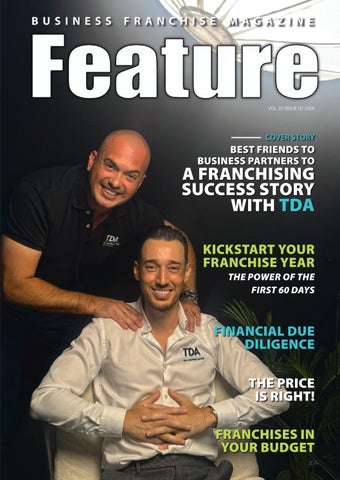
VOL 20 ISSUE 02 2026
cover story
Best Friends to Business Partners to
A Franchising Success Story WITH TDA
Kickstart Your Franchise Year The Power of the First 60 Days
Financial Due Diligence The Price is Right! Franchises in your budget business franchise MAGAZINE 33
Explore Franchise Opportunities with Senior Helpers Australia Are you passionate about making a difference in your community while owning a successful business? Senior Helpers Australia offers an incredible franchise opportunity for individuals looking to join a trusted leader in the home care industry. Since 2011, Senior Helpers has been dedicated to improving the quality of life for seniors and their families across Australia, providing essential services such as chronic disease care, disability support, and respite care. At Senior Helpers, we are passionate about making a real difference in peoples’ lives. Since 2011, we’ve helped connect thousands of Australians with compatible aged care and disability care, supporting clients in their wish to remain happy and healthy in their own homes. We’ve been an international leader in professional home care services since 2002, developing pioneering programs like our Senior Gems® & Parkinson’s Care.
Why Choose Senior Helpers?
Proven Business Model
High Demand Industry
Comprehensive Training and Support
Community Impact
Flexible Business Model
We Celebrate Life
Call 1300 AGECARE or 1300 243 2273 to find out more
www.seniorhelpers.com.au
Senior Helpers – Home Care Only Better
34 business franchise MAGAZINE
conte nts
fr anchises in your price r ange Featured Cover Story 36 TDA, Tax Depreciation: Best Friends To Business Partners to a Franchising Success Story
Franchisee in Action 50 My Home: Claudia and Rod Forward: Owners – My Home Cronulla
Focus
36
42 Right At Home: A Year In Review
Expert Advice 38 Marissa Candy: Kickstart Your Franchise Year, The Power of the First 60 Days 40 Robert Toth: Franchises in Your Budget 44 Tony Meredith: The Sales Factor: Why Your Ability to Sell Matters More Than The Franchise Fee
44
42
48 Kate Groom: Financial Due Diligence 52 Lauren Clemett: The Price is Right 54 Stewart Germann: Affordable Franchises
38
50 business franchise MAGAZINE 35
franchising feature
cover story: TDA Tax Depreciation
Best Friends to Business Partners to
A Franchising Success Story WITH TDA Theo Mavratzakis and Daniel Farugia first crossed paths at the age of 12, in a state far sunnier than their current Head Office location in Melbourne. Their story began in Newcastle, where Daniel had just moved and joined Theo’s school. According to Daniel, their friendship took root on the soccer field and it was his skill and determination that impressed Theo so much that he knew immediately he had found a friend for life.
36 business franchise MAGAZINE
Theo, however, recalls it differently, for him, it was Daniel’s energy, focus, and collaborative nature that made him a friend for life. Regardless of which version you hear, and despite the pair being complete opposites, the bond between the two was immediate and enduring. That childhood connection laid the foundation for a partnership that would last decades. From school and university projects to their early professional careers, Theo and Daniel developed a friendship built on trust, complementary skills, and shared ambition. That partnership ultimately evolved into TDA Tax Depreciation, a company that has become one of Australia’s leading specialists in property tax depreciation. Their long-standing relationship continues to shape TDA’s culture, embedding trust, professionalism, and a commitment to excellence in every aspect of the business. TDA’s focus has been on providing high-quality, ATO-compliant tax depreciation reports for residential and commercial properties. Seeing the growing national demand for expert services, Daniel and Theo launched the franchise model in 2025 to empower property-focused professionals to build their own businesses under a trusted, expertled brand. Today, TDA franchisees operate across metropolitan and regional territories throughout Australia, delivering services that help investors maximise returns, reduce tax liabilities, and confidently navigate complex ATO regulations. Both founders bring extensive industry expertise. Daniel Farugia, a Registered Tax Agent and Certified Quantity Surveyor (AIQS), has over 20 years of experience in construction, property, and taxation. He holds an Honours degree in Construction Management and has mentored university students while leading major projects nationwide. Daniel is recognised for his leadership, work ethic, and ability to deliver results. Theo Mavratzakis, also a Registered Tax Agent and Certified Quantity Surveyor (AIQS), has spent more than 20 years helping clients optimise returns and reduce tax liabilities across diverse investment properties. A frequent speaker at property expos and industry conferences, Theo is known for his meticulous attention to detail, client-focused approach, and ability to create strategies that meet individual investment goals. If you are someone who is interested in opening a TDA Franchise, the process has never been simpler. Joining TDA is designed to be a structured, supportive, and streamlined endeavor that prepares franchisees for success from day one. The journey begins with an initial inquiry, followed by a detailed discussion with the head office team to assess the candidate’s fit, skills, and ambition. We are not in the business of setting people up for failure so the team works effortlessly to kickstart the entire process. Prospective franchisees are guided through a comprehensive discovery process, including: • In-depth training: Technical and operational training covering tax depreciation schedules, client management, reporting systems, and compliance. • Business setup support: Assistance with setup, technology integration, and branding to ensure franchisees are operationally ready. • Marketing and lead generation: National campaigns, pre-qualified leads, and digital assets to help attract clients from day one. • Ongoing mentoring: One-on-one coaching, regular check-ins, and access to senior specialists for technical or business advice. • Continuous professional development: Updates on ATO changes, new construction methods, and best-practice reporting techniques.
Franchisees also benefit from centralised reporting systems that streamline workflow and compliance, allowing them to focus on client relationships and business growth. TDA franchisees are drawn to TDA’s premium, professional service model, where the support infrastructure allows them to focus on growth while maintaining high standards. Looking to the future, TDA is investing in upgraded CRM and workflow systems, enhanced digital inspection tools, and expanded training programs. Within five years, the company aims to become Australia’s largest and most trusted property services franchise network, represented in every major metro and strategic regional zone, and recognised as the preferred partner for brokers, accountants, and property investors nationwide. For professionals exploring franchise opportunities, Daniel and Theo offer practical guidance: 1. Choose a service in demand: Look for industries that provide consistent, year-round need, rather than seasonal trends. 2. Assess your skills and fit: Successful franchisees often combine self-motivation, strong relationship skills, and a passion for the industry. 3. Research the support structure: A good franchise provides training, marketing, ongoing mentoring, and systems to help you succeed. 4. Understand the financial model: Be clear on startup costs, fees, and expected return on investment. A transparent, proven model reduces risk. 5. Think long term: Look for a franchise with growth potential and room to expand, not just short-term opportunities. 6. Leverage the brand and network: A strong national brand, backed by experienced leadership, can help you grow faster and more effectively. The story of Daniel and Theo from 12-year-old friends on a Newcastle soccer field to co-founders of a nationally recognised property services franchise reflects the values that define TDA: trust, dedication, and expertise. For professionals looking to grow a business in the property sector, TDA Tax Depreciation offers more than a franchise, it provides a proven business model, extensive support, and the opportunity to build a sustainable, rewarding career under the guidance of founders whose lifelong partnership has shaped every success of the company. v business franchise MAGAZINE 37
franchising feature
EXPERT ADVICE: Marissa Candy | CEO | The Marketing Factory
Kickstart Your Franchise Year. The Power of the First 60 Days. Ah, January. The month of fresh notebooks, ambitious planners, and the eternal optimism that somehow convinces you that this is finally the year you will get everything right. Let us be honest though, by the end of February, half of those intentions have already fallen by the wayside. I have seen it happen again and again over my 20 plus years working with franchise systems across Australia and internationally. But here is the kicker, the franchises who truly dominate are not relying on luck or motivation. They are using the first 60 days of the new year to set themselves up for unstoppable momentum. 38 business franchise MAGAZINE
The early months of the year are not a warm-up; they are the launchpad. They are the time to sharpen operations, align your team, reconnect with customers, and set up the systems that will carry you through the rest of the year. Ignore them, and you are simply playing catch-up. Embrace them, and suddenly, the entire year feels like it is on your side. “After more than two decades in franchise marketing, I can tell you this: the first 60 days reveal exactly how the rest of your year will go.” - Marissa Candy, CEO and Gold Stevie Awards Winner
Let us get one thing straight, nobody wants another year of chasing their own tail. The most successful franchisees I work with do not set a long laundry list of resolutions and then shrug when they forget half of them by February. They set clear, achievable goals that make sense for their business, their team, and themselves. And they do not just stop at revenue targets; they think about everything that actually matters, customer engagement,
operational efficiency, team growth, and a sprinkling of marketing magic to keep the business front-of-mind. A good franchise knows exactly what a successful year looks like. A great franchise takes those big-picture goals and breaks them into smaller, actionable chunks that can be tackled in the first 60 days. You will be surprised how much of your year’s trajectory is decided before the calendar even reaches March. “The biggest growth killer I see is overcomplicating your plan. The best franchisees focus on a few high-impact priorities and execute them consistently, rather than spreading themselves too thin.” Now, let’s talk about your team. After the holiday break, some of them are still in snooze mode and some of them are already waiting for the next long weekend. That is where you, the owner, come in. If you do not get your team on the same page, aligned, and motivated in January, the rest of the year becomes a battle.
Marissa Candy is the CEO and Founder of The Marketing Factory, a multi-award-winning marketing agency, with their head office based in Brisbane. With over 20 years of experience in brand strategy, franchise marketing, and business growth, Marissa has advised hundreds of franchisees and franchisors across Australia and internationally. She is a Gold Stevie Awards winner and is recognised for her bold, results-driven approach that blends creativity, data, and a touch of bold marketing flair.
to reconnect with customers are the ones who see traction later in the year.
Kick off the year with a team meeting that actually inspires. Bring in a consultant to help you raise the intention. Celebrate last year’s wins, share the vision for this year, and clearly articulate what success looks like for the year ahead. Make it fun, make it energising, and please, make it memorable. Then do not just leave it at a group session. Take the time for one-on-one conversations with each team member. Discover what motivates them, identify their personal goals, and address any hurdles they might be facing. The franchises who start strong with their teams often see higher productivity, better customer experiences, and less drama as the months roll on.
Reconnect With Customers Before They Forget You Marketing is not just about flashy campaigns or social media stunts; it is about keeping your brand top-of-mind with the people who already know you. After the holiday rush, customer behaviour can be unpredictable. Those who act early in January and February
Top franchisees do not just send out a generic Happy New Year email. They craft messages that feel personal, relevant, and valuable. They relaunch loyalty programs, offer thoughtful promotions, and use social media to remind customers why they chose their brand in the first place. This is not gimmicky. It is strategic.
Local Partnerships Are Your Secret Weapon One of my favourite strategies for franchisees is building strong local partnerships. The first 60 days are perfect for forging relationships with gyms, schools, sporting clubs, complementary businesses, or community groups. These partnerships not only drive customers through your doors but also position your brand as a trusted member of the local community. The best franchisees do not wait for opportunities to knock; they create them. By the time competitors realise what is happening, you are already established, visible, and relevant. “The franchisees who become household
names in their communities are the ones who invest in relationships, not just transactions. That is how you dominate a market quietly but effectively.”
Review Your Numbers Now Data does not lie. And January and February are the perfect time to establish baseline metrics for sales, profit margins, marketing ROI, customer retention, and lead conversion. The most successful franchisees monitor these numbers closely and make adjustments before problems spiral. “Revenue is the outcome, not the strategy. The franchisees who win are the ones who know their numbers and act early, rather than hoping for magic.” Remember, the first 60 days decide the other 305. Momentum is built early, not late. Clarity, focus, discipline, and consistency in January and February compound for the rest of the year. The franchisees who dominate the first 60 days do not just survive; they thrive. They finish the year with more revenue, stronger teams, happier customers, and fewer headaches. Your year has already begun. Make these first 60 days count. They will define everything that follows. v business franchise MAGAZINE 39
franchising feature
EXPERT ADVICE: Robert Toth | Special Counsel | Sanicki Lawyers
Franchises in your
There are many low-cost franchises on offer these days that can be attractive to someone who has been made redundant or just tired of your existing career path. Many of these franchises are home services or mobile franchises which are affordable and you don’t need to mortgage your home to get into one. Franchises come in all shapes and sizes and fit many budgets, and no two franchises (even in the same sector) are necessarily the same, so you need to carefully select the right one for you. How do you select the right franchise for you?
Steps to consider • Your Budget Work out your budget and your risk profile – how much can you afford, or borrow, and how far do you want to stretch your borrowings - there is good and bad debt and borrowing or investing to go into a viable business that will generate income and build wealth is “good” debt. That is, you get a return on your investment. • Prepare a business plan Write down your personal goals, objectives, skills you would like to use (or new ones you want to learn), how long do you want 40 business franchise MAGAZINE
to be in the business and, how that will affect your lifestyle and use the plan to assess which franchise aligns with your plan. • Research
Some of these relate to: a. whether you are given an exclusive area or territory to operate in, or just a site. b. whether the franchisor is able to compete with you online.
Select the franchise system that meets your criteria and prepare a short list of potential franchises to then investigate.
c. is there is a marketing or Special Purpose fund you must contribute to.
This should include talking to existing franchisees, focus on the up front and ongoing operational costs and potential earnings and ability to earn an income from your effort.
e. does the Franchisor supply goods and can they force excess stock onto you.
Prepare your own cash flow projections and ensure your cash flows include cost of goods, advertising and a salary for your efforts to ensure it is financially viable. • Independent Legal and Financial Advice Before you commit seek advice from a specialist franchise lawyer and accountant to minimise your risk. As members of the Franchise Council of Australia (FCA) and the International Franchise Lawyers Association (IFLA) Sanicki Lawyers have advised many franchisees in various sectors for over 35 years. We know what’s going on … the good the bad and the ugly! There are many tricks and traps which a Specialist Franchise Lawyer will be able to highlight, so you can make an informed decision before you commit.
d. what extra costs you need to pay for IT, or management systems support.
f. does the Franchisor receive and share supplier rebates? g. check out the exit costs if you sell the business down the track. h. what training is offered and where. i. does the location work based on where you live. j. who generates the leads the Franchisor or is it all your own marketing? k. do the services or goods being offered have longevity or is it a passing fad. l. consider the impact of AI in the business over the next few years as this may have a positive or negative impact. I was speaking to Jaimee Almond a Consultant and regular author and blogger on small business matters. Jaimee works with business owners daily with strategic planning and insights into the purchase of a business or planning to exit their business.
Jaimee had some wise words for prospective franchisees and suggests when looking at buying a franchise, don’t just fall in love with the brand, dig into the business system behind it.
Robert Toth is Special Counsel and Franchise Specialist at Sanicki Lawyers with over 35 years of experience in franchise, licensing and distribution law.
The most important question to consider and ask a franchisor is: How will they help you launch your business successfully?
Named by global law experts as Franchise Law Expert of the Year 2025 in Australia.
Robert is also an Accredited Commercial Law Specialist and regularly publishes articles on franchising in Australia and overseas journals and acts for a number of overseas, local and master franchisors and acts in dispute resolution and mediations.
Contact Robert@sanickilawyers.com.au or call him on mobile 0412 67 37 57 www.sanickilawyers.com.au
A successful franchise system will not leave you to figure it out alone. They will have proven launch playbooks, hands-on support, marketing campaigns, and clear performance targets for you. Jaimee gives the example, in fitness franchises, where you need at least 150 members to make the business viable, for long-term success, so you need a franchisor who not only knows those benchmarks but has a step-by-step system to help you hit them
Mobile v Fixed site franchises Mobile Franchises With a mobile franchise, the up-front franchise fee is usually the biggest cost (it could be as low as $8,000 up to $25,000.00 apart from the need to lease a vehicle, branding and equipment costs. The overall investment could therefore be around $30,000 to $100,000 (high end) to get moving.
b. Does the franchisor have a social media presence and “on line” policy and direct leads to you, in your territory? Is it fair and clear how the leads are allocated ?
The vehicle and equipment can usually be leased, which reduces the up-front capital outlay.
c. Is the territory near where you live? travelling across town to service your territory may become tiring and costly.
Many mobile franchisors charge a fixed weekly or monthly royalty rather than a percentage of gross turnover therefore, the amount payable from a franchisee’s gross turnover (not their profit) can range from 10% up to 14% all up.
d. Do you have to travel long distances within your territory to service clients for a small fee - in which case there may be little profit in each job?
A weekly fixed fee with a smaller franchise can be positive if the business is successful and growing but can otherwise be a fixed cost that becomes a debt to the franchisor if you are not actively working the franchise. The working capital requirements for a mobile franchise are also lower generally than for a fixed site franchise over the first six or twelve months of operation. Even though a mobile franchise has less upfront cost (which means less risk) that may also mean a smaller income or return and simply buying yourself a job. There is nothing wrong with that if you are content with that!
e. Can you still take time off and have a break without impacting on the business if you are a sole trader? f. What is the franchisors policy if you want to go on leave? All in all, a low cost or mobile franchise may be a great option, but it won’t suit everyone.
Fixed Site The franchise fee for a fixed site franchise maybe between $30,000 to $80,000 plus fit out costs, stock and a myriad of other costs so the start-up costs could be well over $250,000.00 to $500,000.00.
Key considerations for a mobile franchise are:
The royalty’s payable on the franchisee turnover generally ranges from 6% to10% plus a marketing fee of between 2% to 4%.
a. Will you get an allocated and exclusive territory, or will the franchisor or other franchisees be able to sell to customers in your territory?
Therefore, the actual return on Investment (ROI) for a fixed site could take much longer than a smaller franchise simply due to amortisation of the costs over a longer period.
Again, you could lease the equipment to reduce the capital outlay but then you also need to ensure you have enough working capital and will likely have all of the costs of a fixed site such as rent and staff costs and Insurances to cover. Whichever franchise you select the key measure of satisfaction will be financial (not lifestyle), that is can you take a reasonable wage for your effort and get a return on your investment (ROI) when you sell down the track.
Getting Good Advice Our view is if the numbers do not look like they work up front walk away as there will be plenty of other opportunities where the numbers will work! I advise my clients “good advice will cost you money, bad advice may just end up costing you a whole lot more!” We see this regularly where a franchisee comes to us for advice after they have taken up a franchise and looking to exit and we find that they did not get any advice at all or they got advice from their local lawyer who did not have the expertise to advise the client properly. Getting the right advice up front may save you thousands down the track so get the best advice from a Franchise Law Specialist before you commit to limit your risk and make an informed decision before you hit the road. v business franchise MAGAZINE 41
franchising feature
focus: Right at Home Australia
Right at Home Australia
A Year in Review
Right at Home Australia had much to celebrate in 2025. It was a massive year for the brand, hiring a new CEO Fritha Radyk, welcoming six new franchise territories and expanding into the Northern Territory, while simultaneously responding to unprecedented regulatory change with the Federal Government’s new Aged Care Act and Support at Home Program.
42 business franchise MAGAZINE
Hiring a CEO
Significant Regulatory Change
Faced with new Quality Care Standards, rapid network expansion, and a planned leadership restructure, Right at Home Australia made the decision to appoint its first CEO mid last year. Fritha will provide strategic leadership and direction for the network of locally owned franchise offices. This is always a watershed moment for any owner led franchise network and comes after much planning and consideration by Right at Home Australia Founders Karen and Daryl Sahli.
Australia's new Aged Care Act (2024), which came into force on 1 November 2025, introduces a fundamental, rights-based overhaul of the aged care system, moving the focus from providers to Older Australian’s needs and preferences. A major reform under the Act is the launch of the Support at Home program, which replaces the previous Home Care Packages program and is intended to provide a single, simplified, and more flexible system for in-home support in the long term. In the short term, Support at Home means a complete change to funding and service
models across the sector. This includes meanstested contributions and lifetime caps on non-clinical care costs to ensure fairness and sustainability. The legislation also strengthens quality standards and regulatory oversight, grants greater powers to the Aged Care Quality and Safety Commission, and enhances whistleblower protections – requiring a significant ‘step up’ for many home care providers. Right at Home’s global care standards, established network, and fee structure (already consistent with the Support at Home Program) makes the company ideally positioned to respond to this once in a generation change to the sector.
Rapid Network Growth As part of the appointment of the new CEO, Karen and Daryl have been freed from dayto-day operations to focus almost entirely on franchise recruitment. It is anticipated that this will further drive the growth Right at Home has already experienced thanks to the opportunities presented by the aged care sector. Right at Home has already sold 60 franchises, with at least 60 more available for potential owners across all Australian states and territories. This expansion directly addresses the significant demand created by Australia's rapidly ageing population. Furthermore, excellent opportunities for resales are emerging as some franchise owners approach the end of their 10-year franchise agreements and look to realise the value of their businesses for retirement.
Planned Leadership Restructure Following the arrival its CEO, Right at Home restructured its executive team to prepare for the new regulatory regime and planned growth, while providing comprehensive support across key functional areas to the network. This restructure focused on four
From left to right: Right at Home Australia Founders Daryl and Karen Sahli, Right at Home International President and CEO Margaret Haynes and Director of International & Strategic Alliances Tony Buccheri
key areas including operations, clinical governance, finance, and systems. The operations team now features dedicated, specialised performance coaches lead by an experienced Head of Franchise Operations to improve franchise performance, service quality, and business health. All members of the clinical governance team are registered nurses with relevant post graduate studies to ensure network-wide compliance with the Aged Care Act and its heightened standards. This enhanced structure has sharpened home office’s focus on compliance and positioned Right as Home to engage more effectively with the Aged Care Commission, ensuring that regulatory requirements are not only met but proactively managed. Right at Home has also engaged a Palliative Care Clinical Specialist to further strengthen its palliative and end of life care practices. This investment ensures that Right at Home’s approach to care is not only compliant but compassionate, embedding specialist knowledge into service delivery and reinforcing its commitment to dignity, quality, and excellence in the most critical stages of life. This collaboration also ensures Right at Home’s clinical practices in this space are research and evidenced based. In finance, Right at Home is increasing senior-level resourcing to support strategic growth and profit optimisation alongside daily financial functions. Finally, the systems team uses dedicated resources to strategically assess the future role of automation and systems within the company.
What’s Next in 2026? Right at Home has enhanced both its strategic and operational agility. The company has a proven track record in scaling the business and solidifing a growth trajectory. Fritha and her leadership team bring fresh expertise and strategic vision to guide expansion, while retaining the knowledge and passion of Right at Home Australia’s Founders. Moreover, the company’s ability to quickly and effectively respond to new legislative changes has turned potential regulatory hurdles into a competitive advantage, ensuring compliance while adapting to meet new market demands. This combination of internal strategic alignment and external responsiveness has created a robust framework for sustained growth in 2026! Are you ready to join the Right at Home Australia network? Enquire about a franchise opportunity today. Right at Home Australia is a leading provider of quality in-home care. Our mission is to improve the quality of life for those we serve ensuring the Right Care, Right at Home™. We support people living with complex and post-operative care needs, dementia and cognitive decline, older adults, and adults living with a disability including NDIS participants. Our tailored services help clients to remain safe and independent in their homes. We have 60 territories across Australia and growing. If you are interested in a franchise opportunity with Right at Home, call us on 1300 363 802 or email franchise@rightathome.com.au. business franchise MAGAZINE 43
franchising feature
EXPERT ADVICE: Tony Meredith | Director and Head Coach | Tony Meredith Coaching
The Sales Factor:
Why Your Ability to Sell Matters More Than the Franchise Fee When prospective franchisees begin their research, most focus almost exclusively on the numbers. They compare franchise fees, inclusions, equipment packages, marketing contributions and training provisions, often building elaborate cost-per-component spreadsheets to justify their final decision. These figures matter, but they only tell part of the story. What they cannot reveal is whether the business will generate enough revenue to sustain itself. Across Australia and New Zealand, one insight emerges with absolute consistency: the price you pay to enter a franchise has little to 44 business franchise MAGAZINE
do with your eventual success. What matters far more is your ability to sell.
the owner to create momentum, not merely maintain a system.
A franchise survives because it can consistently attract customers, convert interest into revenue and nurture relationships that drive repeat business. Sales capability is the engine behind those outcomes. It accelerates time-to-break-even, stabilises cashflow during unpredictable seasons and becomes the skill that distinguishes high performers from those who quietly exit the network.
One of the most common misconceptions among new franchisees is that the brand will deliver a steady stream of customers. This assumption creates two issues. First, it encourages unrealistic expectations about early revenue. Second, it causes unnecessary cashflow stress when leads arrive more slowly than predicted.
Every Franchise Is a Sales Business Before It Is Anything Else
Head office support, national marketing, established brand recognition and operational technology can absolutely strengthen a franchisee’s chances. But these are amplifiers, not replacements, for ownerdriven commercial activity. A system can provide tools, but it cannot compel initiative. Ultimately, sales still sit with the person who signs the franchise agreement.
No matter the category, every franchise begins with a sales conversation. Even the most operationally driven models require
The business may come with training, a vehicle, a uniform and a CRM platform, but the decisive factor is the owner’s capacity to
Yet it remains the capability most frequently overlooked by new buyers.
engage prospects, articulate value and guide commercial decisions. In short, the elements supplied by the franchisor build credibility. The selling done by the franchisee builds the customer base.
Why Lower-Cost Franchises Depend Even More on Sales Capability
Tony Meredith Coaching focuses on helping business owners Grow Sales, Increase Profits, and Regain Time. Tony Meredith Coaching started in 2018 and works with hundreds of small-medium businesses across Australia, in the areas of Franchising, Retail, Services, Manufacturing, and Trades. Tony has over 25 years’ experience working for some of the world’s largest corporations in a variety of senior sales and leadership roles. Contact Tony and his team if you want to grow an outstanding franchise business. info@tonymeredithcoaching.com.au https://tonymeredithcoaching.com.au/ https://www.linkedin.com/in/tony-meredith-coach/ https://www.facebook.com/tonymeredithcoaching
The perception that low-entry-cost franchises are simpler or less demanding is understandable but misleading. Lowercost models frequently rely on local profile, community engagement and direct outreach because they lack the instant brand recognition of larger networks. This shifts responsibility to the owner’s ability to generate activity from day one. These businesses often require intensive sales effort in the early months, sometimes including: • local prospecting and street-level introductions • door-knocking to build awareness and trust • letterbox drops, targeted outreach and community announcements • attending networking events to establish professional relationships • systematic follow-up and appointment setting • building partnerships with complementary local businesses
promise premium experiences, and with that promise comes the expectation of proactive, personalised relationship management. Success in these systems relies on:
Franchisees who succeed in these categories are not the ones waiting for head office leads; they are the ones creating them through disciplined, daily sales activity. They recognise that the entry cost is not a shortcut. It is an opportunity that rewards visibility, energy and commercial persistence.
• deliberate customer engagement and faceto-face connection
The misconception that a cheaper franchise reduces the need for sales can significantly set new operators back. The lower the brand recognition, the higher the sales requirement. Owners who understand this dynamic often outperform expectations because they treat selling as their primary function rather than an auxiliary task.
• consistent networking within commercial and community circles
Mid-Range and Premium Networks Still Reward the Confident Seller Higher-priced franchises typically offer more robust brand equity, refined operating systems and extensive training. These features do create advantages, but they do not dilute the importance of selling. Premium brands
• nurturing ongoing relationships and encouraging repeat business • participating in local events to enhance awareness and goodwill
While premium networks may provide more inbound opportunities, they move faster when the franchisee is comfortable initiating conversations, following up enquiries and positioning the brand confidently. The franchisees who achieve the quickest return on investment typically demonstrate high levels of commercial initiative, not merely operational competence.
Sales Capability Is a Strategic Insulation Against Market Pressure Markets shift, communities evolve and
sectors experience cycles. Every franchise network inevitably encounters periods of tightening demand. Operators who rely exclusively on walk-in traffic, online bookings or inbound enquiries find themselves vulnerable during these shifts. Sales skills operate as a hedge against unpredictability. A franchisee who can sell can also adapt. They can: • generate demand when inbound traffic slows • build partnerships when referrals decline • diversify lead sources as trends evolve • remain profitable when competitors open nearby • retain customers through better engagement and communication The ability to create commercial opportunity rather than wait for it is one of the strongest predictors of long-term franchise success. It is also the capability that allows operators to outperform others in the same system. Even in challenging conditions, the franchisees who remain profitable are those who can consistently initiate conversations that lead to work. business franchise MAGAZINE 45
franchising feature
EXPERT ADVICE: Tony Meredith | Director and Head Coach | Tony Meredith Coaching
Three Sales Questions Every Franchise Buyer Should Ask Before Signing Before committing to a franchise, prospective buyers should evaluate their readiness through a lens that extends beyond the financial modelling. The following three questions provide a reliable indication of whether the operator is prepared for the realities of franchise ownership. 1. Can I generate leads without relying exclusively on head office? If you cannot, your business becomes vulnerable to marketing fluctuations outside your control. Owner-driven lead generation protects against that dependency. 2. Am I comfortable building relationships and initiating commercial conversations? Sales is connection, not pressure. But connection still requires confidence, clarity and willingness to initiate dialogue. 3. Will I commit to weekly sales activity even when operations get busy? In many franchises, sales activity peaks at the beginning, then declines as the business becomes operationally intense. Revenue plateaus soon after. Sustainable growth requires an ongoing, disciplined sales rhythm. Prospective franchisees who answer these questions honestly and act on the insights that emerge give themselves a far clearer understanding of what success will demand.
Four Practical Steps to Strengthen Sales Capability Before You Buy Sales is a skill that can be learned and mastered. If you are evaluating a franchise investment, the following steps will position you for stronger performance from day one.
1
Conduct a genuine self-assessment of your sales capability
Identify strengths, acknowledge blind spots and recognise the habits you may need to develop. Clarity now prevents frustration later.
2
Test-drive the sales experience
Speak with current franchisees. Role-play customer conversations. Attend discovery days with questions that probe how leads convert. When possible, shadow a top
46 business franchise MAGAZINE
performer to observe how they build rapport and momentum.
3
Build a 90-day sales and revenue plan
Outline the exact sales activities you will complete in your first twelve weeks. Include daily behaviours, weekly outreach targets, community engagement commitments and follow-up protocols.
4
Invest in sales training before you launch
Waiting until after you open increases risk. Enter the system with the capability already built. Training sharpens confidence, and confidence accelerates traction.
Why Sales Is the Multiplier That Determines Franchise Performance The franchise model has always been built on the idea of systems, support and replicable processes. These features reduce complexity and increase operational consistency. But they do not replace the commercial behaviours that drive growth. Sales capability multiplies the value of every
other component of a franchise. Strong selling makes marketing more effective, operations more predictable, and customer retention more reliable. It amplifies brand equity, accelerates break-even and builds resilience across fluctuating economic cycles. A franchise fee gives you access to a business. Sales capability enables you to grow it. Operators who understand this distinction approach their investment with a different mindset. They enter with the confidence that they can create demand intentionally, not accidentally.
Final Thought Franchising remains one of the most accessible entry points into business ownership, but accessibility should never be mistaken for simplicity. The operators who outperform the market recognise that sales are the activity that powers the system. When you invest in your sales capability, you build resilience, commercial discipline and the confidence to create demand irrespective of market conditions. Those attributes compound over time, turning early traction into sustainable growth. v
: r e h t e g o T a t t Be k c a B l a c o L Bringing A Franchise Network That Supports You and Australian Families
Balonne Betta
ilt on local u b s s e in s u b A faces. ly d n ie r f d n a trust oday! Get in touch t Benefits to Joining the Brand
•
Personalised customer experience
•
Established brand with over 60 years of experience
•
Trusted partnerships
•
Robust marketing support
•
Australia’s largest independent Electrical and Furniture buying group
•
Bespoke Elev8 training
•
Flexibility for your lifestyle
•
Access to exclusive product ranges
•
Multiple revenue streams
•
•
Powerful loyalty programs
Expert store design and planning
•
Seamless technology solutions
•
Competitive bulk buying power
•
Over 150 stores nationwide
No retail experience needed - full training and ongoing support are provided.
Scan to learn more or contact our franchise team!
Phone: (07) 3414 8700 Email: franchiseenquiry@bsrgroup.com.au www.bsrgroup.com.au/franchise-opportunities business franchise MAGAZINE 47
franchising feature
EXPERT ADVICE: Kate Groom | Co-Founder and Director | Franchise Accounting & Tax
Financial Due Diligence Buying a franchise is one of the most significant financial decisions you’ll make. It’s natural to approach a business opportunity with optimism and enthusiasm. However, if the business doesn’t produce the financial results you’re counting on, you could face years of financial stress working long hours for little income or find yourself unable to repay your investment before the franchise term ends.
48 business franchise MAGAZINE
Owning a franchise always involves financial risk. A wise buyer takes action to understand and reduce that risk before signing. Understanding the risk means recognising some hard truths: you’ll only be able to pay yourself if the business makes a surplus after covering operating costs and staff wages. To repay your investment, the business must generate enough profit to cover all costs including your own wages. And here’s the critical point: if you can’t repay your investment within the franchise term, you face the real possibility that the business will close with debt still owing to yourself or a bank. Now to the question of how to reduce the financial risk associated with buying a
franchise. This is the financial due diligence stage of buying a franchise. The first step in financial due diligence is to answer three questions: 1. What will the annual operating costs of the business be? These should include your own wages and interest on any borrowings. 2. How much profit does the business need to make over the initial franchise term to repay the upfront investment? 3. What annual sales are needed to cover the operating costs, repay the initial investment, and provide a return on your investment of your own money? Working out these answers requires detailed financial modeling that accounts for dozens
of variables and their interactions. Most franchise buyers benefit from working with an experienced advisor or accountant who specialises in franchise businesses. Here’s what this process typically involves:
Estimate Your Operating Costs Work out the likely operating costs for the first year you’ll own the business. You’ll need to estimate three types of cost:
Kate Groom is Co-Founder and Director of Franchise Accounting & Tax, an accounting and advisory firm which helps franchise owners with financial management, tax, and accounting.. Kate has a keen interest in financial and business education and has developed and run many courses for business owners. Since starting her working life in audit with Coopers and Lybrand in the UK, Kate has worked in a variety of management and leadership roles in accounting, insolvency, and franchising.
Fixed costs of operation - costs you’ll incur regardless of your sales level. These include rent, insurance (general and workers’ compensation), vehicle costs, utilities, software subscriptions, professional fees like accounting, and ongoing franchise fees if they’re a set monthly amount rather than based on sales. Variable costs - expenses that only occur when you make a sale. In a café, these include coffee, milk, food ingredients, and packaging. The franchisor should provide a target range,
typically expressed as a percentage like 2932% of sales. Franchise royalties calculated as a percentage of sales are also variable costs. Annual wages cost, including superannuation - This can be tricky to estimate because while every business has a minimum staffing requirement, higher sales usually demand more staff. A good starting point is the cost of the recommended staffing level for the first year, or if you’re purchasing an existing business, use the current staff costs as a guide.
Calculate Your Breakeven Point Once you know these costs, you can calculate your breakeven point - the minimum sales needed just to cover costs. Here’s how: First, work out your contribution margin (this is simply 100% minus your variable costs percentage). So, if your café’s food costs are 30% and royalty is 9%, your contribution margin is 61% - meaning 61 cents of every dollar in sales is available to cover fixed costs. Then divide your total fixed costs and wages by this contribution margin. For example, if your fixed costs and wages total $300,000 and your contribution margin is 61%, you need sales of $491,803 just to break even. But breaking even isn’t enough - you also need to repay your initial investment. To factor this in, add another annual cost: your total upfront investment divided by the number of years in your franchise term. A $400,000 investment in a 10-year franchise term means you need an additional $40,000 in profit each year just to get your money back.
Once you’ve completed these steps, you’ll have a reasonable estimate of the target sales for your first year. You can extend this analysis to cover three or four years to get a financial picture of the business over a longer term.
Do the financials stack up? Once you’ve got the financial model worked out, it’s time to turn to the big question: “How confident am I that the business can operate within this cost structure and generate the target level of sales?” This opens up another part of the due diligence process: looking for evidence that your assumptions are reasonable. To do this, you’ll need to ask questions of the franchisor and the existing franchisees. This is where experienced guidance becomes invaluable. A specialist franchise accountant can help you test your assumptions against real franchisee data, identify red flags in the financial model, and ask the tough questions that might save you from a costly mistake. They’ve seen what works and what doesn’t across hundreds of franchise systems, and can spot the difference between a genuine opportunity and one that looks good on paper but struggles in practice. The time and cost of professional advice during due diligence is small compared to the risk of buying the wrong franchise. Done properly, this financial analysis gives you either the confidence to proceed or the wisdom to walk away - both are valuable outcomes. v
business franchise MAGAZINE 49
franchising feature
franchisee in action: Claudia & Rod Forward | Owners | MyHome Cronulla
“What MyHome has given us is not just a super successful business. It has given us a lifestyle and a sense of freedom that has changed our everyday life in the most meaningful ways.” Claudia & Rod Forward, Owners - MyHome Cronulla “They are exceptional franchisors; switched on, values driven and genuinely invested in building long term partnerships. It felt as though we would not only be joining a business, but creating a life with people whose values aligned with ours; who want us to succeed, grow and thrive.” Beyond the people, it was the feeling that a MyHome business would support the life they wanted to live. It offered the structure, the processes and the turnkey model that meant they knew they’d be able to start strong, work together and create something that aligned with their reasons for joining – having the opportunity to build a successful business of their own while still having the time and flexibility their family needed.
$1m+ Within a Year of Launch Having launched MyHome Cronulla in October 2024, Claudia and Rod have already grown it into a $1m+ business.
More time for the things that matter most
When thorough research pays off
After 22 years as a Process Architect in the Banking world, followed by a move into life coaching, and 30 years in Education respectively, Claudia and Rod Forward were ready for something new – something that aligned better with the way they actually lived in their day-to-day life, where they could prioritise new experiences and spending precious time with family and friends.
But finding the right business for them wasn’t a decision they took lightly. Rod spent close to 10 months researching different opportunities and deep diving into more than 50 options. They also attended a franchise expo, spoke to many franchise groups and asked countless questions, so built a strong understanding of what mattered, what to look for, and what to avoid.
With their children now older, and a little less dependent, but aging and increasingly dependent parents requiring more time and care from them, Claudia and Rod wanted to build something that they could be proud of, but that would also allow the time and space to support the changing needs of their family.
That clarity helped them assess the opportunities with a thorough discernment and ultimately led them straight to MyHome.
“We wanted to create a life where we could walk barefoot along the beach in the middle of the week, hand in hand, not because we had squeezed it into a day off, but because we had designed our life architecture to support it.” 50 business franchise MAGAZINE
What particularly drew them to MyHome was the combination of strong systems, genuine support and the calibre of the people behind the brand. The way the entire operation is run made immediate sense to them, but it was meeting the franchisors Russell and Marty in person that sealed it:
And they credit the incredible ongoing support and responsiveness from the management team at MyHome for helping them achieve this success. “They are genuinely invested in helping us succeed. The systems, training and processes have exceeded our expectations. When we first saw the monthly and yearly projections during training, we thought they were ambitious, however, we have kept step with them the whole time.”
We Do Clean, You Do Life. But Claudia recognises that it goes beyond just building a successful business… “MyHome has challenged us and supported us to grow in ways that have been both grounding and energising. We did not just step into a business – we’ve built a team that feels like a family. We are surrounded every day by vibrant, positive people who care about what they do and bring great energy to every interaction. The MyHome motto “We Do Clean, You Do Life” is not just something we say to customers. It is
Key Features of a MyHome Management Franchise: • Regular recurring income – with 95% repeat and referral so you can focus on delivering great service, not constantly searching for new clients • Low overheads and great margins – so you can provide great value and make a very healthy six figure income • Positive cashflow – all payments are taken automatically, no chasing money • Low start-up capital requirements – enabling you to invest in a business of your own • Predictable money-making machine – proven Australian business model • High income without the stress – executive earnings without the hours, commute and pressure • A digital first business – the MyOPTM app eliminates much of the day-to-day hassle out of running your business • Sociable and flexible working hours – giving you time for life, family and friends • Build a valuable asset – building a business you own is an investment in your future woven through every layer of the business. It shows up in the way the franchisors support us, in the way we support our staff and in the way we create space for our own lives. It sits at the heart of everything, and the way it has transformed our day-to-day life has been extraordinary.”
Life by Design Claudia and Rod love that the MyHome system genuinely supports and offers them the freedom to shape their days in a way that fits with how they choose to live. With the MyOP TM app and the robust tech systems behind it, they can spend the majority of their time serving customers and supporting their staff, rather than getting caught up in manual operations. This structure creates the freedom that has been a game changer for them. For example, they decided, right from the start, that they would go away for a weekend every month, and they’ve been able to honour that decision, affording them many fabulous and memorable new experiences together. They’ve also found that being out and about meeting customers across their territory has
helped them feel more connected to their local community – visiting parts of the area they might not otherwise have explored and discovering new places and a deeper appreciation for where they live.
• Industry leading support and training – comprehensive support from day one and for every step of your business building journey
But they really value the extra time they have to spend at home, as a family.
“MyHome is an exceptional opportunity. The systems, the structure and the turnkey model give you everything you need to begin with confidence and create a business that genuinely works.
“Being there when the kids walk through the door, having the space to hear about their day, and sharing the early parts of the evening together has been one of the biggest blessings. They have become part of this journey too. They are watching us grow a business from nothing; seeing the work, the energy and the heart behind it, and it is an extraordinary real-life lesson for them.” “It has been one of the best decisions we have ever made.” So, to anyone dreaming of owning a business like Claudia and Rod’s?
MyHome is not just a business. It is the foundation for the next chapter of our life. So, if you are looking for not only a strong business model, but for a supportive environment where you can grow, contribute and build a life that feels aligned at every level, then MyHome is absolutely worth exploring. It has been one of the best decisions we have ever made.”
Find out more and request a Franchise Information Pack now by visiting www.myhomefranchise.com.au/BFM-Cronulla or scan the QR code for instant access business franchise MAGAZINE 51
franchising feature
EXPERT ADVICE: Lauren Clemett | Keynote speaker, International award-winning Personal Branding Specialist and Best Selling Author x
The Price is Right! Choosing a franchise is one of the most significant professional decisions you'll ever make, and aligning your personal brand with your franchise's value proposition is the unspoken connection between you and your future. You’re investing in capital, but also in your time, passion, and your personal reputation. Yet, many prospective franchisees focus solely on the financials - the initial investment, royalty fees, and projected revenue - without considering a deeper, more personal alignment: Does the brand's fundamental price and value philosophy genuinely match my own? This alignment is the silent engine of your sales success, dictating how comfortably and authentically you can promote, sell, and deliver your franchise's offering. It's about recognising that your personal brand (your values, your habitual spending patterns, and your instinctive perception of value) must be in harmony with the franchise brand's price positioning. If you struggle to understand or justify your own brand's pricing, your customers will feel that hesitation, but if you deeply believe in the value delivered, regardless of the price point, your conviction becomes contagious.
The Value-Driven Deal Hunter
What Your Wallet Says About Your Sales Style
• You’re a savvy shopper, a natural deal-finder, and you pride yourself on getting the best bang for your buck. You believe in efficiency, operational lean-ness, and passing those savings onto the customer. You are focused on the transactional aspect of value.
We all have an intrinsic relationship with money and value. This relationship forms our personal price perception and fundamentally influences how we'll lead our franchise business. So which are you?
• You look for a cut-price, high-volume, or discount-focused franchise brand - think quick-service restaurants, budget fitness centres, or essential-service maintenance.
The Premium Brand Player
• You are a master of efficiency and scale. You understand that your customers are motivated by price and convenience. You know how to operate with tight margins, leveraging technology and systems to drive down operational costs. Your strength is in promoting the accessibility and frequency of the product or service. You are adept at driving repeat business and high "table turn" or customer throughput.
• You naturally gravitate towards quality, bespoke service, and a premier experience. You don't mind paying more for a product or service because you believe the elevated quality, reliability, or status justifies the cost. Your preference is to "buy once, buy well." • You prefer a premium-priced franchise brand - think high-end services, specialised consulting, or luxury retail. • You inherently understand how to sell the value proposition of a premium brand because you are a natural customer of it. You can articulate the benefits that justify the higher price - the longevity, the exclusive access, the superior outcome, or the peace of mind. Your sales approach will naturally focus on developing deep, long-term relationships and maximising the lifetime value of each customer. You appreciate that your target customer is looking for a solution where price is a secondary consideration to quality. • You focus on consultative selling, showcasing the brand story, and building strategic B2B or high-value B2C partnerships. Lower volume, higher margin.
52 business franchise MAGAZINE
• You focus on promotional marketing, loyalty programs, high visibility, and exceptional speed and convenience. Higher volume, lower margin. Neither position is inherently "better." A dollar of profit is a dollar of profit. The key is recognising where you fit. Attempting to sell a premium product when your heart is truly in saving people money will always result in an inauthentic pitch and frustrating business operations. The premium seller will be perpetually frustrated by the need for high-volume efficiency, while the value-driven seller will be constantly struggling to justify a high price point. Know your true north.
Lauren Clemett is a leading personal branding specialist for franchisors who need to systemize consistent, magnetic performance across their entire network. She solves the challenge of scaling leadership, transforming operationally sound franchisees into powerful local market leaders who drive exponential growth. Drawing on her deep expertise from global brand management and unique insights into neurological brand processing (how the brain sees and remembers brands), Lauren equips every franchisee to move beyond the manual to become a unified, magnetic leader, effortlessly recruit A-Player talent and draw in highvalue, ideal customers. www.yourbrandtruenorth.com
part of the value proposition for the price-sensitive buyer. 4. Emphasise Peace of Mind (for Premium Brands): For higher-cost services, focus on the avoidance of risk, the longevity of the solution, and the dedicated personal service.
Painting the Picture of the Outcome This is where marketing and sales excellence become critical, regardless of your price point. The ultimate goal is to shift the customer's focus away from the price tag and towards the value of the outcome. Here’s a simple exercise to help you understand how our brains make purchase decisions around value: Close your eyes and consider the following two words: Bacon & Eggs. Now consider the image your brain painted… Chances are, you envisioned the eggs and bacon cooked the way you want them - scrambled or fried? Perhaps you even saw them poached on sourdough with a coffee on the side at the cafe…or maybe you are vegan and saw alternatives, or you may have even painted the origins story and it was all about the pig and the chicken! I didn't ask you to do that; you just read those two words and your brain, in milliseconds, painted the picture of the outcome you wanted. That's how fast we make decisions about what we want to pay for. When you align with the franchise brand you own, you can paint the picture of the outcome for your potential customers in your marketing, in the way you train your team to speak to people, in your sales service and service communications. The secret is to know what value proposition you want to offer and which franchise brand can do that the best for you. Key Action Points: 1. Define the Transformative Outcome: What does your customer feel or achieve after using your service or product? • Instead of: "We clean your windows." • Try: "Enjoy a brighter home and clearer view with our streak-free, satisfaction-guaranteed window service." 2. Focus on Specificity: Use concrete, sensory, and high-value language that justifies the cost in that millisecond. If it's a premium price, detail the exclusive materials, expert qualifications, or the iron-clad guarantee. If it's a low price, emphasise the swiftness, convenience, and absolute savings. 3. Harness Scarcity and Urgency (for Value Brands): Use promotions and limited-time offers to drive the immediate, highvolume transactions necessary for profitability. The fast action is
The lesson from the Bacon & Eggs exercise is simple: You only have seconds to convert interest into desire. Your marketing must clearly, quickly, and compellingly express the "What's in it for them?" This is the ultimate differentiator that makes price fade into a secondary consideration.
Attracting the Right Team Members This alignment of personal and brand price perception extends beyond the customer to the team you hire. Your team members must also embody the brand's value proposition. A premium brand needs team members who are naturally meticulous, highly relational, and understand that delivering a stellar, personalised experience is non-negotiable - they’re the face of the higher price point. A value-driven brand needs team members who are exceptional operators, fast, efficient, and who can manage high customer flow while maintaining a friendly, consistent service standard. How to Ensure Fit: • Interviewing: Ask situational questions that test their personal value drivers. "Tell me about a time you paid a premium for a service. Why was it worth it?" or "Describe a purchase where getting the best deal was your top priority." Their answers will reveal their innate alignment. • Training: Embed the brand's core value statement into all operational and sales training. Ensure every team member can articulately justify the price point with confidence and conviction.
The Path to Profitable Conviction Choosing a franchise in your price range is less about the dollars and cents of the initial investment and more about the psychological cost of selling a brand you don't fully believe in. If you’re a high-value customer, you will naturally excel at leading a high-value franchise. If you are an efficiency expert, you will naturally thrive leading a high-volume, low-margin franchise. Your task as a prospective franchisor or franchisee is to look beyond the balance sheet and look inward. Find the brand that doesn't just promise profit, but that resonates with your soul’s perception of value. When you genuinely believe in the exchange - whether it's premium quality for a high price, or unparalleled convenience for a low price your passion becomes the most powerful marketing tool your franchise will ever possess. That’s when the price is truly right, for everyone. v
business franchise MAGAZINE 53
franchising feature
expert advice: Stewart Germann | Franchsing Lawyer | Auckland, New Zealand
e l b a d r o Af f FRANCHISES Franchising as a method of marketing goods and services is exciting and there are many business opportunities available. It is essential for any prospective franchisee to look carefully at a business opportunity which involves carrying out due diligence. Purchasing a new franchise system and being one of the first franchisees off the block can be groundbreaking but great care must be taken. Trending franchises which may be appealing often involve food and fitness. For example, Cinnabon, Jamaica Blue, KFC, Snap Fitness and Anytime Fitness. Once a franchisee has identified a particular business to buy then the services of an experienced franchising lawyer and a business savvy accountant are essential. Whether you are buying a home services franchise or a full business format franchise does not matter – your due diligence is the same and you must be careful to ensure that you can afford the purchase price which often includes goodwill, plant fittings and fixtures, and stock. If you elect to purchase a greenfields opportunity then you will have to pay the upfront franchise fee to the franchisor.
What Must You Do? Identify the chosen franchise system and you will be asked to sign a confidentiality agreement or an NDA. If you are buying an existing business through a business broker, you will often be provided with an information memorandum. Whatever you purchase, make sure you can afford the total purchase price including having a working capital provision to cover upfront lease rental payments, legal and accounting fees, necessary equipment purchases plus money in the bank to get you through the first 3 to 6 months. Most of the banks are used to franchises and like them, especially ASB, ANZ and 54 business franchise MAGAZINE
Stewart Germann founded Stewart Germann Law Office (SGL) in 1993 as a boutique law firm at Auckland, New Zealand, specialising in franchising, licensing and business law. Stewart has over 40 years’ experience in franchising law and acts for franchisors in New Zealand, Australia, USA and the UK. SGL also acts for franchisees and provides legal advice. Stewart has spoken at franchising conferences in New Zealand, Australia, Italy, South Korea and USA and he was on the Board of the Supplier Forum of the International Franchise Association (“IFA”) for 6 years until March 2007. Email: stewart@germann.co.nz | Web: www.germann.co.nz
Westpac. With well-known and successful systems, banks may be happy to provide finance subject to a satisfactory personal position from you as a prospective franchisee plus cashflow forecasts. It is good to borrow from a bank when purchasing a franchise as that will ensure an ongoing commitment and discipline with the bank in relation to repayments; but do not over-extend yourself. There is nothing worse than feeling pressured to pay creditors with no buffer. Banks will usually require loans for franchising repaid within five years so your forecasting must build that time frame into account.
• Grant of franchise
Good cash flow management is essential for any business. Of course, due regard must be given to any specific legal requirements of the franchise system. For example, if you were to purchase a business involving food there are strict regulations in relation to food hygiene and food management.
• Franchisor’s obligation to conduct extensive training
An important point to note in regard to today’s world of multi-communications is you must always be aware of the power of social media, especially Facebook and Instagram. Franchising is well understood and accepted in both Australia and New Zealand, and according to the 2024 Survey of Franchising in New Zealand, it covers a wide range of industry categories including retail trade, accommodation and food services, and administration and support services.
Franchise Agreement The key legal document is the franchise agreement. Many clauses which are usually included in the agreement include the following:
• Term of the franchise • Rights of renewal of term • Obligation to pay royalties and advertising fees to the franchisor • Minimum performance criteria • Good faith obligations on the part of a franchisee and the franchisor • Not to prejudice the franchisor’s intellectual property • Customer database and privacy • Customer complaints
• Franchisor’s obligation to provide the manuals which should include the operating manual and health and safety manuals • Dispute resolution recommending mediation Australia is far more regulated than New Zealand with a mandatory disclosure regime. Prospective franchisees can rely on the disclosure document and whatever is stated in it. Therefore, all statements and representations made by any franchisor must be true. To go into franchising, the message is clear – do your homework by way of due diligence, ask the right questions of a franchisor, have a bank behind you which provides necessary finance, and obtain expert accounting, taxation and legal advice. A monetary investment in the due diligence process is essential as you need to know what you are getting into and what your continuing obligations are. However, above all – do not over-extend yourself by paying too much for a franchised business when you really cannot afford it. v
PROVEN BUSINESS
GROWING INDUSTRY
Top reasons to buy into the Poolwerx network: Market-leading brand. Double-digit growth in a robust industry. Award-winning, scalable business model.
START YOUR MOBILE FRANCHISE FROM $99K + VAN* Inclusions:
Multiple-revenue streams.
$10K Marketing package
World-Class training and ongoing support.
Van wrap & fit-out ($7K value)
Opportunities in Australia & New Zealand are limited. Call us today!
4 weeks at Pool School Tools of trade IT hardware & software... plus more! *Vehicle financing or leasing options are available from $35K + GST (T&C apply).
Scan to learn more
or contact our specialist team: Phone AU: 1800 245 447 Phone NZ: 0800 050 759 joinourteam@poolwerx.com.au www.poolwerx.com.au/franchising business franchise MAGAZINE 55