Where Your Water Comes From
The water in your home doesn’t magically come from the tap. It may have traveled hundreds of miles, from melting snowpack to a high mountain reservoir, down a river, through tunnels, treatment plants, and pipes. It may have moved through someone else’s home or was used to irrigate a field before being treated and making its way to your house. Or it may have been pumped from 2,500 feet below the earth’s surface. Where you live in Colorado determines where your water comes from.
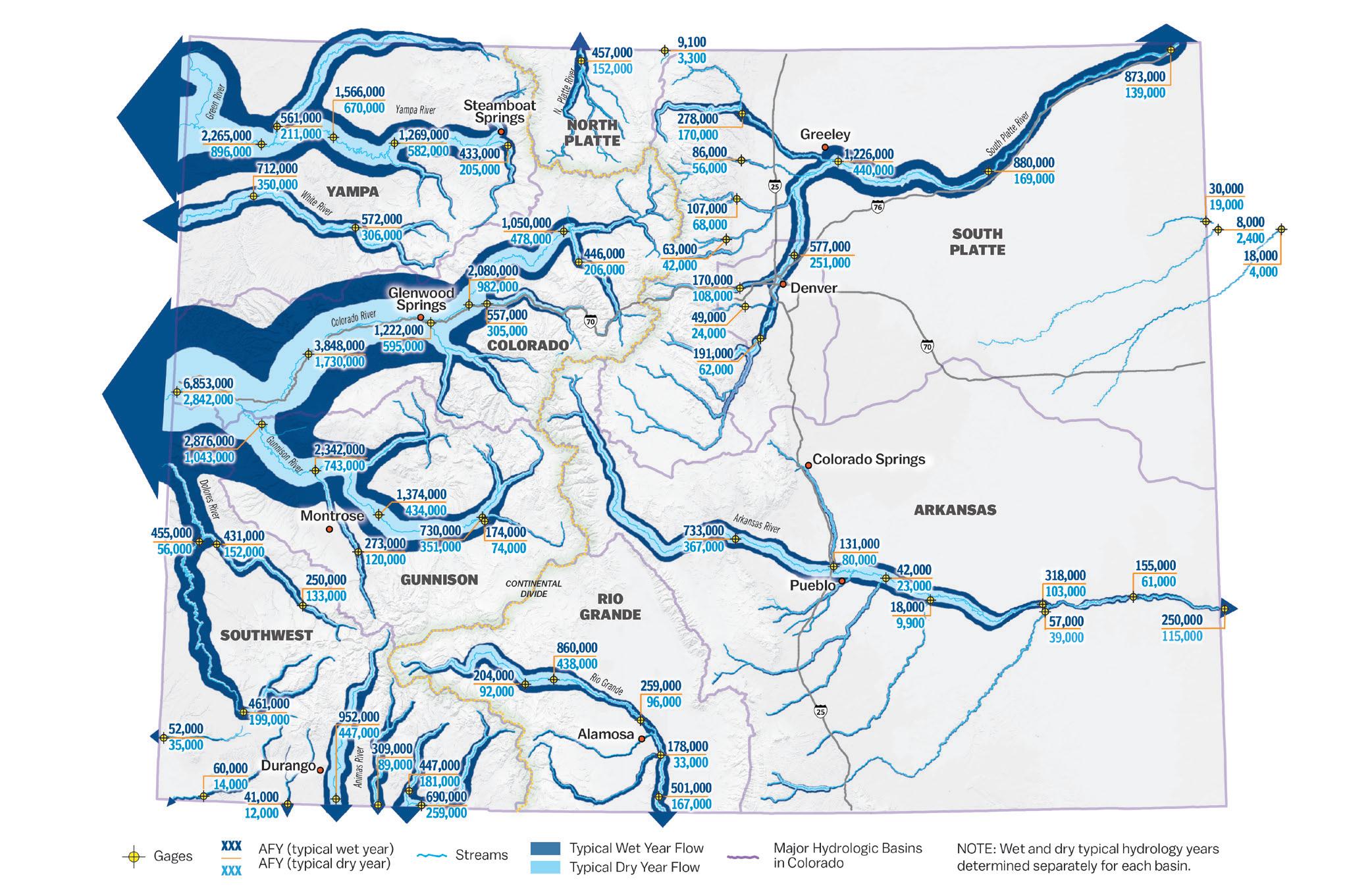
This map shows typical annual high and low streamflows during wet years and dry years, measured in acre-feet at gauges along Colorado’s major rivers and tributaries. This map was originally published in the Colorado Water Plan in 2015.
85 %
Of Colorado’s precipitation falls on the West Slope—most comes in the form of snow
40%
Of the water that originates in Colorado is used within the state, 60% leaves the state
85 % +
Of Colorado’s population lives east of the Continental Divide
2,000
Reservoirs in Colorado with
85 %
Of precipitation that falls in Colorado is used by the natural environment
17
The statewide average annual precipitation, in inches, which includes a range of an average of 7 in/yr to more than 50 in/yr in some mountain locations
River basins exist within the state:
The Arkansas, Colorado, Gunnison, North Platte, Republican, Rio Grande, South Platte, Dolores/San Juan/San Miguel, and the Yampa/ White/Green 9
The Arkansas, Colorado, Platte and Rio Grande 4
Major interstate river basins originate in Colorado, making it a headwaters state:
For additional information and resources, read the Citizen’s Guide to Where Your Water Comes From.
LEARN MORE
From Forests to Rivers and Aquifers
Colorado’s water arrives in a seasonal water cycle. Water evaporates from surface sources, rises in the atmosphere, condenses, and falls as precipitation. Water then moves to a destination, whether through an aquifer or river system.
A. Snowpack that accumulates in the mountains settles mostly in forested watersheds during winter and early spring. About 80% of Colorado’s population relies on forested watersheds for municipal water supplies. These forests stabilize soil and prevent erosion, filter contaminants, enhance soil moisture storage and groundwater recharge, and reduce the likelihood of flooding.
B. When snowpack melts, runoff collects in streams and rivers, which eventually flow downstream and out of Colorado. Colorado is considered a headwaters state because its rivers provide water to 18 other U.S. states and Mexico.
C. Each basin in Colorado relies on a mixture of rain, snow and groundwater to fill its rivers. Most people in the state rely on these surface water supplies for water.
D. Still, 19 of the state’s 64 counties — and about 20% of Coloradans — rely heavily on well water drawn from aquifers. Some of these aquifers, known as tributary aquifers, occur near rivers and streams and interact with surface water flows. On the other hand, nontributary aquifers have little or no connection to surface water supplies and exist underground in deep geological formations. Some of this water is considered ancient “fossil water” and is not replenished as quickly.
BUILT INFRASTRUCTURE
Colorado’s infrastructure moves water from its source to deliver it where and when it is needed, and makes that water usable. This occurs through:
• Transmountain diversions are water conveyances that move water from its native river basin to a receiving basin. There are 27 diversions in Colorado that bring a combined average of 580,000 acre-feet annually from one of Colorado’s four major river basins to another.
• Groundwater wells are drilled into aquifers to supply water to some Coloradans. Wells require a permit from the State Engineer.
• Conveyances such as pipes, ditches, valves, and pumps move water from rivers, streams and aquifers into tanks,
reservoirs and other storage facilities. Water is also conveyed from storage facilities to fields, treatment plants, and homes, and from homes to wastewater treatment plants.
• Storage holds water in place until it is needed. Water can be stored in reservoirs, where it is contained by dams. There are about 2,000 reservoirs in Colorado. More than half of the state’s reservoir water is stored in federally owned reservoirs. Water can also be stored in aquifers through a process called aquifer storage and recovery (ASR), where water is injected into an aquifer for later use.
• Municipal treatment and delivery systems move water from its source and/or storage to a plant where it is treated in accordance with regulations like the federal Safe Drinking Water Act. Treated clean water is pumped through utility systems to homes and businesses.
WATER CYCLE
• Plumbing systems are the privately owned part of a water supply system. This is the final link in a municipal water delivery system. But once water is used and goes down the drain, it typically flows back into a public wastewater or sewage system.
• Wastewater or sewage systems move wastewater after it is flushed down a toilet or drain to a wastewater treatment plant. There it is treated in accordance with federal and state water quality control laws guided by the Clean Water Act. Typically water is disinfected and then reintroduced into local bodies of water and sent downstream for other communities to use.
• Agricultural diversions move water from rivers and streams for use on farms and ranches. Irrigators use headgates, which are mechanical diversion structures that can be adjusted to alter how much water passes through. Headgates direct water into ditches or
canals and from there, smaller ditches or pipelines typically supply individual farms and fields. These systems are often owned and managed by ditch companies or agricultural water districts.
• Return flow is surface water or groundwater that returns back to rivers or shallow aquifers after being applied to beneficial use. In most irrigation systems, crops consume a portion of the water applied and unused water that doesn’t evaporate becomes a return flow. Many downstream water users rely on return flows to meet their water needs.
• Water reuse and recycling is practiced in many Colorado communities on different scales. Some efforts include non-potable reuse, where water is used, purified and then reused for things like irrigation. Others have implemented or are exploring indirect or direct potable reuse projects, where wastewater is purified and piped back to consumers as drinking water.