Forest Health and Wildfire Risk
Increasing Wildfire Risk
The smoke, fire and evacuations that signal Colorado’s fire season are a summer norm, but in recent years, wildfires have grown more frequent, intense, large and destructive. The 20 largest fires in the state’s history have all burned since 2000, with the three biggest ignited in 2020.
Before development, wildland fires played a natural, healthy role in many ecosystems. They burned more frequently, thus the intensity and scale of fires was more limited, and they enabled fire-adapted plants and ecosystems to thrive. But today, decades of fire suppression, fuel buildup, development in close proximity to wildlands (known as the wildland-urban interface or WUI), increases in forest insect and disease infestations, and climate change, among other
factors, have caused an increase in size, severity and duration of wildfires. Fires are expected to continue getting worse. A 50% to 200% increase in the area burned in Colorado each year is projected by 2050, according to the 2017 Colorado State Forest Service and Colorado Water Conservation Board report “Forest Management to Protect Colorado’s Water Resources.”
Today, fires threaten not only homes, infrastructure and human lives, but also the water that people depend on. Even in mountain forests, away from civilization, blazes can load rivers and reservoirs with sediment, nutrients and toxins, impacting water supplies, river and watershed health, and water conveyances or other infrastructure.



























































Ten Largest Wildfires in Colorado History
The state’s ten largest fires on record have occurred since 2000 with seven of them happening in the last 10 years. The red circles indicate the number of acres burned in proportion to one another. The locations are approximate.


Acres burned by year since 2000







Source: tinyurl.com/wbwzbhah













Forest Management for Fire Prevention
Forest management can improve forest health, reduce the severity of fire, limit erosion and water quality impacts, and protect human safety, homes and infrastructure. Some management strategies include:
Fuel breaks and fire breaks Sections of vegetation or soil meant to slow, control or stop a fire. These are often used to create a defensible area and buffer to protect development and critical water resources, reducing wildfire intensity and hazards.
Fuels reduction treatments Tree thinning, dead wood removal, and prescribed burns used to reduce the severity of wildfires and protect targeted locations, resources and watersheds. While effective, these treatments aren’t always feasible in close proximity to developments.
Collaboration for landscape-scale treatment When federal, state, local and private entities work together to identify treatment needs and priorities across management boundaries ignored by fire. Roughly 65% of Colorado’s forests are managed by the federal government, 30% are in private ownership, and 5% are managed by other entities.
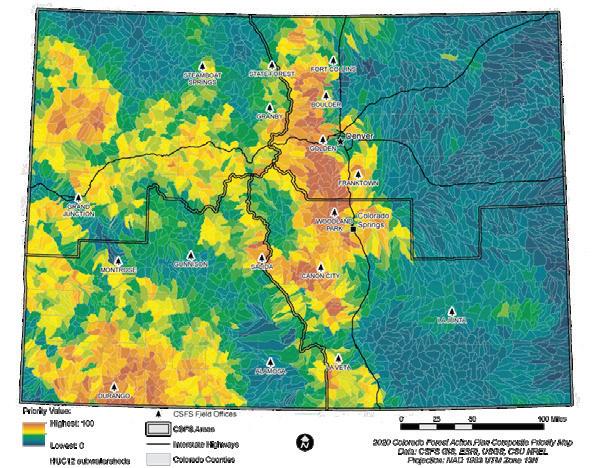
Ten percent of Colorado’s 24 million acres of forests need urgent attention to address forest health, wildfire risk, and threats to water supplies— at a cost of ~$4.2 billion
Communities Tackle Forest Treatment
About 80% of Coloradans rely on forested watersheds to deliver municipal water supplies. With increased fire incidence, various efforts are underway to minimize fire risk through forest treatments.
Community Wildfire Protection Plans (CWPPs) are locally drafted to reduce fuels and address concerns. Colorado’s SB 09-100 set the intention for all counties with fire hazards to create a CWPP. As of May 2021, there were 249 CWPPs on the Colorado State Forest Service (CSFS) website, but 94% of them are over five years old.
Other forest management efforts are spearheaded by water providers and stakeholders partnering with state and federal agencies to protect their water. Such partnerships include Forests to Faucets, the Colorado-Big Thompson Headwaters Partnership, the Rio Grande Watershed Emergency Action Coordination Team, the Dolores Watershed Resilient Forest Collaborative, the San Juan Headwaters Forest Health Partnership, and others.