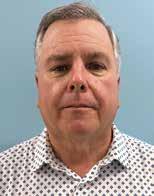
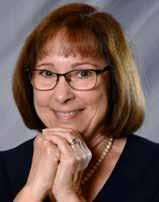
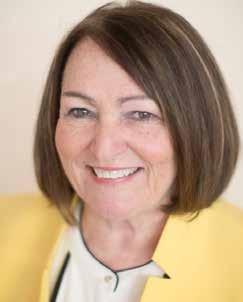
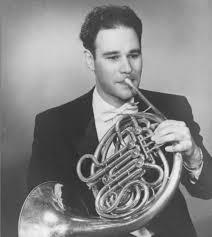
Executive Director Florida Music Education Association
Kathleen D. Sanz, PhD Hinckley Center for Fine Arts Education 402 Office Plaza Tallahassee, FL 32301 (850)878-6844 or (800) 301-3632 (kdsanz@fmea.org)
Editor-in-Chief
Kelly Miller, DMA University of Central Florida 12488 Centaurus Blvd. Orlando, FL 32816-8009 (407)823-4545 (kelly.miller@ucf.edu)
Editorial Committee
Terice Allen (850)245-8700, Tallahassee (tallen1962@hotmail.com)
Judy Arthur, PhD Florida State University, KMU 222 (850)644-3005 (jrarthur@fsu.edu)
Alice-Ann Darrow, PhD (alifsu@mac.com)
Jeanne Reynolds (jeannewrey@gmail.com)
John K. Southall, PhD Indian River State College, Fort Pierce (772)462-7810; (johnsouthall@fmea.org)
Advertising Sales Valeria Anderson (val@fmea.org) 402 Office Plaza Tallahassee, FL 32301 (850)878-6844
Official FMEA and FMD Photographers
Bob O’Lary Amanda Crawford
Art Director & Production Manager
Lori Danello Roberts LDR Design Inc. (lori@flmusiced.org)
Circulation & Copy Manager
Valeria Anderson, (800) 301-3632
Copy Editor Susan Trainor
Advertiser Index
The Florida Music Director is made possible by businesses and organizations that advertise with us. They make it possible to provide you with a high-quality publication, and we gratefully acknowledge their support of our mission. We hope you will take special notice of the following advertisement and consider the products and services offered. It is another important way you can support your professional association and the enhancement of Florida music education.
The publisher does not endorse any particular company, product, or service. The Florida Music Education Association (FMEA) is not responsible for the content of any advertisement and reserves the right to accept or refuse any advertisement submitted for publication. Information for advertisers (rate card, insertion orders, graphics requirements, etc.) can be found at FMEAMediaKit.org Florida Music Director reserves the right to refuse any ad not prepared to the correct specifications OR to rework the ad as needed with fees applied.
ADVERTISERS
Florida International University...................................................... 4
Stetson University ........................................................................... IFC
The advertisers shown in bold provide additional support to FMEA members through membership in the Corporate and Academic Partners (FCAP) program. FCAP partners deserve your special
2025–26 FMEA MEMBERSHIP: You are eligible for membership in the Florida Music Education Association if you are an individual engaged in the teaching, supervision, or administration of music in elementary and secondary schools, colleges, or universities within the state. Visit FMEA.org/membership to learn more about the benefits of active membership.
SUBSCRIPTIONS: Direct correspondence regarding subscriptions to: Hinckley Center for Fine Arts Education, 402 Office Plaza, Tallahassee, FL, 32301-2757. Subscription cost included in FMEA membership dues ($9); libraries, educational institutions, and all others within the United States: $27 plus 7.5% sales tax.
SUBMISSIONS: Article and art submissions are always considered and should be submitted on or before the 1st of the month, one month prior to the publication issue to: Kelly Miller, DMA, kelly.miller@ucf.edu.
All articles must be provided in digital format (e.g., Microsoft Word). All applicable fonts and images must be provided. Images must be at least 300 dpi resolution at 100% of the size. All submissions must be accompanied by a proof (color, if applicable). Ads may be submitted via email to val@FMEA.org
CIRCULATION: The circulation of the Florida Music Director is 4,500 educators. Published eight times annually by The Florida Music Education Association, Hinckley Center for Fine Arts Education: 402 Office Plaza, Tallahassee, FL 32301FMEA reserves the right to approve any application for appearance and to edit
MESSAGE
MESSAGE
The Power of Our Profession
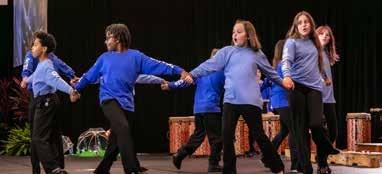
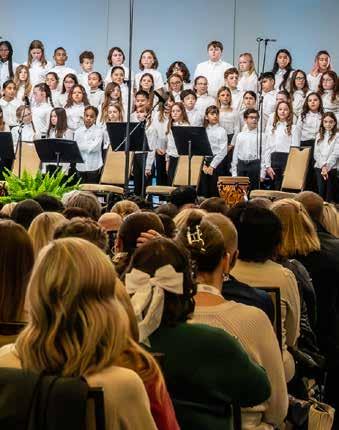
Welcome to March 2026. Thank you to everyone who attended our conference this past January! It was so great meeting so many new faces and reconnecting with familiar ones. The power of our profession was evident throughout the week, and the collective impact we made as a music education family in Tampa will resonate for a lifetime—for our all-state students, conference attendees, parents, chaperones, and our corporate and academic partners. Bravi tutti!
We are looking forward to a busy spring and summer. District and state music performance assessments (MPAs) are underway through our component associations and our sister organization, FSMA. These benchmark performances provide our educators and students a wonderful opportunity to showcase their achievements on stage and receive world-class feedback to reach the next level. Congratulations to all of you for preparing your students so diligently.
As announced in January, the Center for Fine Arts Education (CFAE) named Scott Evans our new CEO. Scott brings a wealth of public school and nonprofit experience to the role. We look forward to working with him and the outstanding team at CFAE to continue advancing music education across our state!
I am also pleased to announce a new way to connect with our leadership: the FMEA President’s Virtual Town Hall. Scheduled for March 30, 2026, this event offers an open forum to ask questions, discuss the future of our association, and provide input on the vital topics facing music education today. Please watch your inbox for an email from FMEA with registration details and the participation link.
On behalf of the Executive Committee and Board of Directors, we wish you a phenomenal spring semester. I would like to close by restating a portion of my remarks from this year’s conference:
Be the person in the arena—do the hard thing. When work is done with a spirit of empowerment for our students and a selfless dedication to our craft, others in our community begin to recognize and articulate the true power of our profession.
Onward, my friends.
Always musically yours,
Harry “Skip” Pardee, EdD, President Florida Music Education Association
Harry “Skip” Pardee, EdD
President Florida Music Education Association
APPLY NOW
June M. Hinckley Music Education Scholarship
The Florida Music Education Association (FMEA) is soliciting scholarship applications for the June M. Hinckley Music Education Scholarship. The Association will award $1,000 scholarships to selected 2026–27 graduating high school students who were accepted to a Florida all-state ensemble and who intend to major in music education at a Florida college or university.
How to Apply: Fill out the online application using the link below. As part of the online process, you will be asked to upload these files:
w Essay: Answer both of the following questions in a typed response of approximately 1,200 words and save it as a Microsoft Word (.docx) file:
1) Why do you wish to become a music educator?
2) Why should music be available to all students?
w Three Letters of Recommendation signed and scanned as PDF files
w High-Quality Headshot Photograph, such as your senior photo or a similar image. This will be published in the Florida Music Director magazine if you are one of the scholarship winners.
2026 Scholarship Online Application
An OFFICIAL COPY of your transcript (must remain sealed) must be sent to the following address:
June M. Hinckley Music Education Scholarship
Attn: Val Anderson
402 Office Plaza Tallahassee, FL 32301
Postmark Deadline: April 17, 2026
Applications will be reviewed by a representative committee of teachers, administrators, and music educators convened by FMEA. Notification will be made by May 30. Monies awarded will be distributed to the appropriate college or university once the student is enrolled.
About June M. Hinckley
As arts education specialist for the Florida Department of Education, June Hinckley led the development of the Sunshine State Standards for the Arts, which are based on the National Arts Standards and were adopted by the Florida State Board of Education in 1996. Hinckley assisted schools and school districts with the implementation of the arts standards and with connecting the arts with the state accountability and testing program, and she served as a liaison among the various K-12 arts education groups, higher education, and community arts organizations. She was a founding organizer of the Arts for a Complete Education project, which has coalesced the various community, industry, and school arts organizations in Florida to work cooperatively and proactively to improve the quality and quantity of arts programs throughout the state.
N O T E SFLORIDA SCHOOL MUSIC ASSOCIATION
Benny L. Bolden, Jr., EdD President Florida School Music Association
A SEASON OF Excellence, Purpose, and Gratitude
s we turn the page into the February/March edition of the Florida Music Director, I want to begin with a resounding congratulations to our entire Florida music education community on yet another outstanding FMEA Professional Learning Conference. Once again, our membership demonstrated why Florida continues to be a national leader in music education—through preparation, professionalism, innovation, and a shared commitment to students.
From inspiring performances and high-quality clinics to meaningful fellowship and collaboration, this year’s conference reflected the very best of who we are. These moments remind us that FMEA is not simply an organization; it is a community of educators united by purpose, passion, and an unwavering belief in the transformative power of music. Thank you to our conference leadership, performers, clinicians, exhibitors, volunteers, and every director who showed up ready to learn, connect, and grow.
As we move from conference season into music performance assessment (MPA) season, I want to take a moment to reframe how we view this important milestone. While ratings are often the most visible outcome, MPA represents something far greater. It is a powerful instructional tool—one that promotes goal setting, discipline, teamwork, accountability, and musical literacy. It teaches students how to prepare with intention, perform under pressure, receive feedback, and grow from experience.
Beyond the scores and plaques, MPA builds confidence, character, and community. It reinforces the educational value of music as a vehicle for critical thinking, emotional expression, and lifelong skills. To our directors: thank you for the countless hours spent rehearsing, encouraging, adjusting, and believing in your students. To our adjudicators and support teams: thank you for serving with
professionalism and care. And to our students: your dedication and courage on the performance floor matter—far beyond a rating.
This season also marks a deeply personal moment for me, as my term as president of the Florida School Music Association begins to draw to a close. Serving this organization has been one of the greatest honors of my professional life. To have had the opportunity to lead FSMA— and to do so as the first African-American president in its history—is something I do not take lightly.
I stand on the shoulders of many who paved the way, and I am profoundly grateful for the trust you placed in me. Together, we have worked to strengthen relationships, expand access, elevate voices, and ensure that every student—regardless of ZIP code or background—has the opportunity to experience a high-quality music education. This milestone is not mine alone; it belongs to all of us who believe that representation, inclusion, and excellence must walk hand in hand.
As I reflect on this journey, my heart is full of gratitude—for the Executive Committee, our district leaders, our teachers, our students, and the countless individuals who make FSMA strong. Though my term may be ending, my commitment to music education in Florida remains steadfast.
Thank you for allowing me the honor of serving. Thank you for the work you do every day. And thank you for continuing to make music matter for our students, our schools, and our state.
With pride and appreciation,
Benny L. Bolden, Jr., EdD, President Florida School Music Association
AdvocacyREPORT
A Constellation of Miracles
round 20 years ago, the day before the FMEA conference was set to begin, then-FMEA President Frank Howes said something that has stayed with me ever since. He looked around at everything about to unfold and said simply, “It’s a miracle.” A few years later, when it was my turn as FMEA president, I found myself standing in that same spot in the Marriott lobby on the day before the conference was to begin, feeling the same excitement, anticipation, and if I’m honest, a bit of anxiety. I remembered Frank’s words. There are so many moving parts to this conference, and yet it all comes together in a way that
feels almost magical. Indeed, it’s miracle.
Twenty or so years later, I realize it’s actually a constellation of little miracles that results in the big miracle and magic of the FMEA Professional Learning Conference. Each of the 24 all-state ensembles and their hard-working coordinators represent their own miracles. There is no other state with this large number of all-state ensembles. Each presenter and session coordinator creates their own special miracles. Every invited performing ensemble inspires us and moves us. The outstanding exhibits are second to none and exist only because of the remarkable
work of our staff and board members. I could go on, but you see the pattern. Indeed, miracles are happening everywhere. They happen because so many people are working incredibly hard to make their small part of the conference not only exceptional, but better than it has ever been before. Because of each one of these people, the FMEA conference becomes far greater than the sum of its parts, “a true
miracle,” in the words of Frank Howes.
Of course, the conditions for this constellation of miracles to occur would not be possible without the incomparable FMEA staff—Dr. Kathleen Sanz, Val Anderson, Dr. Josh Bula, Jasmine Van Weeldon, Siena Deaton, and FMEA financial consultant Richard Brown; the extraordinary FMEA conference planning chairperson, Dr. John
Angela Hartvigsen
Jeanne W. Reynolds
Southall, and his team; the hardworking FMEA Executive Committee—Dr. Skip Pardee, Jason Locker, and Bernie Hendricks; the entire FMEA Board of Directors; and all component boards and committee members. So many people working together, all focused on creating an annual miracle. It’s truly impressive.
Advocacy Hub
Please allow my advocacy co-chairperson, Angela Hartvigsen, and I to highlight our own advocacy miracle workers. Our Advocacy Committee planned and executed a very successful Advocacy Hub this year. We want to give a big shout out to Jon Casañas who envisioned the various advocacy stations we rolled out this year. Jon’s creativity, passion, and enthusiasm for advocacy is its own small miracle. We offer our sincere thanks to every FMEA member who worked at the Advocacy Hub. There are too many to mention here, but suffice it to say, we had Advocacy Hub volunteers who represented our entire membership— including band, chorus,
orchestra, elementary general music, contemporary media, supervisors, emerging leaders, collegiate, and retired members. The breadth of volunteers suggests our advocacy efforts are strong and will continue to grow.
If you have not checked out the Advocacy Hub page, we encourage you to do so:
FMEA Advocacy Hub.
Legislative Session and Legislative Platform
We invite you to take some time to read and advocate for the issues on our legislative platform which is posted on page 10.
The platform bullets we are most heavily focused on are:
w Support accountability revision that would award an acceleration point for students who earn the Seal of Fine Arts.
w Simplify the Florida Education Finance Program (FEFP) and ensure transparency by creating a separate funding stream for the voucher program (Family Empowerment Scholarships).
• At the time of the writing of this article,
we are supporting Senate Bill 318 that improves oversight and predictability within scholarship programs while protecting public school districts from sudden enrollment and funding shifts.
w Support legislation to address concerns related to co-location issues associated with prior Schools of Hope legislation.
w Fully fund the Division of Arts and Culture Grants.
Lobbyist and Grassroots Efforts
FMEA is working with a new lobbyist this year, and we are hopeful this partnership will help us build a stronger relationship with the Florida Department of Education to expand high-quality, comprehensive music and arts education access for all students. Who knows? Maybe we will see small miracles in the years to come.
Although you may be reading this near the end of
this legislative session, it is never too late to strengthen your advocacy skills. Our grassroots network remains our strongest asset. Stay focused and willing to do your part to make arts education stronger in Florida. This may involve calling a legislator, speaking at a community event, or staying engaged in the local elections, including school board races. Be ready to speak up for strong music education for all.
Hopeful Future
We will realize small advocacy wins when we come together and each do our part. Thanks to my colleague and friend, FMEA Past President Frank Howes, for his astute observation about the “miracle” of the FMEA Professional Learning Conference. Indeed, FMEA inspires a constellation of miracles, not only in Tampa each January, but throughout the year in countless classrooms and the halls of the Florida Legislature.
Jeanne W. Reynolds
2026 LEGISLATIVE PLATFORM
The Legislative Platform is a product of the Center for Fine Arts Education Advocacy Committee
Fine Arts Academic Achievement and Alignment
w Support accountability revision that would award an acceleration point for students who earn the Seal of Fine Arts
w Allow enrollment in one year of Dance Technique Courses to satisfy the one high school required PE/Health course (HOPE).
w Allow participation of 2 years of marching band to satisfy the school-required PE/Health requirements, including the Personal Fitness Requirement.
w Oppose mandates and/or legislation that may cause unintended consequences of limiting students’ access to sequential fine arts coursework, including the continued erosion of the Fine Arts Credit.
w Support funding and/or processes to make Florida arts education data accessible to all stakeholders, either by funding membership in the Arts Education Data Project https://artseddata.org or streamlining DOE data for greater ease and accessibility.
w Support additional funding for the Early Childhood Music Education Incentive Program. Florida Statute 1003.481 recognizes the importance of early childhood education.
Education Funding
w Fully fund Division of Arts and Culture grants that earn passing scores.
w Provide for an annual increase in the Base Student Allocation commensurate with the rate of inflation and cost of living to ensure a high-quality, comprehensive education, including access to arts programs for all students.
w Simplify the Florida Education Finance Program (FEFP) and ensure transparency by creating a separate funding stream for the voucher program (Family Empowerment Scholarships).
w Support legislation to address concerns related to co-location issues associated with prior Schools of Hope Legislation.
w Minimize the impact to school districts from any proposed property tax reform
Educational Accountability
w Require the same accountability measures for all schools and vouchers receiving state funding.
Teacher Recruitment and Retention
w Provide flexibility and support for recruiting and retaining highperforming teachers and staff to deliver high-quality instruction (including arts education).
w Increase teacher salaries in a meaningful, sustainable manner to attract and retain highly effective teachers.
w Support any potential legislative language to include stipends for visual and performing arts teachers for duties outside the contracted workday.
w Add clarifying language to HB 875 (from the 2025 session) to ensure performing and visual arts teachers possess the qualifications and training needed to provide high-quality instruction for Florida students.
FMEA Collegiate Advocacy Day
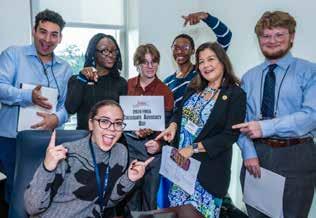
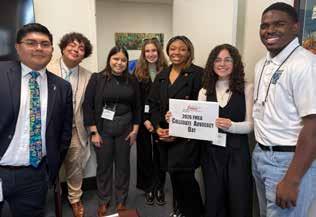
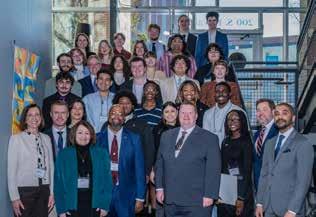
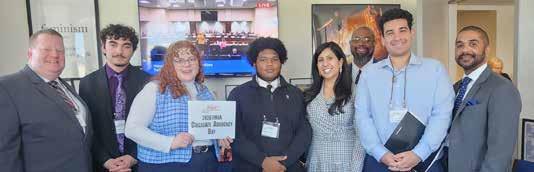
The 10th annual FMEA Collegiate Advocacy Day was held February 10, 2026. Florida NAfME Collegiate members from five universities traveled to Tallahassee to meet with legislators and advocate for music education. Students spoke passionately and effectively about the importance of music education in all Florida schools. Topics they addressed included acceleration points on the school grade for students who earn the Seal of Fine Arts, fully funding the arts and cultural grants, and the importance of equitable funding for education. These students inspire all of us to be the best advocates we can be.
from the 2026 FMEA Professional Learning Highlights
Conference & All-State Concerts
Highlights
2026 FMEA HALL OF FAME
is prestigious award honors individuals for outstanding contributions over an extended period of time to music and education in Florida, as well as throughout the nation.
Dr. Kenneth Williams
2026 H of F e Inductee
KennethWilliams, PhD, a Florida native, recently retired from the distinguished music faculty of Douglas Anderson School of the Arts (DA) in Jacksonville, Florida. During his tenure at DA, he taught conducting and literature, music theory, music history, and served as conductor of the DA Symphonic Band. He earned a BA in music education and an MM in conducting and wind literature from the University of South Florida and a PhD in music education from Florida State University. His academic journey was shaped by esteemed mentors including Charles Quarmby, Charles Johnson, James Croft, Jerry Junkin, and Clifford Madsen.
With a career spanning more than five decades, Dr. Williams has conducted ensembles across middle school, high school, university, and professional levels, leaving an indelible mark on music education and performance throughout the state and beyond. He began his career in Sarasota, Florida, teaching at Booker School, Sarasota High School, and the Sarasota Visual and Performing Arts Center, while also holding a principal chair with the Florida West Coast Symphony Orchestra. His subsequent positions included directing bands and orchestras at Winter Park High School, serving on the conducting faculty at LaVilla School of the Arts in Jacksonville, and leading as arts supervisor for the Christina School District in Delaware. Within Duval County Public Schools, he also served as director of fine arts and instrumental music specialist.
Dr. Williams’ academic affiliations include faculty appointments at Florida State College at Manatee, Tallahassee State College, Florida State University, and the University of Texas at San Antonio (UTSA), where he chaired the Music Education Department and conducted
the UTSA Symphonic Band. He has also served as associate conductor for the Florida West Coast Symphony Youth Orchestra, the Florida Symphony Youth Orchestra, and the Tallahassee Symphony Youth Orchestra, and as conductor of the San Antonio Symphony Youth Orchestra and the Cannon Music Camp Orchestra at Appalachian State University.
A passionate advocate for music education, Dr. Williams is a past president of both the Florida School Music Association and the Florida Music Education Association. He has served extensively as a clinician, adjudicator, and consultant. At present, he is an artistic consultant to the First Coast Wind Symphony in Jacksonville. He has adjudicated for the Florida Bandmasters Association and the Florida Orchestra Association state music performance assessments. He has also served as conductor and presenter at the prestigious Midwest Clinic in Chicago and has twice conducted a Florida all-state band. His written contributions have appeared in Florida Music Director, Bandworld Magazine, Glaesel/Selmer Newsletter, National Band Association Journal, and Music Educators Journal Dr. Williams is a member of the National Association for Music Education, the National Band Association, the Florida Music Education Association, and the Florida Bandmasters Association.
In recognition of his distinguished career and service, Dr. Williams was inducted into the Florida Bandmasters Association Roll of Distinction of the FBA Hall of Fame in 2016. He remains active as a conductor, clinician, and advocate for music education, continuing to inspire the next generation of musicians through his artistry, mentorship, and lifelong dedication to our noble profession.
ItAWARDS COMMITTEE
Sondra A. W. Collins Chairperson
is my great honor to introduce our 2026 FMEA award winners! The FMEA Awards program recognizes the efforts and accomplishments of exemplary music educators, school and district administrators, business partners, music programs and projects, and others who have made an outstanding contribution to music education. Their efforts help FMEA attain our mission of promoting a quality, comprehensive music education in all Florida schools. Please applaud these individuals, as well as all the awardees that came before them, as we strive to showcase exemplary music education throughout our state. As you read about our 2026 FMEA award winners, you may have exemplary music educators, administrators, businesses, or programs and projects come to mind. Please remember them when next year’s nomination period begins this spring and nominate them!
Congratulations to all of our 2026 FMEA awardees! We honor you and thank you for your commitment to quality and comprehensive music education for ALL, in ALL schools.
MUSIC EDUCATOR OF THE YEAR
The FMEA Music Educator of the Year designation is awarded to the music educator who has served their students, community, and profession in an exemplary manner. This award recognizes outstanding merit in music teaching. The recipient must have demonstrated notable achievement as a music education professional for 10 or more years, and must have demonstrated continued contributions/commitment to the profession and to FMEA/NAfME.
MUSIC EDUCATOR OF THE YEAR
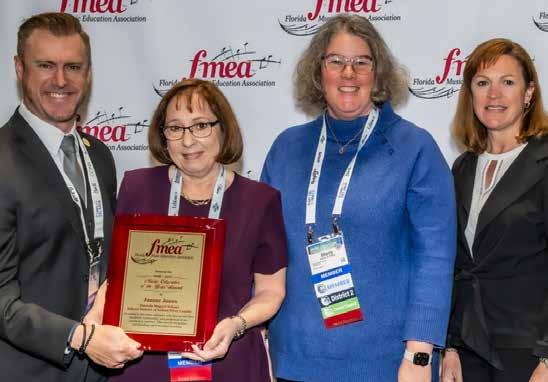
Janine Jones Elementary Music Educator Osceola Magnet School School District of Indian River County Nominated by Sherry St.Petery on behalf of FEMEA
Janine Jones is an elementary school music educator at Osceola Magnet School in Vero Beach, Indian River County, Florida. Mrs. Jones began her teaching career 45 years ago in New York State and eventually moved to Florida, where she has been teaching elementary music for the past 40 years. She is also children’s choir director at First Presbyterian Church in Vero Beach and administrative director of PRIMO School of Music.
Mrs. Jones has maintained a private flute studio for the past 45 years. She teaches flute and flute choir at Primo School of Music in Vero Beach. Her flute students have received numerous superior ratings at solo and ensemble events and have advanced to play in all-state ensembles.
Mrs. Jones started as a middle school band director. After finding her way to elementary music, she developed an interest in the Orff philosophy for teaching music and sought Levels 1, 2, and 3 Orff Certification with Jim Solomon
and Shirley McRae. She went on to take the Master Class with Jos Wuytack at Memphis State University. Mrs. Jones attended many of the national American Orff Schulwerk conferences to further her studies in the Orff teaching philosophy. She attends the Florida Music Education Professional Learning Conference annually and has participated in the Curriculum Fair to present grants and curriculum ideas. She is a national board certified teacher in early-middle childhood music. She has dedicated her 45 years of teaching to building strong programs
for young musicians, as reflected in the many times her school was named a Florida Music Demonstration School. Her Elementary Orff Ensemble has twice performed at the FMEA conference as a featured Mini-Concert, in 2002 and 2010. Mrs. Jones has had students participate in both the All-State Elementary Chorus and the All-State Elementary Orff Ensemble. She has also served as an adjudicator for both ensembles.
To offer varied performance opportunities for her students, Mrs. Jones has continued on page 20
continued from page 19
had the following performing groups in her school: Third, Fourth, and Fifth Grade Chorus; Fifth Grade Honors Chorus; Explorer Ensemble; Orff Club; Ukulele Club; Drumming Ensemble; and Recorder Club.
Mrs. Jones believes that a teacher can be more successful if they are connecting, communicating, and learning from other professionals. This begins within one’s own school, where a music teacher is often the only music person in the building. Building relationships with colleagues is essential to a strong program. Becoming involved in school life is a vital component of being successful. She has practiced this belief by becoming involved in the School Advisory Council (chair) and taking on the roles of department chair, magnet school coordinator, PBIS team, and teacher liaison for the PTA board. As magnet school coordinator, she applied for and received many school awards including Magnet Schools of America Merit Award, Florida Golden School Award, and Five Star Award. She has coordinated schoolwide celebrations and events and led the task force to rebrand her current school to a school of engineering and mathematics. Her involvement also included team-building activities for staff, and on several occasions she has led music ensembles for staff members, including Orff ensembles, drum circles, and singing. The latest event occurred when she taught her staff the Engineering Design Process song she wrote to emphasize this important piece of the curriculum, complete with Orff instruments and added percussion. The staff recorded it and also played it for the students at the school.
Along with her leadership roles within her school, Mrs. Jones has been a leader for the district music staff. She serves as the district elementary lead teacher. In
that role she has organized district events and concerts for elementary. Among these events is a Saturday MusicFest, open to elementary students, where students rotate through different music stations such as singing, drumming, instruments, movement, ukulele, and recorder. She has supervised three student teachers and has mentored more than 20 new teachers, both in the traditional certification program and some involved in the alternative certification program. Mrs. Jones has worked to provide professional development in the district that is relevant to elementary music teachers. She has served as a liaison between elementary and secondary music teachers and has coordinated K-12 AllCounty Music Festivals for the district.
Mrs. Jones has received the Florida Music Demonstration School designation five times in her career, in two different schools. She has been named Teacher of the Year four times and has advanced to a district finalist twice. She has twice been nominated for the Education Foundation Award of Excellence and has been Mainstream Teacher of the Year. She continually gets “Highly Accomplished” ratings every year.
In her efforts to provide a complete and quality music education for all students, Mrs. Jones has written and received 14 grants for her classroom. She has written five additional grants for her school, totaling over $35,000 in funding for her music programs and her school.
Mrs. Jones believes that community partnerships are also an important part of building a strong music program within a school. Her performing groups have performed annually for the Vero Beach Museum of Art, both at their Holidays at the Museum event and at the Children’s Art Festival. Her students were filmed performing the jingle for the Learning Alliance in Vero Beach and currently are
working on the “Lullaby Project” with that same community group. Other community performances include events such as ArtWalk, School Choice Fairs, Teacher of the Year Gala, and more. Her work at First Presbyterian Church of Vero Beach has led to a strong partnership between the schools and the church. The church hosts the Elementary MusicFest held annually and assists with various costs associated with that program. Mrs. Jones teaches music at the church’s after-school program on Wednesdays. She also offers a free opportunity for elementary students to stay after the program to participate in more advanced music activities. She also hosts a music summer camp at the church.
Mrs. Jones’ teaching career has spanned 45 years in two states, and her philosophy has remained consistent. Mrs. Jones believes that every child has the right to a quality music education and that it is essential for their education, as well as vital for their humanity. She asserts that if quality opportunities are provided for students, they will come, they will learn, and they will thrive.
COLLEGE MUSIC EDUCATOR OF THE YEAR
The FMEA College Music Educator of the Year designation is awarded to the college music educator who has served their students, community, and profession in an exemplary manner. This award recognizes outstanding merit in college-level music teaching or music administration. The recipient must have demonstrated notable achievement as a music education professional for 10 or more years, and must have demonstrated continued contributions/ commitment to the profession and to FMEA/NAfME.
COLLEGE MUSIC EDUCATOR OF THE YEAR
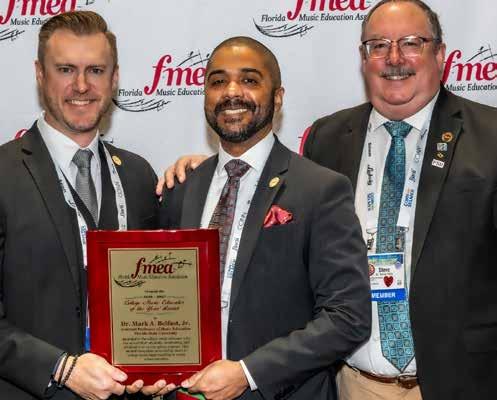
Mark A. Belfast, Jr., Ph.D.
Assistant Professor of Music Education
Florida State University
Florida NAfME Collegiate Advisor FMEA Board of Directors
Nominated by Steven N. Kelly, PhD
Dr.Mark A. Belfast, Jr., is an assistant professor of music education at Florida State University. At FSU, Dr. Belfast teaches undergraduate and graduate music education courses, directs dissertation and thesis projects, serves as the faculty advisor to the award-winning FSU Collegiate NAfME Chapter, and is the associate director of the FSU Summer Music Camps. A native of Alabama, he received his BME and MEd from Auburn University and his PhD in music education from Florida State University. Dr. Belfast also serves as the Florida NAfME Collegiate advisor on the FMEA Board of Directors. Prior to coming to FSU, Dr. Belfast taught K-12 music in Alabama and Georgia and served on the faculty of Southeastern University in Lakeland, Florida, as both professor and coordinator of music education and as the assistant dean of the College of Arts and Media.
Dr. Belfast is a passionate, consummate professional focused on developing future music teacher educators and work-
ing with individuals with special needs. Dr. Belfast’s teaching experience includes undergraduate and graduate music education courses, as well as directing public school instrumental music programs in Alabama and Georgia. His research interests include teacher effectiveness, music teacher education, jazz pedagogy and performance, and music for special populations. Dr. Belfast has presented research and educational clinics in regional, national, and international ven-
ues, including the International Society for Music Education (ISME) Special Music Education and Music Therapy
Pre-Conference Seminar, the National Association for Music Education (NAfME) Music Research and Teacher Education National Conference, NAfME Biennial Northwest Division Conference, Desert Skies Symposium for Research in Music Learning and Teaching, the Society for Music Teacher Education Symposium on continued on page 22
continued from page 21
Music Teacher Education, and the Florida Music Education Association Professional Learning Conference. The results of his research have appeared in a variety of professional publications, including the Proceedings of the 24th International Seminar of the Commission on Special Music Education and Music Therapy, Journal of Music Teacher Education, Missouri Journal of Research in Music Education, The Journal of the Desert Skies Symposium on Research in Music Education, NBA Journal, and Florida Music Director. In addition to his research and teaching, Dr. Belfast serves on the advisory board for the Desert Skies Symposium for Research in Music Learning and Teaching, the editorial board for the Research Perspectives in Music Education journal, and he is co-chair of the ISME Special Music Education and Music Therapy Commission.
In addition to his many academic and leadership activities, Dr. Belfast is
widely recognized as one of the premier jazz adjudicators and clinicians in our state. Since coming to Florida, Dr. Belfast has been invited to conduct the Florida All-State Middle School Jazz Band and numerous all-county and district jazz bands. He has been invited to adjudicate jazz music performance assessments in nearly every district in the state while also being invited as a clinician in many band rooms.
Dr. Belfast is a strong advocate for preservice music teacher educators. He has served on the FMEA Board of Directors as the Florida NAfME Collegiate advisor since 2019. During this time, the collegiate memberships at colleges where he has taught have surged. The overall number of statewide collegiate chapters and members has dramatically increased, and at the national level the FSU Collegiate NAfME Chapter won National Chapter of the Year in 2025 and the president of that
organization won the national Professional Achievement Award in 2025. Additionally, Dr. Belfast has continuously been active in promoting the Florida collegiate members to participate in the annual Collegiate Advocacy Day event each year at the Florida State Capitol. The FMEA website acknowledges that the collegiate efforts have directly helped FMEA and Florida music education to achieve legislative successes with the new Florida Seal of Fine Arts and the new law allowing marching band participation to count as PE credit.
Dr. Belfast is highly respected by so many across the state of Florida. Many know him for his passionate, humble personality, one who never hesitates to assist music educators at every level. They talk about his ability to connect with students and teachers, his unwavering sense of professionalism, and his drive to elevate music education wherever he is.
The “Immediate Impact” Music Educator Spotlight recognizes outstanding accomplishments of early-career music educators.
FMEA seeks to spotlight the outstanding work and accomplishments of music educators in the earlier stages of their teaching careers who are making an “immediate impact” in their schools, communities, and students. Through the power of music education, these ambitious FMEA members influence positive change, create amazing musical experiences for their students, and help enrich Florida’s music education community.
LET US BRAG ABOUT YOU!
Please submit the nomination form and materials for yourself or a colleague who exemplifies these criteria.
ELEMENTARY AND SECONDARY ADMINISTRATORS OF THE YEAR
The FMEA Administrator of the Year designation is awarded to a school administrator who is not a professional music educator, but who displays ardent support of school music programs. This award recognizes excellence in leadership, encouragement, and promotion of music education in Florida schools. The recipient must have demonstrated significant efforts in support of music education resulting in awareness or enhancement of the school’s music program, allocation of resources, and/or growth of music programs, as well as serving as an active administrator for a minimum of five or more years and employed in their current position for three years.
ELEMENTARY ADMINISTRATOR OF THE YEAR
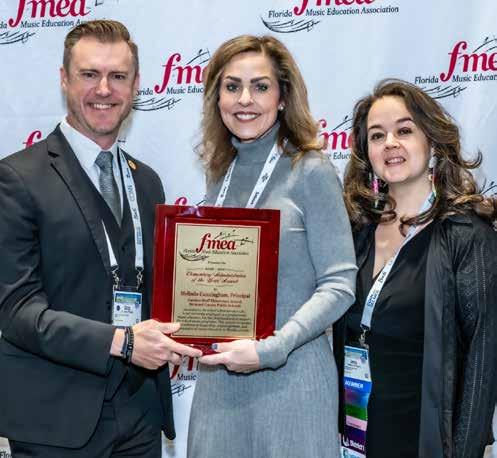
Melinda S. Cunningham Elementary Principal
Hawkes Bluff Elementary School
Broward County Public Schools
Nominated by Jessica Gronberg on behalf of FEMEA
Melinda S. Cunningham is the principal at Hawkes Bluff Elementary School in Davie, Florida, within Broward County Public Schools. Born and raised in Broward County, Melinda is a proud product of Broward County Public Schools, where she attended elementary, middle, and high school. Her deep roots in the community have shaped her lifelong commitment to education and service.
Melinda earned her undergraduate degree from Florida International University, followed by a master’s degree in elementary education from Florida Atlantic University. Driven by a passion for leadership and school improvement, she went on to obtain her certificate in educational leadership from Nova Southeastern University.
With a heart rooted in education and a spirit devoted to community, Melinda has dedicated 34 years to Broward County Public Schools, including 25
years to Hawkes Bluff Elementary— eight years as assistant principal and the past 17 years as principal. Her career in education spans more than three decades. Beginning as a classroom teacher and curriculum facilitator in 1992, then serving as assistant principal for eight years, Ms. Cunningham has con-
tinuously demonstrated her unwavering commitment to student growth, creativity, and excellence. As principal, she has been a steadfast advocate for the power of music and the arts, ensuring that every child has the opportunity to shine. Her leadership is defined by a continued on page 24
commitment to academic excellence and a nurturing school culture that feels more like family than institution.
Under Melinda’s guidance, Hawkes Bluff Elementary has consistently achieved academic excellence, earning an “A” rating during her tenure as principal. Her visionary leadership and collaborative approach have empowered students, staff, and families to reach new heights of success. In recognition of her outstanding contributions to education, Melinda was honored with the Florida PTA Outstanding Principal of the Year Award—a testament to her dedication, impact, and advocacy for students and families across the state.
What makes Ms. Cunningham truly exceptional is her deep belief in the transformative power of music education. Her leadership is defined by openness, encouragement, and the joyful word she offers to every new idea: “Yes.” This spirit of affirmation has opened countless doors for the students of Hawkes Bluff, allowing them to pursue artistic dreams with confidence and enthusiasm. Because of her vision, music is not treated as an “extra” at Hawkes Bluff—it is embraced as essential to the whole child’s development.
County’s All-County Elementary Chorus and Music Showcase.
She has also championed opportunities for students to bring music into the broader community. Thanks to her leadership, Hawkes Bluff ensembles have proudly performed at the Fort Lauderdale International Airport, with community partners such as Lowe’s, at Relay for Life and other charity events, at Miami Heat and Miami Marlins games, and at the district elementary music performance assessment. Each of these experiences reflects Ms. Cunningham’s conviction that music education not only develops skills but also builds confidence, connection, and community pride.
Her vision for music education extends beyond performance opportunities. Ms. Cunningham has consistently supported the pursuit of resources to expand access for every child. Through her advocacy, the school has secured grants to provide class sets of ukuleles, Makey Makeys, and world drums; a full piano curriculum through Music and the Brain; and recorders for every third through fifth grader through Volta Music Foundation’s Link Up program. These efforts ensure that music is accessible, equitable, and woven into the daily lives of students.
contributed to the broader mission of elevating music education across Florida. She embodies the qualities of a true advocate: vision, passion, and unwavering support for teachers, students, and the power of the arts.
Ms. Cunningham works hand-inhand with students, staff, and families to ensure every child is empowered to reach their highest potential—academically, socially, and emotionally. Melinda’s vision is clear: every student deserves the opportunity to thrive in the areas where they shine brightest. Melinda is passionate about educating the whole child and providing experiences that allow all students to thrive and excel, wherever their passion takes them. She believes that it takes the entire school community to help students be successful and that by working together, all students can reach their highest potential.
Under her leadership, Hawkes Bluff has become a vibrant hub of musical opportunity. Students now benefit from a wide range of musical programs, including a thriving piano club, an energetic drumline club, two auditioned choruses combined as the Harmonious Hawkes, and a musical theater program. Ms. Cunningham’s encouragement has empowered students to reach beyond the walls of their school, successfully auditioning for and performing with all-state, regional honor choirs, and Orff ensembles; Rising STARS; and Broward
Ms. Cunningham’s leadership also shines in the annual Night of the Arts, a beloved community celebration that showcases student talent across disciplines. This event has grown into a tradition that reflects her belief in honoring creativity in all its forms, and in celebrating students as artists, musicians, and visionaries. At the heart of Ms. Cunningham’s leadership is the conviction that the arts are essential, transformative, and for every child. Her work has not only enriched the lives of students at Hawkes Bluff Elementary but has also
Beyond the school walls, Melinda finds joy in spending time with her family, diving into a good book, exploring new places, and engaging in local community events. One of Melinda’s greatest blessings has been witnessing former students return to Hawkes Bluff as parents—a testament to the lasting impact of her dedication and the enduring bonds she has helped build.
Throughout her career, Melinda has remained devoted to fostering a culture of collaboration, respect, and high expectations. Her unwavering belief in the power of community and her commitment to the success of every child continues to inspire those around her. continued from page 23
SECONDARY ADMINISTRATOR OF THE YEAR
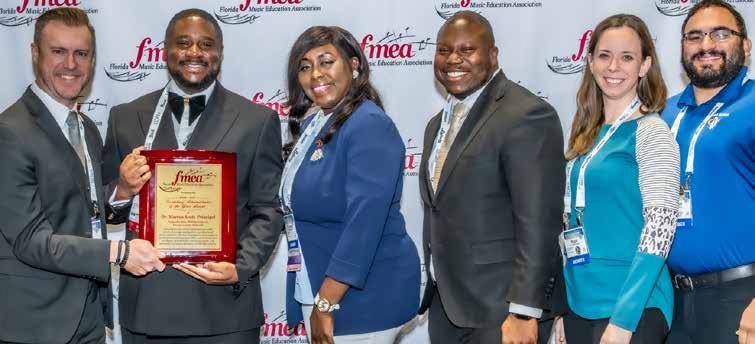
Marcus Scott, EdD
Secondary Principal, Augusta Raa Middle School
Leon County Schools
Nominated by Arnekua Jackson, PhD, on behalf of the FMEA Multicultural Network
Dr.Marcus Scott is the principal at Augusta Raa Middle School in Leon County Schools. He is a passionate music educator, leader, and lifelong advocate for arts education. A native of Atlanta, Georgia, Dr. Scott discovered his love for music at an early age, actively performing in concert and marching bands throughout middle and high school. His musical excellence led him to perform in several prestigious events, including the Opening Ceremonies of the 1996 Olympic Games, the Carnival of Nice Parade in France, and the Macy’s Thanksgiving Day Parade in New York City.
Dr. Scott continued to nurture his passion for music at Florida A & M University in Tallahassee, Florida, where he was a
proud member of the world-renowned Marching 100. He earned his BS in music education in 2003, laying the foundation for a distinguished career dedicated to inspiring and educating young musicians. He began his professional journey as band director at Nims Middle School in Tallahassee, Florida, where for six years he developed a dynamic music program that emphasized creativity, discipline, and student growth. His success in the classroom and on the podium resulted in many superior ratings in concert band MPA. This achievement reflected his belief that music education plays a vital role in academic achievement and personal development. There, he inspired students through the language of music, using melody and rhythm to instill discipline, confidence, and self-expression. His background in music education is not merely a footnote in his biography; it is the foundation of his leadership philosophy. He understands the transformative power of music because he has witnessed it firsthand in the lives of his students.
Building upon his background in music
and education, Dr. Scott transitioned into school administration, serving as assistant principal at Godby High School and Deerlake Middle School, before becoming principal of Raa Middle School in 2020. In each role, he has remained deeply committed to promoting the arts as a cornerstone of a well-rounded education, ensuring that every student has access to meaningful and high-quality musical experiences. Today, as principal of Augusta Raa Middle School, Dr. Scott leads a school of more than 860 students and 85 faculty and staff with the same passion he once brought to the rehearsal room. His leadership is marked by empathy, innovation, and high expectations. He ensures that music and arts education are not considered electives of convenience but essential pillars of student development. Under his administration, fine arts educators are supported, programs are funded, and student performances are celebrated as integral to the school’s culture.
Dr. Scott is more than a principal. He is a cultivator of excellence, a bridge-builder continued on page 26
Podcast
FL Music Ed
Tales from the Heart of Florida’s Music Education Community
Tune in as we delve into the heart of music education, exploring topics that resonate with our members and beyond. Whether you are a seasoned educator or a passionate student, this podcast is for you. With six insightful episodes already available for streaming, there’s no better time to join in the conversation.
Follow “Key Conversations” on Spotify or Apple Podcasts to receive instant updates whenever a new episode drops.
KEY CONVERSATIONS
continued from page 25
for underserved communities, and a passionate advocate for music and the performing arts as core components of a student’s academic and personal development. His journey from music classroom to principal’s office is not just a career trajectory—it is a story of purpose, impact, and heart.
What distinguishes Dr. Scott is his ability to seamlessly blend administrative excellence with arts advocacy. He does not simply allow music to exist—he elevates it. He has expanded career and technical education offerings in his school, increased certification exam success rates, and generated funding to meet technology needs, all while protecting and enhancing music program scheduling and visibility.
His leadership helped increase student access to dual enrollment courses, including partnerships with Florida Agricultural and Mechanical University and Embry-Riddle Aeronautical University. By creating innovative course offerings and alternative success plans for students at risk of not graduating, Dr. Scott has consistently shown a commitment to equity and achievement. These actions have contributed to a dramatic increase in school graduation rates, rising from 77% to 92% under his guidance.
But Dr. Scott’s vision extends beyond numbers. He fosters inclusive learning environments where music and creativity are accessible to all students. He partnered with Florida State University and the Center for Autism and Related Disabilities to create programs that help students understand and support peers with neurodiverse needs. His leadership ensures that music classrooms remain safe havens for exploration, acceptance, and expression.
In December 2022, Dr. Scott earned his EdD in higher education from Maryville University, further expanding his ability to influence educational leadership and policy.
Throughout his career, Dr. Scott has championed the transformative power of music education—empowering students to find their voices, express their creativity, and achieve excellence both inside and outside the classroom. His dedication continues to inspire future generations of music educators and student musicians alike.
His academic and professional credentials reflect not just ambition, but a profound dedication to lifelong learning and leadership. He serves as a mentor to teachers, a collaborator with parents, and a visionary for students. He is frequently called upon to navigate complex situations with calm clarity, whether managing emergency protocols, revising schoolwide discipline plans, or leading professional development.
FMEA SUPERINTENDENT OF THE YEAR
The FMEA Superintendent of the Year designation is awarded to the Florida school district superintendent who has displayed ardent support of the district’s school music programs. This award recognizes excellence in leadership, encouragement, and promotion of music education in Florida schools. The recipient must have demonstrated significant efforts in support of music education, resulting in awareness or enhancement of the county’s music program.
Criteria:
w Must be nominated by an active member of FMEA and NAfME.
w Must have demonstrated a significant contribution in support of music programs/curricula in the district schools. This should include exemplary programs of standards-based, sequential music curriculum offered as part of the school day, throughout elementary, middle, and high schools.
w Must have demonstrated evidence of districtwide policies and longrange plans for music education at all levels.
w Must have demonstrated evidence of equitable access to music programs across all grade levels, including financial support of music instruction and/or growth of music programs in the district.
SUPERINTENDENT OF THE YEAR
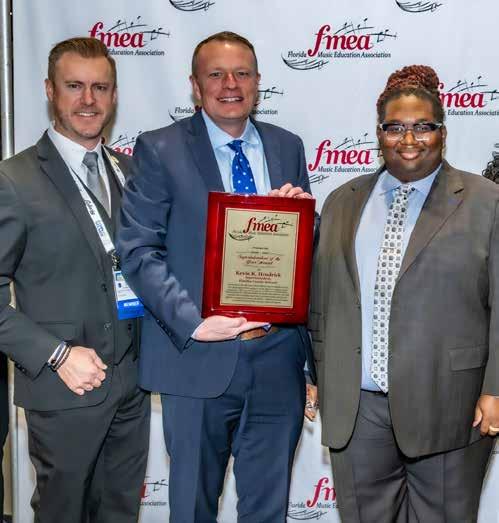
Kevin K. Hendrick Superintendent Pinellas County Schools
Nominated by Ajori Spencer
KevinK. Hendrick is the superintendent of Pinellas County Schools. He is an innovative educational leader and gifted communicator, committed to student achievement and building a culture of excellence. Before becoming superintendent, he played a pivotal role in arts education, assisting the committee that oversees the special millage referendum, which directly supports teacher training and music programs. During his leadership, Pinellas County Schools achieved an A district grade for the first time in 2024 and again in 2025.
When schools across the country faced the uncertainty of the pandemic, many districts made painful cuts to the arts. But in Pinellas County, Florida, Superintendent Kevin K. Hendrick charted a different continued on page 28
continued from page 27
path—one that not only protected music programs, but set them on a trajectory to thrive. His unwavering commitment to music education has positioned him as a leader whose vision should be recognized with the Florida Music Education Association’s Superintendent of the Year award.
Before his appointment as superintendent, Hendrick served as chief academic officer during one of the most challenging times in education. While districts elsewhere debated whether music programs could even continue, Hendrick insisted that Pinellas County’s programs would not only survive but flourish.
One of his earliest decisions was to ensure that marching bands were among the first groups allowed to perform again once health guidelines permitted. “Don’t we want more students participating in the arts, not less?” he asked—a question that became a guid-
ing principle for the district’s approach. That philosophy unlocked unprecedented access to federal ESSER and ARP funding for music programs, ensuring students had the resources and opportunities to stay engaged when they needed the arts most.
When Hendrick became superintendent, he immediately launched a districtwide series of “Listen and Learn” sessions. The arts-focused session quickly became the most attended of them all, confirming what he already believed: music and the arts are not side programs—they are central to student success and community pride. He then put this belief into practice by establishing the Office of the Student Experience, a department designed to bring together K-12 initiatives with the arts at its heart. His goal is clear: every child should have access to the creativity, discipline, and joy that music education provides.
Superintendent Hendrick emphasizes enhancing the student experience and is a strong supporter of the arts. He regularly attends various musical events throughout the district and advocates for improved music education for Florida’s students. He fosters partnerships with local museums, theaters, and cultural organizations, expanding opportunities for students to engage in the arts.
Hendrick’s advocacy for music education is not limited to policy—it’s personal. As a proud “band dad,” he has witnessed firsthand how music transforms students’ lives. This perspective drives him to act with urgency in leadership meetings, where he regularly highlights arts achievements and challenges principals to expand opportunities for students.
Every summer, he checks on staffing to make sure sequential music programs are fully supported from elementary through high school. His attention to detail ensures that students have highly qualified music educators in place from the very first day of school.
For decades, FMEA has been a leader in championing music education in Florida by providing support for local coalition building and actively supporting state legislative priorities.
GET INVOLVED!
Use these links to fnd your state senator and representative.
If you are interested in getting more involved in advocacy initiatives or need local support, please contact the FMEA offce.
(850) 878-6844 or (800) 301-3632 jeannewrey@gmail.com
Under Hendrick’s leadership, the Pinellas County School Board has also become a partner in celebrating the arts. Despite diverse viewpoints among board members, motions that support arts education regularly pass unanimously. At public meetings, student musicians and artists are recognized for their achievements, reinforcing the value of the arts at the highest levels of district governance.
While many districts face declining arts opportunities, Pinellas County has moved in the opposite direction—strengthening, expanding, and celebrating them. His work has earned him numerous awards. In May 2025, the University of South Florida College of Education chose him for the Dean’s Lifetime Achievement Award.
SCHOOL BOARD OF THE YEAR
The FMEA School Board of the Year designation is awarded to a Florida district school board or an individual school board member who has demonstrated support for and commitment to high-quality music education throughout the school district. This award recognizes excellence in leadership, encouragement, and promotion of music education in Florida schools
Criteria:
w Must be nominated by an active member of FMEA and NAfME.
w Must have demonstrated a significant contribution in support of music programs/curricula in the district’s schools. This should include exemplary programs of standards-based, sequential music curriculum offered as part of the school day, throughout elementary, middle, and high schools.
w Must have demonstrated evidence of districtwide policies and long-range plans for music education at all levels.
w Must have demonstrated evidence of equitable access to music programs across all grade levels including financial support of music instruction in the district.
SCHOOL BOARD OF THE YEAR AWARD
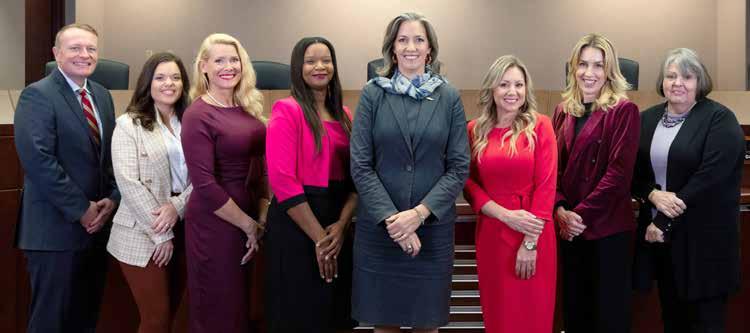
Pinellas County School Board Katie Blaxberg, Lisa N. Cane, Caprice Edmond, Laura Hine, Eileen M. Long, Stephanie Meyer, Dawn M. Peters
Pinellas County Schools
Nominated by Meghan Alfaro on behalf of FEMEA
Themission of the Pinellas County School Board is to provide the best opportunities for all students to succeed by adopting policies that ensure continual improvement of student achievement, a safe learning environment, and effective, efficient operations. As the governing body of the Pinellas County School District, the board oversees the control, operation, organization, management, and administration of schools in
Pinellas County, as outlined in Florida Statutes and State Board of Education rules. Beyond these essential responsibilities, the board has demonstrated an enduring commitment to ensuring that the arts, especially music, remain a vital part of every child’s education. That commitment has been clearly demonstrated through the long-standing support of the district’s special millage continued on page 30
continued from page 29
referendum. First passed by voters in 2004 at a one-half mill rate, the referendum dedicated a portion of its funding to the arts, protecting music programs during a time when many districts across Florida saw reductions or eliminations of arts opportunities. Recognizing the referendum’s impact, the community renewed it in 2008, 2012, 2016, and 2020, each time affirming its value to students.
In May 2024, the school board unanimously approved placing an increase before voters, raising the rate from onehalf mill to a full mill. This bold decision resulted in a successful public vote and expanded funding for schools across the county. With 15% of the revenue dedicated to the arts, the increase ensures that music education will not only be sustained but significantly expanded for future generations.
The results are already visible. For the first time, pre-K students are able to participate in music programs, introducing them to creativity and self-expression at the very beginning of their educational journey. Elementary schools have expanded ensembles and arts-integrated activities while middle and high schools have benefited from new instruments, updated marching uniforms, and expanded instructional resources. By providing equitable access, the referendum removes financial barriers and allows all students to participate fully in music.
Educators across the district recognize the board’s deliberate and long-term planning. Even during times of statewide financial constraint, the board has ensured stable staffing of credentialed music educators, ensured every elementary music educator has a dedicated instructional space on campus, safeguarded sequential K-12 music instruction, and supported the maintenance of quality instruments. These policy decisions reflect a deep understanding that music
is not a luxury, but a core component of a well-rounded education. Their unwavering support for music education has led to the district being recognized as a Best Community for Music Education by the National Association of Music Merchants every year since 2019.
Just as important, the Pinellas County School Board leads by example as visible advocates. Board members attend student performances, highlight achievements in public forums, and consistently speak about the power of music to shape creative, confident, and successful young people.
For more than 20 years, the Pinellas County School Board has demonstrated what it means to be a true champion for music education. Through careful stewardship of referendum funding, courageous leadership, and unwavering advocacy, the board has ensured that students of all ages have access to high-quality music education—an investment that will continue to enrich both schools and the wider community for generations to come.
Katie Blaxberg
Katie Blaxberg is a native Floridian who graduated from Fort Walton Beach High School and earned a college degree in biomedical science from the University of South Florida. After graduation, Katie received her teaching certification through St. Petersburg College. Each learning community deepened her interest and passion for education, eventually leading her to public service. Katie served as the district aide for the Honorable Chris Latvala during his tenure as the education and employment chair for the Florida House of Representatives. During this time, the House passed landmark
legislation that provided raises for teachers and supported the rights of students and parents in the classroom. In addition, with the support of the Marjory Stoneman Douglas High School Public Safety Commission, several school safety bills were passed to make our children safer in schools. In addition to her work for the Florida Legislature, Katie is an active and engaged community member. Through the years, she has devoted her time to her children’s schools, Temple B’nai Israel, and the Jewish Federation of Pinellas and Pasco Counties, and she created a community scholarship program for women. Her education, professional experiences, and community service are three pillars that inform her leadership style. But her agenda is driven by her “special interests,” her three children. With a child in high school, middle school, and elementary school, Katie understands that each child’s educational needs are unique, and she is committed to being an advocate for all students and their families as they work collectively to get those needs met, improving process and outcomes whenever possible. Ms. Blaxberg understands the importance of collaboration to achieve the vision and mission of Pinellas County Schools, which is 100% student success, and welcomes insights, ideas, and feedback as she embarks on her first term as Pinellas County School Board Member, District 5.
Lisa N. Cane
Lisa N. Cane is a Pinellas native. She graduated from St. Petersburg College with an AA and completed her bachelor’s degree in creative writing from Eckerd College. Lisa is the founder and creative director of the Tampa Bay Performing Arts Academy where she has instructed more
than 800 students ages five to 18 over the past 10 years. Lisa has been married for 11 years and is a proud mother of four children, three that currently attend Pinellas County Schools. Lisa is a 19-year voting member of the National Association of Recording Arts and Sciences (aka the GRAMMY Awards Association) and is a member of the National Association of Teachers of Singing.
Caprice Edmond
Caprice Edmond was elected to the school board in 2020. A lifelong resident of St. Petersburg, Mrs. Edmond is a proud graduate of Gibbs High School. She earned a BA in psychology, a master’s degree in elementary education with ESOL endorsement, an MEd in educational leadership, and certification in infant family mental health from the University of South Florida, St. Petersburg. Mrs. Edmond served as a guardian ad litem for 10 years. She currently serves as board chairperson. As an educational leader and advocate for children and families, Mrs. Edmond is active in the community and serves in leadership roles on numerous committees and organizations. She has a significant and consistent history of advocacy for children and families on local, state, and national levels through her work with unions and parent teacher associations. As an instructional leader, she was a teacher and science coach in Pinellas County Schools, mainly in Title I and Transformation Zone schools. Since her election in 2020, Mrs. Edmond has earned Certified School Board Member status through the Florida School Boards Association (FSBA). She has held the position of vice chair on FSBA’s Equity Committee and served as an officer on
FSBA’s Board of Directors. Mrs. Edmond served as the appointed representative for Pinellas County on FSBA’s Advocacy Committee, serving on both the federal and state committees. She was the chair of FSBA’s Equity Committee during the 2024–25 school year and earned the 2024–25 FSBA President’s Award for leadership. Mrs. Edmond became the president of the Greater Florida Consortium of School Boards in 2024 and will serve until June 2026.
Laura Hine
Laura Hine was elected to the Pinellas County School Board in 2020, reelected in 2024. Born and raised in Tampa, Florida, Laura attended K-12 public schools graduating from Chamberlain High School. Laura’s mother was a public-school teacher and their Girl Scout leader; Laura’s father served in the Army during Vietnam, had a career in insurance, and was their Little League coach. They raised Laura with a strong sense of citizenship, duty, and community service. These values propelled her into service. After graduating from the U.S. Naval Academy in 1997, Laura served in the Navy for six years as a surface warfare officer completing two deployments to the Middle East, participating in national tasking related to Afghanistan as well as coalition work with the United Nations in East Timor. Laura was among the first women to integrate a U.S. warship. Upon her return home to Florida in 2003, Laura joined the construction industry, earning her commercial general contractors license, U.S. Green Building Council LEED AP designation, and working on a number of design-build projects with The Beck Group including the Southwest Airlines
terminal at Tampa International Airport. In 2015, Laura was asked by Tom James of Raymond James Financial to serve as the project director for the development of The James Museum of Western & Wildlife Art and associated real estate in downtown St. Petersburg. In 2019, Tom asked Laura to serve as the museum’s executive director, which she did until stepping down in 2023 to spend her full time in public education. Laura earned a BS in aerospace engineering from the U.S. Naval Academy and an MBA in finance and international business from the University of South Florida, St. Petersburg. She is married to Hank Hine, who serves as the executive director of The Dalí Museum; together they have two young children, two grown children, and one grandchild. As their younger children came of age for school, Laura came alive to the importance of strong public education as vital to our communities and to our democracy. In 2015, Laura co-founded the nonprofit Friends of North Shore Elementary, then engaged in leadership through PTA, all the time gathering families and asking the teachers and leaders, what can we do for you? Laura’s passion for exceptional education for all students grew and fueled her to ask the community to serve on the school board in 2020. Laura recently concluded serving as chair of the Pinellas County School Board, and currently serves as a member of the Pinellas County School Board, as chair of the Pinellas County Health and Human Services Leadership Board, member of the District Safety and Security Committee, and member of the City of St Petersburg Future of Work Task Force. Laura also serves as treasurer of John Hopkins Middle School PTSA, as a lay reader at their church, St. Thomas Episcopal, and recently as the assistant coach of the boys’ volleyball team at John continued on page 32
continued from page 31
Hopkins Middle School. Like her parents, Laura has always volunteered in the community; child life services at Johns Hopkins All Children’s Hospital, Exalted Warrior Foundation for wounded veterans, several boards to include Girl Scouts of West Central Florida and Studio@620, and coaching Little League for several years, to name just a few. Laura believes that strong public education is vital to our communities, vital to our democracy, and that education can be and must be exceptional for all students.
Eileen M. Long
Eileen M. Long was elected to the school board in 2016. Mrs. Long is a graduate of Seminole High School. She earned her degree in special education from the University of South Florida and has added reading and ESOL to her teaching certificate. Prior to her election to the school board, Mrs. Long’s teaching career spanned 34 years. She began her career in Hillsborough County and has served as an educator in Pinellas County Schools for 32 years. She has spent her entire teaching career in middle schools, teaching students with special needs and in dropout prevention programs. She was a varying exceptionality specialist for nine years. She taught at several schools in Pinellas, most recently teaching at Clearwater Intermediate. Mrs. Long has served as PTSA secretary and ways and means co-chairperson for the International Baccalaureate Boosters at Palm Harbor University High School and is actively involved in the League of Women Voters of North Pinellas and has served as a member of the Homeless Leadership Alliance of Pinellas. She has
served on several district committees, including the Calendar Committee, the ESE Advisory Board, and the Safety and Security Committee. Mrs. Long’s husband, Robert, is a math teacher at Osceola Middle School. They have lived in Dunedin for 25 years and have two children who graduated from Pinellas County Schools.
Stephanie Meyer
Stephanie Meyer was elected to the school board in November 2022. She is a Pinellas native and former businesswoman. Mrs. Meyer’s passion for education inspired her to leave a successful career working for a Fortune 100 company to become a local high school/ Advanced Placement social studies teacher and college professor. Her passion for education runs deep in her Pinellas roots.
As a product of the Pinellas public school system and the daughter of a beloved 34-year veteran teacher, she has a unique perspective on the challenges and triumphs the public school system has experienced over the years. She returned to college as an adult, earning an AA from St. Petersburg College as well as a BS in political science/history and an MA in history from Liberty University. Mrs. Meyer has worked with the Florida Legislature and stakeholders to pass legislation for curriculum transparency and parental rights. She is committed to reforming Pinellas public schools so that every child receives the education they need and deserve. She lives in Pinellas County with her husband, Steve, a local firefighter, and their three children.
Dawn M. Peters
Dawn M. Peters was elected to the school board in November 2022. She is a Florida native, a successful businesswoman, and a devoted mother to two children. She currently serves as vice chairperson. Ms. Peters’ strong desire to be involved in her children’s education and her community motivated her to volunteer at her daughters’ schools after a successful career in property management. Both her daughters attended neighborhood, fundamental, magnet, and charter schools and are now using the Bright Futures scholarships at St. Petersburg College and the University of South Florida. After serving as a certified substitute preschool teacher, an elementary school student mentor, and a PTA officer for many years, Ms. Peters acquired a unique perspective and understanding of the Pinellas County school system’s strengths and challenges. Ms. Peters also worked as a volunteer and mentor coordinator at Thurgood Marshall Fundamental Middle School, where she gained insight into the struggles facing many students and families and the crucial role of parental and community involvement. Because schools are the foundation of our community, state, and nation, she believes it is critical to have the best education system for all children and families. She is committed to transparency and achieving real change in our schools that will provide equal opportunities for all students to receive the best education possible. She is a certified personal trainer and nutritionist and currently serves as president of a Pinellas County volunteer group serving veterans.
LEADERSHIP AWARD FOR
MUSIC EDUCATION
The FMEA Leadership Award is presented to an individual who demonstrates outstanding and sustained skill in a leadership or an administrative capacity and who carries the mission of the FMEA forward throughout the state and/or the nation. The recipient must have served a minimum of five years in a leadership or administrative capacity and employed in their current position for three years, as well as must have demonstrated notable achievements as a leader in the promotion of music education and continued contributions/commitment to the profession and to FMEA/NAfME.
LEADERSHIP AWARD FOR MUSIC EDUCATION
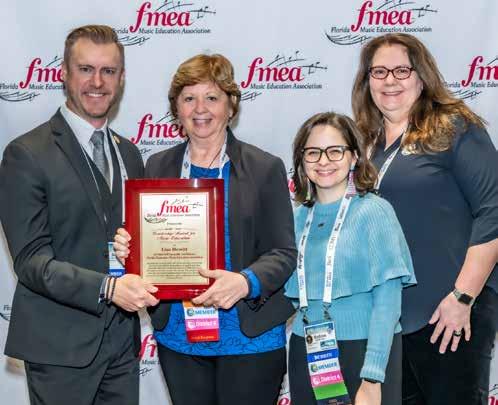
Lisa Hewitt
All-State Elementary Orff Ensemble Coordinator
Florida Elementary Music Educators Association
Nominated by Madison Kerr on behalf of FEMEA
LisaHewitt is the all-state Orff ensemble coordinator for the Florida Elementary Music Educators Association, a component of the Florida Music Education Association. Lisa Hewitt has spent a lifetime of teaching elementary music and serving in leadership roles in her schools, districts, and professional organizations. She began teaching in 1981 in Seminole County Public Schools and retired in 2024, having spent 33 years in Orange County Public Schools.
For more than four decades, Lisa Hewitt has exemplified the highest standards of leadership, dedication, and distinguished service in music education. A graduate of Stetson University in DeLand, Florida, with a BME, Lisa has continually pursued advanced training and professional development, completing multiple Orff Schulwerk courses and engaging in international study. Her education also includes post-Level III (Master
Class) Orff Schulwerk Teacher Education, World Drumming Level I, and Suzuki Violin I. Lisa attended the International Summer Courses at the Orff Institute in Salzburg, Austria, in 2018 and Spain Orff in Madrid in 2019. This lifelong commitment to learning has informed a career dedicated to inspiring students, mentoring teachers, and advancing the field of elementary music education. After getting her start teaching in Seminole County, Lisa then taught for 33 years in
Orange County Public Schools, where she left a lasting impression on her students and colleagues.
At the national level, Lisa’s leadership has played a pivotal role in shaping the direction of the American Orff-Schulwerk Association (AOSA). Serving as AOSA president, Lisa represented the organization at NAfME’s Hill Day and RoundTable in Washington, D.C., advocating for music educators nationwide. Her leadership continued on page 34
from page 33
continued as national conference chair (2023–2025), where she guided an incredible learning and networking experience for music educators interested in the Orff Schulwerk approach. Her earlier roles on the AOSA National Board of Trustees, including regional representative and financial assistance chair, reflect a long history of dedicated service. She has also served as Region IV representative on the AOSA National Board of Trustees and served on the AOSA Executive Committee as vice president, 2017–2019, and president, 2019–2021. Her most recent appointment was AOSA national conference chair for the 2024 Professional Development Conference in Des Moines, Iowa, and she continues to serve on the National Conference Committee.
Equally impactful has been Lisa’s service and leadership for Florida music education. As the inaugural coordinator of the Florida Music Education Association’s All-State Elementary Orff Ensemble (2016–2019, 2021–present), Lisa has given countless students the chance to take part in an honors music performance experience highlighting the
Orff Schulwerk method. Lisa organized and implemented this first in the nation ensemble, and it performs annually at the Florida Music Education Association conference, with the concert being a conference highlight that showcases the incredible potential and importance of elementary music education. Locally, Lisa served as president of the Central Florida Orff Chapter (2004–2006), elementary music district chair for Orange County Public Schools (2006–2015), and Orff chair for OCPS (2004–2013), roles that fostered collaboration and elevated music instruction across the Central Florida area. Her vision also established the Mary T. Gibson Scholarship Fund through the Central Florida Orff Chapter, ensuring ongoing support for teacher education.
Throughout her career, Lisa has been sought after as a presenter, clinician, and conductor at the local, state, and even international levels. She has served as a clinician presenting professional learning sessions for Seminole County Public Schools, Orange County Public Schools, FEMEA regional events, several states, at the AOSA National Professional
Development Conference, and was a presenter at the 2019 International Orff Forum Conference in Salzburg, Austria. In addition to conducting several Orff all-county ensembles, Lisa was the first all-state Orff clinician for Idaho Music Education Association, in January 2020. Her expertise and passion for creative music-making has inspired both colleagues and students alike. Recognition for Lisa’s contributions to music education span her career. From receiving the Florida Music Education Association Educator of the Year award (2016), multiple Teacher of the Year honors at the school and district levels, and the AOSA Lifetime Membership Award (2021) in recognition of her exemplary service to the organization, Lisa’s leadership and impact on her field are valued and recognized by all.
She attributes her love of serving to her dad, who served his professional photography organizations in many leadership positions. She is enjoying having more time to spend with her family, continuing to serve, and looks forward to doing more traveling soon.
DISTINGUISHED SERVICE AWARD OF AN INDIVIDUAL IN MUSIC EDUCATION
The FMEA Distinguished Service Award is presented to persons or organizations inside or outside the field of professional music education. This award recognizes exceptional service to or support of music education. The recipient(s) must have demonstrated noteworthy contributions to music education, with statewide impact preferred.
DISTINGUISHED SERVICE OF AN INDIVIDUAL IN MUSIC EDUCATION
Elisabeth (Lisa) J. Olson
Voice Instructor
Nominated by Michelle Tredway on behalf of FVA
Elisabeth (Lisa) J. Olson is a voice instructor and fierce music education advocate. Elisabeth’s love for music began at three years old when her mom regularly took her to hear and see the Dayton Philharmonic perform; she also
had the opportunity to attend her mom’s piano lessons where her curiosities and respect for artistic development began to take root. The United States Air Force moved her family to Eglin Air Force Base in Okaloosa County at a pivotal point in her formative years. Upon moving to Niceville, Florida, she had the blessing of being part of the Ruckel Middle School band and chorus and matriculated upward to Niceville High School chorus. While in Opus 1, she had the privilege of being encouraged by Michael Dye to
pursue a degree in music. With this encouragement, Elisabeth earned a BM in vocal performance from Samford University in Birmingham, Alabama, and later an MME from the University of Mobile, Alabama School of the Arts.
After serving as a high school choral director for several years, Elisabeth decided to pursue her passion for vocal pedagogy and began teaching applied lessons as well as serving as a support to various choral programs. With the ability continued on page 36
continued from page 35
to observe change over time, she was able to see both the life-changing impact of high-quality music education on young people and the impediments facing classroom teachers in the pursuit of providing high-quality instruction and opportunities. It was these observations, along with the desire to see every child have access to high-quality music opportunities across their K-12 education, that began to form the foundation of intentional advocacy efforts.
Believing that to whom much is given, much is required fits hand-in-glove with the truth that no good thing should be
withheld from those who are deserving so long as it is in your power to act, the pursuit of intentional, informed, and intense advocacy began. Elisabeth discovered that her love of scholarly research, data collection, and music were the perfect trifecta for advocacy. Speaking with her children’s teachers, serving as a volunteer, and gaining understanding of the priorities and structures put in place by both local and state leaders became the launching point for greater advocacy efforts.
The privilege of being entrusted with the knowledge of needs, goals, and desires
by music educators is an honor for which Elisabeth is most grateful. She continues to listen and act to support educators and students. Her overarching desire is to see all children in the state of Florida have complete access to high-quality music education opportunities.
EXHIBIT AT THE FMEA TRADE SHOW
With approximately 10,000 attendees annually, the FMEA Professional Learning Conference is one of the largest music education professional learning events in the Eastern U.S.
In addition to approximately 250 clinic sessions and concerts, the FMEA Professional Learning Conference is host to the All-State Bands, Orchestras, Choruses, Guitar Ensemble, and Orff Ensemble.
Attendees include elementary and secondary music teachers, music supervisors, college students, college music teachers, school administrators, K-12 students performing in the All-State ensembles, students and professional musicians performing with invited performing ensembles, and parents of performing students.
EXHIBIT DATES
JANUARY 13-16, 2027
EXHIBIT RATES
Booth Type Price Each*
Single Booth $750.00
Single Corner Booth $790.00
Endcap Booth $1,845.00
4-Booth Island $3,690.00
6-Booth Island $5,500.00
8-Booth Island $7,350.00
10-Booth Island $9,100.00
16-Booth Island $14,560.00
12-Booth Island $10,920.00
9-Booth Island $8,190.00
*Corporate and Academic Partners are eligible for a booth discount. LEARN MORE
Mrs. Olson’s efforts are already extending beyond the borders of her own county. Her research on behalf of music education has been noted by fine arts supervisors around the state and has earned her a seat on the state FMEA Advocacy Committee. Jeanne Reynolds, FMEA advocacy co-chairperson, FMEA past president, FMEA Hall of Fame member, and past performing arts specialist for Pinellas County Schools, states, “Lisa is willing to dive into educational research, legislation, and policy to advance her goals. She builds relationships with educational decision makers, school board members, district leaders, and superintendents and is comfortable meeting with them. Lisa prepares diligently for these meetings. She knows her stuff! And she is confident about presenting her requests for funding and staffing. I know of no other layperson in the state who is responsible for the restoration of music units or the addition of music units or funding for music education. Lisa has done this. In these challenging times, she has accomplished what has eluded many music supervisors.”
Mrs. Olson serves the musical community selflessly and tirelessly as an advocate of all school music education.
Dr. Christopher Burns, Osceola County fine arts resource specialist, notes, “Her approach is always student-centered, grounded in the belief that music education is essential to a well-rounded education. She leads by example, showing that true service is about creating opportunities for every child to learn, create, and thrive.”
EXEMPLARY MODEL MUSIC PROGRAM
The FMEA Exemplary Model Music Program/Project designation is awarded to an individual or group for a meritorious, exemplary music education programs or exemplary projects completed in the field of music education. Exemplary music programs or projects may include exemplary or innovative music education that provides or continues to provide a significant, positive impact on students, music educators, and/or schools. These types of programs might include, but are not limited to, those that resulted or are resulting in elevated music/arts education advocacy or awareness, beneficial workshop opportunities for students or educators, effective music education and the innovative implementation of programs that provides high student engagement and opportunities for students, improved music educator effectiveness, relevant research, effective community programs/projects impacting schools, school improvement as related to music education, effective multicultural or interdisciplinary programs/projects, or comprehensive music education programs that may include nontraditional music offerings.
EXEMPLARY MODEL MUSIC PROGRAM
Instruments
of Change
Glen Schubert, CEO, in conjunction with Hillsborough County Public Schools, Music Supervisor Jon Sever Nominated by Dr. Jeffrey Cayer
Instruments of Change (IOC) was founded in 2009 with the mission to “Profoundly impact the lives of children through the gifts of musical instrument donation, instruction, and performance.” The Instruments of Change band program is a transformative, school-based initiative designed to enrich the lives of elementary students by provid ing consistent access to high-quality music education, instrument instruction, and performance opportunities. Rooted in the belief that music has the power to shape character, foster discipline, and build confidence, the Instruments of Change program offers more than just musical
training—it lays a foundation for lifelong success.
In 2025, Instruments of Change currently works in 10 Title I elementary schools in Hillsborough County and is looking to expand into other counties in the state of Florida. IOC brings band programs to Title I (low-income) elementary schools by providing transformative music education. These elementary students feed into the middle and high
schools with the highest dropout rates, and their communities face significant socioeconomic challenges. Data from Hillsborough County indicate elevated rates of poverty and lower educational attainment in these ZIP codes compared to the regional average. This translates to limited access to enriching extracurricular activities that foster academic and personal growth for students. The fifth grade students sign a contract and commit to come to band class, attend continued on page 38
performance opportunities, submit practice logs, and do “pass-offs” where they show they have learned the skills and can play their instrument. When they complete their contract, they earn a new instrument for middle school band. IOC directly addresses these disparities through the Hillsborough County Public Schools established fifth grade band programs. IOC equips students with instruments and provide expert instruction within the familiar and supportive environment of their own school. This accessibility is crucial in communities where transportation and financial constraints can hinder participation in outside programs.
equations, score higher on language tests, both academic understanding and comprehension, have better spatial reasoning, incur lower instances of alcohol and drug abuse, have higher self-esteem, and have higher high school graduation rates.
Beyond academics, music education fosters crucial life skills and positive behaviors. IOC students learn the value of hard work through dedicated practice, experience the satisfaction of personal accomplishment as their musical abilities grow, and develop a strong sense of accountability and responsibility through their commitment to the band. Participation in a band ensemble cultivates essential teamwork skills, as students learn to collaborate and contribute to a shared musical goal. IOC creates a vital educational pathway for elementary students in these underserved communities. The IOC program provides an immediate positive connection to their school, fostering a sense of belonging and engagement. Simultaneously, it lays the foundation for long-term academic and social advantages. This combination of school engagement and academic enrichment underscores the critical role IOC plays in empowering students with skills and opportunities that extend far beyond the music room. This combination of school engagement and academic advantage is why IOC is so important. It gives them a reason to go to school and brings academic benefits to make them more successful.
The program is designed to cultivate a range of positive outcomes, both academic and personal, for these young learners. Two main outcomes translate to this being so impactful. First, earning their own instrument connects them, in a positive way, to their middle school experience and gives them a desire to attend school. Second, the benefits that come from learning to play an instrument weigh heavily on their future academic success. The process of learning to play a musical instrument acts as a powerful catalyst for development. Research consistently demonstrates that students who engage in musical training achieve higher scores on math tests, exhibiting a greater capacity for understanding complex equations. Researchers from University of British Columbia found that students who learned to play a musical instrument in elementary school and continued playing in high school scored about one academic year ahead of their non-music peers in their English, math, and science skills (Journal of Educational Psychology, 2019). In fact, decades of studies show us that students who learn to play an instrument score higher on math tests and show an ability to understand complex
For the past 16 years, IOC has witnessed the tangible impact of their mission. At the culmination of the fifth grade program, students who successfully fulfill their program “contract” to demonstrate commitment and progress receive their very own instrument to continue their musical journey in middle and high school. This ownership fosters a deeper connection to their instrument and their
musical identity. IOC further supports these students by providing instrument maintenance and repairs until their high school graduation, ensuring continued access to this enriching opportunity. IOC’s measurable outcome is tracking enrollment: aiming for 70% program completion and anticipating 30% attrition. During the 2024–25 school year, 68% of enrolled fifth grade band students completed the program and earned their own instruments to begin their middle school band experience. And last school year, 100% of Springhead Elementary and Knights Elementary band graduates who feed into Marshall Middle School enrolled in the band program—unprecedented success! IOC is also currently working with the band directors to identify what made these programs so successful and will then use these details to make innovative decisions to further expand on the success of all IOC band programs.
Over the years, Instruments of Change has developed an efficient operational model to bring instruments and instruction to schools. IOC has also developed the Instruments of Change curriculum to allow for greater long-term success for the students. Through the IOC programs, students from Title I schools go on to academic success in middle and high school, and then into college.
The Instruments of Change band program does more than teach children how to play an instrument—it builds character, opens doors to future opportunities, and creates a lasting impact on students’ lives. By fostering creativity, discipline, and a strong sense of belonging, the program empowers young people to believe in themselves and take pride in their achievements. Through music, these students learn that with commitment and effort, they can achieve excellence—both on the stage and beyond. continued from page 37
2026 FMEA Music Education Service Awards
The Music Education Service designation is awarded to music educators who have been active in music education for 25 years or more. This award recognizes the outstanding service of our members who have committed themselves to this profession for most of their adult lives.
Bartram
Surfside
Music Educator
Liberty Magnet Elementary School
School
continued on page
Jarrod Koskoski 25 years Music Educator
University High School Volusia County Schools
Jennifer Rock 25 years Music Educator
Heritage High School Brevard Public Schools
Susan Bazin 26 years Music Educator
Key Largo Middle School Monroe County Schools
Barbara Mattingly 26 years Music Educator
Trail High School St. Johns County School District
James Allen Colvin 27 years Music Educator
Middle School Bay District Schools
Bill R. Guthrie 27 years Music Educator
River Springs Middle School Volusia County Schools
Monica Leimer 27 years Music Educator
DeLand High School Volusia County Schools
Vincent Parrulli 27 years Music Educator
Calvin A. Hunsinger School Pinellas County Schools
Sherry St.Petery 27 years
District of Indian River County
continued from page 39
Dr.
28 years Music Educator
Elementary School Center for Fine Arts Alachua County Public Schools
Catherine McConnell 29 years Music Educator
Ransom Middle School and Tate High School Escambia County Public Schools
Ann
30 years
Retired Music Educator
Former School:
Buddy Taylor Middle School Flagler Schools
Deerlake Middle School Leon County Schools
Calista Zebley 29 years Music Educator
Clearwater Fundamental Middle School Pinellas County Schools
31 years Director of Music
Grace Lutheran School
Kristen
28 years
Music Educator
Progress Village Middle Magnet School Hillsborough County Public Schools
Julia Davidson Hood 30 years
Music Educator
Millennium Middle School Seminole County Public Schools
32 years
Music Educator
Newsome High School
Hillsborough County Public Schools
Donald DeVito
Marjorie Kinnan Rawlings
Lisa Dollar 28 years Music Educator
Franzen
Paris
Jennifer Tippett
Pinellas
John Owen Davis II
Robin Benoit 35 years
Performing Arts Director
East Lake Middle School
Academy of Engineering Pinellas County Schools
Beth Cummings 35 years
Senior Director of Fine Arts
Polk County Public Schools Fine Arts
Polk County Public Schools
Angela Pape Horne 35 years Music Educator
Ransom Middle School Escambia County Public Schools
38 years
Arts Integration Coordinator
Pinellas County Schools Performing Arts Pinellas County Schools
Deborah
Dubbert 35 years
Retired Music Educator
Former School: Murdock Middle School
Charlotte County Public Schools
Dr. James (Jim) Smisek 35 years
Director of Bands
Seminole State College of Florida Seminole
38 years Music Educator
Ormond Beach Elementary School Volusia County Schools
39 years Music Educator
Largo High School Pinellas County Schools
(Kay)
Lisa Lehmann
Emily (Kris) Light
Christopher Benoit
continued from page 41
39 years Music Educator
Rochelle School of the Arts
Polk County Public Schools
Stephen
42 years Music Educator
Pine Island Academy
St. Johns County School District
46 years Music Educator
Osceola Magnet Elementary School School District of Indian River County
SPECIAL RECOGNITION
In appreciation and gratitude for your extraordinary service to
Dr. Kathleen D. Sanz President/CEO and Executive Director
Center for Fine Arts Education
Florida Music Education Association
Florida School Music Association
Florida Art Education Association
Start thinking about who you would like to nominate for the 2027 Awards.
Freeda Woolf Phifer
Panoff
Janine Jones
2026 FMEA MUSIC ENROLLMENT AWARDS
The Middle and High School Music Enrollment Award is presented to music programs demonstrating high enrollment in music courses. This award recognizes the effectiveness of programs that offer attractive music curricula as well as those that excel in the recruitment and retention of students. Schools hold the award for three years. They may be looked to as models of quality programming, scheduling, and recruitment and retention of students. In order to qualify for this award, at least 30% at the high school level and 45% at the middle school level of the entire student body must be enrolled in a music course.
GALAXY MIDDLE SCHOOL – 45%
Volusia County Schools — Principal: Dr. Eidie Velez
MIDDLE SCHOOLS
Music Educators: Frederick Blanchard, Noelle Elliott, Brianna Hanks
THOMAS L. SIMS MIDDLE SCHOOL – 45%
Santa Rosa County District Schools — Principal: Emily Donalson Music Educators: Angela Polito, Sarah Wolf-Miller
EDGEWOOD JR./SR. HIGH SCHOOL – 46%
Brevard Public Schools — Principal: Jacqueline Ingratta
Music Educators: Joseph Franco, Andy Kropp, Dennie Miller, Lisa Sinatra
NORTH FORT MYERS ACADEMY FOR THE ARTS – 46%
The School District of Lee County — Principal: Andrew Miller Music Educators: Shannon Abney, Tylar Brockhouse, Christina Mofat
SAFETY HARBOR MIDDLE SCHOOL – 46%
Pinellas County Schools — Principal: Susan Alvaro
Music Educators: Jacob Fox, Alicia Kelley
SOMERSET COLLEGE
PREPARATORY ACADEMY – 46%
St. Lucie Public Schools — Principal: Erika Rains
Music Educators: Michael Rossi, Marissa Ruiz, Eileen Walentin
DR. MONA JAIN MIDDLE SCHOOL – 47%
School District of Manatee County — Principal: Kate Barlaug Music Educators: Charles Hernandez, Payton Liebe
FERRY PASS MIDDLE SCHOOL – 47%
Escambia County Public Schools — Principal: Joshua Jackson
Music Educators: Evelyn Aguirre, Christina Aldahondo, Jakob Wisdom
LUMINARY MIDDLE SCHOOL – 47%
Orange County Public Schools — Principal: Jefrey Aldridge
Music Educators: Johan Quevedo, Michael Sperr
NORTH NAPLES MIDDLE SCHOOL – 47%
Collier County Public Schools — Principal: Melissa Kuk
Music Educators: Jacob Howard, Nancy Visceglie
RENAISSANCE CHARTER SCHOOL AT CHICKASAW – 47%
Orange County Public Schools — Principal: Dr. Jamie Menchaca
Music Educators: Kimberly Lackey, Omar Zelaya
DELAND MIDDLE SCHOOL – 48%
Volusia County Schools — Principal: John R. Devito
Music Educators: Melinda Fradley, Christian Ricketts
IVY HAWN CHARTER
SCHOOL OF THE ARTS – 48%
Volusia County Schools — Principal: Danielle Suhr
Music Educators: Kevin Gaskill, Sarah Wilson
OAKRIDGE MIDDLE SCHOOL – 48%
Collier County Public Schools — Principal: Ronna Smith
Music Educators: Tatum Howard, John Rosbottom
SEBASTIAN CHARTER
JUNIOR HIGH SCHOOL – 48%
School District of Indian River County
Principal: Dr. William Dodds
Music Educator: Ethan Kinkle
WESTMINSTER CHRISTIAN SCHOOL – 48%
Miami-Dade County — Principal: John Manoogian
Music Educators: Seth Carlson, Joseph Carpenter, Jessica Carrasquillo, Lauren Hartman
DELTONA MIDDLE SCHOOL – 49%
Volusia County Schools — Principal: Dr. Stephen Hinson
Music Educators: Anthony Mandese, Kelvin Nguyen, Victoria Senko
continued from page 43
P.K. YONGE DEVELOPMENTAL RESEARCH SCHOOL – 49%
University of Florida, Alachua
School Director: Dr. Carrie Geiger
Principal: Dr. Ashley Pennypacker-Hill
Music Educators: Dr. Jamie Burg, Robert Edmondson, Heidi Harriss, Kamie Hemmerich, Robert Marski
PERSHING SCHOOL – 49%
Orange County Public Schools — Principal: Sanjay Brown Music Educator: Keith Nichols
ODYSSEY CHARTER JR./SR. HIGH SCHOOL – 50%
Brevard Public Schools — Principal: Michael Davis
Music Educators: Emily Broom, Glenn Hofman, Marli Kevelin, Aaron Stout
RANSOM MIDDLE SCHOOL – 50%
Escambia County Public Schools
Principal: Dr. Alphonse Marsh
Music Educators: Angela Horne, Steven Kershaw, Catherine McConnell, Robert Rigdon
COUNTRYSIDE MONTESSORI CHARTER SCHOOL – 51%
Pasco County Schools — Principal: Michael Picone
Music Educator: Lisa Marie Lebron
LAWTON CHILES MIDDLE SCHOOL – 51%
Seminole County Public Schools — Principal: Melissa Laudani Music Educators: Brittni Autrey, Grace Kuperman, Suzette Swallow
WILLIAMS MIDDLE MAGNET IB SCHOOL – 51%
Hillsborough County Public Schools — Principal: John Haley Music Educator: Michael Garcia
AVALON MIDDLE SCHOOL – 52%
Orange County Public Schools — Principal: Marisol Mendez
Music Educators: Christina Machado, Eric Saidat
SILVER SANDS MIDDLE SCHOOL – 52%
Volusia County Schools — Principal: Dr. Rick Inge
Music Educators: Nicholas DeHenes, Taylor Gelb, Joseph Powell
FARNELL MIDDLE SCHOOL – 53%
Hillsborough County Public Schools
Principal: Pablo Gallego Alvarez
Music Educators: Rebekah Mahusay, Alec Pearl, Sara Skinner
LEGACY MIDDLE SCHOOL – 53%
Orange County Public Schools — Principal: Jason Jimenez
Music Educators: Ryan Lumm, Aaron McGarvey
BURNS MIDDLE SCHOOL – 54%
Hillsborough County Public Schools
Principal: Matthew DiPrima
Music Educators: Kelly Chisholm, Emily Poisson, Colleen Strom
THE OUT-OF-DOOR ACADEMY – 54%
Sarasota — Principal: Debra Otey
Music Educators: Erick Crow, Chelsea Santucci, Nicole Young
LYNDON B. JOHNSON MIDDLE SCHOOL – 56%
Brevard Public Schools — Principal: Marina Saporito-Middleton
Music Educators: Erin Dryer, Mason Taylor, Charlotte Walters
PINEAPPLE COVE CLASSICAL ACADEMY, LOCKMAR – 56%
Brevard Public Schools — Principal: Paris Koblitz
Music Educator: Laurie Nkwa
GLENRIDGE MIDDLE SCHOOL – 60%
Orange County Public Schools — Principal: Daniel Kempinger
Music Educators: James Brannock, Deshawn Burns, Cole Dekle, Madelon Morgan
GOTHA MIDDLE SCHOOL – 60%
Orange County Public Schools — Principal: Monica Emery
Music Educators: Bret Carson, Jimmy Higginbotham, Sara Mirabal
VIERA MIDDLE SCHOOL – 61%
Brevard Public Schools — Principal: Catherine McNutt
Music Educators: Kaitlyn Klingberg, Jacqueline Knappenberger, Thomas Silliman, Marcey Sperr
HUNTER’S CREEK MIDDLE SCHOOL – 63%
Orange County Public Schools
Principal: Joumana Moukaddam
Music Educators: Elizabeth Bichler, Sarah Burns, Rafael Couret
DELAURA MIDDLE SCHOOL – 64%
Brevard Public Schools — Principal: Tina Susin
Music Educators: Kali Gleacher, Bailey Hatzell, Amelia Lohman
HAMLIN MIDDLE SCHOOL – 65%
Orange County Public Schools — Principal: Bridget Bresk
Music Educators: Ashley Blair, Robert Krahn, Amy Wacksman
THOMAS JEFFERSON MIDDLE SCHOOL – 65%
Brevard Public Schools — Principal: Meara Trine
Music Educators: Bobbe Butler, Lisa Hartley, Shane O’Leary
BEN HILL MIDDLE SCHOOL – 66%
Hillsborough County Public Schools — Principal: Coddie Webster
Music Educators: Jay DeDon, Jesalin Gonzalez, Tifany Jones
PROGRESS VILLAGE MIDDLE MAGNET SCHOOL OF THE ARTS – 67%
Hillsborough County Public Schools — Principal: Peter Megara
Music Educators: Ryan Boots, Kelly Cottet, Kristen Franzen, John McColley
MEADOW WOODS MIDDLE SCHOOL – 68%
Orange County Public Schools — Principal: Emilio Vitulli
Music Educators: Ignacio Poncio, Corinne Roberts
LOCKHART MIDDLE SCHOOL – 69%
Orange County Public Schools — Principal: Clarence Truitt
Music Educators: Taylor Kofnas, Victoria Vinson
MILLENNIUM MIDDLE SCHOOL – 70%
Seminole County Public Schools — Principal: Dr. Crystal Higgs
Music Educators: Sonia Galarza, Julia Hood, George Netterville, William Richey, Javorrye Ross, Jillian Savia
HOWARD MIDDLE SCHOOL – 87%
Orange County Public Schools — Principal: Dr. W. John McHale
Music Educators: Steven Hernandez, Daniel Lovelette, Keegan Norman, Aaron Penfeld, Damon Wille
PINE CREST SCHOOL, FORT LAUDERDALE CAMPUS – 99%
Broward County — Principal: Peter Boylan
Music Educators: Christian Davis, Jared Doyle, Gretchen Fasulo, Peter Francis, Antoine Khouri, Carissa Reese, Derek Shapiro, Michael Testa
PINE CREST SCHOOL, BOCA RATON CAMPUS – 107%
Palm Beach County — Principal: Melanie Connors
Music Educators: John Frasca, Tennison Hubbard, Allison Mair, Martha Schimelpfenig, Sharon Selinger, Inna Slusarenko
SAINT PAUL LUTHERAN SCHOOL – 130%
Polk County — Principal: Gregory Sawyer
Music Educators: Daniel Bates, Denise Bates
HIGH SCHOOLS
DR. PHILLIPS HIGH SCHOOL – 31%
Orange County Public Schools — Principal: Jackie Ramsey
Music Educators: Raine Hollingsworth, Sarah Lightbody, Jonathan Money, Jane Moore, Solangi Santiago
HERITAGE HIGH SCHOOL – 32%
Brevard Public Schools — Principal: Stephen Link
Music Educators: Samantha Felber, Colby Hollingsworth, Nancy Jackson, Meghan Ramsey, Jennifer Rock
EDGEWOOD JR./SR. HIGH SCHOOL – 33%
Brevard Public Schools — Principal: Jacqueline Ingratta
Music Educators: Joseph Franco, Andy Kropp, Dennie Miller, Lisa Sinatra
SATELLITE HIGH SCHOOL – 34%
Brevard Public Schools — Principal: Courtney Lundy
Music Educators: Kevin Albright, Joseph Leites, Christopher Simons
P.K. YONGE DEVELOPMENTAL RESEARCH SCHOOL – 38%
University of Florida, Alachua
School Director: Dr. Carrie Geiger
Principal: Dr. Ashley Pennypacker-Hill
Music Educators: Dr. Jamie Burg, Robert Edmondson, Heidi Harriss, Robert Marski
ODYSSEY CHARTER JR./SR. HIGH SCHOOL – 39%
Brevard Public Schools — Principal: Michael Davis
Music Educators: Emily Broom, Glenn Hofman, Marli Kevelin, Aaron Stout
EDGEWATER HIGH SCHOOL – 40%
Orange County Public Schools — Principal: Dr. Alex Jackson
Music Educators: Alexander Glover, Camden Jordan, Maria Toledo, Oscar Vinson
SOMERSET COLLEGE PREPARATORY ACADEMY – 55%
St. Lucie Public Schools — Principal: Erika Rains
Music Educators: Michael Rossi, Marissa Ruiz, Eileen Walentin
PINE
CREST SCHOOL, FORT LAUDERDALE CAMPUS – 61%
Broward County — Principal: Joseph Walters
Music Educators: Christian Davis, Jared Doyle, Gretchen Fasulo, Allan Finn, Antoine Khouri, Carissa Reese, Deena Shapiro, Michael Testa
MEMORIES OF
Joe Kreines
BY MATTHEW MCCUTCHEN
OOn July 31, 2025, Florida lost one of its musical geniuses. Joe Kreines (1936–2025) moved to Florida from Chicago in the 1960s to accept a position as the associate conductor of the Florida Symphony Orchestra in Orlando while simultaneously serving as the conductor of their youth orchestra. Wind players from Winter Park High School were impressed with Joe’s knowledge and skill, so they asked their band director, Edgar Jack Williams, to invite him to come for a rehearsal. Thus began six decades of Kreines giving an estimated 600 clinics to high school bands, orchestras, and choirs through out Florida. In 2004, in recognition of his
outstanding work with young musicians, he was recognized by the Florida Bandmasters Association by being inducted into their Roll of Distinction, a particularly notable honor considering that he never held a band directing position. In addition to his clinical skills, Joe was in great demand as an accompanist and rehearsal pianist. He accompanied countless student performers at district and state solo and ensemble festivals, often without the benefit of a rehearsal. He had an encyclopedic knowledge of composers and repertoire and regularly stunned people with his photographic
Equally adept as a composer, arranger, and transcriber, Kreines created more than 200
works in many genres. While he wrote for a wide variety of solos and ensembles, band directors knew him for his music for wind band. He was especially noted for his work editing and transcribing the music of Percy Grainger and for authoring Music for Concert Band, a selective annotated guide to band literature.
In 1990, I was a freshman at Furman University when John Carmichael called a rehearsal of our wind ensemble at 8:00 on a Saturday morning to work with a special guest, who turned out to be Joe Kreines, a name I did not know. Near the beginning of the rehearsal, he turned to the blackboard, drew a >, and asked us what it was. Once we answered, “an accent” and “a decrescendo,” he asked us what the difference was between the two. Silence. “Nothing,” he practically screamed. “An accent is nothing more than a miniature decrescendo.” That was earthshattering information to a college percussionist who just thought an accent meant to “hit it harder.” One of my proudest moments as a director came 25-plus years later when Joe was watching me rehearse the Florida Wind Band. I wrote a > on the board and told the players that an accent was nothing more than a miniature decrescendo. He looked at me, nodded, smiled, and whispered, “Exactly!”
Realizing there are hundreds of similar stories among Florida band directors, I reached out to several of his friends, colleagues, and admirers and asked them to share their memories and short stories. Here are their responses.
In1994, when I served as interim director of bands at Stetson University, I programmed Lincolnshire Posy for our final spring concert. It is well-known that Joe Kreines was as knowledgeable as anyone about the music of Percy Grainger. His research into Lincolnshire Posy was the foundation for Fred Fennell’s edition. Joe authored a presentation on the songs of Lincolnshire Posy where he would offer lessons on the history of each folksong, and then sing each one while accompanying himself on the piano.
Of course, I brought Joe in to give his presentation and rehearse the band. His explanation of the sixth movement, The Lost Lady Found, was particularly memorable. To explain the importance of the accents in the music, Joe performed a dance that would accompany the song in its original folk song form. Joe sang the song and enthusiastically jumped in the air and kicked on beat three. When he conducted movement six, he would jump and stomp loudly on beat one to indicate the heaviness he sought to get the musical energy the movement required. Never one to follow the herd, Joe Kreines was the most unique and exciting conductor I have ever known.
— Jim Bishop, Retired
Joe taught me to actively listen. Several years ago, we were sitting in his Florida room, and I told him Mahler’s Symphony No. 9 was my favorite symphony. We listened to the entire recording, and at the end he had a single tear on his face. That was the longest I have ever sat continued on page 48
Joe Kreines
continued from page 47
without speaking. When it was complete, I told him he should transcribe the last movement for wind band. He laughed and told me I could do it. We went back and forth about this for 20 years, playing different sections on the piano and commenting on what fit where. As I sat with Joe and Kevin Fuller on July 11, 2025 (the last time I would get to see Joe), Kevin, who was aware of this, looked at Joe and said, “I guess Josh has to transcribe Mahler 9 now,” and Joe smiled as he attempted to laugh.
Another core memory was when he placed the first movement of Beethoven’s Symphony No. 5 on our stands at Stetson University. I looked at him and Dr. Adams and said, “There is no way this will work.” The band began playing, and I kid you not, it sounded like it was written for band. Joe just sat and smirked at me and mouthed, “I told you so.”
Joe’s kindness and attentiveness to my musical development were instrumental to my personal growth. From collaborating as my accompanist, to working on transcriptions and orchestrations, and being the recipient of personal compositions for my marriage and the birth of my children, I am forever in debt to Joe’s teaching, guidance, and support.
—Joshua D. Blair, PhD Director of Bands, Plant City High School
In1982, I was in my second year as band director at Lakeland Senior High School. Joe Kreines had already made himself available to guest rehearse during the previous year. I quickly saw the enormous benefit of his musical understanding and rehearsal intensity and welcomed him to the podium whenever he was in the neighborhood. During a conversation in late winter 1982, Joe suggested that we program Music for Prague, 1968 by Karel Husa for our FBA state concert band assessment. I had never heard of the piece, and after reviewing it, I thought he was nuts. I did not like it, did not understand it, and did not make any musical connection with it at first. And it was really difficult! That was a clear marker of where I was as a wind band conductor at age 29. Joe kept encouraging me to try it, and I continued to study it. As I evolved, thanks in large part to Joe’s musical insights and conviction, I realized that Music for Prague, 1968 was not only a masterpiece but also one of the most impactful musical compositions of the 20th century. From that point on, my desire to know and understand the artistic
repertoire of the wind band expanded exponentially. Joe’s mentorship, musicianship, encouragement, and overall musical genius had a profound impact on me as both a musician and a conductor. And by the way, the impact of Music for Prague, 1968 on our students, who I thought would have a more difficult time with the piece than I did, was overwhelmingly positive. They played it beautifully. I will always be grateful for the influence of Joseph Kreines.
—John C. Carmichael Professor Emeritus, University of South Florida Executive Director and Conductor, Pinnacle Winds, Inc. Kansas City, Mo.
Ifirst met Joe in the early 1960s in the band room at Edgewater High School. I was practicing my clarinet in the band room after school when a stranger walked in to see our band director, Del Kieffner. As he passed, I heard him shout “Your A is FLAT” (yes indeed—always has been). That was the start of a great friendship. Over the years, he accompanied my senior recital at USF and rehearsed my bands at St. Cloud, Miramar, and J. P. Taravella almost every year. I put him up at my house many times, stepped in between him and my wife as they argued over something we saw on the news, watched him do better than the contestants on Jeopardy, and took him to dinner many times, which was always an adventure. I even caught him in my arms when he passed out during a rehearsal. I owe a great deal of thanks to Joe for the things I learned from him that helped make me the band director/educator I became. He was without a doubt a huge contributor to the successes those band programs experienced.
—Neil Jenkins
Executive Director, Florida Bandmasters Association
WhenI first met Joe, I was a young band director at Cocoa Beach Jr./Sr. High School in Brevard County. He asked me when my band rehearsed, and I told him. Fast forward to the spring of my first year when we were preparing for concert band assessment. During the class change just prior to band period, I got an announcement from the front office saying, “There is a Joseph Kreines here to see you.” I had not yet invited him to any specific rehearsal; he just showed up and took over my rehearsal. I quickly understood why he was invited into so many band rooms; it was a rehearsal clinic for me as much as it
was for my students. From that day forward, Joe Kreines had an open invitation to visit my band rehearsals. He rehearsed my bands every year, oftentimes more than once during a given year.
I credit Joe with much of my success as a band director, including how to get a band to phrase musically, the importance of brass hearing the woodwind sonority for balance, and the musical intensity of a TRUE piano dynamic. He helped guide me to become familiar with countless wind band pieces of the highest quality, many of which I performed with my bands over 30 years as a high school band director in Florida at Cocoa Beach, Auburndale, Lincoln, Buchholz, and Stoneman Douglas high schools. His knowledge and mentorship were as valuable as anything I experienced in formal education.
The last interaction Joe had with my bands was in 2018 at Stoneman Douglas High School. I arranged for him to be at the very first wind symphony rehearsal after the horrific tragedy we experienced. Among the pieces he rehearsed that day was the finale from Mahler’s Symphony No. 3. It was one of the most profound and moving rehearsals I ever witnessed. It brought us all closer to each other through music-making and underscored our motto from that day forward, stated by Leonard Bernstein after John F. Kennedy’s assassination, “This will be our reply to violence: to make music more intensely, more beautifully, more devotedly than ever before.” Thank you for how you impacted so many lives, including mine, through your passion for music, Joe!
—Alex Kaminsky Director of Bands, VanderCook
College of Music Chicago, Ill.
Joe could be described as music personified—almost everything he did in life was in pursuit of raising musical standards and spreading awareness of “good” music (symphonic literature) in the world. His home was a musical shrine, with thousands of scores and tens of thousands of recordings—he would honor a composer’s birthday by listening to their music all day. His legacy lies in multiple arenas: the thousands of music educators who learned from him and passed on knowledge and love of music to the next generation, the performers he inspired having played under his baton, and the hundreds of transcriptions and compositions he wrote that are played around Florida, the United States, and the world. He
would hang out at solo and ensemble festivals with a shirt pocket full of checks and cash; he wanted to be available for any student whose accompanist did not show up, to sight-read their solo accompaniments so they could be adjudicated. He would always say, “I might not hit every note, but I will stay with you and be musical. Just pay me whatever, or not.”
—Aaron Lefkowitz
Director, Rollins College Wind Ensemble President, Aeolus Music Publication
Sinceour first collaboration in 1976 when I was a fledgling band director, every time I’ve made music, I have felt as though Mr. Kreines was watching over my shoulder. His generosity in sharing knowledge and passion has helped keep me musically and artistically honest for all these years.
I was humbled and honored when Joe invited me to guest conduct for his FBA Hall of Fame concert. And when he dedicated his transcription of the finale to Mahler’s Symphony No. 3 to me, I was speechless and deeply moved, feeling both honored and humbled.
There were times when he would take me to task (and those of you who really knew Joe will understand). I vividly remember seeing Joe the next morning after a performance I gave at the FBA state concert MPA. The first thing out of his mouth was not words of congratulations, but instead, “Where did you get that awful interpretation of the Sullivan?” My answer: “Well, Joe, I made it up. Isn’t that one of the wonderful things about what we do?” This response elicited a smile from this extraordinary man.
You always knew what Joe was thinking. He was unfailingly honest in his opinions, and his intent was always to help you be artistically true to the music and to become the very best at your music-making. I sorely miss my lifelong mentor and friend. Thank you for all the lessons, Joe.
Kenneth Williams, Retired
Matthew McCutchen serves as USF’s director of bands. He is also the artistic director and conductor of the Florida Wind Band, the conductor of the Bay Area Youth (BAY) Winds, and is an elected member of the prestigious American Bandmasters Association.
The Conversation in Teaching Jazz Improvisation
BY CURTIS NEWSON
wWhen a new student walks into a foreign language class for the first time, they know virtually nothing of the new language. It is brand new to them and—depending on the language—they might be able to take things from English, or it may be even more foreign than English. They meet their teacher for the first time and, if that teacher is the cliché, they might not even speak English to them: only the new language. What is the student to do? They lack the ability to communicate because they have no knowledge of the new language! Although immersion has been proven the best way to learn a new language, the very beginning of that language-learning process can be scary.
The traditional band director is very good at teaching the music on the page, but students are rarely going to pick up the context of how the notes on that page are written. So, when we ask our students to take a solo in
jazz band, they might feel the exact same way as the new language learner: scared and maybe clueless about what to say. Yet, our colleagues in the foreign language department do their job so well that their students are arguing perspectives and critically analyzing major works in that once foreign language by their senior year. What can we learn from their perspective by treating jazz improvisation as a second language?
Music as a Language
The adage “music is a language” has a lot of truth to it. Music is a human phenomenon found in all cultures around the world, similar to language. People use music to describe many emotions, stories, and feelings. As music teachers, this is not new to any of us because we likely have experienced this before and hopefully strive to
Improvisation
create these experiences for our students. However, we can also consider that music is, quite literally, a language.
I like to remind my students of this sometimes and ask them, “How do we experience language?” We usually come up with four actions: reading, listening, writing, and talking. In these four methods of expressing language, two of them are inputs (reading and listening), and two of them are outputs (writing and talking). Simultaneously, two of them include a visual component, and the other two are based on an aural component. (I bet you figured those out with no explanation from me.) In music, we have the exact same four methods of expression. Most band directors do a very good job of teaching the inputs: how to read music and how to listen musically (individual, trios, sections, etc.). However, many band directors do not get into how to write music or how to converse on instru-
ments as fluently in the classroom.
Jazz music, often described as an “aural tradition,” uses an input and output expression of language with no visual component: listening and talking. This is only somewhat different from our traditional band classroom. As discussed previously, we teach listening and how to listen in both settings. Are there differences in how we listen contextually? Absolutely, but at least our students’ ears are polished enough that we just need to redirect them. The other method of language that traditional band directors are good at teaching is reading. This type of reading is not simply reading silently to ourselves the way we would read a book in public to avoid bothering others. This type of reading is prepared, such as from a script for film or theatre. In this reading, you rehearse
Jazz Improvisation
continued from page 51
to make the piece sound good, but the ideas in the piece were written by someone else. What is the main difference then between jazz music’s talking and a concert band’s reading? It’s a personal grasp on vocabulary and comprehension of what that vocabulary means.
Stages of Second Language Acquisition
According to Krashen and Terrell (1983), second language acquisition begins naturally in three stages: (1) pre-production, (2) early production, and (3) speech emergence. In the pre-production stage, students will mostly listen and participate by responding outside of the target language. In order to do this, the student might use pictures, act out their response, or respond in their original language. In a Spanish classroom, the student in the pre-production stage, when asked, “Donde esta la Niña?” might point to a picture of a girl. In the early production stage, students will mostly listen and respond with short words or phrases that represent very common events (e.g., Hello, Goodbye, How are you?) or represent simple answers in dichotomy (e.g., Yes or No, This or That). In the speech emergence stage, students will have gained enough vocabulary to produce simple sentences and will have developed a foundational comprehension. An English language learner in this stage might start to describe their surroundings by saying, “I like the trombone” or ask simple questions such as “Where can I buy a trombone?” In both the early production and speech emergence stages, language learners can make a lot of mistakes, both grammatically and with vocabulary, and a teacher should not magnify these errors. They will go away over time as the language learner finds them and fixes them, and they should only be addressed when it drastically changes the meaning. As mentioned earlier, the personal grasp on vocabulary is the missing element between talking and reading. These three stages of language acquisition will be used as outlines for different activities to learn jazz vocabulary in the classroom.
Call and Response
In the first stage, pre-production, there is a focus on listening and participating within boundaries the language learner knows. Although it can be useful in a classroom setting to spend time just listening to jazz music, students come to play their instruments. Call and response is an important identifying marker in jazz music and can also be scaffolded appropriately with engaging features to make the beginning jazz improviser comfortable with the idea of playing on their own.
As babies need their parents to say bite-sized syllables to them, we can provide bite-sized motives to students through our own playing. After establishing parameters, such as key or specific scale degrees, you can start by having them “mimic” what you play. Parameters I would set at the very beginning might look like the following scenario:
The teacher plays one measure, and students, as a group, play back the same measure, using the first three notes of the concert Bb major scale, with the drum set playing a swing groove in the background and mimicking the rhythm with the band.
Doing this builds confidence for playing based on listening without singling students out because they are playing as a group. From there, one can expand this into two measures at a time and include more notes or different scales.
The next activity after group mimicking would be group call and response. Call and response can only make sense if the response is appropriate to the call given. I use this as a lesson in conversational skills. If someone says a statement to start a conversation like, “The weather looks nice today,” there are a few appropriate responses and some inappropriate ones as well. Appropriately, you might agree, “Yes, it is!” or disagree, “I think it’s too hot.” Inappropriately, you might ignore them by being silent or by changing the subject, saying, “What’s your favorite color?” For now, every response needs to be appropriate, and either agree or disagree. Musically, what does that look like? Maybe if the call goes up a scale, the response could go up more or go down the scale. In context with the class, the same parameters should be kept from the mimicking earlier, but now they get choices. They are improvising without hesitating as much because they are doing it as a group.
Figure 1
Examples for Each Level of Call and Response
Type of Call and Response
Group Mimicking
Group Call and Response
Individual Call and Response
Example Parameter
Teacher-led, one measure each, first three notes of the B b major scale
Teacher-led, one measure each, B b pentatonic scale
Student-led, two measures each, B b major scale
Once this process has been achieved a comforting number of times as a class, we can raise the stakes and go from group call and response to individual call and response. There are a few ways we can achieve this. One way is by the teacher playing the call phrase the entire time: teacher, student A, teacher, student B, and so on. Another way is by simply going down the line: teacher, student 1, student 2, student 3, and so on. The main problem that occurs when we go down the line is when a student is not listening to the last student and plans what to play when it is their turn. Just like it is important to listen in a conversation, for this exercise it is important to listen to the previous call and then respond to it. Once the class understands one of these call and response exercises, a more experienced student can lead the process by becoming the caller. Figure 1 (above) provides examples of three levels of a call and response activity.
Digital Patterns
As the students get more comfortable with improvising on their instrument and find bits of vocabulary over time,
Example Call and Response (in scale degrees)
Call: 1-2-3
Response: 1-2-3
Call: 1-2-3
Response: 5-6-1 or 3-2-1
Call: 1-2-3|3-2-1
Response: 1-2-3|1-7-1
they are prepared for the second stage of acquisition, early production. We now want to encourage putting these bite-sized pieces of vocabulary into context of the music we are playing. In his Midwest Clinic presentation, Mark Dahl (2024), the director of bands at Lyons Township High School in Illinois, spoke about applying smaller pieces of jazz vocabulary in context of chords in a blues form. Dahl has his students start each class by singing, and then playing, the root of each chord of a blues. After a week or two and without any sheet music, they have a procedural knowledge of the chord changes in a blues.
The next step is to teach one small motive using scale degrees, or what Dahl calls “digital patterns,” and to have the students find it for each chord in the blues. A great starting place could be a traditional B b blues where the chords are B b , E b , and F triads because every note is in the key. Figure 2 (below) provides an example of this where the digital pattern is “1-2-3.”
Digital patterns can be made easier or harder, and can be used for whatever type of chords are needed for any
continued on page 54
Figure 2
Traditional B b Blues Using the “1-2-3” Digital Pattern
Jazz Improvisation
continued from page 53
set of chord changes. With enough digital patterns handy, a student could use a few throughout an improvised solo, or switch back-and-forth between two or three as an exercise on a new set of changes. The premise, though, is that students are learning a phrase of vocabulary and applying it to many different chordal contexts. This can make their understanding of keys, scales, form, chords, and vocabulary better and more applicable.
ii-V Outlines
Using the digital patterns from before, a student will be able to showcase that they know what the chord changes are and where they happen in the song. While this alone is a dream in many classrooms, jazz musicians hardly just play notes in each chord. They use the notes in the chords to outline the tonal center. Similarly, a second language learner may know hundreds of vocabulary words, but connecting phrases together in conversation is much more convincing and exciting. Similar to the speech emergence stage of second language acquisition, we want to do more contextually with the vocabulary we now have.
If you ask any jazz musician what the most important chord changes to study are, they would say a “ii-V-I.” If we think back to our music theory classes, a ii-V-I harmonic progression is very common and can establish a
3
key center. Popular music composers throughout the 20th century often used this progression to set up key centers in their music. In any jazz standard, there will likely be multiple ii-Vs that establish at least two key centers, sometimes more. If a student then wants to explore more jazz standards, it is important that a student knows how to identify ii-Vs and what to do when they are playing them.
In Connecting Chords with Linear Harmony (1996), Bert Ligon wrote about which notes in a ii-V should be highlighted and three frameworks, or “outlines,” that make those notes more clear to the listener. Ligon noted that the most restless chord member of each chord is the seventh. If we think back again to our music theory classes, we may remember that the seventh will resolve down into the third of the next chord. Ligon describes this usage of significant tones smoothly connecting chords as “Linear Harmony” (1996). Now that we know sevenths connected to thirds is the secret to what to play in ii-Vs, how do we as educators teach that to a group of students?
Ligon uses outlines as the basic forms of melodies and phrases that have been used by many composers and musicians in the Western music canon that outline the connecting notes we previously mentioned. Figure 3 (below) illustrates three outlines in the key of C major.
Outlines 1–3 in C Major With Each Note Labeled Based on the Chord Above It
Figure
Each outline connects sevenths to thirds between chords and ends on the third of the I chord. Looking at Outline #1, once the key center is identified and the student knows what notes are in the chord, it would be easy enough to explain: arpeggiate the ii going up, and go down the scale of the key. In studying a jazz standard as a class, we now have another approach, this one specifically designed for connecting chords throughout the chart.
Conclusion
Using these three approaches in your jazz classroom will help your students gain vocabulary, which is the primary thing holding them back. Just like a second language learner, they need to acquire a lot of vocabulary and the vocabulary needs to make sense in context. Whether you use one of these approaches or scaffold them, your jazz students will feel more comfortable improvising, will understand the abstract things like chords or form, and will have something to play that sounds like they under-
stand harmony. Hopefully, over time, your students will start to listen to jazz on their own and transcribe based on the skills you taught them.
Curtis Newson, BME , is the associate direc tor of bands at Leon High School in Tallahassee, Florida, where he leads both jazz bands. He also serves as coordinator of the District 3 AllDistrict Jazz Bands. He is pursuing a master’s degree in music education from Florida State University.
References
Dahl, M. (2024, December 18). Teaching improvisation in the big band setting [Conference session]. 2024 Midwest Clinic, Chicago, IL, United States. https://www.midwestclinic.org/2024_clinician_ Mark_Dahl
Krashen, S. D., & Terrell, T. D. (1983). The natural approach: Language acquisition in the classroom. Alemany Press.
Ligon, B. (1996). Connecting chords with linear harmony. Hal Leonard.
Purposeful Rehearsal Formations for Choral Ensembles
BY SARITA GUSTELY
Choral Formations and Placement in the Research Literature
For many choirs, experimenting with formations is less about chasing a magic fix and more about finding small, practical advantages in how singers work together. Thinking intentionally about where singers stand can turn an everyday rehearsal routine into a more deliberate part of our teaching toolkit. Choral formations have been a frequent topic at professional development sessions over the years, with notable conductors such as F. Melius Christiansen, Weston Noble, Robert Shaw, Charlene Archibeque, and many others who have demonstrated their favorite setups, from classic sectional blocks to variations of mixed formations. Building on that rich tradition, I offer a practical framework for treating seating and formation choices as everyday teaching tools. These approaches can support initial note learning, encourage independent part-singing, refine listening and balance, and focus on text and tone. With so many options avail-
able, conductors can view formations as a flexible set of rehearsal choices, selecting the layout that best fits a particular choir, on a particular day, for a specific rehearsal goal.
Alongside this practical knowledge, a growing body of researchers have examined how formation, spacing, and acoustical placement affect what choirs sound like and how singers feel. Adams (2018) used the term choral configuration for three main components. Acoustical placement, or voice matching, refers to which singers stand next to one another within or across sections. Formation is the overall layout of the ensemble, such as sectional blocks, mixed or quartet-based groups, or column arrangements. Spacing describes how close or far apart singers stand, both side to side and front to back, including distance between rows and riser height. Across the studies Adams reviewed, spacing had the strongest and most consistent impact on acoustic and perceptual outcomes, while formation and placement produced more subtle differences in sound.
Regarding spacing specifically, Daugherty et al. (2019) compared close and spread singer spacing at several riser heights in two performance halls. Singers preferred spread spacing of about two feet between shoulders and reported that it made it easier to hear both their own voices and the ensemble. Acoustic measures also showed clearer and more stable sound in the spread conditions (Daugherty et al., 2019). Researchers examining choral formation have likewise shown that layouts such as sectional, quartet, scattered, and random groupings lead adjudicators to rate performances differently. When voice parts were mixed within each row, listeners tended to hear a clearer, more vibrant sound and could follow individual lines more easily, especially in polyphonic music, than in solid block or straight column sectional arrangements (Lambson, 1961; Morris et al., 2007).
Most of the discussion of choral configuration has centered on how the choir is heard from the audience’s perspective. There is also a need to understand how singers experience each formation from within the ensemble. In a study with a collegiate choir, Atkinson (2006) combined acoustical analysis (long-term average spectrum, LTAS, which summarizes the overall balance of frequencies in the sound) with singer questionnaires and found that mixed–spread formations were generally preferred and were perceived as best supporting singers’ ability to sing and listen comfortably.
Researchers working with a single soprano section compared a typical sectional layout with seating plans based on acoustic compatibility, in which singers stood next to others whose tone continued on page 58
Rehearsal Formations
continued from page 57
quality and resonance matched closely. The compatibility-based layouts produced more spectral energy, higher listener ratings, and higher comfort ratings than the typical layout, even when spacing remained the same (Gilliam, 2021). Ekholm (2000) compared different tone qualities and seating arrangements by asking singers to use either a more soloistic tone or a more blended tone in various formations. Voice teachers tended to evaluate singers more favorably when they maintained a healthy, soloistic technique, and singers reported that very tight formations made it hard to hear their own voices and encouraged over-singing. Taken together, these findings suggest that a balanced self-to-other ratio is important. Singers need to hear enough of their own sound relative to the ensemble to sing comfortably and healthfully.
Much of this valuable work has approached choral formations from a performance perspective, focusing on concert placement, acoustic output, and singer or listener preference (Adams, 2018; Atkinson, 2006; Daugherty et al., 2019; Ekholm, 2000; Gilliam, 2021; Lambson, 1961; Morris et al., 2007). However, the same variables can also function as instructional tools in day-to-day rehearsals. Because singers spend most of their musical lives in rehearsal, applying formation research in that setting is a natural and important extension of the existing literature.
A Rehearsal-First Mindset
If spacing, formation, and placement can shape how singers hear and feel, they can also be planned intentionally to support specific learning goals. One practical approach is to let formations change across the rehearsal cycle, reflecting the choir’s needs. Early in the sequence, singers may benefit from the security of sectional placements. As learning progresses, they may also benefit from standing in a mixed formation, which can strengthen both individual musicianship and ensemble listening.
The choral configurations that follow are designed with rehearsal pedagogy in mind and can be adapted to different choir sizes, voicings, and room configurations. Each assumes approximately two feet of lateral spacing between singers, with as much distance between rows as the space allows (Daugherty et al., 2019). Experimenting with these options not only addresses immediate pedagogical needs but can also inform singer and conductor preferences when it is time to choose a final performance formation. When rehearsals begin to feel routine, trying a
new formation can offer a gentle reset. A change in singer placement often sparks fresh listening, focus, and engagement, making the novelty itself a useful teaching tool.
Rehearsal Goal 1
Initial Phases of Learning Repertoire
In the initial stages of learning a piece of repertoire, singers often rely on strong same-part support to establish accurate pitches and rhythms. Research on choral spacing and formation suggests that sectional singing can make it easier for singers to hear their own part clearly and align with nearby voices (Atkinson, 2006; Morris et al., 2007). In this formation, each section stands in a circle facing inward with spread spacing between singers (see Figure 1). Strong music readers or confident leaders are placed at several points around the circle so that support is distributed rather than concentrated in one location. This arrangement favors the note-learning process by allowing singers to hear matching lines on all sides, reinforcing patterns, and helping them check accuracy quickly in a low-pressure context.
One drawback of section circles is that singers may not always see the conductor clearly. As an adaptation, sections can form a “clover” formation in which three or four circles face inward toward a conductor standing
Figure 1
Section Circles Formation
Each voice part stands in its own inward-facing circle with approximately two feet of lateral spacing between singers. Strong readers are distributed around each circle so that same-part support surrounds every singer during initial note learning and text work.
Three or four section circles face inward toward a conductor standing in the center, preserving same-part support while improving sightlines and gesture visibility. This setup works well for first readings, rhythm work, and text prosody when you want both strong sectional reinforcement and clear conducting access.
in the center (see Figure 2). This preserves the same-part benefits of section circles while also making it possible to see the conductor. The size of the rehearsal room will determine if circles can be realized. On fixed risers, some singers may need to stand on different steps to approximate the same effect. When combined with spread spacing, these arrangements promote a favorable self-to-other ratio. Singers receive robust sectional support while still hearing enough of their own voices to avoid over-singing (Adams, 2018; Daugherty et al., 2019). Section circles or the clover formation are especially useful for first readings, rhythm work, and prosody of the text.
Rehearsal Goal 2
Sectional Unity
After section circles have supported basic note learning, the next step is to refine vowel shape, vocal technique, and dynamics or articulations within each part. Section singing can build on that foundation by focusing on how individual voices align and blend with one another.
Acoustic-compatibility placement has produced more spectral energy and higher listener ratings than typical or loosely grouped layouts (Gilliam, 2021), and voice teachers have evaluated individual production more favorably when singers maintain a healthy soloistic technique
rather than altering their tone in unnatural ways to blend (Elkhorn, 2000). In this model, singers are voiced first and then placed into rows that build out the section (see Figure 3). The primary goal is for each singer to stand next to voices that feel compatible in timbre and resonance. This supports a sense of sectional unity while encouraging healthy, efficient production for everyone. This kind of voice-matched sectional signing within repertoire is especially useful for balance, intonation, and navigating registration in rehearsal. For a more detailed description of voice-matching procedures, see Gardiniere’s (1991) dissertation entitled Voice matching: An investigation of vocal matches, their effect on choral sound, and procedures of inquiry conducted by Weston Noble. Conductors can tune cadences, unisons, or exposed passages in these voiced rows and then transfer that refined sectional sound into more mixed formations later in the rehearsal sequence.
Each section is arranged in rows so that singers stand next to voices with compatible timbre and resonance. This voicematched layout supports sectional unity, balance, and healthy technique as conductors refine vowels, registration, and dynamics within each part.
continued on page 60
Figure 2
Clover Section Circle Formation
Figure 3
Voiced Sections Formation
Rehearsal Formations
continued from page 59
Figure 5 Mixed Pod Formation
Rehearsal Goal #3
Intonation
and Choral Blend
Once singers can perform notes and rhythms accurately in section circles and achieve sectional unity in voiced rows, a natural next focus is overall intonation and blend. Mixed formations promote listening beyond individual sections and across voice types, which often leads to more stable intonation, improved balance, and a richer shared timbre as each voice is surrounded by other parts. This independence must be preceded by development in music literacy skills, thoughtful repetition, and muscular memory, all of which help singers feel secure without a full section beside them.
Two formations that work especially well for this goal are semi-mixed rows and mixed pods. In a semi-mixed formation, the choir still has clear soprano, alto, tenor, and bass areas, but along each row, singers alternate between adjacent parts (see Figure 4). This pattern places each singer between two different parts while keeping same-part support nearby. For conductors, semi-mixed rows offer a way to put research on mixed formations into practice while still feeling familiar, serving as a helpful hybrid
Figure 4 Semi-Mixed Formation
The choir maintains clear soprano, alto, tenor, and bass regions, but along each row singers alternate between adjacent parts (for example, S–A–S–A or T–B–T–B). Semi-mixed rows invite cross-part listening and more stable intonation while still keeping nearby same-part security.
Singers stand in small groups of four or five, typically with one singer on each part and an extra singer on the part with more voices if needed. Voiced, acoustically compatible pods encourage independence, vertical awareness of the harmony, and a resonant, blended ensemble sound.
between voiced section singing and fully mixed pods. Morris et al. (2007) found that mixed formations, in which singers are intermingled rather than grouped strictly by section or in columns, produced a choral sound with more high-frequency energy. Therefore, the sound was brighter and contained more upper overtones, which made individual lines easier to distinguish. Singers in Atkinson’s (2006) study also reported preferring mixed-spread formations over more compact arrangements.
In a mixed-pod formation, singers stand in small groups of four or five, usually with one singer on each part and, if needed, an extra singer on the part that has more voices. Pods can be used with any voicing (see Figure 5). Conductors can voice-match each pod so the singers in it are acoustically compatible, experimenting to discover which combinations align most naturally in timbre and resonance. Formations based on voice compatibility can make the choir sound brighter and more resonant, with a tone that carries well and feels easier to sing, and both listeners and singers have rated these layouts more comfortable and pleasing (Gilliam, 2021).
Seating plans that mix parts in an intentional way have also been evaluated more favorably than random mixed arrangements (Lambson, 1961). In mixed pods, each singer is surrounded by other parts and has a clear sense of the vertical sonority, while spread spacing helps maintain a healthy balance between self and ensemble sound.
From a rehearsal perspective, semi-mixed rows and mixed pods can be used in sequence. For more polyphonic or rhythmically independent textures, semi-mixed rows, voiced sectional rows, or section circles may offer clearer part security while still encouraging cross-part listening.
Mixed pods are particularly effective for homophonic or lightly contrapuntal repertoire, where vertical alignment, text clarity, and blend are central goals. Together, these formations invite singers to hear the harmony more completely and to contribute confidently to an in-tune, unified ensemble sound.
Rehearsal Goal #4
Choosing a Performance Formation
By the time performance week arrives, you and your singers have “test driven” several formations. The question becomes “Which one should be kept for the concert?” Instead of guessing, you can treat your rehearsals like a field test and let the sounds you hear in rehearsal guide the final decision. As you cycle through the formations, keep a simple checklist in mind:
w Accuracy: In which formation do singers hold pitches and rhythms most consistently?
w Section Sound: Where does each section sound the most unified in tone and vowels?
w Cross-Section Tuning: In which formation do chords lock in most easily and stay in tune?
w Texture and Balance: Where is it easiest to hear the primary melody, the countermelody, and essential inner parts?
w Repertoire Context: Which formation best matches what the piece is about? Which formation captures the essence of the piece and its particular challenges? The best fit for performance formation is simply the one that results in the most “yes” answers for your ensemble. Rehearsal formations do more than prepare singers for continued on page 63
Please take time to thank and support our 2025-2026 Academic Partners.
The College of Idaho
BRONZE PARTNERS
Florida Gulf Coast University
Florida Southern College Mercer University Rollins College
Partners as of February 9, 2026.
*Please visit FMEA.org/partners for partnership details or call 850-878-6844.
Rehearsal Formations
continued from page 61
your concert; they also provide conductors with concrete evidence to make informed musical decisions about how the choir will stand in performance.
Putting the Pieces Together
In day-to-day rehearsals, using these formations might unfold as a simple progression. Begin in section circles, move to voiced section rows to strengthen sectional unity, shift to semi-mixed rows as cross-part listening develops, and introduce mixed pods when singers are ready for more independence. Because research studies typically compare formations over several excerpts rather than a single run-through, singers in those projects have time to adjust before offering comfort and preference ratings (Atkinson, 2006; Daugherty et al., 2019; Gilliam, 2021). In rehearsal, conductors can mirror this approach by giving each formation several attempts so singers can settle in and notice what improves with familiarity, rather than abandoning it after the first trial. Along the way, short check-in questions with the ensemble members such as “Which setup helped you hear the inner lines?” and “Where did tuning feel easiest?” can provide helpful feedback for the conductor. Informal versions of the questionnaires used by Atkinson (2006), Daugherty et al. (2019), and Gilliam (2021) can be adapted as quick exit tickets or brief conversations with your ensemble. In this way, space becomes part of your rehearsal pedagogy, and formation changes follow the learning process because they support specific musical and instructional goals.
independence, intonation, and overall blend. Over time, rotating thoughtfully among these options not only helps singers develop musicianship and confidence, but it also gives conductors real evidence for choosing a performance formation that fits the repertoire and the ensemble. When rehearsal space is viewed as an instructional tool, formation decisions become one more musical choice in service of healthy, expressive, and responsive choral singing.
Originally from Mexico City, Sarita Gustely earned a BMME at the University of Kentucky and an MM in choral conducting at Florida State University, where she pursues a PhD. She has co-conducted the FSU Jazz Ensemble, served as ACDA president, taught high school choir in North Carolina, and organizes tours and clinics in Mexico.
References
Adams, K. A. (2018). Choral configuration: An overview of research and implications for the choral music educator. Update: Applications of Research in Music Education, 37(2), 24–29. https://doi.org/10.1177/8755123318783526
Conclusion
By approaching formations as teaching tools, conductors can align the physical space of the choir with their musical and pedagogical goals. Previous research on spacing, acoustic placement, and mixed formations suggests that how singers stand influences both what audiences hear and how singers feel, and those same principles can support clear rehearsal goals at every stage of learning. Section circles and voiced rows foster accuracy and sectional unity, semi-mixed rows invite cross-part listening while preserving security, and mixed pods encourage
Atkinson, D. S. (2006). The effect of choir formation on the acoustical attributes of the singing voice (Publication No. 3245987) [Doctoral dissertation, University of Mississippi]. Available from ProQuest Dissertations & Theses Global.
Daugherty, J. F., Grady, M. L., & Coffeen, R. C. (2019). Effects of choir spacing and riser step heights on acoustic and perceptual measures of SATB choir sound acquired from four microphone positions in two performance halls. Journal of Research in Music Education, 67(3), 355–371. https://doi.org/10.1177/0022429419844508
Ekholm, E. (2000). The effect of singing mode and seating arrangement on choral blend and overall choral sound. Journal of Research in Music Education, 48(2), 123–135. https://doi.org/10.2307/3345571
Giardiniere, D. C. (1991). Voice matching: An investigation of vocal matches, their effect on choral sound, and procedures of inquiry conducted by Weston Noble (Publication No. 9213181) [Doctoral dissertation, New York University]. Available from ProQuest Dissertations & Theses Global.
Gilliam, T. M. (2021). Effects of three common choral configurations on acoustic and perceptual measures of a soprano section’s sound. Update: Applications of Research in Music Education, 39(2), 54–66. https://doi.org/10.1177/8755123320965935
Lambson, A. R. (1961). An evaluation of various seating plans used in choral singing. Journal of Research in Music Education, 9(1), 47–54. https://doi.org/10.2307/3344394
Morris, R. J., Mustafa, A. J., McCrea, C. R., Fowler, L. P., & Aspaas, C. (2007). Acoustic analysis of the interaction of choral arrangements, musical selection, and microphone location. Journal of Voice, 21(5), 568–575. https://doi.org/10.1016/j.jvoice.2006.04.006
Mark Custom Recording Service, Inc. Music & Arts
Partners as of February 9, 2026.
*Please visit FMEA.org/partners for partnership details or call 850-878-6844.
Please take time to thank and support our 2025-2026 Corporate Partners.
PARTNERS
Cathy’s Choir Class
Hal Leonard
Head’s House of Music
J.W. Pepper & Son, Inc.
BRONZE PARTNERS
Music and the Brain - Building for the Arts
Music is Elementary MusicFirst PACE Travel Sight Reading Factory West Music Company
FLORIDA MUSIC EDUCATION ASSOCIATION
2025-2026 DONORS
Thank you to all of the donors who have shown their dedication to the improvement of music education in Florida by supporting our Mission through financial contributions.
Our donors support specific causes by donating to the FMEA funds of their choice:
FMEA Scholarship Fund
Music Education Advocacy General Fund
June M. Hinckley Scholarship
Professional Development for Members
Mel & Sally Schiff
Music Education Relief Fund
The following have graciously donated to FMEA from December 8, 2025, through February 9, 2026.
MAESTRO’S CIRCLE
$10,000 and up No current donors at this time.
ARTIST’S CIRCLE
$1,000 – $9,999
All County Music
Artie Almeida
In Honor of my sister, Joyce Slatton, & my niece, Katie Grace Miller
Russell Robinson
Fred Schiff In Memory of Mom & Dad
DONATE TODAY FOR A STRONGER TOMORROW.
With your support, FMEA will continue to grow its programs for teachers and students, strengthen united advocacy eforts, and improve your professional development opportunities. Visit FMEA.org to learn more information about each fund and to make a donation.
SUSTAINERS
$100 – $999
Carlos Abril
In Honor of Ms. Terry Paulen
Sandra Adorno
Andre Arrouet
Lucinda Balistreri
In Honor of music & arts educators in Sarasota County
Gordon Brock
Trent Brown
In Honor of J. Mark Scott
Kasia Bugaj
Judith Bula Wise
In Honor of Dr. Josh Bula
Dale Choate
In Memory of Dr. Colleen Kirk
Dayna Cole
In Memory of Linda Mann
Alice-Ann Darrow
Virginia Densmore
In Memory of Gene Densmore
Shelby Fullerton Deragon
In Honor of Kathy Sanz
Virginia Dickert
In Memory of Lindsay Keller & Debbie Liles
Michael Dye
In Honor of Michelle R. Tredway
William Fredrickson
Kathleen James
In Memory of Dr. Dale Blackwell
Beth & Steven Kelly
Sheila & John King
Jason Locker
In Memory of June M. Hinckley
Joseph Luechauer
Deborah Mar
In Memory of Barbara Kingman
David Martinez-Cooley
John Nista
In Memory of Stanley Dmitrenko
Mary Palmer
Douglas Phillips
In Memory of Dr. Bobby Adams
Kyle Prescott
Jeanne Reynolds
In Honor of Pinellas County Performing Arts Teachers
Mary Catherine Salo In Memory of Gary Rivenbark & Wes Rainer
Steven Salo
In Memory of John “Buck” Jamison & John Aiello & in Honor of Dr. Bill Prince
Alicia Romero-Sardinas In Memory of John Rose
Meghan Alfaro In Memory of Carol Boyce
David Bayardelle In Memory of Dr. George Sparks
Mark Belfast In Memory of Dr. Mark A. Belfast, Sr.
Greg Carswell In Memory of all deceased members of the FMEA
William Castillo
Jeff Cayer
Shelby Chipman
Zachary Chowning
Patrick Cooper In Memory of Martha Matteson
Dewey Dodds
Ronald Alumbaugh
James Bruce
Jamie Bryan
In Honor of J. Mark Scott
Addy Burwell
In Honor of
Sara Hofschneider
Jeff Cayer
SUSTAINERS
(Continued)
$100 – $999
Kathleen Sanz
In Memory of June Hinckley
J. Mark Scott
In Honor of Jason Locker, Michael Dye, Dr. Judy Bowers, Dr. Judy Arthur, & Dr. André Thomas
D. Gregory Springer
Jeannine Stemmer In Memory of Barbara Kingman & Lauren Alonso
PATRONS
$25 – $99
Patrick Dunnigan
Judith Evans
Margaret Flood
Lisa Foltz
In Memory of Rev. V. Ron Feener
Bradley Franks In Memory of Gary W. Rivenbark
Tina Gill In Honor of Gary Rivenbark
Dakeyan Graham
John Grau
Ron Guzzo
Julie Hebert In Memory of Marsha Juday
Cynthia Heidel
Ernesta Chicklowski
Denise Dumala
Timothy Eaton
Debbie Fahmie
Amanda Gilbert
Gabriel Gonzalez
In Honor of Luke Hall
Angela Hartvigsen
Bernie Hendricks
Leiland Theriot
In Memory of Clayton Krehbiel
Richard Uhler
Howard Weinstein In Memory of Barry Weinstein
Kenneth Williams
Anonymous
Anonymous In Memory of Joan Lee Alkyer
Marsha Kindall-Smith
Joshua Langston
Christine Lapka
Matthew McCutchen In Honor of John Carmichael
Amelita McGrath
Kelly Miller
Katie McGuire Menges
Reiko Niiya
Terry Pattishall
Edward Prasse
Arthur Pranno
Marie Radloff In Memory of Charles F. Ulrey
FRIENDS
up to $24
William Hazlett
Lisa Hewitt
Sara Hofschneider
In Honor of Adaline Burwell
Angel Irizarry
Jason Jerald
Sarah-Christina Larose
Clinton Randles
Diana Rollo
William Rose
Susan Smith
Cheri Sleeper
Eddie Steadman
Andrea Szarowicz On Behalf of Byrdie L. Jackson
Katelyn Taylor In Memory of Jared Benyola
Valerie Terry
Anonymous (4)
Anonymous In Memory of Archange Fils-aime
Jessica Moore In Memory of Dr. Nancy Barlar
Merleon Morgan
Brandon Oliva
Elisabeth Olson
Connor Oneacre
Luis Oquendo
John Parris
Ian Schwindt
Sierra Silvia
John Southall
Kelly Southall
Ajori Spencer
Noiree Weaver
Anonymous (8)
FLORIDA NAfME COLLEGIATE
Mark A. Belfast, Jr., PhD Advisor
Collegiates in Action
Marchinvites us to pause, reflect, and celebrate the power of what we do. Music In Our Schools Month® is more than a title on the calendar—it’s a reminder of why we chose this path and of the responsibility we carry as future educators, advocates, and leaders. In classrooms, rehearsal halls, practice rooms, and communities across the state, music is shaping students’ voices, identities, and connections. As NAfME Collegiate members, you are already part of that impact.
Music in our schools matters, because it builds more than musical skill. It cultivates discipline, empathy, creativity, and collaboration—qualities our
students need now more than ever. As you prepare for careers in music education, you are also preparing to be advocates for access, equity, and excellence in arts education. Whether you are teaching your first lesson, observing in a local school, or refining your own musicianship, your work contributes to a larger story: one where every
student deserves a complete education that includes music.
With the first day of spring right around the corner, your newly elected officers have stepped into their roles with energy, purpose, and a deep commitment to serving you. They are working hard to listen to the expressed needs of the membership and to translate those needs into meaningful opportunities, resources, and connections. From professional development and networking to advocacy and community building, your officers are focused on strengthening the
collegiate experience across the state. This organization thrives when members are engaged, informed, and willing to share their voices. So please do not hesitate to contact me or any of the state officers if there is ever anything we can do for you! One powerful way to get involved this month is through NAfME’s Collegiates In Action Week, taking place March 23–27. The week features a social media campaign designed to highlight the impact collegiate members can have when they step beyond the classroom and into service and advocacy. Whether
that means volunteering in local schools, hosting music advocacy events, mentoring younger students, or sharing your own music education story, Collegiates In Action Week is a chance to put values into practice. It’s about visibility, service, and reminding communities that music education is alive, essential, and worth supporting. Be sure to check out the Collegiates In Action Week page for a schedule of each day’s theme, and tag @NAfME, @NAfMECollegiateOfficial, and @flnafmecollegiate so we can help share the exceptional things you are doing!
As Music In Our Schools Month® unfolds, remember that your journey matters. You are not preparing for the future—you are shaping it right now. Through your involvement in Florida NAfME Collegiate, your engagement with your peers, and your commitment to action, you are helping ensure that music remains a vital part of education across our state. The work you are doing now carries lasting significance for music education and for the students whose lives will be shaped by it. Thank you for your continued commitment to this profession and to the values it represents.
FLORIDA NAfME COLLEGIATE
Grace E. Wieckowski President
OftentimesI hear our collegiate students referred to as the “future of music education.” This phrase never sat well with me because in my opinion it isn’t true. As collegiates, we shouldn’t have to wait for the “future” to get involved; we are fully capable of getting involved now.
At the time of writing this article, we are merely days away from our 10th annual Collegiate Advocacy Day, and I could not be more excited for this event. Collegiate Advocacy Day is an incredible event that allows our collegiate members across the state to speak to our legislators about the importance of music in our Florida schools. I’ve had the privilege so far of attending three Advocacy Day or “Hill Day” events on both the state and national levels and can speak from personal experience that they are a great opportunity to get involved and excited about the advocacy process. These events teach us as collegiates the skills we will need to advocate for our own classrooms one day while being able to take an active role in supporting the very programs we will one day run. This is just one of the many ways our collegiate members are taking it upon themselves to get involved now.
As our calendars turn the page to March, we approach a very special time for both preservice and in-service music educators alike. March is Music In Our Schools Month®, and it reminds us of the importance of a strong music education for all children. Since it is the season of highlighting school music programs, I think now is also a great time to talk about all the amazing work our NAfME Collegiate chapters across the state did this past year to “get involved now” and support school music programs.
Starting in Tallahassee, Florida A & M students went out into local middle and high schools to volunteer in their music programs, and Florida State University students hosted a fundraiser to help local music programs cover their expenses. In Jacksonville, University of North Florida students wrote thank you notes to local teachers thanking them for all they do. In Central Florida, Stetson students hosted their 11th annual Honor Chamber Festival and took on the challenge of teaching middle school students for the day, while at Florida Southern College, students helped to run and organize the all-county choir, band, and orchestra events for Polk County. Looking down south, Florida Atlantic University students used their summer to advocate for a school at risk of losing its marching band, and Florida International University students were able to organize a donation drive with a local school to provide practice clothes and new uniforms to their marching band. This is just a fraction of all the amazing work that is happening across the state with a handful of our Florida NAfME Collegiate chapters.
Seeing all of the great work our Florida NAfME Collegiate members have been able to achieve “now” makes me so proud to get to serve as their state president, and I am confident in saying we as collegiate members are NOT the future of music education; we are the present, and we CAN make an impact on Florida music education NOW!
MULTICULTURAL NETWORK COMMITTEE
Arnekua Jackson, PhD Chairperson
The 4 Cs: Celebration, Connection, Culture, and Community
The2026 FMEA Professional Learning Conference offered a meaningful space for educators to gather in fellowship, deepen professional practice, and strengthen collective purpose through music education. From the moment educators arrived, the conference environment was filled with intentional collaboration, inspiring professional learning, and opportunities to connect across disciplines, regions, and lived experiences. Whether through engaging sessions, spontaneous conversations, or shared meals that nourished both body and spirit, the week affirmed FMEA’s ongoing
commitment to equity, excellence, and unity through music education.
A cornerstone of the conference week was the FMEA Multicultural Network (MCN) General Business Meeting, which experienced an exceptional turnout of music educators from across the state. The strong presence reflected a growing commitment to culturally responsive teaching and inclusive practices that honor the diverse identities of Florida’s students. The atmosphere was one of affirmation, collaboration, and shared purpose—an authentic expression of community in action.
The Multicultural Network was honored to welcome Jeanne Reynolds, FMEA advocacy co-chairperson, as our featured guest. Mrs. Reynolds delivered an empowering presentation that transformed advocacy from an abstract concept into an attainable, actionable practice. She equipped educators with practical tools for engaging administrators, school boards, families, and policymakers, while emphasizing the importance of clearly articulating the value and impact of music education. Her message was both timely and motivating: effective advocacy begins with informed educators
who confidently share their stories and speak with purpose. Participants left prepared to champion music education within their schools and communities. The meeting concluded with a dynamic debut performance by BBB Collective, also known as Black, Brown, and Brass. This innovative brass quintet blends musical excellence
with cultural representation, offering performances that are as educational as they are inspiring. Their artistry, energy, and commitment to access made their appearance a powerful celebration of culture through sound.
BBB Collective comprises distinguished performers and educators:
w Schelvin Robinson, trumpet — founder of Trumpet Outreach for Youth Education
w Fred Green, trumpet — professor at the University of Tampa
w Margaret Dixon, horn — performer, educator, and entrepreneur
w Dunwoody Mirvil, trombone — professor at Stetson University
w Ralph JeanPaul, tuba — assistant director of bands and professor of low brass at Florida A & M University
Beyond performance, BBB Collective is committed to inspiring the next generation of musicians through live concerts, educational workshops, master classes, and interactive presentations designed for schools, teachers, and community organizations.
MCN also proudly sponsored three impactful conference sessions focused on reaching diverse learners and exploring world music traditions:
w Rewriting the Narrative:
Building a Thriving Choral Program in a Title I School
– Andrew Thompson
w East to West 2026: Treasures and Traditions –Deborah Mar
w Quintessentially
Cuban: Identifying the Idiosyncrasies of Cuban Band Music and How to Effectively Teach Them –
David Ramos
Each session offered culturally grounded pedagogy, practical strategies, and meaningful takeaways that educators could immediately implement in their classrooms, further advancing the Multicultural Network’s mission.
Looking ahead, the Multicultural Network is proud to announce the 2026 MCN Conference Theme: Transforming the Classroom: Culturally Responsive Practices That Inspire and Sustain
MCN Summer Professional Learning 2026
Building on the momentum of the 2026 FMEA Professional Learning Conference, the FMEA Multicultural Network Summer Professional Learning will take place in June 2026 as a two-day professional learning experience designed to deepen practice and strengthen community. The Summer MCN Professional Learning will feature interactive sessions, hands-on workshops, and collaborative learning opportunities focused on culturally responsive practices across choral, band, orchestra, general music, and higher education settings. Designed for both emerging and veteran educators, the experience will emphasize practical strategies, meaningful dialogue, and shared learning that educators can immediately apply in their classrooms and programs. Additional details, including the location, session proposals, and registration information, will be announced soon.
The 2026 FMEA Professional Learning Conference served as a powerful reminder that when educators come together with intention and shared purpose, transformative work happens. The FMEA Multicultural Network looks forward to continuing this important work together.
Stay tuned ... the best is yet to come.
Partners Make It Possible
FLORIDA COLLEGE MUSIC EDUCATORS ASSOCIATION
Kyle Prescott, DMA, President
Building Florida’s Musical Future Through Collaboration
Formusicians, collaboration is second nature. From our earliest rehearsals to professional performance careers, we grow through working with others. The ensemble experience— whether a duet or a symphony orchestra—teaches us how collective artistry can achieve something far greater than any one individual. The same is true for professional collaboration. When schools, programs, and disciplines work together, we strengthen the musical and educational fabric of our state.
As the higher education affiliate of FMEA, the Florida College Music Educators Association (FCMEA) represents faculty and staff from Florida’s colleges and universities. Our members regularly collaborate with colleagues across all levels
of music education— elementary and secondary programs, professional ensembles, community arts organizations, and private instructors—as well as civic and government partners. These connections take many forms: inviting partners to campus for festivals, camps, or conferences; visiting schools and community venues to perform or to present master classes; and creating shared learning opportunities that link academic study with realworld artistry.
True collaboration, however, requires more than shared enthusiasm. It begins with clear, honest conversations about goals and expectations. A request for help is not the same as a partnership. When every participant both contributes
to and benefits from the relationship—and when those benefits align with each partner’s mission—a lasting, meaningful collaboration is formed. The rewards of such partnerships often reach far beyond what any one organization could achieve alone.
As Florida music educators, our collective strength lies in working together. I encourage K–12 teachers to connect with nearby colleges and universities to explore ways to enrich your students’ experiences while supporting the mission of higher education programs. Likewise, college and university faculty should pursue partnerships that not only recruit students but also provide genuine value to our colleagues in the field.
Collaboration must extend beyond our students. We should bring K–12 teachers, professional performers, and industry experts onto our campuses not only to learn— but to teach. When university curricula are shaped by the realities of the community and the profession, our programs stay vibrant, relevant, and responsive.
Together, through intentional and creative partnerships, Florida’s music educators can ensure a thriving, connected, and sustainable future for our profession—and for the students we serve.
Four important initiatives are currently underway within FCMEA. The Creative Explorations Grant and the Visiting Scholars Program each offer up to $2,000 to full members of the association through a peerreviewed application process available on the FCMEA website ( FCMEA.org). In addition, two new annual honors—the Faculty Award for Teaching Excellence and the Faculty Award for Creative Activity—celebrate outstanding contributions to our profession. Both awards are also reviewed and administered through the FCMEA online portal.
John J. Dupuis President
Why Choose Music? A Look at the Importance of Elective Music Programs
One of our advocacy goals as educators is to inform students and families of the importance of music education and its effect on academic and creative growth. Feel free to reference this article as you continue to develop and refine your advocacy action plan.
Choosing elective courses in middle and high school is an important decision, and music programs offer benefits that extend far beyond the classroom. Whether students are interested in band, chorus, orchestra, guitar, piano/ keyboard, modern band, or music theory, secondary music programs provide powerful academic, social, and personal advantages that last a lifetime.
Music Builds Stronger Thinkers and Learners
Music education strengthens the brain in unique ways. Students who study music regularly develop enhanced skills in critical thinking, problem-solving, and pattern recognition. Reading music reinforces literacy skills, while rhythm and meter strengthen mathematical understanding. Ensemble performance demands focus, discipline, and attention to
detail. These are skills that directly support success in other academic subjects. Research consistently shows that students involved in music tend to demonstrate higher academic engagement and improved school attendance.
Music Teaches Teamwork and Leadership
“Research shows that music education has a positive impact on social and cognitive development of children. And these effects are long lasting—better hearing, better motor skills, improved memory, better verbal and literacy skills.”
– Alan Harvey, musician and neuroscientist
Ensembles such as band, chorus, and orchestra are built on collaboration and teamwork. Students learn responsibility and mutual respect as they work together toward shared goals. Each member plays a role, and students learn that individual effort contributes to collective success. Over time, students develop leadership skills by mentoring peers, leading sectionals, and modeling behaviors of a professional musician—experiences that
prepare them for future careers and workplace performance.
Music Builds Confidence and Personal Growth
Performing music helps students develop poise, resilience, and selfconfidence. Preparing for concerts, assessments, and performances teaches goalsetting, perseverance, and the ability to learn from mistakes. Sharing music with an audience empowers students to take pride in their accomplishments and overcome performance anxiety. These same skills translate to public speaking, interviews, and real-world challenges.
Music Takes Students Out of the Classroom
Whether performing on stage, at a parade, or in another country, music takes students out of the classroom to a place where music can be shared and presented to others. Community performances give visibility to music programs, county and state events provide additional concert platforms, and taking trips with school music groups provides students with powerful learning
experiences that extend well beyond the classroom. These opportunities expose students to new environments, cultures, and even elevated performing experiences.
A Place for Every Student
One of the greatest strengths of secondary music education is the ability to draw from, and include, students from a variety of different backgrounds and experiences. With offerings such as band, chorus, orchestra, guitar, piano/keyboard, modern band, and music theory, there is a place for everyone. Students do not need prior experience to succeed; only curiosity, effort, and a willingness to learn.
Conclusion
Secondary music programs enrich the educational experience by developing the whole student academically, creatively, socially, and emotionally. By enrolling in music courses, students gain skills that support success in school and in life, while discovering the joy of making music together. Music is more than an elective. It is an opportunity to grow, connect, and thrive.
TALLAHASSEE
FLORIDA STATE UNIVERSITY
MAY 17, 2025
CONTEMPORARY MEDIA COMMITTEE
Clint Randles, PhD Chairperson
TAMPA
UNIVERSITY OF SOUTH FLORIDA
MAY 15, 2025
Teachers are welcome to bring their student bands to a festival experience that will celebrate their students’ achievements in the area of cover song and original song performance. Students will perform a 10-minute set of cover and original music and then have a 30-minute coaching session by a music teacher producer from the hosting institution. Students should plan on spending the day to hear other bands perform and experience the unique program of each host institution. There will be performances from university students, presentations from members of the music industry, and valuable Q&A sessions for how to make better music. All student performances will be professionally multitrack-recorded. At the end of each festival, two bands will be awarded the honor of having one of their original songs released on a special album following the Festivals.
Site Locations
w Tampa: University of South Florida Elementary and Middle Schools: May 14
High Schools: May 15
w Tallahassee: Florida State University All Schools: May 16
General Guidelines:
1. All Florida student bands in grades K–12 are eligible to participate. Students must, however, be nominated by an FMEA member teacher.
2. Students can enter one of three divisions: elementary (K–5), middle school (6–8), or high school (9–12).
3. This is a group festival. Groups can consist of as few as two or more individuals.
4. Each student can only be involved in one submission.
5. The submission deadline is 5:00 pm EDT on March 20, 2026.
Each Group Must Submit a Performance of:
1. A Cover Song. Cover songs are songs written and/ or performed by an artist who is not the student(s) performing.
2. An Original Song. Original songs are songs written and/or performed by the songwriter(s) at the festival.
Submission Guidelines:
w Submissions can include original compositions, mashups, partner songs, re-mixes, covers, etc. Live performance pieces must be no longer than four minutes in length.
w Submissions must include both a cover song and an original song. Performances can involve any single musical style or combination of musical styles. While live performance compositions can include any combination of instruments and vocalists, they must prominently feature at least one digital instrument (computer, electric guitar, phone, electronic toy, tablet,
w The inclusion of other performing arts, such as movement, dance, theater, poetry, and visual art, is encouraged.
Submission Process:
FMEA member teachers may nominate as many students and/or student groups as they wish. Each nomination must include the following:
1. A video recording of a live performance of the two full pieces.
w The video should be uploaded to a video-sharing site such as YouTube, Vimeo, TeacherTube, or the composer’s or school’s/teacher’s website. Make sure it’s set so that anyone with the link can view the video. For example, in YouTube, this would be “Unlisted” but not private, and in Google Drive the sharing settings should be “anyone with the link” can view. The online application will ask for the link/URL.
w If submitting an audio recording, it should be an mp3 file. The application will ask you to upload it.
2. The online application will ask for: composer name(s) and email(s), school name(s), year(s) in school, composition title, duration, listing of instrumentation and equipment used, an analysis of the piece’s form, one or two paragraphs describing the compositional/creative process, a listing of student performers that includes name, email, school name, year in school, and type of participation in the composition for each student, and links to uploaded video/audio files.
The submission deadline is 5:00 pm EDT on March 20, 2026. Only applications completed by this time will be considered. Students whose works are selected for performance will be notified by March 27 and will be expected to attend the event.
SECONDARY GENERAL MUSIC COMMITTEE
Ed Prasse Chairperson
FMEA Steel Band Festival
w March 28, 2026
The Blankner School, Orlando Clinician: Liam Teague (Northern Illinois University)
w April 11, 2026
The Pine School, Hobe Sound Clinician: William Sahely (Raa Middle School)
w April 18, 2026
Raa Middle School, Tallahassee, Clinician: Dr. Jeff Grant (Lowndes High School)
Guitar Ensemble Festivals
2026 Festival Sites:
w February 14, 2026: Edgewater High School, Orlando
w February 21, 2026: College of Central Florida, Ocala
w February 26, 2026: Leon High School, Tallahassee
w April 25, 2026: Southwest Middle School, Lakeland
Performance Options:
w Solo: Perform one piece in a 10-minute timeslot for evaluation. $15 entry fee.
w Small Ensemble: Perform one piece in a 10-minute timeslot for evaluation. $10 per performer, maximum eight performers.
w 30-Minute Ensemble Workshop: Perform two pieces in a 30-minute workshop setting. $150 entry fee.
w 60-Minute Ensemble Workshop: Perform three pieces in a 60-minute workshop setting, $300 entry fee.
Deadline:
Checks and signed entry forms must arrive at the FMEA office 14 days prior to the festival date of the site you choose to attend. Credit card payments are not available for the festival entry fees at this time, so please plan accordingly.
CLICK HERE to enter the Guitar Festival.
Teacher Qualifications:
Each director should be a current member of the Florida Music Education Association (FMEA) by March 1.
Student Qualifications:
Steel band members must be a part of an elementary or secondary school curriculum either during school or extracurricular.
Performance Time: Each entry will have 20 minutes of performance and a 20-minute clinic.
Performance Subdivision:
Each steel band entry can divide the performance time into smaller ensembles if desired. For example, an entry of 20 students can play one song utilizing all 20 students, followed by one song for 10 students, followed by the other 10.
Music Selection Criteria:
Due to the variance in curriculum and class structure, directors should select music that is appropriate and challenging to the students in their classroom. If the music being performed is published, the director must bring the original score for the clinician. This is to assist the clinician in providing useful comments and also to discourage unlawful photocopying. Directors are, of course, able to perform
their own unpublished arrangements.
Directors are encouraged to program at least one selection that includes a traditional soca or calypso style, including typical engine room instruments .
Equipment: Music stands will be provided for each performing group.
Performing groups must provide all instruments and instrument stands used in performance, including drum set and engine room. There will be access to electrical outlets.
Entry Fee: $10 per student. Checks are to be made payable to “FMEA,” 402 Office Plaza, Tallahassee, FL 32301-2757. The entry form, generated by the online entry application below, must be printed and signed by the principal and director and mailed along with the check.
CLICK HERE to learn more about the Steelband Festival.
FMEA Emerging Leaders: What, Why, & How
Manyof you may have heard of this FMEA program called the Emerging Leaders, and you may have asked yourself these questions: What is this Emerging Leaders thing, why does it even exist, and is it something I can join or be a part of? KEEP READING, and when you are done, we hope your questions will be answered and you will be ready to nominate a fellow music educator or yourself for the program.
But first, what is the FMEA Emerging Leaders program? Let’s start with the mission statement:
The FMEA Emerging Leaders program encourages and builds leadership in the classroom, school, local community, school district, state, and beyond by cultivating relationships, maximizing potential, and expanding servant leader opportunities for Florida’s future world changers.
Leadership in music education is rarely about the baton and/or performances alone; it is about the vision we bring to our classrooms, the advocacy we champion in our
EMERGING LEADERS COMMITTEE
Co-Chairpersons
districts, and the community we build across the state. The Emerging Leaders program is designed to identify potential music education leaders, to equip them with the support, guidance, and opportunities to develop and expand their potential, and to empower them to actively step into leadership roles locally, statewide, and even
nationally. The program is guided by three fundamental pillars that help support the mission statement:
1. Service
2. Individual Growth & Development
3. Mentorship
Why You Should Be a Part of It
If you have ever felt the “lonely island” syndrome of being a music educator, this program could possibly be the answer. Here are a few reasons why one should consider applying for the program:
1. Fast-Track Your Impact: Move from being a leader in your rehearsal room to
a voice in your district and state.
2. Build Your Advocacy Toolkit: Gain the specific communication skills and knowledge needed to protect music education and promote it to stakeholders.
3. Find Your People: Join a network of like-minded, ambitious peers who will support you for years to come.
The future of music education in Florida doesn’t just happen—it is built by those who are willing to step forward. Whether you are in your third year of teaching or your 30th, if you have a propensity for leadership and a desire to serve, the Emerging Leaders program is a great place to start.
for more information and for the Emerging Leaders nomination form.
Nominations will be open until March 31, 2026. Feel free to email emergingleaders@ flmusiced.org with any questions or concerns.
Bernard (Bernie) Hendricks, Jr.
Jason Locker
DIVERSE LEARNERS COMMITTEE
Christine Lapka, EdD Chairperson
Where Every Student Belongs: Inclusive Approaches at FMEA 2026
The 2026 FMEA Professional Learning Conference highlighted a powerful and growing commitment to meeting the needs of diverse learners in music classrooms across the state. This year’s sessions offered practical strategies, fresh perspectives, and collaborative problem-solving opportunities designed to support students with varied learning needs.
Sessions such as “You Have Questions, We Have Answers: Including Students With Disabilities and Differences in Band,” provided a candid and highly useful forum for teachers seeking real-world solutions to the challenges of accessibility and participation in ensemble settings. The presenter emphasized flexibility, collaboration, and practical adaptations. To explore these ideas further, see their book Q & A for Teaching Band to Students with Differences and Disabilities.
“Beyond the Senses: Creating Pathways to Musical Excellence” and
“Music for Every Body: Inclusive Music Education Strategies for Blind/Visually Impaired and DHH Students” pushed attendees to expand their understanding of multisensory instruction. Through demonstrations and resource sharing, clinicians highlighted adaptable approaches that honor the musicianship of students whose sensory experiences differ from traditional instructional models.
A strong theme of community and relationshipbuilding ran throughout the program. “Harmonizing Inclusion: Making Musical Connections Among Students With Disabilities” explored peer-supported musicmaking and the power of social connection while "The Power of Collaboration:
Teaching Our Diverse
Learners" and the Diverse Learners Committee Panel Discussion reinforced the idea that no educator works alone. These panels invited dialogue among teachers, therapists, and specialists, modeling the collaborative ecosystems necessary for truly inclusive music programs. We plan to offer similar sessions in the future to provide a space for collaboration.
The conference also featured a session titled “One Size Fits … Some: Differentiation in Band Repertoire,” emphasizing how thoughtfully crafted compositions—with optional or adapted parts—allow novices and advanced musicians to thrive within the same ensemble. Attendees listened to the piece performed with different combinations of parts and
discussed how similar the final product remained even when some students played the more advanced part while others played a part that was less advanced. Building on last year’s session, presenters again demonstrated repertoire intentionally written to promote inclusive, multilevel performance. (Pro tip: Look for multi-level band and orchestra music at your favorite local music store. I found multiple titles at J. W. Pepper and Stanton’s.) Taken together, the diverse learner sessions at the 2026 conference reinforced a central philosophy within our profession: if music education is truly important, then every student deserves a meaningful place within it. Presenters framed inclusion as a foundational commitment—one that guides repertoire choices, instructional approaches, and collaborative practices. Throughout the sessions, educators were encouraged to continue creating environments where all learners can engage, participate, and grow musically, affirming the belief that access to music is essential for every student.
Christine Lapka, Laura Meehan, Nerissa Rebagay, Edward Ercilla, and Cody Puckett at "The Power of Collaboration: Teaching Our Diverse Learners" session
PROFESSIONAL LEARNING COMMITTEE
Ajori B. Spencer Chairperson
In Pursuit of Joy PART 4
In Part 3 we discussed how, despite our best efforts of positivity, cognitive distortions might lead us down a path of negativity. By recognizing and challenging these distortions, we can protect our positivity and maintain a balanced perspective. Reframing of thoughts is a key strategy to overcome those challenging distortions. Let’s look at a few examples, all of which are rooted in the idea of Socratic questioning. It makes sense that questioning, a technique that we often use in our classrooms to deepen
students’ understanding, can be used on ourselves to deepen OUR understanding of a situation or event. While it may seem silly or uncomfortable to have conversations with yourself, when joy is at stake, it behooves us all to explore any resource available. Joy is the very fuel many of us (and our students) need to make it through the day.
“Joy, Riley wants YOU.” Our students come to us seeking an experience they cannot receive anywhere else. Music class provides a unique
environment where joy, creativity, and self-expression come together in ways that are unmatched by other subjects. For many students, music is more than just an elective; it is a space where they can engage deeply in their learning and emotions. The joy that both student and teacher experience in music class is rooted in the satisfaction of creative achievement, collaborative success, and personal growth.
In the foreword to Gholdy Muhammad’s book Unearthing Joy, Pharrell Williams states:
What would you tell a friend?
Remove yourself from the situation. If a friend were telling you the story, would your opinion or interpretation of the situation be different? Would your advice change?
How do I know this is true?
Instead of accepting a thought or interpretation of a situation because it feels true, ask yourself a series of questions that demand evidence.
Sometimes, we cannot see joy because we may doubt its existence in such a harsh world … . I don’t want children to begin to have an interest in education when they leave school; instead, I want children to have a love for education from the moment they enter our learning spaces.
If students’ core memories become their belief system, then we are tasked with molding and reinforcing a belief system that loves and supports the arts for a lifetime. What memories are we creating for our students?
Resources
Muhammad, G., & Williams, P. (2023). Unearthing joy: A guide to culturally and historically responsive teaching and learning. Scholastic Inc.
Villines, Z. (2025, November 18). Cognitive restructuring: Techniques, examples, and benefits Medical News Today. https:// www.medicalnewstoday.com/ articles/cognitive-restructuring
What is another possible explanation?
Allow yourself to explore other plausible reasons a scenario may have occurred. Challenge your automatic/negative thoughts by generating a series of alternate, realistic possibilities.
s we move into the second semester, I think it’s important to reflect on what we have achieved thus far. January brought some wintery weather and my favorite professional learning experience of the year—the Florida Music Education Association (FMEA) Professional Learning Conference.
Attending FMEA is always energizing. Between the motivating clinics, outstanding concerts, and the chance to reconnect with colleagues, I leave each year feeling both exhausted and inspired. By the time I returned to school, I was full of new ideas and excited to get back in front of the bands! Watching students eagerly read through new music and begin the process of selecting pieces for MPA reminded me why this time of year is so special.
For band directors, February and March are some of the busiest months of the entire year. Our
calendars quickly fill with pre-MPAs, MPAs, solo and ensemble festivals, jazz band events, fundraisers, allcounty performances, field trips, and, of course, the daily responsibilities that ever pile up.
It is overwhelming at times. There never seems to be enough time, and it’s easy to get caught up in the constant to-do list of ordering scores, fixing instruments, preparing for additional rehearsals, ordering busses, etc. The list goes on and on.
During this hectic stretch, I try to remind myself of the fact that students are in band because it is fun. They love making music, being part of a group, and feeling that sense of accomplishment in a positive and encouraging atmosphere. If we keep that at the center of what we do, it helps put all the pressure and preparation into perspective.
It’s also a good reminder that we, as directors, need to take care of ourselves. When we make our own well-
FLORIDA BANDMASTERS ASSOCIATION
Jeff Cayer, EdD President
being a priority, we’re better teachers and better leaders for our students. Over the years, I’ve learned a few things to keep in mind during this season:
1. Lean on Mentoring and Support Networks. One of the greatest strengths of our profession is the willingness of others to help. The Florida Bandmasters Association offers excellent mentoring opportunities, and reaching out to experienced colleagues can make a huge difference. Whether it’s refining ensemble sound, improving sight-reading, or simply getting another perspective, we don’t have to do this alone. Contact the mentoring committee for free assistance!
2. Be Intentional With Time. Time is especially precious as MPA season approaches. Setting clear rehearsal goals and staying focused on priorities helps keep everything on track. A little extra planning,
both musically and logistically, can prevent a lot of last-minute stress.
3. Remember Work-Life Balance.
This job can easily take over if we let it. Don’t forget that your family and friends need you too! There is life outside of the band room. Making time for life outside of band is essential, especially during the busiest months.
4. Keep Students Motivated and Inspired.
As the pressure builds, it’s important to keep rehearsals positive and encouraging. Celebrating progress, recognizing effort, and reminding students how far they’ve come goes a long way. When students feel confident and supported, the music takes care of itself. I record my bands at every stage of the MPA preparation process. It is fun to play a recording from two weeks ago so that students see how much they are improving.
Whenever the schedule starts to feel overwhelming, I remind myself that spring break is just around the corner. Having that chance to rest and recharge, whether through travel or simply relaxing at home, helps keep everything in perspective. I keep my computer screen saver set on photographs of Panama in anticipation of my spring break trip.
All the hard work we put in during these months is worth it when we see the growth in our students. Watching them rise to the occasion, both musically and personally, is one of the most rewarding parts of this job.
February and March are demanding, but they are also some of the most fulfilling months of the year. The challenges we face now lead directly to student success and meaningful musical experiences. By taking care of ourselves, leaning on our colleagues, staying organized, and keeping rehearsals fun and engaging, we can navigate this season with confidence. At the end of the day, it’s not just about ratings or performances. It is about the journey we take with our students and the love of music we help them develop along the way.
Here’s to a great band season ahead.
Go, Band!
Andrea Szarowicz President
MPA
Thank You and Looking Ahead: From FMEA to MPA Season
Our 2026 FMEA Professional Learning Conference & All-State Concerts have come and gone, and what a wonderful musical experience they were. The level of artistry displayed by our all-state ensembles, along with the many outstanding performances by school music programs from across Florida, was truly inspiring. Equally impressive were the professional development sessions led by our colleagues—thoughtful, practical, and grounded in a shared commitment to excellence. It is this combination of performance and professional learning that continues to set Florida apart.
I want to take a moment to sincerely thank our outstanding all-state orchestra coordinators—Marcey Sperr, Jennifer Erickson, Samantha Felber, Katherine Ng , and Steven Bossert. Their dedication, organization, and tireless work are the foundation of our all-state program’s success. The level of care they bring to every detail ensures meaningful musical experiences for both students and directors.
Thank you as well to the membership who attended the FOA General Membership Meeting during the conference. Congratulations to those who will be serving as coordinators of our all-state ensembles next year:
w Sarah Gurraine – 9/10 All-State Concert Orchestra
w Samantha Felber – 9/12 Honors Orchestra
w Marcey Sperr – 7/8 Middle School All-State Orchestra
With the conclusion of the FMEA conference, we now turn our focus to music performance assessment (MPA) season. Please support your hard-working district chairperson by remaining mindful of all deadlines, including title changes and application requirements. When questions arise, the handbook is always your best first reference.
As you plan ahead, please note the following important state MPA dates:
w March 9 – State Solo & Ensemble MPA application postmark deadline
(Late applications will incur a fee.) Registration starts on 2/9
w March 28 – State Solo & Ensemble MPA, Florida Southern College, Lakeland
w March 23 – State Concert MPA application postmark deadline
(Late applications will incur a fee.) Registration starts on 3/2
w April 13–15 – State Concert MPA, Titusville High School, Titusville
This is a particularly busy time of year, and I encourage you to reach out to colleagues who are new to your district. For some, this may be their first MPA experience. A quick check-in, helpful reminders, or guidance through MPA procedures, including remembering to number scores—can make a meaningful difference.
As always, please feel free to contact any member of the FOA board with your questions or concerns. We are here to support you. I wish you the very best as you prepare for MPA season and look forward to seeing many of you at our upcoming state events.
Grateful.That is how I feel after our amazing January conference! I am grateful for the opportunity to see so many of you, and for the sense of camaraderie in our elementary music community in the state of Florida. I am grateful for the phenomenal performances of our All-State Elementary Orff Ensemble and All-State Elementary Chorus, and for the dedicated work of the coordinators, Lisa Hewitt and Rosemary Pilonero, and Ruthie Antmann and Alex Gartner. I am grateful for the hard work of your amazing FEMEA board members, who work tirelessly to ensure every piece is in place for all the events. I am grateful to the FMEA board for providing us this opportunity. As president I got a glimpse “behind the scenes” as to what it takes to put on a conference of this magnitude,
and believe me, the work of the board is incredible. I am grateful for the partnership of the Hillsborough County Elementary Music Educators Association for providing instruments for the Orff ensemble, and for our vendor partners Peripole and West Music for providing instruments for our fabulous headliners, Melissa Fuller Flores and Ani Silva-Berrios. And finally, I am grateful for all of you who shared your
Meghan Alfaro President
expertise in sessions or at the curriculum fair. Our state is full of expert teachers. A professional learning conference is nothing without passionate and dedicated learners like all of you!
Now that spring is on its way, we are looking forward to Music in Our Schools Month® in March. FEMEA is excited to launch a MIOSM social media campaign featuring YOU! If you’ve spent any time in education, you may have realized that the flood of negativity is constant and that “education is failing” is the narrative. Those of us doing the work every day see firsthand what a difference music education makes for students in our classrooms. We know all the ways education is NOT
“failing”! So, let’s spread the good news! Elementary music is strong in Florida, but it can grow stronger. We still have areas in the state, and therefore children, who lack access to elementary music education in their schools. A child who had an amazing elementary music experience grows into a lifelong music education advocate.
Here is how you can help: Share your good news!
1. Teacher Spotlight
Help us spotlight YOU, the amazing people who make the magic happen every day!
2. Teacher Tip of the Day
Share your expertise with others with a classroom management tip, tech tool, engaging activity, etc.
FLORIDA ELEMENTARY MUSIC EDUCATORS ASSOCIATION
3. The Power of Music Education
Share an anecdote that describes how you have personally seen music education touch the life of a young musician.
4. What Does Music
Mean to Me?
Ask your students to share what music education means to them in their own words.
Help us flood social media with the good news of Florida elementary music education. Scan these QR codes to complete a brief survey that we can use to generate our social media posts. Remember to share with your elementary music teacher friends and to share the posts on social media. Together we can make a difference!
FLORIDA VOCAL ASSOCIATION
Jeannine Stemmer President
Resetting Fiona
I’venever been a fan of running, though I know plenty of people who love it. I often wonder why anyone would willingly put in so much work to prepare for the mental and physical exhaustion of a marathon. Runners will tell you that the hardest part of a marathon is when you “hit the wall.” That wall usually comes somewhere between miles 18 and 22, so close to the end, yet not quite there.
This is the moment when those who have truly prepared, through proper nutrition, conditioning, and care for their bodies, are able to push through. It’s where training matters. It’s where experience kicks in. It’s where you rely on everything you’ve done to take care of yourself so you can finish the race.
I may not love to run, but I do know that every school year is a marathon. And just like runners, I’ve learned that I must take care of myself if I want to finish strong. My purpose is to inspire young people through music, not just to make them better musicians, but ultimately to make them better people. To do that well, I need energy. I need to be present. I need to be whole.
If you’ve read any of my articles, you know I love The Little Mermaid. Ariel was my favorite Disney princess, and “Part of Your World” was my favorite song, probably the reason I fell in love with singing in the first place. But if I’m being completely honest, I’m probably more like Fiona from Shrek.
I wake up in the morning singing with the birds, excited for the day ahead. As the day wears on, though, I realize that before long … I’m turning into an ogre. The sheer exhaustion, the constant pouring into children, the work, the paperwork, and the oftenthankless nature of it all push me closer to the moment when I need to retreat for the evening.
I’ve also learned that resetting isn’t as simple as eating a Snickers, no matter what the commercials say. It takes intentional care. You must find your own “magic” that allows you to reset and show up again the next morning. (And yes, maybe this isn’t the perfect illustration, since we eventually learn Fiona was an ogre all along, but you get my gist.)
Tips for Resetting Fiona:
1. Prioritize proper rest, both physical and mental.
2. Find a craft or hobby that helps reset your mind (for some people, that even includes running).
3. Spend time in fellowship with those you love and those who love you.
Take care of yourself. Make sure that when you wake up in the morning, you can sing with the birds and pour into your students with purpose and joy. As we enter MPA season, may you remember why you do what you do, and may you finish the race strong.
FOR MUSIC TEACHERS
This on-going column seeks to stimulate awareness of research issues for FMEA teachers and researchers.
FMEA RESEARCH COMMITTEE
D. Gregory Springer, PhD, Chairperson Florida State University
How Much Should My Students Practice?
Many music teachers lament that their students “just aren’t practicing.” Indeed, practicing is an important aspect of skill acquisition in music, and it offers many positive results (Miksza, 2011). Both quantity and quality of practicing are considered necessary for musical development, but it remains a complex and multifaceted aspect of human behavior. Therefore, research into how musicians of all levels practice will provide important information that can help music educators guide their students to higher levels of musical achievement.
Dr. Peter Weinert (Kansas State University) recently published a study in Update: Applications of Research in Music Education that was focused on the practice requirements of students in band and orchestra classrooms. As he mentioned in the article, “the purpose of this study was to investigate the requirements K–12 instrumental teachers have for individual musical practice and the rationale for requirements” (p. 48). The project involved a survey of 398 instrumental music teachers focused on the practice requirements for their students.
Most of the teachers who participated (66%) indicated that they require students to practice for at least one of their classes, and high school teachers tended to require the most weekly practice time from their students. In response to openended questions, the teachers described “supporting student learner behaviors” as the primary reason to require practicing, followed by “supporting students musically” and “best option for my program” (p. 51). Participants also responded to a
question asking whether high school students should be held to different practice requirements than younger students. Responses varied according to that question, which Weinert summarized according to the following themes: (a) “diverse musical purposes of practice,” (b) “underlying differences exist between MS/HS students,” and (c) “discernable attributes of practice should differ by age” (p. 51).
This was a well-conducted study on an important topic for music educators at all levels. I encourage you to read the whole article in Update because it provides many more details that can help to support your own teaching, regardless of grade level. Although the current article was focused on band and orchestra teachers, there are many transfers to other teaching areas. As always, I encourage you to sign up for free email alerts from the journal so you can remain abreast of all the important research findings that can guide your professional development as a music teacher.
References
Miksza, P. (2011). A review of research on practicing: Summary and synthesis of the extant research with implications for a new theoretical orientation. Bulletin of the Council for Research in Music Education, 190, 51–92. https://www.jstor.org/stable/10.5406/ bulcouresmusedu.190.0051
Weinert, P. C. (2025). A survey of individual practice requirements in K–12 band and orchestra instruction. Update: Applications of Research in Music Education, 44(1), 46–56. https://doi. org/10.1177/87551233251328356
Email your questions and feedback to dgspringer@fsu.edu with a subject heading Research Puzzles.
CONNECT
WEINERT
tive Director ’s
The mission of The Florida Music Education Association is to promote quality, comprehensive music education in all Florida schools.
With Gratitude for Our Collective Impact on Music Education in Florida NOTES
The82nd annual Florida Music Education Association Professional Learning Conference & All-State Concerts, The Power of our Profession: Music Education Collective Impact, concluded on January 17, 2026. The amount of energy was incredible: teachers networking, 24 all-state ensembles with 2,794 all-state students, the Student Leadership Workshop, the Student Conference Experience, TriM students, and invited performing ensembles. This event is one of the largest professional learning events in music education in the United States. There were approximately 250 clinic sessions and concerts.
There were 15,000-plus attendees, including performing ensembles, parents, chaperones, and audiences. Under the leadership of President Harry “Skip” Pardee, EdD, President-Elect Bernie Hendricks, and Immediate Past President Jason Locker, the conference was a great success. With contributions from the FMEA Board of Directors, volunteers, partners, and staff, FMEA moved music education forward in the state of Florida.
We cannot go without thanking Dr. John K. Southall, the conference planning chairperson, who made a major contribution to the conference’s success with his many, many hours of coordination throughout the year. Great job, board members and volunteers!
As the 2026 FMEA Professional Learning Conference & All-State Concerts came to a close, FMEA began preparing for the 2027 FMEA conference, scheduled for January 13–16, 2027, in
Tampa, Florida. Mark your calendars now. The session proposals and performance submissions are on the FMEA website and are open for application. Please consider applying to present or have your school ensemble perform at the 2027 conference.
Advocacy/Legislation
The 2026 Regular Legislative Session is in full swing, having begun on January 13, 2026, and will run through March 13, 2026. The Advocacy Committee is working diligently to advocate for arts education generally and music education specifically. Please see Jeanne Reynolds’ advocacy article and become familiar with the 2026 Florida Legislative Platform posted on the website and in this edition of the FMD
continued on page 86
FMEA Executive Director
Kathleen D. Sanz, PhD
continued from page 85
With Gratitude for 15 Years of Moving Music Education Forward
Serving the members of the Florida Music Education Association as executive director since March 1, 2011, has been one of the greatest honors of my professional life. As I reflect on these past 15 years, I am filled with deep gratitude, pride, and joy—for the people, the purpose, and the collective impact we have made for music education and for Florida’s students.
These years have truly been 15 years of pure joy. Not because the work was easy—it never is—but because the mission was always meaningful. Every challenge, every milestone, and every moment of progress was rooted in a shared belief that music education matters and that Florida’s students deserve access to transformative musical experiences led by dedicated, inspired educators.
I have been extraordinarily fortunate to serve alongside visionary leaders whose commitment to FMEA and to music education has shaped our organization and strengthened our voice across the state and the nation. I offer my sincere appreciation to the presidents with whom I have had the privilege to work alongside: Joe Luechauer, Sheila King, Beth Cummings, Dr. John K. Southall, Dr. Kenneth Williams, Dr. Steve Kelly, Dr. Shelby Chipman, Jason Locker, Dr. Harry “Skip” Pardee, and President-Elect Bernie Hendricks. Each brought a unique perspective, leadership style, and unwavering dedication to our mission. Their trust, collaboration, and guidance made my work not only possible but deeply rewarding.
The June M. Hinckley Center for Fine Arts Education is home to an incredible staff whose dedication to the success of FMEA students and members is truly commendable. They have provided unwavering support over the years, beginning with Valeria Anderson, who joined the Center in 2003 and has faithfully assisted all association board members with exceptional dedication.
Dr. Josh Bula began his full-time career with the Center in 2011 and has played a vital role in moving the association forward through his technological expertise. Jasmine Van Weelden joined the Center in 2017, bringing her strong membership and marketing skills, while Siena Deaton, who began in 2023, has
provided valuable assistance to staff across the organization. In addition, Richard Brown began working with the Center in 2011 and, through his ongoing consulting relationship, has provided financial expertise to the associations. The many years these individuals have devoted to working with the associations speak volumes about their deep commitment to music education in our state. I sincerely and wholeheartedly appreciate each member of this outstanding staff.
Beyond our presidents, I am grateful to the entire FMEA community—our board members, committee chairpersons, volunteers, industry partners, collegiate members, retired educators, and, of course, the thousands of music teachers across Florida who show up every day for their students. Your passion fuels this organization. Your advocacy elevates our profession. Your belief in the power of music gives purpose to everything we do.
Together, we have moved music education forward— through growth, change, innovation, and resilience. We have celebrated student achievement, supported educators at every stage of their careers, and strengthened FMEA’s leadership in arts education. Most importantly, we have remained focused on students, ensuring that music remains a vital, vibrant part of their education and lives.
Thank you for allowing me the privilege of serving as your executive director. Thank you for your trust, your partnership, and your friendship. These 15 years have been a gift, and I am endlessly grateful to have shared this journey with such an extraordinary community.
I will miss every one of you, AND I will see you at the 2027 FMEA Professional Learning Conference & All-State Concerts.
With sincere appreciation and enduring commitment to music education in Florida and the nation,
School of Music, KMU 330; Tallahassee, FL 32306 (850) 644-4069; skelly@admin.fsu.edu
EX-OFFICIO MEMBERS
Historian/Parliamentarian & Executive Director Kathleen D. Sanz, PhD Hinckley Center for Fine Arts Education
402 O ce Plaza Dr.; Tallahassee, FL 32301-2757 (850) 878-6844; Fax: (850) 942-1793; kdsanz@fmea.org
Editor-in-Chief Kelly Miller, DMA
University of Central Florida; 12488 Centaurus Blvd.; Orlando, FL 32816-8009; (407) 823-4545; kelly.miller@ucf.edu
Conference Planning Committee Chairperson John K. Southall, PhD Indian River State College; 3209 Virginia Ave.; Fort Pierce, FL 34981 (772) 418-9133; johnsouthall@me.com
FSMA President Benny L. Bolden, Jr., EdD laruemusic99@gmail.com
Hall of Fame Chairperson...................................................... Mary Palmer, EdD (407) 252-5172; mpalmerassoc@aol.com
Florida NAfME Collegiate Advisor Mark A. Belfast, Jr., PhD (850) 644-3424; mbelfast@fsu.edu
DOE Arts Education Consultant Erin O’Connor Florida DOE, Bureau of Standards & Instructional Support 325 W. Gaines St.; Tallahassee, FL 32399-0400 (850) 245-0762; erin.o’connor@fldoe.org
President.......................................................................... Grace E. Wieckowski Stetson University; gwieckowski@stetson.edu
FLORIDA MUSIC SUPERVISION ASSOCIATION
President.................................................................................... John J. Dupuis Volusia County Schools; 200 N. Clara Ave.; DeLand, FL 32720-4207 (813) 787-6790; jjdupuis@volusia.k12.fl.us
MULTICULTURAL NETWORK
Chairperson................................................................... Arnekua Jackson, PhD St. Thomas University; 16401 NW 37th Ave.; Miami Gardens, FL 33054 arnekuajackson@gmail.com
COMMITTEES
Advocacy Jeanne W. Reynolds, Co-Chairperson (727) 744-7252; jeannewrey@gmail.com
Advocacy Angela Hartvigsen, Co-Chairperson School Board of Sarasota County; 1960 Landings Blvd.; Sarasota, FL 34231 (941) 927-9000; angela.hartvigsen@sarasotacountyschools.net
All-State Eligibility ................................................... Harry “Skip” Pardee, EdD Collier County Public Schools; 5775 Osceola Trail; Naples, FL 34109-0919 (239) 377-0087; pardeh@collierschools.com
Awards
Sondra A. W. Collins sondra.collins@marion.k12.fl.us
Budget/Finance, Development
Harry “Skip” Pardee, EdD Collier County Public Schools; 5775 Osceola Trail; Naples, FL 34109-0919 (239) 377-0087; pardeh@collierschools.com
Contemporary Media
Clint Randles, PhD University of South Florida; 4202 E. Fowler Ave.; Tampa, FL 33620-9951 (813) 974-2311; randlesc@usf.edu
Diverse Learners
Christine Lapka, EdD University of Central Florida; 12488 Centaurus Blvd.; Orlando, FL 32816-2372; christine.lapka@ucf.edu
Emerging Leaders Dakeyan C. Graham, PhD, EdD, DMA Alachua County Public Schools; 3600 NE 15th St.; Gainesville, FL 32609 dregraham@gmail.com
Florida Corporate & Academic Partners
Fred Schi All County Music; 8136 N. University Dr.; Tamarac, FL 33321-1708 (954) 722-3424; fred@allcountymusic.com
Professional Learning Ajori Spencer Pinellas District O ce; 301 4th St. SW; Largo, FL 33770-3536 (727) 588-6055; spencera@pcsb.org
Research D. Gregory Springer, PhD FSU College of Music; 122 N. Copeland St.; Tallahassee, FL 32306 (850) 644-2925; dgspringer@fsu.edu
Secondary General Music Ed Prasse Leon High School; 550 E. Tennessee St.; Tallahassee, FL 32308 (850) 617-5700; prassee@leonschools.net
Student Engagement Michael Antmann, EdD Freedom High School; 2500 W. Taft-Vineland Rd.; Orlando, FL 32837 (407) 816-5600; michael.antmann@ocps.net
FMEA COMPONENTS
FLORIDA BANDMASTERS ASSOCIATION
President Je Cayer, EdD president@fba.flmusiced.org
Past President Bernard (Bernie) Hendricks, Jr. Ocoee High School; 1925 Ocoee Crown Point Pkwy.; Ocoee, FL 34761 bernard.hendricks@ocps.net
Executive Director Neil Jenkins Florida Bandmasters Association; P.O. Box 840135; Pembroke Pines, FL 33084 (954) 432-4111; Fax: (954) 432-4909; exec@fba.flmusiced.org
Business Manager Jo Hagan, CPA 8975 San Rae Rd.; Jacksonville, FL 32257 (904) 379-2245; Fax: (904) 379-2260; jo@barefootaccounting.com
FLORIDA ELEMENTARY MUSIC EDUCATORS ASSOCIATION
President Meghan Alfaro Pinellas District O ce; 301 4th St. SW; Largo, FL 33770-3536 (727) 588-6055; meghan@femea.flmusiced.org
Past President Ashley Peek Holley-Navarre Intermediate; 1936 Navarre School Rd.; Navarre, FL 32566-7504; ashley@femea.flmusiced.org
Executive Director .................................................................. Jennifer Sullivan 1750 Common Way Rd., Orlando, FL 32814; (321) 624-5433; slljenn@aol.com
FLORIDA ORCHESTRA ASSOCIATION
President Andrea Szarowicz Steinbrenner High School; 5575 W. Lutz Lake Fern Rd.; Lutz, FL 33558-9234 (813) 792-5131; aszarowicz@myfoa.org
Past President ............................................................................. Laurie Bitters Winter Park High School; 2100 Summerfield Rd.; Winter Park, FL 32792 (407) 622-3200; laurie.bitters@gmail.com
Executive Director Cheri A. Sleeper 1915 S. 47th St.; Tampa, FL 33619; (813) 363-4139; csleeper@myfoa.org
FLORIDA VOCAL ASSOCIATION
President Jeannine Stemmer Florida Christian School; 4200 SW 89th Ave.; Miami, FL 33165 (305) 226-8152; jeannine@fva.net
Past President David Pletincks Powell Middle School; 4100 Barclay Ave.; Brooksville, FL 34609-0860 (352) 403-8437; david@fva.net
Executive Director David Verdoni verdoni@fva.net
Business Manager...................................................................... Jo Hagan, CPA 8975 San Rae Rd.; Jacksonville, FL 32257 (904) 379-2245; Fax: (904) 379-2260; business@fva.net
CENTER FOR FINE ARTS EDUCATION
402 O ce Plaza Dr.; Tallahassee, FL 32301-2757 (850) 878-6844; Fax: (850) 942-1793
President/CEO Kathleen D. Sanz, PhD (kdsanz@fmea.org)
Director of Operations Valeria Anderson, IOM (val@fmea.org)
Technology Director Josh Bula, PhD (josh@fmea.org)