SAFe Certification Practice Test Ace Your Agile Exam

Page 1


SAFe Certification Practice Test

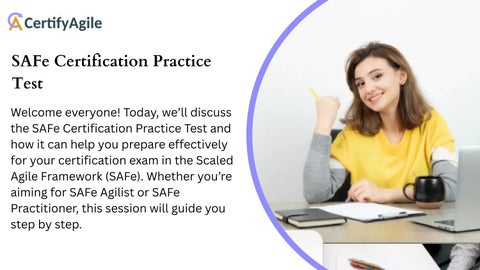
Welcome everyone! Today, we’ll discuss the SAFe Certification Practice Test and how it can help you prepare effectively for your certification exam in the Scaled Agile Framework (SAFe). Whether you’re aiming for SAFe Agilist or SAFe Practitioner, this session will guide you step by step.

About Us

Certify Agile

Helping professionals pass Agile exams with confidence

CertifyAgile was started by coaches and exam setters who saw a simpler path to exam success: practice with purpose, clear feedback, and focused study that fits real life.

Thousands now use our realistic mocks, explanations, and analytics to clear Scrum and SAFe® certifications—often on the first attempt.

Our mission

We turn anxious test prep into clear progress. Every course maps to the latest blueprints, with coaching notes from practitioners who’ve been on both sides of the exam.

Blueprint‐accurate mocks with detailed rationales.

Analytics that spotlight weak areas and next steps.

Mobile‐first experience for learning anywhere.

Human support from certified experts.

What is SAFe?

Good credit plays a vital role in achieving financial stability and freedom. It shows lenders that you’re responsible with money and helps you qualify for better financial opportunities.

Easier approval for loans, mortgages, and credit cards

Lower interest rates, saving you money over time

Higher credit limits and better loan terms

Easier to rent apartments or buy a home

Can impact employment and insurance options

Reflects trustworthiness and financial responsibility

Importance of SAFe Certification ?

Validates knowledge in Agile and SAFe principles

Improves career opportunities

Boosts organizational efficiency

Speaker Notes

Getting SAFe certified proves your understanding of Agile and SAFe principles. It not only enhances your career prospects but also equips you to contribute effectively to your organization’s Agile transformation

What is a SAFe Certification Practice Test?

A simulated SAFe exam

Covers all key concepts: Lean-Agile Principles

SAFe Roles & Responsibilities

Program Increment (PI) Planning

Helps assess readiness before the real exam Speaker Notes.

A SAFe Certification Practice Test is essentially a mock exam that replicates the questions and format of the official SAFe exam. It allows you to practice applying your knowledge in realistic scenarios, covering core topics like Lean-Agile principles, SAFe roles, and Program Increment planning

Benefits of Taking Practice Tests

1. Identify Knowledge Gaps

Practice tests help you pinpoint the areas where your understanding is weak. For SAFe, this might be concepts li Program Increment (PI) Planning, Lean Portfolio Managem or specific roles like the Scrum Master or SAFe Agilist. By identifying gaps, you can focus your study efforts where th matter most, rather than wasting time on concepts you already understand.

2. Improve Time Management

Most certification exams are time-limited, and SAFe exams are no exception. Taking practice tests under timed conditions helps you develop a strategy for pacing yourself, ensuring that you can attempt all questions confidently within the allotted time.

3. Build Confidence

Repeated exposure to exam-style questions reduces anxiety. When you take several practice tests, the exam format and question types become familiar, which boosts your confidence. This psychological preparedness is often just as important as knowing the content.

4. Familiarity with Exam Pattern

Practice tests simulate the actual exam environment, including the structure, number of questions, difficulty level, and question types. This familiarity reduces surprises on exam day, so you can focus solely on answering questions rather than worrying about the format.

5. Reinforce Learning

Every question you attempt forces you to recall knowledge and apply it to a scenario. This active learning reinforces your understanding of LeanAgile principles.

6. Scenario-Based Preparation

SAFe exams often include real-world scenario questions. Practice tests expose you to these situations, helping you learn how to apply principles in practical settings, not just memorize theory.

7. Track Progress

By taking multiple practice tests over time, you can track your improvement. You can measure how your scores increase, which topics you consistently struggle with, and adjust your study plan accordingly.

Turn static files into dynamic content formats.

Create a flipbook