HEALTH&SAFETY BULLETIN





Welcome to Ceres Rural’s Health & Safety Bulletin. Each quarter, we update you on industry news, topical issues, and safety alerts with the aim of supporting you in achieving best practice on your farm or estate. This edition summarises the annual statistics recently published by the Health & Safety Executive (HSE) for work-related ill health and injuries. It outlines the steps to follow when administering veterinary medicines and provides key considerations for the safe use of tractor three-point linkages. The bulletin includes advice on maintaining a safe working environment, and strongly recommends participating in free online training regarding children on farms. Lastly, two recent prosecutions from outside of agriculture are reviewed, together with the clear learning outcomes for the industry.
The HSE has published its annual work-related ill-health and injury statistics for 202122. The key facts from their figures include:
1.8 million work-related ill health cases.
0.9 million work-related stress, depression or anxiety cases.
0.5 million work-related musculoskeletal disorder cases.
36.8 million working days lost due to work-related ill health and non-fatal workplace injuries.
0.1 million workers suffering from COVID-19 which they believe may have been from exposure to coronavirus at work.
0.6 million workers suffering from a work-related illness caused or made worse by the effects of the coronavirus pandemic.
0.6 million workers sustaining a non-fatal injury.
123 workers killed in work-related accidents.
The statistics also suggest that 12,000 lung disease deaths each year are estimated to be linked to past exposures at work. In financial terms, the annual costs of workrelated injuries are estimated at £7.6 billion, with the annual costs of work-related injuries and new cases of ill health (excluding long latency illnesses such as cancer) being £18.8 billion.
In agriculture, an estimated 4.1% of workers sustain a non-fatal workplace injury annually. This rate is statistically significantly higher than that for workers across all industries (1.6%). There were an estimated 6,000 work-related cases of musculoskeletal disorder, accounting for around half of all ill health in the sector. In 2021-22, there were 915 non-fatal injuries to agricultural employees reported to RIDDOR, of which 43% were specified injuries and 57% were over seven-day injuries.
Returning to the national picture, an estimated 17 million working days were lost due to work-related stress, depression, or anxiety in 2021-22. This is over half of all working days lost due to work-related ill health. HSE’s Chief Executive, Sarah Albon, said: “Stress and poor mental health is the number one cause of work-related ill health. The effects of stress, depression, and anxiety can have a significant impact on an employee’s life and on their ability to perform their best at work.
“Britain is one of the safest places in the world to work but we need all employers to do more and take seriously their responsibilities to support good mental health at work. That’s why improving mental health in the workplace is a key priority in our 10year strategy ‘Protecting People and Places’, and why we’re developing new partnerships across industry to help employers support their employees.”
Work-related ill health cases in 21/22
Source: Labour Force Survey
Working days lost to work-related ill health & non-fatal workplace injury in 21/22
Source: Labour Force Survey
Work-related stress, depression or anxiety cases in 21/22
iSource: Labour Force Survey
Workers suffering a non-fatal injury in 21/22
Source: Labour Force Survey
Workers suffering from COVID-19 in 21/22 which they believe was from exposure at work
Source: Labour Force Survey
Work-related musculoskeletal disorder cases in 21/22
Source: Labour Force Survey
Annual costs of new cases of ill health in 19/20, excl. long latency illnesses e g cancer
Source: HSE Cost Model
Workers suffering from work-related illness caused by or made worse by the coronavirus pandemic in 21/22
Source: Labour Force Survey
Workers killed in workrelated accidents in 21/22
Source: RIDDOR
Lung disease deaths each year estimated to be linked to past exposures at work
Source: death certificates and epidemiological info
Annual cost of workrelated injury & new cases of ill health in 19/20, excl long latency illnesses e g cancer
Source: HSE Cost Model
Annual cost of workrelated injury in 19/20
Source: HSE Cost Model

Veterinary medicines include antibiotics, vaccines, wormers and ectoparasiticides such as sheep dips Some of these may be harmful to human health. Medication may be administered orally, via injection or treatment to the skin or udder.Potential hazards include zoonoses causing a variety of conditions and diseases, crushing or kicking causing bruising or injury, accidental injection causing puncture wounds or cuts, and skin irritation from chemicals and medications used Long working hours can result in stressful posture and musculoskeletal complaints, however regular breaks and job rotations should be implemented to alleviate these issues where they arise
It is the employer’s responsibility to ensure there are adequate control measures in place with regard to COSHH legislation, appropriate personal protective equipment available, and methods used to minimise exposure wherever possible.
When administering medication, animals should be appropriately restrained where possible. If using a crush, this should be purpose built with foot restraints, belly winches and adequate space, and be maintained in accordance with the manufacturer’s instructions. The condition of the crush should be checked before use and damage reported for repair.Yards and buildings should be kept clean, free of clutter and well maintained
Stockmen should be informed of any problem animals prior to administering medication, with problem animals resulting in a second stockman assisting if required. Stockmen should be experienced and medically fit to work, with it being the employer’s responsibility to ensure appropriate information, instruction, training, and supervision is provided. Lone working should be avoided where possible. Personal protective equipment including eye protection, dust masks, gloves and wellington boots should be used. Applicators with shrouded needles should be used, and sharps should be stored and disposed of safely Personal hygiene is essential, with immediate access to suitable washing facilities if users become contaminated. Washing facilities should also be used before and after administering veterinary medication, and particularly before eating, drinking or using the toilet.
Developed in the 1920’s, the three-point linkage comprises of three moveable arms forming a triangle at the rear of the tractor. The two lower, hitch-lifting arms are controlled by the tractor’s hydraulic system providing lifting, lowering, and tilting of the implement. The top link is the central upper arm and provides a rigid connection, either manually or hydraulically.
Three-point linkages are an essential interface between many tractors and implements, but their safe use is frequently overlooked in an effort to hitch up and get on with the job as quickly as possible. Implements which are connected via the three-point linkage can be unstable and dangerous when hitching up Operators should always consider the following when using three-point linkages:
Whether the tractor can safely and physically lift the implement.
Whether the tractor needs counter balancing with front weights
Whether it is safe to stand where you are standing.
Whether help is necessary to safely hitch or unhitch
Whether communication is clear between the operator and anyone assisting.
Never stand between the tractor and implement, or behind them unless the tractor is stationary, and the operator is aware of your presence.
Operate controls from the correct position.
Never forget others around you are also at risk.
Make sure you use the right hitch system.
Never stand on or with your feet under the implement.
Ensure jacks, skids and other supports are used and maintained correctly.
Ensure stops are adjusted to prevent the machine from moving in transport.
Ensure pipes and cables are not caught or pinched during movement.
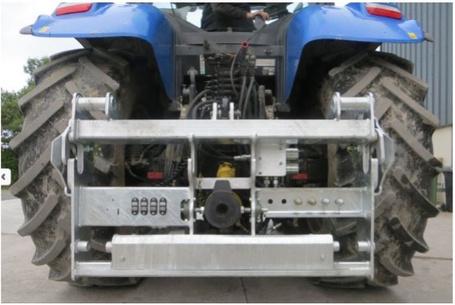
Equipment is evolving to allow for the safer use of three-point the Farm Hitch shown in the photograph consists of a (TMA) and Implement Mounted Assembly (IMA). The TMA tractor’s three-point linkage for most of the time, and is with the safety benefit of minimising the risk of any incidents conventional hitching and unhitching.

Farms and estates can be dangerous places to work. They potentially include large buildings, specialised fixed equipment, heavy machinery, and livestock, and can be particularly hazardous for those who are unfamiliar with the setting.
The following steps should be followed to maintain a safe working environment.
Observe all signs, speed limits and site safety rules.
Beware of people, machines, livestock, and buildings when manoeuvring.
Take note of the location and height of overhead power lines.
Turn radios off and open a window if safe to do so when moving around yards. Do not leave vehicles or implements where they could cause an obstruction.
Provide and maintain good levels of external lighting in farmyards. Keep to marked pedestrian routes and crossing points if provided.
Lay heavy objects flat so they cannot fall over but can be easily moved.
Use an appropriate means of access or trained contractor when working at height.
Ensure guards and safety rails are in place and in good working order.
Leave areas where you have been working in a clean and safe condition.
Do not obstruct areas of access or egress or fire assembly points.

Lantra have developed and launched a free online training course aimed at ensuring the safety of both budding young farmers and those visiting farms who may not be familiar with the environment.
This course – Children on Farms – covers the law, children and tractors, children and ATVs, and children and falls. It also covers other issues including child safety around equipment, harmful substances, and the importance of having a farm safety checklist. The training lasts approximately 45 minutes.On completion of the free course, participants can download their Lantra Child Safety on Farms Course Certificate.
There are too many accidents on farms involving children: in November, a 2-year-old was killed when he was struck by a tractor on a farm in Northern Ireland.The 2021-22 annual statistics also include a 9-year-old who was killed when he was run over by a truck and bowser.Although the Christmas period represents a quieter time on arable units, the workload for many livestock and dairy farms is maintained and children are increasingly present as school holidays begin.
It is strongly advised that farm workers at all levels – from management to operational, both permanent and temporary – complete this training and download the certificate. The training can be accessed via this link.

The following are examples of recent prosecutions – this bulletin focuses on two cases from outside of agriculture, but with clear learning outcomes for the industry:
Eddie Stobart has been fined after staff at its rail and container freight port in Widnes, Cheshire were exposed to asbestos. An HSE investigation found that while preparing a site for the storage of empty containers, Eddie Stobart did not carry out an asbestos survey prior to excavation work commencing, nor did it provide the workers with any asbestos-related training.
The business pleaded guilty to breaching Regulations 5 and 11(1) of the Control of Asbestos Regulations 2012 and was fined £133,000 and ordered to pay costs of £9,260.
The HSE commented that, “the duty to manage asbestos relates to entire premises, including yard areas, not just buildings. There is no safe level of exposure to asbestos.”

The law requires businesses undertaking work in demolition, maintenance or any other work which exposes or is liable to expose employees to asbestos to assume ACMs are present unless you have evidence, such as an asbestos survey to indicate otherwise.
A packaging company has been fined after an engineer had his hand amputated following trying to fix a fast-flowing cardboard box-making machine capable of making 200 boxes per minute.
The engineer and a colleague went inside the fixed perimeter guard of the machine and closed its interlock gate, meaning it could not be restarted. He climbed into the machine to reset a conveyor belt and then remained in a section of the machine where it was possible to stand while it was running.
When the machine started up, the engineer felt a tugging on his arm. It is thought the sleeve of his overalls became caught in a nearby exposed chain drive, which pulled his hand into the mechanism and amputated it at the wrist. Following extensive hospital treatment, the hand was reattached during an 11-hour operation, but the employee still has very limited movement and significant pain, and can no longer work or drive.
The HSE investigation found that the manufacturer’s handbook for the machine was in Italian, with no English version available. The risk assessment was not suitable because it did not consider the risks created from the use of the machine, including during maintenance activities. There was no safe system of work in place to ensure safe isolation and access for tasks such as maintenance. Culturally, it was found to be common practice to bypass the gate that kept people and the machine separated, and to stand within the fenced area while the machine was in operation, demonstrating a lack of adequate supervision.Employees had not received any instruction for the safe isolation of the machine.
The company pleaded guilty to breaching Section 2(1) of the Health & Safety at Work etc. Act 1974 and was fined £115,000 and ordered to pay costs of £5,308.
An unsafe culture of working without shutting off and isolating machinery becomes contagious. Planned preventative maintenance can affect the reactive basis on which repairs are required. That removes the time pressure element and provides a greater chance to consider the necessary actions, and risks to which workers might be exposed.
If you would like to discuss any topics raised in this issue of the Health & Safety Bulletin, do not hesitate to contact our Healthy & Safety Guidance expert.

ROBERTGAZELY PARTNER|SAFFRONWALDEN
robert.gazely@ceresrural.co.uk 07592 041 617