July 2013
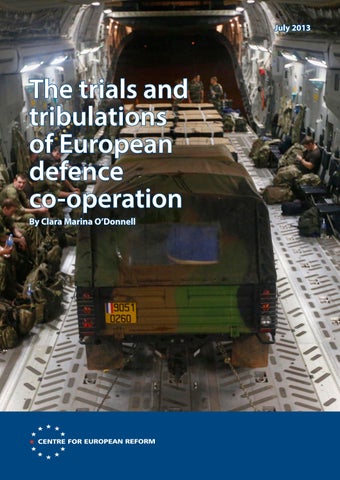
The trials and tribulations of European defence co-operation By Clara Marina O’Donnell
The trials and tribulations of European defence co-operation By Clara Marina O’Donnell
In an attempt to minimise the impact of defence spending cuts, European governments have introduced some welcome forms of military collaboration. But they need to sign up to many more joint projects if they want to stem the deterioration of their armed forces. The many obstacles that have hitherto impeded European defence co-operation remain. Governments are reluctant to trust their neighbours and they want to protect jobs at home. At least some of these hurdles could be removed. Governments should seek to emulate co-operative programs like the European Air Transport Command. They should propose new NATO equipment programmes which involve more European defence companies. They should also agree on an ambitious European drone programme at the European Council in late 2013. France’s strategic defence review, published in April, was met with sighs of relief in several European capitals and in Washington. Many had feared that Paris would replicate the debilitating defence cuts introduced by a number of European countries since the onset of the economic crisis. According to some EU officials, European defence budgets combined have dropped from €200 to €170 billion since 2008, as governments have sought to rein in public spending. But President François Hollande resisted calls from his finance ministry to reduce the defence budget by 10 per cent. Instead he has frozen funds for France’s armed forces at just over €30 billion a year until 2019. Nevertheless, the French review, known as the ‘Livre Blanc’, is an uncomfortable reminder to all Europeans of the security challenges they face. The white paper highlights that Europe’s stability continues to be threatened from many directions, not least North Africa, the Middle East and the Sahel. It also recognises that the United States is suffering from its own budgetary strains and is tired of long military operations. It therefore argues that Europeans should not assume that Washington will provide its full military support to stem conflicts which are primarily of interest to Europe. Faced with such realities, the Livre Blanc echoes the conclusion drawn by NATO and the EU in recent years: if Europeans must take on more responsibility for their regional security at a time of severe fiscal austerity, they should buy only essential military capabilities and increase the co-operation amongst their armed forces.1 Many European countries are still reforming their militaries so that they can tackle post-Cold War threats. 1: For more on the Livre Blanc see Camille Grand, ‘La tendance à l’armée Bonzaï se poursuit’, L’Express, April 2013, and Etienne de Durand,
They still sometimes spend money on the wrong capabilities. And although most European states have been involved in some defence collaboration for years, they continue to unnecessarily duplicate much of their military equipment, training and logistics. Unfortunately, military co-operation is easier said than done. European countries remain reluctant to trust their neighbours. They also want to protect jobs, be it in their armed forces or their national defence industries. As a result, although Europeans militaries have agreed to some new joint initiatives since the economic crisis, the result has been savings of only €200 to €300 million – around one hundred times less than what they have cut. This policy brief will review the cost-saving measures which governments have introduced in response to the economic downturn, assess the most intractable obstacles to further defence collaboration, and suggest solutions to at least some of these problems. ‘La France recentre sa politique de défense’, Le Figaro, April 2013.
The trials and tribulations of European defence co-operation TITLE Month July 2013
info@cer.org.uk | WWW.CER.ORG.UK
1
Some good news France and the United Kingdom are making headway in several of the initiatives they outlined in 2010 when they committed to increase their bilateral defence co-operation in the Lancaster House treaties. The two countries are integrating their military doctrines effectively; their nuclear co-operation is going well; and they are buttressing their plan to set up a combined joint expeditionary force by 2016 with military exercises. In 2012, the British and French navies trained together, and an air force exercise is planned for 2013. When releasing the Livre Blanc, France confirmed that it wants to develop a helicopter-launched missile jointly with the UK. British and French officials argue that enhanced coordination between London and Paris made it easier for them to convince other NATO allies to intervene in Libya. And British policy-makers point to the UK’s military support to France in Mali as another illustration of strengthened Franco-British defence collaboration – even though some French experts think that the level of assistance provided by the UK in that case has been insufficient.2 Elsewhere in Europe, Denmark, Finland, Iceland, Norway and Sweden have strengthened their regional defence co-operation under the umbrella of ‘NORDEFCO’. The Air Forces of Norway, Finland and Sweden train together across each other’s airspace. Belgium and the Netherlands are setting up a joint helicopter command. And last September, Bulgaria and Romania agreed terms to make it easier to police each other’s airspace. Within NATO, under the umbrella of ‘smart defence’, the Netherlands is installing new radars on four frigates to
support NATO’s missile defences. The transatlantic alliance is also helping small groups of European countries implement over 20 cost-saving projects. The EU’s European Defence Agency (EDA) is providing guidance to ten EU states that want to acquire more air-to-air refuelling planes. Eighteen nations now take part in an EDA network to facilitate maritime surveillance through information exchanges. The agency is also helping governments harmonise their safety standards for munitions – according to the EDA this could lead to savings of up to €1.5 billion a year across the EU.
Many initiatives to pool military “capabilities do not even make it onto the drawing board. ” Meanwhile, the European Commission has been helping EU governments secure savings through removing inefficiencies in the European defence market. Amongst other things, the Commission is ensuring all memberstates make the most of two new directives. One directive streamlines export controls for military equipment within the EU. The other directive makes it easier for governments to use competitive tendering when they buy defence equipment. Poland, the Netherlands, Luxembourg and Slovenia had been slow to implement the new rules, which should have been in force by August 2011. So to speed up the process, in September 2012 the Commission asked the European Court of Justice to fine them.
Still too scared to share Though welcome, these initiatives fall short of the repeated promises by European governments to overhaul how they spend their military budgets. Even when faced with today’s economic imperatives, EU states still struggle to embrace ambitious collaboration in defence. Countries remain wary of relying on others for military capabilities. States fear that shared military forces may become unavailable if a partner disapproves of a particular operation. For many NATO members, such concerns were exacerbated when Germany withdrew its pilots from the alliance’s jointly owned surveillance aircraft (AWACS) during the deployment to Libya – even though Berlin sent more AWACS pilots to Afghanistan in order to free up military personnel from other NATO countries for the Libya operation. 2: For more on British support to France’s military intervention in Mali see Michael Codner, ‘The British military contribution to operations in Mali: Is this mission creep?’, RUSI analysis, January 2013, and Benoit
The experience of the Franco-German brigade has also heightened unease within the French armed forces about joint capabilities. Paris and Berlin have been unable to deploy the brigade as a bi-national formation to Afghanistan because they have never agreed about the level of risk to which troops should be exposed. Instead, units from the brigade have been deployed as part of separate French and German contingents. European governments also worry that if they buy military equipment from a company based in another country, they will be unable to ensure either that the firm has stock available for them or that the company can obtain an export licence. On the other side, exporting countries fear that if their national defence firms sell sensitive components to companies in other EU states, it will be harder to stop these components from being Gomis, ‘France-UK defence co-operation and Mali’, Chatham House expert comment, January 2013.
The trials and tribulations of European defence co-operation July 2013
info@cer.org.uk | WWW.CER.ORG.UK
2
re-exported to undesirable countries outside the Union. Indeed, while some EU members, including Germany and the UK, have very reliable export controls, others, such as Romania and Bulgaria, have lower standards.3 Finally, ministries of defence remain nervous about sharing details of their sensitive military technology with allies. Sometimes two EU states will independently ask the same defence company to develop a piece of equipment, such as a new radar. Both countries will ask the firm to set up internal firewalls within its research and development efforts so that the two radar programmes are kept separate. The company then has to duplicate a lot of its efforts, and the cost of building the radars grows. Because of this continued European reluctance to rely on neighbours, many initiatives to pool military capabilities do not even make it onto the drawing board. In addition, EU efforts to integrate defence markets are floundering. For example, the European Commission set up a ‘defence task force’ in 2011 to propose new measures to dismantle defence trade barriers. But several European governments, including the UK, have made it clear to the Commission that they have little appetite for bold new reforms. It would be unrealistic to expect that ministries of defence can overcome all of their sensitivities relating to trust in the foreseeable future. And EU member-states are far from the only countries which place heavy controls on their military technologies – US security restrictions are also very onerous. For example, when European defence firms buy American ones, European owners are sometimes only permitted to have partial knowledge of the activities of their American subsidiaries.4 But there are ways to minimise the risk of disagreements about the use of shared military assets. First, EU states
can co-operate with countries that have similar strategic cultures – an approach which has been adopted by France and the UK.5 It is true that this option has its drawbacks. It risks reinforcing the divisions between the more militarily active European countries and those that are less so. Nevertheless it remains one of the most realistic shortterm options.
could use the model of the “EATCGovernments for deployable field hospitals, transport helicopters and transport ships. ” Second, European ministries of defence can set up initiatives which reduce the scope for a country to block its partners from using shared capabilities. This is the case with the multinational European Air Transport Command (EATC). Based in the Netherlands, the EATC commands almost 150 aircraft from Belgium, France, Germany, Luxemburg and the Netherlands. The planes mainly do strategic airlift and air-to-air refuelling. And the EATC determines how to use them most efficiently. But in contrast to NATO’s AWACS, which are jointly owned, the aircraft used in the EATC belong to the participating nations. As a result, a country can refuse to take part in a particular operation. But it cannot stop other members of the EATC from doing so. Additional European countries could set up similar commands for their strategic airlift and air-to-air refuelling planes. Governments across the EU could also use the model of the EATC for other military capabilities which are less sensitive than combat troops and therefore do not require national commands. This could include deployable field hospitals, transport helicopters and transport ships.
More than two to tango? European countries also differ on whether they should cooperate with only a few partners, or work within a larger group, when they develop new military technologies, pool equipment, train or deploy together. The UK, frustrated by the delays and cost overruns encountered by large multilateral programmes in the past, including the A400M and Eurofighter, firmly believes that bilateral procurement efforts are more efficient. In contrast, many in France think that more partners lead to greater added value in procurement projects. Since President François Hollande took office, Paris has wanted to widen some of the bilateral Franco-British defence 3: See Clara Marina O’Donnell, ‘The EU finally opens up the European defence market’, CER policy brief, June 2009. 4: See Clara Marina O’Donnell, ‘A transatlantic defence market, forever elusive?’, CER policy brief, July 2010.
projects outlined in the Lancaster House treaties. The French government has been particularly keen to include Germany in some Franco-British joint efforts – even though French officials recognise that Berlin can be a difficult partner and that the forthcoming German elections may complicate joint military efforts even further. A number of EU and NATO officials acknowledge that while they would prefer all members of each organisation to participate in their respective collaborative projects, at times it can be difficult for nearly 30 countries to work together – particularly if governments insist on having different technical specifications for the equipment they build. 5: See Tomas Valasek, ‘Surviving austerity: The case for a new approach to EU military collaboration’, CER report, April 2011.
The trials and tribulations of European defence co-operation July 2013
info@cer.org.uk | WWW.CER.ORG.UK
3
As a result, these officials consider military co-operation among smaller groups a more effective alternative, particularly in the initial stages of a joint project. Current NATO smart defence efforts are shaped around this logic. The 20 or so cost-saving initiatives in the pipeline each have a lead nation and several participating nations, and additional countries can join as the project develops. The logic of ‘starting small – widening later’ also made it easier for EU governments to set up the European Air Transport Command.
importance to military equipment that can help defend Europe’s territory from outside aggressors.
But for ‘clusters’ of military co-operation to be effective, European governments need to co-ordinate their various bilateral and regional military projects. For example, countries participating in the different clusters must ensure that their armed forces can communicate on the battlefield. Too often, European countries only think of interoperability amongst different regional groupings as an afterthought.
Some policy-makers complain that the UK resisted any EU military involvement in Libya during the NATO operation and see this as a reflection of the British government’s lack of interest in CSDP. And many EU states are worried that the UK might withdraw from some aspects of CSDP as a result of its current ‘balance of competences review’, or that the country might leave the EU completely if it holds a referendum on membership.
In addition, European countries must ensure that their neighbours do not think that they are pursuing bilateral defence efforts at the expense of the EU or NATO. When France and the UK signed the Lancaster House treaties, many member-states feared that the agreements were a manifestation of Paris and London’s dwindling interest in broader European defence efforts – and in the case of Britain, they had a point.
Paris and London should do more to reassure those European countries that still have doubts about French and British commitments to collective European defence. Otherwise the countries which believe that they still face territorial threats will be less inclined to develop the expeditionary armed forces advocated by NATO and the EU. They will prefer instead to spend more on defending their borders.
Since then, a number of states have been reassured by British and French officials that their bilateral co-operation is designed to complement EU and NATO initiatives. The Livre Blanc has also helped: it emphasises the importance for France of both the transatlantic alliance and the EU’s Common Security and Defence Policy (CSDP).
European efforts to develop drones have “become bogged down in competing and unsuccessful initiatives. ”
But there remains unease. Several countries are disappointed that London and Paris are standing back from EU efforts to review the European Security Strategy; Italy, Poland, Spain and Sweden are promoting the initiative.6 Some Central European governments are uncomfortable about the fact that Britain and France have prioritised expeditionary military capabilities in the Lancaster House treaties. These countries would prefer Europe’s two largest defence players to give more
London and Paris could contribute to EU discussions on a new security strategy. They could more actively help smaller countries identify pooling and sharing projects. And the British authorities should use the balance of competences review to highlight the many benefits of EU defence efforts for the UK – be it improvements in European military capabilities, helpful crisis management operations, or fewer barriers to the trade in defence goods.
Furthermore, France and the UK have reportedly shown limited interest in helping the Visegrad countries implement pooling and sharing projects. That contrasts with Belgium, Luxembourg, the Netherlands and Norway, which have provided Central Europeans with extensive lessons learnt from their own experiences in regional co-operation.
Industry, technology and jobs In response to the decline in military spending, European defence companies are warning that they will increasingly struggle to develop cutting-edge military technologies. Some of them say that they will give more importance to potential customers in other parts of the world where defence spending is increasing, such as India and the Middle East. As a result, the military equipment produced by defence companies based in Europe could be less well adapted to the needs of European customers.
EU states acknowledge that integrating their defence markets would improve the prospects for European industry and create savings for ministries of defence. Yet as described above, many governments are still nervous about allowing the European Commission to take further steps to dismantle defence trade barriers. They also remain loath to merge their defence firms with those of other countries. As well as having concerns over sovereignty, national authorities fear that industrial
6: See Björn Fägersten, Alessandro Marrone, Martín Ortega and Roderick Parkes, ‘Towards a European global strategy’, IAI, PISM, RIE, UI, May 2013.
The trials and tribulations of European defence co-operation July 2013
info@cer.org.uk | WWW.CER.ORG.UK
4
consolidation will force some of their arms manufacturers to shed jobs – a prospect which is particularly unpalatable in difficult economic times. The inability of France, Germany and the UK to agree to a merger between BAE and EADS last autumn was a reminder of the perennial obstacles to industrial consolidation in Europe. Numerous EU and NATO officials – and many senior figures in the British and French governments – agreed with BAE and EADS that the merger was likely to benefit the European industrial base. It could have created a company with more balanced military and civilian operations and a simplified ownership structure (compared with that of EADS at the time). The firm would have had access to wider pools of government funds for research and development. And its size would have enabled it to compete on a more equal footing with the likes of Boeing in both the European market and the lucrative American one. But concerns over sovereignty and jobs made Berlin uncomfortable about the deal. The desire of many European governments to protect their national industrial bases also hampers multinational efforts to develop new equipment. Many French officials and defence industrialists believe that most of NATO’s smart defence projects, including missile defence, favour US defence companies. There is some truth to this. But NATO allies could increase the level of European industrial participation in smart defence projects by suggesting more initiatives which involve equipment made in Europe. For example, as Camille Grand of the Fondation pour la Recherche Stratégique suggests, Berlin, London, Paris or Rome could sell some of their older fighter jets which they want to discard because of budgetary constraints to countries in Central Europe that are keen to strengthen their arsenals cheaply. This would allow the European companies which previously built spare parts for the fighter jets in Germany, France, Italy or the UK to continue doing so for the new owners in Central Europe.
drone. But three years later, neither London and Paris, nor Berlin and Rome have signed any contracts to build these aircraft. And the picture has become further muddled by calls from the French government to widen FrancoBritish defence efforts to other European countries, when London remains opposed to the idea. Since April 2013, the EDA has also been trying its luck in launching a European MALE. It is inviting all EU member-states to build the drone together. The agency is also trying to help EU governments agree common air worthiness rules so that remotely piloted systems can fly across European air space (which they currently cannot do). Unfortunately for the EDA, so far ministries of defence have only agreed in principle to this EU-wide effort to build a MALE. It is still unclear how many governments will be willing to provide any money. Faced with the lack of any home-made MALEs, EU countries are increasingly buying a US-made equivalent, the Reaper. The UK and Italy have operated Reapers in Afghanistan for several years. France is buying several of them to use in Mali. And Germany and the Netherlands might follow suit. There are some benefits for Europeans, and in particular the UK, in using American drones. It is cheaper for EU governments to buy from the US than to develop their own remotely piloted aircraft. For the UK, the use of Reapers also gives access to significant US intelligence. Because of the close ties between both countries, American and British armed forces have been sharing much of the information their Reapers collect when flying in Afghan skies.
programmes do not “needLargeto bemultinational as expensive and complicated as they have been in the past. ”
The unwillingness of EU states to integrate their defence industries is also hampering their efforts to develop drones. For years, governments across Europe have stressed the need to build their own remotely piloted systems for military and civilian uses. But ministries of defence have been slow to invest in the relevant technologies.
In the long run, however, both Europeans and the US will suffer if EU countries rely only on US-made equipment. Because of America’s technology controls, it can take time before Washington can approve a sale. For example, Italy has tried to buy weapons for its Reapers for about two years.
European efforts to develop surveillance drones that fly at medium altitude (known as MALE), in particular, have become bogged down in competing and unsuccessful initiatives. A French-led effort to develop a joint European MALE that began in 2004 collapsed a few years later. At the time of the Lancaster House treaties, the UK and France promised to develop a MALE bilaterally. This led Germany and Italy – upset about being left out – to declare that they would build their own medium altitude
US export rules also make it harder for national European regulators to certify whether a drone is safe to fly over their airspace. When America sells remotely piloted systems to its allies it does not always give the full details of the IT systems underpinning the equipment. Washington’s desire to protect its most sensitive technologies is understandable. But certification challenges contributed to Germany’s recent decision to cancel its purchase of several high altitude drones built
The trials and tribulations of European defence co-operation July 2013
info@cer.org.uk | WWW.CER.ORG.UK
5
in an EADS partnership with Northrop Grumman – even though Berlin had already invested more than €500 million in the programme. Finally, if Europeans do not develop globally competitive remotely piloted aircraft, US defence companies will be under less pressure to offer competitive prices on both sides of the Atlantic. This will be to the detriment of both European and US taxpayers. Europeans should therefore build their own versions of the next generation of unmanned systems, whether these be MALEs or remotely piloted fighter planes. At a minimum, Britain, France, Germany and Italy will need to build these aircraft together. EU countries could barely afford duplicating expensive aerospace programmes prior to the economic crisis. They definitely cannot afford it now.
Fortunately large multinational programmes do not need to be as expensive and complicated as they have been in the past. Ministries of defence just need to be more flexible about the technical specifications of the various drones. Even if EU governments compromise on the design of the aircrafts, they will still have more say on how the equipment works than if they buy off-the-shelf, as they currently do. Europeans must also engage their US counterparts to agree common standards for air worthiness. Otherwise, the possibilities for transatlantic trade will be curtailed. Europeans and the US would also run the risk of being unable to deploy remotely piloted aircraft to help their allies in a military or civilian emergency because they would not have permission to fly in each other’s airspaces
Seize the opportunities American officials worry that Europeans will never overcome their aversion to defence co-operation. The practical and political obstacles facing EU states are certainly daunting. But Europeans have already demonstrated some ability to implement cost-saving military collaboration.
But EU governments still have time to exploit the spotlight that the Council will put on defence policy and procurement. At a minimum, they should use the occasion to launch a European drone programme so that Europe can compete globally in the next generation of remotely piloted systems.
For the future, although many features of the European defence landscape are inauspicious, there is some good news. Several large procurement programmes which began in the Cold War are coming to an end. As a result, governments will have more flexibility about how – and with whom – they develop their future military equipment.
Such an initiative would benefit Europe and the US operationally and industrially. It would also show the rest of the world that even under significant financial duress, Europeans remain committed to international security.
The merger talks between BAE and EADS have reportedly spurred greater interest in defence industrial issues within the British government, and the idea of having a defence industrial policy has become more politically acceptable.
Senior fellow at the Centre for European Reform and a non-resident fellow at the Brookings Institution.
EU states have also committed to discuss defence matters at the European Council in December 2013. So far, governments have shown limited appetite to launch bold new initiatives at the meeting. Some EU officials are starting to worry that the Council could become an embarrassing reminder of Europe’s military shortcomings.
Clara Marina O’Donnell
This policy paper is based on a report of the FR-UK Defence Forum, an initiative between the Centre for European Reform, Chatham House, the Fondation pour la Recherche Stratégique, the Institut Français des Relations Internationales and the Royal United Services Institute. July 2013
For more information on this topic, and others, visit our website: www.cer.org.uk
The trials and tribulations of European defence co-operation July 2013
info@cer.org.uk | WWW.CER.ORG.UK
6