October 2013
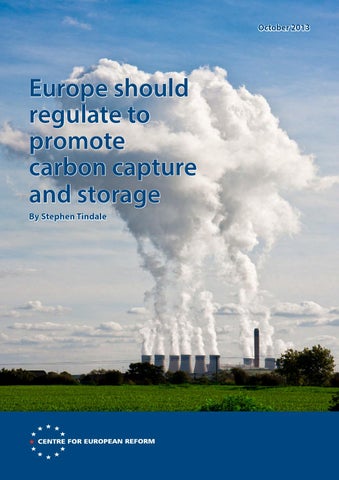
Europe should regulate to promote carbon capture and storage By Stephen Tindale
Europe should regulate to promote carbon capture and storage By Stephen Tindale
The EU has made no progress in rolling out carbon capture and storage. The USA and China are ahead in the race to commercialise this technology. The European Commission should follow California’s lead and regulate the maximum amount of carbon dioxide that power stations are allowed to emit. To ensure that Europe gains the economic advantages of CCS commercialisation, the Commission and national governments should subsidise CCS projects. Christine Lagarde, Managing Director of the International Monetary Fund, has described climate change as “by far the greatest economic challenge of the 21st century”.1 Jim Yong Kim, president of the World Bank, has warned that climate change “imperils all of the development gains we have made”.2 So climate change is not only an issue for environmentalists. It must also be a concern for economists and foreign policy-makers. To control climate change, energy must be used much more efficiently, and low-carbon energy sources must be used. Renewable energy is the best energy source because – as the name indicates – it will never run out. The EU must meet its 20 per cent renewable target by 2020, and set further targets for the end of each subsequent decade.3 But however ambitious Europe is on renewables, many decades will pass before renewables can provide all the energy consumed. So other low-carbon transition technologies are needed. Nuclear power is one such technology. Carbon capture and storage (CCS) is another. CCS removes carbon dioxide from power stations and industrial facilities. Once captured, the carbon dioxide is transported in pipelines and stored indefinitely in old oil or gas fields or salt-water acquifers. CCS is essential if the EU is to play its part in global climate protection. Over half of Europe’s electricity is generated from coal and gas. Coal is the most damaging of the fossil fuels to the climate, gas is much cleaner, but not clean enough to reduce emissions sufficiently to mitigate climate change. Gas produces about half as much 1: Christine Lagarde, ‘A new global economy for a new generation’, IMF, January 23rd 2013. 2: Jim Yong Kim, ’Make climate change a priority’, The Washington Post, January 25th 2013.
greenhouse gas per unit of electricity as coal does, but about a hundred times as much as nuclear. The decision of some member-states – notably Germany – to end the use of nuclear power, and therefore burn more fossil fuels, makes CCS even more indispensable. CCS can remove most of the carbon dioxide emissions from fossil fuel power stations, enabling both coal and gas to compete with nuclear and renewables in terms of low-carbon emissions. Coal with CCS is better than gas without CCS. Furthermore, CCS would have major energy security advantages. It would enable Europe to reduce energy imports and burn more coal without undermining the EU’s drive to cut emissions of greenhouse gases. If the EU commercialises CCS before other parts of the world, there will also be large export opportunities. China gets almost 80 per cent of its electricity from the burning of coal. Global coal reserves are plentiful –even in Europe – and they will be used to generate electricity for many decades to come. So too will gas, particularly if Europe and Asia are as successful in extracting shale gas as the US has been. CCS is a proven technology at small scale, but not at large scale. In 2007 the EU set a target that there should be ten to 3: Stephen Tindale, ‘How to expand renewable energy after 2020’, CER policy brief, December 2012.
Europe should regulate to promote carbon capture and storage TITLE October Month 2013
info@cer.org.uk | WWW.CER.ORG.UK
1
12 large scale CCS projects in operation by 2015.4 Six years later, there are none are under construction in Europe. Eight are being built elsewhere: four in the US, three in Canada, and one in Australia. The Chinese government has said that it will support and subsidise CCS, and 11 large scale projects are currently being developed (though none is yet under construction). So the EU needs urgently to catch up: otherwise it will lose any claim to global leadership on climate change, as well as the energy security and economic advantages of CCS. The European Commission is well aware of this. Earlier this year it consulted on whether CCS should be mandatory on all new coal-fired power stations.5
This policy brief first summarises the benefits of CCS. It then outlines existing EU policies and explains why they have not resulted in progress towards EU objectives. The next section considers how the EU can overcome the main obstacle – a lack of finance – and what type of CCS projects it should support. Finally, the paper argues that the EU should not rely only on financial incentives to promote CCS, but should also use regulation. The EU should adopt emissions performance standards, like those that apply in some US states and are being introduced by the European Investment Bank (EIB) and the American and British governments.
The benefits of CCS CCS technologies can be divided into three categories: Pre-combustion: This captures the carbon dioxide before the fuel is ignited and burns the remaining hydrogen-rich gas to produce power. The technology should reduce carbon emissions by 90 per cent. It is widely used in the production of fertiliser and hydrogen. But pre-combustion technology cannot be retrofitted onto existing power stations. Oxyfuel: This approach captures carbon dioxide during the combustion process. Prior to combustion, air is separated into nitrogen and oxygen. Fuel is then burned in the oxygen, producing carbon dioxide and water vapour, which can easily be separated. This process should also enable 90 per cent of the carbon dioxide emissions to be captured. Oxyfuel technology can be retrofitted onto existing plants. Post-combustion: This technology is already used in other industrial applications, though not at the level required for a large power plant. It involves capturing the carbon dioxide after the fuel has been burnt. Postcombustion CCS can be retrofitted, to all or part of an existing power station. It can also capture up to 90 per cent of the carbon dioxide from the part of the power station that it covers.6 CCS can be used on coal, gas or oil power stations, or in industrial facilities such as cement or iron and steel makers. It has been used and shown to be effective at small scale and at every stage of the capture, transportation and storage process. There is no reason to believe that it will not work in an integrated, large scale project. But this has yet to be demonstrated. Once separated and transported, carbon dioxide can be used to extract more oil or gas from fields which are 4: The EU defined ‘large’ plants as those with capacity of 250 megawatts or higher. 5: European Commission, ‘Communication on the future of carbon capture and storage in Europe’, March 2013.
close to being depleted. This enhanced oil or gas recovery improves the economics of CCS – though it reduces the climate benefits. Enhanced oil or gas recovery has been a significant driver for the deployment of CCS in the US and Canada, but has played little role in Europe. The Commission does not expect this to change in the future.7 Nevertheless, CCS would bring significant economic and energy security benefits. EU countries spent over €400 billion on imported energy in 2011. All Europe’s (and the world’s) energy could eventually come from renewables.
CCS can be used on coal, gas or oil power “stations, or in industrial facilities. ” But other low-carbon bridge technologies will be needed for at least the next half century. With a number of EU governments having ruled out nuclear power plants, Europe will only be able to meet its climate objectives if it works hard to commercialise CCS. Some coal used in Europe is imported from Asia and America, as this is cheaper than mining it at home. Nevertheless, most of the coal used in the EU is produced locally. Almost 90 per cent of the electricity generated in Poland comes from coal, around half in Greece, the Czech Republic, Denmark and Bulgaria and over 40 per cent in Germany. Since many member-states have well-established mining industries, retaining coal generation would also promote European employment. If the EU took a lead in developing and commercialising CCS technologies, European firms could also enjoy lucrative new export opportunities. China is the world’s largest producer and consumer of coal it has always refused to sign up to international agreements that would 6: For more explanation, see Stephen Tindale with Simon Tilford, ‘Carbon capture and storage: What the EU needs to do’, CER report, February 2010. 7: European Commission, ‘Communication on the future of carbon capture and storage in Europe’, March 2013.
Europe should regulate to promote carbon capture and storage October 2013
info@cer.org.uk | WWW.CER.ORG.UK
2
limit its carbon dioxide emission. But in May 2013, the Chinese National Development and Reform Commission, a government agency responsible for planning economic development, proposed that from 2016 there should be a cap on Chinese greenhouse gas emissions. This proposal has yet to be agreed by the government, but the agency is extremely influential, so it probably will be. Such a cap would make China an enormous market for CCS. Brazil,
South Africa and India are also likely to push ahead with the deployment of CCS. The US will become a major market if the Obama administration succeeds with its plan to regulate greenhouse gas emissions from power stations. At present, the US, China, Canada, Australia and Norway are all more advanced than Europe in developing CCS technologies. The EU will struggle to catch up or overtake them as long as its policies on CCS are so weak.
The EU’s efforts so far In 2009 the EU adopted the ‘carbon dioxide geological storage directive’, usually known as the ‘CCS directive’. It does not make CCS mandatory, nor does it determine a date in the future when it will be. It merely requires member-states to ensure that carbon captured in power plants or industrial facilities is stored in a safe way. Operators of power plants over 300 megawatts are required to assess the feasibility of retrofitting CCS. If this is feasible, they are required to be ‘CCS ready’ – to set aside enough space on the site to build CCS equipment. The need to leave a bit of land empty is not an onerous requirement, but even so the Commission admits that very few plants have yet been made ‘CCS ready’.8 And the Commission will only review the CCS directive in 2015. Also in 2009, the Commission awarded grants totalling €1 billion from the European Economic Recovery Plan to six CCS projects. Two of these projects have subsequently been abandoned: Vattenfall withdrew from a planned CCS project on a 500 megawatt coal-fired plant in Germany in 2011 because the government had not transposed the ‘CCS directive’ and because the company had not been offered a large enough subsidy. Polska Grupa Energetyczna withdrew from the construction of a 250 megawatt project coal-fired plant in Poland in April 2013 after it failed to get an additional grant from the Commission.
Three of the projects are still formally in development, but will probably never be built: An oxyfuel project on a new coal power station in Compostilla, north-east Spain. The developer Endesa has indicated that it is very unlikely to proceed. The UK government withdrew its support from a project to build a coal-fired power station with CCS in Don Valley, Yorkshire. Without government support it has no chance of proceeding. A 250 megawatt coal-fired power station in Porto Tolle, Italy, is on hold, because in 2011 a court cancelled the environment ministry’s award of an environmental permit. A new permit may be given next year. But the developer, Enel, has so far only received a grant of €100 million, and says that it would need at least €400 million. That leaves only one large scale CCS project that is proceeding – though not yet under construction – with an EU grant of €180 million. This is a post-combustion project at a 250 megawatt coal-fired plant in Rotterdam, the Netherlands. The carbon dioxide will be transported to depleted off-shore gas fields. The developers, E.ON and GDF Suez, have also received a grant from the Dutch government.
Reasons for the lack of progress The collapse of the carbon price is one “reason why the EU has made no progress on CCS. ”
The collapse of the carbon price is one reason why the EU has made no progress in rolling out CCS. The emissions trading system (ETS) was expected to provide developers with a powerful incentive to fit CCS to fossil fuel power stations because emitting carbon would become very expensive. But the ETS has not delivered. The International Energy Agency calculates that the carbon price would have to be above €40 a ton to make CCS economically viable for developers.9 Due to the economic recession and the over-allocation of permits by the Commission, the EU price is at the time of writing below €5.
Because CCS has not yet been demonstrated at scale, no one knows how much it will cost. But it is already clear that it will not be cheap. As long as carbon prices are at rock bottom, energy companies are asking for most of the cost of fitting CCS to be covered by public subsidies. But the subsidies on offer have been much too low.
8: European Commission, ‘Communication on the future of carbon capture and storage in Europe’, March 2013.
9: International Energy Agency, ‘The cost and performance of carbon dioxide capture from power generation’, 2011.
Europe should regulate to promote carbon capture and storage October 2013
info@cer.org.uk | WWW.CER.ORG.UK
3
For example, the proposed CCS demonstration project in Germany would have cost Vattenfall €1.5 billion. The Commission offered to contribute just €180 million, with the result that the project was not economically viable. In addition to grants under the European Economic Recovery Plan, energy companies could apply for grants from the ‘New Entrant Reserve 300’ (NER300). The EU set this up in 2008, as part of its climate and energy package, to subsidise both CCS and “new and innovative renewables”. The revenue for the NER300 comes from the auctioning of 300 million permits from the ETS, so the amount of money depends on the carbon price. When the NER300 was set up, ETS permits were trading at above €30 per ton of carbon. This would have led to revenue of about €9 billion. But €5 per ton will result in much lower revenue, and therefore less public subsidy for clean technology. In December 2012 the Commission announced the recipients of NER300 grants from the auctioning of the first 200 million permits: all went to renewables projects. The Commission argued that member-states had not provided sufficient information on how the CCS projects would be financed. The Commission then called for applications for grants from revenue raised auctioning the remaining 100 million ETS permits. But only one CCS project was submitted: an oxyfuel project at Drax, Yorkshire, in the UK. All other applications were for renewables. As well as the financial obstacles, CCS faces public opposition in many EU countries, most notably in Germany. Such opposition is based on a perception that carbon dioxide could be dangerous and should not be
stored anywhere near places where people live. Carbon dioxide is not toxic. But it is heavier than air. So if a large amount of carbon dioxide escapes from underground storage and concentrates in an enclosed space such as a valley, people could suffocate. Carbon dioxide stored in old oil and gas fields or salt-water acquifers is very unlikely to leak. The Intergovernmental Panel on Climate Change, following extensive research and peer review, concluded that “the fraction [of carbon dioxide] retained in appropriately selected and managed geological reservoirs is very likely to exceed 99 per cent over 100 years”.10 However, a small chance of leakage is not the same as zero chance of leakage, and would understandably cause concern for those living nearby. It would be better to store the carbon dioxide under the sea where possible. (There is less public opposition in countries such as the UK that intend to store the carbon dioxide under the sea bed.) Where this is not possible – in landlocked countries for example – the carbon dioxide should be stored under flat countryside. Some opposition in Germany is also based on the view that investment in CCS will divert money away from renewables and so postpone the achievement of the energy transition – Energiewende. This view is correct. Even large energy companies have a finite amount of money to invest, and public finances are currently under severe strain. But this lack of resources is not a good reason to oppose CCS. If nuclear is ruled out, CCS is the only technology that is sufficiently low-carbon to protect the climate while the EU moves towards an economy that relies exclusively on renewable energy.
How to overcome the financial obstacles to CCS The ETS needs fundamental reform, principally by adding a guaranteed floor price for carbon. The Commission’s proposal to delay the auctioning of some permits (‘backloading’) has now been agreed by the European Parliament. This will stop the price collapsing to zero but is far from sufficient to make the ETS an effective policy instrument. The Commission should now quickly follow up with proposals for strengthening the ETS, including a price floor which would give investors the certainty they need to choose low-carbon options.11 However, the European institutions will take time to agree on, and implement, measures to strengthen the ETS. The EU cannot afford to put CCS on hold until the ETS is overhauled. Otherwise Europe will be left behind in the race to commercialise CCS. More importantly, the global climate would sustain further damage. So while reforms of the ETS are continuing, the Commission should move ahead as rapidly as possible with CCS grants. 10: Intergovernmental Panel on Climate Change, ‘Special report on carbon dioxide capture and storage’, Cambridge University Press, 2005.
It should not take a year to select a CCS “project out of a list of one. ” The Commission has indicated that the decision on the next phase of NER300 grants will be taken in the summer or autumn of 2014. It should not take a year to select a CCS project out of a list of one. The UK government must move quickly to ensure that the Commission has the necessary information about additional financial support which the Drax project will receive. Then a grant to this project should be awarded. And the Commission must identify funds – possibly from the research budget – for further rounds of CCS grants. The top priority for funding should be an oxyfuel coalfired power station. Oxyfuel CCS captures the carbon dioxide from the whole of a power station and can be 11: Stephen Tindale, ‘Saving emissions trading from irrelevance’, CER policy brief, June 2012.
Europe should regulate to promote carbon capture and storage October 2013
info@cer.org.uk | WWW.CER.ORG.UK
4
retrofitted to existing power stations, so combines the advantages of pre- and post-combustion. Fortunately, the one CCS bid for NER300 is for an oxyfuel coal power station. In future funding decisions, the Commission should give priority to CCS on gas generation. To do this, it should change the way it assesses projects. It currently judges projects on the basis of cost per ton of carbon dioxide saved. This favours coal – the Commission estimates that the average cost of CCS for coal power stations is €40 per ton, and for gas €80 per ton.12 So giving all the grants to coal projects would deliver greater carbon savings in the short term. However, gas generation is better for backing up intermittent renewables such as wind and solar, because gas stations can be turned on and off more quickly than can coal stations. Therefore, to meet its longer-term climate and renewables objectives, the EU needs to commercialise CCS for gas as well as coal. It should do this by judging projects not only by cost of ton
of carbon dioxide saved, as it does now, but also by the amount of low-carbon electricity generated. This would often favour gas. European grants will not provide sufficient money to enable the construction of large scale CCS projects. National financial support will also be required. The Dutch government gave €150 million to the Rotterdam project, alongside the €180 million from the Commission. The Commission should – if at all possible – ensure that national applications to subsidise CCS projects are consistent with state aid rules. However, financial support may not be enough to get large CCS demonstration projects built. And once the technology has been demonstrated, it must be widely deployed. CCS will require regulations. Regulation would also help get the demonstration plants built, because developers would know that operating demonstration projects would give them early-mover advantage.
An emissions performance standard The EU has a much better record on the use of regulation to combat pollution than it does on the use of market mechanisms. For example, in 1992 catalytic converters were made mandatory on all new cars, a move which has substantially improved air quality. The 1998 ‘large combustion plant directive’ helped to curb acid rain. To tackle carbon emissions from coal power plants, the EU should follow the actions of California. In 2007, California implemented an emissions performance standard (EPS) which requires new or substantially upgraded coal power plants to have emission levels no higher than an efficient gas plant. The states of Washington and Oregon have introduced similar laws. In these states, all electricity retailers supplying consumers in the state must meet the EPS. The Californian EPS is estimated to have prevented the construction of around 30 coal stations without CCS.13 It must not take Europe 20 years to emulate California’s regulations, as it did with catalytic converters. An EPS is a necessary part of EU climate policies if they are to be effective. In 2010, when seven energy and environmental directives were being combined into the ‘industrial emissions directive’, the Commission rejected calls from some MEPs to regulate greenhouse gases, arguing that this would undermine the ETS. Now, given the lack of progress on CCS and the collapse of the carbon price, the Commission has consulted on whether to propose an EPS which would make CCS mandatory on new coal power stations.14 12: European Commission, ‘Communication on the future of carbon capture and storage in Europe’, March 2013. 13: Sarah Keay-Bright, ‘Response to the consultative communication on the future of CCS in Europe’, July 2013.
The Commission’s consultation document states, correctly, that an EPS would not necessarily drive investment in CCS. It might only increase gas generation. However, a shift of investment from high carbon coal to lower carbon gas, even without CCS, would be a significant step in the right direction. Furthermore, an EPS could be used to require CCS installation on gas as well as coal power stations.
An EPS is a necessary part of EU climate “policies if they are to be effective. ” The Norwegian government has said that all new gas power stations must have CCS. Norway has considerable experience with CCS: it has separated carbon dioxide from natural gas and stored it since 1994. But this is at a gas field rather than a gas-fuelled power station. Norway does not use much gas for electricity generation, because it has so much hydroelectric power. Nevertheless, the Norwegian energy company Statoil, in partnership with Shell, had hoped to build a large CCS gas plant in Mongstad, central Norway. There is already a small CCS test facility at Mongstad. But in September the Norwegian government said that it would not provide more subsidy for expansion. An EU EPS could be set at a level low enough to require CCS on new gas power stations. Alternatively, the EU could introduce an EPS at a level which required CCS on 14: European Commission, ‘Communication on the future of carbon capture and storage in Europe’, March 2013.
Europe should regulate to promote carbon capture and storage October 2013
info@cer.org.uk | WWW.CER.ORG.UK
5
all new coal power stations, and make clear that the level would be lowered in, say, 2030 to require CCS on all new and existing gas power stations. Such a timetable would not prevent gas power plants from being built now: they are relatively cheap to build, so the cost could be recouped before 2030. While the Commission is consulting on an EPS, another European institution is introducing one. The European Investment Bank (EIB) adopted a new energy lending policy on July 23rd 2013. In future the EIB will only lend to coal projects if the coal is to be burnt in a highly efficient combined heat and power station, or in a plant with CCS, or mixed with biomass. The EPS level will be reviewed at least once every five years, to take account of technological and EU climate policies. If policies are strengthened, the EIB level will be lowered. In the US, the Obama administration is also trying to introduce an EPS. Having failed to get a cap and trade proposal through Congress, the president has instructed the Environmental Protection Agency to regulate greenhouse gas emissions from power stations, just as it regulates other pollutants. The Environmental Protection Agency is proposing an EPS similar to the one existing in California and other states, which would make new or refurbished coal stations without CCS illegal. On June 25th Obama unveiled a new climate plan which strengthened the proposed regulation by extending it to existing coal power stations, even if they are not being refurbished. He also said that the Environmental Protection Agency should introduce the regulation without delay. The regulation would be introduced under an existing piece of legislation, the 1970 Clean Air Act, so does not have to pass through Congress. There will be legal challenges from the coal sector. Nevertheless, President Obama has in effect declared that market mechanisms are not sufficient to clean up the power sector, and that regulation must also be used. The Canadian federal government has introduced an EPS which all new power stations must meet. Canada’s EPS level is based on a highly-efficient gas power station, so is slightly stricter than the Californian or proposed US levels. The Canadian EPS will come into force in mid-2015. New coal stations will have a 10 year exemption from the rule as long as they are carbon capture ready. This is a weakness in the climate-effectiveness of the EPS, as it will allow new
coal stations with no CCS. But it may be effective for CCS development. If these new power stations are not retrofitted with CCS before 2025, they will have to be closed down. Power companies are unlikely to build a coal station which will only operate for ten years. So they will only build new coal stations if they are serious, and optimistic, about CCS.
Obama has in effect declared “thatPresident market mechanisms are not sufficient to clean up the power sector. ” The UK government is also introducing an EPS which will require new coal power stations to have CCS. But new gas power stations will only be required to be ‘CCS ready’, so that CCS can be retrofitted to them after they have opened. This approach is unlikely to reduce Europe’s overall emissions. Fewer emissions in the UK will mean that UK companies need fewer ETS permits, leaving more for companies in other member-states and so reducing the price of carbon even further. An EU-wide EPS would avoid undercutting the ETS, and would be much more effective at promoting the deployment of CCS. A European EPS would need to apply to all retailers selling electricity within the EU – based on the Californian model. The first organisation that buys electricity in California is responsible for meeting the EPS, even if it then sells the electricity on to another retailer rather than to a consumer. This avoids ‘carbon leakage’ – the export of production from a territory with strict climate policies to one with lax climate policies. In this case, carbon leakage would occur if California cut emissions from power stations within the state borders but imported more dirty electricity from other states. Carbon leakage resulting from an EU EPS would be a significant threat. Several EU member-states import large amounts of electricity from outside the EU. For example, Hungary, Slovakia, Poland and Romania import power from Ukraine, and Finland and Lithuania do so from Russia. But if the EU introduced an EPS, the Turks could build coal power stations without CCS and export the power to the EU. Serbia, Albania, Montenegro and Kosovo could do the same. So Californian-style measures to prevent carbon leakage would be essential alongside an EPS.
Conclusion The EU is in serious danger of losing any claim to lead the world on climate action. In the past two decades, this policy area has been a relative success story for Europe. The Commission must propose, and the Council and Parliament accept, structural reform of the ETS. The
Commission should also award grants to coal and gas CCS projects. And it should press for a regulation to limit the amount of carbon dioxide that a power station is allowed to emit. This should be set at a low enough level to make CCS mandatory on all new coal power stations.
Europe should regulate to promote carbon capture and storage October 2013
info@cer.org.uk | WWW.CER.ORG.UK
6
Europe cannot implement a successful climate policy without the involvement of Germany. Germany has rejected nuclear power, and is investing seriously in energy efficiency and renewables. But however well it progresses on these, it will be several decades before Germany can phase coal and gas out of the electricity sector. CCS in Germany is essential. Since the Commission does not have much clout in Germany at present, other EU governments that support CCS – such as the Dutch and British – should do all they can to convince Germany that CCS is a necessary low-carbon bridge technology.
Without CCS, the path to Europe’s low-carbon future is clouded with uncertainty. The climate and energy security benefits would justify the costs of an EPS requiring CCS on coal power stations.
Stephen Tindale
Associate fellow, Centre for European Reform October 2013
For more information on this topic, and others, visit our website: www.cer.org.uk
Europe should regulate to promote carbon capture and storage October 2013
info@cer.org.uk | WWW.CER.ORG.UK
7