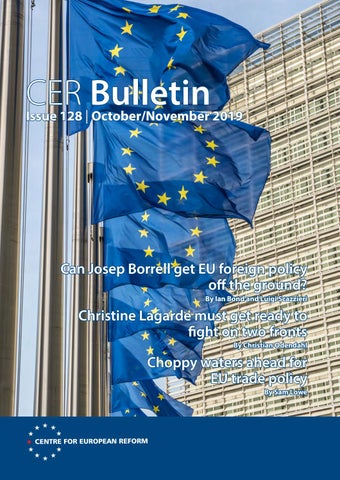
CER Bulletin
Issue 128 | October/November 2019
Can Josep Borrell get EU foreign policy off the ground? By Ian Bond and Luigi Scazzieri
Christine Lagarde must get ready to fight on two fronts By Christian Odendahl
Choppy waters ahead for EU trade policy By Sam Lowe
Can Josep Borrell get EU foreign policy off the ground? by Ian Bond and Luigi Scazzieri
The EU’s new foreign policy chief, Josep Borrell, may struggle to coordinate the Union’s external activities in the face of rival European commissioners and unruly member-states. The EU’s first High Representative for Foreign Affairs and Security and Vice President of the Commission (HRVP), Catherine Ashton, wrote in 2013 that her job consisted of “trying to fly a plane while still bolting the wings on”. Appropriately, the Spanish foreign minister, Josep Borrell, who will (subject to the European Parliament’s approval) succeed Federica Mogherini as the third HRVP on November 1st, is an aeronautical engineering graduate. He will need to be a skilled pilot to navigate through the institutional and substantive storm clouds facing him. Ashton and Mogherini can claim some successes. Ashton became the de facto lead negotiator for the so-called ‘E3 + 3’ (China, France, Germany, Russia, the UK and the US) in their talks with Iran on ending its nuclear weapons programme; and persuaded Kosovo and Serbia to discuss normalising relations. The Iran nuclear deal was finalised on Mogherini’s watch; and she worked with NATO Secretary General Jens Stoltenberg to develop the EU’s closest ever partnership with NATO. But both HRVPs were peripheral actors in efforts to resolve conflicts in Libya, Syria, Ukraine and Yemen that had significant impacts on European security. Borrell has his work cut out to
make the EU one of the main players even in its own immediate neighbourhood. Intra-Commission co-ordination has been a long-term problem. Borrell, like Mogherini, will chair a team of Commissioners with portfolios touching on the EU’s external policy, including trade, defence industry, aid and energy. He will have to persuade them all to work coherently to the priorities set out in the EU’s 2016 global strategy. The Union has often failed to respond in a joined-up way to issues with internal and external implications, such as conflicts around the Mediterranean and the migration crisis. Commission President-elect Ursula von der Leyen’s instructions to Borrell recognise the need to do better. But Borrell is not one of the new ‘Executive Vice Presidents’ of her new “geopolitical Commission”: that suggests he will have reduced institutional clout. The stumbling block for all HRVPs, however, is member-states’ primacy in foreign policy. Individual member-states pursuing their own foreign policies may sideline the HRVP and the European External Action Service (EEAS). Moreover, when member-states disagree, as France and Italy have over how to deal with
INFO@CER.EU | WWW.CER.EU CER BULLETIN ISSUE 128 | OCTOBER/NOVEMBER 2019 3
Libya’s civil war, the EU is paralysed. Von der Leyen has encouraged Borrell to follow up proposals by the current Commission to take some decisions by qualified majority, as foreseen in the Treaty on European Union, rather than unanimously, but member-states will resist. Borrell will need sharp elbows to get to the negotiating table whenever there is an international conflict to resolve. He will also have to show, as Ashton did during the Iran negotiations, that he can offer something as the representative of the EU as a whole that individual member-states cannot. Depending on the state of post-Brexit relations with the UK, he may have to deal with a London more interested in showing off its independence than supporting EU foreign policy initiatives. If Borrell can see off attacks on his position and reinforce the institutional role of the HRVP, he can then turn to the difficult foreign policy dossiers that he will inherit. His two top, and interlinked, priorities should be the EU’s relations with the US and with China. Borrell must try to work with President Donald Trump’s administration, however difficult that may be. Not all of the world’s problems can be solved by EU-US co-operation, but very few can be solved without it. Borrell needs to get the two sides talking about the issues they disagree on, including Iran, the Middle East peace process and European defence co-operation. Borrell should also try hard to find areas of shared interest in which the EU and the US could pursue complementary policies. China is the most important area of potential cooperation. Europeans used to take a more benign view of China’s trajectory than the US, but in recent years the EU too has become disillusioned with an internally repressive and externally assertive China. In March 2019 the Commission and EEAS described China as a “systemic rival promoting alternative models of governance”. Borrell should have a key role in ensuring that the EU presents a united front and defends its values against Chinese divide-and-rule tactics and ‘sharp power’, without involving itself in USChina great power competition. Apart from relations with the US and China, Borrell should focus on problems closer to home. The EU’s dealings with Moscow cannot be fully normalised as long as Russia occupies Ukrainian territory. However, the EU consensus on taking a firm line with Russia, which has held since the annexation of Crimea in 2014, is increasingly strained, not least by a French effort to ‘reset’ relations. Borrell must counter
any preconception that he will be soft on Russia. He should refocus the EU around a compromise policy firm enough to satisfy hawks but flexible enough to keep others on board. At the same time, he must work with the commissioner for the neighbourhood and enlargement, to ensure that the reform process in Ukraine continues. Borrell will also face a range of pressing challenges in the Middle East. The nuclear agreement with Iran is unravelling, thanks to Trump’s policy of ‘maximum pressure’, and military tension between the US and Iran is increasing, potentially leading to major disruption of oil production and shipping in the Gulf. Borrell will need to redouble European efforts to preserve what is left of the nuclear deal, while persuading Washington and Tehran to de-escalate. To Europe’s south, Libya remains locked in civil war. Borrell should not simply view Libya through the lens of migration, but instead back a recently announced German initiative to hold a conference to stabilise the country. Improving relations between Rome and Paris, following the change in Italy’s government, give Borrell a chance to forge a common European stance. Libya also offers a rare opportunity for Europe to work together with Trump. Finally, the EU’s ties with Turkey are badly strained. But with the US-Turkish relationship in even worse condition after a series of bilateral spats, it is in the EU’s interest for Borrell to engineer a better relationship with Ankara to prevent Turkey drifting further toward Russia. If the member-states and the Commission want the EU to have a coherent and effective external policy – and they should, in their own interests – then they must strengthen Borrell, not undermine him. Von der Leyen should make him an executive vice president of the Commission, and member-states should pursue their foreign policy priorities through him. Turbulence in international relations has worsened since Ashton became HRVP in 2009. The need for the EU to have a unified external policy that works should be clear by now. Borrell must quickly show his 27 fractious and sceptical passengers that he is the right man to fly them to safety, and dissuade them from hijacking the plane.
Ian Bond
Director of foreign policy, CER @CER_IanBond
Luigi Scazzieri
Research fellow, CER @LScazzieri
Christine Lagarde must get ready to fight on two fronts by Christian Odendahl
As Christine Lagarde takes over the presidency of the ECB, she has little room to ease monetary policy. She will need to convince northern European fiscal policy-makers to help. Mario Draghi will soon hand over the European Central Bank (ECB) to Christine Lagarde, the former head of the International Monetary Fund (IMF). He will pass on a much more powerful and modern central bank than the one he took over in 2011: the ECB has a bigger toolkit with which to fight recessions and support financial markets; it is an experienced crisis-fighter and the de facto guarantor of the euro; and it is Europe’s top bank supervisor. But Draghi is also handing over an economic situation that could hardly be worse for the incoming president: the economy is weakening, with Germany probably in recession; inflation has remained stubbornly below target for years and is falling again; and interest rates are at or below zero, even for bonds that only mature in 30 years time.
Image: © IMF
In his penultimate monetary policy meeting in September, Draghi pushed through a new stimulus package. By ECB standards, it was a timely response to recent economic data. Resistance to the stimulus was not confined to the traditionally reluctant members of the ECB’s governing council. But Draghi was right in his analysis – and right to prepare the ground for the incoming president. By absorbing the criticism of the conservative press in Germany and elsewhere, he made the job for Lagarde considerably easier.
But it is still a bloody difficult job. The economy shows little sign of improvement. Europe’s manufacturing sector is suffering from a global slowdown, in part caused by uncertainty: the US-China trade war continues to rage, the tensions in the Gulf are escalating, and Brexit remains unresolved. Lagarde may well have to ease monetary policy further. However, the monetary toolbox is almost fully in use. Lagarde can only give the screws another turn. The ECB’s key interest rates are at 0 per cent (the refinancing rate at which banks can borrow central bank money) and -0.5 per cent (the deposit rate at which banks deposit central bank money). This is low, but interest rates on German government bonds are lower still. The ECB could cut rates further, as the Riksbank has done: the comparable Swedish rates stand at -0.25 and -1.25 per cent respectively. To ensure that bank profits are not hit unduly by negative deposit rates, the ECB has introduced a tiering system, so that banks only pay negative rates on deposits above a certain threshold. Interest rate cuts also affect the ECB’s Targeted Longer-Term Refinancing Operation (TLTRO) programme, which provides money to banks for up to three years on condition that they make new loans to businesses or homebuyers. The interest rate on this long-term funding is
INFO@CER.EU | WWW.CER.EU CER BULLETIN ISSUE 128 | OCTOBER/NOVEMBER 2019 5
automatically linked to the key interest rates (and the volume of new loans). In September, the ECB made the terms of the programme more attractive for banks. There is a growing concern that interest rate cuts are ineffective when rates are already low. However, so far at least, banks are passing on most of the lower rates to borrowers. Lower interest rates would also have a dampening effect on the euro, which helps exporters. The ECB could also buy more assets. In September, it restarted its asset purchase programme (APP) for government, corporate and covered bonds as well as asset-backed securities. By buying assets, the ECB forces their former owners into other investments, for instance more risky corporate bonds. Higher demand for such assets, in turn, reduces the cost of investing for firms. The monthly pace of asset purchases will be €20 billion per month, which is lower than it was during the previous APP. Lagarde could increase the volume of purchases. It is even conceivable that the ECB could buy shares to make equity funding cheaper for companies. There is no economic limit to the amount of securities the ECB could buy to reach its inflation target. However, there are political constraints. Foreign assets are taboo as it would be seen to be manipulating the currency. Owning too many government bonds would put the ECB in an awkward position if countries have to restructure their debt. By becoming a major shareholder of private companies, the ECB would have to take decisions on company boards. Lagarde will need to find creative ways around such obstacles. The major innovation of the latest policy package was to make monetary policy more explicitly ‘state-contingent’: the ECB is now promising to keep policy on the current (or a more expansionary path) until inflation has safely returned to its target. This is an important and long overdue change. For example, it matters today whether the ECB would tolerate an economic boom in the future (that is, raise interest rates rather late) or whether it would act more cautiously, and tighten interest rates at the first sign of increased inflation. So far, the ECB has proved very cautious. Lagarde could go further, and promise not only that inflation should safely reach 2 per cent, but that it should also overshoot the 2 per cent target for a while to make up for the
persistent undershooting over the last five years. In effect, Lagarde would promise to tolerate a boom before starting to tighten. This kind of aggressive communication ensures that interest rate cuts or asset purchases do not fizzle out, as companies and investors no longer expect the ECB to tighten as soon as inflation starts to rise. Lagarde and her chief economist, Philip Lane, would have to convince an increasingly reluctant governing council to implement such further easing. But even then, there is a good chance that monetary stimulus alone would be insufficient to revive the economy and bring inflation back to 2 per cent. In that case, fiscal policy would need to help stimulate the economy, especially in countries such as Germany that have plenty of room to spend more or tax less. But Berlin is unwilling to help the eurozone economy – or in fact, its own, as Germany is among the worst affected by the current downturn. Lagarde will have to provide a stronger challenge to fiscal policy-makers in these countries than Draghi dared. Europe’s fiscal rules are supposed to make sure that spending is counter-cyclical, that is, that member-states spend more in downturns (and less in boom times), thereby helping the ECB to stabilise the eurozone economy. It turns out, however, that the current rules have failed to encourage counter-cyclical spending. Lagarde needs to push for a major revamp of the rules if she wants fiscal policy to help her. The rules need to be re-designed so that they bring about strongly counter-cyclical fiscal policy in all euro area countries. Lagarde would probably find an ally in the incoming Commission President Ursula von der Leyen. But the eurozone needs more than that. A common eurozone budget that raised spending when the ECB was reaching its limit would be ideal. Unfortunately, the political agreement that was reached in June turned the idea of a eurozone budget into an item of the general EU budget, made it too small to matter, and stripped it of its main function – stabilising the eurozone economy. Lagarde should ask politicians in Berlin, The Hague and like-minded countries to reconsider their opposition. She should make clear that critics of monetary stimulus have to present an alternative, and that alternative is a strong fiscal response.
Christian Odendahl
Chief economist, CER @COdendahl
Choppy waters ahead for EU trade policy by Sam Lowe
The strategic case for new EU free trade agreements is strong. But delivering them requires accommodating the European Parliament and winning over an inwardly focused agriculture lobby. The relative stability of the world trading system over the last two decades increasingly appears to have been an aberration. Trade and geopolitics have never been distinct, but Donald Trump has underlined their inter-dependence with his attacks on China and the EU, and his efforts to undermine the rules-based trading order. The US no longer views World Trade Organisation (WTO) rules and processes as adequate means to hold China to account. And its efforts to contain China bilaterally have spilled over into the rest of the world’s national security, digital and foreign policies.
Image: © European Union, 2019
The EU is caught in the middle. So far, the EU has benefitted from the turmoil created by Trump’s trade war, which provided the political impetus to conclude trade agreements with Japan, Canada, Mexico (upgrade), Singapore and Vietnam; but the waters ahead look choppy. To navigate the international and domestic political storms, EU trade commissioner-designate Phil Hogan will need to make the strategic case for a resilient trade policy. But he will face a European Parliament looking for greater reassurance that the EU’s trade policy complements its environmental ambitions, and an inwardly focused European agriculture lobby. In an increasingly uncertain international setting, the EU needs to lock in binding economic ties
with other nations. While the reform of the WTO and its appellate body should remain an EU priority, these efforts are likely to fail, at least in the medium-term. Equally, the current EU strategy of stalling until Trump is no longer in power is flawed. Even post-Trump, the EU should not assume that economic ties with the US will return to ‘normal’. The Democrats will probably run on a trade platform that has many of the same flavours as Trump’s, if not his outright antagonism to Europe. The EU should try to de-escalate the trade war, but from a strategic perspective its long-term focus should be on increasing the options available to its exporters by opening new markets elsewhere. Hogan should prioritise the completion of free trade agreements with Australia and New Zealand, on the basis that they enlarge the EU’s footprint in the region. In combination with its existing deals with Japan, Canada, Mexico, Peru, Singapore, Vietnam and Chile, the new FTAs would cement rules-based trade relations between the EU and the majority of remaining Trans-Pacific Partnership countries. Furthermore, the EU should take another look at its neighbourhood. It should give greater impetus to upgrading its association agreements with North African countries such as Egypt and Morocco. Turkey’s relationship with the EU (and US) is strained, but the EU should focus on the strategic
INFO@CER.EU | WWW.CER.EU CER BULLETIN ISSUE 128 | OCTOBER/NOVEMBER 2019 7
importance of its ties with Ankara, and look again at upgrading its customs union with Turkey. One of the long-running obstacles to EU liberalisation efforts has been the EU farming lobby, which benefits massively from EU trade agreements while at the same time opposing most of them. Hogan is well placed to navigate the sensitive politics, being both from Ireland (a country with a vocal agriculture sector) and the former EU commissioner for agriculture, where he developed a reputation as a tough but sensible negotiator. Hogan will not find it easy to bring the increasingly climate-conscious European Parliament onside, but it is possible. As I argued in a recent CER paper, the EU should explore the possibility of a border carbon tax, but approach the issue with care to avoid inflaming international tensions further. Hogan should also consider beefing up the enforceability of the environment and labour commitments in EU trade agreements. While doing so might make trade partners slightly more reluctant to strike FTAs, it could lead to increased public and parliamentary buy-in, making ratification more straightforward. One concession Hogan will be forced to make is on the planned EU association agreement with the Mercosur trading bloc members Brazil, Argentina, Paraguay and Uruguay. He would be wise to put the agreement on the backburner and avoid pushing for ratification until political
conditions are more conducive to success. The Mercosur agreement makes concluding a deal with Australia and New Zealand more difficult as it also fuels European agriculture concerns about low-cost competition. Recent forest fires in the Amazon and increasing deforestation in Brazil under the Bolsonaro administration have also made the agreement a tough sell with both the European Parliament and member-states. Hogan will also find himself forced to navigate the trade-technology-national security nexus, where trade policy becomes intertwined with industrial, regulatory and defence policy – for example, on China, Huawei and 5G. He has been tasked with working with executive vice president-designate Margrethe Vestager to address some of these issues. Until the EU can present a coherent external line on questions of 5G, data localisation, industrial policy and the like, its ability to influence international discussions will be limited. If EU trade policy is to succeed in the coming years it must become more strategic in the face of a deeply unstable international order. Hogan’s challenge is to not only communicate this vision, but also to bring the European Parliament, member-states and entrenched lobby groups along with him. Doing so will be anything but easy.
Sam Lowe
Senior research fellow, CER @SamuelMarcLowe
CER in the press The Wall Street Journal 19th September Given that she was appointed with the support of conservative governments in central and Eastern Europe, Ms von der Leyen made a conscious decision to alienate left-wing rather than right-wing politicians, said Camino Mortera-Martinez of the CER. Financial Times 10th September Agata GostyńskaJakubowska of the CER said: “The role of the executive vice-president gives Vestager extra clout in tough conversations with the US and in China but also with the EU’s own member-states.”
The Wall Street Journal 10th September “It’s a general problem of bank profitability, and now they [the banks] can find someone – the ECB – to blame,” says Christian Odendahl of the CER. The Washington Post 6th September “The new [Italian] government is likely to be more responsible in economic terms than either the previous one, or a cabinet led by the League,” said Luigi Scazzieri of the CER. The Times 4th September Sam Lowe of the CER says the “guilty secret of trade” is
that in terms of the long-term economic impact most trade agreements amount to “little more than rounding errors”. The Telegraph 7th August Charles Grant of the CER said the fact that both the migrant and eurozone crises have now been contained provides grounds for cautious optimism that the rise in far-right ideology and antisemitism will not become the ‘new normal’ for Europe. BBC News 6th August The UK appears to be heading for a no-deal Brexit, Ian Bond of the CER tells BBC News, with Boris Johnson
making Theresa May’s red lines redder and harder to cross. “The way out of it is for Johnson to reconsider those red lines, but at the moment that’s not the position he’s in”. Financial Times 25th July Some (such as CER’s John Springford) see a different chain of events unfolding. Johnson spends the next few weeks going through the motions. He takes his revised Brexit deal to the EU and is rebuffed. He then demands a no-deal Brexit and is rebuffed again – this time by a majority of MPs who block it happening in the Commons. Then Johnson would move to a general election.
INFO@CER.EU | WWW.CER.EU CER BULLETIN ISSUE 128 | OCTOBER/NOVEMBER 2019
Recent events 26 September Friends of the CER reception 2019, London Hosted by HE Mr Carlos Bastarreche Keynote speaker: John Major 19 September Breakfast on ‘The new world (dis)order and the future of Europe’, London With Alexander Stubb
John Major
Alexander Stubb 18 September CER/AIG breakfast on ‘The US and the EU: Entering a new phase’, Berlin With Susanne Riegraf, Jana Puglierin and Stormy-Annika Mildner
(L to R) Jana Puglierin and Sophia Besch
11 September CER/Kreab breakfast on ‘The EU’s space and defence policy as a move towards European strategic autonomy’, Brussels With Elżbieta Bieńkowska
Elżbieta Bieńkowska
Forthcoming publications Can Europe learn to play power politics? Zaki Laïdi Defending Europe’s values: The rule of law vs the will of the people Ian Bond and Agata GostyńskaJakubowska
Europe, the US and China: A love/hate triangle? Sophia Besch, Ian Bond and Leonard Schuette EU 2030: Globalisation, technological change and the future of the European economy Sam Lowe and John Springford
For further information please visit
www.cer.eu
An offer EU can’t refuse: What is Europe doing to fight corruption? Camino Mortera-Martinez What would an effective UK trade policy look like? Sam Lowe