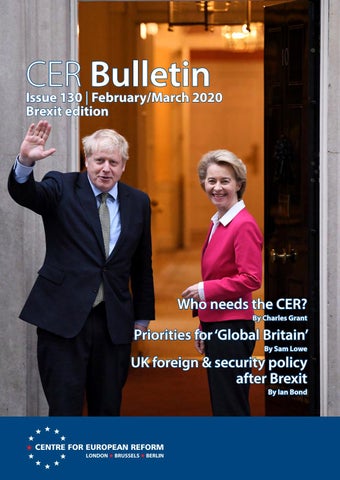
CER Bulletin
Issue 130 | February/March 2020 Brexit edition
Who needs the CER? By Charles Grant
Priorities for ‘Global Britain’ By Sam Lowe
UK foreign & security policy after Brexit By Ian Bond
Who needs the CER? by Charles Grant
My colleagues and I are often asked what Brexit means for the Centre for European Reform – and sometimes whether the CER is needed at all once Britain leaves the EU. The short answer is that we are here to stay. We opened our office in London in January 1998 and we plan to keep going for at least another 22 years. The longer answer is that, ever since our foundation, we have focused on two missions. The first is to come up with policies and ideas that can help to make the EU a more effective and successful organisation. The second is to suggest ways of improving the quality of Britain’s relationship with the EU. Both missions are at least as important post-Brexit as before the UK’s departure, and in some ways even more so. On the first mission, we seek to achieve an EU that is open, outward-looking, influential and prosperous, with close ties to neighbours and allies, and the ability to stand up to adversaries. Those who are on our mailing list or familiar with our website will be aware that the lion’s share of our work has nothing to do with Brexit. For example, of the 11 longer papers that we published in 2019 (which we call policy briefs or essays) only one was on Brexit – though plenty of our shorter ‘insights’ covered that subject. Our most downloaded policy brief of the year, ‘Schengen reloaded’, by Raoul Ueberecken, set out a reform agenda for a policy area with which
Britain has always had a distant relationship. Our second most downloaded paper, by our Berlinbased chief economist Christian Odendahl and deputy director John Springford, analysed the growing divergence between Europe’s regions, and is part of a series on the future of the European economy. We have always been and will remain a pro-EU think-tank. But we are unsparing in our criticism when the performance of the EU and its memberstates falls short. One of the EU’s weaknesses is that it struggles to respond rapidly to changing circumstances (we share French President Emmanuel Macron’s frustration with what he terms its immobilisme). The EU is currently faced with numerous challenges, such as the growing geopolitical and economic heft of China, the social and economic consequences of artificial intelligence and machine learning, the unbridled power of the big tech companies and the threat to European values from both strongman leaders outside the EU (including US President Donald Trump) and populist forces within. Can the EU respond promptly to such challenges, and can
INFO@CER.EU | WWW.CER.EU CER BULLETIN - BREXIT EDITION ISSUE 130 | FEBRUARY/MARCH 2020
it be proactive as opposed to simply reactive? The answers will determine whether Europe can preserve its values, prosperity and sovereignty. Ever since the CER started, about half our researchers have been non-British and the team currently includes two Germans, an Italian, a Pole, a Spaniard and a Ukrainian. This year they will be working on subjects such as the EU’s relations with the US, Russia and China; the Middle East and the neighbourhood policy; European defence policy and NATO; police and judicial co-operation, and migration; the EU’s trade and industrial policies; and the European economy and eurozone reform. One thing that has changed since the Brexit referendum is that we have opened offices in Brussels and Berlin. We did so to reinforce our links to continental policy-makers: we are a European think-tank with a headquarters in London rather than a UK-centric organisation. Both these offices help to insert the CER into the EU’s policy debates, promote our ideas and gather useful information – and they also host events. As for the second mission, concerning Britain’s ties to the EU, we favour the closest possible relationship that is compatible with the political realities – for the mutual benefit of the UK and the 27. We regret Brexit and also the meagre prospects of the UK remaining close to the EU’s customs union and single market. But the CER deals with the world as it is rather than as we would wish it to be. We shall suggest constructive and viable ways for the EU and the UK to work well together. And we shall continue to speak truth to power on both sides of the negotiation, as we have done since the referendum. On the EU side, we think some of its leaders have been too complacent since the British voted to leave their club. We will argue against those who take a maximalist line on excluding third countries from close co-operation with the EU, whether on trade, security, foreign or defence policy. Only criminals, terrorists and hostile states will benefit if UK-EU co-operation in such areas becomes unnecessarily difficult. As for the British, we shall explain the trade-offs that are fundamental, for example that if the UK insists on more regulatory autonomy, there will be more disruption to current patterns of trade. Many influential people in Britain still appear to be unaware of the trade-offs, partly because of wishful thinking and partly because large parts
of the media lack the expertise and/or desire to hold politicians to account. Negotiators may find it easier to achieve a mutually beneficial post-Brexit partnership in the security sphere than for trade. We hope to see security co-operation that in practical terms will be almost as close as it has been during the UK’s membership. Both the UK and the EU will be stronger and safer if bespoke ways can be found to plug the British into EU structures. The political constraints in the UK are unlikely to be overwhelming: few people voted for Brexit because they disliked the Common Foreign and Security Policy. Both Macron and German Chancellor Angela Merkel are keen to see a close security relationship, to diminish the chances that a loose-cannon Britain will slide towards the US. However, there can only be a close partnership in the realm of justice and home affairs if the UK accepts EU rules on data, and a role for the European Court of Justice. Furthermore, there is a serious risk that an acrimonious breakdown of the trade talks could stymie efforts to build a deep partnership on security. Britain and the EU will be negotiating on the countless dossiers of their relationship for the next decade and perhaps much longer. The CER’s role will be to help explain to each side of the Channel what is motivating the other side, and what policies and actions are most likely to ensue. Our vantage point is ideal: our head office is in London, yet our contacts in Brussels, Berlin, Paris and other capitals, in Europe and beyond, are second to none. Any think-tank that aspires to influence must produce proposals that are practicable, wellargued and readable. And that is what we have sought to do over the past two decades, putting a premium on sober, serious, rigorous analysis of the key political and economic challenges facing Europe. The CER’s highly-experienced team puts a lot of time into ensuring that our publications are well-written and that our seminars are highlevel and interesting. We plan to stick to that formula, although the means by which we reach our audience is constantly evolving and some people now know us mainly via social media or podcasts. We will also remain on hand to share our expertise and opinions with policy-makers, parliamentarians, the media and the wider public, without fear or favour.
Charles Grant
Director, CER @CER_Grant
Priorities for ‘Global Britain’ by Sam Lowe
When the UK leaves the EU on January 31st 2020, it will enter the final phase of a process leading to the erection of trade barriers with its most important trading partner. Rather than charging headlong into a trade agreement with the US, Britain’s priorities should be stabilising relationships with existing trade partners and regaining their trust. Meanwhile, it should develop a clearer idea of what it wants its freshly independent trade policy to achieve, and why. In the coming years the UK will need to convince trade partners that it has a constructive role to play in an era where openness to trade is on the wane. At the same time, it must be honest about its limited ability to shape the global trade agenda. The UK’s trade relationship with the EU remains its most economically important one. Yet the UK’s desire for full control over domestic regulation and trade policy significantly limits the potential scope of the EU-UK relationship. At best, the EU and UK are on course to conclude a free trade agreement (FTA) that removes all tariffs and quotas, but creates significant new administrative and regulatory barriers to trade in both goods and services. Assuming the government is set on diverging from EU rules in the services sector, a more pragmatic approach would see the UK attempt to negotiate a relationship akin to Switzerland’s, which is de facto within the EU’s single market for goods. Whether the EU would countenance such a request remains uncertain, however. While the UK has made good progress on replicating EU trade agreements ready
for Brexit, there is still much to do. Some agreements will need to be renegotiated in their entirety due to partner countries refusing to roll them over – for example, the EU’s FTAs with Canada and Japan. Of the agreements yet to be rolled-over, the one with Turkey – which is in a customs union with the EU – is particularly tricky. The UK cannot remain in a customs union with Turkey unless it is also in a customs union with the EU, which the British government has ruled out. The UK can negotiate an FTA with Turkey as long as it also concludes one with the EU, but without a customs union trade will flow less freely than before. FTAs with Australia, New Zealand and Canada are good to have, but replacing the EUJapan agreement should be the UK’s priority. Japan is the third biggest investor in the UK (after the US and EU), but its companies and
INFO@CER.EU | WWW.CER.EU CER BULLETIN - BREXIT EDITION ISSUE 130 | FEBRUARY/MARCH 2020
government view Brexit as a betrayal of trust. The British government will need to rebuild that relationship. Furthermore, the UK will need to work closely with Japan (from which it can learn a lot) in the World Trade Organization (WTO) and other forums in order to defend British interests and promote rules-based trade. Like Japan, the UK will be a mid-sized power amid tussling economic superpowers. The UK must engage the US in trade negotiations immediately after Brexit, but drop its starry-eyed optimism. President Donald Trump is unpredictable and quick to take offence, and treats trade as akin to a protection racket – first he increases the threat, in the form of tariffs and instability, and then offers to shield you in exchange for payment. The UK will not get an easy ride just because of its socalled special relationship with the US. If the UK resists US demands, particularly in the area of agriculture and food hygiene, then concluding a comprehensive FTA could take years. Yet the UK may find a few trade-related morsels to provide political wins both for Trump and Prime Minister Boris Johnson before November’s US elections. For example, the British government could ask the US to exempt the UK from the tariffs levied against the EU, after the latter lost the WTO Boeing-Airbus dispute, in return for giving Trump something he wants. But Britain will need to tread carefully, and avoid being forced to pick sides in a trade war between the US and EU. It must also avoid being dragged into foreign policy positions it would not otherwise take on issues such as Iran and China by a president who is happy to use economic leverage to keep his allies in line. The UK’s relationship with China may prove particularly tricky. Trump will probably demand Britain’s full support in his push against Chinese trade practices, in return for a US trade agreement. The UK should certainly back plurilateral initiatives by the EU, US and Japan to address industrial subsidies and forced technology transfer in China. But it should avoid obviously picking sides at a moment where the British economy is already vulnerable. Elsewhere, the UK is entering a world in which it cannot rely on the WTO to settle trade disputes, due to the US’s refusal to appoint new members to the oraganisation’s appellate body. This problem, among many facing the WTO, is not one the UK can resolve by itself. But it can build good will by investing time, money and people in the committees and functions that keep the WTO ticking over day-to-day.
As for Britain’s long-term strategy, trade agreements should be more than just political trophies. They should have a purpose, whether economic or geopolitical, and work as an extension of overall government policy, not in isolation. The UK government needs to consider what it hopes to achieve, and how a trade agreement might help.
Donald Trump is unpredictable and “quickPresident to take offence, and treats trade as akin to
a protection racket – first he increases the threat, in the form of tariffs and instability, and then offers to shield you in exchange for payment.
”
Inevitably this will involve choices and tradeoffs. Is the UK prepared to make the domestic compromises necessary to seal an agreement? So far the government has struggled to produce answers. For example, UK policies designed to discourage immigration undermine efforts to make the UK attractive for investment and any aspirations to further liberalise trade in services. More positively, some of the UK’s large aid budget could be allocated to building trade capacity and transport and telecommunications infrastructure in the developing world, and supporting the creation of the African Continental Free Trade Area – steps which would promote economic growth and offer more opportunities for UK exporters. Johnson has been an enthusiastic supporter of ‘Global Britain’ – an ambition to be a global leader, among other things in promoting free trade – which has become a mantra for Brexit supporters who argue that the UK’s voice will be more influential outside the EU. Expectations will need to be tempered. The UK has a positive contribution to make to the global trade system, but its approach should be born of pragmatism and realism, not arrogance and bluster. More than anything, the UK should take a breath, pause, and assess the reality of its situation and the role it can play – and then plan accordingly. Brexit means it is time for the British trade policy debate to grow up.
Sam Lowe
Senior research fellow, CER @SamuelMarcLowe
UK foreign & security policy after Brexit by Ian Bond
Nobody works in the UK’s Foreign and Commonwealth Office for long without hearing the dictum of 19th century Foreign Secretary Lord Palmerston: “We have no eternal allies, and we have no perpetual enemies. Our interests are eternal and perpetual, and those interests it is our duty to follow”. Palmerston may have treated Britain’s relations with other states as ephemeral, but from the beginning of the Cold War until the Brexit referendum, the UK treated the preservation of its alliances as one of its perpetual interests. In December 2019, however, the British government announced an ‘integrated security defence and foreign policy review’ that will “reassess the nation’s place in the world, covering all aspects of international policy from defence to diplomacy and development”. Prime Minister Boris Johnson said that this would be the deepest review since the end of the Cold War – implying that it might lead to a radical reshaping of the UK’s approach to its relations with other European powers. When she was prime minister, Theresa May shied away from any drastic change in foreign and security policy relations with the EU. The government’s July 2018 white paper called for “a single, coherent security partnership between the UK and the EU”, covering both internal and external security co-operation. And in a presentation for EU negotiators in May 2018, the UK set out in some detail the arrangements that it hoped to negotiate with the EU, preserving as much as it could of its access and influence as a member-state.
At the time, the EU was unwilling to get into the details of the future relationship with the UK, whether in relation to trade and economic arrangements, or a foreign and security partnership. Even so, the relevant sections of the political declaration accompanying May’s withdrawal agreement pointed to a continued close relationship – described as a “broad, comprehensive and balanced security partnership”. The Johnson government left this part of the political declaration almost untouched. But at some point Johnson will have to decide whether he, like May, wants a close security and foreign policy relationship with the EU, or something that enables him to claim that the UK has ‘taken back control’ of its internal and external security policy (even if it never lost it). The current foreign secretary, Dominic Raab, came into office philosophically inclined to seek new allies outside the EU. Soon after his appointment, he wrote an article for The Sunday
INFO@CER.EU | WWW.CER.EU CER BULLETIN - BREXIT EDITION ISSUE 130 | FEBRUARY/MARCH 2020
Telegraph in which he argued that while the UK wanted a strong relationship with European partners, “Brussels isn’t the only game in town”. Raab seemingly wants to avoid frequent formal meetings with the EU, and to work instead through ad hoc coalitions and small groups, and in NATO. Such bilateral and ‘minilateral’ approaches would enable the UK to influence some of its former partners, such as France and Germany, before they go off to formulate EU policy – but they would not fully replace a seat at the EU table. After the debacle of the Suez crisis in 1956, when the US pressured the UK into withdrawing from Egypt, the UK has almost always aligned itself with the US on foreign policy issues, even when some of its European partners have not, most notoriously in the 2003 Iraq war. Recent events have shown the limitations and risks of such a policy, however. US President Donald Trump has shown himself to be a particularly unreliable ally. He withdrew from the nuclear deal with Iran in the teeth of opposition from the UK as well as the rest of the EU; he announced that he was pulling US forces out of northern Syria without warning, still less consulting, the UK and others with troops in the area; and he authorised the assassination of Iranian General Qasem Soleimani without giving his allies any chance to get their troops out of harm’s way in case of retaliation. The UK’s defence secretary, Ben Wallace, told The Sunday Times that the assumption made in the UK’s ‘Strategic Defence and Security Review’ in 2010 that the UK was “always going to be part of a US coalition is really just not where we are going to be”. Meanwhile, China is increasingly assertive in Africa, the Middle East and elsewhere, and its foreign and security policy aims are rarely likely to correspond with those of the UK. Like most EU member-states, the UK has tended to let the EU speak out about China’s human rights record, while it has focussed on increasing British trade and investment relations with China. Now it will have to decide whether to stick with its principles or its economic needs. London may find that dealing with Beijing by itself is a lot harder than working as part of the EU. Weakening foreign policy ties with the EU might make sense if the UK wanted to pursue a radically different international course after Brexit; but there is no sign of that – indeed, the UK has remained aligned with the EU over issues including Iran and sanctions against Russia. In the parliamentary debate on the new government’s programme in December 2019,
the British priorities Raab listed – free trade, human rights, democracy and the international rule of law – are indistinguishable in substance from those set out by the EU in its 2016 ‘Global Strategy’, or espoused by leading memberstates like France, Germany or Italy. At this point, it would make more sense for the British government to say explicitly that it expects to stay aligned with its EU partners on almost all international issues. That might at least create some good will – which may be in short supply in other parts of the negotiations on the future relationship. Handled well, the negotiations on future law enforcement and judicial co-operation could also benefit both parties: the only winners from less effective information sharing or extradition arrangements will be criminals and terrorists, and the UK has much to contribute in terms of intelligence and policing capabilities. The UK, however, has got off on the wrong foot with its negotiating partners after making unauthorised copies of the Schengen Information System database, to which – though not a member of the Schengen area – it has had access for border control purposes; and for failing over several years to pass on information to other EU member-states when their nationals were convicted of criminal offences in the UK. The Dutch liberal MEP Sophie in ’t Veld described the UK as “behaving like a bunch of cowboys”. The political declaration speaks of considering data exchange arrangements that “approximate those enabled by relevant Union mechanisms”. But the European Parliament, always sceptical of proposals to share EU citizens’ data with third countries, may well ensure that information sharing is much more limited. Co-operation with ‘Five Eyes’ intelligence partners or other non-EU countries will not compensate for what the UK loses. Notwithstanding the bravado of Johnson and Raab, protecting the UK’s security and projecting its values in the world will only be made more difficult by Brexit. The rest of the world could not fill the lacunae left by Brexit even if they wanted to. The EU itself would certainly puzzle Palmerston, were he alive today. But he would have been just as bewildered by the approach of his successors, who risk unnecessarily alienating their European allies and simultaneously damaging the UK’s interests.
Ian Bond
Director of foreign policy, CER @CER_IanBond
INFO@CER.EU | WWW.CER.EU CER BULLETIN - BREXIT EDITION ISSUE 130 | FEBRUARY/MARCH 2020
CER in the press Financial Times 22nd January Time pressure will “focus minds on the continent and make it easier for the EU-27 to maintain unity”, says Agata Gostyńska-Jakubowska of the CER think-tank in Brussels. ...“Power is shifting to France and Germany,” says Ms Gostyńska-Jakubowska. “But Germany is extremely weak, with domestic politics paralysing its leadership in the EU,” she adds. This “strengthens France and leaves Poland and others extremely uneasy”. The Economist 11th January Research by the CER [The big European sort? The diverging fortunes of Europe’s regions] suggests that less successful places tend to be older and less productive. The EU has a pot of money to ensure “cohesion”, but it is small and less equipped than national budgets to redistribute from winners to losers. The Telegraph 7th January Charles Grant, director of the CER says the EU is terrified of
granting favoured access to its markets without any kind of commitment to stay true to European standards and regulations. Reuters 6th January “I would be surprised if [investors’] optimism is sustained, unless Boris Johnson extends the transition or finds ways to deepen the trade agreement,” said John Springford, deputy director of the CER. The Washington Post 3rd January Major additional Iranian violations of the deal “would push the Europeans, whether they like it or not, towards a harder stance on Iran, which might ultimately lead to more alignment with Washington,” said Luigi Scazzieri, a research fellow at the CER. Die Welt 29th December ”The fact that for Germans the military as an instrument of foreign policy continues to play a subordinate role
indicates a low threat perception” said Sophia Besch, a senior research fellow at the CER. At the same time, this is proof of “an implicit trust that Germany’s partners – especially in NATO – will continue to take military responsibility for German security”. The Express 27th December Sam Lowe of the CER said he also expected the EU to try to press the UK into agreeing a treaty allowing European access to British fishing waters by next July. The New York Times 27th December “There is a fear that if you take what potentially are quite expensive decisions with regards to 5G because the Americans have told you that they are a security problem, and then President Trump gets a trade deal with China and suddenly Huawei is all OK again, then you’ll feel like the earth has moved under your feet,” said Ian Bond, director of foreign policy at the CER.
The Guardian 6th December “The single biggest underpriced thing in this whole debate about Brexit is that Johnson and the EU might actually get a trade deal done by 31st December 2020,” said Sam Lowe, a senior research fellow at the CER. “It’s not that I am pushing this as a likelihood, I just think it’s possible and it could catch people offguard.” The New Statesman 1st December As Christian Odendahl of the CER puts it, Esken and NoWaBo are by international comparison about as hardleft as the IMF, in that they want more of Germany’s vast surplus to be spent on wide-eyed priorities like school, digital and rail improvements. Their proposed minimum wage increase to €12 an hour, below the level currently being proposed in Britain by renowned hardline socialist Boris Johnson, would inject some much-needed demand into the slowing eurozone economy.
Forthcoming publications Can Europe overcome its paralysis on Palestine? Beth Oppenheim
What would an effective UK trade policy look like? Sam Lowe
The UK-EU foreign policy relationship after Brexit Ian Bond
Europe, the US and China: A love/hate triangle? Sophia Besch, Ian Bond and Leonard Schuette
EU 2030: Globalisation, technological change and the future of the European economy John Springford
European autonomy and transatlantic divergence Sophia Besch and Luigi Scazzieri
For further information please visit
www.cer.eu