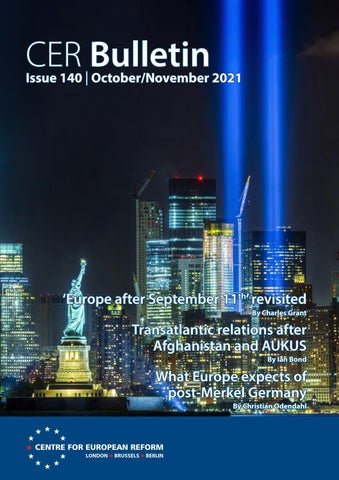
CER Bulletin
Issue 140 | October/November 2021
‘Europe after September 11th’ revisited By Charles Grant
Transatlantic relations after Afghanistan and AUKUS By Ian Bond
What Europe expects of post-Merkel Germany By Christian Odendahl
‘Europe after th September 11 ’ revisited by Charles Grant
The attacks of 9/11 brought the major powers together. But that unity did not endure, and the world now risks division between the West and the authoritarian powers.
Photo from the launch of 'Europe after September 11th', London, December 11th 2001 (L to R) Jack Straw, Charles Grant, Nick Butler, Heather Grabbe, Steven Everts and Edward Bannerman
In December 2001 my colleagues and I published a CER report on how the world was responding to the atrocities of 9/11. The tone of ‘Europe after September 11th’ was gushingly optimistic: “The major powers have come together and committed themselves to fight international terrorism,” we wrote. “This alliance promises to be a constructive force in world affairs”. We noted several positive geopolitical developments. Some of them proved to be short-lived – and the West has endured a torrid two decades. But though down the West is far from out. The US had re-engaged with the world. George W Bush had started his presidency with a domestic focus, but found himself working with allies and the United Nations. However, he soon abandoned multilateralism and invaded Iraq. His successors sought to reduce American involvement in distant wars. But Joe Biden’s clumsy retreat from Afghanistan this summer probably does not signal a permanent shift to isolationism. He wants to refocus on China, and as long as the US sees itself as a power with global interests, it will struggle to avoid military interventions. The EU had strengthened its security cooperation. It did particularly well on internal security, soon crafting the European Arrest Warrant and boosting the role of Europol. More recently it has created a European border guard.
On foreign and defence policy the EU has new institutions, such as the ‘High Representative Vice President’, a quasi-foreign minister, the External Action Service, a quasi-foreign ministry and (so far unused) military ‘battle groups’. But the EU doesn’t have much more real authority in these domains than it did 20 years ago, when Javier Solana was its chief diplomat. “Since the attacks on the World Trade Centre, Putin has moved deftly to position Russia as a key ally of the West,” we noted. The Russian president wanted to get closer to the EU and NATO, and join the WTO. Vladimir Putin supported the US-led intervention in Afghanistan, including the deployment of US forces on former Soviet territory, while he was helpful at the UN and gave US forces access to Russian airspace. But Putin soon turned against the West. The invasion of Iraq in 2003, Ukraine’s ‘Orange Revolution’ against the election of a proRussian president in 2004, Western support for Kosovo’s unilateral declaration of independence in 2008 and Western criticism of Putin’s growing authoritarianism all contributed to this shift. China had used the crisis to improve its relationship with the US, backing it at the UN, sharing intelligence and offering cautious support for its military action. Twenty years on, China has become so strong – economically, diplomatically and militarily – that it sees little
INFO@CER.EU | WWW.CER.EU CER BULLETIN ISSUE 140 | OCTOBER/NOVEMBER 2021
need to defer to the US. Proud of its own model, it believes the West is locked into decline. Some of our optimism now seems naïve or hubristic. But it reflected the spirit of the age – one in which history had apparently ended, to the West’s advantage. The US responded to 9/11 by invading Afghanistan, in order to prevent terrorists using it as a base. That objective has been (for now) largely achieved: though Islamist terrorism remains prevalent in many countries, the US has been spared major attacks. Terrorists tend to flourish in some of the less prosperous parts of the world. We wrote in the report: “Many of the more virulent forms of terrorism thrive in places where law and order has collapsed, gangsterism rules, weapons are readily available, poverty and disease are rife, and the world economy is distant.” Those judgements are still valid, but the West has lacked the commitment and patience to build better polities in places like the Sahel and Afghanistan. It has tolerated excessive corruption and allowed Islamist insurgents to present themselves as morally superior to Western-backed regimes. Many factors have sullied the optimism of 2001, and weakened the West, including: 1) The conduct and outcomes of the US-led interventions in Afghanistan and Iraq. These have greatly damaged America’s image. With some prescience, we noted in our report: “If the next phase of the war against terrorism [is] an all-out attack on Iraq…without strong evidence of links between Baghdad and al-Qaeda, and without UN approval, the new coalition would collapse. Not only would the moderate Muslim countries, the Russians and the Chinese peel away from the US, but so would most EU governments.” The two forever wars reinforced narratives of Western fallibility. The US also did much else to tarnish its reputation, such as setting off the financial crisis, electing Donald Trump and mismanaging the COVID-19 pandemic. 2) The EU’s failure to become a geopolitical force. Its leaders have been distracted by a plethora of problems – the financial and eurozone crises that began in 2008 and 2010 respectively, the immigration crisis of 2015, Brexit in 2016 and COVID-19 in 2020-21. The EU survived them all, but national leaders have been unwilling to let the institutions lead on foreign policy, to invest more in the military capabilities that Europe lacks or to steer their military cultures towards a greater willingness to use force. Thus the economic giant remains a political pigmy. Biden’s unilateral withdrawal from Afghanistan reinforces the argument of French President
Emmanuel Macron that the EU needs more capacity to act on its own – ‘strategic autonomy’. Others prefer to cross their fingers and hope that America will turn up when needed. 3) Russia’s re-emergence as a power of sorts, after its weakness in the 1990s. Putin has played a weak hand well. Helped by the oil price rises that began in 2000, he gave the impression of managing the economy professionally and revived the armed forces. He showed he was willing to use force ruthlessly, as in Georgia in 2008, Ukraine in 2014 and Syria in 2015. Though the economy is stagnating, Putin and his entourage are self-confident, believing that history is moving in their direction – away from liberalism and multiculturalism, and towards greater respect for the nation, faith and authority. 4) China’s relentless emergence as a superpower. Those who argued 20 years ago that it could not continue to succeed economically without adopting some democratic principles – including The Economist – have been proven wrong, so far. The political system has become steadily more repressive, without any apparent economic cost. Competent economic management has allowed living standards to grow, while military capability has expanded massively. China’s largesse towards many developing countries, for example via the Belt and Road Initiative, has bought it diplomatic capital. It offers poorer countries an authoritarian but successful model of development. And in recent years it has become willing to challenge the Americans. In 2021 there seems little prospect of restoring the global unity of 20 years ago. There is a risk of two hostile camps – the Western democracies and the authoritarian powers – dividing up the world. Many countries, of course, do not want to take sides. But the West should not be too disheartened. Its economies remain far ahead of Russia and China, in terms of per capita GDP, and its societies attract many more migrants than they do. And those two countries often scare rather than charm their neighbours – they have very few true friends. China’s increasing assertiveness risks provoking a hostile alliance of its neighbours. Russia’s inability to diversify its economy away from natural resource exports may one day undermine domestic support for the regime – and its ability to intimidate neighbours. Under their current leaders neither autocracy is likely to want to work with the West. But as 9/11 showed, history is full of unexpected turns.
Charles Grant
Director, CER @CER_Grant
Transatlantic relations after Afghanistan and AUKUS by Ian Bond
America’s relations with its European allies have survived worse crises than the row over whose submarines Australia will buy, or even the Afghanistan debacle. The US should not be complacent, however. Joe Biden was supposed to be the answer to Europe’s prayers. After four years of punishment beatings from Donald Trump, Europeans enthusiastically greeted a new, Atlanticist president. One of his first appointments was Secretary of State Tony Blinken, French educated and French speaking; another, National Security Adviser Jake Sullivan, had been a Rhodes Scholar at Oxford. What could possibly go wrong? As it turns out, a lot. Before Biden’s first European tour, in June, the CER warned Europe’s leaders not to get carried away. Even in the best of times, there is often friction in transatlantic relations. By September Biden faced several significant crises in relations with his allies. The first relates to Afghanistan. Trump, not Biden, negotiated the deal with the Taliban to withdraw all US forces from the country; but Biden also wanted the troops home. There was little consultation with allies over the process. Even as it became clear that Afghan forces and the government in Kabul were unravelling, Biden refused to consider requests from EU leaders and British prime minister Boris Johnson to delay the final withdrawal of US troops. Though the US and its allies ultimately evacuated more than 100,000 Afghans and others from
Kabul, the chaos at the airport, with desperate Afghans falling from departing aircraft, will long be remembered. Europeans were frustrated by their inability to keep evacuating people without US help once Biden had decided to end the airport operation. The second crisis stems from the Australia/ UK/US (AUKUS) defence deal announced on September 15th by Biden, Johnson and the Australian prime minister, Scott Morrison. As part of the new arrangement, Australia will acquire nuclear-powered submarines from the US and/ or the UK, having cancelled a €56 billion contract signed in 2016 to buy diesel-electric submarines from France. France was predictably furious, and recalled its ambassadors from Canberra and Washington – though the latter has now returned. France has 1.6 million citizens in its territories in the Indo-Pacific region, and a significant military presence there to defend them. France was the first European country to adopt an Indo-Pacific strategy, and has spent several years cultivating defence and security partnerships in the region, including with Australia and the US. Though most EU member-states did their best to keep out of the row, the EU institutions stood by France: Ursula von der Leyen, President of the European Commission, told CNN’s Christiane
INFO@CER.EU | WWW.CER.EU CER BULLETIN ISSUE 140 | OCTOBER/NOVEMBER 2021
Amanpour on September 20th that the treatment of France had been unacceptable, and business as usual could not resume until the US had clarified its position. The third irritant is the Nord Stream 2 gas pipeline from Russia to Germany. Despite rare bipartisan US Congressional consensus that the pipeline would damage European security, in May Biden waived sanctions against some Western companies involved in its construction. In July he struck a deal with German Chancellor Angela Merkel allowing construction of the pipeline to go ahead, in return for German investments in green energy in Ukraine and a promise that Berlin would press for EU sanctions on Russia if it used energy supplies as a weapon against other countries. Central and Eastern European countries, which had repeatedly tried and failed to get Germany to stop the construction of Nord Stream 2, felt let down by Biden’s deal; some of them wonder why the US has (as they see it) sided with Russia and Germany against the interests of its more loyal allies. As gas prices now rise in Europe, members of the European Parliament have urged the European Commission to investigate whether Russia is limiting gas exports to Europe, contributing to below-average storage levels, which threaten energy cut-offs in the winter. Biden is old enough to remember earlier crises in NATO, beginning when President Charles de Gaulle withdrew France from the Alliance’s military command structure in 1966 and forced NATO forces and headquarters to relocate from France. NATO has weathered arguments over (among other things) the deployment of intermediate range nuclear missiles in Europe, the reunification of Germany, and the invasion of Iraq in 2003. Biden may be relaxed, thinking that Europe has nowhere else to turn but the US – it will not align itself with China (still less Russia). As Jeremy Shapiro of ECFR wrote in a prescient article in June 2021 about the US administration’s attitude to Europe, “beneath the surface politeness, they pay fairly little attention to European concerns”. Biden may feel he has already weathered the various storms. Afghanistan is in the rear-view mirror. European and US publics may not like the way the withdrawal was carried out, but no-one is calling for Western troops to go back. The AUKUS row is in the process of being defused: Biden and French President Emmanuel Macron issued a joint statement after a telephone call on September 22nd, in which they “agreed that the situation would have benefited from open consultations among allies”. Biden “reaffirmed
the strategic importance of French and European engagement in the Indo-Pacific region”, and “recognised the importance of a stronger and more capable European defence, that… is complementary to NATO” – a phrase that allows France to argue that the EU should do more in the defence field, as long as its efforts also strengthen NATO capabilities. The countries most dismayed that Nord Stream 2 is going ahead are also those who most value the US security guarantee and are most distrustful of any European substitute. It would be a mistake for Biden to be complacent, however. The recent rows have shown that scratchy transatlantic relations and strains among European countries can make it harder for him to achieve his foreign policy objectives elsewhere. In order to concentrate US defence resources against China’s growing military power, he needs to be confident that Europe will remain secure and stable, even if the US reduces its presence. That means encouraging Europeans to invest more in their own defence, take more responsibility for defending their own territory and for stabilising Europe’s neighbourhood, and (since 21 countries are members of both organisations) focus on increasing EU-NATO co-operation rather than arguing over which organisation should be in charge of Europe’s security. If Biden wants European help to deal with broader challenges from China, including in trade, setting international standards and preventing the transfer of sensitive technologies, he needs to show that he is prepared to listen to European views – including on the undesirability of seeing every issue through the prism of confrontation with China. If Europe feels ignored, it is less likely to be helpful to the US. Above all, however, Biden needs to ensure that the US does not inadvertently contribute to divisions among European states, and to encourage some (including the UK) to patch up relations with their democratic neighbours. Even as Biden was trying to smooth things over with Macron, British sources were suggesting that the remit of AUKUS could be expanded to broader Indo-Pacific security issues, while still excluding France – an unhelpful idea, in the circumstances. A weak, disunited Europe, unable or unwilling to stand up to pressure from authoritarian states, will demand more US political attention and military underpinning. That is not what Biden needs, when he is trying focus on the Indo-Pacific region.
Ian Bond
Director of foreign policy, CER @CER_IanBond
What Europe expects of postMerkel Germany by Christian Odendahl
Europe expects Germany’s likely new Chancellor, Olaf Scholz, to keep Europe united while adding more strategic vision to fight climate change, transform the European economy and navigate global politics. The German election ended as the polls had predicted: Olaf Scholz and his Social Democrats (SPD) came out strongest, and will try to form a government with the Greens and the socially liberal but economically conservative Free Democrats (FDP). It will take time and some drama, but in the end the three parties will agree a ‘traffic light coalition’ (so called because of each party’s colour). It is hard to argue that Armin Laschet and his Christian Democrats (CDU) have a popular mandate to form a government when they achieved a historically bad result, secured fewer seats than the SPD and have a leader who is personally a lot less popular that Scholz. Europe is watching in nervous expectation. While European issues played almost no role in the election campaign, the next government will face an almost endless list of issues to resolve at the European level, including badly needed reforms to Europe’s fiscal rules; the ‘Fit for 55’ package to achieve Europe’s climate goals including the controversial carbon border adjustment mechanism; debates on how to tax and regulate digital giants; foreign policy challenges in relations with Russia, the Western Balkans and Turkey; and a common European strategy vis-à-vis China on economic, foreign and security policy.
Germany faces three types of European expectations. The first is that Berlin will remain a reliable partner. Germany’s most important role in Europe is forging compromises between competing interests and keeping Europe united. Germany does not see the EU in transactional terms, nor as a vehicle for enhancing German power, but as the core of its national interest. Brexit has only strengthened Germany’s role as compromise builder: smaller North-Western states and Central and Eastern European governments previously relied on Britain to take their interests into account; Berlin must now shoulder more of that responsibility. Angela Merkel was a gifted negotiator and tactician, briefed on every detail of critical dossiers, aiming to find solutions that everyone – herself included – could live with. Every German chancellor must play that role. Scholz is likely to do it well, given his political experience and sober persona, even though it will take time for him to acquire Merkel’s political standing among European leaders. The second expectation is that Berlin will lead in modernising the European economy and fighting climate change. The worst parts of Merkel’s legacy are the missed opportunities in the 2010s to bring Europe back to full employment and to use low interest rates to
INFO@CER.EU | WWW.CER.EU CER BULLETIN ISSUE 140 | OCTOBER/NOVEMBER 2021
invest in Europe’s future and the fight against climate change. In Europe, Merkel backed austerity and reforms aimed at reducing deficits. These reforms did not generate the economic growth that their proponents thought they would. In Germany, she led governments that spent most of their fiscal surpluses on increasing pensions instead of pushing with urgency for investment in digital infrastructure, innovation or preparations for the country’s fight against climate change. As a result, it took the eurozone until 2016 to return to the economic output level of 2008, and it will take Germany a decade to make up for the low levels of public investment of the Merkel years. Germany abandoned nuclear energy during her time in office, while remaining one of the worst polluters per capita in the world.
on the agenda is a green re-think of Europe’s fiscal rules, to allow for public investment (and support for private investment) not just in strong states like Germany, but all across Europe in order to reach net zero. Germany’s coalition agreement will set the tone for that debate, and Europeans are rightly expecting the SPD and the Greens to put a strong emphasis on greening Germany’s fiscal rules first. That is doable. The traffic light coalition may agree to a €500 billion climate transition fund, mostly outside the fiscal rules, to support both public and private investment, including encouraging Germany’s Mittelstand companies to make the transition to net zero and become innovators on climate. That in turn could become a model for a green investment clause in the European fiscal rulebook.
Towards the end of the Merkel years, political realities changed and balanced budgets became a lower priority. Brexit and Donald Trump’s presidency showed that in times of economic and social dislocation, even mature democracies were vulnerable to populism. The growing influence of authoritarian states (including China) in Europe led many German politicians to conclude that investment in the continent’s economic strength and political unity was vital if it was to remain resilient. Meanwhile, Germany’s debate on public spending and debt had become less dogmatic, as a new generation of German economists emerged and the previous decade’s economic policies were re-assessed. With negative interest rates and rapidly declining public debt, the German public no longer felt threatened by public debt. Finally, climate change had become the single biggest concern of German voters, convincing many policy-makers that all tools should be available to fight it, even if that meant crossing German red lines.
The third expectation is that the next German government should be more willing to incur an economic cost in order to make Europe a robust actor in foreign policy. That is arguably the trickiest area for Scholz. Both the FDP and the Greens have signalled that they back a tougher European approach towards autocratic regimes, including China. Scholz has voiced his support for a better-equipped Bundeswehr to underline Europe’s military strength, contrary to the views of others in his party. But talk is cheap. The gas crisis unfolding in Europe provides a first challenge, especially for the SPD. After backing the Nord Stream 2 gas pipeline from Russia to Germany, much to the horror of European partners, it is up to Berlin to show that Germany is willing to stand up to Russia in a geo-economic conflict. But Europe should not expect too much: the new government will only deviate cautiously from Merkel’s course – whether in relation to the yet-to-be-ratified EU investment agreement with China, Nord Stream 2 or relations with Turkey – and will focus first on strengthening alliances and building a common strategic outlook in Europe and with the US.
Merkel herself crossed one such red line, in response to the pandemic, and was backed by a surprisingly large segment of Germany’s economic policy community. Working with Scholz, her finance minister, she put together a recovery fund for the EU that not only involved up to €750 billion of common EU debt but also sizeable transfers to economically weaker countries in the South and East of Europe. The fund focuses on reforms and investments to make the European economy fit for the 21st century, including the digital and the green transitions. Many European countries now expect German policy to favour more public spending and investment, though not necessarily in the form of transfers like the current recovery fund. High
Scholz and his traffic light government will need a more strategic vision for Germany and Europe than the Merkel governments, but the same ability to find compromises and common European positions on thorny political issues. Merkel had a challenging decade full of crises to manage. Scholz will not have it any easier.
Christian Odendahl
Chief economist, CER @COdendahl An earlier version was published as an editorial in Intereconomics Volume 56, Number 5, 2021.
INFO@CER.EU | WWW.CER.EU CER BULLETIN ISSUE 140 | OCTOBER/NOVEMBER 2021
CER in the press Politico 23rd September “Every German chancellor of any coalition would say, ‘let’s fix this Brexit and trade issue and come to a stable and trustworthy relationship and then we can talk,’" said Christian Odendahl, chief economist at the CER. "So the best the UK can do to improve the relationship with Germany is to fix the conflict with the EU over the Northern Ireland protocol.” The Guardian 20th September Sam Lowe of the CER said he was baffled as to why people in the government thought they were winning concessions through hardball tactics. “I find that a really fascinating argument because I know that trade and co-operation agreement quite well, and the UK did not get much of what it wanted at all,” he said. The Sunday Times 19th September “Nobody in Germany has been thinking about Britain
or Brexit. It just hasn’t been a feature of the campaign. It isn’t anybody’s priority,” said Charles Grant of the CER.
most experienced, sober and Merkel-like candidate,” says Christian Odendahl of the CER.
The Independent 10th September “At a time of serious supply chain disruption, it would make sense if the UK decided to further delay the imposition of new controls on food and products entering the UK from Europe,” said Sam Lowe of the CER. “But this is becoming a recurring theme, with deadlines being pushed back late in the day.”
The Economist 27th August Ian Bond of the CER, notes that support for the [Northern Ireland] peace process is unusually bipartisan in America. If Mr Johnson is seen as threatening it, the reaction in Washington will be fierce.
TRT World 7th September "Russia has no interest in the success of jihadis but equally it does have an interest in its other adversaries being tied down in their fights with jihadis," said Ian Bond of the CER. The Telegraph 5th September “With his absolute calm and wealth of experience, he’s [Olaf Scholz's] easily the
The Sunday Times 1st August Charles Grant, director of the CER, said the French were “definitely annoyed with the Brits” and this had led to a reluctance to agree to the bridge-building exercise. “The British want a summit. The French say, ‘Great – so what should we talk about?’ The British say, ‘I don’t know – let’s have a summit.’ The French say, ‘No – we’ve got to have substance.’ ” The Washington Post 1st August “These are 3,000 people who
were flown from a country very far away and were just left on the border of the EU and that’s an entirely new phenomenon,” said Camino Mortera-Martinez of the CER. “Flying people in is a complete other level of aggression and retaliation.” CNN 28th July "I think that the Commission's being short sighted by [resisting the UK’s application to rejoin the Lugano convention] solely as a way to withhold a favor from the UK, because this doesn't just negatively affect the UK, it will affect EU nationals too," said Zach Meyers of the CER. Financial Times 22nd July Ask officials in Brussels and London how trade has changed and you may get two very different answers. John Springford at the CER breaks down why there is such a difference in post-Brexit import and export data.
Recent events 7-8 October 17th Bodrum Roundtable webinar Speakers include: Gülnur Aybet, Carl Bildt, Angelina Eichorst, Ben Hodges and Alexander Lambsdorff 4 October Conservative Party Conference fringe event on 'Britain and the EU: What kind of relationship do they need?', Manchester Speakers: Greg Hands, Lucy NevilleRolfe, Juliet Samuel, Tom Tugendhat and Theresa Villiers
30 September Webinar on 'Making a success of COP26' Speaker: Peter Hill 28 September Labour Party Conference fringe event on 'Britain and the EU: What kind of relationship do they need?', Brighton Speakers: Hilary Benn MP, Jenny Chapman and Lisa Nandy MP
For further information please visit
www.cer.eu
20 September CER/KREAB webinar on Webinar on 'Priorities for the European Union' Speaker: Philippe Léglise-Costa 17 September CER/KREAB webinar on 'Can the EU become an effective global actor?' Speaker: Frédéric Bernard