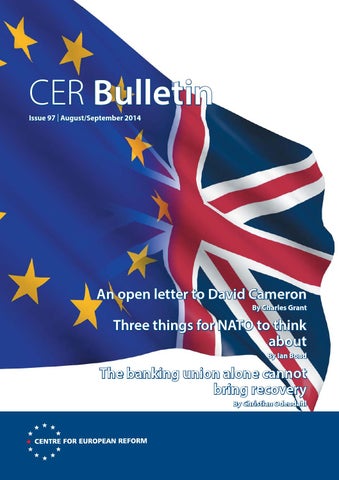
CER Bulletin Issue 97 | August/September 2014
An open letter to David Cameron By Charles Grant
Three things for NATO to think about By Ian Bond
The banking union alone cannot bring recovery By Christian Odendahl
An open letter to David Cameron by Charles Grant
Dear Prime Minister, The bitter rows over the appointment of Jean-Claude Juncker to the Commission presidency show what a difficult task you have set yourself: negotiating reforms to the EU and then winning a referendum in 2017 on keeping Britain in. Some of the reforms you want would require unanimity among EU governments, and others a qualified majority – and none of them is achievable unless you can find many allies. Yet in the vote on Juncker’s appointment only Hungary backed you. You and your team still feel bitter about the Juncker affair. You saw the system of Spitzenkandidaten – whereby the candidate of the party with the most MEPs becomes president – as a bid by the European Parliament to grab more power than the EU treaties have given it. You understood that the system would do little for democracy in the EU, since most of those voting in the European elections had never heard of the candidates. And you thought Juncker was not the ideal person to modernise the EU. Many leaders agreed with you on these points (as did the CER). Yet 26 of them backed the Luxembourger, because they really thought Spitzenkandidaten would enhance democracy, or they did not want to cross Germany once it had declared for Juncker, or they thought he would win and wanted to secure a good job for their commissioner. For the first time in the history of the EU, a big country was steamrollered on an issue that it considered a vital national interest.
So you and your colleagues have every reason to feel aggrieved. But I fear that the sense of grievance may prevent you from grasping that your government has a serious credibility problem in other EU capitals. Some leaders – including those sympathetic to Britain – ask if you are not more focused on party management, satisfying Conservative eurosceptics and winning back votes from UKIP than on keeping Britain in the EU. These leaders observe your recent reshuffle, in which you sacked ministers favourable to the EU and the European Court of Human Rights. They look at your choice of commissioner: for the tactical benefit of avoiding a by-election you appointed an unknown member of the House of Lords (though happily it turns out that Jonathan Hill is both serious and pro-EU). They recall the strident manner of your opposition to Juncker, even when it was clear that he would win; and some of them claim that you threatened to
INFO@CER.ORG.UK | WWW.CER.ORG.UK CER BULLETIN ISSUE 97 | AUGUST/SEPTEMBER 2014 3
harden your policy on the referendum if Juncker became president. These recent events followed a long history of eurosceptic policies – from leaving the European Peoples Party to rejecting the fiscal compact treaty – that have eroded goodwill towards you. All this gives others an excuse not to take your ideas for reform seriously (and creates a climate in which a surprising number of senior Germans believe pernicious myths, such as that you have demanded wide-ranging opt-outs from European Union policies). EU leaders lament that you did not follow through the argument for British membership that you started to make in your January 2013 Bloomberg speech – when you promised to campaign for a Yes “with all my heart and soul”. Since then you have merely written a couple of short newspaper articles. You could have used your government’s review of EU competences – which showed that the impact of the Union on the UK was mainly positive – to make the case for membership; but you chose to give very little publicity to the results. Other leaders assume that you are simply unwilling to confront Conservative europhobes. But if you want to win a referendum, at some point you will have to try to convince the British people of the EU’s merits. If you leave this till the last minute it may well be too late. If you spoke out on the benefits of EU membership, you would convince many governments that you have a serious strategy for keeping Britain in. So my first piece of advice is to level with the British people and explain what is stake for their prosperity and security. More Bloomberg speeches, please. Of course this would upset many Conservatives, but you are going to have to do that at some point. When you decided on a referendum, you knew your party might face another 1846 moment; Robert Peel did the right thing in passing the repeal of the Corn Laws, but split his party irreparably in doing so. Second, keep your demands for reform within the realm of the possible. By now you probably realise there is unlikely to be a new EU treaty before your referendum (though you have had some advice to the contrary). Germany would like a few treaty changes to strengthen the legal foundations of eurozone governance but is in no hurry, while most other countries, including France – worried about the difficulties of ratifying a new treaty – are firmly opposed. The absence of a new treaty that requires your signature will limit your bargaining power in a negotiation. Many in your party will push you to ask for the unattainable in the hope that you will fail. Resist them. And if you can be
more precise about what you want, you will have more credibility and others will be more willing to work with you.
“Though you have reason to feel aggrieved, the UK has a serious credibility problem in other EU capitals. ” Third, to maximise British influence you need to do a better job of building alliances. Tell ministers and top officials to spend more time forging friendships in other capitals, some of which share the UK’s views on particular issues. The British tend to ignore smaller countries, which together have a lot of votes in the EU. And they should have worked harder to retain the friendship of the Poles and other Central Europeans, who used to be allies but have been put off by (amongst other things) anti-immigrant rhetoric in the UK. Britain would have more friends if it were prepared to take the lead more often, in areas where it has expertise, such as foreign policy, defence, energy, climate, trade and the single market. You and your ministers also need to behave in a clubbable way – not threatening people, but engaging in a spirit of compromise and helping others with their problems. You did that in last year’s talks on the EU’s seven-year budget cycle and won a good deal. If you worked along these lines, you would find your EU partners more co-operative. They want Britain to stay in the club but have so far paid little attention to what ‘Brexit’ would mean for the EU’s global standing, foreign policy, economy and so on. Nor have they thought enough about the efforts they will need to make to help keep Britain in. You can encourage them by moderating your policies and rhetoric. If – as seems possible – you start attacking and cutting ties to the European Court of Human Rights you will discourage your partners from helping you reform the EU. You cannot both placate the eurosceptics and lead a successful referendum campaign. Yours sincerely,
Charles Grant Director, CER
Three things for NATO to think about by Ian Bond
When NATO leaders meet in Wales in September, they should do more than deliver statements and adopt declarations stitched together from well-polished clichés. The world does not need to hear how important defence is to the allies (though most spend a lot less than 2 per cent of GDP on it); how vital NATO remains in a challenging international environment (though members avoid using NATO’s tools, even where they might help); or how NATO’s door remains open to new members (except for those who want to join). At some point, unity in vacuity does more harm than good to European security; better to have a proper argument about NATO’s future. NATO leaders should take this chance to thrash out in private three key issues. These are what to do; with whom; and how. NATO allies face an enormous range of security problems, yet generally they look to other organisations, not NATO, for solutions. PostAfghanistan, no ally seems keen on large-scale expeditionary warfare in a NATO framework. Led by the UK and France, NATO intervened in Libya in 2011 but did little to tackle the subsequent mess. In Syria, despite every atrocity, NATO stayed on the sidelines. The allies sent Patriot air defence missiles to protect Turkey, but looked to the UN to resolve the Syrian conflict and the EU to deal with refugees in neighbouring countries. As violent jihadis have advanced through Iraq, the US has sent 300 advisers to help the government, but NATO secretary general Anders Fogh Rasmussen has said
that he sees no role there for the alliance (even though Iraq shares a border with Turkey). Farther afield, the economic interests of NATO members would certainly be damaged by territorial conflicts in the South or East China Seas. Most European governments, however, are either content to leave the US to deal with Asian problems, or see EU soft power as their contribution in the region; NATO’s capabilities are not part of their toolkit for Asia. The one area in which NATO should unarguably have a role is territorial defence. Russia has put European geopolitics back on the agenda, by annexing Crimea, interfering in Eastern Ukraine and almost certainly supplying the missile that shot down Malaysian Airlines flight MH17. The German defence minister, Ursula von der Leyen, told Der Spiegel on June 11th: “Russia cannot be allowed to become our opponent”. But Rasmussen rightly thinks that NATO should be ready to respond in
INFO@CER.ORG.UK | WWW.CER.ORG.UK CER BULLETIN ISSUE 97 | AUGUST/SEPTEMBER 2014 5
kind if Russia wants to behave as an adversary: the alliance cannot protect its members by pretending that Russia is currently a friend. So NATO leaders should start by agreeing that they must be able to mount an effective defence of members’ territory, including against Russia. But they should also agree that in a globalised world security threats may not only arise from the country next door, and that NATO capabilities should be used wherever that is the best way to contribute to allies’ security. With whom should NATO carry out its missions? The EU is an obvious candidate: NATO and the EU have 22 members in common (out of 28 in each organisation). But co-operation is inadequate. The dispute between Turkey and Cyprus is a serious obstacle. The summit should agree that if all 34 countries in the two organisations share objectives, they should then make effective and efficient use of capabilities, not pursue inter-institutional or bilateral rivalries. Sometimes it will make sense to have a single, EU-led operation with military and humanitarian aid and development components; but sometimes the EU and NATO will need to mount separate but complementary operations. The summit should also decide what to do about enlargement. In June 2014, NATO foreign ministers agreed that “NATO’s door remains open and no third country has a veto over NATO enlargement”. But the last new members to join the alliance were Albania and Croatia in 2009; and none of the remaining applicant countries is making much headway. The accession or not of the three Balkan aspirants – Bosnia and Herzegovina, Macedonia and Montenegro – would have little impact on European security. Georgia and Ukraine are different. The compromise devised in 2008 between supporters and opponents of letting them in was about the worst possible: NATO said that the two countries would become members, but without giving them a deadline or a Membership Action Plan (MAP). Russia’s response was to invade Georgia and recognise the independence of its breakaway regions, Abkhazia and South Ossetia. On one view, this proved the madness of extending NATO’s Article 5 defence guarantee to countries that could not control their territory and might be invaded by Russia; others argued that if Georgia had already been a member of NATO the invasion would never have happened. Despite Georgia’s major contribution in Afghanistan, foreign ministers again decided in June not to give Georgia a MAP but a “substantive package ... that will help it come closer to NATO”. Ukraine’s membership aspirations were not
mentioned at all; indeed, President Obama said in March that neither Georgia nor Ukraine was “currently on a path to NATO membership”. This repeats the mistakes of 2008. Instead of accepting that Russia can veto NATO membership for its neighbours by invading them, the alliance should invite Georgia, where there is overwhelming popular support for membership, to join.
“NATO should be ready to respond in kind if Russia wants to behave as an adversary. ” Ukraine’s case is more difficult. Though support for membership is rising, there is not a clear-cut national majority in favour. NATO leaders need to decide whether to follow the advice of Zbigniew Brzezinski and agree with Russia that Ukraine will be sovereign but neutral, regardless of what the Ukrainian people want; or whether to work with Kyiv to create the conditions for it to join NATO, if that is the popular will. But leaving Ukraine’s eventual status as a subject to be fought over will only damage European security. Only after deciding what to do and with whom should leaders talk about the capabilities and methods NATO needs. Most allies, except the US, need to spend more on defence. But simply spending 2 per cent of GDP without analysing requirements will not be enough. Putting more forces into Poland and the Baltic states offers them useful reassurance. But Russia’s new style of warfare in Ukraine, using special forces, local militias and covert weapons supplies, backed up by an unrelenting propaganda barrage aimed at domestic and international audiences, should get NATO thinking. Before it gives up the counterinsurgency skills acquired in Afghanistan, it should ask itself whether 500 of Putin’s ‘little green men’ could really “end the existence of Latvia as a unified state”, as one Russian commentator claimed. Could NATO fight, let alone win, an information war of the kind Russia has mounted against Ukraine? The machine gun made the bayonet charge obsolete; the aircraft carrier reduced the battleship to a supporting role; NATO leaders should spend time in September thinking what the next game-changer might be, and how to ensure that it disrupts NATO’s adversaries more than the allies themselves.
Ian Bond Director of foreign policy, CER
The banking union alone cannot bring recovery by Christian Odendahl
The banking union, two years after its inception, is still a work in progress. In another financial crisis, it is debatable whether a truly European approach would prevail over a partly national response; and the process of decoupling banks from the solvency of their governments is far from complete. Overall, however, the banking union is a significant step. The blame for the faltering recovery in the eurozone should be directed elsewhere.
There are three objectives for the banking union. The first is to break the vicious loop between banks and sovereigns. If banks get into trouble in the future, taxpayers should be spared as much as possible. Likewise, banks should properly diversify their assets across the eurozone (and beyond), rather than load up on their home government’s bonds and thereby risk being dragged down if the state’s solvency is in doubt. With the Single Resolution Mechanism (SRM) and the Bank Recovery and Resolution Directive (BRRD) agreed, the resolution of a bank in trouble will have to rely to a much larger extent than before on bail-ins of equity- and bond-holders. A common resolution fund, building up to €55 billion over eight years, is supposed to help in cases where public money is needed. The problem is that policy-makers have overdone the bail-in and underfunded the resolution fund.
In times of crisis, a wall of money to arrest panic can be more useful than a sudden bail-in. The reason is that market panic over the value of bank bonds, even if unjustified, can destabilise the whole system. The ECB’s OMT programme, which arrested bond market panic in 2012, is a good example of what a wall can do. This is not to say that taxpayers should bail out investors. A large resolution fund just ensures that panic does not destabilise the banking system, which would lead to even larger costs for taxpayers, and banks in trouble could be resolved in an orderly manner to the extent that is possible. With the current setup, national ad hoc measure might prevail in a systemic crisis. Progress on diversifying the banks’ holdings of domestic sovereign debt has been slow, because policy-makers are worried that a sell-off by domestic banks would push up government funding costs. The ECB’s current asset quality review (AQR), however, will test the resilience of banks
INFO@CER.ORG.UK | WWW.CER.ORG.UK CER BULLETIN ISSUE 97 | AUGUST/SEPTEMBER 2014 7
to falling prices of government bonds, which is a good start. The ECB should use this opportunity to toughen regulation on sovereign bond holdings, too. The second reason to have a banking union is to prevent future crises through better regulation. National regulators in pre-crisis years often turned a blind eye to the build-up of risk in their financial system, especially the debt financing of asset bubbles. They tend not to consider risks at the eurozone level, and face political pressure not to rein in their banks. The ECB in theory has different incentives: it takes eurozone-level risk into account; it is charged with ‘cleaning up’ the economy after financial crises; and it has no interest in promoting national champions. The ECB’s current actions and self-confidence suggest that it will be a better regulator in practice, too. The final aim is to draw a key lesson from the Japanese experience of the 1990s – if rather late in the day. Instead of realising losses and cleaning out their loan books, Japanese banks rolled over loans to barely solvent ‘zombie’ companies, preserving the illusion of health for both, and blocking the supply of credit to more productive firms, which is necessary for a sustained recovery. The eurozone has finally started to force banks to face the music: the ECB is conducting the AQR of the largest banks’ books; in conjunction with the European Banking Authority, it will subsequently stress test their balance sheets; and it will require those that fail to raise capital. Banks now have an
incentive to restructure bad assets so that new credit can help support recovery. Judging by the reaction of banks, some of which have realised losses and raised capital on financial markets, it is working. However, the problem remains that the economic assumptions underlying the stress tests could turn out to be too optimistic. For example, inflation is currently lower than in the ‘adverse scenario’ used in the stress tests. The ECB should correct its assumptions and toughen the stress tests. Firms in, say, Italy still pay more for their funding than their German peers. In part this is because the banking union is still incomplete – in some parts set to remain so – and balance sheet clean-ups take time. Another reason could be the economic prospects for many firms in struggling economies, especially small ones: domestic demand is weak and export growth requires time, stronger world demand and a weaker currency. Boosting economic demand is the job of fiscal and monetary authorities. They should relax fiscal targets while the recovery is still weak, and ensure that monetary policy is sufficiently forward-looking and aggressive to raise inflation back to target. The ECB and European policy-makers are, belatedly, playing their part on banking; now they need to adopt the right macroeconomic policies, too.
Christian Odendahl Chief economist, CER
CER in the press Financial Times 24th July 2014 As Lord Kerr explained in an article on Wednesday for the CER, the practical issues about the euro, free movement of people and opt-outs are actually relatively simple. “The EU will adamantly refuse to mediate between London and Edinburgh,” he said. The Telegraph 17th July 2014 Mr Ian Bond said China is unlikely to rescue the Kremlin as the West pulls back. “They drove a very hard bargain on the gas pipeline deal [with
Gazprom] and they are not going to roll over Russian debt at low interest rates out of friendship for Putin,” he said. Financial Times 9th July 2014 John Springford [of] the CER said he disagreed with accusations by some UK commentators that the euro area’s policy on clearing houses amounted to regulatory protectionism aimed at winning business from London. Bloomberg Businessweek 24th June 2014 “The signing of the OMV-
Gazprom deal is part of Russia’s attempt to drive a wedge in the EU’s response to the Ukraine crisis,” said Rem Korteweg of the CER. Financial Times 12th June 2014 This week, the CER produced a report on the economic consequences of leaving the EU. Its conclusion is stark: all conceivable halfway houses would deliver the lack of influence that comes from being outside the EU with the lack of independence from being inside it. “In” or “out” is the choice: of the two, the first would be vastly better.
Spiegel 5th June 2014 In the ‘FAZ’ the Brit Charles Grant writes: “There is no mention of Spitzenkandidaten in the treaties, but rather that the European Council should take the parliament election results into account.” That is the nature of a revolution: it writes its own laws. Wall Street Journal 3rd June 2014 “The lower inflation is, the harder it is for Spain or Italy to get on top of their debt burdens”, said Simon Tilford, deputy director of the CER.
INFO@CER.ORG.UK | WWW.CER.ORG.UK CER BULLETIN ISSUE 97 | AUGUST/SEPTEMBER 2014
Recent events June 30th CER’s 16th birthday party hosted by HE Pasquale Terracciano, ambassador of Italy to the UK, London With a keynote speech by the Rt Hon Michael Gove MP
June 23rd Allianze-CER European forum dinner on ‘Is EU competition policy fit for a globalised world?’ Brussels With Joaquín Almunia Rt Hon Michael Gove MP
Joaquín Almunia
June 11th Launch of the final report of the CER commission on the UK and the EU single market, London With a keynote speech by Lord Mandelson
May 28th Breakfast on ‘What the results of the European elections mean for Parliament and the European Union’ Brussels With Klaus Welle Lord Mandelson
Klaus Welle
Forthcoming publications The state of the eurozone economy Simon Tilford and Christian Odendahl
Global climate negotiations – what we can hope for Stephen Tindale
Franco-British defence co-operation Ian Bond
Strategic implications of an Iran deal Rem Korteweg
To read all of our recent publications please visit our website.
For further information please visit
www.cer.org.uk