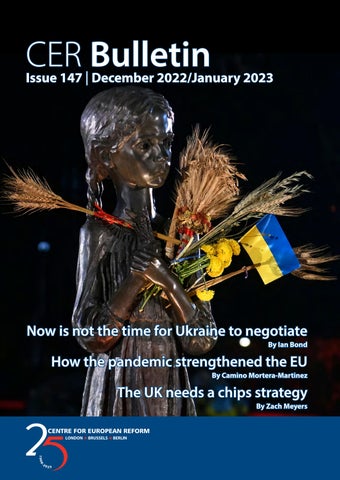
CER Bulletin
Issue 147 | December 2022/January 2023
Now is not the time for Ukraine to negotiate By Ian Bond
How the pandemic strengthened the EU By Camino Mortera-Martinez
The UK needs a chips strategy By Zach Meyers
1998
-
20
23
1998
-
20
23
Now is not the time for Ukraine to negotiate by Ian Bond
There are good reasons to want the war in Ukraine to end as soon as possible. “War is Hell”, as the US general William Tecumseh Sherman said after the American Civil War. Ukraine has suffered terrible civilian and military casualties and catastrophic damage to its infrastructure; an end to the fighting would spare the country further harm. But negotiations at this stage would benefit Russia more than Ukraine. A range of Western politicians, analysts and military figures have begun to argue that Ukraine should start peace talks with Russia. Some fear escalation leading to nuclear war. Some are concerned at the human costs to Ukraine of continued fighting. Some worry about the economic costs to the West of supporting Ukraine and sanctioning Russia. Some fear that the West may jeopardise its own defence by transferring too many weapons to Ukraine. But whatever their motivations, when Western commentators write of the need “to moderate [Ukrainian] public expectations of a decisive victory”, they are implying that Ukraine should be prepared to leave Putin in possession of at least some of the territory that, prior to 2014, Russia itself had accepted as Ukrainian. There are at least six reasons why Western advice to negotiate now is misplaced. First, it ignores the agency of the Ukrainians themselves. They are the ones under attack from Russia; they alone can say whether the victory they seek is worth the suffering involved
in achieving it. Polling by Gallup in September showed that 70 per cent of Ukrainians wanted to fight on until victory, and 91 per cent of Ukrainians defined victory as recovering control of all Ukraine’s territory, including Crimea. If the Ukrainians themselves decided that recapturing Crimea – the toughest military challenge ahead – was not worth the expected number of casualties, that would be a different matter; but there is currently no sign that they will. Second, unless talking and fighting continued in parallel, Ukraine would find itself divided along a ceasefire line for as long as negotiations continued (as it was following the Minsk agreements of 2014 and 2015). That would leave a significant part of the Ukrainian population under Russian occupation. Evidence from every area liberated by Ukrainian troops shows what that means: torture; disappearances, sexual violence, Russification of the education system and the forced adoption of Ukrainian children with a view to wiping away their Ukrainian identity. The US
info@cer.EU | WWW.CER.EU CER BULLETIN issue 147 | DECEMBER 2022/JANUARY 2023
ambassador-at-large for global criminal justice has strongly implied that such war crimes and crimes against humanity, taken together, could amount to genocide. There may be reasons to negotiate with a leader responsible for genocide – like Yugoslavia’s Slobodan Milošević in the 1990s – if the alternatives are worse. But while Ukraine is still advancing, it will not want to leave Russia in a position to continue the ‘deUkrainianisation’ of occupied areas. Third, there is a risk that those pushing for negotiations will increase damaging divisions within the West, when unity is most vital. In her State of the Union address to the European Parliament in September, European Commission President Ursula von der Leyen said: “We should have listened to the voices inside our Union – in Poland, in the Baltics, and all across Central and Eastern Europe. They have been telling us for years that Putin would not stop”. Those that think Ukraine can satisfy Putin’s imperial urges with territorial compromises are again ignoring the views of allies and partners with most reason to fear Russia’s intentions. There is also a risk of friction between Ukraine and its partners. Some in the West may criticise Kyiv as happy to take Western weapons but not Western advice. By contrast, Kyiv may be frustrated that even after nine months of brutal war some of its Western partners are still more concerned that a Ukrainian victory will provoke Putin into using nuclear weapons than they are worried about the effect of a Russian victory on Ukraine and its people. Fourth, linking pressure on Ukraine to negotiate with Putin’s threats of escalation would set a disastrous international precedent. If the US and its allies back down in the face of nuclear or energy blackmail on this occasion, why would Putin believe they would defend the Baltic States or others in the face of similar Russian threats? And if threatening a nuclear attack enables Putin to protect his territorial gains in Ukraine, a country with no nuclear weapons and outside the protection of the West’s nuclear umbrella, then both aggressive powers and their potential victims will be increasingly motivated to acquire nuclear weapons of their own, either to threaten or to deter. Fifth, offering Putin negotiations, and presumably a pause in fighting when his forces are under pressure, would give Russia the chance to reconstitute its forces and refill its arsenals in preparation for a renewed attack on Ukraine. Putin has believed for a long time that “Ukraine is not even a country”. As long as he is
in power, his goal will remain to reunite those he regards as the ‘Russian’ peoples of Ukraine and Russia. If Russia can rebuild its strength, at least partially, while it still occupies a significant part of Ukraine, Putin’s starting point for his next attack will be more advantageous than it was in February. Russia did not use the time after the Minsk agreements to seek a durable peace but to prepare for the next phase of the war; there is no evidence that this time would be different. Finally, despite the setbacks Russia has suffered so far, there is no sign that Putin himself or those around him are looking for ‘off-ramps’. At the annual Valdai Forum, Putin argued (as he had done on many previous occasions) that Ukraine was an “artificial state” and suggested that “only Russia, which created today’s Ukraine, could be the … guarantor of Ukraine’s statehood, sovereignty and territorial integrity”. This implies he has not given up his objective of controlling the country. Putin sees Western talk of off-ramps as an indication that the West itself is looking for a way out of the conflict, and therefore as a reason for him to apply more pressure. Talk of negotiations now will only reinforce his belief that time is on his side. This said, the war is still likely to end with negotiations: however successful Ukrainian forces are in the fighting, there is not going to be a ‘victory banner over the Reichstag’ moment, when the Ukrainian flag flies over the ruins of the Kremlin and the remnants of the Russian army surrender unconditionally. But the timing and circumstances of talks will have to be right if the result is to be lasting peace. Negotiations launched now might (or might not) give Ukraine temporary relief; but they would be very unlikely to produce a stable and long-lasting settlement of the conflict. For that, Russia will have to be in a much weaker position. For Ukraine, there is an element of risk in not seeking a rapid end to the fighting. Perhaps, despite its poor performance since February, the Russian army will mobilise more troops, re-arm and defeat Ukraine in battle next spring. If the West wants to mitigate that risk and bring about a quick end to the war, it should step up its military support to Kyiv. Once Ukraine has achieved a decisive victory on the battlefield, negotiations will be much easier.
Ian Bond
Director of foreign policy, CER @CER_IanBond
1998
-
20
23
How the pandemic strengthened the EU by Camino Mortera-Martinez
The EU has tried for years to become more resilient to global shocks. The new European Health Union is a good start. But the world is changing fast. The EU muddled through the eurozone and migration crises. But it responded more deftly to the Covid-19 pandemic, with EU member-states borrowing jointly to pay for the pandemic and its aftermath, and purchasing vaccines together. This effective response was mirrored in the EU’s swift reaction to Russia’s February 24th attack on Ukraine. The Union cannot be complacent, however. There will be other emergencies. The EU needs to prepare for the next big health crisis in a world that is increasingly splitting into two blocs. In November 2020, the European Commission published its proposals for building a European Health Union (EHU) on the basis of several elements. The first is to empower the European Centre for Disease Prevention and Control (ECDC). The ECDC will now be able to monitor the public health situation in member-states and issue recommendations to help them prepare better for health emergencies. If there is an outbreak of a disease, the ECDC will be able to deploy a newly-created ‘EU health task force’ on the ground. Second, EU law-makers have decided to give more competences to the European Medicines Agency (EMA). At the beginning of the pandemic, the EMA was often not informed of shortages of critical medicines, protective gear like masks, and devices such as ventilators – and was thus unable to help EU governments procure
those in the international market. During the early months of the pandemic, member-states engaged in a race to buy equipment and masks in a largely unregulated marketplace – a race that richer member-states found easier to win. The EMA also had patchy access to clinical trials databases, because Covid-19 medical treatments were developed swiftly and under different national programmes that were not always reported back to the Amsterdam-based agency – which made authorising treatments and vaccines for use in the EU more difficult. The EMA’s new powers should be able to solve these problems. The EHU’s biggest innovations are a law on panEuropean health risks; and a new and powerful department in the European Commission in charge of preparing for and responding to crises. The regulation on serious cross-border threats to health establishes new obligations for memberstates and EU institutions to monitor and share information on diseases. Crucially, it regulates the joint procurement of vaccines so that, next time a crisis hits, the EU can follow a playbook instead of rushing to organise their purchasing through informal channels, as was the case during the pandemic. The regulation also allows the Union to buy drugs, tests and personal protection equipment, which will allow the EU to pull its common weight in the hope of avoiding
info@cer.EU | WWW.CER.EU CER BULLETIN issue 147 | DECEMBER 2022/JANUARY 2023
the shortages Europe experienced during the early months of the pandemic. The EU’s new Health Emergency Preparedness and Response Authority (HERA) is an ambitious endeavour. It is in charge of gathering intelligence on threats to public health and will fund R&D on drugs, vaccines and medical devices so that, when a crisis hits, the EU has the technology to face it. When necessary, HERA will also buy and stockpile vaccines, drugs or medical equipment for the memberstates. And it can trigger a pan-European state of public health emergency, which will allow the Commission to take decisions quickly, and activate emergency funding. HERA can also act in case of nuclear or chemical attack, or in emergencies stemming from climate change. HERA has sweeping powers: never before has the EU been allowed to purchase and stock critical material or to switch to emergency decision-making in the same way national governments do in times of crisis. Whether the EU’s new powers on health work will be unclear until the next crisis, but experts are optimistic. The EU’s next public health problem to tackle – bar another pandemic – will be money and growing geopolitical tensions. The European Commission hoped that the bloc’s (ultimately successful) joint procurement of Covid-19 vaccines would help justify a bigger budget for contingency planning. The International Monetary Fund thinks mitigating the effects of the pandemic will cost the world $12.5 trillion by 2024. Preparing for it would have been much cheaper. But with a war next door, an energy crisis and inflation at a record 10.6 per cent in the eurozone, the EU faces too many competing budget demands. Although HERA has a budget of €6 billion for 2022-2027, member-states are less willing than at the height of the pandemic to commit more funds to the EHU. Senior officials worry that political momentum has been lost. Another urgent task for the EU is to secure meaningful reform of the World Health Organisation (WHO). It was too slow to declare a global emergency at the start of the pandemic, and initially failed to investigate whether Beijing was right to claim that the virus was not transmissible between humans. But tense relations between Washington and Beijing, exacerbated by suspicions over China’s handling of the Covid-19 outbreak, make much needed reform harder to achieve. Like most international organisations, the WHO works by consensus and nothing can be done unless all member countries agree. This is particularly worrying in the case of public health: if something like
Covid-19 emerged in a world where Russia is isolated and China and the US are increasingly at loggerheads, what would happen? Officials worry that channels of communication are closing: neither HERA nor BARDA (its US equivalent) have contact with their Chinese counterparts; and informal communication between Western and Chinese scientists (which led to the discovery and sequencing of SARSCoV-2’s RNA in the early stages of the pandemic) has become less frequent. Preparation for another pandemic requires the Union to assess where it has supply vulnerabilities and either to build wellmaintained stockpiles or to ensure that domestic suppliers will be able to raise production of drugs, protective equipment and medical devices to meet a sudden explosion in demand. The EHU is well-equipped to do that. But the question remains about how to get these supplies cheaply and quickly for stockpiles or in the middle of a crisis. At least in the short term, the EU will still have to source some low value-added products, like masks, from Asia; and some higher-added value goods, like medicines, from the US. But there will be more government intervention in the international supply chains for critical drugs and the chemicals that are needed to make them, and higher value-added medical devices, such as ventilators. This will force the European Union to reduce its dependency on imports, as the French have been advocating for years. In the words of a senior EU official, “it is not that the French are winning. It’s that the world is becoming more French”. Russia’s weaponisation of its energy supplies to Europe has confirmed their view. The pandemic increased the powers of the European Commission and changed the way the European Union worked in many policy areas, not only health. It also showed that the EU needed more effective tools to deal with public health emergencies; the EHU is a big step in the right direction. The EU’s response to Russia’s attack on Ukraine has built on the lessons of the pandemic, with member-states giving the EU institutions more latitude to act quickly rather than laboriously crafting compromises. Other crises will arise: member-states should already be thinking about how the EU can leverage its regulatory and other powers to combat threats – whether viruses or foreign leaders – that do not respect Europe’s national borders.
Camino Mortera-Martinez Head of the Brussels office, CER @CaminoMortera
1998
-
20
23
The UK needs a chips strategy by Zach Meyers
London wants chip-makers in Britain to support innovation. But using national security laws to engineer that outcome is counterproductive. Instead, the UK needs a more sober post-Brexit tech policy. The global supply chain for semiconductors is becoming more politicised. In October, the Americans unveiled new controls on exporting high-end chips and chip-making equipment to China, to constrain its ability to lead in new technologies like artificial intelligence. The US and EU are both promising large subsidies to onshore semiconductor manufacturing, fearful of relying on Taiwan for cutting-edge chips. The British government has been comparatively reactive. But after more than a year of equivocation, it has said that it will force a Chinese-owned firm, Nexperia, to unwind its purchase of the UK chipmaker Newport Wafer Fab (NWF), on national security grounds. The UK should instead focus on proactively nurturing its strengths. The UK’s approach to the NWF deal was chaotic. After it was announced in July 2021, the UK foreign affairs parliamentary committee labelled the deal “sovereignty for sale”, and some US lawmakers pressured London to reverse it. But reviews by the UK’s national security advisers apparently did not justify overriding the deal. Eventually, in May of this year, after increasing pressure from MPs, then business secretary Kwasi Kwarteng announced he would undertake a fresh retrospective review using the UK’s new foreign investment screening tool. A final decision was then postponed three times amidst Westminster’s broader political chaos.
There are indications that Kwarteng’s successor, Grant Shapps, may have decided to unwind the deal not because new national security concerns were discovered, but rather for political expediency and industrial strategy ambitions. The transfer of intellectual property to China poses the biggest threat: but the NWF has no technology that China does not already possess, and if that was a genuine concern then reversing the deal after 18 months would be too late. The government did not consult with Nexperia, which said it had proposed safeguards to address security concerns. And Schapps’ cited justifications for his decision are speculative. He implied the UK’s capabilities would be undermined if NWF became involved in sensitive chip-making activities in future, like making compound semiconductors. The government is devoting public funds to supporting this technology, which creates high-performance chips using non-silicon materials. Shapps was also worried that nearby chip firms and institutes in the South Wales tech cluster (several of which are also developing compound chips) could become security-compromised too. The government therefore clearly wants NWF to support the UK’s technological ambitions. But using national security laws to try to engineer that outcome is risky. NWF had been struggling for years, before its Chinese owners
info@cer.EU | WWW.CER.EU CER BULLETIN issue 147 | DECEMBER 2022/JANUARY 2023
secured its future by using it for unexciting high-volume manufacturing, rather than trialling new technologies. There is no guarantee the next owner will support new technologies at NWF either – or that such activities will prove economically sustainable. After all, NWF used to have compound chip capabilities, but its previous German owners shifted those facilities to the EU after the Brexit referendum. If the government wants to nurture the UK’s chip sector, it needs to make investment in it more attractive by developing and sticking to long-term support plans. If London had done so, past owners of NWF might not have abandoned the UK’s innovative ambitions in the first place. Brexit has not helped: it dampened business investment, limited UK firms’ access to European markets and made that access less certain, and has constrained the UK’s access to skilled labour. But successive prime ministers have made the problem worse, for example by subjecting tech policy to repeated reviews, new strategies and changes in direction. Chips policy – and the vague plan for the UK to lead the world in compound chip technology – is no exception. Industry has been clamouring for a ‘semiconductor strategy’ since 2020. The government has long promised one, and there were reports that it would publish the strategy alongside its final decision on the NWF deal. But that document is still absent. When it is eventually produced, the UK strategy should recognise that successful chip firms are globally focused. The chip supply chain is complex and countries succeed where they have comparative advantages (or can afford large and long-term public subsidies). China provides many raw materials, US firms own the main software tools used to design chips, and Taiwan and South Korea dominate cutting-edge manufacturing. Britain has an important place in this value chain. The most successful and most promising UKbased chip companies, like Arm, Imagination and Graphcore, produce designs. Because they are so specialised, crude market share statistics can understate these firms’ importance. While overall it is the US and not the UK which dominates chip design, Arm has incredibly energy-efficient designs for processors. These are indispensable to make devices like smartphones. Successful British chip firms have not needed UK chip-making factories to test their innovations. Instead, they have developed their own relationships with the world’s largest chip manufacturers. For example, Graphcore works closely with Taiwanese firm TSMC, because
Graphcore’s most advanced chips require a bespoke production process which no other manufacturer provides. These factors mean the government should not fret about protecting domestic chip-making facilities. Instead, its focus should be on creating a stable and supportive policy environment, protecting intellectual property created in Britain, and finding ways to help UK chip designers secure pilot lines to trial cutting-edge technologies at manufacturing facilities overseas. Using national security laws to engineer industrial outcomes is far less effective. Unwinding a deal more than a year after it has been completed only contributes to the UK’s reputation as unpredictable and politically febrile. The UK's haphazard strategy does have one benefit: so far, the UK has not devoted massive subsidies to local chip manufacturing, like the EU, US and many other countries. The UK is instead focusing on increasing public R&D spending, such as increasing funding for a ‘Catapult’ facility aimed at boosting compound chip technology. This modest approach is wise, if the UK sticks to it. The EU and US plans will be expensive: cutting-edge chip-making plants have extraordinary capital costs, so it is more efficient to have fewer factories and for those factories to have very high output. This is why most cuttingedge production is centralised in Taiwan, and why the most successful manufacturers are independent, making chips for many different design firms. Industry insiders are warning new subsidised factories will contribute to a supply glut. A subsidy race seems likely too: despite the US and EU promising to use their Trade and Technology Council as a forum to co-ordinate subsidies, only three chip-making firms (Intel, Samsung and TSMC) have the technological capabilities to deliver cutting-edge factories, and the skills required to operate these firms are globally scarce. The UK should leave these dilemmas to its larger allies. London’s decision to unwind the NWF deal reflects the zeitgeist of chip nationalism. But London’s dilemma was particularly acute because NWF had already abandoned the government’s technological ambitions, preferring an unexciting but more financially secure business over supporting riskier innovation. If the UK pursues more stable, long-term innovation policies after Brexit, the government might find itself freer to focus on national security.
Zach Meyers
Senior research fellow, CER @Zach_CER
info@cer.EU | WWW.CER.EU CER BULLETIN issue 147 | DECEMBER 2022/JANUARY 2023
CER in the press Financial Times 25th November As long as they can’t agree on how to distribute migrants internally, EU capitals will continue to focus on striking deals with countries to take back rejected asylum seekers and beefing up border security, writes Luigi Scazzieri of the CER. Al Jazeera 25th November Zach Meyers of the CER think-tank, said [Elon Musk’s management] is an “arbitrary approach” that’s “hard to reconcile with the Digital Services Act”, a new European Union law that will start applying to the biggest online platforms by mid-2023. Euronews 18th November MCC Brussels is “a thinktank that is totally and
completely affiliated with the Orban government and that, I assume, is here to push his agenda and to look for ideas to bring back to Budapest,” said Camino Mortera-Martinez, head of the Brussels office at the CER. Financial Times 18th November To meet EU-wide emergency targets for the reduction of electricity and gas demand, more actionable information campaigns are needed, writes Elisabetta Cornago of the CER. Governments should also encourage utilities to set up incentive schemes to reward energy savings. Politico 15th November The Chips for Europe Initiative's €11 billion focused on commercialising
research “would still punch below its weight” ven if it all materialises, said Zach Meyers, a senior research fellow at the CER. Meyers estimates that the US's chips strategy promises $13.2 billion in research. The New Statesman 8th November It would be very surprising if this reduction in trade hadn’t reduced growth, and indeed John Springford of the CER estimates that if you look at the UK’s performance compared to a basket of “similar” countries, our growth shortfall is about 5 per cent. The Sunday Times 23rd October She [Giorgia Meloni] may be lukewarm, however, about any moves towards further European integration – seen by France, in particular, as a precondition for the
further eastward expansion of the EU, said Charles Grant, director of the CER. “This will be very bad for those who really care about enlargement, because the French and others are quite clear there will not be another country joining the EU until the treaties have been changed to have more majority voting,” he said. Sky News 14th October Ian Bond of the CER says the West needs to stop being – and sounding – afraid of a nuclear attack. “Nothing is as provocative to Putin as weakness, so the more the West says 'We are afraid that Russia might use nuclear weapons', the more likely that Putin is to continue making the threat of using nuclear weapons – and perhaps even use one or two to demonstrate he really means it.”
Recent events 29 November CER/EUROPEUM/Think Visegrad roundtable on 'From Prague to Chișinău: What future for the European Political Community?', Brussels Speakers: Roland Freudenstein, Charles Grant and Jan Kovář 29 November CER/Kreab breakfast on 'How to strengthen the EU?', Brussels Speaker: Lars Danielsson 18-19 November Conference on 'Macroeconomics in a time of pandemic and war', Ditchley Park Speakers included: Agnès Bénassy-Quéré, Marco Buti, Benoît Cœuré, Swati Dhingra, Clare Lombardelli and Martin Sandbu 10 November CER/AIG Geopolitical Risk Series webinar on 'The US midterm elections'
Speakers: Laura von Daniels, Tim Prange, Christoph Schemionek and Leslie Vinjamuri 8 November CER/Kreab breakfast on 'The future of Europe', Brussels Speaker: Klaus Welle 2 November Breakfast on 'Labour's plans for UK foreign policy', London Speaker: David Lammy 27-28 October SWP/CER/Brookings Daimler USEuropean Forum on Global Issues, Washington Speakers included: Carl Bildt, Melinda Bohannon, Julian Gewirtz, Philip Gordon, David Miliband, Victoria Nuland, Michael Scharfschwerdt and Thomas Wright
For further information please visit
www.cer.eu
10 October CER/AIG Geopolitical Risk Series webinar on 'China's 20th Party Congress' Speakers: Jörn Beißert and Stefan Gätzner 7-9 October CER/EDAM 18th Bodrum roundtable, Bodrum Speakers included: Carl Bildt, Volkan Bozkır, Baiba Braže, Ünal Çeviköz, Angelina Eichhorst, Ahmet Kamil Erozan, Jeffry Flake, Alexander Gabuev, Alexander Graf Lambsdorff, Gideon Rachman, Odile Renaud-Basso and Nathalie Tocci 4 October Conservative party conference fringe event on 'Britain and the EU: What kind of relationship do they need?’, Birmingham Speakers: Thomas Erndl, Greg Hands, Juliet Samuel and Theresa Villiers