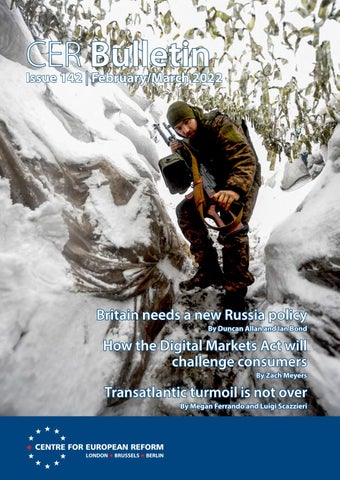
CER Bulletin
Issue 142 | February/March 2022
Britain needs a new Russia policy By Duncan Allan and Ian Bond
How the Digital Markets Act will challenge consumers By Zach Meyers
Transatlantic turmoil is not over By Megan Ferrando and Luigi Scazzieri
Britain needs a new Russia policy by Duncan Allan and Ian Bond
Press articles by British defence secretaries rarely cause much of a stir – unexciting pieces on defence reform are the norm. But Ben Wallace’s January 17th article on the situation in Ukraine is an exception: point by point it refutes Russian President Vladimir Putin’s claims about the threat that Ukraine and its Western partners supposedly pose to Russia, ending with a warning about what a Russian attack on Ukraine would mean for the rest of Europe. Wallace’s line reflects the UK’s 2021 Integrated Review of security, defence, development and foreign policy, which described Russia as “the most acute direct threat to [the UK’s] security” in the 2020s. The government’s analysis is good and shows how far UK views have evolved since the 2010 Strategic Defence and Security Review, which had little to say about Russia, and even less that was critical. Now the UK needs a strategy to go with the analysis. Russia’s current menacing activity around Ukraine should be a crystallising event for UK policy. Putin has deployed sizeable forces to threaten Ukraine, and in effect demanded that NATO accept a Russian sphere of influence in Central and Eastern Europe. The UK has responded more robustly than most NATO allies to the pressure on Ukraine: it has supplied the Ukrainian armed forces with around 2000 anti-tank missiles, and sent 30 service personnel to train the Ukrainians in their use. But while strong words from the defence secretary and firm support for Kyiv are useful, they need to be part of a coherent overall strategy. Russia fights its enemies in domains stretching from
disinformation and influence operations through gas supply reductions and cyber-attacks to fullscale military conflict. The UK needs a similarly broad strategy for dealing with Russia. Such a strategy should start at home and work outwards. The first priority should be the protection of UK territory, citizens and institutions. That is partly a military task. It also involves cyber defence, traditional counterespionage and hardening British society against disinformation. Despite concerns about Russian efforts to influence the 2014 Scottish independence referendum and the 2016 Brexit referendum, little has been done to investigate, let alone prevent repetition. But the most important task of all should be combating illicit financial flows from Russia and frustrating the Russian regime’s cultivation of UK political parties and opinion-formers, which threatens Britain’s democratic institutions. The Parliamentary Intelligence and Security Committee’s 2020 report on Russia highlights the problem that wealthy members of the Russian elite, well connected in Moscow, are also donors
INFO@CER.EU | WWW.CER.EU CER BULLETIN ISSUE 142 | FEBRUARY/MARCH 2022
to British political parties, “with a public profile which positions them to assist Russian influence operations”. The government, however, has done little if anything to tackle the issue – Russian money of uncertain origin is still welcomed with few questions asked. The second priority should be the security of the Euro-Atlantic area. The UK prides itself on consistently meeting the NATO goal of spending 2 per cent of GDP on defence. The question is whether the government spends its money wisely. It should invest more in forces designed and deployed to deter hostile Russian military activity in the North Atlantic and the mainland of Europe. The UK should also work with the EU and European countries to take the tools of energy blackmail out of Russia’s hands, by reducing dependence on Russian gas. The third priority should be countering Russian activity that damages UK and Western interests beyond Europe: the Russian state has made use of quasi-private military companies to disrupt Western stabilisation efforts in Libya, the Central African Republic, Mali and elsewhere. At the same time, the UK should not make the mistake of overstretching limited assets in the hope of being a major player in the Middle East or the IndoPacific region. Finally, the UK should not shut the door on the possibility of better relations. Disagreements between London and Moscow will need to be managed through dialogue; and there are still a few issues, such as non-proliferation and counter-terrorism, on which London and Moscow might be able to co-operate. And the UK should continue to promote educational, scientific, sporting, tourism and mutually beneficial trade links with Russia, to underline that the UK’s problems are with the current leadership and its policies, not with the Russian people. The UK has a number of policy tools to implement its strategy. It has skilled diplomats, some with significant experience of Russia; capable intelligence services (though Russia was a lower priority for them after the end of the Cold War and the rise of the international terrorist threat); and significant if stretched military forces. The UK also has important soft-power tools, including the BBC and British universities; they can be used to reach out to parts of Russian society that government bodies find it hard to make contact with. The UK’s most important asset, however, is its network of allies and partners. On its own, the UK is vulnerable to hostile Russian action; but if it is attacked (as in the attempt to poison the former spy Sergei Skripal in 2018), it can respond more effectively in concert with like-minded states, co-ordinating the imposition of sanctions and other measures.
Brexit, particularly the UK’s decision not to try to negotiate an agreement on foreign, security and defence co-operation as part of the postwithdrawal arrangements, has made some of this co-ordination harder than it need have been. On Russia policy there are sympathetic memberstates with which the UK can work to influence EU debates. But Brexit has moved the centre of gravity in the EU towards those member-states who prefer to pursue a softer line with Russia, believing in the teeth of all the evidence that making concessions to Putin will ensure lasting European stability. The defence secretary has made a valuable contribution to countering Russian disinformation and helping Ukraine. But he should not have to lead the government’s effort to meet the Russian threat, or to co-ordinate with the EU and likeminded governments on sanctions and other measures to deter Russia from invading Ukraine. As foreign secretary, Boris Johnson went to Moscow in 2017 hoping to improve a difficult relationship. He should now accept that no improvement is likely at least as long as Putin and his fellow securocrats are in charge. He should work with EU and NATO governments to limit the damage that the regime can do to European security and prosperity. Johnson and the foreign secretary, Liz Truss, should also be talking to counterparts from countries for whom avoiding confrontation is currently a higher priority than maintaining Ukrainian sovereignty. They should aim to build a Western consensus that compromising core interests is worse than having an adversarial relationship with Russia. A successful UK strategy for Russia has to be based on realism – about Russia’s strengths, weaknesses and intentions, but also about the UK’s vulnerabilities and its assets. Johnson and Truss should acknowledge, at least to themselves, that it would be easier for both the UK and the EU to stand up to Russia if they had a more functional foreign policy relationship. Brexit has given the UK greater flexibility to ‘go it alone’ in devising foreign policy; it has not made it any more likely that splendid isolation in Europe will help the government achieve its policy goals, especially when dealing with a ruthless, disruptive actor like Putin.
Duncan Allan
Associate fellow, Russia and Eurasia programme, Chatham House
Ian Bond
Director of foreign policy, CER @CER_IanBond This article is adapted from a report by the same authors, 'A new Russia policy for post-Brexit Britain', to be published by Chatham House.
How the Digital Markets Act will challenge consumers by Zach Meyers
At the end of 2021, the European Parliament agreed on its preferred version of the Digital Markets Act (DMA). The DMA is a set of rules which would regulate big tech companies’ digital platforms to increase competition online. The EU law-making institutions – the Commission, the Council of Ministers representing member-states and the Parliament – are under pressure to finalise the DMA quickly. France’s presidency of the EU began on January 1st, and French President Emmanuel Macron wants the DMA finalised before he runs for re-election in April, to prove to voters he is tough on (American) big tech. The disagreements between law-makers are small, so this timeframe is achievable. Broadly, compared with member-states and the Commission, the Parliament wants the DMA to regulate fewer online platforms; to impose stricter rules on the platforms that it will regulate; and to impose harsher penalties on platforms that do not follow the rules. The Parliament’s proposals, however, could have significant consequences for innovation and for the quality of digital services.
Google’s app stores. It is difficult or impossible for smaller firms to compete against these platforms today. And, instead of competing with each other head-on, big tech firms increasingly co-operate with each other to protect their own core platforms.
The DMA could deliver some modest ‘quick wins’ – such as making mobile apps cheaper by lowering the costs that, say, Apple charges for placements in its app store. But these wins would soon be forgotten if big tech firms became slower to roll out innovations to European consumers.
If the DMA succeeded in making big tech’s core platforms more vulnerable to disruption in Europe, big tech firms would have to work harder to keep improving their services, and they might try harder to dislodge each other. Smaller disruptive firms may also prefer to enter the European market first, rather than other parts of the world where big tech firms would remain more impervious to competition. The DMA could therefore encourage greater spending on research and development, and deliver new innovations for Europeans.
Many of the DMA’s rules target big tech’s core platforms – like Google’s search engine, Facebook’s social networks, and Apple and
The Parliament’s proposals to strengthen the DMA rules targetting big tech’s core platforms are broadly pro-innovation.
INFO@CER.EU | WWW.CER.EU CER BULLETIN ISSUE 142 | FEBRUARY/MARCH 2022
As one example, MEPs want to force big social media platforms to be ‘interoperable’. This means consumers could swap Facebook for a competing social media app, while still being able to interact with their friends who stay on Facebook. Interoperability would make it easier for Facebook’s users to leave. If the interoperability rules are properly designed and implemented, this would make it easier for competitors to Facebook to succeed – and should give Facebook incentives to build new features to attract and keep consumers. But some of the Parliament’s other proposals would have more ambiguous effects on innovation in Europe. For example, the Parliament wants more of the DMA’s rules to apply to big tech firms’ dominant services – which are not part of their entrenched core platforms. In some cases, the rules are justified because they would allow new forms of competition. For example, the DMA would open up the iPhone’s payments technology, allowing competitors to Apple Pay to be used on iPhones. But in other cases, the DMA rules – even without Parliament’s proposed changes – would simply constrain how big tech firms can develop and promote new services. Parliament wants to extend these rules even further. For example, when a consumer first uses a smartphone with Google’s Android operating system, MEPs want the consumer to choose from a range of options for each type of app – such as their preferred web browser – rather than being able to start using their phone right away with the pre-installed apps. This proposal could affect innovation incentives for tech firms. For example, Google has developed its Android operating system and gives it away to phone manufacturers for free, making it more likely that consumers will try out Google’s other pre-installed services. If MEPs had their way, Android might no longer serve this purpose for Google, so Google might start charging manufacturers to use it. That might mean it becomes profitable for developers to create new operating systems, generating more competition – but it might also simply drive up the cost of smartphones and discourage Google from investing in Android’s development. Getting the balance right is tricky. When it comes to the quality of digital services, the DMA involves similarly difficult choices. The DMA will make big tech’s services worse in certain ways, to allow for more competition and more choice. As examples, big tech firms will be less able to offer personalised services; their services will not work together as seamlessly as they do today; and consumers could face more ‘cookie banner’-style requests for consent.
Some of this pain is necessary so consumers are prompted to shop around, rather than remaining in the cosy ecosystem of services of a single firm. Many of these nuisances should also resolve themselves in the long run, once big tech firms resign themselves to the reality of the DMA. For example, big tech firms might choose to process less personal data so consumers are not bombarded with consent requests. The DMA is therefore a case of ‘no pain, no gain’ for consumers. Law-makers should not undermine the DMA by trying to eliminate every consumer inconvenience – otherwise, they will jettison some of its long-term benefits. However, lawmakers should also ensure any pain is not so sudden and severe that European consumers hate the DMA. Law-makers therefore need to give the Commission more discretion about how big tech firms comply with the DMA rules. The DMA currently allows some exceptions from the rules. But these exceptions are too narrow to be of much use. The exceptions also allow a big tech firm to decide for itself when they should apply – which could allow firms to undermine the DMA’s objectives. Instead, firms should be required to seek the Commission’s agreement when they believe a DMA rule would cause unjustified harm to consumers, so the firm and the Commission can agree on alternative ways to meet the DMA’s objectives. If the final form of the DMA is negotiated by March, then Macron will be able to tout it as an achievement, well before voters are faced with the DMA’s effects. However, the EU will have to live with the DMA for years to come. Law-makers therefore need to consider MEPs’ proposed amendments carefully. The DMA will inevitably be somewhat of a crude instrument – and the final negotiations between lawmakers will not change that. But if it is targeted in scope, the DMA will still achieve more good than harm. If it is not, European innovation could slow – and European consumers could end up bitterly disappointed.
Zach Meyers
Senior research fellow, CER @Zach_CER A number of technology companies including Amazon, Apple and Facebook are corporate members of the CER. The views expressed here, however, are solely the author’s, and should not be taken to represent the views of those companies. To read more on this subject see Zach's recent CER policy brief 'No pain, no gain? The Digital Markets Act'.
Transatlantic turmoil is not over by Megan Ferrando and Luigi Scazzieri
The US might be ‘back’, but sources of friction with Europe persist. And in 2022, Europeans should expect an inward-looking America as Biden focuses on domestic issues prior to the mid-term elections. Europeans started 2021 with high hopes for the transatlantic relationship. After the acrimony and tantrums of the Trump era, President Biden held out the promise of a return to better times. America, as he put it, was "back". One year on, many European countries and the US agree on the importance of upholding democratic freedoms, international norms and multilateral institutions. They have, so far, managed to present a fairly united front in response to Russia’s threats of military action against Ukraine. Their views on China have converged, especially after Beijing responded to European sanctions linked to human rights violations with its own sanctions against MEPs and think-tanks. The investment agreement that the EU and China reached in 2020, to the US’s annoyance, stands little chance of being ratified. Under Biden, Washington has taken a more positive stance towards EU defence initiatives than it had done in the past. The EU and the US have launched a dedicated security and defence dialogue, and Washington is in the process of joining an EU project on easing physical and regulatory obstacles to moving military forces across the continent. The US is also set to conclude a co-operation agreement with the European Defence Agency, which could enable more defence industrial collaboration.
Although the EU and the US have given up hope of striking a free trade agreement, trade tensions have eased: last June they agreed to suspend for five years the retaliatory tariffs they had imposed during the protracted Boeing-Airbus subsidy dispute, and in October there was a deal to resolve the long-running dispute on steel and aluminium tariffs. The EU and the US have also established a Trade and Technology Council to co-operate on technology development and regulation, manufacturing and supply chains, and trade and investment issues. However, not all is well in the transatlantic relationship. First, Europeans have been disappointed by what they see as Biden’s lack of consultation with them on major decisions. Many allies felt that the way in which he decided on and executed the withdrawal from Afghanistan was unilateral, even though those allies did not have the will or ability to remain without the US, or to handle the Kabul airport evacuation alone. In September, the AUKUS submarine agreement infuriated France, intensifying Paris's interest in making Europe less dependent on an increasingly distracted US for its security. And as Russia threatened to invade Ukraine, many eastern EU states worried that Washington would negotiate with Russia without taking their concerns fully into account – although they were more worried by France’s calls for separate EU talks with Moscow.
INFO@CER.EU | WWW.CER.EU CER BULLETIN ISSUE 142 | FEBRUARY/MARCH 2022
Second, there are substantive policy disagreements that will continue to cause transatlantic friction. The EU and the US are often economic competitors, and each side worries that the other is becoming more protectionist. Many Europeans see Biden’s ‘foreign policy for the middle class’ as a cover for protectionist policies. And the EU’s plan to introduce a carbon border adjustment mechanism worries US exporters, since it will impose additional costs on them, to help the EU avoid carbon leakage. Meanwhile, the EU’s efforts to enhance its digital and technological sovereignty and to rein in the anti-competitive practices of (mainly US) digital platforms will continue to be an irritant. In the security field, the US could quickly sour on the EU assuming a larger role in defence matters if EU countries do not follow through with plans to improve their defence capabilities, or if their plans threaten to undermine NATO. Indeed, the EU and the US will have to work hard to avoid disagreements over the respective roles of NATO and the EU, both of which will release strategic documents this year. As China and Russia embark on increasingly disruptive foreign policies and draw closer to each other, the need for a unified transatlantic stance is more pressing than ever. But it will not be easy to achieve. Europeans have become more concerned about China’s policies, but many think that isolating Beijing is unhelpful. If the US pushes Europe to take a much harder stance on China, this will probably lead to more divisions, within Europe and across the Atlantic. Until now, Russian aggression has united Europe and America and appears to have re-invigorated NATO. But if Russia were to take military action against Ukraine, divisions over how to respond might drive a wedge between the US and Europe – especially if some EU states, constrained by public opinion and energy dependency on Russia, prove unwilling to impose the sweeping sanctions that the US (and most eastern EU countries) envisage. Europeans also look with growing concern to domestic developments in the US, where Trumpism seems to be growing stronger. Recent polling by the University of Massachusetts suggests that 71 per cent of Republican voters believe Biden only won the election through cheating. A December poll by Gallup indicates that Biden’s approval rating stands at 43 per cent – a sharp drop since the start of his term. And the few anti-Trump Republicans, like Liz Cheney, have either been disavowed by their party or are not standing for re-election in November, when Americans vote in mid-term elections. Current polling indicates that Republicans are likely to make large gains,
depriving Democrats of their narrow majorities in the House and the Senate, and essentially putting an end to Biden’s domestic reform agenda. Nineteen Republican-governed states have been complicating the voting process for their residents by reducing the number of polling stations, redrawing voting districts and abolishing postal voting. This will boost the Republicans’ chances. To avoid defeat at the mid-term elections, Democrats will need to persuade voters that they are delivering on their promise to make America stronger and fairer. But one year after taking office, Biden’s $1.75 trillion ‘build back better’ plan, supposed to drive the recovery from the pandemic and make the US a leader in the fight against climate change, is still stuck in the Senate. Legislation to counter voter suppression, another of Biden’s priorities, has not made it past the Senate either. All this means that Europeans should expect Biden to be more focused on domestic priorities in 2022. The US will not ignore major foreign policy crises if they arise, but Europeans should expect limited help from Washington in dealing with challenges that affect them more than the US, whether that is trouble in Bosnia, renewed tensions in the eastern Mediterranean, a rekindling of the civil war in Libya, or instability in the Sahel. Biden’s focus on domestic policy will weaken US influence and may encourage further foreign policy adventurism by Moscow and Beijing. And if the Republicans gain control of Congress at the end of the year, this will constrain Biden’s room for manoeuvre in foreign policy. A Republican-controlled Congress could push Biden towards foreign policy positions that create friction with Europe and make a united transatlantic stance harder, for example over China, Iran or Russia. Europeans will soon find out exactly how long Biden’s America is likely to be back for. In the meantime, they should invest in their capacity to protect their interests, whatever Washington does.
Megan Ferrando
Clara Marina O'Donnell fellow, CER @MegsFerrando
Luigi Scazzieri
Senior research fellow, CER @LScazzieri
INFO@CER.EU | WWW.CER.EU CER BULLETIN ISSUE 141 | DECEMBER 2021/JANUARY 2022
CER in the press Financial Times 16th January “There’s more and more of a trans-European debate,” observes Christian Odendahl, chief economist at the CER, a Londonheadquartered think-tank with offshoots in Brussels and Berlin. “There are still national bubbles but a sense that we’re all in this debate together.” The Wall Street Journal 14th January “If Pécresse wins, the world goes on, like Scholz winning in Germany,” says Charles Grant, director of the CER. Center-left Mr Scholz looks set to maintain many policies of centerright former Chancellor Angela Merkel. Post-Merkel Germany, while stable, will likely play a diminished role in Europe. “The new government will take time to come together due to the difficulty of the three-party coalition,” he says. TechMonitor 14th January [Digital currencies] are seen as a way to bolster financial
inclusion in countries with large unbanked populations. But for developed economies like the UK, the benefits are more limited, argues Zach Meyers, a senior research fellow at the CER. The Economist 1st January According to John Springford of the CER, Britain’s total combined imports and exports have been depressed by 11-16% relative to its peers since the beginning of 2021. Imports have been hit hardest – surprisingly, because Britain postponed customs checks until January 2022, whereas the EU did not. The Guardian 26th December Asked how Brexit has gone so far, Charles Grant, director of the CER, says that, ironically, the most obvious post-Brexit negotiating successes for the Johnson government have been in areas where it has managed to stay close to the EU, not move away – such as the “rolling over” of EU trade deals.
Politico 14th December Ian Bond, director of foreign policy at the CER, said the UK will keep a watchful eye on whether France tries to block reforms to NATO that London considers a priority, such as standing up to China in the Indo-Pacific, boosting cyber security capabilities and investing more on defense R&D. ITV News 10th December The pandemic delivered a huge shock to UK and global trade but the deputy director of the CER, John Springford, told ITV News he’s “pretty confident” that Brexit is to blame for the slump. Vox 8th December “After 16 years of very little progress, I think Germany is in for a bit of a modernisation shock,” said Christian Odendahl of the CER. Financial Times 3rd December The CER is making the case for extending the lifetime
of the EU recovery fund beyond the current cut-off date, 2026. The RRF should instead become permanent, and focus on climate investment to ensure the EU meets its carbon neutrality goal by 2050. The Times 3rd December “Germany is seen [in Washington] as quite a reliable and stable ally, but also as an ally with a strong voice in Europe,” said Sophia Besch, a defence expert at the CER. “A Germany that finds consensus within Europe before coming to the US is the kind of partner that the US wishes for.” The New York Times 1st December Camino Mortera-Martínez, a senior research fellow at the CER, said the new measures [to restrict asylum rights at the Belarus border] amounted to “rubberstamping the behavior” of Poland, Latvia and Lithuania. “Especially Poland, which has been breaking all asylum laws possible,” she said.
Recent events 27 January CER/Open Society European Policy Institute webinar launch of 'Is there a future for the EU’s area of freedom, security and justice? A plan to build back trust' Speakers: Giuliano Amato, Giulia Laganá, Camino Mortera-Martínez and António Vitorino
18 January CER/Open Society European Policy Institute webinar on 'The future of the recovery fund' Speakers: Pierre Beynet, Marco Buti, Elisabetta Cornago and John Springford 16 December CER/IPC/NUPI webinar on 'Assessing EU foreign, security and defence policy co-operation with its neighbours' Speakers: Daria Gaidai, Faruk Kaymakcı, Sanja Kovač and Eivind Vad Petersson
For further information please visit
www.cer.eu
6 December CER/BiEPAG webinar on 'What next for Europe and the Western Balkans?' Speakers: Florian Bieber, Robert Cooper, Milica Delević and Nikolaos Tzifakis 1 December CER/AIG webinar on 'EU-China co-operation on climate action after COP26' Speakers: Paolo Caridi, Norbert Gorißen and Janka Oertel