CER Bulletin
Issue 139 | August/September 2021
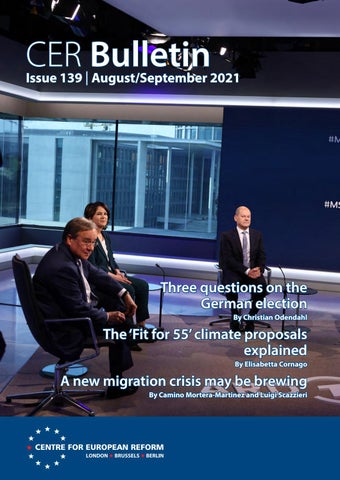
Three questions on the German election By Christian Odendahl
The ‘Fit for 55’ climate proposals explained By Elisabetta Cornago
A new migration crisis may be brewing By Camino Mortera-Martinez and Luigi Scazzieri
Three questions on the German election by Christian Odendahl
As the floods in Germany change the dynamics of the race, the CDU could win the most votes yet end up in opposition. In that case, the chancellor could be the SPD’s Olaf Scholz. The German federal election on September 26th is fast approaching. Angela Merkel is stepping down as chancellor after 16 years, and will leave Armin Laschet, current prime minister of North Rhine-Westphalia, in charge of the Christian Democrats (CDU) and well-placed to succeed her as chancellor. But Germany’s political landscape is evolving: the largest parties – the CDU and the Social Democrats (SPD) – are a lot smaller than they were and the Greens have become a serious contender for the chancellery. The current strength of the Free Democrats (FDP), a conservative-liberal party, also adds coalition options to the menu. Who will come in first? For a while in the spring it seemed as though the Greens could overtake the CDU, but now the polls have reversed, with the CDU ahead by 10 points. Excitement around the Greens’ candidate for chancellor, Annalena Baerbock, has subsided. The Greens’ campaign failed to anticipate the high level of scrutiny Bearbock would be subjected to. Her credibility has been undermined by writing an unnecessary book with the help of a lot of copy and paste, embellishing her CV and being late in declaring additional income to the Bundestag. Her approval rating is still around 30 per cent, but her disapproval rating has increased strongly.
But just as the press was full of articles asking whether the Greens should have instead nominated the more popular Robert Habeck as their candidate, torrential rains caused severe floods in Germany and Laschet’s state in particular, killing more than 160 people. This was an opportunity for Laschet to display his leadership credentials. But he made every conceivable mistake. He ignored detailed and alarming flood warnings and travelled to southern Germany to campaign, leaving the affected counties to deal with the fallout. He failed to realise that the severity of the situation required a state task force – and changed his views on whether the floods should affect German climate policy three times in 24 hours. He was then caught laughing in the background of a sombre TV interview with the German president in one of the worst-affected towns in his own state. A recent poll suggests that Laschet’s approval ratings have taken a severe hit, from already low levels. His plan to become chancellor by doing and saying very little – which worked well until the flood – is obsolete. Which leaves an unlikely winner of recent weeks: the SPD’s Olaf Scholz, who is by far the most experienced chancellor candidate. His response to the flooding was measured, and focused on putting together a financial rescue
INFO@CER.EU | WWW.CER.EU CER BULLETIN ISSUE 139 | AUGUST/SEPTEMBER 2021
package – as would be expected of a finance minister and vice chancellor. Furthermore, his recent successes on the global stage – the G20’s agreement on minimum rates of corporate tax is associated with him in Germany – have added to his standing, relative to his two rivals. The SPD is still well below 20 per cent in the polls, and it is highly unlikely that the SPD will overtake the CDU. But the Social Democrats are within touching distance of the Greens and slowly climbing.
earners, which would be difficult for the FDP to stomach. An SPD-Green-FDP coalition would only really work if the SPD were larger than the Greens, thus making Scholz the chancellor.
The CDU will probably end up as the largest party, but does that mean that Laschet will become chancellor? With one exception – Konrad Adenauer governing with an absolute majority after the 1957 elections – post-war Germany has always been ruled by coalitions. The CDU, even when it was the largest party in the Bundestag, has at times still found itself in opposition, for example when the SPD and FDP formed a coalition under the SPD chancellors Willy Brandt and Helmut Schmidt. This election may lead to another instance of this happening.
What does the election mean for Europe? All the major parties share a strong commitment to the EU, the transatlantic alliance and the euro. Outside Germany, it is often underestimated how strongly Germany’s security and commercial interests anchor the European and international policies of its leaders. EU and NATO membership, for example, are not transactional projects to Germany, but at the core of its national interest. No conceivable CDU chancellor would dissolve the euro or expel one of its members. Nor would a Green chancellor suddenly change course on China fundamentally, despite some hawkish rhetoric, as Germany’s commercial interests are too strong. That is a benefit and a curse at the same time: Europe can count on the next German government to provide stable, predictable leadership; but no conceivable coalition seems willing to challenge voters on their preference for the status quo, like strict fiscal rules and tight monetary policy, aversion to military interventions and limiting confrontation with either Russia or China.
The most likely outcome is still a CDU-Greens coalition. That is a well-rehearsed combination in several states, both parties are keen to govern and the pressure on their leaderships to come to an agreement after the election would be high. The CDU-Greens coalition would have broadly similar policies to the existing government, but with a stronger green agenda because the Greens would aim to extract concessions from the CDU: a steeper carbon price path in the national scheme, more subsidies for renewables and more public investment in decarbonising transport and buildings. Another coalition of Greens, SPD and FDP could also have the numbers to govern. This ‘traffic light’ coalition (because the parties’ colours are green, red and yellow) would aim to tackle, at least rhetorically, the three main issues facing Germany: climate change (Greens), social equity (SPD) and the modernisation of its economy and public sector (FDP). However, forming a stable three-party coalition of erstwhile enemies would be tricky: the election platforms of the SPD and Greens on the one side, and the FDP on the other, do not exactly match, with the FDP favouring tax cuts for the rich. There is another, underappreciated problem of a traffic light coalition: the SPD’s fear of entering the coalition as a junior partner and thus becoming a permanent second fiddle to the Greens. To avoid that, the SPD would put hefty policy demands on the table, such as more generous social benefits or higher taxes on high
A coalition that would definitely not work, despite pundits outside Germany suggesting it could, is a CDU-SPD-FDP combination. If the SPD entered such a government, dominated by the right, its remaining voters would abandon it in droves.
But there are nuances between the possible coalitions which would affect Europe. A traffic light government would be keen to invest in modernising Germany’s economy and public administration. But there would be no way it could fundamentally reform domestic fiscal rules against CDU opposition, since changing the constitution requires two-thirds majorities in both houses of parliament. Tweaking the existing rules is possible, as is circumventing them via special investment funds, but without proper change in Germany, the EU’s fiscal rules will be harder to reform. A CDU-Greens coalition could reform Germany’s fiscal rules to allow for more public investment to fight climate change, setting the tone for something similar at the EU level. Overall, however, the mere fact that Germany’s government will be a centrist coalition means that its European and international policies will be variations of the status quo.
Christian Odendahl
Chief economist, CER @COdendahl
The ‘Fit for 55’ climate proposals explained by Elisabetta Cornago
The costs of the Commission’s proposals to meet the EU’s 2030 climate goals need to be distributed in a more progressive way. Despite the jokes about Fit for 55 sounding like a fitness programme for the middleaged, the climate policy package presented by the European Commission on July 14th is a historic milestone. With its 13 proposals, the Commission has charted a path towards reducing EU-wide greenhouse gas emissions in 2030 by 55 per cent, relative to 1990 levels, as required by the Union’s recently-approved Climate Law. The proposals will face political resistance, because they involve increasing carbon prices for both businesses and households. The key to making the package a reality is to put compensation front and centre, through income support to address energy poverty and investment support for industry’s decarbonisation efforts. The EU Emissions Trading System (ETS) places a yearly cap on EU CO2 emissions by requiring the businesses covered to buy carbon permits from a fixed pot. It currently covers heavy industrial sectors, electricity generation and intra-EU flights. However, European heavy industry and aviation have so far obtained most of their emissions allowances for free, so that they can remain competitive with foreign businesses, most of which do not pay for carbon emissions. This has reduced incentives for low-carbon innovation, and led to industrial emissions falling more slowly than those from the electricity sector.
The Fit for 55 package aims to accelerate decarbonisation by gradually reducing the overall amount of emissions allowed under the ETS. The number of free ETS allowances for individual plants already depends on benchmarks that reflect the emissions of the most efficient plants in that sector. The new proposal would provide fewer free allowances to plants that do not undertake the decarbonisation efforts suggested by energy auditors. The package will also directly support innovation and investment in heavy industry: a greater share of the ETS’s revenues will be allocated to innovation subsidies, and ‘carbon contracts for difference’ will be introduced. These contracts will guarantee investors a fixed carbon price, higher than the current one, for a set period of time if they innovate and invest in decarbonisation. Some clean technologies that are in the early stages of deployment are too expensive, given current carbon prices. At the end of the contract, the firm can sell, at market price, the ETS allowances that it did not use thanks to green investment, and receive the difference between the market carbon price and the higher, contracted carbon price. In essence, the Commission is bringing forward higher carbon prices for industrial innovators. The package also proposes to level the playing field between domestic and foreign producers
INFO@CER.EU | WWW.CER.EU CER BULLETIN ISSUE 139 | AUGUST/SEPTEMBER 2021
of cement, iron and steel, aluminium, electricity and fertilisers with a carbon border adjustment mechanism (CBAM). This mechanism would impose a cost of carbon on imports of these goods into the EU, eventually replacing the free allocation of ETS emissions allowances. But the timeline for ending free allowances, which will be phased out by 2036, is not ambitious enough. If the 2030s are ‘the decisive decade’ for climate action, as the Commission insists, it should not wait 15 years to apply the ‘polluter pays’ principle to industry. Households have not yet felt the full impact of carbon pricing, because of the limited scope of the ETS. This would change with the proposal for a new ETS, beginning in 2026 and separate from the existing scheme to start with, to cap pollution from road transport and heating, both of which are largely powered by fossil fuels. The Commission also wants national taxes on heating and transport fuels to be set according to their energy content and environmental performance, which is currently not always the case. These proposals would lead to higher prices at the pump and higher heating bills, which would disproportionately hit lower-income households, who spend a higher share of their income on transport and heating. To mitigate that hit to incomes, the Commission plans to put 25 per cent of the revenues from the new ETS into a Social Climate Fund. The fund will launch in 2025, one year before carbon pricing starts applying to buildings and road transport. Frontloading this kind of compensation is important, in order to make climate action fairer and more effective: transfers are necessary to offset fuel price increases. But the Commission’s proposal needs to be bolder and more detailed: the carbon price of this new ETS needs to be made stable and predictable, to give households guidance on future costs; and a larger share of revenues of the new ETS should go into the Social Climate Fund, to make the scheme politically acceptable while creating strong incentives for households to invest in reducing their emissions. In addition to price signals – energy taxes and ETS carbon prices – to encourage households to shift away from natural gas heating and petrol or diesel cars, the Commission is also proposing regulations to lower carbon emissions. For example, if adopted, new standards for car and truck emissions would end sales of combustion engine vehicles in 2035. The proposals for the power sector seek to increase the share of renewable energy sources to 40 per cent of final energy consumption, and to reduce energy demand, by making the
EU-wide energy-efficiency target binding. Both aims are welcome and necessary to achieve the 2030 climate goals, but there are challenges. 60 per cent of the EU’s renewable energy still comes from biomass – from forests, municipal waste, and agricultural and wood-working residues. Today, the dependency on biomass needs to be squared with the EU’s ambitious biodiversity and forestry strategies: this will require stringent criteria to ensure that biomass use is environmentally sustainable. The new EU-wide target for energy-efficiency would be binding, and paired with indicative national-level targets. Energy-efficiency improvements in transport and industry are largely in the hands of industrial players and can be encouraged with carbon prices, standards and, if needed, subsidies for innovation. Efficiency improvements in housing are in the hands of households: poorer people will need support in order to afford the costs of renovation. Many member-states are offering renovation subsidies as part of their recovery plans, but more investments will be needed. Overall, the proposals are ambitious, and long negotiations loom between the Commission, the member-states and the European Parliament. To get the package over the line and reach its targets, Europe must: Resist the call from some member-states to water down price signals. Reaching the ambitious climate targets without strong and consistent price signals will not work. Price signals are not sufficient, but they are a necessary foundation of climate action. Stand its ground on regulatory requirements. Regulation sets minimum standards to force innovation, and adds further credibility to price signals. The main political battle here is the phase-out of combustion engine cars. Be bold in addressing the distributional impacts of the energy transition. Richer households, richer businesses and richer member-states should shoulder a larger share of the cost of climate action. Avoiding these discussions is not an option: climate inaction would have even more unequal outcomes. Lead the world in climate action. The EU needs to raise its climate diplomacy efforts ahead of the COP26 climate negotiations in Glasgow: it should encourage the US and China to match its own policy efforts, and it should step up its support for developing countries to help them in the energy transition.
Elisabetta Cornago
Research fellow, CER @ElisabettaCo
A new migration crisis may be brewing by Camino Mortera-Martinez and Luigi Scazzieri
Member-states have made some progress towards a common asylum system. But large divisions endure and the EU’s efforts to increase co-operation with third countries will continue to face difficulties. For EU policy-makers, a new migration crisis is never far from sight. After dropping sharply in 2020 – when most people could not leave home, let alone cross borders – the number of migrants arriving irregularly in Europe is rising. According to Frontex, the European Union’s border agency, arrivals during the first five months of 2021 increased by 47 per cent compared to the same period in 2020. In May, around 12,000 people crossed illegally from Morocco to the Spanish enclave of Ceuta in less than two days. The crossings followed Spain’s decision to provide medical treatment to Brahim Ghali, a leader of the Sahrawi people who want independence from Morocco. In response, Morocco instructed its border forces to look the other way. Then in July, Frontex had to intervene on the border between Lithuania and Belarus, after a sharp rise in border crossings. The migrants mostly came from sub-Saharan Africa and were reportedly flown in and pushed across the border by the Belarusian government, in retaliation for EU sanctions. The numbers are not as headline-grabbing as those of 2015-16, when 1.4 million people arrived irregularly in Europe. However, they point to how willing disgruntled neighbouring countries are to exploit desperate people in order to put pressure on the EU – especially in
the case of Belarus flying in migrants from other continents. This is not a new phenomenon, but it should bring migration back to the top of the EU’s agenda. The EU and its member-states managed to weather the 2015-16 migration crisis by striking controversial deals with countries like Turkey and Libya, to stop migrants from reaching Europe. Since then, the Commission and the member-states have given more powers to Frontex and national law enforcement bodies to police the external borders of the passport-free Schengen area. The Commission has also tried to create a common asylum system, including solidarity measures that would distribute asylum-seekers between member-states. In September 2020, the Commission relaunched negotiations among the member-states with a proposal for a ‘new migration pact’. On the surface, the politics of migration in Europe remain toxic. Delays and failures in registering and processing asylum applications at Schengen’s external borders have caused bottlenecks and pitched frontline and destination countries against each other. The former claim that they need more help in dealing with asylum-seekers; the latter say border countries are simply unwilling to do their
INFO@CER.EU | WWW.CER.EU CER BULLETIN ISSUE 139 | AUGUST/SEPTEMBER 2021
job, as it is easier for them to turn a blind eye to migrants moving into other member-states. Behind the scenes, however, there has been some progress. In June the member-states agreed to turn the EU’s Asylum Support Office into a fully-fledged EU agency, with more staff and powers to intervene in a crisis. For years, frontline countries insisted that all reforms had to be adopted as a package – they would not take on greater responsibilities for quickly processing arrivals or accept compulsory deployments of EU staff on their territory until there was an agreement to distribute asylumseekers across the bloc. To break the stalemate, EU countries agreed that the agency should not carry out compliance checks and monitoring, or unilaterally deploy staff on their territory, until other asylum reforms had also been agreed. The deal on the asylum agency is a small step in the right direction. But other proposed reforms will be harder to conclude. It is unclear whether the processing of asylum applications can be as quick as the Commission would like. And although border states insist on the distribution of asylum-seekers across the EU, this remains controversial. Some member-states continue to think that solidarity measures encourage migrants to come to the EU, while others remain unwilling to take in any migrants at all. EU countries also disagree on when a crisis would be serious enough to trigger solidarity measures. It may be possible for member-states to make further progress by reaching piecemeal agreements on some of the issues relating to improving access to migrants’ data, and the screening and processing of asylum applications. But the most contentious measures will have to be decided as a package deal, reflecting a compromise between member-states on increased responsibilities for managing arrivals and burden-sharing – whether it is through accepting asylum seekers, contributing with material support or helping with deportations. Until then, solidarity will continue to take the form of ad-hoc measures by coalitions of willing member-states, and the EU will still focus its efforts on the external dimension of its migration policy, particularly on the common objective of reducing the number of migrants arriving in Europe. The question is whether the EU’s efforts in this direction will be sufficient to deal with new trends in migration – such as climate change creating refugees or unfriendly governments exploiting migrants to put pressure on the Union.
The EU has pushed ahead with plans to deepen co-operation with third countries, saying it intends to use carrots and sticks, including curtailing Schengen visas for countries that are not co-operating. The Union has continued to give money to partners in the Western Balkans, North Africa and the Middle East, to promote economic development and to strengthen their border controls. EU leaders have also agreed to provide new funds to Turkey to help it sustain the millions of refugees that it hosts on its territory. The Union wants to bolster cooperation with Tunisia and with Libya, now that there is a provisional unity government in Tripoli. Perhaps most crucially, the bloc is actively trying to get migrants’ countries of origin to take back nationals whose asylum applications have been rejected. Currently only around a third of those ordered to leave the EU do so, largely because of a lack of co-operation from foreign authorities. All the EU’s efforts to secure greater cooperation from third countries are likely to remain legally difficult and fraught with practical challenges. Its reliance on partners to keep out migrants will encourage many of them to extract an increasingly high price for co-operation, by asking for more money. Meanwhile, the EU’s plans to motivate countries of origin and transit to take back irregular migrants will be difficult to implement. Many countries are deemed unsafe for migrant returns. And for many governments, agreeing to take back their nationals is politically damaging and can mean losing remittances that are worth much more than EU funding. Despite these challenges, the EU has no choice but to manage migration together with third countries, including with difficult partners – unless member-states are willing to engage in massive pushbacks of migrants or to accept large numbers of irregular arrivals, risking Schengen’s collapse. This means the EU will have to offer its partners more financial help as well as practical assistance and greater avenues for legal migration, in return for their co-operation. But co-operation won’t always be possible and EU leaders should be ready to stand up to coercion by countries that will not hesitate to exploit desperate migrants, like Belarus. If they don’t, they may soon find a new migration crisis brewing.
Camino Mortera-Martinez
Senior research fellow, CER @CaminoMortera
Luigi Scazzieri
Research fellow, CER @LScazzieri
INFO@CER.EU | WWW.CER.EU CER BULLETIN ISSUE 139 | AUGUST/SEPTEMBER 2021
CER in the press The Evening Standard 22nd July The CER estimates that leaving the single market and customs union at the end of December 2020 had reduced UK trade by £10 billion, or 13.5 per cent, in May. John Springford, deputy director of the thinktank said this was on top of an £8 billion, or 10 per cent, hit to trade between the June 2016 referendum and splintering away from the single market. Bloomberg 19th July “As long as the ECB continues to expect too-low inflation, the new strategy would require it – strictly speaking – to loosen its policy,” said Christian Odendahl, chief economist at the CER in Berlin. “The true test of the negotiated consensus is still ahead.” The Wall Street Journal 14th July Brussels worries that continuing to grant free ETS allowances might breach WTO rules, but industry representatives believe CBAM and free allowances – without which their exports risk becoming uncompetitive – can coexist. Russia, Turkey, China and the UK are expected to be
hardest hit, according to Elisabetta Cornago and Sam Lowe at the CER. The Economist 14th July “Slashing emissions is a rotten problem for the officials, politicians and diplomats who must solve it. The costs come now and the benefits are reaped only in a generation,” points out Elisabetta Cornago of the CER think-tank. The New Statesman 2nd July As a new paper by Luigi Scazzieri of the CER notes, Germany and the UK signed a “Joint Vision Statement” on security in 2018; they are both part of the “Northern Group” of states around the North and Baltic seas; along with France they comprise the “E3” states crucial to the Iran nuclear deal; German leaders among others have in the past contemplated the idea of a European Security Council that binds in the UK. Financial Times 30th June Sam Lowe, trade expert at the CER, said it was no longer possible for British ministers to point the finger at Brussels when it came to issues like trade or subsidy control.
The New York Times 25th June “It’s very difficult for Greece but also for the EU to cooperate with Turkey to crack down on trafficking,” said Camino Mortera-Martinez of the CER in Brussels. “It’s easier for the Greek authorities to say ‘You were there, you were steering the boat and so you are charged with this crime.’” The Economist 17th June A model constructed by John Springford, deputy director of the CER, concludes [in April] that goods trade is 11% lower than it would otherwise have been, on top of an earlier 10% fall since the referendum. Bloomberg 16th June “Obtaining a settlement [with Google on antitrust investigations] is likely to be a roadmap for other regulators,” said Zach Meyers, a research fellow at the CER. Euronews 14th June “The language on China certainly goes much further than anything NATO has said before,” Ian Bond, director of foreign policy of the CER,
told Euronews. “I think this does reflect an increasing realisation that China is developing in ways that we hadn’t hoped for and perhaps we didn’t expect a few years ago when the talk was of China becoming a responsible stakeholder in the international system.” Financial Times 14th June “Once participating banks start to go into the nitty-gritty of designing [the European Payments Initiative], the interests of those banks will start to diverge,” warned Zach Meyers, a research fellow at the CER. The Express 1st June Charles Grant, director of the CER, said France will use its EU presidency in the first half of next year ahead of the French presidential elections to “promote its ideas of Europe”. But Mr Grant warned officials will need to produce “concrete deliverables” to help Mr Macron win. Mr Grant wrote: “France will use its EU presidency in the first half of 2022 to promote its ideas on Europe. Fortunately for Macron, many of the key people in Brussels are sympathetic to France.”
Recent events 13 July Launch of 'How to fight corruption and uphold the rule of law' Speakers: Katalin Cseh, Carl Dolan, Camino Mortera-Martinez and Michiel van Hulten
22 June Webinar on 'How does the EU lead the world on climate change?' Speaker: Frans Timmermans
For further information please visit
www.cer.eu
9-11 June Progressive Governance Digital Summit 2021 'Placing politics above economics: How COVID-19 has led to a public finance paradigm shift' Speakers: Agnès Bénassy-Quéré, Jason Furman and Christian Odendahl