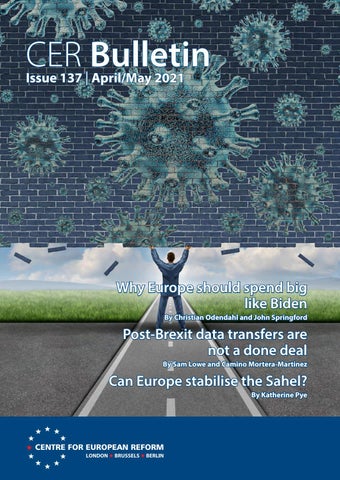
CER Bulletin Issue 137 | April/May 2021
Why Europe should spend big like Biden By Christian Odendahl and John Springford
Post-Brexit data transfers are not a done deal By Sam Lowe and Camino Mortera-Martinez
Can Europe stabilise the Sahel? By Katherine Pye
Why Europe should spend big like Biden by Christian Odendahl and John Springford
A big macroeconomic experiment is underway in the US. The $1.9 trillion fiscal package, agreed by Congress in March, sits on top of December’s $900 billion commitment, bringing total new spending to $2.8 trillion. In addition, the Biden administration is planning to invest a further $3 trillion in infrastructure and education (although some of this will be financed by tax hikes). Not all of the $2.8 trillion is short-term stimulus – much of it consists of measures that would be considered the normal operations of a welfare state in Europe, such as income support to help households pay their bills while COVID-19 restrictions continue. But in all, this amounts to a big jump in debt-funded US government spending, which should raise growth significantly in 2021. The ‘Biden plan’ is not without its critics, even on the progressive side of the political spectrum. Larry Summers, former Treasury secretary under Bill Clinton, argues that it will raise inflation because government spending will be two times larger than this year’s output gap – a standard but controversial measure of the extent to which an economy is running below capacity. Those defending the Biden stimulus insist that big spending is needed as the extra income support will mostly help people whose finances have been badly damaged by the pandemic. The US economy is also far smaller than would have been predicted a decade ago, making it
unclear what the true capacity of the economy really is. Its potential might be quite a bit higher than the output gap measure suggests, lowering the upward pressure on wages and reducing the risk of runaway inflation. From an economic perspective, it is clearly more risky to do too little than too much: the Federal Reserve can always tighten monetary policy if government largesse sets off an inflationary boom, while slow growth and low inflation can become a trap, as Europe’s last decade shows. The OECD reckons that growth in the US will be 6.5 per cent in 2021, compared to the eurozone’s 3.9. Both are forecast to grow at around 4 per cent in 2022. That means that, at the end of 2021, the US is projected to return to the level of output that the OECD had forecast before COVID-19 emerged, while the eurozone economy will be 4 per cent smaller. There are two reasons why the economic recovery in Europe will be slower. First, the rollout of vaccines in Europe is roughly six weeks behind the US. As of late March, the EU had
INFO@CER.EU | WWW.CER.EU CER BULLETIN ISSUE 137 | APRIL/MAY 2021
administered 13 doses per 100 people, according to the ‘Our World In Data’ website. The US passed that mark on February 10th. Six weeks is not a huge difference, but there are worrying signs of a third wave of the pandemic hitting Europe, and British and South African variants of the virus may force governments to impose tougher, longer and therefore more costly lockdowns in order to contain them. The second reason is economic policy. The EU and its member-states had a good start to the pandemic, allowing sizeable ‘automatic stabilisers’ to play out, and adding or extending schemes to keep workers in jobs, support incomes and provide liquidity to firms. Moreover, the EU’s €750 billion debt-financed recovery fund will raise investment spending in the years to come (even if it will not provide much additional spending this year). But it is now up to national governments – some of them highly indebted and at risk of falling foul of Europe’s fiscal rules in the future – to boost their economies further. In some ways, Europe is more in need of stimulus than the US, yet on current plans its governments will do far less than the Biden administration. Take corporate debt, which will end up much higher after this pandemic. Over-indebted firms can act as a drag on growth if they cut investment and costs to pay back their creditors. US corporate debt tends to be higher than the eurozone’s, but American companies are on average larger than those in Europe and have access to deeper capital markets, while US bankruptcy procedures tend to be speedier, so higher corporate debt is less of a problem. Gross fixed capital formation – a broad measure of investment – grew a meagre 0.7 per cent a year in the US between 2016 and 2019, a rate that, with some wild quarterly swings, continued in 2020. In the eurozone, however, it shrank by 0.8 per cent a year between 2016 and 2019, before falling by another 1.6 per cent in 2020. That augurs ill for the recovery, with higher corporate debt as a result of the pandemic curbing hiring and investment more in Europe than in the US. Households’ finances on both sides of the Atlantic look similar, however. In both the US and the EU, the financial costs of COVID-19 have been concentrated on lower income workers, many of whom have either been furloughed or have lost their jobs. People in office jobs have built up savings as a result of having fewer opportunities to spend. With luck, a splurge of spending – on holidays, meals and entertainment – once restrictions are lifted could lead to a rapid rehiring of workers in the hospitality sector.
Evidence on both sides of the Atlantic suggests that a decent chunk of households’ higher wealth will be consumed – around 10-15 per cent. But it is unlikely that all of the foregone consumption from periods of lockdown will be recovered, and surveys suggest most people are planning to pay down debts or maintain a higher level of savings. However, the European economy entered the pandemic in a low-inflation, low-growth equilibrium, and may well return to that without aggressive fiscal stimulus. The eurozone’s inflation outlook is weak, just as it had been going into the pandemic. Investors and official bodies do not think that consumer spending will rapidly close the gap between aggregate demand and the supply capacity of the economy once restrictions are lifted. US long-term inflation expectations, however, are well anchored on the US inflation target, thanks in part to the Biden stimulus. For these reasons, Europe’s governments should be introducing enough fiscal stimulus to push the economy back to its potential output, and the ECB needs to continue signalling that it would not react to a burst of inflation with tighter policy (if it considers higher inflation to be temporary). Given the balance of risks, it is worth testing the extent to which the economy can cope with higher expenditure without a large rise in inflation. Policy-makers might be surprised, considering that before the pandemic unemployment rates in Germany, the Netherlands, Britain and elsewhere in northern Europe had fallen to very low levels without generating wage growth and hence inflation. And the recovery fund, if spent wisely, should help to expand the supply capacity of the European economy. If it turns out that fiscal policy is overdone, and the ECB considers longer-term inflation expectations to be rising too high, the usual central bank tools to cool the economy will work. Quantitative easing can be slowly and methodically unwound, with the ECB selling government bonds to the private sector, raising interest rates across the economy. And short-term interest rates can be raised too. Given the balance of risks – especially the desperate need to avoid another lost decade of economic stagnation and political instability – Europeans must loosen the fiscal taps, and spend big like Biden.
Christian Odendahl
Chief economist, CER @COdendahl
John Springford
Deputy director, CER @JohnSpringford
Post-Brexit data transfers are not a done deal by Sam Lowe and Camino Mortera-Martinez
Data transfers are essential for both trade and security co-operation. The EU and the UK should not let minor differences obscure the fact that they have more in common than divides them. The freedom to move data between the EU and the UK is as important to some businesses as the freedom to move goods, services and people. And for European and British security services, the ability to share and access data about criminals is an essential component of keeping people safe. The European Commission's decision to propose two adequacy decisions for the transfer of personal data to the UK, under the General Data Protection Regulation (GDPR) and the Law Enforcement Directive (LED), therefore came as a relief to both EU governments and the UK. But this is just the beginning of a long, bumpy road. The Commission’s adequacy decisions are not final: the European Data Protection Board (EDPB, an EU privacy oversight body) must issue an opinion and a committee of representatives from the 27 member-states must green-light the decisions. While the EDPB’s opinion is not binding, it will indicate whether there are any grounds for concern amongst national data protection authorities. And if the adequacy decisions are adopted, the European Parliament and the Council of Ministers can ask the Commission to withdraw them at any time, if there are concerns about the way the UK is applying privacy rules. MEPs are already suspicious that Britain plans to undercut the EU on data protection in the future, and the threat of legal challenges looms large.
In 2013, Austrian lawyer Max Schrems complained to the Irish data protection authority about Facebook’s transfers of European citizens’ data to its Californian headquarters, under the EU-US Safe Harbour agreement. Schrems argued that the EU could not guarantee that its citizens’ privacy would be respected when their data was transferred to the US, because surveillance laws there required private companies to hand data to the government. The case ended up before the European Court of Justice (ECJ), which eventually struck down the Safe Harbour agreement in 2015. In 2016 the EU replaced Safe Harbour with a data adequacy decision, known as the Privacy Shield. This too was felled by the ECJ in July 2020, after another case instigated by Schrems. Now transatlantic personal data transfers can only happen if the data subject consents or if transfers are needed for the fulfilment of a contract. Commission officials are well aware that the UK adequacy decisions could face similar legal challenges and have set out in detail how the decisions will deal with some of the issues raised by the Schrems saga. For example, they will be reviewed every four years, to ensure compliance. But a review clause does not guarantee the UK adequacy decisions will continue; the Privacy Shield had to be re-examined every year and that did not stop it from being annulled by the ECJ.
INFO@CER.EU | WWW.CER.EU CER BULLETIN ISSUE 137 | APRIL/MAY 2021
An additional problem for the UK is that the ECJ has already said that UK data retention laws are not in line with EU standards. In 2016, the Court said that Britain’s 2014 Data Retention and Investigatory Powers Act breached EU law because it allowed for general and indiscriminate retention of citizens’ data by law enforcement authorities. And in a separate 2017 case, the ECJ ruled that the UK government should be more careful when gathering data, as it was failing to show why bulk data retention was needed for some investigations. The court has recently confirmed this view in cases against French and Belgian security services. While the adequacy decisions refer to all these cases, they do not explain how the ECJ’s concerns may be assuaged.
to set global standards on data against the inherent aversion of some member-states to any measures that could jeopardise the privacy of their citizens. But the EU will not succeed in setting the global agenda on data if it only approaches the topic defensively. The pandemic has changed the way people use and understand data, and the real-time sharing of open-source data helped scientists to develop COVID-19 vaccines speedily. And citizens’ health data will be more public after the pandemic: the EU has recently published plans for a ‘vaccine passport’, which will allow vaccinated and COVID-19negative people to travel across the bloc. Such sensitive data sharing would have been unimaginable a few months ago.
Eventually the longevity of the UK data adequacy decisions may depend on perceptions, and in particular the growing EU suspicion that the UK will renege on its previous commitments in order to eke out a competitive advantage for its companies. The UK has already signalled that it intends to embrace a less defensive attitude to cross-border data liberalisation than the EU. In its trade agreement with Japan, in contrast to the EU’s with Japan, the UK accepted provisions preventing unjustified data localisation measures and restrictions on the free flow of data between the two countries. The UK also intends to accede to the Comprehensive and Progressive Agreement for Trans-Pacific Partnership (CPTPP) – an agreement on trade and investment between 11 Pacific countries – which has liberal commitments on the flow of data.
In practice, the EU and UK are more instinctively aligned on privacy and data flows than some law-makers think, despite slightly different conceptual frameworks. But trust between the parties is in short supply, with the UK’s seemingly cavalier approach to its Withdrawal Agreement commitments, and the EU’s threats to restrict vaccine exports to Britain. There is a risk that any and every UK action could be viewed by the EU as an aggressive act, and an excuse to rescind the adequacy decisions. This would be a mistake.
This is not to say that the UK intends to rip up its privacy laws. The British government hopes to be able to retain adequacy decisions with the EU, while pursuing a more forward-thinking approach to data in its trade agreements. Technically speaking this should be possible. Both Japan and New Zealand benefit from EU adequacy decisions, despite being members of CPTPP, and despite some early EU concerns about onward data transfers in the case of Japan. And notwithstanding some EU suspicion of CPTPP’s data provisions, GDPR is arguably covered by the agreement’s exemptions, which allow for restrictions on data flows so long as they serve a legitimate public policy objective. The main difference between the EU and others such as Japan, the US, and now the UK, is one of mind-set: whereas the EU presumes the data protection regimes of other countries are inadequate unless proven otherwise, others reverse the burden of proof. On the EU side, the Commission has found itself in a never-ending struggle to balance its desire
The real threat to the EU’s attempts to establish global data protection norms and protect its citizens’ privacy is not the UK, or even the US, but digital-authoritarian China. The EU should prioritise reaching a common understanding with the UK, the US and other like-minded countries – perhaps by opening up the membership of its proposed EU-US Trade and Technology Council. And if legal challenges continue to make it hard for non-EU businesses and law enforcement agencies to share data with the EU, the bloc should contemplate alternative routes instead. The EU could consider offering to sign all-encompassing data treaties with close partners that include judicial redress and coordinated review clauses, to avoid the problems raised by the Schrems rulings. The 2016 EU-US Umbrella Agreement on law enforcement data transfers could be a good model to follow, as it is an overarching treaty that has, for now, escaped legal challenges. Despite the present acrimony, data sharing between the EU and UK remains vital for the trade and security of both.
Sam Lowe
Senior research fellow, CER @SamuelMarcLowe
Camino Mortera-Martinez Senior research fellow, CER @CaminoMortera
Can Europe stabilise the Sahel? by Katherine Pye
Costly European efforts to quell violence in the Sahel have failed. Europe must place more stringent conditions on the funding going to those governments responsible for perpetuating unrest in the region. Despite a large-scale military intervention from France and long-term EU involvement, violence in the region is entering its ninth year, as conflict has escalated and spread across the region. The Sahel – made up of the G5 Sahel Alliance countries, Mali, Niger, Burkina Faso, Chad and Mauritania – is a strategic priority for Europe. As well as hosting jihadist groups affiliated with alQaeda and IS, the region is the source or transit route for large numbers of migrants heading for Europe. France in particular is worried that jihadist organisations could sponsor domestic terrorism, or attack French-owned uranium mines in Niger. But the Sahel is also important to Europe’s credibility as a crisis manager: it has established a geopolitically significant presence there that it lacks in other areas of conflict in its neighbourhood, such as Libya and Syria. Europe must now demonstrate that it can help resolve complex problems in its own backyard. Conflict in the region began in 2012-13, when jihadist insurgents and the Tuareg – a nomadic ethnic group, some of whom had been mercenaries in Gadhafi’s Libya – seized swathes of territory in northern Mali. After the Malian government failed to stop their advance southwards, France intervened. The UN, the EU, France and Algeria brokered a peace deal between the Malian state and the Tuaregs in
2015. France subsequently launched a longerterm mission against jihadist groups – Operation Barkhane. In 2016, however, a new conflict in central Mali broke out between ethnic groups and spread to Burkina Faso and Niger. Jihadists have taken advantage of inter-communal tensions to recruit members, and deaths from terrorist attacks in the region have risen five-fold since 2016. Popular frustration at the Malian government’s inability to surpress the violence led to mass protests in July 2020 and a military coup in August. Extensive international and European efforts to stabilise the region are under way. The UN has its second largest mission in the world operating in Mali (MINUSMA) and France has deployed 5,100 soldiers as part of Operation Barkhane to help the G5 Sahel Alliance’s Joint Force fight terrorist groups. The EU has capacity-building missions in Mali and Niger to assist civilian law enforcement personnel (EUCAP Sahel Mali and EUCAP Sahel Niger) and a military training mission in Mali (EUTM Mali). The EU also allocates development funds to security-focused tasks such as border surveillance missions. The Sahel Alliance co-ordinates development activities among European donors, including France, Germany, the UK and the EU, who fund 880 projects worth €11.6 billion.
INFO@CER.EU | WWW.CER.EU CER BULLETIN ISSUE 137 | APRIL/MAY 2021
European assistance has predominantly focused on bolstering the capacity of Sahel states to fight jihadist groups – strengthening the Joint Force, targeting group leaders, training soldiers and helping establish military bases. Alongside military capacity building, Europe has also poured money into public service provision in outlying regions to improve citizens’ access to hospitals, schools and water. Europeans hoped that their policy of ‘returning’ state security forces and services to northern and central regions would reduce support for jihadists. Islamist armed groups had tried to take advantage of the lack of public services to present themselves as better governors, building schools and arbitrating inter-ethnic land disputes. The problem with this approach, however, is that the states to which millions of euros of security assistance flow every year are also responsible for carrying out illegal killings and human rights abuses against their own populations. For many communities in the Sahel, not only do state security forces fail to protect them from violence, but they also actively pose a threat to their safety. The Malian army, which received training in human rights from EUTM Mali, was implicated both in Mali’s August 2020 coup and in human rights violations in the centre of the country. These killings are not isolated incidents but repeated patterns; in 2020 more civilians were killed by state security forces than jihadist groups in Mali and Burkina Faso. These massacres disproportionately take place against the Fulani ethnic group, a nomadic community living in central Mali, which drives them to turn to jihadists for protection, exacerbating interethnic tensions and perpetuating the conflict. Continuing to fund the Sahel’s armed forces without ensuring accountability for abuses undermines Europe’s attempts to stabilise the region. Europeans need to send a firm message that state-sponsored human rights abuses must stop. So far, France and the EU have been reluctant to criticise the regimes they provide with security assistance. When Human Rights Watch presented evidence of a mass execution of 180 Fulani civilians by Burkina Faso’s army in June 2020, the EU’s response was only to demand that the authorities shed light on these allegations, reiterating European support for the army’s counter-terrorism campaign. France and the EU should impose sanctions on military officials who commit illegal killings, to prevent further abuses which will fuel recruitment to jihadist groups. An awkward truth for Europe is that many citizens of the Sahel do not find the return of
state administration desirable. Widespread mistrust of elites and prominent corruption scandals mean that many citizens (particularly those outside national capitals) would prefer to have less corrupt institutions rather than to restore or reinforce the existing ones. The July 2020 protests in Mali were a reminder of public resentment against the corruption and complacency of governing elites. Meanwhile a 2020 audit in Niger found that at least $137 million of public money had been lost due to corrupt contracts for military equipment. Public outrage led to mass demonstrations, which were violently suppressed. The EU nevertheless tends to see governments in the region as important allies on counter-terrorism and migration, turning a blind eye for instance to democratic backsliding in Niger. Europeans should make their development assistance conditional on good account keeping, better public audits and transparency, to avoid encouraging corrupt practices. There is a prime opportunity to do this in Mali, since large tranches of assistance have been frozen following the 2020 coup. European partners could condition the release of funds on action plans for financial transparency. Donors should also push for the prosecution of individuals implicated in corruption scandals, to help deter repeats of Niger’s military contracts debacle. Europe’s aversion to condemning the domestic practices of Sahelian states, and attaching conditions to their support, is understandable. France especially wants to avoid accusations of neo-colonialism, given that the G5 Sahel countries are all former colonies. But France is frequently accused of this anyway; anti-French protests have become commonplace in Mali. Meanwhile, Europe’s current approach has not only failed to stop a serious escalation of the conflict – 2020 was the deadliest year since the violence began in 2012 – but has also shown that backing regimes which perpetuate atrocities against their own citizens is not going to lead to regional stability. Abuses and corruption by Sahelian governments are driving recruitment to jihadist groups, triggering civil unrest and prolonging a conflict in the EU’s backyard. It is time Europe adapted its approach accordingly.
Katherine Pye
Clara Marina O’Donnell fellow, CER @katherine_pye The forthcoming CER policy brief ‘The Sahel: Europe’s forever war?’ will explore European involvement in the Sahel in depth.
INFO@CER.EU | WWW.CER.EU CER BULLETIN ISSUE 137 | APRIL/MAY 2021
CER in the press Politico 19th March “It’s going to be all about damage limitation,” said Charles Grant, director at the CER think-tank [of the role of the Commission’s new UK unit]”. ...“ The British thought that during the Brexit negotiations [Richard Szostak] sometimes took quite a hard line,” Grant said. “Nobody accused him of being too soft on the British.” The New Yorker 18th March “That exports to the EU collapsed so badly, much worse than to everyone else, shows that, quelle surprise, if you have some checks on the French side of the border, you’re going to have a lot less trade,” said John Springford of the CER. Financial Times 18th March As Sam Lowe of the CER explains here, such a Swissstyle deal would leave the
UK “permanently bound to EU food hygiene rules”, but in return there would be no more need for export health certificates and the reams of other red tape currently strangling UK businesses. The Independent 13th March John Springford of the CER calculated that Brexit had reduced Britain’s total goods trade by £16bn (22 per cent), on top of a 10 per cent reduction in volume in the years after the 2016 referendum. Politico 5th March “It’s not like anyone in the EU is able to fully exercise their freedom of movement at the moment,” argued Camino Mortera-Martinez of the CER. “The unvaccinated wouldn’t face discrimination [once vaccine passports are agreed], because they would still be allowed to travel under limited circumstances
– it would just be easier for those who’ve had the shot,” she said. The Irish Times 24th February Sam Lowe of the CER, said the protocol could only endure if it enjoyed broad consent. “It is in the EU’s interest to be as accommodating as possible so as to ensure that it endures and to ensure that it doesn’t have to keep returning to this question constantly, over and over again,” he told the Northern Ireland Affairs Committee.
Bloomberg 12th February “What was clear before the pandemic has become even more obvious now: the fiscal rules in Europe need a substantial overhaul,” said Christian Odendahl of the CER. “For now, we have to live with small steps,” he said. “If these small steps, such as a slower fiscal transition out of the pandemic to support the recovery, turn out to be economically useful without undermining debt sustainability, then the fiscal hawks may be more open to a broader rethink.”
RTÉ 12th February “It is difficult to overstate the scale of the challenges that Draghi and Italy face“, said Luigi Scazzieri of the CER. ...“But spending funds is not enough,“ noted Mr Scazzieri, adding that the new premier “will find it just as challenging to enact longcalled for reforms“.
France 24 4th February It [the EU] has levers, but it “underestimates its ability to influence the behaviour of the Russians,“ says Ian Bond, director of foreign policy at the CER. “The Russian economy relies on Europeans to buy its hydrocarbons and to sell it goods and services,“ he underlined.
Recent events 29 March CEP/CER/UKICE webinar on 'Brexit's economic impact: Early evidence and future prospects' Speakers: Stephanie Flanders, Anna Jerzewska, Thomas Sampson and John Springford 24 March Webinar on 'The meaning of 'global Britain': The Integrated Review 2021' Speakers: Peter Ricketts and Kori Schake 15 March Webinar on 'Financing the transition to net zero' Speaker: Werner Hoyer
9 March Webinar on 'Charting a path towards CPTPP: The UK's trade objectives for 2021 and beyond' Speaker: Greg Hands
9 February CER/GMF/KREAB webinar on 'Transatlantic relations, building back better' Speakers: Anthony Gardner and Sigrid Kaag
5 March Webinar on 'The EU in 2030' Speaker: Clément Beaune
4 February Webinar on 'What kind of EU-UK relationship, postBrexit?' Speaker: João Vale de Almeida
23 February CER/KREAB webinar on 'The role of Europe's energy sector in bouncing back from COVID-19 and delivering the European Green Deal' Speaker: Kadri Simson
For further information please visit
www.cer.eu