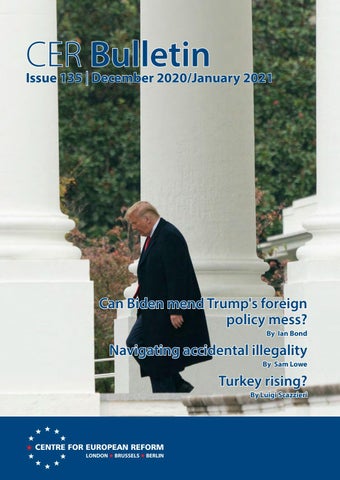
CER Bulletin
Issue 135 | December 2020/January 2021
Can Biden mend Trump's foreign policy mess? By Ian Bond
Navigating accidental illegality By Sam Lowe
Turkey rising? By Luigi Scazzieri
Can Biden mend Trump's foreign policy mess? by Ian Bond
After Donald Trump’s stormy inaugural address when he took office in January 2017, I wrote that Trump would “do enormous damage both to the US and to the rest of the world”. His term of office is ending as turbulently as it began. President-elect Joe Biden is facing a major renovation project. Trump can point to some successes. His administration brokered the diplomatic recognition of Israel by the UAE, Bahrain and Sudan – the first Arab countries to recognise Israel since Jordan in 1994. Trump developed good relations with Indian Prime Minister Narendra Modi and strengthened defence ties between the two countries, capitalising on shared concerns about China’s rise. Some things that could have gone wrong did not. Most experts, including at the CER, predicted that moving the US embassy from Tel Aviv to Jerusalem could cause unrest in the Arab world; it has not. Trump threatened North Korea at one point with “fire and fury like the world has never seen”; but he ended up avoiding war and holding three summits with North Korean leader Kim Jong-un instead. But Trump’s failures outweigh his successes. First, he wasted America’s greatest foreign policy asset: its network of allies. When taking foreign policy decisions, he generally ignored America's friends; sometimes he actively
damaged them (for example, by imposing tariffs on steel and aluminium imports from countries such as Canada on supposed national security grounds). Despite the continuing Russian threat, Trump ordered the withdrawal of 12,000 troops from Germany, less than half of whom will be redeployed elsewhere in Europe. He is currently trying to withdraw US troops from Afghanistan, against military advice, even though the Taliban, al Qaeda and the Islamic State continue to threaten US and allied interests there. Second, Trump has coddled authoritarian leaders, including US adversaries. He boasted to the author Bob Woodward that he had protected Saudi crown prince Mohammed bin Salman from facing any consequences after the murder of the journalist Jamal Khashoggi. Despite bipartisan concern in the US, Trump reportedly told Chinese leader Xi Jinping that building concentration camps for the Uyghur minority in the Xinjiang region was the right thing to do. At the request of Turkish President Recep Tayyip Erdoğan, Trump precipitously withdrew US troops from northern Syria, abandoning US allies in the process.
INFO@CER.EU | WWW.CER.EU CER BULLETIN ISSUE 135 | DECEMBER 2020/JANUARY 2021
Trump has consistently deferred to Vladimir Putin. Russia’s interference in the 2016 US election went unpunished. Though the US imposed additional sanctions on Russia during Trump’s term, Trump himself criticised Russia only rarely. In 2019, complaining of Russian non-compliance, he withdrew from the 1987 Intermediate-Range Nuclear Forces (INF) Treaty, which eliminated US and Soviet/Russian ground-based medium range missiles. But Russia is now free to deploy as many of these nuclear systems as it wants, unconstrained by the treaty. In 2020 Trump withdrew from the Open Skies treaty, a 1992 agreement involving 35 European and North American states that allows its members to overfly each other’s territory in aircraft equipped with cameras, infra-red scanners, radar and other sensors; if Russia follows Trump in withdrawing from the agreement, US allies in Europe will lose useful insights into Russian military activity. Third, Trump has rejected multilateral approaches to solving international challenges, seeing them as intrinsically disadvantageous to the US. He has undermined the World Trade Organisation, preventing the proper operation of its dispute settlement mechanism and forcing other countries to find work-arounds. In 2017, he announced that the US would withdraw from the Paris climate change agreement – which it did on November 4th 2020, the day after the US presidential election. Trump claimed that the agreement was “a massive redistribution of United States wealth to other countries” and criticised the influence that it would give other countries over US economic policy – ignoring the fact that any obligations would be mutual. In the midst of the COVID-19 pandemic he has withdrawn from the World Health Organisation, regarding it as excessively influenced by China, rather than working through it to counter the crisis. Trump also pulled out of the Joint Comprehensive Plan of Action (JCPOA), the 2015 agreement between Iran and China, France, Germany, Russia, the UK and the US to constrain Iran’s nuclear weapons programme. He imposed unilateral sanctions on Tehran instead, arguing that he could get a better deal than Barack Obama, both in terms of stopping Iran’s nuclear and missile programmes and frustrating its aspirations to become a regional hegemon in the Middle East. But the US is now at odds with the other JCPOA signatories, and Iran has lost its main incentive to comply with the deal – namely the economic benefit of getting sanctions lifted. It has expanded its nuclear activities, bringing it closer to having a nuclear weapons capability. Meanwhile, the reduction of US forces in the Middle East has increased Iran’s relative power in the region.
For a president supposedly determined to stand up to China, Trump’s unilateralism has often served Beijing’s interests. When Trump withdrew from the 12-nation Trans-Pacific Partnership (TPP) free trade deal in 2017, he lost the opportunity to create a huge economic space following US standards. He thereby handed the initiative to China – which has just signed the Regional Comprehensive Economic Partnership free trade deal with 14 Asia-Pacific countries, including seven of the original TPP countries. In four years, Trump has shown that ‘America first’ is no basis for a superpower’s foreign policy strategy. Indeed, he has had no strategy: he has been an unreliable ally (as the Syrian Kurds discovered, to their cost) and an inconsistent adversary (whose relationship with Kim Jongun went from “fire and fury” to “we fell in love”). Trump’s legacy is a world in which America and its allies are weaker and its adversaries are stronger than in 2017. According to opinion polling by the Pew Research Center, the number of people globally taking a favourable view of the US has fallen dramatically since Obama left office: it is at its lowest ever level in Australia, Canada, Japan and the UK. In the past, America’s reputation has recovered quickly from such dips when a new president took office. But in Trump’s lengthy refusal to concede defeat to Joe Biden the world sees a dysfunctional US, not a country with strong institutions and the rule of law. Big powers will be tempted to take advantage of US domestic paralysis; smaller countries will seek better relations with the rising powers as a hedge against US decline. If Biden cannot get a grip on the COVID-19 pandemic, or if Republicans, having ignored Trump’s exploding budget deficit, now insist on austerity and block Biden’s agenda, then the US will suffer lasting economic and political damage. In that case, voters could blame Biden and vote in another Trump-like candidate in 2025. The US’s democratic partners are looking forward to Biden’s steady, consensual approach to foreign policy. But some of the damage Trump has done will take more than one presidential term to fix – if it can be fixed at all. For Europeans, the US remains an indispensable ally, but it may not be able to fill that role forever. European leaders would be well-advised to do what they can to help rebuild transatlantic ties and their populations’ trust in the US; but they should also intensify their preparations for future storms.
Ian Bond
Director of foreign policy, CER @CER_IanBond
Navigating accidental illegality by Sam Lowe
Next year many companies selling goods or services between the UK and EU will inadvertently break some rule or other. But the immediate consequences of their inevitable infractions remain uncertain. Even if the EU and UK succeed in concluding a free trade agreement (which at the time of writing is uncertain), on January 1st 2021 hundreds, perhaps thousands, of companies selling goods or services between the UK and EU will be breaking some rule or other, if only by mistake. Packets will be mislabelled, financial products will be sold from the wrong jurisdiction and people travelling to countries to meet clients will breach the terms of their visa. This accidental illegality will be widespread, and is an inevitable consequence of asking businesses to adjust to a radically different operating environment at breakneck speed. It is not a question of whether companies will break the law – they will – but how vigorously the EU and UK authorities choose to enforce the new rules. Companies evidently need to fall into line as quickly as possible, but will the approach taken by regulators and market surveillance authorities be heavy-handed or more accommodating? The sheer number of temporary derogations and day-one mitigation measures announced by the UK suggest that, at least to begin with, it will prioritise crossborder flows over strict enforcement of the rules. But despite some limited measures being announced by individual member-states
– Belgium will not penalise companies that have made honest mistakes on their customs declarations for the first two months of the year, for example – there is still considerable uncertainty regarding the EU-wide approach. Take product labelling. From January 1st, as is the case now, all British-produced products sold in the EU will need to have a CE mark applied, to show conformity with EU standards. What changes is that the producers in England, Wales and Scotland (Northern Ireland has its own specific issues) will not be able to directly release the product onto the European market. Instead, the EU-based importer will be required to accept liability if anything is found to be out of order. As such, the CE-marked product will have to be accompanied by a label listing the address of the EU importer/distributor (rather than the British producer’s). For EU-produced goods sold in Britain, the UK government has announced that it will recognise CE marking until at least the end of 2021, but from January the goods will need to be accompanied by the importer’s details. There has been a lot of confusion on the issue of labelling, with the UK’s guidance changing over the course of the year. It should not therefore be surprising if many imported products are not
INFO@CER.EU | WWW.CER.EU CER BULLETIN ISSUE 135 | DECEMBER 2020/JANUARY 2021
accompanied by the correct documentation when placed on the EU or UK markets. Whether the correct labels have been applied to imported goods is not usually checked at the border, but in the marketplace by the relevant countries’ market surveillance authorities. Failure to comply can lead to product recalls, fines and (theoretically) imprisonment. In practice, we do not know what approach EU member-states and UK authorities will take to policing and ensuring compliance. Legal uncertainty exists even for well-prepared UK-based investment banks that plan to continue selling their services to EU-based clients. In the expected absence of equivalence arrangements covering investment banking, UK-based firms that have established an EU entity are planning to rely on a process called reverse solicitation to justify continuing to serve existing EU-based clients from Britain. This is an area where individual member-states’ regulators have discretion, and the UK firms will need to be able to convincingly argue that it was entirely the client’s decision to continue to buy services from the UK-based operation, even though they were given the option to move their custom to an EU-based entity. Investment banks must set up an EU-based subsidiary, move EU-focused sales teams to within the EU and offer EU-based clients the opportunity to shift their business out of the UK before they can confidently accept custom through reverse solicitation. Even if the bank has taken all of these steps, and can make a convincing argument that it is acting entirely at the client’s direction and in the client’s interest, it still runs the risk of falling foul of the regulator – especially if a lot of trading activity remains in the UK. At best UK-based investment banks are looking for legal assurances that they will receive a warning from regulators before facing sanction. This heightened degree of operating uncertainty increases the cost of doing business – once routine transactions will now need to be examined by lawyers, and risk assessments will need to be undertaken. At the more extreme end, some UK firms fear that the legality of long-term trades with EU-based counterparties (for example a bilateral derivatives contract) could be called into question, either by the counterparty if the trade goes against them, or by EU regulators. Here the issue is not that investment banks have failed to prepare for new post-Brexit terms of trade – they have spent a lot of money doing so – but that the regulatory and enforcement environment is uncertain and discretionary.
Even travelling for work becomes more tricky. While visas will not be required for UK nationals going on business trips to the EU from January 1st (so long as they do not stay for more than 90 days in a 180-day period), there will be restrictions on the type of activity they are permitted to carry out. Generally speaking, short-term business visitors will not be able to sell products or services to the general public or receive payment from a business or person based in the EU. Meetings and consultations might be permitted, while market research and commercial transactions might not be. However, there is no EU-wide list setting out which activities are permitted or not (although a future EU-UK free trade agreement could provide a partial one) and the types of permitted activities vary by member-state. As with the examples above, the enforcement environment matters – and while it might seem inconceivable that British business people entering the EU will be interrogated at the border by jobsworth officials, it is possible. For EU nationals entering the UK for a business trip, breaching the terms of their visa could see their employer face civil penalties of up to £20,000 per non-compliant visitor, jail time and severe reputational damage. While a degree of leniency, at least in the short-run, might be expected, if there are continued breaches at some point authorities will probably take a harder line. The three examples highlighted in this piece provide a snapshot of the issues facing companies in the New Year. Technically, while all of the above (and more) applies whether there is a EU-UK trade deal or not, for political reasons regulators will be more inclined to be indulgent if there is an agreement. But any grace periods are likely to be short, discretionary and inconsistently applied across member-states, if they exist at all. Beyond the headline grabbing queues at the border, businesses trading goods and services between the EU and UK face the unenviable task of navigating a confusing legal and enforcement environment for the foreseeable future.
Sam Lowe
Senior research fellow, CER @SamuelMarcLowe
Turkey rising? by Luigi Scazzieri
Turkey’s foreign policy has become increasingly militarised and assertive, driven by a mix of ambition, security concerns and domestic politics. However, despite its recent successes, Ankara is at risk of overreaching. Turkish foreign policy has become increasingly assertive and militarised over the past few years as Ankara has drifted further from the West. Turkey has behaved aggressively towards Greece and Cyprus in the Eastern Mediterranean, sending exploration vessels accompanied by warships to prospect for hydrocarbons, and asserting its claims both to contested waters and a share of the region’s gas resources. Earlier this year, Ankara encouraged thousands of migrants to try to cross into Greece, a move that the EU saw as an orchestrated assault on the Greek border. At the same time, Turkey’s relationship with the US has severely deteriorated as a result of Washington’s support for the Syrian Kurds and Ankara’s purchase of a Russian S-400 air defence system. Turkey has become involved in many conflicts in the Middle East and North Africa. Turkish forces have carried out several incursions into Syria since 2016, establishing a buffer zone in the country’s north to prevent the Syrian Kurds from consolidating their presence on Turkey’s border, and to prevent Russia and the Assad regime from defeating the remaining rebels and creating a wave of refugees that would pour into Turkey. At the same time, Turkish forces have fought against the Kurdish PKK terrorist
group in northern Iraq. In September, Turkey irritated its NATO allies by providing Azerbaijan with political backing, drones and – reportedly – fighters from Syria during its recent offensive to recapture the breakaway Nagorno-Karabakh region. The war cemented Turkey’s status as a key player in the Caucasus. Turkey has also sought to expand its influence in the Middle East and Africa. Early in 2020 Ankara intervened in Libya’s conflict, providing military assistance to the beleaguered UN-backed Government of National Accord (GNA) in Tripoli. Ankara’s support allowed the GNA to repel military commander Khalifa Haftar’s attempt to seize power, stabilising the situation and creating the conditions for the parties to agree a ceasefire. At the same time, Turkey has also tried to deepen political and economic links with countries like Algeria, Niger and Tunisia, as well as establishing a military base in Somalia. Turkish foreign policy is being driven by a combination of three factors. The first is President Recep Tayyip Erdoğan’s ambition to revive Turkey’s status as a major regional power. This ambition is fuelled by nationalism, often tinted with religion, and underpinned by a belief that
INFO@CER.EU | WWW.CER.EU CER BULLETIN ISSUE 135 | DECEMBER 2020/JANUARY 2021
the global balance of power is shifting away from the West. Under Erdoğan, Turkey has sought to position itself as the leader of the Sunni world, prominently backing the cause of the Muslim Brotherhood, supporting the Palestinian cause and engaging in a struggle for supremacy with the rival bloc of the UAE, Egypt and Saudi Arabia. The second factor driving Turkish foreign policy is a sense of insecurity created by a regional environment that has become more threatening – in part due to Ankara’s own actions. The conflict in Syria, with the emergence of ISIS on Turkey’s doorstep and the rise of the Kurdish YPG militia, has undermined Turkey’s security and created incentives for a more militarised foreign policy. Turkey feels that its Western allies have not taken its security concerns seriously. At the same time, as Ankara has become more assertive, it has prompted Cyprus, Egypt, France, Greece and the UAE to form a de-facto coalition to contain it, for example excluding Turkey from the exploitation of the Eastern Mediterranean’s gas resources. This has led to Ankara feeling surrounded and prompted it to be even more assertive. The third factor driving Turkish foreign policy is domestic politics. Ankara’s shift towards a more militarised policy coincides with Erdoğan’s alliance with the ultranationalist Nationalist Movement Party (MHP) and the failure of the peace process with the PKK in 2015. At the same time, with Turkey’s economy in deep crisis and growing domestic opposition to his government, pursuing an assertive foreign policy has become a tool for Erdoğan to boost his popularity. Turkey’s successes abroad have fed a sense of national pride. Moreover, it is difficult for the opposition to criticise the government’s foreign policy. For example, Ankara’s stance on maritime boundaries in the Eastern Mediterranean is not new and is shared by the opposition. Turkey’s more assertive foreign policy has also been fuelled by Donald Trump’s willingness to strike deals with Erdoğan, for example removing US troops from the Syrian-Turkish border to allow Turkey to attack the YPG in Syria in October 2019, and showing restraint in penalising Turkey for the purchase of the S-400, resisting pressure from Congress to impose economic sanctions. At the same time, the lack of US engagement in the Middle East under Trump allowed rivalry between Turkey and its regional adversaries to escalate. Fear of financial collapse, combined with COVID-19, pressure from the US and EU and worries about a clash with Russia could nudge Ankara into a less confrontational attitude
towards the West. Erdoğan is pragmatic enough to adjust course to avoid catastrophic outcomes, as shown by his early November decision to replace Turkey’s finance minister and central bank governor and to rhetorically embrace the need for reform to prevent a full-blown economic crisis. Erdoğan might also decide to end naval operations aimed at Greece and Cyprus, and seek a compromise with Washington so the S-400s are not deployed – if he thinks that doing so is necessary. However, Turkey’s foreign policy trajectory is unlikely to change in a significant way, because Erdoğan will not abandon his ambition for Turkey to become a major power and will continue to try to advance its influence in the Middle East and Africa, even if he reduces tensions with Europe and the US. Moreover, Erdoğan has lost many moderate voters in the past few years, and he is unlikely to regain them so long as the economy remains weak. Appealing to nationalism may offer the only possible path to victory in the next elections, scheduled for 2023. The more Ankara asserts itself, the more it will be at risk of overreaching. Its military efforts, based on using a mix of Syrian mercenaries and drones, have been both low-cost and successful so far, and Turkey has established itself as one of the major players in many of the conflicts in the Middle East and North Africa. However, Ankara seems to lack a clear end goal for many of the regional conflicts it is involved in. For example, it is difficult to see how it can extricate itself from the conflict in Syria. Moreover, Turkey’s room for manoeuvre is likely to be increasingly constrained by its rivalry with Russia, and by Greece, Egypt, the UAE and France increasing their co-operation to contain its ambitions in the region. Europe and the US will have to craft an approach towards Turkey that maintains co-operation in areas of shared interest like countering terrorism, steers Ankara away from direct confrontation and also tries to defuse the rivalry between Turkey and its adversaries. Joe Biden’s election as US President makes it more likely that the US will be willing to pressure Ankara to reduce tensions, and this will embolden the EU to follow suit. At the same time, Europe and the US should do their best to ease tensions between Turkey and its neighbours, especially in the Eastern Mediterranean, to prevent escalation and a potential rupture between Turkey and the West.
Luigi Scazzieri
Research fellow, CER @LScazzieri
INFO@CER.EU | WWW.CER.EU CER BULLETIN ISSUE 135 | DECEMBER 2020/JANUARY 2021
CER in the press ABC 15th November "The UK has never hidden its ambivalent attitude towards the European Union and over the decades the EU has accommodated significant British exemptions – opt outs from things like the Schengen Agreement on open borders between members," said Camino Mortera-Martinez of the CER. The Economist 12th November Charles Grant of the CER, says the next weeks will see growing pressure for a deal from business and probusiness cabinet ministers and Tory MPs. Mr Johnson’s
rising unpopularity and reputation for incompetence also suggest he badly needs to show he can at least get a much-promised Brexit trade deal. The Japan Times 5th November On the EU’s proposals, Sam Lowe, a trade expert at the CER, wrote, "the proposed rules of origin suggest the (European) Commission spies an opportunity to use the trade agreement to further its ambitions of ‘strategic autonomy,’ and cajole European industry into hastily developing an on-shore domestic battery industry."
Deutsche Welle 4th November Ian Bond of the CER, said the US was still "a long way from a constitutional crisis." But, he told DW, no matter the outcome of the 2020 election, the EU was going to have to start relying less on US leadership on the world stage in the years to come." Euronews 16th October "The shift towards a more assertive policy coincides with [President Recep Tayyip] Erdoğan's alliance with the ultranationalist MHP [Nationalist Movement Party] since 2015 and the
strengthening of his rule after the failed coup in 2016," said Luigi Scazzieri of the CER. The Sunday Times 4th October As John Springford of the CER pointed out, equivalence does not cover every aspect of financial services, especially when firms deal with ordinary consumers. However, he argued that it would still be helpful. "Once the pandemic is over there will still be benefits in being able to dip into a big pool of skilled financiers in London rather than having workers distributed across Europe" wrote Springford.
Recent events 25 November Ditchley economics seminar on 'Can the EU use trade and investment policies to advance its strategic goals?' Speakers: Alan Beattie, Anu Bradford, Gabriel Felbermayr and Caroline Freund 23 November Launch of 'Partners of first resort: America, Europe, and the future of the West' Speakers: Ian Bond, David McKean and Bart Szewczyk
Speakers: Merle Maigre, Thomas Philippon, Monika Schnitzer and Hal Varian 12 November Ditchley economics seminar on 'How should Europe respond to China?' Speakers: Manuel Muñiz Villa, Jean PisaniFerry, Daniela Schwarzer and Nathalie Tocci
20 November Webinar on 'How can Europe protect the rule of law in times of crisis?' Speaker: Věra Jourová
5 November Ditchley economics seminar on 'The global recovery from the pandemic: How can we get it right this time?' Speakers: Olivier Blanchard, Catherine Mann, Elina Ribakova and Maarten Verwey
19 November Ditchley economics seminar on 'Is Europe falling behind technologically, undermining its power on the global stage?'
28 October CER/AIG webinar on 'Russia and the EU: Winter is coming (again)' Speakers: Michael Harms, Agnieszka
For further information please visit
www.cer.eu
Legucka, Kadri Liik and Christian Pernhorst 26 October Webinar on 'Deal or no deal: What outcome for the Brexit talks?' Speakers: Charles Grant, Camino MorteraMartinez and Sir Ivan Rogers 12 October Launch of 'Europe, the US and China: A love-hate triangle?' Speakers: Sophia Besch, Ian Bond, Leonard Schuette and Yu Jie 8-9 October CER/EDAM 16th Bodrum Roundtable Speakers included: Kostas Bakoyannis, William Burns, Reinhard Bütikofer, Ekrem İmamoğlu, Rana Mitter, Marietje Schaake, Kori Schake, Namık Tan, Nathalie Tocci and Linda Yueh