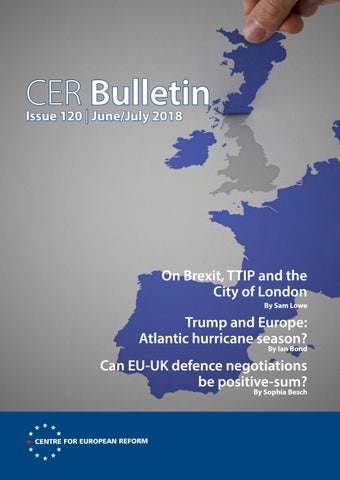
CER Bulletin Issue 120 | June/July 2018
On Brexit, TTIP and the City of London By Sam Lowe
Trump and Europe: Atlantic hurricane season? By Ian Bond
Can EU-UK defence negotiations be positive-sum? By Sophia Besch
On Brexit, TTIP and the City of London by Sam Lowe
The EU was keen to include financial services in TTIP, the proposed trade agreement with the US. Is its reluctance to do so with the UK mere hypocrisy? The EU has repeatedly said that, unless the UK changes its red lines and decides to stay in the single market, financial institutions based in the UK should expect to be treated post-Brexit in the same way as those based in any other nonmember country. In practice this will mean, at best, operating under the meagre provisions of the EU’s equivalence framework, which in certain areas allows for financial services providers to sell into the EU from outside, but which can be unilaterally rescinded by the European Commission with 30 days’ notice. Most recently, Michel Barnier asked an audience at the EUWestern Balkans summit in Sofia: “why would the equivalence system, which works well for the US industry, not work for the City?” In contrast, the UK has put forward a proposal based on mutual recognition, whereby both the UK and the EU would accept each other’s rules as equivalent in outcome even if specific provisions were different, and the outcomes were achieved in a different way. That would allow cross-border trade to continue much as it does now. Importantly, revocation of market access would be determined on the basis of consultation and set criteria, thereby giving institutions and investors greater security and confidence. This has been welcomed by many in the City. But
just as the UK was always going to propose something to this effect on financial services, the EU was always going to say “no”. Mutual recognition of financial services regulation, as proposed by the UK, goes against the single market framework which increasingly relies on harmonised rules, minimum standards, continual co-operation and overarching supranational oversight and enforcement. This approach gives national regulators the confidence that foreign banks under the purview of other EU member-states are not exposing their financial system to excessive risks or ripping off their consumers. Privileged market access will not be on offer to the UK, which wants to extricate itself from the harmonised rule book and associated oversight. Furthermore, if the EU were to allow UK-based institutions to operate in its market on the basis of mutual recognition of outcomes, it would run the risk of undermining its rule-making autonomy and the integrity of the single market. Companies trading out of the UK would in effect be able to operate across the single market on the basis of a different rule book, offering opportunities and incentives for the UK to engage in regulatory competition. Under the EU’s existing equivalence
INFO@CER.EU | WWW.CER.EU CER BULLETIN ISSUE 120 | JUNE/JULY 2018 3
regime, rulings are largely confined to types of financial activity that are deemed to pose low systemic and consumer risk. Some in the UK, including the prime minister, have pointed to the Transatlantic Trade and Investment Partnership (TTIP), the stalled EUUS FTA negotiations, as an example of past EU willingness to include financial services in a trade agreement. It is true that financial services were to be covered in TTIP, just as they are in all EU trade agreements. They will inevitably be in any future EU-UK free trade agreement, too. But the financial services provisions contained in EU FTAs do little more than reaffirm the EU’s market access commitments and reservations as already laid out in its WTO General Agreement on Trade in Services schedules, which do not amount to much. The one area where Michel Barnier has indicated the EU is prepared to up its offer is with regard to the right of establishment. This will further reduce the already low barriers facing UK-based services providers wishing to set up within a memberstate in order to service the EU. It will also lock in existing rights of establishment, guarding against future rollback. But this will not give the City access from London and firms will still need to establish subsidiaries in the EU. TTIP could have potentially gone further on regulatory co-operation in financial services. Officially, the EU proposed a continuing regulatory dialogue that would have ensured consultation between the EU and US prior to new financial regulations; a co-ordinated approach to the implementation of international standards; a joint review of existing rules to try and identify unnecessary barriers to trade; and an ongoing commitment to scope out potential future equivalence rulings. The UK could realistically aspire to something similar, but these arrangements should not be confused with comprehensive mutual recognition. There is, however, slightly more to the story. Although they have never been published, the EU did table some informal proposals on regulatory co-operation in financial services during the fifth round of the TTIP negotiations, which offered more detail. In its non-paper the EU proposed a process that could eventually lead to ‘mutual reliance’ of regulations and future rules, although mutual reliance was not fully defined. This does suggest that the EU was, at one point at least, considering something in the context of an FTA that appears similar to mutual recognition. However, other sections of the non-paper muddy the water, such as a section clarifying that any party may rescind equivalence decisions unilaterally, but should consult beforehand.
The UK should not take this non-paper as evidence that the EU will concede to British demands on mutual recognition in financial services post-Brexit. These unpublished proposals were a product of a post-financial crisis era in which regulators were under pressure to increase international co-operation; even so, they are vague about the extent of mutual recognition that the EU would consider. While the non-paper suggests EU sentiment could one day shift back towards being more favourable to mutual recognition, it should not be taken as indicative of where the EU is now in the Brexit negotiations, or will be any time soon. Behind closed doors, member-state representatives say that comprehensive mutual recognition is not something an FTA can allow in and of itself. It would also require the EU to change many of its laws, which provide certain rights only to financial institutions incorporated within the territories of member-states of the EU and the European Economic Area. In itself, this would not be an impossible hurdle to clear, but it would require the will to offer mutual recognition in the first place, which is currently absent on the continent. The EU is amenable to suggestions as to how to improve and expand the scope of its equivalence regime. Instead of pushing for the pipe dream of mutual recognition, the UK and the City should engage more readily with the current discussions on this issue, including clearer guidelines concerning the withdrawal of an equivalence ruling and a longer notice period of withdrawal. The UK should also make the case for including an ongoing, structured regulatory dialogue on financial services in the future EU-UK partnership, leaving open the possibility that new opportunities for improved market access may emerge. Beyond the specifics of the future relationship, in the short-to-medium-term a degree of honesty and humility is warranted. The EU line on financial services is not going to crack, and the memberstates do not believe they need the City as much as the City believes they should. If the UK is unwilling to change its Brexit negotiating red lines, and in particular its plan to leave the single market, the only way for a UK-based financial institution to guarantee its continued ability to service EU-27 customers post-Brexit is to establish itself within the EU-27. And the EU is rolling out the red carpet.
Sam Lowe
Research fellow, CER @SamuelMarcLowe
Trump and Europe: Atlantic hurricane season? by Ian Bond
The Atlantic hurricane season does not officially start until June 1st, but US President Donald Trump’s decision on May 8th to withdraw from the Joint Comprehensive Plan of Action (JCPOA) – the Iran nuclear deal – has triggered an early transatlantic storm. In pulling out of the agreement – which froze Iran’s nuclear weapons programme, in exchange for sanctions relief – Trump ignored pleas from all his main European allies. Unless Trump changes course, sanctions will kick in later this year, hitting European firms that do business with Iran harder than they hit Iran itself. It appears unlikely that an EU plan to ban European companies from complying with US sanctions on Iran will stop firms doing the White House’s bidding, for fear of US punishment. This is the latest move by Trump that puts the US at odds with its European allies. In June 2017 he withdrew the US from the Paris climate agreement; he has threatened to impose tariffs on European steel, aluminium and vehicle producers on spurious national security grounds; and he has regularly criticised NATO (even to the point of suggesting that the US might not defend an ally under attack if it had not spent enough on its own defence). In response, European leaders are becoming more vocal in their criticism of Trump. British Prime Minister Theresa May, French President Emmanuel Macron and German Chancellor Angela Merkel issued a joint statement on
May 8th expressing “regret and concern” at his withdrawal from the JCPOA. For many EU member-states, the reflex has been to look for purely European approaches to international challenges. In remarks on May 10th at a ceremony in Aachen to award this year’s Charlemagne prize for services to European unification to Macron, Merkel said that the US would no longer simply protect Europe; Europe had to take its fate into its own hands. Macron, in accepting the prize, said that Europe should not allow its trade policy to be decided by “those who blackmail us while explaining that the international rules that they contributed to drafting are no longer valid because they are no longer to their advantage”. He also warned against allowing even allies who had been “friends in the hardest times in our history” to take foreign and security policy decisions for Europe. And in a speech at the European University Institute on May 11th, Federica Mogherini, the EU High Representative for foreign and security policy, bemoaned the fact that “screaming, shouting, insulting and bullying [are] systematically destroying and dismantling everything that is already in place”. She argued that the world needed a change of attitude,
INFO@CER.EU | WWW.CER.EU CER BULLETIN ISSUE 120 | JUNE/JULY 2018 5
from confrontation to co-operation, that only the EU could work for; this, she claimed, gave Europeans a huge opportunity. There have been rows between the US and its European partners before, from Suez in 1956 to the Iraq war in 2003. Recognition of shared interests and values has always enabled the parties to patch up their quarrels. But commentators argue that this time it is different. An editorial in Germany’s Der Spiegel on May 11th claimed that “the West as we once knew it no longer exists”, and called for “clever resistance against America”. The American writer James Traub described the Atlantic alliance in a Foreign Policy article as “already a corpse”, and said that Trump’s withdrawal from the JCPOA had driven the last nail into its coffin. It must be tempting for European leaders to respond in kind to Trump’s provocations, but they should resist. Trump’s views on trade, the ‘unfairness’ of the EU and the shortcomings of allies have been consistent for many years, and are unlikely to shift dramatically. Nevertheless, European leaders should continue to try to nudge him in more constructive directions where they can, as diplomatically as possible. They should also do more to engage with US priorities outside Europe, where US and European interests converge, particularly in Asia. Rather than suggesting that disagreements with Trump offer Europe an opportunity to go it alone, European leaders should try to strengthen public support for transatlantic ties. As well as underlining the value of the security partnership with America, they should emphasise the importance of bilateral trade and investment to Europe’s prosperity, despite the failure (so far) to negotiate a transatlantic free trade agreement. It will not be easy to overcome growing public antipathy towards Trump (especially in Western Europe), but it is essential to minimise the damage to broader transatlantic relations. One lesson that Europeans should learn from the election of Trump is that it is no longer just coastal elites whose views matter in the formation of US foreign, defence and trade policy. EU and European states’ public diplomacy efforts need to be directed at a wider audience. And where they can, European countries should be ready to work with members of Congress, and with US states or cities – as they have on climate change, for example. American perceptions of their European allies would improve if Europe invested more in its own defence and security. The German
government’s new budget proposal foresees defence spending falling to 1.23 per cent in 2022, rather than rising towards the NATO target of 2 per cent by 2024 – exactly the wrong signal to send. But effective defence today demands more than just tanks, ships and aircraft – it needs resilient societies. Russia has shown in recent years that it can easily exploit the divisions in Western countries where a significant part of the population feels alienated from the establishment running the country, or distrusts state institutions.
It must be tempting for European leaders to “respond in kind to Trump’s provocations, but they should resist. ” The EU and US should both do more to increase transatlantic contacts between young people – at present there are almost four times as many Chinese students as Europeans in the US, and more than five times as many Chinese students as Americans in Europe. China is an important partner for both the US and Europe; but for the long-term viability of the transatlantic relationship Europeans and Americans have to get to know each other better. The days when hundreds of thousands of US troops were in Europe with their families, exposing Europeans to the American way of life and learning something about their hosts in return, are over. Even if Trump turns out to be a one-off, and America reverts to the mean after him, neither Europe nor the US should take the survival of the transatlantic partnership for granted. But for the foreseeable future, the two sides of the Atlantic will still have more interests and values that unite them than that divide them. There is no more sense in a ‘Europe first’ policy than in Trump’s ‘America first’ approach. The right response for Europe in the face of the current administration’s unilateralism is to work with transatlanticists in the US to preserve as much as possible of the partnership, so that once Hurricane Donald has blown over – whether that is in 2021 or 2025 – there are still strong foundations on which to rebuild.
Ian Bond
Director of foreign policy, CER @CER_IanBond For a more detailed discussion of the trends weakening the transatlantic relationship, see Ian Bond’s recent policy brief ‘Has the last trump sounded for the transatlantic partnership?’.
Can EU-UK defence negotiations be positive-sum? by Sophia Besch
It is clearly in Britain and the European Union’s mutual interest to continue working closely together on defence after Brexit. Nevertheless, negotiating defence co-operation will not be pain-free; there are obstacles to a quick and easy deal. First, many aspects of the future defence relationship will be heavily dependent on British access to the EU’s internal market. UK defence firms that rely on international supply chains would like barrier-free market access and migration schemes for skilled workers. The UK is also concerned that its firms will be excluded from bidding for European defence contracts – either because projects are supported by the Commission’s new Defence Fund, designed to boost industrial co-operation between EU member-states, or because the EU is wary of allowing non-EU-member-states to access sensitive technology. The spat over British participation in the EU’s ‘Galileo’ space programme shows how difficult it will be to disentangle economic and security interests during the Brexit negotiations. Second, the draft withdrawal agreement allows for a defence agreement to be implemented during the transition period, without waiting for finalisation of the post-2020 relationship. But such an agreement would be limited to activities covered by Title V of the Treaty on European Union. Agreements on UK participation in the EU’s satellite programmes, or on access to the defence fund, would fall outside any defence deal. Therefore, the more the British government wants to include in an
agreement on defence, the less likely it is that there will be an early agreement. Third, the UK government wants a defence partnership that goes beyond any of the arrangements the EU has with third countries. For example, the UK wants to continue to be part of EU military operations only if it is allowed to participate in detailed operational planning. But the EU wants to protect its autonomous decision-making process. And it also wants to ensure that the settlement with the UK does not disturb defence relationships with other third countries. The EU’s defence partners, like Norway, are already fretting about the possibility that Britain might be given more rights than they have, or that fall-out from the Brexit negotiation process might put at risk what they have secured for themselves over the years. In the medium term, it is likely that Brexit will prompt the EU to re-assess its relations with third countries: first, to ensure that the UK continues to play a full part in EU missions and operations; and second, because the discussion with Britain will show up anomalies and shortcomings in existing agreements. Britain can encourage these reform efforts, but not force them – any sense that Brussels is ‘tailoring’ its new arrangements to the UK would be counterproductive.
INFO@CER.EU | WWW.CER.EU CER BULLETIN ISSUE 120 | JUNE/JULY 2018 7
In the meantime, the UK and the EU will have to negotiate the conditions under which the UK can supply troops to EU missions and operations and continue to participate in the research and development of defence capabilities. Being plugged into EU operations matters to Britain less because of their operational value than because the UK has an interest in influencing the EU’s strategic direction, regional priorities and level of ambition. The UK also wants to prevent EU-NATO duplication. In order to be able to remain part of the EU’s defence debate, however, Britain will have to demonstrate its commitment to the EU’s military efforts. The UK could negotiate an agreement to provide troops and assets to the EU – such as Britain’s strategic airlift capability, which helps the EU deploy more rapidly – in exchange for close consultation and information sharing in the early stages of EU operational planning. The UK should also seek an administrative agreement, similar to Norway’s, with the European Defence Agency (EDA), which oversees EU defence capability development. It would not have full voting or veto rights, but could contribute to EDA projects and attend some committee meetings. And it should negotiate arrangements with the EU that allow UK organisations to tender for EU projects within the Defence Fund and the next framework programme for research and innovation. If it wants to protect British firms’ participation in
European defence co-operation, Britain will also have to conclude an information-sharing agreement with the EU. If the EU excludes the UK from the Union’s defence infrastructure, it would not only lose British expertise and capabilities, but also potentially undermine its own ambitions. In order to be credible, EU defence structures need the involvement of the UK, one of the few European powers with serious military capacity. But some in the EU see Britain’s decision to leave as an attack on the fundamentals of European co-operation and no longer trust the UK as a strategic partner. What is more, the UK’s threat to launch a competitor to Galileo suggests to EU hardliners that London’s commitment to European security co-operation is thinner than Theresa May has repeatedly promised. The UK, in turn, would not benefit from distancing itself from the EU’s defence structures. But there is a lack of tolerance in the UK for the EU’s legal and political red lines. Some in Britain also mistrust other EU member-states, as they feel that their defence industries are seeking to benefit from Brexit. Both sides need to be careful to prevent what should be a positive-sum game from turning into a zero-sum one.
Sophia Besch
Research fellow, CER @SophiaBesch
CER in the press The New York Times 15th May 2018 Ian Bond of the CER, argued that “Europeans and Atlanticist Americans must preserve what they can of the trans-Atlantic partnership” while Mr Trump is in office. CNN 11th May 2018 “We are in a period in paralysis,” said John Springford, deputy director of the CER. “All of the bits of Brexit that are hardest to deal with are coming together at once.” The Guardian 10th May 2018 Camino Mortera-Martinez of the CER said the UK risked
going over a cliff edge on aspects of EU police co-operation, including the European arrest warrant, crime-fighting databases and membership of Europol. The Washington Post 9th May 2018 “The EU can take steps to mitigate the impact of the [US] sanctions,” said Luigi Scazzieri of the CER. “But overall, companies will be scared. They will also prioritise their business with the US.” The Economist 3rd May 2018 After Brexit, Britain faces exclusion from the most militarily sensitive encrypted part of Galileo. That reflects
high-minded worries over data security, but also lowminded hopes of hoovering up lost British contracts. As Sophia Besch of the CER notes, this shows how petty rivalries risk damaging broader co-operation in defence and security. The Financial Times 20th April 2018 National leaders want to roll back integration, for example, by regaining full control over the appointment of the next European Commission president. Agata GostynskaJakubowska says these efforts suggest that “the irony of Brexit is that the EU is becoming more British, just as the UK is leaving the EU”.
The Telegraph 12th April 2018 Sam Lowe the CER’s trade wonk, acknowledges that [in a customs union] the UK would be unable to lower its import tariffs on goods, but it would be “entirely free to negotiate new arrangements covering services, investment, data, government procurement and intellectual property”. The Financial Times 15th March 2018 “Davis, with his breezy self-confidence, sometimes finds it hard to connect with Barnier, who sticks firmly to the rigorous principles of the EU’s legal order,” says Charles Grant, director of the CER.
INFO@CER.EU | WWW.CER.EU CER BULLETIN ISSUE 120 | JUNE/JULY 2018
Recent events 16 May Dinner on ‘Is Europe cyberready? How to improve Europe’s cyber security’, London With Julian King
11 April Dinner on ‘The future UK-EU relationship: A Home Office perspective’, London With Amber Rudd Julian King
Amber Rudd
29 March Dinner on ‘The future of Britain’s trade policy’, London With Greg Hands
28 March Roundtable on ‘Modern Belarus and its place in Europe’, London With Vladimir Makei
Greg Hands
Vladimir Makei
Forthcoming publications The European Union and Saudi Arabia: Embrace or retreat? Beth Oppenheim
Plugging in the British: Completing the circuit Sophia Besch, Ian Bond and Camino Mortera-Martinez
For further information please visit
www.cer.eu
Putin and Russia Ian Bond and Igor Yurgens