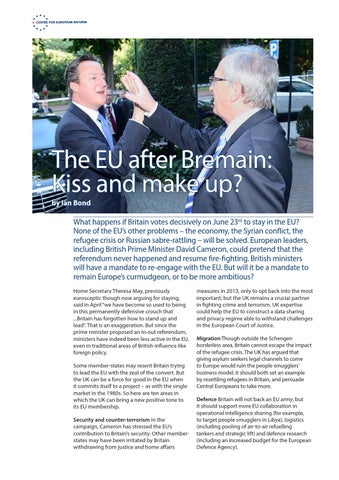
The EU after Bremain: Kiss and make up? by Ian Bond
What happens if Britain votes decisively on June 23rd to stay in the EU? None of the EU’s other problems – the economy, the Syrian conflict, the refugee crisis or Russian sabre-rattling – will be solved. European leaders, including British Prime Minister David Cameron, could pretend that the referendum never happened and resume fire-fighting. British ministers will have a mandate to re-engage with the EU. But will it be a mandate to remain Europe’s curmudgeon, or to be more ambitious? Home Secretary Theresa May, previously eurosceptic though now arguing for staying, said in April “we have become so used to being in this permanently defensive crouch that ...Britain has forgotten how to stand up and lead”. That is an exaggeration. But since the prime minister proposed an in-out referendum, ministers have indeed been less active in the EU, even in traditional areas of British influence like foreign policy. Some member-states may resent Britain trying to lead the EU with the zeal of the convert. But the UK can be a force for good in the EU when it commits itself to a project – as with the single market in the 1980s. So here are ten areas in which the UK can bring a new positive tone to its EU membership. Security and counter-terrorism In the campaign, Cameron has stressed the EU’s contribution to Britain’s security. Other memberstates may have been irritated by Britain withdrawing from justice and home affairs
measures in 2013, only to opt back into the most important; but the UK remains a crucial partner in fighting crime and terrorism. UK expertise could help the EU to construct a data sharing and privacy regime able to withstand challenges in the European Court of Justice. Migration Though outside the Schengen borderless area, Britain cannot escape the impact of the refugee crisis. The UK has argued that giving asylum seekers legal channels to come to Europe would ruin the people smugglers’ business model; it should both set an example by resettling refugees in Britain, and persuade Central Europeans to take more. Defence Britain will not back an EU army; but it should support more EU collaboration in operational intelligence sharing (for example, to target people smugglers in Libya), logistics (including pooling of air-to-air refuelling tankers and strategic lift) and defence research (including an increased budget for the European Defence Agency).
INFO@CER.ORG.UK | WWW.CER.ORG.UK CER BULLETIN ISSUE 108 | JUNE/JULY 2016 7
The single market Britain’s strength in service industries gives it a special incentive to push for the single market to cover more of the services sector. With the referendum behind, the British government should acknowledge that more single market means more regulation at the EU level, and support growth-promoting reforms. Energy The UK has pushed a market-based approach to reforming the EU energy sector, but it should accept that the market alone will not protect Central European countries reliant on Russian gas, and work with the Commission to ensure that countries have both an obligation and the infrastructure to supply their neighbours in a crisis. Neighbourhood The EU’s neighbourhood, to the east and south, is a mess. Enlargement, which stabilised Central Europe after 1989, is increasingly unpopular in the EU (including in Britain, its traditional champion), and not on offer to countries in the Middle East and Maghreb. Britain should work with other leading member-states to devise a comprehensive plan of security operations, political engagement and free trade to stabilise the neighbourhood. Foreign policy British activism in the Balkan conflicts of the 1990s contrasts sharply with Britain’s disengagement from efforts to resolve the conflict between Russia and Ukraine. It may be too late to persuade France, Germany, Russia and Ukraine to include the UK in the ‘Normandy format’; but London should push for the EU to do more wherever international tensions threaten European interests, including in East Asia.
Trade Brexiters are not entirely wrong when they argue that protectionism elsewhere in Europe may slow down EU trade deals with important partners. The UK should co-ordinate northern and central European free-traders to push for faster progress. It should encourage its friends in Beijing and Tokyo to move forward on the EU/China bilateral investment treaty and the EU/Japan free trade agreement. European Parliament Cameron should reverse his decision to take the Conservative Party out of the European People’s Party (EPP) group, which robbed the Tories of influence in the Parliament. Not every party in the EPP is irredeemably federalist; Cameron could strengthen his alliance with Angela Merkel while still working to make the EPP more economically liberal and politically flexible. Rebuilding Britain’s EU expertise The UK is now very under-represented in EU institutions. The government should launch a concerted effort to get the best young civil servants to work in the Commission and the External Action Service, and to challenge the prejudice that British ‘eurocrats’ have betrayed the UK for salaries and perks. And it should simultaneously increase its bilateral diplomatic effort in Europe to rebuild the UK’s influence with partners. Such ambitious goals would serve UK interests. The question is whether Cameron will pursue them boldly, and face down eurosceptics who are already preparing for another membership referendum. In the national interest, he should do both.
Ian Bond
Director of foreign policy, CER
CER in the press Sky News 22nd May 2016 Appearing on the Murnahan Show to comment on the referendum campaign, the CER’s director Charles Grant argued that Remain have a much harder argument to make than the Leave side. He said “the international outlook also doesn’t help”. The Telegraph 18th May 2016 Spain could ask British retirees to pay for their own healthcare – according to the CER’s John Springford – or move to curb access to healthcare services outright.
Bloomberg 11th May 2016 ”When the economy or energy prices begin to push inflation higher, the real test will be whether the ECB has the stamina to hold on,” said Christian Odendahl of the CER. The Wall Street Journal 29th April 2015 In a recent article the CER’s Agata Gostyńska-Jakubowska drilled deeper into the questions that surround Article 50 of the Lisbon Treaty, the clause that would have to be used to negotiate the UK’s departure.
The Sun 22nd April 2016 Gordon Brown told a meeting of 100 leading economists held by the CER: “People’s concerns are not just economic, but they relate to security and they relate to what kind of country we are becoming and what is happening on our borders.” The Daily Mail 22nd April 2016 ”Obama isn’t an instinctive pro-European,” said the CER’s Ian Bond. “He opposes Brexit because it risks creating more problems for America in Europe.”
The New York Times 19th April 2016 Simon Tilford of the CER noted that referendums in Europe had often fallen prey to oversimplification. “Lots of people ...will allow their frustrations with immigration and globalization to influence how they vote,” he said. Politico 7th April 2016 Rem Korteweg of the CER said “[the result of the Ukraine referendum] will slow the accession process down and raise doubts about whether the EU can stand by commitments it makes.”