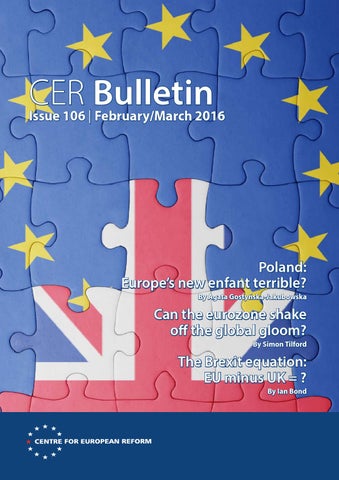
CER Bulletin
Issue 106 | February/March 2016
Poland: Europe’s new enfant terrible? By Agata Gostyńska-Jakubowska
Can the eurozone shake off the global gloom? By Simon Tilford
The Brexit equation: EU minus UK = ? By Ian Bond
Poland: Europe’s new enfant terrible? by Agata Gostyńska-Jakubowska
Poland’s Law and Justice (PiS) party has never hidden its admiration for the Fidesz government in neighbouring Hungary. “I am convinced that one day we will have Budapest in Warsaw,” said Jarosław Kaczyński, the party’s leader in 2011, when PiS lost the parliamentary elections. Today, Kaczyński can realise his dream: PiS has a parliamentary majority and it is free to copy Fidesz policies. But while Viktor Orbán, the Hungarian prime minister, managed to get away with most of his ‘illiberal’ reforms, the Polish authorities may not be so lucky. On January 13th the European Commission decided to assess whether the rule of law is under threat in Poland.
more difficult for the Tribunal to challenge new legislation. The new law obliges the Tribunal to rule on cases in the order it receives them, rather than deciding for itself which cases are more important and should be moved to the front of the queue. As a result, it will be some time before the Tribunal has the opportunity to assess the constitutionality of PiS measures.
Neither Orbán nor Kaczyński like being criticised, whether by the media or the courts. When Orbán won the parliamentary elections in 2010, he quickly turned the public media, which were often critical of him, into a government mouthpiece. The current Polish government has also pushed through legal changes enabling it to replace the top management in public radio and TV with supporters of PiS.
The EU institutions worry that Budapest and Warsaw are deliberately trying to weaken democratic checks and balances. The European Parliament regularly summoned the Hungarian prime minister to Strasbourg to explain his ‘illiberal’ policies; and the Commission took Hungary to the European Court of Justice for violating EU law by, among other things, forcing the country’s 274 judges to retire. The Commission did not, however, activate article 7 of the Treaty on European Union (TEU) against Hungary. This article – regarded as a ‘nuclear option’ – is designed to address a serious and persistent threat to democratic values in a member-state and can lead to the suspension of EU voting rights. EU leaders (minus the one concerned) must agree unanimously to impose sanctions under article 7 – something that would
When the Hungarian constitutional court questioned some of Orbán’s laws, Fidesz (which until 2015 had a ‘super-majority’ in parliament) simply amended the Hungarian constitution. But PiS cannot do this: it lacks a constitutional majority. It can however amend laws. In December 2015 it changed the act governing the Constitutional Tribunal (Court) to make it
INFO@CER.ORG.UK | WWW.CER.ORG.UK CER BULLETIN ISSUE 106 | FEBRUARY/MARCH 2016 3
be hard to achieve even if the governments of Warsaw and Budapest did not protect each other. Rather than making a vain attempt to use article 7 against Poland, the Commission activated the ‘rule of law framework’ – an instrument it adopted in 2014 to fill the gap between purely diplomatic pressure, infringement procedures and article 7. The framework enables the Commission to assess ‘systemic threats’ to the rule of law in EU member-states which, if not addressed, could endanger the EU’s democratic values. This mechanism builds on a dialogue with the member-state but the Commission may recommend changes to disputed policies. If the Commission is not satisfied with the outcome of the dialogue or the implementation of its recommendations, it can propose that article 7 be activated. The Commission seems to be treating the Polish government more harshly than the Hungarian one. Why? First, Orbán conducted most of his controversial reforms between 2010 and 2012 when the EU was preoccupied with the euro crisis. The Barroso Commission had little time to worry about the rule of law in Hungary. The EU still faces many crises but the new Commission is more assertive vis-à-vis member-states and sees protecting the rule of law within the EU as a higher priority than its predecessor did. In this area, as in many others, the Juncker Commission reflects the priorities of the European Parliament. The social democrats and liberals in the Parliament have long called for tighter EU supervision of democracy in member-states. President Juncker, who needs the Parliament’s support to pass his legislative programme, has asked Frans Timmermans, his first vice-president, to address their concerns. Second, Orbán has more influential allies than Kaczyński has. Fidesz belongs to the European People’s Party (EPP), the biggest political group in the European Parliament. Fourteen EU commissioners are affiliated with the EPP. Joseph Daull, the EPP president, once admitted that Orbán is the EPP’s enfant terrible. But the EPP, which only has 30 seats more than the Socialists & Democrats in the Parliament, wants to hold onto the 12 votes of Fidesz. Law and Justice is less lucky. It sits with the British Tories in the European Conservatives and Reformists (ECR) group, which is only the third largest group in the Parliament. PiS may have thought that an alliance with David Cameron’s party would be enough to block EU
action against Warsaw. But Cameron has more important things to worry about. Although the British government views the rule of law framework as an undesirable power grab by the Commission, it is unlikely to be a vocal opponent of action against Poland. Cameron is renegotiating Britain’s membership of the EU. Warsaw is his close ally but Cameron also needs the support of other member-states, including those which worry about the rule of law in Poland or Hungary; and he does not want to draw attention to the fact that the Commission has such a tool, lest eurosceptics argue that it is another reason to vote to leave the Union.
PiS may have thought that an alliance with “David Cameron’s party would be enough to block EU action against Warsaw. ”
Third, the Commission has drawn lessons from its earlier, unsuccessful attempts to use infringement procedures to address Hungary’s actions. The Commission hoped that it would bring Orbán to heel by taking Hungary to the European Court of Justice. But when in 2012 the Court ruled that the early retirement of the country’s 274 judges (whom Orbán replaced with party loyalists) violated EU law, Orbán compensated the judges instead of reinstating them, thus complying with the letter but not the intention of the ruling. The new mechanism is designed to make the Commission’s actions more efficient.
Finally, Poland is one of the most pro-European nations in the EU. According to the latest Eurobarometer report, 55 per cent of Poles view the EU positively. This compares to 39 per cent in Hungary and an EU average of 37 per cent. The Commission may hope that while citizens of most member-states would have seen its action as an unnecessary intervention in domestic matters, Poles might react differently. If the Commission is right, Poles will see the decision to trigger the rule of law framework as a sign that Poland is losing influence in the EU and hold it against PiS. Support for PiS would then fall, causing the government to reconsider its ‘illiberal’ intentions. But if the Commission is wrong, it risks antagonising one of the few member-states that still sees the EU as beneficial rather than a problem. Let’s hope for the former.
Agata GostyńskaJakubowska Research fellow, CER
Can the eurozone shake off the global gloom? by Simon Tilford
The outlook for the global economy is worsening quickly, raising question marks over the eurozone’s recovery. Will consumption and investment rise by enough to offset the likely weakening of eurozone exports, or will the recovery peter out? What does the deteriorating global environment mean for the ECB’s attempts to raise inflation and to ward off threats to the debt sustainability across the eurozone? The currency union is at no risk of falling back into recession in 2016, but last year might turn out to have been as good as it’s going to get. The eurozone economy expanded by around 1.5 per cent in 2015, and hence by considerably less than the US or the UK. The weakness of eurozone activity was one reason why inflation across the currency bloc fell to zero. While economic recovery accelerated in some member-states, notably in Spain and Ireland, the French and Italian economies remained weak, and German growth disappointed yet again, coming in at 1.5 per cent. Had the eurozone rebounded from the downturn and then growth had slowed to 1.5 per cent, that level of growth would have been less disappointing. But the currency union has barely recovered pre-crisis levels of activity. Indeed it is a testament to diminishing expectations that the eurozone’s 2015 growth performance is seen as something of a success. With interest rates at just 0.5 per cent, the fiscal position across the currency union as a whole neutral and big falls in the prices of oil and commodities
boosting households’ purchasing power, it is disappointing that growth was not stronger. Will the recovery gain momentum or stall in 2016? On the plus side, the ECB will leave interest rates at close to zero and charge banks more to deposit funds with it, in an attempt to get them to increase their lending. In all likelihood, the ECB will also persist with quantitative easing – the practice of central banks electronically creating new money and buying financial assets, such as government bonds – in an attempt to boost economic activity and inflation. Fiscal policy across the eurozone as a whole is likely to be mildly expansionary, not least because of refugee related expenditure in Germany. Credit conditions for businesses have improved across the eurozone as a whole. And the further steep fall in oil and other commodity prices should provide an additional fillip to consumption, at least in the short term.
INFO@CER.ORG.UK | WWW.CER.ORG.UK CER BULLETIN ISSUE 106 | FEBRUARY/MARCH 2016 5
The biggest negative for the eurozone’s growth outlook is the rapidly worsening external environment. First, all the major emerging markets bar India are slowing simultaneously, with the outlook for the pivotal Chinese economy highly uncertain. The best case scenario is that China manages the transition to slower growth without a major crisis. Just as likely, however, is that the Chinese economy buckles under the weight of massive debt and surplus industrial capacity, opening the way for a full-blown crisis. The IMF estimates that a 1 per cent fall in the growth of emerging markets will knock 0.2 per cent off growth in developed markets, and more for economies – such as Germany – that do a lot of trade with emerging economies. Second, slower growth in emerging markets, especially China, is a major factor behind the weakening of commodity prices which is hitting the Russian and Middle-Eastern economies hard. Finally, growth is falling back in the US and the UK. Altogether, this points to a slowdown in the pace of global expansion and a weakening of trade. Eurozone policy-makers had been banking on a weak euro driving demand for the currency bloc’s exports and boosting eurozone inflation by increasing the prices of imported goods. But with the likelihood of interest rate rises in the US and UK receding quickly (and with it the incentive for investors to buy dollars and pounds) and the Chinese almost certain to devalue the renminbi, there is little probability of the euro weakening much further. In all likelihood, foreign trade will subtract – perhaps substantially – from eurozone growth in 2016. And with Chinese and other emerging economy goods getting cheaper, and oil and commodity prices falling, the currency union will be importing deflation rather than exporting it. This risks aggravating the other big negative facing the eurozone: low inflation. Rapidly declining inflation gives a one-off boost to consumption, but poses a raft of economic challenges. The longer inflation remains very low, the greater the risk that firms hold off on investment (in the expectation that investment will get cheaper) and that firms stop raising wages. Low inflation also aggravates debt sustainability problems: countries need some inflation in order to erode the real value of their debts. The fall in the headline rate of eurozone inflation in 2016 reflected falling commodity prices. But ‘core’ inflation – which excludes movements in the prices of energy and raw materials – also remained very weak, hovering around 1 per cent and hence far short of the ECB’s target of close to 2 per cent. And with producer prices (so-called ‘factory gate’ prices) declining rapidly and average eurozone wage settlements
falling back in line with the declining headline rate of inflation, there is little reason to expect a rise in the core measure of price increases. Domestic demand in the eurozone did pick up in 2015, with the result that economic growth was largely driven by domestic sources; by contrast, exports accounted for all the growth in the eurozone economy in the 2009-14 period. The question is whether domestic demand will strengthen by enough in 2016 to offset the slowing of exports and the weakness of import prices. For that to happen, private consumption will need to pick up further. In all likelihood, employment levels will continue to recover. Average wages should grow in real terms in 2016, but by less than last year as low inflation expectations bring down wage settlements. As a result, private consumption is likely to expand by around 1.5 per cent, assuming a global crisis does not spook eurozone consumers into saving more.
Will consumption and investment rise by “enough to offset the weakening of exports, or will the recovery peter out? ” The outlook for investment is more uncertain. A sustained recovery in the eurozone economy requires investment spending to recover ground (it is still around 15 per cent below 2007 levels), as only that will lift productivity growth and support higher wages. Business investment across the eurozone did pick up slightly in 2015, but not by enough to make a significant contribution to economic growth. The gradually improving eurozone labour market, moderate pick-up in consumption and improved bank credit conditions should encourage some firms to step up investment. But the worsening external environment will hit business confidence, as will the steep decline in share prices; January 2016 was the worst start to a year for European equities since 1973. Very weak inflation expectations could also cause firms to delay investment. Eurozone governments, meanwhile, are not going to embark on a public investment spree. The global economy has shifted from being the potential saviour of the eurozone economy to an additional source of uncertainty for it. 2016 will determine whether the currency union’s recovery has legs or whether it peters out. The risk is on the downside.
Simon Tilford Deputy director, CER
The Brexit equation: EU minus UK = ? by Ian Bond
Most discussions of the UK’s possible exit from the EU focus on what Britain would be like afterwards: whether it could trade more freely with the world, escape EU regulations and reduce immigration. Equally important, however, is what the EU would be like afterwards; and how in turn this might affect post-Brexit relations between the UK and the EU. Former EU legal adviser Jean-Claude Piris set out seven possible models for this relationship in his recent policy brief for the CER, ‘If the UK votes to leave: The seven alternatives to EU membership’. He concentrated mainly on the UK’s urgent need to have continued access to the single market. If Britain left the EU it would have to negotiate a trade agreement with a group that had just lost one of its more economically liberal members. The gap between the laissez-faire British and the dirigiste continentals is smaller than the British imagine, as John Springford showed in ‘Will the eurozone gang up on Britain?’ But the biggest question is whether the EU would be willing to give the UK the market access it currently enjoys – and whether, over time, the market might become more closed to non-EU countries. The UK has consistently pushed for an open EU – especially in financial services, since the City of London is a global financial centre, not just a European one. Without the UK, would any other member-state resist ECB pressure to confine euro clearing to the eurozone, for example? The centre of gravity in the EU would shift in areas other than the single market, however,
including justice and home affairs (JHA), and foreign and defence policy. Though the UK is often caricatured as Europe’s perpetual naysayer, the reality is more nuanced. In some areas the UK has indeed been the main obstacle to European co-operation, but in others it has actively promoted it. The EU minus Britain would not automatically become the federal state that eurosceptics fear, but it might not reflect UK preferences as closely as it now does. In the Justice and Home Affairs area, the UK’s opt-in means that it is already less than a full partner. It has, however, opted in case-by-case to important JHA measures including Europol and the European Arrest Warrant (EAW). The UK has actively employed the EAW, submitting more than a thousand requests to other member-states from 2010-14. Once outside the EU, the UK would have to negotiate a bilateral extradition agreement with the Union, or individual bilateral agreements with each of the EU’s 27 member-states. If the UK were also to reject the European Convention on Human Rights, however, as a result of the government’s proposed ‘British Bill of Rights’, would all EU member-states be able to extradite suspects to
INFO@CER.ORG.UK | WWW.CER.ORG.UK CER BULLETIN ISSUE 106 | FEBRUARY/MARCH 2016 7
the UK? And would the European Parliament (minus UK MEPs) ratify an EU-UK agreement, or reject it on human rights grounds? In foreign policy, the UK has frequently used EU machinery to pursue its own foreign policy objectives. In an EU without the UK, only France, as a permanent member of the UN Security Council, would have a truly global foreign and security policy outlook. If the UK wanted EU support for foreign policy initiatives, therefore, it would have to contend with a more parochial EU. Would an EU at 27 have imposed sanctions regimes on Burma (where other member-states had economic interests vulnerable to sanctions)? Or become as heavily engaged in Somalia – a UK priority before it became an EU issue? Would the UK outside the EU act unilaterally, and if so with what effect? And would the EU, having lost one of its major economic and diplomatic powers, carry the same weight with interlocutors like Iran? The UK’s departure would also affect transatlantic relations: the EU might become a more difficult foreign policy partner for the US (forcing the US to make more efforts to cultivate other member-states). Despite continued military and intelligence links, would the US pay less attention to UK views?
In defence, the UK has sometimes been an active participant in EU operations and is a staunch defender of the need for EU defence policy to be compatible with NATO. Only Britain and France among EU member-states have full-spectrum military capabilities and a tradition of overseas deployments. Post-Brexit, France would probably continue to promote EU operations in Africa and elsewhere; but the UK would struggle to get the EU to reflect British priorities. And while the EU at 27, even more heavily influenced by Germany than it is now, would be more reluctant to conduct operations, it might be more willing to set up European structures completely outside NATO, at the risk of putting EU symbolism ahead of military effectiveness. Would the UK, which has always resisted such gestures, be able to do anything from outside the EU to prevent them? Brexit would have important implications for the future direction of the EU, not just the UK. Eurosceptics might be right that, all things being equal, the UK would be fine outside the EU. But in reality all things will not be equal.
Ian Bond
Director of foreign policy, CER
CER in the press The Economist 15th January 2016 The effects of EU membership on trade patterns are difficult to measure, but John Springford of the CER and colleagues have carried out a modelling exercise which concluded that Britain’s trade with the rest of the EU was 55 per cent greater than it would have been if outside. The Washington Post 3rd January 2016 ”Given that by any objective measure the EU is in a terrible mess, I’m shocked that the ‘in’ campaign is still getting half,” said Charles Grant director of the CER. Grant said he wants to see Britain remain part of the EU, but he is pessimistic that it will. Fears about immigration explain why. “It’s always quite easy to scare people,” Grant said.
The Christian Science Monitor 29th December 2015 Agata GostyńskaJakubowska of the CER, says that PiS will use antiEuropean rhetoric at home, while being more consensual in Brussels, likely following mainstream EU policies. The Wall Street Journal 22nd December 2015 “As terrorists slip across borders and hide on the Internet, Europe and America must learn to share intelligence better”, wrote Camino Mortera-Martinez of the CER. The Telegraph 21st December 2015 Simon Tilford, deputy director of the CER said Spain is not out of the woods and the eurozone’s elites are “mistaking a modest cyclical
upturn for something more profound”. The New York Times 17th December 2015 “The four horsemen of the apocalypse are circling,” said Charles Grant of the CER, referring to the security threat raised by a newly assertive Russia, the chaotic influx of asylum seekers, Greece’s calmed but far-fromsolved financial crisis and Britain’s future direction. The Guardian 16th December 2015 At a meeting organised by the CER this week, Conservative speakers from all wings of the party argued that, irrespective of what the pro- or anti-Europeans may want, the vote will in fact be shaped by the migration issue. It is hard to disagree with that.
The New York Times 15th December 2015 “There has been a tug of war between eastern and southern members about priorities, but now the east sees a Russian threat in the south, too, while the south sees a new conventional threat, as in the east,” said Rem Korteweg of the CER. The Financial Times 9th December 2015 There is certainly a problem in insisting on running a large surplus while simultaneously wanting others to reduce their deficits. ...If that again means Germany will fund reckless loans to the euro periphery (the CER’s Simon Tilford has calculated that Germany has lost half a trillion euros on its foreign investments since 2000), so be it .
INFO@CER.ORG.UK | WWW.CER.ORG.UK CER BULLETIN ISSUE 106 | FEBRUARY/MARCH 2016
Recent events 15 December 2015 CER/Kreab breakfast on ‘Climate change before/after COP21’, Brussels With Artur Runge-Metzger
Artur Runge-Metzger
14 December 2015 Discussion on ‘What reforms does Cameron need, so that the Conservatives campaign to stay in the EU?’, London With Flick Drummond, Liam Fox, Dominic Grieve, Jesse Norman and Radosław Sikorski
Dominic Grieve
7 December 2015 Charles Grant was awarded the Star of Italy, London 2 December 2015 Dinner on the EU referendum, London With Jonathan Faull
(L to R) Charles Grant and Ambassador HE Pasquale Terracciano
Jonathan Faull
1 December 2015 Breakfast on ‘Turkey after the elections’, London With Cansen Bașaran-Symes and Daniel Dombey 26 November 2015 Launch of ‘Europe’s orphan’ and ‘We don’t need no federation’, London With Martin Sandbu and Reza Moghadam Cansen Başaran-Symes
For further information please visit
www.cer.org.uk
Martin Sandbu