Millstone or multiplier? EU foreign policy by Ian Bond
EU foreign policy co-operation gives the UK a chance to persuade 27 other countries to support British aims – but Britain’s success depends on the UK showing more interest. Since the Maastricht Treaty established the European Union’s Common Foreign and Security Policy (CFSP) in 1992, successive British governments have seen CFSP as an important tool to achieve national foreign policy goals. Were they right, or would Britain’s foreign policy be more effective outside the EU? One way to judge is to compare some of the priority objectives of the UK Foreign and Commonwealth Office (FCO) with the EU’s foreign policy goals, for example on Iran, Russia, Somalia and international organisations. The UK and the EU both sought a comprehensive nuclear agreement with Iran. The July 2015 deal with Tehran reflected the work of EU high representatives (Javier Solana, Catherine Ashton and Federica Mogherini) on behalf of the socalled E3+3 – France, Germany, the UK, China, Russia and the US. Despite the distrust between Iran and the four Western countries, Tehran was more comfortable with the EU, which played a vital role as lead negotiator.
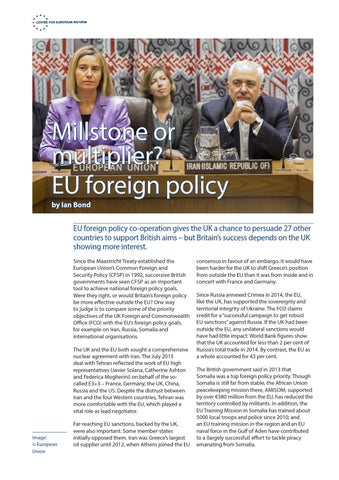
Image: © European Union
Far-reaching EU sanctions, backed by the UK, were also important. Some member-states initially opposed them. Iran was Greece’s largest oil supplier until 2012, when Athens joined the EU
consensus in favour of an embargo. It would have been harder for the UK to shift Greece’s position from outside the EU than it was from inside and in concert with France and Germany. Since Russia annexed Crimea in 2014, the EU, like the UK, has supported the sovereignty and territorial integrity of Ukraine. The FCO claims credit for a “successful campaign to get robust EU sanctions” against Russia. If the UK had been outside the EU, any unilateral sanctions would have had little impact: World Bank figures show that the UK accounted for less than 2 per cent of Russia’s total trade in 2014. By contrast, the EU as a whole accounted for 43 per cent. The British government said in 2013 that Somalia was a top foreign policy priority. Though Somalia is still far from stable, the African Union peacekeeping mission there, AMISOM, supported by over €580 million from the EU, has reduced the territory controlled by militants. In addition, the EU Training Mission in Somalia has trained about 5000 local troops and police since 2010; and an EU training mission in the region and an EU naval force in the Gulf of Aden have contributed to a (largely successful) effort to tackle piracy emanating from Somalia.
INFO@CER.ORG.UK | WWW.CER.ORG.UK CER BULLETIN ISSUE 105 | DECEMBER 2015/JANUARY 2016 7
One of the tasks of the FCO is to “deliver more effective and modernised international institutions”. The UK and the EU both see international organisations like the UN and the Organisation for Security and Co-operation (OSCE) in Europe as tools for preventing and resolving conflicts, but if the UK ever disagrees with the rest of the EU on the need to involve them, it has a veto, since on foreign policy, EU action needs unanimous agreement. In the UN, the UK is better placed to lobby for budgetary discipline as part of a group of countries that pay more than a third of the bills, rather than on its own as a country that pays little more than a twentieth. In the OSCE, the EU’s voice is even greater: EU member-states provide 70 per cent of the OSCE’s budget and make up half the membership of the organisation (28 out of 57 participating states). The EU is not involved in every international issue of concern to the UK. But where the EU is relevant, as seen in the examples above, it helps rather than hinders the UK in achieving its goals. If the UK left the EU, its ability to influence the CFSP decision-making process would be dramatically reduced. This loss of influence would be a particular problem in the defence field. As one of the EU’s most pro-NATO members, the UK has stopped the EU’s Common Security and Defence Policy (CSDP) developing in ways that might harm NATO, and supported work in both NATO and the EU to enable the two to co-operate better. From
outside the EU, the UK could no longer veto steps agreed by the remaining members, such as the creation of a ‘European army’, that would weaken NATO’s role in Europe’s defence. But the UK’s biggest problem with CFSP at present is not that the EU is too active in areas that the UK opposes; it is that Britain is not investing enough in making European foreign policy work more effectively for UK interests. Ministers seem reluctant to push for EU initiatives (leaving Germany and France to take the lead in negotiations with Russia over its conflict with Ukraine, for example). And the UK is significantly under-represented in the EU’s diplomatic service, the European External Action Service, both in Brussels and in EU delegations abroad. According to the EEAS, with 12.4 per cent of the EU population, Britain has only 7.2 per cent of the positions in the EEAS – fewer than France, Germany, Italy or Spain. The French have a proverb, les absents ont toujours tort – the absent are always wrong. The UK is only half-present in EU foreign policy today; leaving the EU would compound the mistake.
Ian Bond
Director of foreign policy, CER A longer version of this article was submitted as evidence to the House of Commons Foreign Affairs Select Committee Inquiry on the Costs and Benefits of EU Membership for the UK’s Role in the World.
CER in the press The Economist 12th November 2015 John Springford of the CER says any four-year waiting time [before EU migrants receive benefits] would constitute illegal discrimination under EU law. Mr Cameron himself conceded that some other answer might be needed. Bloomberg Businessweek 28th October 2015 “Unless something is done, we will see more and more fences and border controls, and then we will have a Schengen crisis, and if we have a Schengen crisis, we will have an EU crisis,” said Camino Mortera-Martinez of the CER.
Tagesspiegel 25th October 2015 “The risk of social unrest [due to decreased oil proceeds] may lead governments to increase repression, resulting in human rights violations, terrorism and migratory pressures,” said Rem Korteweg of the CER.
The New York Times 17th October 2015 George Osborne has decided that getting the Chinese to invest large amounts in the UK is the salvation of the UK economy,” said Ian Bond of the CER. “He is running roughshod over the Foreign Office and security policy.”
The Telegraph 19th October 2015 “A British-Italian initiative to clarify the distinction between eurozone countries and the others could be significant,” said Charles Grant of the CER, “because diplomatically, it shows one of the founding six is willing to work with the British on EU reform.”
The Telegraph 17th October 2015 “Merkel has always been seen as a reasonable guardian of German interests and stability, and on this issue [refugee crisis] she was in a dilemma: she couldn’t be too hawkish on the issue, given the German public consensus on migrants,” said Christian Odendahl of the CER.
The Economist 17th October 2015 As Charles Grant of the CER puts it, “other EU countries that know little about finance – or that seek to favour their own financial centres – could vote for rules that harm [the City’s] competitiveness.” The Financial Times 27th September 2015 As Simon Tilford of the CER recently argued, there is no way the eurozone will be able to shrug off the global downturn because its postcrisis recovery strategy rests on net exports. The eurozone is headed for a current account surplus of 3.5 per cent of gross domestic product this year.