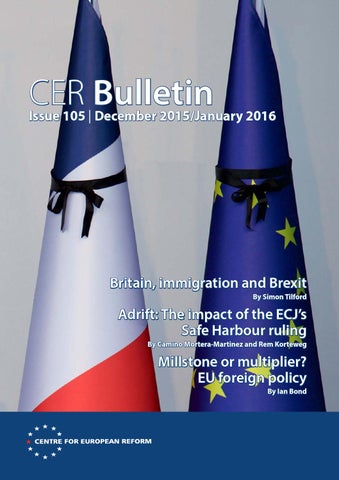
CER Bulletin
Issue 105 | December 2015/January 2016
Britain, immigration and Brexit By Simon Tilford
Adrift: The impact of the ECJ’s Safe Harbour ruling By Camino Mortera-Martinez and Rem Korteweg
Millstone or multiplier? EU foreign policy By Ian Bond
Britain, immigration and Brexit by Simon Tilford
If Britain votes to leave the EU it will be because of hostility to immigration. It will not be because of the threat of eurozone caucusing, the role of national parliaments vis-a-vis the European Parliament, regulatory threats to the City of London or concerns over the competitiveness of the EU economy. Disillusionment with the EU has risen in the UK because membership has become synonymous in many voters’ minds with uncontrolled immigration. Why has immigration, in particular EU immigration, become so toxic an issue in the UK that it could cost the country its membership of the Union? Net immigration into the UK has picked up strongly over the last couple of years as the country’s economic recovery has gained momentum and sucked in workers from elsewhere. But contrary to much of the British press coverage, net immigration into the UK over the last 15 years has not been exceptional in an EU context. For example, between 2000 and 2014 net inflows to Italy and Spain were higher than those to the UK (or Germany or France, for that matter). The share of Britain’s population comprising non-Britons is not out of line with other EU countries. And a higher proportion of immigrants living in the UK come from non-EU countries than in any other EU member-state. Britain also has a strong record of integrating migrants, suggesting that British employers, both public and private, are more open to giving jobs to people with foreign qualifications than
their counterparts in many other EU countries. This is one reason why a higher proportion of UK immigrants are skilled than in any other member-state. Immigrants from EU countries are also more likely to be employed than native Britons and are big net contributors to the UK’s public finances. So why has EU immigration become so toxic? One reason is probably because British workers’ real wages fell sharply between 2008 and 2014, with those on low wages suffering the biggest falls. There is little evidence to suggest that EU immigration as opposed to a deep recession caused this, but in the popular mind there is a causal link between migrants and falling wages. Another reason is housing. House-building in the UK has lagged behind demand for 35 years. Despite a gradual increase in completions over
INFO@CER.ORG.UK | WWW.CER.ORG.UK CER BULLETIN ISSUE 105 | DECEMBER 2015/JANUARY 2016 3
the last two years, Britain is still building a third less houses than it was in 2007, with the result that the shortage of housing is becoming more acute every year. In many parts of the country, prices are out of reach for people on average incomes, let alone low paid workers. This has left a rising proportion of the workforce living in expensive, cramped, privately rented accommodation. Britain now has the lowest living space per inhabitant of any EU-15 country and the smallest new homes in the EU-28. Many blame immigrants for this state of affairs, but the real culprit is an egregious failure of public policy.
address the chronic policy failures driving the rise in anti-immigrant sentiment.
Immigrants are also blamed for putting the National Health Service (NHS) and education services under pressure. As already noted, EU immigrants are net contributors to public finances and hence are not to blame for underfunded public services. But this is not the way it appears to many Britons on waiting lists for NHS care or unable to get their children into their local school. The problem is again public policy: the supply of public services is too slow to respond to increased demand for them. This is partly because of the government’s squeeze on public spending. But it also reflects an institutional problem: the tax benefits of immigration flow to central government, which is slow to compensate organisations such as the NHS or local education authorities for the costs of providing the additional public services required by immigrants.
Successive UK governments have pandered to “anti-immigrant sentiment rather than addressing the chronic policy failures behind it. ”
A final factor behind rising hostility to immigration is the diminishing social status of the white working class. There has been a marked improvement in average educational attainment in the UK in recent years, but this improvement has largely passed by white working class households. This group is now easily the worst educated in the country, as well as the most likely to be in low-paid work and to be competing for scarce supplies of social housing. The offspring of white working class parents are much less likely to go to university than the offspring of immigrant parents. Britain has an admirable record of integrating immigrants, but is proving weak at addressing the problems of poor white citizens. In short, attitudes to immigration are being fanned by the failure of successive governments to tackle the country’s real problems: housing, the poor educational performance of the white working class and the financing of public services. Immigrants, in turn, have become an easy scapegoat for politicians of nearly all persuasions. It is easier to blame them than
The Conservatives have been especially guilty of this. The burden of austerity has fallen hardest on the poorest and weakest in society through cuts in welfare and other social spending; the better off have been largely shielded from its effects. By implicitly linking immigration with the pressures on public finances and public services and the housing shortage, the government has made sure that some of those who might have blamed the government for these problems are blaming immigrants.
This has drawn attention away from the impact of government policies, but it has done so at a high cost. By talking about immigration as a problem and treating the need to reduce it as axiomatic, politicians have legitimised xenophobia. The reason anti-immigrant sentiment is focused on EU migration as opposed to immigration from outside the EU is simple: complaining about Polish immigration is not seen as racist in the way complaining about black or Asian immigration is. But it is just as xenophobic, and pretending otherwise is a major reason why Britain has got itself into such a mess over the issue. It could cost the country its EU membership, which both the government and the Labour Party acknowledge confers far more benefits than costs on the UK. The EU faces serious challenges, from eurozone governments’ failure to get on top of the problems of the eurozone to the inability of EU institutions to bridge the gap between themselves and ordinary EU citizens. But if the UK leaves the EU, the reason will be of British politicians’ own making: popular hostility to immigration. The tragedy is that this situation could have been prevented, had the Labour Party and the Conservatives shown some leadership by refusing to link immigration with social and economic problems, and by facing down populist sentiment in the media rather than pandering to it. But that would have required them to get serious about addressing the country’s supply-side problems, and neither has shown much stomach for that fight.
Simon Tilford Deputy director, CER
Adrift: The impact of the ECJ’s Safe Harbour ruling by Camino Mortera-Martinez and Rem Korteweg
On October 6th, the European Court of Justice (ECJ) suspended the ‘Safe Harbour’ transatlantic agreement on data flows. In doing so, the Court overstretched its competence by answering a question it was not asked, and in the process changed the way the internet is governed. The decision has created legal uncertainty about whether companies can move data from the EU to the US. To avoid costly and wasteful bureaucracy inhibiting online commerce, the EU urgently needs to strike a new transatlantic deal on data flows. The Commission hopes to secure a new Safe Harbour agreement with the US. However, this agreement would not be immune from legal challenge in Europe. The US will insist that a new agreement has a national security exemption, meaning that the US National Security Agency (NSA) may continue to examine EU citizens’s data for security purposes. Therefore, a transatlantic agreement establishing when European countries and the US may violate privacy is required in addition to a new Safe Harbour agreement.
agreements exist with 11 countries, including Canada, Argentina and Israel). Companies that certified their compliance with Safe Harbour’s privacy principles were allowed to transfer data from Europe to servers located in the US. Schrems argued that Edward Snowden’s revelations about the NSA’s surveillance programme proved that the US violated EU privacy rights. He demanded that Facebook stop transferring his data to American servers. The Irish upper court (Facebook has its European headquarters in Ireland) referred the case to Luxembourg. It asked the ECJ to establish whether Safe Harbour gave national data protection authorities the power to examine a potential breach of privacy rules.
The ECJ’s decision came after Maximilian Schrems, an Austrian law student, took legal action against Facebook for breaching EU data protection laws. The Safe Harbour agreement allows EU citizens’ data to be transferred to other countries if their laws ensure an adequate protection of privacy. In 2000, the European Commission recognised that the US met that requirement. (Similar
The ECJ ruled that national authorities may do so. But it also decided to examine whether the US met the Safe Harbour principles. The EU judges decided that the US did not, because of Snowden’s disclosures. This may or may not be true, but what is surprising is that neither the US government nor Facebook were part of the proceedings. Their positions were not heard
INFO@CER.ORG.UK | WWW.CER.ORG.UK CER BULLETIN ISSUE 105 | DECEMBER 2015/JANUARY 2016 5
and the Court took its decision on the basis of third party allegations. This was wrong and has justifiably sparked ire in the US.
is now tarnished, as the ECJ has questioned the exchange of data between two of the staunchest proponents of a global internet.
The ECJ ruling entails several bad consequences for Europe. It creates regulatory uncertainty for those 4,500 companies that rely on transatlantic data flows for some or all of their activities, including IT and internet firms, as well as banks, retailers and manufacturers.
The disagreement over transatlantic data flows may also undermine the continuing transatlantic trade talks: while TTIP is intended to reduce transatlantic trade barriers, the ECJ is raising them. European officials have hinted that TTIP might cover data protection – negotiations are underway on e-commerce and other sectors that require transatlantic data flows – but the Schrems ruling means that a solution cannot wait that long. And it is possible that the recently concluded trans-Pacific trade deal, TPP, will allow US digital firms to expand more easily in Asian markets than in Europe. In Asia, US data standards are likely to be more readily accepted, while Europe’s cumbersome data protection landscape may inhibit the rollout of new services.
The regulatory burden arising from the ruling will be more easily borne by large digital incumbents, which are mostly American, precisely at a time when the Commission hopes to give a boost to European digital start-ups. After the ruling, the Commission issued guidelines explaining how companies can continue to send data legally to the US. But the guidelines give few details. In the meantime, businesses have to rely on cumbersome ways to work around the problem. These include ‘model contracts’: clauses agreed with EU authorities on data transfers between EU and non-EU companies, or individuals. But these contracts could also be open to legal challenges. Then there are ‘binding corporate rules’ – bespoke agreements adopted by corporations, and requiring EU approval – which govern data transfers between a company’s operations in different countries. These rules are costly to draft and the EU must agree them with every company separately. The most wasteful, but possibly more legally robust solution, would be for companies to build data storage centres in Europe to hold EU citizens’ data, rather than transferring it to the US. In November, Microsoft unveiled plans to set up such a centre on German soil. Only large companies can afford this approach. The ruling may also erect barriers to data flows within the EU. The ECJ has allowed all 28 national data protection authorities to review the adequacy of privacy standards in countries outside the EU. National data watchdogs may interpret these non-EU standards differently, leading to a situation where data could be transferred legally to America from one memberstate but not another. The Court’s decision could contribute to the fragmentation of the internet. One of the internet’s main benefits for citizens and companies is the free flow of information across the globe. An open internet is in Europe’s interest. By contrast, China, Russia and other authoritarian countries are seeking more national control over it. The EU has been cooperating with the US and others at multilateral forums, like the Freedom Online Coalition, to keep the internet open. But Europe’s credibility
The privacy of European citizens must be protected, but the EU should refrain from the damaging posturing shown in the Schrems ruling. A new Safe Harbour agreement is in the works. However, the new agreement could be delayed beyond January. The Commission has said it will not investigate cases of noncompliance with the ECJ ruling until then, but if negotiations drag on, US companies could become liable to penalties. And a new agreement is unlikely to assuage the ECJ’s concerns. The deal’s national security exemption will probably give the NSA continued access to data from European users. The irony is that, after the Snowden affair, the US has increased judicial scrutiny of the NSA, while some European countries, such as France, the Netherlands and the UK, have given more powers to their intelligence services with limited legal oversight. What is needed, beyond a new Safe Harbour agreement, is for Europe and America to agree on principles governing intelligence gathering – through a bilateral agreement setting limits on unwarranted surveillance, for example. They should also explore the possibility of adopting a treaty on commercial data transfers, which may be possible should the US adopt a federal data protection law to replace its outdated 1974 Privacy Act. Till then, the ECJ has put many firms in legal limbo, and it has inhibited Europe’s digital ambitions.
Camino Mortera-Martinez Research fellow, CER
Rem Korteweg
Senior research fellow, CER
This article is part of a longer paper sponsored by OSEPI.
Millstone or multiplier? EU foreign policy by Ian Bond
EU foreign policy co-operation gives the UK a chance to persuade 27 other countries to support British aims – but Britain’s success depends on the UK showing more interest. Since the Maastricht Treaty established the European Union’s Common Foreign and Security Policy (CFSP) in 1992, successive British governments have seen CFSP as an important tool to achieve national foreign policy goals. Were they right, or would Britain’s foreign policy be more effective outside the EU? One way to judge is to compare some of the priority objectives of the UK Foreign and Commonwealth Office (FCO) with the EU’s foreign policy goals, for example on Iran, Russia, Somalia and international organisations. The UK and the EU both sought a comprehensive nuclear agreement with Iran. The July 2015 deal with Tehran reflected the work of EU high representatives (Javier Solana, Catherine Ashton and Federica Mogherini) on behalf of the socalled E3+3 – France, Germany, the UK, China, Russia and the US. Despite the distrust between Iran and the four Western countries, Tehran was more comfortable with the EU, which played a vital role as lead negotiator.
Image: © European Union
Far-reaching EU sanctions, backed by the UK, were also important. Some member-states initially opposed them. Iran was Greece’s largest oil supplier until 2012, when Athens joined the EU
consensus in favour of an embargo. It would have been harder for the UK to shift Greece’s position from outside the EU than it was from inside and in concert with France and Germany. Since Russia annexed Crimea in 2014, the EU, like the UK, has supported the sovereignty and territorial integrity of Ukraine. The FCO claims credit for a “successful campaign to get robust EU sanctions” against Russia. If the UK had been outside the EU, any unilateral sanctions would have had little impact: World Bank figures show that the UK accounted for less than 2 per cent of Russia’s total trade in 2014. By contrast, the EU as a whole accounted for 43 per cent. The British government said in 2013 that Somalia was a top foreign policy priority. Though Somalia is still far from stable, the African Union peacekeeping mission there, AMISOM, supported by over €580 million from the EU, has reduced the territory controlled by militants. In addition, the EU Training Mission in Somalia has trained about 5000 local troops and police since 2010; and an EU training mission in the region and an EU naval force in the Gulf of Aden have contributed to a (largely successful) effort to tackle piracy emanating from Somalia.
INFO@CER.ORG.UK | WWW.CER.ORG.UK CER BULLETIN ISSUE 105 | DECEMBER 2015/JANUARY 2016 7
One of the tasks of the FCO is to “deliver more effective and modernised international institutions”. The UK and the EU both see international organisations like the UN and the Organisation for Security and Co-operation (OSCE) in Europe as tools for preventing and resolving conflicts, but if the UK ever disagrees with the rest of the EU on the need to involve them, it has a veto, since on foreign policy, EU action needs unanimous agreement. In the UN, the UK is better placed to lobby for budgetary discipline as part of a group of countries that pay more than a third of the bills, rather than on its own as a country that pays little more than a twentieth. In the OSCE, the EU’s voice is even greater: EU member-states provide 70 per cent of the OSCE’s budget and make up half the membership of the organisation (28 out of 57 participating states). The EU is not involved in every international issue of concern to the UK. But where the EU is relevant, as seen in the examples above, it helps rather than hinders the UK in achieving its goals. If the UK left the EU, its ability to influence the CFSP decision-making process would be dramatically reduced. This loss of influence would be a particular problem in the defence field. As one of the EU’s most pro-NATO members, the UK has stopped the EU’s Common Security and Defence Policy (CSDP) developing in ways that might harm NATO, and supported work in both NATO and the EU to enable the two to co-operate better. From
outside the EU, the UK could no longer veto steps agreed by the remaining members, such as the creation of a ‘European army’, that would weaken NATO’s role in Europe’s defence. But the UK’s biggest problem with CFSP at present is not that the EU is too active in areas that the UK opposes; it is that Britain is not investing enough in making European foreign policy work more effectively for UK interests. Ministers seem reluctant to push for EU initiatives (leaving Germany and France to take the lead in negotiations with Russia over its conflict with Ukraine, for example). And the UK is significantly under-represented in the EU’s diplomatic service, the European External Action Service, both in Brussels and in EU delegations abroad. According to the EEAS, with 12.4 per cent of the EU population, Britain has only 7.2 per cent of the positions in the EEAS – fewer than France, Germany, Italy or Spain. The French have a proverb, les absents ont toujours tort – the absent are always wrong. The UK is only half-present in EU foreign policy today; leaving the EU would compound the mistake.
Ian Bond
Director of foreign policy, CER A longer version of this article was submitted as evidence to the House of Commons Foreign Affairs Select Committee Inquiry on the Costs and Benefits of EU Membership for the UK’s Role in the World.
CER in the press The Economist 12th November 2015 John Springford of the CER says any four-year waiting time [before EU migrants receive benefits] would constitute illegal discrimination under EU law. Mr Cameron himself conceded that some other answer might be needed. Bloomberg Businessweek 28th October 2015 “Unless something is done, we will see more and more fences and border controls, and then we will have a Schengen crisis, and if we have a Schengen crisis, we will have an EU crisis,” said Camino Mortera-Martinez of the CER.
Tagesspiegel 25th October 2015 “The risk of social unrest [due to decreased oil proceeds] may lead governments to increase repression, resulting in human rights violations, terrorism and migratory pressures,” said Rem Korteweg of the CER.
The New York Times 17th October 2015 George Osborne has decided that getting the Chinese to invest large amounts in the UK is the salvation of the UK economy,” said Ian Bond of the CER. “He is running roughshod over the Foreign Office and security policy.”
The Telegraph 19th October 2015 “A British-Italian initiative to clarify the distinction between eurozone countries and the others could be significant,” said Charles Grant of the CER, “because diplomatically, it shows one of the founding six is willing to work with the British on EU reform.”
The Telegraph 17th October 2015 “Merkel has always been seen as a reasonable guardian of German interests and stability, and on this issue [refugee crisis] she was in a dilemma: she couldn’t be too hawkish on the issue, given the German public consensus on migrants,” said Christian Odendahl of the CER.
The Economist 17th October 2015 As Charles Grant of the CER puts it, “other EU countries that know little about finance – or that seek to favour their own financial centres – could vote for rules that harm [the City’s] competitiveness.” The Financial Times 27th September 2015 As Simon Tilford of the CER recently argued, there is no way the eurozone will be able to shrug off the global downturn because its postcrisis recovery strategy rests on net exports. The eurozone is headed for a current account surplus of 3.5 per cent of gross domestic product this year.
INFO@CER.ORG.UK | WWW.CER.ORG.UK CER BULLETIN ISSUE 105 | DECEMBER 2015/JANUARY 2016
Recent events 20 November 2015 Lunch discussion on ‘TTIP, the road ahead’, London With Maria Åsenius 17 November 2015 Roundtable on ‘Does EU regulation stifle innovation?’, Brussels With Robert Madelin and David Willetts
Maria Åsenius
(L to R) Robert Madelin and David WIlletts
6-7 November 2015 Conference on ‘Has the euro been a failure?’, Ditchley Park Speakers included: Ed Balls, Marco Buti, Stephen King and Ludger Schuknecht 21 October 2015 Dinner on ‘The banking union, one year on’, London With Danièle Nouy (L to R) Ed Balls and Ludger Schuknecht
Danièle Nouy
15-16 October 2015 Conference on ‘Deep freeze? East-West relations and the Arctic’, Helsinki Speakers included: Olli Rehn and Paavo Lipponen
Olli Rehn
9-11 October 2015 Conference on ‘11th Bodrum roundtable’, Bodrum Speakers included: Carl Bildt, Abdullah Gül, Siddharth Mohandas and Klaus Welle
For further information please visit
www.cer.org.uk
Abdullah Gül