June 2013
Priorities for EU development aid By Stephen Tindale
Priorities for EU development aid By Stephen Tindale
EU member-states should increase the proportion of development aid they give through the European Commission. Most Commission development aid should be spent on programmes which best meet human needs, irrespective of the EU’s strategic or foreign policy priorities. Europe also needs to make other policies, notably those for agriculture, fisheries and energy, consistent with its development policies. The Commission should give priority to the provision of clean energy to rural areas in developing countries. This would meet peoples’ basic needs, save many lives and help protect the global climate. Introduction The world has made considerable progress in promoting economic and social development. But major challenges remain. Around one billion people still do not have enough to eat and lack access to safe water. One and a half billion have no source of electricity.1 Europe is a major donor of aid. In European capitals, development aid is more and more considered an instrument of foreign policy, to promote national economic, commercial or strategic interests. These are all legitimate objectives for national governments, but human well-being must not be overlooked. People who lack the necessities to live fulfilling lives must be helped, even if such aid has no commercial or strategic benefit to the donors. In 2000, the United Nations agreed the Millennium Development Goals (MDGs). These set targets for the reduction of poverty, hunger, disease and environmental damage by 2015. The UN is holding a review summit in September 2013 to discuss how these goals should be updated. in February the European Commission published a paper which argued in favour of combining human development and environmental protection – though it did not propose specific targets.2 The EU will need a common EU position on the MDGs. Despite Europe’s economic difficulties, therefore, development aid will be on the EU’s political agenda for the next few months.
1: European Commission, ‘European report on development 2011/2012’, 2012.
The EU is a major donor of both short-term humanitarian aid, to help deal with conflicts or natural disasters, and longer-term development aid, to help countries make progress economically, politically and socially. Humanitarian aid is not seriously questioned by European politicians and publics. The need for emergency relief is very visible on television screens, and there is little debate about which countries should or should not benefit. By contrast, development aid – which accounts for over 90 per cent of global (and European) aid flows – is a highly contested subject. This policy brief will argue that Europe is not yet giving as much aid as it has committed to give. It will then focus on development aid managed by the Commission. It will recommend that the Commission should manage a greater proportion of Europe’s total development aid, as Commission programmes deliver economies of scale and reduced administrative costs. It will then argue that all EU policies must be made more consistent with development objectives. The policy brief will propose that Commission aid spending priorities should be driven by human need rather than strategic or foreign policy considerations. And it will recommend that more money should go on clean energy programmes, particularly in rural areas.
2: European Commission, ‘A decent life for all: Ending poverty and giving the world a sustainable future’, February 2013.
Priorities for EU development aid June 2013
info@cer.org.uk | WWW.CER.ORG.UK
1
Is Europe giving enough? The term ‘EU aid’ is used in development literature to mean both aid administered by the European Commission and aid given directly by member-state governments. The EU spent €53 billion on aid in 2011, over twice as much as the second largest donor, the United States (this figure covers both development aid and humanitarian aid). The Commission administered €9.6 billion, while the rest was given directly by the member-states. However, Europe is giving less development aid than it promised it would. In 1970, the United Nations set a target that developed countries should give at least 0.7
per cent of national income each year in aid. This target has been repeatedly reaffirmed in numerous international meetings, notably in the discussions around the MDGs. In 2005 the EU pledged that countries that were members before 2004 would meet the target by 2015. In 2011 total EU aid (Commission and member-states) amounted to 0.42 per cent of GDP. Only four member-states met the target: Sweden, Luxembourg, Denmark and the Netherlands. (The only non-EU country to exceed the target is Norway.) Although the UK will soon reach the target, the Dutch are cutting development spending so will fall below 0.7 per cent this year.
The benefits of the Commission managing aid There are both political and practical advantages to the Commission managing aid programmes. The Commission is more widely regarded as a neutral development player than are national governments, whose commercial or historical links sometimes dominate decisions on aid allocation. A large proportion of Spanish aid goes to Latin America. France focuses on the Caribbean and Francophone Africa and the UK on Anglophone Africa and south Asia. These parts of the world all need development assistance. But so do countries with which member-states have no historic links. The Commission operates programmes in countries which are very poor but not significant recipients of member-state aid. One such example is Eritrea, the world’s fifth poorest country, where the Commission has funded agriculture and infrastructure projects. There are also cost advantages to Commission-administered aid. One large programme is more likely to be effective than several small ones, so Commission management can deliver economies of scale. It can also cut administrative costs. The Commission has 136 delegations working on development around the world. These reduce the need for member-states to have their own offices. Commission management also cuts the administrative burden on recipients: developing country governments often complain about having to report to large numbers of donors separately. A 2011 report by the Italian company SOGES estimated that greater co-ordination of European development programmes could result in annual administrative savings to donors and recipients of €5 billion.3
Commission aid programmes should be revealed and corrected, but should not be used as weapons of attack against the Commission generally. Overall, Commission aid is well administered.
Commission’s good performance on “aidTheis recognised even by parties not normally enthusiastic about EU activity. ” The quality of Commission aid is widely recognised, by international organisations, national governments and non-governmental organisations. The OECD concluded in 2012 that Commission programmes had improved significantly since an earlier review in 2007. Among the areas where improvement was noted, the OECD listed better co-ordination of aid programmes, streamlined financial processes, and the fact that the Commission had begun working more closely with civil society.4
Commission development aid is neither perfect nor without problems. All aid is subject to misuse, wastage and corruption, to some extent. Examples of failures in
The Commission’s good performance on aid is recognised even by parties not normally enthusiastic about EU activity. For example, in 2011 the UK government published a review of multilateral aid which commended Commission programmes for strong financial management and transparency systems, moderate administration costs and predictable funding. The Commission has two large aid instruments at its disposal: the European Development Fund for Africa, the Caribbean and Pacific countries (EDF)5 and the Development Cooperation Instrument for Asia, the Middle East and Latin America (DCI). The British government awarded the highest possible rating to the EDF.6
3: SOGES, ‘The aid effectiveness agenda: The benefits of going ahead’, 2011. 4: OECD, ‘European Union: Development assistance committee peer review’, 2012. 5: The EDF is based on the Cotonou agreement signed in 2000. The Cotonou agreement will be revised in 2015 and is due to end in 2020.
Since it is based on this agreement, the EDF is technically outside the EU budget. However, most of it is administered by the Commission. A small proportion, the investment fund, is administered by the European Investment Bank. 6: UK Department for International Development, ‘Multilateral aid review’, 2011.
Priorities for EU development aid June 2013
info@cer.org.uk | WWW.CER.ORG.UK
2
The UK government’s verdict on the DCI was less favourable. This was described as insufficiently povertyfocused, less innovative than the EDF, too inflexible and cumbersome, and weak on the implementation of some issues, such as the gender strategy. The OECD was also less complimentary about the DCI than it was about the EDF. It suggested reducing the number of budget lines within the DCI, and increasing assessments of results.7 The agreement on the EU’s multiannual financial framework for 2014-20 which European leaders signed on 8th February 2013 promises again that the Union will meet the 0.7 per cent target by 2015.8 The European Parliament has yet to pass this agreement. But development aid does not appear to be a contested issue. Under the agreement the amount allocated to the EDF for the next seven years is almost exactly the same as was allocated in the current seven years, at just under €27 billion. The Commission had proposed a 13 per cent increase in the EDF. It had also proposed a 19 per cent increase for the DCI.9 The amount that will be given to the DCI has not yet been finalised. This is part of a broader budget heading, called ‘Global Europe’, which covers pre-accession and
neighbourhood policy as well as development aid. The Council agreed on a 1.8 per cent increase in ‘Global Europe’, to €58.7 billion. So it is very unlikely that the DCI will receive a substantial increase from the amount in the current multiannual financial framework.
The contribution of Commission aid “to the 0.7 per cent target will not increase significantly. This is regrettable. ” As a result, the contribution of Commission aid to the 0.7 per cent target will not increase significantly. This is regrettable. As mentioned above, Commission aid delivers economies of scale and cost savings. Given current economic circumstances, national governments are under pressure to reduce aid spending and postpone or ignore the 0.7 per cent commitment. Such pressure is unavoidable, but should be kept separate from the debate about whether development aid should go directly from the member-states or via the Commission. Either form of spending contributes to the national and European 0.7 per cent target.
Commission aid and the Millenium Development Goals In 2000, the UN agreed the Millenium Development Goals (MDGs). These aim to:
eradicate extreme hunger and poverty;
achieve universal primary education;
promote gender equality and empower women;
reduce child mortality;
improve maternal health;
combat HIV/AIDS, malaria and other diseases;
ensure environmental sustainability; and
develop a global partnership for development.
These goals are supposed to be met by 2015, though none will be achieved entirely. Extreme hunger and poverty, child mortality and lack of clean water and sanitation are too widespread to eradicate in such a time frame. So the UN set targets to reduce rather than eliminate these problems by 2015.
7: OECD, ‘European Union: Development assistance committee peer review’, 2012. 8: European Council, ‘Conclusions: Multiannual financial framework’, February 8th 2013. 9: European Commission, ‘The multiannual financial framework: The proposals on external action instruments’, December 7th 2011.
Development aid can make a contribution to meeting the MDGs. Aid alone will never be enough to meet them: economic growth is essential, and it is not possible to establish whether development aid contributes to economic growth. A 2012 report by the UK House of Lords select committee on economic affairs into the effectiveness of development aid noted that “the difficulties of accurate measurement and attribution, and of assessing what would have happened if no aid had been given, are so formidable that the evidence that aid makes a contribution to growth in recipient countries is inconclusive”. This report also noted that trade policy is more relevant to economic growth than development aid ever will be.10 However, the MDGs are not intended only to promote economic growth. Progress towards goals such as universal primary education and reduced child mortality can be achieved even if the economy is not growing, as long as there is money available to build schools, train teachers, and provide safe drinking water and sanitation. Development aid can provide some of this money. Even those who criticise development aid overall often acknowledge that it can help meet specific goals. For example, aid-sceptic William Easterley accepts that aid has been effective in reducing polio and increasing access to clean water and sanitation.11 10: House of Lords select committee on economic affairs, ‘The economic impact and effectiveness of development aid’, March 2012. 11: William Easterly, ‘The white man’s burden: Why the West’s efforts to aid the rest have done so much ill and so little good’, Oxford University Press, 2006.
Priorities for EU development aid June 2013
info@cer.org.uk | WWW.CER.ORG.UK
3
Commission aid has helped deliver some very significant progress towards the MDGs. This is recognised in the OECD report mentioned above. It is also acknowledged by non-governmental organisations working on development, such as Concord, the European confederation for non-governmental organisations working on relief and development. Commission aid has contributed to many households getting access to clean drinking water and to electricity, many children being enrolled in primary education, and many children being vaccinated against measles, a major killer of children in the developing world. This progress has been spread across many countries. To give just two examples:
The Commission gives about 15 per cent of the aid received by Burkina Faso. It has worked with that government to promote health, access to water and education. Over 99 per cent of residents are now vaccinated against measles. Three quarters of girls attend primary school. And over half a million people have been provided with safe water.12 The Commission provides around 12 per cent of the aid received by Bangladesh. Aid has enabled Bangladesh to train and employ 35,000 new teachers, buy 60 million new textbooks, and build new toilets and wells at schools. 13
Lack of policy coherence The main fault with EU development policy is not the quality of spending, or even the insufficient quantity, but the fact that other EU policies damage poor countries. Since 2005, the EU has aimed to make all its policies coherent with its strategy for development. However, some EU policies, particularly those on trade, agriculture and fisheries, continue to harm poor countries. Increased trade will not automatically help meet the MDGs, since the EU will have little influence over how the money earned by the developing country will be spent. Nevertheless, as noted above, trade is more important for economic growth than aid will ever be, so is a vital component of meeting some of the MDGs. The EU takes part in Aid for Trade, as do many other international organisations including the World Trade Organisation (WTO) and the UN. Aid for Trade involves donors providing financial and technical assistance to developing countries, especially the least developed countries, to build up their supply-side capacity and strengthen their trade-related infrastructure, including roads. The WTO argues that Aid for Trade has a supportive role to play in the realisation of the MDGs. However, better infrastructure and capacity building will not be sufficient. The EU should also remove tariffs and quotas which discourage or exclude produce from developing countries. Since 1971 Europe has operated a Generalised System of Preferences (GSP), under which goods from developing countries are given preferential access to the European market. This means reduced or zero tariffs, and higher or no quotas. In October 2012 the EU adopted a revised GSP, which will operate from the start of 2014. Countries which have achieved high or upper middle income, per capita, will no longer be beneficiaries. So most of Latin America will be excluded, as will Malaysia and South Africa. China and India will 12: OECD, ‘European Union: Development assistance committee peer review’, 2012. 13: European Commission, ‘2012 annual report on the European Union’s development and external assistance policies and their implementation in 2011’, 2012.
continue to be GSP beneficiaries, although some of the produce from both countries is excluded for specific reasons to do with product quality.
Some EU policies, particularly those on “trade, agriculture and fisheries, continue to harm poor countries. ” Countries which have free trade agreements with the EU, such as South Africa, will not be harmed by loss of GSP treatment. But other middle income countries will. The tariffs for imports from countries without most favoured nation status are high – for example, an average of 54 per cent for milk and 34 per cent for grains. The Commission’s desire to focus on the least developed countries is understandable. Removing tariffs and quotas for all developing countries could impact negatively on the least developed, since Europe would import more from middle income countries. But there are many poor people in middle income countries, who would benefit from greater earnings. And if the removal of tariffs and quotas was combined with a reduction in European agricultural subsidies, Europe would import more, so the least developed countries would not necessarily lose out. The EU would lose some income from tariffs, but this would be much less than the money saved by cutting agricultural subsidies. Since subsidies to European farmers enable them to undercut farmers from elsewhere, the EU should reduce payments to European farmers by much more than the 11 per cent cut agreed by the Council in February. As Christopher Haskins argued in a previous CER policy brief, single farm payments should be phased out, and more money spent on rural development, particularly in newer member-states.14 Environmental protection 14: Christopher Haskins, ‘A chance for further CAP reform’, CER policy brief, February 2011.
Priorities for EU development aid June 2013
info@cer.org.uk | WWW.CER.ORG.UK
4
should be achieved through regulation rather than financial incentives. Lower agricultural subsidies would reduce production in Europe. This could lead to increased agricultural imports from developing countries, and higher income for these countries.15 Europe’s fisheries policies also undermine some of the goals of its development policy. The Commission subsidises fishing boat modernisation under the structural funds. Some member-states (notably Spain) also subsidise the fishing sector. EU fishing fleets have increased activity off developing countries in recent years, partly because there are fewer fish to catch in European waters. Around a quarter of all fish caught by EUregistered boats come from developing country waters. This raises the price of fish for the local inhabitants, and reduces employment. Developing country governments
often sign fishing agreements with the EU, for which they get paid. But even when they cancel agreements, as Senegal did in 2006, illegal European trawlers still fish their waters. Member-states need to become more active at preventing such law-breaking. And the EU should cut subsidies to the European fishing fleet. The EU’s ambitious plans to expand renewable energy, to 20 per cent of all energy by 2020, are also not fully coherent with its development policies. Increased demand for energy from crops leads to ‘land grabs’ in which companies buy large areas of arable land in the developing world. This reduces the land available to grow food, and will lead to further deforestation. To prevent this, crops grown on land that has been used to grow food in the last two decades should not count towards renewable energy targets.16
Where should Commission aid go? Commission development aid should be used primarily for maintaining progress towards the MDGs, not for strategic or foreign policy reasons. The European External Action Service must be involved in development aid decisions, since aid is a powerful means of extending the EU’s ‘soft power’. But the decisions should continue to be taken by the Commission itself. The main driver of allocation decisions should be human need rather than foreign policy objectives. Some development aid can be justified on strategic grounds, such as the wish to avoid more failed states. However, some of the world’s existing failed states, including Somalia and the Democratic Republic of Congo, have been major aid recipients. So aid cannot be guaranteed to avoid state failure. Aid can, however, be guaranteed to meet some basic human needs, as long as it is well administered. Bangladesh is a strong example of a country that requires aid for reasons of human need. This country is not widely seen as a strategic priority, though many observers have concerns about the rise of Islamic fundamentalism there. Bangladesh is not well endowed with natural resources, though it has some gas and coal. Yet the human development case for aid to Bangladesh is strong. Bangladesh is a low-lying, densely populated country. Seven hundred kilometres of its coastline were washed away by cyclones in 2007 and 2009, and have not yet been reconstructed. Increases in extreme weather due to climate change will present great threats to Bangladesh, as will rising sea levels. The Commission’s new development policies, the ‘Agenda for Change’ published in October 2011, and agreed by the Council in May 2012, move in the right direction. The new approach will target countries that are in the greatest need of external support, including fragile states. It will 15: Nicola Cantore, Sheila Page and Dirk Willem te Velde, ‘Making the EU’s common agricultural policy coherent with development goals’ Overseas Development Institute, September 2011. 16: Stephen Tindale, ‘How to expand renewable energy after 2020’, CER policy brief, December 2012.
focus on human rights, democracy and other elements of governance. Priority areas will include health, education, sustainable agriculture and energy.17 The Commission also proposed that 17 middle-income countries, including China, India, Brazil, Indonesia, Malaysia, Mexico and Argentina, should cease to receive significant quantities of EU aid from 2014.
The main driver of allocation decisions “should be human need rather than foreign policy objectives. ” Much development aid should continue to go to subSaharan Africa. This part of the world already has several failed states, including Somalia and the Democratic Republic of Congo. Failed states provide a haven for terrorists and thus pose a risk to Europe. So a strategic case can be made for assistance to some parts of sub-Saharan Africa. But even if it could not, there is a strong moral case. Over 400 million Africans – more than half the total population – live on less than $1.25 a day, which the United Nations defines as living below the poverty line. Three hundred million Africans – a third of the total population – do not have access to clean water and sound sanitation. There is not much doubt that aid should go to poor people in poor countries. Less clear is whether it should go to poor people in middle income countries. Threequarters of the world’s poor live in such countries. The MDGs will not be met if these people are not helped out of poverty. But, one might argue, middle income countries should deal with their own problems. Aid to 17: European Commission, ‘Increasing the impact of EU development policy: An agenda for change’, October 2011.
Priorities for EU development aid June 2013
info@cer.org.uk | WWW.CER.ORG.UK
5
India presents a stark example of this dilemma. India is a middle income country and an emerging economic and political power. It has nuclear weapons and a space programme. So the Indian state is not without money. Yet many millions of Indians still live in poverty.18 India and other middle income countries no longer need as much development aid as they have been receiving. The Commission’s intention to cut significant amounts of aid from 17 of them is sensible and should be implemented. However, the MDGs will be missed by wide margins if the developed world stops all aid to poor people in middle income countries. The governments of these countries would not be able to meet all the MDGs for their populations even if they wished to. So poor
people in middle income countries should continue to benefit from some EU development aid. Such aid should not, however, be given to the developing country’s central government as budget support. This approach would be impossible to justify to European publics. All development aid to middle income countries should go to specific programmes aimed at the very poor. The Commission should work with local and regional governments, particularly to deliver decentralised renewable energy, to help achieve the MDGs. For example, in India it should work with the governments of poor states such as Rajasthan, Uttar Pradesh, Orissa and West Bengal, instead of the national government in Delhi.
Climate aid Climate change poses a major threat to developing countries and their inhabitants. This is particularly true of sub-Saharan Africa, although Africans have done virtually nothing to cause climate change. Nobel peace prize winner Wangari Maathai writes that “shifting rainfall patterns, partly as a result of global climate change, directly threaten the livelihoods of the majority of Africans who still rely on the land for their basic needs”.19 Climate change will also cause the expansion of the Sahara and Kalahari deserts and the spread of malaria to highland parts of Ethiopia, Kenya, Rwanda and Burundi. The moral case for developed countries to fund programmes to reduce greenhouse gas emissions (referred to in climate policy discussions as ‘mitigation’) and to help developing countries deal with the now-unavoidable consequences of climate change (‘adaptation’) is clear. Europe, North America and Australasia became developed by burning fossil fuels. So most of the greenhouse gases in the atmosphere are the historic responsibility of these countries. China is now the world’s largest emitter of total greenhouse gases each year. But China’s contribution to historic emissions remains below 10 per cent, whereas the USA and Europe are responsible for over a quarter each. Low-carbon energy sources are available, but not yet as cheap as fossil fuels. So, if developing countries are to choose low-carbon rather than high-carbon energy, they will require financial assistance. Some of the money for coping with the consequences of extreme weather will be emergency humanitarian aid, but some of it should also be longerterm development aid. For example, tropical countries should be helped to use drought-resistant crops more widely, even when these are more expensive than conventional crops or water management. Developing countries would prefer more of the money 18: Turkey is another middle income country that receives aid from the EU. But much of the money Turkey gets is to prepare it for eventual (though uncertain) EU membership, not to reduce poverty.
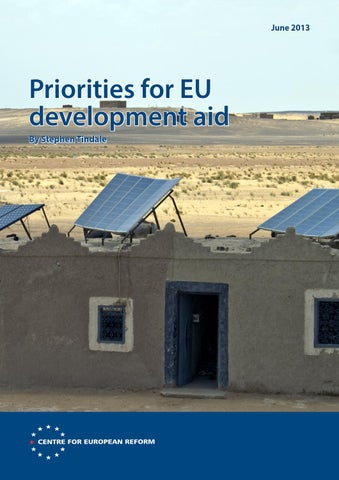
to be spent on adaptation measures, since the need to deal with extreme weather has greater urgency than the need to develop clean energy. However, the Commission should continue to give priority to mitigation programmes. In particular, it should support rural renewable energy projects. Such projects will help protect the global climate. They will also provide real assistance to rural populations in many developing countries. Renewable energy technologies are well suited to provide decentralised energy, so reducing the need for electricity or gas grids. For example, solar photovoltaic panels combined with batteries can provide light for villagers each night. This enables children who have to work during the day to learn in the evening. Access to electricity also enables households to set up small businesses. An anaerobic digester can convert manure and sewage into renewable gas plus fertiliser. The gas can then be used in the village for cooking and heating. Development aid for energy will contribute to better livelihoods, better economic prospects and greater human security. A top priority for Commission aid should therefore be to provide renewable energy for rural populations. This would place the EU at the forefront of UN SecretaryGeneral Ban Ki-moon’s 2011 ‘Sustainable energy for all’ initiative. EU development commissioner Andris Piebalgs is well placed to implement this approach: he was previously energy commissioner. And the EU has successful experience in rural renewable projects. The EU has supported the use of solar panels in Msamala, a rural district of Malawi. This has led to a reduction of a third of firewood burnt (reducing carbon dioxide emissions) by women and children, and increased learning hours for almost 9,000 students. The revenue of 34 companies has also increased because new activities, including bee-keeping and mushroom growing, have 19: Wangari Maathai, ‘The challenge of Africa’, Knopf Doubleday, 2009.
Priorities for EU development aid June 2013
info@cer.org.uk | WWW.CER.ORG.UK
6
become possible.20 Support for rural renewable energy would also play to one of the Commission’s strengths – the ability to work with regional and local governments in developing countries. Other international development organisations, such as the World Bank and the UN, do very little of this – partly for legal reasons (they are only permitted to do so if the central government agree) and partly due to their institutional cultures. A focus on rural energy would enable the EU to continue to assist poor people in middle income countries. The Commission could also focus on villages, building on the experience of the ‘millennium village’ project. This project, launched in 2006, involved 80 villages in ten African countries. It aimed to improve agriculture, nutrition, health, water and sanitation, infrastructure and the environment, at a cost of $120 (€91) per person.
The impact of a village being selected as a millennium village is hard to measure, since no baseline villages without such intervention were selected as benchmarks. (It would be hard to justify selecting such benchmarks, since this would require the villages to be deprived of all meaningful assistance simply for the purpose of assessment.) Nevertheless, the millennium village approach appears to have led to good progress. A 2008 review by the Overseas Development Institute found that crop yields, labour productivity and school enrolment had improved, and the risk of disease reduced.21 Inhabitants of millennium villages are encouraged to participate in development projects, so the approach fits with the EU’s intention to strengthen civil society. The EU should therefore use the millennium village approach, extending the focus of activity to include renewable energy.
Conclusion At a time of economic austerity throughout Europe it is tempting to think that charity should begin at home, and that development assistance is a luxury we cannot afford. There are moral reasons to reject that argument and say that after 45 years it is time that the EU met the target of spending 0.7 per cent of national income on development aid. There are also practical reasons. Even when it does not support foreign policy or strategic ends directly, development aid can be in the interests of the EU, as well as the recipients. Helping countries to progress towards the MDGs results in more educated and prosperous populations, more likely and able to purchase goods and services from the EU, and less likely to contribute to problems like environmental degradation or uncontrolled migration. Whether the EU collectively spends more or less on development assistance in future, it makes sense to spend it efficiently. That means letting the Commission manage more of it. It also means ending the situation in which the EU spends money in one area, for example fisheries, which means that the money it spends in another, namely development assistance, goes partly to waste.
20: European Commission, ‘2012 annual report on the European Union’s development and external assistance policies and their implementation in 2011’, 2012.
The Commission must continue to improve its administration of development aid. It should administer aid to Asia, the Middle East and Latin America in the way it now administers aid to Africa, the Caribbean and Pacific countries. It should implement its Agenda for Change. And it should give greater priority to clean energy in developing countries, including middle income countries. Especially in times of austerity, Europe must emphasize efficiency in the way it uses development aid. The Commission ought therefore to manage more of the total given by Europe. Not all European aid should go through the Commission. Member-state governments have legitimate national objectives. But member-state governments should not continue to manage 80 per cent of European aid. The proportion of aid administered by the Commission could be doubled without impinging on national governments’ ability to pursue their foreign policy objectives.
Stephen Tindale
Associate fellow, Centre for European Reform June 2013
21: Overseas Development Institute, ‘Millenium village project review’, 2008.
Priorities for EU development aid June 2013
info@cer.org.uk | WWW.CER.ORG.UK
7