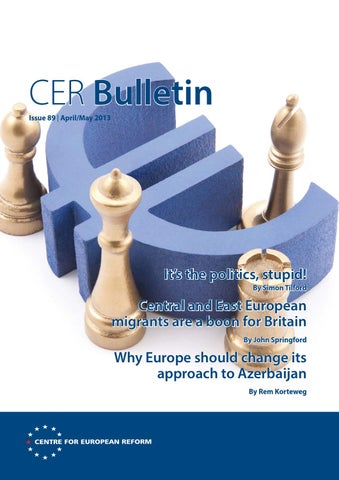
CER Bulletin Issue 89 | April/May 2013
It’s the politics, stupid! stupid! By Simon Tilford
Central and East European migrants are a boon for Britain By John Springford
Why Europe should change its approach to Azerbaijan By Rem Korteweg
It’s the politics, stupid! by Simon Tilford
Many economists have been accused of being too gloomy about the euro because they underestimate the degree of political commitment that eurozone countries have made to the single currency. The ECB’s success in buying time for the politicians has emboldened those who argue that when push comes to shove, policy-makers will do what is necessary to save the euro. The optimists tend to attribute continued scepticism to a poor understanding of the politics or to a refusal to acknowledge the significance of the steps already taken. In fact, those who claim that politics will come to the rescue irrespective of how bad the economics get are guilty of complacency. There is a gulf between the political objectives that member-states were pursuing when they joined the euro and where they find themselves now. This is the principal reason why their commitment to rectifying the flaws of the euro is so weak. For the French, the euro was a way of regaining some control over monetary policy from the Bundesbank and of maintaining economic and political parity with a newly united Germany. There was next to no discussion in France over what a currency union implied in terms of the country’s economic and social policies, and certainly no sense that by joining the euro France was effectively committing itself to a liberal economic agenda. The French pushed strongly for a broad euro including Italy and Spain, not out of any commitment to closer EU integration, but in an attempt to further dilute Germany’s hold on the newly-created European Central Bank (ECB).
France’s plans have backfired spectacularly. Far from helping the country maintain economic and political parity with a united Germany, the euro has increased German economic and political influence. On the face of it, it is not obvious why this would be the case. The French economy has outperformed the German one since the launch of the euro, France (unlike Germany) has very healthy demographics, and the French economy (unlike Germany’s) is able to generate growth in domestic demand. But when countries have no control over the currencies in which they borrow – as is the case in the eurozone – fiscal strength and a country’s trade balance take on disproportionate
INFO@CER.ORG.UK | WWW.CER.ORG.UK CER BULLETIN ISSUE 89 | APRIL/MAY 2013
importance: France is running sizeable budget and trade deficits. Germany is now calling the shots in a way that was never foreseen by the French and has come as a profound shock to them: France is now routinely on the receiving end of lectures from German politicians on how to reform its economy. The country has little option but to pursue policies – pro-cyclical fiscal austerity – that threaten to deepen its economic downturn. At the same time, France does not have the kind of labour market institutions which have enabled Germany to deliver wage restraint. With the appointment of Mario Draghi, the ECB put some distance between itself and Germany, but the ECB remains constrained in what it can do by the need to keep Germany on board. For the Italians, the motivation for joining the euro was largely national prestige – a determination not to get left behind. Whereas the European Exchange Rate Mechanism debacle of 1992 effectively killed off British enthusiasm for the euro, the Italian elite drew different lessons. For them, it was not the fixing of the lira to the deutsche mark that was risky, but the failure to make this link irrevocable. To the extent that the risks were acknowledged, the Italian elite calculated that fixing the lira forever would leave the country with no option but to squeeze out inflation and push through reforms aimed at raising productivity. Things have not turned out as planned. Italy’s economy is now in a full-blown slump. If it contracts in 2013 by as much as the Italian authorities now expect, the economy will be 10 per cent smaller than it was in 2007, and no bigger than it was in 1999. Despite running a primary budget surplus, Italy has no option but to run an extremely tight fiscal policy as investors are wary of lending to a major debtor that does not control the currency in which it borrows. As in other struggling euro countries, the ratio of public debt to GDP is rising very rapidly.
The Germans were more ambivalent about the euro than the French or the Italians: Germany was the only EU country aside from Britain to have a proper debate about the implications of joining the single currency. The German business community was generally positive, seeing in the euro a way of preventing other European countries from recouping competitiveness against Germany by devaluing their currencies. A sceptical German electorate was brought on board with a promise that the euro would be as strong as the deutsche mark and that the ECB would effectively be the Bundesbank writ large. There was little sense that the euro would require closer pooling of sovereignty, let alone mutualisation of risk in the form of a fully-fledged banking union or eurobonds.
“Germany is now calling the shots in a
”
way that was never foreseen by the French. The euro has certainly enabled Germany to lock in competitive advantage. And while there was no sense that Germany signed up to the euro with a view to strengthening its political position in Europe, German policymakers have taken to their new found status with something close to gusto. They routinely tell other eurozone countries how to run their economies, citing Germany as a model for the currency union as a whole. This approach has delivered politically for Chancellor Angela Merkel. For example, Germany’s failure to bolster Mario Monti by opening the way for a degree of debt mutualisation ultimately paved the way for Beppe Grillo, but it played well with German voters. This is unsurprising: they did not sign up to risk mutualisation and are highly hostile to it.
Far from gaining a seat at the top table, Italy is seen as resolutely ‘peripheral’, routinely lumped in with Greece, Portugal and Spain. It can only remain in the euro if it pushes through reforms of its economy and if it can rely on external support in the form of ECB financing and stronger demand for its exports from other eurozone economies. However, intractable political stalemate makes economic reform extremely unlikely, which further reduces the already slim chances of increased external support of one form or another.
When they joined the single currency, the key countries were not committing themselves to a federal Europe or to very liberal economic policies. This is a major reason why their commitment to rectifying the eurozone’s underlying problems remains so half-hearted. Of course, the gulf between eurozone countries’ motivations for joining the euro and the reality of membership does not mean that they will necessarily fail to put the single currency on a sound footing. But the Cyprus situation alone should make people cautious about claiming that the politics will always trump the economics in a currency union comprising countries with very different motivations for joining and divergent political cultures.
For Germany, the euro was largely a quid pro quo for French acceptance of German unification.
Simon Tilford Chief economist, CER
2
Central and East European migrants are a boon for Britain by John Springford
When economies are struggling, governments find it difficult to resist calls for protectionism of one form or another. The British government is trying to erect barriers to immigration. It has promised to cut net immigration to tens of thousands of people per year, from an average of 200,000 since 2004, many of whom came from the new Central and East European members of the EU. In January 2013, ministers announced that they were considering a negative advertising campaign about Britain in an effort to deter migrants from Bulgaria and Romania, whose citizens are free to work in the UK from 2014. And in March, the government said it would try to change EU rules that give European migrants access to welfare benefits, to tackle perceived ‘benefit tourism’. As Britain’s economic stagnation continues, it is hardly surprising that the government is pandering to public hostility towards immigrants. Public opinion has hardened against unemployment benefits, particularly for foreigners. And immigration from Central and Eastern Europe remains high, despite the rise in the UK’s unemployment rate. Nevertheless, the economic case for EU migration is strong. In some respects, it is getting stronger, despite Britain’s poor economic performance. And, perhaps surprisingly, the case rests on Central and East European migrants’ contribution to the public finances. There can be no doubt that immigration from Central and Eastern Europe has raised Britain’s
rate of economic growth. But have some Britons lost their jobs, or received lower wages as a result? Several economic studies have found no evidence that this is happening. Largescale immigration from Central and Eastern Europe – nearly 1 million people since 2004 – has made no difference to the job prospects of UK nationals. According to research by the government’s Migration Advisory Committee, it has also had no effect on Britons’ wages, even since the economic downturn. Why is this the case? Many Central and East European migrants are employed in jobs that British workers either do not want to do, or do not have the skills for. And migrants spend their earnings in Britain, which results in jobs for other
INFO@CER.ORG.UK | WWW.CER.ORG.UK CER BULLETIN ISSUE 89 | APRIL/MAY 2013
people. Thus, immigration has led to economic activity which would not otherwise have taken place, even if the migrants themselves take most of the extra national income. Migrants contribute not by providing more jobs and wages for British people, but by paying more into the public purse than they take out. This is because they are younger, more likely to be in employment, and on average better educated than the British population as a whole. So they receive less welfare, health or pension spending than the average Briton. EU migrants help to pay British people’s benefits, not the other way round. Many Central and Eastern Europeans take jobs for which they are overqualified on arrival. They then move quickly up the earnings ladder as they switch to more productive work, or develop a larger client base, if they are selfemployed. The tax take from Central and East European workers has been growing, despite the recession. Data from the UK Labour Force Survey (LFS) shows that their median weekly wage, before tax, grew by 52 per cent between 2006 and 2012, from £250 to £380. They are now only £5 behind Britons. And as the number of migrants has grown, so have the British treasury’s revenues. On the spending side of the ledger, Central and East European migrants receive fewer benefits than Britons. Fully 83 per cent participate in the labour market, compared to 77 per cent of UK nationals of working age. More are registered as unemployed – in the third quarter of 2012, 8.2 per cent were jobless, against 7.4 per cent of British citizens. But migrants are less likely to receive unemployment-related benefits: according to LFS data, just 1.7 per cent are on Jobseeker’s Allowance, half the rate of takeup among the host population. A far smaller proportion of Central and East European immigrants receive disability, pension, and child benefits than British people. Very few Central and Eastern Europeans live in social housing, and only 5 per cent receive housing benefit (compared to 8.5 per cent of Britons). They may well push up private rents in some areas, but this is best tackled by building more houses (which would also create jobs for the host population). Central and East European migration is a rare source of growing tax revenue for Britain. And migrants can also contribute to the longterm health of Britain’s public finances. As the population ages, more workers will be needed to pay for pensions and healthcare, the costs of which are projected to rise steeply.
The elderly have been largely protected from the Conservative-Liberal Democrat coalition’s spending cuts: health, pensions and old-age benefits have been increased or frozen. As Britain’s baby boomers retire over the next ten years, this spending must either be cut, or new sources of revenue found to pay for it. A larger and more skilled working age population would help; but the government needs to spend more on the education of children of Central and Eastern Europeans in the short term.
“’Benefit tourism’ is a red herring: Central and East European migrants’ growing wages are paying for British citizens’ benefits. ” Unfortunately, the government is cutting the education budget: by 2015, it will be 14 per cent smaller in real terms than it was in 2010. Capital spending is taking the brunt of the education cuts, as the coalition abandoned the previous government’s school building programme. This is coinciding with a rise in the birth rate, to which Central and East European immigrants are contributing by having more children than the native-born population. Many who arrived shortly after EU accession have settled and started families: around half a million more children need to be educated as a consequence of European immigration. More and larger schools are required, as well as more teachers, or the quality of British education will fall in areas that are seeing the fastest population growth. Investment in school buildings and teachers would require more spending in the short term. But the government’s cost of borrowing is at a record low. And in the long term, that investment will pay for itself: more educated children become more skilled workers, who contribute more in taxes and require less welfare spending. Britain’s political debate about EU migration is heated, populist, and lacking in evidence. Central and East European immigrants have no effect on Britons’ employment prospects; they are hard-working and increasingly productive; they contribute more to the public purse than they receive; and they and their children will help to ease the fiscal cost of an ageing population. Perhaps the UK government could run adverts inviting more Central and Eastern Europeans to come, rather than trying to put them off?
John Springford Research fellow, CER
4
Why Europe should change its approach to Azerbaijan by Rem Korteweg
The EU has relied on oil and gas from Azerbaijan to reduce its dependence on Russian energy supplies since the beginning of the 21st century. Because of Baku’s strategic importance, the EU has not assertively promoted good governance in Azerbaijan through its European Neighbourhood Policy. However, developments in gas exploration and production are changing the EU’s relationship with the Azerbaijanis. This could pave the way for a more coherent EU policy that balances energy security with a greater emphasis on democratic reform. Nestled between Iran and Russia, energyabundant Azerbaijan is prime geostrategic real estate. Since it gained independence from the Soviet Union in 1991, it has been concerned that its neighbours will interfere in its domestic affairs. In the early 1990s, Azerbaijan fought a war with Armenia, in which Russia sided with the Armenians. During the war, Baku lost control of Nagorno-Karabakh, a contested area that covers one-eighth of its territory. The conflict is still unresolved and the area occupied. In this rough neighbourhood, Azerbaijan needs allies. Energy is central to these friendships. Georgia and especially Turkey are regional partners. But by tying the country with pipelines to Europe’s energy market and attracting US and European investment, Baku has also been developing allies in the West to safeguard its independence. With its oil production having peaked in 2010, Azerbaijan wants to deepen its energy relationship with Europe by developing an
off-shore natural gas field called Shah Deniz II. In 2013, the state oil company of Azerbaijan (SOCAR), along with its partners including BP, will decide which pipeline will deliver Shah Deniz-gas to Europe, Nabucco-West or the Trans-Adriatic pipeline (TAP). The decision will complete the so-called Southern Gas Corridor which has been a key element in the EU’s energy diversification strategy and could deliver roughly 10 per cent of Europe’s gas imports by 2020. The government in Baku is also promoting a European secular image. Last year Azerbaijan signed a major deal with Microsoft, in a drive to become a regional IT hub in an otherwise internet-unfriendly region. Geopolitically, the country supports America’s ‘new silk road’ vision for Central Asia, and Baku has troops in Afghanistan supporting NATO. But in spite of the flourishing energy relationship and converging geopolitical interests, there
INFO@CER.ORG.UK | WWW.CER.ORG.UK CER BULLETIN ISSUE 89 | APRIL/MAY 2013
is disappointment on both sides. In Baku, academics and politicians call the EU’s policy hypocritical and insincere. They complain about the limited European support for resolving the Nagorno-Karabakh conflict. The issue, in truth, has not figured high on the European agenda. The so-called Minsk group, co-chaired by France, the US and Russia, is the focal point for peace talks. A resolution of the crisis would require Moscow’s support, but this is unlikely in the near term. After all, Russia perceives its interests as being best served by maintaining some degree of instability in its renegade ‘near abroad’. Baku also feels that EU countries have accepted the southern Caucasus as part of Russia’s sphere of influence. While it is impossible to verify, Azerbaijani politicians even suggest that Moscow could be funding NGOs to highlight human rights violations in Azerbaijan, driving a wedge between the West and Baku. One Azerbaijani politician described it as follows: “Europe is figure-skating, while Russia is playing ice-hockey.” However, the EU is understandably concerned about the slow pace of democratic reform in the country. Brussels points to serious human rights and governance problems: Azerbaijan lacks an independent judiciary, electoral reforms are needed, corruption is widespread and fundamental rights such as the freedom of the media, assembly and association are restricted. Brussels’ annual development budget for Azerbaijan is very small – less than €50 million euros. Baku earns this much every day selling its fossil fuels. But the EU now has an opportunity to be more assertive. America’s shale gas
boom means more gas is available globally and liquefied natural gas will give Europe alternatives with which to satisfy its energy needs. In a decade’s time, Europe may have developed its own shale gas and new gas could also flow from the eastern Mediterranean. These new resources, together with depressed energy demand, will make gas supplies from Azerbaijan less important to the EU. The EU has an interest in keeping Azerbaijan in the Western orbit. In return for political reforms by Baku, the EU and its member-states, particularly France, should make a credible effort to resolve the Nagorno-Karabakh conflict. They should cajole Russia (itself weakened by the global gas glut) and build international pressure to get a solution from Armenia and Azerbaijan. Baku’s options are limited. Azerbaijan needs Western support – diplomatically, to remain afloat in the region’s turbulent political waters, and economically, to develop its non-hydrocarbon economy and in the meantime to buy its oil and gas. Ultimately gas could flow east instead of west, to the booming markets in East Asia. But for this to happen, the trans-Caspian pipeline would have to be built to connect Azerbaijan with the Central Asia-China pipeline. Neither the economics nor the politics are there yet. Azerbaijan’s example suggests that the changing energy landscape could herald the prospect of a more coherent European foreign policy.
Rem Korteweg Senior research fellow, CER
CER in the press Les Echos 4th March 2013 Philip Whyte of the CER criticises eurosceptics in his country who claim (according to an increasingly popular expression) that Britain “has shackled itself to a European corpse” and who argue that the economy is crippled by the regulatory burdens that the Brussels bureaucracy is constantly inventing. The Guardian 1st March 2013 “Voters now associate structural reforms with slump, rising unemployment and social stress,” said Charles Grant and Simon Tilford of the CER
in a paper published on Friday. “The Berlin-Brussels-Frankfurt consensus on austerity that Monti’s government [pursued] has discredited the very reforms that are needed to boost the Italian economy.”
“Supply side reforms are no panacea,” said Simon Tilford of the CER. “As austerity continues into 2013, more surprises about the weakness of economic activity in Europe are inevitable”, he said.
The New York Times 25th February 2013 “No doubt Italy has an imperfect political culture, but this election I think is the logical consequence of pursuing policies that have dramatically worsened the economic and social picture in Italy,” said Simon Tilford of the CER.
Global Finance 12th February 2013 Katinka Barysch of the CER in London, says the debate [about a British EU referendum] is already having a negative economic impact: Investors are getting nervous. “Rather than chasing UKIP votes, the Conservative party would be better advised to explain to the British people how they benefit from being part of Europe.”
Financial Times 15th February 2013
The New York Times 8th February 2013 “The budget negotiations are the most visible sign of member-states winning and losing from the European Union,” said Hugo Brady of the CER. “The result is a totally parochial budget that is poorly adapted to rapidly changing times.” Christian Science Monitor 29th January 2013 “In many European countries, there are more restrictions on the duties women can perform in the armed forces than in the US. As a result, women play less of a prominent role,” says Clara O’Donnell, of the CER.
6
INFO@CER.ORG.UK | WWW.CER.ORG.UK CER BULLETIN ISSUE 89 | APRIL/MAY 2013
Recent events 5 March CER breakfast on ‘The fight against serious and organised crime: What should Europe’s priorities be?’, London With Rob Wainwright, director of Europol
Rob Wainwright
19 February CER/Kreab Gavin Anderson breakfast on ‘Competition policy at a time of economic crisis’, Brussels With Joaquín Almunia, European commissioner for competition
Joaquín Almunia
13 February Roundtable on ‘The future of eurozone governance, and what it means for non-euro countries’, London With Pierre Moscovici, French minister for economy and finance
Moscovici roundtable
Pierre Moscovici
Future publications Do Britain’s European ties damage its prosperity? Philip Whyte
Why the troika has not fixed the euro Douglas Rediker and David Gordon
The working time directive: What’s the fuss about? Katinka Barysch
Priorities for EU development aid Stephen Tindale
To read all of our recent publications please visit our website.
For further information please visit
www.cer.org.uk